Home Blog Page 35

As Modi govt extends humanitarian support to Nepal, read how India has helped 7 other disaster-torn countries in the past several years

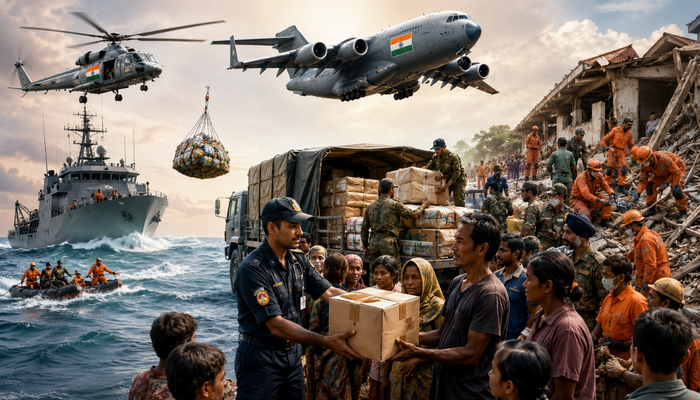
As the neighbouring Nepal is grappling with ravaging flash floods, India rose to the occasion and extended swift humanitarian assistance to the Himalayan country. India sent 62 tonnes of emergency aid to Nepal. India was the first country to provide physical assistance to the country in the middle of the deadly disaster.

As the death toll from the catastrophic flash floods rose above 600 and the number of missing people crossed 2000, India is actively taking part in the intensified rescue and relief operations, along with local authorities in Nepal. The Indian government is also sending consignments of relief material to Nepal.

On Saturday (29th August), India sent a fourth tranche of relief material to the country along with an 11-member team of doctors, paramedics and tunnel rescue specialists. According to the Indian Ministry of Foreign Affairs, the Indian government has also offered a tunnel rescue team, a medical team and personnel from its National Disaster Response Force to the disaster-hit country.

India has been among the first responders whenever its neighbours faced any natural disaster or any other calamity. It has stood by its Himalayan neighbour, which often faces natural disasters, through thick and thin. The Indian government extended similar support to Nepal following the devastating 2015 earthquake. The Indian government and the Indian armed forces launched a massive rescue and relief operation under Operation Maitri.

During the operation, the Indian Air Force and the Army flew 2223 sorties, rescued/evacuated about 11,200 people (including 780 casualties) to safer places and transported and dropped about 1700 tonnes of relief materials. Besides, the Rapid Action Medical Teams of the Indian armed forces extended medical assistance to 4762 injured.

Let’s take a look at how India has emerged as the ‘first responder’ and a true friend in need during times of crisis for not just its neighbours but also for countries located afar.

Operation Amistad after twin earthquakes in Venezuela

About two months ago, in June 2026, the South American country of Venezuela was jolted by twin apocalyptic earthquakes. The calamity caused horrifying visuals of high-rise buildings turning into rubble, huge loss of life and devastation. The Modi government presented an example of friendship and support in times of crisis by sending urgent humanitarian assistance to Venezuela under Operation Amistad (the word Amistad means friendship in Spanish).

Under the operation, which was part of India’s HADR mission, the Indian government dispatched two Indian Air Force C-17 Globemaster aircraft carrying humanitarian relief supplies and a 41-member rescue team to assist the ongoing relief and rescue efforts in the Bolivarian Republic of Venezuela. The relief consignment included a self-reliant Indian medical task force, an Indian Army Field Hospital unit with HADR pallets and medicines, 30 tonnes of relief supplies, 6 tonnes of medicines and medical equipment and two BHISHM cube portable hospitals. 

The Indian government expressed solidarity with the people of Venezuela and assured the government of Venezuela of all possible assistance in the time of crisis.

Operation Sagar Bandhu after Cyclone Ditwah hit Sri Lanka

In November 2025, a deadly cyclone hit the coasts of Sri Lanka, causing massive floods, loss of life and destruction. The Indian government launched Operation Sagar Bandhu to provide urgent emergency assistance to the country. Two Indian Navy ships immediately transported food supplies and relief material, tents, tarpaulins, blankets, hygiene kits, ready-to-eat food items, medicines and surgical equipment to Colombo.

India deployed troops from the National Disaster Response Force (NDRF) and the Air Force to provide search, rescue, and relief assistance. A 5-member medical team for on-site training and an 80-member special Urban Search and Rescue (USAR) team of the NDRF were sent to assist in rescue efforts. Chetak helicopters from INS Vikrant and MI-17 helicopters of the Indian Air Force joined the Sri Lankan Air Force in conducting search and rescue operations.

India’s unwavering support and humanitarian efforts in the middle of a crisis touched the people of Sri Lanka, who expressed their gratitude to the Indian troops deployed in the rescue work.

Operation Brahma for earthquake-hit Myanmar

In March 2025, when Myanmar was hit by a ravaging earthquake, India stepped up as a good neighbour and helped it in the rescue and relief work. The 7.7 magnitude earthquake wreaked havoc, killing over 5000 people and injuring over 11,000. The Modi government launched Operation Brahma to extend support to the disaster-torn neighbour.

The Indian government sent IAF aircraft carrying the National Disaster Response Force (NDRF) personnel and tonnes of relief material to the country. In addition to that, India deployed two of its Naval ships for rescue work. Another aircraft carried 118 personnel from the Indian Army’s Field Hospital Unit, including Women and Child Services and relief material to Myanmar.

India also provided disaster relief support to Myanmar after it was hit by Cyclone Komen in July-August 2015, causing floods and landslides. The cyclone affected 250,000 people and destroyed over 500,000 acres of farmland. The government provided emergency relief assistance to the country and transported relief materials to the country.

Operation Dost following earthquakes in Turkey and Syria

India extended humanitarian support after devastating earthquakes hit Turkey and Syria in March 2023. India launched Operation Dost to help in the rescue and relief operations in the two countries. Within hours of receiving requests for assistance from Turkey, the Indian government dispatched relief material along with three teams of the National Disaster Response Force (NDRF) to help the disaster-hit country. The Indian Army set up an on-field hospital to offer medical assistance to the injured. Similar assistance was provided by India to Syria, where the Indian government sent Indian Air Force aircraft carrying emergency relief assistance.

India aid after volcanic eruption in Papua New Guinea

In November 2023, Papua New Guinea, an island country in Oceania, was hit by a major eruption at Mount Ulawun. The volcanic eruption forced the government of Papua New Guinea to evacuate around 26,000 people from the affected area. India was quick to extend humanitarian aid to the country, which is its development partner under the Forum for India-Pacific Islands Cooperation (FIPIC).

The Indian government announced $1 million in immediate relief assistance for the country. India sent 11 tonnes of disaster relief material, including tents, sleeping mats, hygiene kits, meals ready to eat, and water storage tanks and 6 tonnes of medical aid material. Prime Minister of Papua New Guinea James Marape thanked the Modi government for sending humanitarian aid during the humanitarian crisis caused by the volcanic eruption.

This was not the first time that India extended support to the country. It also provided humanitarian assistance to Papua New Guinea following the 2018 earthquake and the 2019 volcanic eruption. Due to the Indian government’s unconditional support to the country in times of crisis, the relations between the two countries grew stronger and warmer. This was reflected when PM Marape welcomed PM Modi and touched his feet out of respect at the airport during the latter’s visit to the country in May 2023.

Operation Samudra Maitri for earthquake and Tsunami-hit Indonesia

In October 2018, a catastrophic earthquake and subsequent Tsunami hit the island country of Indonesia. The 7.5 magnitude earthquake combined with the tsunami caused widespread destruction in the country, leaving over 4000 people dead. The Modi government launched Operation Samudra Maitri to help its neighbour in tough times.

Under the operation, the Indian government sent two Indian Air Force aircraft, C-130J and C-17, carrying relief material, including medicines, tents, and generators, along with medical personnel and equipment to set up a field hospital. India also deployed three Indian Navy ships, INS Tir, INS Sujatha and INS Shardul, which carried additional humanitarian supplies.

Over the years, India has time and again proved that it is a reliable neighbour and a generous friend to countries in times of natural disasters. India’s response to disasters at the domestic as well as international level has demonstrated the effectiveness of its Humanitarian Assistance and Disaster Relief (HADR) framework.
Did Nepal refuse foreign rescue help? What Kathmandu’s decision means as it accepts relief aid

As rescuers race against time after devastating flash floods in Nepal, a question has emerged over whether Kathmandu actually refused offers of foreign search-and-rescue assistance, including from India, despite hundreds of people still missing.

The answer is more nuanced than a simple “yes” or “no”.

Nepal’s Foreign Ministry said on Friday that it does not currently require foreign search-and-rescue teams, insisting that its own security agencies are capable of handling the operation. At the same time, India says it has specifically offered to deploy teams from the National Disaster Response Force (NDRF), along with specialised equipment, and is still awaiting Nepal’s response.

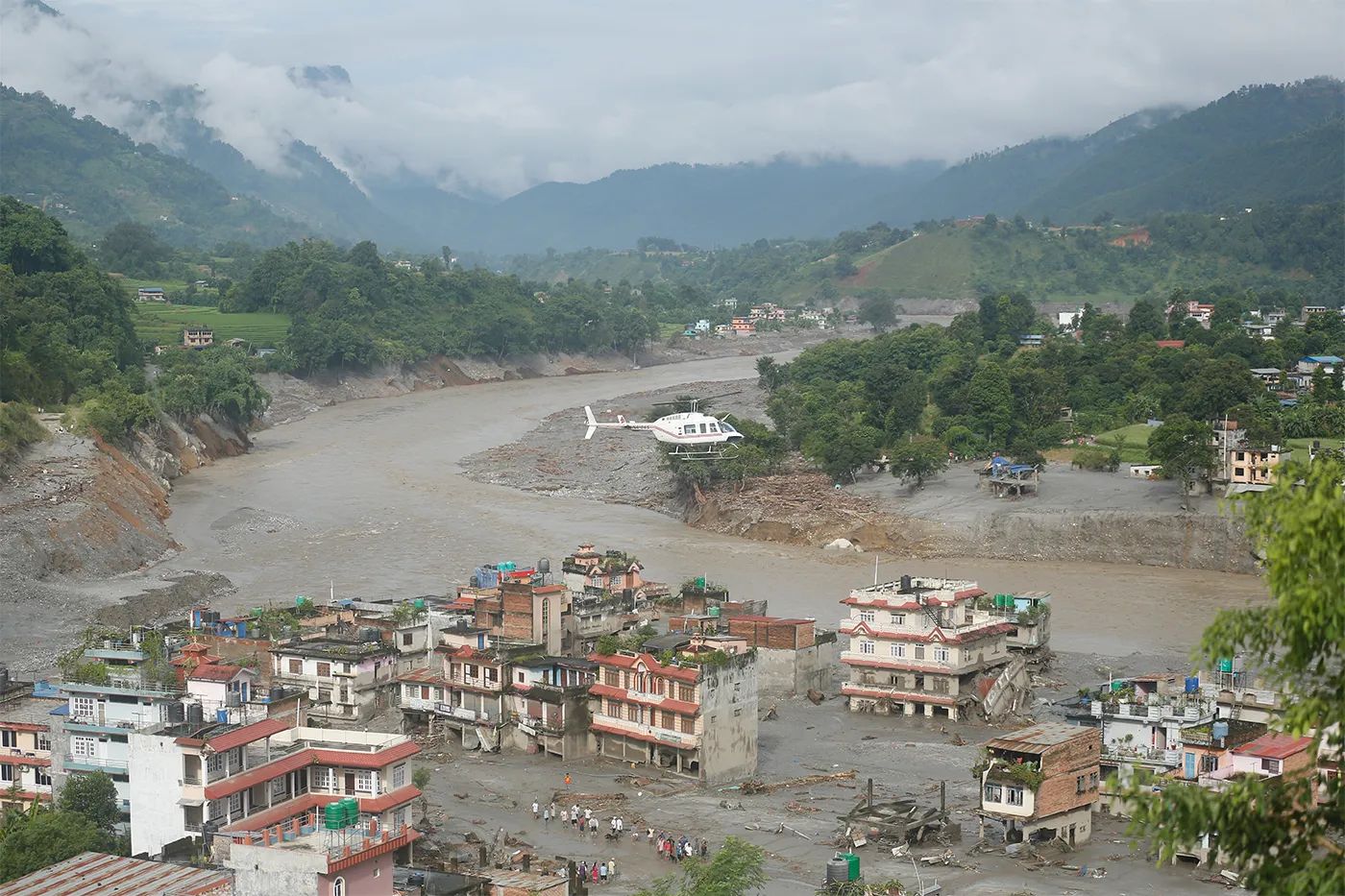
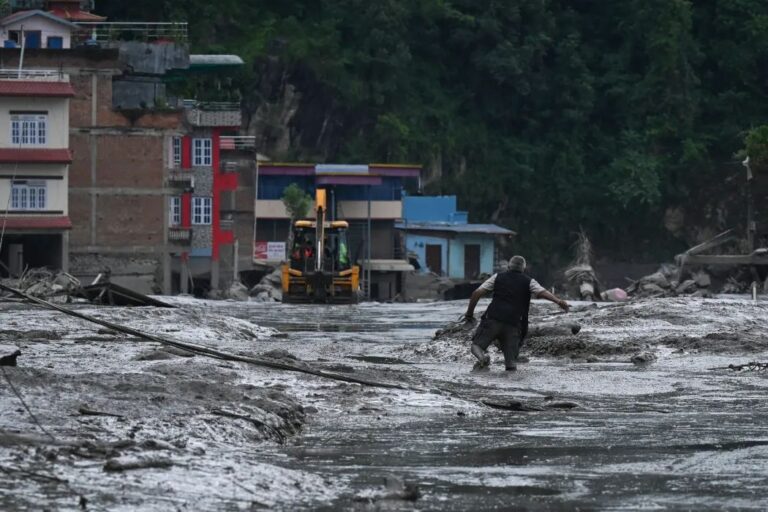
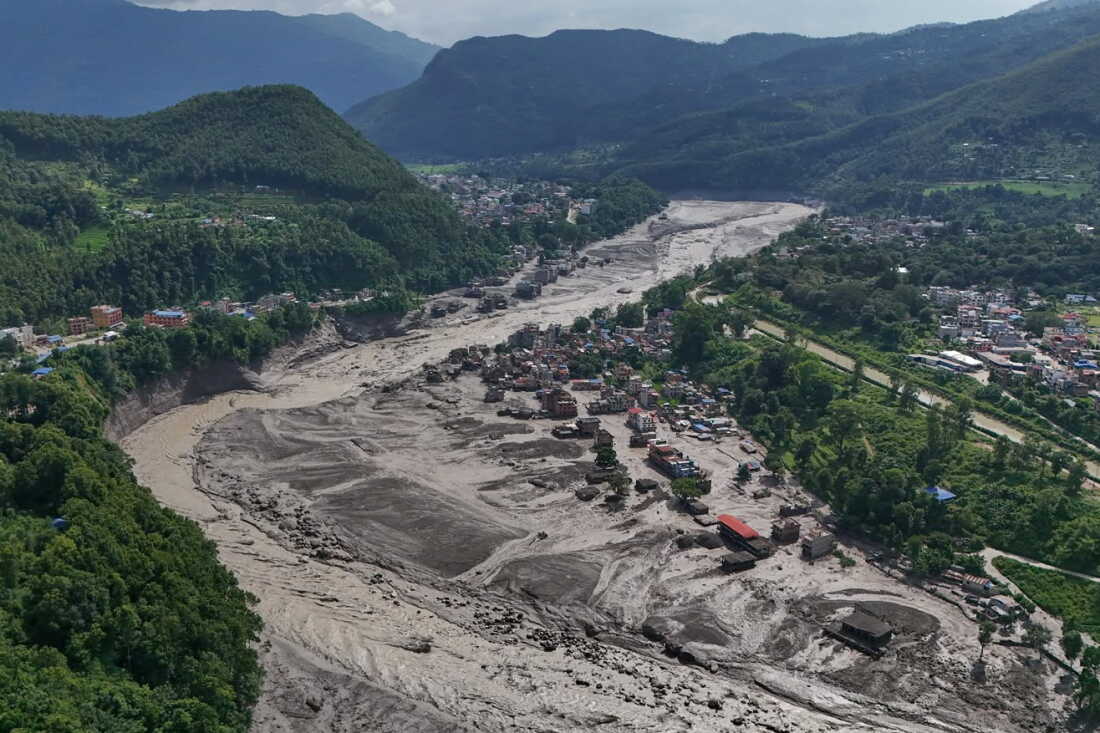
The scale of the disaster helps explain why the question has attracted attention. At least 552 people have been killed on both sides of the Nepal-Tibet border, while more than 1,400 people have been reported missing, including hundreds of foreign nationals. Entire settlements have been swept away, roads and bridges destroyed, and hydropower infrastructure badly damaged.

Nepal floods
Damaged houses stand precariously near the swollen, debris-choked banks of the Trishuli River after flash floods in Nepal’s Nuwakot district on Wednesday, Aug. 26, 2026. (AP Photo/Niranjan Shrestha)

This apparent contradiction has fuelled questions over what exactly Nepal has accepted, what it has declined and whether the situation could change as rescue operations enter a critical phase.

What did Nepal actually say?

Nepal Foreign Ministry spokesperson Lok Bahadur Chhetri said offers of assistance from other countries were “natural”, but maintained that Nepal’s security agencies were conducting the search-and-rescue operation.

“For now we don’t require such help,” Chhetri said, according to reports.

The statement came after The Kathmandu Post reported that Nepal had declined requests from several countries to send specialised rescue teams.

Those countries reportedly included India, China, the United States, Britain, Japan, South Korea, Sri Lanka and Bangladesh.

South Korea separately said Nepal had indicated that it was not yet planning to accept foreign rescue teams. Seoul has nevertheless pledged $1 million in humanitarian assistance through international organisations.

So, strictly speaking, Nepal has not said it is rejecting all foreign assistance. Its position appears to be that it does not presently require foreign search-and-rescue teams because its own forces are handling that part of the response.

Then what about India’s NDRF offer?

This is where the distinction becomes important.

India’s Ministry of External Affairs said on Friday that it had made a specific offer to send NDRF personnel and associated equipment to Nepal to assist with ongoing search-and-rescue operations.

“We await a response from Nepal,” MEA spokesperson Randhir Jaiswal said.

External Affairs Minister S Jaishankar also said India remained in close contact with the Nepal government and had offered a range of assistance, which Nepal was evaluating.

The MEA said India was also preparing additional humanitarian assistance at Nepal’s request, including medical support, engineering teams and equipment aimed at helping restore damaged infrastructure. Jaiswal said two aircraft carrying relief material had already been sent, with a third expected to carry more humanitarian assistance.

India has already decided to send a tunnel-rescue team and a medical team, particularly because of concerns over people potentially trapped at the Trishuli 3A hydropower project.

Around 100 people are reportedly stranded at the project site, with the possibility that some could be trapped inside tunnels.

The tunnel operation illustrates why specialised capabilities may become important even if Nepal does not want large foreign rescue contingents operating across the country. India said a recce team would first assess the site and determine what equipment would be needed before the specialised tunnel-rescue team is deployed.

This makes the situation more complicated than the claim that “Nepal refused India’s help”. India has offered a specific capability; Nepal says it does not currently need foreign search-and-rescue teams, while New Delhi says it is still waiting for Kathmandu’s response.

Nepal has already accepted some Indian assistance

Another important detail is that Nepal has not shut the door on Indian assistance altogether.

According to the MEA, portable Bailey bridges have already been sent to Nepal following a request from the Nepali authorities.

These prefabricated bridges can be rapidly assembled and are particularly useful in disaster zones where existing bridges have been washed away.

Jaiswal also said India had offered associated technical teams with the Bailey bridges so that connectivity could be restored quickly in affected areas.

The flash floods devastated parts of Rasuwa and neighbouring districts close to the Tibet border, severely disrupting transportation and communications.

Villages have been swept away in Nepal-Tibet flash floods (Image Source: Northeast)

Therefore, the available information suggests a more selective approach from Kathmandu: assistance that Nepal specifically requests is being provided, while the deployment of foreign search-and-rescue teams remains a separate question.

Why would Nepal hesitate to bring in foreign rescuers?

One explanation is Nepal’s experience after the devastating 2015 earthquake.

The disaster triggered an enormous international response, with rescue and relief teams arriving from around the world. While the assistance was crucial, managing large numbers of foreign teams also created logistical and coordination challenges.

Nepal may therefore be reluctant to bring multiple international rescue teams into an already chaotic disaster zone unless there is a clearly identified operational requirement.

But another possibility has also been raised.

The worst-hit areas include Rasuwa district, close to the border with China’s Tibet region. Dinesh Bhattarai, a former Nepali ambassador to the United Nations in Geneva, suggested that the geographical sensitivity of the area could have influenced Kathmandu’s decision.

“They may have thought about the locational sensitivity of the region and decided not to accept foreign teams,” Bhattarai told Reuters.

Nepal’s Foreign Ministry, however, rejected that interpretation.

Chhetri said the decision had nothing to do with China’s sensitivities, maintaining that Nepal’s own rescue agencies were capable of managing the operation.

The bigger question: Is Nepal’s own capacity enough?

This is ultimately the issue that matters more than the diplomatic back-and-forth.

The floods have caused extensive destruction, with the death toll approaching 500-600 according to varying reports, while hundreds of people remain missing or unaccounted for.

Rescue efforts are being hampered by destroyed roads, damaged infrastructure, disrupted communications and the continuing risk of flooding.

A lake created by accumulated debris near the Nepal-China border even began overflowing on Friday, temporarily forcing rescue operations to stop before they resumed.

At the same time, hundreds of foreign nationals have been caught up in the disaster.

India said around 320 Indian nationals and 100 people of Indian origin remained uncontactable. Around 400 Indians on the Tibetan side have since been contacted and confirmed safe, while another 96 Indians stranded near the border have crossed into Nepal.

India has also brought rescued citizens home. Twenty-one Indians rescued from Nepal reached New Delhi on Friday, with Jaishankar saying around 85 Indians had been rescued from different locations so far.

Importantly, Jaishankar said the rescued Indians were particularly grateful to the Nepal Army, which had helped evacuate them from a difficult location.

So, did Nepal “refuse” foreign rescue help?

Partly, but the wording needs qualification.

Nepal has publicly said that it does not currently require foreign search-and-rescue teams and that its own security agencies are conducting those operations. Reports indicate that several countries offered to deploy specialised teams.

However, Nepal’s own spokesperson later clarified that this should not be interpreted as a blanket rejection of international assistance. Chhetri said Nepal may request specialised expertise if it becomes necessary: “It is not that we will not need help, but our security network is capable and working effectively right now.”

India, however, says its NDRF offer is still awaiting a response. New Delhi is also preparing specialised tunnel-rescue and medical teams, while Nepal has already requested and received other forms of Indian assistance, including Bailey bridges.

The picture, therefore, is not of Nepal refusing all international help.

It is more accurately described as Kathmandu choosing to retain control of the search-and-rescue operation while selectively accepting assistance that it considers necessary.

That distinction is crucial. Nepal appears to be saying: its own security agencies will lead the rescue operation for now, but Kathmandu remains open to requesting specific expertise, equipment and humanitarian support when it considers them necessary. India’s position is similarly clear: it is ready to provide NDRF teams and equipment, but has not said that those teams have already been accepted for deployment.

Whether that remains the right decision could become clearer in the coming days. In a disaster where people may be trapped in tunnels, roads have been destroyed, and communications remain patchy, the central question is no longer simply who offered help.

It is whether the available rescue capacity can reach everyone who can still be saved, and how quickly.

UK police seize over £250,000 in ‘terrorist cash’ from Majid Freeman: Read how he instigated anti-Hindu violence in Leicester in 2022

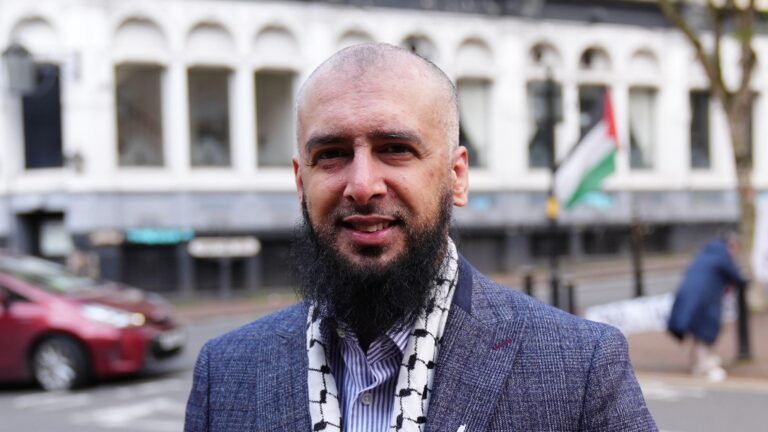
Leicestershire Police have seized assets worth more than £250,000 from Leicester-based Muslim ‘activist’ Majid Novsarka, better known as Majid Freeman, who is facing terrorism charges over supportive statements about Hamas and social media posts relating to terrorism.

Court documents lodged at Nottingham Magistrates’ Court reveal that the force has made six separate applications under the Anti-Terrorism, Crime and Security Act 2001. The applications include a request to forfeit £239,008 in cash seized from Novsarka on March 19, 2024, which police have described as “terrorist cash”.

The documents also show that police are seeking to continue detaining cryptocurrency-related assets held through KuCoin, Nest, Revolut and CB Payments. The wallets are valued at $36,069, or approximately £26,000. A further, undisclosed sum held in an account frozen in July 2024 is also the subject of a forfeiture application.

The six applications are due to be considered at Birmingham Magistrates’ Court on November 10, 2026. Novsarka, 38, denies the two terrorism charges against him and is due to stand trial at Birmingham Crown Court in September 2027. The offences concern his social media activity.

According to the prosecution case, Novsarka is accused of expressing views supportive of Hamas, which is proscribed as a terrorist organisation in the UK. He is also accused of using a social media post relating to the 2015 Charlie Hebdo attacks in Paris to encourage his followers to carry out, plan or incite similar acts of terrorism.

Novsarka has denied the allegations. His representatives at CAGE have also challenged the suggestion that the seized money was connected to terrorism, arguing that there has been no determination about what the cash was intended for and pointing out that his charitable activities involved handling and transferring money.

The seizure proceedings are separate from the criminal prosecution, and the court has yet to determine whether the money or crypto assets are connected to terrorist activity.

Majid Freeman, the fanatic who was at the forefront of instigating violence against Hindus in Leicester

Majid Freeman is a local  Leicester Muslim “activist” who is known to harbour problematic and extremist Islamic views. Throughout the Leicester violence, Majid was at the forefront of spreading fake news that instigated violence against Hindus. 

It was on 28 August 2022 that a scuffle broke out after India defeated Pakistan in a T20 match after the Indian flag was desecrated. After the scuffle, Hindus had even calmed the situation down and tended to the individual who had snatched and desecrated the Indian flag. Majid Freeman, however, had a different story to tell. 

On the 30th of August, after the  Leicester police got influenced by the Muslim organisations and lied about “death to Muslims” being chanted by Hindus (they later clarified their investigation found no such chants were heard), Majid took to Twitter to rabble-rouse against Hindus.

On the 30th itself, he lied about Quran being desecrated in  Leicester, insinuating that the Hindus had committed this act. However, OpIndia tried to verify these claims. 

There was another incident that was cited by Majid Freeman to claim that Hindus had been attacking Muslims. He claimed that a mob of 30+ Hindus had chased and assaulted a Muslim teenager. When confirmed, it turned out that while the Muslim organisations had claimed this, no video evidence was submitted to the police and no investigation was underway, OpIndia was told by Insight UK.

On the 4th of September, when the violence against Hindus started with mobs hunting them down in their houses and on the streets, Majid Freeman took to Twitter to dog-whistle against Hindus again.

Freeman did not merely report on the unrest. He repeatedly amplified inflammatory allegations against Hindus at a time when tensions were already running high, helping push unverified claims to a large online audience.

From the 4th to the 7th of September, Muslim mobs went on a rampage against Hindus. On the 4th of September, when Majid tweeted and dog-whistled, the Muslim mob went on a rampage unprovoked while the Hindus were celebrating Ganesh Chaturthi. Eggs were thrown when Hindu symbols were spotted and where Ganesh puja was being held. A Hindu man was dragged out of his home and stabbed. When his aunt ran out of the house to defend him, she was injured because the Muslim mob punched and beat her.

On the 12th of September, a dangerous lie started. It was alleged that Hindu men had attempted to abduct a Muslim girl while she was going to school. 

After the story went viral, aided by Majid Freeman, the Hindu man started getting threats from Islamists since they had outed his car number, his location and his picture.

On the 14th of September, the  Leicester police confirmed that the news was fake. 

In fact, another lie that was circulated by Majid Freeman and his Islamist cohorts was that a Mosque was attacked by Hindus during their peaceful protest. The Leicester police confirmed that no such mosque was attacked; however, they did confirm that a Hindu temple had been vandalised.

A BBC investigation into the Leicester disorder previously examined the role of social media in spreading unverified allegations. It specifically documented how Freeman shared a claim that a 15-year-old Muslim girl had nearly been kidnapped by Indian boys. Freeman later acknowledged that the allegation turned out to be wrong.

The episode showed how Freeman used his social-media reach to amplify an unverified communal allegation, contributing to an atmosphere in which Hindus were increasingly portrayed as perpetrators of attacks that had not occurred.

Freeman’s conviction during 2022 Leicester violence

Freeman’s conduct during the unrest eventually resulted in a separate criminal prosecution. In June 2024, he was convicted of a Section 4 public-order offence relating to the September 2022 disorder. He was sentenced by Northampton Magistrates’ Court on September 9, 2024, to 22 weeks in prison.

The court found that his conduct involved an intention to provoke “immediate unlawful violence”. OpIndia reported that the judge concluded Freeman had used abusive words with the intention of provoking violence.

The conviction was for a public-order offence, but it further cemented Freeman’s record of using inflammatory rhetoric during the Leicester unrest.

Earlier scrutiny over extremist associations and terror links

Freeman’s online activities and associations had attracted scrutiny well before the Leicester riots. OpIndia investigation revealed Freeman often expressed sympathy for Islamist extremist figures and causes.

Freeman had even encouraged European Muslims to undertake jihad in Syria and had published material praising or paying tribute to Al-Qaeda cleric Anwar al-Awlaki. OpIndia also examined his involvement with organisations involved in humanitarian activity in Syria and alleged connections to networks associated with Islamist extremism.

A separate report by the Henry Jackson Society similarly recorded allegations that Freeman had encouraged Muslims to “do jihad in Syria” and had promoted tributes to al-Awlaki.

He is also linked to humanitarian organisations operating in Syria, including Aid4Syria and organisations associated with the Turkish charity IHH.

On social media, Freeman has often expressed sympathy towards ISIS and Al-Qaeda-linked figures.

From Leicester riots conviction to terrorism prosecution

In the latest case, he is accused of encouraging terrorism and expressing support for Hamas through social-media posts. Those charges remain contested and will be tested at trial in 2027.

The latest seizure proceedings add another dimension to the case. Leicestershire Police are seeking the forfeiture of more than £239,000 in cash described in court documents as “terrorist cash”, alongside cryptocurrency assets worth approximately £26,000 and another frozen sum.

The November hearing is expected to examine the police applications concerning the substantial sums seized from Freeman, while his terrorism case remains pending before Birmingham Crown Court.

Did Subhash Chandra get away with paying Rs 6.5 crore against Rs 22,006 crore debt? Here’s the truth

A recent National Company Law Tribunal (NCLT) order passed in insolvency proceedings against Zee Group founder Subhash Chandra triggered a debate regarding the fairness of the tribunal’s decision. The order passed on 25th August directed Subhash Chandra to pay an amount of ₹6.5 crore to creditors in the case concerning claims worth ₹22,006.57 crore.

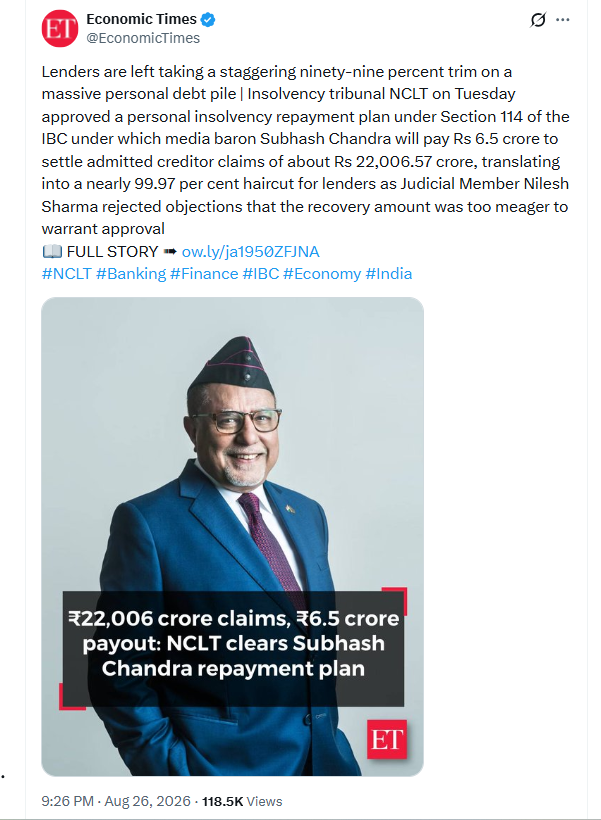
Soon, several reports emerged suggesting that the tribunal passed an unfair order by allowing a reduction in Chandra’s liability, with a huge cut of 99.97% in the creditors’ claims.

Screenshot via X

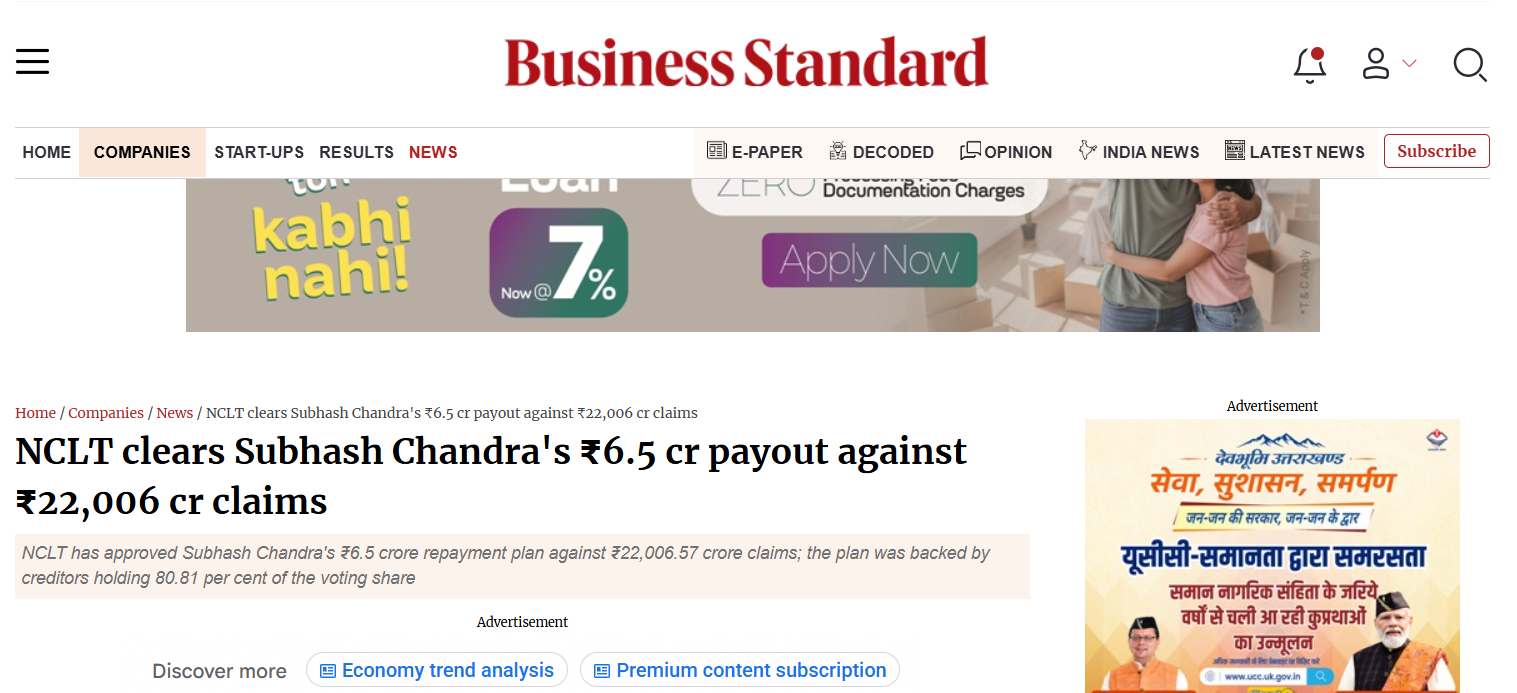
Reports published headlines to insinuate that Chandra was being let off by making him pay a minuscule amount against the massive debt pile of over ₹22,000.

Screenshot via Business Standard

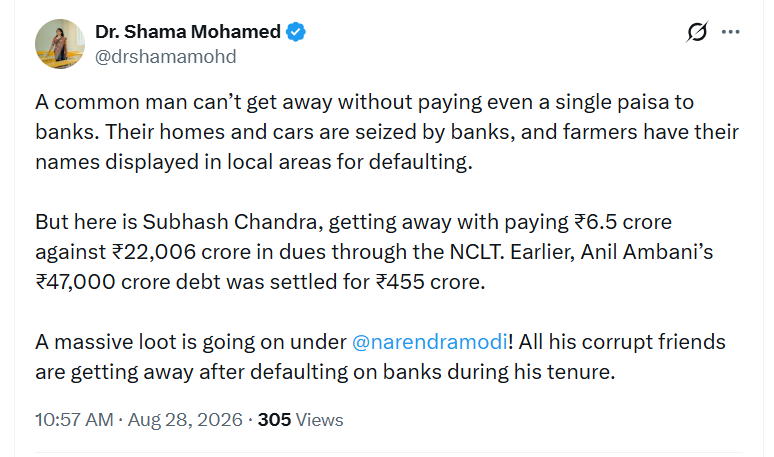
Grabbing the opportunity, the Congress ecosystem also jumped to attack the Modi government based on misleading headlines. Commenting on the NCLT order, Congress member Dr Shama Mohamed termed it a “massive loot” going on under the Modi government.

“A common man can’t get away without paying even a single paisa to banks. Their homes and cars are seized by banks, and farmers have their names displayed in local areas for defaulting. But here is Subhash Chandra, getting away with paying ₹6.5 crore against ₹22,006 crore in dues through the NCLT. Earlier, Anil Ambani’s ₹47,000 crore debt was settled for ₹455 crore. A massive loot is going on under @narendramodi! All his corrupt friends are getting away after defaulting on banks during his tenure,” Dr Mohamed posted on X.

Screenshot via X

Mainstream media reports and the Congress ecosystem together suggested that Subhash Chandra had taken a personal loan of ₹22,006.57 crore, which he failed to repay to the creditors, and that the matter eventually went to the NCLT, where Chandra was able to largely avoid his liability by securing an order which directed him to pay only ₹6.5 crore.

However, all the claims and allegations turned out to be misleading and false after Chandra’s office issued a clarification on the NCLT order and set the record straight.

The truth behind the ₹22,000 crore claim

According to the clarification issued by Chandra, he did not personally take the loan money from the creditors. This means that the Zee Chairman did not take the loan amount of ₹22,006.5 crore from the lenders. He only acted as a personal guarantor for the loan amount, which was taken by companies linked to Zee and the Essel Group.

The ₹22,006.5 crore amount represents the total value of guarantees and claims filed by the creditors in the proceedings before the NCLT. This does not mean that Chandra, in his personal capacity, owed the amount to the creditors or that it is personally payable by him. Moreover, the amount includes different categories of claims made by two groups of lenders, as clarified by Chandra’s office.

One group of lenders had rejected the repayment plan and filed claims worth ₹3,992 crore against Chandra as a personal guarantor. Out of the ₹3,992 crore claims, ₹620 crore have been settled so far and ₹3,372 crore remain to be repaid. Regarding the unpaid amount, the borrowing entities offered to pay ₹1,113 crore to the lenders, and discussions were underway.

The other group of lenders made claims to the tune of ₹16,386 crore, out of which ₹16,201 crore was admitted during the insolvency proceedings. However, the claim was disputed by the borrowing entities, and the process to settle the remaining amount with the lenders is ongoing.

Chandra also rejected claims that his personal net worth was ₹45,888 crore in 2017 and said that the market capitalisation of Essel Group companies was being misrepresented as his net worth. It said that Chandra’s assets were valued at ₹39.08 crore in his declaration to Parliament in 2016. It added that his total assets stood at ₹31.79 crore in 2024 as disclosed to the resolution professional.

Subhash Chandra’s personal liability

Chandra’s liability to pay ₹6.5 crore, along with ₹25 lakh in process costs, was fixed in personal insolvency proceedings, which commenced against him after he gave a personal guarantee for a loan worth ₹ 170 crore to Vivek Infracon from Indiabulls Housing Finance. The loan went bad, leading to the filing of insolvency proceedings by Indiabulls in 2022. The NCLT later admitted the personal insolvency proceedings against Chandra in April 2024.

The liability to pay ₹6.5 crore was not imposed by the NCLT on Chandra. In fact, it was approved by a majority vote of 80.814% of creditors. Many of the creditors did not cast their votes. Notably, in insolvency proceedings, the role of the NCLT is supervisory. It cannot substitute for that of the creditors. It can only examine whether the creditors’ judgment is legally viable.

Thus, it is clear from Chandra’s clarification and the facts of the insolvency proceedings that the mention of the ₹22,000 crore figure in the headline that Chandra’s personal liability of ₹6.5 crore is misleading. Chandra has not been granted a sharp reduction of 99.97% on the loan amount claimed by the creditors.

The massive loans were taken by different commercial entities, and Chandra only acted as a personal guarantor for them. A personal guarantor is not primarily responsible for the repayment of the loan amount. If borrowing entities fail to repay the loan amount, the lenders can recover it from the guarantor’s personal assets.

In this case, after the loan amount was defaulted on, lenders initiated personal insolvency proceedings against Chandra before the NCLT. After examining Chandra’s assets, the tribunal proposed a repayment plan, which was approved by the majority of the lenders. This only fixes Chandra’s personal liability to ₹6.5 crore, while the recovery proceedings against the principal debtors for the recovery of the arrears are continuing.

PCB threatened to boycott Lord’s Test over Sky Sports interview: What did Imran Khan’s sons say that spooked Pakistan?

The Pakistan Cricket Board (PCB) has once again managed to turn cricket into a political battleground. This time, the target was not a rival team or a controversial match decision, but a Sky Sports interview with the two sons of jailed former Pakistan Prime Minister and World Cup-winning captain Imran Khan.

During the ongoing second Test between England and Pakistan at Lord’s, the PCB threatened to prevent the Pakistan cricket team from returning to the field after lunch if Sky Sports broadcast an interview with the two sons of former Pakistan Prime Minister and World Cup-winning captain Imran Khan.

The threat was extraordinary. A cricket board was effectively attempting to hold an international Test match hostage to pressure a broadcaster over an interview concerning a jailed former prime minister.

And then the grand threat evaporated.

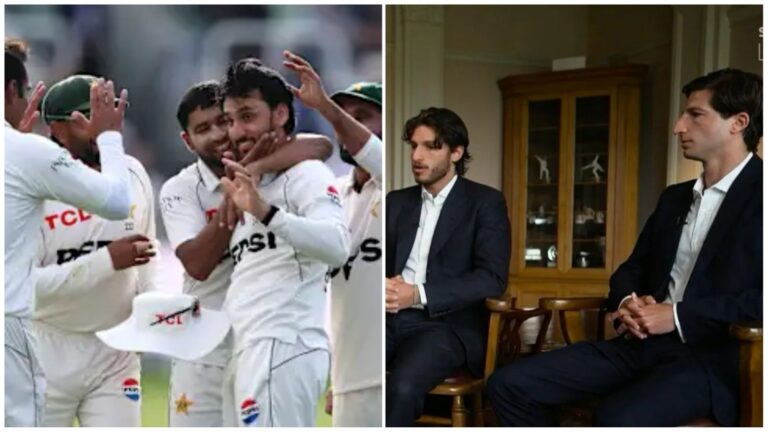
According to former England captain and Sky Sports commentator Mike Atherton, the PCB approached Sky Sports before the lunch interval and objected to the interview featuring Imran Khan’s sons, Sulaiman and Kasim Khan. The board warned that Pakistan’s players would not come back out for the afternoon session if the interview was broadcast.

Sky Sports initially delayed the segment. But the broadcaster eventually aired the approximately 18-minute interview during the lunch break.

And then came the embarrassing part for the PCB.

The Pakistani players returned to the field. No boycott. No walkout. No dramatic withdrawal. The Test simply carried on.

So why did the PCB make such an extraordinary threat in the first place? What exactly did Imran Khan’s sons say that made the Pakistan cricket establishment so uncomfortable?

This was not a cricket interview.

The interview, conducted by Atherton inside the Lord’s Pavilion, was obviously not a routine cricket conversation.

Sulaiman and Kasim spoke about the condition of their father, his treatment in prison, his alleged isolation, concerns surrounding his eyesight and the family’s difficulties in accessing him.

Imran Khan has been imprisoned since August 2023 after being convicted in corruption-related cases. His family and political supporters have repeatedly alleged that he is being subjected to political persecution and denied adequate medical care. Pakistani authorities have rejected allegations of mistreatment and have maintained that Khan is receiving appropriate medical attention.

But the most explosive part of the Sky Sports interview was Sulaiman’s allegation about what he believes is happening to his father inside prison.

Asked about Imran’s worsening situation, Sulaiman said:

“They’re just blatantly trying to kill him in there.”

He further alleged that authorities wanted to keep his father imprisoned for as long as possible and silence him.

That is a serious allegation.

And, crucially, it was not being made on an obscure political YouTube channel or a partisan Pakistani platform. It was being broadcast by Sky Sports during coverage of an England-Pakistan Test match at Lord’s.

For the Pakistani establishment, that created a very different kind of problem.

So what exactly frightened the PCB?

The PCB’s objection centred on the political nature of the interview appearing during coverage of an international cricket match. But that explanation raises a much bigger question: if the interview was so politically objectionable, why did the board think threatening to disrupt an England-Pakistan Test was an appropriate response?

The irony is almost impossible to miss.

By threatening to keep its players off the field over an interview about Imran Khan, the PCB itself made the cricket match political.

The interview was about a former Pakistan captain and prime minister who remains enormously significant to the country’s political landscape. His sons were speaking about his health and prison conditions.

The PCB had no locus standi on dictating what a private English broadcaster could broadcast. And yet, it went ahead with the threat, hoping that it could somehow force Sky to abort streaming the interview of Khan’s sons.

In other words, the board’s apparent strategy was to keep politics out of cricket by threatening to weaponise cricket in a political-media dispute.

That contradiction needs no embellishment.

The timing made the interview impossible to ignore

The interview was recorded on Wednesday, just one day before the second Test began at Lord’s.

That meant the PCB had very little room to prevent the conversation from becoming part of the wider international narrative surrounding the Test.

The interview was eventually broadcast during the lunch interval on the opening day.

By then, viewers were hearing directly from Imran Khan’s sons about claims that their father was being kept in isolation for more than 23 hours a day, concerns about his eyesight and the alleged denial of access to independent medical professionals.

Sulaiman also claimed that the brothers had not seen their father since November 2022 and that they had faced difficulties obtaining visas to travel to Pakistan.

The brothers said their priority was not to create a political spectacle but simply to see their father.

That made the interview particularly difficult to dismiss as merely another political attack.

The eyesight allegation added another layer

One of the concerns raised by Imran Khan’s sons involved his eyesight.

Sulaiman claimed that his father had lost around 80 per cent of the vision in one eye and alleged that the problem had remained inadequately addressed.

He also questioned why Imran had not been examined by an independent doctor.

According to the Pakistani government’s position, however, Khan has received medical attention and was declared fit by doctors before being returned to prison. Authorities have also cited security considerations in explaining aspects of his medical treatment.

But Pakistan’s claims can hardly be taken at face value. The country has been notorious for lying through its teeth. Even during the search for Osama Bin Laden, Pakistan kept reiterating that it was standing with the US in its fight against terrorism. But where was Laden found? In the military town of Abbottabad in Pakistan.

Here in this case, PCB and Pakistan’s government have been claiming Imran Khan has been provided with medical treatment that he needs. But that’s an eyewash to manage global outrage over the treatment of one of their former Prime Ministers and World Cup-winning captain.

A broadcaster is entitled to interview the family of a major international political figure. If Pakistani authorities dispute allegations made during the interview, they can respond to them.

Threatening the participation of a cricket team, however, is an entirely different matter.

The boycott threat lasted until it was time to actually boycott

The most revealing part of the episode is what happened after Sky Sports finally broadcast the interview.

Pakistan did not boycott the Test.

The players returned to the field after lunch.

The match continued as though the PCB’s threat had never happened.

That raises an obvious question: if Pakistan’s participation was really conditional on the interview not being aired, why did the team ultimately walk back onto the field?

That’s probably because Pakistan’s cricket team and its board are struggling. bly then decide to The boycott of the test would have not only meant Pakistan losing the series, but it would also risk upsetting the English Cricket Board, which would probably never call Pakistan again for a series. It would only result in Pakistan touring associate nations it frequently plays: Zimbabwe, UAE, and others.

Whatever the answer, the episode exposed a striking mismatch between the PCB’s reported threat and what it was ultimately willing to do.

Instead of forcing Sky Sports into silence, the PCB’s intervention arguably generated even more attention for the interview.

Had the board simply ignored it, many viewers might have watched the segment and moved on.

Instead, the PCB’s threat to boycott the Test created a second story around the first story.

The interview was no longer merely about Imran Khan’s prison conditions.

It had become a story about the Pakistan cricket establishment trying to stop an international broadcaster from airing the claims.

The PCB did exactly what it claimed to oppose: it dragged politics into cricket

This is the biggest irony of the entire episode.

Pakistan has frequently complained about politics being mixed with cricket, especially when international sporting events become vehicles for political messaging.

Yet here, the PCB itself reportedly turned a Test match into a bargaining chip over a political interview.

The board could have argued that the segment was outside the sporting remit of the broadcast.

It could have issued a rebuttal.

It could have asked the Pakistani government to respond.

Instead, it threatened to disrupt the participation of the Pakistan team at Lord’s.

That is not keeping politics away from cricket.

That is using cricket to fight a political and media battle, precisely the kind of politicisation that cricket administrators routinely claim to oppose.

Even former cricketers have raised concerns over Imran’s treatment

The controversy comes amid renewed international concern over Imran Khan’s treatment in prison.

A group of 21 former international captains, including Indian cricket legends Sunil Gavaskar and Kapil Dev as well as Atherton, have reportedly renewed an appeal to Pakistan Prime Minister Shehbaz Sharif, calling for humane treatment and adequate medical care for the former Pakistan captain.

That is significant because Imran’s situation is not merely a domestic political dispute anymore.

His status as one of Pakistan’s greatest cricketers has given the issue an international sporting dimension.

He remains the country’s only World Cup-winning captain, and his transition from cricketing icon to prime minister makes his imprisonment particularly consequential for the cricketing world.

The brothers also questioned Pakistani cricketers’ silence

Sulaiman and Kasim were asked about the limited public support for their father among former Pakistan cricketers.

Sulaiman said he believed many former players continued to respect and revere Imran, but argued that publicly speaking about his situation could carry consequences in Pakistan’s current political environment.

The brothers also pointed to the support their father had received from former international captains.

Atherton himself has been among those who have spoken publicly about concerns surrounding Imran’s treatment.

That made the Sky Sports interview even more significant.

The interviewer was not simply a political commentator looking for controversy. Atherton was a former England captain speaking to the sons of a former Pakistan captain whose cricketing legacy is inseparable from the country’s sporting identity.

They still support Pakistan at Lord’s

The interview also included a strikingly apolitical moment.

Despite being born and raised in Britain, Sulaiman and Kasim made clear that their cricketing loyalties remained with Pakistan.

When asked who they would support at Lord’s, they left little in doubt.

They backed Pakistan.

It was a reminder that whatever their father’s political fate, his sons still identify strongly with the country whose cricket team he once led to its greatest triumph.

Pakistan’s cricket troubles continue on the field

Ironically, all of this unfolded while Pakistan were already struggling to make an impact in the Test series.

Pakistan lost the opening Test at Headingley by an innings and 103 runs.

At Lord’s, Pakistan won the toss and elected to field. Mohammad Abbas led the bowling attack with four wickets, while Mohammad Ali claimed three as England finished the opening day on 248/9.

The third and final Test is scheduled to be played in Birmingham from September 9.

Pakistan also remain at the bottom of the World Test Championship standings, while England occupy seventh place.

So, at a time when the PCB should have been concentrating on cricket, it found itself fighting a broadcaster over an interview about a jailed former prime minister.

And the attempt to bully Sky Sports into dropping the segment ultimately failed.

The PCB’s panic made Imran Khan the story

There is a final irony here.

If the PCB’s objective was to prevent politics from overshadowing cricket at Lord’s, its reported intervention achieved almost the exact opposite.

The interview was aired.

The players returned after lunch.

The Test continued.

But the controversy surrounding the PCB’s boycott threat ensured that Imran Khan’s prison conditions became an international talking point during an England-Pakistan Test.

The PCB may have wanted to bury the interview before it reached a global cricket audience.

Instead, its reported threat gave the episode an even bigger spotlight.

And by threatening to keep Pakistan’s cricket team off the field because a broadcaster wanted to interview Imran Khan’s sons, the PCB revealed something far more damaging than anything contained in the interview: Pakistan’s cricket establishment often accuses others of politicising the game, but it is the PCB that is unable to keep politics out of cricket.

Wave of bomb blasts, shootings and arson shakes Southern Thailand: All you need to know about the Islamic insurgents suspected behind the attacks

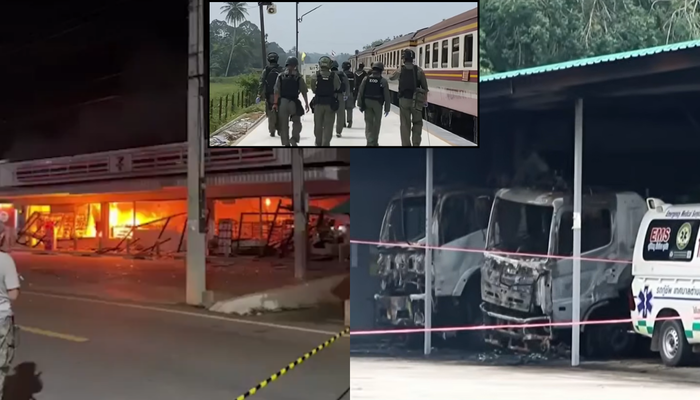
A wave of coordinated attacks jolted southern Thailand over the weekend (22nd and 23rd August), leaving three people injured and causing massive property damage. According to some reports, around 51 coordinated attacks were carried out in 21 districts of three Muslim-dominated, insurgency-hit provinces of Pattani, Yala, and Narathiwat. Some other reports stated that the attacks were over 70 in number and were spread across four provinces of Pattani, Yala, Narathiwat and Songkhla.

The attacks included bombings, warning shootings, attacks on local government offices, and arson targeting telecommunications infrastructure, CCTV cameras, vehicles, and property. The majority of the attacks reportedly happened in Narathiwat province, where three people were injured, followed by Yala and Pattani.

“Multiple coordinated incidents aimed at creating unrest occurred in various locations across the southern border provinces”, a statement by the Thailand military’s Internal Security Operations Command (ISOC) reportedly said. The attacks were followed by an explosion at a convenience store in Mayo district, Pattani, on Monday.

Following the attacks, Thailand’s Prime Minister Anutin Charnvirakul held an urgent meeting with high-level security officials on Sunday to review the situation. Thai security forces have been deployed at the sites of the attacks, where they are engaged in the task of collecting evidence and nabbing suspects. The attacks have also led to increased security on the country’s borders to prevent any attempts at infiltration amidst the internal chaos.

A curfew was reportedly imposed in Narathiwat province from Saturday night till Sunday morning. The attacks caused major damage to buildings and vehicles. The Thai military had intelligence about the attacks but was not sure of the time and place. “We had intelligence reports for about two months that there would be attacks on local offices,” Commander of the Thai army in the southern region, Lieutenant ⁠General Norathip Poinok, was quoted as saying.

This is the first major attack since July 2026, when Thai soldiers were attacked by around 10 attackers who opened fire at them and threw pipe bombs at a security checkpoint in Narathiwat. Five paramilitary soldiers were killed and six civilians, including a 10-year-old boy, were wounded in the attack, which happened when the Thai government was holding negotiations with the BRN.

Islamic separatist group suspected to be behind the attacks

No insurgent group has claimed responsibility for the attacks. However, it is suspected that Islamic separatist groups like the Barisan Revolusi Nasional (BRN), which are known to have the capacity to carry out attacks of this scale, might be behind the attacks. The BRN is active in the three Muslim-dominated provinces of Pattani, Yala, and Narathiwat. The Islamic insurgent group has a long-standing demand to create an Islamic state by merging the three southern provinces and separating them from the Buddhist-majority country.

The three states have a history of insurgent activities, which date back to the 1960s, when insurgent groups, including the BRN, started the fight for an independent Islamic nation. The Islamic insurgent groups have been threatening the unity and sovereignty of Thailand. They refuse to be associated with the rich cultural heritage of Thailand and want to create a separate nation for their co-religionists. For about two decades, they have been attacking Thai security forces to pressure the Thai government into fulfilling their demand for a separate Islamic nation.

The provinces of Pattani, Yala, and Narathiwat were officially recognised by the British as part of Thailand in the early 1990s under the Anglo-Siamese Treaty, which demarcated the existing political border between Thailand and Malaysia. The treaty was signed between Thailand (then the Kingdom of Siam) and the United Kingdom in 1909.

Under the treaty, the Siamese kingdom relinquished its claim over the territories of the northern Malay states of Kedah, Kelantan, Perlis, and Terengganu in favour of the British colonisers but retained its control over regions including Pattani, Yala, Narathiwat, and Satun. The three provinces were already being ruled by the Siamese kingdom, and the treaty merely recognised it. Before the treaty, the three provinces were part of the former Malay-Muslim Patani sultanate. It is based on this piece of Thai history that the insurgents have been calling for a separate Islamic nation.

The current conflict began in 2004 when the insurgents raided an army base in Narathiwat province and killed several soldiers and stole weapons. The attack triggered a chain reaction of attacks and counterattacks between the insurgents and the Thai security forces. Over 7,800 people have reportedly been killed across three provinces since 2004.

Thailand is not the only country where Islamic insurgent groups have demanded a separate Islamic state based on Muslim-majority demographics; similar demands have been witnessed in several parts of the world. The Partition of India in 1947 was also preceded by religion-based political demands made more than 80 years ago, the consequences of which continue to shape India’s political and social landscape.

Live Law has a ‘Constitutional’ problem with government officials doing Bhumi Pujan in state functions: Does secularism mean de-Hinduisation?

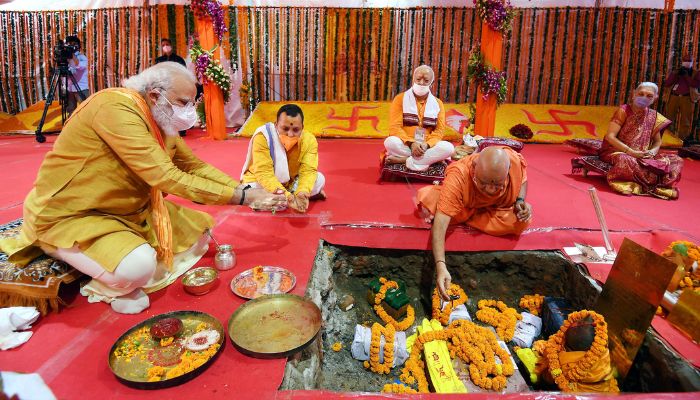
Legal reporting website Live Law recently published an opinion piece that attempted a “Constitutional examination of Bhumi Pujan ceremonies”. The Live Law article published on 23rd August 2026, lamented that the participation of constitutional functionaries, including the Prime Minister, in Bhumi Pujan, Havan, Vedic chanting, coconut-breaking and other Hindu rituals before inauguration or stone-laying of public infrastructure has become common even though Constitutionally, India is ‘Secular’ country.

The Live Law article headlined, “Can ‘Culture’ Justify Religious Rituals At State Functions? Constitutional Examination Of Bhumi Pujan Ceremonies” essentially frames Havan, Bhumi Pujan, coconut-breaking, and other such rituals at state events as ‘unconstitutional endorsement of Hinduism, that somehow violates the secularism, freedom of conscience, equality and democratic neutrality.

“…But, when viewed from the lens of constitutional law, secularism, equality, freedom of conscience, and democratic legitimacy, a pertinent question arises whether the State, acting through public officials and public institutions, can formally associate itself with rituals rooted in one particular religious tradition while claiming to remain secular and neutral toward all faiths and non-faith positions,” the article reads.

“Despite the differentiation, a fundamental principle that remains cogent is that the State itself has no religion. Therefore, the question arises when state and public institutions, through official ceremonies, appear to recognize and identify themselves with the symbols, rituals, and theological assumptions of a particular faith,” it adds.

The article conflates the American/French model of secularism with the Indian, though it admits that unlike the foreign models, the Indian interpretation of secularism was never about creating a wall of separation between religion and the State. Indian idea of secularism is more about principled engagement with all faiths rather than banishment of religion altogether from public life.

Further, the article mentions the 1994 S.R. Bommai v. Union of India case, and the 2005 Gopalakrishnan Nair vs State of Kerala case.

The Bommai case, however, actually endorses the accommodative model of principled engagement with all faiths. It does not hold that any single ritual performed by a government or constitutional official establishes theocracy. The problem would have been only when there was systemic favouritism, and the governments or those holding constitutional offices were using state machinery to propagate their religion or suppress others. There is no real constitutional or societal harm in an official partaking in a Bhumi Pujan or Havan ceremony before a ribbon-cutting.

The S.R. Bommai case was about dismissal of state governments for complicity in communal violence after the Babri Masjid demolition in Uttar Pradesh’s Ayodhya. In the Gopalakrishnan Nair case, the Supreme Court held that the management of a temple’s properties, finances, educational institutions, and administration are all secular activities, and different from spiritual and ritualistic guidance, which remains with the temple Thanthri.

Yash Mittal, the author of the Live Law article, asks that if the State has no religion, why should a government building, a court complex, a public hospital, or a highway project formally commence with rituals invoking Hindu deities or religious blessings? He further asks whether the performance of such rituals at State events amounts to the State identifying with the Hindu religious faith. The author also asks, “Does it not discriminate against citizens following other religious faiths or no faith (atheists or agnostics)? Does it not amount to the creation of a theocratic state?”

Bhumi Pujan threatens secularism, Iftar doesn’t?

The author is not content with the various court interpretations of the term ‘secularism’ and invocation of the idea of ‘Vasudhaiv Kutumbakam’, and highlights the 1986 Bijoe Emmanuel case wherein the Supreme Court protected Jehovah’s Witness Christian students who refused to sing the national anthem due to religious beliefs, emphasising freedom of conscience under Article 25.

The article describes the Andhra Pradesh High Court decision in Atheist Society of India v. Govt. of Andhra Pradesh and the Gujarat High Court’s decision in Rajesh Himmatlal Solanki v. Union of India, as merely “strengthening” the position of those opining that performance of Hindu rituals at public infrastructure inauguration or state events are religious but not non-secular acts.

However, there is more to these court interpretations than a ‘convenient rationalisation’. Their reasoning tracks the Indian constitutional practice in other contexts. For example, India’s national motto is “Satyamev Jayate”. This motto is lifted from the Mundaka Upanishad, a Hindu scripture. The state emblem, the Ashok Chakra has Buddhist provenance, even the Indian Judiciary’s motto, “Yato Dharmastato Jayaḥ” has been taken from the Hindu epic, Mahabharat and finds repeated mentions in the Shrimad Bhagwat Gita.

And yet the Indian State and Indian Judiciary remain secular. Has the judiciary turned away a Muslim or Christian or any non-Hindu petitioner because its motto is taken from Mahabharat or Shrimad Bhagwat Gita?

Has the participation of state and constitutional officials in Bhumi Pujan, including Prime Minister, Judges, Governors, Collectors, etc, ever resulted in hinderance of religious practice of non-Hindus? If a highway has been inaugurated with the Hindu tradition of coconut-breaking, does that mean the highway will exclusively be used by Hindus?

More than etymology, intent and impact matter. Regarding the Bijoe Emmanuel case, it was about more about compelled participation; the Christian students were disciplined for not singing the national anthem. However, nobody is disciplined, penalised, jailed, or denied service for not partaking in Bhumi Pujan or skipping a religious ritual at any event involving the presence of State or Constitutional officials.

This whole freedom of conscience against forced quasi-religious observance argument applies to forced individual participation. If a government or constitutional officials are not tolerant enough to passively witness a Bhumi Pujan or any such rituals, their own practice of secularism should come under question.

If we begin advocating such strict implementation of ‘secularism’ in all spheres, why should governments provide financial aid to Madarsas? Why should there be ‘minorities’ departments in state and Central governments? Why should governments at all be involved in the management of Hindu temples? Why should governments grant holidays on religious festivals? Why should the government provide Haj subsidy? Why do ministers holding constitutional office organise Iftar parties? The “whys” would be endless, and answers would compulsorily involve deviation from the very idea of secularism the Live Law article wants strictly implemented.

Author Yash Mittal also raises a ridiculous “why not the public events of stone laying ceremony, whose operational cost is borne from the public purses, be distanced from an unauthorised religious performance of a particular faith?”

Performance of a Havan, Bhumi Pujan, or coconut-breaking ceremony does not require expenditure of crores of rupees of taxpayers’ money. If the State can spend hundreds of crores on Haj subsidy, a few coconuts or a priest’s honorarium would not cost much. In fact, such expenses in most cases are not dealt with through the State treasury.

Constitutionally speaking, Article 27 restricts compulsion to pay taxes specifically appropriated for propagation or maintenance of a particular religion. The negligible costs of a religious-cultural ceremonial segment within a larger public-works event do not meet that threshold.

Live Law never raised the ‘scientific temper’ argument when states fund Madarsas imparting Islamic education, but invokes it to question Bhumi Pujan

The Live Law op-ed throws a situation wherein a Muslim, Christian, Sikh, Buddhist, Jain, Parsi or Jewish citizen attends the inauguration of a government hospital, school, court building or public infrastructure project, but the official ceremony begins with the invocation of Hindu deities. In this context, the author argues that the non-Hindu attendees would ask: “Is this a ceremony of the State, or a religious ceremony being conducted by the State?”

Why would a truly secular and tolerant non-Hindu ask such a question? Does the mere attendance, not participation, of a foundation ceremony wherein Vedic mantras are being chanted, result in the conversion of the State into a religious actor?

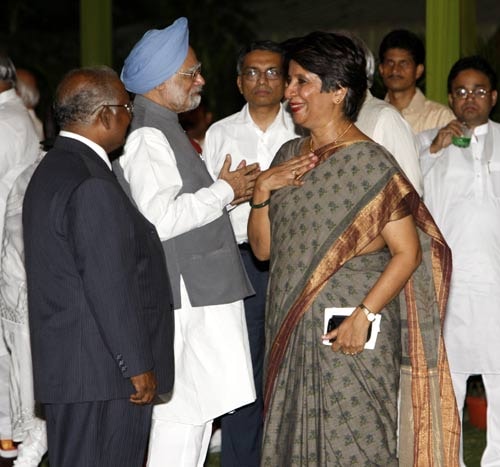
Prime Minister Manmohan Singh with Chief Justice of India K.G. Balakrishnan and Foreign Secretary Nirupama Rao. (Image source: IndiaToday)

Under the UPA government, Iftar Parties were all the rage. They were organised at the Rashtrapati Bhavan and PM’s residence too. These Iftars were attended by several notable dignitaries, including the then CJI of India. However, no raked up ‘democracy in danger’, ‘separation of state and church [read religion]’ argument then? How exactly do Iftars promote scientific temper?


Back in February 2024, former Justice Joseph Kurian asked CJI Chandrachud to drop the Supreme Court’s motto “Yato Dharmastato Jaya” (Where there is Dharma, there is Victory), taken from the Hindu epic Mahabharat. Speaking at an event organised by left-liberals and the controversial portal TheWire, former Justice Joseph suggested that the Supreme Court’s motto diverges from the national motto and, by implication, the national ethos. Back in 2018, Joseph equated the Catholic Church to the Preamble of India, but no one cried ‘secularism khatre mein hai’.

In India, the principle of separation of powers ensures that the three branches of government—executive, legislative, and judicial—function independently, but it does not preclude social or cultural contact between them. Scientific temper comes under Directive Principles, and coexists with cultural symbolism.

Hindu religious-cultural practices sans any imposition on non-Hindus, in a Hindu-majority country, are not equivalent to State establishment any more than Christian cultural references or ceremonies in Western democracies amount to violation of secularism or neutrality.

The article concludes with former Supreme Court Justice Abhay S. Oka’s suggestion that people should adopt a new practice of bowing down to the Preamble of the Constitution instead of performing religious “poojas and archanas”. The remarks are offered in the article as a final settlement or solution to the supposed debacle. However, would this practice not amount to deification of the Constitution and, by extension, its author(s)?

India does not need to blindly copy-paste or replicate the Western supposed maximalist reading of secularism and impose cultural deracination of public life. India owes its secular character to the Hindu majority. India has already lost a significant portion of its land to Islamic intolerance and exclusionary intransigence in 1947. The world’s only Hindu-majority country cannot afford to sever its Hindu civilisational roots and consciousness in the pathological pursuit of becoming as ‘secular’ as possible.

Who killed 4 members of the Chakraborty family in Bangladesh? Two arrested, but questions mount over erased evidence, mystery shirt and an attempt to shield Islamists

The investigation into the gruesome killing of four members of a Hindu family in Rangpur city, Bangladesh, has officially been transferred from the Kotwali Police Station to the Detective Branch (DB) of the police. 

Police officials stated that this transition was executed to ensure absolute transparency and to facilitate a swift submission of the charge sheet in court. The former Investigating Officer (IO), Inspector (Investigation) Milon Kumar Chatterjee of Kotwali Police Station, formally handed over all relevant case files, collected evidence, and detailed information to the newly appointed IO, Zinat Ali, who serves as the Officer-in-Charge of the Metropolitan Detective Branch. 

The police appear determined to simplify the case and mislead the public, but the transfer comes amid widespread protests that continue to brew across Rangpur as residents and civil society members firmly reject the narrative presented by the police. 

Social media platforms in Bangladesh are currently buzzing with intense discussions, heated debates, and sharp questions regarding the two Hindu youths arrested in connection with the horrific murder of Ganapati Chakraborty, a retired schoolteacher, and his entire family in this northern district.

The questions have become more intense because police moved quickly from recovering the bodies to arresting two local youths and presenting a specific explanation for the killings. The families of the arrested youths, as well as relatives of the victims, have challenged parts of that account.

Four decomposed bodies found inside locked house

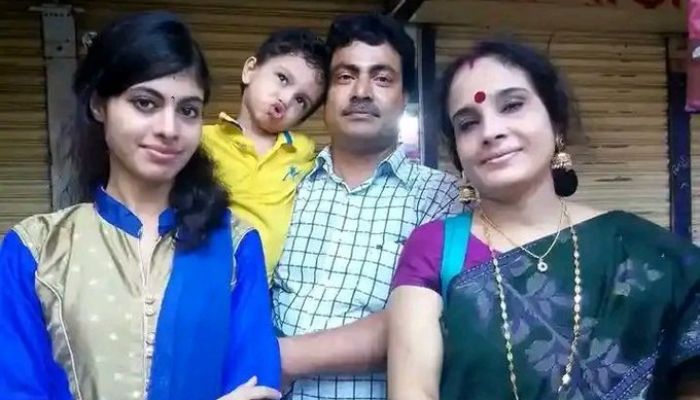
The case came to light on the night of 22nd August, when police recovered the decomposed bodies of four members of the same Hindu family from their two-storey house in the Kamalkashana-Machuapara area of Rangpur city. The victims were retired Rangpur Zilla School teacher Ganapati Chakraborty Jewel, 65, his wife Pritilata Chakraborty, 50, their daughter Agami Chakraborty, around 25, and their 12-year-old son Priyam.

The house was locked from outside. Neighbours and relatives became suspicious after noticing that no one from the family had been seen for some time and a strong foul smell was coming from inside. Pritilata’s younger sister, Puja Chakraborty, said she had last spoken to the family by phone on Thursday night, August 20. When she could not contact them on Saturday, she went to the house with her husband at around 9 pm and found the main gate locked. She contacted Bangladesh’s emergency number 999, following which police arrived and broke open the lock.

The bodies were found in different parts of the property. Ganapati’s body was found on the roof; the bodies of Pritilata and their daughter were found around the staircase, while Priyam’s body was found inside a room, under a bed.

Ganapati had retired from Rangpur Zilla School in December last year. After retirement, he was reportedly providing homoeopathic medical services from a chamber at Rangpur Cooperative Market. His daughter had completed her master’s degree from Carmichael College, while Priyam was a Class V student at Rangpur Zilla School.

Police arrest two Hindu youths, claim confessions

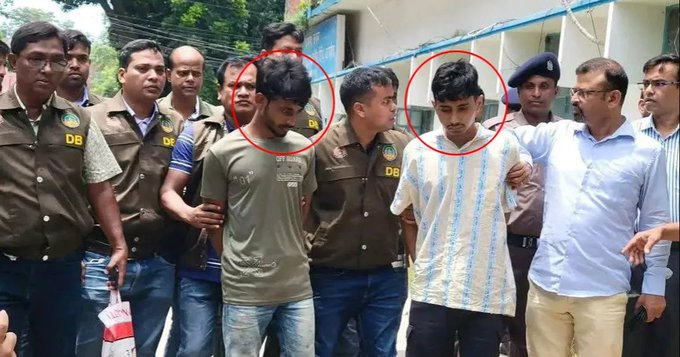
Police subsequently arrested two young Hindu men, Mugdha Das and Siddhartha Das, from the Machuapara area on Sunday night, 23rd August. Police identified them as residents and alleged that they were involved in the killings. According to police, both later gave confessional statements before Rangpur Chief Metropolitan Magistrate Court Judge Md Rafiqul Islam under Section 164 of the Code of Criminal Procedure. They were subsequently sent to jail.

Police have said the two youths were consuming yaba on the roof of Ganapati’s house when the retired teacher confronted them. According to the police version, the confrontation escalated, and the family members were killed. Police have also suggested that the crime may initially have been connected to robbery or an attempt to make the incident look like a robbery.

However, the case is nowhere near as simple as the police are making it out to be before the media. Local observers and human rights defenders strongly suspect that law enforcement is attempting to build a convenient narrative to quickly wrap up the case, cover up critical lapses, and shield the real perpetrators behind this heinous crime, which carries a communal angle similar to previous targeted attacks on Bangladeshi Hindus in recent years by Islamists.

‘This was a planned murder’: family rejects police narrative

Directly rejecting the police claim, Puja Chakraborty, the younger sister of slain Pritilata Chakraborty, voiced strong scepticism regarding the official storyline. She publicly stated, “We are sceptical about the police’s claim regarding the motive for the murder. We cannot understand anything. Police are saying that two yaba addicts allegedly killed four people one after another.”

She further revealed a horrifying detail that police had initially kept hidden: “When we received the bodies in the evening, we found that their faces had been burned. Earlier, police did not allow us to go near the bodies.” Emphasising her conviction, she asserted, “This was a planned murder.”

The angle of a planned killing has also been echoed by Ganapati’s elder brother Gopinath Chakraborty, who said a larger group could have been involved. He also questioned the circumstances surrounding the crime and demanded that the actual perpetrators be identified and punished.

Erased evidence and mounting questions over a mystery shirt

It is not just the family suggesting that this was a premeditated hit. A series of glaring discrepancies, altered crime scene conditions, and erased evidence strongly suggest that authorities are actively attempting to obscure the potential communal or organised angle.

Suspicion deepened when photos of one of the arrested suspects went viral on social media. The shirt worn by the detainee during his presentation to the media appeared virtually identical to a shirt frequently worn by a senior police officer in Rangpur, leading the public to question how an officer’s clothing ended up on an accused person. 

Image via X

Deputy Commissioner of Rangpur Detective Branch Sanatan Chakraborty has dismissed the allegation that the shirt belonged to him. He told BBC Bangla that the shirt was a common one and said, “That same shirt is owned by me and at least two hundred other people in Rangpur. My shirt is right here with me. Purposeful mispropaganda is being spread regarding this.”

Yet, this explanation was directly contradicted by Binoy Das, the father of accused Siddhartha Das, who openly challenged the official version of events. Speaking to reporters, Binoy Das stated, “On late Saturday night, a large crowd including the police gathered at Ganapati’s house. Later, late that night around dawn, police came to my house looking for Siddhartha. I woke him up from his uncle’s house and handed him over to the police. He was wearing a T-shirt at the time. But later, when the police brought him before the journalists, I saw him wearing a shirt. Whose shirt is that? I have never seen him wear that kind of shirt before.”

The families of both arrested youths have also said the men were away from the crime scene at the relevant time, contradicting the police account. Those claims will need to be tested against phone records, CCTV footage, forensic evidence and other independent material rather than accepted or rejected solely based on competing statements.

There are further questions about the electricity supply to the house. The new investigating officer reportedly said the accused had told investigators that they cut the electrical wire near the meter. However, a local electrician who later repaired the connection told The Daily Star that the line had actually been severed from the electric pole. Such differences are important because they can help establish whether the suspects’ account matches the physical scene.

Autopsy raises another layer of questions

The troubling discrepancies do not end with clothing. Major contradictions have emerged between the police statements and the actual autopsy findings.

Police said the four victims were strangled, and the autopsy later confirmed that strangulation/asphyxiation was the cause of death. However, when the bodies were finally handed over to relatives after autopsies at Rangpur Medical College Hospital around 7:00 PM on Sunday, family members and doctors discovered that the faces of all four victims had been severely burned with a flammable substance or chemical. 

Disturbing video footage from the scene showed bloodied liquid pooled on the floor, with young Priyam lying dead on the bedroom floor, his face visibly scorched.

This directly conflicts with the earlier account from relatives who said the faces appeared burned and with an initial CID statement suggesting that a flammable substance may have been poured on the victims’ faces. CID Rangpur official Sumit Chowdhury had said investigators would collect samples and send them to the forensic department to determine what substance, if any, had been used.

The disagreement makes the forensic evidence especially important. If a chemical or flammable substance was used, laboratory testing should establish it. If the facial changes were instead caused by decomposition, as the autopsy doctor said, that should also be clearly documented. The final forensic and laboratory reports therefore matter far more than competing claims circulating on social media.

Questions have also been raised about the missing mobile phones, the electricity supply, the movements of the accused and the police explanation of how the suspects allegedly accessed the rooftop. These issues need to be checked through objective evidence, including call records, digital data, DNA testing, fingerprints and other forensic material.

A disputed claim over sexual assault

Adding to the mystery is a severe conflict regarding potential sexual assault. In a conversation recorded on a hidden camera, a mortuary attendant (dom) who assisted during the autopsies stated there were clear signs of sexual assault on the mother and daughter. However, the official forensic physician who conducted the autopsy flatly denied these claims, stating that physical examinations and lab samples showed no such evidence and dismissing the worker’s statements as entirely incorrect. 

How this stark contradiction between an on-ground mortuary worker and the official medical report will be resolved remains unclear, especially since police completely ignored this sensitive matter during their initial media briefings.

Police washed the house and destroyed the evidence 

In another chilling revelation, the family of the arrested Hindu youth wept before cameras, asserting that their sons were being framed as convenient scapegoats to protect influential figures. The accused’s family revealed that officers altered the crime scene, saying that the house was washed and cleaned under police supervision, effectively destroying critical forensic evidence. Instead of securing the perimeter, officers were seen repeatedly entering and operating inside the residence before full forensic mapping.

The scale of the crime itself makes the questions difficult to ignore. Why was an entire family killed, including a 12-year-old child? If the police theory is that the killings began after a confrontation over yaba consumption, investigators must establish how that confrontation allegedly led to four deaths and whether the evidence independently supports the suspects’ statements.

Similarly, if robbery was involved, investigators must establish what was stolen, whether there were signs of forced entry, whether money or valuables were missing and whether forensic evidence connects the arrested men to the house. If investigators rule out a communal motive or the involvement of additional people, that conclusion should also be based on evidence rather than assumption.

Ultimately, one central question hangs over the case: Was this truly a casual, spontaneous crime committed by two young men just to buy drugs, or was it a planned, sinister execution designed to liquidate another Hindu family and instil fear across the minority community? 

The fact that the victims were Hindu makes the communal angle an important possibility to examine, particularly given concerns among minority communities in Bangladesh and recent cases of Bangladeshi Hindus being murdered by Islamists. This is an important angle that the police appear to be downplaying and keeping from the public. 

Demand for judicial investigation

A judicial investigation into the killings was demanded at a human chain and protest rally organised by the Bangladesh Sanatan Party (BSP) in front of the National Press Club in Dhaka on Wednesday, 26th August. Several organisations, including Bhakta Sangha Society Bangladesh, World Hindu Federation, Bangladesh Deshwali Samaj, Bangladesh Sanatan Kalyan Jote and Bangladesh Loknath Foundation, joined the programme.

Mob violence, Palestinian flags, and a distorted tricolour: Here are 5 incidents from Eid-e-Milad processions where Islamists went on a rampage

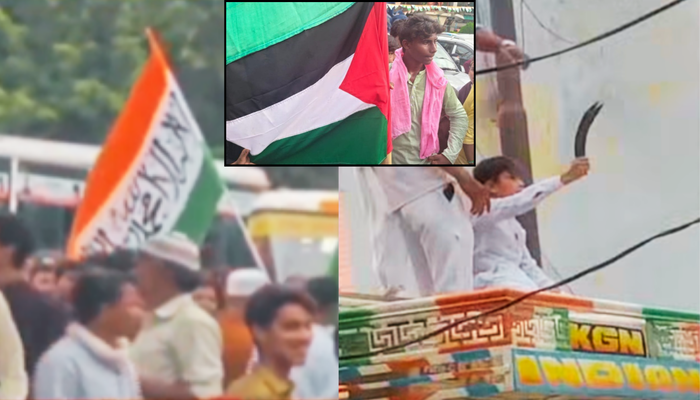
As Muslims across India celebrated Eid-e-Milad on Wednesday (26th August), disturbing visuals emerged during the processions taken out during the Islamic festival. While reports of Palestinian flags being waved during the Eid procession surfaced in Karnataka, West Bengal and Maharashtra, sharp weapons were flashed, and the national flag was disrespected in Uttar Pradesh.

Palestinian flag waved by a Muslim man in Karnataka

A Palestinian flag was reportedly waved during an Eid procession in Ankola town of Karwar district in Karnataka. A man named Mohammed Raza Akbar Ali, a resident of Vitthalghat in Krishnapur, had brought the flag to the rally and waved it. He was arrested by the police and taken to the police station.

Deputy Superintendent of Police Girish said that legal proceedings were initiated against Akbar Ali. He urged people to maintain peace, assuring that appropriate action would be taken against him.

Palestinian flag raised during Eid procession in West Bengal

A similar incident came to light in the state of West Bengal, where a Palestinian flag was waved during an Eid procession in the Islampur district. West Bengal Chief Minister, Suvendu Adhikari, confirmed the incident through a post on X, where he mentioned that two foreign flags were seized by the police across the state during Eid celebrations. The police registered FIRs against the culprits.

“…our Administration maintains an uncompromising Zero-Tolerance Policy against any attempt to disrupt social harmony or misuse sacred occasions for External Political Propaganda. I appreciate the swift and decisive action taken by the Islampur District Police in confiscating unauthorized Foreign Flags, registering FIRs and initiating strict legal proceedings against those involved. Only two flags were confiscated across the State,” CM Adhikari said.

Muslims brandished weapons, played provocative songs in UP

Eid celebrations were not limited to waving Palestinian flags. In Badaun, Uttar Pradesh, Muslims, including kids, openly flashed sharp weapons during an Eid procession and played provocative songs. Visuals of the religious rally show some Muslim men and a Muslim kid sitting on top of a moving vehicle and waving large knives as the lyrics “Begunaaho pe sitam dhaane wale, teri hasti na mita du to mai Musalman nahi‘ (I am not a true Muslim if I do not eliminate those who commit atrocities against the innocent).

A video of the procession shows it passing through a busy road as Muslims flashed weapons and the threatening song blared on loudspeakers, creating an uncomfortable environment for the general public.

Tricolour disrespected in UP

In another Eid-e-Milad procession taken out in the Mahoba district of Uttar Pradesh, Muslims disrespected the national flag. The Muslims taking part in the religious procession distorted the national flag by replacing the Ashok Chakra at its centre with some Islamic words.

After the video of the Eid procession went viral on the internet, the police registered an FIR against an unidentified accused. An investigation has been launched into the matter.

Muslim mob attacked Hindus in Mumbai

A Muslim mob attacked Hindus in the Parel-Chinchpokli area of Mumbai during an Eid-e-Milad procession on the night of 26th August. The incident happened near the Laxmi Cottage building as the procession was passing through the area. According to locals, Muslims taking part in the religious procession raised provocative slogans and tore posters, creating chaos.

This is not the first time that such anti-national and nuisance-causing activities have been witnessed during a Muslim festival. A few months back, in May, widespread violence and bloodshed occurred during the Islamic festival of Eid-ul-Adha or Bakrid. Following the animal sacrifice ritual during the festival, streets in various parts of the country were seen flooded with the blood of slaughtered animals, causing great inconvenience to people.

In Madhya Pradesh’s Ratlam, a severed cow head was found on Bakrid, which triggered protests by local Hindu rights organisations. The same day, a chunk of meat was found outside the house of a Hindu family in Ujjain.

In a horrific incident on the Islamic festival, a Hindu youth named Surya Chauhan was stabbed to death by his Muslims friends who invited him to a Bakrid party in the Khoda area of Ghaziabad, Uttar Pradesh. In another disturbing incident, a Muslim man, Gada Khan, was caught cooking meat inside the Durga Temple premises on Bakrid in Uttar Pradesh’s Meerut district.

Violence, hate-mongering, provocative slogans, and activities causing public nuisance and inconvenience are recurring themes during Muslim festivals celebrated across the country.

Are Meta Ray-Ban smart glasses a privacy nightmare? Secret filming, data misuse and what you need to know

The AI-powered smart glasses by Meta are being promoted as a new way to use technology without constantly reaching for a phone. But behind their promise of hands-free help, live translation and quick photo and video recording, growing concerns are being raised about privacy.

A major part of the concern comes from what happens to the information captured by the glasses after it is recorded. An investigation in Kenya found that workers who help train Meta’s AI systems have seen highly private material captured through the glasses, including videos from homes, bathrooms and bedrooms. Other investigations have also highlighted cases where people were filmed without knowing it and later found themselves appearing in widely shared social media videos.

Kenya investigation brings hidden data work into focus

The Kenya case began with workers employed by Sama, a company that works as a subcontractor for Meta. In Nairobi, thousands of data annotators help train AI systems by reviewing and labelling images and videos so that machines can understand objects, people and the world around them.

Their work includes identifying objects in images, following shapes and checking whether AI systems have correctly understood visual information. But some workers told Swedish newspapers Svenska Dagbladet and Göteborgs-Posten that the material they handle can go far beyond ordinary images.

Workers described seeing videos recorded inside private homes. Some said they had encountered footage showing people using bathrooms, getting dressed, having sex or accidentally exposing private information such as bank cards. One worker described seeing a man leave his glasses on a bedside table before his wife entered the room and changed her clothes.

The workers said the material can be extremely sensitive and that they are expected to continue working even when they realise they are looking into someone’s private life. They also described reviewing conversations and transcripts involving subjects such as crimes, protests and sexual comments.

The investigation also found questions around the protection of people appearing in the footage. Former Meta employees said faces in annotation material are automatically blurred, but workers in Kenya said the system does not always work properly. In difficult lighting conditions, faces and bodies can sometimes remain visible.

Meta did not directly answer several questions about how such highly private material could reach subcontractors. The company referred to its AI terms and privacy policy, which say that some interactions with its AI systems may be reviewed by humans.

How do Meta’s smart glasses work?

Meta’s smart glasses are made in partnership with eyewear company EssilorLuxottica and use the familiar Ray-Ban design. They contain a small camera, speakers built into the arms and, in newer versions, lenses capable of displaying information.

The glasses can be activated using the voice command “Hey Meta”. They can answer questions, interpret what the camera sees, take photographs and videos, handle calls, play music and podcasts, and provide features such as live translation.

Meta has presented the glasses as an all-in-one assistant that can help users at work, guide them while travelling and allow them to capture moments without taking out a smartphone. The company has also promoted privacy controls and says users remain in control of their data.

However, the way the technology works creates a difficult privacy question. The camera is built into the frame and can be less noticeable than a phone camera. A small light is meant to indicate when the glasses are recording, but users and people around them may not always notice it, especially in bright conditions.

The glasses also rely on Meta’s infrastructure for several AI functions. An investigation by Svenska Dagbladet and Göteborgs-Posten found that when the glasses were tested without an internet connection, some AI features stopped working. Network traffic showed frequent communication between the phone and Meta servers. The investigation concluded that the AI could not operate entirely locally on the phone.

Meta’s privacy terms say that voice recordings may be saved for product improvement or training when a user actively agrees. But data needed for the AI assistant to function, including voice, text, images and sometimes video, can be processed automatically. The terms also state that some interactions with Meta AI can be reviewed manually by humans.

Privacy concerns are growing

The concern is not limited to what the wearer chooses to record. People around the wearer may also be captured without knowing it.

Meta markets its glasses with the message that they are designed for privacy and controlled by the user. The company advises users to respect people’s wishes and switch the glasses off in sensitive places.

But several incidents have shown how difficult that can be in everyday life.

One of the biggest concerns is the growing use of smart glasses to secretly record strangers for social media content. Men have been seen approaching women in public places, including shopping areas and beaches, while wearing Meta’s glasses. They ask casual questions or use pickup lines, while the women do not realise that a camera is recording them. The videos are then posted online, sometimes attracting large audiences and abusive comments.

The technology has also been used for prank videos. Some creators have recorded unsuspecting people while carrying out fake petitions, embarrassing stunts or other tricks. Because the glasses look like ordinary eyewear, people may not realise that a camera is operating nearby.

This creates a different problem from traditional filming. When someone holds up a phone, the camera is usually visible. With smart glasses, the recording device can be much harder to notice.

Meanwhile, reports say that Norway is contemplating stricter rules for smart glasses, including a possible ban on facial recognition in public spaces.

Woman discovers she was secretly filmed

One such case involved a woman identified by the BBC as Alice, a name used to protect her identity.

Alice said she was walking into a London shopping centre when a man wearing smart glasses approached her. She believed he was simply trying to talk to her. She later discovered that the interaction had been recorded and posted on social media.

The video was viewed around 40,000 times before she learned about it through a friend. Alice said she felt shocked because the man had not been holding a phone or placing an obvious camera in front of her.

When Alice contacted the account and asked for the video to be removed, she said she was told that removal would be a “paid service”. She did not pay and reported the matter to police.

The Metropolitan Police said an investigation was opened but could not progress because of limited information. The man later told the BBC that he did not intend to cause distress and described his content as light-hearted interactions.

The video was later removed from TikTok, and the platform banned his account for violating its rules on bullying and harassment. But Alice said she remained worried because the person still had the original file and could upload it again.

Another woman finds her video had gone viral

A similar case involved Toluwa Omitowoju, who discovered that she had been secretly filmed by a man wearing Meta’s AI glasses.

She only found out after friends and people she had not spoken to for years began sending her the video. It had spread across social media and received more than 200,000 views.

Omitowoju said she had not known she was being filmed and had not been asked for permission before the video was posted. She said that with a phone camera, a person at least has the chance to see the device and object to being recorded. With smart glasses, she felt that this ability to refuse was being taken away.

The incident is part of a wider trend in which content creators use wearable cameras to make prank and pickup-line videos involving people who have not agreed to be recorded.

Instagram head Adam Mosseri said the platform was taking action against videos that harass people or invade their privacy. Meta has also said its glasses have safety features, including a light that comes on during recording and software designed to stop recording if that light is covered.

However, a CBS News test found that the disabling mechanism did not appear to work when the light was covered after recording had already started. Meta responded that the feature is designed to prevent recording when the light is covered before the recording button is pressed.

Swedish investigation raises questions about data processing

The concerns go beyond secret filming on the street. The investigation by Svenska Dagbladet and Göteborgs-Posten also examined what happens to information once users activate the AI functions.

Reporters bought a pair of Meta Ray-Ban glasses and connected them to the Meta AI app. During testing, they found that the glasses contacted Meta servers while AI functions were being used.

The investigation also examined information given by sales staff in Sweden. Some retailers told customers that they had complete control over what information was shared with Meta, while others admitted they were not sure where the data went.

The newspapers found that the actual process was more complicated. The glasses needed Meta’s infrastructure to process information for certain AI functions, meaning that saying all information simply remained on the user’s device did not give the complete picture.

Privacy experts questioned whether users fully understand what happens to their information. Under European data protection rules, companies must be transparent about how personal data is processed and where it goes.

Kleanthi Sardeli, a data protection lawyer at the organisation None Of Your Business, said there could be a transparency problem if people do not realise that the camera is recording when they speak to the AI assistant.

The Swedish Authority for Privacy Protection also raised concerns about how clearly users understand what happens behind the scenes. Petter Flink of the authority said people may not realise how much information can be extracted from their daily lives.

Meta says users bear responsibility for how the technology is used

Meta has defended the privacy and safety features of its glasses. The company says users are informed about the possibility of human review through its terms and has said that it has teams working to limit misuse.

At the same time, Meta has said that the responsibility ultimately lies with users not to misuse the technology.

The company has also said that its glasses have a recording light and other measures intended to prevent covert recording. But critics argue that the problem is not only whether a person presses the record button secretly. It is also about whether people nearby can realistically know that they are being recorded and where that footage may eventually go.

A bigger challenge as smart glasses become common

Meta’s glasses have already become a major product in the smart-glasses market. The company says seven million pairs have been sold, while estimates cited in the investigation put Meta’s share of AI and smart-glasses sales at more than 80 %.

Other major technology companies are also moving into the market. Apple is reportedly developing smart glasses, Snap has announced a new version of its Specs, and Google is again working on smart-glasses technology.

If these products become widely used, privacy concerns could become much larger. Cameras built into ordinary-looking glasses could make it harder for people to know when they are being recorded in places such as shops, museums, hospitals, cinemas, courthouses and other public spaces.

Meta has also reportedly considered adding facial recognition to future versions, which could take the privacy issue further by allowing wearers not only to record people but potentially identify them.

The technology has clear benefits. Users can take photographs without reaching for their phones, listen to music while staying aware of their surroundings, make calls and use AI assistance while travelling.

But as smart glasses become more common, the question is no longer simply what the wearer can do with them. It is also about what happens to the people who happen to be in front of the camera and whether they have any real way of knowing, refusing or controlling what happens to their images and personal information.