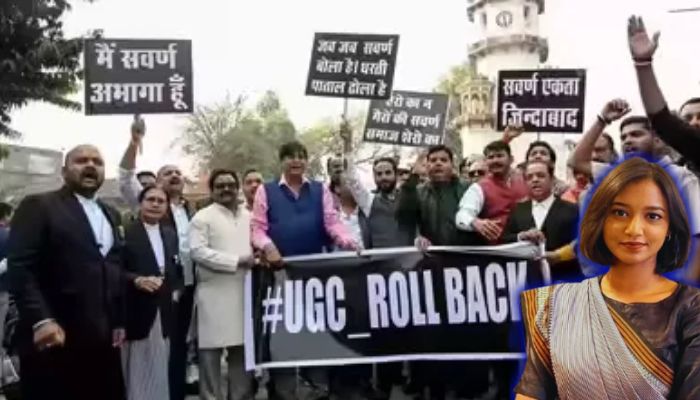
Local Hindus are demonstrating for the demolition of an unlawful mosque in Sanjauli which is near Himachal Pradesh’s capital Shimla. The Hindu Sangharsh Samiti asserted that the Congress government in the state has failed to act, despite directives from both the Shimla Municipal Corporation and the Sessions Court. In fact, the court ruled the mosque as an illegal structure and even mandated its demolition.
Due to protests from locals, no one is permitted to conduct prayers there. The OpIndia team visited the site and engaged with the residents to gain insight into their views.
The people stated that the victors to the illegal mosque often harass Hindu women and girls as they walk along the road. The sole access route to the mosque passes through a Hindu-inhabited area. Multiple incidents of voyeurism, stalking have been reported by locals, stating that some mosque visitors even peek inside Hindu houses and pass comments on women.
OpIndia also went to the mosque to talk with the Muslim cleric and learn about his perspective on the situation. However, neither the mosque committee member nor the imam was willing to comment, despite considerable efforts.
There was another staircase next to the unauthorised structure which we used to converse with a man. He immediately refused to talk when the journalist’s name was mentioned. He provided a phone number and several attempts were made to get in touch with the person who refused to speak and the call was cut off.
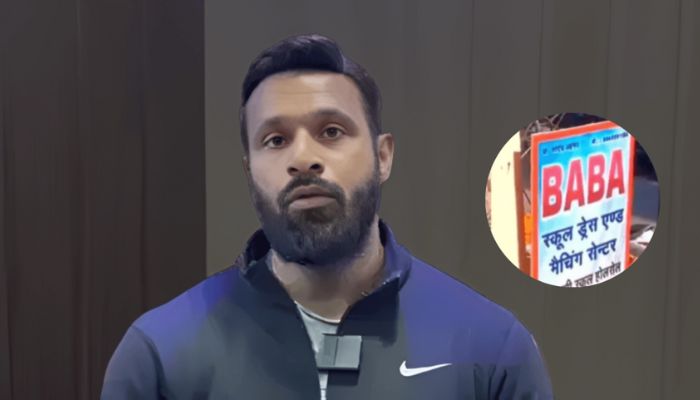
The call was terminated when we inquired about the response over the allegations. In an interview with OpIndia, local resident Rajkumar Sharma remarked that the construction of this mosque progressed at a slow pace. A primary school previously occupied this location and he was also a student there. The institution eventually relocated to Dharamshala. After some time, small mounds began to appear on this site as a small mosque came into existence which expanded over time.
This is the reason the lower floor of the mosque is plastered while the walls of the upper two floors were left unplastered. The first floor was built first and the two additional floors were added afterward. Prayers are conducted on the lower floor and the cleric stays on the upper levels. Two extremely dirty washrooms can be found upon entering the mosque. The area for performing ablution is also very filthy.
According to Rajkumar, the surrounding area is primarily Hindu and Muslims gathered in proximity to the mosque following its construction. They travel from distant locations to offer their prayers at this mosque. The route leading to this site includes a staircase and a mere glance at this pathway revealed that it was designed for the passage of a limited number of people.
"प्राथमिक स्कूल बना मस्जिद, सलीम टेलर ने इकट्ठा किए मुसलमान"
खिड़कियों से अब करते हैं आसपास के घरों में ताक-झाँक, बच्चियों को कहते हैं 'माल' @Anurragmishra को शिमला की अवैध मस्जिद के पास रहने वाले स्थानीय व्यक्ति ने बताई परेशानी! pic.twitter.com/mTcHmfroDL
As the OpIndia team progressed further, they attempted to speak with several individuals. RK Singh, a healthcare professional, noted that both the Bharatiya Janata Party and Congress governments have remained in power in the state. He raised the question of where the government was during the construction of the mosque.
Singh outlined that the matter is currently before the court, however, the government bears responsibility for the unlawful building. He added that the law applies equally to all citizens of the nation. Hence, everyone should await the court’s verdict and the mosque should be dismantled if it is pronounced illegal.
We had a discussion with Ravi Kumar, a nearby vegetable vendor. He indicated that some individuals are calling for the mosque’s removal. He has been living in this locality since 1990 at which time a small mosque was present. A significant number of Kashmiris, along with other outsiders, visit there to offer their prayers. He expressed that this matter should be resolved in line with constitutional guidelines.
While walking along the path, the OpIndia team noticed a collection of small houses in the vicinity. Hindus have lived in this area for many years. Out of concern for potential controversy, these people appeared reluctant to talk about the issue. Several closed their doors promptly when their names were mentioned. This reflects the scale of fear that the residents experience.
The presence of a mosque in this area raises considerable concerns, particularly given the absence of a Muslim community there. Additionally, the mosque does not align with the local cultural practices. The first floor is finished with plaster, while the upper two floors remain unplastered. Reaching the mosque necessitates ascending a flight of stairs and Hindu residences are situated on either side of the pathway.
According to the local populace, individuals from the mosque frequently peer into the windows of residences as they proceed to their prayers. They have been reported to intimidate females who are walking by. As a result, the residents are determined to see the mosque relocated at any cost.
The violence that took place during the so-called anti-pollution protests, where demonstrators glorified slain Naxal commander Madvi Hidma and attacked police with pepper spray, has attracted Section 197 of the Bharatiya Nyaya Sanhita (BNS) against the attackers, which deals with acts, statements or communications that threaten India’s sovereignty, unity, integrity or security. Twenty-two attackers were booked and fifteen are currently in judicial remand. While the attackers are facing strict legal action, the digital footprint of the organisations associated with the organising groups has revealed a problematic past.
Delhi Police has added BNS section 197 in the FIR registered at Kartavya Path Police Station in connection with India Gate protest: Delhi Police
As per the Delhi Police, "The protesters were holding posters of Maoist commander Madvi Hidma (who was recently killed in the…
On 23 November, a group of protesters gathered at C-Hexagon near India Gate to demonstrate against rising pollution in Delhi. The protest was spearheaded by left-leaning student organisations, Bhagat Singh Chhatra Ekta Manch (bsCEM) and The Himkhand, which had invited several other organisations to join.
Although the protest was ostensibly about pollution, it soon morphed into propaganda as members of The Himkhand and bsCEM raised pro-Naxal slogans. They glorified the recently killed Naxal commander Madvi Hidma and shouted slogans such as “Comrade Hidma Amar Rahe”. When the police tried to intervene, the protesters not only attacked police personnel but also used pepper spray on them, causing injuries to the eyes and face.
As a result, two FIRs were registered against 22 protesters, of whom 16 were arrested. Fifteen were sent to judicial remand by Patiala House Court on Monday, while one was sent to a juvenile safe house after claiming to be a minor. Furthermore, Section 197 of Bharatiya Nyaya Sanhita (BNS) has been added to the FIRs which deals with acts, statements or communications that threaten India’s sovereignty, unity, integrity or security.
Scientists For Society distances itself
While gathering support for the protests, bsCEM and The Himkhand contacted several other organisations that have similar ideological leanings. One such organisation was Scientists For Society. After the protests were derailed from the intended topic on Sunday, the organisation issued a statement distancing itself from the pro-Naxal slogans raised at the site that led to the violence, the attack on the police and the arrests.
Source: Instagram
In its statement, the organisation said, “We want to clarify that we joined this forum solely on the issue of pollution when we were approached by Himkhand. At no point were we informed that Himkhand and bsCEM planned to raise any unrelated or adventurist slogans. As soon as we realised what was happening, we first tried to stop them; when they refused to respond, we immediately distanced ourselves from them and continued addressing the common people and carrying forward the protest separately. We also want to reiterate that this act on part of these aforementioned organisations is completely undemocratic, totally against the ethics, mandate and common minimum programme of the issue-based joint front based on the issue of pollution crisis in Delhi.”
The organisation’s problematic stance on Hidma
While the organisation distanced itself from the “adventurist slogans” glorifying Madvi Hidma, it cunningly called the killing of the most wanted Naxal an “extrajudicial killing”. Even before distancing itself from the slogans, Scientists For Society categorically called for a “high-level inquiry” into the “extra-judicial encounters of Hidma and his associate”.
Source: Instagram
They said, “While we strongly believe that there should be a high-level inquiry into the extra-judicial encounters of Hidma and his associates and we unequivocally condemn these encounters, we also believe that this was not the appropriate platform to raise this issue. Ordinary students and citizens had joined this protest specifically to address the issue of pollution.”
Examining the organisation’s ideology
OpIndia looked into the history of the organisation, which started posting on social media around November 2020, to understand its ideology and the campaigns it had participated in previously, and some problematic things came to the fore. While the organisation claimed to be pro-science and stated that it works to encourage students to pursue science, build libraries and more, there are posts that categorically put them in the list of left-leaning organisations. Of course, while it is a fact that if bsCEM and The Himkhand had invited them, it was obvious that they shared similar ideology.
Pro-Palestine narrative
On 8 November, the organisation published a post that it claimed was about pollution in Delhi. However, during the protests, they admitted to having expressed solidarity with the people of Palestine.
One of the speakers at the protest spoke about pollution in Delhi and then continued to criticise the President of the United States, Donald Trump, for suggesting there is no problem of pollution. He then brought up the issue of Palestine and said, “The biggest example today is the liberation struggle of Palestinians against the ongoing barbaric genocide. Scientists For Society along with other organisations stand in solidarity with Palestine because we cannot talk about environment without standing with the masses, without standing with humanity.”
He then praised controversial environment activist Greta Thunberg and echoed her statement that there is no use talking about climate change when thousands of children are dying on the other side. He also raised the slogan “From the river to the sea, Palestine will be free”.
Greta Thunberg is known for participating in every protest even if it is not about the environment just for the sake of a photo-op. During the farmer protests in India, she accidentally shared a toolkit that was being used to paint India in a bad light on the international platform. Though she immediately deleted the link to the toolkit, it exposed how the farmer protests were hijacked by individuals and organisations with vested agendas.
The organisation has a long history of a pro-Palestine stance. On 23 October, it criticised esSENSE for “denying genocide in Gaza”.
Coming to the pro-Palestine slogans raised by the members of SFS, “From the river to the sea” is literally a genocidal call. It specifically alludes to the territory situated between the Jordan River, marking the eastern border of Israel, and the Mediterranean Sea to the west.
People raising this slogan want the land between the two boundaries to be free of Jewish people. They want the entire land between the Jordan River and the Mediterranean Sea to be Palestine, which means they want the elimination of the state of Israel. This is clearly a call for genocide of Jews, essentially another Holocaust.
The Islamist ideology behind the slogan “From the river to the sea, Palestine will be free” is often seen as an intent of genocide. In 1966, Hafez al-Assad, the Syrian leader and father of the country’s current dictator, stated, “We shall only accept war and the restoration of the usurped land to oust you, aggressors, and throw you into the sea for good.”
Terrorist outfit Hamas, responsible for the deaths of 1,400 people on 7 October, asserts its rejection of Israel with the statement, “Hamas rejects any alternative to the full and complete liberation of Palestine, from the river to the sea,” as outlined in the organisation’s 2017 constitution.
Targeting Hindus and Diwali
On 2 November, the organisation criticised the Government of Delhi for allowing fireworks on Diwali, which was actually allowed by the Supreme Court on the government’s request. The aim of the post was not only to criticise the CM Rekha Gupta-led BJP government in the National National Capital but also to present the Hindu festival of Diwali as a major contributor to the pollution problem. Phrases like “Godi Media” were also used in the post against media houses that left-leaning organisations believe are pro-government.
Source: Instagram
Targeting Hindus and Diwali, the organisation wrote, “How could this even be possible? After all, how can a ‘Hindu’ government in a country of ‘Hindus’ stop ‘Hindu festivals’ from being celebrated, even if it means ordinary people, such as those living in Delhi NCR, fall ill or even lose their lives?”
In the aftermath of the violence, several organisations that enthusiastically joined the so-called anti-pollution protest are now scrambling to shield themselves from police action by hurriedly disowning the pro-Hidma sloganeering. Yet their own digital footprints tell a very different story. Their posts, statements and past campaigns reveal that they all belong to the same ideological cult, united by a familiar script of Naxal sympathy, Palestine activism and routine Hindu-baiting. No amount of last-minute distancing can erase what their own public record has already made abundantly clear.
Bhagat Singh Chhatra Ekta Manch, commonly known as bsCEM, is a student-led left-leaning organisation that often participates in protests linked to environmental and social issues in Delhi. However, the real agenda of the organisation has always been to propagate a pro-Naxal narrative. Recently, the group was seen at the centre of a large anti-pollution demonstration that took place on Sunday, 23rd November. While the event was presented as a campaign for clean air, it soon became clear that the agenda went far beyond environmental demands.
What made the protest controversial was not just the violence but also the slogans and posters displayed by participants. Instead of focusing only on air pollution, organisers praised slain Naxal commander Madvi Hidma, calling him a hero and raising slogans like “Comrade Hidma Amar Rahe.” For those unaware, Hidma was one of the most wanted Naxals. He was responsible for numerous attacks on security personnel and civilians. He was also the mastermind of the infamous 2010 Dantewada attack that claimed the lives of 76 CRPF personnel. Posters glorifying Maoist groups were displayed, and some participants even referred to Maoist outfits as “people’s governments”.
When the police tried to stop them, violence broke out as some of the protesters attacked police officers and even used chilli spray on them. This led to the police registering two FIRs and arresting 15 people. All of them, except one who claimed to be a juvenile, were sent to judicial remand by Patiala House Court on Monday.
?Self proclaimed 'Andolonjeevis' protesting against Air pollution in Delhi have raised 'Comrade Hidma Amar Rahe' slogan
It has become clear that these protesters don’t care about the environment, they care about Maoists. pic.twitter.com/Naj6mFzaPJ
This shifted the focus of the protest. Instead of looking like a civil movement demanding better air quality, the demonstration started appearing like a political mobilisation by left-leaning and Maoist-aligned groups. bsCEM leaders, such as Ravjot Kaur and The Himkhand, were among the main organisers. They had also held a “Press Conference on the Movement for Clean Air” just days earlier, on 14th November, indicating that their role in the protest had been planned for some time.
The sexual assault allegations against Mukundan Nair and bsCEM supported the accused
According to a report by ForPol, in 2024, a young woman accused Mukundan Nair, a member of FACAM (another Urban Naxal group), of sexually assaulting her. At the time, she was associated with Nazariya Magazine, a left-leaning collective, while Mukundan belonged to a different allied organisation.
In March 2024, Nazariya formed an internal investigation committee to look into the allegations. However, instead of taking firm action against Mukundan Nair, the committee concluded that he would undergo “rectification.” This is a term commonly used in communist spaces, but even the victim later said she did not know what it meant in practical terms.
The victim was deeply dissatisfied with the committee’s findings. She went public, saying that Nazariya was not taking her complaint seriously and was trying to protect the accused. In November 2024, instead of re-examining the case, Nazariya expelled the victim from the group.
The situation became even more disturbing when Nazariya released statements accusing the victim of being influenced by “imperialist ideology,” having “non-ideological sexual relationships,” and straying from “communist morality.” These terms had no connection to her sexual assault complaint, but they were used repeatedly to discredit her character and shift the focus away from her allegations.
The victim speaks out against bsCEM
In December 2024, the SfPD (Students for People’s Democracy) published a statement from the victim. According to the victim, several activists linked to bsCEM were directly involved in her public shaming and supported Nazariya’s actions against her.
The victim’s statement (Image via ForPol)
The victim wrote that she wanted to take legal action against those who were slandering her, but she hesitated because she had previously had negative experiences with the police.
She further said that bsCEM was part of the anti-displacement forum that had expelled Mukundan Nair after the initial complaint, yet they refused to publicly comment on the matter. She said that within a week of her expulsion by Nazariya, bsCEM had supported the decision and even assisted in spreading false claims about her.
The victim also revealed that she was slut-shamed and privately defamed by members of the group. “Supporters and enablers of sexual assault have a welcome place in this movement,” she said, pointing directly to bsCEM’s hypocrisy.
Photographs and public contradictions
In May 2025, the SfPD shared a photograph showing bsCEM members casually spending time with Mukundan Nair, even though they were fully aware of the allegations. SfPD publicly condemned bsCEM and accused them of shielding a sexual offender. They also asked pro-Palestine collectives to explain why one of their members, Rejaz, also appeared in those photos.
SfPD Statement in May (Source: ForPol)
At the same time, an old screenshot surfaced showing Baadal, a senior member of both bsCEM and FACAM, admitting that they knew about Mukundan’s offence and had removed him. Despite this, bsCEM continued to associate with him and even appeared in friendly photos months later.
SfPD used the case for their own political gain
After SfPD released its statement in May, several Urban Naxal groups, including Nazariya and bsCEM, launched a joint counter-attack against SfPD. Their joint statement accused SfPD of being part of the “Surajkund Scheme” and described them using complicated ideological terms such as “post-modernist petty bourgeoisie opportunists.” None of these accusations addressed the actual issue: why Nazariya and bsCEM had protected an accused sexual offender.
SfPD responded by pointing out that many individuals had questioned Nazariya and bsCEM online for shielding Mukundan. SfPD also said that the groups were deleting comments and blocking people on social media who raised concerns.
But it is also important to note that SfPD itself belongs to the same wider Urban Naxal landscape and has its own history of controversies. The Dharmasthala case, which they aggressively promoted, later turned out to be false. Even so, SfPD continued using the case for political gain.
This made it clear that these groups were using the sexual assault survivor’s trauma to fuel their own ideological battles, instead of focusing on justice.
When the victim went public in October 2024
The situation escalated further in October 2024, when the victim shared her experiences publicly. Right after her statement, SfPD issued its first formal statement supporting her and criticising Nazariya. They said the victim had highlighted serious issues like patriarchal structures, victim blaming, and the enabling of sexual abuse within Nazariya.
Three days later, on 24th October, Nazariya responded. They admitted there had been major lapses in their handling of the complaint, but they did not address the deeper concerns raised by the victim.
On 26th October, SfPD released another long statement, criticising Nazariya sharply. They demanded proper reforms, gender sensitisation, and structural changes within the organisation. They also accused Nazariya of protecting the people who mishandled the complaint while making the victim’s identity public. According to SfPD, the investigation committee had also judged the victim’s personal life instead of focusing on the assault.
The next day, SfPD issued yet another statement, this time targeting two Nazariya members, Nishant Anand and Val Vashri. They accused them of circulating the internal investigative report without the victim’s consent and of trying to slut-shame her by sharing graphic details of the abuse.
On 23rd November, Nazariya expelled the victim from the group completely. SfPD condemned the move and compared it to a patriarchal household where abuse is treated as a private problem, and survivors are silenced.
By early 2025, the matter had spilt over into international left circles as well. SfPD even discussed the issue in an interview with the Revolutionary Maoist Coalition in the USA. They repeated their criticism of Nazariya’s actions and again highlighted the harm caused by phrases like “sexual opportunism.”
But through all this, one thing became clear that the Urban Naxal groups involved, Nazariya, bsCEM, FACAM, and even SfPD, were using the sexual assault case as a battleground for ideological superiority.
PM Modi’s address in Ayodhya during the historic Dhwajarohan ceremony at the Shri Ram Janmabhoomi Temple was not just a ceremonial speech; it was a powerful articulation of civilisational memory, national resolve, and India’s spiritual self-confidence.
“Today, the city of Ayodhya is bearing witness to yet another pinnacle of India’s cultural consciousness. Today, all of India and the entire world are filled with the presence of Ram. In the heart of every devotee of Rama, there is unparalleled satisfaction, boundless gratitude, immense, otherworldly joy,” PM Modi said in his address.
Through a series of symbolic references and emotive appeals, Modi framed the moment as a turning point in India’s cultural and moral journey.
Here are 7 key takeaways from PM Modi’s historic speech from the Dhwajarohan ceremony at the Ram Mandir:
Healing of historical wounds
A central theme of the Prime Minister’s speech was the idea of civilisational healing. Modi repeatedly underscored that “wounds and pain of centuries are healing today,” describing the hoisting of the dharma flag as the fulfilment of a 500-year-long resolve.
The Ram Temple, in his framing, is not merely a structure of worship but the closure of a historical chapter marked by struggle, patience, and faith.
The dharma flag as a civilisational symbol
Modi elevated the saffron dharma flag beyond a ritualistic object, describing it as the banner of India’s civilisational renaissance. He highlighted the symbolism embedded in it, the saffron colour, the legacy of the Suryavansh, the sacred “Om”, and the Kovidar tree, presenting the flag as a representation of Ram Rajya’s ideals and India’s cultural resurgence.
Hailing it as a completion of a centuries-long yajna, PM Modi said, “The Dhwajarohan is the culmination of the sacred flame that burned for 500 years without wavering in faith or devotion. The divine energy of Lord Shri Ram now stands enshrined in the form of this dharma-dhwaj at the grand temple. This flag is not merely a symbol, it represents the resurgence of Indian civilisation.”
आज उस यज्ञ की पूर्णाहुति है, जिसकी अग्नि 500 वर्ष तक प्रज्वलित रही।
जो यज्ञ एक पल भी आस्था से डिगा नहीं, एक पल भी विश्वास से टूटा नहीं।
ये धर्म ध्वजा केवल एक ध्वजा नहीं, ये भारतीय सभ्यता के पुनर्जागरण का ध्वज है।
Perhaps the most politically and philosophically significant message was Modi’s assertion that “Ram is not just a person, Ram is a value.” He linked the moral framework of Lord Ram to India’s contemporary national goals, stating that for India to become a developed nation by 2047, citizens must “awaken the Ram within themselves.”
“Ram is not merely a historical or divine figure, but a living principle and a guiding value system. If India truly wants to emerge as a developed nation by 2047, every citizen must internalise and awaken the ideals of Ram within themselves, and no occasion could be more appropriate than the present moment to take such a collective resolve,” PM Modi proclaimed.
राम मंदिर का ये दिव्य प्रांगण भारत के सामुहिक सामर्थ्य की भी चेतना स्थली बन रहा है।
यहां सप्त मंदिर बने हैं। यहां माता शबरी का मंदिर बना है, जो जनजातीय समाज के प्रेमभाव और आतिथ्य की प्रतिमूर्ति है।
यहां निषादराज का मंदिर बना है, ये उस मित्रता का साक्षी है, जो साधन नहीं, साध्य… pic.twitter.com/5GBEjKuNdm
Modi portrayed Ayodhya as more than a pilgrimage city; it was described as the land where ideals transform into conduct. He traced Ram’s journey from prince to Maryada Purushottam, using it as a metaphor for how a society rooted in values can elevate individuals into exemplars of ethical living. Ayodhya, in this narrative, becomes the spiritual capital of India’s moral imagination.
“Ayodhya is a sacred land where lofty ideals are reflected in everyday conduct. It is the city from where Lord Shri Ram began His life’s journey, setting an example for the world of how an individual, guided by social harmony and deeply rooted values, can rise to the highest standards of righteousness,” PM Modi said.
He further said, “When Shri Ram departed from Ayodhya, He did so as a prince, but when He returned, He was no longer just royalty, He had become the embodiment of moral excellence, revered as Maryada Purushottam.”
Call for social harmony, not division
Contrary to critics who often view the Ram Temple through a political lens, Modi emphasised unity over division. He stressed that “Ram unites through emotion, not division,” and that devotion, not lineage, is what matters. His appeal to visit the Sapt Mandapam, which symbolises faith, friendship, duty, and social harmony, was aimed at grounding the movement in ethical and social cohesion rather than triumphalism.
Congratulating devotees and labourers who constructed the Ram Mandir
Another notable element was the emphasis on inclusive devotion. Modi cited scriptural belief that even those unable to visit the temple, but who pay respect to the temple flag from afar, receive the same spiritual merit. This broadened the scope of participation, making the Ram Temple a shared spiritual moment for Hindus worldwide, not limited by geography or access.
PM Modi said, “Our scriptures teach that even those who are unable to physically visit the temple, but offer their reverence to the temple flag from a distance, receive the same spiritual merit. The flag is a powerful symbol that would allow devotees to feel connected to the birthplace of Ram Lalla even from far away, it would carry the message, guidance, and inspiration of Lord Shri Ram to people across the world for generations.”
Acknowledgement of collective effort
The Prime Minister concluded by shifting the spotlight away from himself and towards the collective national effort. He thanked devotees, labourers, artisans, architects, planners, and workers, acknowledging the Ram Temple as a product of mass devotion and national cooperation rather than political will alone.
PM Modi’s Ayodhya speech was crafted as a civilisational statement, not just a religious address. By blending faith with national development, history with aspiration, and devotion with discipline, he positioned the Ram Mandir and its Dhwajarohan ceremony as a symbolic foundation for India’s journey towards 2047 and beyond.
For the first time in recorded history, that is thousands of years, a volcano in northeastern Ethiopia has erupted, sending dense ash plumes up to 14 kilometres into the sky and across the Red Sea towards Yemen and Oman. Hayli Gubbi volcano in the earthquake-prone Afar region of Ethiopia, which is almost 800 kilometres northeast of Addis Ababa (capital city of the country), erupted on the morning of 23rd November at 8:30 am.
The nearby village of Afdera was also coated in ash as the explosion continued for several hours.
Hayli Gubbi volcano, in Ethiopia’s north-eastern region has erupted for the first time in 10,000 yrs & it is impacting flights as far as Delhi. DGCA, India's aviation regulator has asked airlines to avoid region impacted. Plumes are expected to reach western & northern India pic.twitter.com/yHJH6APzZJ
According to reports, there were no injuries but the eruption might have an impact on the cattle herders in the area. The 500-meter-high volcano is located in the Rift Valley, a region of intense geological activity where two tectonic plates converge. The last eruption of the volcano, which is located in Ethiopia’s Erta Ale Range, might have occurred between 10,000 and 12,000 years ago.
Volcano in northeast Ethiopia has erupted for the first time in nearly 12,000 years, sending thick plumes of smoke 14 kilometres into the sky, and ash clouds toward Yemen and Oman pic.twitter.com/edZCp6TFbW
A local reported hearing a loud noise and what he characterised a “shock wave” and added, “It felt like a sudden bomb had been thrown with smoke and ash. Many people were left stuck in Afdera as they were moving to the Danakil desert, a popular tourist destination in the area.
A volcano in Ethiopia’s northeastern region erupted for the first time in nearly 12,000 years, sending thick plumes of smoke up to 14 kilometres (nine miles) into the sky. pic.twitter.com/2p0zIV5MpH
According to the Smithsonian Institution’s Global Volcanism Program, Hayli Gubbi has not had any known eruptions during the Holocene, which started at the end of the last ice age approximately 12,000 years ago. It “has no record of Holocene eruptions,” informed Michigan Technological University professor and volcanologist Simon Carn.
According to experts, Hayli Gubbi is a shield volcano, similar to Mauna Loa in Hawaii. Instead of producing enormous columns of ash, these volcanoes are recognised for their seeping lava flows. “To see a big eruption column, like a big umbrella cloud, is really rare in this area,” expressed Juliet Biggs, an earth scientist at the University of Bristol in England, reported Scientific American.
A satellite image shows ash rising from the eruption of the Hayli Gubbi volcano in Ethiopia. (NASA Handout via Reuters)
The Toulouse Volcanic Ash Advisory Center (VAAC) conveyed that ash clouds from the current explosion also passed over northern Pakistan and India. Southwestern Arabia, which includes Yemen and Oman are also going to be impacted.
The plume initially entered India over western Rajasthan, according to weather trackers. The plume covered portions of Delhi, Haryana and Rajasthan by the late evening of 24th November. According to forecasters, the volcanic ash was set to hit Gujarat by 10 pm and then northwest Maharashtra, Delhi, Haryana and Punjab before affecting the Himalayas and other areas. The ash plum finally spread into China from Northern India.
The Indian authorities advised people to “just wear a mask and AQI levels will be somewhat impacted but plume is mostly in lower-mid atmosphere and going up. Expected Flight delays and changes in flight plans if based in Mumbai & Delhi ATC (Air Traffic Control) IFR (Instrument Flight Rules). The sky may look like a duststorm is in progress.”
DGCA issues advisory
The Directorate General of Civil Aviation (DGCA), India’s aviation regulator issued a warning to airlines and airports of potential disruptions caused by the volcanic ash drifting over northern India. It pointed out that the Volcanic Ash Advisory Centre in Toulouse and the Airport Authority of India have issued a volcanic ash advisory and an ASHTAM warning of hazardous conditions.
A special notification known as an ASHTAM is sent to aviation operators when an ash cloud or volcanic eruption could endanger planes. DGCA has directed all flight operators to go over the volcanic ash protocol operational manuals and inform all relevant staff. It advised airlines to modify flight planning, routing, and fuel considerations in accordance with the most recent advisories, and to rigorously avoid publicised volcanic ash affected areas and flight levels.
It added that airlines have been told initiate internal safety risk management procedures and report any potential ash encounter, including abnormal engine performance or smoke or scent in the cabin. The DGCA has requested that the operators maintain ongoing surveillance of the volcanic ash cloud situation and stay informed, among other things, by using satellite imagery and meteorological data.
The authority has mandated that the operators inspect runways, taxiways and aprons right away if volcanic ash interferes with airport operations. It outlined, “Depending on the contamination, the operations may be restricted, and cleaning procedures have to be completed before resuming movements.”
There has already been a major disruption to air traffic due to the volcanic eruption. The volcanic ash concern has caused flights to be cancelled by a number of airlines, including KLM, IndiGo and Akasa Air.
Airlines on alert
The eruption has forced the diversion of several flights to and from India. The ash plumes are predicted to have an impact on Delhi and Jaipur. They were predicted to reach in Jamnagar of Gujarat, at 5:30 IST (Indian Standard Time), therefore Indian aviation officials are on high alert. Due to the anticipated plumes, Indigo’s Kannur-Abu Dhabi 6E1433 flight was diverted to Ahmedabad on 24th November, affecting all flights in that region. An Indian carrier’s aircraft that touched down in Abu Dhabi underwent inspection, before it was allowed to return to the country.
IndiGo, Air India and Akasa Air reassured passengers that safety is their first priority. “Our teams are closely tracking the situation in coordination with international aviation bodies. We are fully prepared with all necessary precautions to ensure safe and reliable operations. Our 6E teams are available across all touchpoints to support you with any assistance you may need. We will continue to monitor the developments round the clock and keep you informed of any updates to help minimise inconvenience (if any),” IndiGo shared on social media.
Following the recent eruption of the #HayliGubbi volcano in #Ethiopia, ash clouds are reported to be drifting towards parts of western India. We understand that such news may cause concern, and we want to reassure you that your safety remains our highest priority.
“We are closely monitoring the situation and remain in constant touch with our operating crew. There is no major impact on Air India flights at this time. We will take all necessary steps under our precautionary plans to ensure the safety of our passengers, crew and aircraft, which remains our top priority. Our ground teams across the network will continue to support passengers and keep them updated on their flights,” stated Air India
Following the volcanic eruption in Ethiopia, ash clouds have been observed over certain geographical regions. We are closely monitoring the situation and remain in constant touch with our operating crew. There is no major impact on Air India flights at this time.…
Akasa Air likewise mentioned, “We are closely monitoring the volcanic activity in Ethiopia and its potential impact on flight operations in nearby regions. Our teams will continue to assess the situation in compliance with international aviation advisories and safety protocols and take necessary actions as required.”
#TravelUpdate We are closely monitoring the volcanic activity in Ethiopia and its potential impact on flight operations in nearby regions. Our teams will continue to assess the situation in compliance with international aviation advisories and safety protocols and take necessary…
“A volcanic eruption in Ethiopia has affected airspace over parts of West Asia, which may impact some international routes. Passengers are advised to connect with their respective airlines to check the status of their flights before leaving for the airport,” noted Chhatrapati Shivaji Maharaj International Airport in Mumbai.
There have been reports of volcanic ash activity over portions of the Arabian Peninsula since the eruption. Although there have been no cautions related to the ash drift towards India, airlines have issued cautious notifications for travellers passing through the Middle East.
On 24th November, US President Donald Trump signed an executive order to establish a new federal Artificial Intelligence programme named the Genesis Mission. Modelled after the ‘Manhattan Project’, which catapulted the country to become a major atomic power, this project is meant to mobilise federal data and resources to create AI models with practical scientific impact.
“This order launches the Genesis Mission as a dedicated, coordinated national effort to unleash a new age of AI‑accelerated innovation and discovery that can solve the most challenging problems of this century. The Genesis Mission will build an integrated AI platform to harness Federal scientific datasets, the world’s largest collection of such datasets, developed over decades of Federal investments, to train scientific foundation models and create AI agents to test new hypotheses, automate research workflows, and accelerate scientific breakthroughs,” the order reads.
Today, the Department of Energy is introducing the Genesis Mission.
President Trump is launching this historic national effort to harness the AI computing revolution and double the productivity of American science within a decade. America’s Golden Age of discovery begins now. pic.twitter.com/ZBGCKvax08
The Department of Energy has been directed to convert the national lab system into an integrated stack that provides high-performance computing resources, Domain foundation models across physics, materials, bio, energy, AI agents to explore design spaces, evaluate experiments, automate workflows, Robotic/automated labs and production tools for AI-directed experiments and manufacturing, in addition, national-scale AI scientist and AI lab tech as infrastructure.
Aggressive timelines, strict deadlines: Trump’s Genesis Mission is a move at integrating AI with America’s scientific resources
As per the executive order signed by President Trump, within 60 days, the Department of Energy has to propose at least 20 national challenges in advanced manufacturing, biotechnology, critical materials, nuclear fission and fusion energy, quantum information science, and semiconductors and microelectronics.
In addition to directing the DoE to propose national challenges within 60 days of the order’s signing, the American president has also tasked the department with identifying Federal computing, storage, and networking resources available to support the Mission.
Within 120 days, Secretary of Energy is directed to “identify a set of initial data and model assets for use in the Mission, including digitization, standardization, metadata, and provenance tracking; and develop a plan, with appropriate risk-based cybersecurity measures, for incorporating datasets from federally funded research, other agencies, academic institutions, and approved private-sector partners, as appropriate.”
Moreover, within 240 days, the Energy Secretary has to ensure mapping of all robotic laboratories and automated facilities across national laboratories and production facilities with the ability to engage in AI-directed experimentation and manufacturing.
The executive order further states that within 270 days of its date, the Secretary of Energy will demonstrate an initial operating capability of the Platform for at least one of the national science and technology challenges.
In a nutshell, the goal of the Genesis Mission is to create a functioning AI-for-science loop within nine months.
With this order, the US government has decided to formalise a federal AI stack parallel to the commercial one. The DoE and other concerned authorities have been directed to align agency AI programs and datasets onto this platform, run joint funding calls and prize programs, and build partnership frameworks with external players.
This essentially opens doors for private players like Nvidia, OpenAI, Anthropic, xAI, Google, the clouds, biotech and chip companies to become potential co-developers and suppliers for the DoE AI system.
The Trump administration has been arguing that American scientific progress has stagnated despite massive federal investments. New drug approvals have declined, scientific outputs per researcher have slumped, hammering innovation, particularly in critical areas like energy and medicine.
Reliant on manual experimentation and siloed data, traditional methods are proving to be too slow in the 21st century. Trump administration has viewed AI as a transformative tool to make things better. In July this year, the US government brought the AI Action Plan, which removed regulatory barriers and stressed American leadership.
With the Genesis Mission, the Trump administration aims to coordinate the fragmented federal assets with academia and private companies to reduce reliance on foreign nations, especially China for semiconductors, critical minerals and AI technology. The Mission is also aimed at tackling surging energy costs through AI-driven advances in nuclear fusion and efficient manufacturing.
For decades after Independence, India’s political class lived inside a carefully manufactured taboo: that holders of constitutional office must behave like cultural orphans. Prime Ministers were expected to be embarrassed by temples, Presidents were advised to treat rituals as political liabilities, and lawmakers were trained to treat Bharat’s civilisational identity as something to be hidden, diluted, ashamed of or apologised for.
PM Modi did not merely challenge this taboo. He obliterated it.
His upcoming visit to Ayodhya on November 25, where he will ceremonially hoist the saffron flag atop the shikhar of the Ram Janmabhoomi Temple, is not just a religious event. It is a civilisational statement. A democratically elected Prime Minister openly participating in the spiritual life of his civilisation is no longer scandalous. And that psychological shift, more than any election, more than any policy, is one of Modi’s most under-acknowledged political achievements.
The manufactured shame of public faith
Independent India did not inherit only the British administrative system, but also a deeply entrenched colonial contempt for native spirituality. Over time, post-1947 political elites, shaped by Western left-liberal frameworks and Marxist historiography, transformed “secularism” into something alien to the Indian ethos.
In practice, this meant Hindu symbols were treated as politically dangerous, Hindu rituals were framed as regressive, and Hindu identity in public life was either downplayed or actively erased. Asserting Hindu identity, especially by an elected representative, was dismissed and discredited as ‘rising communalism’ or even worse, ‘an advent of sinister majoritarianism’.
A Prime Minister inaugurating dams and factories was celebrated as modern and progressive, while a Prime Minister indulging in piety or performing a yajna was instantly branded “communal”. A Hindu Chief Minister donning a skullcap was hailed as a beacon of India’s much-vaunted ‘secularism’, a President visiting churches was applauded as a sign of inclusivity, yet a Governor participating in aarti was criticised as a violation of “constitutional morality”. This hypocrisy was not accidental. It was systemic, carefully engineered to ensure that Hindu civilisational expression remained politically suspect inside its own homeland.
Ayodhya symbolism
Now, as PM Modi prepares to hoist the saffron dhwaj atop the completed Ram Janmabhoomi Temple, the symbolism is layered and irreversible. For the first time in independent India’s history, the Prime Minister does not behave like a cultural refugee inside his own civilisation. Faith is no longer treated as a weakness or a liability in the practice of governance. Religion and constitutional duty are no longer projected as natural enemies that must exist in permanent tension.
Here’s a man who is not shy of wearing his identity on his sleeve and practising his faith openly, without seeking validation from anglicised elites or apologising to leftwing secularists who have long tried to shame Hindus into silence.
This moment represents not “majoritarianism”, as critics insist, but civilisational normalisation, an organic correction of an artificial psychological imbalance that was imposed for decades.
Sengol installation in the new Parliament
The installation of the Sengol in the new Parliament exposed how deeply distorted India’s self-perception had become. The sceptre that symbolised the historic transfer of power from British hands to Bharatiya hands, sanctified by Tamil Shaivite Adheenams, had been reduced to a museum artefact and casually described as nothing more than a “walking stick”. This was not a harmless oversight; it was ideological vandalism.
By restoring the Sengol to the heart of the legislature, Modi did far more than honour a forgotten object. He restored the grammar of Dharma to the very idea of Indian statehood. The Vedic chants inside Parliament, the Ganapati Homam before the exercise of legislative power, and the consecration by saints were not attempts to mix religion with the state. They were acts of decolonisation, reclaiming a civilisational consciousness that had been deliberately buried under borrowed Western political frameworks.
Faith and Constitution section
One of independent India’s most successful intellectual frauds was the false narrative that devotion and democracy were incompatible. Citizens were conditioned to believe that spiritual depth made leaders undemocratic, that faith made governance unconstitutional, and that reverence for civilisational identity somehow translated into political extremism.
PM Modi’s open and unapologetic religiosity shattered this artificial binary. By meditating in Kedarnath caves, performing rituals at Badrinath, participating in Ayodhya ceremonies, and allowing Vedic rites inside Parliament, he demonstrated that the Indian Constitution does not demand cultural amnesia. It does not require Prime Ministers to become atheists, nor does it outlaw spiritual rootedness. Modi simply exercised rights that every Indian citizen already possesses, and he did so without embarrassment. That is what truly unsettled the old ecosystem.
Reclaiming Bharat
The modern Indian Republic was constructed with institutions, but it was deliberately stripped of civilisational confidence. Over time, the state stopped viewing itself as the inheritor of an ancient and living civilisation and instead behaved like a post-colonial entity uncertain of its own legitimacy. This imposed amnesia was not natural; it was cultivated.
Modi reversed that psychological trajectory. The Kashi Vishwanath Corridor redevelopment, the reconstruction of Kedarnath, the Ram Temple in Ayodhya, and the installation of Sengol in Parliament are not isolated acts of cultural symbolism. They represent an underlying civilisational reorientation. Bharat is no longer pretending to be a rootless republic born in 1950. It is rediscovering continuity with a civilisation that predates all colonial and ideological impositions.
Modi as practitioner
Before assuming office, Narendra Modi was a practising and observant Hindu, and that identity did not disintegrate when he entered public life. Unlike leaders who performed rituals awkwardly for political optics or limited their faith to election-season photographs, Modi’s religiosity is lived rather than staged. It is embedded in discipline, routine, and personal conviction.
When he worships, it does not come across as signalling. When he fasts, it does not appear calculated. When he chants, it does not seem tactical. This authenticity has deeply unsettled those who built careers portraying Hindu spirituality as politically dangerous. Because Modi did not merely display faith; he normalised it in the highest office of the land.
Shifting the Overton Window
Perhaps Modi’s most underestimated achievement is not administrative or electoral, but psychological. He shifted the Overton window of what is considered socially and politically acceptable in Indian public life. Two decades ago, the idea of a Prime Minister chanting Vedic mantras inside Parliament would have triggered constitutional panic. Today, it is increasingly perceived as normal.
Earlier, a Prime Minister openly participating in temple rituals would be framed as polarising. Today, it is increasingly recognised as authenticity. This shift did not occur through speeches or messaging alone. It happened through consistency, conviction, and the legitimacy of popular mandate, which forced the old narrative frameworks to collapse.
Healing a wounded civilisation and ending the imported shame
The Ram Mandir was never just about stone, mortar, or architecture. It was about collective memory, historical humiliation, and civilisational survival. It told a civilisation that: Your memory matters. Your wounds were real. Your struggle was not illegitimate. For centuries, Indic civilisation endured systematic cultural assault, through iconoclasm, invasions, colonial exploitation, and later, ideological suppression by post-Independence elites.
Through his actions, PM Modi has created a new unspoken pact between the Indian state and its people. Under this pact, people will no longer have to be ashamed of their faith. They will not have to hide their identity, and they will not have to apologise for following their traditions and rituals. And in return, the state will no longer act like an alienated power structure.
This is not a theocracy. This is a civilisation remembering itself.
The Pran Pratishtha of Ram Lalla was not the culmination of a movement. It was the beginning of psychological repair. It told a long-silenced civilisation that its trauma was real, its memory was legitimate, and its perseverance was not in vain. It marked the slow reversal of enforced civilisational shame.
The taboo is dead. The civilisation is awake.
PM Modi has not fused religion with the state. He has restored honesty between the state and the civilisation it governs. Faith is no longer treated as something that must be hidden behind closed doors. Cultural identity is no longer something to be apologised for. Governance is no longer spiritually embarrassed.
The taboo that public representatives must be culturally neutered to be constitutional has been shattered. A Prime Minister hoisting the saffron flag atop the Ram Temple, a Parliament consecrated with Vedic chants, and a symbol of Dharma overlooking legislative power are not regressions. They are civilisational corrections.
The era of imported shame is fading. The civilisation is remembering itself. And the taboo is gone for good.
India’s Defence Minister Rajnath Singh sparked a political debate on Sunday (23rd November) with his remarks about Sindh, the region that today lies inside Pakistan. Speaking at an event organised by the Sindhi community, he said that while Sindh may not be a part of India at the moment, “civilisationally, Sindh will always be a part of India,” adding that borders are not permanent and “may change in the future.” His comments immediately drew sharp criticism from Pakistan, which condemned the statement as “delusional” and “dangerously revisionist.”
During his speech, Singh referred to a quote by veteran BJP leader Lal Krishna Advani, who had written about how Sindhi Hindus of his generation still felt the pain of losing Sindh during the Partition. Singh said that the Sindhi people have always shared a deep emotional and cultural connection with the Indus River, explaining that for Hindus, the river has been sacred for thousands of years. He added that even many Muslims in Sindh once considered the waters of the Indus to be as holy for them as Aab-e-Zamzam in Mecca.
#WATCH | Delhi: Defence Minister Rajnath Singh says, "…Today, the land of Sindh may not be a part of India, but civilisationally, Sindh will always be a part of India. And as far as land is concerned, borders can change. Who knows, tomorrow Sindh may return to India again…"… pic.twitter.com/9Wp1zorTMt
He repeated the same thought twice during his address, saying, “Today, the land of Sindh may not be a part of India, but civilisationally it will always remain Indian. And as far as land is concerned, borders can change. Who knows, someday Sindh may return to India again.” He also emphasised that people who revere the Sindhu River are “our own,” and will always remain connected to India, no matter where they live.
Pakistan rattled at Rajnath Singh’s remarks
Pakistan reacted immediately on Monday (24th November), issuing a strong condemnation through its Foreign Ministry. Islamabad, rattled by Singh’s remarks, described them as “delusional” and accused India of promoting an “expansionist Hindutva mindset” that threatens regional peace. The Pakistan government grumbled that his words violated international law, crossed diplomatic boundaries, and challenged the sovereignty of recognised borders.
In its official statement, Pakistan warned New Delhi against making provocative remarks. It said Indian leaders must refrain from issuing comments that could increase tensions in an already sensitive region. The statement further insisted that instead of making such claims, India should focus on addressing internal issues and ensuring the safety of its minority communities.
— Ministry of Foreign Affairs – Pakistan (@ForeignOfficePk) November 23, 2025
Pakistan’s Foreign Ministry also used the opportunity to rake up other political issues. It held forth that India must hold accountable those involved in violence against minorities and should work towards correcting what it called “faith-based prejudice” and “historical distortions”, even though Pakistan’s own record of protecting minorities has been awful. The press release went on to mention the grievances of India’s northeastern states and claimed that several communities there face “systematic marginalisation and identity-based persecution.”
Islamabad also linked the issue to Kashmir, urging India to take “credible steps” to resolve the dispute in accordance with UN resolutions. The press release concluded by stating that Pakistan would continue to protect its security, sovereignty, and national independence, and is committed to resolving all disputes peacefully, but only based on justice and international law.
Sindh’s deep civilisational link with India
Sindh is not just a geographical region; it is a major part of India’s ancient civilisational roots. The Indus River, or the Sindhu, flows through this land and has shaped the culture, agriculture, and early settlements of the entire region.
For thousands of years, communities living along the Sindhu developed some of the world’s earliest urban cultures. Many of India’s oldest stories, spiritual traditions, and cultural practices originated in the region that we today call Sindh. From the Indus Valley Civilisation to the epics, the land has remained closely tied to India’s consciousness.
India’s connection with Sindh is geographical, linguistic, cultural, mythological, and historical. The region was once a key part of ancient Bharatvarsha, and its name appears in several old Indian texts. Even our national anthem continues to include “Sindh,” showing the deep roots that the region holds in India’s identity.
The name ‘Sindh’ and its link to the Sindhu (Indus) river
The word “Sindh” comes from the ancient Sanskrit term “Sindhu,” meaning the river that flows powerfully across the plains. The Sindhu is one of the most important rivers in Asian history and gave birth to multiple cultures around it. It is the source from which the region got its name, and through the region, even India got its name.
The river formed the basis of the Indus Valley Civilisation, one of the oldest and most advanced civilisations in the world. Cities like Harappa and Mohenjo-daro, with their planned layouts, drainage systems, and trade networks, flourished along its banks. The people living in these settlements had connections with other civilisations in Afghanistan, Iran, and Central Asia, making Sindh a major centre of ancient trade.
Thus, the name “Sindh” is not just a label for a province; it is directly tied to the river that shaped Indian civilisation from the very beginning.
How India got its name from the Indus (Sindhu) River
The story of India’s name also begins from the same river. The ancient Sanskrit word “Sindhu” became “Hindu” in Persian, as old Persian language did not pronounce the ‘s’ sound at the beginning of words. When the Persians came into contact with the people living east of the river, they started calling the land “Hindu,” and its people “Hindus.”
Later, when the Greeks interacted with the Persians and the regions around the Indus, the word changed again. Greek dialects often dropped the ‘h’ sound, so “Hindu” became “Indos,” which eventually turned into the word “India.” This is how the name of a river slowly became the name of an entire country.
The name “Bharat” existed from much earlier times, but “India”, the name recognised across the world, came from the Indus Valley and the Sindhu River. The ancient Greek explorer Scylax of Caryanda, who travelled down the Indus River between 550 BCE and 450 BCE, played a major role in spreading knowledge about this land to the Western world. As trade routes expanded and geographical knowledge increased, “Indos” and “India” became fixed terms for this entire region.
Scylax of Caryanda, an ancient Greek explorer, conducted an exploration of the Indus River (Image via India Today)
Over time, even the word “Hindustan” developed from the same root. “Sindhu” became “Hindu” in Persian, and Persian rulers called the land beyond the river “Hindustan”, the land of the Hindus. This name became popular across several centuries and formed an important part of India’s cultural identity.
The Indus (Sindhu) River
The Indus River, or Sindhu, is amongst the longest river systems of the world, extending over a course of approximately 3,180 kilometres. It originates near Mansarovar Lake in Tibet at a site called the “Lion’s Mouth” or Sênggê Kanbab, flows through Ladakh in India into Gilgit-Baltistan, and finally across Pakistan to the Arabian Sea near Karachi.
The Indus has six major tributaries, namely, the Jhelum, Chenab, Ravi, Beas, Sutlej, and the Indus itself. Post-Partition, water sharing between India and Pakistan was finalised under the Indus Waters Treaty of 1960, whereby Pakistan received control of the Indus, Jhelum, and Chenab, and India was given control of Ravi, Beas, and Sutlej.
Image via Pinterest
It is around this river that the Indus Valley Civilisation grew. The people of this civilisation built some of the earliest known urban settlements and advanced sanitation systems. They traded not only within the region but also with faraway places. It goes to show how important a role the Sindhu River played in shaping the early history of the Indian subcontinent.
The river continues to be of immense cultural and religious significance. Ancient texts refer to the river as a “protector” and a holy waterbody that is central to rituals, stories, and traditions.
The Indus River System stretches over thousands of kilometres and sustains millions of people. The Jhelum originates from the Verinag spring in Jammu & Kashmir. The Chenab is the largest tributary, which is formed by the successive confluence of the Chandra and Bhaga rivers in Himachal Pradesh. The Sutlej has its source from Lake Rakshastal near Mansarovar. Together, these rivers have sculpted agriculture, trade, and civilisation in the northern part of the subcontinent.
It is at the Indus River that the Indus Valley Civilisation began, and was completely dependent upon, over 5,000 years ago. This civilisation produced planned cities, its extensive drainage networks, and a sophisticated trade culture. This is why the Indus or Sindhu continues to be an abiding feature of Indian history.
Sindh in the Ramayana and the Mahabharata
The connection between Sindh and India is also reflected in our two greatest epics, the Ramayana and the Mahabharata. These stories, known across generations, speak of Sindh as an important part of the landscape of ancient India.
Sindh in the Ramayana
In the Ramayana, Sindh was part of King Dasharatha’s vast empire. When Kaikeyi demanded her two boons from Dasharatha, he told her that his kingdom stretched from Sindh and Sauvira to Anga, Vanga, Magadha, Kashi, and beyond. This shows that Sindh was considered an important region even during those times.
When Sita was kidnapped by Ravana, Rama sent search parties in all directions. One of the groups of vanaras (monkeys) went towards Sindh, which was known for its unique “swimming horses.” Later, after the victory over Ravana, Rama gave the region of Sindhu-Sauvira to his brother Bharata. Bharata’s sons further expanded their rule into Gandhara, where they built major ancient cities like Peshawar (Pushkalavati) and Taxila (Takshasila).
Sindh in the Mahabharata
In the Mahabharata, Sindh appears again in several important sections. The region was ruled by King Jayadratha, who was married to Dushshala, the sister of Kaurava prince Duryodhana. Jayadratha supported the Kauravas in the war and was known for his conflict with the Pandavas.
In one incident, Jayadratha tried to misbehave with Draupadi during the Pandavas’ exile, leading to a fierce confrontation with Arjuna and Bhima. Later, during the war, he played a key role on the day Abhimanyu was killed, which led Arjuna to take a vow that he would kill Jayadratha before sunset.
The Mahabharata also describes the Sindhu River as a powerful force and a great protector. In the Anushasan Parva, it says that bathing in the Sindhu leads the soul towards heaven. These references show that the river and the region were deeply respected in ancient Indian traditions.
Sindh in India’s National Anthem
Even today, the Indian national anthem Jana Gana Mana includes Sindh as part of the regions that constitute the Indian subcontinent. Written in 1911 by Rabindranath Tagore, the anthem reflects the geography of undivided India, long before Partition. At the time, Sindh played a major role in trade, culture, education, and politics.
Despite the Partition in 1947, the word “Sindh” has remained in the anthem. According to most historians, it is there as a signifier of India’s civilisational identity and a recognition of the subcontinent’s shared heritage: Sindhi culture, literature, music, and spiritual traditions have contributed immensely to India, and the word in the anthem serves as a reminder of that contribution.
Borders may change, but history does not
The Partition of 1947 divided India and Pakistan on political and religious grounds. Lines were drawn on the maps, and millions of people became displaced overnight. But political decisions cannot wipe out thousands of years of civilisation, culture, and shared history.
Sindh has always been linked with India through geography, culture, spirituality, and ancient tradition. The Indus River, the epics, the civilisation, and even our national anthem point to the same truth that Sindh has been an essential part of India’s identity.
On 24th November, Patiala House Court sent five accused who pepper sprayed police during anti-pollution protests to two-day judicial custody. One accused has been sent to a juvenile safe house as he claimed to be a minor. The accused will stay in juvenile custody till his age is verified.
#UPDATE | Patiala House Court remanded 5 accused in 2 days' judicial custody. The court has asked the police to file a copy of the videos in the court. The court has asked to send one accused to a safe house till his age is verified, as he has claimed to be a minor. https://t.co/Tx6x6mwsfV
The protesters were raising slogans commemorating one of India’s most wanted Naxals, Madvi Hidma, who was recently killed in an anti-Naxal operation. When the police tried to stop them, the protesters sprayed pepper spray on the police personnel, injuring them. Two FIRs have been filed against 22 attackers. Six have already been arrested and police are investigating the matter to identify the other accused.
The protest was spearheaded by Bhagat Singh Chhatra Ekta Manch (bsCEM). During our investigation into the group, we found that it is part of Campaign Against State Repression (CASR) which is a collective of 38 left-leaning organisations including bsCEM, AIRSO, AISA, AISF, APCR, BASF, BSM, Bhim Army, CEM, CRPP, CTF, DISSC, DSU, DTF, Forum Against Repression Telengana, Fraternity, IAPL, Innocence Network, Karnataka Jan Shakti, Progressive Lawyers Association, Mazdoor Adhikar Sanghthan, Mazdoor Patrika, Morcha Patrika, NAPM, Nishant Natya Manch, Nowruz, NTUI, People’s Watch, Rihai Manch, Samajvadi Jan Parishad, Samajvadi Lok Manch, Bahujan Samajvadi Manch, SFI, United Against Hate, United Peace Alliance, WSS, and Y4S.
While OpIndia is digging into CASR, we noticed two names that appeared as speakers in several press conferences organised by the collective, that are, Safoora Zargar and Asif Iqbal Tanha. These names shined among others because these two are among the accused in the larger conspiracy case in the anti-Hindu riots of 2020.
Source: Instagram
On 30th December 2024, CASR announced that there would be a press conference on 5th January 2025 with six speakers, out of which two were Safoora and Tanha. The press meeting was organised to condemn the National Investigation Agency (NIA) case commonly known as the Lucknow Conspiracy Case which the agency filed in June 2023 to probe the attempts to revive CPI (Maoist), a banned Naxal outfit.
According to media reports, the case revolved around the attempts at revival of the banned outfit by the members, sympathisers and overground workers associated with it. They reportedly were trying to regain influence in the Northern Regional Bureau (NRB) that includes states like Uttar Pradesh, Uttarakhand, Delhi, Punjab, Haryana and Himachal Pradesh.
Safoora, during the press conference, claimed that the conspiracy cases against so-called activists were an attempt by the central government to suppress dissent and called them limitless blackholes. On the other hand, Tanha called for sustained and fearless resistance against the systematic oppression.
While their statements during the press conference were linked to the arrests of so-called activists that were trying to revive a banned Naxal outfit, it is essential to recall their role in the anti-Hindu Delhi riots.
Who is Safoora Zargar and her role in Delhi riots
Safoora Zargar is one of the accused in Larger Conspiracy Case in anti-Hindu riots of 2020. She was booked under the Unlawful Activities (Prevention) Act for her alleged role in the conspiracy that led to the Delhi Riots in February 2020. She was arrested in April 2020. The Delhi Police had claimed that she was part of the conspiracy to “destroy, destabilize and disintegrate the Government of India in order to compel to withdraw the Citizenship Amendment Act (CAA) and the alleged National Register of Citizens.”
The Delhi High Court granted bail to Safoora Zargar in the Delhi Riots case in June 2020 on humanitarian grounds. After the Central Government said that it had no objections to her release, bail was granted. A regular bail was granted to Safoora Zargar after furnishing a bond of Rs. 10,000 on the condition that she will not leave the territory of Delhi without the permission of the Court and will not hamper the investigation.
Who is Asif Iqbal Tanha and his role in Delhi riots
Asif, a Jamia Millia Islamia student and member of the Student Islamist Organization (SIO) since 2014, was arrested under the Unlawful Activities (Prevention) Act in May for purportedly being a part of a larger conspiracy behind the February riots in northeast Delhi.
In fact, Asif Iqbal had admitted to orchestrating riots and a march of 2500-3000 people from Gate no.7 of Jamia Millia Islamia on December 12. He revealed that Sharjeel Imam gave a provocative speech to encourage ‘protestors’ to execute a ‘chakka jam’ on December 13.
Asif confessed to organising a ‘Gandhi peace march’ on December 15 from the Jamia metro station to the Parliament via Zakir Nagar and Batla House. He stated that the purpose of naming it after Mahatma Gandhi was to lure more people into joining the march. Reportedly, the Delhi police had set up barricades near the Surya Hotel to prevent the ‘protestors’ from surging forward. Asif Iqbal confessed to provoking people to break through the police barricades under the impression that the cops lacked the ‘guts’ to stop them.
However, his plans did not succeed as the police soon resorted to lathi-charge to disperse the unruly mob. The Jamia students then resorted to stone pelting, setting buses on fire, and creating mayhem on the streets of Delhi. As such, both the policemen and the ‘protestors’ were injured during the course of the march.
Asif Iqbal further admitted that he delivered provocative speeches at several places in the country, including Kolkata, Kota, Lucknow, Kanpur, Ujjain, Indore, Jaipur, Patna, Sabzibagh, Araria, Samastipur, Ahmedabad. Reportedly, he urged common Muslims to protest against the Indian and not to shy away from engaging in violence if such a need arose.
Asif added that JNU activist Umar Khalid had suggested the idea of blocking roads and disrupting traffic during the visit of US President Donald Trump to India. The plan of action was then executed by the likes of Meeran Haider and Safoora Zargar, which later culminated into violent riots. Besides his desire to turn India into an Islamic country, he considered the Citizenship Amendment Act (CAA) as anti-Muslim and therefore joined the students of Jamia Milia Islamia in opposing it.
About CASR
As mentioned above, CASR is a collective of 38 left-leaning organisations. OpIndia traced its origin back to November 2022 when they first posted about a public meeting in support of Naxalites including GN Saibaba, Hem Mishra, Prashant Rahi, Mahesh Tikri and Vijay Tikri.
Source: Instagram
The public meeting was held on 5th December and interestingly, Supreme Court advocate Prashant Bhushan, RJD’s Rajya Sabha MP Manoj Jha and CPI’s General Secretary D Raja were among the speakers.
Source: Instagram
Not to forget, Prashant Bhushan is closely linked to the anti-Hindu Delhi riots of 2020 as the secret meeting mentioned in the larger conspiracy case in Delhi riots was held at an address linked to him. Prashant Bhushan is also linked to the so-called anti-pollution protests where pro-Naxal left-leaning protesters raised slogans remembering Madvi Hidma.
In recent times, CASR has condemned the raids on Kashmir Times where security forces recovered ammunition.
Source: Instagram
They also condemned the killing of Madvi Hidma by security forces in anti-Naxal operations.
Source: Instagram
It is alarming to see how these organisations and individuals, several of whom have been booked under UAPA or linked to cases involving Naxal revival and the anti-Hindu Delhi riots, appear repeatedly within the same networks. The overlapping roles, shared platforms and coordinated activism raise serious concerns that warrant a deeper and more comprehensive probe. A thorough investigation is essential to understand the extent of these linkages and to ensure that such networks do not undermine national security under the guise of dissent.
Urban naxals, masquerading as anti-pollution protestors, laid siege to the India Gate on Sunday (23rd November). While championing the cause of ‘pollution’, they raised slogans eulogising slain Maoist commander Madvi Hidma and attacked the police with chilli spray.
Two rabid leftist organisations were at the helm of this carefully crafted protest, meant to glorify the ideology of Red terror while gaining mass support in the name of ‘pollution.’ These groups included Bhagat Singh Chhatra Ekta Manch (bsCEM) and ‘The Himkhand’.
Urban naxals in India are now weaponising climate change and environmental activism to promote left-wing extremism and undermine the nation’s sovereignty and territorial integrity.
Protest is on Delhi Pollution
Slogans- "Comrade Hidma Amar Rahe"
The real protest is against Killing of Naxalite Hidma who has killed hundreds of our Jawans.
These "Laal Salam" Communists celebrated when Hidma led attack on on 75 CRPF Jawans in 2010.
The Himkhand operates two accounts on Instagram – one which goes by the username ‘thehimkhand‘ and the other with the username ‘the.himkhand.’ A cursory glance at its posts reveal that the leftist outfit has been active since May 2024.
While it started out as an outfit fighting ‘climate change’ and ‘environmental disruptions’, the organisation did not take long to co-opt regional politics and anti-establishment narratives.
Days after the Ladakh administration cancelled the land allotment to Sonam Wangchuk-led Himalayan Institute of Alternative Learning (HIAL) over gross irregularities, the activist sought to create anarchy and chaos in the region by raking up the cause of ‘Statehood’ and provoking violence.
Around the same time in October this year, ‘The Himkhand’ was championing the cause of the ‘Ladakh movement. Not just that, it was actively rationalising violence too.
“The protestors’ act of torching the BJP office is a symbolic rejection of the party’s model of anti-Himalayan development. The people of Ladakh have delivered their mandate,” read one of the posts uploaded on 5th October this year.
Screengrab of the Instagram post by The Himkhand
In another post, the leftist outfit attempted to justify violence as mere constructs designed by ‘ruling class to restrict action.’
Coincidentally, ‘The Himkhand’ had recently invited Prashant Bhushan, a major provocateur during the 2020 anti-Hindu Delhi riots as a speaker for an event on ‘air pollution.’
It’s crystal clear that Bhagat Singh Chhatra Ekta Manch and ‘The Himkhand’ are working in tandem to incite violence, glorify red terrorism in the garb of climate activism.
Screengrab of the post by The Himkhand
It must be mentioned ‘The Himkhand’ has been the frontrunner in opposing and thwarting development projects such as the Char Dham Railway project under the garb of ‘environmental conservatism.’
With Operation Kagar reaching its conclusion and elimination of Red terror, urban naxals and their associated outfits are now championing different socio-economic causes as a last resort to brainwash and indoctrinate people.