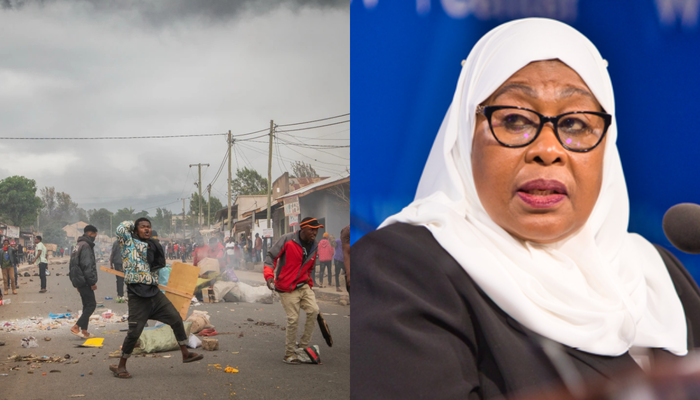
Hundreds of people were charged with treason on Friday (7th November) by a Tanzanian court in the aftermath of massive protests last week. Over 200 have reportedly been charged by the court for inciting demonstrations with the intention of obstructing the election, which was termed as “compromised” by the African Union election observers.
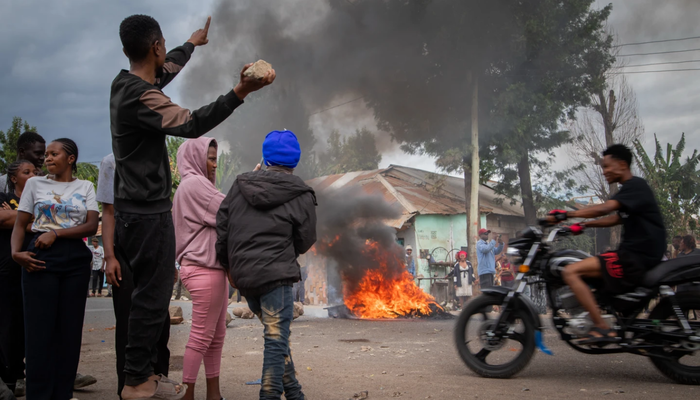
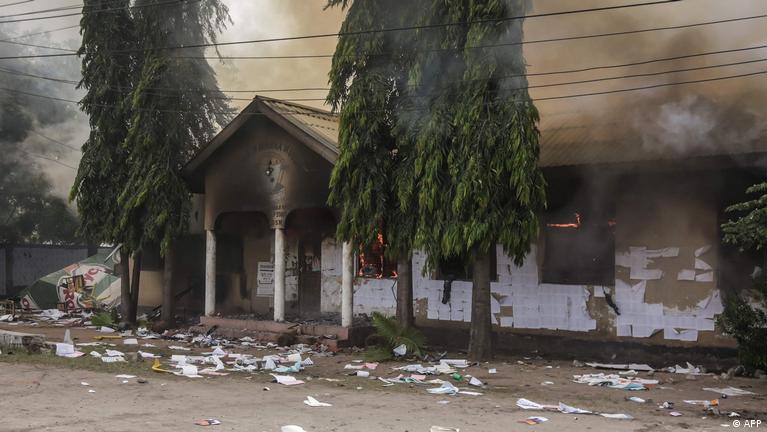
Elections were held in the East African nation on 29th October, in which President Samia Suluhu Hassan was declared the winner with 98% of the vote. However, the opposition was barred from contesting the elections, which is why it denounced the elections as “sham”. As per reports, violent protests erupted across the country on the day of the election, during which hundreds of people are said to have been killed. A six-day internet shutdown was imposed by the authorities in view of protests. Some reports state that the authorities downplayed the scale of violence and claimed that the election process was free and fair.
Image via AP
The opposition accused the government of hiding numbers
The opposition party, Chadema, accused the government of hiding the death toll and claimed that at least 800 people were killed in the election violence. Some reports, based on diplomatic and security inputs, suggest that the number could be in thousands. Notably, the Tanzanian authorities have not released any official information about the deaths.
Chadema party’s secretary, Amos Ntobi, said that hundreds of people died in the northern Mwanza region alone. “We saw people being shot in broad daylight. There were bodies all over the streets – some people were killed instantly, others were left badly wounded. There are so many bodies in the hospitals,” Ntobi reportedly said. Ntobi added that he attended at least nine funerals, including those of two children aged 9 and 11. One of the children was shot near his house, and the other was killed while returning from a shop. He said that many people were shot dead and several others were beaten to death.
Violence hit Tanzania after protests over what people alleged was a sham election
NGOs allege excessive use of force by Tanzanian authorities
A joint statement was reportedly released by seven NGOs, including the Legal and Human Rights Centre (LHRC), which stated that there was “excessive use of force” by authorities against unarmed protestors. It added that several civilians were killed inside their homes, which left their families traumatised. “Families have been left traumatised, and children have witnessed violence against their parents,” the statement stated, adding that young people were targeted, in particular. The statement further said that hundreds of people were arrested by Tanzanian authorities, and many are held in detention without bail.
The accused appeared before a court in Dar es Salaam on Friday. “Some of them have been beaten, they are sick, they have not received any medical treatment,” Paul Kisabo, a lawyer with the Tanzania Human Rights Defenders Coalition, reportedly said. Kisabo said that the accused would remain in detention till the next hearing as they are charged with a non-bailable offence. The accused reportedly included a prominent Tanzanian businesswoman, Jenifer Jovin, who allegedly instigated protestors and advised them to wear gas masks to protect themselves from the police’s tear gas.
It is reported that the accused, if found guilty, could be granted the death penalty. However, no execution has taken place in the country since the 1990s. Most of the death sentences are eventually commuted to life imprisonment.
President Samia blames foreign elements for the violence
President Samia Suluhu Hassan first assumed office in 2021, becoming the first woman President of the country, following the death of President John Magufuli. She condemned the violence and blamed foreigners for creating the unrest. Samia’s remarks have instilled fear of safety in Kenyans living in the country. This led to Kenya’s Foreign Minister Musalia Mudavadi urging his Tanzanian counterpart to ensure the safety of Kenyans living in the country.
Tanzania and Kenya are core members of the East African Community (EAC). The relations between the two countries were strained in May this year over Tanzania’s treatment of Kenyans who had gone to Dar es Salaam to observe the treason trial of opposition leader Tundu Lissu.
On 6th November, Kushinagar District Court convicted Moinuddin Ansari of raping a minor and sentenced him to lifetime imprisonment along with Rs 5 lakh fine. Justice Dinesh Kumar-led single-judge bench pronounced the judgment.
Ansari was caught on camera committing a serious crime against a college student at the institution where he was employed as a faculty member. After the video went viral, Ansari was arrested and booked under Section 64(2) and 351(3) of Bharatiya Nyaya Sanhita, and Sections 5(c) and 6 of the POCSO Act. The victim stated in court that Ansari, who was a faculty member at her school, gave her a drug-laced snack in his office within the school premises. She described entering an unconscious-like state after consuming it, during which Ansari assaulted her. The video depicting the incident was shared on the village WhatsApp group, from where the principal saw it.
During the hearing of the case, the court heard testimonies of ten witnesses including the victim, her father, police officials, Dr Vinisha who examined the victim, principal of the college Santosh Kumar Verma and others.
OpIndia accessed the judgment in the case.
Background of the case
On 8th April, it was reported that Kushinagar Police arrested a college teacher named Moinuddin Ansari was allegedly raping a Hindu minor girl. He was caught on camera raping the girl inside institution’s premises.
Kushinagar police have confirmed the incident and stated that they have taken cognisance of the social media post. A police investigation found that the video is from the Krishak Intermediate College, Malludih, under Kasaya police station limits.
About the incident
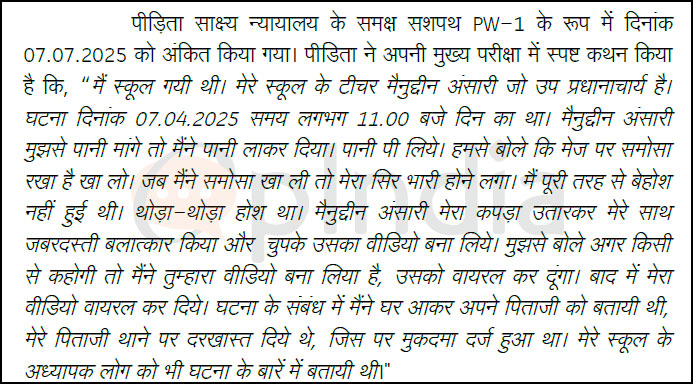
According to the court documents, the incident took place on 7th April 2025 at around 11 AM. The victim, who is 17 years old, had gone to the Krishak Intermediate College where Ansari, who was a teacher at the college, asked her to bring water and to eat a samosa that was there on the table. The victim ate the samosa and soon after went into an unconscious-like state. Ansari took advantage of the situation, removed her clothes and raped her. He made a video of the heinous act and threatened the victim that if she tells anyone about it, he would make the video viral.
What the victim said
In her statement in the court, the victim said, “I had gone to the school. Moinuddin Ansari is vice-principal at my school. The incident took place at around 11 AM on 7th April 2025. Moinuddin Ansari had asked me to bring water which I did. He then asked me to eat the samosa that was there on the table which I did as well. After eating the samosa, I started to feel dizzy. I was not fully unconscious. Ansari removed my clothes and raped me and secretly made a video.”
Source: Kushinagar District Court
She further told the court, “He threatened that if I tell anyone, he would make the video viral. When I came back home, I informed my father about the incident. My father filed a complaint at the police station and informed the college about the incident. A female police officer recorded my statement. She also took me to a government hospital for medical examination. My statement was recorded in front of the magistrate in a closed room. When the incident took place, I was 17 years old and studying in class 12.”
Statement by the medical examiner
In her statement, the medical examiner said that the victim informed her about the incident. When she asked the victim if she was physically assaulted, she said no. The victim told the medical examiner that she was raped and was feeling pain in the private parts. The medical examination took place 49 hours after the incident.
During the examination, samples including control blood sample, buccal swab and smear, nail clipping, hair with follicles, vaginal swab and smear were taken and sent to lab for testing.
Statement by the principal
In his statement, principal Santosh Kumar Verma informed the court that he came to know about the viral video on 7th April 2025. He recognised Ansari in the video and pointed out that the incident took place in the same room that was allotted to Ansari as he held additional responsibility for sports and scouting.
What did the defence say
During the hearing, defence claimed that the case filed against Ansari was a fake one and denied all the allegations. Ansari accused the principal of giving false statement over personal grudge against him and claimed the case was filed against him as part of a conspiracy. He even claimed that the video, that had gone viral on social media, was fake.
The defence further stated it was unclear who made the video and there was no mention of the victim being under the influence of any drug in the medical report.
Defence also raised objection over the FIR as there was overwriting and claimed it was modified as part of conspiracy against him. He also pointed out there was no mention of making the video viral in the FIR. Defence further raised objection on why the victim’s brother, mother and sister were not made witnesses and questioned the authenticity of the fact that the victim went to her father to tell about the incident and not her mother or sister. The defence claimed that as no biological fluids were found or matched with Ansari, the case was fake.
Observation by the court
Notably, the court categorically said that the FIR is not “encyclopedia”. It is not essential that the FIR has all the details of the incident. The overwriting, that Ansari’s counsel raised objection on, was done by the complainant over the date “7” which, the court observed, could have been done to correct a mistake. The court further noted that people coming from rural background are not expected to take care of all the legal aspects while writing the complaint. The court said minor mistakes do not make the victim’s testimony unreliable.
Though it was unclear who made the video, the viral video of the incident was accepted by the court as evidence. Furthermore, the video was shared in a WhatsApp group of the villagers. Principal of the college, Santosh Verma, saw the video in that group.
Source: Kushinagar District Court
The court further dismissed the objection raised on not making mother, sister and brother witnesses stating that if the victim’s testimony is found to be true by the court, there is no need to make family members witnesses.
While dismissing the objection that no biological fluid was found on the victim, the court noted that sperm can be taken from the vagina of the victim even after 24 to 48 hours of the incident only if the vagina is not washed. As the medical examination was done 49 hours after the incident, the victim could have washed her private parts and taken a bath. It could be the reason no biological fluid was found.
In its judgment, the court referred to verses from the Manusmriti and Ramcharitmanas to highlight the traditional Indian perspective on the respect and sanctity accorded to women. Citing “यत्र नार्यस्तु पूज्यन्ते रमन्ते तत्र देवता” from the Manusmriti, the court noted that where women are honoured, divinity flourishes. Further quoting from the Ramcharitmanas, “अनुज बधू भगिनी सुत नारी। सुनु सठ कुमति सम ए चारी।। इन्हहि कु दृष्टि बिलोकइ जोई। ताहि बधे कच्छु पाप न होई।”, it explained that those who cast an evil gaze upon women such as one’s brother’s wife, sister, daughter, or son’s wife deserve no pardon for their act, and punishing such offenders is not considered sinful. These citations were used to emphasise how Indian scriptures have long upheld women’s dignity as sacred and inviolable.
Source: Kushinagar District Court
The court further stated, “In Indian culture, the relationship between a teacher and a disciple is not limited merely to education, but is a sacred and profound bond that promotes character building, as well as moral and spiritual growth. The teacher is regarded as a revered figure who guides the disciple on the right path and imparts knowledge. The disciple, in turn, is expected to show complete faith and respect towards the teacher and to follow their instructions with sincerity. The purpose of this tradition is to instil knowledge for self-realisation and to maintain balance in life.”
Judgment
In its verdict, the court sentenced the accused Moinuddin Ansari to lifetime imprisonment for the remainder of his natural life under Section 6 of the POCSO Act for committing sexual offence against a minor. He was also fined Rs 5,00,000 and in case of non-payment, he would face an additional two years of imprisonment. Furthermore, he was sentenced to four years of rigorous imprisonment and a fine of Rs 25,000 under Section 351(3) of BNSS with a further six months of imprisonment in default of payment. The court directed that 70% of the fine amount be provided to the victim as compensation through the District Legal Services Authority. The sentence shall run concurrently with any previous sentence awarded to the accused.
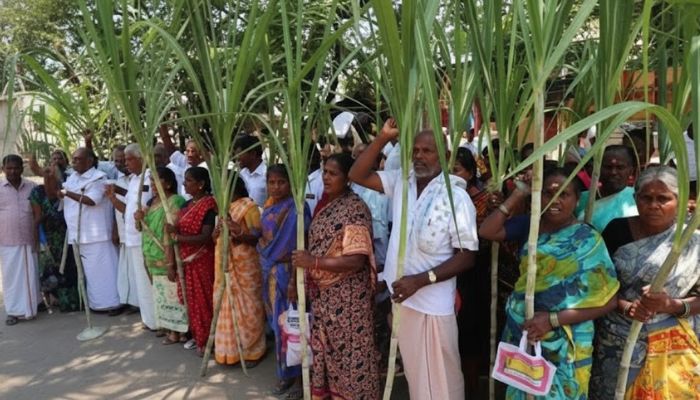
After nine days of intense protests in North Karnataka, the sugarcane farmers withdrew their protest on Friday, 7th November evening, as part of a compromise between the state government and sugar mill owners. The farmers had demanded a better price for their product, as increasing costs and production surplus made the existing rate unsustainable.
#WATCH | Belagavi, Karnataka | Farmers celebrate as the Karnataka government has fixed the procurement price of sugarcane at Rs 3,300 per tonne for the ongoing season. pic.twitter.com/R97CjND7lQ
Farmers from Belagavi, Bagalkot, Vijayapura, Vijayanagara, Bidar, Gadag, Hubballi-Dharwad, and Haveri districts had taken to the streets since October 30. They sought a higher sugarcane price than the Fair and Remunerative Price (FRP) fixed by the Central government. While the FRP for the 2025-26 season stands at Rs 3,550 per tonne for a basic recovery rate of 10.25 %, the farmers end up receiving only about Rs 2,600 to Rs 3,000 per tonne after deducting harvesting and transportation charges that together range from Rs 800 to Rs 900 per tonne.
Farmers argued that the amount was not enough to cover the rising costs of labour, fertilisers, irrigation, and fuel. They demanded a net payment of Rs 3,500 per tonne after deducting harvesting and transport expenses, saying that only this rate would make sugarcane cultivation sustainable.
Government-farmer talks and agreement
After several rounds of fruitless discussions, Karnataka Chief Minister Siddaramaiah held a seven-hour-long marathon meeting in Bengaluru on Friday with representatives of 81 sugar factories from across the state. This included 11 cooperative units, one government-run factory, and 69 privately owned mills.
By the end of the meeting, an agreement was reached to pay sugarcane farmers Rs 3,300 per tonne. As part of the deal, sugar mills will pay Rs 3,250 per tonne, while the state government will add a Rs 50 subsidy. This rate excludes harvesting and transport costs. The decision effectively increases the price by Rs 100 over the rate earlier proposed by the Belagavi district administration.
Siddaramaiah announced the decision in Bengaluru, saying, “The government and factory owners have decided to contribute Rs 50 each, ensuring that farmers receive Rs 3,300 per tonne.” Soon after, farmer leaders in Belagavi declared an end to the protests, including the highway blockade near Hukkeri, where minor incidents of stone-throwing and police intervention had been reported earlier.
Political tussle between the State and Centre
The issue also highlighted tensions between the Karnataka Congress government and the BJP-led Central government over pricing policy. Siddaramaiah wrote to Prime Minister Narendra Modi seeking an urgent meeting to discuss sugarcane pricing reforms and to allow states to fix or endorse a “net price” for farmers after harvesting and transport deductions.
ತನ್ನ ದುರಾಡಳಿತವನ್ನು ಸರಿಪಡಿಸುವುದು ಬಿಟ್ಟು @INCKarnataka ಸರ್ಕಾರ ಕೇಂದ್ರ ಸರ್ಕಾರದ ಕಡೆಗೆ ಬೊಟ್ಟು ಮಾಡುತ್ತಿದೆ. ಎಲ್ಲದಕ್ಕೂ ಮೋದಿ ಸರ್ಕಾರದ ಕಡೆಗೆ ಕೈತೋರಿಸುವ @siddaramaiah ಅವರು ತಮ್ಮ ಜವಾಬ್ದಾರಿಯನ್ನೇ ಮರೆತುಬಿಟ್ಟಿದ್ದಾರೆ.
In his letter, Siddaramaiah argued that the real problem lies in the Central policy decisions. He pointed out flaws in the FRP formula, stagnant Minimum Support Price (MSP) for sugar, export restrictions, and insufficient ethanol procurement from sugar-based feedstock all of which, he said, were hurting farmers’ earnings.
“The Centre has increased the sugar recovery rate benchmark from 9.5 % in 2017-18 to 10.25 % now, but it has not adjusted the FRP to reflect the higher costs faced by farmers,” the Chief Minister said. He urged the Centre to permit states to make pricing adjustments so that farmers could earn a fair amount.
The Union Minister for Consumer Affairs, Food and Public Distribution, Pralhad Joshi, meanwhile, advised the state government to settle the issue by holding proper consultations with farmers and mills rather than escalating the confrontation. “The state government should sit with all sides and reach an amicable solution,” Joshi said at a press conference on Thursday.
Why farmers rejected earlier price offers
Karnataka is among India’s largest sugarcane-producing states. The state produced about 5.6 crore metric tonnes of sugar in 2024, and this year’s production is expected to cross 6 crore metric tonnes due to favourable conditions. The high production, however, has led to a surplus, adding pressure on prices and factory payments.
Earlier this year, the Belagavi district magistrate had fixed cane prices at Rs 3,100 per tonne for 10.5 % sugar recovery and Rs 3,200 for 11.25 % recovery. Farmers had rejected those rates, saying they were too low to be sustainable. The revised Rs 3,300 per tonne brings some relief, though farmers have said they will continue to seek longer-term policy changes.
By Friday night, as news of the agreement spread, protests across Belagavi and surrounding regions were withdrawn. Farmers dismantled road blockades, and local leaders thanked the government for listening to their concerns. The police also released several detained protesters.
Chief Minister Siddaramaiah said that the resolution showed the government’s commitment to protecting the interests of farmers while maintaining law and order. “We have taken this decision by putting farmers’ welfare first,” he said, expressing hope that all sides would cooperate to avoid future confrontations.
With the immediate crisis resolved, Karnataka’s sugarcane farmers now look to both the state and Central governments for a lasting solution to pricing disputes that have become a recurring issue during every crushing season.
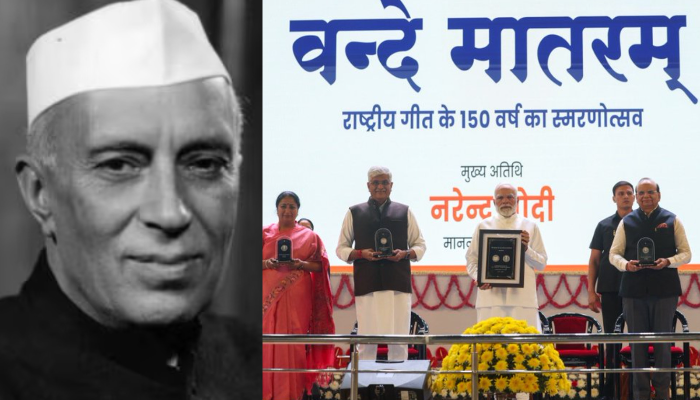
7th November 2025 marks the 150th anniversary of India’s National Song ‘Vande Mataram’. Today, Prime Minister Narendra Modi inaugurated the year-long commemoration of the iconic song at the Indira Gandhi Indoor Stadium in the national capital.
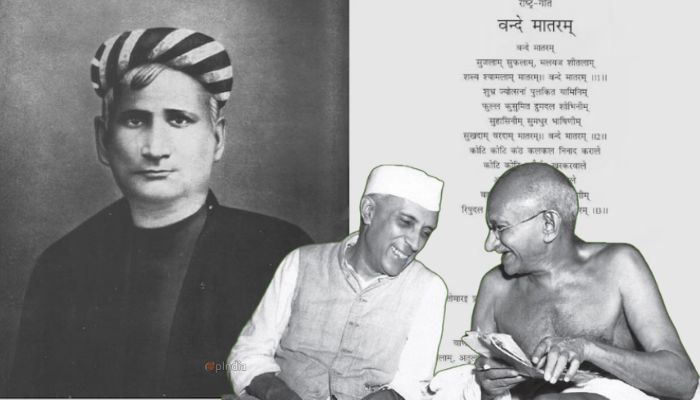
150 years ago, Bankimchandra Chatterji, also known as Bankim Chandra Chattopadhyay, wrote the Vande Mataram song on the auspicious occasion of Akshay Navami, which was on 7th November 1875. Appearing first in the literary journal “Bangdarshan” as a part of Chatterji’s iconic novel Anandamath in 1882, the song invoked the motherland as a shining embodiment of strength, unity, prosperity and divinity. The song became synonymous with devotion to Bharat.
Chatterji’s composition transcended its literary origins and became a rallying cry for freedom fighters and nothing short of a national anthem during the independence struggle. Decades later, Vande Mataram became the national song of India, connecting Indians of independent Indian with those who fought and won freedom from the British colonial rule.
In the year 1896, Gurudev Rabindranath Tagore sang the poem for the first time at the Kolkata session of the Indian National Congress. It was officially adopted as the national song by the Constituent Assembly of India on 24th January 1950. At that event, Dr Rajendra Prasad had declared that Vande Mataram should be honoured equally with the national anthem, Jana Gana Mana.
Set against the backdrop of the Bengal famine of 1770, which claimed 10 million lives, the novel Anandamath portrays a dystopian Bengal ravaged by exploitation, starvation, deaths and oppressive foreign rule.
Vande Mataram is a lyrical ode to the motherland. It personifies India as a divine feminine figure akin to Goddess Durga. Rabindranath Tagore performed the song for the first time in front of an audience in 1896 during a meeting of the Indian National Congress.
Vande Mataram and the Fakir-Sanyasi Rebellion
At the heart of Anandamath and Vande Mataram lies the Sanyasi-Fakir Rebellion of the 18th century. The rebellion was a gritty precursor to the intensified resistance against British colonial rule.
Spanning 1763-1800, the Sanyasi-Fakir Rebellion united Hindu Sanyasis and Sufi fakirs or Derveshis in guerrilla warfare against the East India Company and its puppet Nawabs in Bihar and Bengal. The rebellions torched British outposts, raided Company treasuries, and disrupted revenue collection over the British bans on pilgrim taxes, tolls and grants by Zamindars. Earlier, when Zamindars were affluent, they used to give grants to ascetics; however, since the East India Company seized the Diwani or tax collection rights, demands for tax from zamindars increased. Resultantly, the zamindars were neither able to pay taxes to the Company nor give grants to Sanyasis and Fakirs.
Back in 1771, over 150 Hindu Sanyasis were killed for no apparent reason, triggering an uproar and violence in Natore (now in modern-day Bangladesh). The Britishers deemed the Sanyasis as plunderers and wanted to stop them from collecting money from zamindars or headmen en route to shrines. Many sects of Hindu ascetics, including the Dasanami Naga Sadhus, participated in this rebellion.
Drawing heavily from the history, Bankim Chandra fictionalised the Sannyasis as secret warrior-monks in Anandamath, the abbey of bliss or sacred abbey. These warrior-monks rise against a famine-stricken Bengal struck by the dual tyrannies, British mercantilism led by Governor Warren Hastings and the misrule of Nawab Mir Qasim. The rebels chanted Vande Mataram as their rallying cry, and the song went on to become the paean of Indian resistance against British colonial rule.
Vande Mataram given a communal colour due to its critique of the Bengal Nawab’s misrule, which led to famine
Anandamath was founded during the Bengal agrarian crisis, when the region was struck by three successive famines in the early 1770s, against the backdrop of the Fakir-Sannyasi Rebellion. However, interestingly, the novel blamed the agonising conditions on the ruler Nawab Mir Qasim and charged that the state’s downfall was caused by his tacit consent to the East India Company.
In Anandamath, Bankim Chandra Chattopadhyay unflinchingly depicts the Muslim Nawab of Bengal, modelled on Mir Qasim, as an absolutely corrupt tyrant whose policies exacerbated the famine in 1770. While the scenes of Nawab’s soldiers looting granaries and oppressing peasants, while the East India Company pulled the strings from afar, the novel fuelled allegations by the Muslims that it vilified Muslims as oppressors.
This, however, was far from the truth. The Bengali Muslim elite at that time, installed by the Mughal tyrants and subsequently co-opted by the British, were indeed complicit in the oppression of common people.
Muslims had a special objection to the invocation of Maa Durga and Hindu temple imagery in the Vande Mataram song, arguing that it was idolatrous and against Islamic monotheism.
“The East India Company was then calling the shots from behind the facade of a puppet Muslim Nawab. It was rack-renting peasant surplus to augment revenues from which the Company extracted a massive tribute. The drive was so relentless that three successive droughts produced a famine of catastrophic proportions in 1770. Much of the land returned to waste and approximately one-third of the population starved to death,” noted historian Tanika Sarkar in “Birth of a Goddess: Vande Mataram, Anandamath and Hindu Nationhood.”
The account, according to her, held “the Nawab responsible not just for widespread death and starvation, but also for a deliberate and total destruction of Hindus, of their honour, faith, caste and women. In other words, it forces a split between the agents and victims of the famine: the agents are Muslims and the starving and dying people are always identified as Hindus.”
All India Muslim League to Mohammed Ali Jinnah, Vande Mataram got characterised as an ‘anti-Muslim’ song
First sung by Rabindranath Tagore in 1896, Vande Mataram evolved into a battle cry during the 1905 partition of Bengal and quickly advanced to become a strongly evocative representation of the freedom movement. However, the Muslim leadership at that time failed to see and embrace the nationalistic song beyond their narrow fundamentalist mindset. They argued that since the Vande Mataram song was an ode to Mother India, singing of Vande Mataram is against the “tenets of Islam” and a “sacrilege against Allah” because a Muslim can bow to only Allah and no one else.
Sadly, this Islamist viewpoint remains prevalent even in contemporary India, as many Muslim maulvis and Islamists in general refuse to sing Vande Mataram.
Many of the Muslim leaders in British-ruled India, who labelled Vande Mataram as some sort of ‘anti-Muslim’ or ‘Hindu nationalist’ song, ended up being the proponents of the separatist agenda that culminated in the creation of Pakistan. These Islamists not only derided Vande Mataram as idolatrous and anti-Muslim but also argued that the deification of the motherland amounts to ‘shirk’.
All India Muslim League President Syed Ali Imam while speaking at the organisation’s second session in December 1908, declared, “I cannot say what you think, but when I find the most advanced province of India put forward the sectarian cry of ‘Bande Mataram’ as the national cry, and the sectarian Rakhi-Bandhan as a national observance, my heart is filled with despair and disappointment; and the suspicion that, under the cloak of nationalism, Hindu nationalism is preached in India becomes a conviction.”
Three decades later, Mohammed Ali Jinnah, who partitioned the country on Islamic lines, echoed similar views in an article dated 1st March, 1938, published in The New Times of Lahore:
“Muslims all over India have refused to accept Vande Mataram or any expurgated edition of the anti-Muslim song as a binding national anthem.”
Muslim League members walked out and Jinnah used the episode for his divisive agenda and to rally Muslim support for the same.
Notably, the main offence over the full Vande Mataram song stemmed from the lyrics “त्वंहिदुर्गादशप्रहरणधारिणीकमलाकमलदलविहारिणीवाणीविद्यादायिनी, नमामित्वाम्नमामिकमलांअमलांअतुलांसुजलांसुफलांमातरम् (Thou art Durga, Lady and Queen, With her hands that strike and her swords of sheen, Thou art Lakshmi lotus-throned, And the Muse a hundred-toned, Pure and perfect without peer, Mother lend thine ear, Rich with thy hurrying streams, Bright with thy orchard gleams, Dark of hue O candid-fair In thy soul, with jewelled hair And thy glorious smile divine, Loveliest of all earthly lands, Showering wealth from well-stored hands! Mother, mother mine! Mother sweet, I bow to thee, Mother great and free.)
Jawaharlal Nehru truncated Vande Mataram to placate Jinnah and other Islamists
The Congress party’s ‘placate the Muslims at the cost of Hindus’ policy is not a post-independence phenomenon. Rather, the INC began to cede Hindu interests one at a time to appease Muslims, even in the pre-independence era. Since the Muslim community was offended by the Vande Mataram song due to its later stanzas mentioning Maa Durga, the Congress, instead of countering the Islamists by emphasising Bharat’s Hindu cultural and traditional foundation, chose to genuflect before the Islamist intransigence.
In consequence of Congress’s abject surrender, the Vande Mataram song was mutilated, and four stanzas were dropped out of six to satisfy those who, just years after, betrayed the nation.
It would not be wrong to say that, besides the support of Islamists, Mohammed Ali Jinnah’s biggest strength was Mohandas Karamchand Gandhi. M.K. Gandhi’s suicidal empathy for Jinnah and the ‘Muslim cause’ and undeserved attention helped Jinnah stay relevant and influential.
In 1937, Gandhi, apparently wary of alienating his Muslim ‘allies’, advocated that only the first two stanzas, which do not mention overt Hindu religious imagery, be sung. Thus, in the Faizpur Congress Session in that year, only the first two stanzas of Vande Mataram were sung. Prime Minister Narendra Modi also highlighted this fact in his speech on Friday.
PM Modi at event celebrating 150 years of ‘Vande Mataram’
He says some stanzas of the original Vande Mataram were removed in 1937 calling it a “historic injustice” that “sowed seeds of partition”
Warned against divisive ideologies that “still remain a challenge” to the nation.… pic.twitter.com/Z6ezUWZ04Q
To understand how submissively the Congress leadership acquiesced to appease Jinnah and other Islamists, one needs to go through the correspondence and addresses of India’s first prime minister, Jawaharlal Nehru.
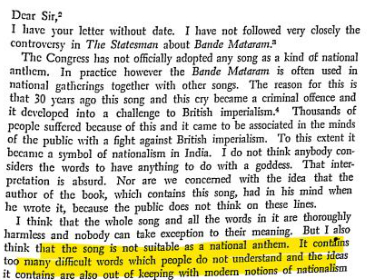
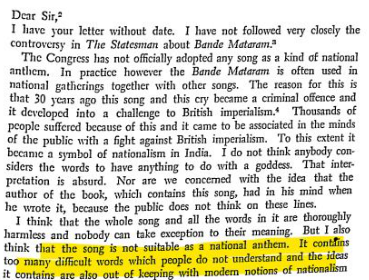
In a letter to Urdu poet Ali Sardar Jafri, Nehru stated that the song Vande Mataram is unrelated to the Congress and is “not suitable as a national anthem.”
“The Congress has not officially adopted any song as a kind of national anthem. In practice however the Bande Mataram is often used in national gatherings together with other songs. The reason for this is that 30 years ago this song and this cry became a criminal offence and developed into a challenge to British imperialism,” Nehru wrote.
Although Nehru acknowledged the popularity and significance of the Vande Mataram song in uniting Indians against the British, he further tried hard to reinforce Congress party’s secular credentials and wrote, “I do not think anybody considers the words to have anything to do with a goddess. That interpretation is absurd. Nor are we concerned with the idea that the author of the book, which contains this song, had in his mind when he wrote it, because the public does not think on these lines.”
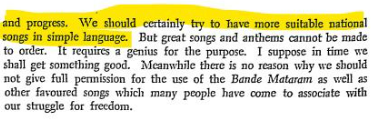
In his pursuit of distancing Congress from ‘Hindu nationalism’, Nehru went on to write, “It contains too many difficult words which people do not understand and the ideas it contains are also out of keeping with modem notions of nationalism and progress. We should certainly try to have more suitable national songs in simple language.”
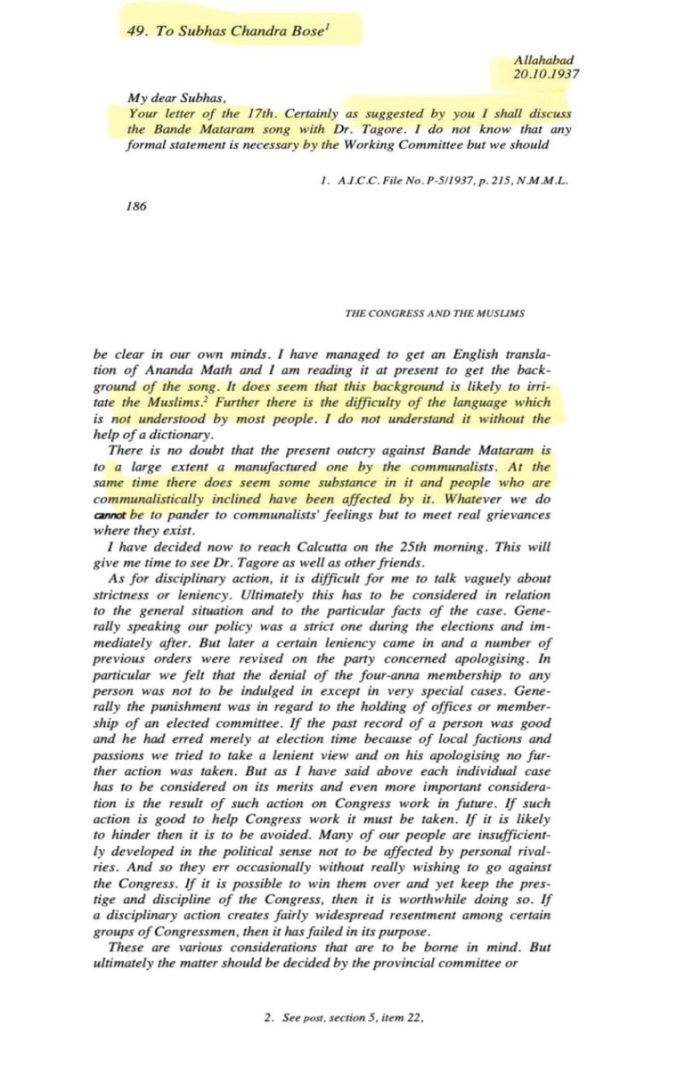
Similarly, in his letter to Subhash Chandra Bose dated 20th October 1937, Nehru said that the Vande Mataram song was meant to “irritate the Muslims.”
“I have managed to get an English translation of Ananda Math and I am reading it at present to get the back- ground of the song. It does seem that this background is likely to irritate the Muslims…There is no doubt that the present outcry against Bande Mataram is to a large extent a manufactured one by the communalists. At the same time there does seem some substance in it and people who are communalistically inclined have been affected by it. Whatever we do cannot be to pander to communalists’ feelings but to meet real grievances where they exist,” Nehru wrote.
Gandhi and Nehru’s arbitrary truncation of Vande Mataram to appease Muslims reminds of another similar doing of MK Gandhi. The corruption of the Hindu bhajan ‘Raghupati Raghav Raja Ram’ to secularise it and include ‘Allah’.
Although Gandhi is credited with popularising this hymn by using it during his famous Dandi March in 1930, the lyrics were taken from Shri Nama Ramayanan, an old religious text penned by Sri Lakshmanacharya, and modified by Gandhi.
While Gnadhi inserted “Ishwar Allah tero naam, sabko sammati de Bhagwan”, the original lyrics made no mention of Allah. Raghupati raghava rajaram, patita paavana sitaram, Sundara vigraha meghashyam, Ganga tulasi shaligram. Bhadra girishwara sitaram, Bhagat janapriya sitaram. Janaki ramana sitaram, Jaya jaya raghava sitaram.
Be it the truncation of Vande Mataram or bastardisation of Raghupati Raghava Raja Ram song, these episodes showed unmatched alacrity in stripping Hinduness of a song evoking nationalist fervour and distorting a Hindu religious song to address the reservations held by Muslims showed that just like in the post-independence Congress era, even in pre-independence times, it was always the responsibility of the Hindu majority to accommodate the demands of the Muslim minority while expecting nothing but betrayal in return.
Neither Gandhi nor Nehru nor the Congress party ever denounced the verses in the Holy Quran that call idol-worshipping a shirk/sin and ordain capital punishment for idolatry. Gandhi embraced the Khilafat Movement, which eventually gave strength to Muslims in Malabar and resulted in the Hindu genocide, also known as the Moplah riots of 1921. Gandhi embraced Jinnah, who eventually declared Direct Action Day, resulting in the killings and rape of thousands of Hindus, Sikhs and other non-Muslim communities.
History tells us that a Hindu departure from its religious roots has only pushed Muslims towards their religious extremist foundation. The more secular the Hindu leadership becomes by ceding its religious ground, the further Islamists expand their tentacles.
Vande Mataram: India’s National Song that does not get celebrated by all Indians
On 24th January 1950, Vande Mataram was adopted as independent India’s national song by the constituent assembly based on a proposal by President Rajendra Prasad. While the song is sung in school assemblies, Independence Day events, and patriotic programs, the portions truncated by Congress back in 1937 remain comparatively lesser known and sung. Such is the impact of Congress’s surrender.
Even today, the Muslim bodies in Jammu and Kashmir, including Mutahida Majlis-e-Ulema (MMU) and Anjuman-e-Ahl-e-Hadith, have come out in opposition against a government directive asking schools across Jammu and Kashmir to commemorate the 150th Vande Mataram anniversary.
These Muslim bodies have given the same old excuse of infringement upon Muslim religious freedom and “against our religious beliefs”. They have also called an order to commemorate Vande Mataram, as “a deliberate attempt to impose an RSS-driven Hindutva ideology on a Muslim-majority region under the guise of cultural celebration.”
Islamists in general, too, have been opposed to singing Vande Mataram or raising Bharat Mata ki Jai slogans, calling it against their religious tenets. As the nation commemorates the sesquicentennial of Vande Mataram, India must remember the historical communalisation and derision of the song by Islamists and take measures not to repeat the sinful mistake Congress leadership made back then. Accommodating the unreasonable demands of Islamists does not bolster secularism or ensure peace; it rather amounts to tightening the noose around one’s own neck.
India commemorated the 150th anniversary of its national song “Vande (Bande) Mataram” on 7th November with a postage stamp and coin as Prime Minister Narendra Modi referred to the revolutionary hymn as “a mantra, an energy, a dream, a solemn resolve, a prayer to mother India” during an event at the Indira Gandhi Indoor Stadium. He launched year-long commemoration of the 150 years of the National Song.
दिल्ली में राष्ट्र गीत वन्देमातरम् के 150 वर्षों के ऐतिहासिक समारोह में शामिल होकर एक नई ऊर्जा का अनुभव हो रहा है। pic.twitter.com/fnQBcyMS6a
A year-long nationwide program has been launched in the honour of the occasion. State governments, cultural groups and educational institutions will observe it with a variety of events and activities.
वन्देमातरम् के 150 वर्षों की स्मृति में विशेष डाक टिकट और स्मारक सिक्का जारी कर गौरवान्वित हूं। pic.twitter.com/nYBRGcFS1W
Bankimchandra Chatterjee created “Vande Mataram” on the auspicious occasion of Akshaya Navami on 7th November 1875 to honour the homeland and was later included in his 1882 novel “Anandamath.” The song was originally performed in public at the Indian National Congress session in 1896 by Rabindranath Tagore who also composed its music.
It has been played with incredible devotion and passion throughout the centuries ever since. However, the song which instilled a profound sense of patriotism and sacrifice in every freedom fighter as well as stoked fear in the heart of the British Empire was subjected to fatwas and communal attacks.
The members of the Muslim community alleged that the song contained explicit Hindu religious implications and portrayed the motherland as Goddess Durga. The self-proclaimed leader of the freedom movement, the Indian National Congress rather than countering these elements and affirming the cultural and traditional foundations of the land, opted to respond in a completely contrary manner.
Hence, the song was mutilated as four stanzas were dropped out of six to satisfy a radical faction of society that ultimately betrayed the nation. The Congress party yielded to the dictates of the Muhammad Ali Jinnah led Muslim League and did not hesitate to amputate such an integral part of the country’s freedom movement.
The correspondence and addresses of India’s first prime minister Pandit Jawahar Lal Nehru, who was one of the pioneers of the Indian secularism and among the tallest faces of the party, emphasized how submissively its leadership acquiesced to appease the Islamists.
Removed stanzas from Vande Mataram: Nehru tells Jinnah
Nehru discussed about the forced religious controversy regarding “Vande Mataram” with Jinnah and he referenced the extensive statement from the Congress Working Committee in an intense attempt to point out his secular merits to the partitioner of India.
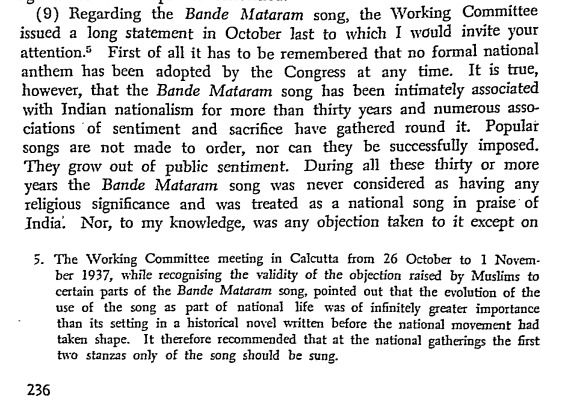
“First of all it has to be remembered that no formal national anthem has been adopted by the Congress at any time. It is true, however, that the Bande Mataram song has been intimately associated with Indian nationalism for more than thirty years and numerous associations of sentiment and sacrifice have gathered round it,” Nehru informed, according to the Congress and the Muslims.
The Working Committee, which met in Calcutta from 26th October to 1st November 1937, ruled that the Muslims community’s opposition to “Vande Mataram” was legitimate and suggested that only the song’s first two stanzas be performed at national events.
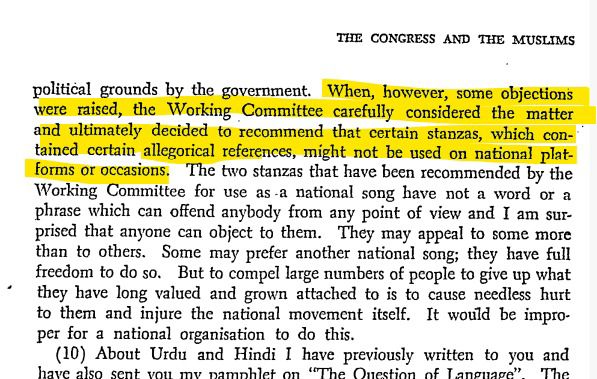
He initially conveyed, “Popular songs are not made to order, nor can they be successfully imposed. They grow out of public sentiment. During all these thirty or more years the Bande Mataram song was never considered as having any religious significance and was treated as a national song in praise of India. Nor, to my knowledge, was any objection taken to it except on political grounds by the government.”
Nehru swiftly focused on the central issue of how the party accommodated the Muslims by determining “to recommend that certain stanzas which contained certain allegorical references, might not be used on national platforms or occasions.”
He further stated, “The two stanzas that have been recommended by the Working Committee for use as a national song have not a word or a phrase which can offend anybody from any point of view and I am surprised that anyone can object to them. They may appeal to some more than to others. Some may prefer another national song and they have full freedom to do so.”
Nehru conveniently overlooked the fact that no one can truly appease an Islamist. If you give them an inch, they will take a mile and then some more. He then implored, “But to compel large numbers of people to give up what they have long valued and grown attached to is to cause needless hurt to them and injure the national movement itself. It would be improper for a national organisation to do this.”
Bande Mataram has religious connotations, my ideology supersedes the song: Nehru announces in an address
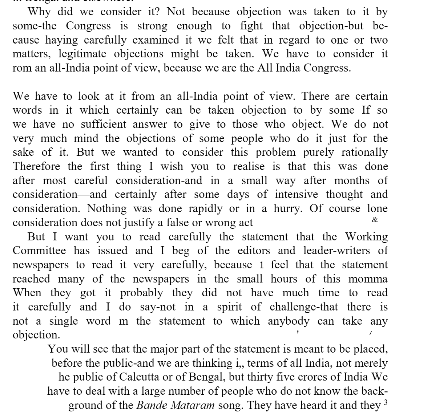
Nehru announced that his party had chosen to acknowledge the Muslim perspective regarding “Vande Mataram” because it aims to represent the viewpoint of all of India apparently including the fanatics as it is known as the “All India Congress.”
“There are certain words in it which certainly can be taken objection to by some. If so we have no sufficient answer to give to those who object. We do not very much mind the objections of some people who do it just for the sake of it,” he declared during a speech.
Nehru subsequently insisted that the statement issued by the Congress Working Committee was made after extensive discussions, reflections and considerations not solely for the citizens of Calcutta or Bengal (Bankimchandra Chatterjee’s native place) but for thirty-five crores of India.
“We have to deal with a large number of people who do not know the background of the Bande Mataram song. They have heard it and they have liked it and a sentiiment had grown around it. Few know how it arose and when it arose. Because of this ignorance of the background many honest misconceptions have arisen about it,” he pointed out.
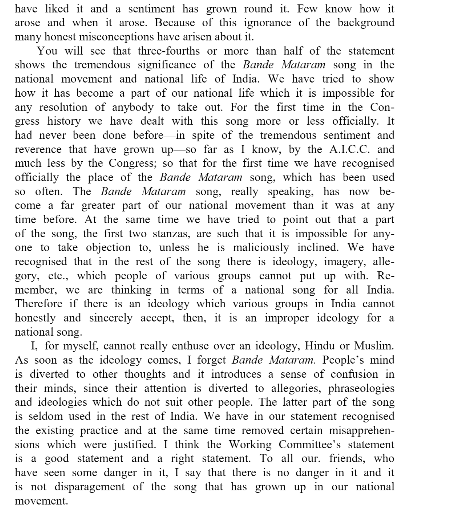
Nehru articulated the critical role and crucial position of the song, which is condemned by a specific religious group, in India’s freedom struggle. He tried to label the strong opposition, rooted in religious fundamentalism as misunderstandings and “honest misconceptions.”
However, the All India Congress Committee willingly decided to pacify its historically favored voter base instead of elucidating these points, by arguing that while the initial verses of the song meet the secular standards of Congress and the later ones do not.
“We have recognised that in the rest of the song there is ideology, imagery, allegory, etc., which people of various groups cannot put up with. Remember, we are thinking in terms of a national song for all India. Therefore if there is an ideology which various groups in India cannot honestly and sincerely accept, then, it is an improper ideology for a national song,” Nehru argued further fuelling the objections raised by the Islamists.
Furthermore, in a distasteful display of his “secular” credentials, Nehru bragged that the song which motivated millions to live and die for their country is of minimal importance to him while creating a false equivalence between Hindu and Muslim ideologies to further pacify the latter.
“I, for myself, cannot really enthuse over an ideology, Hindu or Muslim. As soon as the ideology comes. I forget Bande Mataram. People’s mind is diverted to other thoughts and it introduces a sense of confusion in their minds, since their attention is diverted to allegories, phraseologies and ideologies which do not suit other people,” he boasted.
Nehru contended that the song’s latter sections were rarely heard in the rest of India and the Congress which recognised the practice had to dispel some “misapprehensions which were justified.” He then lauded, “I think the Working Committee’s statement is a good statement and a right statement. To all our. friends, who have seen some danger in it, I say that there is no danger in it and it is not disparagement of the song that has grown up in our national movement.”
Congress and Nehru, fundamentally, agreed that the concerns were baseless, yet they had to be upheld to sustain the facade of “secularism,” which is the suppression of Hindu rights, sentiments and feelings for Muslims.
No relation to Congress, India should have another national song: Nehru’s letter to Sardar Jafri
Nehru discussed the religious row surrounding “Vande Mataram” in a letter dated September 1937 to Urdu writer and poet Ali Sardar Jafri, asserting that the song is unrelated to the Congress. Nevertheless, he acknowledged that the song become deeply intertwined with the sentiment of independence and holds a significant place for the Indian people.
He stated, “The Congress has not officially adopted any song as a kind of national anthem. In practice however the Bande Mataram is often used in national gatherings together with other songs. The reason for this is that 30 years ago this song and this cry became a criminal offence and developed into a challenge to British imperialism.”
Nehru outlined that thousands of people suffered as a result and the populace began to identify the song with a struggle against British imperialism, making it symbol of nationalism in India. He insisted, “I do not think anybody considers the words to have anything to do with a goddess. That interpretation is absurd. Nor are we concerned with the idea that the author of the book, which contains this song, had in his mind when he wrote it, because the public does not think on these lines.”
Nehru clarified that the entire song and its lyrics were completely “harmless” and no one can “take exception to their meaning,” to further establish the “secular credentials” of the Congress, as a defence against accusations of communalism from the Muslim community. He then proceeded to reveal the true agenda and conveyed that “Vande Mataram” should not be regarded as a national song.
“It contains too many difficult words which people do not understand and the ideas it contains are also out of keeping with modem notions of nationalism and progress,” Nehru contended to justify his absurd statement and added, “We should certainly try to have more suitable national songs in simple language.”
Nehru after stressing that the creation was not associated with his party and was excessively complex to be designated as a national song, tried to perform a counterbalancing act and expressed, “But great songs and anthems cannot be made to order. It requires a genius for the purpose.”
“I suppose in time we shall get something good. Meanwhile, there is no reason why we should not give full permission for the use of the Bande Mataram as well as other favoured songs which many people have come to associate with our struggle for freedom,” he concluded.
Nehru understood the significance of the song for the nation, but sought to substitute it with another composition in the name of minor excuses as the real reason is clearly apparent in Congress politics, which has not evolved to this day.
Conclusion
Nehru and Congress, while aware of the astronomical significance of “Vande Mataram” and its incredible impact during the freedom struggle, decided to dismember and even wished to replace the song to indulge the Islamists without considering the long-term repercussions of their actions to embolden these forces.
Now, as the nation observes this pivotal occasion, it is equally necessary to understand the background and history of such vital elements of the national struggle, including how they were belittled for political motives as well as personal agendas, alongside the effect they had on the collective national conscious.
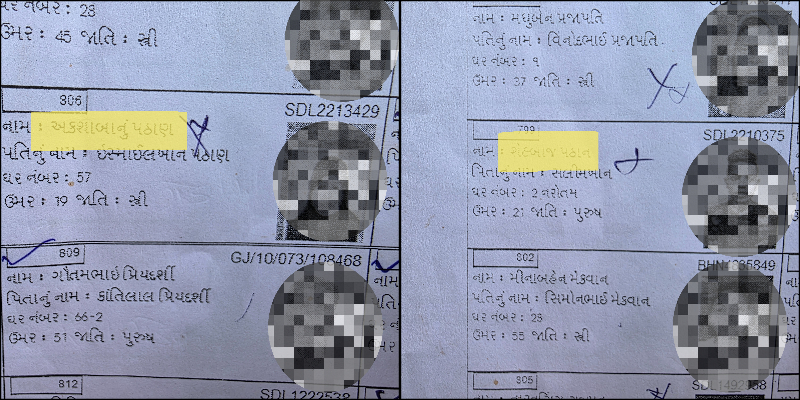
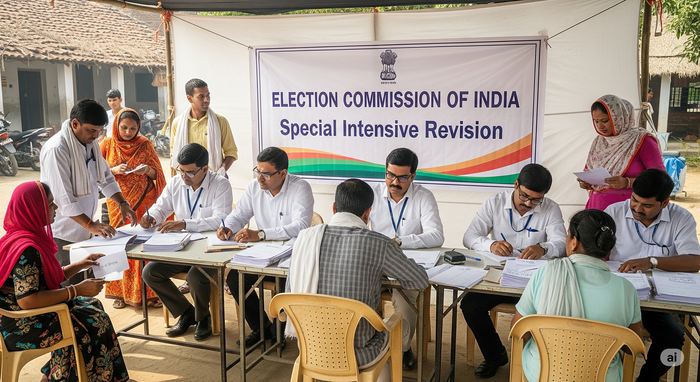
After successfully conducting the Special Intensive Revision (SIR) exercise in Bihar, the Election Commission of India (ECI) has launched the second phase of SIR in 12 states across the country, including Gujarat. This second phase of the SIR began on 4th November. Meanwhile, reports emerged from an area in the Bapunagar assembly constituency of Ahmedabad about some Muslim names being found in the voter list of the area, where only Hindu and Christian families reside. Locals questioned the inclusion of Muslim names in the voter list since there is no Muslim population in the area.
OpIndia visited the area and talked to locals to find out the details. The residents told OpIndia that they support the SIR exercise and that it should be initiated as soon as possible to remove fake names from the voter list.
Muslim names were also found included in the voter lists of Hindu-majority areas like Prerna Society and Narottamdasni Chali in Rakhial, Bapunagar assembly constituency, Ahmedabad. However, locals said that no Muslims reside in this area and that the addresses mentioned before the Muslim names in the voter list do not even exist in the locality.
From what the locals told OpIndia, it was clear that the area had been inhabited by Hindu and Christian families for years. We spoke to several other locals who corroborated the information. One local, who had been living in the locality for years, said that no Muslim family ever lived in the locality and that the Muslim names in the voter list were fake. He also said that the SIR exercise should be conducted to remove bogus names from the voter list.
Another local named Kanubhai spoke to OpIndia and said that he has been living in the Prerna Society since childhood. He said that none of the Muslim names mentioned in the voter list belong to anyone in the society. He added that a proper verification should be conducted, and only the names of those who actually reside in the society should be included in the voter list.
Similarly, an elderly woman, who had been living in this society for approximately 40 years, mentioned that no Muslim person lives in her lane and only people from the Hindu community reside there. She also said that some incorrect names have been added to the voter list.
Speaking to OpIndia, a young man, about 18-19 years old, said that he has been living in this society since birth. He also said that only Hindus live in both this chawl (tenement) and the society, there are no Muslims. He added that if fake names of voters have appeared in the voter list, they should be immediately corrected. He added that an SIR exercise is important to update voter rolls and remove fake names from them.
A local named Maheshbhai, who has been living in the area for 53 years, also repeated similar facts, speaking to OpIndia. He said, “I have been living here since birth, and I am not aware of any Muslim person buying or renting a house in this chawl or society.” He suspected that this could be a conspiracy and demanded an investigation into how the names of people from the Muslim community appeared on the voter list of a Hindu-majority area.
Regarding the verification of voter registration in the SIR process, he said, “Voter list verification is a correct measure. Verification must be done. This matter could have serious repercussions in the future, so it is right to stop it at the outset. It will be difficult to deal with it all at once after the matter escalates, so the process that is currently underway is correct.”
જે વ્યક્તિ જન્મથી આ વિસ્તારમાં રહે છે તેઓએ જણાવ્યું કે અહીંયા છેલ્લા 50 વર્ષોમાં ના તો કોઈ મુસ્લિમે મકાન ખરીદ્યું છે, ના તો કોઈ ભાડે રહેવા આવ્યા છે… છતાય જો મતદારયાદીમાં મુસ્લિમ નામ હોય તો તે કોઈ ષડયંત્ર હોવું જોઈએ.
It is noteworthy that before every election, the voter list undergoes a revision process, but it is not reviewed from scratch, which results in such shortcomings. Processes like SIR are essential for a comprehensive verification of the electoral rolls. The error in voter lists in the Bapunagar area demonstrates why SIR is necessary not just in Gujarat but also in the rest of the country. Decades after the last SIR, the Election Commission is revising and verifying the entire voter list to remove bogus names and ensure that eligible and qualified voters are not left out.
This SIR was conducted successfully in Bihar, and it has now commenced in a total of 12 states and Union Territories, including Gujarat, West Bengal, and Uttar Pradesh. Under the SIR, BLOs will conduct door-to-door verification to verify documentary evidence and remove incorrect names from the voter list. This extensive exercise, aimed at removing fraudulent voters, will last for a month. Therefore, those whose names have been removed will be given ample opportunity to appeal. After the appeal period is over, a final voter list is likely to be published in February next year.
In Gujarat, there have been frequent cases where Bangladeshi infiltrators have created forged documents. If such illegal immigrants are also included in the voter list, they can be identified and their names can be removed from the voter list through SIR.
Phase 1 of Bihar Assembly Election concluded on the 6th of November 2025 with a record voter turnout of 64.66%, the highest ever in the state’s electoral history. The Election Commission of India (ECI) hailed the landmark figure as a reflection of voters’ faith in democracy and the success of several new voter-friendly initiatives introduced this year. In the midst of elections, the usual suspects were busy spreading fake news to cast a doubt on the electoral process. AltNews’ Mohammad Zubair took to X (formerly Twitter) to spread fake news against DD News and PM Narendra Modi with the intention of casting aspersions on the electoral process.
What Prime Minister Narendra Modi tweeted after Bihar Election Phase 1 concluded
On 6th November after the voting process concluded, Prime Minister Narendra Modi took to X to hail the electoral process and predict an NDA victory.
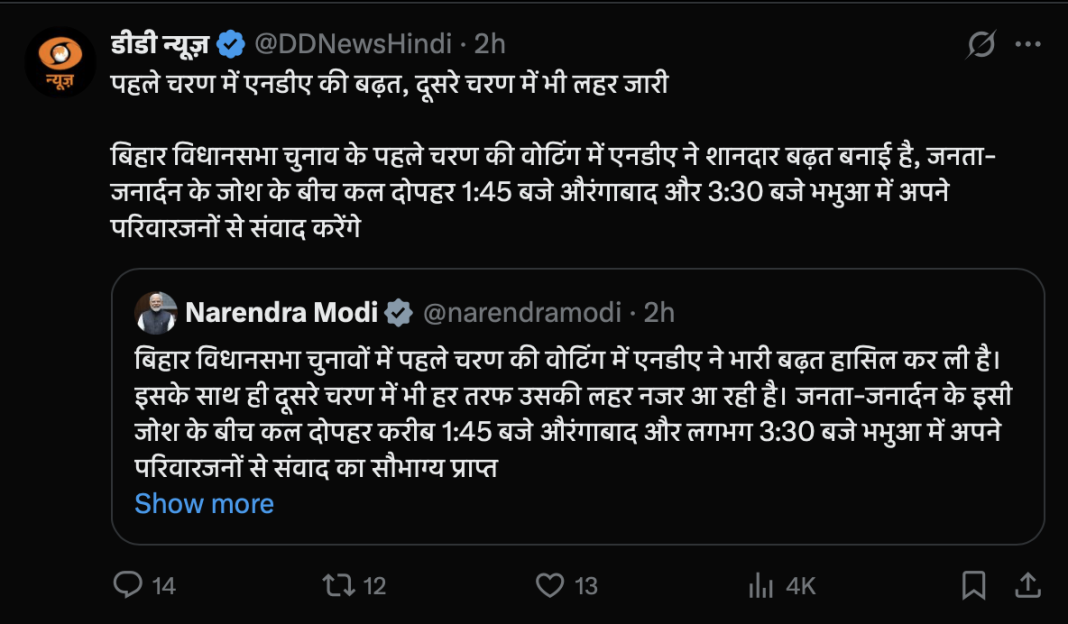
He tweeted, “In the first phase of voting in the Bihar Assembly elections, the NDA has gained a massive lead. Along with this, its wave is visible everywhere in the second phase as well. Amid this enthusiasm of the public and the masses, tomorrow afternoon around 1:45 PM, I will have the good fortune to communicate with my family members in Aurangabad, and around 3:30 PM in Bhabhua”.
बिहार विधानसभा चुनावों में पहले चरण की वोटिंग में एनडीए ने भारी बढ़त हासिल कर ली है। इसके साथ ही दूसरे चरण में भी हर तरफ उसकी लहर नजर आ रही है। जनता-जनार्दन के इसी जोश के बीच कल दोपहर करीब 1:45 बजे औरंगाबाद और लगभग 3:30 बजे भभुआ में अपने परिवारजनों से संवाद का सौभाग्य प्राप्त…
The post by Prime Minister Narendra Modi was a rather standard post where political parties and their leaders express their estimate of victory and expressing confidence of their party being ahead in the polls.
What Doordarshan News tweeted, quoting PM Modi
Quoting the tweet by Prime Minister Narendra Modi, DD News tweeted, “पहले चरण में एनडीए की बढ़त, दूसरे चरण में भी लहर जारी बिहार विधानसभा चुनाव के पहले चरण की वोटिंग में एनडीए ने शानदार बढ़त बनाई है, जनता-जनार्दन के जोश के बीच कल दोपहर 1:45 बजे औरंगाबाद और 3:30 बजे भभुआ में अपने परिवारजनों से संवाद करेंगे”.
DD News essentially tweeted the exact words from the post of Prime Minister Modi, not only relaying his hope for a victory but more importantly, the line about his engagement in Bhabhua.
The insinuation of Mohammad Zubair’s tweet was that DD News had some inside information that the votes had been caste in favour of NDA. Essentially, parroting the same fake news of “vote chori” which is being spread by Rahul Gandhi, Congress and other opposition members.
The intention of the tweet was, clearly, to insinuate that the election had already been rigged and skewed in the favour of NDA. DD News, being the state broadcaster, was in the know of this rigging or had been instructed by the Modi government (or PM Mod himself) to tweet about an impending NDA victory.
Fact Check: How Mohammad Zubair was spreading fake news
The DD News tweet was a verbatim relay of what PM Modi had posted and the post by Prime Minister Narendra Modi was merely a political statement expressing the hope of victory. Doordarshan had in no way predicted an NDA win and from its post, it is evident that it was relaying, word for word, the post of the PM.
Mohammad Zubair deliberately used an English translation of the post by DD News so it was not, at first glance, evident that DD News was merely repeating the statement by PM Modi, thus attempting to portray as if the tweet was an independent analysis by the state broadcaster.
Further, the indirect assertion also was that PM Modi had, somehow, prior knowledge of the result of the election. This, however, is untrue. Political parties and leaders often declare that they are ahead in polls once voting ends. These political statements are made by all parties and all leaders. The statement in no way means that any prior knowlege of the result exists.
For example, just like PM Modi, Tejashwi Yadav of the RJD also took to X to claim that RJD was ahead in the polls after Phase 1 of voting concluded.
आज बिहार ने प्रथम चरण में बदलाव के लिए मतदान किया है। हर बिहारवासी ने 20 साल के अंधकार को मिटाने के लिए, घर से निकल कर परिवर्तन की ऐसी रोशनी जलाई कि पूरे बिहार में सुख, समृद्धि, सुरक्षा, सम्मान, सौहार्द, शांति और खुशहाली की दस्तक सुनाई देने लगी है।
In a long post, Yadav claimed that after Phase 1, the support for Mahagathbandhan was visible. He tweeted, “For the first time in 20 years, an unprecedented wave of change is visible in favor of the Mahagathbandhan. Not just from every home, but from every heart, only one voice is resounding: this time, we will bring a new youth government, we will run the government from every home, and we will make every Bihari worry-free and a change-maker, that is, a CM”.
Now, if a news channel was to relay the exact words by Tejashwi Yadav, would it mean that the news channel, or Yadav himself, “rigged” the elections and had prior knowledge of the results? Clearly not.
Such fake news and misinterpretation by Mohammad Zubair amid an ongoing election is dangerous for the integrity of the election process since it casts aspersions on the authenticity of the process.
How Mohammad Zubair regularly spreads fake news, acts as mouthpiece of Islamists
Mohammad Zubair often resorts to fake news and ad hominem attacks to silence any criticism of Islam or even terrorism. He often tries to silence criticism of Islam, label critical, fact-based statements about his Faith by targeting individuals, playing the ‘Islamophobia card’ and unleashing his lynch mob at them.
This has been his SOP (Standard Operating Procedure) of sorts for quite some time now. Zubair shrewdly avoids fact-checking arguments and tries to character assassinate the individuals raising those arguments instead.
For instance, he unleashed his lynch mob against Nupur Sharma over her remarks about the nature of the relationship between the Islamic Prophet Muhammad and Aisha.
The facts shared by the then-BJP spokesperson in the context of a debate on Times Now have been reiterated by many prominent Islamic scholars. Zubair did not ‘fact-check’ Nupur Sharma and instead resorted to an ad hominem attack.
Recently, he tried to amplify the fake news about Dharamsthala to tarnish Hindus, had attempted to blame Hindus for violence by Muslims in Mhow, attempted to whitewash the genocide of Hindus in Bangladesh and spread fake news about Kanwariyas attacking the police. These are only some examples of the dangerous lies that are parroted by Mohammad Zubair on a regular basis. OpIndia has covered several of his shenanigans which can be read here.
In what can only be described as a dangerous normalisation of racial hatred against Indians, Texas-based conservative media outlet The Blaze, a platform that projects itself as the “anti-woke” voice of American conservatism has decided to hire a man whose entire digital persona revolves around vilifying Indians, mocking Hindu culture, and dehumanising brown immigrants.
Meet Matt Forney, the poster boy of online hate, a self-professed “anti-globalist” and serial misogynist who has, for months if not years, been running a one-man hate campaign against Indian tech workers in the United States. A cursory glance at his X profile reveals his unhealthy obsession with Indian H1B workers. And this week, the American conservative media outlet, The Blaze, rewarded him for his unabashed dehumanisation of Indians working in the US.
On November 4, Forney proudly announced on X (formerly Twitter) that The Blaze has hired him as a “reporter” on H1B/Indian issues.
“I’m pleased to announce that @theblaze has hired me as a reporter on H-1B/Indian issues. My first article, on the H-1B and DEI-fueled collapse of USAA, is up now. Thank you to everyone at THE BLAZE for giving me this opportunity!”
I'm pleased to announce that @theblaze has hired me as a reporter on H-1B/Indian issues.
My first article, on the H-1B and DEI-fueled collapse of USAA, is up now.
Yes, you read that right. A man who literally calls for the deportation of every Indian in America, has been given a byline to report on “Indian issues.”
If irony could die of embarrassment, this would be its funeral.
The Blaze’s descent into moral bankruptcy
The Blaze is not some fringe blog on the internet. It’s a major American conservative outlet founded by Glenn Beck, one that claims to fight for truth, national interest, and American jobs. Yet in 2025, this “defender of free speech” decided to reward a man whose speech is indistinguishable from hate propaganda.
In doing so, The Blaze has signalled that it’s not interested in honest discussions about H1B visas or labour policy. It’s interested in dog-whistling to the worst instincts of its audience, by portraying Indians as parasites and foreign invaders.
And if you thought Forney was just some edgy online provocateur, think again. This is the same man who authored a sleazy “book” titled “Do the Philippines: How to Make Love With Filipino Girls in the Philippines”, a disgusting sexual travelogue dripping with racism, objectification, and colonial lust.
That’s the kind of man The Blaze just hired to cover something as consequential as H1B employment and Indian professionals.
If that doesn’t show you how “serious” the American conservative media is about labour anxieties, nothing will. The moral custodians of Western conservatism have outsourced their credibility to a man whose literary contribution to civilisation is a guidebook on sexual exploitation.
The long trail of bigotry
Matt Forney’s anti-Indian hatred is not new, not subtle, and not random. It’s been a sustained, obsessive campaign to depict Indians as corrupt, incompetent, untrustworthy, and dangerous. In fact, Forney has just given a new dimension to the deep-rooted Hinduphobia prevalent in the US.
Let’s take a look at some of his most vile statements, all of which are still proudly displayed on his X account.
1. “DEI = Deport Every Indian”
Forney routinely twists the term “DEI” (Diversity, Equity, and Inclusion) into “Deport Every Indian.” It’s not satire, not dog whistling against Indian disapora. It’s a slogan of ethnic cleansing disguised as a political critique. He has repeatedly called for the U.S. to mass deport Indian professionals, accusing them of “stealing jobs,” “ruining companies,” and “destroying America.”
Commenting on Kruti Goyal taking over as the CEO of Etsy Inc., Forney tweeted that it was yet another ocassion when an “unqualified Indian” becomes the head of an American company. He concludes his tweet with “DEI: Deport Every Indian.”
Nevermind the fact that Goyal is an American citizen with degrees from Stanford and Harvard. But Forney has never allowed facts to get in the way of his racist bigotry.
Yet another unqualified Indian takes over an American company. And I guarantee her first action will be to fire every American and replace them with other Indians, either directly or via bodyshops.
If anyone else had said “Deport Every Jew” or “Deport Every Black,” they’d be erased from polite society overnight. But “Deport Every Indian”? That’s apparently acceptable content for America’s conservative media.
2. Mocking Diwali celebrations at USAA
Forney recently posted a video of Diwali celebrations at USAA, a major American financial firm, to rant against Hindus and Indians working in the US.
“EXCLUSIVE: USAA throws parties for Indians while ignoring American holidays. Veterans are committing suicide from stress and layoffs,” he claimed.
EXCLUSIVE: an insider at USAA provides footage of the company's recent Diwali event. It looks like a Tim and Eric skit.
Remember, while USAA throws parties for Indians, it ignores American holidays and its veteran employees are committing suicide from stress and layoffs. pic.twitter.com/krMLjvztYJ
So, according to Forney, a Diwali party for Indian employees causes white veterans to die. This is how Hinduphobia cloaks itself, by turning cultural visibility into moral offense. What’s worse, The Blaze decided this man should report on the very Indians he dehumanises.
3. “Do you feel safe flying Delta knowing Indians run its IT?”
In another tweet, Forney claimed: “NEW: a reader shares pictures of Delta Airlines staffers… almost entirely Indians. Given that Indians have been implicated in data breaches, scams, and identity theft, beyond being incompetent at their jobs, do you feel safe flying Delta knowing that Indians have taken over its IT department?”
NEW: a reader shares pictures of Delta Airlines staffers at their headquarters in Atlanta. Almost entirely Indians.
He writes that 98 percent of Delta's IT department is Indian, their CTO is Indian, and their VP of IT is also Indian.
This isn’t “critique of outsourcing.” This is the oldest racist trope in the book that brown people are dirty, dishonest, and unsafe to be around. Forney’s logic is straight out of the segregation era, except this time, the target isn’t African-Americans, it’s Indian techies.
4. “Your data and finances are not safe if Indians handle them.”
Months after Coinbase suffered a data breach, Forney used it to fuel his propaganda. Taking to X, he tweeted, “Remember that $400 million data breach Coinbase suffered? It was the result of hackers bribing Indian tech support staff. Your data and finances are not safe if Indians handle them. DEI: Deport Every Indian.”
Remember that $400 million data breach Coinbase suffered a few months ago? It was the result of hackers bribing Indian tech support staff who worked for TaskUs, an Indian contractor.
Your data and finances are not safe if Indians handle them.
So much for “data-driven journalism.” The man invents conspiracies, substitutes ‘Indians’ for ‘hackers’, and pushes them as fact, all to incite hate. Yet, that’s exactly the kind of “expert” The Blaze now employs to write about Indians in America.
5. “Freddie Mac has been taken over by Indians… posing a national security risk.”
Forney’s obsession with Indians borders on the delusional. In one of his “exclusive exposés,” he claimed: “An insider reports that Freddie Mac has been taken over by Indians on visas, posing a national security risk… the company is run like a big syndicate.”
NEW: an insider reports that Freddie Mac, a government-sponsored corporation, have been taken over by Indians on visas, posing a national security risk.
According to the insider, Freddie Mac's management has been taken over by Indians, and it now hires almost over 90 percent of… pic.twitter.com/EE8mZC771I
He even alleged that Indian managers “discriminate against whites.” So, Indians are corrupt, criminal, AND racist now, according to a man who sees a foreign conspiracy every time he spots a brown face in a cubicle.
This isn’t journalism; it’s hate literature wrapped in corporate gossip.
And this is just the tip of the iceberg. Forney’s X profile is replete with posts attacking Indians, painting a target behind Indian diaspora, projecting them as immoral and corrupt by furthering dangerous stereotypes and linking random untoward developments with H1B workers.
The anatomy of a bigot
Matt Forney represents the new breed of Western bigots, not the hooded Ku Klux Klan racist of the 1960s, but the digital white nationalist who hides his hatred behind hashtags and “anti-globalist” rhetoric.
He knows that open racism won’t fly in polite circles, so he repackages it as concern for “American workers.” Every Indian engineer becomes a “job thief.” Every Hindu festival becomes a “foreign intrusion.” Every brown face becomes a “national security threat.”
And now, The Blaze has handed him a megaphone to mainstream that hatred.
Let’s be clear: this is not some isolated incident. It’s part of a broader pattern in the West, where Hinduphobia is the last socially acceptable racism.
You can’t mock Muslims. You can’t mock Jews. You can’t mock Blacks. But you can mock Hindus, laugh at Diwali, ridicule Sanskrit names, and accuse Indians of infiltrating America and still get a job at a top conservative outlet.
That’s what “free speech” means in the American moral dictionary.
The hypocrisy of Western media
The irony would be laughable if it weren’t so vile. This is the same Western media ecosystem that sermonises India daily, lecturing us about “minority rights,” “hate speech,” and “intolerance.”
Every other week, some New York Times columnist writes sound alarm bells of how “Modi’s India” is becoming an “authoritarian state.” CNN runs panels about “Hindu nationalism.” The Washington Post writes sob stories about “India’s shrinking liberal space.”
But when an American media company hires a man who calls for deporting every Indian, the same liberals and conservatives fall silent.
Because their commitment to “fighting hate” stops at the colour brown and religion Hinduism. Hinduphobia, to them, is not hate; it’s a political hobby. While the Left and the Right in the US are a sea apart, one thing that truly unites them is their shared hate for Hinduism, and by extension, for India and Indians.
The bigger picture: Why this hate sells
Forney’s bile isn’t just personal, it’s political. There’s a growing anxiety in the U.S. establishment about India’s rise.
For decades, India was seen as a pliant, post-colonial market good for cheap labour and moral lectures. But under PM Modi, India has refused to play that part. It buys oil from Russia, trades with Iran, signs deals with China, and talks to everyone on its own terms.
That defiance has rattled both the American Left and Right. So, what do they do? They attack the visible face of Indian success the diaspora. Indian professionals become the soft targets for America’s bruised ego. The recent strain in the diplomatic relationship between the two countries, powered by Trump and his aides’ obstinacy to blame and attack India for Russian oil purchase even as the US continued to import Uranium and other important commodities from Moscow, and its duplicity in not calling out China even though Beijing trumped New Delhi in its purchase of Russian oil.
Seen in this context, Forney’s “Deport Every Indian” campaign isn’t just xenophobia. It’s a reflection of a declining empire lashing out at a rising civilisation.
The human cost of normalised Hinduphobia
The most tragic part of this saga is that while Forney enjoys his new job, ordinary Indians in America pay the price. In the past few years, there’s been a sharp rise in racially motivated assaults against Indian-Americans. Students, cab drivers, and tech professionals have been shot, stabbed, or beaten by attackers shouting slurs like “Go back to your country.”
When hate becomes normalised in media, it doesn’t stay in tweets, it spills into streets as witnessed in the rising number of hate crimes Indians have faced in the West, particularly in the United States, in the last few months. When ideologues like Forney are allowed to blame Indians for everything that’s wrong in the US, it paints a target behind the diaspora and directs bigotry towards Indians living in the US, most of whom are hard-working individuals helping American multinational companies achieve their true potential.
Forney’s rhetoric is not “just words.” It’s psychological permission for violence. And by hiring him, The Blaze is complicit in that violence.
Matt Forney, a symbol of growing anti-Hindu, anti-India sentiments in the US
Matt Forney is not a journalist. He is a hate merchant. His career began with writing racist erotica about Filipino women. It evolved into demonising Indians. And now, thanks to The Blaze, it’s being rewarded with legitimacy.
That tells you everything you need to know about how serious the American conservative establishment really is about “labour anxieties.” They don’t want solutions, they want scapegoats. And Indians, apparently, make for convenient ones.
When The Blaze hires a man who thinks “Deport Every Indian” is a punchline, it’s not a media hire; it’s an endorsement of hate. And when the so-called guardians of Western morality stay silent, it exposes a simple truth: In the hierarchy of Western outrage, brown Hindu lives still rank somewhere below pageviews.
A woman from Delhi has dragged the Municipal Corporation of Delhi (MCD) to the Delhi High Court for compensation after she was brutally attacked by a pack of stray dogs earlier this year. In the last hearing that took place on 29th October, the MCD sought additional time from the court to file its reply, which was granted by Justice Mini Pushkarna, and the matter will be heard next in March 2026. The petitioner, Priyanka Rai, was reportedly bitten on her feet in March 2025 while returning home riding pillion on a motorcycle.
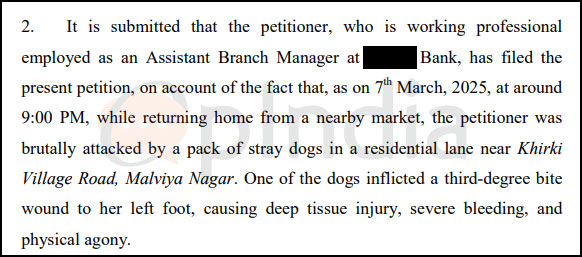
According to the court documents accessed by OpIndia, Priyanka works as an Assistant Branch Manager at a bank. On 7th March at around 9 PM, she was returning home from a nearby market. A pack of stray dogs brutally attacked her in a residential lane near Khirki Village Road, Malviya Nagar. She suffered 42 dog bites, and one of those was a third-degree bite wound on her left foot which caused deep tissue injury, severe bleeding, and physical agony, the court document stated.
Source: Delhi High Court.
Petitioner calculates damages using Punjab and Haryana HC formula
In her plea, Priyanka relied on a formula devised by the Punjab and Haryana Court in its August 2023 judgment, where the court stated that the compensation should be based on the severity of the injury. The court had directed the Punjab, Haryana and Chandigarh governments to compensate dog bite victims with a minimum of Rs 10,000 per teeth mark and Rs 20,000 per 0.2 cm of wound where flesh is pulled off the skin. However, reports stated that even after 10 months of the judgment, the victims continued to wait for the compensation.
Using the formula, Priyanka claimed compensation of Rs 12 lakh for a total wound area of 12 cm and Rs 4.2 lakh for 42 tooth marks. She also sought Rs 3.8 lakh for psychological trauma. In total, the compensation sought by Priyanka is worth Rs 20 lakh. According to her submission in court, she continues to live in “psychological fear” due to the condition of stray dogs in her locality.
Supreme Court hearing stray dog menace case
While her case has made headlines, it is essential to recall the suo motu case being heard by the Supreme Court of India on the stray dog problem in the country. It all started with the death of a six-year-old girl, Chhavvi, in Delhi, who succumbed to a rabies infection months after being bitten by a stray dog. Anguished by the report on the matter in The Times of India, the Supreme Court bench comprising Justice J B Pardiwala and Justice R Mahadevan took suo motu cognisance and sought a reply from Delhi’s civic body in the matter.
On 11th August, just a couple of weeks after the apex court took cognisance, a judgment was passed ordering the MCD to remove all stray dogs from Delhi’s streets in a phased manner. The so-called dog lover lobby, irked by the judgment, rushed to the Chief Justice of India and sought intervention, and the matter was forwarded to a three-judge bench.
Within days, on 22nd August, the previous judgment was modified, and the release of dogs was allowed after sterilisation and vaccination. However, the court sought all pending cases related to stray dogs from High Courts across the country to be moved to the Supreme Court and asked all states and UTs to file affidavits on the implementation of ABC Rules in their respective jurisdictions.
Interestingly, while individuals and NGOs were allowed to intervene in the case, they could do it only after submitting a deposit of Rs 25,000 for individuals and Rs 2,00,000 for NGOs. On 3rd November, the Supreme Court allowed victims of dog bites to intervene in the ongoing stray dog matter without any deposit. The apex court will next hear the matter on 7th November.
Amid the ongoing matter, MCD officials were attacked in Delhi when they tried to pick up dogs for sterilisation and vaccination. A group of self-styled dog lovers not only attacked the MCD van but also threatened officials with consequences if they picked up the dogs.
Many self-styled dog lovers have staged protests, and while the Supreme Court has categorically ordered the stopping of public feeding, the dog lovers continued to do so using so-called loopholes in the matter.
Why compensation alone is not the solution
While Priyanka Rai’s plea has ignited the debate on the accountability of civic bodies once again, the issue of the stray dog menace runs deeper. Priyanka has the knowledge and financial background to drag the MCD to court. However, for every victim who approaches the courts, there are thousands who suffer in silence.
Since June, OpIndia has covered over 100 stray dog attacks, and most of the dog bite victims came from marginalised or poor families. Such families neither have the resources to hire lawyers nor the awareness to demand justice. The court’s formula may provide relief to a few, but compensation cannot substitute prevention and policy enforcement.
As part of OpIndia’s ongoing series on the stray dog menace, it is essential to underline that civic bodies have failed to manage the stray dog population, mainly due to the ABC Rules that came into effect in 2001 under the leadership of then-MP Maneka Gandhi and were revised in 2023 again under her leadership. Because of strict rules against the removal of dogs from the streets even if they are attacking people, both urban and rural spaces have turned into potential danger zones.
RTI reveals over 26 lakh dog bite cases in 2025 alone
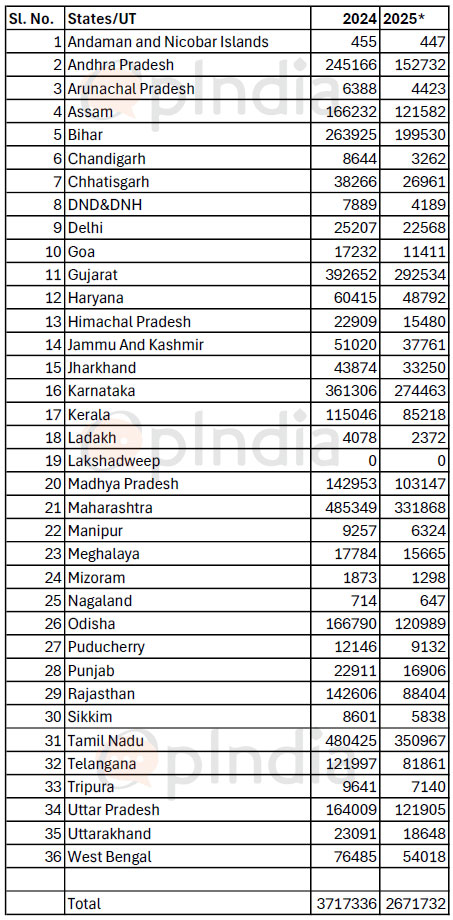
According to a reply to an RTI filed by OpIndia, the Directorate General of Health Services, National Centre for Disease Control (NCDC) revealed that India has already recorded 26 lakh dog bite cases in 2025 till July, while 2024 witnessed over 37 lakh such cases. Such a high number of dog bite cases highlights the scale of the menace and exposes how the ABC Rules have failed to control it.
Number of dog bite cases between 2024 and July 2025. Source: NCDC, Government of India
As civic bodies across the country have failed to strictly enforce sterilisation drives, shelter management, initiatives to stop pet abandonment, and public awareness programmes, the dog population continues to rise. Compensation, even when granted, will remain a privilege accessible only to a few.
A growing public safety crisis
Every year, millions are bitten, and justice is nowhere to be found. Adequate medical aid is still a farce as victims are dying even after receiving all shots of anti-rabies vaccines. As the Supreme Court prepares to hear from victims, the question remains: will India continue to treat the stray dog crisis as a humanitarian debate or finally as a public safety emergency?
OpIndia is doing a series on the stray dog menace in India which can be checked here.
The Election Commission of India (ECI) has announced a Special Intensive Revision (SIR) of electoral rolls in 12 states and Union Territories as part of its ongoing nationwide voter verification and cleansing exercise. Among the states covered are poll-bound regions like West Bengal, Tamil Nadu and Uttar Pradesh. Assam, though it has assembly elections scheduled in 2026, was not included in the list of states to undergo SIR next.
A state-wide SIR was recently completed in Bihar, where assembly elections are currently underway with the new, updated electoral roll.
Chief Election Commissioner (CEC) Gyanesh Kumar, while addressing a press conference on October 27, 2025, clarified that Assam’s case is legally distinct from all other Indian states. He pointed out that citizenship verification in Assam operates under separate provisions of the Citizenship Act, 1955, and the Assam Accord of 1985, which introduced Section 6A to the law. This section explicitly defines who qualifies as an Indian citizen in Assam, a framework different from the rest of the country.
#WATCH | Phase 2 of SIR | On Assam not included in the second phase of SIR, CEC Gyanesh Kumar says, "Under India's Citizenship Act, there are separate provisions for Assam. Under the supervision of the Supreme Court, the checking of citizenship there is about to be completed. The… pic.twitter.com/NoeqZ5x6DY
As per Section 6A, immigrants who entered Assam before January 1, 1966, are deemed Indian citizens, while those who entered between January 1, 1966, and March 25, 1971, can become citizens only after fulfilling stringent criteria. Those entering after March 25, 1971, are to be considered illegal migrants. These provisions are unique to Assam, given its long-standing demographic anxieties and cross-border migration from Bangladesh. Therefore, a blanket SIR similar to Bihar or Bengal would directly clash with the state’s special citizenship mechanism and the ongoing, Supreme Court-monitored NRC process.
Kumar emphasized that a special order for Assam would be issued separately once the citizenship verification exercise under NRC nears completion. The logic is clear: conducting an SIR in Assam right now would mean a duplication of effort, potential double-deletions, and interference with the apex court’s timeline.
Why Assam is a legal outlier
The NRC in Assam ordered by the Supreme Court in 2013 has already excluded over 19 lakh individuals as “doubtful citizens.” However, appeals and re-verifications are still pending. The citizenship status of many remains legally unresolved. If the ECI were to simultaneously carry out a nationwide SIR in Assam, it could inadvertently remove or include names that are still under judicial consideration.
This is not merely an administrative inconvenience; it’s a constitutional minefield. The Election Commission cannot legally preempt or contradict the Supreme Court’s ongoing supervision of the NRC. Hence, the ECI’s prudence in holding back Assam’s SIR until a special order is issued is not just logical, it’s mandatory.
The Leftist U-Turn: Outrage for hire
But predictably, this pragmatic and legally sound decision has triggered another wave of selective outrage from the usual suspects in the left-liberal ecosystem that never misses an opportunity to politicize the ECI.
In Bihar and West Bengal, the same cabal comprising the likes of Mahua Moitra, Yogendra Yadav, Manoj Jha, and NGOs like People’s Union for Civil Liberties and Association for Democratic Reforms (ADR) had vehemently opposed the SIR. They had filed petitions in the Supreme Court earlier this year, arguing that the exercise was a conspiracy to “disenfranchise” large numbers of voters.
The Supreme Court, however, dismissed their plea, calling it a mere case of “trust deficiency.” The court reaffirmed that the SIR was a routine constitutional exercise meant to remove bogus voters, duplicates, and deceased persons, nothing more.
Yet, when the ECI decided not to conduct SIR in Assam this time, the same leftists and opposition leaders suddenly discovered a new outrage. Yogendra Yadav, who once wanted the ECI restrained, now wonders why the SIR is not being conducted in Assam. DMK spokesperson Saravanan Annadurai accused the ECI of turning into a “citizenship-finding unit.” Congress spokesperson Shama Mohamed called the ECI’s NRC-related explanation an “excuse.”
It is almost comical how quickly the narrative flips. When the ECI works to update the voter list in Bihar, it is bad. But it is suddenly wanted to interfere in an ongoing SC-monitored NRC process because the Secular-Liberal lobby thinks the chaos and confusion will provide them with further fuel to spread misinformation and vilify democratic institutions.
The Election Commission’s job is to keep the electoral roll updated and make sure that anyone dead, migrated out, or ineligible is not in the voter list. The ECI’s function is not to detect and deport illegal immigrants, issue citizenships, or examine the validity and legality of citizenships. In Bihar SIR, approximately 6.5 million voters were removed from the list. However, not all the names removed were illegal immigrants. Those removed included voters who died, those who failed to prove that they are citizens of India, those who permanently migrated to other places, and those voters who were present in more than one list.
The Opposition’s double standard: When convenience becomes principle
This selective indignation exposes the moral bankruptcy of India’s left-liberal opposition. Their stance on the ECI shifts not with principle, but with political expediency.
When the SIR threatened to clean up voter rolls in Bihar, a state with a large population of illegal Bangladeshi-origin voters who have historically benefited opposition parties, the exercise was branded “undemocratic.” But in Assam, where the same process could potentially reinforce the BJP’s nationalist credentials by validating the NRC outcomes, the Left now cries foul over its absence.
Let’s call this what it is: vote-bank panic.
The opposition fears that in states like Bihar and West Bengal, the cleansing of electoral rolls will expose the depth of illegal voting blocs that have skewed democratic outcomes for decades. In Assam, however, the same opposition wants to push the ECI into violating Supreme Court oversight just to craft a new narrative that the ECI, “under BJP pressure,” is shielding Hindu illegals while targeting Muslims.
It’s a cynical, circular game:
If SIR happens → “BJP-ECI conspiracy to delete Muslim voters.”
If SIR doesn’t happen → “BJP-ECI conspiracy to protect Hindu voters.”
Either way, the Left’s script stays the same: always attack the ECI, always question institutions, and always create distrust before elections.
The facts they won’t tell you
In Bihar, during the recently completed SIR, approximately 6.5 million names were removed from the electoral rolls. Not all were “illegal immigrants”, most were deceased voters, duplicates, or those who had migrated. The ECI’s function is not to decide who is an Indian citizen but to ensure that every eligible citizen gets to vote once, and only once.
Similarly, in Assam, the ECI’s caution stems not from political bias but from judicial restraint. The NRC process is still under review because both the Supreme Court and the Assam government have raised concerns over its accuracy, with many foreigners allegedly included and many indigenous people excluded. Chief Minister Himanta Biswa Sarma has publicly supported a fresh verification, and the state government has assured full cooperation with the ECI once the Supreme Court allows further action.
The real issue: Opposition’s insecurity
The fury over Assam’s exclusion is, therefore, not about democracy; it’s about losing control over the narrative. For years, the opposition has thrived on portraying the BJP as authoritarian and the ECI as compromised. Election after election, they have refused to admit their actual flaws and, instead of introspection and scrutiny of their own political message, or even the smallest attempt to find out why they have been rejected by the people, they have been hoping that blaming democratic institutions and creating mass public distrust in the country will help them achieve their goal.
The same “liberals” who cried foul when bogus names were deleted in Bihar are now demanding that Assam’s voter rolls be overhauled immediately, even if it means clashing with the Supreme Court monitored NRC. What they really want is chaos, a narrative of “ECI confusion” they can exploit in the run-up to 2026.
A lawful, logical pause
Far from being “irrational” as The Print’s editorial claimed, the ECI’s reasoning is meticulous and lawful. A special SIR for Assam will come, but only after the NRC process concludes under the Supreme Court’s watch. This ensures the integrity of both citizenship verification and voter registration.
The ECI’s restraint, in this case, demonstrates institutional maturity, not partisanship. Those who accuse it of bias today were the same who demanded judicial oversight yesterday. The only consistent thing about them is their inconsistency.
In truth, the Election Commission is simply doing what the Constitution requires, maintaining electoral purity without undermining judicial authority. Assam’s exclusion from the current SIR is not a political decision; it is a constitutional necessity.
The real question is not “Why no SIR in Assam?” But, “Why does the opposition oppose or support the same process depending on its vote-bank math?”
As the dust settles, one thing becomes clear: the ECI is standing firm on law and logic, while the opposition stands only on opportunism.