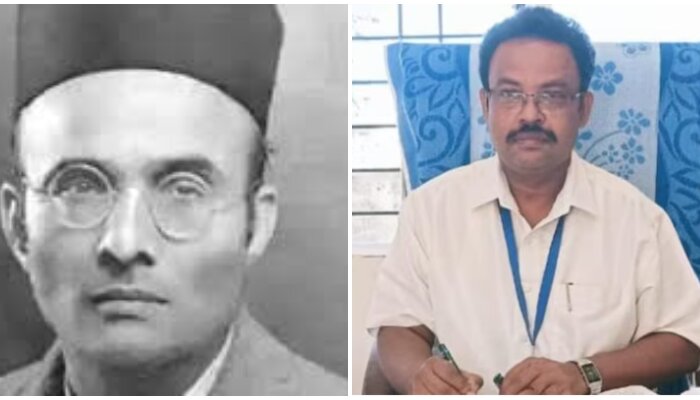
The principal of the Government Pre-University College for Girls at Ijarilakmapur in the Haveri district of Karnataka has come under fire for reportedly allowing the institution’s students to participate in “Veera Savarkar Samsarane,” a program honouring freedom fighter Veer Savarkar. Bharatiya Janata Party leader KS Eshwarappa and his son Kanthesh graced the private function. The Karnataka education administration has taken cognisance of the issue and is prepared to take disciplinary action against Principal K Krishnappa.
Department officials claimed that on 12th December, the institution was inspected by Ritesh Kumar Singh, the principal secretary of the school education and literacy department, and Akshaya Sridhar, the chief executive officer of the Haveri district panchayat. They observed a drop in attendance and inquired about it after which they discovered that about ninety-five pupils were missing because they had joined in a group practice for the “Veera Savarkar Samsarane,” which was slated for 17th December.
Principal Secretary Ritesh strongly disapproved of the situation and instructed the CEO of the Zilla Panchayat to provide the education department with a comprehensive report on it. “Principal K Krishnappa exhibited negligence by allowing woman students to participate in private events outside the educational programmes organised by the department,” an official stated, citing the report.
The Pre-University Board Haveri’s deputy director, Umeshappa attested to the fact that the Principal Secretary had received a report on the occurrence. He confirmed that the pupils had participated in the program’s rehearsal even though he had not previously been aware of their engagement.
Allegations that K Krishnappa obtained the role of principal in 2021 by fabricating evidence regarding an ongoing disciplinary department investigation have added fuel to the fire around him. On 29th September 2023, the School Education and Literacy agency rescinded his promotion in response, based on department representatives.
The deputy director of the pre-graduate education department issued K Krishnappa instructions on 20th November to report to the school education department in Bangalore and transfer management of Ijarilakamapura College to a senior lecturer. He stayed on as the principal until his resignation on 17th December.
Discussions have arisen in the district over the timing of Krishnappa’s dismissal, which coincided with female pupils’ participation in the “Veera Savarkar Samsmarane” program.
Umeshappa remarked, “I have submitted a report to the higher authorities of the education department regarding the students sent for the Savarkar program, which is not an academic program.” He alleged that the report was turned in by directives from higher authorities and that K Krishnappa’s demotion and release from duty had nothing to do with the Savarkar programme.
Principal Secretary Ritesh Kumar addressed the situation and indicated that they have received the report and are looking into the matter thoroughly. In the meantime, Madhu Bangarappa, the Minister of Primary Education promised strict measures. He noted, “I’ll make it very clear when I took over this department, I wanted to review the textbooks, which I did, and all this is in favour of children, their studies, for their benefit itself and if at all something has gone wrong (on the Savarkar issue) related to the education, we will take stringent action mercilessly.”
Haveri District Youth Congress President Prasanna Hiremath claimed, “The principal violated norms by sending students to non-academic programs; the department officials have already initiated a probe and sent a report.”
K. E. Kanthesh, the honorary president of Rashtra Bhakta Balaga, the outfit that organised the program mentioned, “The demotion of the principal is not related to the student’s participation in the Savarkar commemoration programme. Veer Savarkar is a freedom fighter and we invited more than 600 schoolchildren who participated without hampering their classes.”
However, the principal continued to insist on his innocence and emphasised that he had no idea that students were present at the practice. According to him, they took part beyond official class hours which ended at 12 in the afternoon.
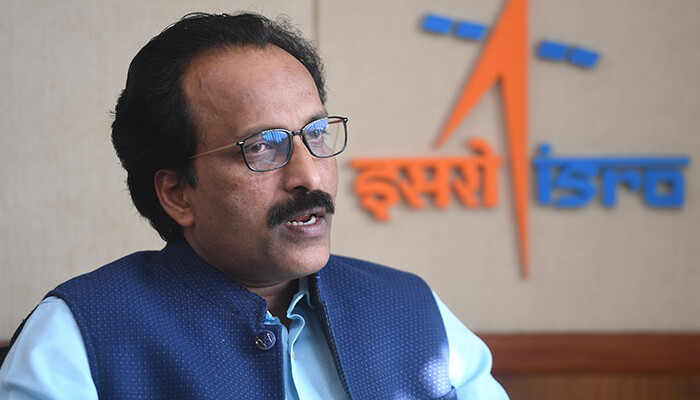
Indian Space Research Organisation (ISRO) has had a year marked with various successful space missions, including the “universal history maker”, Chandrayaan-3. While the world showered praises on ISRO for its remarkable endeavours this year, ISRO chairman S Somnath recently revealed that no other country is willing to share tech on life support system for the upcoming human space flight mission, Gaganyaan. This, however, will not deter ISRO from its ambition as the space agency will be developing its indigenous environmental control and life support system (ECLSS).
Speaking at the Manohar Parrikar Vidnyan Mahotsav 2023, the ISRO chairman said, “We have no experience in developing an environmental control life support system. We were only designing rockets and satellites. We thought that this knowledge would come from other nations, but unfortunately, after so much discussion, nobody is willing to give it to us.”
Somanath emphasised ISRO’s historical focus on rocket and satellite architecture when expressing ISRO’s early lack of experience in ECLSS development. Despite efforts to collaborate, no government was ready to contribute critical knowledge, prompting the decision to design the system in-house.
Somanath emphasised ISRO’s commitment to indigenous development, using existing expertise and local industries.
He discussed the difficulties that the Gaganyaan initiative faces, underlining the nation’s commitment to skill development and design enhancement. Somanath underlined the importance of increased skills and confidence for successful human space exploration. “When we send humans to space through our Gaganyan programme, I think the amount of skill and confidence that we need to have has to be higher than what we currently have,” the ISRO chief remarked.
Somanath stated that the process for building confidence is currently taking place across ISRO with the assistance of national laboratories. “The rocket is the first component of the Gaganyaan programme. The rockets are always bound to fail; whenever it is ready for launch our tension and heartbeats go up because even if the rocket is built very safely having all the processes followed, something can still go wrong. And if something goes wrong, no one can fix it or adjust it. Thousands of elements must work flawlessly for a launch to happen,” he stated.
Explaining the technical aspects of the ECLSS, Srimathy Kesan, founder and CEO of Space Kidz India said, “The ECLSS, a technological cornerstone, intricately manages air quality and water supply essential for astronaut survival in the challenging environment of space. Through meticulous mechanisms incorporating activated charcoal beds, catalytic oxidizers, and molecular sieves, this system impeccably regulates cabin air quality, ensuring a breathable atmosphere for the crew.”
Kesan further stated that the Oxygen Generation System splits water molecules into oxygen and hydrogen gas using cutting-edge electrolysis. This closed-loop mechanism assures a steady supply of oxygen for breathing while efficiently generating water from hydrogen wastes. The Water Recovery System also reclaims and purifies water from a variety of sources, including crew members’ urine and cabin humidity.
Notably, through decades of research, collaboration, and technological advances, NASA (United States), Russia’s Roscosmos (Russia), ESA (European Space Agency), and other space organisations have made major contributions to the development of their respective ECLSS systems. However, they have shown reluctance in sharing the ECLSS-related research with ISRO, thus requiring India to indigenously develop the ECLSS.
ISRO is preparing for unmanned flight tests of the mission’s ‘crew escape system’. The Indian space agency has already announced that it will soon commence the unmanned flight tests for the Gaganyaan mission as the first development flight Test Vehicle (TV-D1) is in the final stages of preparation. ISRO will launch a crew of two to three members into a circular orbit 400 kilometres above Earth as part of the Gaganyaan project. The mission will take one to three days and will focus on assuring their safe return to Earth.
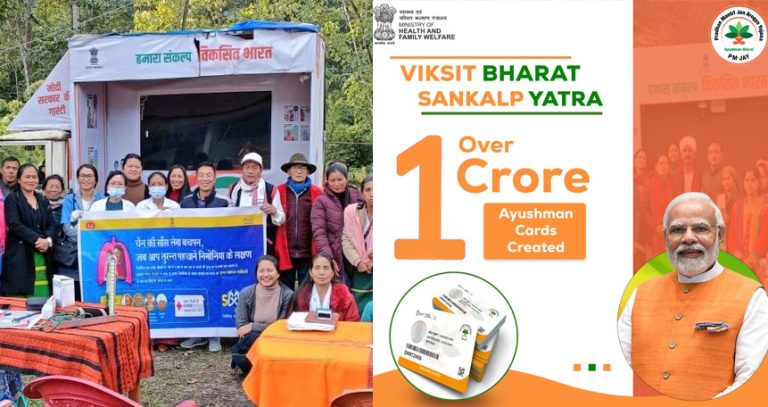
In a significant milestone demonstrating the strengthening of the country’s health infrastructure and propelling healthcare excellence in India, India has achieved a commendable landmark. 1,02,23,619 crore Ayushman cards have been created during the Viksit Bharat Sankalp Yatra, as per an official press release.
Under the ongoing Viksit Bharat Sankalp Yatra, the cumulative footfall has reached 1,31,66,365 in 79,487 Health camps conducted in 3,462 Gram Panchayats and Urban Local Bodies, to date, it added.
Under the flagship scheme of the Ministry of Health and Family Welfare, Ayushman cards are being created using the Ayushman app and physical cards are being distributed to the beneficiaries. To date, more than 23,83,473 physical cards have been distributed.
As per the release, a total of 6,34,168 Ayushman cards have been created at the health camps held yesterday
Ayushman card = guarantee of free health treatment!
In a significant milestone aimed at making quality healthcare accessible to all, over 1 crore Ayushman Cards have been created under the ongoing #ViksitBharatSankalpYatra.
Screening of patients for TB is carried out by screening for symptoms, sputum testing, and using NAAT machines wherever available. Cases suspected to have TB are referred to higher facilities. By the end of Day 36, more than 49, 17,356 people had been screened out of which more than 3,41,499 were referred to higher Public Health Facilities, it added.
The press release said that under Pradhan Mantri TB Mukt Bharat Abhiyan (PMTBMA), consent is being taken for patients suffering from TB to receive assistance from Nikshay Mitras. Attendees willing to be Nikshay Mitras are also being provided on-spot registration. More than 1,17,734 patients have given consent under PMTBMBA and more than 39,819 new Nikshay Mitras were registered.
Under the Nikshay Poshan Yojana (NPY), monetary assistance is provided to TB patients through Direct Benefit Transfer. For this purpose, details of the bank accounts of the pending beneficiaries are being collected and accounts are being Aadhaar seeded. Details of 30,093 such beneficiaries have been collected, the release further stated.
In areas with a predominantly tribal population, screening of eligible population (up to 40 years of age) is being done for the detection of Sickle Cell Disease (SCD) through the Point of Care (PoC) tests for SCD or through Solubility Test. Cases testing positive are being referred to higher centres for management. More than 5,08,701 people have been screened so far, out of which 21,793 were found to be positive and referred to higher public health facilities, as per the release.
As per the release, screening of eligible population (30 years and above) is being done for Hypertension and Diabetes and cases suspected to be positive are being referred to higher centres. Around 10,297,809 people have been screened for Hypertension and Diabetes. More than 4,82,667 people were suspected to be positive for Hypertension more than 3,45,898 were suspected to have Diabetes and more than 7,59,451 people were referred to higher public health facilities.
The Viksit Bharat Sankalp Yatra was launched by the Prime Minister on November 15 from Khunti, Jharkhand to saturate the benefits of central government schemes across the nation. As a part of on-spot services under the Yatra, Health Camps are being organized at the places of halt of the IEC Van in the Gram Panchayats.
(This news report is published from a syndicated feed. Except for the headline, the content has not been written or edited by OpIndia staff)
In a bizarre incident, a man pronounced triple talaq on his wife over a WhatsApp call after learning that she had given her kidney to her brother who was battling for his life. The woman identified as 40-year-old Tarannum lives in Uttar Pradesh’s Bairiyahi village under the Dhanepur police station located in the Gonda district and her 44-year-old spouse Mohammad Abdul Rasheed is employed in Saudi Arabia.
The accused forced her to ask for Rs 40 lakh for her organ after she told him about the measures she took to preserve her sibling’s life. He then divorced her as she disregarded his advice. Her in-laws also threw her out and she is at present residing in her parents’ home.
Tarannum was reportedly married to Mohammad Abdul Rasheed of Jaitapur village approximately twenty to twenty-five years ago. When she could not conceive after five years of marriage, he remarried and moved to Saudi Arabia to pursue his career. She revealed that her older brother Mohammad Shakir had been afflicted with a kidney condition for the previous 18 months.
She mentioned that she talked to her husband who had approved before deciding to provide one of her kidneys to her brother. However, following the contribution, when he was given a new lease of life and returned home after his recovery, the perpetrator placed greater pressure on her to obtain the amount that she turned down. Afterwards, he called her to announce triple talaq to her utter shock.
Police filed a case based on the victim’s complaint and stated they would bring charges against the culprit as soon as he returned to India. Radheshyam Rai, Additional Superintendent of Police attested to the fact that a case has been registered and the required steps are being taken.
The nation had proclaimed triple talaq to be unlawful in 2019. The Muslim Women (Protection of Rights on Marriage) Act forbids triple talaq and carries a maximum three-year prison sentence. According to the Supreme Court, anticipatory bail could be granted in these situations as long as the court hears from the complainant woman before approving pre-arrest bail.
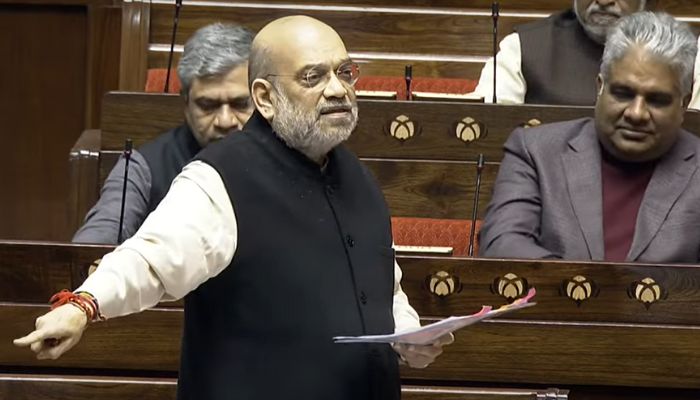
On Thursday (21st December), the Union Home Minister Amit Shah replied to the debate in Rajya Sabha on the newly passed Bharatiya Nyaya (Second) Sanhita 2023; Bharatiya Nagarik Suraksha (Second) Sanhita 2023; and Bharatiya Sakshya (Second) Bill 2023. In his address, he specified that no NGO can file a mercy petition on behalf of the convict. He added that one who does not feel remorse does not have a right to file a mercy petition.
Amit Shah’s response came a day after Shiromani Akali Dal MP Harsimrat Kaur Badal raised the issue of Bandi Sikhs, Balwant Singh Rajoana, Devendrapal Singh Bhuller, Gurdeep Singh Thehra and others. She said that the mercy petitions filed for these convicts have been pending for the last 12 years and the new laws do not have any provisions for their relief. Amit Shah in his response underlined that to ask for mercy, one should first remorse for the crime he has committed.
Amit Shah said, “We have made a lot of provisions regarding the mercy petitions. One can file a mercy petition within 30 days of rejecting a plea in the Supreme Court. No NGO can file a mercy petition on behalf of the convict. One who has committed the crime should feel remorse for the crime and beg for the mercy of the honourable president of India. Then only his mercy petition will be considered valid and will be taken into consideration.”
He further said, “We receive a lot of such mercy petitions in which the criminals say that they do not believe in the constitution of India. Also, some other people file mercy petitions on their behalf. If you do not believe in the constitution of India, then the provisions of mercy petitions do not apply to you. Better you get hanged. One who does not feel remorse does not have a right to file a mercy petition.”
Amit Shah also addressed this issue in the Lok Sabha
While replying to the debate on the bills in Lok Sabha, Amit Shah said, “There were suggestions regarding the provisions of the mercy petitions. It was said that a ‘third party’ should be given the right to file the mercy petitions. I am strictly against it. If a person who has committed a crime does not feel any remorse for the sin he has committed and has no realisation of what crime he has committed, he has no right to use the word mercy. One who feels remorse for his crimes has the right to ask for mercy.”
Amit Shah said, “Harsimrat Kaur Ji, I understand very well what you want to say. If a person commits terrorist activity, goes to jail, and then says that he does not believe that he has done anything wrong – and we have mercy on that person? I do not agree with this. This can never be done.
Amit Shah was referring to issues raised by Harsimrat Kaur Badal
On 20th December, Shiromani Akali Dal MP Harsimrat Kaur Badal participated in the debate in Lok Sabha over the three new bills. In her address, she said, “Punjabis and particularly Sikhs are a community who have sacrificed the most for the nation. In the decade of 1980s, the situation in Punjab was not good. A few youths from Punjab went astray in their emotions and took some steps for which they have been imprisoned for the last 28 to 30 years. I am talking about our Bandi Sikhs. Because in the new laws, there is nothing which will enable the Bandi Sikhs to get justice.”
She added, “There were youths like Bhai Rajoana (Balwant Singh Rajoana), Devendrapal Singh Bhuller, and Gurdeep Singh Thehra who took certain steps because of the situation in Punjab. All of them are jailed for the last 28, 30, or 35 years. How can they be imprisoned for so long without any justice? This is a violation of human rights and humanity.”
She further said, “About mercy petitions. it is said in the new laws that only the immediate family of the person can file a mercy petition. Balwant Singh Rajoana has been in a cell of size eight feet by eight feet for the last 28 years. His mercy petition was filed 12 years ago. No decision has yet been taken on the petition by a court or the government. If he has no immediate family, as his parents have died, who will file a mercy petition for him? What kind of law you are bringing in? His prior petition has not been decided for 12 years. Is there any greater injustice than this?”
Harsimrat Kaur Badal said, “Balwant Singh Rajoana is 65 now. Other convicts in the Beant Singh murder case get parole and they come out and stay at their homes. Even Rajiv Gandhi’s killers have come out. Society has no problem with them as their conduct in prison was good. But when it comes to Balwant Singh Rajoana, the government says anti-social elements can not be set free – that too after so many years.”
Who is Balwant Singh Rajoana?
Balwant Singh Rajoana is given the death penalty for his role in the assassination of Punjab’s former chief minister Beant Singh. In July 2007, Rajoana was convicted for his involvement in the explosion outside the Punjab civil secretariat that killed Beant Singh. The blast took place on August 31, 1995, outside the Punjab and Haryana civil secretariat in Chandigarh. Along with Punjab’s former chief minister Beant Singh, 16 others were killed in this explosion.
In 2012, the Shiromani Gurudwara Prabandhak Committee (SGPC) filed a mercy plea demanding the commutation of the death sentence of Rajoana. In 2019, to mark the 550th birth anniversary of Guru Nanak Dev, the Central Government announced a decision to reduce Balwant Singh Rajoana’s death penalty to life imprisonment and to free eight Bandi Sikhs who remained incarcerated despite having served their sentences. Giani Raghbir Singh, the Jathedar of Akal Takht, has formed a committee to address the matters of Rajoana and other Bandi Singhs with the Prime Minister’s Office by the end of December.
Reactions from the political arena
Reacting to Amit Shah’s recent remarks, SGPC chief Harjinder Singh Dhami said, “The demand of releasing Bandi Singhs is within the scope of the Constitution. Shah’s remarks are contrary to the Centre’s notification.”
Delhi Sikh Gurdwara Management Committee chief Harmeet Singh Kalka, however, said that Harsimrat Kaur Badal’s decision to raise this issue in parliament was unnecessary. He said, “When the issue of Bandi Singhs was being followed by Akal Takht constituted panel, there was no logic of raising it in the Lok Sabha.”
BJP leader Manjinder Singh Sirsa commented that Harsimrat’s raising of the issue was a strategy to garner political advantage. While discussing the Bills intended to replace the IPC and the CrPC, Harsimrat suggested amending the provision that currently permits only the convict’s family to file a mercy petition.
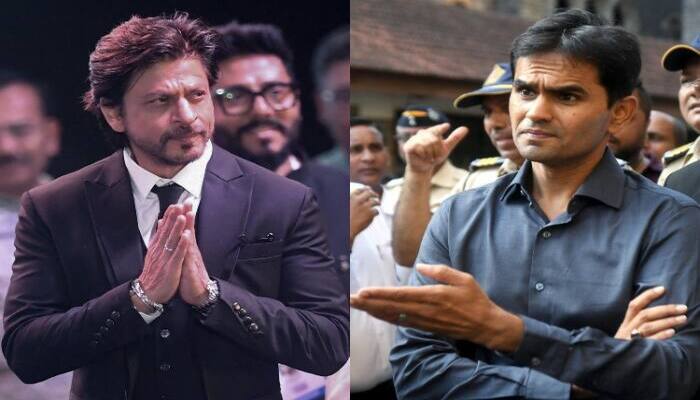
“Bete ko hath lagane se pehle baap se baat kar’ (Before laying your hand on the son, speak to his father)” this dialogue from Shah Rukh Khan starrer film “Jawan” released in September this year. The dialogue said by SRK’s character Vikram Rathore was called by his fans an indirect dig at Sameer Wankhede, the former anti-drugs officer in charge of investigating Aryan Khan’s cruise ship drugs case. In a recent interview with MensXP, Sameer Wankhede reacted to the dialogue, calling it ‘roadside.’
“This dialogue sounds very roadside to me. I neither watch movies nor listen to any dialogue. I don’t know anything about this movie. But if someone has targeted this towards me, then I would like to respond to it in English.” Wankhede then quoted another writer and said, “I have burnt many houses and bridges and I have danced on those burnt houses and bridges so I fear no hell, so please don’t scare me,” Wankhede said.
Although Wankhede did not delve into the details of the ongoing case since the matter is sub judice, when asked about his memories with Shah Rukh Khan before the Aryan Khan case, Wankhede said, “2-3 times bhi mulakaat hui, toh bhot cordial type baat hoti thi. He knew me very well and I also knew him very well. But I have no regrets, maine apni duty nibhaayi Bharat mata ke liye.”
Earlier this year, Sameer Wankhede was accused of attempting to extort money from Shah Rukh Khan in exchange for the release of his son, Aryan, from custody. Aryan Khan had been detained for a month following the narcotics bust on the 2021 Cordelia cruise ship. During this time, Sameer produced messages reportedly received by Shah Rukh Khan, claiming that there was no proof to support his claim that he was seeking money from the actor.
Notably, when the trailer of the SRK starrer was released in August this year, Wankhede had written a cryptic post on his X profile which read, “I have licked the fire and danced in the ashes of every bridge I ever burned. I fear no hell from you.-Nicole Lyons. A quote that always inspires me !”
I have licked the fire and danced in the ashes of every bridge I ever burned. I fear no hell from you. -Nicole Lyons A quote that always inspires me !@ABPNews@news24tvchannel@RoflGandhi_
It is worth recalling that on 3rd October 2021, Aryan Khan, Arbaaz Merchant, and other 6 people were detained from a luxury cruise liner where a rave party was going on. As per reports, cocaine and ecstasy pills were found on Khan and others with him. The Court had then held that a prima facie case is made out against Khan and other co-accused. However, on 28 October 2023, the Bombay High Court granted Khan and two others bail in the case.
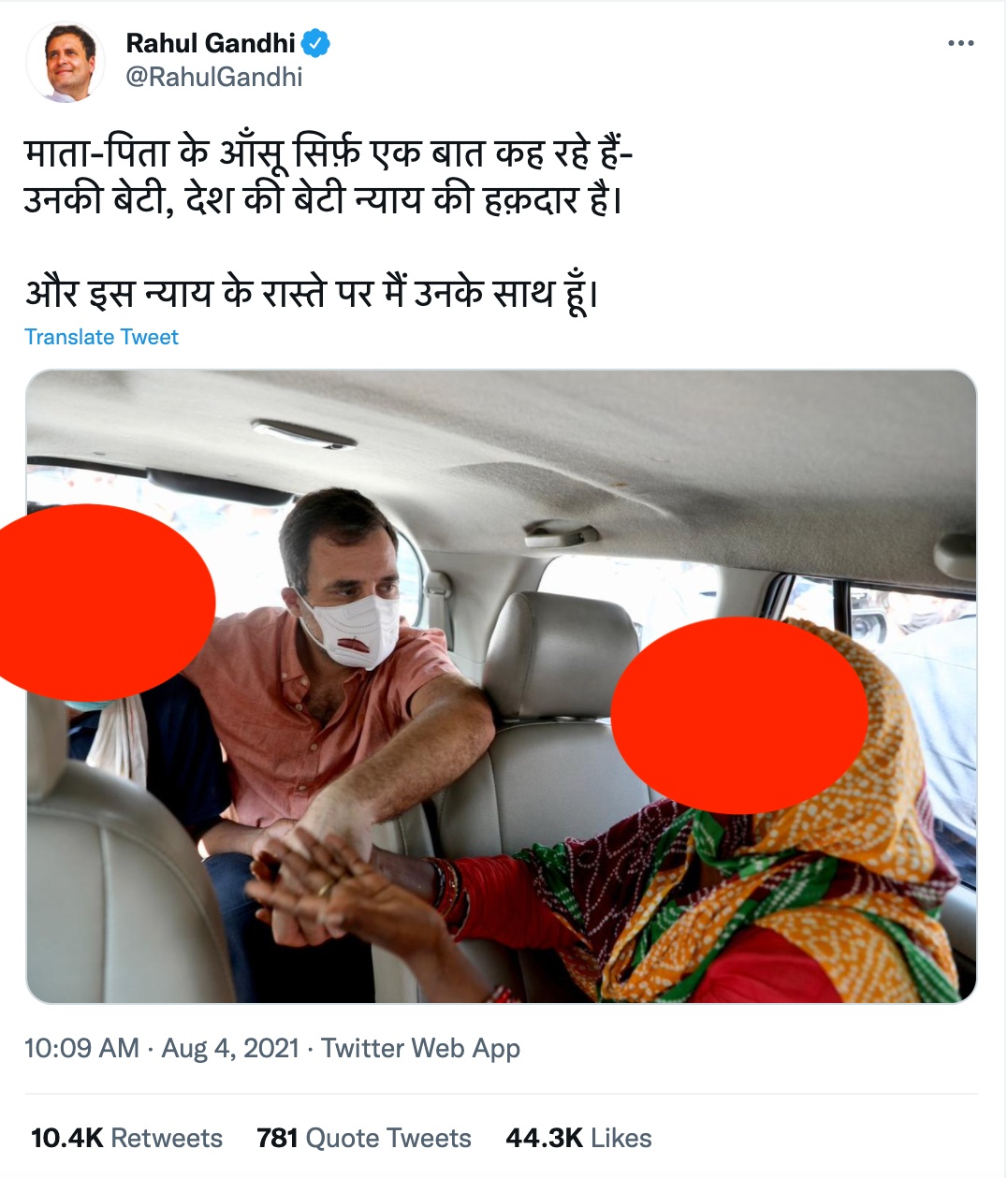
On 22nd December 2023, Rahul Gandhi gave an undertaking to the court agreeing to delete his tweet where he had revealed the identity of a minor victim in his attempt to politicise the 2021 Delhi rape and murder case. In August 2021, a 9-year-old Dalit girl was allegedly raped and murdered inside a crematorium. Days after the news, Rahul Gandhi had visited the parents of the victim. Thereafter, the Congress leader and his party published pictures and videos revealing the identity of the family of the victim.
Tweet by Rahul Gandhi
After the tweet by Rahul Gandhi, NCPCR took cognisance of the offence committed and wrote to social media platforms to take the tweet down. The NCPCR informed Twitter that Section 74 of the Juvenile Justice Act, 2015 prohibits the disclosure of the identity of a minor in any form of media and Section 23 of the POCSO Act, 2012 also stated that no information or photo of a minor should be published in any form of media that revealed the identity of the minor.
According to the complaint, the tweets put out by Rahul Gandhi shared certain personal details about the victim violating Section 23 of the POCSO Act, 2012, and Section 74 of the Juvenile Justice Act,2015. Hence, the NCPCR asked Twitter to remove the tweets put out by Rahul Gandhi as it was a deprivation and a violation of child rights.
Thereafter, Rahul Gandhi’s tweet had been restricted in India, while in the rest of the world, his tweet was visible.
The current case in the Delhi High Court stems from a plea moved by Makarand Suresh Mhadlekar where he pleaded that the tweet by Rahul Gandhi violated provisions of the JJ Act and POCSO Act.
While it may seem like Rahul Gandhi was merely following the law by agreeing to take his Tweet down, the truth is far from it. The High Court bench had essentially urged Rahul Gandhi to delete the tweet revealing the identity of the minor victim as it said it did not want to pass a judicial order against him. Essentially, the court told Rahul Gandhi that unless he deletes his tweet, the court will pass an order forcing him to comply. It was after this that Rahul Gandhi submitted an undertaking, agreeing to remove posts where he revealed the identity of the minor victim.
The Delhi High Court further instructed the Delhi Police to file a status report in the matter of filing an FIR against Rahul Gandhi in the next 4 weeks and posted the matter for 24th of January 2024.
While the High Court instructed the Delhi Police to file a status report, the conduct of the police and the arguments it presented in court were nothing short of bizarre.
The Delhi Police’s bizarre arguments in a bid to shield Rahul Gandhi
During the hearing, the Delhi Police on Thursday made arguments that left many shell-shocked. The arguments aimed to shield Rahul Gandhi and absolve him of culpability after he revealed the identity of a minor victim.
In court, the counsel for Delhi Police in the matter, Santosh Kumar Tripathi, told the court that the investigation against Rahul Gandhi was underway and there was “a lot of complexity in the matter”.
Further, the Delhi Police shockingly informed the High Court that the victim was not raped or murdered but died due to electrocution.
If this assertion by the Delhi Police was not shocking enough, the Delhi Police went a step further. When asked about the status of the investigation against Rahul Gandhi and the filing of the FIR, the Delhi Police asserted that “unless the first part is proved, which is the main crime, subsequent circulation of anything on Twitter is not a crime. The purpose of Delhi Police is not to scandalise anyone”.
Essentially, the Delhi Police told the court that there was no evidence to prove that the 9-year-old Dalit girl was raped and murdered, and since the original crime has not been proved, Rahul Gandhi committed no crime by revealing the identity of the minor victim by publicly revealing the identity of her family.
Let us keep in mind here that the Delhi Cantonment case of this alleged rape and murder was a wildly politicised one. After the news of the alleged crime broke, Rahul Gandhi travelled to meet the victim’s parents, there were several protests, and the usual tropes about a “priest” raping and killing a Dalit child were furthered to create disaffection against the Hindu community at large by furthering the caste narrative.
In 2021, the Delhi Police said that the child did not die of electrocution as claimed by the accused, but was raped and murdered. In the chargesheet, relying largely on the disclosure statements by the accused, the Delhi Police named 55-year-old Radhey Shyam, the priest of the crematorium in South-West Delhi, and other employees – Kuldeep Singh, Salim Ahmad and Laxmi Narayan, as the accused. The chargesheet claimed that there was sufficient evidence against them.
As per its press release in 2021, the Delhi Police gathered scientific and technical evidence apart from recording testimonies of witnesses before filing its charge sheet. Assistance was taken from the Forensic Science Laboratory, Rohini as well as Delhi Police’s forensic experts on biology and odontology. Forensic psychologists were also engaged during the interrogation of the accused, the Delhi Police stated.
Now, 2.5 years after a 400 page chargesheet was filed in the case claiming that there was sufficient evidence against the 4 accused, the Delhi Police, in a case related to Rahul Gandhi, stated in court yesterday that they had reached the conclusion that there was no rape and murder in the case.
While this revelation was shocking enough, what was far more astounding was the argument that the Delhi Police took, based on this revelation, to shield Rahul Gandhi.
In court, the Delhi Police claimed that since they had concluded that there was no forensic evidence to prove rape and murder, Rahul Gandhi had broken no laws by revealing the victim’s identity.
How the Delhi Police’s argument in the Rahul Gandhi case is legally unsound
The Delhi Police’s argument that because 2.5 years after the FIR was filed, they have concluded that no rape or murder took place, Rahul Gandhi had not broken any law by revealing the identity of the minor victim is legally an unsound opinion. The law has been established as far as the identity of the minor victim is concerned and it has nothing to do with the eventual conviction or acquittal of the accused. This is to say that the eventual outcome of the case in the court of law has no bearing on whether the identity of the minor victim can be revealed or not. Regardless of the outcome, revealing the identity is in contravention of the law.
If the Delhi Police’s argument is to be accepted, then it would mean that till the case reaches its conclusion, which may take years, any individual including the media is free to circulate the identity of the minor victim. This would be against natural justice and the very purpose for which these laws against the revelation of identity have been put in place. The reason the law prohibits the circulation of the identity of a minor victim, regardless of the acquittal or conviction, is because it stigmatises the minor victim. The stigma attached to their identity being revealed is not dependent on the conclusion of the case or evidence of the crime.
There are several laws, provisions and guidelines that prove that the Delhi Police’s position in the case of Rahul Gandhi is legally unsound.
Section 74 of the Juvenile Justice Act, 2015
Prohibition on disclosure of the identity of children.
(1) No report in any newspaper, magazine, news sheet or audio-visual media or other forms of communication regarding any inquiry or investigation or judicial procedure, shall disclose the name, address school or any other particular, which may lead to the identification of a child in conflict with the law or a child in need of care and protection or a child victim or witness of a crime, involved in such matter, under any other law for the time being in force, nor shall the picture of any such child be published: Provided that for reasons to be recorded i.n writing, the Board or Committee, as the case may be, holding the inquiry may permit such disclosure, if in its opinion such disclosure is in the best interest of the child.
(2) The Police shall not disclose any record of the child for the purpose of character certificate or otherwise in cases where the case has been closed or disposed of.
(3) Any person contravening the provisions of sub-section (1) shall be punishable with imprisonment for a term which may extend to six months or fine which may extend to two lakh rupees or both.”
Section 74 of the Juvenile Justice Act, 2015 makes it amply clear that under no circumstances would the identity of a minor victim or even a minor witness of a crime, will be revealed. The law says that no detail that could lead to the identification of the minor victim or witness shall be published in any medium – this would include the identity of the parents of the victim – a detail which was publicised by Rahul Gandhi in the given case. The law provides that contravention of this act would attract a jail sentence of up to 6 months.
Section 23 of the POCSO Act, 2012
(1) No person shall make any report or present comments on any child from any form of media or studio or photographic facilities without having complete and authentic information, which may have the effect of lowering his reputation or infringing upon his privacy.
(2) No reports in any media shall disclose, the identity of a child including his name, address, photograph, family details, school, neighbourhood or any otherparticulars which may lead to disclosure of the identity of the child: Provided that for reasons to be recorded in writing, the Special Court, competent to try the case under the Act, may permit such disclosure, if in its opinion such disclosure is in the interest of the child.
(3) The publisher or owner of the media or studio or photographic facilities shall be jointly and severally liable for the acts and omissions of his employee.
(4) Any person who contravenes the provisions of sub-section (1) or sub-section (2) shall be liable to be punished with imprisonment of either description for aperiod which shall not be less than six months but which may extend to one year or with fine or with both.”
Section 23 of the POCSO Act, 2021 also makes it clear that any circulation of identifiable information, which includes the family details of the minor victim, is punishable by no less than 6 months in jail, which could extend up to 1 year. While this rule mentions the media, it also extends to individuals such as Rahul Gandhi.
Section 228A of the IPC
“Whoever prints or publishes the name or any matter which may make known the identity of any person against whom an offence under section 376. section 376A, section 376B, section 376C or section 376D is alleged or found to have been committed (hereafter in this section referred to as the victim) shall be punished with imprisonment of either description for a term which may extend to two years and shall also be liable to fine.”
Section 228A of the IPC talks about the illegality of disclosing the identity of a victim of sexual assault. While this law is not specifically made for minor victims, it extends to all victims of sexual assault, including minors.
Nipun Saxena v. Union of India
The Nipun Saxena v. Union of India case is set strict guidelines to be followed regarding the identity of victims of sexual assault. These guidelines are widely accepted as the standard in such cases.
The court in this case set out:
1. No person can print or publish in print, electronic, social media, etc. the name of the victim or even in a remote manner disclose any facts which can lead to the victim being identified and which should make her identity known to the public at large.
2. In cases where the victim is dead or of unsound mind the name of the victim or her identity should not be disclosed even under the authorization of the next of kin, unless circumstances justifying the disclosure of her identity exist, whichshall be decided by the competent authority, which at present is the Sessions Judge.
In the Nipun Saxena case, the court makes it clear further that no individual can disclose the identity of the rape victim or any information that can lead to her identity being known to the public at large, which is exactly what Rahul Gandhi did.
In none of these laws or precedents, does the conclusion of the case have any bearing, which is to say, in none of these laws or precedents does it say that an individual is permitted to disclose the identity of the victim and it would not be considered a crime if eventually, the accused are acquitted.
It is, therefore, shocking that the Delhi Police would in court make such an argument that is not supported by the established law of the land. The only conclusion which explains the Delhi Police and its advocate’s argument is that this was a shoddy attempt at shielding Rahul Gandhi from the repercussions of his action since it is evident that he did not want a judicial order to this effect on his record.
Questions that arise from the conduct of the Delhi Police in the Rahul Gandhi matter
There are several questions that arise from the conduct of the Delhi Police and its counsel in the Rahul Gandhi matter.
If the police are saying now that there is no evidence to support that rape and murder occurred, then why did it 2.5 years ago mention in the chargesheet that there was ample evidence to support the claims of rape and murder?
If the victim was indeed electrocuted to death, as the Delhi Police claims now, then why did it in their chargesheet dismiss the accused’s assertions to the same effect?
If they did have ample evidence of the crime in 2021, what changed in the following 2.5 years for them to claim today that no rape or murder took place?
In the past 2.5 years since the chargesheet has been filed, why has the trial in the case not proceeded at all?
If there was indeed no rape and murder, then why did the Delhi Police in the Rahul Gandhi matter insist that they would file their status report in a sealed cover to the court?
If the Delhi Police is filing a closure report in the case, which says that there was no rape, then why did it insist that it does not want the details to be discussed in open court?
Why did the Delhi Police feel compelled to safeguard Rahul Gandhi by misinterpreting the law?
Why did the Delhi Police say in court that it would submit its report to the court in a sealed cover because it did not want to “scandalise anyone”? Who did it think it would scandalise? Rahul Gandhi? Why is that their concern to begin with?
Did the Delhi government actively subvert the law in this case to shield Rahul Gandhi?
Why did the Delhi Police insist that the NCPCR has no locus standi in the case against Rahul Gandhi Sec 13 CPCR Act clearly states otherwise?
These questions have bewildered even those in the know of the case and close to the investigation against Rahul Gandhi. A senior advocate on the condition of anonymity claimed that the Delhi Police’s argument in court had shocked everyone and it made no legal sense. “It would appear that the case is being botched up either way to shield Rahul Gandhi”, he said. Another close to MHA, under whom the Delhi Police falls, said that they would be looking into the matter and ensuring that the investigation is not being compromised for political reasons.
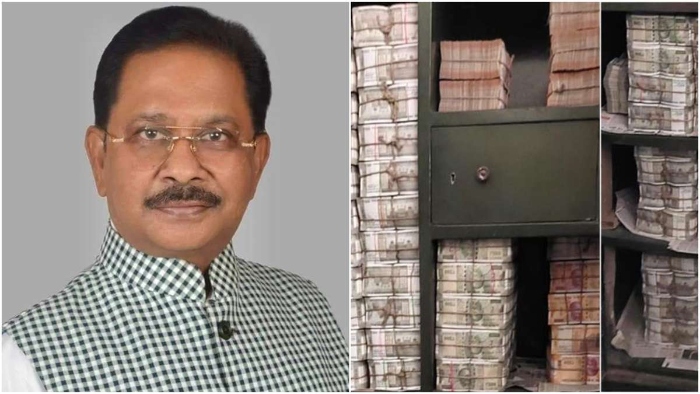
In a historic raid, the Income Tax department seized hundreds of crores from premises linked to Congress Rajya Sabha MP Dhiraj Sahu. Now, the department has revealed that out of this seized Rs 351 crore, Rs 329 crore was recovered from dilapidated buildings in small towns of Odisha. The money was stashed in hidden chambers and hidden safe houses camouflaged as an unoccupied residence located in small towns of Odisha including Sudapada and Titlagarh in Bolangir district and Khetrajrajpur in Sambhalpur district, the I-T Department confirmed on Thursday, December 21.
Besides the cash, many incriminating pieces of evidence in the form of documents and digital data have been found and seized, the Income Tax Department said.
Income Tax Department conducts search operations in Odisha, Jharkhand and West Bengal
During the search operation, a large number of incriminating evidence in the form of documents and digital data has been found & seized
In West Bengal, Jharkhand, and Odisha, the Income Tax Department carried out extensive search operations at properties connected to the Congress MP as well as at a liquor distillery. The operation, which began on December 6 and lasted for more than a week, encompassed more than thirty locations in ten districts throughout the three states.
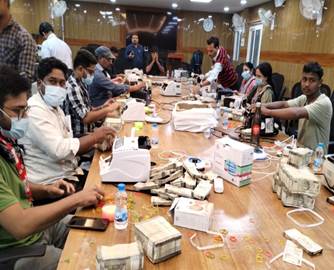
More than 100 I-T officials were present during the raids and more than 40 machines were deployed to count the seized cash. This cash haul has been cited as the largest in the last 42 years.
Image credit: PIB
The tax authorities said that after a preliminary examination of the evidence that was seized, they discovered references for the flow of unaccounted cash, systematic information on undisclosed cash receipts, and records of unreported sales of country liquor.
“The main employees looking after the business activities of the group, have admitted that the cash found and seized during the search operation represents the unaccounted income of the group, generated through its multiple business concerns. This was also corroborated by one of the family members who is actively involved in the business. The facts unearthed during the search operation indicate that the group has been indulging in huge suppression of income earned from the liquor business,” the statement read.
MP from Jharkhand, liquor empire working in several districts of Odisha
It may be mentioned here that the largest amount of cash was found from the liquor manufacturing units of Baldev Sahu and Sons, in Sudpada, Balangir, a town in Western Odisha. As of 10th December, the SBI branch in Balangir declared that all the 176 bags of cash brought from the premises of Baldev Sahu and Sons were counted. This counting took 5 days, and involved dozens of bank staff, and counting machines. Reports in Odisha have stated that the total amount of cash seized from Odisha is over 400 crores and nearly 60 kgs of gold.
2 more liquor traders, reportedly the relatives of Dhiraj Sahu, named Deepak Sahu and Sanjay Sahu, were raided in Titilagarh, a town in Balangir district. I-T seized 11 crores of cash from the premises of the Sahu brothers. Raids at the Sambalpur unit of the company found 37.5 crores.
The political implications of the case were hinted at by Union Minister Dharmendra Pradhan in Odisha. Without taking names, he stated that the money has been looted from the poor people from Odisha and Modi government will ensure that the powerful people linked with the ‘family business’ of the Congress leader (Dhiraj Sahu), will have to answer before the public of Odisha.
Who is Dhiraj Prasad Sahu?
Dhiraj Prasad Sahu is a Rajya Sabha MP for Congress from Jharkhand. His family has been associated with the Congress party since independence. He became RS MP in by-polls in 2009 for the first time. In 2010, he was elected as RS MP for the second time; in 2018, he was re-elected for RS by Congress for the third time. He actively participates in parliamentary proceedings. Sahu was part of Rahul Gandhi’s Bharat Jodo Yatra. In recent raids at Odisha-based Boudh Distillery Pvt Ltd, where Dhiraj Prasad Sahu is a partner, the Income Tax Department recovered over 300 cr of unaccounted cash. Congress Party has distanced itself from the controversy, while BJP leaders, including PM Modi, have targeted Congress.
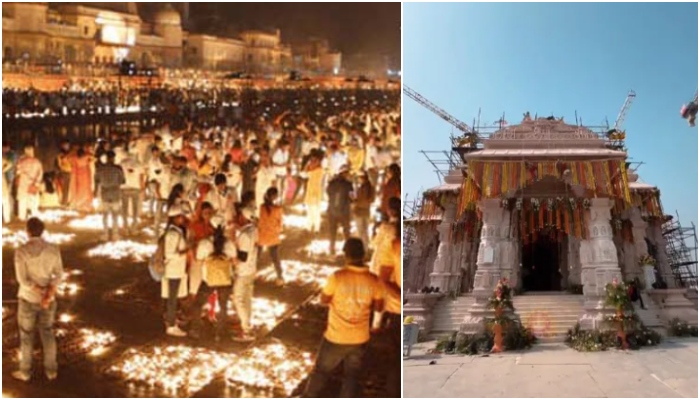
As the date of Ram Mandir’s grand inauguration and Pran Pratishtha of Lord Ram at Ram Janmabhoomi in Ayodhya draws closer, ISKCON has welcomed the pilgrims to Ayodhya for Lord Ram’s darshan offering free full lunch prasad along with the distribution of Vedic literature and sankirtan to around 5000 persons daily. The ISKCON has also decided to set up free medical camp in the city during the Ram Mandir inauguration event in January.
The information was disclosed by Yudishthir Govind Das who is the spokesperson of the ISKCON India Board. “ISKCON welcomes all the pilgrims coming to Ayodhya for the darshan of Lord Sri Rama. Daily 5000 pilgrims will be served full lunch prasad along with distribution of Vedic literature & sankirtan by devotees of different nationalities,” Das said sharing a short video of the program.
ISKCON welcomes all the pilgrims coming to #Ayodhya for the darshan of Lord Sri Rama.
Daily 5000 pilgrims will be served full lunch prasad along distribution of Vedic literatures & sankirtan by devotees of different nationalities.
According to Das, ISKCON has decided to undertake a ‘Padyatra’ from Delhi to Ayodhya which would be completed by the Ram devotees in around 41 days. He also said that on the day of the inauguration of the iconic Ram Temple, luminous ghee diyas will be lit in all the ISKCON temples across India.
The ISKCON Ayodhya Temple is dedicated to Sri Sri Radha Gokul Nanda, Sri Sri Gaur Nitai, Sri Sri Sita Ram Lakshman, and Hanuman and is located in the heart of Ayodhya. Ayodhya is one of the most important pilgrimage sites in the North Indian state of Uttar Pradesh, and it is best known as the birthplace of Lord Rama. According to the epic Ramayana, Ayodhya is an ancient city with all the characteristics of an old-world charm. Since Lord Ram is the 7th incarnation of Lord Vishnu, ISKCON Ayodhya Temple holds a special place in the hearts of the people in India.
The majestic Ram Mandir in Ayodhya is slated to have its ground level finished by the end of this year. The general secretary of the Sri Ram Janmbhoomi Tirath Kshetra Trust, Champat Rai released beautiful photographs of the temple’s sanctum sanctorum on 9th December.
In the later tweets, Rai also clarified that several political leaders, actors, and all the significant religious heads belonging to varied religions have been invited for the inauguration ceremony.
22 जनवरी 2024 को अयोध्या जी में प्राण प्रतिष्ठा के शुभ अवसर पर आमंत्रित किये गये समाज जीवन के विभिन्न क्षेत्रों में कार्यरत महानुभावों के बारे में जानकारी। pic.twitter.com/PKoWeO4Xsy
Prime Minister Narendra Modi is scheduled to attend the event to install the Ram Lalla idol on the temple grounds on 22nd January, drawing thousands of Lord Ram followers to Ayodhya for the landmark event. Furthermore, notable individuals like industrialists Mukesh Ambani, Gautam Adani and Ratan Tata, cricketers Sachin Tendulkar and Virat Kohli and Bollywood megastar Amitabh Bachchan among other actors are invited to the consecration ceremony.
The consecration or the Pran Pratishtha ceremony is expected to be a grand event as the Teerth Kshetra Trust has sent traditional invitations to all prominent temples, spiritual leaders, Shankaracharyas, Mahamandaleshwars, and leaders of Sikh, Jain, and Buddhist sects from all over the country.
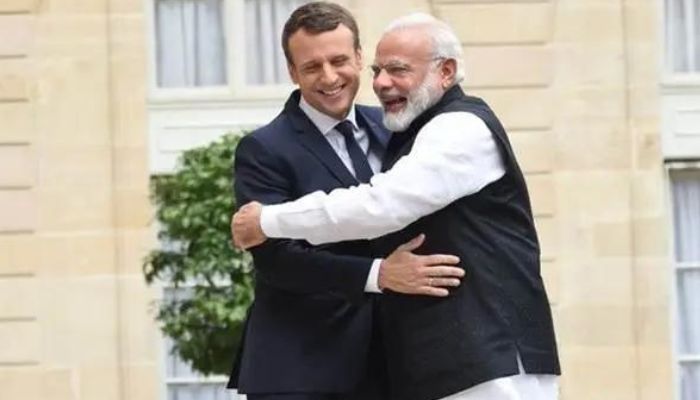
The Narendra Modi-led-government has invited French President Emmanuel Macron as the Chief guest for India’s 75th Republic Day.
As per reports, this marks the 6th instance when the Indian government invited a French leader as a Chief guest for the Republic Day parade.
India has previously invited French Prime Minister Jacques Chirac (1976), President Valéry Giscard d’Estaing (1980), President Jacques Chirac (1998), President Nicolas Sarkozy (2008), and President François Hollande (2016).
French President Macron to be the chief guest at India's Republic day 2024. Earlier this year, PM Modi was the guest of honour at Bastille day in Paris. Reporting: pic.twitter.com/AFM00QG5ND
During his tenure as the Prime Minister of India, Narendra Modi has invited US President Barack Obama (2015), French President François Hollande (2016), UAE Crown Prince Mohammed bin Zayed Al Nahyan (2017), Heads of ASEAN nations (2018), South African President Cyril Ramaphosa (2019), Brazilian President Jair Bolsonaro (2020), and Egyptian President Abdel Fattah el-Sisi (2023).
Earlier this year, the French government invited Indian Prime Minister Narendra Modi to be the Guest of Honour at France’s National Day celebrations on 14th July.
An Indian tri-services contingent also took part in this event in order to reinforce its significance, representing the strengthening of ties and shared ideals between India and France.
Cher Narendra, heureux de t'accueillir à Paris comme invité d'honneur du défilé du 14 juillet !
प्रिय नरेंद्र, 14 जुलाई की परेड के सम्मानित अतिथिके रूप में तुम्हारा पेरिस में स्वागत कर के मुझे बहुतखुशी होगी। pic.twitter.com/XTJi4MiE0E
India’s participation in the Bastille Day Parade, as an ascending global power, emphasises its broadening influence on the international scene and reflects the strengthening ties between the two democracies.
This year marks the 25th anniversary of the Indo-French partnership. In July, the French President felicitated PM Modi with the ‘Grand Cross of the Legion of Honor.