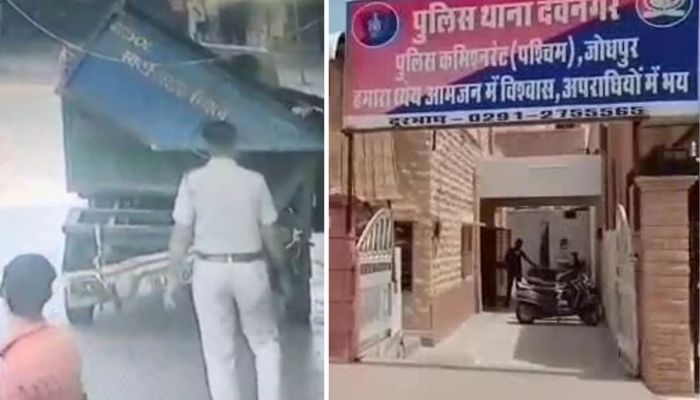
In a shockingly callous incident from Rajasthan’s Jodhpur, the body of a daily wager, who was crushed by a bus in a roadside accident was taken to the hospital by police in a garbage collection vehicle. The mishap took place outside the police station in the Barkatullah Khan Stadium area, after which the body of the slain man was hurriedly dumped in a garbage truck by the policemen and sent away to the hospital.
According to the report by Hindi news portal Jagran, the Jodhpur Police even made secretive attempts to suppress the matter. However, the incident was revealed when the CCTV footage from a camera placed in the hospital lobby caught the garbage vehicle that reached the hospital premises.
Man killed in a road accident in Jodhpur. Body brought to hospital in a garbage tipper by the police pic.twitter.com/ksY8c2RApj
In the morning on Wednesday, a local daily wager was crushed under a bus parked near the ACP office, Pratapnagar, situated near Barkatullah Khan Stadium in Jodhpur. Reportedly, the person slept under the bus the previous night and instantly met a tragic death after the bus driver started the vehicle. The daily wager was crushed under the tyre of the bus and died on the spot. The deceased person has been identified as Devram Prajapat, a resident of Bilara.
Upon receiving the information, city police officials reached the accident spot and waited for a vehicle to arrive at the spot. While the vehicle to carry the dead body failed to arrive on time, the police shifted his body to the trauma centre of MDM hospital in a garbage van owned by the civic body.
The National Human Rights Commission took cognizance of the matter after the police apathy came to the fore. The commission has sought a report from the police department in the next 15 days. The matter that has unfolded in Jodhpur has triggered widespread anger and outrage on social media.
BJP MP from Jaipur Rural Rajyavardhan Singh Rathore lashed out at the Ashok Gehlot led Rajasthan administration on Twitter. Calling the incident an act of shame, he wrote, “Everyone is ashamed to see the exploits of the Congress Raj. In the home district of Chief Minister Ashok Gehlot, the youth who died in a road accident was taken to the hospital by the police in a garbage car. Living the life of a common man under the Gehlot government is hell, even after death, the insensitivity shown by the government makes it miserable.”
कांग्रेस राज के कारनामें देखकर हर कोई शर्मसार है।
मुख्यमंत्री अशोक गहलोत जी के गृह जिले में सड़क दुर्घटना में मृत युवक को पुलिस कचरे की गाड़ी में डालकर अस्पताल ले गई।
गहलोत सरकार में आमजन की जिंदगी जीते जी तो नर्क है ही, मरने के बाद भी सरकारी संवेदनहीनता उसकी दुर्गति करती है। pic.twitter.com/xEVPVkP11E
Immediately taking cognisance of the matter, Dev Nagar police station in Jodhpur rushed to the scene upon receiving the preliminary information. According to reports, SHO Jai Kishan Soni ordered officials to remove the body from the location, since people started gathering at the spot in large numbers. When Head Constable Rawat Singh tried to get a taxi, it did not arrive on time. Responding to the situation, the police officers had no option but to carry the body of the victim to the hospital in a garbage van owned by the civic body.
Currently, Jodhpur police commissioner Navjyoti Gogoi has ordered ACP West, Chakraborty Singh, to investigate the matter.
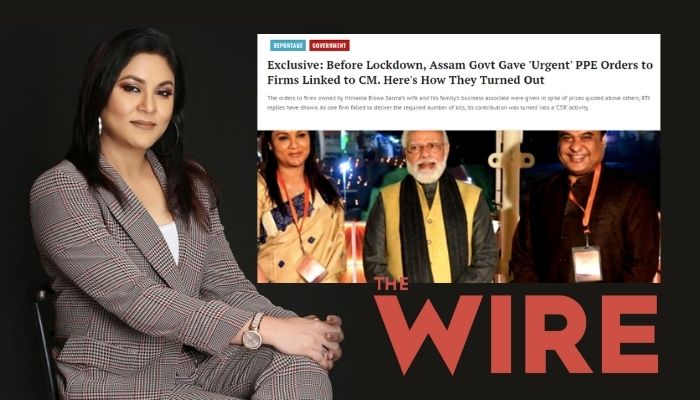
Leftist media portal The Wire continues to publish baseless allegations of corruption on Assam CM Himanta Biswa Sarma and his wife. On Wednesday, the portal published a report alleging that a firm allegedly owned by Riniki Bhuyan Sarma was given an order to supply PPE kits and other Covid-19 essentials without following due procedure. The report claimed that when Himanta Biswa Sarma was the health minister in the previous Sarbananda Sonowal govt in Assam, a firm owned by his wife Riniki Bhuyan Sarma was granted an urgent work order to supply 5,000 PPE kits, despite having no history of supplying or producing medical equipment and safety gears.
However, Riniki Bhuyan Sarma has refuted the allegations made in the report by The Wire, and said she didn’t take even a penny for supply of the PPE kits. She said that she had donated the PPE kits to the National Health Mission under CSR, and no payment was taken for the same.
The Wire in collaboration with Guwahati-based news portal ‘The Cross Current’ had claimed through a series of Right to Information (RTI) replies that orders for emergency medical supply orders during Covid-19 were given to four considered firms without following a tendering process. The Wire report says that out of the four firms, three are linked to chief minister Himanta Biswa Sarma’s wife Riniki Bhuyan Sarma and his family’s business associate.
The Wire claimed that an urgent work order to supply 5,000 PPE kits was given to JCB Industries, of which Sarma’s wife Riniki Bhuyan Sarma is the owner. While the Guwahati-based firm is known to produce sanitary napkins, The National Health Mission (NHM), Assam granted the order to Sarma’s company with no history of producing any medical equipment, the report claimed. It further said that the order to JCB industries was given on March 18, 2020 when there was a sudden presence and rise of Covid-19 cases in India.
Through the RTI replies, The Wire also claimed that apart from JCB Industries, orders for PPE kits to two other firms – GRD Pharmaceuticals and Meditime Healthcare were given. As claimed by the portal, the companies are owned by Ghanshyam Dhanuka, Sarma’s business associate. As per the report, the later firms have supplied medical equipment to the state government since Congress was in power in Assam.
With the RTI application that was filed by The Cross Current, the media portal used the replies for its report. The primary accusation is that JCB Industries and Meditime Healthcare failed to meet the delivery of goods on the target date. Secondly, the Wire claimed that PPE kits at higher rate (Rs 990 per piece) were procured from the companies, on the same day it bought PPE kits at the rate of Rs 600 per piece from another Assam-based firm, NE Surgical Industries.
Riniki Bhuyan Sarma’s rebuttal
Assam CM Himanta Biswa Sarma’s wife Riniki Bhuyan Sarma has rubbished the report by The Wire calling it a piece of propaganda. “At the risk of dignifying such malicious propaganda with a reply, The Wire has come out with an unfounded accusation once again,” she said in a statement.
Clarifying the matter of supplying PPE kits, Riniki Bhuyan Sarma said that when the Covid-19 pandemic broke out in Assam, there was not a single PPE kit available in Assam, a medical safety unit mandatory for health workers treating Covid-19 patients. Therefore, she had arranged some PPE kits through a business acquaintance and delivered the same to the National Health Mission. However, when the NHM issued a work order against this, so that she can raise an invoice for the supply, she informed the authorities that it is a donation and she will not take payment for the same.
She informed that at a delicate time when PPE kits were available nowehere in Asaam, she stepped forward with the help of her company to help the government with the same. “In the first week of the pandemic, not a single PPE kit was available in Assam. Taking cognisance of the same, I reached out to a business acquaintance, and delivered around 1500 PPE kits to the NHM with a lot of effort. Later on, I wrote to the NHM to treat the same as a part of my CSR. A due acknowledgement enclosed” Sarma said in a statement issued today.
— RINIKI BHUYAN SHARMA (@rinikibsharma) June 1, 2022
She further added, “I did not take a single penny out of this supply. I have always been transparent about my belief in giving back to the society, irrespective of my husband’s political standing. My organisation has also supported the NHM in the fight against COVID by donating to the Aarogya Nidhi.” It is notable that Aarogya Nidhi is state government’s Financial Assistance Scheme.
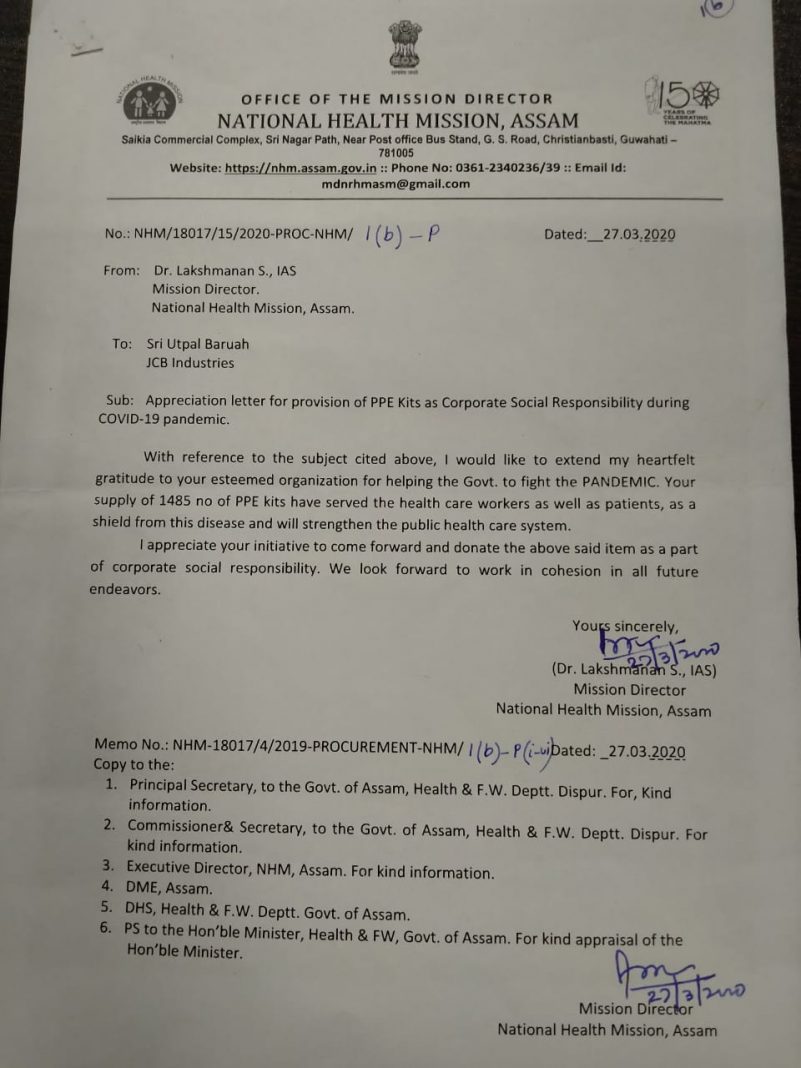
Riniki Bhuyan Sarma also attacked an appreciation letter from National Health Mission in Assam, which makes it clear that she had donated the PPE kits, and didn’t accept any payment. The letter written by the NHM Assam Mission Director to JCB Industries says that he extends his heartfelt gratitude to her organisation for helping the govt with 1485 PPE kits. The subject of the letter says that it is an appreciation letter for providing PPE kits as Corporate Social Responsibility during Covid-19 pandemic.
Copy of letter written by NHM managing director, N. Lakhsmanan to the company for Sarma’s CSR initiative
The letter further says, “I appreciate your initiative to come forward and donate the above said item as a part of corporate social responsibility. Therefore, it is clear from the NHM’s letter that Riniki Bhuyan Sarma’s firm had donated 1485 PPE kits to the Assam govt when the healthcare system in the state needed it the most under CSR. The firm was not issued any ‘illegal order’ as alleged by The Wire, and no payment was made for this supply that the media portal tried to question.
It is a surprise that while The Wire could gather so many document through RTI, they could not locate this letter by NHM saying it was a donation. Moreover, they also claimed that while JCB Industries was issued an order to supply 5000 PPE kits, it was cancelled as only 1485 kits was supplied. Therefore, The Wire needs to answer what was scam if the order was cancelled, because no order means no payment.
Sarma lashed out at The Wire when Rinika Bhuyan Sarma said, “If only such propaganda websites were to do things beyond paying mere lip service in times of crisis, India would be in a better place. I will always stay firm in my belief to serve the country, irrespective of such sponsored hit jobs.”
The Wire report also makes some shocking claims, indicating that there was no need to issue urgent orders for PPE kits and other essential items to combat Covid-19 in March 2020. It is notable that during emergencies and urgent needs, governments can bypass the lengthy tendering process and issue urgent orders to procure items and services. It is a normal procedure used by all govts, not just the BJP as the article seems to suggests.
The report claims, “state health department had issued four ‘urgent’ work orders between March 18, 2020 and March 23, 2020 to procure PPE kits and hand sanitisers even prior to the “panicky” situation that had set in due to the national lockdown”, which is complete disregard of the fact of that time. The fact is, Assam had entered the “panicky” situation more than a week before PM Modi had announced national lockdown on March 24, 2020. Assam govt had announced a partial lockdown on 15th March itself, closing down schools and colleges, gyms, cinema halls etc. Such proactive measures by Assam govt in general and then health minister Himanta Biswa Sarma had ensured that Assam was able to manage the pandemic well.
Assam govt had built temporary Covid-19 hospitals with thousands of beds even before a single Covid-19 case was detected in the state, and by logics of The Wire, that was a scam because there was “panicky situation”. It is very shocking that a media house The Wire claimed that issuing urgent orders for PPE kits before national lockdown was wrong, while nobody expects them to appreciate a BJP govt for taking proactive steps, especially when there was no PPE kits in the state, the leftist is actually portraying it as a scam.
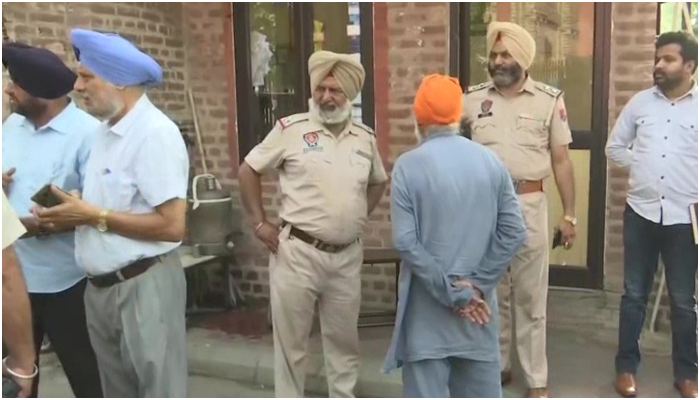
On Wednesday, two brothers identified as Sudhir Malik and Ashish Malik were injured in a clash between two groups outside Khalsa College, Sector 26 in Amritsar, Punjab. The third-year Commerce graduate students were injured as guns were fired during the clash.
The Punjab Police confirmed that shots were fired during the clash between two groups outside the college but termed the incident as a routine crime and not a gang war. According to the reports, the duo victims were in a car with two other friends when they were blocked by two cars, one ahead and the other from behind.
Punjab | Two persons injured in a clash between two groups outside Khalsa College, Amritsar
Shots were fired during the clash between two groups outside the college. The situation is under control. It was a routine crime, not a gang war. Further probe underway: Police pic.twitter.com/nWbeeoNrJO
The victims in their statement said that around 10 armed people got off the two cars and attacked them with sharp-edged weapons. The victims were going towards DT Mall in their car to watch a movie. They have now been admitted to a private GMSH-16 hospital with severe injuries to the stomach and arm.
Controversial singer and Congress leader Sidhu Moosewala shot dead in Punjab
Earlier, on May 29, popular Punjabi singer, rapper, and Congress leader Sidhu Moosewala was shot dead in an attack in Mansa, Punjab. Multiple rounds were fired at his vehicle resulting in his death. Goldy Brar of the Lawrence Bishnoi gang took responsibility for the murder, alleging Moosewala was involved in the murder of one of their gang member, but Police did not take any action against him.
In the current case, the Punjab Police has recorded the statement of the victims and have registered a case in the matter. Investigations in the case are underway.
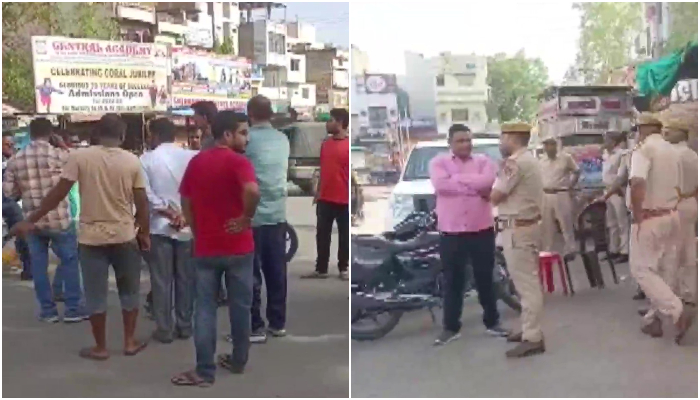
On Wednesday, massive protests broke out in the city of Chittorgarh in Rajasthan after a youth named Ratan Soni was brutally attacked and murdered by some miscreants on Tuesday night. Deceased Ratan Soni was the son of former BJP councilor Jagdish Soni and was associated with the Bajrang Dal and the Rashtriya Swayamsevak Sangh (RSS).
Rajasthan | People protest in Chittorgarh after Ratan, the son of a former councillor Jagdish Soni was killed last night. Case registered against three people. Visuals from this morning. More details awaited. pic.twitter.com/oEQV40ZRsO
— ANI MP/CG/Rajasthan (@ANI_MP_CG_RJ) June 1, 2022
According to the reports, a case has been registered against three persons who used swords and sticks to kill the deceased. Ratan was attacked as he was on his way back home after attending a program in Manglik Dham on Tuesday night. The miscreants who were on the bike left the spot after attacking him.
The incident happened at around 10 pm after a scuffle broke out between two groups. Injured Ratan was immediately shifted to a local hospital for treatment but was later shifted to a hospital in Udaipur. However, he breathed his last during the journey. His body was brought to Chittorgarh’s district headquarters.
Meanwhile, SSP Chittorgarh, Preeti Jain confirmed that a person was killed last night around 10 pm after a scuffle broke out between two groups. “Police have registered an FIR against 3 people and 2 have been detained”, she said. She also added that no Section 144 was imposed and that no internet services were shut down in the area.
A person was killed last night around 10 pm after a scuffle broke out between two groups near a liquor shop. Police have registered an FIR against 3 people and 2 have been detained. We are investigating the matter: Preeti Jain, SSP Chittorgarh pic.twitter.com/AufUduacCA
— ANI MP/CG/Rajasthan (@ANI_MP_CG_RJ) June 1, 2022
Reportedly, massive protests were held in Chittorgarh’s Dhuncha Bazar area where the demonstrators demanded strict legal action against the miscreants and financial assistance to the family members of the deceased. “Police were carrying out a flag march and during that the incident of stone-pelting was reported. One person who was showing aggression, was taken away in the police custody. Now there is peace in the area”, SP Jain added.
#WATCH | Rajasthan | Stone pelting on Police in Chittorgarh’s Dhuncha Bazar area as the situation remains tense after the son of former BJP councillor Jagdish Soni was killed last night following a scuffle between two groups pic.twitter.com/dL97BDpykh
— ANI MP/CG/Rajasthan (@ANI_MP_CG_RJ) June 1, 2022
She also said that the Rajasthan Armed Constabulary (RAC) and Special Task Force (STF) was deployed in the area to ensure that the law and order is maintained. “The situation is completely under control. Postmortem of the body to be conducted”, she stated.
Rajasthan | Postmortem of the body to be conducted. Three people detained so far and FIR registered. The deceased’s family has demanded financial assistance & a job for a member of the family: Preeti Jain, SP Chittorgarh
— ANI MP/CG/Rajasthan (@ANI_MP_CG_RJ) June 1, 2022
Reports mention that the family of the deceased had demanded financial assistance and a job for a member of the family. Collector of Chittorgarh, Rajasthan confirmed on June 1 that a job will be provided to the Ratan’s widow and compensation of Rs 25 lakhs also will be provided to the family.
Chittorgarh, Rajasthan | The Administration has agreed to our demands. We should get justice. Last rites will be performed today after the postmortem is conducted: Former BJP councillor Jagdish Soni on his son’s death pic.twitter.com/37iXJqKVju
— ANI MP/CG/Rajasthan (@ANI_MP_CG_RJ) June 1, 2022
Meanwhile, according to Former BJP councillor Jagdish Soni, father of deceased Ratan Soni, last rites of the deceased will be performed after the postmortem is conducted. The Police in the case has so far registered complaint against the miscreants and has taken three persons in the custody. Further investigations are underway.
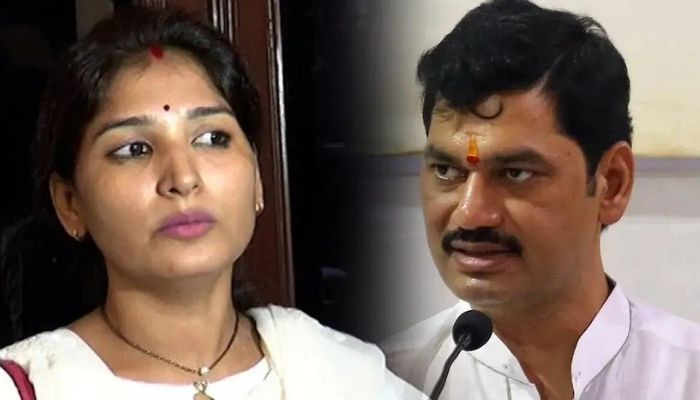
Maharashtra Cabinet Minister Dhananjay Munde’s second wife Karuna Sharma Munde has come up with new allegations against the minister on Wednesday 1st June 2022. She made a sensational statement saying, “If I play a CD, Maharashtra will be shocked.” Besides, she also alleged that Dhananjay Munde is responsible for her mother’s suicide.
Karuna Sharma held a press conference in Mumbai, in which she has levelled several serious allegations against Dhananjay Munde. She said, “Dhananjay Munde got my sister Renu Sharma imprisoned on false charges because she was going to make a big revelation about Dhananjay Munde at a press conference; but before that, she was arrested by the police.”
She further said, “No action is being taken on the complaint I have given against Dhananjay Munde. The NCP is backing Dhananjay Munde. I was respecting Pawar Saheb till now. However, in this case, it is sad to see that he is backing such persons.”
Karuna Sharma alleged that her mother committed suicide because of Dhananjay Munde. She said, “My daughter Shivani Dhananjay Munde was scheduled to hold a press conference. However, she remained absent from the press conference as she was threatened. The arrest action was taken against us due to pressure from Dhananjay Munde. It was because of him that my mother committed suicide. I have evidence that I am Munde’s first wife. I have not spoken to my sisters trusting Munde since 2008. Munde misused his ministerial post. Pawar should remove Munde from the post of minister. We have evidence that Dhananjay Munde has illicit relations with other women as well.”
Karuna Sharma’s sister accuses NCP leader and Maha cabinet minister Dhananjay Munde of rape; claims police apathy
Earlier this year, Maharashtra Cabinet Minister Dhananjay Munde’s second wife Karuna Sharma Munde accused him of being involved in multiple extra-marital affairs and hiding six children he conceived of them.
It is notable that the truth about Dhananjay Munde’s affairs unfolded in January last year when Renu Sharma tweeted alleging that he raped her repeatedly in the year 2006 and a police station was not ready to lodge her complaint. After the allegations increased the political turmoil in Maharashtra, Munde had clarified in a Facebook post about being involved in a relationship with Karuna Sharma and having 2 children out of wedlock. However, he dismissed all allegations made by her sister Renu and asserted that this was a ploy to threaten him.
Starting on September 5, 2021, Karuna faced judicial custody for two weeks in a case of murder and was booked under the Atrocities Act. Karuna was in Beed, the turf of Munde, and was soon to expose the wrongdoings of her husband Dhananjay Munde before her arrest. In December same year, at a press conference in Ahmednagar, she announced her entry into politics while announcing her new party, “Shiv Shakti Sena.”
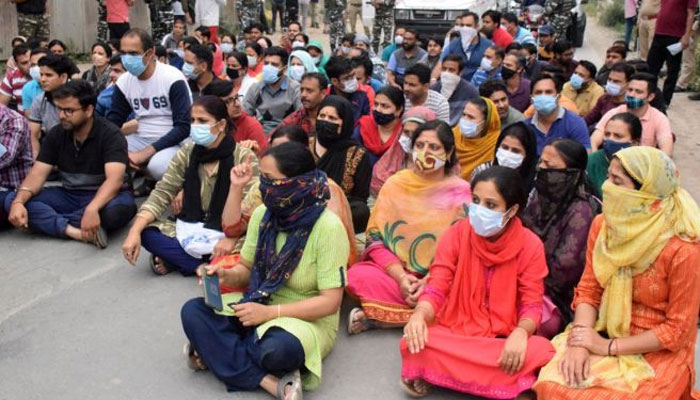
On June 1, Jammu and Kashmir Lieutenant Governor chaired a key meeting amid targeted killings. As per the reports by several media houses, the sources suggest that PM Package employees and others who belong to minority communities posted in the Kashmir division will be posted at secured locations. LG has set June 6, 2022, as the deadline for the process. Kashmir being a Muslim majority region, minorities in the region includes Hindus, Sikhs and other non-Muslim communities.
The decision to relocate minority employees to ‘secure locations’ in the valley comes after a series of targeted killings of Hindu government employees by terrorists in Kashmir and fears of their exodus from Kashmir.
#LIVE: J&K L-G chairs key meet amid targeted killings; Sources say, PM Package employees and others from minority communities posted in Kashmir division will be immediately posted at secured locations and the process to be completed by Monday, 6th June 2022 (1/3)
“PM Package employees and others from minority communities posted in Kashmir division will be immediately posted at secured locations and the process to be completed by Monday, 6th June. It has to be ensured that no employee should work or reside in isolated areas or in a scattered manner” a govt source said, as per media reports.
Sources further suggested that during the meeting, LG emphasized Confidence Building measures that need to be taken to ensure the Kashmiri Hindus feel safe and secure. The Senior officials have been asked to visit the employees and appraise the concerns they have. Deputy Commissioners (DCs) and Superintendent of Police (SPs) have been ordered to actively monitor the situation and ensure the complaints raised by the employees are rectified.
At J&K L-T’s meet, as per sources, DCs/SSPs will carry out assessment of accommodation of the PM Package and minority community employees. It has to be ensured that no employee should work or reside in isolated areas or in a scattered manner https://t.co/hBNv8QrX25
The assessment of accommodation of employees of PM Package and minority community will be carried out by DCs and SSPs. They have been asked to ensure that no employee should be posted or reside in isolated areas or in a scattered manner.
Targeted killings of Kashmiri Hindus
In the last few months, several Kashmiri Hindus especially including were employed under PM Package, were targeted by terrorists in the valley. The Kashmiri Hindus threatened to leave the valley following the repeated attacks.
On Wednesday, Delhi CM Arvind Kejriwal appealed to the Central Government to protect the lives of Kashmiri Hindus living in the Union Territory of Jammu and Kashmir. This came after a Hindu school teacher Rajni Bala was shot dead by Islamic Terrorists in the Kulgam district’s Gopalpora area on May 31.
After insulting the sufferings of Kashmiri Hindus over the successful release of Vivek Agnihotri’s ‘The Kashmir Files’, AAP Supremo Arvind Kejriwal now seems to have taken a u-turn on his position towards the issue of rights of the community.
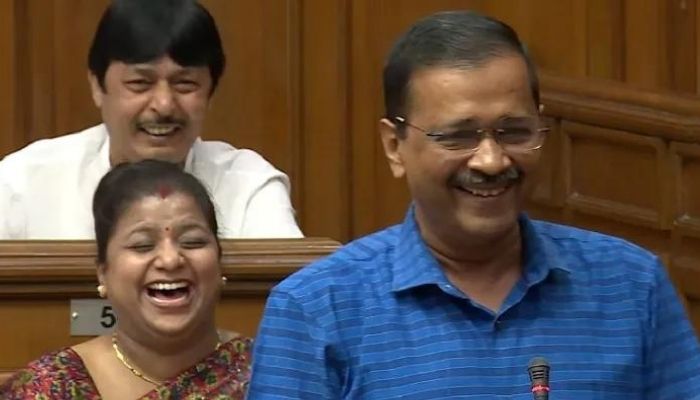
Kejriwal on Wednesday addressed a press briefing highlighting the issues Kashmiri Hindus face in the region. He said, “The Kashmiri Pandits are disgruntled. They have only one demand from the government – safety and security from terrorists.”
He highlighted that the Kashmiri Pandits went back to the valley and settled there but they are facing the same threats that they went through in the 1990s. “They have been selectively targeted and killed in their homes, and offices. This is inhumane and anti-national. And nobody is doing anything to stop this,” he alleged. “When Kashmiri Pandits oppose this, there are locked into their societies. When they raise a voice, their voices are stifled. Is this Justice?” he asked.
He highlighted that 16 Kashmiri Hindus have been killed so far this year. “The common man of Kashmir wants Hindus and Muslims to live together in peace. But the terrorists do not want this to prevail. To this day, Kashmiri Pandits are being forced to leave Kashmir and flee to Jammu or nearby areas. The era of the 1990s is coming back,” Kejriwal claims with a sceptical grin.
With his address, Kejriwal requested that Kashmiri Hindus should be protected and their voices should not be stifled. “I request the Central Government that we are ready to help you in the process of re-establishing Kashmiri Pandits to their homes in Kashmir. We are together in this,” he said.
Kejriwal’s concerns have come at a time when there has been a continuous rise in the targeted killings of Kashmiri Hindus by Islamic terrorists. Recently, on May 12, a Kashmiri Hindu youth, working for the revenue department, Rahul Bhat was killed by terrorists in Budgam district.
Arvind Kejriwal denied genocide of Kashmiri Pandits, had called ‘The Kashmir Files’ a jhoothi film
However, when Vivek Agnihotri’s ‘The Kashmir Files’ was creating record numbers at the box office and stirred the national consciousness towards the cause of Hindus in Kashmir, Kejriwal did not lose an opportunity to mock the genocide in 1990 in the Delhi assembly.
In response to pleas requesting to make the movie tax-free in Delhi, Kejriwal mockingly asked director Vivek Agnihotri to make the film available for free on YouTube instead for everyone to watch. Further, he insinuated that ‘The Kashmir Files’ is a movie not grounded in reality and that is a “jhoothi” (fake) film. With an intention to lash out at BJP leaders supporting the film, Kejriwal ended up denying the genocide endured by the Kashmiri Hindus in the 1990s.
While Kejriwal has now tried his hand at raising the issue of Kashmiri Hindus lately, his exercises in mocking an independent film that tried to capture the real-life plight of the Kashmiri Hindus will not be forgotten.
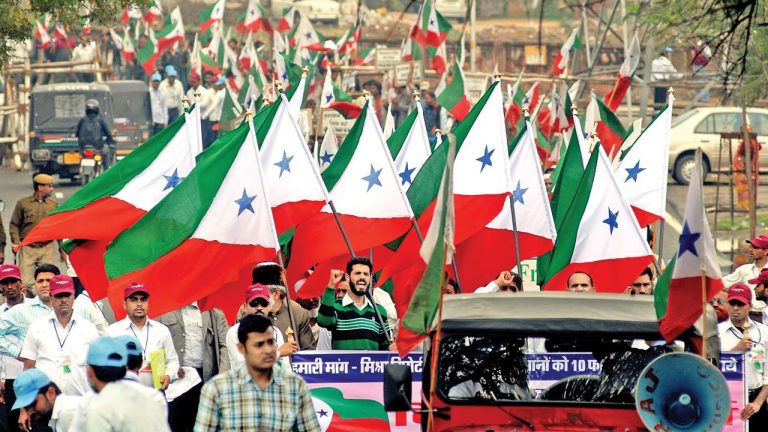
The Enforcement Directorate has frozen the bank accounts of the Islamist organisation Popular Front of India (PFI) under the provisions of the Prevention of Money Laundering Act (PMLA).
According to reports, 23 bank accounts of PFI and 10 bank accounts of PFI’s front organisation RIF (Rehab India Foundation) are frozen by the Enforcement Directorate.
Enforcement Directorate tightens its noose around PFI, files prosecution case in money laundering case
Earlier last month, the Enforcement Directorate (ED) had filed a prosecution case (similar to a charge sheet) against two Popular Front of India (PFI) leaders, Abdul Razak Peediyakkal alias Abdul Razak BP and Asharaf Khadir alias Ashraf MK, for money laundering of Rs 22 crore. Both are Kerala-based PFI office bearers.
According to the charge sheet, these leaders of the PFI established a business in Munnar, Kerala, to launder money acquired abroad and support the organization’s “radical activities.” It is also claimed that these leaders were involved in the formation of a purported “terror group” by the PFI.
As per the charge sheet, these two, “in association with other PFI leaders and members associated with overseas entities, were developing a residential project — Munnar Villa Vista Project (MVVP) at Munnar — with a motive to launder money collected from foreign countries as well as within the country and to generate funds for PFI to finance its radical activities.”
In March of this year, Razak, the divisional president of PFI’s Perumpadappu unit in Malappuram, was nabbed at Kozhikode airport while attempting to leave the country. Ashraf MK was arrested in Delhi last month.
The ED claims Razak transferred almost Rs 34 lakh from the UAE to Rehab India Foundation (RIF), a cover organisation for PFI. He also reportedly transferred Rs 2 lakh to M K Faizy, the leader of the PFI’s political front, the Social Democratic Party of India (SDPI).
The two are also related, according to the ED, to the payment of Rs 3.5 lakh (from August 2018 to January 2021) to PFI member Anshad Badharudeen, who was nabbed by the Uttar Pradesh Police Anti-Terrorism Squad last year, along with PFI member Firoz Khan. The authorities discovered homemade explosive devices, a 32-bore pistol, and seven live rounds in their possession.
The ED has been examining PFI leaders’ purchase of various overseas properties, including a bar-cum-restaurant in Abu Dhabi, following the discovery of some papers in raids on its members in Kerala on December 8, last year as part of the money-laundering investigation.
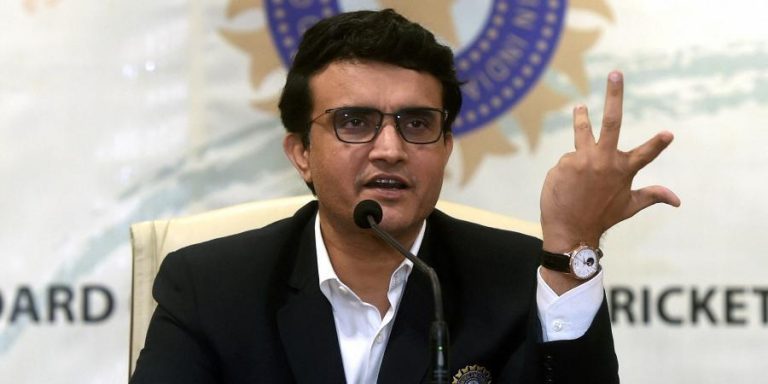
BCCI President and former cricketer Sourav Ganguly on Wednesday took to Twitter to announce that he is starting a ‘new chapter’ in his life. He said that year 2022 marks 30 years of his life in cricket and thanked everyone for the support and love he has received.
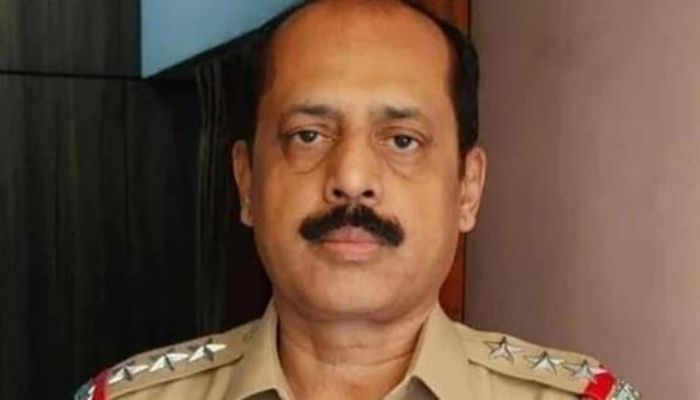
On Wednesday 1st June 2022, a special CBI court allowed dismissed Mumbai police officer Sachin Vaze to turn approver and depose as a prosecution witness against other accused including Maharashtra’s former home minister Anil Deshmukh. The order has come in connection with a corruption case against Deshmukh and others. The court ordered Waze to appear before it on June 7.
Vaze had filed an application before the special CBI court. In his plea, he had claimed that he had cooperated with the Central Bureau of Investigation (CBI) before and after his arrest, following which his confessional statement was recorded before a magistrate under provisions of the Criminal Procedure Code (CrPC).
Maharashtra | Special CBI court has approved the application of dismissed police officer Sachin Waze to turn ‘approver’ against other accused including former home minister Anil Deshmukh in an alleged corruption case. The court has ordered Waze to appear before it on June 7
In response to this, the CBI had approved Vaze’s plea, subject to certain conditions. Special judge DP Shingade approved Vaze’s plea. The judge said, “Your application is awarded to you, but subject to certain conditions.” According to this order, Sachin Vaze can depose as a prosecution witness in the corruption case.
Sachin Vaze is in judicial custody for three cases. The first one is the case of an explosives-laden vehicle found near industrialist Mukesh Ambani’s residence in south Mumbai and the murder of Thane businessman Mansukh Hiran. The second one is the CBI case in which he sought pardon. It is a preliminary inquiry of rupees 100 crore corruption allegations against former home minister Anil Deshmukh that were raised by Mumbai’s former Police Commissioner Param Bir Singh. The third one is a money laundering case against Anil Deshmukh and others. Deshmukh is also under probe by the ED.
The court has extended Vaze’s custody by 14 days. Sachin Vaze was arrested in March 2021. A special court recently rejected his bail calling him highly influential. The court had also noted that the possibility of tampering with evidence cannot be ruled out.