Home Blog Page 3777

‘Brahmins, Baniyas are in my pockets’: How BJP leader Muralidhar Rao’s quotes were taken out of context by the usual suspects

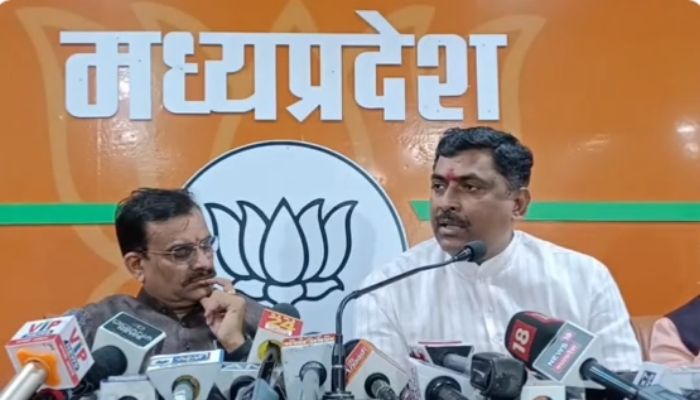
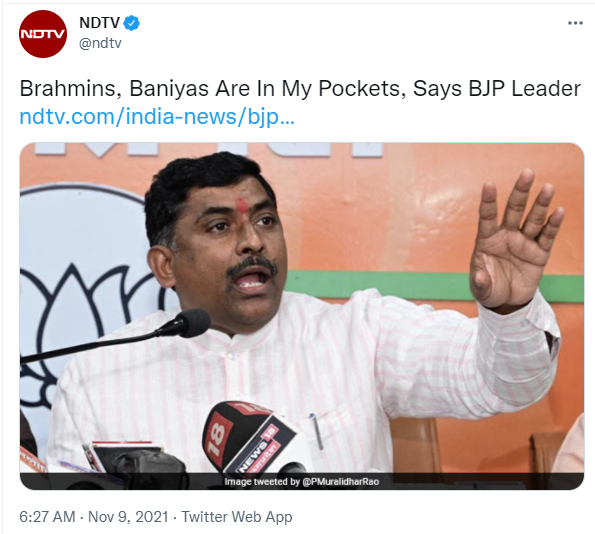
On Tuesday (November 9), several media houses claimed that BJP leader P Muralidhar Rao said that the party has complete control over Brahmins and Baniyas in the country. One of the media houses which peddled the same was NDTV.

Screengrab of the tweet by NDTV

Besides NDTV, ABP News and Amar Ujala too made such outlandish claims. The said comment was made by P Muralidhar Rao during a press conference held in Bhopal on Monday (November 8). Since the media houses published it without highlighting the context, it created an upheaval in political spheres.

The Truth behind the ‘Brahmin-Baniya in pocket’ claim

A complete video of the media interaction of the BJP leader was published on Twitter by popular user and activist Ankur Singh. During the press conference, a journalist asked, “BJP has been known as a Brahmin-Bania party till now. Should we start calling it SC-ST-OBC party?” In response to the skewed question posed by the journalist, P Muralidhar Rao remarked, “I have Brahmin and Baniya in my pocket…When our leaders and voters were Brahmins, you called us the Brahmin party. When there was a Baniya, you called us Baniya party.”

The BJP leader was again interrupted by the journalist, who then asked him to run the party on the agenda of ‘development.’ P Muralidhar Rao clarified, “When I started the party, I did so for all sections of the society. At that time, we had the support of some sections of society. Journalists would then write that the party belonged to that particular section of the society. We did not change our roots based on what you wrote.”

He added that due to a low representation of Scheduled Caste and Scheduled Tribes in BJP, the party was making endeavours to increase their representation and give the impression that is a party for all. “We are not leaving Brahmins, Baniyas or other sections to mould ourselves to accommodate anyone.” P Muralidhar Rao also pointed out that earlier the media would label the BJP as a ‘Delhi-based party’ and even a local party. He implied that in spite of all labels based on caste and region, BJP will continue to remain a party for every citizen of India.

Short films on homosexual relationships, including one on a male escort, to be screened in Kolkata schools: Report

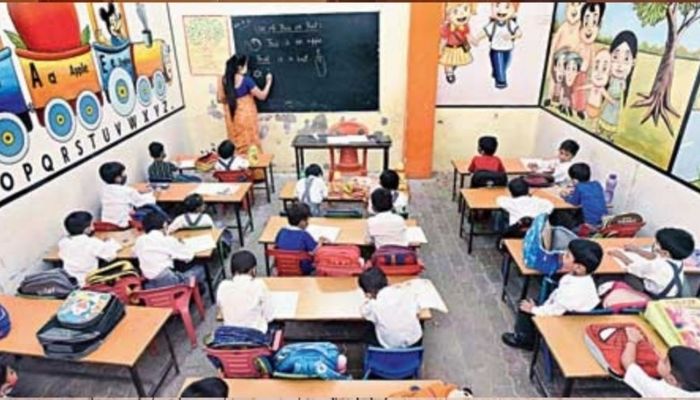
About 8 short films based on same-sex relationships will be screened in schools of Kolkata to promote ‘inclusive education’, reported The Times of India.

The said films have been directed by four people, namely, Salim Shekh, Manish Chowdhury, Saptarshi Ray and Avijit Marjit. Shekh had directed 3 short films, namely, ‘Dwitiyo Purush’, ‘Dekha’ and ‘Dakkhina’ while Chowdhury had shot ‘Dhora Pore Gechi Aami‘, ‘Dutto‘ and ‘Deya Neya‘. Saptarshi Ray directed the film ‘Durbin and Avijit Marjit had directed ‘DumbBell.’ All four directors are reportedly students of a UNICEF and Adobe-supported studio named Prasayam Visual Basics. The 8 films were shortlisted for Prayasam’s Bad and Beautiful World Festival and will be screened at schools once they reopen.

According to Salim Shekh, his film ‘Dekha‘ explores the meeting between a homosexual (gay) son and his estranged father. His other film, Dakkhina is based on the dignity of a male escort. Shekh, who is 23 years old, stated, “Some of my friends who are male escorts have insisted that self-respect is very important for them. By making this film, I wanted to break the myth that society has about their self-esteem for their life’s choices.” Manish Chowdhury’s Deya Naya is based on the relationship between a man and a food delivery boy and the challenges posed due to class differences.

“In just over 15 minutes, I have tried to explore how socio-economic hurdles pose as greater problems for thriving of such relationships,” he said. Saptarshi Ray’s Durbin is about the confession of a journalist to his live-in-partner about the crisis he is faced with after his father’s demise and learning about his secrets. He claimed, “Actors went back after listening to the storyline. That’s why it is all the more important to screen these short films so that these inhibitions are done away with.”

While speaking about the matter, Prasyam’s Director Prasanta Roy stated, “The main objective of the screenings is to promote inclusive education so that LGBTQ youth do not feel isolated or unwanted.” The Times of India reported that the short films portray fictionalised stories highlighting same-sex relationships and explore topics such as identity crisis, child abuse, companionship and more. The films will be premiered next month on December 3 at Kalanjali Art Space.

Russia: Russian LGBT Network, exiled lawyer Ivan Pavlov declared ‘foreign agents’, believed to be receiving foreign funding

0

Russia on Monday declared an LGBTQ Rights group Russian LGBT Network as a ‘foreign agent’. Besides, many lawyers and media persons have also been classified the same by the country. Ivan Pavlov, now in exile, along with four other lawyers were placed on the list.

The list now comprises 93 names of rights activists, journalists, media outlets and others the ministry believes are receiving foreign funding to carry out political activity in Russia.

The Russian government instructed that the groups and individuals classified as ‘foreign agents’ must specify the same in all their publications and on social media. Those on the list will be obligated to comply with strict financial reporting standards and must declare themselves to be foreign agents before publishing anything.

The Russian LGBT Network, which came into existence in 2006 and operates in several regions in the country, provides legal assistance and support to lesbian, gay, bisexual and transgender people and their families and also carries out educational campaigns, according to its website.

The group had in the month of February, protested the arrest of two Chechen men who were subsequently deported back to Chechnya. They accused Russian authorities of imprisoning and torturing homosexuals in secret jails.

In 2013, Russia had banned the promotion of homosexuality and sex-reassignment procedures among children. Vladimir Putin maintains that Russian society has no problem with homosexuality but children should be left alone until they come of age when they can make decisions for themselves regarding who they want to be.

Meanwhile, lawyer Ivan Pavlov had come under scrutiny in the month of April after he was suspected of revealing sensitive material from the treason case against one of his clients- former journalist Ivan Safronov.

Earlier this year, Pavlov defended the political network of Russian opposition leader Alexei Navalny, who was admitted to the ICU in the month of August after being allegedly ‘poisoned’. Navalny, Putin’s staunch critic, had then claimed that the Russian President-Vladimir Putin was behind his suspected poisoning.

Pavlov, who was forced to flee Russia in September, after which authorities reportedly put him on a wanted list, welcomed the Russian authorities’ decision to put him on the list of ‘foreign agents’ as a “badge of honour”.

“To become a ‘foreign agent’ today is almost like receiving a state prize for special services in the area of freedom of speech and information,” he said. “The long list of honorees includes so many brilliant journalists and rights defenders that it would even be kind of hurtful not to be one of them.”

Meanwhile, defending its decision of declaring rights activists, journalists, media outlets as ‘foreign agents’ and denying the claims that the media is being harassed, Kremlin said that the legislation is necessary to safeguard Russia from foreign interference.

Joe Biden let out a ‘yuge’ fart and Camilla, Duchess of Cornwall cannot stop talking about it: Details

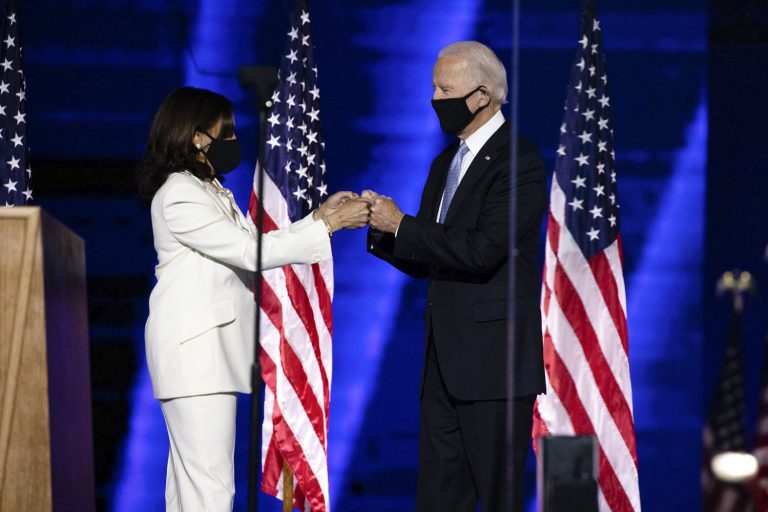
President of the United States, Joe Biden, let out a huge fart during a conversation with the Duchess of Cornwall, Camilla Parker Bowles, at the COP26 in Glasgow. The fart surprised the Duchess so much that she has not stopped talking about it, a source told the Daily Mail.

“It was long and loud and impossible to ignore,” a source with knowledge of the situation told the Daily Mail. “Camilla hasn’t stopped talking about it.” Joe Biden also appeared to fall asleep during the opening speeches at COP26.

Recently, Joe Biden is also rumoured to have suffered a “bathroom accident” during his meeting with Pope Francis at the Vatican. The rumours prompted people to trend #PoopyPantsBiden on Twitter, with Joe Biden getting mocked on the platform. The US President has also demonstrated bizarre behaviour during his public appearances and interviews with the media.

During a recent CNN town hall, Biden stood awkwardly with his fists clenched in front of him, and appeared to have his hands on a podium that existed only in his mind. His mental fitness to lead has also been questioned ever since he announced his run for the presidency, and they have only intensified on the backdrop of his conduct since becoming president.

Meanwhile, his approval rating is at an all time low, hovering around the higher 30s and lower 40s. On the 7th of November, his approval ratings fell to 37.8%. Vice President Kamala Harris has an even lower approval rating at 27.8%.

The greatest achievement of Hindus in the past 7 years: Shifting the Overton Window

In 2016, a year before I had joined OpIndia as their editor, I read an interesting article on the ‘MyVoice’ section of the website. It is essentially a corner of the internet where users can express themselves but OpIndia does not wholly endorse the opinions expressed thereof. The article was headlined, “Why I will celebrate the destruction of the Babri structure on 6th December”. I was agape at the audacity – pleasantly surprised. One has to realise how Hindus simply did not have the audacity to express their joy at the events of 6th December 1992. Babri was the outward anathema of our collective conscience. We were forced to be ashamed even if we secretly rejoiced Hindus finally reclaiming a piece of their heritage.

I grew up in a house where my grandfather and father expressed insurmountable joy at the illegal structure being demolished. They fervently believed that Hindus were forced to take matters into their own hands because the secular state subjugated Hindus and chose to ignore their 500-year-old battle to reclaim the very spot where their Bhagwan Ram was born. It was a great source of pain that the State had forced Ram Lalla to live in a rickety tent. It was a great source of rage that in our own land, we could not truly express what we wanted, as a people.

It was April 2019 when I truly realise how far we had come. I had been working with OpIndia for over 2 years when politicians made a controversy out of a sentiment that several Hindus like me secretly felt. Chanting “Ram rashtra hain, rashtra Ram hain“, Sadhvi Pragya declared that she was proud of taking part in the demolition of the illegal structure called Babri Masjid that once stood on Ram Janmabhoomi.

A litany of abuse followed, not just from Muslims but from politicians who had made a career out of holding Hindus by their hair and rubbing their nose on the ground, breaking their pride, hacking their self-respect.

My colleagues and I were upset, enraged even. We decided, then to throw caution to the wind. The article I had read in 2016, sitting in my cosy office space had to be mainstreamed. As disparate people who had come together simply because we were sick of the media’s political correctness and literary subjugation of Hindus, we had to speak up.

We published the article on main OpIndia website on 21st of April 2019. Babri Masjid Demolition – why people can be proud of it. It was out there.

“Babri structure was a symbol of that tyranny and barbarism”, the article said. “I celebrate the destruction of that symbol. I celebrate the annihilation of brutality. I celebrate the restoration of equality. I celebrate 6th December. I celebrate self-respect. I celebrate freedom”, the author declared.

I don’t think a lot of people realise the gravity of the decision to publish this article on OpIndia. Over the years, we as a people had been conditioned to edit our opinions to be commensurate with the imposed norms of political correctness. There had been renegades like Sita Ram Goel, Arun Shourie (before we lost him to the dark side), Ram Swarup and many others, but for the average unwashed masses, opinions inconvenient to the establishment were taboo. In our mind, we risked being ostracised by our social circles and probably booked by the secular state for daring to endorse the destruction of a symbol of Muslim oppression and tyranny.

But that did not happen. While we feared friendly recoil, we were hailed for publishing an article that verbalised the sentiment of the people. Being the voice of those who could not voice these opinions themselves.

The Overton Window had shifted. Forever.

The Overton Window is a set of ideas and policies which are acceptable to the mainstream population at a given time. The spectrum of acceptability ranges from what the society deems “unacceptable” to what set of ideas eventually becomes a government policy acceptable to the mainstream population.

Joshua Treviño has postulated that the six degrees of acceptance of public ideas are roughly:

  • Unthinkable
  • Radical
  • Acceptable
  • Sensible
  • Popular
  • Policy

The Overton Window, simply put, shifts when an acceptable idea becomes popular and then translates to policy. Or better yet, when a radical idea journeys its way through being considered ‘sensible’ to ‘popular’ and then translates into policy.

The idea that the head of the state would proudly participate in the Bhoomi Pujan of Ram Mandir was “unthinkable” given that most of us in our 30s today had observed politics since the time the government in power went to the Supreme Court denying Bhagwan Ram’s existence. Interestingly, after the Supreme Court, on this very day in 2019, had ordered in favour of Hindus, Congress had come supporting the construction of Ram Mandir, though in muted tones.

What was unthinkable then, became political policy now.

The ripple effect of a some-what, tangentially Hindu centric party being in power has been subtle and driven by the masses far more than the government itself directly. What was taboo then, is mainstream now. We went from “Godse was a Hindu terrorist” to “Godse was a murderer, but there is no harm in saying he was a nationalist”. The challenge is to turn the shift in Overton Window into policy, which in this case, would be getting the government to declassify his last testimony in court. We went from saying that the demolition of Babri Masjid was a dark path on the syncretic culture of India to taking pride in Hindus reclaiming Bhagwan Ram’s Janmabhoomi. We went from wanting a hospital at Ram Janmabhoomi to wanting a Bhavya Ram Mandir and a pining to reclaim Kashi and Mathura. With the Overton Window shifting, the challenge now is to translate this to government policy, which would mean the removal of the Places of Worship Act.

Subtly, taboos have been broken and what was once considered “unthinkable” or even “radical” has become “sensible” if not “popular”. Perhaps the most fascinating aspect of the Overton Window shifting is that it has been done purely by the masses – how it should be. Much like the 2020 and 2021 Diwali celebrations. While the Secular state banned firecrackers assuming that it is only a celebratory tradition, Hindus took to the streets, defying the ban, even getting arrested, lighting the sky so our ancestors could find their way back to their abode after the Mahalaya Paksha was over. While the Secular state made a policy thinking that the idea of the ban was mainstream, the people rose up in dissent, asserting that the Overton Window had long shifted and what they thought was mainstream was now obsolete.

But perhaps, the most “unthinkable” idea was that of India being a land of Hindu consciousness.

The acceptability of the propositions furthered by the Citizenship Amendment Bill was split in the middle. As is India’s wont, the ideological divide was as stark as a bright sunny summer morning. The Left opposed the provisions tooth and nail. The ‘idea of India’ that has long been touted as the existential foundation of India had been shaken, as per them, with one swift motion.

The Left has long espoused the principle that India is an all-giving, all-embracing entity, especially when it comes to Muslims. Whether this special corner of the heart that bleeds only for Muslims is a result of political compulsions, the Gandhian dystopia or the engrained false persecution complex is unclear. Perhaps it is a culmination of all of the above.

Either way, while the Left detested the idea of law finally being honest enough to give citizenship to persecuted minorities from neighbouring Islamic nations, the non-Left rejoiced the decision as one that rights a historic wrong.

The idea of the act was simply – India is the only land that has a Hindu majority. Hinduism, Sanatan, is engraved in its consciousness since before the political boundaries were drawn. Our stories, our heroes our legacy is attached to this land and no other. Hindus deserve a land they can come back to when the world seems too harsh, when their rights are denied and when they are persecuted because of their very identity.

The only criticism of the Citizenship Amendment Act was perhaps the fact that it did go as far as to give Hindus a ‘right to return’, much like Israel gives to Jews. That would have been the truest establishment of a “Hindu Rashtra”. But CAA, even in its current form, was a policy borne out of the Hindus recognising the civilisational entity that is Bharat. Mainstreaming the idea that India is indeed a Hindu land. That idea then translated to policy. What was radical then, was policy now, albeit, one that fell short, but policy nonetheless.

The government in power, on its own, is not responsible for shifting the Overton Window. Basically, they are responsible for recognising where the window is and then making policies that are commensurate with where the window is. It is people outside the acceptability spectrum that move the window by convincing the masses that what is radical today should be policy tomorrow.

The Modi government being in power is sufficient for the Overton Window to shift. It is a government that is at the very least, if not proactively Hindu centric, tangentially so by being responsive to Hindu demands. How we create that demand is something Hindus need to decide. One must not have heard of Joseph Overton, but one has certainly heard of the chants of Jai Shree Ram in 2014. The chants of ‘Hind, Hindu, Hindutva’, ‘Mandir Wahi Banayenge’ and “Kashi Mathura Baaki hai”. One might not have heard of the Overton Window but one certainly remembers how we broke down, tears bedewed our cheeks when on 9th November 2019, the Supreme Court vindicated a battle Hindus had fought for 500 years. Hindus have not only shifted the Overton Window but shattered the glass, never to be implanted again.


Four times National Award winning actress wins Padma Shri, ‘liberals’ can’t keep calm

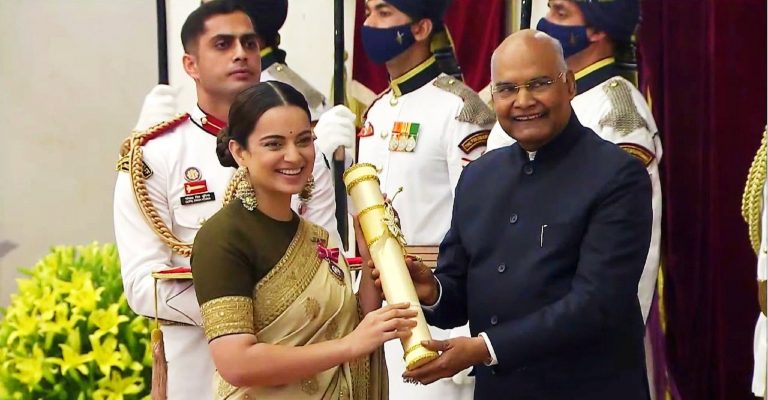
Earlier yesterday, the government of India conferred Padma Awards on 119 recipients in a ceremony held at the Rashtrapati Bhawan. A ceremony to honour the awardees could not be held in 2020 owing to the Covid-19 pandemic. Among those received awards included Karan John, Kangana Ranaut, P V Sindhu, Rani Rampal, Arun Jaitley(P), Sushma Swaraj(P) and several others.

However, the inclusion of actor Kangana Ranaut in the list of recipients for the prestigious honour did not sit well with a few left-leaning “intellectuals” who had a meltdown watching President Kovind bestow the Padma Shri Award 2020 to the ‘Manikarnika’ actress.

Usual suspects suffer a meltdown after Kangana receives Padma Shri Award 2020

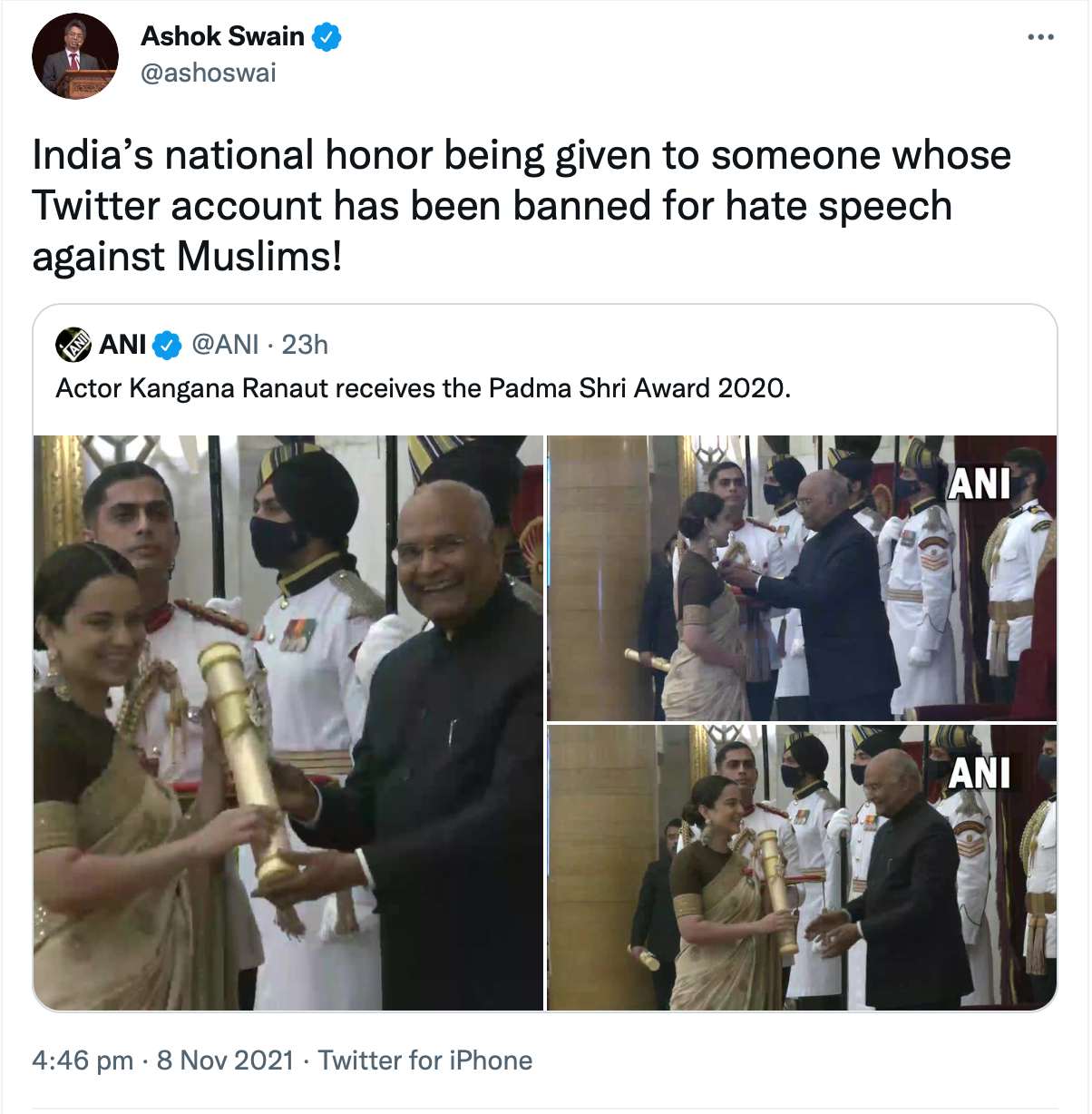
Ashok Swain, who is apparently a Professor at Uppsala University in Sweden and is often found peddling fake news on Twitter, quoted an ANI tweet about Kangana receiving the Padma Shri Award and said India’s national honour is being awarded to someone whose Twitter account has been banned for hate speech against Muslims.

Source: Twitter

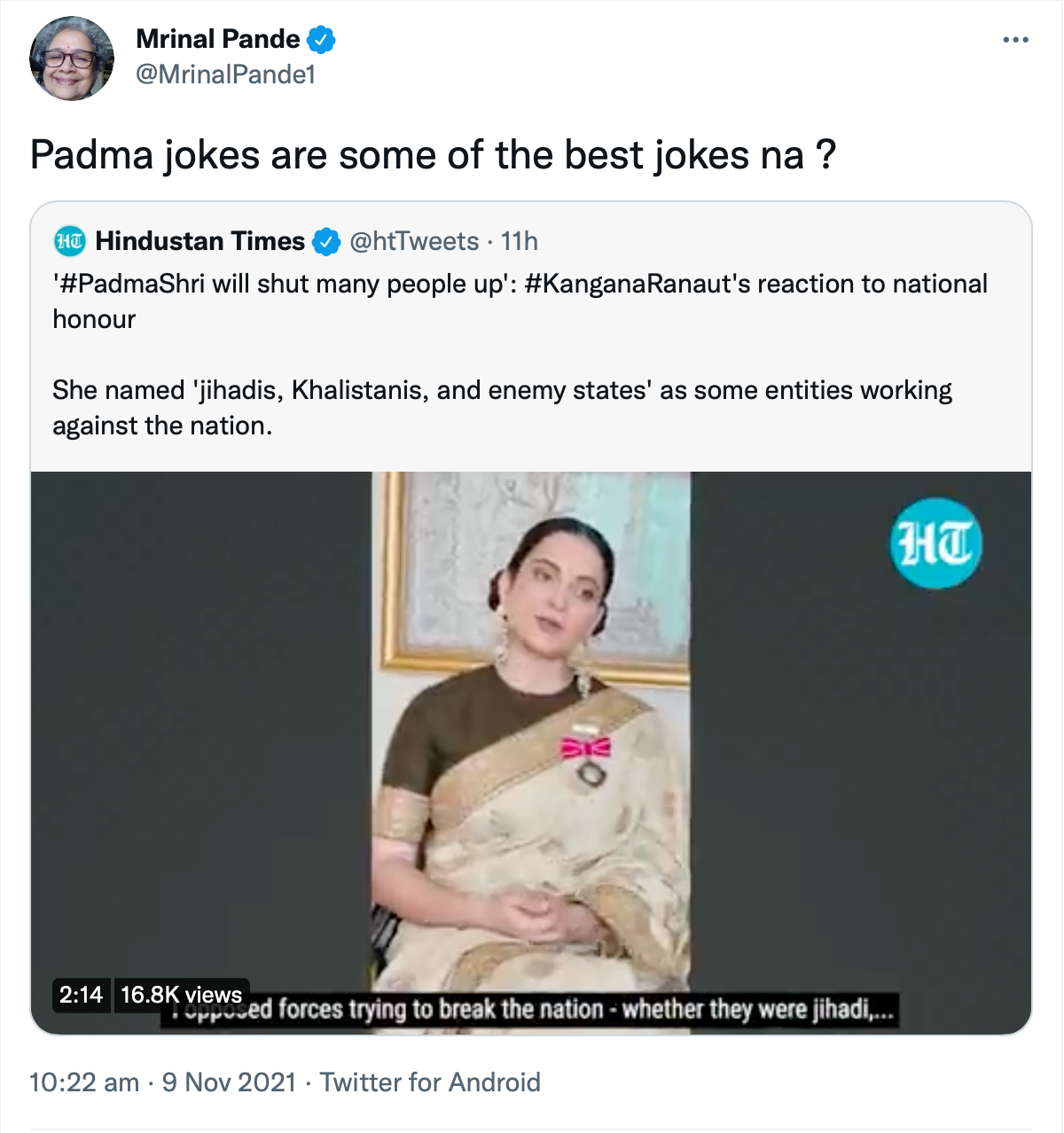
Similarly, Mrinal Pande, a columnist for the Congress mouthpiece National Herald, also had a hard time digesting the fact that Kangana Ranaut was awarded with a Padma Shri. She took to Twitter to quote Kangana’s reaction to the national honour and wondered if Padma jokes are some of the best ones.

Source: Twitter

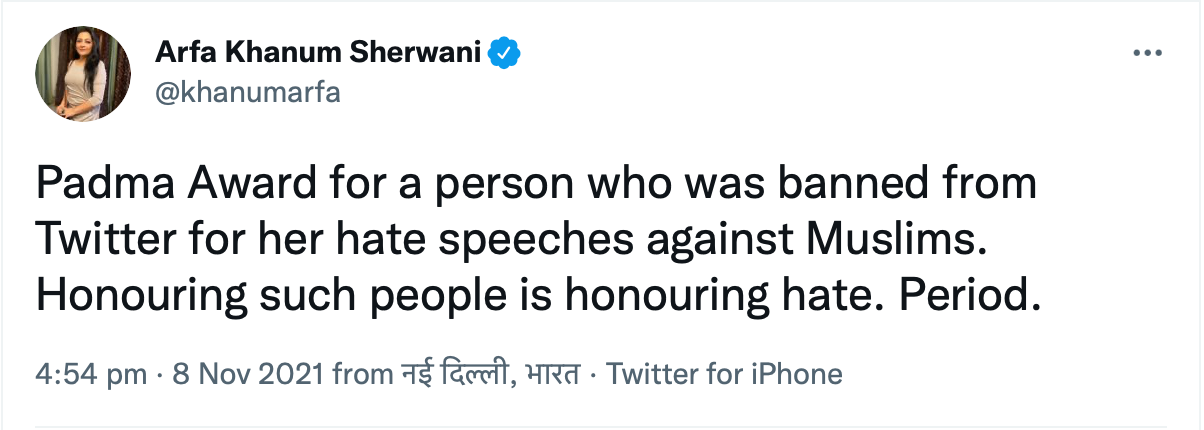
Then there was Arfa Khanum Sherwani, a journalist associated with leftist propaganda website, The Wire, and who is known for defending proponents of radical Islam, said hononouring people who are banned for hate speeches is akin to honouring hate.

Source: Twitter

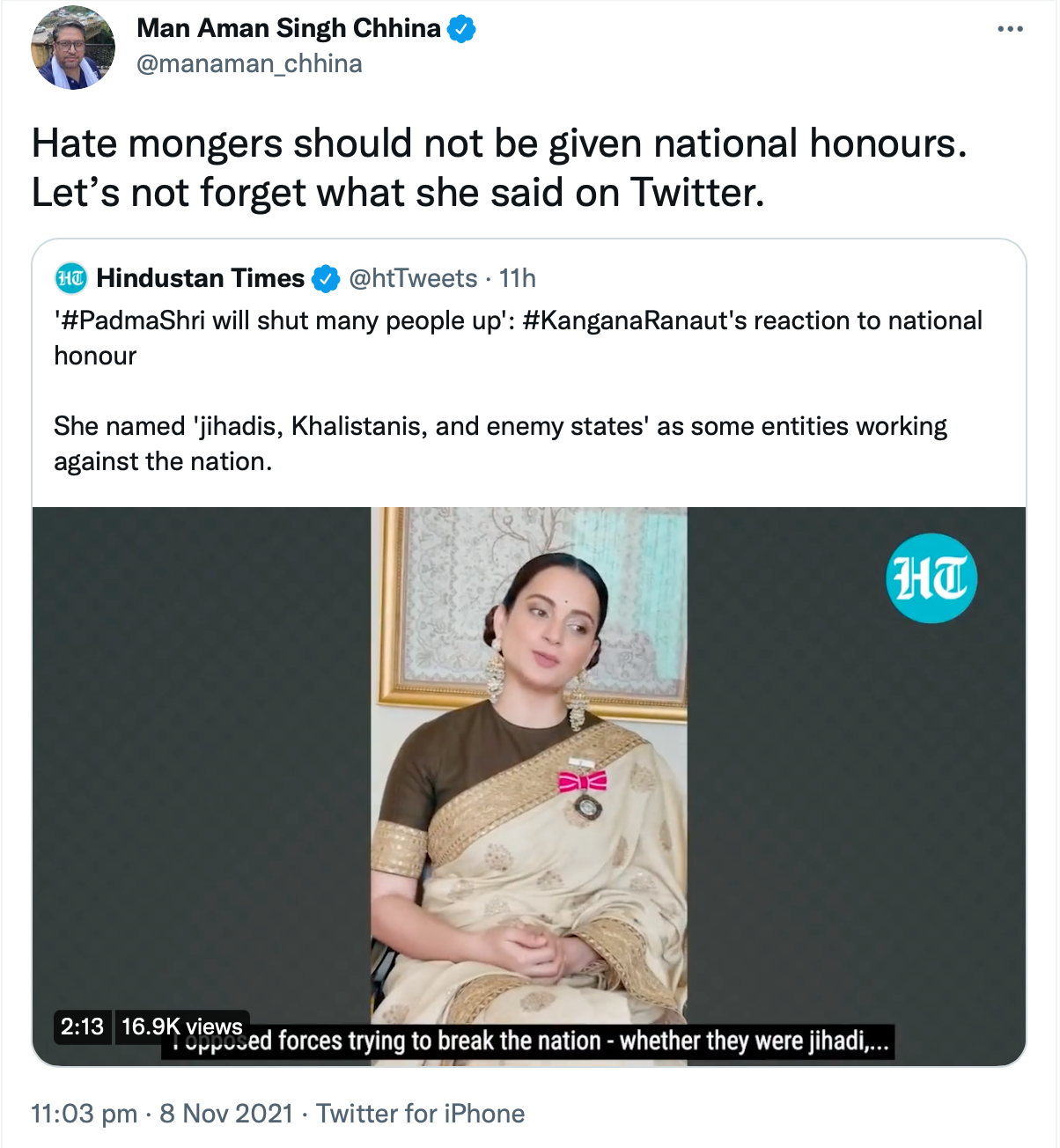
“Hate mongers should not be given national honours. Let’s not forget what she said on Twitter,” tweeted Man Man Singh China, a journalist according to his Twitter bio.

Kangana Ranaut thanks her followers after receiving Padma Shri 2020
Source: Twitter

Liberals fume as Modi government awards merits and achievement over sycophancy

Kangana’s detractors cite her suspension from Twitter as a compelling reason for the government to have not conferred the prestigious honour on the actor. However, it is worth bearing in mind that the the Padma Awards are bestowed by the government on individuals for distinction in their respective areas of expertise and not for their existence on social media websites like Twitter. Even terror outfit Taliban has many accounts on Twitter through which it communicates with the world. Therefore, having a Twitter account is not exactly a great yardstick to decide whether one deserves a Padma award or not.

Notably, Kangana has four national awards to her name. She was recently awarded the Best Actress Award for her performances in Manikarnika: Queen of Jhansi and Panga. She had also won Best Supporting Actress for Fashion in 2008, Best Actress awards for Queen in 2014 and Tanu Weds Manu Returns in 2015.

The actor has been awarded for her excellence in her profession, which is acting. However, the left-leaning intellectuals and journalists, believe she should not have been awarded because her Twitter account was suspended. Naturally, merit and hard work are among virtues most detested by the usual suspects because for years they had been using tools of lobbying, ingratiation and sycophancy to land the prestigious awards. With the Modi government selecting the Padma Award recipient based on their achievements and merit, this unease among the left-leaning intellectuals and journalists is but obvious.

‘Padma Award will shut mouths of lot of people’: Actor Kangana Ranaut

After receiving the award, Kangana took to Instagram to share a message for her followers. She said she had previously received many awards for her work as an actor but the Padma Shri showed how the country valued her as an ‘ideal citizen’ too. “I am grateful. When I had started my career at a young age, it took me 8-10 years to taste success. But when I finally became successful, I did not enjoy that but launched myself into other issues. I shunned fairness products, items numbers, working in movies with popular male leads and with production houses. I made more enemies than I made money,” she said.

In her video message, Kangana also pointed out how being outspoken on social and political issues have resulted in legal cases filed against her. “People often ask me what do I get by doing all this? Why do I do all this? This is not your job. So this award is my answer to them.”

When NYT & BBC declared Nehru intolerant: Be it PM Modi or Nehru, global elite has always hated an assertive India

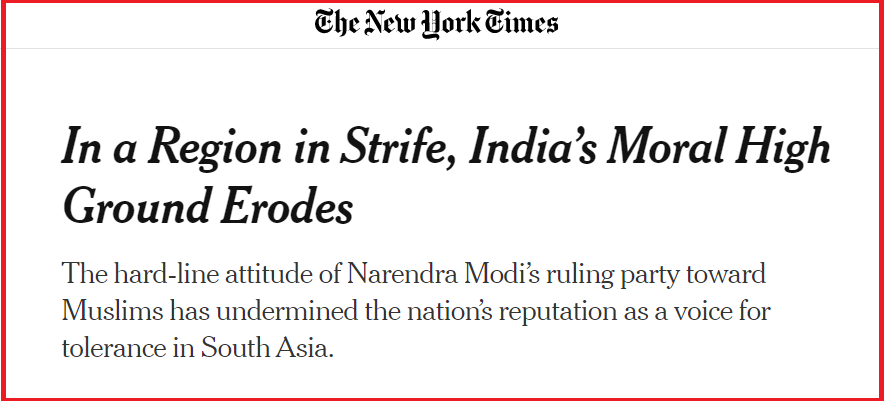
Consider this article that was published in The New York Times a couple of days back.

Article by New York Times

And now, read this.

With his invasion of Goa Prime Minister Nehru has done irreparable damage to India’s good name and to the principles of international morality.” — The New York Times, Dec 19, 1961. 

Although this is no laughing matter, I know some of you might be tempted to burst out laughing. Could it be that the New York Times suffers from such a lack of imagination that they have not changed their language one bit in sixty years? And on a more serious note, do global elites always get so angry whenever India tries to deal with the world on its own terms? Yes, and yes.

That extract is from a particularly infuriating piece in The New York Times titled “India, the Aggressor,” published in December 1961. Its language is basically the same as that being used to attack PM Modi today, whether on the matter of Article 370, or the ghost of “intolerance.”

First, some background. In 1947, when India gained independence, Goa could not become part of the new nation because it was a Portuguese colony. For over a decade, the Indian government tried to reason with Portugal, to convince them to let go of their colony. A non-violent resistance movement grew up within Goa, seeking union with India.

But Portugal said NO. For those wondering, Portugal at the time was ruled by the crazy Salazar. You can’t call Salazar a dictator because that would hurt his feelings. So, from 1932 to 1968, Salazar ruled over Portugal, calling for elections every four years. And in each of these elections, his ruling National Union party won exactly 100 percent of the vote. Not 99 percent, not even 99.9 percent, but one hundred percent. Even Kim Jong Un settles for just under 100 percent, but not Salazar! So that’s the kind of person India was dealing with.

Finally, on Dec 17, 1961, India’s patience ran out. The Indian military lifted a finger, and in a day or so, the Portuguese fled.

Whose side would the New York Times take in this conflict? The side of democratic India? Or the side of the white colonial power, that too ruled by a crazy dictator. 

Of course, The New York Times took the side of the white colonial power. Because that’s what global liberalism always was. And still is. Anybody who reveres The New York Times should know this story. We always heard that the West adored Nehru and they really did. As long as he showed India as a land of snake charmers, they loved him. As long as India with its policy of “non-violence” was no threat to anyone, they loved him. But if Nehru asserted India’s rights, they were ready to be just as harsh with him.

How harsh? After the liberation of Goa, President John F Kennedy told the Indian ambassador that

People are saying that the preacher has been caught coming out of the brothel.

Ouch! But JFK’s words are very revealing in how the global elite wants India to behave. They love India as the preacher. Not that they listen to the preacher’s words. Portugal was a client state of the US (and still is). The US could easily have prevailed on them to do the right thing. But they didn’t do that. They love India as the penniless preacher saying nice things in their ear. 

And no, the bitterness over Goa is not something that the West forgot in a hurry. Here is the Washington Post over twenty years later, in 1983!

Goa, of course, is the former Portuguese colony that preachy, “nonviolent” India grabbed in 1961 in what still lives as a world-class instance of post-colonial hypocrisy. It would have taken a special perversity for Commonwealth dignitaries to relax at the scene of India’s permanent conquest and… 

Just read their words – permanent conquest, post-colonial hypocrisy. 

That article was written in 1983! Now somebody remind me, please. Isn’t this the same Washington Post that pays sepoys in India even today to write on how India is a mean fascist state? Their words have not changed one bit. Their hatred for India has not changed one bit. Only their sepoys have aged and have been replaced by new ones. 

And wait till you find out how “intolerant” Nehru was:

Our correspondent adds that the Hindu half of the population is highly delighted about the change.

That’s the BBC in December 1961. Spreading lies all around the world about the patriotism of Christians of Goa. Painting India as a Hindu majoritarian state looking to oppress religious minorities. How familiar! How similar to what they are doing today.

And all this from the BBC, from The New York Times and from The Washington Post, for what? On behalf of a crazy dictator from Portugal! Can you trust the motives of these ‘news’ organizations today? 

The advantage of bringing up this sixty-year-old incident is that it gives us clarity. It tells us what the global elite is and how they think about India. It helps us see beyond the partisan fog that always clouds the present. Nehru was not from BJP nor RSS. But when he tried to assert India’s natural rights, they hated him for it. They tried to label him as an aggressor and intolerant of religious minorities. It’s the same as what they are doing to Modi today.

The global elite does not hate PM Modi because he is from BJP. They do not hate PM Modi because they consider him intolerant. Even if he was, the global elite would not care. They hate him because he is an Indian who loves India and wishes for India to assert its rights. Clarity is important. 

Crimes in Rajasthan: Congress leaders keep going to UP to manufacture dissent while their own backyard is on fire

For the second year in a row, the Congress-ruled state of Rajasthan recorded the highest number of rape and attempt to rape cases, as per the National Crime Records Bureau (NCRB) data for 2020.

The figures for crime against women peaked at 34,535 in 2020. The report further revealed that as many as 409 cases of rape were reported just in the capital city of Jaipur in 2020. 

According to monthly crime data, just the Jaipur police filed 84 cases of murder this year till September as compared to 69 in 2020. 

The Director-General of Police, ML Mathur in the month of August had informed that the state reported a 16 per cent increase in crime rates from 2013 to 2019. 

Addressing a press conference, the DGP further said that 31 per cent more cases were registered in 2019 as compared to 2018. 

‘Manufacturing dissent in non-Congress states’

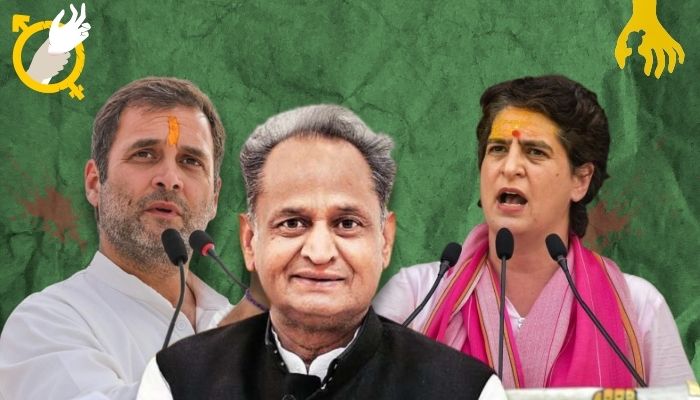
While the state of Uttar Pradesh is close to Rajasthan in the number of crime cases, strangely the Congress leadership, especially the Gandhi family rolls into gymnastics to manufacture dissent in the neighbouring state. 

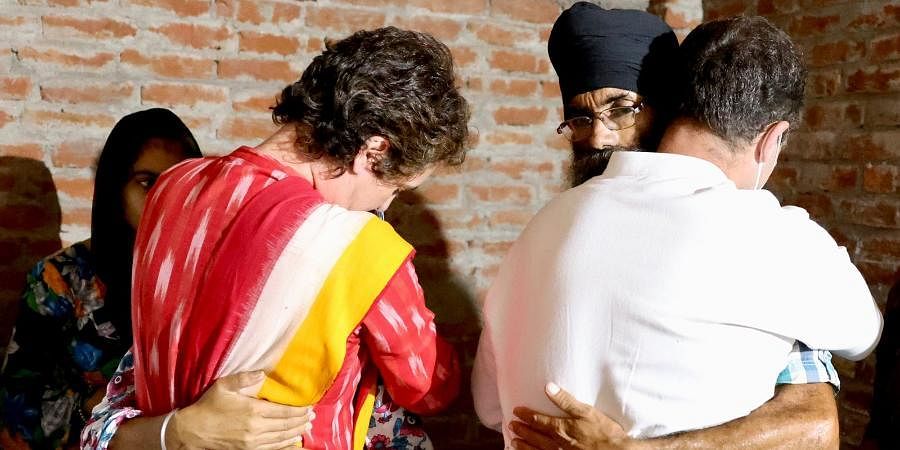
From Hathras to Lakhimpur, the Congress leadership hopped, skipped, laughed, jumped and toppled to make the most of the two unfortunate cases in UP. Moreover, the Gandhi siblings left no opportunity to click silhouettes with the victims to circulate in media.

Rahul Gandhi and Priyanka Gandhi Vadra hug the family of a victim killed in the Lakhimpur violence. Image Source: New Indian Express

They even camped in the state led by the opposition to ‘demand justice’ for the victims while their own state is on fire. 

Maqsood thrashes neighbour Nandu Bai

A video surfaced on social media on Monday where two men can be seen thrashing a woman brutally in Rajasthan’s Kota. Reportedly, Maqsood and his son thrashed Nandu Bai with sticks when she went to ask for the money lent to the duo.

The dispute escalated and Maqsood along with his son beat Nandu Bai leaving her unconscious. The incident is from Rajasthan’s Suket area. The victim is being treated at Jhalawar hospital and one accused has been arrested. 

The incident was captured on a CCTV camera which went viral on social media. 

23-year-old woman gangraped in Dausa

In another incident from Monday, a 23-year-old woman was gangraped in Rajasthan’s Dausa by four men. The victim had arrived in Jaipur to meet a female friend of hers.

She then met her friend’s boyfriend who accompanied her to Dausa. The man had two other accomplices with him. As per the complaint, the accused gave her alcohol to drink. 

The three accused were then joined by a fourth person after which all four of them took turns to rape her. The victim was also brutally thrashed by the accused. 

Qutubuddin murdered his father on ‘Allah’s instructions’

Rajasthan police on November 01 arrested Qutubuddin (40) for murdering his father on ‘Allah’s instructions.’ The police informed that Qutubuddin’s father Ibrahim Khan was ailing. 

Qutubuddin murdered his father brutally saying that he was “instructed by Allah” to send his father to him. During the investigation, it was found that Qutubuddin had also murdered in mother in the month of Ramzan but the family kept the matter under the wraps. 

Judge arrested for sexually exploiting a minor boy

A judge in Rajasthan’s Bharatpur was arrested on November 03 for sexually exploiting a 14-year-old minor boy. The judge has been sent to 15 days in judicial custody by a magistrate court on Saturday.

According to a complaint filed by the victim’s mother, the young boy used to visit a stadium to play tennis. Several police officials and judges also frequented the same stadium to play. 

The woman in her complaint revealed that the judge first befriended the boy and started taking him home from the stadium. He used to then intoxicate the boy with narcotic substances to sexually assault him. 

This went on for months till the boy complained of pain to his mother. 

Minor raped and impregnated his minor cousin

In another case from November, the Rajasthan police arrested a minor for raping and impregnating his 15-year-old cousin. The matter came to light after the girl delivered a baby girl at a government hospital.

The girl’s family was aware of the pregnancy, however, they chose to stay mum due to family relations. The victim’s family has refused to accept the newborn child. 

The accused had been staying with the girl and her family during vacations. 

5 Rajasthan cops punished for beating and stripping colleague

As per a Hindustan Times report, the Rajasthan Police department has sent five constables to the police line following a complaint. 

The incident is from November 04 when five police officials barged into the room of a head constable deployed in a police station in Udaipur, thrashed and stripped him in an inebriated condition.

The victim was also threatened by the accused cops. 

School teacher raped 11-year-old

A 31-year-old government school teacher was by the Rajasthan police in October for raping an 11-year-old schoolgirl in Rajasthan’s Jhunjhunu district.

As per reports, the minor girl in her statement to the police revealed that the teacher asked her to stay back after school hours on October 5 and sexually assaulted her. The accused also threatened her to not report the incident. 

However, after staying quiet for more than a week, the girl called a child helpline number she found on her school textbook and reported the matter. The accused was arrested from his home in Alwar. 

Obsessive lover murdered woman, hugged her dead body

In another horrific incident, a 21-year-old made advances at a victim Shanti Devi who is the mother of two sons while she was at Jojawar Nadi for MGNREGA work. 

When the victim shunned his advances, the accused attacked her with an axe and hacked her to pieces till she died. He then hugged her body after hacking her to death. 

As per the police, the accused had been harassing and stalking the victim for several months.

Exposing the sad state of affairs, the aforementioned incidents are just a handful from the plethora reported every day. 

From cold-blooded murder to gangrape, the law and order situation in Congress leader Ashok Gehlot-led Rajasthan is worrisome. 

In official statistics released by the State police, a 28% increase in atrocities against Dalit women, 20% in burglary and 28% in cases of theft between January and July were reported this year.

Conveniently ignoring the rise in crime rates in Rajasthan, Priyanka Gandhi Vadra’s social media timeline is flooded with political gimmicks in the poll-bound state of Uttar Pradesh. 

Islamists whine and cry for second year in a row over Supreme Court verdict on Ram Janmabhoomi, vow to rebuild it yet again

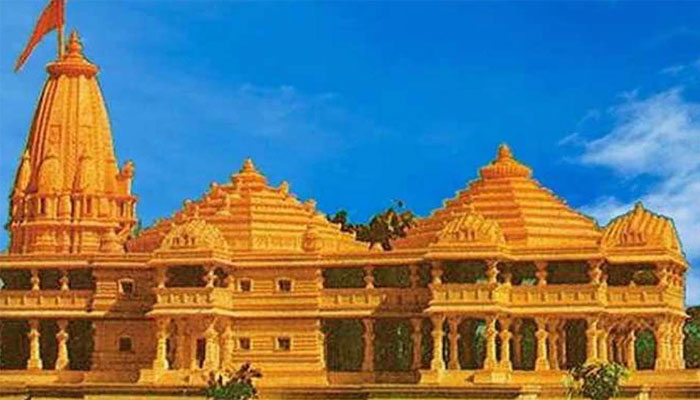
On November 9, India is celebrating the second anniversary of the historic Supreme Court judgement that put an end to the decades-old land dispute in Ayodhya. The apex court had handed over the land to Hindus where the disputed structure often referred to as ‘Babri Masjid’ once stood. In the last two years, the construction of Bhavya Ram Mandir has progressed as expected. By December 2023, the construction will likely be completed, and devotees will be able to visit Ram Mandir.

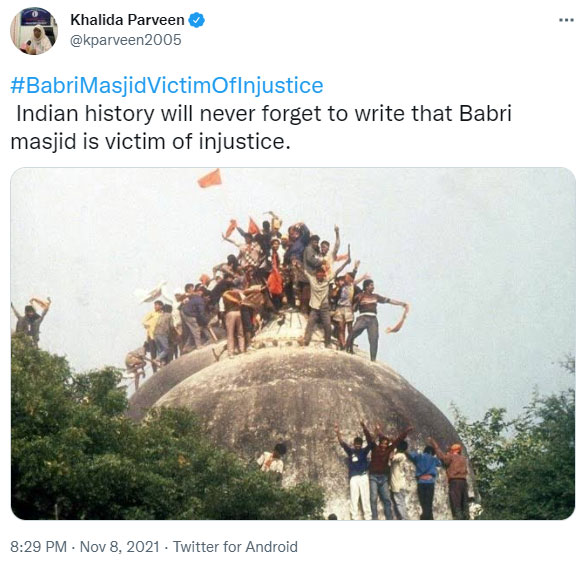
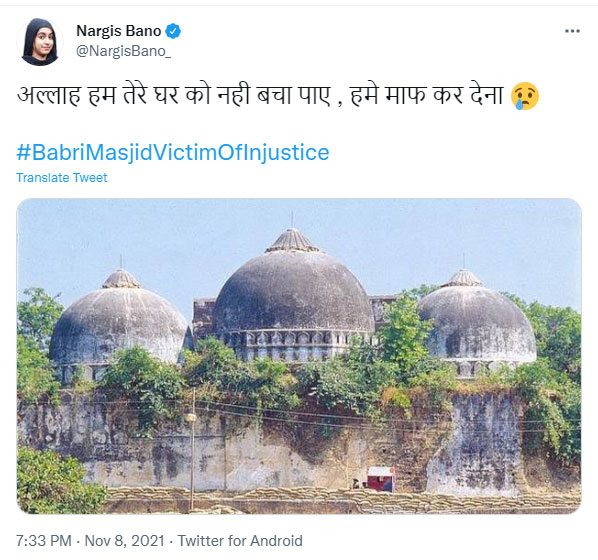
Meanwhile, Islamists on social media are whining and crying the second year in a row over the Supreme Court’s verdict on Ram Janmabhoomi. Hashtags such as #BabriMasjidVictimOfInjustice are trending on social media, pointing out that the judgment favouring Hindus was a form of injustice against Muslims.

A Muslim activist Khalida Parveen wrote, “Indian history will never forget to write that Babri masjid is victim of injustice.”

Source: Twitter

Journalist, The Ghazi Times, Nargis bano wrote, “Allah we could not save your house, forgive us.”

Source: Twitter

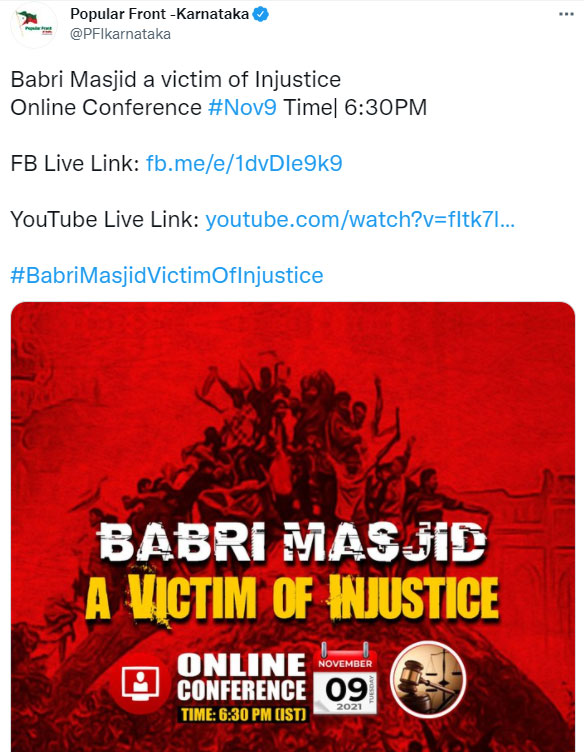
Islamist organization Popular Front of India’s Karnataka chapter is organizing an online conference where members of PFI and other leaders including Rajya Sabha member Maulana Obaidullah Khan Azmi is scheduled to speak.

Source: Twitter

AIMIM’s chief’s old video on Ram Janmbhoomi verdict is also getting viral on social media in which he alleged Muslims were not fighting for the land but for their rights. He said, “It [the verdict] was disrespectful to the community.” Interestingly, these leaders are quiet on the anniversary of the verdict.

All Indian Muslim Council wrote, “9 November 2019 is the date when the whole world saw how justice has been murdered in India and on the basis of faith, the decision has been given to build Ram temple instead of Babri Masjid, which was completely unconstitutional. Minorities were oppressed by killing justice.”

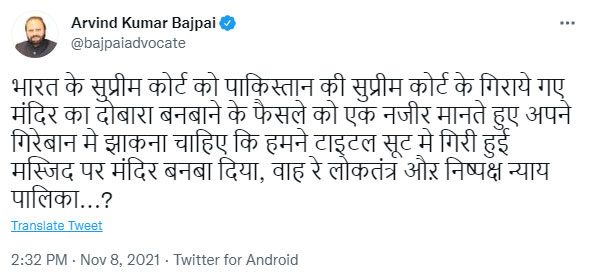
Arvind Kumar Bajpai, National Vice-President, LJP, said, “Considering the decision of the Supreme Court of Pakistan to rebuild the demolished temple as an example, the Supreme Court of India should look in its decision that we have built a temple on the mosque that was demolished in the title suit. What democracy and fair judiciary?”

Source: Twitter

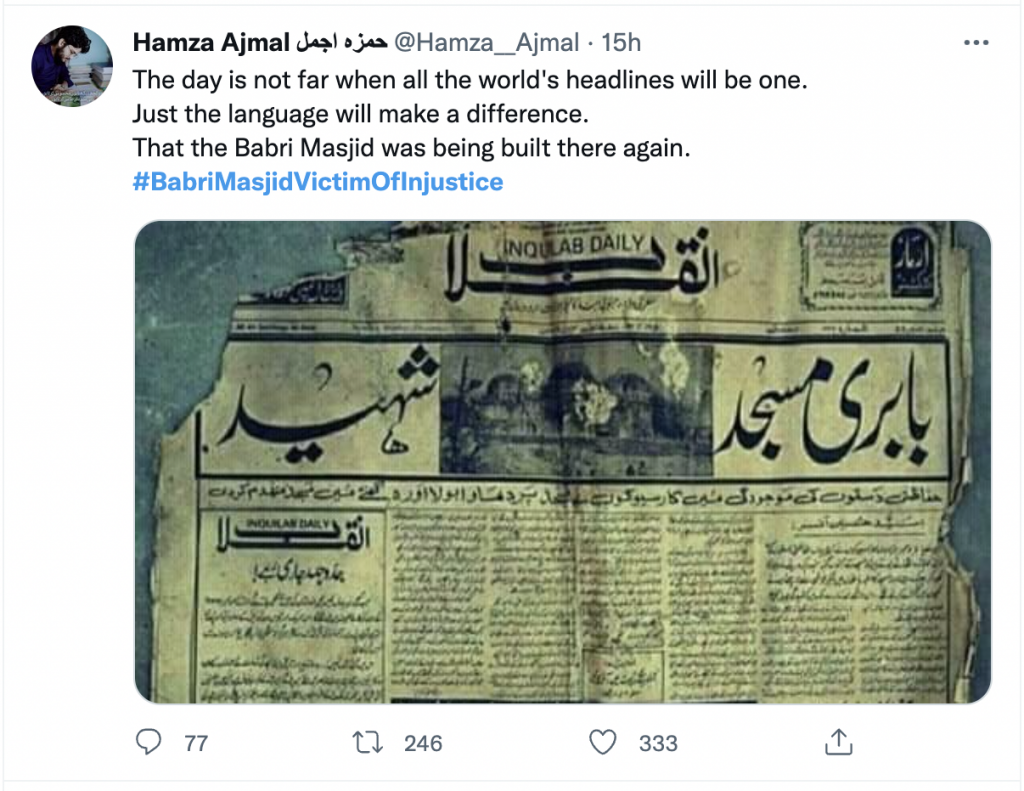
Many even expressed their dream of ‘rebuilding Babri’ again.

Babri will rise again

Some Islamists even claimed that the ‘law was lynched.

And some more wet dreams of Islamists about ‘rebuilding Babri’.

And how ‘Babri is alive’. Barkha Dutt’s “Jamia Shero” was also amongst the Islamists who was found whining about the Ram Janmabhoomi verdict.

The construction of Bhavya Ram Mandir

After the formation of Ram Mandir Trust in 2020, as per Supreme Court guidelines, the Bhoomi Pujan ceremony was conducted on August 5, 2020, in the presence of Prime Minister Narendra Modi and other religious and political leaders. The foundation work for the temple is almost complete. L&T is taking care of the construction. Ram Mandir is being built using the donations from the devotees from across the country collected via donation drive under the supervision of Ram Mandir Trust. The construction is expected to be completed by December 2023.

‘Seed mother’ Rahibai Soma Popere conferred with the Padma Shri award: Read how she brought in the farming revolution

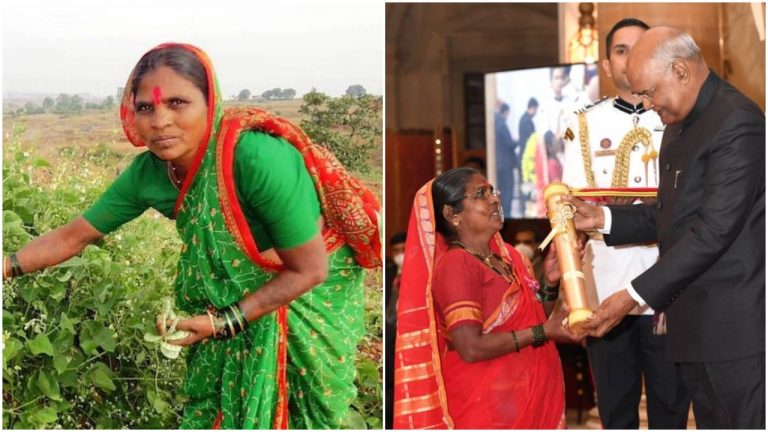
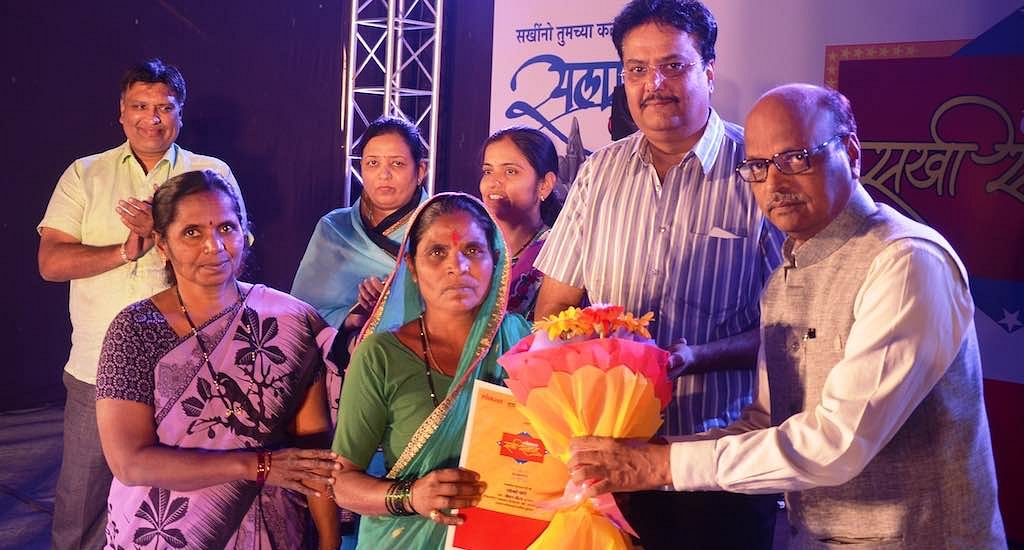
President Ram Nath Kovind has conferred the Padma Shri to Rahibai Soma Popere for her contribution in the field of agriculture. The President of India’s official Twitter handle shared a picture of the president of India honouring Rahibai Soma Popere, fondly known as ‘beej mata’ or ‘seed mother’, with the country’s fourth-highest civilian national award.

“President Kovind presents Padma Shri to Smt. Rahibai Soma Popere for Agriculture. Popularly known as ‘Seed Mother’, she is a tribal farmer from Mahadeo Koli, Tribal community from Ahmednagar district of Maharashtra”, the tweet said.

Rahibai Soma Popere conferred with Padma Shri

Rahibai Soma Popere, resident of remote Kombhalne village in Ahmednagar’s Akola tehsil, has been conferred with the Padma award. The awards were declared in January 2020 and conferred in the ceremony at Rashtrapati Bhavan on Monday, November 8.

A year prior to this, a three-minute short film on Rahibai Popere’s story of her campaign against hybrid seeds by a city-based filmmaker had won the third prize in the international section of Nespresso Talents 2019 at the 72nd Cannes Film Festival.

Image credit: Unnati Silks

Who is Padma Shri recipient Rahibai Soma Popere

Born in 1964, Popere is a Mahadeo Koli tribal farmer from Komblne village in the Akole tribal block in Maharashtra’s Ahmednagar district. She was unable to attend school owing to poverty, so she began working in agricultural labour and cow rearing to support her family when she was ten years old. She married Soma Popere, also uneducated, when she was 17 years old. Agriculture was the family’s sole source of income. She learned about agrobiodiversity, wild food resources, and traditional culture by practice and experience, despite not having attended school.

“Bakshish bhaari pan tyacha peksha kaam bhaari (Awards are good but my work is better),” she had once said, adding: “He (her father) gave me the only knowledge that he possessed. He took me around the farm and taught me about native seeds and how to plant them. Later, like everyone else, I too began using hybrid seeds. It was only after my sons and their kids started falling ill that I realised something was wrong with what we were eating. I felt it was the hybrid seeds and the use of pesticides and fertilisers.”

She learnt through her experiences that preserving agro-biodiversity and wild food resources is critical to achieving seed sovereignty and nutritional security.

Source: Twitter handle of Indian cricket icon VVS Laxman

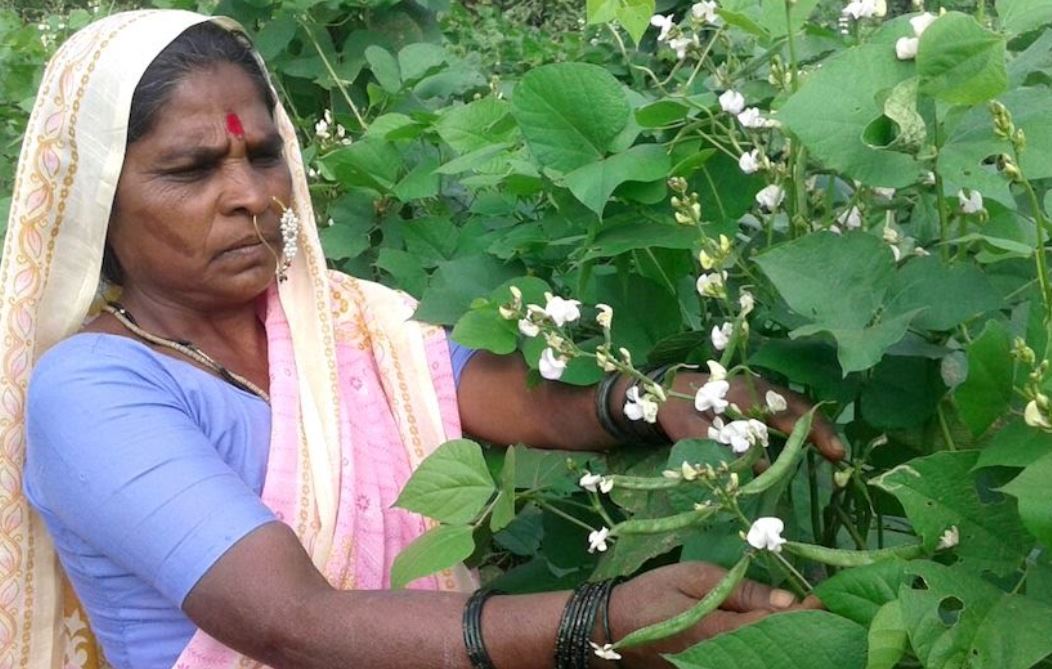
Two decades ago, Popere decided to revert to her childhood knowledge and began preparing indigenous seeds and delivering them to others. She developed a Blackberry nursery and gave them out as gifts to members of the Self-Help Group (SHG). Popere started by distributing the seeds to members of two self-help groups, to relatives and also giving away seeds as return gifts. Soon, she came to be known as a beej mata. Besides, Rahibai travelled across Maharashtra and beyond to conserve indigenous seeds.

Source: Twitter handle of Indian cricket icon VVS Laxman

She subsequently established a nursery of hyacinth bean seedlings, rice, vegetables, and bean landraces, which she distributed to 210 farmers in Akole Block’s seven communities. She also established an in-situ germplasm conservation facility, which conserved and multiplied about 43 landraces of 17 different crops (paddy, hyacinth bean, millets, pulses, oilseeds, and so on). She’s also started a house-hoarding perennial kitchen garden.

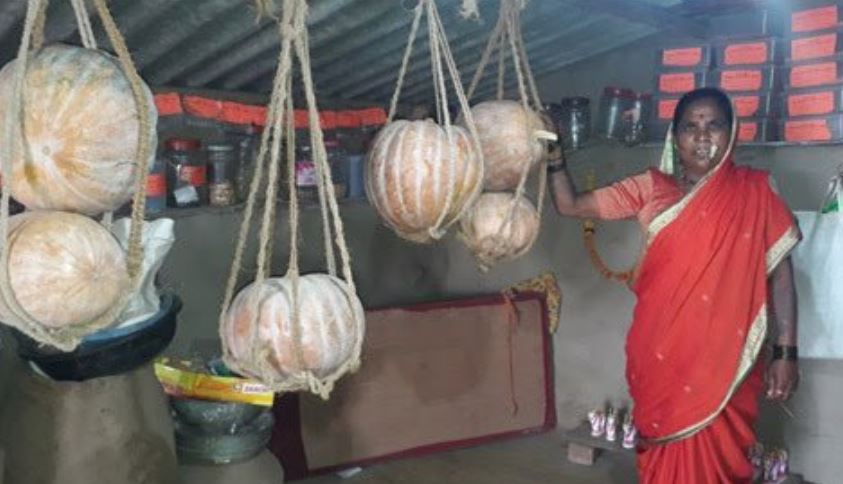
Rahibai owns a seed bank with nearly 200 types of indigenous seeds

According to reports, she has a seed bank near her house, which she developed with the help of BAIF, a national NGO that implements innovative development programmes in various sections of the country with. This seed bank has nearly 200 types of indigenous seeds, including pulses, 30 types of vegetables, 11 varieties of rice and medicinal plants, among others.

Rahibai travelled across states to preserve native seeds and also raises awareness about the value of such indigenous seeds. She educates people about organic farming, agro-biodiversity, and wild food resources.

Rahibai has achieved remarkable feet by designing her own water harvesting structures, including a farm pond and a traditional jalkund. She successfully turned a two-acre wasteland into a profitable farm and began earning money from the vegetables she raised there. Rahibai also learnt organic agricultural techniques with the help of Maharashtra Institute of Technology Transfer for Rural Areas.

Rahibai now teaches farmers and students about crop selection, soil fertility practises, and pest management, among other things, after successfully implementing all she learned. She gives farmers native crop seedlings to encourage them to switch to native types. Rahibai has trained about 3500 farmers across the Ahmednagar district.

In addition to agricultural projects, Rahibai leads another Self Help Group in Kombhalne, Chemdeobaba Mahila Bachat Gat, which organises several social initiatives such as health camps and solar lamp distribution.

While Rahibai’s efforts are making a visible impact at different district and state levels, they make a significant contribution towards genetic diversity in India’s agricultural sector.

President Ram Nath Kovind Monday presented Padma Awards at the Rashtrapati Bhawan. The 2021 list comprises seven Padma Vibhushan, 10 Padma Bhushan, and 102 Padma Shri Awards, of which 29 awardees are women, 16 Posthumous awardees, and 1 transgender awardee.