Home Blog Page 379

Ambuja Cements, part of Adani Group, delivers highest annual Profit After Tax, up 9% YoY at Rs 5,158 cr, crosses 100 MTPA capacity

0

Ambuja Cements, part of the diversified Adani Group, has posted its highest-ever annual profit after tax (PAT) at Rs 5,158 crore, a 9 per cent increase year-on-year, while annual revenue surged to Rs 35,045 crore, up 6 per cent from the previous year.

The company reported its strongest-ever financial and operational performance for the fiscal year ended March 31, 2025, marking a milestone as the company crossed 100 million tonnes per annum (MTPA) in cement production capacity.

This achievement positions Ambuja as the ninth-largest cement producer in the world.

The company also reported record cement volumes of 65.2 million tonnes, reflecting a 10 per cent YoY growth.

Commenting on the results, Vinod Bahety, Whole Time Director and CEO, Ambuja Cements, said, “This year marks a historic milestone in the journey of Ambuja Cements as we cross the 100 MTPA capacity. Additionally, we have ongoing organic expansions at various stages across the country, which will help us achieve 118 MTPA capacity by the end of FY 2026, a significant step, bringing us closer to our goal of 140 MTPA by 2028.”

“The 100 MTPA milestone is not just a number, it’s a mark of our ambition, resilience, and purpose. As India builds the foundation for a USD 10 trillion economy, we are committed towards our role in building the nation’s infrastructure that empowers growth, connects communities, and supports a greener tomorrow. Driven by Purpose and Defined by Progress – ‘Hum Karke Dikhate Hain’,” he said.

For the fourth quarter of Financial Year 2025 (Q4 FY25) alone, the company delivered an EBITDA of Rs 1,868 crore, a 10 per cent increase YoY, and the highest EBITDA per tonne at Rs 1,001, with margins improving to 18.9 per cent. Standalone PAT rose sharply by 75 per cent YoY to Rs 929 crore.

Earnings per share (EPS) for the quarter stood at Rs 3.88, and the company declared a dividend of Rs 2.0 per equity share.

Ambuja’s impressive performance was underpinned by its ongoing cost optimisation efforts, capacity expansion, and sustainability initiatives. The company successfully commissioned a 2.4 MTPA brownfield expansion at its Farakka Grinding Unit in West Bengal and completed the acquisition of Orient Cement, strengthening its pan-India footprint.

Highlighting its green commitment, Ambuja commissioned 299 MW of renewable energy capacity (200 MW solar and 99 MW wind) in FY25. This is part of its roadmap to achieve 1,000 MW of green energy by June 2026, targeting 60 per cent green power usage by FY28.

Operational efficiency was enhanced through reduced fuel costs, optimized logistics via modal shifts, including marine and rail transport, and improved clinker capacity utilisation at newly acquired assets like Penna, Sanghi, and Asian cement plants. Logistics costs dropped 2 per cent to Rs 1,238 per tonne, while fuel cost per 1,000 Kcal was cut by 14 per cent.

This news report is published from a syndicated feed. Except for the headline, the content has not been written or edited by OpIndia staff

Kashmiri student molested at Jamia Millia Islamia, liberal gang went silent after attacker turned out to be Mohammed Abid, told journalist to delete story

There has been a surge of stories of ‘Kashmiris and Muslims being attacked’ in different parts of India, following the deadly Pahalgam terror attack. The carnage, which was carried out by 4 Islamic terrorists on 22nd April, claimed the lives of 26 innocent civilians (primarily Hindus).

It had come to light through the families of the victims that they were subjected to religious profiling by the terrorists. Once it was determined that the victims were Hindus, they were selectively killed. Since then, a conscious effort is being made in the media to divert the public from the religious profiling of Hindus in Pahalgam to stories of ‘Muslim victimhood.’

Isolated incidents (including fake ones) are being highlighted to paint a grim picture of ‘innocent’ Kashmiris and Muslims being targeted by Hindus over the Pahalgam terror attack. One such incident occurred in Jamila Millia Islamia.

Screengrab of the tweet by journalist Swati Goel Sharma.

It had come to light that a female student from Jammu & Kashmir was assaulted at the minority educational institution in Delhi on Sunday (27th April). The incident occurred just outside Gate Number 8 of the campus.

The story was first covered by a journalist named Ubair ul Hameed. But, he was pressured into deleting the story by other Kashmiri students studying at Jamia Millia Islamia.

By that time, it was not publicly known that the molester was a Muslim man from Mewat named Mohammed Abid.

Journalist Swati Goel Sharma inquired, “Kashmiri journalist reveals he was asked to delete a report by Kashmiri group at Jamia Milia about harassment of a Kashmiri girl at campus, hours after it went viral.”

“Was it because molester turned out to be Mohd Abid from Mewat, puncturing their narrative of blaming it on Hindus as aftermath of Pahalgam?” she added.

In the viral video, the woman who was molested confronted the accused.

“What did you do while walking? You did nothing? He punched me on my chest. Look here now,” the 24-year-old victim was heard saying in a viral video.

According to reports, the police detained the accused, Mohammed Abid, on Sunday (27th April).

Preliminary investigation revealed that the incident was not related to the Pahalgam terror attack, although such insinuations were made when the video first went viral and the name of the molester was unknown.

Journalist Ubair ul Hameed was aghast that Kashmiri students of Jamia Millia Islamia forced him to delete his story, but allowed other media channels.

He additionally claimed that the reason for the deletion of the molestation story was security concerns of Kashmiri students and not identity of the perpetrator or the fact that the perpetrator Abid is from Mewat.

Diversionary tactics at work

With the revelation of the actual identity of the molester, the sinister attempt to blame the heinous crime on the Hindus had failed.

As stated earlier, a concerted effort is being made to demonise the Hindu community by accusing it of targeting Kashmiris and Muslims in the aftermath of Pahalgam terror attack.

This ‘Muslim victimhood’ card is employed to divert public debate from the religious hate-fueled onature f the terror attack.

OpIndia had exclusively debunked the fake news about the death of a Muslim corporate employee in Bengaluru at the hands of his Hindu colleagues for not chanting ‘Gayatri Mantra’ and not commenting on the Pahalgam terror attack.

The fake news was amplified by the leftist propaganda outlet, The Quint, which later deleted the story without citing any apology.

The story was covered by ‘journalist’ Aliza Noor based on a fake story by a LinkedIn user named Ishan Saxena and did not bother to verify the facts of the matter. It was gutted after it failed to fit the ‘Muslim victimhood’ story.

Adani Green reports robust FY25 results, surpasses USD 1 Billion in EBITDA

0

Adani Green Energy Ltd (AGEL), India’s largest and fastest-growing pure-play renewable energy (RE) company, has announced financial results for the period ending 31 March 2025, showcasing significant growth and operational excellence, according to a release.

The company’s EBITDA grew by 22 per cent annually, reaching Rs 8,818 crores, it said.

The company also informed that its Energy Sales increase by 28% YoY to 27,969 million units, equivalent to half of Singapore’s annual power consumption. The Revenue Growth Increased by 23% YoY to Rs. 9,495 crores.

It has Achieved EBITDA margin of 91.7% and Cash Profit Surge by 22% YoY to Rs. 4,871 crores.

Strong revenue, EBITDA and Cash profit growth is primarily backed by robust greenfield capacity addition of 3.3 GW, deployment of advanced RE technologies and superior plant performance.

Sagar Adani, Executive Director, Adani Green Energy, said,”We are playing a pivotal role in India’s renewable energy growth, which is evident from our historic 3.3 GW greenfield capacity addition in FY25. We contributed 16% to the nation’s utility-scale solar and 14% to wind energy additions, setting new benchmarks for rapid, large-scale renewable energy deployment.”

He said, “We are progressing well to develop the world’s largest renewable energy plant of 30 GW by 2029 at Khavda, Gujarat having operationalized 4.1 GW of solar and wind capacity within two years of commencing construction. We delivered high solar capacity utilisation factor (CUF) of 32.4% in Q4 FY25. This underscores the site’s high resource potential harnessed by deploying advanced technologies such as bifacial n-type modules, horizontal single-axis trackers (HSAT), and waterless robotic cleaning systems. Aligned with our circular economy framework, we achieved water positivity across our entire operational portfolio ahead of our FY26 target, a testament of our commitment to achieve the ESG objectives.”

According to the release, AGEL has consistently expanded its greenfield capacities backed by advanced resource planning, engineering, and supply chain management, with project management, execution and assurance from our partners, Adani Infra India Ltd (AIIL).

“Operational Capacity expanded by an impressive 30% YoY to 14.2 GW and to increase to 15.2 GW with an additional 1 GW near completion, putting us on track to achieve 50 GW target. The greenfield additions in FY25 included 1,460 MW of solar capacity and 599 MW wind capacity in Khavda, 1,000 MW of solar capacity in Rajasthan and 250 MW of solar capacity in Andhra Pradesh,” it said.

The energy sales increased by 28% YoY propelled by the robust capacity additions and strong operational performance, it said.

According to the release, AGEL’s operations and maintenance (O&M) leverage sophisticated data analytics, enhanced by machine learning and artificial intelligence, in collaboration with our O&M partners, Adani Infra Management Services Pvt Ltd (AIMSL).

“AGEL has consistently generated electricity exceeding the overall annual commitment under the power purchase agreements (PPA). In FY25, AGEL’s PPA based electricity generation was 107% of the annual commitment,” said the release.

“AGEL’s O&M is driven by advanced technology with Energy Network Operation Center enabling real time monitoring of the renewable plants across the country. This has not only enabled consistent higher plant availability in turn resulting in higher electricity generation but also led to reduction in O&M cost resulting in industry-leading EBITDA margin of 92%,” the company said.

AGEL is developing a massive 30 GW renewable energy plant at Khavda in Gujarat. This is spread over an area of 538 sq km, almost 5 times the city of Paris. This project will set a global benchmark for the development of ultra large-scale renewable energy plants.

It noted that, in a mere 2 years from breaking ground, AGEL has operationalized 4.1 GW solar and wind capacity. With robust manpower deployment, localized supply chain and advanced technologies like robotic solar module installation, AGEL is on a firm track to achieve 30 GW RE capacity in Khavda by 2029 setting a global benchmark for the speed of execution at such a large scale.

AGEL refinanced USD 1.06 Billion (Bn) maiden construction facility with long-term financing. AGEL refinanced its maiden construction facility, instrumental in developing the world’s largest solar-wind hybrid renewable cluster in Rajasthan. This long-term financing represents door-to-door tenure of 19 years with fully amortized debt structure and is well aligned with the cash flow life cycle of the underlying asset portfolio. On the back of the strong operational performance track record, the facility has been rated AA+ by three domestic rating agencies.

This breakthrough completes the capital management program for the underlying asset portfolio. This strategic program has proven to be the main catalyst for AGEL’s sustained growth and is vital to achieving its long-term growth objectives.

AGEL is committed to its ESG goals and has continued to retain its top ESG rankings. It was ranked 3rd in FTSE Russell ESG assessment in the Alternative Electricity Subsector, secured the 1st rank in Asia and is amongst the top 5 globally in the renewable energy (RE) sector in ISS ESG’s latest assessment, and is also amongst the top 10 in the RE sector globally in Sustainalytics’s ESG assessment. Additionally, AGEL achieved the 1st rank in the power sector for the third consecutive year as per the recent ESG score published by CRISIL.

(This news report is published from a syndicated feed. Except for the headline, the content has not been written or edited by OpIndia staff)

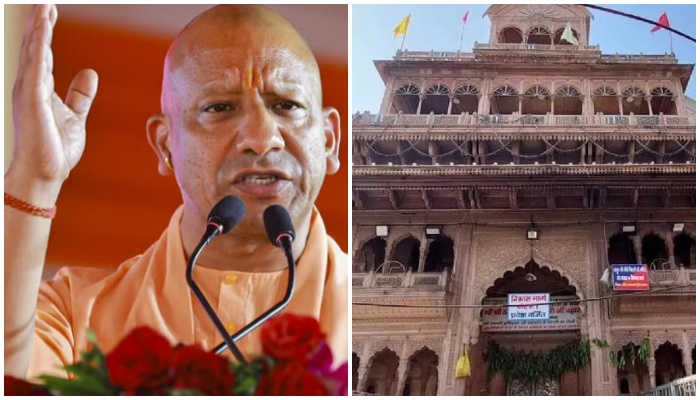
Banke Bihari Temple in Vrindavan refuses to boycott Muslims vendors amid protests against Pahalgam terror attack, says ‘Not Practical’

The prominent Banke Bihari Temple in Vrindavan has rejected calls from Hindu organizations opposing the Pahalgam terror incident for a boycott of Muslims who provide services at the revered place, reported the Times of India. It is one of the most popular pilgrimage destinations in Uttar Pradesh and even across India.

The demand followed calls by demonstrators in Vrindavan and Mathura for Hindu visitors and retailers “not to trade with the minority community”. Additionally, Muslim store owners were asked to “write proprietors’ names on business establishments.

Stores owned by Muslims have been identified according to Nagendra Maharaj, a member of the Kashi Vidvat Parishad, an organization that has called for the de-linking of Muslims from the temple’s affairs. He said, “We’ve asked them to write their names on shops and Hindu shopkeepers to avoid working with them and not to employ people from that community.”

“It is not practical. Muslims, particularly artisans and weavers, have deep-rooted contributions here. They’ve played a major role in weaving the dresses of Banke Bihari for decades. Many of them have a strong belief in Banke Bihari and visit the temple too,” Gyanendra Kishore Goswami, priest of the temple responded to the demand, on 28th April.

Goswami also serves on the management committee for the temple. He added, “Also, in Vrindavan, some of the crowns and bangles for the deity are made by them (Muslims).” The majority of the locals allegedly agreed with his assertions.

He further conveyed, “Yes, those terrorists (in Pahalgam) should be punished severely and we’re totally with govt. But in Vrindavan, Hindus and Muslims live together in peace and harmony.”

Authorities at the Banke Bihari temple had also turned down a proposal a month back that called for a ban on garments made for Lord Krishna by Muslim weavers. There were “no changes to the selection process for the deity’s attire,” according to the temple authorities at the time. The sanctity and purity of the “poshaks” (clothes) offered to the lord were their top priorities, per the priest. He had stated that the temple had nothing against taking them from the Muslim community if they believed in the deity.

Pahalgam Terror Attack

26 innocent Hindu tourists were shot dead and numerous others injured by terrorists in the Baisarann valley of Pahalgam. They were told to provide their names, identity cards, and religious affiliations, and were even instructed to recite verses from the Quran to verify their faith. Additionally, their trousers were taken off and pulled down to further confirm their identity. People confirmed to be non-Muslims were executed without mercy.

Fifteen local Kashmiri overground workers (OGWs) and terror associates have been identified through electronic surveillance as primary suspects who may have assisted the Pakistani attackers responsible for the Pahalgam massacre. Citing opposition to the Indian government’s policies that encourage non-Kashmiris to reside in the valley, The Resistance Front (TRF), a known proxy of the Pakistan-based Lashkar-e-Taiba, first hurried to claim credit for the massacre. However, they quickly withdrew their statement, alleging a purported breakdown in communication.

IPL: 14-year-old Vaibhav Suryavanshi gets honoured by Bihar CM Nitish Kumar after his mind-boggling century, gets reward of Rs 10 lakhs

0

Bihar Chief Minister Nitish Kumar announced a prize money of Rs 10 lakh for the 14-year-old rising sensation Vaibhav Suyravanshi following his record-breaking ton against Gujarat Titans on Monday at the Sawai Mansingh Stadium.

Suryavanshi left an everlasting impression in the history of the T20 format with his grand spectacle at the Sawai Mansingh Stadium. The 14-year-old, who has recently taken baby steps in his career, toyed with GT’s bowling unit, boasting 694 international caps.

At 14 years and 32 days, the boy wonder, who hails from Bihar, became the youngest player to score a century in T20 cricket and the second-fastest to hit a ton in the cash-rich league’s history after Chris Gayle’s 30-ball heroic effort against Pune Warriors in 2013. It took a searing yorker from Prasidh Krishna to put an end to Suryavanshi’s relentless onslaught.

Nitish congratulated Suryavanshi for his impeccable performance during Rajasthan’s resounding 8-wicket triumph, and on Tuesday announced a prize of Rs 10 lakh from the state government.

“Congratulations and best wishes to Vaibhav Suryavanshi of Bihar, who became the youngest player (14 years) to score a century in the history of IPL. He has become a new hope for Indian cricket as a result of his hard work and talent. Everyone is proud of him. I met Mr Vaibhav Suryavanshi and his father in 2024, and at that time, I wished him a bright future. After his brilliant performance in IPL, I also congratulated him over the phone. Vaibhav Suryavanshi, a young cricketer from Bihar, will also be given a prize money of Rs 10 lakh by the state government. I wish that Vaibhav creates new records for the Indian team in the future and brings glory to the country,” Nitish wrote on X.

Union Minister Chirag Paswan also hailed the 14-year-old for his memorable performance and told reporters, “On behalf of the party, I wish him all the best. He is a young talent and has made such a beautiful start at such a young age. His future is very bright.”

(This news report is published from a syndicated feed. Except for the headline, the content has not been written or edited by OpIndia staff)

‘Nothing wrong in using Pegasus for national security purposes’: Supreme Court refuses to make expert committee’s report public

In a significant observation during a hearing on Tuesday, the Supreme Court of India remarked that the use of spyware by the country for national security purposes is not inherently problematic. However, the Bench emphasized that allegations of such technology being misused against private individuals will be carefully examined.

The Bench comprising Justices Surya Kant and N Kotiswar Singh was hearing a batch of petitions related to the alleged use of Pegasus spyware by the Indian government to surveil journalists, activists, politicians, and others. “To have a spyware, nothing wrong… we cannot compromise and sacrifice the security of the nation,” the Court stated. At the same time, it clarified that individuals’ right to privacy under the Constitution must be protected.

In response to arguments from Senior Advocate Kapil Sibal and others, the Court maintained that while those who suspect they were targeted by Pegasus can seek clarity, the full expert committee report on the matter would not be made public due to national security concerns. “Yes, individual apprehension must be addressed, but it cannot be made a document for discussion on the streets,” the Bench said.

The expert committee, appointed by the Supreme Court and led by former Justice RV Raveendran, submitted its findings in 2022. It examined 29 mobile devices and found no conclusive evidence of Pegasus in any, though traces of other malware were detected in five. Importantly, the committee noted that the Government of India did not assist in its investigation.

During Tuesday’s hearing, Sibal pointed to new evidence, including WhatsApp’s admission in a U.S. court of being targeted by Pegasus. Senior Advocate Shyam Divan argued that if the State had used spyware on its own citizens, it would be “worse” than previously imagined. Solicitor General Tushar Mehta dismissed the claims as being driven by other motives.

The Court reiterated that any report affecting the “security and sovereignty of the country” would remain confidential, but individuals could still request to know if they were affected.

The matter will next be heard on July 30.

Bhopal rape gang: Muslim men targeted Hindu girls, trapped, raped and blackmailed using videos, lawyers thrash accused at court

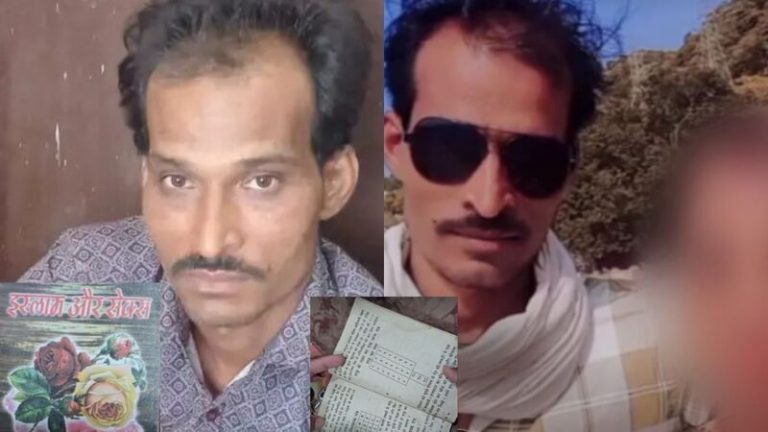
A Muslim gang that trapped and raped Hindu girls in Bhopal, Madhya Pradesh, was assaulted by attorneys. The Muslim gang’s boys were taken to court in saffron gamchas which infuriated the lawyers. The cops also organised a procession with the perpetrators before to their arrival. The accused preyed on Hindu girls. Two Muslim girls also used to assist the group, according to the case’s investigation. On the evening of 28th April, Farhan Khan, Ali Khan and Sahil Khan, members of the Muslim gang were taken to the court.

The proceedings regarding their case continued until 6 pm after which the police began to escort them back. During this process, the sight of the saffron gamcha worn by the accused provoked anger among the lawyers present at the court premises. The latter also raised slogans and began to thrash Farhan and Ali, however, the police managed to intervene and successfully extracted them. The court has placed two accused in remand.

While escorting them to the court, the cops made them walk the entire distance and perform sit-ups on the street. Hindu groups also attempted to assault the three individuals during their medical examination at the hospital, in Bhopal, but they managed to escape. Consequently, the police had to conduct their medical checkup twice. It has also been revealed that Ali attempted to flee from the police, resulting in a broken leg.

Currently, the police are conducting a probe into the Muslim girls associated with the boys from this Muslim gang. Authorities have identified two such individuals. These girls acted as intermediaries for the Muslim boys, facilitating friendships with Hindu girls. According to media reports, one of the girls has been employed at a cosmetics store. She would encourage Hindu girls who went to the shop to attend Sahil’s dance class.

She specifically targeted economically disadvantaged Hindu girls and urged them to engage in sexual relations with Sahil in exchange for waiving the class fees. It has come to attention that Muslim girls have forced Hindu victims to wear burqas, participate in fasting (Roza) and exerted pressure for marriage and conversion. The police are conducting an inquiry to uncover further details.

Background of the case

The Bhopal incident bears startling resemblance to the Beawar case, where a group of Muslims similarly targeted Hindu girls. In the present matter, an FIR was lodged on 18th April, revealing that Farhan Khan had targeted a female student enrolled in his college. Five official complaints have been registered in this matter, implicating twelve individuals. Subsequently, he sexually exploited her and began to intimidate her by recording the incidents on video.

Later, he pressed the victim into introducing her friends to Sahil and Ali. When she complied out of fear, Sahil and Ali summoned the other two girls to various locations, where they also sexually exploited them during the initial meeting and recorded the encounters. The three perpetrators then pressured the girls to convert to their religion and persistently urged them to marry. The accused regularly demanded money from the girls.

The investigation has uncovered the names of other individuals, such as Faizan, Mohammad Ali, Abrar Khan, Hamid, Arshad, and Siraj. A victim recounted being compelled to watch pornographic material, facing physical violence in the car if she did not obey. She was threatened with a knife against her neck. She was even pressured to embrace Islam and marry. The victims disclosed that they were raped after being made to ingest marijuana. The police are executing raids in several areas of Madhya Pradesh as well as Bengal and Bihar.

Bangladesh: Hindus continue to suffer as temple demolished, plans underway to replace 200 year old crematorium with ‘cattle market’

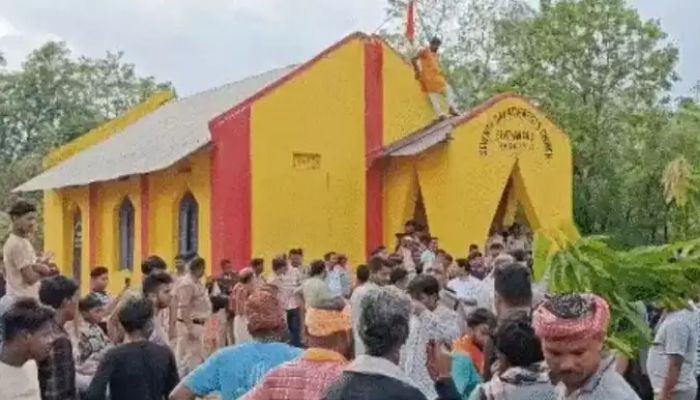
On Sunday (27th April), Hindus living in Uchakhila Union in Mymensingh district of Bangladesh staged a protest against the vandalism of an under-construction temple by Muslims and attempts to turn a 200-year-old crematorium into a ‘cattle market’.

According to reports, the Upazila Nirbahi Officer (UNO) of Ishwarganj upazila named Mohammed Ershadul Ahmed has been eyeing to demolish the Hindu temple and crematorium and build a cattle market instead.

While speaking about the matter, a local Hindu leader named Pintu Chowdhury informed that the crematorium in Uchakhila Union is 200 years old. He added that the construction of a temple was underway adjacent to the crematorium.

Chowdhury informed that the UNO ordered the demolition of the temple on Saturday (26th April) and has announced shifting of the crematorium to another site.

He emphasised, “The crematorium and the temple cannot be shifted…The followers of Sanatan Dharma are angry and hit the streets in protest today.”

Another local Hindu leader named Paresh Saha said that a ‘group’ had been threatening to evict Hindus from the place. He stated that the crematorium is being filled with sand to build a cattle market. “On Saturday, they demolished the pillars of the temple,” he pointed out.

The secretary of the Bangladesh Puja Udjapan Front, Bijoy Mitra Shuvo, said that no administrative action was taken to stop the demolition despite prior imitation by Hindus.

UNO Mohammed Ershadul Ahmed downplayed the entire incident by claiming the destruction of temple pillars happened ‘inadvertently.’

In the meantime, local Muslim groups such as the Ishwarganj Upazila branch of the Islamic Movement are pretending that nothing has happened. During a press conference on Monday (28th April), they claimed that there was no truth to the demolition of the temple and crematorium.

Attack on Hindus in Bangladesh since the ouster of Sheikh Hasina

OpIndia has been vetting and reporting cases of atrocities on Hindus since the ouster of Sheikh Hasina on 5th August 2024.

There have been at least 205 attacks on Hindu temples, shops and businesses within 3 days of the fall of Dhaka.

We previously exposed how Muslim students have forced as many as 60 Hindu teachers, professors and government officials to resign from their positions.

Human rights activist and exiled Bangladeshi blogger, Asad Noor, has recently revealed that the minority community is now being coerced into joining ‘Jamaat-e-Islami’.

On 6th September, a procession of Hindu devotees carrying the idol of Lord Ganesha came under attack in the Kadam Mubarak area in Chittagong city of Bangladesh.

Ahead of the Durga Puja celebrations, a radical Muslim man named Yasin Mia vandalised the idols of Goddess Durga and other Hindu deities in Gouripur town in the Mymensingh district of Bangladesh on 25th September.

In the latest series of attacks, idols of Goddess Durga and other Hindu deities were vandalised at the Rishipara Barwari Puja Mandap and the Manikadi Palpara Barwari Pujamandap on 28th September and 1st October respectively.

The attacks were carried out in Sujanagar upazila in Pabna district in Rajshahi Division of Bangladesh. While a total of 4 idols were defaced at the Rishipara Barwari Puja Mandap, another 5 Hindu idols were destroyed at the Manikadi Palpara Barwari Pujamandap.

On 3rd October, 7 idols of Hindu deities were destroyed at the Gopinath Jiur Akhara Durga Puja mandap in Kishoreganj, Dhaka Division, Bangladesh.

On 5th November, the Hindu community came under attack from police and law enforcement authorities in Hazari Goli in Chittagong city of Bangladesh.

On 29th November, a violent Muslim mob attacked Hindu minorities and vandalised 3 temples in Patharghata in  Chittagong district of Bangladesh.

The Hindu religious sites that the Muslims targeted included the Shantaneshwari Matri Temple, the Shoni Temple, and Shantaneshwari Kalibari Temple. The attack took place immediately after the conclusion of Jumma Namaz

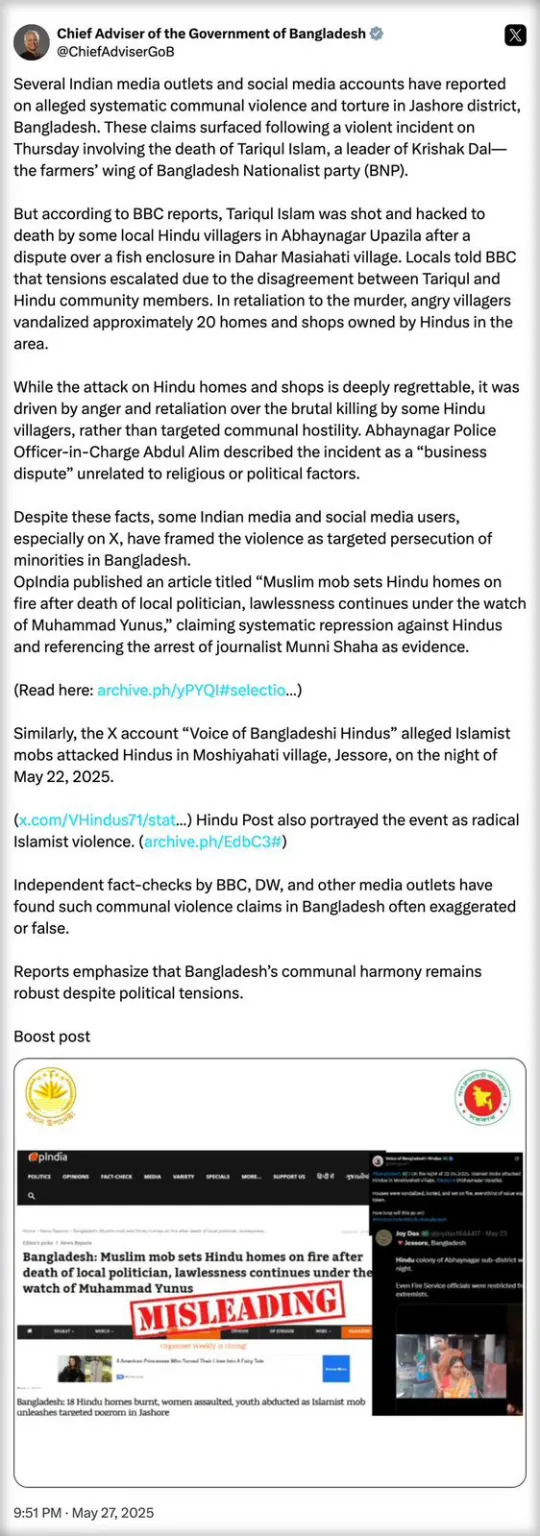
On 30th November, a prominent Hindu journalist named Munni Saha was arrested by the police from Karwan Bazar in Dhaka city of Bangladesh.

A group of extremists attacked the Mahashmashan Kali Mata Mandir, vandalised 7 idols of deities and stole gold ornaments on 13th December 2024.

On 19th December, a Muslim man identified as Alal Uddin vandalised an idol at the Polashkanda Kali Temple and then attempted to create a fake alibi. The incident occurred in Haluaghat upazila in the Mymensingh district of Bangladesh.

Another 37-year-old Muslim man identified as Azharul vandalised several idols of deities in Haluaghat Upazila in the Mymensingh district of Bangladesh.

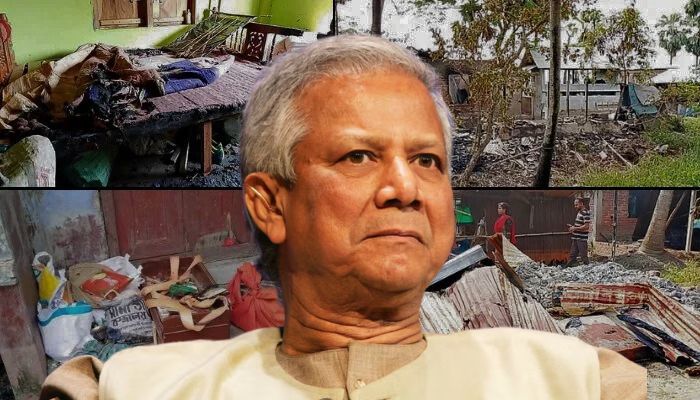
The recent arrest of Chinmoy Krishna Das Prabhu and his aides, attempts at banning Hindu organisation ISKCON and stiffling Hindu protests with cases of ‘sedition’ highlight systematic persecution under the interim government of Muhammad Yunus.

There have been multiple instances of attacks on Hindus under the pretext of ‘blasphemy.’ The recent cases of Hridoy PalUtsab MandalPartha Biswas PintuAkash DasPranta Talukder and Utsab Kumar Gian are shining examples of targeted persecution.

Pahalgam attack: Security forces confirm that terrorist Hashim Musa is a former Pakistan Army para commando

In a major revelation made in the Pahalgam terror attack, the security agencies have identified one of the terrorists involved in the attack as Hashim Musa, a Pakistani national and former para commando in the Pakistan Army. Hashim Musa has been working with the Pakistani Islamic terror outfit Lashkar-e-Taiba and was sent to Jammu and Kashmir to carry out terrorist attacks.

“It is possible that he was loaned by Pakistan special forces, like Special Service Group (SSG), to LeT,” an officer of the security establishment told TOI.

According to the authorities, Hashim Musa’s army background was confirmed during the questioning of 15 Kashmiri overground workers (OGWs). It is notable that these OGWs are being seen as key suspects in the Pahalgam attack probe for facilitating the Pakistani jihadis. They are accused of arranging logistics and helping in reconnaissance, hinting at the role of Pakistan’s ISI.

Other than the Pahalgam attack, Hashim Musa was also involved in the October 2024 terror attacks at Gagangir, Ganderbal, in which six non-locals and a doctor were killed, and at Buta Pathri, Baramulla, which left two army personnel & two army porters dead. In the Gagangir and Buta Pathri attacks, two local terrorists trained in Pakistan, Junaid Ahmad Bhat and Arbaaz Mir, were involved. The two jihadis, however, were killed in separate encounters by security forces in November and December 2024.

As the zipline operator chants ‘Allahu Akbar’ while Hindus are gunned down, the complicity of local Kashmiris in the Pahalgam massacre can no longer be denied

The valley of Kashmir, once romanticised as “Paradise on Earth,” has once again revealed its darker underbelly — not through whispers and accusations, but through cold, hard, horrifying evidence. A video, now viral across social media, shows a zipline operator in Pahalgam callously pushing a tourist into the jaws of death, while chanting “Allahu Akbar,” even as terrorists beneath opened fire on helpless visitors.

It is difficult to overstate the significance of what we witnessed in that clip. It shatters, beyond repair, the carefully cultivated liberal narrative of “Kashmiriyat” — the supposed culture of harmony and hospitality that Kashmir’s apologists dust off and present to the nation every time a terror attack stains the valley with blood.

In the video, the tourist — an innocent civilian who had come to soak in the famed Baisaran meadows — is hanging mid-air on the zipline, vulnerable and exposed. As gunfire erupts below, the natural instinct for any human being should have been to protect the person, to unhook him, to pull him back, to shield him from certain death. Instead, the zipline operator, a local Kashmiri, utters “Allahu Akbar” — a cry that, though sacred to many, has been appropriated by terrorists as a battle shout before bloodshed — and sends the tourist hurtling towards the carnage unfolding beneath.

This is no accident. It is not cowardice. It is complicity.

The tourist, identified as Rishi Bhatt, later recounted his suspicions against the zip line operator. He revealed that the operator did not utter the phrase when his family members took the ride earlier. He also mentioned that the terrorists were dressed like security personnel and that locals were among the first to flee the scene, offering no assistance to the victims.

For decades, a section of the Indian intelligentsia, media, and political establishment has laboured under the delusion — or perhaps the willful lie — that terrorism in Kashmir is the handiwork of a handful of “outsiders,” with the local population being mere helpless victims. The truth, however, has always been more sinister. Locals have been indispensable cogs in the machinery of terror: sheltering terrorists in their homes, providing logistics, conducting reconnaissance, helping transport weapons, and serving as eyes and ears for cross-border handlers.

Now, it seems, they have taken it a step further: actively pushing innocent tourists to the harm’s way.

What happened in Pahalgam is not an aberration; it is the logical culmination of years of indoctrination and radicalisation. For every terrorist who sneaks across the Line of Control, there are dozens of locals ready to embrace him, to feed him, to guide him, and — when the time comes — to help him slaughter civilians without remorse.

Sure, there are some locals like Syed Adil Hussain Shah who was martyred trying to snatch the weapons of terrorists and protecting the tourists. But let us not indulge in selective idealism: their numbers are tragically few, dwarfed by the overwhelming complicity or indifference displayed by the larger populace. Isolated examples of selflessness, while praiseworthy, cannot be used to whitewash the widespread and systemic support that terrorism enjoys among many local networks. The fact that terror attack took place over 200 kms away from the Line Of Control highlights the support the terrorists might have received from local population.

The myth of “Kashmiriyat” has been weaponised to silence critics, to paint any discussion about local complicity as bigotry. But the gruesome reality playing out again and again in the valley demands honesty. It demands that we discard the rose-tinted glasses and see Kashmir for what it has become: a region where a substantial portion of the population is either actively aiding terrorism or turning a blind eye to it.

Even those condemning the attack are doing so because it is affecting their daily livelihood. Why are Kashmiri leaders not talking about suspected local involvement in the scale of attack witnessed in Pahalgam on April 22? There is either chilling silence — the same silence that has accompanied thousands of terror attacks, bomb blasts, targeted killings, and pogroms over the decades or recriminations—blaming the Centre for security lapse, conveniently sweeping under the rug the fact that terror support from across the border and some level of complicity engineered the Pahalgam attack.

Every year, crores of taxpayer rupees are poured into the valley under the garb of “development,” “healing,” and “reconciliation.” And yet, time and again, when the bullets fly and the bombs explode, we find locals not standing with India, but with its enemies. Before the abrogation of Article 370, a large section of Kashmiri youth in sensitive regions took to stone pelting, often to disrupt army cordon and give a cover fire to help terrorists escape. With the Article 370 abrogated and a severe clampdown on terror finance, the anger against armed forces seems to have gradually diverted towards civilians and tourists.

The complicity of the local populace is the open secret that our liberal commentariat refuses to address. It is easier to blame Pakistan — and to be sure, Pakistan’s role in fomenting terror is undeniable — but cross-border infiltration would mean little without a willing support system on the ground. It is the locals who act as the extended arms of these handlers, making attacks like Pahalgam possible.

The incident at Pahalgam should be a wake-up call. India must recalibrate its approach towards Kashmir, shedding the illusions that have allowed this betrayal to continue unchecked. Security forces need to be empowered, intelligence networks must be more ruthless, and the web of local support to terrorism must be systematically dismantled.

Above all, the Indian public must reject the sickly-sweet sermons about “Kashmiriyat” and demand accountability. Sentimentality and imaginary constructs like ‘Kashmiryat’, designed to make us oblivious to the impending dangers has cost us too many lives already.

The face of the zipline operator sending a man to a carnage unfolding below, should be seared into the national consciousness. It is a reminder that not every local in the valley is innocent, and not every hand extended is meant to save.

Some hands, as we saw that day, are pushing us into darkness.