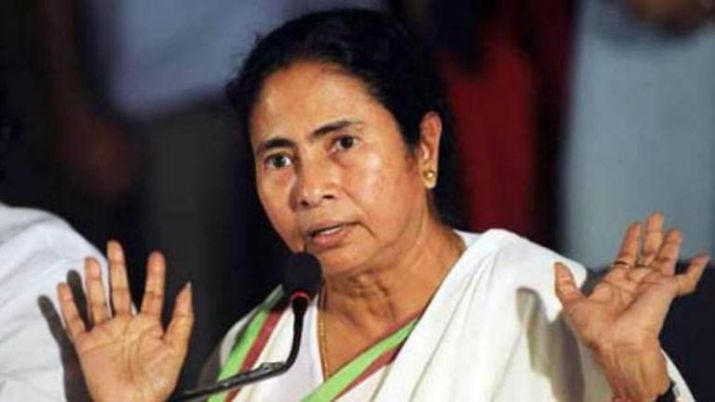
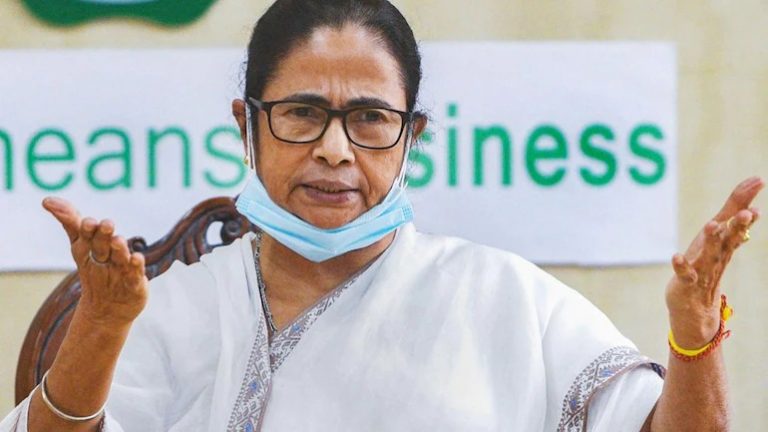
Amidst the tussle between the Central government and West Bengal over Chief Secretary Alapan Bandyopadhyay, West Bengal CM Mamata Banerjee has now stooped down to playing petty games. After refusing to relieve Alapan Bandyopadhyay, Mamata Banerjee announced his retirement from the post of the state’s chief secretary. This move was clearly taken to ignore the central government’s order to release him for further posting at the Centre.
Our chief secretary Alapan Bandyopadhyay retired today; he will continue as chief advisor to CM for next three years: West Bengal CM Mamata Banerjee
“Since Alapan Bandyopadhyay has retired today on May 31 from his service, he is not going to join in Delhi,” Mamata said, adding that he will continue as the chief advisor to CM for the next three years.
“I will not allow him (Alapan Bandyopadhyay) to leave Nabanna. He is now the Chief Advisor to Chief Minister. We have appointed HK Dwivedi as the new Chief Secretary and BP Gopalika as the new Home Secretary,” Mamata Banerjee told the media.
Centre issues show cause notice to Alapan Bandyopadhyay
This move came after the Centre issued a show-cause notice to Alapan Bandyopadhyay after he failed to report to the department of personnel, public grievances and pensions (DoPT) in New Delhi today (Monday). The Centre had asked the top bureaucrat to join tomorrow (Tuesday).
Evidently, since the central government had recalled West Bengal Chief Secretary to Delhi and asked the state govt to release him with ‘immediate effect’, Mamata Banerjee, according to her whims, decided to suddenly retire the WB chief Secretary only to appoint him as her advisor from Tuesday.
Mamata Banerjee refuses to relieve Chief Secretary
Earlier in the day, Mamata Banerjee, in her 5-page letter to Prime Minister Narendra Modi refused to relieve Alapan Bandyopadhyay, Chief Secretary, West Bengal. In her letter, she called the union government’s order asking Bandyopadhyay to report to North Block by 10 AM on Monday ‘wholly unconstitutional’. She said, “I have been shocked and stunned by the unilateral order sent to us by the Government of India, asking us to release Sri Alapan Bandyopadhyay IAS, Chief Secretary, West Bengal, so that he may join the Government of India on May 31, 2021.”
Mamata Banerjee had requested to let Alapan Bandyopadhyay continue as the Chief Secretary
Interestingly, Mamata Banerjee herself had requested the central government to allow Alapan Bandyopadhyay to continue as the Chief Secretary of the state for another three months. Accordingly, Bandyopadhyay’s tenure was extended as the chief secretary by the central government on May 24.
On May 24, Banerjee, while announcing the extension, had said: “Our chief secretary has got an extension for three months. We are happy because he has got the experience of working during last year’s Amphan as well as during the ongoing Covid-19 pandemic”.
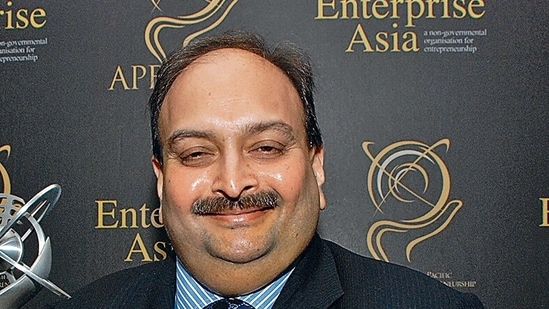
The woman who accompanied Mehul Choksi during his visit to Dominica was most likely working in cahoots with the team that abducted him, and not his girlfriend, as was widely reported in the media. A report published in India Today quotes sources close to the fugitive businessmen to claim the woman was part of the team, which was involved in his “abduction, torture and arrest”.
Choksi had gone missing a few days ago from Antigua and Barbuda and was later traced to and arrested in Dominica. The fugitive diamantaire had alleged through his counsel that he was kidnapped from Jolly Harbour on May 23 and people having links with India were responsible for his abduction.
According to the report, the woman was staying in Antigua and had started meeting Choksi during morning and evening walks. She allegedly befriended Choksi and invited him to come over to her place on May 23. A team was lurking at her residence, waiting for Choksi to turn up. When he did arrive at the woman’s apartment, the group abducted him and spirited him away to Dominica, where he was arrested.
The report comes a day after Prime Minister of Antigua and Barbuda Gaston Browne made a sensational claim that Choksi travelled with his girlfriend to Dominica but was caught. The PM also exhorted the Dominican authorities to directly deport Choksi back to India. Prime Minister of Antigua Gaston Browne also conceded that the Indian government has sent a jet to Dominica to prove that Mehul Choksi is a fugitive before the court.
“Yes, I can confirm that there is a jet. My understanding is that the Indian government has sent certain documentation from the courts in India to confirm that Mr Choksi is a fugitive. My understanding is that it will be used before the court next Wednesday. As you know, the judge in Dominica has actually put a stay on his deportation until the hearing next Wednesday. So, the Indian government is going all out to ensure that he is repatriated to India and can stand trial there,” Gaston Browne emphasised.
Mehul Choksi arrested in Dominica
Dominican authorities had arrested Choksi on Wednesday for entering the country “illegally” from Antigua and Barbuda, where he has been living since January 2018. The ‘missing’ ex-diamantaire was spotted in Dominica’s capital city of Roseau at the Canefield beach where he was disposing of some documents at sea. Police got suspicious and approached him. When he was asked about his purpose to visit Dominica, he refused to answer.
After Choksi was arrested in Dominica, it was speculated that he will be extradited to India. However, the hopes of repatriating PNB Bank scam accused Mehul Choksi to India was soon dashed as Dominica said that they will send him back to Antigua, not India.
Earlier, pictures of fugitive Mehul Choksi, held behind bars in Dominica, had surfaced on social media. The photographs were shared by Antigua News Room.
Choksi’s role in the Rs 13,600 crore PNB bank fraud
Choksi, along with his nephew Nirav Modi, are accused of perpetrating bank fraud worth Rs 13,600 crore on Punjab National Bank. The fraud came to light in 2018 and he along with his nephew have been on the run since. While Modi is currently in the UK, Choksi was in Antigua.
Recently, a UK court had ruled that his nephew Nirav Modi will be extradited to India from the UK to face charges of conspiring to defraud PNB. Choksi faces charges of criminal conspiracy, criminal breach of trust, cheating and dishonesty, including delivery of property, corruption and money laundering.
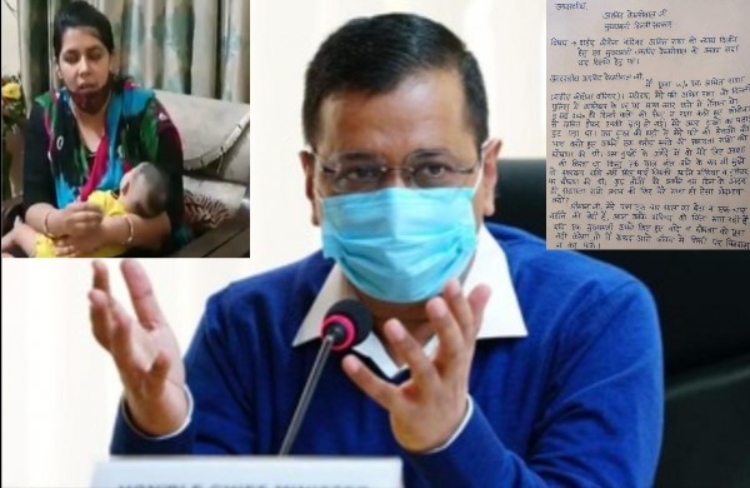
After waiting for more than a year, the wife of deceased Police constable Amit Rana has written to Delhi CM Arvind Kejriwal reminding him of his unfulfilled promise that a compensation of Rs 1 crore will be granted to Rana’s family. Without mentioning the name of the selected few families who recently received the compensation amount, Pooja, Amit Rana’s widow, questioned Kejriwal about the discrimination meted out to her family.
It is pertinent to recall that Police constable Amit Kumar Rana, who had succumbed to the infection on May 5, 2020, was the first Covid casualty in the police force. Today, it’s been more than a year since the death of Rana, but, his family is still awaiting Rs 1 crore compensation as was promised by Delhi Chief Minister Arvind Kejriwal.
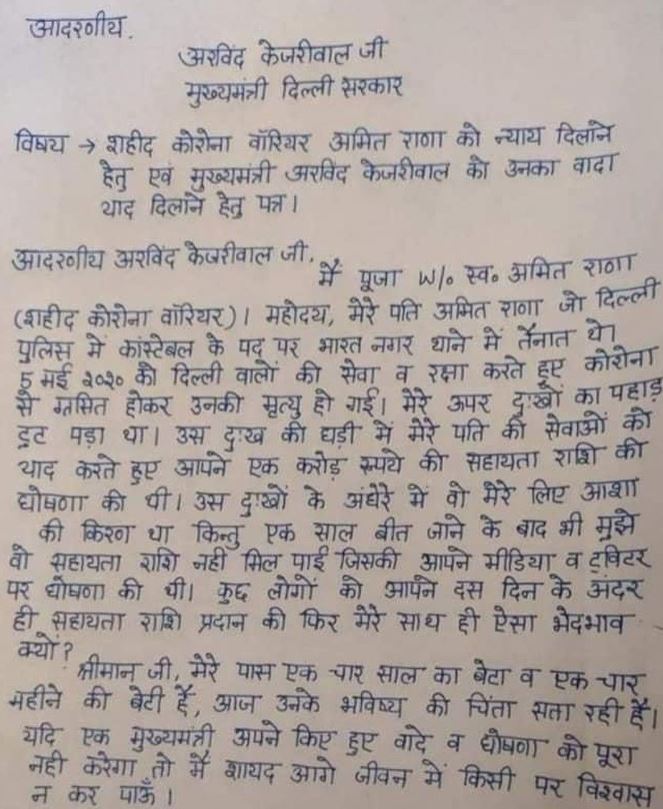
Reminding the CM of his commitment, Pooja wrote in Hindi, “My husband was a martyred corona warrior, and succumbed to the pathogen while serving the people of Delhi. I was filled with sorrow and dejection. In that hour of grief, acknowledging the sacrifices made by my husband, you assured me financial help of Rs 1 crore. You announced the same on Twitter and in front of the entire media. That gave me some hope. However, we never received that amount.”
“Some families received help within 10 days then why this discrimination with me? I have a four-year-old son and a four-month-old daughter. I am worried about their future. If a Chief Minister doesn’t fulfil his promises, I might never be able to trust anyone else. Waiting for justice,” added the grief-stricken Pooja, expressing her disappointment in the CM.
Amit Rana’s widow Pooja’s letter to Delhi CM Arvind Kejriwal (Source: News18)
AAP Government rejects Police Constable Amit Rana’s file
In January this year, Pooja, Amit Rana’s widow, said that the family was recently informed that Amit’s file had been rejected by the Delhi government because it did not meet their requirements. She added that they had submitted all the necessary documents sought by the government department but were later informed that their file has been rejected on the ground that Amit wasn’t on COVID-19 duty.
Even as almost 200 Covid warriors sacrifice their lives in the line of duty, Kejriwal compensates 3 families
However, now that the kin of Dr Anas Mujahid, a junior resident doctor at the Department of Obstetrics and Gynaecology in Delhi’s GTB hospital, and a few others have been provided with the financial assistance of Rs one crore from Arvind Kejriwal, Pooja, who has been awaiting compensation for more than a year now, questioned the discrimination meted out to her family.
Interestingly, though more than 100 doctors and 92 teachers have died in Delhi this year, the Delhi government has compensated only a select few families of Covid warriors who died performing various COVID-19 duties.
On May 23, Delhi Chief Minister Arvind Kejriwal met the father of Dr Anas Mujahid and handed him over a cheque of Rs 1 crore. While speaking to Mujahid’s father Kejriwal said, “Many Covid warriors like Dr Anas are on the frontline helping the people of Delhi and it is because of them that we are able to save lives and the Delhi government is able to fight the pandemic.
How during the first wave, Arvind Kejriwal rejected claims of 12 cops
While Kejriwal has been going around town acknowledging the sacrifices made by COVID warriors and promising to provide financial aid to the kins of those who have lost their lives in the line of duty, it was reported how in December 2020, during the first wave of the pandemic, the Delhi government had rejected claims filed by 12 out of 15 families of police personnel who died of coronavirus while on duty.
As per reports, as many as 31 police officers in Delhi have lost their lives due to coronavirus during the first wave. Of these, 15 were on coronavirus duty when they were on duty. Of these 15, 12 claims are rejected while 3 are pending with Delhi government.
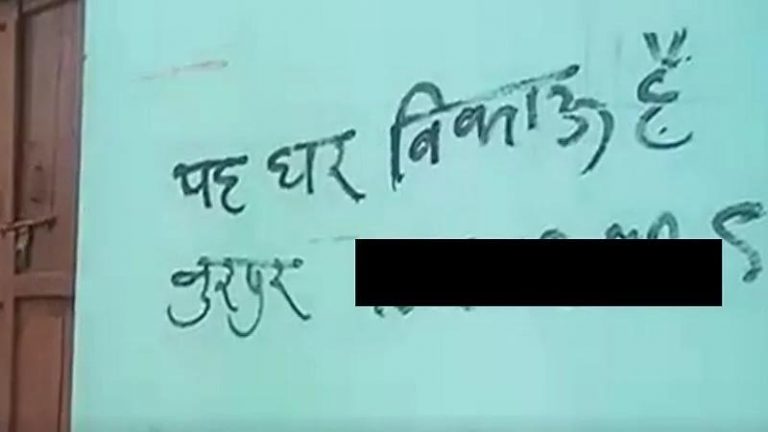
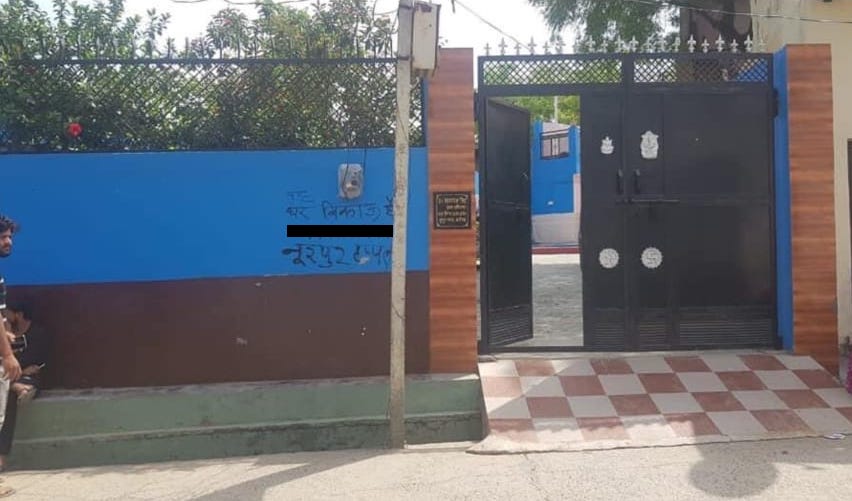
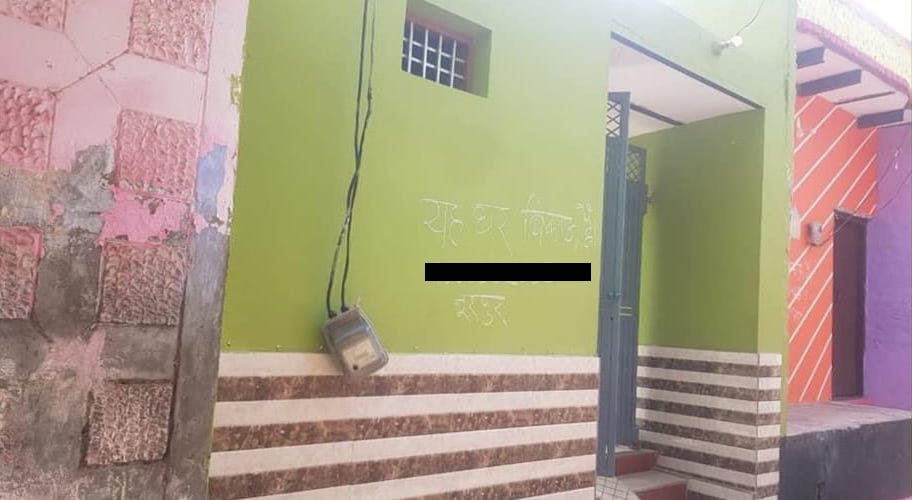
Hindus of Noorpur village in Aligarh district in Uttar Pradesh, are considering selling their houses and fleeing the town amidst threats of persecution at the hands of hooligans from the Muslim majority. Several houses owned by Hindus in Noorpur bear a similar message —‘This house is on sale’—scribbled on their outer walls, informing prospective buyers that the property is on sale.
Noorpur is a Muslim-majority village in Western Uttar Pradesh. According to reports, about 800 Muslim families live in the village. There are 125 families of Hindus, the majority of whom belong to the Jatav community (Scheduled Castes).
The Dalits in the village assert the decision of fleeing the village for a safer abode elsewhere is taken in view of the alleged atrocities meted out on them by hooligans from the dominant Muslim community. However, the Aligarh Police said the situation is under control and there is no reason for Dalits to migrate from the village.
Earlier last week, journalist Keshav Malan uploaded a video from the village, in which he stated that there are many Hindu houses in Noorpur scrawled with the messages of being on sale. According to the journalist, Hindus are compelled to sell their property and leave the village because of the atrocities committed against them by people from the Muslim community. Lewd comments are passed against Hindu girls, their marriage processions are not allowed, the journalist claimed.
Dalits in Noorpur forced to sell their house after atrocities committed against them by members of Muslim majority
The oppression of Hindus, including Dalits, in Noorpur village, came to light after a complaint was filed against members of the Muslim community for attacking a marriage procession. According to the complainant, Omprakash, his daughter’s marriage procession was attacked and pelted stones at by the Muslim community. He has said that some people, including Aakar Kalua, Sarfu, Sohail and Farrukh, abused the village’s lawyer son Allaraji and instigated the procession. Stones were hurled at the marriage procession, which resulted in injuries to many people.
Muslim miscreants pass lewd remarks against Hindu girls, stop their marriage processions: Villager
The aggrieved families told us that Dalit Hindus of the village have been forced to flee over the past few years due to increasing number of violent incidents against them. They also said that casteist slurs were hurled at them and they were not allowed to carry out processions on public roads.
One such victim, Sunil Jatav, said the molestation of Hindu girls by Muslim hooligans has become par for the course in the village. He said this has been continuing for the last 5-6 years, with Muslims hooligans of the village stopping marriage processions of Hindu boys and girls and indulging in skirmishes with them.
“This has continued for a while now. They (Muslims) stop the marriage processions of our brothers and sisters. Owing to these, Hindus here are considering of leaving the village. These messages of ‘The house is on sale’ are put up voluntarily by Hindus, who are tired of the atrocities committed by the Muslim miscreants,” the villager said.
Another Dalit house in Noorpur with ‘house on sale’ message written on its outer wall
Complaint filed against Omprakash and others for obstructing the prayers held in the mosque
A complaint has also been lodged with the police from the other side. In this complaint, the other side has accused Omprakash, Babulal and other people of trying to obstruct the prayers being held in the mosque. The complaint said that people of the Hindu community tried to disrupt the namaz by playing DJ and drums near the mosque and made a ruckus by climbing on the platform of the mosque. The complaint also accused the members of the Hindu community of assaulting Muslims.
Police says no Hindu migration is underway at the Noorpur village
Speaking to OpIndia, CO Kher, Aligarh, said that he, along with senior police officers, had visited the village and that there was no Hindu exodus underway in the village.
In this regard, Praveen Mann, in charge of the Tappal police station, in a conversation with Opindia denied that Hindus migrated from the village due to fear of Muslims. Local MLA Anoop Pradhan told Opindia that there was a dispute between Hindus and Muslims in the village over the procession, but it was a mutual quarrel.
OpIndia CEO Rahul Roushan while in an interview Big Tech and the alleged ‘Congress toolkit’ explained how the content being marked as manipulated media by Twitter is only bad news for the Congress party.
While talking about the repercussions of the ‘toolkit’, Rahul Roushan remarked that no Congress supporter can deny that the propaganda mentioned in the toolkit actually matches the deeds of the party and the left ecosystem.
On Congress’s allegations against the BJP of reverse-engineering the toolkit, Roushan (from 35:00) said, “(They) are saying that whatever Congress and the left ecosystem are doing which results in propaganda against India is not part of a conspiracy but a natural reaction.”
Rahul Roushan’s interaction on Big Tech vs the Government of India
Roushan opined that the allegation of being driven by a toolkit can still be defended, however, claiming that the party’s reaction to the current scenario was not basis any motivated document but a natural and expected response is indefensible.
Big tech vs the Government of India
When asked about the shenanigans of Twitter and its non-compliance to the new rules released for social media platforms by the government, Roushan said that there has to be a cost attached for non-compliance.
Roushan advocated that it is necessary to get digital platforms to abide by the law of the land in a constitutional framework that is followed in most democracies.
The government of India had recently come up with a strongly worded rebuttal to Twitter’s misleading and obfuscating statements to media today regarding Indian law and its so-called policies.
‘Toolkit’ to defame India and Prime Minister Narendra Modi
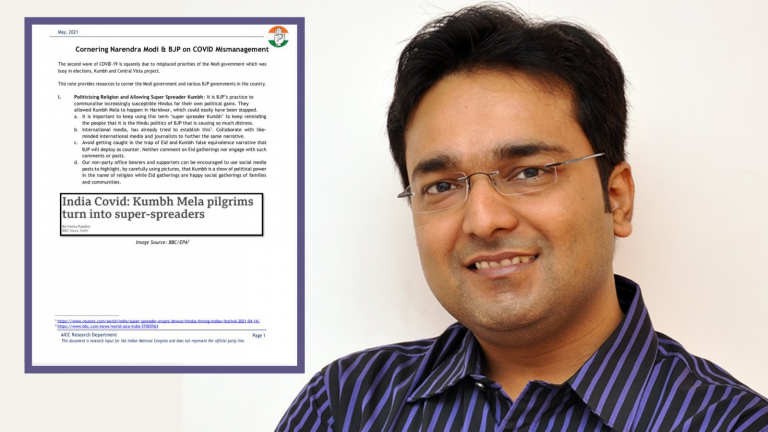
The alleged toolkit claimed by the AICC created an upheaval on social media platforms early this month advocating ways to defame Prime Minister Narendra Modi and India amidst the raging pandemic. The four-page document gave a detailed description of how to attack Prime Minister Narendra Modi, defame Hindus, get ‘tailored’ articles attacking the Indian government in international media, and generally fan an anti-Modi hatred among the masses.
Incidentally, every propaganda mentioned in the document resembled the modus operandi of Congress party workers and supporters leading to suspicion. Consequently, following a complaint by the Congress party, Twitter attached a ‘manipulated media’ label to tweets.
The Government of India objected to the same and said, “In its communication to Twitter, the Ministry has stated that a complaint has already been made by one of the concerned parties before local law enforcement agency questioning the veracity of the toolkit and the same is under investigation.”
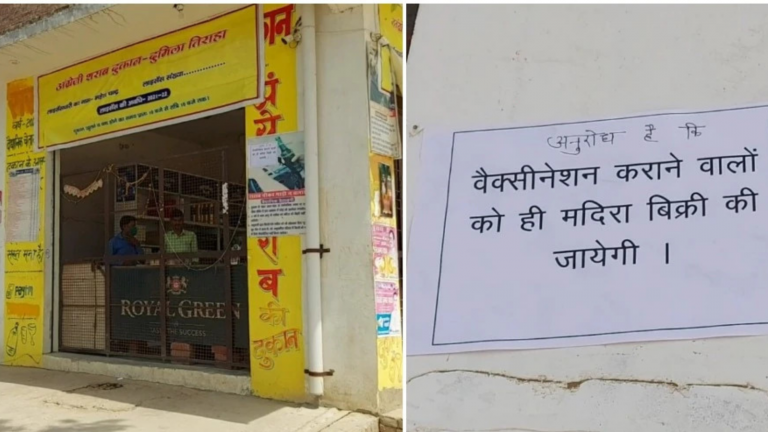
Liquor shops in Uttar Pradesh’s Etawah district are flashing a new notice saying no liquor will be sold without a vaccine certificate. The poster was reportedly put up on the orders of Etawah SDM Hem Kumar Singh.
“The SDM told us to get more and more people vaccinated,” said the employees of liquor shops confirming the same.
“We’re selling liquor only after checking the vaccination certificate of the customer,” said another shopkeeper in an interview to ANI.
Etawah: Liquor sellers in Saifai say the sub-divisional magistrate have instructed them not to sell liquor to those who are not vaccinated against COVID-19.
“We’re selling liquor only after checking the vaccination certificate of the customer,” a shopkeeper says. (30.05) pic.twitter.com/BCqXttPkmv
However, the District Excise Officer of Etawah Kamal Kumar Shukla informed, “No such order has been issued. The SDM might have asked the liquor sellers to motivate people to get vaccinated.”
No such order has been issued. The SDM might have asked the liquor sellers to motivate people to get vaccinated: Etawah District Excise Officer Kamal Kumar Shukla (30.05) pic.twitter.com/kNLNYi3sY3
This order comes after the DM of Firozabad announced that the salaries of government employees will be withheld unless they receive the jab, as per a report in India Today.
The state of Uttar Pradesh has been aggressive with door-to-door testing and the inoculation drive. The Yogi Adityanath government has set a target of administering one crore doses of the Covid-19 vaccines in the month of June.
The district administrators are trying various initiatives like the ones implemented in Saifai and Firozabad to achieve this target.
Covid-19 situation in Uttar Pradesh
With the recovery rate surpassing 95% in the most populous states of the country, the UP government has announced some relaxation in curbs from June 1 in 55 districts.
An order by the state government said that the economic activities will be allowed to resume in zones/ districts which have less than 600 active cases from Tuesday onwards.
The markets too can remain open for longer hours from 7 am to 7 pm from Monday to Friday, however, no relaxation will be given in the weekend curfew.
The state recorded 1,908 cases new coronavirus cases in a span of 24 hours between 29 May and 30 May with the positivity rate at 0.5 per cent.
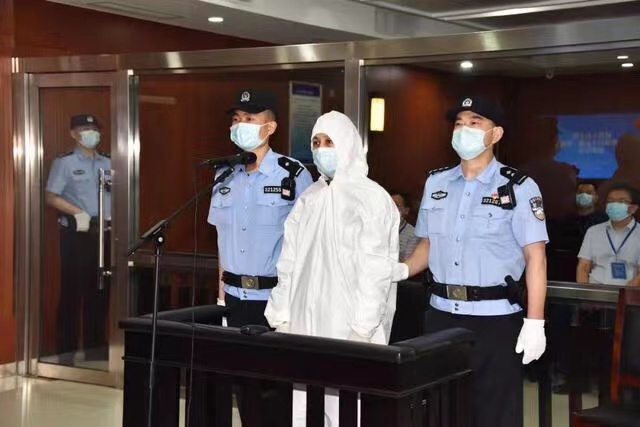
A social media celebrity in China was sent to 8 months in prison for mocking the Chinese soldiers who were killed during the Galwan Valley clash with Indian Army personnel.
“Qiu Ziming, or Labixiaoqiu, an internet celebrity with 2.5 million followers, was sentenced to 8 months in prison for infringing on reputation of heroes and martyrs, and ordered to make a public apology. In Feb, he smeared martyrs killed in Galwan Valley border clash with India,” a tweet posted by Global Times said.
Qiu Ziming, or “Labixiaoqiu,” an internet celebrity with 2.5 million followers, was sentenced to 8 months in prison for infringing on reputation of heroes and martyrs, and ordered to make a public apology. In Feb, he smeared martyrs killed in Galwan Valley border clash with India pic.twitter.com/WhO7jLEcJQ
Qui was arrested by the Chinese police earlier in February 2021 for allegedly smearing PLA soldiers killed in the Galwan Valley border clash with India. According to a report published in Global Times, Qui was arrested for spreading false information and smearing four soldiers who died and one who was wounded during their skirmishes with the Indian Army on China’s Twitter-like Social media platform Sina Weibo.
Shortly after his arrest, Qui’s Weibo account, which had more than 2.5 million followers, was suspended for mocking the Chinese soldiers who lost their lives during their illegal trespassing of the Indian territory.
Galwan Valley clashes and how opposition India politicians helped China in spreading misinformation
On the night of June 15th 2020, China had attacked Indian soldiers and unilaterally tried to change the status quo in Eastern Ladakh by attempting to intrude into Galwan valley. In the violent face-off where Indian soldiers managed to push the PLA soldiers back, 20 Indian soldiers made the ultimate sacrifice and reportedly, China had lost 43 of their men. After the face-off, China had vociferously denied reports of casualties on their side and called it a misinformation campaign.
Soon after the clashes took place, the Indian opposition politicians fell over themselves to use the tragedy in their bid to undermine the Modi government. Senior Congress leader and former party president Rahul Gandhi raised aspersions by asking why the soldiers did not carry weapons (ignoring that the treaty signed by India in 1993 and 1996 prevented that), alluding to either incompetence of soldiers or the intentions of their superiors.
It was then alleged that Gandhi’s insinuations helped China in spreading misinformation with regard to the Galwan Valley clashes. As such, Gandhi’s mysterious relationship with China had come under spotlight several times, most notably during the Doklam stand-off when he was caught secretly meeting Chinese officials.
The Gandhi-scion, not once but twice, was caught meeting Chinese officials, raising suspicion among the policymakers regarding the intent of his secretive meeting with the Chinese. The first meeting had taken place in 2017, when Rahul Gandhi had a meeting with the Chinese Ambassador to India Luo Zhaohui, especially at a time when India and China were in the middle of a stand-off at Doklam. While Congress had denied such meetings and had termed news reports suggesting that the Gandhi-scion had indeed met Chinese officials as ‘fake news’, the Chinese embassy itself confirmed the same much to Congress’ embarrassment.
Besides, several other opposition politicians in India also used the Galwan tragedy to attack the Indian government, and in the process casting doubts over the prowess of the Indian Army.
Chinese admit to casualties it suffered during the Galwan Valley
However, months after claiming that it suffered no casualties in the Galwan Valley clashes, China in February this year posthumously awarded honorary titles to 4 of those who had died during the attempted intrusion into India—a confirmation that China too had suffered casualties in the deadly clashes.
Not even a month has passed since Mamata Banerjee secured an emphatic victory over the BJP in the West Bengal assembly elections, her party leaders are already promoting her as the next Prime Minister of India. Trinamool figureheads on social media are trending the hashtag #BengaliPrimeMinister on Twitter to put forth Didi’s name as the next Prime Ministerial candidate.
Trinankur Bhattacharjee, the state president of Trinamool Chhatraparishad, was among those who participated in the hashtag.
Women safety, security & empowerment are our priorities. Hence we want @MamataOfficial to lead our country. We want to implement schemes like Kanyashree, Rupashree, Saboojsathi, Swasthyasathi & Khadyasathi across India. So we want Didi to be the PM.#BengaliPrimeMinisterpic.twitter.com/HokeRBwvZc
— Trinankur Bhattacharjee (@TrinankurWBTMCP) May 31, 2021
Spokespersons of the party participated in the Twitter trend as well.
Bengal, the land known for its pivotal role in social, cultural and political renaissance, will once again show the way to India. Fellow countrymen, gear up for your next #BengaliPrimeMinisterpic.twitter.com/viq9ydNJwB
There are important takeaways for opposition parties from Banerjee’s early moves with three years still remaining in Prime Minister Modi’s second term. Clearly, she is not in the mood to waste time after securing a healthy victory.
More regional chauvinism
Mamata Banerjee went all in with the regional chauvinism card in the assembly elections. Although it is unclear the extent to which it benefited the party, Banerjee appears to believe it significantly contributed to the results.
With Lok Sabha Elections in 2024, it appears that Trinamool Congress believes the party will be able to secure more seats than it did in 2019 by projecting a Bengali Prime Minister, consistent with the ‘Bohiragoto’ narrative.
But it is unclear how she will reconcile her national aspirations with the ‘Bohiragoto’ narrative. It does not appear sensible to engage in regionalism while harbouring intentions to play a greater role in national politics.
Nonetheless, the idea of a Bengali Prime Minister might strengthen her hand in West Bengal itself in 2024.
Mamata Banerjee is pitching herself as the front in line among rivals
The trend is also geared as much towards opposition leaders from other parties as it is against Narendra Modi. In the lead up to 2019, there was great uncertainty regarding who will be elected the Prime Minister should the Mahagathbandhan manage to secure power.
Mamata Banerjee wishes to sweep away her rivals from other parties in the possible grand alliance while the wind is still in her favour. And truly, there are very leaders from other parties who could match her stature.
Sharad Pawar and Uddhav Thackeray cannot win Maharashtra on their own. Arvind Kejriwal is limited to the national capital which has a very small population compared to major states. Ashok Gehlot, Amarinder Singh and others from the Congress party will not take a leap over the Nehru-Gandhi Parivar. That leaves Banerjee with very few credible contenders.
However, in order to ensure her candidature, she is attempting to brush aside any opposition that might arise.
Not so good news for Rahul Gandhi
Undeniably, it is bad news for Rahul Gandhi. The Congress party would have wanted to create a grand alliance with itself at the center but opposition parties may not be willing to take that route. Rahul Gandhi as the Prime Ministerial candidate will certainly not be acceptable to other parties given how poorly he has fared in one on one contests against Narendra Modi.
Even in 2019, it was clear that although Rahul Gandhi wanted to be the PM candidate, other parties did not consent. With that in mind, Banerjee is attempting to emerge as the compromise candidate.
Even so, for the BJP to lose in 2024, the Congress party has to secure around 100 seats at the very least. Under such circumstances, it will be interesting to see how other parties sideline the party with the second highest seats.
Mamata Banerjee may spark an infighting
Banerjee could very well spark an infighting with her early moves for 2024. Infighting is the major cause for concern in any such grand alliance as many parties are traditionally rivals of each other. For instance, the Mayawati-Akhilesh alliance could not dent BJP’s chances as their traditional vote-banks do not see each other in good light.
Similarly, Banerjee’s candidature as Prime Minister is sure to irk the Left Front who may then hesitate to throw their weight behind the alliance. The Congress party itself may develop a cold feet as it would want Rahul Gandhi to succeed Narendra Modi as Prime Minister.
Will Mamata Banerjee be acceptable nationally?
The biggest concern for Mamata Banerjee is the fact that she has practically no base outside West Bengal. Even if she wins all the seats, which appears impossible, the maximum she could win is 44 seats. Outside of West Bengal, even among Bengalis, she does not enjoy great popularity.
Bengalis in North East do not vote along the same lines as those in West Bengal. Therefore, the BJP is likely to sweep Bengali Hindu votes in Tripura and Assam. Combined with her ‘Bohiragoto’ narrative, it makes it immensely difficult for Banerjee to expand her voter-base.
Given such constraints, Banerjee may well have national ambitions but it is an uphill task henceforth.
Throughout human history, beliefs and values have evolved based on changing circumstances but also due to courageous stands taken by a few. Drastic societal changes that seem to take place overnight, are often built on sustained movements that continue to wear down opposition and gather support until the status quo ecstasies down.
In political terms, the shifting of acceptable ideas in public is called the Overton window. The theory is that on each side of the left-right political spectrum, ideas fall all the way from popular to unthinkable (with policy or existing laws as the center). The aim of each side is to move the window of acceptability further to their side.
As an example, the issue of gay marriage in the US was traditionally considered extreme left and radical or perhaps even unthinkable. However due to a sustained campaign, at least since the 1960s, activists have shifted public opinion to such a degree that support for gay marriage is now not only acceptable, but also legal.
This shifting of the Overton window is important not just for the opposition but even for the ruling party in order to sustain and build upon political energy. Obama himself publicly came out against gay marriage during his 2008 campaign but reversed his stance in 2012 while up for re-election, no doubt realizing the ground underneath him had shifted on the issue.
Coming closer to home, the Hindutva movement has not successfully lobbied for these kinds of Overton shifts, especially in the last few years. Hindu society is always reacting, with the Ram Janambhoomi Movement standing out as a key exception. The build up to the Ram Mandir verdict shows what’s possible when setting the narrative versus accepting the worsening status quo.
With a right of center government in power, the time is ripe for the Hindu right to sway public opinion on key subjects. Additionally, there are many global trends such as anti-colonialism, victimhood narrative, displacement of traditional media, revisiting history and natives’ rights, that can be leveraged to amplify Hindu causes and defeat opposing voices. The below is only a sample list of potential focus areas.
Most of these positions may seem radical but that’s only because the colonial state that India runs on has shamed Hindus into accepting second class status in India. I will also including modern or recent examples from other countries to establish precedence and parallels.
As a precursor, the first step should be the establishment of a truth and reconciliation commission to document the reality of Mughal and Colonial rule. This should include an exhaustive accounting of temples destroyed, Hindus massacred and general crimes against Hindu society, crimes not done solely for political reasons but due to religious bigotry. Many societies have done a similar accounting, for example to unearth the reality of slavery in the Americas, and the destruction of natives in places such as Africa and Australia.
Shining a light on historical truths naturally leads to the following demands:
Rebuilding of all mandirs that were destroyed or converted into churches or masjids
Revisiting decrees that gave native land to Waqf and Church authorities. Such land should be reclaimed where possible by the state and used for public good or to setup industries.
Removal of the minority ministry, minority commissions etc.
Secondly, while the CAA has been an important step in implicitly recognizing India as the spiritual home of dharmics, we need to go beyond. The ‘secular’ word inserted in the Constitution during the Emergency needs to be removed and instead verbiage needs to be added that clearly outlines India as a dharmic land. Across the globe, there are Christian, Islamic, Jewish and even Buddhist countries but none that are Hindu. This needs to be corrected.
Thirdly, this writer is in the minority opinion that state control of temples may not necessarily be a negative if the funds can be used for the good of society. Instead of releasing control to a whole spider web of Hindu organizations, we should instead make the following demands of the government:
State support for ghar wapsi, including monetary rewards for conversion or reconversion in genuine cases
Vedic school and gurukuls to be setup to ensure continuity of key traditions
National salary and pension for pujaris, purohits etc
Next, there should be mandatory teaching of the Gita, the Vedas, Ramayana and the Mahabharata in all public schools. If Western schools can teach courses on the Gita, there’s no reason why it’s teachings can’t be disseminated in Indian schools.
A national ban on cow slaughter. Most countries have bans on killing certain animals, we just need to add the cow to our list.
Lastly, there needs to be a law on hate speech that targets Hindus. The concept of hellfire and condemning someone to hell just because of their beliefs is an alien concept in dharmic thought, as well as one that defies common sense. The use of the word kafir and the public airing of beliefs that propagate the concept of ‘non-believers’ going to hell will be made punishable by law. The use of the ‘N’ word by a non-Black is a crime in the US and so is the denial of the holocaust in many countries.
We as a people cannot look to Modi as a messiah. The flower blooms only after the hard work of tilling the soil, planting the crops and nurturing the plants is done. It’s time for Hindu society to roll up its sleeves and get to work.
A huge controversy erupted recently when Baba Ramdev’s video declaring allopathy as a hollow practice exploitating people went viral. The Indian Medical Association jumped into the frey, taking a strong objection to his remarks and threatening to move court if the Union Health Ministry does not take cognizance of the remarks made by Ramdev.
The Health Ministry promptly expressed its disapproval over Ramdev’s remarks, issuing a letter to the Yoga Guru to retract his statements. Ramdev complied with the request made to him by the Union Health Minister Harsh Vardhan and withdrew his statements against allopathic medicines.
However, the war of the words between the Indian Medical Association and Baba Ramdev did not seem to abate. In fact, it only became shriller and more intensified. Functionaries of the Indian Medical Association, most notably the former IMA chief Dr Rajan Sharma and IMA secretary Dr Jayesh Lele, hauled Baba Ramdev over the coals in a TV debate after the Yog Guru shot 25 questions at them, highlighting the shortcomings of allopathy and asking them for permanent solutions to some of the most common diseases.
In the debate, Baba Ramdev was seen striking a conciliatory tone with his opponents, asking them to acknowledge the salutary effects of the Ayurvedic method of treatment, just like he recognised the contribution of the allopathic system in life-saving situations, grave surgeries and serious ailments. However, he was subjected to contempt and disdain by Dr Lele as he lost his cool over the Yog Guru. Dr Jayesh Lele’s angry outburst was celebrated by the left-leaning liberals, who hailed him for hitting out at Baba Ramdev and trashing his Ayurvedic system of treatment.
As the IMA received support from the liberal quarters, it continued with its intimidation tactics to bully Baba Ramdev into submission. The IMA then sent a Rs 1000 crore defamation suit to Baba Ramdev, asking him to withdraw his statements against the allopathic medicines. Baba Ramdev retorted back by sharing a video clip from Aamir Khan’s show ‘Satyameva Jayate’, where a guest named Dr Samit Sharma was seen explaining the huge price difference between generic and branded medicines. Posting the video clip on micro-blogging site Twitter, Ramdev dared ‘medical mafias’ to sue the actor if they can.
इन मेडिकल माफियाओं में हिम्म्त है तो आमिर खान के खिलाफ मोर्चा खोलें-
Tussle between IMA and Baba Ramdev spawns allopathy vs Ayurveda debate
The confrontation between Baba Ramdev and the IMA has inevitably sparked a debate between which is the better way of treatment—Ayurveda or allopathy. Several people have jumped into the debate, either in support of the Ayurveda and against the allopathic way of treatment or vice versa. The conversation surrounding the medical treatment has polarised to such an extent that it has turned seemingly binary—either you are with Ayurveda or allopathy—there is no room for people who possibly think either of the methods is beneficial in their own right.
The conflict between allopathy and Ayurveda is centuries old. It is widely believed that the use of modern medicine started in India in the 16th century. During that time and before that, there were hardly qualified doctors and patients were treated by millennia-old Ayurvedic methods. Ever since the advent of modern medicines, there is an enduring debate over which is the more effective way of treatment.
Ayurveda, one of the oldest methods of treatment, is made up of two words from the Sanskrit language Ayur and Veda. Ayur means life and Veda means science. That is, Ayurveda means the science of life. allopathy is said to have its roots in Greece about 2400 years ago.
While the Allopathic way of treatment has made tremendous leaps and bounds in terms of progress, especially in the 19th and the 20th century, the Ayurvedic treatment also made significant advances, providing cures for seemingly pervasive and common diseases that Allopathy has so far failed in finding permanent solutions to. The Ayurvedic system has proven to be effective, and there are cases abound where the patients have been cured of their chronic diseases through Ayurvedic treatment.
The recent tussle between Baba Ramdev and the IMA has reignited this centuries-old debate between the two methods of treatments. Allopathy is opposed by the Ayurvedic faction mainly because of the side effects the doses of medicines have caused among patients. While the Allopathy faction has rejected the Ayurveda method of treatment, calling it quackery and accusing it of lacking scientific evidence.
Baba Ramdev, for his part, has been critical against allopathic treatment and medicines, partly because of the allopathic doctors’ arrogant disregard of the Ayurvedic method of treatment. His comments against allopathy, which spawned the debate in the first place, were uncalled for and unwarranted. While he has been placatory since then and has acknowledged the advantages of modern medicines, the continuing criticism of allopathic treatment does not bode well for the morale of the doctors who are involved in the fight against the COVID-19 pandemic.
Ayurveda and allopathy both can coexist, without having to discredit the other
It is a fact that allopathic way of treatment has contributed significantly to cure diseases and save ailing lives. A host of vaccines, surgeries, and treatment methods developed to ward off a multitude of maladies is a testament to modern medicine’s success. Even in the current pandemic, the doctors are doing their best to help people fight and recover from COVID-19, a respiratory illness that has proven to be highly infectious and staggeringly lethal.
The IMA and the allopathic doctors, on the other hand, are unnecessarily prolonging the debate, continuing to attack Baba Ramdev even though he has already retracted his comments on the allopathic medicines and doctors. Perhaps, the IMA sees the controversy as leverage to save its head Dr John Austin Jayalal, who is mired in a case for talking about converting COVID-19 patients to Christianity.
The vilification of Ayurveda and Yoga as quackery is unjustified, given that for centuries these methods were used by our ancestors to treat the diseased and help people lead a long life. In fact, the same Ayurveda and Yoga, which are scorned by the allopathic doctors in India, are now gaining traction in western countries. While in India, Ayurveda is subjected to ridicule, the western pharmaceutical giants are making a beeline to patent its methods and medicines for treating patients.
As India grapples with the resurgent coronavirus outbreak, both the Ayurveda and Allopathy practitioners and supporters need to realise that both treatments can coexist simultaneously, without the need to discredit the other. Both Ayurveda and Allopathy have unique characteristics that distinguish one from the other. It, however, does not mean that there should be a debate over the supremacy of one treatment over the other. Each of them has proven beneficial in treating patients, and therefore they both deserve to exist in their own right.
The coronavirus outbreak has proven to be an intractable contagion, even for the allopathic way of treatment that prides itself on being successful in fighting modern diseases. In such difficult times, India should use all its resources and expertise to stave off the threat emanating from the ferocious second wave of the coronavirus outbreak, instead of sparring over which is the more effective method of treatment amongst the two.
The coronavirus outbreak will not be the first time that India would fend off a contagion. For centuries, the Ayurvedic method of treatment had helped the country sail through the devastating bouts of plagues, flu outbreak and other severe diseases. At a time when the allopathic doctors are overburdened with COVID-19, a smidgen of humility towards Ayurvedic treatment would do them good and help the country combat the pandemic more effectively.