Amidst the 3rd phase of the ongoing West Bengal State Assembly polls, a Trinamool Congress (TMC) booth agent was thrashed by a group of women in Arambagh in the South 24 Parganas district. The attack comes days after TMC leader Mamata Banerjee urged women to attack security personnel with ‘Haatha kunthi‘.
As per reports, the incident took place in Subhaypur Harijan Prathamik Vidyalaya (Polling station 230) in the Arambagh Vidhan Sabha constituency. A group of women reached the polling station and pulled the TMC agent Babar Ali Khan out of the booth. He was allegedly beaten with ‘haatha kunthi’ by the women in the presence of the central security personnel.
ABP Ananda reported that despite the efforts of the security forces to pacify the situation, the women continued to thrash the TMC agent. He then managed to escape and reach the van of the police authorities. On being asked to return back to the polling booth, he cited ‘personal safety’ to refrain from going back. The TMC booth agent then left the scene.
(Video Courtesy: Youtube/ABP Ananda)
While speaking about the matter, Khan said, “The police are protecting me here. But they (referring to the group of women) are thrashing me there in the presence of the central forces. They have failed to protect me. These cops have saved my life.” The third phase of the West Bengal State Legislative polls have so far witnessed violence, ISF bombing and obstruction of voters by the Trinamool Congress.
Mamata Banerjee advocated mob justice during election rallies
While perpetuating fear in the minds of people that the BJP could unleash a similar form of brutality, Mamata Banerjee said during an election rally, “Ek jot hoye berhoben…Ekta loker gayae haath dile, ekta mayer gaye haath dile, lokho maa hatha kunti niye berhobe (Leave your homes in groups. If they touch anyone, especially a woman, lacs of mothers will come out with kitchen utensils in their hand)”.
She further added, “If they attack any man, then, all the elderly must unite in groups.” While gloating over the idea of violence, the West Bengal Chief Minister stated, “Ami dekhte chai khela ke haare aar khela ke jeete (I want to see who loses this game (of violence) and who wins.)
During an election rally in Falakata in the Alipurduar district on Friday(April 2), Mamata Banerjee claimed that the central security personnel have been working in cahoots with the BJP as a part of a sinister conspiracy to defeat the Trinamool Congress. “Don’t listen to them. If they try to intimidate you, then, you must unite and chase them away with utensils, sticks and brooms,” the West Bengal recommended the people of Falakata to resort to violent means.
Yesterday, an 18-year-old girl from Pilkhuwa was thrown into the Gangnahar canal in Dasna Mussoorie after being stabbed with a knife by her estranged friend, as per a report in Amar Ujala. The accused—Amaan Malik, with the help of his friend Shaadab, kidnapped the girl at knifepoint and brought her from Pilkhuwa to Dasna—where after an altercation they stabbed the girl with a knife and threw her in Gangnahar.
She was reportedly stabbed before being thrown into Gangnahar. However, she was rescued after people in the vicinity heard her cries for help. As people started to gather near Gangnahar to pull her out, the accused escaped from the spot. She was subsequently rescued from Gangnahar and taken to the hospital where she is currently undergoing treatment.
थाना मसूरी क्षेत्र में कल दिनांक 05 -4- 21 में हुई घटना के संबंध में पुलिस अधीक्षक ग्रामीण की वीडियो बाईट। pic.twitter.com/ePChAX0GeV
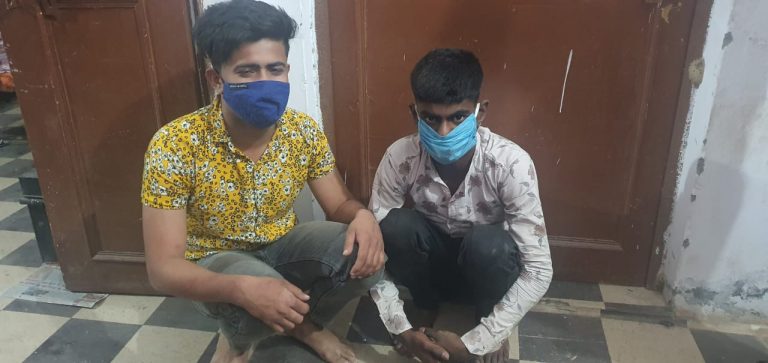
The police registered a case of attempt to murder after the girl’s mother filed a complaint against the accused. Hours after the incident, the two accused—Amaan and his friend Saadab—were arrested by the police.
According to the uncle of the 18-year-old student, about two years ago, the girl met Amaan Malik, who worked at a shop along the canal. Gradually the two became friends. Family members claim that the girl had stopped talking to Amaan for about two months. He had tried many times to approach the girl and talk to her, but she refused. Her uncle said Amaan and his friend Shaadab intercepted the girl when she had gone to the market on Monday.
The girl was then taken towards the railway road on the pretext of having a private conversation. There, Amaan talked to the girl for about 10 minutes. His friend, Shaadab also stood beside them during their conversation.
Amaan and Saadab had kidnapped the girl at knifepoint
Family members claim Amaan kept pressuring the girl to talk but she did not relent. Following this, Amaan gestured towards Shaadab who kidnapped the girl at the knifepoint. She was then taken to Dasna Gangnahar. The duo tried to have a conversation with the girl. However, before the girl could make sense of anything, Shaadab caught hold of her hand and Amaan started stabbing her with a knife. The student kept screaming for help, even as Amaan kept stabbing her.
The girl tried to get herself free from Shaadab’s grip, but could not succeed. Hearing the screams of the girl, a passer-by created a noise that spooked the accused. As people started gathering at the spot, Amaan and his accomplice Shaadab fled from the area, but not before throwing the girl into Gangnahar. The person who was in the vicinity rescued the girl from the canal with the help of passers-by, after which the police was informed. The police took the girl to Dasna CHC, from where she was shifted to the MMG District Hospital.
The family said their daughter had stopped talking to Amaan after she sensed his behaviour and actions to be suspicious. She, therefore, severed all ties with him and stopped talking to him altogether.
A year ago, she stopped talking to Amaan. At that time, the accused Amaan had threatened her that she and her family would face dire consequences if she did not resume her friendship with him. Cowed by his threat, the girl grudgingly started talking with Amaan again. However, a couple of months ago, the girl again stopped talking to him.
According to the medical examiners, there were several knife wounds on the girl’s body. She had knife marks around her arm, thighs and neck. She was transferred to the District MMG Hospital after her condition became critical. The family was informed about the incident and they quickly rushed from Pilkhuwa to Ghaziabad.
Ghaziabad Police have issued a video where they have informed that acting on the family’s complaint, the two accused have been arrested within a few hours.
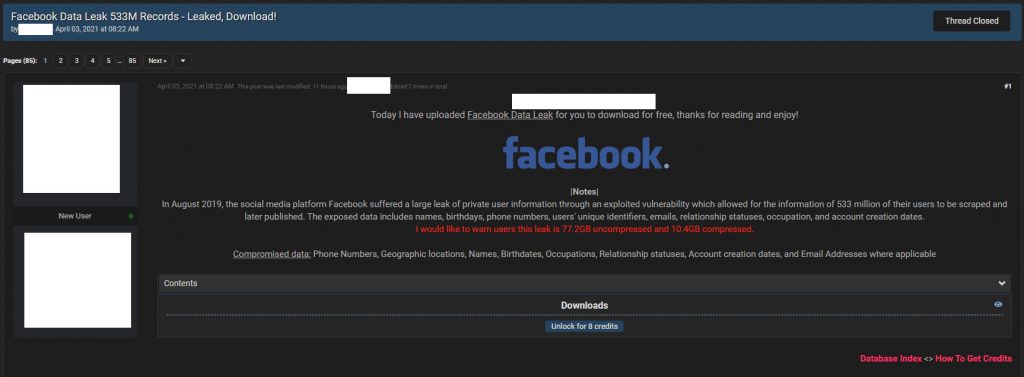
A massive data dump of 533 million global Facebook users has been leaked and making rounds on hacker forums. As per the posts by threat actors who leaked the data, it contains user names, birthdays, phone numbers, users’ unique identifiers, emails, relationship statuses, occupation, account creation dates and more.
Post by threat actor informing details of the data dump
The hacker also mentioned that the data was scraped from Facebook in August 2019 when the social media giant suffered a large leak of private user information, thanks to a vulnerability that was later fixed. The hacker said, “In August 2019, the social media platform Facebook suffered a large leak of private user information through an exploited vulnerability which allowed for the information of 533 million of their users to be scraped and later published.” In the comments, it was mentioned that the database was up for sale for $99 on another forum in March.
In comments, it was clearly mentioned that the data dump contained information of 61,62,450 Indian users.
The dump is divided in different files country-wise. Indian file has 61,62,450 records.
Experts’ views on Data Leak
The leak was reported by several experts, including Alon Gal, CTO of Israeli cybercrime intelligence firm Hudson Rock, Troy Hunt of haveibeenpwned.com and others. Gal also reported the leak in January 2021, where he said that the leak was underreported. At that time, Gal reported that a user had created a Telegram bot that allowed users to query the database for a low fee. “This obviously has a huge impact on privacy,” he said.
In early 2020 a vulnerability that enabled seeing the phone number linked to every Facebook account was exploited, creating a database containing the information 533m users across all countries.
It was severely under-reported and today the database became much more worrisome 1/2 pic.twitter.com/ryQ5HuF1Cm
— Alon Gal (Under the Breach) (@UnderTheBreach) January 14, 2021
On April 3, while quoting his January thread, Gal informed that the 533 million records were leaked for free. He further added that the bad actors would possibly use the information in the leaked data for scamming, hacking, social engineering and marketing.
Details include:
Phone number, Facebook ID, Full name, Location, Past Location, Birthdate, (Sometimes) Email Address, Account Creation Date, Relationship Status, Bio.
Bad actors will certainly use the information for social engineering, scamming, hacking and marketing.
— Alon Gal (Under the Breach) (@UnderTheBreach) April 3, 2021
Troy Hunt, founder at haveibeenpwned.com on April 4, wrote a long thread on the data leak. He said, in the first review, he found out that the database has extensive data set with one file per country. Though he could not find data of anyone from his family, he said, “I’m hearing from other trustworthy sources that the data is legit, and that seems a reasonable assumption to work on for now.”
On first review, it’s an extensive data set with one file per country and a header row as follows:
Hunt added that he would extract the data, which he was expecting to be around 10 million and not hundreds of millions, as reported by the hackers. Talking about the impact of such breach and data being freely available, Hunt said, “For a targeted attack where you know someone’s name and country, it’s great for mobile phone lookup. Much harder to do en masse as there’s no reliable key; I couldn’t make a big list of emails and resolve them to phone numbers as email is rare in the data.
So, I’ll extract those addresses, do some further verification then load the data. It won’t be hundreds of millions of records, I suspect it’ll be less than 10M, but obviously that’s still a substantial number.
After parsing, Hunt found 2,529,621 email addresses in the data dump. Anyone can check if their data was leaked based on the email addresses on the website haveibeenpwned.com.
Email parsing now done, found 2,529,621 unique addresses across the 108 files. Call it about 0.5% of all records having an email address.
Later on April 6, in reply to the thread, he said that the phone numbers are also being uploaded on haveibeenpwned.com, making it easier for the users to check if their information got leaked. By the time this report was published, it was still under process. He added that when there is a vacuum of information, people speculate. “Facebook needs to make a clear statement on the data that’s in broad circulation; when it happened, where it came from and what’s in it. Without that, confusion and speculation reign,” he said.
The Facebook phone numbers are now being loaded into @haveibeenpwned and will be searchable later today. Stay tuned, I’ll push out a short blog once it’s good to go (will be queryable via the existing API too ?).
Joe Tidy, Cyber Reporter for BBC, mentioned several Facebook breaches that affected more than one million users. According to his post on Twitter, in 2019 alone, there were four data breaches at Facebook affecting 600 million (March 2019), 540 million (April 2019), 419 million (September 2019), and 309 million (December 2019) users.
In case you’re lost, here’s all Facebook’s data breaches that affected more than 1m users.
– June 2013: 6m users – 2016: 90m (Cambridge A) – May 2018: 14m – Sept 2018: 50m – March 2019: 600m – April 2019: 540m – Sept 2019: 419m – Dec 2019: 309m
As there were several breaches in 2019, there was confusion over which data has been made available online. In another tweet, Tidy suggested that as per Facebook’s confirmation on the data, the available data dump was from September 2019, which was initially thought to be of 400 million users.
Confirmed by Facebook. These 2 breaches in 2019 were indeed separate. So there was one in April that led to 500m users data exposed and another in September (the one we are all taking about now) which was initially 400m users. ? https://t.co/vJu2NRl9YQ
While talking to OpIndia, Sunny Nehra, Admin at Hacks And Security, said, “Though the data is old but downplaying the leak is not the way to go. The dump has an enormous amount of data that bad actors can use for spamming, hacking and marketing.” He further added that security in Digital space is an illusion. All applications do suffer from some or other vulnerabilities. The better they are tested, the more vulnerabilities are found. Facebook has a proper bug-hunting program where anyone who finds some valid vulnerability can report to them and get fame & financial rewards. But malicious hackers prefer to misuse it rather than reporting it.
Facebook acknowledged a vulnerability in 2019 caused by their “view as” feature, potentially exposing its 50 mln users access tokens to hackers. This or other vulnerability that can let a hacker access private info could have been used to fetch this data. Nehra added, “any data breach should not be taken lightly. When users are informed about the breach, they can take the required steps to avoid any further damage.”
Tomasz Onyszko, Founder at Predica, called it a “truly global phone book”. He said, “If it confirms and it is not a random dataset scraped from other sources, then it might be first, truly global phone book.”
If it confirms and it is not a random dataset scrapped from other sources, then it might be first, truly global phone book. @troyhunt have you got this reported / checked already?
Several Facebook executives have taken the task to downplay the leak. Liz Bourgeois, Director, Strategic Response Communications at Facebook, said on Twitter that the data is old. She said, “This is old data that was previously reported on in 2019. We found and fixed this issue in August 2019.” However, the executives fail to acknowledge that even though the data is from 2019, it contains phone numbers and email IDs of the users, which do not change that often.
This is old data that was previously reported on in 2019. We found and fixed this issue in August 2019. https://t.co/mPCttLkjzE
The data breach has sparked worldwide outrage. As per reports, so far, Turkey, Ireland and the Philippines have initiated a probe into data leak. On April 5, National Privacy Commission, Philippines, said that they are currently investigating the large scale data breach. NPC said that it is validating the information that over eight lakh Facebook accounts of Filipino netizens have been “compromised as part of the large-scale breach affecting 533 million global users of the social media networking site.”
Turkey’s Personal Data Protection Authority (KVKK) also launched a probe into the data leak. As per reports, KVKK on Monday decided to initiate an ex-officio investigation into the data leak where information of 533 million Facebook users was shared on a hacker forum.
Ireland’s Data Protection Commission (DPC) initiated the probe despite Facebook’s claim that the data is old. Graham Doyle, deputy commission, DPC, said that the data dump appears to be from the previous leak, and it happened before the EU’s GDPR privacy legislation was in effect. “However, following this weekend’s media reporting, we are examining the matter to establish whether the dataset referred to is indeed the same as that reported in 2019,” he added.
Phone numbers and emails are a ‘blessing’ for spammers, scammers and marketers
Assuming the number of emails and phone numbers included in the data breach is not in hundreds of millions as suggested by the hacker, the possible use of such data dump is still a huge threat to privacy. It has to be noted that phone numbers and emails are not just for sending spam messages. Here are some potential vulnerabilities you may be exposed to if your information is leaked.
Hackers can send link with malicious code leading to financial losses. By clicking on the malicious link in a message or email, you may grant access to your computer or phone to the hacker without realizing it. One of the main concerns is phishing emails. Nowadays, many users who are on Facebook are not well versed with technology. They often fall for phishing attacks that may lead to identity theft and financial losses.
Phone numbers and emails are often sold online to marketers. These telemarketers may use your email or phone numbers to send spam emails. It does not matter if you are registered with the ‘Do Not Disturb’ service or not. In this case, the spammers will not consider the role of any government regulation.
Facebook has been facing criticism for data leak and malpractices
There have been several instances when Facebook was accused and, in some cases, fined for data breaches and malpractices. In 2019, Facebook signed a deal worth $5 billion with Federal Trade Commission after finding that the company was collecting user phone numbers on the pretext it would be used only for two-factor authentication.
During the investigation, it was found that Facebook was using the collected information for targeting Facebook users with additional advertising. At that time, FTC said, “Facebook violated the FTC Act by engaging in a new set of deceptive practices relating to the collection and use of consumer phone numbers provided by consumers to enable security features such as two-factor authentication.” After the said case, Facebook was permanently barred from using numbers gathered from two-factor authentication requests for advertising purposes.
In 2020, Canada’s independent Competition Bureau fined the tech giant with CAD 9 million penalties for improperly sharing data with third-party developers. The competition watchdog had said, “the company made false or misleading claims about the privacy of Canadians’ personal information on Facebook and (messaging app) Messenger”.
In 2019, Brazil fined Facebook $1.65 million for improperly sharing users’ data in a case linked to the global Cambridge Analytica scandal. Ministry of Justice had said that Facebook did not inform the users “about the consequences of the default privacy settings, especially in relation to the data of “friends and friends of friends.”
In February 2021, the Italian competition watchdog fined Facebook 7 million Euros for not complying with a request to correct improper commercial practices in its treatment of user data. The fine was imposed after it failed to publish the amended statement as ruled by the Italian watchdog in 2018 after it found that Facebook had not informed users properly about its collection and use of data.
At that time, the watchdog had fined Facebook with 5 million Euros and asked it to publish an amended statement on the homepage of its website for Italy, on the Facebook app, and on the personal page of each registered Italian user.
What can users do about the leaked data?
As the data leak happened around two years ago and since then the data has been sold and resold, there is nothing much you can do about it. However, there are some steps that you should take as the data is now freely available for hackers to download across the world.
Do not click on any link that you receive in email or SMS, especially from an unknown number or email ID.
If you receive an email or a message from your bank, any financial institute, any government institute, or receive an email claiming you have won some prize, prefer not to click on the links in the email or message. It will be better if you visit your bank website and check the claim that has been made in the email.
Inform your friends and family about the data breach. Tell them not to click any link in the messages or emails from unknown senders.
Prefer not to click on shortened links. It is a standard practice to save yourself from any potential hack or scam.
If you haven’t yet, please install a good antivirus on your computer and smart devices.
You can check if your information was leaked by entering your email id or phone number on https://haveibeenpwned.com/.
Jordan B Peterson appears to have discovered that a Captain America comic has been written where his ideas have been projected as part of the philosophy of the villain Red Skull. The clinical psychologist and author was rather shocked after he became aware of it.
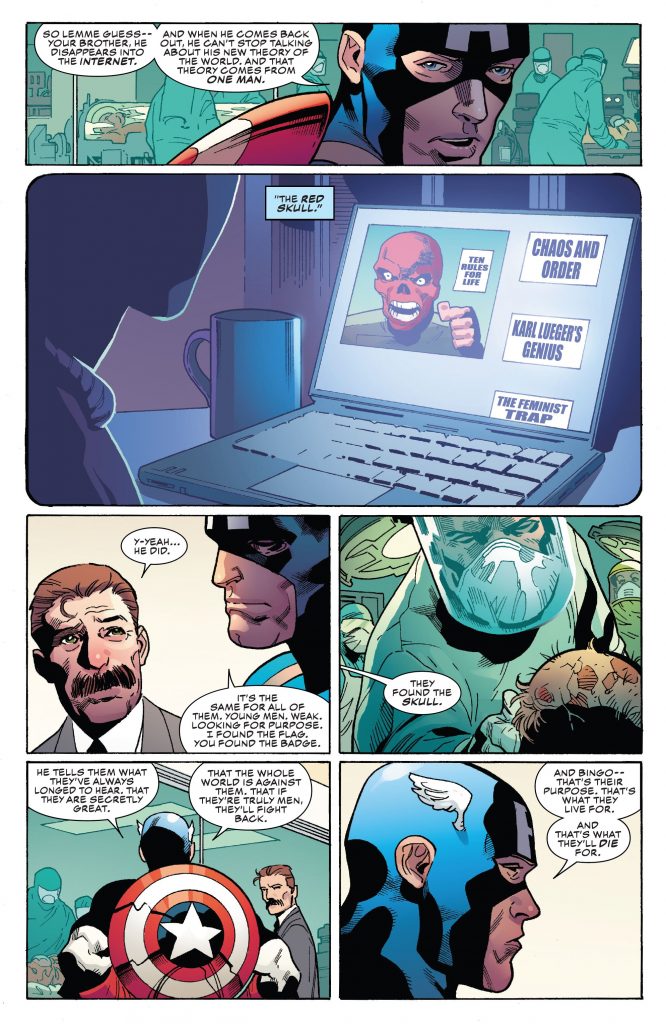
The Captain America comic in question was written by one Ta-Nehisi Coates, an African American author. A user on social media shared the image of one of the pages of the comic while replying to Jordan Peterson on Twitter. According to those on social media, the concerned image is from the 28th issue of the Captain America comic.
The controversial Captain America comic (Source: Social media)
The comic describes a conversation between Captain America and another individual. Red Skull can be seen on a laptop screen offering sermons on “Ten Rules for Life”, which is an obvious jibe at Jordan Peterson who has authored the popular bestseller “12 Rules for Life”.
Furthermore, Captain America’s words leave little room for doubt that Red Skull is based on the clinical psychologist. Red Skull is described as someone who offers lectures on the internet. “It’s the same for all of them. Young men. Weak. Looking for purpose. I found the flag, you found the badge. They found the Skull,” says the protagonist.
He continues, “He tells them what they’ve always longed to hear. That they are secretly great. That the whole world is against them. That if they’re truly men, they’ll fight back.” It is a gross oversimplification of Jordan Peterson actually teaches, to put it mildly.
Peterson said, after his initial “What the hell” reaction about the matter, “Do I really live in a universe where Ta-Nehisi Coates has written a Captain America comic featuring a parody of my ideas as part of the philosophy of the arch villain Red Skull?”
The Marvel Universe, which Captain America is a part of, has become increasingly ‘Woke’ in recent times with politics invading entertainment spaces in the United States. It is not the only one which has become overly politicised with the Star Wars franchise and others traversing a similar trajectory.
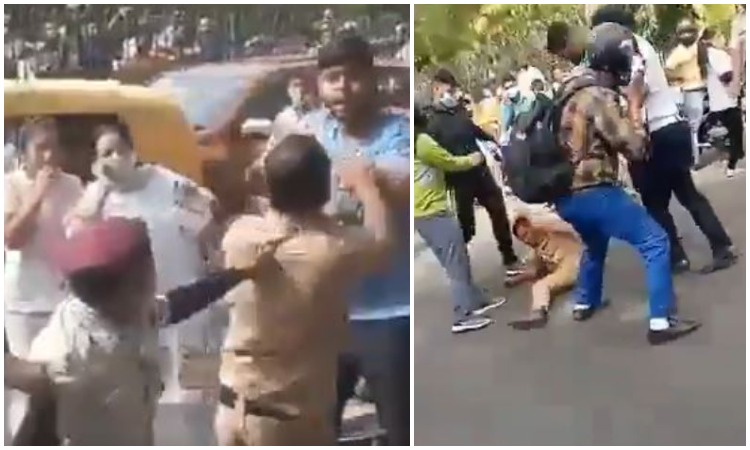
On Tuesday (6th April) videos of a clash between the Delhi government’s civil defence volunteers and passersby went viral on social media. The incident was reported from the streets of South Delhi’s Hauz Khas area on Monday afternoon, where a Delhi Civil Defence (DCD) volunteer was seen beating a youth with a belt and thereafter the officer was attacked by a group of irate crowd.
In the first video, a DCD officer is seen hitting a youth in a plain blue T-shirt with a belt. Another man intervenes. He somehow pacifies the angered officer and pulls him away.
Kejriwal Government’s Civil Defence Army Got into Fight with a Driver in South Delhi for Not wearing Mask .
Video of a Civil Defence Employee beating Driver with Belt . FIR registered from Both sides pic.twitter.com/LpcmRzzSdu
In another video men in plain clothes were seen attacking the uniformed civil defence volunteers. A group of men are seen kicking an official lying on the road. The police had reportedly found this video during the investigation of the incident.
#UPDATE: Police found another video during investigation when the 20-year-old student along with passersby attacked the civil defence volunteers. Cross FIRs have been registered at Hauz Khas police Station. @IndianExpress, @ieDelhipic.twitter.com/YrK7SSuIzs
— Mahender Singh Manral (@mahendermanral) April 6, 2021
The scuffle broke out reportedly when the volunteers were carrying out a mask-checking exercise in the area. Three officers have been reported to be injured in the incident.
FIRs have been registered by both parties at the Hauz Khas police station, according to media reports.
In what transpired, the DCD personnel stopped a car near a traffic signal near the IIT-Delhi in the Hauz Khas area. According to police as the traffic signal turned green, another car which was being driven by a student identified as Gitesh Dagar applied the brakes suddenly following which a third car hit his car. This enraged Dagar, who got out of his car and confronted the officials.
This led to a heated argument between the 20-year-old Gitesh Dagar and Delhi Civil Defence (DCD) volunteers, who were issuing challans to people not wearing masks. The argument soon turned violent at a traffic signal in South Delhi. The DCD volunteers were then seen hitting the student with a belt after which, the latter, along with a few other people passing by attacked the DCD personnel.
Speaking about the incident, DCP (South), Atul Kumar Thakur said: “The incident came to light after we received a PCR call at around 3 pm on Monday. The DCD employees, who were issuing challans to people not wearing masks at a traffic signal near the IIT gate, had stopped Gitesh Dagar’s car. He was travelling with his aunt and her daughter from a doctor’s clinic. On stopping the car while the traffic light was green, a vehicle from behind rammed into Dagar’s car following which he came out and started arguing with the volunteers.”
Thakur added that the DCD volunteers allegedly hit the student with a belt. Following this, the student and a few other people, who had gathered there, started beating the volunteers. “They have sustained injuries and have been shifted to a hospital for treatment. FIRs have been lodged against both the parties and a probe is on to ascertain what exactly happened,” said DCP (South).
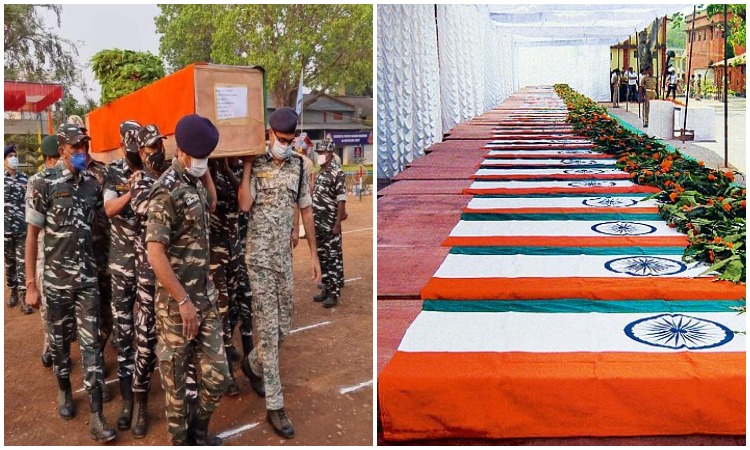
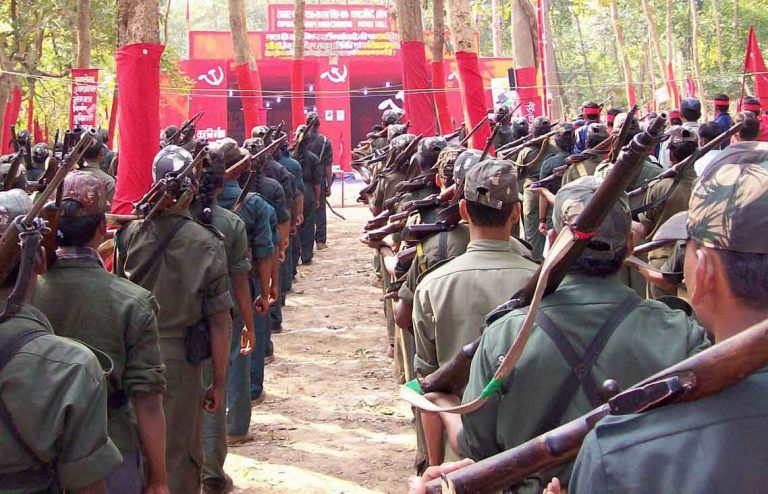
In the deadliest terrorist attack of 2021, a group of 400 Naxals ambushed a massive operation that included the STF, DRG and District Force of the Chhattisgarh Police, the CRPF and its elite COBRA unit on April 3 (Saturday). The teams were deployed in the forests of Chhattisgarh for a search and destroy anti-Maoist operation along the border of the Bijapur-Sukma district.
It was during this operation that the security teams of around 1500 personnel were ambushed by 400 Naxalites from three sides- led by the most-wanted Maoist commander and leader of the ‘People’s Liberation Guerilla Army’- Hidma. The close encounter between the Naxalites and security forces lasted for four hours in which the Naxalites rained bullets from light machine guns, used low-intensity IEDs and rocket launchers, brutalised dead bodies and escape with weapons.
This brutal Naxal attack that resulted in the killing of 22 jawans of Central Reserve Police Force (CRPF) and leaving 31 injured at the Sukma-Bijapur border in Bastar division on April 3 (Saturday) brings back the memory of the deadly 2010 Dantewada attack, where the Maoists used the same modus operandi of isolating and attacking a company of soldiers returning from an area domination exercise.
The soldiers were already out on the field for over 24 hours and vulnerable due to exhaustion. The Naxalites used this sensibility to launch an attack, almost wiping out the CRPF’s 82nd Battalion back in 2010. And this trend has been continuing until today.
2010 Maoist attack in Dantewada, Chhattisgarh
On this day in 2010, April 6, 76 CRPF jawans were killed in an ambush by Naxals near Chintalnar village in Dantewada, Chhattisgarh. The attack occurred in the Tademetla forests when over 80 officers from the central paramilitary force Central Reserve Police Force (CRPF) and a local police group were conducting an area domination exercise in the Bastar tribal region of the Indian state of Chhattisgarh.
It was reported how Maoists, who waited on hilltops, opened indiscriminate fire and triggered an IED blast as the convoy appeared. Later, the reinforcements that were rushed to the site were also blown up. The CRPF team, which comprised only 120 personnel were heavily outnumbered by almost 1000 Maoists who attacked and killed the jawans and fled the scene with weapons, including bulletproof jackets, guns and ammunition.
A fierce gunbattle was on between the security forces and Naxals in the jungles of Dantewada. Rescue operations were reported to have been hampered because of heavy firing by the Naxals. Helicopters that were rushed in to rescue injured CRPF jawans had been fired at by the Naxals using anti-aircraft guns. The heavy firing had, however, made it difficult for the rescue helicopters to land. The cowardly attack by Naxalites had then resulted in the martyrdom of 76 CRPF soldiers, while 50 others were said to be seriously wounded.
By far, the Dantewada attack remains the worst ever attack in the history of Maoist insurgency, inflicting severe casualty to the Indian forces.
In what is said to be the clincher in Antilia bomb scare case and Mansukh Hiren death case, CCTV footage accessed by Republic TV shows suspended API Sachin Vaze approaching the Chhatrapati Shivaji Maharaj Terminus (CSMT) after allegedly scaling the wall of the Mumbai Police headquarters to avoid CCTV cameras on March 04.
Sachin Vaze’s March 4 visuals OUT: Jumped wall to avoid CCTV cameras; took CST-Thane train https://t.co/LHD2z7L3KH
As per sources, Sachin Vaze reached the CSMT station at 7 pm on March 04 and proceeded to take a train to Thane. He reached the destination at 8.10 pm following which he made a phone call using a SIM card procured from bookie Naresh, who is in NIA’s custody currently. An NIA officer in a statement revealed, “We suspect that Vaze then called Hiren posing as officer Tawade, using the SIM card that was procured from Gujarat by another accused.”
It is alleged that after meeting Mansukh Hiren with constable Vinayak Shinde, he left for Byculla and reached the destination by 9.20 pm. He then called his aide Riyaz Kazi to ask him to bring his mobile phone to the Dongri Police Station.
It was also reported that Vaze raided one Tipsy Bar located in Dongri to suggest that he was conducting a raid at the time of Mansukh Hiren’s murder. As per sources, Sachin Vaze’s attempt to call Kazi to Dongri Police Station was an alleged attempt to deceive the investigation agencies by creating an alibi for himself.
The Thane businessman, Mansukh Hiren, was found dead the next day.
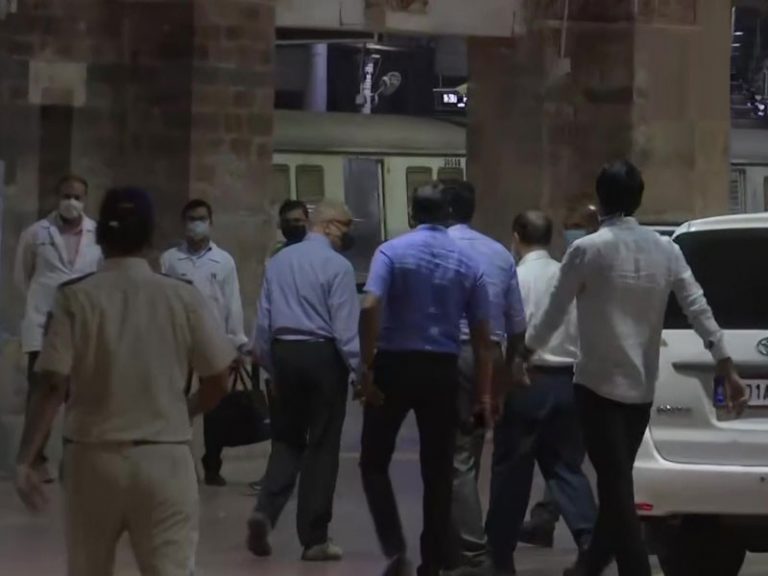
NIA Takes Sachin Vaze To CST Station To Recreate Crime Scene
The NIA in the late hours of Monday recreated the crime scene, first at the CSMT station and then at the Kalwa station in the presence of Sachin Vaze.
NIA along with Sachin Vaze recreating the crime scene at CST station. Image source: ANI
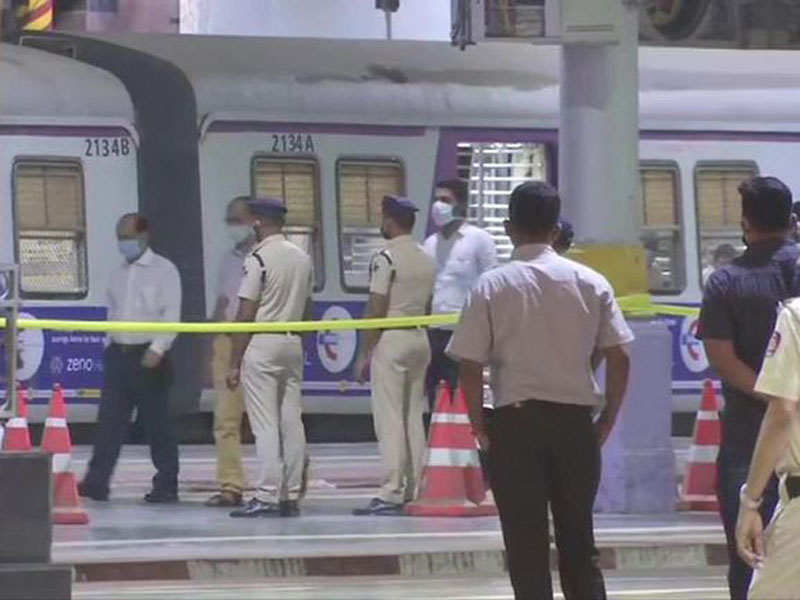
The accused was taken to platform number 4 of the CST station, which was cordoned off and then to the Kalwa station where he was asked to walk down the Kalwa railway bridge.
NIA takes Sachin Vaze to Mumbai’s CST station to recreate crime scene, visuals out https://t.co/wxPw4KXhnB
The NIA also conducted late-night raids on Saturday in a bid to recover more evidence in its probe against Sachin Vaze.
Another luxury vehicle seized
Adding to the never ending list of luxury vehicles associated with Vaze, the National Investigation Agency on Monday traced a luxury Italian sports bike ‘Benelli’ from Daman that is said to be registered in the name of Meena George, the mystery woman who is under NIA’s scanner for her alleged connections with Sachin Vaze.
NIA has seized eight luxury vehicles until now which were allegedly used by Vaze for various reasons around the time of Antilia bomb scare incident and Mansukh Hiren’s murder. These include a Green Scorpio, a white Innova, two black Mercedez Benz cars, a Land Cruiser Prado, a black Volvo, and a white Mitsubishi Outlander.
The NIA is still on the lookout for two more luxury cars, one being an Audi in which Vaze was seen traveling with suspended cop Vinayak Shinde in a CCTV footage recovered from Bandra-Worli Sea Link on March 03.
The 22 Central Reserve Police Force (CRPF) men who were killed-in-action during Saturday’s encounter with Maoists in Bastar, Chhattisgarh, were the latest in the long and endless list of security personnel and civilians killed in the attacks carried out by the left-wing terrorists. The attack was a grim reminder of the menace of Maoist terrorism afflicting the nation.
The security forces had launched an operation along the Sukma-Bijapur border, where an intense face-off resulted in the martyrdom of 22 jawans. It is being reported that one soldier is still missing. Besides, 31 soldiers were injured in the encounter that ensued between the armed personnel and the Maoists.
A police officer privy to the developments said it was a “U-shaped attack” in which the security personnel were stuck at a lower level, and the Maoists perched atop the two hilltops, fired indiscriminately at the security forces. The police officer also claimed that the Maoist operation was led by Hidma, the same Maoist who was responsible for the catastrophic attack on CRPF personnel in Sukuma in 2017. There was intelligence input that Hidma was present in the area for the last 17 days, the officer said.
The incident has once again brought to fore the challenges of the left-wing extremism facing the country. For decades now, several pockets in the country have become stronghold of the Communist terrorists, who use the local areas to their advantage to perpetuate their reign of terror. Often, the target is the police, security personnel and political leadership. But the Maoists have demonstrated that they won’t shy away from attacking and harming the civil population either.
The Maoists and Naxals have also demonstrated that they possess modern weapons, are adequately trained, and are ruthless in their guerrilla warfare against the security forces. They have used the factor of a surprise to great advantage, stunning their opponents with a surprise attack and inflicting maximum damage.
Against the backdrop of the pernicious attack that took place in Chhattisgarh last week, let’s take a look at some of the major Naxal ambushes in the last few years:-
Jnaneswari Express train derailment
Perhaps, the deadliest of the Maoist attacks in the last couple of decades has to be the Jnaneswari Express train derailment. For the passengers of the train, the disaster struck when they were in deep sleep. The train bound to Mumbai got derailed between Khemashuli and Sardhia stations of South Eastern Railway after midnight May 28, 2010, and toppled on the adjacent tracks.
A goods train coming from the opposite direction within a few minutes ploughed through the bogies, taking the toll of the injured and dead even higher. About 148 passengers lost their lives in the incident and more than 200 passengers were injured.
In the investigation that ensued following the incident, it came to light that the accident was a result of sabotage by activists of frontal organisations of the Maoists, who had damaged the railway tracks that eventually caused the derailment.
West Bengal chief minister Mamata Banerjee was then the Railway Minister of the country. Following the incident, she was reluctant to admit the Maoist connection in the attack even though the incident took place in West Bengal’s Naxal-hit Midnapore district. Banerjee had then called for a CBI inquiry into the incident, alleging that the accident was a conspiracy by the ruling CPM in West Bengal.
The premier investigation agency named Maoist leader Bapi Mahato as the prime accused in the case. Days later he was arrested by the police. In his interrogation, Bapi Mahato confessed that he was a member of Mamata’s Trinamool Congress before he joined the People’s Committee against Police Atrocities (PCAPA), a frontal organisation of the Maoists responsible for the derailment of Jnaneswari Express.
However, Banerjee remained adamant that the conspiracy was hatched by the CPM. Only months later, she grudgingly admitted the investigation findings that pointed towards the involvement of Maoists in planning and executing the attack that saw more than 140 deaths.
Dantewada Naxal attack in Chhattisgarh claims lives of 76 security personnel
In April 2010, a month before the Jnaneswari Express derailment, Chhattisgarh was jolted with a major Naxal attack when 75 Central Reserve Police Force (CRPF) and a state police personnel were killed in an ambush in the thick Mukrana forests of the Dantewada district.
The CRPF team was attacked while they were taking a break after a long tiring night of travelling. The team had completed its three-day anti-Maoist operation and was on its way. They took a break at around 6 am after travelling all night, when they were ambushed by up to 1,000 Maoists positioned on the neighbouring hilltop. The Naxals, fully aware of the CRPF troop movement, launched an attack with deadly precision, giving the soldiers no chance to mount a response. They blew up an anti-landmine vehicle and then began firing indiscriminately.
The shell-shocked and worn out jawans were not in a position to follow and abide by the standard operating procedures like checking the road for landmines. They were massacred within minutes of the attack. The Naxals subsequently looted all the weapons that the CRPF party had.
26 CRPF personnel martyred in Naxal ambush in Narayanpur, Chhattisgarh
2010 was amongst the worst year with regard to the Maoist insurgency in the country. A month after the Jnaneswari Express derailment that killed over 140 people and two months after the horrendous Dantewada attack in which 76 security personnel lost their lives, Naxals executed another deadly ambush, killing 26 CRPF personnel.
In June 2010, a heavily armed group of Naxals, sitting atop a hill, targeted a 63-member security contingent that was returning on foot from road opening duty. The Maoists opened indiscriminate fire, which has been their modus operandi, to sow confusion and panic among the soldiers and thereby inflict maximum damage.
The attack place at Daurai Road area of Chhattisgarh’s Narayanpur, about 300 km from Raipur. 26 CRPF personnel lost their lives in the attack.
The Naxal attack on Congress cadres in Darbha Valley, Chhattisgarh
Another horrifying attack that shook the nation’s conscience and forced the ruling class to reconsider its strategy in dealing with the Naxalites was the Darbha Valley attack in Chhattisgarh in May 2013, in which the entire state Congress leadership was wiped out. At least 27 people were killed in the attack when the Naxalites had ambushed several Chhattisgarh Congress leaders, including state secretary Nand Kumar Patel, his son Dinesh, former Union minister VC Shukla and former state minister Mahendra Karma.
The Congress leaders were on their way from Sukma to Jagdalpur after a rally, which was a part of the party’s ‘Parivartan Yatra’, when the deadly attack took place. They had passed through Naxal-affected regions during the march.
Former Chhattisgarh chief minister Ajit Jogi, who was a Congress leader at the time, was also scheduled to travel with the convoy, but had changed his plan at the last minute and decided to travel by helicopter.
The attack was a signature Maoist attack as carried out in the past. The left extremists used the thick cover of the forested area of the Bastar-Sukma border to their advantage and laid an ambush. After ambushing the convoy, the Maoists detonated an IED to create a crater and cut off the convoy’s escape route. Once the vehicles slowed down, the Naxals opened indiscriminate fire on the Congress leaders.
25 CRPF personnel killed in the April 2017 Naxal attack in Sukuma, Chhattisgarh
The Sukuma district of Chhattisgarh is considered one of the most volatile regions plagued by the scourge of left-wing terrorism. The region has witnessed more than half a dozen Maoist attacks in the last decade.
The deadliest of the attacks took place in April 2017, when Maoists attacked a team of around 100 men, belonging to the 74th battalion of the CRPF, based at the Burkapal camp on the Dornapal-Jagargunda road in south Sukma, was out to provide protection for road construction work in the area.
25 CRPF personnel were martyred in the attack and seven others were grievously injured. In retaliation, CRPF opened fire and shot dead 10-12 Maoists.
According to the official information that was released after the encounter ended, the attack was carried out by Hidma, head of PLGA Battalion 1. The battalion is one of the fiercest armed cadres of the Maoists and had carried sophisticated weapons to attack the CRPF team. Besides, the group also included many women cadre.
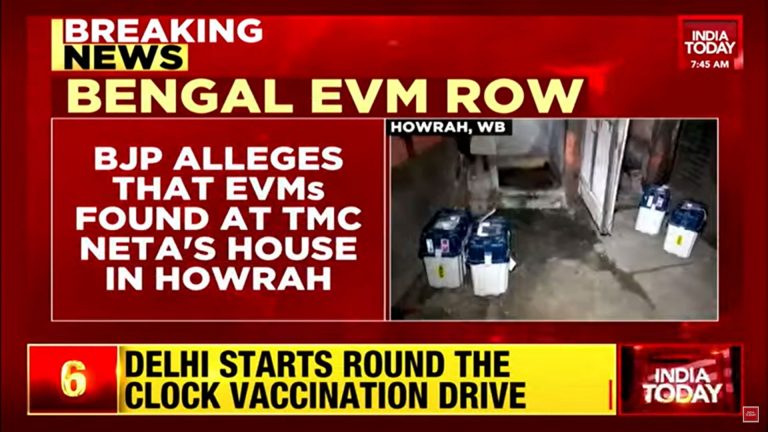
On April 5, while West Bengal was preparing to vote for 31 seats in the third phase of Assembly elections across districts – South 24 Parganas, Howrah, and Hooghly the next day, ruling party TMC faced criticism as EVMs were found in one of its leaders. Interestingly, India Today tried to pass it off just as an allegation by BJP.
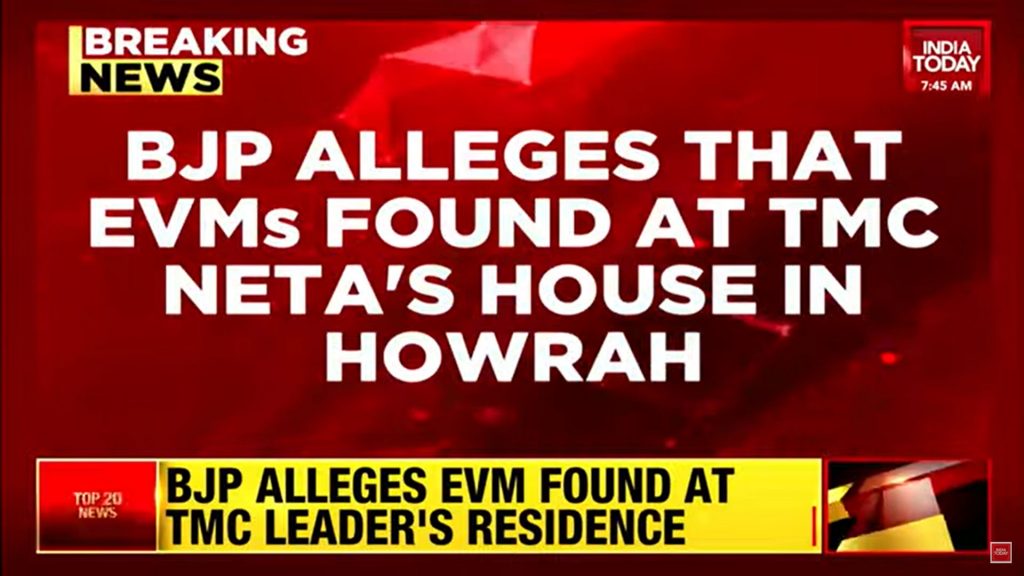
In a video report, India Today said, “BJP alleges that EVMs were found at TMC Neta’s house in Howrah”. In a 2-minute report, the anchor and the reporter kept on repeating that BJP is alleging the EVMs were found in TMC’s leader’s house. The anchor repeated it four times while the reporter used different words as ‘alleged’ and ‘claimed’. Interestingly, the visuals of EVMs and VVPATs played in the background for one minute in the 2-minute report while the anchor kept on saying that BJP is alleging instead of confirming that the EVMs were indeed found in the TMC leader’s house.
India Today claimed BJP is alleging EVMs were found in TMC leader’s house
EC suspended the presiding officer
As per reports, EVM and VVPAT machines were found at TMC leader Gautam Ghosh’s residence at Tulsiberia. The EVMs and VVPATs were brought to the residence of the TMC leader by Tapan Sarkar, a sector officer, in an election duty car. The sector officer who was caught red-handed by the villagers claimed that since it was very late in the night, the central forces had slept off and refused to open the booth, so they had to stay at a relative’s house to sleep who ‘happened to be a TMC leader’.
The Election Commission, in its report, said that the EVMs and VVPATs found at the TMC leader’s house were part of reserve stock, and they will not be used for the voting. The presiding officer was suspended. Reports suggest that when the villagers found out about the EVMs, the tension broke down in the area, and central forces were called to control the situation.
Netizens questioned India Today’s style of reporting
Several netizens raised eyebrows over the way India Today had reported.
Even NDTV reports that EVMs were found inside TMC leader’s house but for @aroonpurie its just an allegation by BJP. They are real Dalal, who pretends to be neutral. pic.twitter.com/eMvo6wT056
The second phase of polling in West Bengal had witnessed several violence cases emerging from Nandigram, East Midnapore and Keshpur. BJP leader and Mamata Banerjee’s opponent, Suvendu Adhikari’s convoy was also attacked by alleged TMC goons in Nandigram.
The prime reason behind crimes against women is obviously the deteriorating law and order condition of that particular country or state. However, Pakistan PM Imran Khan assumes otherwise. According to Khan, “fahashi” (vulgarity) is the main reason behind the rise in rape and sexual violence and not the declining lawlessness in the country.
The Pakistan PM was taking calls on Sunday, 4th April, when a caller asked him what the government plans to do in the light of rising incidents of rape and sexual violence, especially against children. To this Imran Khan opinioned that there are some fights that governments and legislation cannot win alone. He said that the society must join in the fight, adding that it was important for societies to protect themselves against “fahashi” (vulgarity), reported Geo News.
‘Pardah system is there in Islam to keep temptation in check’, claims Imran Khan
Imran Khan then went on to advocate the whole concept of ‘pardah’ in Islam, saying that it is there for a purpose. He said that the pardah system is there in Islam to “keep temptation in check”. It’s interesting that the Pakistan Prime Minister believes that the best way to protect women and children is to keep them behind a veil and not boost the law and order system of the country.
The Pakistan prime minister said there are many people in society who “cannot keep their willpower in check”. “Iska kuch tou effect aana thha na (It had to manifest itself in some way),” he added.
He concluded by reiterating that incidences of rape and sexual violence are “spreading like cancer” in society. Official statistics in Pakistan have revealed that at least 11 rape incidents are reported in the country every day, with over 22,000 cases reported to the police in the last six years.
However, what Imran Khan forgets to mention is that only 77 of the accused have been convicted which comprises 0.3 per cent of the total figure. According to the Geo News report, these statistics were obtained from the Police, Law, and Justice Commission of Pakistan, Human Rights Commission of Pakistan, the Women’s Foundation, and provincial welfare agencies.
As if this was not enough that in February, that the Forensics Department of Khyber Medical College University proposed a plan to charge rape victims Pakistani Rs 25,000 for medical examination and Rs 5,000 for an autopsy for the local residents of Peshawar.
Sexual assaults by men of Pakistani origin common worldwide
Not only in the terror state of Pakistan, where apart from native women and children, minority Hindu women are also kidnapped and raped and an alarming frequency, but sexual assaults by men of Pakistani origin has also increasingly become a common occurrence worldwide.
In the last few months, there have been several cases where Pakistani migrants were found committing unspeakable sexual atrocities against native women and children in Greece. While the victims have been predominantly native women, in some cases, even children have been brutalised by men of Pakistani descent.
Last year we reported how the United States Ambassador-at-Large for International Religious Freedom, Samuel Brownback made certain revelations regarding the situation of Hindu and Christian women in Pakistan. Brownback said that Pakistan has been marketing Hindu and Christian woman as concubines and forced brides to China. He highlighted how religious discrimination makes religious minorities in the country vulnerable.