Home Blog Page 4921

Mumbai police cracks down on BJYM’s peaceful protest in another display of predisposition of Maharashtra govt to stifle dissent

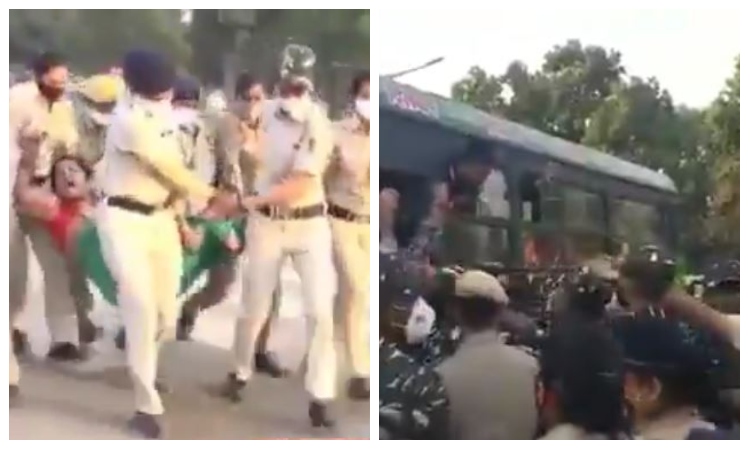
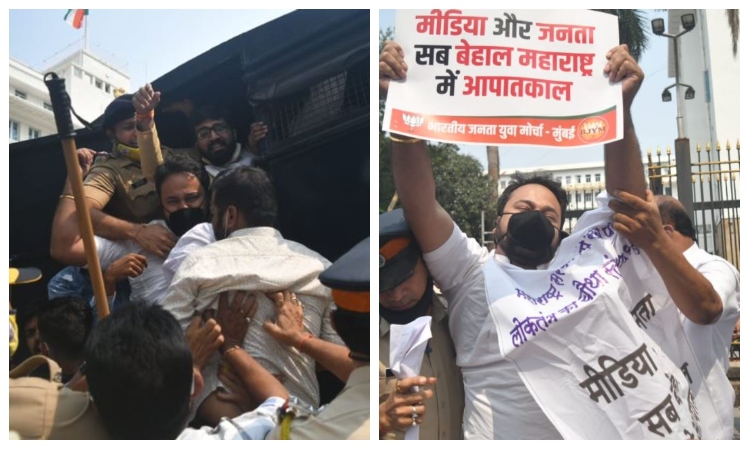
The Mumbai police came down heavily on the Bhartiya Janta Yuva Morcha (BJYM) workers staging a peaceful protest against the illegal crackdown on media and social media by the Maha Vikas Aghadi government in Maharashtra. The protests took place outside the Mantralaya in Mumbai today. The Mumbai police have detained BJYM Mumbai chief Tajinder Tiwana and several other workers from outside the Mantralaya.

According to BJP spokesperson Suresh Nakhua, Mumbai police reached the spot where the BJP youth wing workers were peacefully staging a protest, against the Maharashtra Government’s high-handedness and efforts to stifle the media, and forcefully stuffed the BJP workers in the police van.

He said that the Uddhav Thackeray government’s fascism has thrown Maharashtra into a state of undeclared emergency, where journalists and social media users are being harassed and terrorised if they dare to speak against the Uddhav Thackeray government.

Following several cases where media and social media users have been facing the wrath of the Maharashtra Government recently, BJYM and BJP leader had organised a peaceful protest at 12 pm today, outside the Mantralaya- administrative headquarters of the state government of Maharashtra in south Mumbai to protest against the MVA Government’s predisposition to curb the voice of media.

Maharashtra government vs dissent

Several cases in the last few months have surfaced which has highlighted how the Maharashtra Government has always tried to choke the rising voices of dissent. The state government at the behest of Shiv Sena chief Uddhav Thackeray has tried to stifle freedom of expression by filing several random cases against journalists and social media activists who have dared to articulate their views against the Maha Vikas Aghadi government in the state.

Maharashtra Government vs Republic TV

The Maha Vikas Aghadi government and been in loggerheads with Republic TV and it’s Editor-in-chief, Arnab Goswami ever since the prime time show aired on Republic Bharat over the lynching of Hindu sadhus in Palghar. A sting operation had revealed that the MVA government, especially CM Uddhav Thackeray is vehemently against Republic TV and they want to shut it down in the state.

Several FIRs were filed against the editor-in-chief of the channel and he was called to the police station in Mumbai where he was grilled for more than 11 hours. A case was also filed against him and his channel Republic TV for broadcast on April 14 and 15 regarding the Bandra migrants incident.

Arnab had also alleged that one of his reporters and the camera person was unlawfully detained by the Maharashtra government when they were on a trail of an investigative story in Navi Mumbai. Another Republic TV journalist Pradeep Bhandari was reportedly recently encircled physically by the Mumbai Police and was detained illegally. It was alleged that Pradeep was assaulted as well and was not provided with access to lawyers. The channel had stated that it was Bhandari’s continuous perusal of the Sushant Singh Rajput’s death case had irked the Maha Aghadi government.

A few days back, Republic TV was also targeted in a TRP manipulation case when the Mumbai Police Commissioner Param Bir Singh who claims soon fell flat.

Despite this, the witchhunt against the news channel by the Mumbai police at the behest of the Maharashtra state government only went on to intensify. After registering FIR against the entire editorial team of Republic TV, recently, Mumbai police demanded editorial access to the newsroom of the channel.

Twitter users become victims of intolerance of the Maha Vikash Aghadi government

In another case, a Twitter user Sameet Thakker became the victim of intolerance of the Maha Aghadi government. Thakker, a resident of Nagpur, was arrested for allegedly calling the son of Maharashtra Chief Minister Uddhav Thackeray ‘baby penguin’. A video emerged where he was seen tied with a rope and his face covered with a black cloth as he was being led by the Mumbai police officials. 

However, Sameet Thakker is not alone who has been in the front line of attack by the Maha Government. Another social media user Sunaina Holey was arrested for allegedly making ‘offensive’ comments against Maharashtra CM Uddhav Thackeray and Environment Minister Aaditya Thackeray on social media.

People on social media were outraged by the highhandedness shows by the Shiv Sena-led Maharashtra government. The party was criticised heavily for attempting to curtail an individual’s right to freedom of speech and expression.

Retired Navy officer Madan Sharma attacked by Shiv Sena goons

Similarly, retired Navy officer Madan Sharma had also bear the brunt of the Maharashtra Government for sharing a cartoon on WhatsApp. He was mercilessly beaten up by Shiv Sainiks for sharing a satirical cartoon featuring Uddhav Thackeray and his allies Sharad Pawar and Sonia Gandhi. The CCTV footage of the incident had gone viral on social media, where one could see how the veteran was brutally attacked by a bunch of Shiv Sena goons.

Maharashtra Government goes after actor Kangana Ranaut

In addition to these, actress Kangana Ranaut was also hounded by the Uddhav Thackeray government for her unequivocal opinions. The faceoff between the Maha Vikas Aghadi government and Kangana which started after the latter had compared Mumbai to Pakistan Occupied Kashmir in the wake of Azaadi graffiti seen on the streets of the city, and the subsequent inaction of the Mumbai Police, landed up subjecting the ‘Queen’ actress to threats of violence, derogatory words by Shiv Sena leader and her house worth crores being demolished. The actor had then alleged that the BMC’s decision to demolish her property was a direct consequence of her comments against the Maharashtra government.

Dear Maneka Gandhi, attempts to curb animal sacrifice is a direct assault on Hindu Dharma and it is time to stop such efforts

0

There is a concerted campaign underway against the Hindu practice of animal sacrifice and it has been the case for quite some time. We have had at least two High Courts ban the practice in recent time and we have another state, Kerala, where it has been banned for years. But opposition to the practice has not come from the Courts alone as politicians have also attempted to punish Hindus that practice it using their influence.

Most recently, an FIR was registered against unidentified individuals over animal sacrifice at the Durga Saptakshi Temple in Kamptee, Nagpur. It was registered after BJP MP Maneka Gandhi instructed the police to take urgent action against the practitioners. Thus, it can be clearly seen that opposition to the practice is regardless of political affiliations.

The Supreme Court, fortunately, has been far more sensible in this regard, which is certainly highly unusual. The apex court stayed both the High Court orders and a bench led by Chief Justice SA Bobde made some very salient observations while hearing an appeal against the Kerala law that bans animal sacrifice.

“There seems to be a dichotomy. Killing animals and consuming it is allowed. But killing animals, offering it to a deity and then consuming it is not allowed,” the CJI-led bench said. The appellants had made the same argument in their plea challenging the law. “The Act criminalises the intent behind the animal sacrifice, and not animal sacrifice per se. If the sacrifice is not for propitiating any deity but for personal consumption, even in the precincts of temple, it is not forbidden. This arbitrary classification is violative of Article 14 of the Constitution,” the plea had said.

Animal Sacrifice in Hindu Dharma

Before we proceed any further, we shall first discuss the essentiality of the practice of animal sacrifice in Hindu religious practices. The core element of the practice has been recognized by a wide range of scholar and scriptural sanction for it can be found in all major texts. Mohit Bharadwaj, a ritualistic practitioner of Hindu Dharma and founder of Vaidika Bharata, told this journalist, “Animal sacrifice is prescribed in all major texts. But it is highly regulated.”

Mr. Bharadwaj continued, “There are several theological explanations, the most basic being that the Devata, to whom the animal is being offered, has commanded so in the scriptures. Later on, several sampradaya-s came up which while respecting Veda/Smrti-s, still did not abide by them, loosely speaking. For them occasionally, animal sacrifice is more from the point of view that they are offering it to the Devata because it is food.”

Mr. Bharadwaj also told us that Shrauta and Grhya sutras, which are the primary authority on all Hindu rituals, explicitly sanction animal sacrifice. Scholars agree with Mr. Bharadwaj here. In a paper authored by Suchitra Samanta and published by the Association for Asian Studies, it is said, “Several Tantra as well as Purana texts list appropriate animals and vegetables which may be offered in sacrifice. These texts unanimously emphasize the goddess’ pleasure in receiving such offerings, and eloquently describe the material and spiritual benefits to the sacrifier.”

The author adds, “In everyday speech, the gift-offering of goats, pathabali (chagabali in Sanskrit), is abbreviated to simply bali. It is included within the larger category of pasubali, animal sacrificial offerings. Vegetable offerings fall under the rubric of kusmandadibali.” Her study was based on observations at the famous Kalighat Temple in Kolkata, the homes of the worshippers, texts related to the worship of Maa Kali and interviews of Bengali devotees of the Goddess.

The author further adds, “Where in the Western tradition God and man are perceived as two separate entities, the distinctions between sacrifier and Sakti are ambiguous. The meaning of sacrifice to Sakti has less to do with the personality of God than with the act itself, that which represents the relationship between divinity and sacrifier. Crucially, such an act involves the intent, therefore the “self’ of the sacrifier.”

The author also demonstrates that animals have been traditionally sacrificed in a ritualistic manner for centuries. Another paper published in the International Journal of Hindu studies says, “Animal sacrifice, and specifically animal blood, is part of various rituals and worship practices in both Tantric Hindu and mainstream Hindu traditions and is used for a number of reasons. Blood offerings—probably the predominant background for most animal sacrifices—may be perceived as vigorous and effective means to either nourish a deity or, more often, to pacify and propitiate the potentially aggressive and/or dangerous nature of a deity.”

There are numerous Vedic rites involving animal sacrifice. The Vajpeya and Agnishtoma involve the sacrificing of an animal. Then there is the famous Ashvamedha ritual described in the Ramayana and the Mahabharata which involves animal sacrifice. Thus, there is ample evidence which establishes firmly that the ritualistic sacrificing of animals is an essential practice in Hindu religion.

Why a ban on Pashubali is an attack on Hindu Dharma

A ban on animal sacrifice is effectively a ban on particular aspects of the Hindu belief system rather than a ban on actions. As the Supreme Court duly observed, there is a clear dichotomy here. Killing animals for the consumption of food is not frowned upon by the secular state while sacrificing animals to please the Gods is treated as a crime.

Banning the practice is a frontal attack on the freedom of individuals to practice their religious faith. And as has become obvious in recent times, the secular state of India is ever willing to curb the religious freedom of only one particular religious community. Even the killing of animals during Eid, which is a barbaric practice, is tolerated and even encouraged by the secular state while every opportunity is seized upon to ban animal sacrifice.

Both theologically and in practice, the Islamic method of slaughter is barbaric which is not the case in Pashubali. The theological concept of Pashubali lies on the basis that it is performed to please the Deity and under the command of the Deity Herself. The Halal method of slaughter mandates that the slaughtering of the animal must be done in just one stroke without lifting the knife, using a sharp knife.

It says that the windpipe (throat), food-tract (oesophagus) and the two jugular veins must be cut in a single stroke. Care must be taken that the head is not severed and the spinal cord is not cut. As is obvious, this particular method of slaughtering is far more cruel and brutal. Even so, Islamic practices cannot be the metric for passing judgment on Hindu traditions.

As Hindus, we ought to be more concerned about preserving our own rituals and pleasing our Gods than judging our traditions on the basis of those of other faiths. Pleasing our Gods ought to be our primary concern and that objective ought to acquire greater priority than winning arguments online.

It is oft touted that the beauty of Hindu Dharma is its diversity. The ritualistic practice of animal sacrifice is part of that diversity. While paying odes to diversity within Hindu Dharma, every effort is made to homogenize it and murder that famed diversity of ours in cold blood. We need not actively participate in the ritual itself in order to support it, we need only recognize the fact that it is important to multitudes of our Hindu brethren. And that ought to be justification enough for us to oppose every effort to ban the practice.

Festive season puts Indian Economy back on track as the Auto sector, GST collections post impressive figures in October 2020

As India gradually emerges out of the strict and unyielding coronavirus lockdown it had imposed to curb the spread of the deadly contagion, the economy of the country which had come to a standstill is showing positive and encouraging signs of robust economic recovery.

If statistics are to be believed, Indian economy is set on its path for a steady and sustained financial revival as businesses and economy continues to unwind. Promising numbers from several sectors having profound impact on the overall economy suggest that the stagnation induced by coronavirus lockdown is long behind us and the country is once again marching towards growth.

The unwinding of the nationwide lockdown has predictably had a salutary effect on the debilitating economy reeling under the restrictions imposed by the country earlier this year. While the initial spurt in economic activities in July was considered by many as a result of pent-up demand because of the strict lockdown imposed for about 3 months, the latest statistics from October indicate that India’s growth story, which many ‘political commentators’ ill-disposed to the Modi regime dismissed as moribund, is well on its path to a sustained recovery. The festive season

Automobile sector records an impressive growth rate

One of the most significant factors suggesting healthy economic revival is the growth registered in the automobile sector. Sales number recorded by Hyundai show that it has never had such a good October since its debut in India. It has sold 56,605 units in the Indian market in the last month, going past its previous best of 52,001 units registered in October 2019. The total sales, including domestic and export, is 8.2 per cent higher than the October 2019 numbers, solidifying the revival story.

Perhaps the biggest growth story in the Automobile sector is charted by Maruti Suzuki which reported a staggering 17.9 per cent year-on-year growth in October 2020. From selling 1,41,550 units in October 2019, Maruti Suzuki sold 1,66,825 units in October 2020.

Two-wheelers segment also show encouraging signs of economic revival

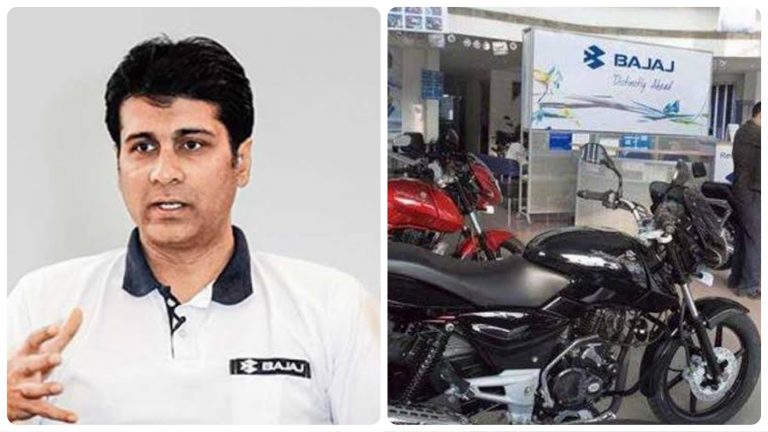
Similar is the story for Hero Motocorp, which had racked up a splendid sales figure in the month of October. Indian multinational two-wheeler company Hero MotoCorp Ltd witnessed the highest-ever sales in a single month in October 2020 after the company sold over 8 lakh motorcycles and scooters in this month alone. As per a statement issued by the company, Hero MotoCorp recorded a growth of 35 per cent as compared to the corresponding month of last years. In October 2019, the company had sold 599,248 units while this month 806,848 units were sold by the company. This came after Bajaj Auto MD Rajiv Bajaj last week lamented that two-wheeler sales in the country remained dismal.

Bajaj Auto has also posted encouraging numbers as its year-on-year growth in October showed a spectacular rise of 18 per cent to 470,290 units from a year ago. This is its highest ever sales recorded in a month, according to the company’s regulatory filing. Pulsar brand recorded sales of over 170,000 units.

GST inflows cross Rs 1 lakh crore mark first time since February 2020

Revenues collected from GST have surpassed Rs 1.05 lakh crore in October 2020, 10 per cent up from the previous year, and highest since February 2020. The increased GST collection is one of the clearest sign yet of the economic recovery after it registered 23.9 per cent contraction in the first quarter of the year.

According to the data released by the Finance Ministry on Sunday, the gross GST revenue collected in October was ₹1,05,155 crore, 10.25% higher than a year ago, and 10.1% more than the indirect tax revenue garnered in September.

“The growth in GST revenue as compared to that in the months of July, August and September 2020, of -14%, -8% and 5% respectively, clearly shows the trajectory of recovery of the economy and, correspondingly, of the revenues,” the Ministry said. 

Analysts have attributed the current uptick in the GST inflows partly to the revival of the economy, along with the festive demand boost and input tax credits as well as other reconciliations that were due for businesses in September. Similarly, the experts believe that the demand could remain robust for the month of November as well on account of continuing festivities.

Indian government working towards providing another economic fillip to sustain growth: Finance Secretary Ajay Bhushan Pandey

To give a sustained character to this economic revival, Finance Secretary Ajay Bhushan Pandey on Sunday said that the government is working on providing another stimulus package to boost the economy. The official reassured that the Indian economy is not only on its path to recovery but is also poised for sustained growth.

Speaking to ANI in an interview, Pandey said, “We are assessing the situation as to which sector or segment of the population is in the need of government intervention and are calibrating our strategies accordingly. We keep are soliciting suggestions from industry bodies, trade associations, various ministries and after going through their suggestions and requirements of the economy, and will come out with effective and timely measures.”

Decline in COVID-19 cases augurs well for the sustained economic growth

One of the significant factors in this dramatic resurgence of the Indian economy is the steady decline in the coronavirus cases reported across the country. The decline in the cases meant that the markets were allowed to open up that plays a crucial role in cranking up the economy. New COVID-19 cases in the country continue to fall for the seventh straight in the country, albeit with a lower rate of decline.

The week that ended on Sunday recorded a 12 per cent drop in the new cases as compared to the week before that saw a 16 per cent decline. However, the number of fatalities continues to decrease rapidly, with 3,586 deaths reported in the last week, a drop of 21 per cent as compared to the previous week.

Further, PMI for manufacturing and services has recovered to 56.8 and 49.8, respectively in September 2020.

With pandemic relatively under control and economic activities steadily mushrooming, analysts believe that if the trend persists, India will be well-placed to recoup the losses it had endured during the nationwide lockdown imposed earlier in the year.

Indian economy to bounce back stronger: FICCI

FICCI president Sangita Reddy on Sunday said that the strategy of Indian government of dealing with the Chinese coronavirus crisis will ensure that our economy will bounce back and emerge much stronger. Hailing lockdown when world over everyone had to choose between saving lives and livelihood, Reddy said that focussing on lives and ramping up health infrastructure has paid off.

Delhi police crackdown on Janta March by Sudarshan News calling it ‘illegal assembly’, netizens ask ‘what were you doing during Shaheen Bagh’

After the brutal killing of a Hindu girl named Nikita Tomar by one Touseef Ahmed in Faridabad, Haryana has come to the fore, the rage against this emerging menace has reached its pinnacle and people from all corners of the country are demanding strict laws against this purported issue. To raise awareness and protest against the systemic targeting and violence against Hindu girls, Sudarshan News chief had organised a peaceful protest- Janta March, at Delhi’s India Gate on November 1. Many people had gathered to support the cause.

Sudarshan News claims police used unwarranted force on Hindus gathered to participate in the peaceful protest against Love Jihad

Meanwhile, Sudarshan TV’s Editor-in-Chief Suresh Chavhanke, who was leading this peaceful protest, alleged that their peaceful campaign was impeded by the Delhi police. The Hindi News channel shared a video clip to confirm how the Delhi police used illegal force on the peaceful Hindu protestors gathered at India Gate. In the clip, some women officers are seen forcefully lifting a Hindu woman protestor and taking her away.

Sudarshan TV chief took to Twitter to claim the one of their reporters-Gaurav Mishra, who was unlawfully detained by the Delhi police, was scoffed by them for wearing a saffron-coloured shirt.

They also alleged that a Delhi police officer named Sarfaraz used unwarranted force to disperse the peaceful protesters.

Delhi police respond, say Sudarshan News is ‘spreading falsehoods’

Responding to the allegations, the Delhi police Tweeted that Sudarshan TV has been spreading total falsehood to justify their “illegal assembly”. The Delhi police claimed that the channel was advised to organize the protest only at the designated place at Jantar Mantar to which they agreed. However, the channel went ahead to surreptitiously assemble at Mansingh Road near India Gate in violation of prohibitory orders under 144 CRPC and DDMA guidelines. “In the discharge of lawful duty, Delhi Police detained a few protesters and removed others from illegal Dharna”, wrote Delhi police.

‘Where were you during Shaheen Bagh protests’? ask netizens

Delhi police’s excesses on Hindus gathered at India Gate on November 1 to support Sudarshan TV’s cause, left some netizens infuriated. They questioned why the Delhi police had not used similar force on the Shaheen Bagh protestors.

Netizens tore into the Delhi police, accusing them of being biased. Many alleged that while Muslim protestors had blocked roads for months in Delhi Shaheen Bagh, the Delhi Police did nothing to remove that illegal assembly. They questioned the so-called appeasement policies and the Delhi police’s alleged failure to prevent the Delhi anti-Hindu riots

Netizens asked whether the Delhi police, who were quick to penalize the Hindus gathered for the Janata March, were sleeping when thousands of Muslims had gathered to stage the Hinduphobic Shaheen Bagh protest. One social media user also opined that the Delhi police, who could not catch Maulana Saad, was brazenly attacking the Hindus to hide their mistake.

It is notable here that the recent murder of a Haryana girl Nikita Tomar by a Muslim man named Tousif who was allegedly forcing her to convert to Islam and marry him has sparked a heated debate over the alleged targeting of young Hindu girls. In another case, a young boy named Rahul was murdered in Delhi recently because he was in a relationship with a Muslim girl. The girl’s brothers had beaten Rahul to death.

“Insider trading?” Netizens wonder as Bajaj Auto registers record sales in October despite Rajiv Bajaj’s fear-mongering about economic slump

As India prepares for the festive season and the economy gradually unshackles itself from the coronavirus-induced lockdown, several sectors of the economy have registered impressive revival. One of them being the automobile sector. After Hyundai, Maruti Suzuki and Hero Motocorp, now the Bajaj Auto has recorded highest ever monthly sales in the last month.

Bajaj Auto reported highest-ever monthly sales of 5.12 lakh units, beating several estimates and registering an 11 per cent year-on-year growth in October 2020.

While the domestic growth in sales has marginally improved by 1 per cent as compared to the numbers recorded in October 2019, the exports had witnessed a stunning 25 per cent growth, with 2.30 lakh units exported in the month of October 2020 against 1.84 lakhs that were sold last year in the same month.

Bajaj Auto’s growth in stark contrast to MD Rajiv Bajaj’s despondent forecast

However, this double-digit overall growth reported by Bajaj is in stark contrast to the gloomy picture painted by its Managing Director a few days ago. On October 26, Bajaj Auto MD Rajiv Bajaj bemoaned that the two-wheeler industry in the country is under tremendous strain and the sales figures reported across the industry are not as impressive as it ought to be in the festive season. He had said that he was not optimistic about demand coming back during the rest of the fiscal year. Bajaj pinned the blame of the ‘downturn’ on new regulations such as ABS, BS 6 etc for the slowdown in the sector, and the policies of the government.

Just a week after Rajiv Bajaj lamented that the government policies have done little to improve the automobile sector, outstanding numbers posted by several companies, including his own, betrays a completely different picture, leading many to believe if Rajiv Bajaj’s misplaced apprehensions were politically motivated, especially with the opposition parties rallying against the government for the alleged messing up of the economy in the aftermath of the crippling coronavirus lockdown.

Rajiv Bajaj’s bleak outlook for the two-wheelers segment in the last week of October did not jibe with the sales figures posted by automobile companies just days later. Bajaj’s pessimistic views about the growth of the two-wheelers’ market came in the last few days of October, a month where his own company had seen a record highest-ever monthly sales of 5.12 lakh units.

Surely, these numbers did not magically conjure up after Bajaj raised his concerns over the slump in the automobile sector. It is also highly unlikely that Bajaj’s sales figure were dragging until October 26 and picked up only when the company MD voiced his anxiety over the stagnation. The growth must have been a constant theme of the entire month of October, which led to Bajaj register such an excellent sales figures.

Being the MD of one of the biggest Indian conglomerate, Bajaj can certainly not be oblivious to the unprecedented growth recorded by his company in the first three weeks of October after which he came out and painted a picture of gloom and doom in the automobile sector. This has led many netizens to question the real intentions of Rajiv Bajaj for fear-mongering about the alleged recession in the two-wheelers segment.

Social Media users allege “insider trading” against Rajiv Bajaj for his misleading assertions

With Bajaj posting spectacular sales figures, several social media users have asked the Securities and Exchange Board of India(SEBI), the watchdog that regulates the Stock Markets in India, to probe Rajiv Bajaj for a possible case of “insider trading”.

Insider trading is defined as a malpractice wherein trade of a company’s securities is undertaken by people who by virtue of their work have access to the otherwise non-public information which can be crucial for making investment decisions. Netizens have alleged that by putting out wrong and misleading information in the public domain, Bajaj may have attempted to manipulate the stock markets.

One social media user suggested that the record numbers appears to strongly point to an “insider trading” angle. Mr Rajiv Bajaj’s shareholdings, and transactions, covering the period leading to his false statement and the Co’s results, must be thoroughly investigated, he suggested.

Another user wondered should not Rajiv Bajaj be probed for insider trading as his false proclamations in the last week of October resulted in the steep fall of stock prices of two-wheelers.

This is not the first time that Bajaj Auto has been under the criticism for a possible case of “insider trading”. Back in 2013, suspicions of insider trading against Bajaj gained momentum when the company stock had fallen by as much as 10 per cent from Rs 264 levels on huge volumes, following which Bajaj Corp had announced an offer for sale at Rs 200.

The highly unusual trade activity with huge volumes led people to speculate if anyone in the management of the organisation knew about the OFS announcement to be made by the company shortly thereafter.

Rajiv Bajaj had joined hands with Rahul Gandhi to peddle lies about India’s post-COVID economic recovery

Also to be noted here is that Rajiv Bajaj has often criticised the government for its policies and appeared to side with the Congress party. Recently, he partook in an interview with Rahul Gandhi which was rife with brazen lies and distortions to allege that the government had been incompetent in handling the coronavirus crisis and the resulting economic downturn faced by the country.

In the interview with Bajaj, Gandhi made a slew of unfounded allegations against the government, claiming that the Narendra Modi government did not provide any stimulus package to various sectors of the economy, which has seen a downturn due to the effects of the global pandemic coronavirus and the subsequent lockdown imposed by the government to tackle it.

With Rajiv Bajaj’s strident criticism of the Modi government and his political inclinations apparent, many have alleged that his recent statements regarding the alleged decline in the two-wheelers segment was meant to fortify opposition parties’ assertion that India’s economy is in a tailspin and that the Modi government has been unable to rescue it.

Bengaluru riots: Anti-Terrorist Cell issues notice to absconding Congress leader Sampath Raj

0

The Anti-Terrorist Cell (ATC) has reportedly issued a notice to Congress leader Sampath Raj, asking him to appear before the Assistant Joint Commissioner BR Venugopal for his involvement in the Bengaluru riots. Raj, a former Bruhat Bengaluru Mahanagara Palike (BBMP) Mayor, has been on the run from the law enforcement authorities.

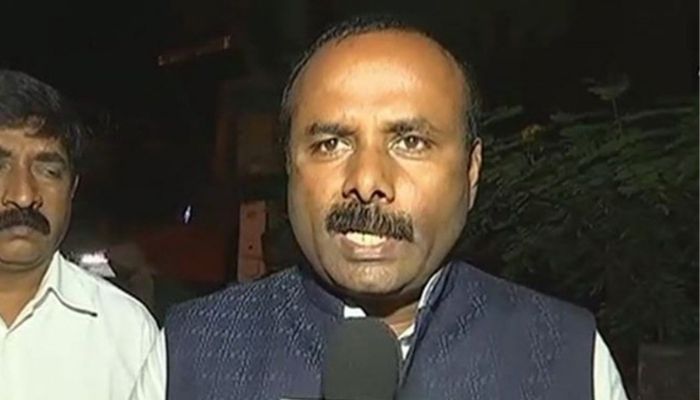
As per reports, Sampath Raj was involved in instigating a fanatic Muslim mob to burn the house of fellow Congress MLA Akhanda Srinivas Murthy in Kaval Byrasandra on August 11. He was first interrogated in August over his role in facilitating the riots. When he was asked to appear for questioning again, he claimed to have contracted Coronavirus and was admitted to a hospital. The cops served a notice to the hospital authorities to inform them prior to his discharge. However, Sampath Raj disappeared on October 30. Central Crime Branch (CCB) has launched a manhunt to nab him.

The charge-sheet filed by the Central Crime Branch (CCB) in connection with the Bengaluru riots case stated that the Congress leader Sampath Raj had joined hands with radical Islamist organisation such as SDPI to target his own party’s Dalit MLA Akhanda Srinivasa Murthy.

The background of Bengaluru riots

On 11th August 2020, at around 8:30 PM, a riot-like situation took place between the DJ Halli and KJ Halli police station limits in the east Bengaluru. As per the reports, more than 1000 people gathered outside the house of Congress MLA Akhanda Srinivas Murthy, demanding immediate action against his relative Naveen, who allegedly posted objectionable content against Prophet Muhammad on Facebook. The situation came under control on 12th August around 1 AM. Three people were killed, and more than 60 police personnel were injured. More than 300 vehicles were damaged in the riots.

The investigation agencies have arrested more than 340 people for arson, stone-pelting and attacking police. Congress MLA Akhanda Srinivas Murthy, while talking to media, said that his house was set on fire. On 17th August, CM BS Yediyurappa said the state government would recover the cost of damage to public and private property from the culprits.

Supreme Court refuses to extend security of former special CBI judge who pronounced verdict in Babri demolition case

0

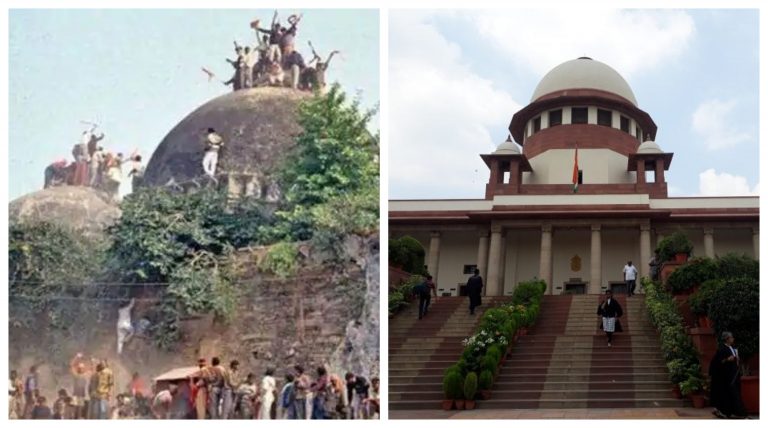
The apex Court today refused to extend the security of former special judge SK Yadav who had pronounced the verdict in the Babri Masjid demolition case. The request of the former special judge was heard by a three-judge bench of Justices RF Nariman, Navin Sinha and Krishna Murari.

Rejecting his request, the Court said that it did not consider it appropriate to provide security. The court was considering the former judge’s request for personal security in view of the sensitive nature of the Babri demolition case.

Former special CBI court judge SK Yadav had delivered the judgment on Babri demolition case on his last day in office. He had written a letter to Supreme Court claiming that there was threat to his life. The Court did not consider it necessary to extent his security.

Babri Demolition Case Verdict

On September 30, 2020, the special CBI court had pronounced the verdict in the Babri demolition case in which all the 32 accused including BJP leaders LK Advani, Murli Manohar Joshi, former ministers Uma Bharti and Kalyan Singh, were acquitted by the court. The court had observed that the demolition of the disputed structure by Kar Sevaks was spontaneous and not pre-planned by the accused. The court rejected the conspiracy angle to demolition.

FIR against Munawwar Rana for openly supporting beheading of ‘blasphemers’

0

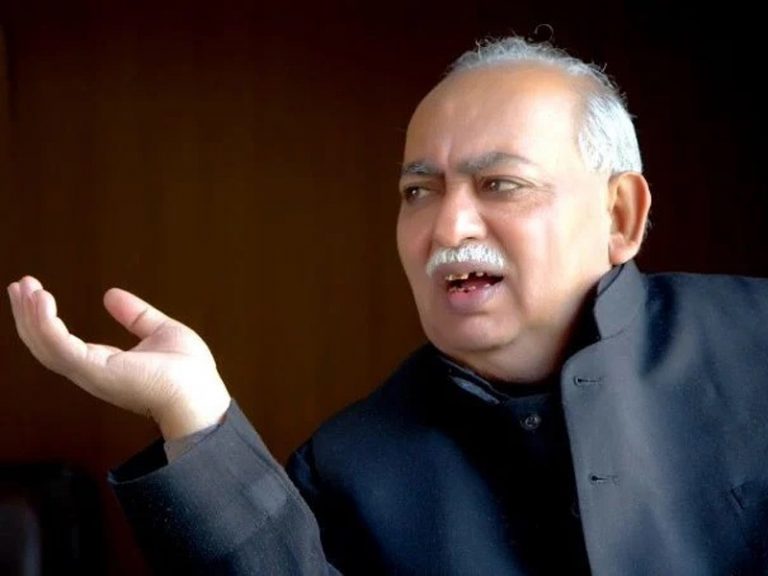
An FIR has been filed against Urdu poet Munawwar Rana in Hazratganj Kotwali, Lucknow. He had recently made a controversial statement supporting the beheading of French teacher Samuel Paty by an Islamic terrorist.

An FIR against the poet has been registered under Section 153-A, 295-A, 298, 505(1)(b), 505(2) of IPC and Section 66 and 67 of IT Act 2008. It was registered at the Hazratganj Police Station, Lucknow, Uttar Pradesh. The complainant has mentioned that he noticed a video of Rana on social media where he was seen supporting terrorist attacks in France and claimed he would do the same if someone had similarly provoked him.

As per reports, the FIR has been filed after the controversial poet refused to apologise over his shameful remarks and asserted that his statements were ‘harmless’.

Munawwar Rana had supported the Paris beheadings

In a recent interview, Munawwar Rana supported the terrorist attack in France. He said the cartoon of Prophet Mohammad hurt the youth, so he killed the teacher who displayed it in his classroom. He further added that if someone makes an offensive caricature of his father or my mother, he will kill him too.

Rana further went ahead to justify the barbaric murders by claiming that in India, “honour killings” have been happening since long and if they are ‘allowed’ how can the beheadings be wrong. In his attempt to defend the terrorist act, he had tried to lie that in India, murders are ‘allowed’. India has never sanctioned murder, be it the so-called ‘honour killings’ or any other violent act. The poet was blatantly and shamelessly lying to cover up his defence of the Islamic terrorists who had now killed multiple people in France over the so-called ‘blasphemous’ cartoons.

Four killed in France over the cartoon row

In the last month, four people have been killed in France over the Prophet Muhammad cartoon row. On 17th October, Samuel Paty, a teacher, was beheaded in France for showing a cartoon of Prophet Muhammad in his class. Later, on 29th October, three people, including a woman, were reportedly beheaded at a Church in Nice, France. Several were injured in several attacks that happened on the same day in different locations across the world. A priest was shot on 1st November while he was closing a church.

While India has shown support to France against terrorism, Islamic nations like Turkey and Pakistan have categorically justified the terrorist attacks in France.

Nagpur: FIR registered against unidentified individuals for animal sacrifice at Temple after Maneka Gandhi directed police to take ‘strict action’

0

An FIR has been registered against unidentified individuals over animal sacrifice (Pashubali) at the Durga Saptakshi Temple in Kamptee, Nagpur. The incident occurred on the 27th of October, 2020. The FIR was prompted by Srushti Chahande Dhoble, a 24-year old woman, who contacted animal activist Karishma Galani which led to the eventual filing of the FIR following instructions from BJP MP Maneka Gandhi.

“I heard wailing noises of animals. When I went inside, I saw three goats, brutally tied up with garlands around their necks. They seemed to be crying out in pain,” said Dhoble. She was passing by the Temple when she allegedly heard the wailing of animals. On entering the Temple, she saw three goats, tied with garlands around the neck.

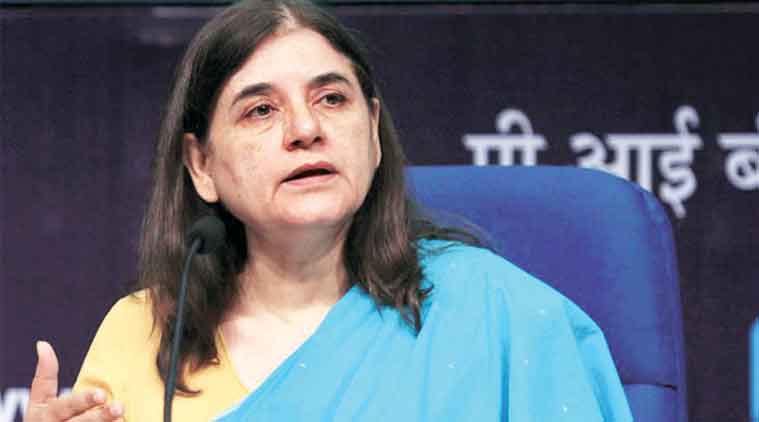
Maneka Gandhi condemned the Hindu practice of animal sacrifice. Maneka Gandhi told ToI, “Though the number of such cases has gone down, such acts are still taking place. The police have become quite active and they are stopping sacrifice of animals after getting tip-offs.” “It is a cruel and vicious act. There is no need to please god through bloodbath. People should stop taking lives of other beings,” she added.

The FIR was registered under various sections of Indian Penal Code, Prevention of Cruelty to Animals Act 1960 and Maharashtra Animal Preservation (Amendment) Act, 1995. Police officials have initiated a probe into the matter and are now attempting to identify the owner of the Temple and those responsible for the act.

In recent times, there has been an organised campaign against the practice of animal sacrifice. Tripura High Court had recently ordered a ban on the practice at Maa Tripureshwari Temple which was eventually stayed by the Supreme Court. The Orissa High Court passed a similar order banning the practice, too, which was again stayed by the apex court.

Why don’t we give credit to Hindu festivals for reviving the economy?

The Indian economy has been doing extremely well in the last two months. The numbers for September were so good that they called it a “September surprise.” They wanted to know if it would last. The numbers for October have started to tumble out and it’s one big party.

The GST collection is up by over 10%. The manufacturing PMI has risen to a ten year high. Top auto manufacturers like Maruti are reporting increases of as much as 19%. Two wheeler manufacturers are reporting their highest sales in any month ever. Tractors are selling so fast that factories are considering three shifts a day to keep up with demand. All across the board, from cars to laptops and phones, demand is soaring.

So what invisible force could be driving this sudden consumption boom? Shopping for Christmas three months early? Shopping for Ramzan three months late?

Say it with me: It is the Hindu festival season that has brought the economy back on track.

Emphasis on the word Hindu. Yes, I know the media talks about “festive season” sales all the time. But whose festive season? It’s the Hindu festive season. Let’s make it explicit.

You might want to ask: Why emphasise religion here? Everyone already knows it is the Hindu festival season. Quit being a jerk about it …

To that I say, when have they not been jerks to us? When has the liberal complex ever shied away from naming and shaming Hindus for anything that goes wrong? When a rape happens in September or October, do they ever shy away from taunts about goddess worship during the upcoming Durga Puja? No, they diligently produce cartoons and sound bytes about it.

Do they ever shy away from poking Hindus in the eye and telling us how biryani, supposedly a Mughal thing, enriches our cuisine? Are they not constantly being jerks about how so many of our historical monuments like the Taj were built by you know who? Aren’t they always jerks about how Urdu enriches the Hindi film industry?

Of course they are. Every chance they get, they impose upon us the idea that India was barren, devoid of culture or anything of value until …

Then, why should I not point out how Hindu festivals have just breathed new life into the coronavirus hit Indian economy? Right now, Hindu festivals are driving the consumption boom and lifting all boats, including those from other communities.

Speaking of Hindu festivals, they get blamed for pretty much everything in a typical year. Why is the air so bad? Because irresponsible Hindus are exploding crackers on Diwali, polluting the air and scaring the pets of the elite. Hindus get blamed for polluting the water with their idol immersions and other offerings. Crimes against women? It is all because of the festival of Holi.

When it comes to blaming Hindu festivals, no connection is too far fetched or too absurd. Come Kumbh mela and Hindus are taught lessons not to abandon their children or elderly parents in the crowd. Innocent Hindus celebrating Rakshabandhan? Tell them to stop being cruel to cows for Rakshabandhan. What’s the connection between killing cows and Rakshabandhan? It doesn’t matter.

Hindus sitting down to watch Ramayana serial on TV? They are responsible for kids injuring themselves in the eye with bows and arrows. Yeah, take your infant son or daughter instead to sit at Shaheen Bagh all night in the Delhi winter. That’s responsible parenting. You might get coverage in TIME Magazine and become a celebrity.

So tell me, when do they ever stop being a jerk about anything and everything in Hindu traditions? You even have folks asking questions like these: because most Hindus cremate their dead; does it not mean they have a lesser right to Bharat than religious communities who compulsorily bury their dead?

Between 1947 and 1991, it was mostly Nehru and his descendants who took the economic decisions that made India a basket case. In the process, they named everything from airports to universities to bus stands after themselves. The blame for the failures went to Hindus. They called it the Hindu rate of growth. They said that Hindus were lazy and fatalistic and did not care for the material progress that led to prosperity in this life. What could Nehru have done?

They are going to blame Hindus for everything from air pollution to the failure of Nehruvian socialism. Should we aggressively highlight that the Hindu festive season has revived the Indian economy? You bet!