A 16-year-old TikTok star, Siya Kakkar, who had an immense fan following on the popular social media app, died by suicide, informed the Bollywood paparazzo, Viral Bhayani. The fashion photographer took to Instagram to confirm the news. The news of Kakkar’s death was broken to him by the head of Kakkar’s talent management agency, Arjun Sarin.
Viral took to Instagram to write: “Sad news 16 year old sweet tik-toker @siya_kakkar died by suicide. Before publishing this I spoke to her Talent management agency head Arjun Sarin who just spoke to her last night for a song collaboration and he says she was in a good mood and perfectly alright. Even he has no clue what went wrong that she had to go this way. You go through her videos and you can she was so good in her content, it’s really sad that she chose this path. If you are feeling depressed please dont do this.
The 16-year-old who has over 1.1 million followers on TikTok and almost 1,29,000 followers on Instagram was known for her dance videos. According to reports, Siya had posted her last TikTok video on Wednesday evening, merely 24 hours before she committed suicide. She had also shared a dance video on her Instagram story around the same time.
According to reports, the family has demanded a detailed police investigation into Siya Kakkar’s death.
The news of the TikTok star’s death comes days after actor Sushant Singh Rajput died by suicide on Sunday, June the 14th 2020. As per reports, he was found hanging at his home in Bandra.
Actor Sushant Singh Rajput died by suicide
Soon after the news of his death, Sushant’s family had alleged foul play. His maternal uncle had claimed that his nephew was, in fact, murdered. Sushant’s brother-in-law who is a senior police officer in Haryana had alleged foul play and has sought a thorough investigation into the case. Even media and social media had been abuzz with a lot of discussions, and speculations over his death. Many reports and persons associated with the film fraternity had alleged that he was a victim of lobbying and nepotism rampant in Bollywood.
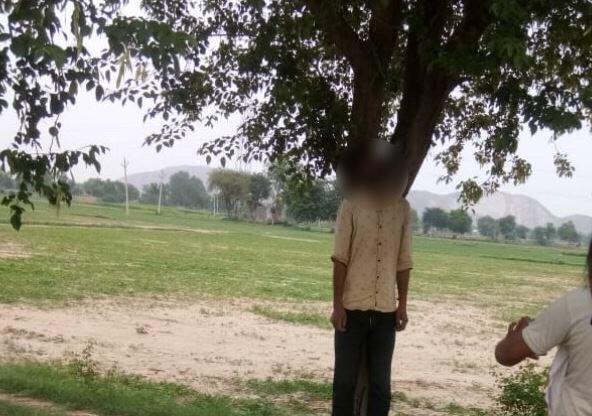
Days after three Muslim youths raped a minor girl in Ramgarh town in Alwar District of Rajasthan, her father has been found hanging from a tree just 500 meters away from the house. While the police have called it a case of suicide, the family has claimed that the minor’s father was murdered. The family members have alleged that the accused who had raped their minor daughter a few days ago, have also murdered him.
The victim’s family alleged that on June 23 (Tuesday), the accused came to their house and took away the girls father. Later he was found hanging from a tree. The family has lodged a murder case against Sumraddin, Mehmood, Anjum, Taufiq and others in this regard.
It is pertinent to note here that the family had pinned the blame of the rape of their minor daughter on three youths belonging to this same gang.
Journalist Swati Goel Sharma of Swarjya, took to Twitter to apprise about the incident. According to the journalist, the father, who was fighting a court case against a man from another community for raping her minor daughter, was found hanging from a tree just before a hearing.
A father, who was fighting a court case against a man from another community for raping her minor daughter, found hanging from tree just before a hearing. This is in Ramgarh in Alwar, which is adjoining to the notorious Mewat. This whole belt is in deep shit and no one cares pic.twitter.com/1LSKZOp561
It is being told that Aneesh Khan, a member of this gang along with two of his accomplice Anjuma and Taufiq had attempted to rape the minor Hindu girl and when his father refused to withdraw the case, Mehmood, Anjum, Taufiq, Umardeen allegedly killed and hung him from the tree. However, the police are still investigating this matter.
Ramgarh police protecting the accused Muslim youths
The family alleged that soon after they approached the police to lodge a complaint against Aneesh, Taufiq and Anjum, who had raped their minor daughter, the Ramgarh police had been mounting pressure on them to reach a compromise with the accused. The family was being constantly pressurised to withdraw the case against the Aneesh.
According to reports, on June 18, the minor girl, after being raped had attempted to commit suicide by jumping into a well. Fortunately, the villagers saw her jumping into the well and rescued her. The minor then apprised her family about the incident.
The family said that the police had at first refused to register a complaint of sexual assault against the accused. Only when the news gained some traction in the media, did the police arrest the main accused Aneesh Khan and registered an FIR against him under the POSCO Act. The other two accused, Taufiq and Anjum were being protected by the police, alleged the victim’s family.
Muslim’s in adjoining Mewat known for inflicting atrocities on Hindus of the region
For the uninitiated Alwar district in Rajasthan is adjoining to the notorious Haryana’s Mewat region has been termed as “Mini Pakistan” because of the atrocities meted out against Hindus, especially Dalits, by the majority Muslim community. In a press release on June 1, former Justice Pawan Kumar, who headed the investigation team to probe the atrocities inflicted against Hindus, especially Dalits, in Haryana’s Mewat had said confirmed that the Muslims in Mewat were being able to carry out these crimes against Dalits in connivance with the administration and the local police.
OpIndia too had reported about the horrific atrocities being inflicted on the Hindus of Mewat, after a press release related to Justice Pawan Kumar’s 4-member team’s investigation report came to light.
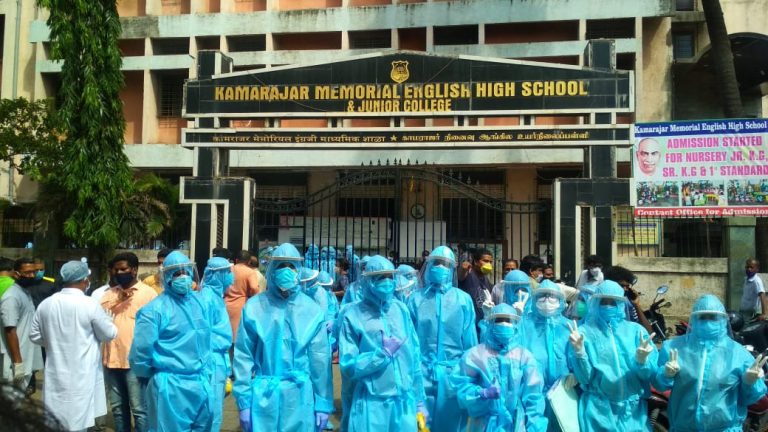
“Somebody had to do it”, said Alexander Fedotov who was part of the largest ever response team trying to contain radiation after the meltdown of the Chernobyl nuclear power plant in the April of 1986. And this is what I reply to everyone who asks me why I spent a week on the Coronavirus frontline. Named ‘liquidators’ meaning ‘to eliminate something that causes problems’, these response teams contained the deadly radiation leak which threatened the very existence of mankind. Volunteering with the efforts of Rashtriya Swayamsevak Sangh (RSS) to screen patients made me feel like a ‘liquidator of Corona’.
As the wave of Coronavirus swept our nation, the need to establish a response team to aid the authorities in testing was felt by many. Already on the ground zero with its various Seva activities, RSS fashioned the first ‘Liquidators of Corona’ to answer the need. First pilot ran through the at-risk settlements in Pune, screening 1,02,450 patients with the help of 365 doctors & 1016 Swayamsevaks. Work expanded to Mumbai as Parle west became the headquarters for the Mumbai effort. Coordinating six batches till today, Mumbai effort has expanded into three more branches headquartered in Marol, Malad and Mulund. Working with local authorities such as BMC and Health Ministry, teams of 500 liquidators have screened over 70,000 patients in Mumbai’s various containment zones and red zones.
Unlike the Liquidators of Chernobyl, many of whom were ordered by the government to join the cleanup effort, we are all volunteers. Hailing from diverse backgrounds, such as teachers, accountants, medical students, engineers, lawyers, photographers and whatnot, ready to take on the challenge of the uncomfortable weather, the claustrophobic gear, the crammed surroundings and mammoth number of patients. When mega screening campaign of Dharavi on the first Sunday of the Junewas announced, many like me volunteered. We had already completed our field work, but we came out of quarantine and delayed our tests to help out in screening largest slum in Asia.
Every batch receives a thorough orientation, teaching us about how to don and doff the PPE, what are we supposed to do once in the field. But no amount of preparation can keep one calm for when you are donning the battle gear known as PPE for the first time. Imagine, you rub a dab of sanitizer on your hand, now come the gloves, rubbery and sticky followed by foot covers rising shin high. Then another round of sanitizer on hands, followed by putting on the overall hooded jumpsuit zipped and secured with belts. Sanitizing our hands again we pull our sleeves down to put on another pair of gloves making sure our wrists are not exposed. Now comes the outer disposable mask atop the N95 we wore at all times. Put up your glasses, pull up your hoody making sure your forehead is covered then topping it off with the face shield.
And when armed with thermal gun, Pulse-Oxygen meter, sanitizer spray and charts for documentations, how can one not feel like a soldier ready to face the enemy. The layering of the masks and face shield meant scuffing wounds behind our ears, which paired with hot and humid conditions-built condensation on our specs and face shields limiting our visibility with bonus of irritation. But the soldier spirit inspired us to fashion makeshift solutions like applying coconut oil behind our ears to avoid scuffing and wearing specs loose and a centimetre down on the nose to avoid condensation.
Our day used to start early, getting up, having preventive medicine like arsenic album, some prayers followed by Pranayama gets things moving. Having breakfast in our rooms, everyone starts getting ready for the field. Hydration is the key to perform because as soon as you put on the PPE, a reverse countdown of five hours begins as having even a drop of water is impossible till out of the PPE, sanitized and bathed at the end of the shift. Everyone assembles in preparation area sitting together, each 3 feet apart for the morning briefing. Then we are updated on the target locality, potential difficulties and special precautions. This planning in advance and planning in detail is the secret of our efficiency. As the briefing concludes, everyone races to don the PPE following its procedure to the t, while helping and looking after teammates to be ready. The equipment to be carried in the field are inspected, restocked and then the we march towards the buses.
Once on the field, the teams of three-consisting two volunteers and one medico – reach the table and immediately start the screening as the local volunteers go door to door to bring the patients in a queue. One volunteer checks temperature and Blood oxygenation levels while another takes it down along with patients contact details and general medical history. Doctors look for symptoms and counsel the patients about COVID19 guidelines. Looking for symptoms, identifying high risk individuals, referring symptomatic suspects to authorities and documenting every patient, the liquidators usually do 4-5 hour shifts each day.
The process of screening for Coronavirus which does not involve taking samples or testing patients is a double-edged sword. In the absence of abundant testing, screening ‘Eliminates’ patients form the suspect pool and maps those at high risk helping authorities in their testing efforts. The screening also serves as a tool of awareness which is far necessary in the times of hysteria and misinformation surrounding the pandemic. Simple reiteration of guidelines by a doctor works miracle to de-stigmatize patients. And I think that is the biggest success of this campaign. Being advised about pandemic guidelines by a human being instead of a blaring faceless loudspeaker helps ease the fear of the Coronavirus pandemic and believe me half the battle is won there. People become more open, approachable, honest in discussing their symptoms and readily accept help.
I have seen a man fearful of being taken away into quarantine, bring his whole family for screening once his doubts were cleared by our ever-enthusiastic medico. In the era of mass confusion and hysteria, we served as a bridge between the authorities and patients. Screening over 24000 households, over 70,000 patients and identifying 924 suspects, I feel humbled and proud to have gotten the opportunity to serve my nation in the past week. Perfecting what Fedotov said with the ‘first person singular approach’ of an ABVP activist, somebody had to do it, then why not me?
Fasahat Ali Khan, reportedly the media advisor and close aide of Samajwadi Party leader Azam Khan has been arrested by UP Police in Rampur on Thursday. The police claimed that khan, who is considered very close to Samajwadi Party leader Azam Khan has 16 criminal cases registered against him.
Also, the police recovered two stolen buffaloes and other stolen gold and silver ornaments from Fasahat Khan’s farmhouse in Koyala village, as per a report in Swarajya.
It is notable that in September 2019, some residents from Yateem khana area had registered an FIR against SP leader Azam Khan and his people for robbery. They also put the allegations that their houses were vandalized and their domesticated animals were taken away by goons of Azam khan. One of the complainants alleged that her four goats, three buffaloes, one cow, and a calf were taken away.
While speaking to TOI, Rampur SP Shaghun Guatam said, “Fasahat Khan, while questioning, had revealed that he had stolen the buffaloes and other items from inside the houses of the Yateem khana residents on the instruction of the Azam khan. Most of the other accused involved in the crime are already on bail while a few others need to be questioned.”
Fasahat was produced before the Additional Chief Judicial Magistrate on Wednesday evening. He was later sent to jail.
Azam Khan lodged in Sitapur jail
Samajwadi Party leader Azam khan along with his family is lodged in Sitapur jail after he was arrested in February on the multiple charges of fraud and forgery. Several cases are lodged against Rampur MP Azam Khan. In September last year, Rampur Police in Uttar Pradesh had booked Azam Khan on allegations of ‘stealing goats’ following the complaint which was filed in October 2016.
It was first land-grabbing, then lion statues, followed by books and valuable manuscripts. He has also been booked for ‘stealing buffaloes’ and later the Rampur MP was also booked for electricity theft. The power supply to Azam Khan’s resort ‘Humsafar’ in Uttar Pradesh was cut after raids were conducted in the resort by the Uttar Pradesh electricity department.
Khan had landed in a major land grabbing case after irregularities and allegations against his family’s Mohammad Ali Jauhar University surfaced last year. The University was raided by Rampur police following a complaint by the principal of Madrasa Aliya, wherein he stated that 9000 books and rare manuscripts from the Madrasa have been stolen.
His son Abdullah Azam was booked for forgery in birth date documents. Suar MLA Abdullah Azam Khan had to lose his membership of the state assembly after he was found guilty of forgery.
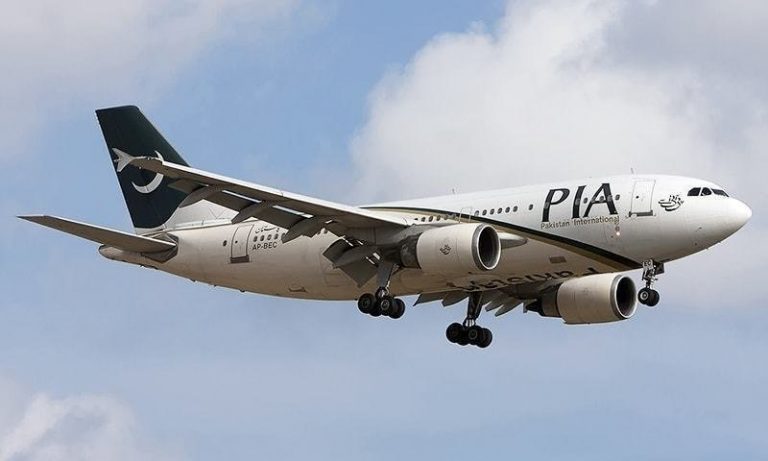
Pakistan’s Aviation Minister Ghulam Sarwar khan made a shocking revelation on Wednesday when he said that more than 30 percent of civilians pilots in Pakistan carry fake licences and so are not qualified to fly a plane.
While addressing Pakistan’s National assembly, the aviation minister said that some 262 pilots in the country paid someone to sit on their behalf in the exam to clear the examination. He added, “They don’t have flying experience.” Khan further added, “Pakistan has 860 active pilots serving its domestic airlines — including the country’s Pakistan International Airlines (PIA) flagship — as well as a number of foreign carriers.”
These findings were revealed after a probe into the PIA plane crash in Karachi last month. However, Khan did not mention whether the pilots on board the crashed plane were fake pilots or not.
PIA grounds pilots
Following the publication of the report into the crash, Pakistan International Airlines grounded 150 pilots suspected of having fake licenses. Abdullah Hafeez, a spokesman for Pakistan International Airlines, said the decision comes after the probe into last month’s PIA crash that killed 97 people in the city of Karachi. He said that a process to remove the 150 pilots without illegal licenses has been initiated by the airlines. “We will make it sure that unqualified pilots never fly aircraft again,” he told The Associated Press.
Earlier, Pakistan International Airlines spokesperson Abdullah Khan had said, “PIA acknowledges that fake licenses are not just a PIA issue but spread across the entire Pakistani airline industry.” He had added that some fake pilots also fly for foreign carriers.
According to the AP report, Pakistan International Airlines had become aware of the scandal two years ago and had fired at least four pilots on allegations of falsifying exams to obtain a flying license from the civil aviation authority. According to sources, many people possess the skills to fly planes by they lack technical knowledge, and hence can’t pass the exam needed to obtain a licence. Therefore, they bribe qualified persons to sit in the exam on behalf of them, and thus they obtained the required licence to fly planes.
Investigation report had stated that the plane crash happened due to human error
The Pakistan International Airlines (PIA) passenger plane which crashed near the Jinnah International Airport in Karachi last month happened due to human error, a probe report released on Wednesday revealed it. The report has suggested that the pilots were discussing the coronavirus crisis during the landing.
Ghulam Sarwar Khan while presenting the report informed that the pilots, as well as the (air traffic) controller, didn’t follow the standard rules. Khan added, “The pilot and co-pilot were not focused, and throughout they were having a conversation about the coronavirus. The [virus] was on their minds. Their families were affected and they were having a discussion about it.”
The Minister also alleged that the pilot was overconfident. He said that the “plane was 100 percent fit for flying, there was no fault.” The report suggested that the pilot was flying the aircraft at more than twice the standard altitude when it approached the runway without the landing gear deployed.
The standard operating procedures were ignored by the pilots and the controller resulting in an aborted landing that damaged the engines heavily. In the second attempt to land, the plane crashed into the residential society near the airport.
PIA plane crash incident
The PIA passenger flight which went down near the Jinnah International airport last month was carrying 107 people on board including passengers and flight crew. As per reports, there were 99 passengers and 8 crew members on board. Several houses have been damaged due to the crash. Officials say that at least two people have survived the crash.
The Pakistan International Airlines (PIA) passenger plane crashed near the Jinnah International Airport in Karachi was traveling from Lahore was about to land in Karachi’s Jinnah international airport when it crashed at the Jinnah Garden area near Model Colony in Malir, Karachi.
Apart from the Tibetans, the greatest beneficiary of a Free Tibet will be India. The recent Chinese incursion and brutal murder of twenty Indian soldiers in Galwan Valley in the Ladakh region of Northern India is yet another reminder of a prophetic letter by Sardar Patel to Prime Minister Jawaharlal Nehru, dated November 7, 1950. In that letter, Sardar Patel wrote, “…There can be no doubt that during the period covered by this correspondence, the Chinese must have been concentrating on an onslaught on Tibet. The final action of the Chinese, in my judgment, is a little short of perfidy. The tragedy of it is that the Tibetans put faith in us; they choose to be guided by us, and we have been unable to get them out of the meshes of Chinese diplomacy or Chinese malevolence.”
“In the background of this, we have to consider what new situation now faces us as a result of the disappearance of Tibet, as we knew it, and the expansion of China almost up to our gates. Throughout history, we have seldom been worried about our north-east frontier. …We had a friendly Tibet, which gave us no trouble…,” Patel had written. While the recent Galwan Valley incident is highly distressing, unfortunately, as long and Tibet remains under the total control of China, it’s almost certain that such an incident will happen again. At the core of the Indo-China border conflict is the issue of Tibet. Historically, China never shared even an inch of the border area with India until the 1950s when China brutally occupied Tibet.
Tibet was never a part of China
A historical analysis of authoritative historical documents by a Chinese Professor Hon-Shiang Lau (2019) showed that Tibet was never a part of China before 1950. By the end of the 1950s, the Chinese occupation of Tibet was completed. The sorrow and devastation tore through a thousand years of peace, and human and cultural genocide soon followed in Tibet and even continues today. A semester-long class that I had with Ambassador Nirupama Rao, (former Indian foreign secretary and ambassador to China) at Columbia University reinforce my initial assessment that no matter how many rounds of the Working Mechanism for Consultation and Coordination for India-China Border Affair (WMCC) meeting takes place or how sweet the diplomatic soundbite may be, there can never be a constructive border solution between India and China as long as Tibet is under Chinese occupation. In this article, I will discuss how the continued Chinese occupation of Tibet cost Indian tax-payer, on average US$ 7.16 billion annually, and how this amount can be used to solve India’s other urgent developmental needs.
Before proceeding further on actual empirical analysis, I would like to share a short personal story. Like any child, my favorite activity around bedtime was to listen to exciting stories that my grandmother used to tell me. She was born and raised in Tawang (a border-town between China-occupied-Tibet and Northeast, India) around the 1920s before she married to my grandfather, who was then serving as the governor of the southernmost district of independent Tibet called Lhuntze dZong. When I was in Tibet, I was always fond of listening to my grandmother’s bedtime stories. She used to tell me how green and beautiful Tawang is. Given the fact that there is no forest around Lhasa city, where I spent my early childhood years, my grandmother’s stories of forest and greenery intrigued me. I often requested her to take me to Tawang to see the forest. She said that she couldn’t take me to Tawang as it is “closed.” To a naive mind of a child that I was, “closing” of the entire region does not make any sense. I resist and argued, how is that possible that you could go back and forth from Lhasa to Tawang in the ’30s and ’40s without any difficulties, and I can’t go now even with advanced mode of transportation?
China’s occupation of Tibet means a multifold military expenditure for India
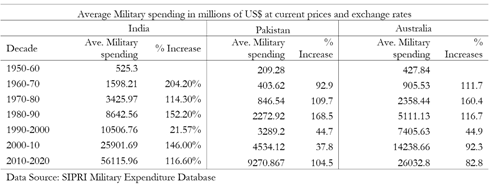
In 2012, I was on a trip to Tawang. It was just like what my grandmother told me back then – greenery everywhere. I hired a local Taxi and went to visit Bumla, the border post between China-occupied-Tibet and India, where official border personnel meeting between the Indian Army and the Chinese Army for regular interactions are held. The distance from Tawang to Bumla is about 36 Km, and it took our taxi around 4 hours to reach there. Despite being strategic military routes, the roads were treacherous and often blocked by landslides. At Bumla, I interacted with some Indian border personnel and asked them how far Lhasa is from here? They said it’s about 420 km but takes only about 8 hours by car. The fact that it only takes about 8 hours to travel about 420 Km from Bumla to Lhasa shocked me a little. The terrain at each side is about the same, if not harsher on the Tibet side, but the road is much better on Tibet side of the border. That experience reminds me of the stories that many people that I met at Tawang told me about the 1962 Indo-China war. While India already lost the 1962 Indo-China war before even it was fought, inadequate road and transportation conditions further added up to India’s defeat. Although much has been changed since the early ’60s, the continued Chinese occupation of Tibet still costs dearly to Indian tax-payers. As shown in the table below, India’s average military spending[1] increased by 204.20% in the decade of 1950-70 as compared to other countries in the table. Australia and Pakistan, as an example, the increase during the same period is only 111.65% and 92.9%, respectively.
Data from SIPRI Military Expenditure Database
What caused this three-fold increase in annual military spending of India in the decade of 1950-70? I argue that China’s occupation of Tibet and subsequent India’s recognition of Tibet as “region of China” through the Panchsheel Agreement of 1954 has a significant causal effect on that. While the observed increase in India’s military spending is a good indicator of the impact of the Chinese occupation of Tibet on India’s military spending, however, without more rigorous statistical analysis, we cannot attribute this increase solely to the illegal Chinese occupation of Tibet. To do so, I used an econometric identification strategy called difference-in-difference estimation to estimate the causal impact of the Chinese invasion of Tibet on India’s military spending.
The Panchasheel Agreement: How much has it cost India to identify Tibet as a ‘Region of China’?
Difference-in-differences (DiD) is econometrics tool in quantitative research that attempts to mimic an experimental research design using observational study data by studying the differential effect of an event/policy (in this case, India recognizing Tibet as a region of China through Panchsheel agreement) on an ‘impacted/treatment group,’ i.e., India, versus a ‘control group,’ Australia. It calculates the effect of an event/policy on an outcome (i.e., annual military spending) by comparing the average change over time in the outcome variable for the treatment group, compared to the average change for the control group. While choosing Australia as a control group may raise a few technical questions, I choose Australia as a control group primarily because Australia did not have to share a border with China when China invades Tibet, as India had to. Furthermore, Australia and then independent Tibet does not share any social, cultural, or political relationship with Tibet as India does.
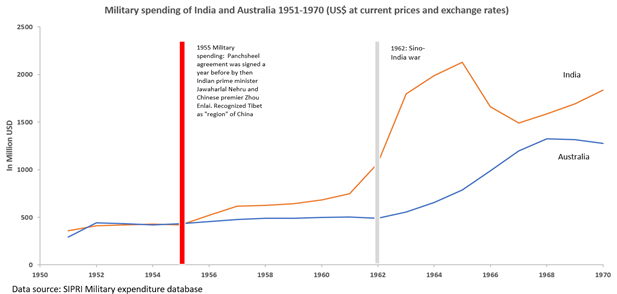
To ensure the internal validity of DID models, the most critical assumption of DiD estimation is the parallel trend assumption. This assumption requires that in the absence of treatment, the difference between the ‘treatment’ and ‘control’ group is constant over time. The figure below shows the trend of military spending of Australia and India between the period of 1951 to 1970. On average, Australia and India have a somewhat parallel trend on military spending from the early 1950s to 1954. But India’s military spending started increasing from 1955. Further increase in military spending was observed after 1959 when China entirely occupied Tibet, and the Dalai Lama had to go into exile. The sharp increase was observed in India’s military spending after the 1962 Sino-India War.
Data from SIPRI Military expenditure database
In 1954, “Agreement on Trade and Intercourse between the Tibet region of China and India,” in which the Panchsheel (Five Principles of Peaceful Coexistence) was officially codified and signed between India and China. Claude Arpi, the author of the “Tibet: the lost frontier” wrote following on this agreement between India and China, “Beijing got what it wanted: the omission of Demchok pass in the Treaty, (leaving the door of Aksai Chin open), the removal of the last Indian representatives and jawans from Tibet, the surrender of Indian telegraphic lines and guest houses, but first and foremost the Indian stamp of approval on their occupation of Tibet…. From an independent State, Tibet had become ‘Tibet’s Region of China’ in the new agreement.”
In estimating the causal effect of illegal Chinese occupation of Tibet on India’s military spending with a difference-in-difference estimation, I used the year 1955 as a point of variation in India’s military spending. Many historians and strategic experts agree that the year Nehru signed the Panchsheel treaty to be the most significant event in Indo-China diplomatic relationship. The data on military expenditure from 1951-2019 is obtained from the SIPRI military expenditure database for the control group (Australia) and treatment group (India). The expense is reported in US$ at current prices and exchange rates. One potential confounder that critics might point out for an increase in India’s military spending that year might be related to continued Indo-Pakistan conflict over Kashmir. While it is a fact that India and Pakistan had fought earlier (1947-48) over Kashmir, however, there was no significant conflict between India and Pakistan in 1955 or even in the decade of 1950-60.
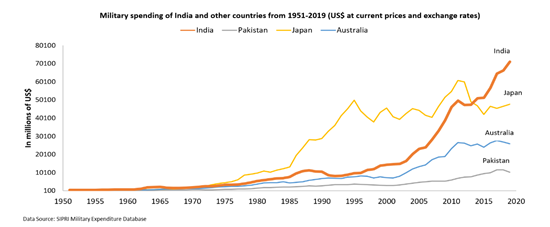
The result of the difference-in-difference estimation shows that, while India’s military spending increases every year. The fact that India has a shared border with China due to the Chinese occupation of Tibet and subsequent signing of the Panchsheel Agreement cost Indian tax-payer about US$ 7.16 billion annually, on average. (F (3, 134) = 30.70, p < .01, R2 = .08). This amount is little over 10% of India’s total military spending in 2019, i.e., US$ 71.1 billion. Adding up this cost from 1955 (the year after Panchsheel agreement) to 2019 without any adjustment to inflation and exchange rate fluctuation, for 64 years, the occupation of Tibet by China cost the Indian government US$ 462.8 billion. The figure below shows military spending in India continues to grow much higher than in many other countries. With annual military spending of US$ 71.1 billion in 2019, India today ranks third highest military spender in the world only after the U.S. and China.
Data from SIPRI Military expenditure database
Had Tibet been free, India would have been richer, healthier and happier
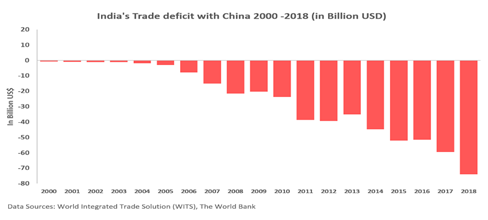
For countries like India, which according to the latest the World Bank report, is the lower-middle-income nation (The World Bank, 2019), the annual amount of US$ 7.16 billion or INR 54,395.8 Crore is not small. This amount could fund India’s one of the most successful welfare programs such as Integrated Child Development Services (ICDS) for several years. According to the report from India’s Ministry of Women and Child Development (MWCD), the central government of India allocated ₹16,335 crores to ICDS program in the 2018-2019 fiscal year. The annual US$ 7.16 billion that India had to spent for the military purpose solely because of China’s continued occupation of Tibet could fund ICDS for about three years. Similarly, this amount can be utilized to eradicate the poverty in India by investing in building the human capital of India and thus making India strong from within. Alternatively, this amount can also be used to address the ever-increasing trade imbalance between India and China, as shown below.
Data from World Integrated Trade Solutions
Less measurable but perhaps far more significant is the impact of environmental destruction and rampant damming of international rivers that originate from Tibetan plateau and its potential impact on downstream nations like India. Many experts attribute the reason for India and China having the highest population in the world to rivers that originate from Tibetan Plateau and flows through India and China, thereby creating very fertile downstream lowland that could sustain such population growth.
The Indian government statistics in 2019 showed that 43.21 percent of the workforce in India were employed in the agricultural section. The success of agricultural production, particularly in the northern and north-eastern part of India very much depend on rivers that flow from Tibetan plateau. However, because of the Chinese occupation of Tibet, these important rivers are being controlled by China and does not seem to show any regard to downstream countries. A 2020 study by two American climatologists shows that China appears to have directly caused the record low water levels by limiting the Mekong river’s flow. (Basist and Williams, 2020) Because of the Chinese weaponization of Tibetan rivers, agricultural production has fallen sharply in downstream nations like Thailand and Vietnam. For instance, Thailand, one of the world’s leading sugar exporters, is expected to produce up to 30 percent less sugar than in previous years due to recent drought, which was further exacerbated by China limiting the water flow of Mekong river. Similarly, in Vietnam, about 94,000 hectares of rice fields are expected to be affected because of saltwater intrusion across the Mekong river basin due to drying up of the Mekong river. If these rivers can be used as the most effective weapons, as many strategic experts believe China will, India could potentially face irreversible consequences as Chinese reckless environmental destruction continues on occupied Tibet.
Conclusion
While the recent Galwan Valley incident is highly distressing, unfortunately, as long and Tibet remains under the total control of China, it’s almost certain that such an incident will happen again. A 2010 confidential document for the U.S. Department of State leaked by Wikileaks indicates that infrastructure development by Chinese in Lhoka prefecture of occupied Tibet, which according to China, includes Tawang, was in part to prepare a “rear base” should a border clash arise. While China appears to be economically influential at the global stage, we must understand that the Achilles heel of China lies in Chinese occupied territories like Tibet. As rightly noted by Sardar Patel in his last letter to Nehru, “Throughout history, we have seldom been worried about our north-east frontier. …We had a friendly Tibet, which gave us no trouble…” All these issues can be sorted out much quickly and even permanently if Tibet is free and Tibetans have more significant says on Tibetan plateau. Similarly, Indian tax-payers do not need to spend an average of an additional US$ 7.16 billion annually for India’s military expenditure. Hence, it is high time for India to reconsider India’s Tibet policy and officially recognized Tibet as occupied territory. Doing so greatly benefits India’s basic national and security interests.
[1] Data sourced from SIPRI Military expenditure database and the figures for India include figures for paramilitary forces of the Border Security Force, the Central Reserve Police Force, the Assam Rifles, the Indo-Tibetan Border Police and, from 2007 the Sashastra Seema Bal. Figures do not include spending on some military nuclear activities (e.g. nuclear warheads).
While India’s western border has always been hot, of late tensions have been mounting on the eastern front as well where till now, things had been peaceful at least on the surface. Things came to a head-on June 15, when India lost 20 of her brave sons in a brutal hand to hand combat with the treacherous Han army, which itself is said to have lost at least twice as many soldiers. The Prime Minister of India, Shri Narendra Modi has paid his tributes to the men killed in action, acknowledged that their sacrifice will not go in vain and any attempts to provoke India or threaten its sovereignty and integrity would not be allowed to go unpunished. India and the world at large know that PM Modi is cut from a different mould than some of his predecessors and as shown by his resolve in conducting the surgical strikes and the air strike at Balakot, he can walk the talk if push comes to shove.
Looking at the current situation, while all of us hope for a peaceful return to the status quo on the LAC, further escalation to a short, localised conflict or even full-blown war can-not be ruled out. While Indian Armed Forces are fighting fit and can deliver more than a bloody nose to China, there are some other avenues in which China enjoys an asymmetric advantage over India. A cursory glance over social and mainstream media over the past couple of days is enough to point out what these avenues are.
A war effort requires participation from each and every individual in some way or the other- if the soldier fights on the war front, the civilians work in the farms and factories to replenish supplies and sustain the war effort. As important it is to keep the army’s morale high, in case of an actual all-out war, the morale of the nation as a whole becomes equally important. It is here that China and India offer a study in striking contrasts.
China is a unitary one-party state, with total censorship on media and no party other than the Communist party permitted to function. China can thereby get away with unimaginable acts like not owning up the loss of lives of its own soldiers like it did in the June 15 confrontation and every other clash in the past. Its citizens have no way of knowing if China is mauled at the hands of the enemy or if its armed forces have suffered multiple casualties. In such a controlled and insulated environment, it is thereby easy to keep the spirits of the nation as a whole upbeat.
In stark contrast, India is a multi-party democracy and has a free media. Under ordinary circumstances, this freedom is a boon, but there are also some unique challenges which India faces. While media must keep those in power accountable, certain sections of the media in India seem hellbent on damaging the nation’s interests in their quest to settle scores with the PM and his party. Where else would you find headlines in newspapers proclaiming ‘Ghar mein ghus ke maara’ (they hit us in our own home) or celebrity accounts with thousands of followers making sarcastic comments and snide remarks to target the government and armed forces? Some could hardly hide their desire to see India get a bashing at the hands of the enemy only to prove that the PM is no tough man that his supporters believe him to be.
On one hand, they believe our army when it says 20 soldiers made the supreme sacrifice, but on the other, they are equally eager to cast aspersions about the authenticity of the surgical strikes or air strike. There is a host of self-declared defence experts (sadly including some retired armed forces personnel), making dubious claims about incursions into Indian territory by the enemy and some have gone to the extent of twisting the statements by Hon. Raksha Mantri who said that the Chinese have built up a fairly large number of troops on THEIR SIDE of the border. All limits were crossed when the former head of Amnesty India went on to say that the real enemy of India was its ruling party and not China. In China, the mere mention of the Tiananmen Square incident is enough to set the security agencies on the trail of the individual, whereas in India, students are allowed to get away after shouting slogans calling for dismemberment of India into a thousand fragments at a university in the heart of Delhi.
India has had a dubious legacy of being defeated by schemes of its own more often than at the hands of the enemy in actual war. It should not come as a surprise then, that such elements abound in the present era as well. What is different today though, is the penetrance and access of real-time information to the remotest corners of the country through mobile phones and cheap internet, which places a very large section of the population at risk of being manipulated and demotivated by such vested interests. In a war-like situation, this can prove to detrimental to the nation.
Thus, the enemy which resides within the borders of India- in university campuses, newsrooms, editorial offices and luxurious Lutyens villas is what weakens India against an adversary as deceitful and strong as China. If tensions continue to mount and there indeed is a full-fledged conflict at the border, India must be prepared to vanquish these enemies alongside dealing with the enemy on the front.
(This article has been authored by Dr. Dev Desai. He is an MBBS Graduate from the All India Institute of Medical Sciences, New Delhi)
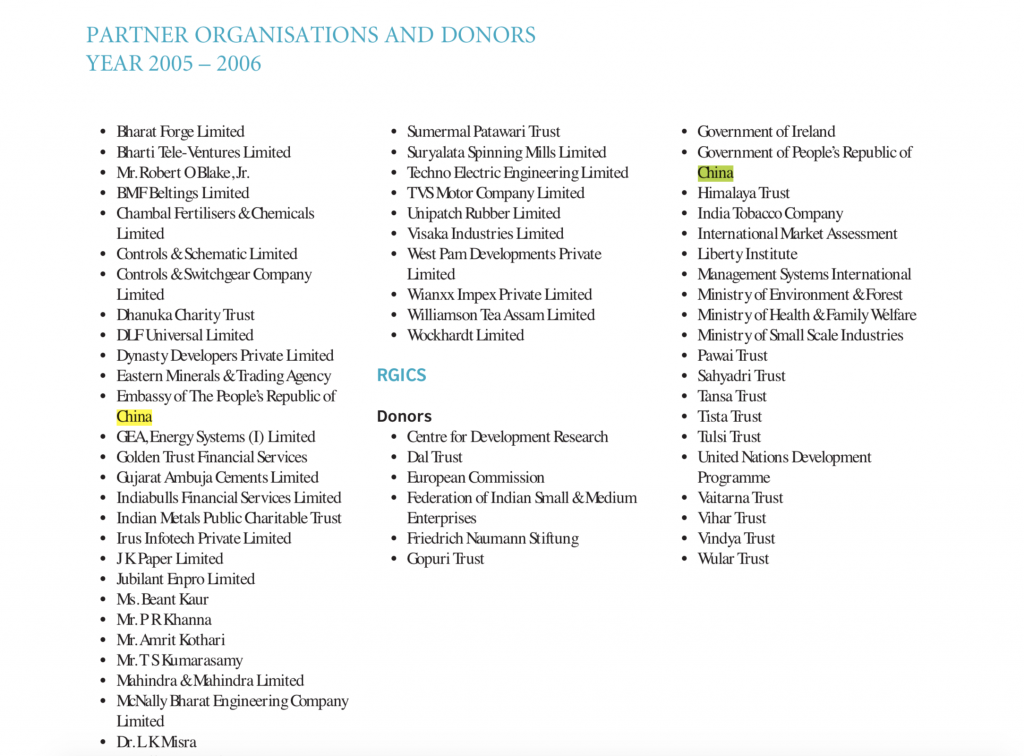
At a time when the Congress party is facing all the heat over its secret deals with the Communist Party of China (CPC), another exposing detail has emerged further strengthening the claims of its intimate links with China. The new expose reveals that the Chinese government had donated Rs 10 lakh to the ‘Rajiv Gandhi Foundation’ in 2006 to give ‘financial assistance’ to its charities. OpIndia had earlier reported that according to a document available on Chinese Embassy in India website, the then Chinese Ambassador to India to India Sun Yuxi had donated Rs 10 lakhs to the Rajiv Gandhi Foundation, which has links to the Congress party and is run by Congress leaders.
Now, a perusal of the Annual Statements of Rajiv Gandhi Foundation has revealed a far more sinister agenda as more details have emerged. Turns out, the Chinese government had not only donated to the Rajiv Gandhi Foundation in the year 2006 but subsequent years as well. It is pertinent to note that Sonia Gandhi is the Chairperson of the Rajiv Gandhi Foundation and since the year 2005, of which documents have been reviewed, Rahul Gandhi and Priyanka Gandhi Vadra were the trustees.
One sinister aspect that emerged is that even in 2005-2006, it was not just the Embassy of China that had donated to Rajiv Gandhi Foundation, but also the Chinese government itself.
Annual report of Rajiv Gandhi Foundation of 2005-2006
While the donation in 2005-2006 was to the tune of Rs 10 lac, further details also emerged.
Interestingly, the Government of China not only donated to Rajiv Gandhi Foundation in 2006, but also in the subsequent years.
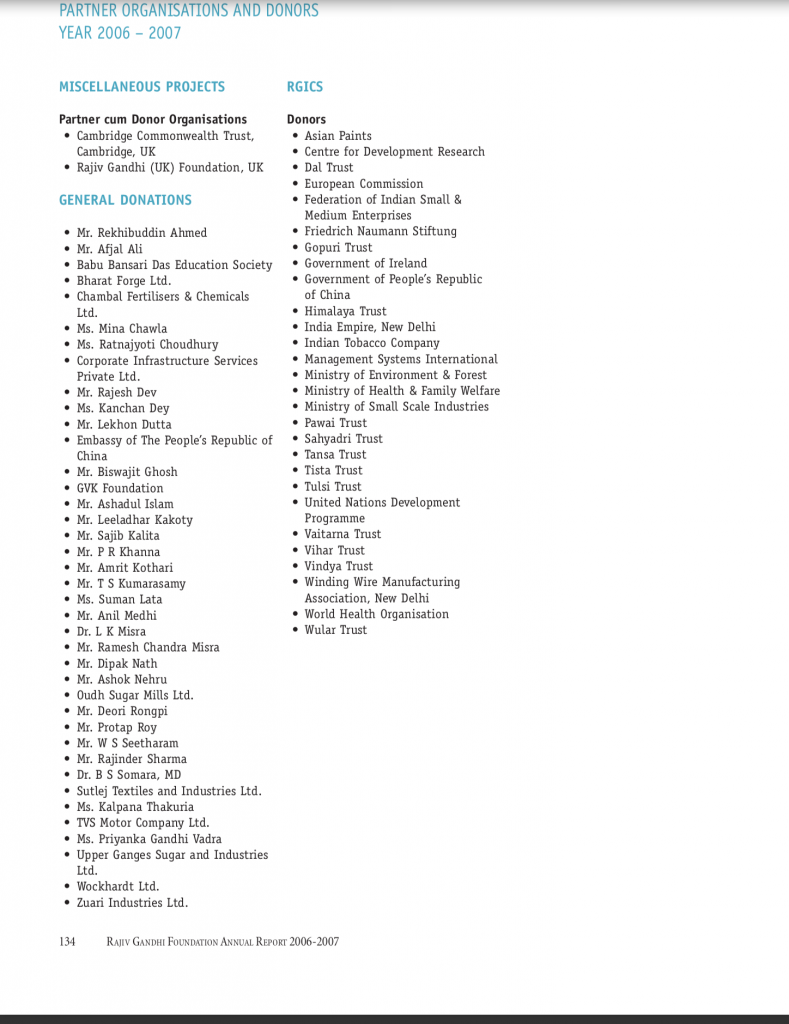
In the Annual Report of the Foundation for the year 2006-2007 as well, the People’s Republic of China is listed as a donor.
Annual report of Rajiv Gandhi Foundation of 2006-2007
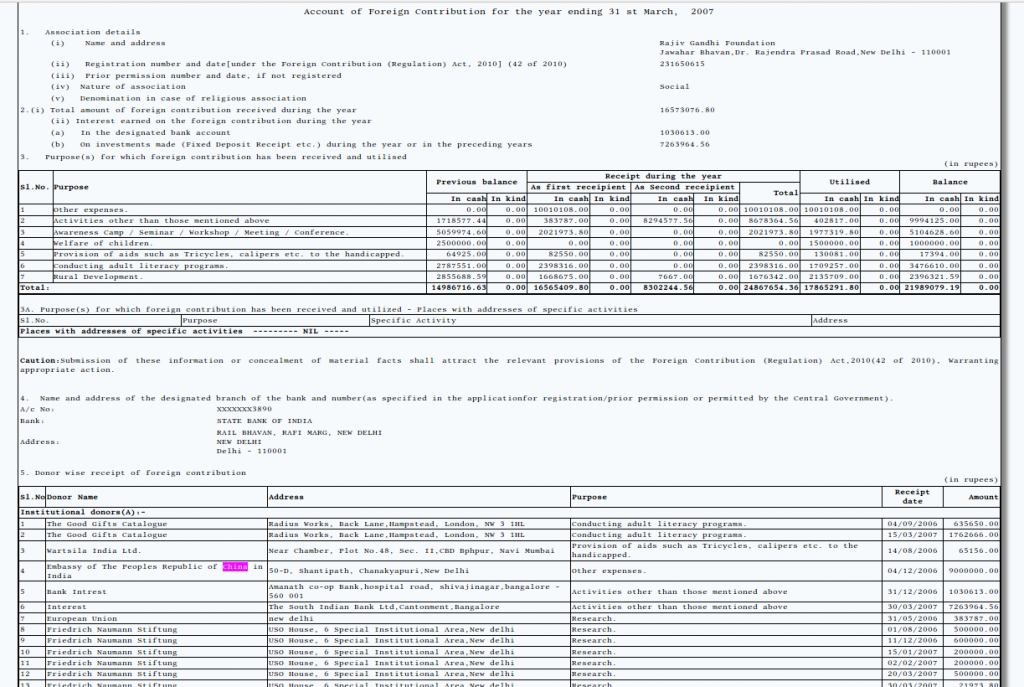
According to the returns filed by Rajiv Gandhi Foundation dug up by Twitter user @By2Kaafi, in the year 2006-2007, the Government of China donated Rs 90 lac to the Rajiv Gandhi Foundation.
Congress took Rs 90 lac from China in 2006-2007
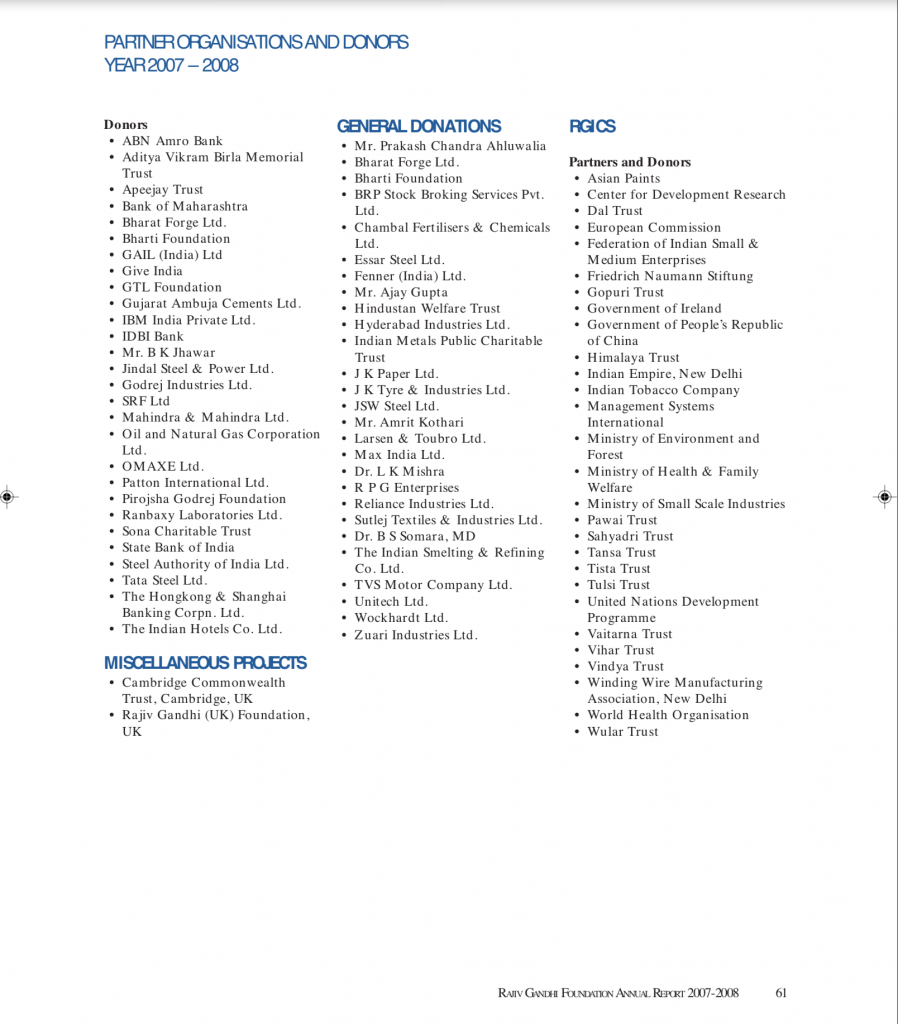
Further, in the year 2007-2008, the Chinese Government was listed as a donor as well.
Annual report of Rajiv Gandhi Foundation of 2007-2008
After well over Rs 1 crore received by Rajiv Gandhi Foundation, the foundation launched a study focussed on the interests of China.
The Annual report of the year 2008-2009 says:
The year witnessed a high point when a high-level delegation from the RGF paid an official visit to China to participate in the celebrations to commemorate the 20th anniversary of Mr Rajiv Gandhi’s historic visit to China in 1989. The delegation, led by Mr. Veerappa Moily, Chairman of the Second Administrative Reforms Commission, included Mr Salman Khurshid, former Minister of State for External Affairs, noted journalists Mr Vinod Sharma and Mrs Neerja Chaudhary, and Prof. Pratap Bhanu Mehta, President of the Centre for Policy Research.
Among the delegation were two Trustees of the Foundation, Prof. Ashok Ganguly and Dr Sekhar Raha. Mr Mohammad Saqib, Fellow of the Institute, accompanied the delegation as a facilitator. In addition to several engagements, the delegation participated in the Conference, ‘Carry Forward the Tradition and Strive for Common Development: Commemorating the 20th Anniversary of H.E. Rajiv Gandhi’s Visit to China’. It was jointly organised by the Foundation and the China Centre for Contemporary World Affairs.
In her message to the Conference, Chairperson of the Foundation, Mrs Sonia Gandhi, fondly recollected “the memories of our meeting with China’s Great Leader, Deng Xiaoping, and recall his pronouncement that the forthcoming century will belong to Asia”. She also said, “The tremendous growth in bilateral trade and economic relations in the last two decades, which reinforced the over-all development of ties, is a noteworthy outcome of the vision of Rajiv Gandhi and Deng Xiaop- ing.” The then Indian Ambassador to China H.E. Nirupama Rao delivered the address at the opening ceremony of the Conference.
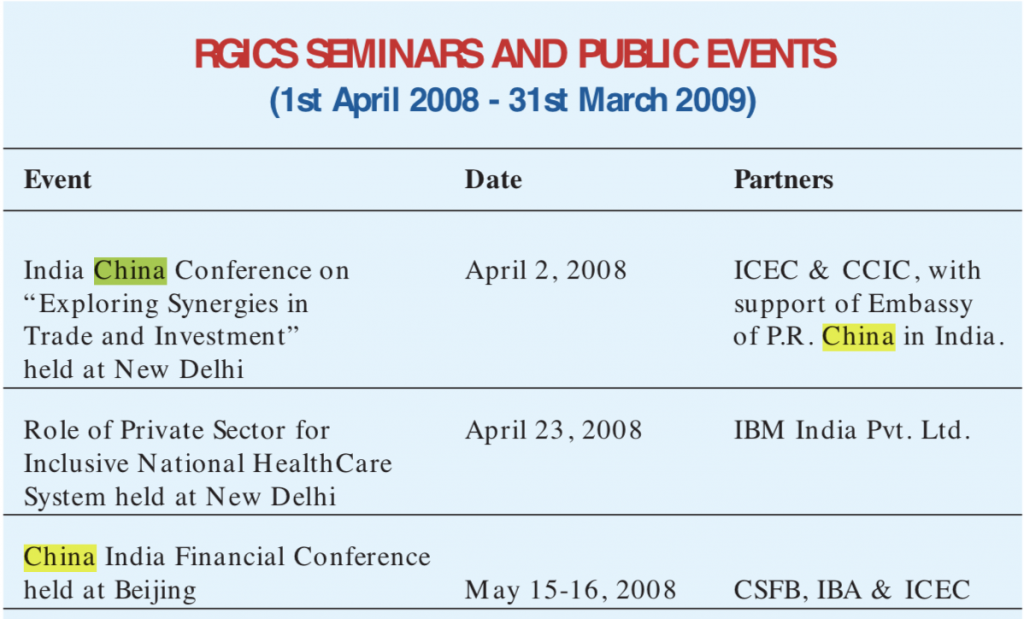
On the same year, after receiving donations from the Government of China, two seminars were held by Rajiv Gandhi Foundation that focussed on the interests of China.
Seminars by Rajiv Gandhi Foundation
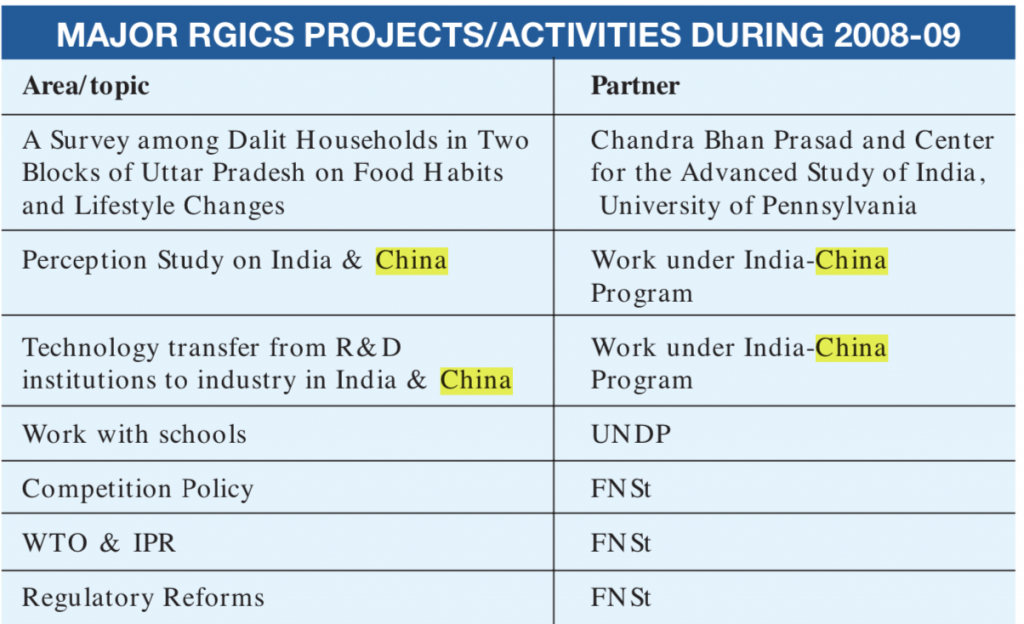
There were two “projects” which were also launched by Rajiv Gandhi Foundation after the donation was received from China. The studies focussed on the “perception study” and Technology transfer from Research and Development institutions to industry in India and China.
Projects by Rajiv Gandhi Foundation
Interestingly, between the years 2009 and 2010, the Rajiv Gandhi Foundation went a step further and studied the feasibility of a Free Trade Agreement between India and China. The study essentially wanted the economy to completely open up between India and China.
The 2009-2010 report states:
In April 2009, RGICS Fellow Mohammad Saqib carried out a feasibility study, ‘India-China: Free Trade Agreement (FTA)’, in association with Dr Purnachandra Rao. The main objective of the study was to gain a better understanding of an FTA between India and China, analyze various trade issues and identify who would stand to gain and lose from such an agreement. The report concluded that China would be the greater beneficiary in all trade dimensions because of the efficiency of its economy: ‘There is a principal need for India to improve its commodity structure to balance its performance of competitiveness and complementarities.’ The authors suggested that India needed, at the minimum, to diversify its products. The study concluded that ‘there are always losers and gainers in the regional and free trade agreements. India and China can balance the gains and losses through an FTA. Therefore both governments should decide to enter into FTA negotiations. The proposed FTA between India and China will be feasible, desirable and mutually beneficial. An FTA between India and China should also be comprehensive, with a free flow of goods, services, investment and capital.’
In 2010-2011, the FTA study continued. The expert mentioned in the annual report only goes to show how the Rajiv Gandhi Foundation was continually undermining India’s position with relation to China and attempting to show China has a far more powerful entity that could only “benefit” India. The report concluded:
The study found China to be more fully integrated into the world economy as a major economic powerhouse than India, in large part because of the comparative advantage of labour surplus. But the study also proposed that an FTA would help bilateral economic relations and that the free flow of goods, services, investment and capital would, in fact, benefit India’s trade sector more than China’s.
Essentially, from the year 2005 to the year 208 at least, the Rajiv Gandhi Foundation was involved in taking money from the Government of China and then, subsequent to that, studies were conducted by the Rajiv Gandhi Foundation that potentially undermined the position of India.
Further, it is pertinent to note that it was in this period, in the year 2008, that Congress signed an MoU with the Chinese Communist Party, which is the only political party in China.
During UPA1 in 2008, the Congress party and the Communist Party of China (CPC) had signed a deal in Beijing for exchanging high-level information and co-operation between them. The memorandum of understanding (MoU) also provided the two parties with the “opportunity to consult each other on important bilateral, regional and international developments”.
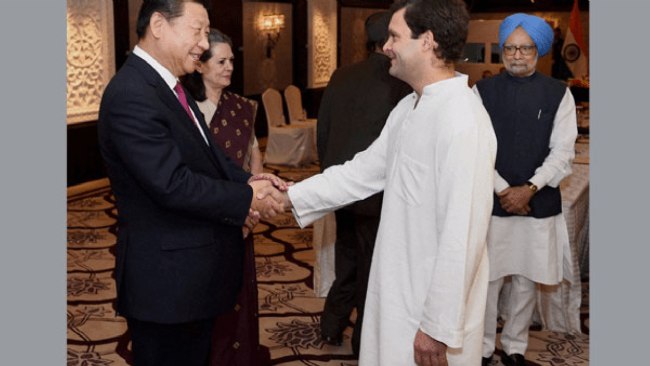
Interestingly, the MoU was signed by the then Congress general secretary Rahul Gandhi and on the Chinese side, it was signed by none other than Xi Jinping himself, who was then the Chinese vice-president and standing committee member of the CPC’s politburo. The MoU was signed in the presence of his mother and party president Sonia Gandhi.
Before the signing of the MoU, the then Congress president Sonia Gandhi and her son Rahul Gandhi had held a long meeting with Xi and other senior leaders of the Communist Party of China to discuss issues of mutual interest.
In 2008, Sonia Gandhi had visited Beijing along with Rahul, daughter Priyanka, son-in-law Robert Vadra and their two children to attend the opening of the Olympic Games. A year before, Sonia Gandhi and Rahul Gandhi had also led a delegation of the Congress party to China.
The 2008 MoU between CCP and Congress came at a time when the Left parties in India had expressed lack of trust in UPA-1 government led by Congress. The India Today report suggests that even as China was aware of the political landscape in India, Xi Jinping went ahead and signed the pact with Congress as CCP wanted deeper ties with Congress, especially the Gandhi
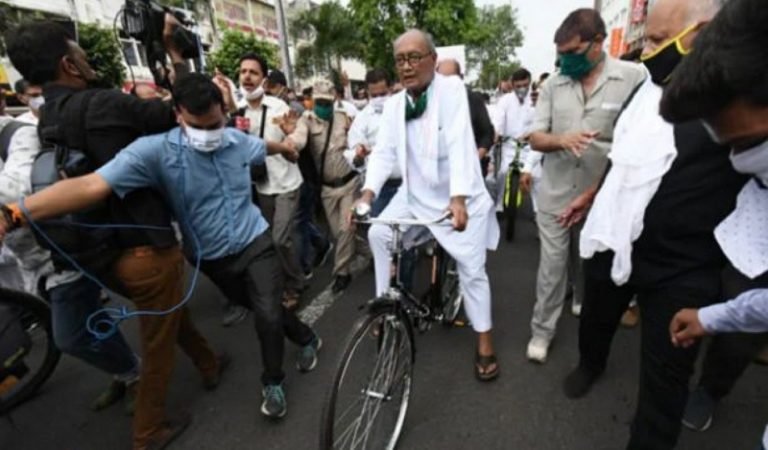
The Bhopal police filed an FIR against Digvijay Singh for leading a cycle protest against the rising prices of fuel amid the lockdown. It is alleged that the Rajya Sabha member did not take any permission from the authorities to stage a protest.
As per reports, the 73-year old politician along with other congress members rode bicycles from Roshanpura square to Chief Minister Shivraj Singh Chouhan’s residence to protest against the Central and state govt’s move to hike fuel prices. A police official stated that delegation was stopped near the Apex bank on their way to Link road no.1 where Madhya Pradesh Chief minister resides because the congress members had not taken any permission for large gathering during the COVID-19 crisis.
Later, an FIR was registered against Digvijay Singh under Sections 188 (disobeying an order duly promulgated by public servant), 143 (unlawful assembly), 269 (negligent act likely to spread infection of disease dangerous to life) and 270 (malignant act likely to spread infection of disease dangerous to life) and 341 (wrongful restraint) of the Indian Penal Code.
FIR against Digvijay Singh for sharing an editted video to malign MP CM
Prior to this, Madhya Pradesh police had filed an FIR against Digvijay Singh for sharing a video of Chief Minister Shivraj Singh Chouhan on his twitter handle. As per the reports, Singh shared an edited version of an old video of Chouhan in connection to a statement made on liquor consumption. The case was filed under sections 465, 501, and 500 of the Indian Penal Code (IPC).
Former minister Umashankar Gupta headed a BJP delegation that submitted a memorandum to the crime branch of Bhopal Police. The complaint mentioned that Chouhan had given a statement against the liquor policy of the Kamal Nath government on 12th January 2020. What Singh shared is only an out-of-context 9-second part of the original 2.19-minute video. They demanded strict action against the Congress leader and his associates for conspiring to defame Shivraj Singh Chouhan.
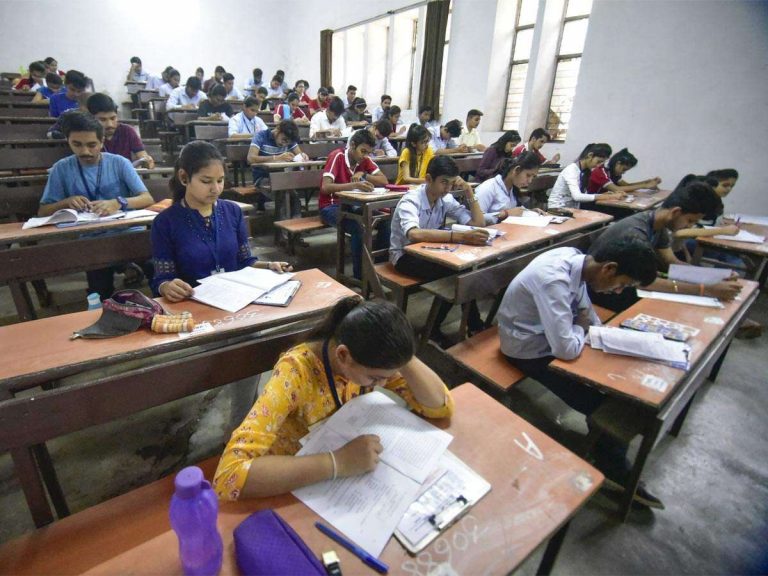
The Council for Indian School Certificate Examination (CISCE) on Thursday informed the Supreme Court that it has cancelled the remaining papers of its Class 10 and 12 board exams. It also said that the board doesn’t agree to give the option to students to write the exam later.
ICSE board also to cancel class 10 and 12 board exams. However, ICSE doesn’t agree to give option to students to write exam later, Solicitor General Tushar Mehta informs Supreme Court. #COVID19pic.twitter.com/jKTKWbSkj7
The exams, which were postponed in view of a nationwide lockdown, had been scheduled to be held between July 1 and 14. The Council for Indian School Certificate Examination had given the children appearing for the exams an option to either appear for remaining papers scheduled to be held from July 2 or opt-out.
On Wednesday, the Maharashtra government had told the Bombay High Court that the Indian School Certificate Examination (ICSE) board cannot be permitted to conduct its pending standard 10 and 12 exams in July in view of the current COVID-19 situation.
CBSE class 10 and 12 remaining exams cancelled too
The decision by the ICSE Board comes soon after the CBSE Board declared the cancellation of CBSE Board Class 10 and Class 12 exams which was scheduled from July 1 to 15. Solicitor General Tushar Mehta appearing for the centre and CBSE informed the apex court that the central board will not conduct the class 10th examination while the students of Class 12th will be given an option of appearing in exams after conditions are conducive.
Exams for class X and XII scheduled for July 1-15 have been cancelled, CBSE tells SC
Meanwhile, the Court has asked the Centre and the CBSE to issue fresh notifications regarding the class 12 examinations. It has asked the latter to give clarification on the issue of option between internal assessment and exam, the status of state board exams and date of results. The bench will pass its order on the matter on Friday.
The Ministry will also issue a notification in this regard on Friday.
Supreme Court had asked CBSE to consider cancelling exams
On June 17, the Supreme Court of India, while hearing a petition by a parent, told CBSE to consider possibilities to scrap remaining board exam papers of class 10th and 12th. The court suggested allotting marks based on internal assessment.
A three-judge bench, comprising AM Khanwilkar, Dinesh Maheshwari, and Sanjeev Khanna, was hearing a petition filed by a parent Amit Bathla, who requested the court to ask CBSE to scrap remaining exams keeping the present situation in mind. The CBSE was to conduct the remaining exams between 1st July and 15th July.