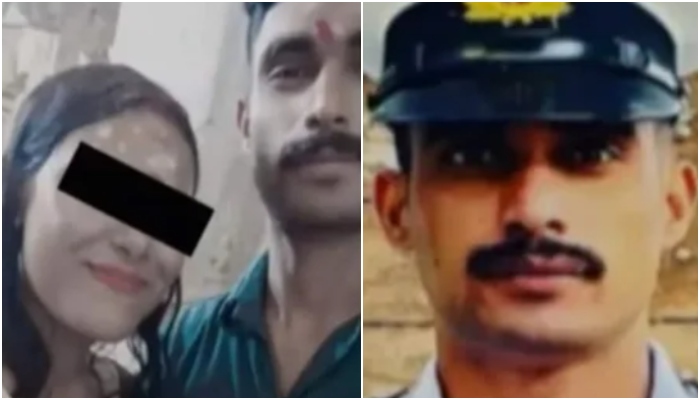
The Govindpur Police (Bengaluru) on Wednesday, 9th October arrested one Bilal Rafiq, a Kerala native who disguised as a Navy officer and manipulated a Hindu woman from Chhattisgarh, establishing a sexual relationship with her. The accused befriended the woman promising marriage and then forced her to convert to Islam.
The case came to the fore after the victim woman who hails from Chhattisgarh filed a complaint at the Govindpur Police Station. The woman said that the two started talking on Instagram in 2021. The accused as per the woman pretended to be a high-ranking commander in the Merchant Navy which helped him win her trust and affection. Their connection grew swiftly, and under his encouragement, the woman relocated to Bangalore to pursue work. In 2022, she got a position as a nurse at a private hospital.
However, the relationship quickly took a negative turn as Bilal began pressuring the woman into several sexual encounters, resulting in two pregnancies. He repeatedly pressed her to get rid of the pregnancies employing multiple arguments. As per the reports, the most common argument that the accused used to manipulate the victim woman was that it was not good for them to have kids before marriage. Despite her reservations, the woman cooperated with his demands.
Recently, the woman became pregnant for the third time. This time, she refused to abort the pregnancy and pushed Bilal to marry her. While Bilal initially agreed, he later began forcing the woman to convert her religion to Islam. When she refused, he postponed the wedding proposal even further. According to her complaint, Bilal further continued to exploit her trust by demanding Rs 1 lakh and an expensive phone, stating they were for the wedding preparations.
The woman also stated that the parents of the accused amid the marriage preparations hurled caste-based abuses at her and her family. She was also threatened to convert her religion to Islam.
Unwilling to convert, the woman asked to get married under the Special Marriage Act, which permits interfaith marriages without conversion. However, when Bilal refused to marry her unless she converted, she filed a complaint with the Govindpura Police.
The Police have detained the accused under the relevant sections of the Indian Penal Code (IPC) for cheating and sexual assault and under the Scheduled Castes and Scheduled Tribes (Prevention and Atrocities) Act.
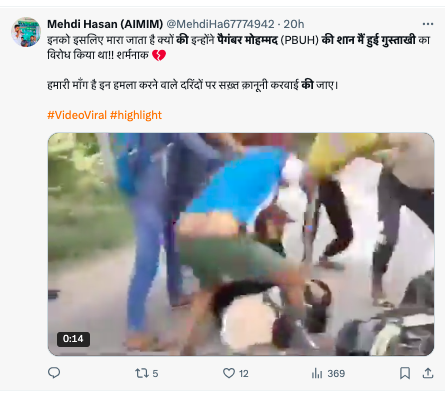
On Wednesday (9th October), a video showing several men beating up a youth went viral on social media with the claims that a Muslim youth was attacked for opposing the attackers from abusing Prophet Muhammad. The video in question is from the Hapur district in Uttar Pradesh.
दावा : इस लड़के को इसलिए मारा गया, क्योंकि इसने पैगंबर मोहम्मद की शान में हुई गुस्ताखी का विरोध किया था।
सच : ये अकरम है। हिन्दू लड़की के साथ होटल से वापस आ रहा था। रास्ते में लड़की के भाइयों ने पकड़ लिया। पिटाई की और पुलिस को सौंप दिया।
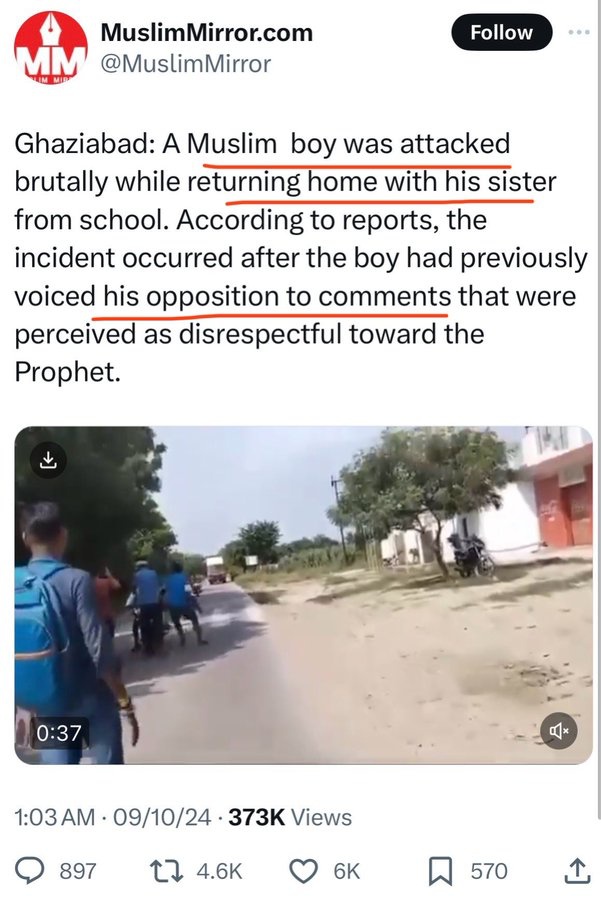
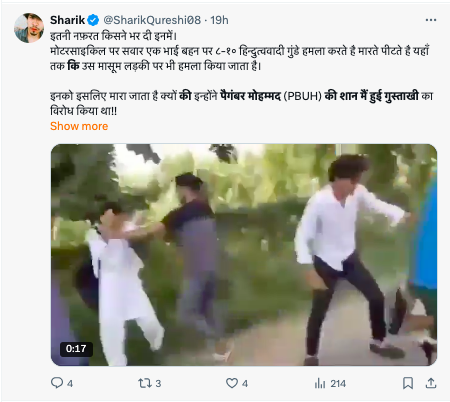
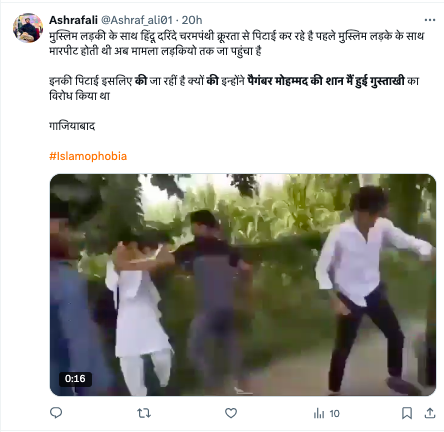
Sharing the video on social media, several Muslim users claimed that the Muslim youth was beaten up by Hindu ‘extremists’ for opposing their abusive remarks against Prophet Muhammad.
Journalist Swati Goel Sharma also shared screenshots of how the video had gone viral with claims that a Muslim youth was beaten up by a mob of “Hindutva extremists”.
It appears that one of the first handles to make the video viral with claims of a Muslim youth being beaten by “Hindutva extremists” for opposing an “insult to Prophet Mohammad” was a handle called “Muslim Mirror” which claims to be a news portal.
It was also claimed that the Muslim youth was with his sister and both were assaulted.
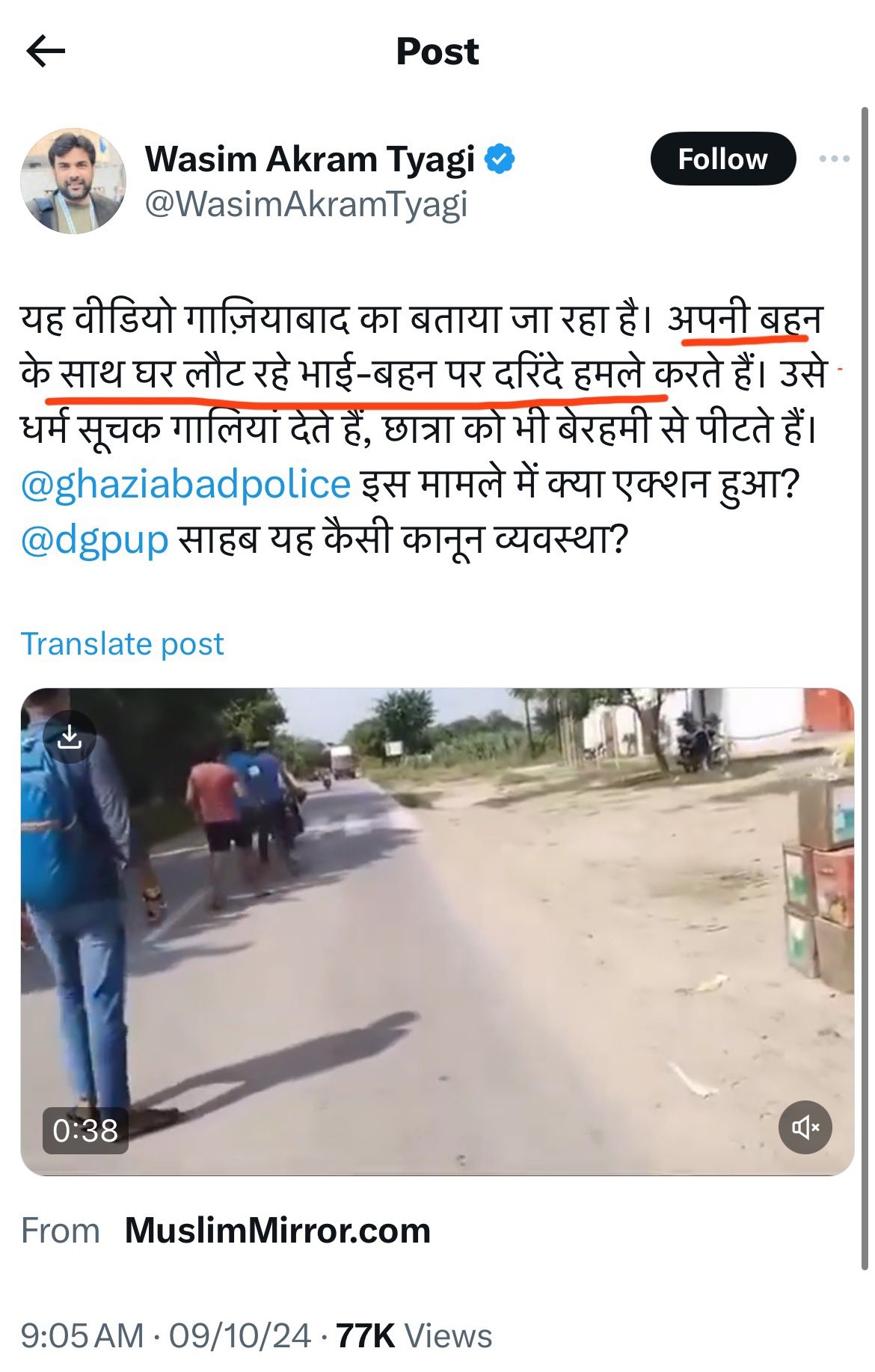
Thereafter, several Muslim “journalists” too picked up the story and spread the false information. Wasim Akram Tyagi, who has been recently booked for spreading fake news about a Muslim man being lynched by Hindus, also shared the video.
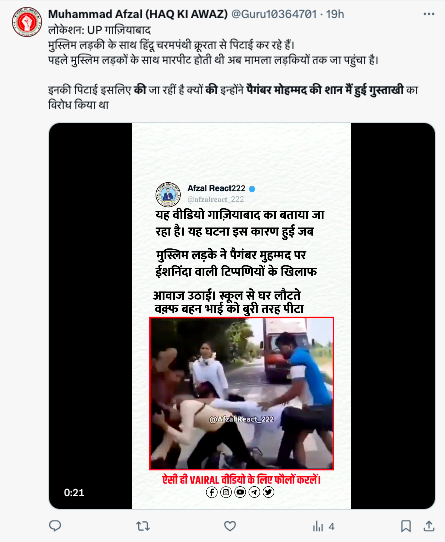
It was then picked up by several other X users. In this vein, an X user Muhammad Afzal claimed that the said video is from Ghaziabad and wrote, “Muslim girl being brutally beaten by Hindu extremists. Earlier Muslim boys used to be beaten up, now the matter has reached to girls. They are being beaten because they protested against the insult to Prophet Muhammad.”
One Mehdi Hasan who claims to be an officer bearer in AIMIM said: “They are being attacked because they opposed the insult done to Prophet Muhammad (PBUH)!! Shameful. We demand that strict legal action be taken against these brutal attackers.”
Another AIMIM supporter Sharik Qureshi shared the viral video and said: “Who filled them with so much hatred? A brother and sister riding a motorcycle are attacked and beaten by 8-10 Hindutva goons. Even the innocent girl is attacked. They were assaulted because they opposed the insult done to Prophet Muhammad (PBUH)!! Shameful. We demand that we should do the same in return for these attacking beasts. We will beat them and then they will come to their senses.”
One Ashraf Ali said: “Hindu extremists are brutally beating up Muslim girls. Earlier, Muslim boys were beaten up, now the issue has reached girls. They are being beaten because they protested against the insult to Prophet Muhammad Ghaziabad.”
Was a Muslim youth attacked by Hindu ‘extremists’ for opposing insult to Prophet Muhammad?
While most social media posts claimed that the video in question was from Ghaziabad, the incident unfolded on 28th September, in the Dhaulana police station precinct of Hapur district.
Moreover, several social media users, mostly Muslims, claimed that the ‘Hindu extremists’ attacked the Muslim youth because he opposed their alleged derogatory remarks against Prophet Muhammad.
However, it has been reported that the Muslim youth identified as Akram had allegedly lured a Hindu girl to a hotel room and raped her. Upon learning about this, the girl’s brothers caught hold of Akram who was going with the girl on his bike and thrashed him. Thus, the claims of purported insult to Prophet Muhammad are false.
Further, the woman the Muslim youth was with, who was claimed to be his “sister”, was in fact the Hindu girl who the Muslim youth had allegedly lured and raped.
In a statement, Hapur’s Additional Superintendent of Police (ASP) Vineet Jaiswal informed that the Hindu girl later filed a complaint against Akram accusing him of luring her into his trap and sexually assaulting her. The police have registered an FIR against Akram, based on the victim’s complaint. Subsequently, the police arrested the Muslim accused and jailed him.
सोशल मीडिया प्लेटफॉर्म पर वायरल वीडियो जिसमें थाना धौलाना क्षेत्रान्तर्गत एक युवक के साथ मारपीट की जा रही है। उक्त वीडियो करीब 10 दिन पूर्व का है, उक्त प्रकरण के संबंध में थाना धौलाना पुलिस द्वारा आवश्यक विधिक कार्यवाही की गई है। इस संबंध में अपर पुलिस अधीक्षक की बाइट~@Uppolicepic.twitter.com/rATlL1wA3B
The Hapur ASP further informed that the police are registering FIR against social media users who falsely linked this incident with an imaginary insult to Prophet Muhammad to disrupt communal harmony. The Hapur Police asked social media users not to post misleading posts on social media platforms without verification and not to spoil the atmosphere by spreading misleading news and giving it a communal colour.
In a mega boost for the Indian Navy and surveillance capabilities of the defence forces, the Cabinet Committee on Security has cleared the major deals for building two nuclear submarines indigenously and buying 31 Predator drones from the US.
As per the plans, the Indian Navy will get two nuclear-powered attack submarines which will help boost its capabilities manifold in the Indian Ocean Region, top sources told ANI.
The deal for building the two submarines at the Ship Building Centre in Vishakhapatnam will be around Rs 45,000 crore and will see a major involvement of private sector firms like Larsen and Toubro, they said.
The deal had been hanging fire for a long time and the Indian Navy had been pushing it as it was a critical requirement for filling the underwater capability gaps.
India has plans of having six such boats in the long run as part of its submarine induction plans.
These boats which are going to be built under the ambitious Project Advanced Technology Vessel project, are separate from the five nuclear submarines being built under the Arihant class at the same location.
The other mega deal cleared today by the Cabinet Committee on Security is for the acquisition of 31 Predator drones from American General Atomics under a Foreign Military Sales contract between the two governments.
The deal had to be cleared before October 31 as the validity of the American proposal was till that time and now it is going to be signed in the next few days only.
As per the contract, the defence forces will start getting the drones over four years after signing the deal, they said.
The Indian Navy will get 15 of the 31 drones while the Army and the Indian Air Force will get eight each and also deploy them together at two bases in Uttar Pradesh.
Indian equipment made by DRDO and private sector firm Solar Industries may be used as the Make in India element on the 31 drones which are expected to be game changers in peacetime surveillance.
(This news report is published from a syndicated feed. Except for the headline, the content has not been written or edited by OpIndia staff)
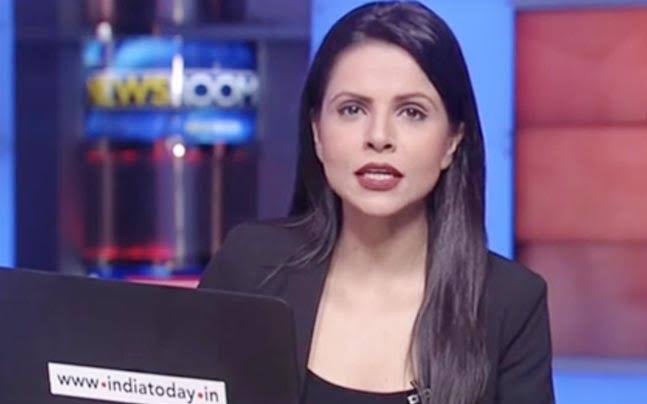
Ever in service of the Congress party, India Today ‘journalist’ Preeti Choudhry has been furiously posting tweets ever since her prediction of the Haryana assembly elections went spectacularly wrong, with Congress being dealt with a demoralising defeat as the BJP returned to power for the third time in a row.
After what came as a surprise to many, especially the Congress party, whose leaders appear completely flummoxed with the results in Haryana, Choudhry has been passionately involved in dissecting the cause of Congress’ failure.
In this pursuit, Choudhry, who is referred to by many on X as ‘Lady Rajdeep’ for her tendency to go soft on the Congress party and often acting as the unofficial spokesperson of the party, posted an infographic that blamed ‘vote-cutters’ responsible for the Congress party’s debacle in the Haryana state elections.
The infographic talked about 14 seats in Haryana where Congress lost to the BJP by a margin less than that secured by the 2nd runner-up. These constituencies included Sohna, Narwana, Uchan Kalan, Assandh, Kalka, Badhra, Mahendragarh, Safidon, Yamunanagar, Rai, Barwala, Samalkha, Dadri, and Tosham.
Essentially, it claimed that Congress would not have lost the elections if there had been no other candidates contesting. This argument not only contradicts the fundamental principles of multi-party democracy but is also deeply flawed, as it presumes that the votes for the second-place candidates in each constituency would have entirely shifted to Congress.
A multi-party democracy is a system in which multiple political parties can contest and attain power. This setup allows various parties to reflect a wide range of perspectives and interests, resulting in a more inclusive representation of the population. Elections are held regularly, granting all eligible citizens the right to vote. Similarly, anyone and everyone can contest polls and stand a chance to represent the interests of their constituencies in the state assembly.
But for Preeti, contesting elections from a constituency where a Congress candidate is in a close fight against a BJP candidate means the 2nd runner-up is a ‘vote-cutter’ who has diminished the chances of the Congress representative from being elected to power. Is she angling for a Presidential system in constituencies where there is a tough contest between a Congress candidate and a rival politician? Is it a way to absolve Congress of the uninspiring campaign it ran ahead of the elections? Surely, dividing Hindu society with caste rhetorics has a shelf life and people will eventually see through the propaganda. And lastly, does the ‘vote-cutter’ epithet apply when a Congress candidate scrapes through a narrow victory or is it reserved only for Congress candidates who have lost by a slim margin?
For those who are familiar with Preeti’s ideological moorings and have watched her pass off her opinions as ‘journalistic’ insights, it is not hard to guess what her answers would be to these questions.
In fact, hours after the results were out, Preeti quickly drew up 10 factors that led to Congress’ defeat in polls, that too after gloating about reading the elections right when the initial trends showed over 60 seats to the Congress party.
Perhaps, even the Congress party would not have been so quick in analysing their loss as Preeti Choudhry has been in dissecting what went wrong for the party.
Earlier yesterday, Congress and its supporters were dealt a body blow after what they assumed to be a cakewalk turned out to be an arduous task as the BJP registered yet another victory in Haryana, forming government in the state for the third time in a row. Against election analysis of poll pundits and ‘ground reports’ by ‘journalists’, BJP won 48 seats, 2 more than the number of seats required to form government at the centre. Congress ended up with 37 seats in the 90-seat Haryana assembly elections.
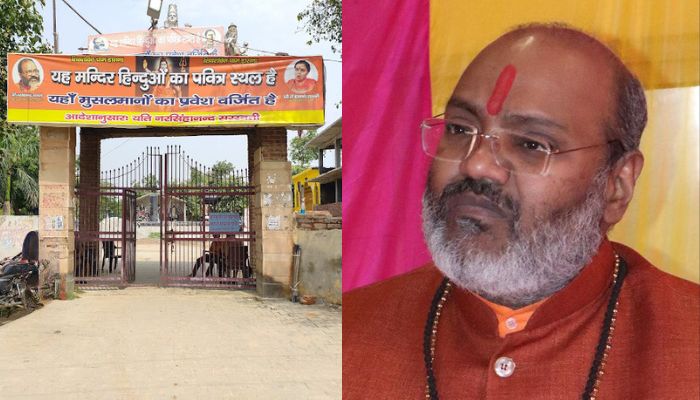
The situation in Ghaziabad, Uttar Pradesh has remained tense ever since the remarks made on Prophet Muhammad. On one hand, Muslim extremists wreaked havoc in the name of Yati Narsinghanand Saraswati’s arrest and on the other, furious Hindu organisations have also repeatedly taken to the streets after Islamists attacked the Dasna Devi temple. Amid this, a maha panchayat has been announced by the Hindu outfits on 13th October.
The police stated that section 163 of Bharatiya Nyaya Sanhita (BNS) has been enforced in the entire area and no authorisation has been granted for the massive gathering. On 7th October Hindu activists reached the Police Commissioner’s Office located in the Police Line and demanded the immediate arrest of the attackers and also demanded the release of Yati Narsinghanand.
Social media is also being used for the promotion of the Maha Panchayat under the slogan of “Chalo Dasna (Let’s go to Dasna)” and all 36 Hindu communities have been called to prepare a framework for the security of the Shiv Shakti Dham where the event is scheduled to take place at 10 am. Meanwhile, the authorities enforced section 163 last week in the entire Ghaziabad which prohibits the assembly of five or more persons.
On the morning of 7th October, protestors who came from Delhi protested at UP Gate. Around 100 people who came on the appeal of a group named “World Peace Harmony” raised slogans when they were stopped from going to the Collectorate. The authorities pacified them and they returned after submitting a memorandum. The agitators blocked a service lane from Delhi to Ghaziabad triggering snarls near the border and disrupting peace in the area. There was a traffic gridlock between 10 and 11 am for an hour because of the commotion.
A report has been filed against 91 people in Kaushambi police station in connection with the demonstration. Police filed a First Information Report (FIR) on 8th October against 11 named persons including the chairman of a nonprofit organization, and about 60 unidentifiable individuals, according to other reports. The authorities mentioned that 16 cases in this case have been launched at different police stations till now and 23 accused have been arrested as well as sent to jail. The most number of cases have been submitted at Wave City police station. On 8th October, cops nabbed Riyaz, a resident of Khari Kuan and Rizwan from Mohalla Qureshiyan and threw them behind bars.
Background of the matter
“Even thousands of years since Ravan committed a small mistake, we burn his effigy. But until now, such criminals have taken birth that Ravan’s existence would fail in front of them. I want to exhort all Hindus from this stage if you want to burn an effigy, burn the effigy of Mohammad,” voiced Yati Narsinghanand during an event that led to massive protests against him by Muslims who raised “Sar Tan Se Juda” slogans and indulged in violence including the attacks on Dasna Devi temple and even police personnel in the name of agitation. The Hindu sage is the priest of the temple.
The police are currently investigating a possible “conspiracy” angle for the 4th October demonstration outside the Dasna Devi Temple. “About 100-150 persons gathered outside the Dasna Devi temple and were raising slogans against the remarks made against Muhammad Paigamber Sahab. When stopped, they resorted to stone-pelting and prevented the discharge of official duties,” the First Information Report (FIR) disclosed.
Amidst the protest, a group of approximately 150 individuals threw stones at cops after which 13 of them were caught. The names of some of the perpetrators who were taken into custody are Farman, Sameer Mohammad, Sajid, Aamir, Shoaib, and Shahzad Syed. “We have so far arrested 13 persons in connection with the 4th October protest and we are also probing the conspiracy and other angles behind the buildup,” informed Surendra Nath Tewari, deputy commissioner of police (rural zone).
The Hindu seer has been arrested by the police but it hasn’t calmed the situation as radical Muslims continue to demonstrate and engage in riots in different areas. On 4th October, similar scenes were observed in Bulandshahr where Islamists pelted stones after Friday prayers and wounded a police officer during their protest. “Nara-e-Takbir Allah Hu Akbar,” “Fansi Do” and “Sar Tan Se Juda” have been a regular feature in these demonstrations.
An FIR has also been filed against Alt News co-founder Mohammed Zubair following the attack on Dasna Devi Temple by Bharatiya Janata Party leader Dr Udita Tyagi. It stated that he along with Arshad Madani and Asaduddin Owaisi, attempted to incite Muslims across the nation and persuaded local Muslims to arrange for outsiders to destroy the Shiv Shakti Dham in Dasna.
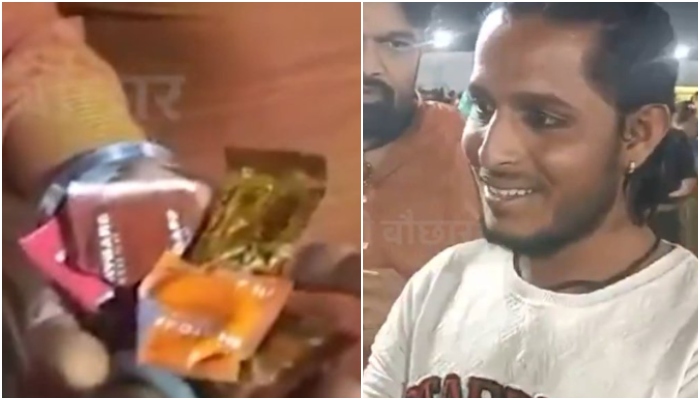
The entry of Non-Hindus has been barred in Garba pandals in several districts of Madhya Pradesh. Despite this, an individual from Ujjain identified as Firoz attended a garba event using a fake Hindu identity. He also was caught carrying condoms in his pocket after which the police were informed by the Hindu community members.
The accused person who introduced himself as Rahul was caught after Hindu Jagran Manch members turned suspicious of him. They inquired him eventually learning that his name was Firoz. The accused was later turned up to the police.
The incident happened on Tuesday, 8th October in the Pandya Khedi region of Ujjain, beneath the Maksi Road bridge. The Garba was taking place at night, and as usual, workers and officials from the Hindu Jagran Manch were around. One of the workers, Ritesh Maheshwari, developed suspicions about a young man in the pandal. When questioned, the young man identified himself as Rahul and claimed to live on Maksi Road, adding that he comes to see the Garba daily.
The Hindu Jagran Manch activists then escorted the young man to the police post in the pandal. When the police enquired about his name, he confessed that his name was Firoz. At this point, Hindu Jagran Manch members began slapping the young man in front of the police.
Following this, the accused youngster tried to make a phone call, but those nearby confiscated his phone. Later, on searching his pockets during the inquiry, several packs of condoms were discovered. An Aadhaar card with his real name was also found. Following this, he attempted to run but was eventually caught by the assembled people who handed him to the police.
The incident has sparked outrage among the Hindu community persons who attend the Garba events. Several garba organizers in Madhya Pradesh have barred the entry of non-Hindus to the event concerning the safety of Hindu women. This is after several people from the specific community have targeted Hindu women in the past in such pandals and engaged them in Love Jihad. Hindu organization members also believe that non-Hindus participating in such Hindu events leads to disrespect of the Hindu religious customs.
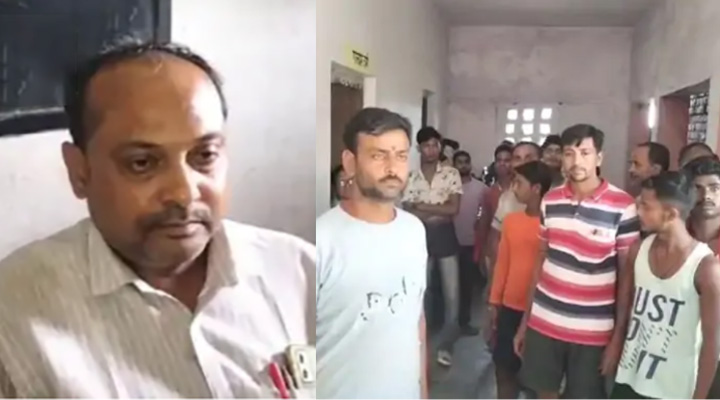
In Begusarai in Bihar, a teacher named Mohammad Ziauddin from Utkramit Madhya Vidyalaya Kadarabad sparked controversy by educating students that Lord Ram and Hanuman were originally Muslims who used to offer Namaaz. Locals were outraged to learn about this statement and rushed to the school to voice their demands for the teacher’s dismissal.
बिहार के बेगूसराय में मुस्लिम स्कूल में भगवान हनुमान को मुस्लिम बताने पर विवाद। हरिपुर कादराबाद स्कूल का मामला, यहां जियाउद्दीन नाम के अध्यापक ने बच्चों को सिखाया हनुमान जी पढ़ते थे नमाज। pic.twitter.com/nLsP3fPN9s
The incident is said to have happened in a private school in the Bachhwara block of Begusarai, Bihar. He reportedly told the students of class 7, “Lord Ram and his devotee Hanuman were Muslims. They used to offer Namaz.” After the school, the children told this to their parents, causing a massive outroar among the villagers. The villagers went to the teacher’s house on Tuesday and protested against his highly objectionable remarks.
When the school opened on Wednesday, a large number of people reached the school and created a ruckus, demanding action against the teacher. When the students of the class were asked about it, they unanimously said, ‘Ziauddin sir told us that Lord Hanuman was first Hindu person to read Namaj, Lord Ram had asked him to read Namaj, and Hanuman was Muslim’. After the confirmation by the students, the protests intensified.
Even several teachers in the school were also outraged after learning. As per the reports, seeing the situation worsening, the teacher was later forced to tender an apology. He said, ‘I taught these things by mistake. I committed a mistake, please pardon me. This will not happen in future.’
However, the villagers were not satisfied with the apology and demanded official action against him, with many demanding his removal from the school.
Union Minister Giriraj Singh has taken cognizance of the event and urged the Chief Minister to take severe action against the teacher who insulted the Hindu Gods and Goddesses.
“Attempts are being made to damage the atmosphere in our parliamentary constituency Begusarai. Ziauddin, a teacher at Kadarabad School, taught the students that Ram and Hanuman were Muslims. This is a major mistake. Immediate action should be taken against such teachers who spread hatred in the society,” he said.
बछवाड़ा प्रखंड के हरपुर, कादरावाद (बेगूसराय) के उत्क्रमित मध्य विद्यालय में शिक्षक जियाउद्दीन द्वारा भगवान राम और हनुमान जी को मुसलमान बताने पर ग्रामीणों ने विरोध जताया। जियाउद्दीन ने इसे स्वीकारा और मुस्लिम छात्राओं समेत अन्य ने पुष्टि की। समाज में विद्वेष फैलाने वाले ऐसे… pic.twitter.com/CIPYSALvhH
— Shandilya Giriraj Singh (@girirajsinghbjp) October 9, 2024
Mohammad Ziauddin made the controversial statement while teaching a class of seventh-grade students on Tuesday, October 8th. The students eventually informed their families and locals, who assembled and confronted the teacher at his home on the same day.
The next morning, when the school reopened, a significant number of parents arrived, creating an uproar. When inquired about the incident in class, numerous students stated that “Ziauddin Sir had said that Lord Hanuman and Lord Ram were Muslims.” This sparked more chaos in the room. Faced with widespread criticism, the teacher later apologized.
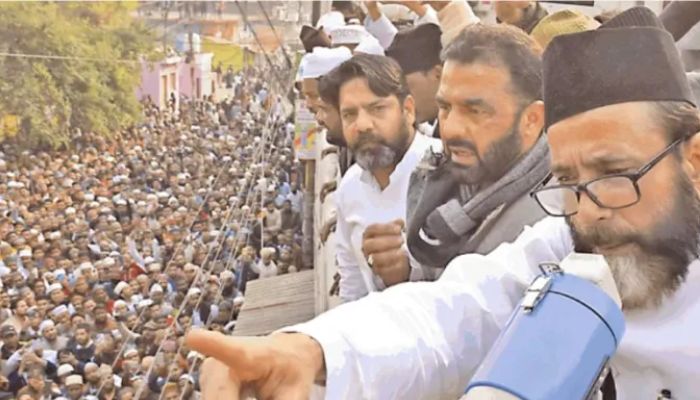
Maulana Touqeer Raza, the head of the Islamic organisation Ittehad-e-Millat Council and a resident of Bareilly, notorious for his inflammatory speeches has once again attempted to stoke unrest in the country. Raza has announced a Delhi ‘march’ in protest against Yati Narsinghanand’s recent remarks against Prophet Muhammad.
This comes right after the Congress party lost elections in Haryana. On the 24th foundation day of the Ittehad-e-Millat Council, Maulana Touqeer Raza said that Yati Narsinghanand allegedly made derogatory remarks about Prophet Muhammad and there will be no memorandum or Dharna against him. Now after Dussehra, Muslims will reach Delhi and gherao the Ramlila Maidan.
Maulana Touqeer Raza stated that Muslim people will take out a massive demonstration in Delhi from all over the country, not just Bareilly. Maulana Touqeer stated, “The people of the country are angry right now. Those who insulted the Prophet continue to roam freely. Our [Muslim] youths are being mob lynched. There have been reports of bearded persons being beaten inside trains.
The Maulana also targeted Prime Minister Narendra Modi and claimed that the country’s Prime Minister is biased against one particular community [Muslims]. He claimed that certain people seek to harm the country’s atmosphere. They are doing all of this for publicity, which is why they disrespect prominent religious figures.
Touqeer Raza’s hateful commentary did not end here as he went on to call Muslim girls and women who marry non-Hindu men as “weak”. “There is no need for girls who leave their religion and marry people of other religions in Islam. There is no place for such weak people in Islam. It is good that they left Islam on their own,” Raza said.
Earlier, Touqeer Raza had also said: “I don’t know whether we are 20 crores or 30 crores, but only 1 per cent of us should come out of our homes and march to Delhi and declare that we will not end the protest until Narendra Modi resigns. Our patience is being tested. If the scale is crossed then the results can be very bad .”
Notably, it was reported in July this year that Maulana Touqeer Raza announced that preparations were underway to publicly convert 5 Hindu women to Islam and conduct their nikkah (marriage) with their Muslim partners. He claimed to have received 23 such applications from 5 Hindu men and 15 women men for converting to Islam.
In February this year, Touqeer Raza threatened a civil war in the country as veteran BJP leader LK Advani was awarded Bharat Ratna. He warned of a civil war in the country. He said that it is due to the patience practised by Muslims that religious tensions are not escalating. Cautioning against Muslims losing control, he said, “If our youth go out of control, then no one can save India from a civil war.”
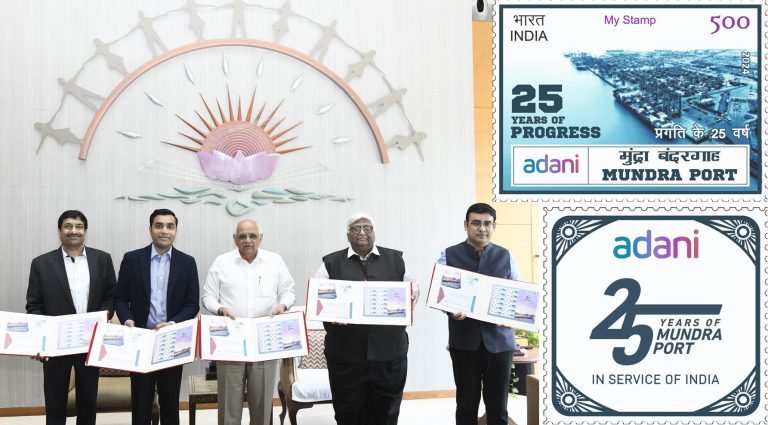
India Post on Wednesday released a commemorative stamp to mark the completion of 25 years of the Mundra Port in Gujarat, the flagship port of the Adani Group. The stamp was unveiled by Gujarat Chief Minister Bhupendra Patel in Gandhinagar on the occasion of World Post Day on 9th October. A press statement issued by Adani Group stated the commemorative stamp “celebrates Mundra Port’s remarkable socio-economic contributions and its transformation into a global maritime powerhouse over the past 25 years.”
The commemorative stamp is titled “25 Years of Progress – Mundra Port” and depicts the development journey of Mundra from an ordinary jetty to a global shipping hub. A total of 60,000 stamps have been printed at the Security Printing Press in Hyderabad. 5000 stamp sheets with 12 stamps in each sheet have been printed. The stamps were designed by India Post in collaboration with Adani Ports and Special Economic Zone.
The stamps will be available for purchase through India Post’s ePortal.
Senior officials of Adani Group and India Post were present at the event in Gandhinagar, including Adani Enterprises Managing Director Mr Rajesh Adani, Adani Ports and Special Economic Zone Managing Director Mr Karan Adani, Gujarat Circle Chief Postmaster General Mr Ganesh V Sawaleshwarkar, HQ Region Postmaster General Mr Krishna Kumar Yadav and others.
In addition to the Mundra Port commemorative stamp, India Post has also introduced a special cover and stamp cancellation process. A copy of the stamp sheet will also be permanently displayed at the National Philatelic Museum in New Delhi.
Group Chairman Gautam Adani thanked CM Bhupendra Patel for releasing the stamp. He tweeted, “Thank you, Hon’ble @CMOGuj Bhupendrabhai Patel, for releasing a commemorative stamp to celebrate 25 years of Mundra Port. Its journey from a tiny jetty in 1998 to one of the world’s leading ports today has not been without its challenges. Mundra Port’s growth symbolises our partnership of trust with Gujarat and its people.”
Thank you, Hon'ble @CMOGuj Bhupendrabhai Patel, for releasing a commemorative stamp to celebrate 25 years of Mundra Port. Its journey from a tiny jetty in 1998 to one of the world's leading ports today has not been without its challenges. Mundra Port's growth symbolises our… https://t.co/16yniZrslwpic.twitter.com/fKmB1CsI3D
Talking about the release of the stamp, Adani Ports MD Karan Adani said, “This commemorative stamp represents not just the legacy of Mundra Port but also our partnership of trust with the people of Gujarat and the supportive policies of the state government. Together, we have turned a vast wasteland into India’s largest port, reaffirming our humble commitment to driving economic development and creating opportunities for our people, while supporting India’s ambition to be a leader in global trade.”
Mundra has become a major port on the north coast of the Gulf of Kutch. The port was given permission to start as a captive jetty in 1994 by the Gujarat Maritime Board when the Congress party was in power in the state. Since then, the port has been developed on a Public Private Partnership basis. And since 2001 Mundra Port and Special Economic SEZ (MPSEZ) has been operational.
Only barren and desert-like land was selected for the development of infrastructure projects in Kutch at a time when no one thought of investing in the region. Adani Group utilised the land to construct India’s largest port.
Giving a brief history of the Mundra Port, the statement issued by the Adani Group said that the port originally built on barren mash has rapidly grown into a key commercial hub and a pivotal gateway for India. “The port, managed by Adani Ports and Special Economic Zone Ltd, has evolved from a single jetty into a global shipping hub, connecting India to the world while also serving a considerable portion of the nation’s hinterland,” the press release said.
It further added, “Today, Mundra Port has become a significant driver of economic growth for both Gujarat and India. Since 1998, the port has contributed over INR 2.25 lakh crore to the state and national exchequer, created more than 7.5 crore man-days of employment and attracted investments exceeding INR 70,000 crore.”
According to the company, Mundra Port now handles nearly 11% of India’s maritime cargo and 33% of the nation’s container traffic.
Adani Ports is now the largest port developer and operator in India which runs 15 ports and terminals across the country, Mundra, Tuna, Dahej, and Hazira in Gujarat, Mormugao in Goa, Dighi in Maharashtra, Vizhinjam in Kerala, Haldia in West Bengal, Dhamra and Gopalpur in Odisha, Gangavaram and Krishnapatnam in Andhra Pradesh, Kattupalli and Ennore in Tamil Nadu and Karaikal in Puducherry.
The company’s ports 27% of the country’s total port volumes.
The company is also developing a transshipment port at Colombo in Sri Lanka and operates the Haifa Port in Israel and Container Terminal 2 at Dar Es Salaam Port, Tanzania.
The statement said that the company’s vision is to be the largest ports and logistics platform in the world in the next decade.
Earlier yesterday, the 2024 assembly election results for Haryana and Jammu and Kashmir Union Territory were announced. The BJP pulled off a surprising win in Haryana, creating history by returning to power for the third time in a row.
The saffron party won 48 out of the 90 assembly constituencies, 2 more than the seats required to form a government in the state. On the other hand, the principal opposition party, Congress, bagged 35 seats, a disappointing figure vis-a-vis lofty claims made by Congress leaders, supporters, and pliant journalists pretending to be ‘neutral’ election observers who pegged the party winning 55-62 seats.
Ever since the Congress lost the 2024 Lok Sabha elections with better numbers than their 2019 tally, their ranks and supporters had been upbeat about the party’s prospects in subsequent elections. But Haryana’s defeat has jolted the party, especially after its leader Rahul Gandhi had been aggressively ratcheting up his divisive campaign with his caste and reservations bluster.
Against this background, it is worth assessing how the reserved seats polled in Haryana.
Out of 90 Assembly constituencies, 17 were reserved for the candidates belonging to the Scheduled castes. These are Bawal, Sadhaura, Shahbad, Guhla, Nilokheri, Israna, Kharkhoda, Narwana, Ratia, Kalanwali, Uklana, Bawani Khera, Kalanaur, Jhajjar, Mulana, Pataudi, and Hodal.
Here’s a quick snapshot of who won the 17 seats reserved for the candidates belonging to the SC community:
Results on seats reserved by members of the SC community in Haryana
The BJP won 8 out of the 17 seats while the Congress party won 9. In terms of percentage, the BJP won 47 per cent of the reserved seats while the Congress party won approximately 53 per cent seats. Some of the victories, for both Congress and the BJP, have been substantial such as Pataudi for the BJP where Bimla Choudhary won with a margin of a staggering 46, 530 votes and Congress’ Naresh Selwal from Uklana, who won by more than 28,000 votes.
There are 17 SC reserved seats in Haryana. Out of the 17, the BJP won 8 while the Congress won 9. It seems like the Dalit vote did not consolidate behind either party, however, favoured Congress in the Haryana Assembly Election pic.twitter.com/XntsLyiZqv
The BJP’s performance is particularly remarkable, given that it came in the wake of the Congress party’s increased focus on caste rhetoric, especially after the Lok Sabha elections, where the Congress party bettered its previous tally of 52 to 99. During the elections, Congress leaders, particularly Rahul Gandhi, went overdrive with his rhetorics on caste census and ‘Jiski jitni aabadi uska utna haq’, designed to woo the reserved classes and break the Hindu consolidation achieved by the BJP under Modi. But the results show that Dalits in Haryana haven’t consolidated behind either of the two political parties.
The Congress leaders and supporters were labouring under the belief that the caste rhetorics had managed to cause a substantial dent in BJP’s vote share. For a while, the BJP thought it was best to emulate the Congress party to ensure they didn’t lose out on the Dalit votes. It briefly dabbled in caste politics with ‘Shoshit Vanchit Samaj’ rhetorics. There appeared to be a tussle between the two political parties regarding who was the greater champion of Dalit rights.
But the results on the 17 SC reserved seats demonstrate the lack of consolidation of Dalits behind any single party. The BJP, on its part, also appears to have realised their folly of pandering to the Congress playbook of fuelling caste divisions and enfeebling the Hindu society. It promptly course-corrected, with the two stalwart saffron leaders, Yogi Adityanath and later PM Modi, both cautioning Hindus against the politics of division with ‘Batoge toh Katoge’ warning.
The results on the 17 SC reserved seats in Haryana bear a lesson for both, Congress and the BJP. For Congress, it is a learning that the caste census and reservation politics may have run their course, as evident in the results of the Haryana state assembly, where Congress managed to do only marginally well than its rival, BJP, despite taking desperate measures, including circulating fake claims attributed to Amit Shah and the BJP, to project itself as the party of the reserved classes.
As more and more Indians join the country’s growth story, distinctions such as caste, colour, creed, and gender, are bound to lose their relevance in electoral politics, which seemed to have played out in Haryana, where both the Congress and the BJP drew an almost equal number of seats, highlighting that caste may no longer be an election issue for the public. It may still be a social issue in some pockets of the country, but in Haryana, other issues trumped caste identity.
For the BJP, the victory in Haryana is remarkable, particularly after the Lok Sabha elections where it sought the ambitious target of winning 400 seats but ended up with 240, relying on its alliance members to form a government at the centre. The lesson for the BJP in these elections is that instead of going on a wild goose chase and allowing Congress to set the narrative, the saffron party should focus and build on its strength, and communicate its achievements effectively to the public. Rather than allowing their decisions to be driven by the fear of being projected as anti-Dalit, the BJP should confidently articulate its vision for the reserved classes and how the brand of politics embraced by the Congress party threatens to disrupt the social fabric of the country and sow divisions within the Hindu society.
Blindly following the opposition party because it is toying with the dangerous idea of dividing the Hindu society on caste lines could be counterproductive, especially when the country has a burgeoning general class that may not take the brazen pandering kindly and punish them in elections. The best bet for the BJP is to keep focusing on bringing economic improvement for the public while simultaneously forging Hindu consolidation like it has been doing for the last 10 years in power. That’s perhaps the only way to ensure Congress’ caste rhetorics die their natural death and pose no electoral hurdles for them in future.
Be it Congress or the BJP, the Dalits in Haryana did not consolidate behind either of the political parties, sending a message to them that identity politics may have run its course and there are more crucial issues that concern the Dalits than appeasement, census, and reservations.