

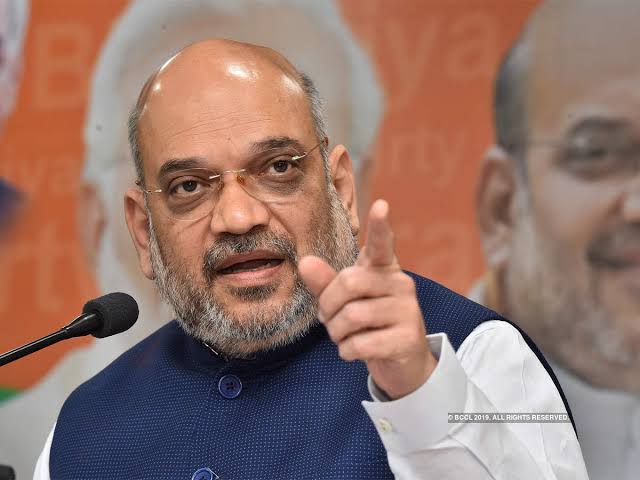
Union Home Minister Amit Shah in an editorial in Times of India says that passing the historic Triple Talaq bill in Rajya Sabha is not just about enacting yet another law but more about restoring honour and dignity to the Muslim women. He adds that the bill is about establishing gender equality.
Adding that the bill is part of Modi government’s commitment on social reforms in spite of the resistance faced by the opposition parties. Shah says that the triple talaq bill provides a statutory shield to Muslim women who have been on the receiving end of the ‘utterly sinful practice’.
Passing the bill in the Parliament shows the government’s relentless effort to give social dignity, respect and honour to women in India. Shah adds that this also brings down the mask of Congress which has always treated the Muslim community as a vote bank. He says that the triple talaq perpetuated the deep-rooted inequality which had very little concern for women’s self-respect.
Welcoming the support for the triple talaq bill from the non-NDA parties, Union Home Minister urged the other parties rise above political differences and support it so that it helps India progress as a nation as well as society.
Analysing Congress’ role on triple talaq, Shah said that Congress, when it had over 400 MPs over three decades ago, could have overturned the historic wrong done in Shah Bano case. In 1985, the Supreme Court had ruled in favour of Shah Bano, whose husband had given her triple talaq. She was to receive a monthly allowance of Rs 500. The SC had said that the order was in conformation with the Sharia. However, Rajiv Gandhi government, instead of implementing, overturned the SC order by bring bringing in a law to nullify the SC order.
The issue was then pushed back till Modi government brought it up. Amit Shah said that bringing in the law exposes the double standards of Congress as well as is quite a blow to appeasement politics.
Taking on the pseudo-liberals, Shah said that the self-proclaimed champions of equality and gender justice were silent and opposed the bill which was an injustice to Muslim women. He said that these so-called liberals are driven by narrow partisan politics and not humanitarian values.
He also called out the opposition’s bluff which questioned the law as applicable only to Muslims. He added how there are Hindu Marriage Act, Christian Marriage Act and other laws to ban child marriages and practice of dowry and other social evils.
Shah added that PM Modi deserves the credit for enacting a law that bans triple talaq. He adds how PM Modi will go down in the history long with other social reformers like Raja Ram Mohan Roy and Ishwar Chandra Vidyasagar who fought for women’s struggles.


