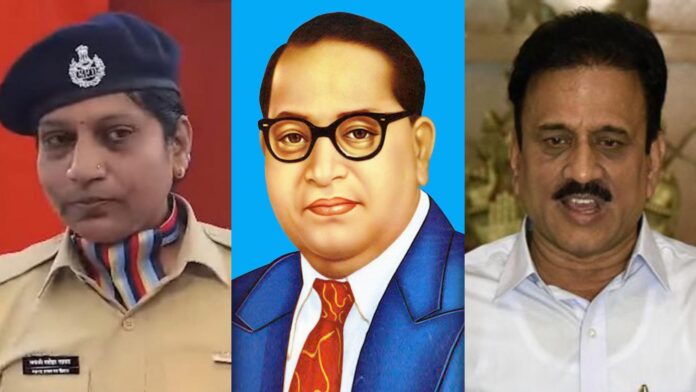
The disruption of Maharashtra minister Girish Mahajan’s Republic Day speech in Nashik by a serving Forest Department official is not a minor episode of emotional overreach, nor is it merely a debate about reverence for Dr B. R. Ambedkar. It is a disturbing marker of deeper institutional decay, in which state functionaries increasingly see themselves not as neutral executors of constitutional authority, but as ideological enforcers empowered to confront elected representatives publicly while on duty.
At the heart of the Nashik incident lies a simple fact: Girish Mahajan, while delivering an official Republic Day address after unfurling the national flag, did not mention Dr Ambedkar’s name. This omission, whether intentional or not, was seized upon by Madhvi Jadhav, a Forest Department staffer, who interrupted the speech mid-event to demand an explanation. Police intervened, she was briefly detained, and the matter quickly snowballed into a full-fledged political controversy.
Mahajan later clarified that the omission was unintentional and apologised. He stated that he regularly invokes Ambedkar in his speeches and had no motive to disrespect him. Under normal democratic and civic standards, the episode should have ended there.
Instead, it escalated into a manufactured outrage, replete with allegations of “erasing Ambedkar’s identity,” calls for FIRs, and political leaders demanding the minister’s removal.
Madhavi went a step further, declaring that the so-called “sin” committed by Girish Mahajan was so grave that it was beyond forgiveness, so severe, she claimed, that even a holy dip at the upcoming Maha Kumbh would fail to wash it away.
This escalation is telling. Not only does it reveal a brazen contempt for Hindu rituals of taking a dip at Maha Kumbh, but it also shows how omission has now been weaponised as insult, and how sections of the political ecosystem have transformed Ambedkar into a figure whose invocation is no longer symbolic or reverential, but compulsory.
This is perhaps the first time in India’s recorded history that a leader has been accused of “insult” not for what he said, but for what he did not say.
That shift is dangerous.
There is no constitutional provision, legal mandate, or civic convention that requires every Republic Day speech to name Dr Ambedkar. Speeches are not affidavits. They reflect emphasis, context, and thematic focus. A minister may speak about nationalism, federalism, Shivaji Maharaj, or contemporary governance without enumerating every historical contributor to India’s constitutional journey. The Constituent Assembly itself was a collective body. Ambedkar was undoubtedly its most prominent intellectual force, but he was not its sole contributor.
If the standard of “insult” is reduced to non-mention, then no speech is safe. Every address can be interrupted. Every minister can be accused. Every omission can be reframed as malice.
That path leads not to constitutional reverence, but to perpetual disruption.
Political activism dressed up as personal grievance
What makes the Nashik incident especially troubling is not merely the outrage, but who initiated it. Madhvi Jadhav was not a private citizen exercising dissent. She was a government employee on duty at a constitutional function. Service rules, administrative discipline, and the basic architecture of the Indian state require bureaucrats and uniformed personnel to remain politically neutral while discharging official responsibilities.
Her conduct was not an act of democratic protest; it was indiscipline.
The fact that she later demanded an FIR against the minister, despite his apology, only reinforces the suspicion that the confrontation was less about constitutional values and more about political posturing and self-justification following an emotional outburst.
More alarming still is the reaction that followed. A section of the political ecosystem was quick to appropriate and celebrate Madhavi’s stunt as an ‘act of defiance’, hiding their dishonesty in hailing what has been a serious act of indiscipline and dereliction of duty.
Instead of condemning the breach of protocol, several opposition leaders and ideological commentators rushed to glorify the official. Mumbai Congress MP Varsha Gaikwad framed the interruption as the “voice of every self-respecting Marathi citizen.”
Congress leader Shama Mohamed went further, calling the forest official “brave” and demanding Mahajan’s immediate sacking for allegedly insulting the “architect of the Constitution.”
A few serving policewomen of the Maharashtra Police have alleged that Maharashtra minister Girish Mahajan omitted the name of B R Ambedkar from his Republic Day speech.
— Dr. Shama Mohamed (@drshamamohd) January 26, 2026
If this is true, the minister must be sacked immediately for insulting the architect of our Constitution. LoP… pic.twitter.com/lLovo0jl4d
Pro-Congress social media handles hailed Jadhav with slogans and salutes.
A grand salute to Madhavi Jadhav for boldly teaching a lesson to the minister who dared to omit Dr. Ambedkar’s name from his Republic Day speech. Jai Bhim 🔥🔥🔥 pic.twitter.com/yDKHkh97EK
— The Dalit Voice (@ambedkariteIND) January 26, 2026
When political actors publicly endorse indiscipline by serving officials, they send a clear signal: ideological confrontation will be rewarded, not punished. Neutrality will be penalised; activism will be celebrated.
This is how institutions corrode.
The elevation of Ambedkar as sacrosanct figure beyond reproach
The transformation of Ambedkar into a sacrosanct figure beyond criticism, beyond omission, beyond contextual restraint adds another troubling layer. Much like figures in rigid monotheistic belief systems, any perceived slight now triggers outrage, allegations, and punitive demands. In extreme cases, dissent or critique attracts the threat of stringent legal provisions, social ostracism, or career destruction.
The irony here is profound.
Dr Ambedkar himself was among the fiercest critics of hero worship. In his final speech to the Constituent Assembly, he issued a prescient warning, “Bhaktiin religion may be a road to the salvation of the soul. But in politics, Bhakti or hero-worship is a sure road to degradation and to eventual dictator”
Yet today, many who claim to act in his name have elevated him into precisely the kind of infallible icon he warned against, one whose name must be ritually invoked, whose absence is treated as blasphemy, and whose legacy is enforced through coercion rather than understanding.
This is not homage. It is instrumentalisation.
More importantly, it narrows the space for free political speech. The Indian Constitution guarantees freedom of expression to every citizen, including ministers. Forgetting to mention Ambedkar is not a crime. It is not even misconduct. A Republic Day speech may focus on any number of themes without being compelled to follow a prescribed ideological script.
If tomorrow a minister omits Jawaharlal Nehru, Sardar Patel, Savarkar, Netaji Subhas Chandra Bose, or any other historical figure, will that too justify disruption India’s freedom struggle and constitutional journey involved countless contributors across centuries. No speech can name them all, nor should it be expected to.
The absurdity of the current outrage becomes clear when viewed against historical precedent. Since Independence, Prime Ministers, Chief Ministers, or even people of some prominence have delivered hundreds of speeches on Republic Day and Independence Day. None have ever been forced to list every freedom fighter or Constitution framer. No one has been accused of “insulting” Bhagat Singh or Vivekananda or Ambedkar because their names were not mentioned in a particular address.
Why, then, this exception?
The answer lies in politics, not principle.
CISF official assaults Kangana Ranaut
The Nashik episode fits into a broader and deeply worrying pattern, where the politicisation of the bureaucracy and uniformed services has been steady and irreversible. In recent public memory, the most striking example was the 2024 incident involving CISF official Kulwinder Kaur, who allegedly slapped MP Kangana Ranaut at an airport, a highly sensitive security zone. Kaur later justified her action by citing Ranaut’s past comments on farmres protests.
The act constituted a serious breach of security and protocol. Yet what followed was even more disturbing. While Kaur was suspended and transferred pending inquiry, there was no firm institutional condemnation. Instead, public figures openly normalised the assault. Music composer Vishal Dadlani even offered to secure employment for her if action was taken. Political supporters lauded her conduct as ‘brave resistance.’
The message it sent was unmistakably stark: ideological violence by on-duty officials is acceptable if the target is politically convenient.
The Nashik incident echoes this logic. The official is portrayed as courageous. The minister, despite apologising, is cast as the offender because he is from the BJP, PM Modi’s party, and, therefore, a fairgame for warriors of Congress ecosystem. Discipline is reframed as oppression. Neutrality is dismissed as moral cowardice.
Bareilly Magistrate Alankar Agnihotri resigns over new UGC regulations
The resignation of Bareilly City Magistrate Alankar Agnihotri on Republic Day further underscores this trend. While resignation is an individualrightAgnihotri’sssss public framing of his exit as a political protest against government policies, complete with media briefings, ideological rhetoric, and mobilisation by caste and political leaders, again blurred the line between administration and activism.
When serving or recently serving officers position themselves as ideological actors, governance itself becomes performative. Administration turns into a platform for signalling dissent rather than executing policy.
A constitutional democracy cannot function this way.
The civil services and uniformed forces are not pressure groups. They are not activist collectives. Their legitimacy derives precisely from their neutrality. Once officials begin to see themselves as moral arbiters empowered to confront elected representatives based on personal or ideological conviction, the chain of authority collapses.
The slippery slope of ideological policing by the state
Today, the justification is Ambedkar. Tomorrow, it could be caste, religion, language, reservation policy, or faith. If every official feels entitled to disrupt, resign theatrically, or physically confront politicians while on duty, governance will grind to a halt.
Republic Day commemorates not just the adoption of the Constitution, but constitutionalism itself, restraint, procedure, institutional boundaries, and respect for roles. The Nashik disruption violated all of these principles.
Political activism while on duty is not courage. It is dereliction. And when such dereliction is celebrated, encouraged, and politicised, it ceases to be an aberration. It becomes a contagion.
India should be deeply concerned, not because Ambedkar was forgotten in a speech, but because the state itself is forgetting the meaning of constitutional discipline.