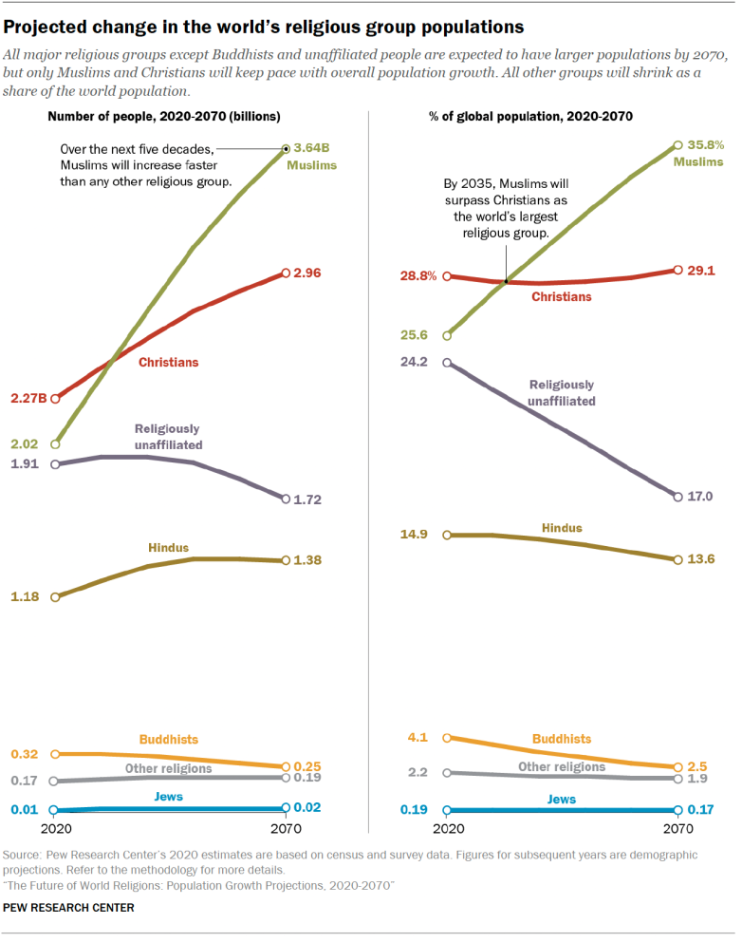
Projecting a major shift in the global religious landscape, Pew Research Center has estimated that Muslims will surpass Christians as the world’s largest religious group by 2035. The Pew Research Center study published in mid-November indicates that despite growth in coming decades, the global Hindu population is heading towards a decline, while the population of other religious groups, particularly in India, will grow at a higher pace.
“By Pew Research Center’s projections, the absolute number of Hindus both in India and around the world will rise in the coming decades. But Hindus will grow at a slower pace than other religious groups and make up a slightly smaller percentage of the global population,” the Pew Research study reads.
Globally, between 2020 and 2070, the percentage of the global Hindu population will decline from 14.9 to 13.6. Hindu population will lag far behind Muslims and Christians, at +17%.
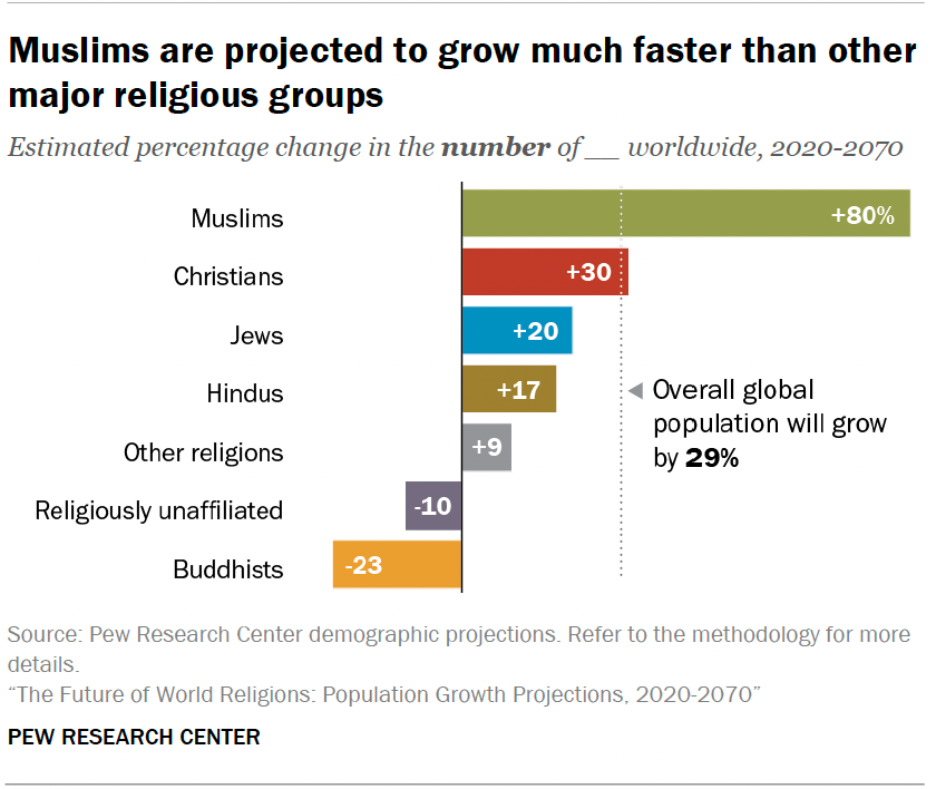
Christian share will marginally increase from 28.8% to 29.1%, at +20%.
Muslims will rise from 25.6% to 35.8% globally, registering a +80% growth rate.
“Muslims are the only major religious group expected to have growing numbers of births in the decades ahead. The other groups are projected either to have steady numbers of births or to experience gradual decline in the number of children born,” the Center states.
Hindu population on decline, India will have one of the world’s largest Muslim populations by 2070: Pew Research makes alarming projections
The study claims that if the current demographic trends will continue, the number of Hindus in India will increase by 176 million between 2020 and 2070.
Pew Research Center indicates that even though India’s total fertility rate (TFR) is declining, “Muslims in India still have more children per woman than Hindus do.”
“Given this fertility gap and Muslims’ younger age profile, Hindus are projected to decline as a portion of the Indian population, while Muslims are expected to rise,” the Pew Research study states.
It says that Hindus will make up 75.8% of India’s population by 2070, slumping from 79% in 2020, while the Muslim share will surge from 15.2% to 19.6%.
Other religions, which include Sikhs, Baha’is, Jains, Shintoists, Daoists, etc will also witness a decline in population, going from 2.5% to 1.8%.
Meanwhile, the Christian population in India is projected to remain stable at 2.2%.
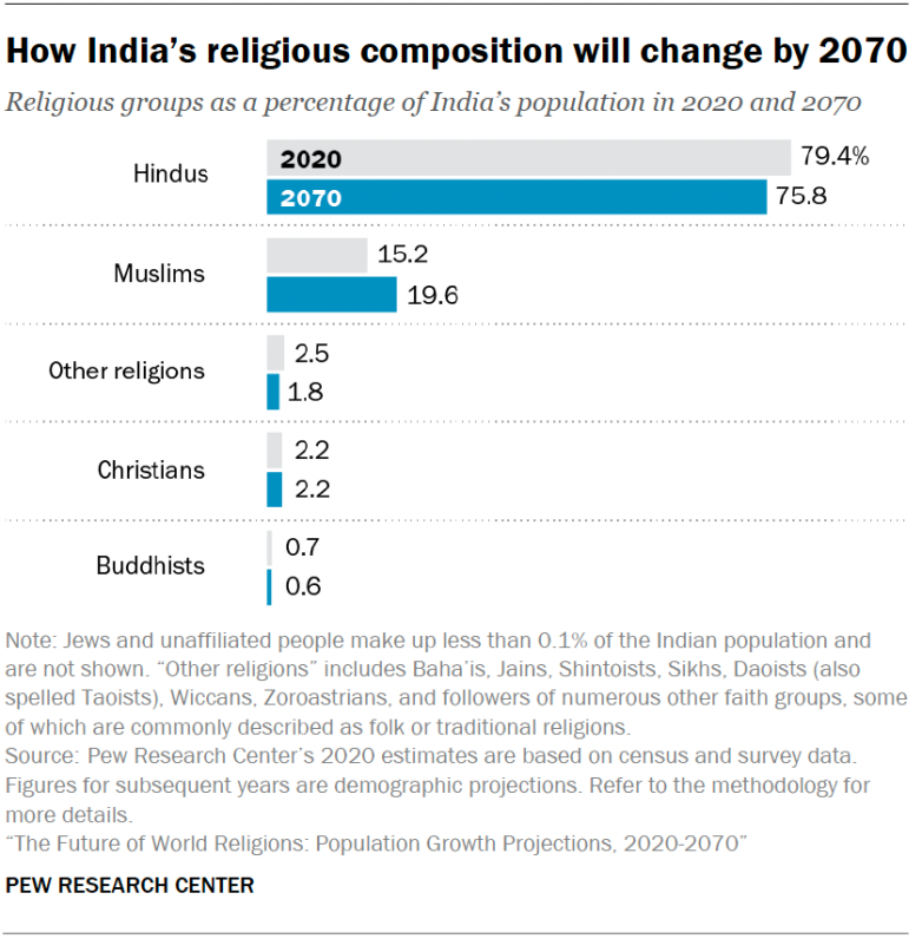
However, Hindus will continue to make up more than three-quarters of India’s population.
Globally, the Hindu population is projected to increase by 199 million between 2020 and 2070, reaching nearly 1.4 billion.
However, the population of non-Hindus globally will increase at an even stronger pace.
“As a result, Hindus will shrink slightly as a share of the global population, falling from 15% in 2020 to 14% in 2070.
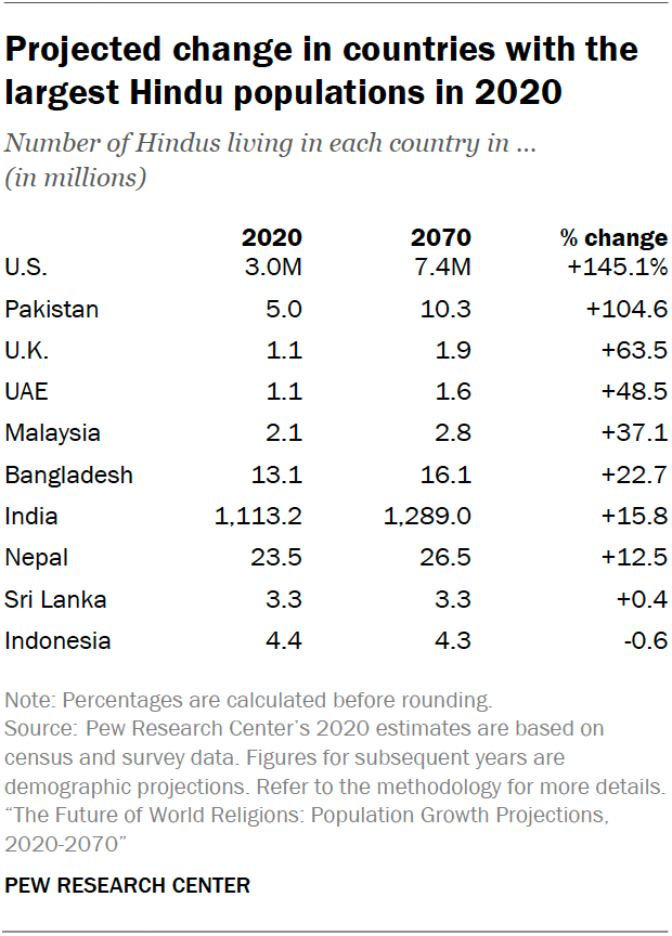
India and Nepal to remain the world’s only Hindu-majority countries by 2070
The Pew Research Center study says that outside India, the Hindu population is expected to grow in Pakistan by about 5 million and in the US by about 4 million between 2020 and 2070.
US will house the fifth-largest Hindu population by 2070.
“Australia will join the top 10 list, ranking ninth with about 3 million Hindus. The United Arab Emirates will drop off the list,” the Center predicts.
While in Pakistan, the Hindu population will witness a natural increase, with births outnumbering deaths; in the US, the projected growth will primarily be driven by immigration.
Notably, the Pew Research Center projects that Pakistan will have the largest Muslim population, followed by India, Nigeria and Indonesia (which currently has the most Muslims).
In the UK, the Hindu population will be 1.9 million in 2070. In Sri Lanka, there will be nominal growth of 0.4%. In Malaysia, the Hindu population is projected to reach 2.8 million. In Bangladesh, the Hindu population will be 16.1 million in 2070.
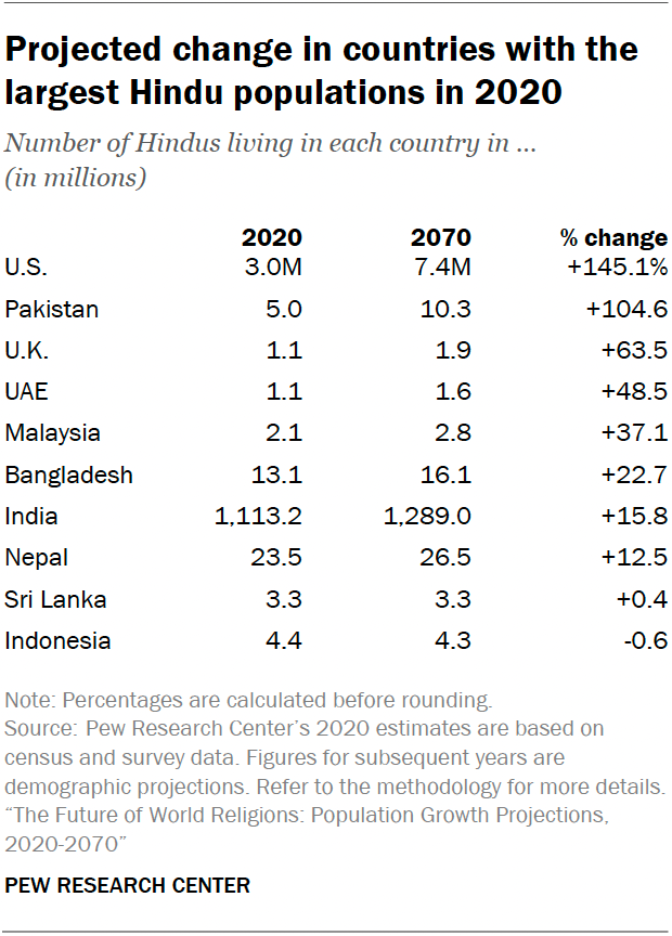
Meanwhile, Buddhists are projected to shrink both in number and as a portion of the world’s population in the coming decades.
In countries like Fiji, Mauritius, and Suriname, the Hindu population will decline by 2070.
The primary reasons for this decline are an ageing population and lower fertility rates compared to non-Hindu groups.
“For example, Hindus in Suriname have a much lower total fertility rate than the Christian majority there (1.4 children per woman vs. 2.6 in 2020-2025). This is an important reason why Hindus are projected to decline from 22% of the country’s population in 2020 to 15% in 2070, while Christians are projected to increase from 53% to 66%,” the report states.
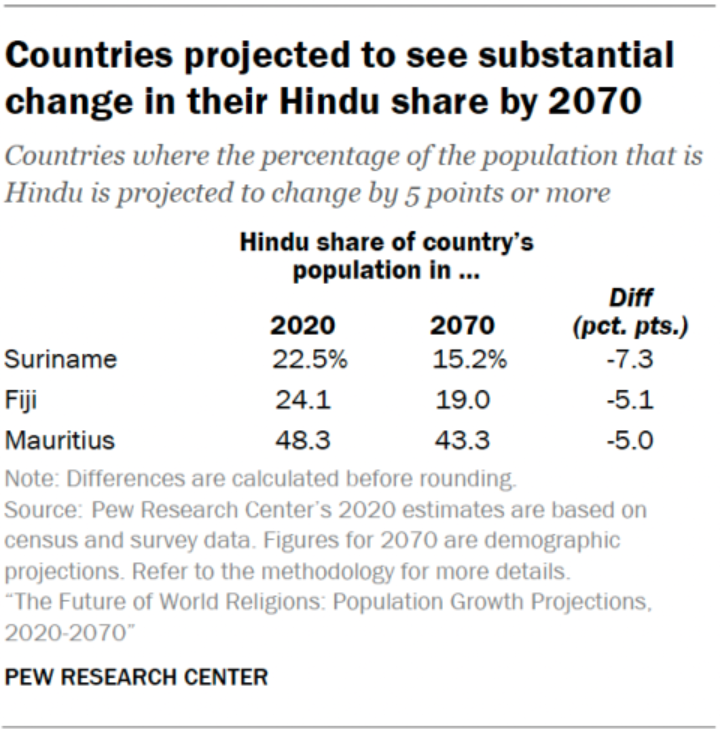
Pew Research predicts the following about the global Hindu population:
- The United States will have the world’s fifth-largest number of Hindus.
- Nepal and India will remain the only two countries with a Hindu majority.
- The portion of the population in Suriname, Fiji and Mauritius that is Hindu will decline by 5 percentage points or more.
“In Asia and the Pacific – where 99% of all Hindus live – the Hindu population is expected to grow by 191 million. By the Center’s projections, Hindus will make up 28% of the Asia-Pacific population in 2070, up from 26% in 2020,” the study reads.
In North America, Hindu population willl more than double in number, from 4 million to 9 million. As a result, they will make up a slightly larger share of the North American population in 2070 (2%) than in 2020 (1%).
In Sub-Saharan Africa and Latin America and the Caribbean, the Hindu population will decrease if the current demographic trends continue. In these two regions, Hindus will make up less than 0.1% of the overall population in 2070, the Center predicts.
Demographic factors such as age structure, fertility and mortality shape populations through births and deaths.
Pew Research Center predicts that if current trends continue, the Hindu population will witness a 200 million surge via natural increase by 2070.
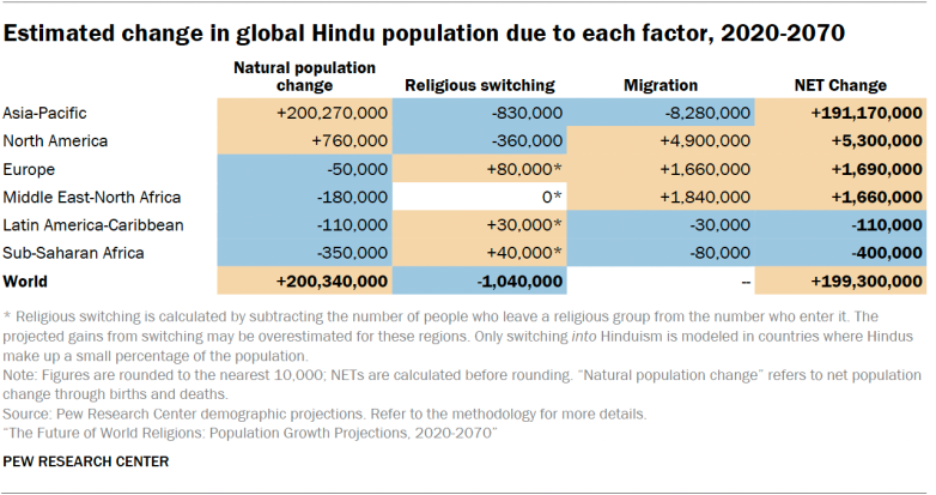
This growth is projected to occur mainly in Asia and the Pacific.
Regarding Hindu fertility rates, the Pew Research Center study indicates that the global Hindu population has a total fertility rate of 1.9 children per woman.
This figure, however, is lower than the rate of non-Hindus worldwide (2.3) and below the replacement level.
Generally, 2.1 children per woman in countries with low mortality rates for infants and children is estimated as the replacement level.
Hindu fertility rate is below 2.1 overall and is particularly low in North America (1.2).
Demographic shifts in India and Hindu population decline: Why Pew Research Center estimates are concerning
India is undergoing a massive demographic shift. This shift, driven by myriad factors, can threaten the Hindu community’s majority status and the secular-democratic character of the Republic.
In a research paper published in Economics and Political Weekly last year, Economist and member of the Economic Advisory Council to the Prime Minister, Professor Shamika Ravi, Economists Mudit Kapoor, Sunil Rajpal and SV Subramanian, revealed that the Hindu population in a Hindu-majority India is declining while the Muslim population, which political parlance calls a ‘minority’ but in reality is the second-largest religious group, is increasing exponentially.
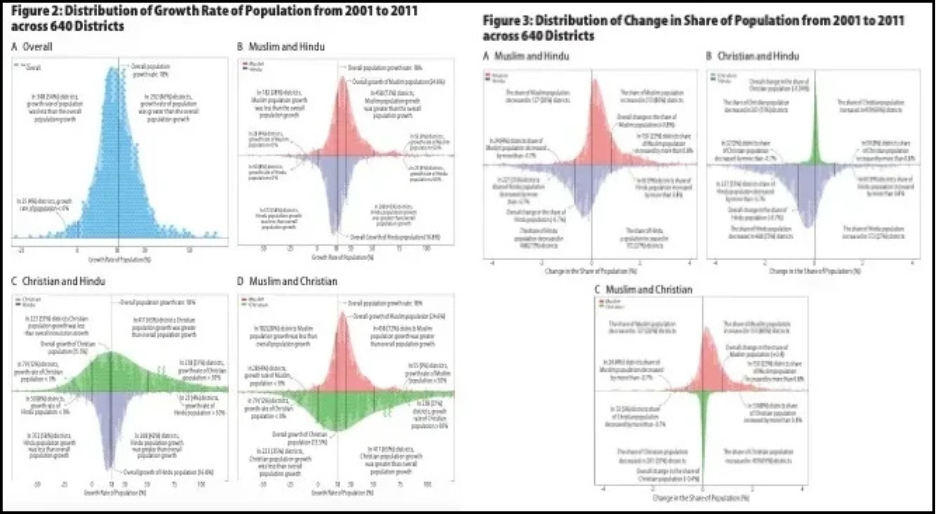
The researchers relied on the census data on religion from 2001 to 2011 to describe the changes in religious composition across 640 districts.
The study titled “Change in Religious Composition across Districts in India from 2001 to 2011” stated that at the national level, the Hindu population came down slightly, from 80.46% in 2001 to 79.8% in 2011. But the Muslim population rose from 13.43% to 14.23%. Even Christians saw a marginal rise in their share.
The researchers found that the share of the Hindu population declined in 468 out of 640 districts of India. That is over 70% of the total districts.
In 227 districts, the dip was even larger than the national average fall of 0.7%. The Muslim population increased in 513 districts, and the Christian population increased in 439 districts.
“Overall, the population growth in India from 2001 to 2011 was 17.7%. The dominant religion was Hindu in both censuses. The fastest population growth was among Muslims at 24.6%, and the lowest was among Jains at 5.4%. The share of the Hindu population declined from 80.46% in 2001 to 79.8% in 2011, a decline of approximately 0.7%. The percentage of the Muslim population increased from 13.43% in 2001 to 14.23% in 2011, an increase of 0.8%. Notably, the share of people who do not wish to state their religion has increased more than three times from 0.07% to 0.24% from 2001 to 2011,” the paper stated.
The numbers highlighted in the paper were particularly alarming in West Bengal.
In districts like Murshidabad, Malda, Uttar Dinajpur, and North and South 24 Parganas, the Muslim population grew at a higher rate than the Hindu population. Due to this, the Hindu share in these districts declined by over 1% in some districts, much higher than the national average.
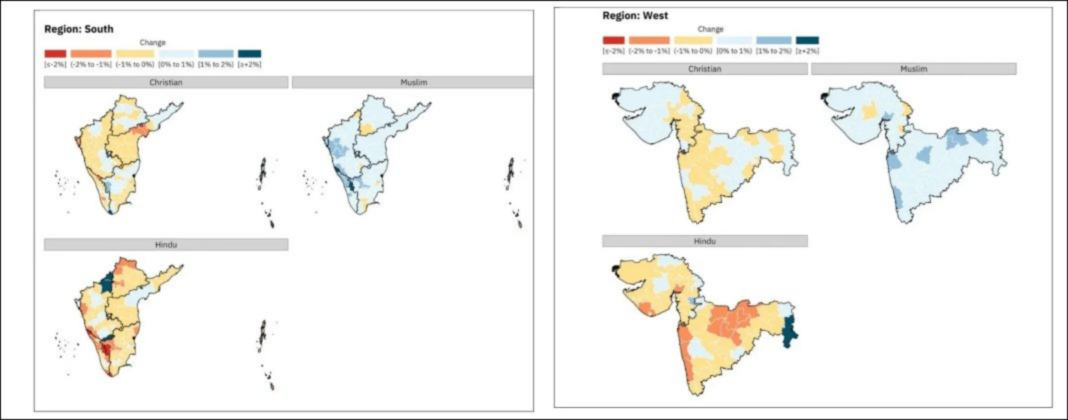
In Assam, the share of Muslims increased in most districts, especially the ones which are adjacent to Bangladesh. Dhubri, Barpeta, Goalpara, and Morigaon districts all witnessed a massive increase in Muslim populations.
Upon comparing the distribution of population growth rates across all districts in the country for Christians, Hindus, and Muslims, the research found that among the Muslims, there were 458 (72%) districts where the growth rate of the Muslim population was greater than the overall growth rate of 18%.
There were 268 (42%) districts where the Hindu population growth was greater than the overall growth rate of 18%, while for the Christians, there were 417 (65%) districts whose population growth rate was more than the overall population growth rate.
Interestingly, in 79 (12%) districts, the Christian population growth rate was less than zero, while the corresponding number of districts for Hindus and Muslims—where their population growth was less than zero—was 50 (8%) and 28 (4%), respectively.
In the northeast states of Nagaland, Mizoram, Meghalaya, and Arunachal Pradesh, the Christian population is increasing rapidly. In 238 Indian districts, the Christian population increased by more than 50% between 2001 and 2011.
Pertinently, Christian missionaries have been very active in these regions, luring non-Christian tribal populations into Christianity by offering financial inducements, jobs, education, and health benefits, etc.
In West Bengal and Assam in the east, the Hindu population has declined, and so is the case in the northwestern districts of Uttar Pradesh, the coastal districts of Maharashtra, Karnataka, and the Malabar region in Kerala. Similarly, in central districts in Maharashtra, Chhattisgarh, and Odisha has been a substantial decline in the share of the Hindu population.
Similar alarms about possible religious-demographic imbalances in across states were raised by a think-tank Centre for Policy Studies (CPS), in January 2025.
The CPS report titled Religious Demography of India: Rising Religious Imbalance in the Declining Fertility Regime of Kerala, revealed that Muslims in Kerala (27% in Kerala, as per the 2011 census) overtook the Hindus, who form 54% of the state’s population in total live births after 2015.
In the year 2019, out of the total live births, Muslims had a share of 44% while Hindus had a share of 41%.
Between 2008 and 2021, the share of Muslims in total live births witnessed a significant increase and in specific years, even overtook Hindus, while the Hindu community’s share in total live births dropped significantly, with similar trends recorded in Christian total live births.
The CPS report had found that between the time period of 2008 to 2019, the share of Muslims in live births has increased from 36.3% to 44.4% while the share of Hindus has correspondingly declined from 45.0 %to 41.0% and that of Christians from 17.6 to 14.3%.
Simply put, the share of Muslims in live births in this period increased by 8%, while that of Hindus went down by 4% and that of Christians by 3.3%.
This indicates that the Muslim share in live births is much higher than their total share in Kerala’s population.
In addition, natural accretion is highest for Muslims, while it is declining for Hindus and Christians in Kerala.
According to a study published by the Economic Advisory Council to the Prime Minister of India, Narendra Modi (EAC-PM) in 2024, between 1950 and 2015, the population share of Hindus in India declined sharply by 7.8% while the Muslim share grew by 43.15%, Christians by 5.38%, and Sikhs by 6.58%.
The share of Hindus in India’s population saw a decrease from 84% in 1950 to 78% in 2015, while that of Muslims witnessed an increase from 9.84% to 14.09% in the same period.
From various studies in India to the latest Pew Research Centre report, all indicate a one-sided increase in the Muslim population while the Hindu population of the Hindu-majority India is consistently declining, with few exceptions, since India attained independence at the cost of relinquishing its territories to Muslims in 1947.
India’s total fertility rate (TFR) has fallen below 2, and in several states, the situation is even worse.
While the Hindu population may still have strong numbers in 2070, the situation for India’s majority community and India’s secular character will come under serious threat from then on, if the current trends of high Muslim population growth continue.
The Modi government, however, has acknowledged these present and future demographic threats India faces.
During his Independence Day speech from the ramparts of Red Fort on 15th August 2025, Prime Minister Narendra Modi cautioned the nation about a conspiracy aiming to change India’s demography.
PM Modi launched a High-Power Demography Mission.
“I would like to alert the nation about a concern, a challenge. Under a well-thought-out conspiracy, the country’s demography is being changed, and the seeds of a new crisis are being sown. Infiltrators are snatching away the livelihood of the youth of my country. Infiltrators are targeting the sisters and daughters of my country. This will not be tolerated. These infiltrators mislead innocent tribals and capture their land. The country will not tolerate this,” he said.
Delayed marriages, prioritising education and careers, and increasingly opting for smaller families or the ‘Double Income, No Kids’ or DINK lifestyle trend, are all significantly contributing to the decline in TFR.
High housing costs, competitive job markets, and the growing necessity of dual-income households are also reshaping traditional family timelines.
China, Japan, and South Korea have been grappling with TFR decline for years; the crisis will knock on India’s door in the coming decades.
While the declining TFR, shifts in demographic trends, and the shrinking share of Hindus in India’s population do not appear immediately catastrophic, if these challenges go unaddressed, India, as a Hindu civilisational state, will be in serious trouble.