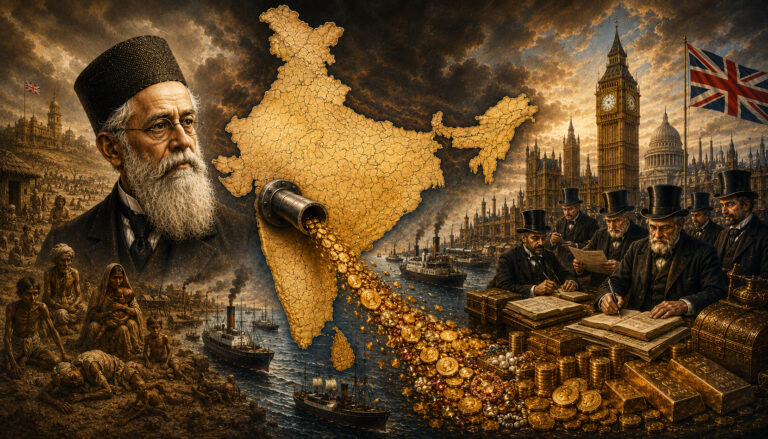
In 1901, Dadabhai Naoroji built one of history’s most devastating economic arguments from a colonized nation, using nothing but the empire’s own numbers. His starting point was strange: India was consistently exporting more than it imported. By the economics taught in London, that should’ve meant India was growing richer. Instead, Naoroji spent 60 years watching that surplus coexist with famine.
Born in Bombay in 1825, Naoroji became the first Indian full professor at Elphinstone College before moving to London in 1855 to run a trading firm. Living there gave him rare access to British Parliamentary records most Indians never saw, and what he found troubled him. In 1867, using official customs and Parliamentary data, he argued that a huge share of India’s trade earnings was simply leaving the country and never coming back. He zeroed in on ‘Home Charges’, British officials’ pensions, interest on debt India never chose to take on, guaranteed payouts to British railway shareholders, war costs, even a rule forcing India to buy supplies from British manufacturers even when cheaper local options existed.
The real mechanism, though, was subtler than outright theft. Through something called the Council Bill system, a British merchant buying Indian cotton paid in London, money that funded British expenses, while the Indian farmer got paid in rupees drawn from India’s own tax revenue. The books balanced. India even ran a trade surplus most years. But no real wealth ever entered the country. Naoroji didn’t stop at the macro picture. Using colonial prison food cost records, he built one of the world’s first data driven poverty lines, and found huge numbers of Indians living below what the government spent to feed convicts.
This wasn’t just personal outrage; it became the movement’s intellectual backbone. Ranade, Dutt, and Gokhale carried it forward; Congress formally adopted the drain theory by 1896, and Naoroji later became the first Indian elected to the British Parliament, eventually calling for ‘Swaraj’ in 1906.
The debate over Naoroji’s exact numbers has raged for over a century, from 1960s skeptics to Utsa Patnaik’s headline-grabbing $45 trillion estimate in 2017, which drew real methodological criticism too. The takeaway isn’t which total is right; it’s that Naoroji’s itemised, sourced approach has aged far better than any single dramatic figure.
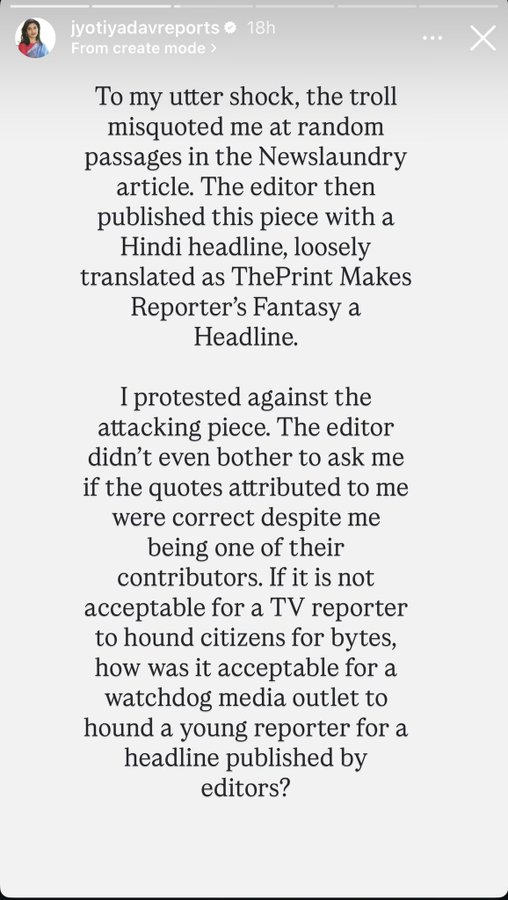
The scrutiny surrounding digital news platform Newslaundry has acquired another troubling dimension after journalist Jyoti Yadav publicly recounted her experience of being isolated and hounded by the organisation after she pursued a story that it had itself considered worth covering.
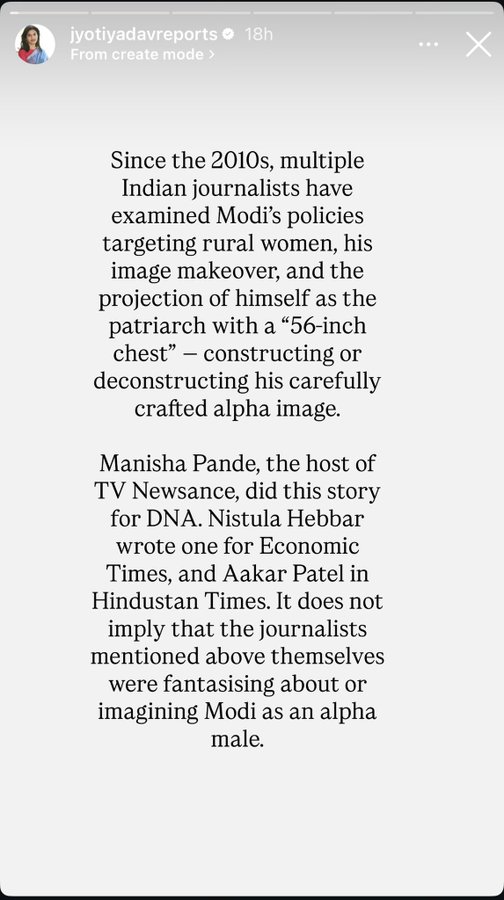
Yadav, in a series of Instagram stories, recalled an episode from 2019 when she was a 25-year-old cub reporter at ThePrint. She said she had pitched a story examining how Narendra Modi’s “carefully cultivated” image as a powerful, authoritative and “alpha” leader was perceived by rural women.
According to Yadav, the subject was hardly unique to her. She pointed out that journalists across publications had examined Modi’s image, including Newslaundry’s own Manisha Pande, Nistula Hebbar of The Economic Times and Aakar Patel of Hindustan Times.
Yet, she alleged, Newslaundry chose to turn the story into a personal attack on her.
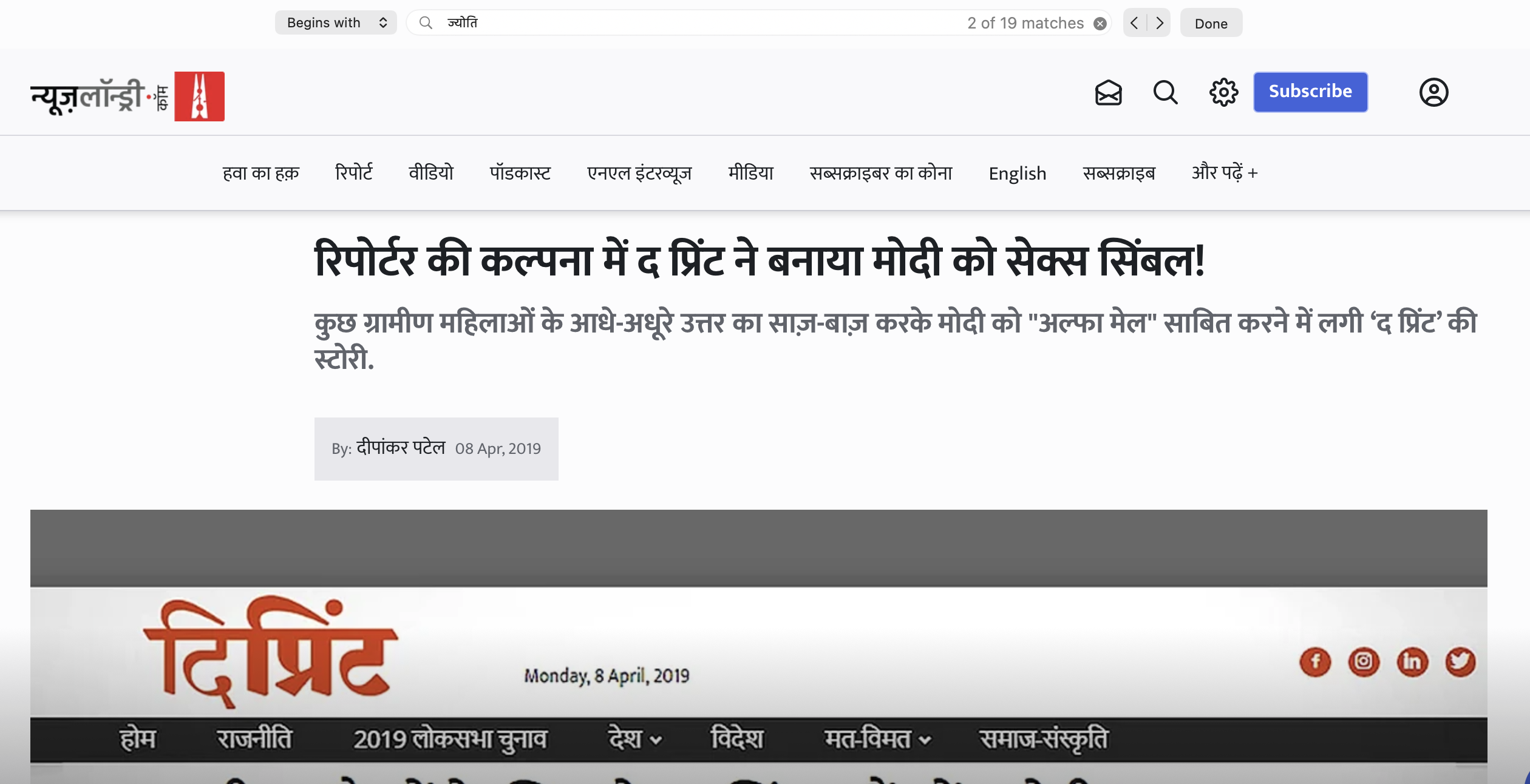
The irony becomes sharper when the publication’s 2019 Hindi article is revisited. Authored by Dipankar Patel, the article carried the headline: “रिपोर्टर की कल्पना में द प्रिंट ने बनाया मोदी को सेक्स सिंबल!”, effectively accusing ThePrint’s story of attempting to establish Narendra Modi as a sex symbol among rural women.
The article went well beyond criticism of the methodology or framing of the story. It repeatedly questioned Yadav’s journalistic judgement, described the piece as sensationalist and sexually obsessed, and sought to dissect her reporting choices.
It questioned why Yadav had asked rural women whether they would marry Modi, whether descriptions of Modi as confident, well-dressed, authoritative and capable of taking action against wrongdoers could legitimately be interpreted as sexual attraction, and whether references to Modi’s photographs with celebrities such as Priyanka Chopra and Ivanka Trump had any relevance to rural women’s perceptions.
The article even challenged Yadav’s understanding of the term “sex symbol”, contrasting her explanation with the dictionary definition of sexual attractiveness.
There can certainly be legitimate disagreement over whether Yadav’s 2019 report justified the headline or whether the methodology supported the conclusions drawn from it. Journalism should be open to such criticism. But that is precisely what makes Yadav’s latest account significant: she says Newslaundry did not merely critique the report. It singled her out personally despite other journalists having explored essentially the same broad subject.
‘A hit job’ on a young reporter
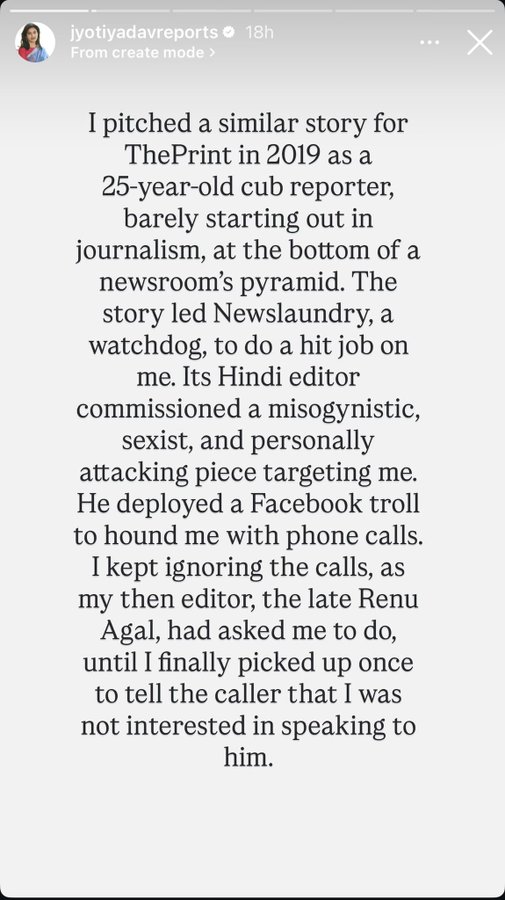
In her Instagram stories, Yadav says she pitched the story to ThePrint in 2019, when she was just beginning her career. According to her account, the story subsequently “led Newslaundry, a watchdog, to do a hit job on me.”
She alleges that its Hindi editor commissioned a “misogynistic, sexist, and personally attacking piece” targeting her and that a Facebook troll was used to repeatedly call her.
Yadav says she initially ignored the calls on the advice of her then editor, the late Renu Agal, but eventually answered one call and told the caller she was not interested in speaking to him.
The more serious allegation concerns the manner in which the Newslaundry article was produced and promoted.
Yadav says the Facebook account used to contact her misquoted her at random passages from the Newslaundry article.
She says she protested against the article, but that the editor did not bother to ask whether the quotations attributed to her were accurate, despite her being a contributor to the organisation.
That allegation raises a basic editorial question: if a publication considers a journalist’s reporting sufficiently problematic to warrant a detailed takedown, why would it not seek clarification from the journalist before publishing quotations attributed to her?
More importantly, why was a story examining the media’s construction of Modi’s public image transformed into a personalised attack on a young woman reporter?
Yadav also points to what she sees as an obvious double standard.
“If Newslaundry deemed it worthy of a hit job, why not include their own editor, Manisha Pande, who had written a similar article?” she asks.
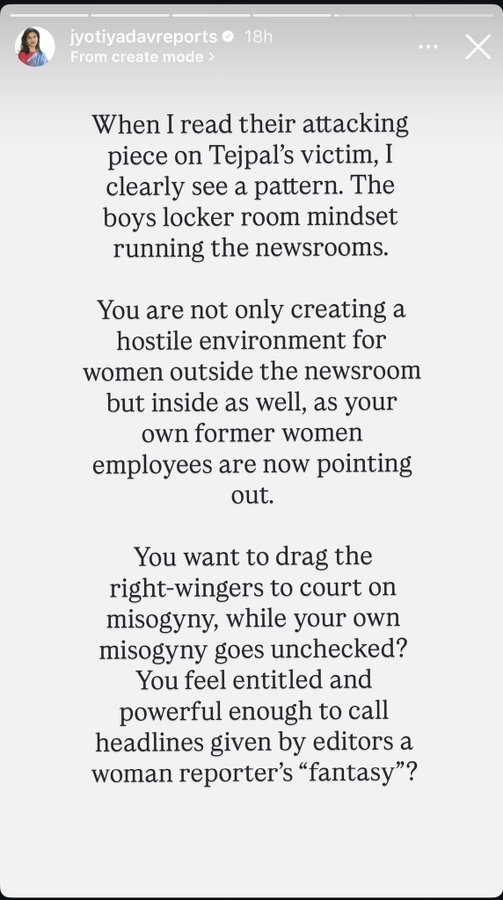
Exposing the Left’s hypocrisy, Yadav wrote: “You want to drag the right-wingers to court on misogyny, while your own misogyny goes unchecked?”
She argues that, at its lowest, the episode could have been understood as two women reporters arriving at similar journalistic questions, one at ThePrint and one at Newslaundry. Instead, she says, the publication chose to isolate and target her.
The Tejpal connection
That account assumes greater significance today because Newslaundry is itself facing questions about the treatment of women within its newsroom.
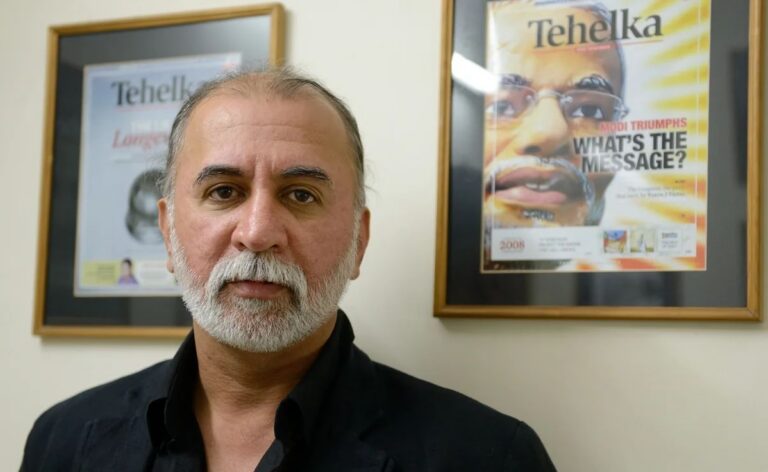
The organisation’s current controversy erupted into the open after the conviction of former Tehelka editor-in-chief Tarun Tejpal. The Bombay High Court recently overturned Tejpal’s earlier acquittal in the 2013 sexual assault case and sentenced him to 10 years’ rigorous imprisonment.
The timing is uncomfortable for Newslaundry because the organisation has a particularly long association with the Tejpal controversy.
In 2012, Newslaundry published an interview with Tejpal, discussing journalism, ground realities and the media’s tendency towards simplistic narratives. The interview remains available on Newslaundry’s website.
But the far more controversial episode came in 2014, when Newslaundry published an open letter by Nirupama Sekhri, sister of Newslaundry co-founder Abhinandan Sekhri, addressed to the woman who had accused Tejpal of sexual assault.
The article was not merely sympathetic to Tejpal. It questioned the complainant’s status as a victim and referred to her as a victim of “bubblegum feminism”. It questioned her conduct and suggested that the incident had been portrayed as something far more serious than it was.
Newslaundry subsequently published a defence of its decision to carry the article, arguing that it was providing a counterpoint to what it described as a one-sided media narrative.
That old article has now been removed from the website, with Newslaundry subsequently explaining that it no longer reflected the values guiding its journalism.
The irony of that history is difficult to miss. A publication that once devoted considerable editorial space to questioning a sexual-assault complainant’s conduct is now being asked to answer questions about allegations concerning the treatment of women who worked inside its own newsroom.
Former employees begin speaking out
Those allegations have come from multiple former employees.
Former Newslaundry senior correspondent Sumedha Mittal publicly said she hoped the organisation would reflect as seriously on sexual-harassment complaints within its own newsroom as it had on the Tejpal article. Former employee Priyanka Ishwari separately raised concerns about alleged workplace conduct, including an allegation that senior journalists shouted at women editors and threatened them during work calls.
But the accounts did not stop there.
On August 10, journalist Sayantan Ghosh also publicly recounted his experience of working at Newslaundry, alleging that the newsroom environment was deeply toxic and that co-founder Abhinandan Sekhri used abusive language towards employees.
Ghosh said that when he received an offer from Newslaundry, he understood that he would work as a trainee journalist for three or four months and could subsequently be hired if his work was good. He described it as, essentially, an unpaid internship, something he was willing to accept because he was young and wanted to become a journalist.
But, according to Ghosh, what he encountered after moving to Delhi was very different from what he had expected.
“The space, as I experienced it, was extremely toxic. The language used by Abhinandan Sekhri towards employees was deeply hurtful to me. People around me told me that this was ‘normal’ in the media—that this was how newsrooms functioned and that one had to develop a thick skin.”
Ghosh said he had previously worked in mainstream newsrooms, including The Telegraph and The New Indian Express, but had never encountered editors abusing reporters or interns in the manner he experienced at Newslaundry.
“So when I was told that such behaviour was ‘normal’ in the media, I could not accept it. It was not normal to me. For everything, in my experience, the person in question was abused. I had never seen people speak to their own employees in that manner before. But I was repeatedly told that this was simply how things were.”
According to Ghosh, the experience became so traumatic that one particular incident remained etched in his memory.
He recalled writing a story on Section 66A and alleged that the abuse directed at him afterwards was so severe that he fled the office.
“One day, after I wrote a story on Section 66A, the abuse was so harsh that I remember lying to the person I was reporting to and fleeing. I stayed in Delhi for another week, until my parents could arrange a train ticket, and then I returned to Kolkata.”
Ghosh said he had considered writing about the experience several times but remained silent because he feared being bullied or intimidated and began questioning whether he was simply being “too sensitive”.
“I questioned whether I was being too sensitive, whether this really was ‘normal’, whether I simply did not understand how the media worked.”
His decision to speak now, he acknowledged, could invite criticism.
“I know the kind of responses that are waiting for me. I know what will be said and I know that many people may question me. Maybe I am prepared today. But I think I should have spoken about this much earlier.”
Ghosh’s account is significant because it adds an allegation of workplace toxicity from a former male employee to the allegations concerning the treatment of women that have surfaced in recent days.
It should, however, be treated as an allegation and an account of his personal experience, rather than as an established finding against any individual. Sekhri and Newslaundry should be allowed to respond to the specific allegations.
Allegations from women employees
The accounts from women who previously worked at Newslaundry are particularly relevant to the questions now being raised about its workplace culture.
Sumedha Mittal, a former senior correspondent, said she hoped Newslaundry would “reflect just as seriously” on sexual-harassment complaints within its own newsroom.
Priyanka Ishwari, another former employee, alleged that women editors were subjected to inappropriate conduct by senior male journalists.
“Also hope they train senior journos not to scream at women editors and threaten them saying ‘Kabse dekha raha hun mein tereko’ over work calls. Training male reporters to behave professionally around female colleagues and not make the office a boy’s lockeroom maybe too much to ask?”
Again, such public allegations do not by themselves establish that a particular act of harassment occurred or that any complaint was mishandled. But when multiple former employees independently raise concerns about the same workplace environment, they warrant scrutiny rather than dismissal.
There is also a separate historical issue involving Vikram Kilpady, who worked at Newslaundry.
Journalist Lamat R Hasan had previously described an alleged 2005 incident involving Kilpady, saying she was “almost” raped. Recounting the incident, she said:
“He turned violent, pulled my hair, grabbed my wrists, held me against a wall and then pushed me on the bed. My attempts to break free failed. I started crying. He let me go. That’s the closest I have come to being raped.”
Kilpady was subsequently associated with Newslaundry, which itself published an article about the allegations against him during the #MeToo period.
The point is not to suggest that employment at Newslaundry establishes guilt in relation to an allegation made years earlier. It does not. The relevant question is instead how media organisations evaluate allegations of serious misconduct when deciding whom to employ, platform or defend, and whether they apply the same standards internally that they demand of others.
When the ‘watchdog’ becomes the subject
These allegations, by themselves, do not establish that any particular complaint was mishandled or that a particular employee committed harassment. That determination belongs to the appropriate internal or statutory mechanisms.
But the accumulation of accounts is difficult to ignore.
One former employee describes a toxic workplace and alleged verbal abuse. Former women employees have raised concerns about workplace conduct and sexual-harassment complaints. Another journalist, Jyoti Yadav, says she was personally targeted by the organisation after it chose to scrutinise her reporting.
The common thread is not necessarily the nature of each allegation. It is the question of power.
What happens inside a newsroom when editors exercise enormous power over young reporters? What happens when criticism is directed not at someone’s journalism but at their character? And what safeguards exist when the people responsible for enforcing professional standards are themselves accused of violating them?
This is where Yadav’s account becomes relevant to the present controversy.
Her allegations do not concern sexual harassment. They concern the treatment of a young female journalist who says she was personally targeted after her work became the subject of a Newslaundry attack.
That distinction matters.
One should not conflate allegations of editorial bullying with allegations of sexual harassment. But together, the accounts being placed in the public domain raise a broader question about newsroom culture: what happens when women inside or outside an organisation become inconvenient to the people exercising editorial power?
Yadav’s allegation is particularly striking because she says the same basic subject had been examined by Newslaundry’s own Manisha Pande and by other established journalists.
She therefore asks a question that goes beyond the 2019 article: why was she isolated and targeted?
“When I read their attacking piece on Tejpal’s victim, I clearly see a pattern,” Yadav wrote in her Instagram stories. “The boys locker room mindset running the newsrooms.”
That is an allegation, not a judicial finding. But it is precisely the sort of allegation that an organisation committed to accountability should be willing to answer with facts rather than rhetoric.
The POSH Questions
And that scrutiny is no longer confined to social media.
The Delhi Commission for Women has taken cognisance of allegations concerning Newslaundry’s handling of workplace sexual-harassment complaints and the functioning of its Prevention of Sexual Harassment mechanism, according to a report by Storyboard18 cited in the material surrounding the controversy. The commission’s chairperson, Lata Gupta, said the matter was sensitive and that the commission was examining the available information before deciding on further action.
Newslaundry, for its part, has rejected the broader allegations.
Editor-in-Chief Manisha Pande has said that the organisation’s workplace-harassment committee acted on every complaint it received and that dismissals and suspensions were imposed wherever warranted. She has also said that none of those complaints was against the organisation’s CEO and that an external member of the committee conducted a POSH training programme in November 2025.
Those responses deserve to be placed on record. But they also leave legitimate questions unanswered.
How many complaints have actually been received over the years? How many were formally investigated? What were the findings? How many resulted in disciplinary action? Was the Internal Complaints Committee properly constituted throughout? Were employees informed whenever its composition changed? And were mandatory POSH and gender-sensitisation requirements consistently followed?
These are not questions that can be dismissed as an attack on independent journalism.
Indeed, the larger issue is not whether Newslaundry is “anti-government”, “left-wing”, “right-wing” or anything else. A publication’s ideological position does not exempt it from the standards it expects from everyone else.
If an organisation routinely lectures governments, corporations, political parties and media houses about institutional accountability, it cannot reasonably object when the same questions are directed at its own newsroom.
Accountability cannot be selective
Newslaundry has built much of its public identity around challenging powerful institutions and demanding accountability from those who believe their stature puts them beyond scrutiny. Its journalism frequently asks institutions to explain how they treat the vulnerable, how complaints are handled and whether internal systems actually work.
It is now facing those questions itself.
And this time, the demand for answers is not coming from a government ministry or a political party. It is coming from former employees, women journalists and a statutory women’s commission examining the allegations.
The lesson from the Tejpal case should be obvious. Institutions cannot decide for themselves which allegations deserve to be taken seriously based on who is making them, how powerful the accused person is, or how inconvenient the allegations may be.
For Newslaundry, the question now is not whether it can produce another statement defending itself. It is whether it is prepared to subject its own institutional practices to the same level of scrutiny it demands from everyone else.
The organisation has every right to dispute allegations against it. But if it answers that its internal mechanisms functioned properly, then transparency about those mechanisms should not be treated as an unreasonable demand.
Because accountability cannot be a principle reserved for political opponents.
And feminism cannot begin and end at the newsroom door.
The woman who accused former Tehelka editor-in-chief Tarun Tejpal of sexually assaulting her in 2013 has reportedly taken to Substack to share a deeply personal account of the ordeal she has endured over the past 13 years. In a lengthy essay, she revisited her childhood, the assault, the subsequent trial and the manner in which her identity, relationships, choices and conduct were repeatedly scrutinised during the legal battle.
Her account comes days after the Bombay High Court overturned Tejpal’s acquittal by the Goa sessions court, convicted him of rape and sentenced him to 10 years’ rigorous imprisonment. The High Court also criticised the trial court for relying on stereotypical notions of how a survivor of sexual assault should behave.
‘My first lessons in politics were in male rage’
In her essay, the survivor reflected on how her childhood shaped her relationship with male anger.
She recalled that her father, a journalist, would discuss politics at home and quiz her about ministers, political parties and Parliament. Yet, despite growing up around political conversations, she said her “first lessons in politics were not from Parliament.”
“They were in male rage,” she wrote.
She described her father as a man who drank heavily and became violent, beating her mother and destroying things around the house before eventually falling asleep. The following morning, she added, he would return to being affectionate and remorseful.
The experience taught her to anticipate male anger and to modify her own behaviour accordingly.
A childhood of learning to appease angry men
The victim recounted being sexually abused as a five-year-old by a teenage boy who had been left to look after her following her parents’ divorce. She said the abuse was discovered by her grandparents, following which her male relatives beat the boy before sending him away.
Yet even then, she said, the violence did not make her feel vindicated.
Instead, she became frightened by the rage she witnessed in the men around her.
As she grew older, she encountered similar aggression outside her home, from men on Delhi’s streets and public transport to strangers and acquaintances who harassed, stalked or threatened women.
Those experiences, she explained, taught her to assess the mood of men around her constantly.
“I learned to read the room, to keep smiling when I wanted to cry,” she writes, describing how she became adept at soothing angry men.
The lesson would eventually shape how she responded to the events that followed years later.
‘I turned myself into an obedient and terrified woman’
The survivor said growing up around violence turned her into someone who tried to avoid confrontation at almost any cost.
While her professional life allowed her to express anger through journalism and political writing, she said her personal life was governed by an entirely different instinct.
“In my personal relationships, I stayed small,” she wrote.
She described herself as pleasing, light and non-threatening, someone who continued to prioritise the emotions of men and suppress her own.
For years, she said, this psychological split appeared to work.
Until the night of the assault.
The night that changed her understanding of politics
At 27, she was sexually assaulted by a man nearly twice her age, a senior figure who was responsible for her livelihood and someone her family knew and trusted.
She said that, in that moment, she was not thinking about politics or ideology. She was thinking about preventing the man from becoming angry with her.
That response, she argued, was the product of years spent learning that male anger could have devastating consequences.
Only later did she understand that the issues she had studied and written about, gender, class, sexuality, power and hierarchy, were present in the room that night.
“Politics lives in the body,” she wrote.
The trial became another battle over her body
The survivor’s account then turns to the 13-year legal battle that followed.
She said the trial repeatedly forced her to defend not simply her allegation, but her entire identity.
Her relationships, photographs, text messages, clothes, financial circumstances and professional conduct were scrutinised. She was questioned about why she did not cry, why she froze, why she continued working after the assault and why she later left her workplace.
Her cross-examination, she said, ran to more than 1,000 pages.
The result was a series of competing labels imposed upon her: “good victim” or “bad”, survivor or liar, journalist or activist, reliable or unreliable.
The Bombay High Court’s recent judgment has brought renewed attention to precisely this question of how survivors are assessed in court.
Bombay HC rejects the ‘ideal victim’ framework.
In overturning Tejpal’s acquittal, the Bombay High Court criticised the Goa trial court’s reasoning and rejected stereotypical assumptions about how a survivor of sexual assault should behave.
The High Court’s ruling comes after years in which the complainant’s conduct following the assault became a major part of the legal and public debate surrounding the case.
The survivor’s Substack essay offered a personal explanation for why such scrutiny can be deeply damaging.
She argued that power does not operate only through institutions such as Parliament, courts or governments. It also operates through bodies, determining whose body receives dignity, privacy and protection, and whose body is subjected to scrutiny and judgment.
‘Victim. Liar. Journalist. Activist.’
The survivor listed the contradictory identities that have been imposed upon her during the thirteen-year ordeal.
The list captured the central argument of her essay: that a survivor is often forced into simplistic categories that leave little room for the contradictions and complexities of an actual human being.
Her Substack account is therefore not merely a retelling of the events of 2013. It is an account of what followed, thirteen years in which she said her credibility, politics, relationships, personality and even her response to trauma were repeatedly placed under the microscope.
After more than a decade of litigation, the survivor has now chosen to tell that story in her own words, not from the witness box, but on an online forum.
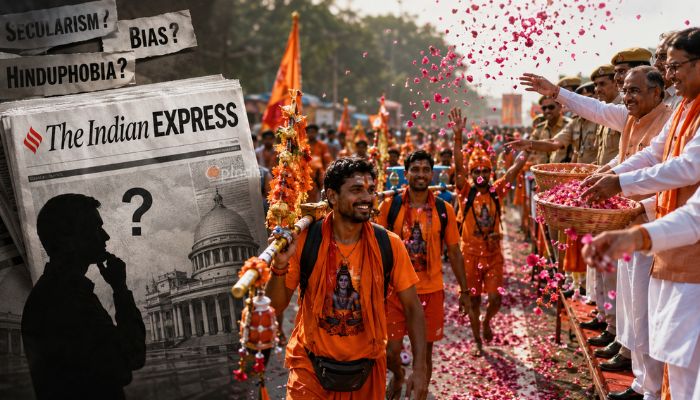
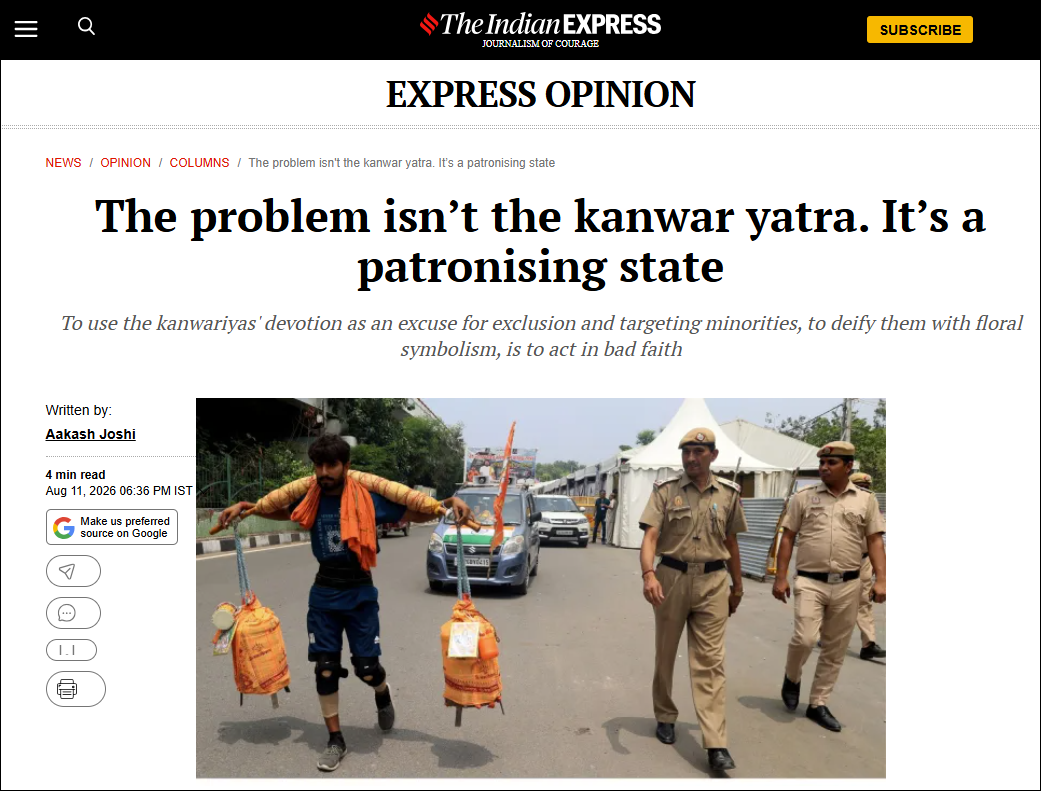
In recent years, it has become ritualistic for the leftist media cabal to vilify Kanwariyas and Kanwar Yatra, in their ideological pursuit of peddling Muslim victimhood and their perverted idea of secularism. While the likes ofThe Wire indulge in explicit Hinduphobic propaganda, The Indian Express veils their identical manoeuvres with layers of nuance.
On the last day of this year’s Kanwar Yatra, 11th August, The Indian Expresspublished an opinion piece headlined, “The problem isn’t the kanwar yatra. It’s a patronising state”.
Beginning with how upper-middle-class and car owner view Kanwariyas as a traffic nightmare and a threat to safety, author Aakash Joshi comes to the real agenda. The author argues that since 2014, essentially with the coming of the BJP in power at the Centre, government authorities have been “trying to “facilitate” the yatris.”
“In doing so, they are not only undermining the secular foundations of the Indian state — the Union of India has no religion — they are also falling into an old trap, which is both dangerous for the Republic and patronising to the believer,” The Indian Express article reads.
Floral showers on Kanwariyas by administrative officials undermine Indian Express’s idea of secularism
How is it that facilitating Kanwar Yatra for Hindus ‘undermines’ India’s secular foundations but the government facilitating and even offering subsidies to Muslims for Haj is not?
How is it that ministers of ‘secular’ (read Muslim-appeasing) political parties organising or partaking in Iftar parties does not undermine secularism? Does showering flowers on Kanwariyas alone undermine India’s secular foundations?
While it is true that the Union of India has no official or state religion, India’s foundation is rooted in Hindu consciousness. Without a Hindu majority, India would, without a scintilla of doubt, lose its legal and, in spirit, secular character.
The article further claims that after 2014, governments are not just facilitating the Kanwar Yatra but are “imposing assumed taboos and even prejudices.”
By ‘governments’, the author specifically meant the BJP governments. The article laments the 2023 decision of the BJP governments in Uttar Pradesh and Uttarakhand to ban sales of non-vegetarian food along the Kanwar Yatra route.
Government directions to shopkeepers to display proprietor name is ‘dog whistle’ against ‘minorities’: For Indian Express, basic transparency is ‘attack on Muslims’
Aakash Joshi described the government orders to shopkeepers and eateries to display their proprietor’s name as “a dog whistle to food segregation and against minority-owned and run businesses.”
How is displaying proprietor’s name a dog whistle? Kanwariyas are free to purchase fruits and other goods from anyone, and the government’s directions to put the names of the street vendors and the hotel owners on their boards were for all and not specifically for Muslims.
There have been numerous incidents wherein Muslims were found to be running shops with the names of Hindu deities, giving an impression that the shop is owned and run by Hindus; however, upon paying via UPI, which displays the real name of the user, it turned out that the shop belonged to a Muslim person. Why this subterfuge, if intentions are right?
How can basic transparency be deemed a dog whistle? Will Aakash Joshi be fine with Hindus selling pork in a Muslim-dominated area during Ramzan, Muharram, or Eid?
It is amusing that the same liberal coterie that describes a mere call to mention the proprietor’s name as religious discrimination, segregation and whatnot shamelessly defends the exclusionary Halal certification of a vast range of products.
There have been instances of Muslim-owned shops being caught spitting on the food or fruits and vegetables they sell. In such a situation, not only Kanwariyas during Sawan but Hindus otherwise also would want to be cautious and informed about who is serving them food.
The article draws a contrast that on one hand, Muslim shopkeepers are being arrested for selling non-veg food along the Kanwar Yatra route, on the other, the senior police officials are showering flower petals on Kanwariyas.
“Has there been an outpouring of demand to target Muslim businesses from the young pilgrims? Have they demanded floral showers?” the author asks.
The Hindu Kanwariyas have certainly demanded ‘targeting’ of Muslim businesses; they have also not demanded floral showers.
During the Kanwar Yatra in the holy month of Sawan, Kanwariyas maintain a Sattvic diet and strictly refrain from even visiting non-veg eateries, let alone consuming non-veg. It is for this reason that food compatibility was implemented along the Yatra route. Is all secularism, accommodation, and adjustment for communal harmony reserved only for Hindus?
It is also interesting that liberals never show such outpour of concern for targeting of one community to appease other when Muslims attack Kanwariyas, pelt stones, or obstruct their path.
“A kanwar yatri is no less a citizen, no less rational and no less demanding of their government than the student protestor in Jantar Mantar and Jharkhand. To use their devotion as an excuse for exclusion and targeting minorities, to deify them with floral symbolism, is to act in bad faith,” the IE article reads.
Floral showers by state officials only signify respect and are cultural symbolism; this gesture is deification of Kanwariyas. Even the supposed ‘Hindu hardliner’ and ‘Islamophobic’ Modi government garlands Haj pilgrims before departure to Saudi Arabia. Does this mean the ‘Hindutva’ government mocks rationality, intellect, and uses their devotion for political optics despite knowing that Muslims largely never vote for the BJP?
Amusingly, the Indian Express also has a problem with Shiv Bhakt Kanwariyas ‘revelling’. In fact, Aakash Joshi wants the ‘powers’ to ask why Kanwariyas revel, why they undertake the Yatra, and what they pray for.
“Perhaps, the powers should listen to the pilgrims — ask them why the release of religious revelry matters so much to them, why they undertake the journey, what they pray for when they do. Then, maybe, they might do what governments are supposed to, instead of believing that pandering is the only politics the pious understand,” the article adds.
One wonders if The Indian Express editor would ask why raising ‘Sar Tan Se Juda’ slogans in Muharram processions matters to Muslims so much, why they remain adamant about slaughtering cows on Bakrid despite no religious compulsion, why they even take out their Juloos, and what they pray for when they offer namaz by blocking roads. Patronising cuts both ways.
Floral showers on Kanwariyas or ensuring that the sanctity of their Yatra is not violated does not amount to insulting their rationality. Patronising cuts both ways. History of independent India is witness to which community has relied on pandering and appeasement by the country’s ‘secular’ parties and government and which community has been subjected to constant neglect, mockery, scrutiny, and villainization.
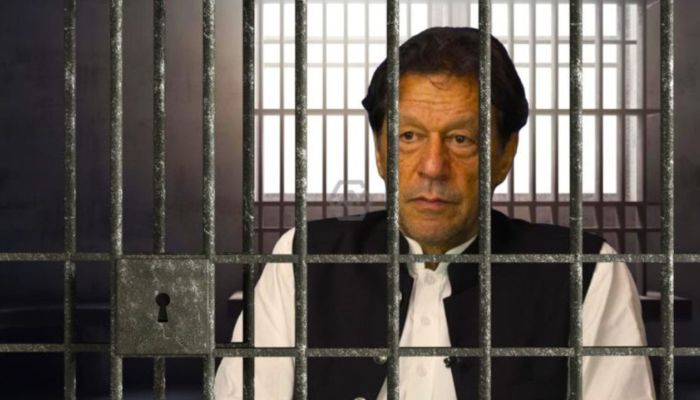
Fresh claims about the death of jailed former Pakistan Prime Minister Imran Khan have once again sparked concern and confusion in Pakistan. Pakistani journalist Wajahat Saeed Khan has claimed that three senior military sources believe Khan may have died in prison. However, the claim has not been independently confirmed, and the journalist himself said that his sources had not personally seen Khan.
BIG: Senior Pakistani Journalist Wajahat S Khan claims that his sources who are three Senior Officers in Pakistani Army have said that they fear Former Pakistan PM Imran Khan is dead inside prison and hence Pakistan Army Chief Asim Munir is hiding him from the entire country. pic.twitter.com/IDjeqFEh1s
Wajahat, an Emmy-nominated journalist based in the US, made the claim in a YouTube video posted on 10th August. He said the information came from senior officers based at the Pakistan Army’s General Headquarters (GHQ) in Rawalpindi.
According to him, at least three officers separately expressed the view that Imran Khan was “no longer with us”. At the same time, Wajahat admitted that none of his sources had personally seen Khan. He repeatedly stressed that the information had not been confirmed and said he hoped the claim was not true.
The claim has gained attention at a time when Khan’s family, lawyers, party leaders and doctors have complained about difficulties in meeting him. His sisters and Pakistan Tehreek-e-Insaf (PTI) leaders have repeatedly sought access to the former prime minister, while the party has demanded an independent medical assessment of his health.
Khan has been in prison since 5th August, 2023 and is currently serving a 14-year sentence in the £190-million Al-Qadir Trust corruption case. His wife, Bushra Bibi, was sentenced to seven years in the same case in January 2025. Both have challenged their convictions. Khan also faces pending cases linked to the 9th May, 2023 protests, during which PTI supporters attacked military installations across Pakistan.
Death claim fuels fresh tension
The uncertainty over Khan’s condition has added to tensions between PTI and Pakistan’s military establishment. Khyber Pakhtunkhwa Chief Minister and PTI leader Sohail Afridi has claimed that more than two million people are ready to take to the streets.
Afridi said PTI was not making an unconstitutional demand and maintained that meetings with Khan would not be used to pass political messages. He also warned of growing anger among young Pakistanis. PTI has announced a long march towards Islamabad on September 27 and has threatened earlier protests if Khan’s family and doctors continue to be denied access to him.
With access to Khan still a major issue, the latest claim has once again raised the question: Is Imran Khan dead? For now, there is no confirmation in the material available to establish that he has died.
Similar rumours surfaced last year
This is not the first time rumours of Imran Khan’s death have surfaced. Similar claims spread in November last year after his family and party colleagues struggled to meet him and confirm that he was safe.
The rumours were put to rest on 2nd December, when Khan’s sister Uzma Khanum met him at Adiala Jail. She said that he was physically well, although he was being kept in isolation.
Another major death rumour surfaced in November when Afghanistan Times reported that Khan had been killed inside Adiala Jail. The report claimed that the 72-year-old former prime minister had died after suffering torture in prison and that his body had been moved outside the jail. Pakistani authorities denied the claim and said Khan was alive.
A fake ‘government press note’ also claimed Khan’s death
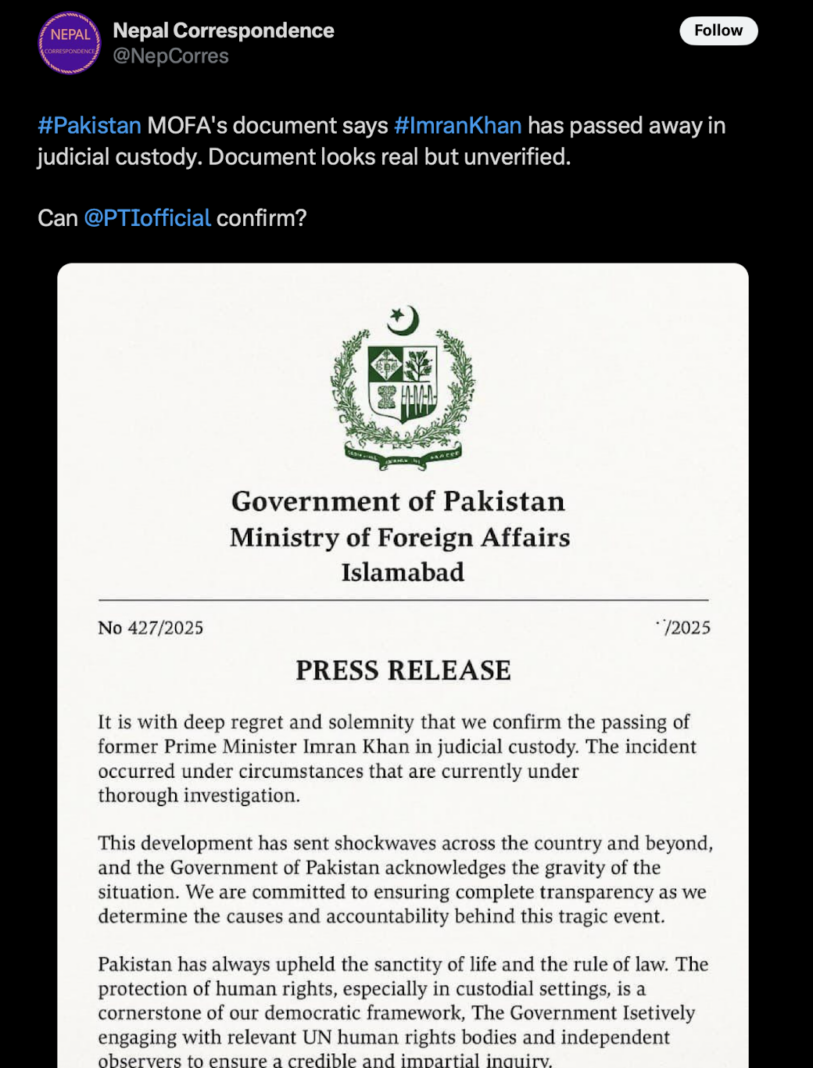
In May 2025, social media was flooded with an image presented as a press release from Pakistan’s Ministry of Foreign Affairs. It claimed that the government had confirmed Khan’s death in judicial custody.
The document, however, contained several signs that raised questions about its authenticity. It did not carry a proper date, despite being marked “No 427/2025”, and contained formatting, punctuation and language mistakes. There was also no confirmation from major Pakistani or international news organisations, the Ministry of Foreign Affairs or the Prime Minister’s Office.
The document was therefore found to be a doctored image rather than a genuine government statement. It came amid other unverified claims about Khan’s treatment in prison, adding to concerns over misinformation surrounding his health and safety.
Claims of assault in jail also turned out to be false
Death rumours were not the only claims surrounding Imran Khan’s time in jail. In May 2025, a purported medical report circulated on social media claiming that Khan had been sexually assaulted in prison.
The document, said to be from Pak Emirates Military Hospital (PEMH), described serious injuries and mentioned tests for HIV, hepatitis and other sexually transmitted infections. It also claimed that Khan’s release depended on clearance from Pakistan’s Chief of Army Staff.
However, the document contained a major inconsistency: it was dated 3rd May, 2025, but had already started circulating online on 2nd May. More importantly, official information indicated that Khan’s medical evaluation had been carried out by doctors at the Pakistan Institute of Medical Sciences (PIMS) in Islamabad, not PEMH.
These discrepancies strongly indicated that the medical report was fake. Khan’s legal team did not issue a public statement confirming sexual assault, and no credible reporting or official statement supported the claim.
The repeated rumours about Imran Khan’s death, health and treatment in jail have continued to spread whenever his family and supporters face difficulties accessing him. The latest claim by Wajahat Saeed Khan has therefore revived an old question around the jailed former prime minister, but until there is confirmation from credible official or independent sources, the claim that Imran Khan has died remains unverified.
The self-proclaimed neutral student leader who created the Cockroach Janta Party from the US, under the guise of education reform in India over the alleged leak in the NEET examination, has resurfaced with AAP links again, and his lies are no longer hidden. While Dipke has tried hard to project himself as a spontaneous youth icon who simply stumbled into public advocacy out of frustration with the system, digital footprints and viral posts tell a completely different story.
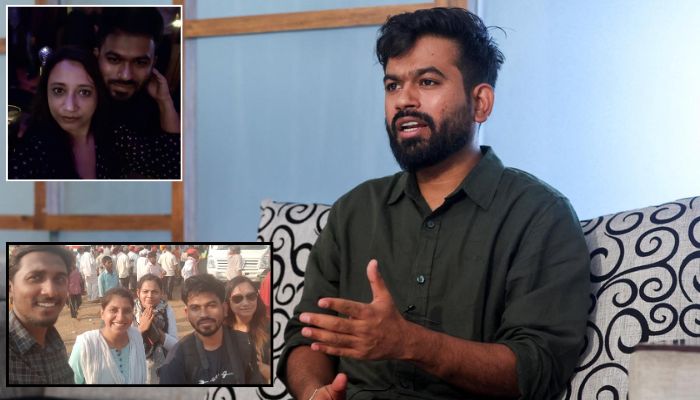
Recent viral social media posts have proven that Dipke was actively associated with the Aam Aadmi Party (AAP) as far back as 2016, and not merely from 2020 to 2023 as he falsely claimed during his televised interview with News24. This revelation blows a massive hole in his narrative of being an independent voice operating without political backing.
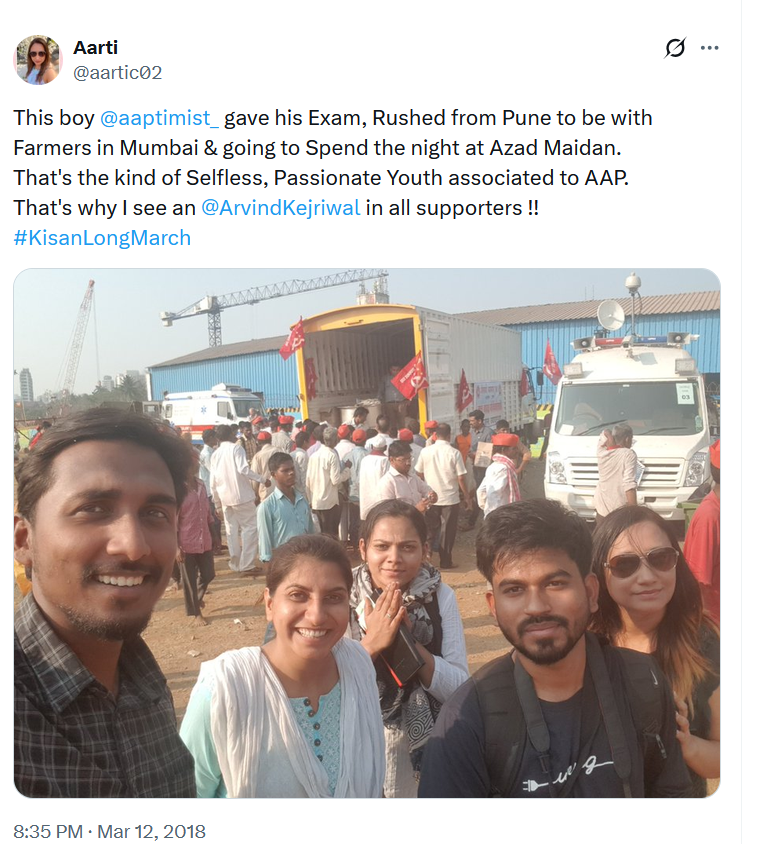
The truth began spilling out when an old 2018 post by Aarti Chadha resurfaced on X (formerly Twitter). The photo of Aarti Chadha and CJP founder Abhijeet Dipke has gone viral, drawing intense attention online. Chadha, who was identified as a key member of AAP’s social media team, had posted a picture with Dipke on 12th March, 2018, explicitly tagging his former handle @aaptimist_, a username he actively maintained until 2020, and which proves his association with AAP without any doubt.
This boy @aaptimist_ gave his Exam, Rushed from Pune to be with Farmers in Mumbai & going to Spend the night at Azad Maidan. That's the kind of Selfless, Passionate Youth associated to AAP. That's why I see an @ArvindKejriwal in all supporters !!#KisanLongMarchpic.twitter.com/NBbsoARDcB
Praising him at the time, Chadha wrote: “This boy @aaptimist_ gave his Exam, Rushed from Pune to be with Farmers in Mumbai & going to Spend the night at Azad Maidan. That’s the kind of Selfless, Passionate Youth associated to AAP. That’s why I see an Arvind Kejriwal in all supporters !!”
Years later, on his birthday in 2024, Chadha tagged his updated handle while warmly acknowledging his crucial role in the party’s online rise: “Happy Birthday Dude @abhijeet_dipke One who worked tirelessly behind the scenes & added the Missing Zing to AAP SM Rise & Shine.” Dipke even replied to her post with a cordial thank you, confirming their long-standing professional bond.
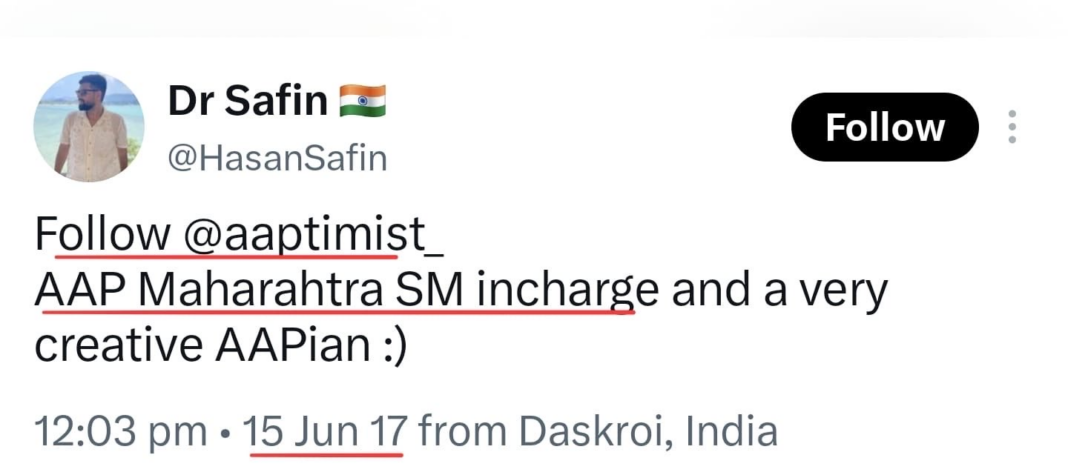
Despite this clear paper trail, Dipke flatly claimed in his News24 interview that his formal association with AAP only spanned from 2020 to 2023. Yet, multiple other AAP insiders have publicly documented his involvement much earlier. On 15th June, 2017, AAP member Hasan Safin openly promoted Dipke’s account, writing: “Follow aaptimist_ AAP Maharashtra SM in-charge and a very creative AAPian.”
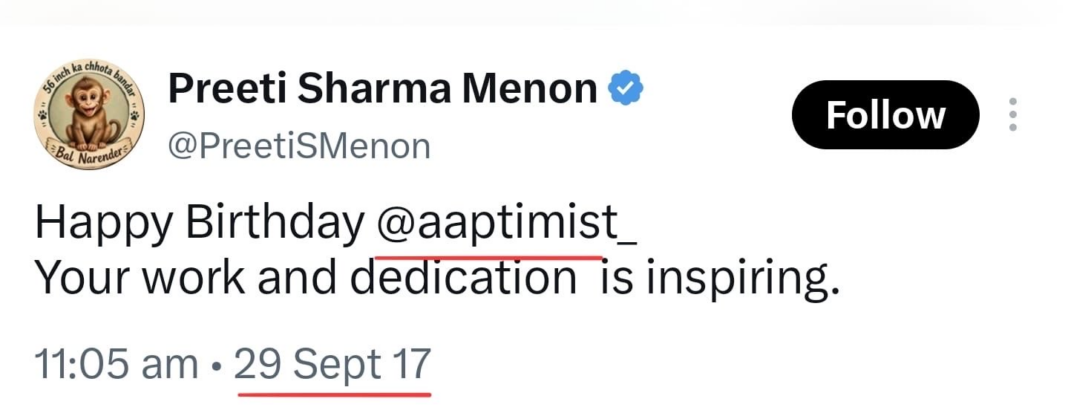
Further establishing his deep-rooted ties, AAP Mumbai President Preeti Sharma Menon publicly wished him on his birthday on 29th September, 2017, directly tagging his @aaptimist_ handle.
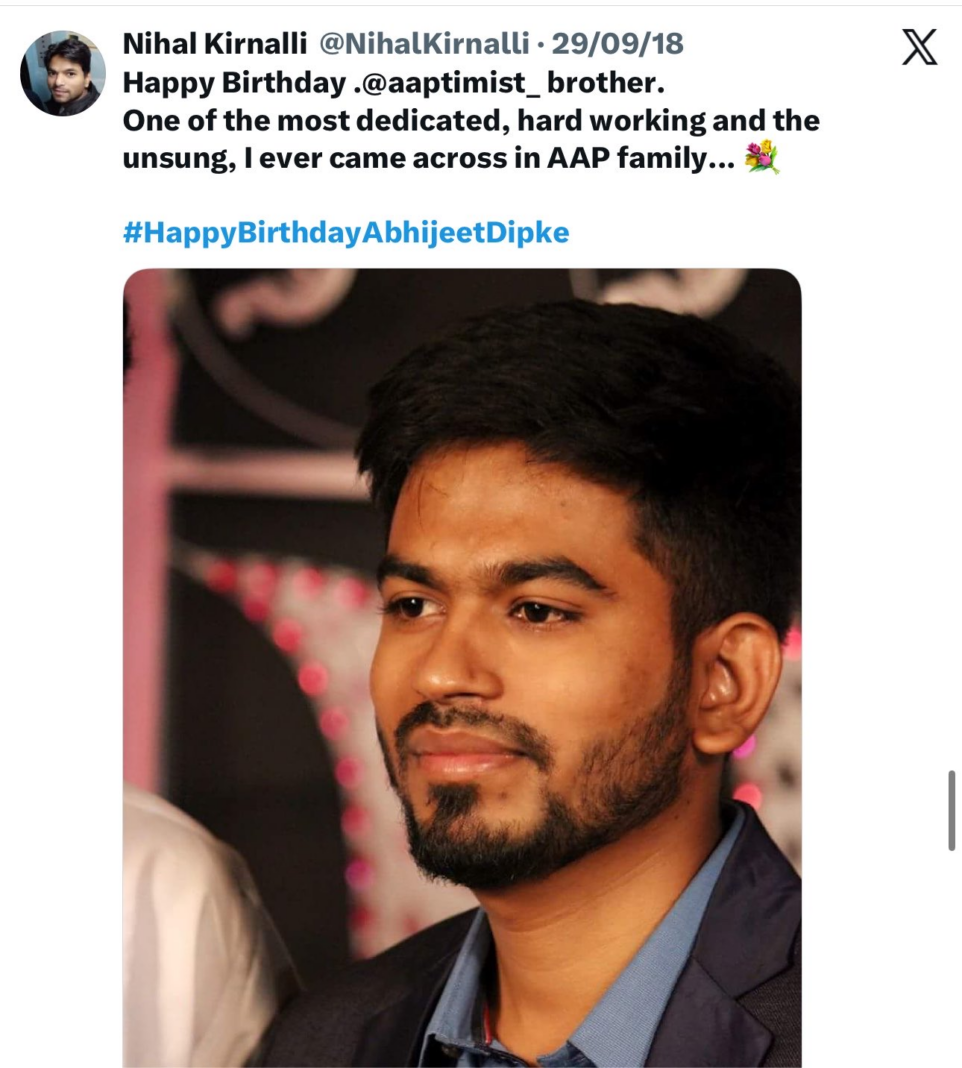
Another party activist, Nihal Kirnalli, posted a photo of Dipke on his birthday in 2018 along with the message: “Happy Birthday, aaptimist_ brother. One of the most dedicated, hardworking and the unsung, I ever came across in the AAP family.”
A history of political warfare and campaign strategy
This is far from the first time Dipke has found himself at the centre of controversy over his direct operational links with AAP. During the 2020 Delhi Assembly elections, media reports identified him as a 23-year-old strategist from Pune operating at the core of AAP’s IT war room under social media head Ankit Lal. He was heavily credited with transforming the party’s digital strategy by crafting catchy one-liners, Bollywood parody videos, and viral memes to project “Brand Kejriwal” while launching sharp attacks on political rivals.
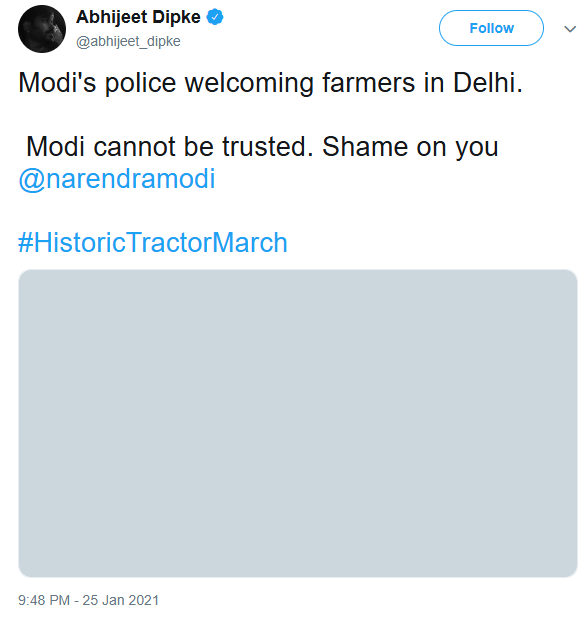
His history reveals a consistent pattern of anti-government messaging. During the violent farm law protests in Delhi, Dipke posted videos of police line movement, tweeting: “Modi’s police welcoming farmers in Delhi. Modi cannot be trusted. Shame on you @narendramodi #HistoricTractorMarch.”
More recently, he began pushing conspiracy theories surrounding election outcomes, alleging without proof that voter deletion was behind opposition defeats, a radical claim that later mysteriously made its way directly into the CJP manifesto, demanding the arrest of the Chief Election Commissioner under UAPA.
From the so-called NEET reforms to anti-National slogans
Armed with a polished background in digital manipulation, this AAP-backed operative managed to orchestrate a massive political movement from thousands of miles away in the US. Dipke emotionally manipulated thousands of honest, stressed students across India, convincing them that the CJP was an independent student uprising fighting solely for NEET paper leak accountability and national education reforms.
However, once thousands of young aspirants gathered at Delhi’s Jantar Mantar, the ground reality quickly degenerated. The protest was rapidly hijacked by far-left student organizations like AISA, AFI, SIMI and JNUSU. Instead of staying focused on exam fairness, speaker after speaker took the microphone to push radical political agendas. Danish Ali, Joint Secretary of JNUSU, addressed the crowd by openly defending individuals jailed under anti-terror laws: “Friends, my name is Danish, and I come from the Centre for Historical Studies. This is the same centre from which our friends Sharjeel Imam and Umar Khalid come. Ask why they have been in jail for so many years. It is because they dared to challenge the ruling government and question those in power.”
The demonstration soon spiralled into chaos, with activists shouting “Azadi” slogans, making inflammatory statements, and, in earlier demonstrations, even harassing women journalists on duty.
The betrayal of India’s youth
Ultimately, the mask has completely fallen off the CJP movement. What was presented to the nation as an organic, youth-led uprising turns out to have been calculated political theatre designed by an experienced party handler operating remotely from the US.
By pulling strings from abroad, lying about his political history, and exploiting the genuine anxieties of NEET candidates, this so-called well-wisher of students created immense public disruption across India.
Thousands of naive students who trusted his “neutral” banner were used as political props, leaving a trail of broken promises, hijacked protests, and exposed falsehoods in his wake.
Despite attempting to erase his footprint and claim neutrality, even Dipke’s current X account retains a telling tweet from 2023, in which he wrote: “Still with AAP and will always be with AAP.” His long-standing political ties demonstrate that the movement was used to serve party interests under the guise of an independent youth uprising.
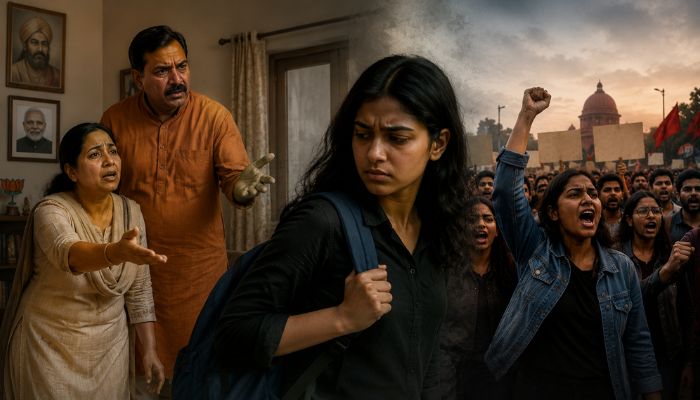
The recent wave of claimed student demonstrations sparked by the Cockroach Janata Party (CJP) at New Delhi’s Jantar Mantar exposed a deep, festering tear in the fabric of Indian households. Across cities and towns, political ideology is no longer just something discussed during election cycles; it has turned into a wall between parents and their children. The protests became a boiling point, showing how radicalisation, digital activism, and ideological clashes have created violent anger in young Gen Z minds, leaving many kids walking away from their homes and hating their parents over political views.
Take the case of 19-year-old Kunal Choudhary from Ludhiana. When he left home to join the protests, he knew he was burning his bridges behind him. Choudhary was raised in a hardcore Bharatiya Janata Party (BJP) and Rashtriya Swayamsevak Sangh (RSS) family, and was an active RSS worker himself. Yet, standing at Jantar Mantar, he severed all ties with his past.
His father, Jeevan Choudhary, a businessman who built his life around RSS values, watched his son broadcast a viral video criticising the ruling party. “They don’t teach you anything useful. They only tell you how to hate Muslims and Dalits,” Kunal openly said about his family’s ideological background.
The rift widened so much that even after the protests were called off on 25th July, Kunal refused to return home. Living in a local gurdwara, relying on communal kitchens, and working odd jobs, he admitted that the difference between his worldview and his family’s was simply too vast to bridge.
A similar story plays out with 24-year-old Priya Singh. Her father, a 55-year-old security firm employee, holds a firm loyalty to the BJP. When Priya made up her mind to join the Jantar Mantar demonstrations, her father warned her. Forced to hide her identity, Priya covered her face during the protests so her family wouldn’t spot her in news photos or online clips.
When she confronted her father over videos showing police action against violent protesters during the protests, he defended the police, claiming that they were right to act against the protesters to control the violence. The hostility at home had started earlier, when Priya secretly cleared the entrance exam for Jamia Millia Islamia without informing her family. Her father accused the institution of trying to convert her.
Today, Priya lives a double life, saying, “Now, when I come home, I don’t mention anything about my friends or classes to my family. I don’t even take calls from friends at home.
Flaunting conflict: The Gen Z trend of villainising parents
What makes this generational split unique today is how young left-liberal activists actively take pride in fighting with their elders. Confronting parents over their political views, recording these intense arguments, and broadcasting family clashes on social media has become a badge of honour among Gen Z youth.
Parents who support the BJP or Prime Minister Modi are routinely villainised online by their own children as “brainwashed” or “bigoted.” Instead of seeking common ground or keeping family bonds intact, youth activism encourages teenagers and young adults to publicly shame their parents’ conservative beliefs to prove their own ideological purity.
The CJP protests, heavily organised and steered by left-liberal student fronts, highlighted this reality. For hundreds of young demonstrators, travelling to Jantar Mantar was as much about rebelling against their conservative households as it was about demanding exam reforms. The protest grounds became a stage where young people flexed their rebellions on Instagram and X, posting stories about fighting with their parents, leaving home, or disobeying family orders just to stand on the front lines. The emotional fallout on families was brushed aside, framed instead as a victory for personal liberation and online engagement.
Glorifying disownment: The case of AISA’s Neha Bora
International media outlet Al Jazeera have played a key role in romanticising these family breaks, turning political hostility against one’s own parents into a heroic act. A primary example of this glorified hostility is Neha Bora, the 29-year-old national president of the All India Students’ Association (AISA).
During an interview with journalist Barkha Dutt, Bora spoke openly about her complete ideological detachment from her parents, a serving Army officer father and a homemaker mother, both of whom support the BJP. Media coverage frequently portrays her open defiance and contempt for her family’s background not as a tragedy of broken personal relationships, but as an inspirational act of political courage.
Bora, a doctoral student at Jawaharlal Nehru University (JNU), has become one of the most visible faces of left-wing student politics in India. As the national leader of AISA, she regularly uses student-centric issues, such as national exam leaks, as a doorway to push radical leftist agendas.
Under her leadership, AISA launched campaigns like “Cockroaches on the streets” and joined the CJP protests, where activists quickly shifted slogans from exam irregularities to demands for “Azadi” and political rhetoric. In public statements, Bora has actively whitewashed anti-terror charges against figures like Umar Khalid and Sharjeel Imam, calling them “ordinary students” subjected to political prosecution, while ignoring court observations regarding their roles in the 2020 anti-Hindu Delhi riots.
Beyond student rights, her digital footprint shows an explicit anti-Brahmin stance masked under the term ‘Brahmanvaad’, opposition to broad Hindu consolidation efforts claiming it frightens minorities, and active support for a free Palestine while downplaying domestic radicalisation threats.
The Leftist playbook: Destroying the family to rebuild the state
This growing drive among young activists to reject their parents is not an accidental byproduct of modern politics; it is a core structural strategy of classic communist and radical leftist theory. To bring about a total political and social revolution, radical ideologies have historically viewed the traditional nuclear family as an obstacle that must be dismantled. The family unit acts as a natural buffer, teaching children heritage, traditional values, authority, and unconditional personal loyalty.
By pushing young individuals to view their parents not as caretakers, but as symbols of “oppressive structures” or “reactionary politics,” far-left ideologies break these foundational emotional bonds. Once a young person is alienated from their home, the party or ideological collective steps in to replace the family, becoming their primary source of identity and belonging.
The recent wave of youth protests shows this playbook in action: kids are encouraged to sacrifice their education, leave their homes, cut off their parents, and find a new “family” among fellow communist and leftist activists on the streets. In the pursuit of ideological victories, the very foundation of the home is being systematically burned down.
Union Home Minister Amit Shah on Wednesday threw down the gauntlet to the Opposition amid the continuing parliamentary deadlock over alleged police excesses against student protesters, offering to sit through an extended debate and answer every question raised by MPs.
Shah said he was ready to remain in Parliament from 3 pm on Wednesday until 3 pm the following day, listen to the Opposition’s concerns and respond point-by-point. His challenge came as opposition parties continued to demand that he personally address the alleged police action during a July 20 student march over the NEET paper leak issue.
मोदी सरकार संसद में हर तरह की चर्चा के लिए तैयार है। मगर विपक्ष का उद्देश्य चर्चा करना नहीं, हंगामा करना है।
विपक्ष लोकसभा अध्यक्ष जी के पास चर्चा का पत्र दे, आज दोपहर 3 बजे से कल दोपहर 3 बजे तक हम चर्चा करने के लिए तैयार हैं। मैं कल विपक्ष के एक-एक सवाल का जवाब दूँगा।
The Home Minister also pushed back against repeated Opposition claims that he had been “missing” from Parliament.
“Terms like ‘laapata’ and ‘bhaag gaye’ are increasingly being heard in India’s public and parliamentary life,” Shah said, arguing that he had been attending Parliament regularly but that repeated disruptions had prevented meaningful proceedings.
Shah said the government had already accepted the Opposition’s demand for a detailed discussion and maintained that there was no reason for the standoff to continue.
Parliamentary Affairs Minister Kiren Rijiju had also made it clear that the government was prepared for a comprehensive debate on the student protests, Shah pointed out. According to the Home Minister, the Opposition had initially sought a discussion, but was now refusing to allow one to take place.
Shah then put the ball firmly in the Opposition’s court.
He asked opposition parties to submit a letter to the Speaker by 2 pm, following which the discussion could begin at 3 pm. He offered to remain in the House until 3 pm the next day to hear the entire debate and respond to every issue raised.
“I will sit in the House; I will listen to everyone and respond to every point. The government has nothing to hide,” Shah said.
He even offered to allow the discussion to continue late into the night and suggested that Question Hour could be suspended if the Speaker permitted it, underscoring his claim that the government was ready for an exhaustive debate.
Shah argued that the Opposition’s demand for a standalone statement from him was not an adequate way to deal with an issue of such seriousness.
“There are established rules and procedures for parliamentary discussions,” he said, stressing that serious allegations should be subjected to a detailed debate rather than being reduced to a one-sided statement.
The Home Minister also said the discussion could cover not only the allegations against the government but also why the Opposition had repeatedly prevented the matter from being debated in the first place.
“The NDA government under Modi ji’s leadership is ready to discuss anything; they just need to let Parliament function,” Shah said.
Rahul Gandhi rejects Shah’s offer
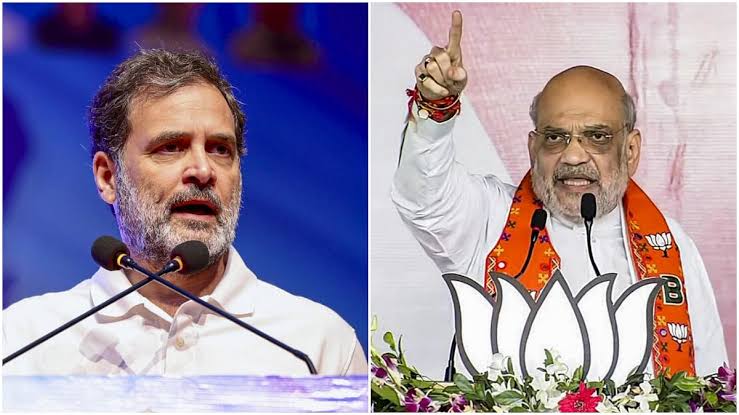
Leader of Opposition in the Lok Sabha Rahul Gandhi, however, rejected Shah’s proposal, insisting that the Opposition wanted answers about the alleged police action rather than what he described as a lecture from the Home Minister.
Rahul questioned who had ordered the alleged use of force against the protesting students and directly sought to know whether Shah had authorised the action.
“Did Home Minister Shah give orders to shoot our children or not? If he did, he is culpable and if he did not, he is incompetent,” Rahul said.
He further alleged that Shah had avoided appearing in the House for nearly three weeks and accused the Home Minister of lacking the courage to face the Opposition.
Rahul later amplified his attack on X, writing that when a person lacks the courage to speak the truth, “silence speaks for him”, and alleging that Shah’s silence amounted to a confession.
The Congress leader’s response effectively rejected Shah’s proposed format for the debate, keeping the confrontation between the government and the Opposition alive. But the dismissal also represents the growing number of instances when the opposition has scooted away after shooting salvos at the Centre. Be it vote chori allegations or the recent students’ protests, where the Opposition, particularly the Congress party, is milking political mileage out of it instead of seeking a permanent solution.
Opposition continues protests
The INDIA bloc has been demanding Shah’s presence in Parliament and a statement over the alleged police excesses against students. The confrontation has also spilled beyond the issue of the student protests.
Earlier on Wednesday, opposition MPs, including Congress president Mallikarjun Kharge and Congress general secretary Priyanka Gandhi Vadra, staged a protest in the Parliament House Complex over allegations concerning donations at the Ram temple in Ayodhya as well as the alleged police action against students.
Priyanka Gandhi also questioned the government over allegations of lathi-charge, pellet-gun use and the deployment of force against protesters.
The Opposition has maintained that the allegations warrant direct accountability from the Union Home Minister, while the government has repeatedly argued that it is ready for a detailed discussion but wants parliamentary proceedings to be allowed to function.
Government challenges Opposition to debate
The latest confrontation follows remarks by Parliamentary Affairs Minister Kiren Rijiju on Monday, when he said the government was prepared for a “full and detailed discussion” on the student movement and related events.
Rijiju, however, urged opposition MPs not to disrupt proceedings while Shah was responding to the debate.
The government has therefore attempted to frame the dispute as a choice between discussion and disruption: it says it is willing to face questions, but the Opposition must first allow Parliament to function.
Shah’s latest offer raises the stakes further. By volunteering to remain in the House for 24 hours and answer every point raised by the Opposition, the Home Minister has effectively challenged Congress and the INDIA bloc to take up the debate on the floor of Parliament rather than continue with protests and demands for a standalone statement.
The Opposition, meanwhile, appears unwilling to accept the government’s proposed terms and continues to insist that Shah must first directly answer allegations surrounding the police action.
With both sides refusing to back down, the political question now is straightforward: does the Opposition want an extended debate with the Home Minister answering questions on the record, or does it want to continue demanding a statement on its own terms?
Shah’s offer has certainly shifted the political pressure. If Congress believes it has unanswered questions, it now has an opportunity to put them before the Home Minister in Parliament and seek answers point-by-point. If it refuses, the government is likely to use that refusal to reinforce its charge that the Opposition is more interested in creating an uproar than allowing a substantive debate.
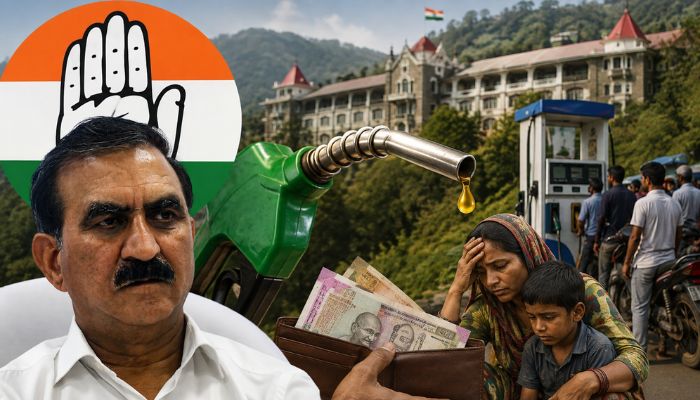
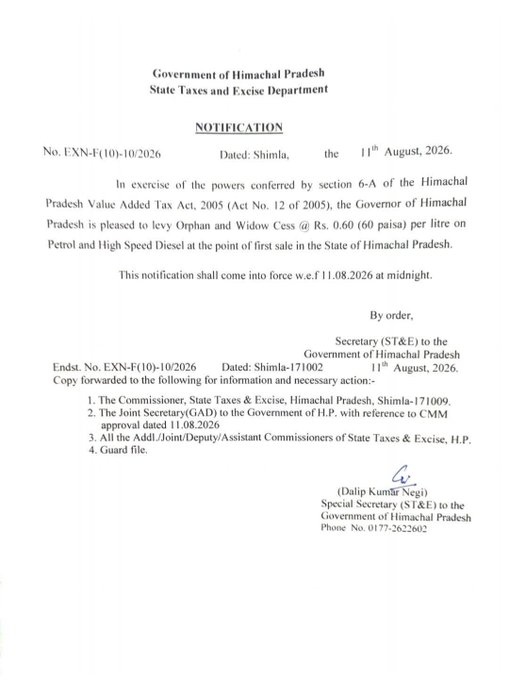
The Himachal government, ruled by the Congress, has imposed a new Widow and Orphan Cess of 60 paise per litre on petrol and high-speed diesel, adding another charge to fuel prices in the state. The new cess came into force from midnight on 11th August after the State Taxes and Excise Department issued a notification on Tuesday.
हिमाचल प्रदेश की तुलना में पंजाब, हरियाणा और उत्तराखंड में पेट्रोल-डीजल के दाम अधिक हैं। यहाँ विधवा बहनों के बच्चों और अनाथ बच्चों की पढ़ाई के लिए केवल 60 पैसे का सेस लगाया गया है।
इस सेस के लिए विधानसभा में कानून भी पारित किया गया था। हमारा प्रयास है कि किसी बच्चे की पढ़ाई… pic.twitter.com/iMDXOhzQND
The notification was issued under Section 6-A of the Himachal Pradesh Value Added Tax Act, 2005, and has the approval of the Council of Ministers. The cess will be collected at the first point of sale of petrol and high-speed diesel in Himachal Pradesh.
Source: AIR News
In simple terms, people buying petrol and diesel in the state will now pay an additional 60 paise for every litre. The money is meant for welfare measures related to widows and orphaned children. But the decision comes at a time when the financial condition of the Himachal Pradesh government has already been a major political issue.
The new levy also raises a bigger question: why is a government facing such serious financial pressure repeatedly looking for new ways to collect more money from ordinary people?
What is the widow and orphan cess?
The legal basis for imposing a widow and orphan cess was provided earlier this year when the Himachal Pradesh Legislative Assembly passed the Himachal Pradesh Value Added Tax (Amendment) Bill, 2026 during the Budget Session.
The amendment gave the state government the power to impose a Widow and Orphan Cess of up to ₹5 per litre on petrol and high-speed diesel. The Bill was passed by voice vote, giving the government the legal authority to introduce the additional levy.
The government has now decided to use that power, although it has fixed the cess at 60 paise per litre, much below the maximum limit of ₹5 allowed under the amended law.
The cess will be charged at the initial sale of fuel in the state. This means the levy is collected before the fuel reaches later stages of sale. The State Taxes and Excise Department has circulated the notification to the Commissioner, State Taxes and Excise, senior departmental officers and other concerned authorities for implementation.
The stated purpose is to generate money for welfare measures for widows and orphaned children. However, for people already paying high fuel prices and grappling with rising household expenses, another charge on petrol and diesel means another increase in their daily expenses.
Meanwhile, the BJP has raised some questions about the new cess. BJP’s Amit Malviya published an X post on 11th August, in which he said, “The Orphan and Widow Cess sounds like a noble cause, but in the absence of data on the likely beneficiaries and the proposed payouts against the collections through the cess, it is nothing more than another attempt to fleece the people of Himachal and upset their household budgets. Congress has run the worst possible government in Himachal Pradesh. The people will completely smash Congress out of power in 2027.”
The Orphan and Widow Cess sounds like a noble cause, but in the absence of data on the likely beneficiaries and the proposed payouts against the collections through the cess, it is nothing more than another attempt to fleece the people of Himachal and upset their household… https://t.co/gdMlst0NHJ
A new cess in a state already struggling for money
Himachal Pradesh has been dealing with a serious financial crisis under the Congress government led by Chief Minister Sukhvinder Singh Sukhu, which came to power in December 2022.
The Congress had entered the election with a long list of welfare promises. These included free electricity, monthly financial assistance for women, restoration of the Old Pension Scheme, government jobs and several subsidy-based schemes.
The problem for the government has been that such promises require a steady flow of money. When revenue does not grow fast enough while expenditure continues to rise, the gap has to be filled through borrowing, higher charges, reduced subsidies or new taxes and cess.
That is the situation Himachal Pradesh has increasingly found itself in.
The latest 60-paise fuel cess therefore cannot be looked at in isolation. It comes after a series of decisions taken by the state government to increase revenue and control spending. The government has been under pressure to meet its regular financial commitments while also trying to continue with welfare schemes.
Salary and pension bills add to the pressure
One of the biggest challenges before the Himachal government has been its large salary and pension bill.
The state has monthly commitments of around ₹2,000 crore towards salaries and pensions alone. At one stage, delays in salary and pension payments affected a large number of government employees and retired employees, leading to a major political controversy.
The government also had to rely on additional borrowing to meet its expenditure requirements.
This is where the Congress government’s earlier welfare promises have become a difficult issue. Schemes announced during the election may create expectations among voters, but maintaining them requires money every month. When the state’s own revenue is not enough, the government has to find money from somewhere else.
More taxes, higher charges and fewer benefits
The government has already taken several steps to increase revenue.
The Assembly approved changes that introduced measures such as an environmental cess and milk cess. The government also reduced some subsidy benefits and increased certain user charges.
Changes in electricity benefits, higher diesel prices and increased water charges in rural areas have also become part of the wider debate over the state’s finances.
The government has even explored other possible sources of revenue, including discussions about regulated cannabis cultivation for industrial and medicinal purposes.
Taken together, these steps show the extent of the financial pressure facing the state. Instead of having enough room to comfortably fund its promises, the government has increasingly had to look for additional sources of revenue.
The new petrol and diesel cess adds another item to this list.
Even temple funds were brought into the welfare debate
The financial pressure has also reached temple trusts. The Congress government in Himachal Pradesh called on temple trusts to contribute funds towards welfare schemes. A notification encouraged temple trusts to provide money for programmes including the Mukhyamantri Sukh-Aashray Yojana and Mukhyamantri Sukh Shiksha Yojana.
The move became controversial because temple trusts and their funds are connected with religious institutions, while the government is responsible for arranging money for its welfare programmes through the state budget.
The fact that the government has had to look at temple trust funds, introduce new charges and reduce some benefits shows how tight the state’s finances have become.
Another burden on the people
Against this background, the 60-paise cess on petrol and diesel looks like another attempt to raise money from the public.
Sixty paise per litre may appear small when looked at separately. But petrol and diesel are used across the economy. Fuel is needed for private vehicles, public transport, goods vehicles, agriculture and businesses. Any increase in fuel costs can therefore have an indirect effect on transportation and other expenses.
The Congress government has kept the new cess far below the ₹5-per-litre ceiling provided by the amended law. Yet the basic issue remains that people are being asked to pay another charge at a time when the state government is already struggling with its finances.
The government may present the cess as a measure for widows and orphaned children, but the wider financial story is difficult to ignore. Himachal Pradesh needs money to meet salaries, pensions, welfare commitments and other regular expenses, while its revenue position remains under pressure.
The latest fuel cess is thus another sign of how the state’s financial problems are translating into measures that ultimately affect ordinary people.
For a government that came to power promising extensive welfare support, the growing list of new charges, higher costs, reduced benefits and borrowing has created a very different picture on the ground. Instead of having enough money to comfortably deliver its promises, the Congress government is increasingly looking towards additional collections from citizens.
And now, petrol and diesel buyers in Himachal Pradesh will pay 60 paise more per litre, with the government saying the money will be used for widows and orphaned children. The immediate burden, however, will be borne by the people buying fuel in the state.
The anti-BJP cabal has consistently been peddling false and alarmist narratives about the Special Intensive Revision (SIR) of electoral rolls. In a latest such bid, actor and Sanatan Dharma hater Prakash Raj has claimed that his name has been arbitrarily removed from the electoral rolls in Bengaluru during the ongoing SIR of voter lists.
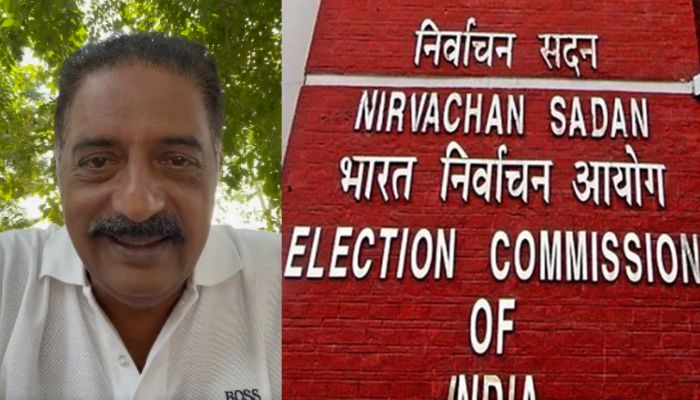
Taking to X on 11th August, Prakash Raj published a 95-second video message in which he claimed that he was among the “65 lakh” voters whose names have been deleted from the voter list during SIR.
Prakash Raj claimed that he was surprised by the deletion of his name, saying that he has very long ties with the constituency.
“Dear friends, saathiyon, I want to share a joke with you. I am one of the 65 lakh voters whose vote right has been deleted from the Bangalore constituency after SIR. Nice joke, no? I was born in this constituency. I lived in this constituency. I had my schooling, college, theatre. And for your kind information, I was an MP candidate of this constituency too,” Raj said.
Fraand 😂😂 you may chose n deny voting rights of few citizens who may not elect you back to thrown.. but can you stop us from eventually bringing you down from your thrown #justaskingpic.twitter.com/S8BpM3CNy0
Prakash Raj insinuated that he has been “denied” the right to vote though SIR at the behest of the BJP-led Central government.
“Well, the joke is nice. Game on. Let me see what is the process I have to go through is. Kya kya kaagaz dikhana padega to get back my voter ID? Well, game on. But one little word, my friend: you can use your powers to deny few of the citizens the right to vote who may not elect you. But can you stop us, my dear friend, from our power of bringing you down? Just asking. Bye,” the anti-Hindu propagandist added.
“Fraand,you may chose n deny voting rights of few citizens who may not elect you back to thrown.. but can you stop us from eventually bringing you down from your thrown #justasking,” the caption of Raj’s post reads.
Predictably, the anti-BJP cabal amplified Prakash Raj’s voter ID deletion claim to further intensify attacks on the Central government and lend credence to outrageous lies that somehow the BJP and the Election Commission have colluded to disenfranchise Muslims and others with a demonstrated pattern of voting against the BJP.
However, the claim made by Prakash Raj that his name was arbitrarily deleted from the Bengaluru electoral roll during the SIR exercise does not hold up against official verification.
Bengaluru civic body refutes the ‘voter name deleted during SIR’ claim by Prakash Raj
The Election Commission of India (ECI) is conducting a Special Intensive Revision of electoral rolls in Karnataka. Reports say that around 1.09 voters, making up to about 19.66% of the state’s total, were flagged under the Absent, Shifted, Deceased, Duplicate/Already Enrolled, or Other category, or the ASDDO category.
However, being flagged under the ASDDO category neither means an automatic nor final deletion. There are provisions for affected voters to submit claims or objections, update details via Form 6, or get verification scrutinised before the draft and final rolls are published.
The ECI will publish the draft roll later in August 2026, while the final electoral roll will be published later in the year.
Meanwhile, Bengaluru Central City Corporation / Additional District Election Officer (and Commissioner) Jagadish G has issued a response debunking Prakash Raj’s claims of forced disenfranchisement.
The official stated that as of 16th June 2026, when the electoral data was frozen for SIR, Prakash Raj’s name remained actively registered in the 163-Shanthinagar Assembly constituency. The official also mentioned specifics, saying that his name was registered in the roll with Serial No. 970, Part No.1.
Moreover, a house-to-house verification by a Booth Level Officer (BLO) at the registered address, No. 266, Garden Apartment, Vithal Mallya Road, revealed that Prakash Raj had permanently shifted. The failed politician, who unsuccessfully contested the 2019 Lok Sabha election from Bengaluru Central, had not resided at the inspected address for about four years.
“During the house-to-house verification conducted by the Booth Level Officer (BLO) of the concerned party, it was found that Mr Prakash Raj had permanently shifted from the registered address at No. 266, Garden Apartment,” Jagadish G said in a statement.
These facts were confirmed by the property manager, neighbours, and the flat owner residing there. Following the verification, a Mahazar or spot verification report was prepared.
Since Prakash Raj had permanently shifted elsewhere, his status was marked “Shifted” in accordance with the Election Commission guidelines. The ECI officials, thus, did not arbitrarily or out of any political bias strike the name of Prakash Raj from the electoral roll.
“Based on their statements, a mahazar (spot inspection report) was drawn, and the voter status was officially marked as ‘Shifted’. This action was executed strictly adhering to the due process of law and the statutory guidelines laid down by the Election Commission of India,” Jagadish added.
In fact, the Additional District Election Officer also stated that he spoke to Prakash Raj by phone, and the actor himself confirmed that he no longer resided at that address. The call was made on 11th August 2026, at 5.30 pm.
Raj also stated that he now resides at a different location still within the same Shanthinagar constituency. The ECI officials said that Prakash Raj can file Form 6 through the BLO to update or register at his current address.
The civic body confirmed that the claims made by Prakash Raj in his social media post were “verified and found not true.”
However, instead of ensuring his own details are updated, Prakash Raj created a hue and cry and cast aspersions on the integrity of the Election Commission.
The Sanatan Dharma eradication enthusiast used a non-issue to lend credence to his and the anti-BJP cabal’s continued efforts to peddle the ‘SIR is backdoor NRC’ bogey.
Interestingly, while Prakash Raj audaciously insinuated that somehow the ECI is ‘compromised’ and targeting Modi detractors, the actor-activist has been under the scanner for allegedly possessing four voter ID cards.
Prakash Raj faces allegations of possessing four voter ID cards
In late June 2026, a non-bailable warrant was issued against him by a Bengaluru court in connection with allegations that he has voter identity cards in several states. In 2019, advocate Dileep Kumar filed a complaint at the Halasuru Gate Police Station, which charged that Raj possessed voter ID cards in four states, including Karnataka, Tamil Nadu and Telangana.
Raj received summonses from the court twice. The actor was instructed in both summonses to appear in court on designated dates. However, he failed to comply both times. The court took note of his absence on both occasions and his continued disregard for the court summons.
The complainant had alleged that Prakash Raj’s name appeared on multiple electoral rolls across Karnataka, Tamil Nadu and Telangana. In addition to Bengaluru’s Shanthinagar, Raj’s name allegedly appeared on voter rolls in Velachery in Chennai, and Serilingampally in Telangana. He was accused of violating the Representation of the People Act provisions that prohibit voter registration in more than one place.