The Guwahati Crime Branch on Thursday registered a First Information Report (FIR) against YouTuber Abhisar Sharma on a complaint of provoking communal sentiments. The complaint was lodged by a local residence named Alok Baruah after Sharma accused Assam CM Himanta Biswa Sarma of practising communal politics.
The FIR has been filed against Sharma under Sections 152 (sedition), 196 and 197 of the Bharatiya Nyaya Sanhita, 2023 (BNS). According to the complaint, Abhisar Sharma ridiculed both the Assam and Union Governments in a recent video published on YouTube.
Complainant Alok Baruah stated that the remarks were made with mala fide intent to disrepute elected governments and have the effect of provoking communal sentiments. The complaint further alleged that such comments are capable of inflaming passions, creating distrust against lawfully established authorities and promoting enmity between religious groups.
Baruah said that “statements like government survives by Hindu-Muslim polarisation, it provokes communal sentiments.” The complaint added, “Perusal of the article published/circulated by Abhisar Sharma the accused clearly reveals that it contained statements ridiculing and denigrating the duly elected Governments of Assam and the Union of India, thereby, endangering the sovereignty, unity and integrity of India.”
The complaint further said, “The accused mocked ridiculed the principle of Ram Rajya, and openly accused the Chief Minister of Assam of communal politics, thereby attempting to create distrust and hatred against the government established by law and promoting enmity between different groups on the ground of religion, prejudicial to maintenance of harmony.” Complainant Baruah further alleged that the article published by Sharma was not mere criticism but amounts to excite disaffection, provoke public disorder, and endanger the unity and integrity of India. “The article published/circulated by the accused Abhisar Sharma is not mere criticism but amounts to an attempt to excite disaffection, provoke public disorder, and endanger the unity and integrity of India by portraying the State as corrupt, communal, and illegitimate, thereby, committed the offence punishable u/s Section 152 of the Bharatiya Nyaya Sanhita, 2023 (BNS),” said the complaint.
‘India is fuelling Russian war machine’, ‘India is profiteering from Russia-Ukraine war’, ‘India is cozying up to Russia’ and whatnot. The Trump administration has assiduously been vilifying India for its Russian oil purchases.
Besides domestic utilisation, India has been buying discounted Russian oil, refining it, and reselling to European markets that have sanctioned Russia, and has essentially ensured that the world does not go through an energy supply crisis. While the US earlier backed India for its role in ensuring stability in global energy supply, suddenly, the Trump administration is furious with India.
US glossing over its substantial gains from the Russia-Ukraine war, while shamelessly villainising India
Recently, US Treasury Secretary, Scott Bessent, dubbed India’s Russian oil purchases and resale of the same, as ‘arbitrage’. Bessent lamented that India made $16 billion in excess profits.
“We have planned to up the tariffs on India, these are secondary tariffs for buying the sanctioned Russian oil,” Bessent declared. Before 2022, he argued, India bought less than 1% of its oil from Russia. “Now, I believe, it’s up to 42%. So, India is just profiteering… they made $16 billion on excess profits, some of the richest families in India.”
Bessent’s ‘India buying sanctioned Russian oil’ comment came even though as per European Union Council Regulation 833/2014, refined crude is no longer ‘Russian’. In simple terms, India is indeed purchasing Russian oil, but what it is selling to Europe is its own refined petroleum products.
And yet, such is the desperation of the officials in Trump administration to blame India for the prolonged Russia-Ukraine war, that Bessent overlooked the fact that the very intent behind the G7’s $60-per-barrel price cap was to keep Russian oil flowing while cutting Moscow’s windfall revenues.
Similarly, White House Advisor on trade adviser, Peter Navarro, also wrote an opinion piece in the Financial Times recently, trying put the sole blame of the Russia-Ukraine war on India, while giving a clean chit to China, Europe and the US itself.
“India acts as a global clearinghouse for Russian oil, converting embargoed crude into high-value exports while giving Moscow the dollars it needs,” Navarro wrote, and further lamented that backed by India, Russia continues to hammer Ukraine, and in turn, American and European taxpayers are “forced to spend tens of billions more to help Ukraine’s defence.”
Both Navarro and Bessent audaciously vilified Indian corporates, but skipped mentioning how American oil companies have made record profits since the Russia-Ukraine war broke out in 2022.
From liquified natural gas (LNG) exports, arms sales, and several other war-driven opportunities, the US is apparently the biggest profiteer of Russia-Ukraine war. So much so, that if Trump genuinely wants to ‘punish’ those fuelling the supposed Russian war machine, he would want Europe to impose sanctions on the US itself.
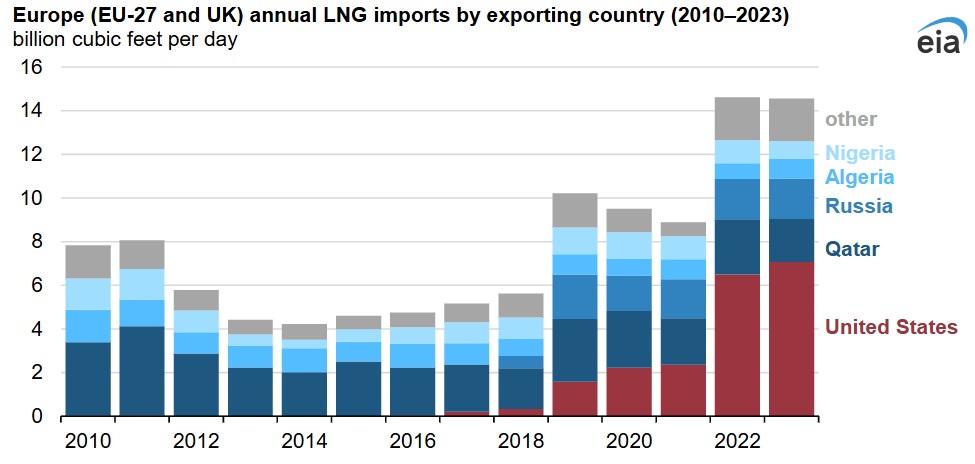
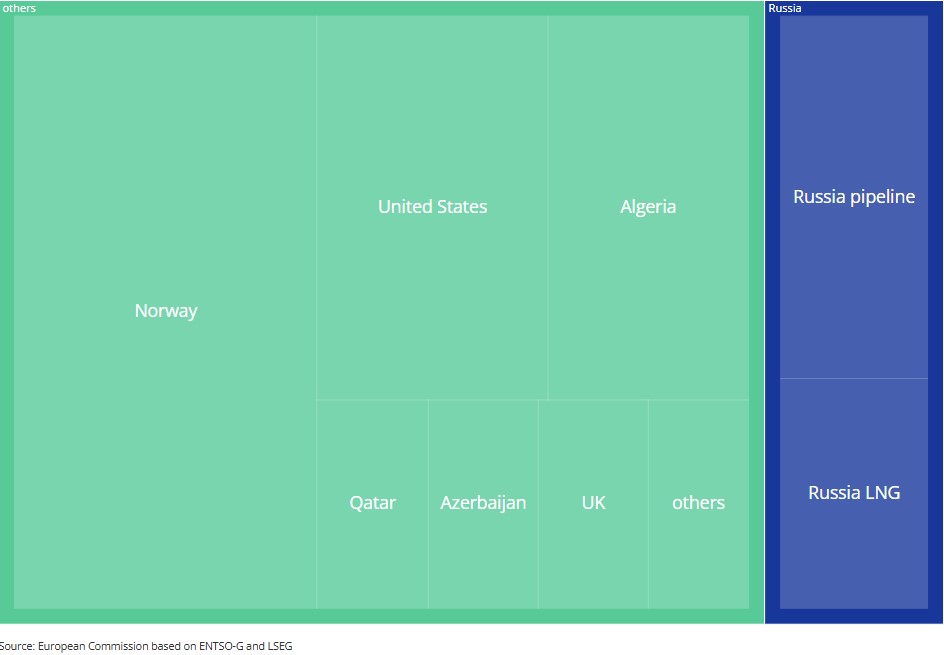
Since the Russia-Ukraine war erupted in 2022, Europe has slashed its reliance on Russia gas, which supplied around 40% of its needs. A barrage of sanctions was directed against Russia to cripple its economy assuming that doing so would compel Moscow into ending the conflict on the West’s terms. While things have not played out that the US and EU planned, the US has filled this LNG supply gap, becoming EU’s top LNG supplier in 2023.
Interestingly, the US sold its cheap LNG to Europe at monumentally higher prices, often four times the US domestic rate citing ‘war-induced disruptions, benefiting from Europe’s urgent need for alternatives. It must be recalled that in 2022, French President Emmanuel Macron slammed the US for charging inflated prices. Even a senior EU official had pointed out that US is “the country that is most profiting from this [Russia-Ukraine] war” through high-priced LNG sales.
“In today’s geopolitical context, among countries that support Ukraine there are two categories being created in the gas market: those who are paying dearly and those who are selling at very high prices, “The United States is a producer of cheap gas that they are selling us at a high price … I don’t think that’s friendly,” Macron said.
In 2022, US oil and gas companies like Chevron and ExxonMobil registered record profits with a massive 125% jump from pre-war 2021. In 2022, the US companies provided 50% of Europe’s liquefied natural gas supplies, in addition, 12 % of its oil. Beset by boycotts, sanctions and the EU price cap, Russian oil and gas sales to Europe shrunk, while the US benefitting from the void, expanded its tentacles and used the same to assert its dominance in NATO as well.
In 2023, the US remained the largest LNG supplier to Europe, accounting for nearly 48% of total LNG imports with France, Spain, the Netherlands and the UK being major importers. In 2024, while Norway accounted for 33% of EU’s gas imports, the US was right behind, having a 16.5% share. In 2024, EU imported over 100 billion cubic meters (bcm) of LNG and the United States was the largest supplier of LNG to the EU, accounting for almost 45% of total LNG imports.
Beyond energy, the US also benefitted from Russia-Ukraine war through its defence exports. The US provided over $19 billion in military equipment to Ukraine, leading to rise in stock prices of American defence manufacturers like Lockheed Martin and Raytheon. In fact, German defence contractor Rheinmetall has also benefitted from Russia-Ukraine war with its stock prices having soared 14 times since the war erupted in 2022.
Not to forget, the US shamelessly boasted that its defence supplies to Ukraine are bolstering American economy. Earlier, the US brought a $95 billion supplemental defence bill, with $60.7 billion allocated to Ukraine, promising that 64% of its funds will ‘rejuvenate the US defence industry.
Now, Donald Trump is selling its weapons to Ukraine through European nations at a 10% premium, essentially to fill America’s coffers while people from both Russia and Ukraine continue to lose life. Trump has even put a cost to US involvement in providing security guarantees to Ukraine. Basically, the US army is functioning as a mercenary for Ukraine. But the US wants the world to believe that not Washington but New Delhi is profiteering off the Russia-Ukraine war.
The hypocrisy of the Trump administration no knows no bounds. While America being a hypocrite is not surprising, Trump’s officials have added another feather on the cap by shameless acknowledging the double-standards.
The same US Treasury Secretary Scott Bessent who accused India of profiteering from Russia-Ukraine war, was seen gloating over USA’s strategy of selling weapons to Europe intended for Ukraine with a 10% markup.
“We are selling arms to Europeans, who are then selling them on to the Ukrainians, and President Trump is taking 10 per cent mark-up on the arms. So maybe that 10 per cent will cover the cost of the air cover,” Bessent told Fox News.
US Treasury Secretary who accuses India of "profiteering" from its oil purchase from Russia, is gloating over the fact that the US is selling weapons to Europe intended for Ukraine with a 10% markup. Selling weapons that kill people and profiteering from it vs India buying… pic.twitter.com/0ImPlsCgYZ
As the Ukrainian President Zelenskyy is reported to have offered to purchase $100 billions worth weapons from US, Donald Trump will get a $10 billion cut, besides the taxes sellers will be paying to the US government.
U.S. is profiting from selling LNG and oil to Europe through increased market share, favourable price differentials, and strategic geopolitical gains. The shift away from Russian imports has made the U.S. a critical energy supplier, boosting revenues for American energy companies and supporting domestic industry growth.
While the US may have cut its Russian crude oil imports from Russia due to sanctions, it continues to trade with Russia in various sectors. Even three years after Russia invaded Ukraine, the United States has not fully cut off its trade ties with Moscow. The US has imported more than $24.5 billion worth of Russian goods since January 2022. This year alone, it bought $1.27 billion worth of fertilisers, $624 million in uranium and plutonium, and nearly $878 million in palladium.
Import of non-ferrous metals such as palladium and aluminium was valued at $876.5 million for the period January to November in 2024. Inorganic chemicals made up $683 million, followed by power-generating machinery at $79 million and cork and wood manufacturers at approximately $64 million.
Other commodities included nuclear reactors and machinery worth $80.81 million, prepared animal feed, iron and steel, and oil seeds, although these contributed smaller shares to the overall imports. The US government’s own data indicates that U.S. exports of goods to Russia fell to $528.3 million in 2024, while imports were worth an amount phenomenally higher. In the year 2023, the U.S. exports to Russia stood at around $598.8 million. Despite Russia enjoying a massive surplus and being involved in a war with Ukraine, there was never really a hiatus in the Russia-US trade.
In fact, during his meeting with the US President in Alaska on 16th August, Russian President Vladimir Putin revealed that US-Russia bilateral trade had expanded by over 20 per cent in the past few months, exposing Trump’s persistent claims that the US has been pressuring Moscow to end its war in Ukraine. Trump, Marco Rubio, Peter Navarro and Scott Bessent, none of them criticise China as harshly as they criticise India even as Beijing is the largest buyer of Russian oil and not India. US Secretary of State Marco Rubio recently not only admitted to having double standards regarding China and India, but also justified Washington’s hypocrisy.
But somehow, India buying Russian oil for essential domestic needs and ensuring that stable global energy prices is bad, and US selling weapons to kill people and earn from profits from it is a peacemaker, messiah, protector-in-chief and whatnot.
Perhaps, the chagrin of India not giving credit to Trump for India-Pakistan ceasefire in May, not nominating him for Nobel Peace prize, which he so desperately seeks, and not opening Indian agricultural and dairy markets for the US, is finding expression in the form of tariffs and anti-India commentary.
It is essential to mention that the US has a penchant for thriving off conflicts and chaos. Chaos, in fact, is a ladder for Washington to climb to the position where US gets to make profits and secure its strategic interests no matter what.
Trump administration thinks that it can arm-twist India into accepting a US-favouring trade deal and genuflecting before Donald Trump just as the failed state of Pakistan did. However, India refuses to succumb to America’s bullying, tariffs, sanctions, penalties, and even the hypocritical and outrageous rhetoric.
EU succumbed to US’s pressure tactics, India gets the blame for resisting Trump’s bullying
OpIndia reported earlier how the European Union capitulated before Trump in the US-EU trade deal and compromised the EU’s interests. Even in this trade deal, US did not skip squeezing maximum profits out of the trading ‘partner’ while giving little in return. Just the way he tried with India, Trump issued tariff threats against the EU, however, unlike India, the European Union chose sabotaging its own interests to be in Trump’s good books over its self-respect.
The EU signed a trade deal with the US on 27 July 2025, reflecting its capitulation before Trump’s tariff threats. Down from 27.5 per cent, the European Union agreed to a 15 per cent tariff on most of its exports to the US, while US exports to the EU face zero tariffs.
In addition, the EU committed to approximately $750 billion in U.S. energy purchases and $600 billion in investments, and increased purchases of U.S. military equipment. Trump’s aggressive negotiation tactics, including threats of levying higher tariffs and leveraging the EU’s reliance on US markets and security, pressured EU Commission President Ursula von der Leyen to agree to the one-sided terms. This, however, came at the cost of leaving European industries, especially automotive and pharmaceuticals, at a massive disadvantage.
Just as it was seen in the case of India in April this year, Trump had put a deadline for the EU as well, threatening to impose a 30 per cent tariff on European products in the absence of a trade deal by 1st August 2025. Trump had also threatened a massive 200 per cent tariff on European pharma products in the absence of a trade deal by 1st August.
Apparently, the EU’s capitulation had emboldened Trump, who thought that his tariff tactics would work against any country; however, India shattered his delusion. Had India opened its markets for US to make profit from, had India ditched Russia to appease White House, had India given credit for Trump’s imaginary role in stopping India-Pakistan conflict, had India nominated Trump for Nobel Peace Prize, India would not have been at receiving end to US’s harshness.
US continues to come up with one or another justification for its profiteering from the Russia-Ukraine war, and package its economic opportunism as measures-taken-out-of-necessity, while accusing India of benefitting from the Russia-Ukraine war.
A former Muslim woman in Uttar Pradesh’s Rampur district accused her relatives of gang rape after she returned to the fold of Sanatan Dharma.
This mosque has been the scene of arms smuggling and gang rape of young girls. Several explicit videos of Raees Ahmed, the mosque’s cleric even went viral on social media. OpIndia had talked to the victim and reported on the serious matter in March 2024. Now, the police have eventually arrested Raees Ahmed.
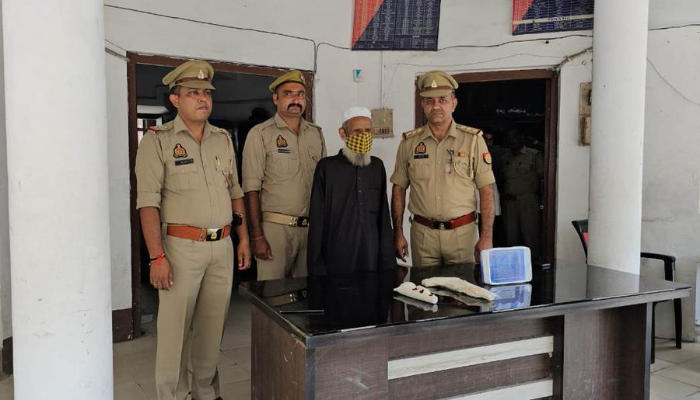
Rampur: Police have arrested Imam of Zeenat Masjid, Maulana Rahish with pistols and cartridges.
Earlier, a video from his mosque went viral where pistols, cartridges, and condoms were seen. In the background, a woman was heard alleging that a "s*x racket" was being run there.… pic.twitter.com/xe0FMCCj2j
“On 20th August, a young woman created a viral video accusing the imam of the mosque. In response to the video, a team was established under the direction of the City Officer which carried out a comprehensive investigation, including a site inspection.” the authorities stated.
As a result of the probe, on 21st August Raees Ahmed, son of Shafi Ahmed who resides in Parchai Kumhariya hamlet of Azimnagar police station area in the Rampur district was arrested by the Police of Civil Line Police Station.
“Cops recovered two 12 bore pistols, four live cartridges of 12 bore and one mobile device from the him. Legal action was initiated against the accused by registering FIR No. 316/25 under Section 3/25 of the Arms Act, Section 3/5(1) of the Uttar Pradesh Prohibition of Unlawful Conversion of Religion Act and Section 66 of the IT Act against him at Police Station Civil Line, Rampur, in connection with the attempt of religious conversion and the viral dissemination of an obscene video.” the police added.
The police emphasized that the videos depicted a man engaging in indecent behaviour towards a woman and locally made firearms as well as ammunition were also visible in them. Immediate action was taken following the receipt of the information and a case was launched.
What did OpIndia’s report disclose
Raees Ahmed threatened the females who did “ghar wapsi” in the name of Allah’s wrath as he sat in front of firearms and pornographic literature, in one of the footage. In one of the videos obtained by OpIndia over social media, Imam Raees was seen interacting with a naked girl. Several illegal weapons and cartridges are found scattered in front of him. Condoms and obscene books with half-naked photos of models are also seen.
While speaking to OpIndia, the victim revealed that her maternal uncle was murdered. This murder was committed to gain control of 350 bighas of land. The victim accused her deceased maternal uncle’s relatives of murder, with Imtiaz as the main accused. It is claimed that after killing the girl’s maternal uncle, her mother was held hostage for 14 years. During this period, the girl’s mother is suspected of being raped for five years at Imam Raees’ mosque. The victim’s father died in 2012.
Another footage obtained by OpIndia shows the victim and Imam Raees sitting face to face. The victim questioned whether Muslims would kill her. The Imam replied, “Yes, we will definitely kill.” The goal is to repent of Allah. Do this: May Allah forgive me for whatever mistakes I have made. I become this by deception or fear, therefore Allah forgive me. The punishment of the grave is very rigorous. Allah is kind to His servants.
Another video of Imam Raees has gone viral on social media. In this video, the Imam mentions a Madrasa. The Imam stated that there were 800-900 girls who had travelled from far areas. When the girl recording the video inquired why those girls were not permitted to go out, Raees stated that if they were given permission, many would flee. Imam Raees further stated that once the first few instances of fleeing occurred, an extreme level of strictness was imposed. According to the Imam, girls can sit together and speak but are not allowed to go out.
OpIndia found two other videos. In both videos, Imam Raees is seen attempting to rape a girl. He first strips a sleeping girl’s clothes and then attempts to rape her. After a while, Imam Raees is seen in another video attempting to tie his pyjamas. He is also seen attempting to hide something in polythene. Another video shows Imam Raees scrolling and listening to a communal video.
The victim told OpIndia that Imam Raees kept her mother in his mosque for almost 5 years. It is said that during this time, he and several others gang-raped the victim’s mother. The victim alleges that all of these videos are from February 2024. The victim asserted that she is fighting for justice for her mother who due to her relatives and the Imam was gang-raped after being held captive for 14 years.
In a stern decision, a Special SC/ST Court in Lucknow sentenced a lawyer life imprisonment on Tuesday (19th August) after he was convicted of filing false rape cases under the Scheduled Castes and Scheduled Tribes (Prevention of Atrocities) Act, 1989. The advocate named Parmanand Gupta used a Dalit woman working under his wife to file large number of fake rape cases against various men. The scam was exposed after the Dalit woman revealed everything after becoming approver in a case.
In a strongly worded verdict, Special Judge (SC/ST Act) Vivekanand Sharan Tripathi condemned the actions of Advocate Parmanand Gupta, who misused the law for personal gain, and convicted him under the provisions of the BNS and the SC/ST Act. Gupta pressured and used the Dalit woman to falsely implicate several persons whom he intended to extort money from or had personal enmity with. Grossly misusing the law, Gupta, with the help of the Dalit woman named Pooja Rawat, who used to work at a salon run by Gupta’s wife in Lucknow, filed several false cases in different courts against various persons.
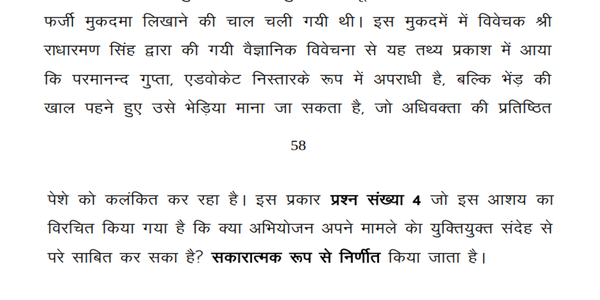
Parmanand Gupta is a wolf in sheep’s clothing: Court
“…Parmanand Gupta is a criminal in the guise of an advocate. He is a wolf in sheep’s clothing, who disgraced the respectable profession of an advocate,” the court harshly remarked in its judgment.
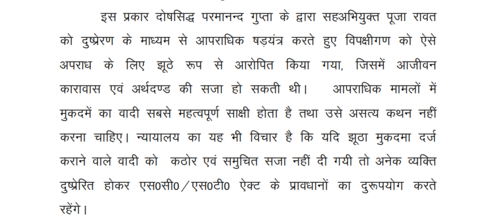
The court noted that Parmanand Gupta made Pooja Rawat file false criminal cases involving serious offences like rape against innocent individuals, who had to face loss of reputation as well as immense hardships in defending themselves. The court added that Gupta should be given exemplary punishment, considering that the provisions invoked by him in his false cases were punishable with life imprisonment and fine, to harass his victims.
Rising cases of misuse of the SC/ST Act
Expressing concern over the rising cases of misuse the laws relating to rale and of the SC/ST Act, the court said that women, in collusion with unethical advocates, have been filing fake rape cases under the SC/ST to obtain for monetary gains.
The court quoted a 2024 judgment of the Allahabad High Court, in which the High Court directed that if cases filed under the SC/ST Act are found to be false, and filed “purely for financial gains”, then legal proceedings should be initiated against responsible persons.
How Parmanand Gupta and Pooja Rawat implicated people in false cases
Parmanand Gupta and Pooja Rawat filed dozens of criminal cases against various people. Since Rawat belonged to a backwards community, Gupta used her to invoke the stringent SC/ST Act against his rivals. Led by his greed, Gupta filed fake cases under the SC/ST Act using Pooja Rawat to obtain the compensation money. He promised her to split the compensation amount, but did not give her any money after receiving the compensation in her name.
A total of 12 such cases were filed by Pooja Rawat through Parmanand Gupta, in which she levelled serious allegations, including rape, against the accused persons, and invoked the SC/ST Act. During the trial of one of the cases, it was revealed that she was not even present at the alleged crime scene and had never even met the accused persons. Apart from this, Parmanand Gupta himself filed around 18 cases against various persons, a fact which was taken into consideration by the court.
The latest and 12th case filed by her stemmed from a property dispute between Gupta and his neighbours, Arvind Yadav and Awadhesh Yadav, residents of Vibhuti Khand in Gomti Nagar, Lucknow. Gupta made Pooja to lodge fake FIRs of rape, sexual harassment, and offences under the SC/ST Act against his neighbours. However, during the investigation, the allegations made by Pooja were found to be false and fabricated.
Consequently, criminal proceedings were initiated against Parmanand Gupta and Pooja Rawat for falsely implicating people in criminal cases. The advocate representing the state also told the court that she has filed 11 similar cases against various persons.
However, during the trial, co-accused Pooja Rawat turned approver and testified against Gupta. She informed the court that Gupta pressured her to make false statements, which she repeated before the magistrate under coercion. She was granted a conditional pardon for cooperating with the court. After the trial, the court acquitted Rawat with a warning not to file false cases in future.
Allahabad HC orders CBI inquiry after noting a pattern of false cases
The matter came to light after some of the people falsely implicated by Gupta and Pooja Rawat approached the Allahabad High Court seeking the quashing of FIRs filed against them. The petitioner apprised the High Court that Parmanand Gupta and Pooja Rawat had been filing false complaints against various persons. They pointed out the fact that Pooja Rawat filed all these cases through the same lawyer, i.e. Parmanand Gupta. Taking serious note of the information provided by the petitioners, the High Court ordered a CBI inquiry into the matter.
“It is also apparent that the informant and her counsel are in collusion with each other and have lodged false FIRs against a large number of people for serious offences only to extract money from them. The present FIR is also such an FIR lodged to create pressure,” the High Court said in its order dated March 5, 2025.
Contempt proceedings were also initiated against the lawyer
In 2023, the Allahabad High Court initiated contempt proceedings against Parmanand Gupta after observing that he tricked and misled the court and concealed material facts on several occasions to obtain favourable orders. The High Court remarked that Gupta “grossly misconducted himself against the Bar Council Rules, professional ethics” and found him guilty of “playing fraud with the Court and interfering in the course of justice by misleading the Court”. “He has made efforts to pollute the stream of justice by his highly unprofessional conduct,” the High Court said ordering suo motu criminal proceedings against Gupta.
Court granted life imprisonment to Gupta
The Court imposed a hefty fine and granted him separate jail terms under the provisions of the BNS and the SC, ST Act. He was granted one year’s simple imprisonment and a fine of ₹ 10,000 under Sections 217/49 of the BNS. The court granted him 10 years’ rigorous imprisonment along with a ₹2 lakh fine under Sections 248/49 of the BNS. Additionally, the court granted him life imprisonment along with a fine of ₹5 lakh under Section 3(2) of the SC, ST Act. The court ordered the sentences to run separately and include the time already spent by him in prison.
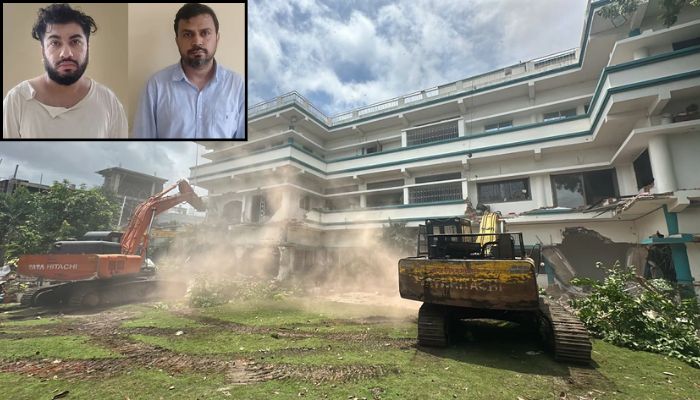
The Madhya Pradesh government on Thursday, 21st August, demolished the 22 crore illegal mansion linked to the infamous Machhli family in Bhopal. The operation took place in Kokta Hathaikheda, where district administration teams and heavy police deployment carried out the action.
Bhopal, Madhya Pradesh: Following previous crackdowns on illegal properties, bulldozer action takes place at the Machhli family’s three-story mansion over drugs, love jihad, and arms cases. Around 200 police personnel are present at the scene pic.twitter.com/1ZCWQlvmyw
Officials said the properties belonged to a family accused of running a criminal empire involving ‘love jihad’ and a large-scale drug syndicate. Earlier, on 30th July, the administration demolished six illegal constructions and sealed the mansion for regulatory violations. Today’s demolition targeted another major property under tight security.
Bhopal, Madhya Pradesh: CM Mohan Yadav orders bulldozer action against the Machhli family’s illegal empire in Bhopal, demolishing a ₹22 crore mansion pic.twitter.com/nkHqPZ4ArE
The latest bulldozer action follows the arrest of Shahwar Machhli and his nephew Yasin Machhli on 23rd July. The duo was nabbed near Bhopal’s Gammon Mall with synthetic drugs and an illegal pistol. Investigations revealed they were key players in smuggling drugs from Rajasthan and Mumbai and supplying them to pubs and lounges in the city.
Chief Minister Mohan Yadav had recently issued a threat that his government would not leave any person behind who was engaged in ‘love jihad’ or the drug mafia. He said strict action would be taken against all such networks to ensure the safety of women and restore law and order. ‘No criminal will be spared. We will dismantle their entire network one by one,’ the CM said.
Background: The criminal activities of Machhli family
The Machhli family’s criminal activities have been under the scanner for decades. Originally involved in fish brokerage in Budhwara, the family shifted to Hathaikheda and, by the 1980s, built influence with political backing. They expanded into fish farming, illegal mining and eventually into narcotics and arms trade.
By the 2000s, the family built ties with the local Hindu community by sponsoring Durga Pandals and Devi Jagrans. When engineering and pharmacy colleges opened around Hathaikheda between 2005-2010, they began targeting students. They organised cricket tournaments and parties to lure the youth. Gradually, drugs became central to these gatherings, and students were pushed into addiction.
According to a report by Dainik Bhaskar, Yasin Machhli emerged as one of the main operators. He not only ran drug supply chains but also trapped Hindu girls, exploiting them for drug delivery. He allegedly lured women into relationships, assaulted them and then used threats and blackmail to control them.
The authorities also found records of rave parties organized by Yasin on the outskirts of Bhopal. Entry charges for these parties varied between ₹10,000–₹25,000, and there were other charges for drugs. Police found videos during these parties, where noise music, drugs and sexual exploitation were the norms.
Yasin is accused of raping a girl
A rape case has been filed against Yasin Machli at the MP Nagar police station in Bhopal. He is reported to have raped a 29-year-old young woman. According to Sub-inspector Archana Tiwari, the victim who is employed at a private firm, lodged a complaint regarding the incident. She mentioned that the two met at a pub approximately one year ago, in her statement.
Yasin developed a friendship with her and their conversations became more frequent. He subsequently invited her to a five-star hotel under the guise of marriage where he violated her.
Yasin’s aide is son of a Congress leader
The network wasn’t limited to the Machhli family. Yasin’s close aide, Anshul Singh alias Bhuri, later revealed to police that he was the son of a Congress leader. He already had over 20 criminal cases against him, including attempts to murder, arms violations and smuggling. Based on his confession, another gangster, Taufiq Nizami, was arrested with weapons.
Earlier this year, Bhopal police also arrested two of Yasin’s associates, Saifuddin and Ashu, with cash and narcotics. Their statements led investigators to Shahwar and Yasin, confirming their direct involvement in large-scale drug trafficking across Madhya Pradesh.
For nearly five decades, the Machhli family flourished in illegal businesses under the cover of political patronage and social outreach. But the façade collapsed as multiple cases of drug peddling, arms trade, rape and forced religious conversions came to light.
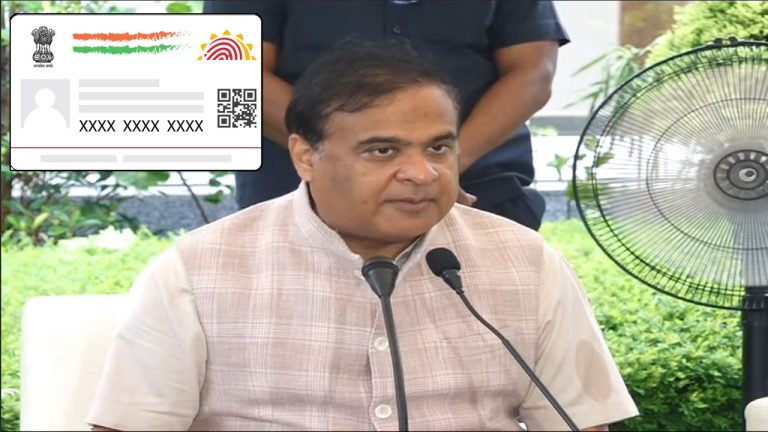
In a significant decision, the Assam cabinet on Thursday decided to stop issuing Aadhaar to adults in the state. Announcing the decision after the weekly cabinet meeting, CM Himanta Biswa Sarma said that the decision has been taken to prevent illegal Bangladeshi immigrants from obtaining Aadhaar numbers.
The CM said that Assam has already achieved saturation of Aadhaar, which means there are not too many adults in the states who have not been enrolled yet. However, the govt has decided to give an extension of 1 year for people from Scheduled Castes (SC), Scheduled Tribes (ST), and tea garden communities.
The CM said that while overall Aadhaar saturation in the state has reached 102%, it has not reached 100% yet in some tribal belt and tea garden areas, and therefore a year has been given for remaining adults in those areas to enrol for Aadhaar.
Himanta Biswa Sarma said, “More Aadhaar cards have been issued than the state’s population. To prevent misuse by infiltrators, we have decided that people above 18 will not be issued fresh Aadhaar cards. Only SC, ST, and tea garden communities are exempted because Aadhaar penetration among them is 96%, meaning 4% are yet to be covered.” Adults from these communities will also not get Aadhaar card after a year.
The CM said that this decision will be implemented from 1st week October. Therefore, if there are any adult without Aadhaar in Assam, they can apply before October.
He said that while the government has taken all steps to stop illegal immigration from Bangladesh, it can’t be sure that it has been completely successful. To prevent those who managed to infiltrate to obtain Aadhaar cards, no more Addhaar will be issued to people above 18 years of case, he said.
The CM said, “We have been catching and pushing back illegal immigrants from Bangladesh regularly. Just yesterday, we pushed back seven infiltrators at the border. We may not be able to push back all, but by closing Aadhaar enrolment, we are sending a strong deterrent signal that infiltrators cannot claim entitlements through Aadhaar.”
The CM added that in rarest of rare cases where an adult has not yet got an Aadhaar number and wishes obtain one, such persons may apply through the DC. Such Aadhaars will be issued only on approval of the DC, he said, adding, “the DC will decide only after discussion with the Foreigners’ Tribunal and the Special Branch. This will ensure strict scrutiny.”
Notably, illegal immigrants obtain Indian identity documents like Aadhaar cards, Voter Identity cards etc with the help of locals and corrupt politicians. After issue of Aadhaar to adults is banned, it will be very difficult for illegal Bangladeshi immigrants to obtain the document in Assam.
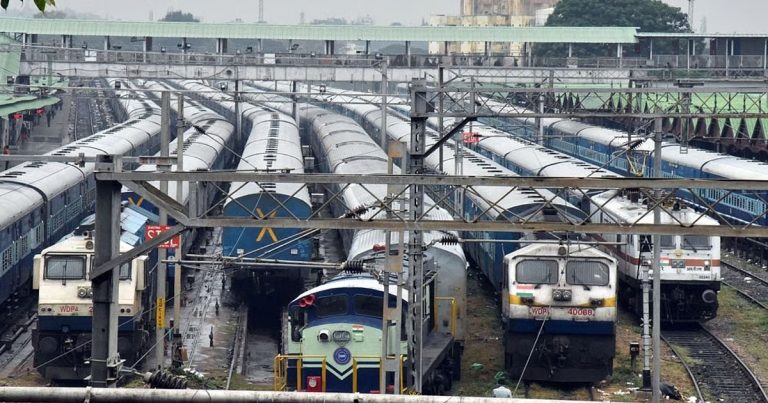
For the convenience of passengers during Diwali and Chhath festivals, Indian Railways has decided to operate more than 12,000 special trains. This announcement comes after railways announced 20% discount on confirmed return journey tickets during the upcoming festival season.
Railway Minister Ashwini Vaishnaw, while addressing the press at Rail Bhawan, said that after discussions with Bihar’s Deputy Chief Minister Samrat Chaudhary, MP Dr. Sanjay Jaiswal, Union Minister Lalan Singh, and MP Sanjay Kumar Jha, it was decided to make special arrangements for the upcoming Diwali and Chhath festivals. He emphasized that passengers should also be facilitated during their return journey.
After consultations with senior public representatives, it was decided that over 12,000 special trains will run for Diwali and Chhath. At the same time, due care will be taken to ensure passengers face no difficulties during their return travel, the minister said.
Minister Vaishnaw further announced that passengers undertaking onward journeys between October 13 to 26 and return journeys between November 17 to December 1 will be offered a 20% discount on return tickets. This initiative will be implemented during this festive season and will benefit a large number of people.
In addition, four new Amrit Bharat Express trains will be introduced from Gaya to Delhi, Saharsa to Amritsar, Chhapra to Delhi, and Muzaffarpur to Hyderabad. A new circuit train, covering important sites related to Lord Buddha and catering especially to middle-class families, will also be launched, covering Vaishali, Hajipur, Sonepur, Patna, Rajgir, Gaya and Koderma, the minister announced.
The Buxar–Lakhisarai rail section will be expanded into a four-line corridor, enabling more train operations. A ring railway system will be developed around Patna. Sultanganj and Deoghar will be connected by rail. A new train service will also run between Patna and Ayodhya. A washing pit facility will be set up at Laukaha Bazar, and work will be carried out on several newly approved road overbridges in Bihar, shri Ashwini Vaishnaw added.
Bihar Deputy CM Samrat Choudhary, Union Minister Rajiv Ranjan Singh alias Lalan Singh, MP Dr. Sanjay Jaiswal, and MP Sanjay Kumar Jha expressed gratitude to Prime Minister Narendra Modi for approving more projects for Bihar and for the launch of several new trains, including Amrit Bharat and Vande Bharat.
In what could potentially be another Trump machination to pressure India for an unfavourable trade deal, the United States Embassy in India has categorically denied former U.S. President Donald Trump’s claim that the United States Agency for International Development (USAID) allocated $21 million for voter turnout initiatives in India.
In a detailed communication with the Ministry of External Affairs (MEA), the Embassy clarified that USAID neither received nor disbursed any such funds between fiscal years 2014 and 2024, nor did it undertake any voter turnout-related activities in the country.
Big Breaking: US embassy in Delhi contradicts Trump's $21m voter funding claim
US Embassy tells India's foreign ministry that USAID/India did not receive/provide funding of $21 m for voter turnout in India (FY 2014 to 2024) nor implemented any voter turnout-related activities https://t.co/ByUadmf11wpic.twitter.com/aIL9YCIx0l
The controversy erupted in February 2025 when US President Trump, citing a review by the U.S. Department of Government Efficiency (DOGE), claimed that USAID had been funding electoral and voter-related projects worldwide. In his remarks, Trump specifically mentioned that India was among the beneficiaries, with $21 million earmarked to “increase voter turnout.” His assertion sparked immediate concerns in New Delhi, leading the MEA to demand a comprehensive explanation from Washington.
On 28 February 2025, the MEA formally requested the U.S. Embassy in New Delhi to provide a detailed breakdown of all USAID-assisted projects undertaken in India over the past decade. The Ministry also sought clarity on expenditure patterns, implementing partners, and whether any activities linked to voter mobilization had been executed.
In its response on 2 July 2025, the U.S. Embassy submitted data covering a decade of USAID funding in India. According to the Embassy, all programs were strictly within the framework of seven Partnership Agreements signed with the Government of India, focusing primarily on development cooperation, health, education, energy, and governance reforms.
The Embassy insisted: “USAID/India did not receive or provide funding of $21 million for voter turnout in India from fiscal years 2014 to 2024, nor has it implemented any voter turnout-related activities in India.”
The Embassy reiterated this stance in a subsequent communication on 29 July 2025, informing the MEA that all USAID operations in India would cease by 15 August 2025 following the Biden administration’s decision to dissolve the agency worldwide. On 11 August 2025, in a letter to the Department of Economic Affairs, the Embassy confirmed that all seven existing Partnership Agreements with India had officially been terminated.
The denial assumes significance against the backdrop of Trump’s earlier statements, which suggested widespread misuse of U.S. foreign aid for political influence abroad. His claims were part of a broader narrative that emerged after Executive Order 14169, signed in January 2025, initiated a sweeping review of all U.S. foreign assistance programs. While DOGE did announce the cancellation of $486 million in USAID funding for the Consortium for Elections and Political Process Strengthening (CEPPS) projects globally, the Embassy in New Delhi has now made it unequivocally clear that no part of that allocation was directed toward India.
The Embassy also released a beneficiary-wise breakdown of allocations for the years 2022, 2023, and 2024, thereby dispelling any lingering doubts about claims made by Trump. Officials emphasised that all USAID operations in India were development-focused and fully transparent, with no involvement in the electoral or political processes of the country.
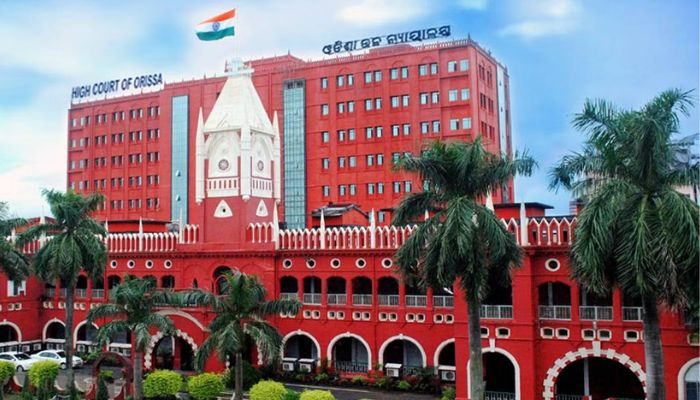
In a recent ruling, the Orissa High Court commuted the death sentence given by the Sessions Court in 2024 to a man named Niranjan Mallik, who brutally murdered two people at different places. He also stabbed a pregnant woman multiple times, and inserted a pastry-roller inside her private part, leading to the death of the foetus.
On 12th August 2025, the Division Bench of Justice Bibhu Prasad Routray and Justice Chittaranjan Dash commuted the convict’s capital punishment observing that his conduct inside the jail is ‘satisfactory’. The bench said that other than the heinous crime he committed, the accused Niranjan Mallik is a ‘normal man’.
“Nothing on his conduct as per the report of the jail authority would constitute an aggravating factor against him to confirm the death sentence. Regardless of the heinous nature of crime committed by him, his conduct inside jail is quite satisfactory as per the report of the Superintendent of Jail and he had also no other antecedent than the present one to be counted against him to justify his death sentence. He was and is a normal man except committing the offence prior to and after the occurrence,” the court said.
Niranjan Mallik’s barbarity and mindless killing of two innocent people
The horrific episode of double murder and unspeakable brutalities against a pregnant woman unfolded on the intervening night of 16th and 17th January 2019. The crime spree started around 2:00 AM and continued till early morning at different places of the Odagaon Town in Nayagarh district of Odisha.
Niranjan Mallik committed murder of two persons, Lochan Sethi (Male) and Badani Pradhan (Female), and injured three more persons namely, Sulochana Pradhan (Female), Amulya Barik (Female) and Dambaru (Male). The deceased, Lochan, was working as a night watchman in the vegetable market at Odagaon.
It was when Lochan Sethi was performing his night duty in the vegetable market, the convict all of a nowhere appeared with a piece of wooden plank and suddenly hit him on his head and other parts of the body. Immediately, the other watchman of the nearby Ganesh Market rushed to the spot, however, Niranjan Mallik fled the crime scene.
Soon after, when deceased Badani was sweeping front portion of his house, which is within the compounded premises of Sanjibnee Clinic at Odagaon, the convict suddenly appeared there and dealt a blow on her head. The deceased fell in a pool of blood and died at the spot. Hearing her cry for help, her daughter Sulochana, who was bathing nearby, rushed out. However, Mallik assaulted the pregnant lady with the same wooden plank.
Niranjan Mallik did not stop at this. He stabbed Sulochana multiple times and inserted a pastry roller (Belena Kathi) into her vagina. At that time Sulochana was around seven months pregnant. Sulochana was working in Sanjibanee Clinic and residing there along with her mother (deceased Badani) in the servant quarters located within its premises and the spot of the crime is the front area of their house surrounded by compound wall of the clinic.
As some passersby approached the clinic after hearing screams of the victim, convict Niranjan Mallik fled away wearing a ladies night gown kept outside.
In another incident after some time, the convict assaulted an elderly woman named Amulya Barik, who was going to a temple in the early morning. The injured victim fell on ground with bleeding wounds. The convict then proceeded to attack another injured person Dambaru, who was opening his shop. While the convict proceeded to attack Dambaru with the same wooden plank, the victim fought back and snatched the plank after a tussle. In reaction, appellant Niranjan Mallik bit the left-hand little finger of the injured so severely that the tip of finger was separated from the rest part of the finger, leaving his mutilated finger bleeding profusely.
Niranjan Mallik’s conviction
The convict had pleaded not guilty. During his examination, he mostly replied to all questions put to him as falsehood or without his knowledge. The investigation was completed and the chargesheet was filed. Subsequently, during the trial, the Additional Sessions Judge, Odagaon found Niranjan Mallik guilty under Sections 302 (murder), 307(attempt to murder), 325 (voluntarily causing grievous hurt), 326(voluntarily causing grievous hurt by dangerous weapon) and 458 (lurking house trespass after preparation of assault) of the IPC.
In addition to other sentences, Mallik was sentenced to death for commission of offence under IPC Section 302 (double murder).
Following this, the matter was brought by the trial court to High Court for the death sentence’s confirmation. Meanwhile, the convict also filed a criminal appeal assailing the conviction and sentence. The defence submitted that the convict had previously received treatment for mental unsoundness and in absence of any motive in committing the offences, it is established that the convict did such assault by unsoundness of mind, without any intention, being incapable of knowing the nature and consequence of the act. The court tagged both the cases and heard them together.
The High Court bench, however, observed the defence failed to prove the convict’s mental unsoundness before the trial court. “The convict participated in trial as a normal person with sound mind taking the plea of innocence and falsehood. He did not say anything during his examination by the court under Section 313 Cr.P.C. either regarding his previous conduct or treatment relating to unsoundness of mind,” the court said.
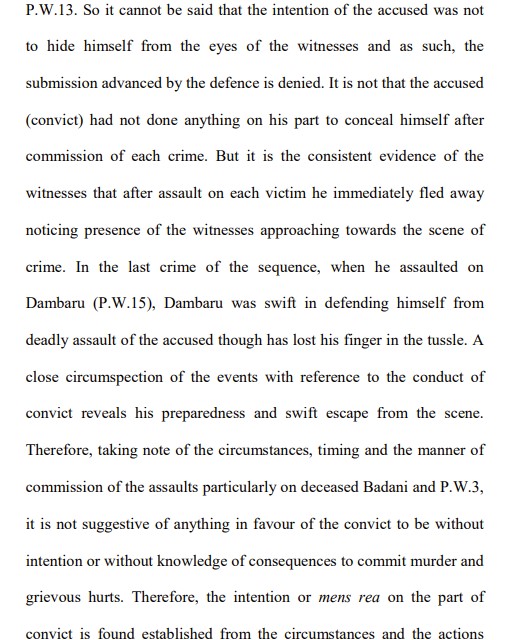
Rejecting defence’s argument that since Mallik was mentally unsound, he had no motive for the crimes he committed. However, the court stated that mere absence of motive for the crime without any corroboration with previous insanity cannot be the determinative factor to rule in favour of his insanity in committing the crime. The court also pointed out that the fact that the convict used the lady nightgown for fleeing away after hearing the locals approaching the crime scene, indicates the convict’s clever mind.
“So far as motive is concerned, absence of same in a case of homicide is immaterial where there is direct evidence of eyewitnesses supported by medical evidences. Motive is a mental factor hidden in a deep recess of the mind,” the court said.
The Court was convinced that the deaths of the deceased were homicidal based on the statements of the eyewitnesses and post-occurrence witnesses as well as the medical evidence. After analysing the evidence gleaned from eyewitness testimonies, it became clear that the appellant was the perpetrator of the crimes in question. The court took special note of the testimony of victim Sulochna and highlighted the barbarity the pregnant woman was subjected to by the convict.
“Therefore, the intention or mens rea on the part of convict is found established from the circumstances and the actions narrated by the witnesses. As such, the conviction rendered by the trial court on the accused is found justified and thus confirmed,” the stated.
The court mentioned that the trial court had imposed death sentence on the convict for commission of murder punishable under Section 302 I.P.C. along with payment of fine of Rs.50,000/-. The convict was further awarded with sentences for life imprisonment.
Court says “he was and is a normal person”
However, regarding the death sentence, the High Court said that the trial court made no efforts to evaluate the aggravating and mitigating circumstances before imposing the death sentence.
The Orissa High Court had directed the jail authority for collection of detailed information with reports on the past life, psychological condition and post- conviction conduct of the Appellant along with such other materials and also granted opportunity to the Appellant (convict) to file affidavit producing any material on mitigating circumstances.
As per the report submitted by the convict’s father, Niranjan Mallik studied till high school and moved to Gujarat. He got married and two kids, however, his marital life did not go very well. He switched businesses and in 2012, he had an accident. His financial and mental condition deteriorated from thereon. In the latter half of 2016, Mallik development psychiatric issues and underwent treatment. His village people spoke good of him.
Meanwhile, the medical report filed by the team of doctors stated that the convict t is having stable psychological condition without any adversity observed in his conduct. His short- and long-term memory is largely intact and no issues found in his social and personal judgment.
The court cited the report of the medical officer of the jail to observe that the behaviour and attitude of the convict towards other inmates and staff is good and he performs daily routine work in a normal manner.
“So in the opinion of the Senior Superintendent of Circle Jail, Berhampur the convict’s behavior is quite normal. He prays to God and reads Holy Gita regularly and other daily newspapers and his behavior towards others is very normal,” the court observed.
The court said that while it is true the criminal is also a human being and is entitled to a life of dignity notwithstanding his crime, however, the murders committed by the convict, and brutalities inflicted by him on his victims alongside the emotional and psychological impacts on the families of the deceased persons “constitute an aggravating factor”.
However, the court mentioned previous judgments in similar cases to stress that despite the presence of aggravating factors, it is imperative for the court to state special reasons for death sentence and consider the possibility of reformation and rehabilitation of the convict.
The court examined the convict’s socio-economic background and noted that he hailed from poor economic strata and had no previous criminal antecedent other than the present case. It also highlighted the findings of the jail authority’s report to observe that Mallik’s conduct inside the jail is “normal and cordial” with other inmates.
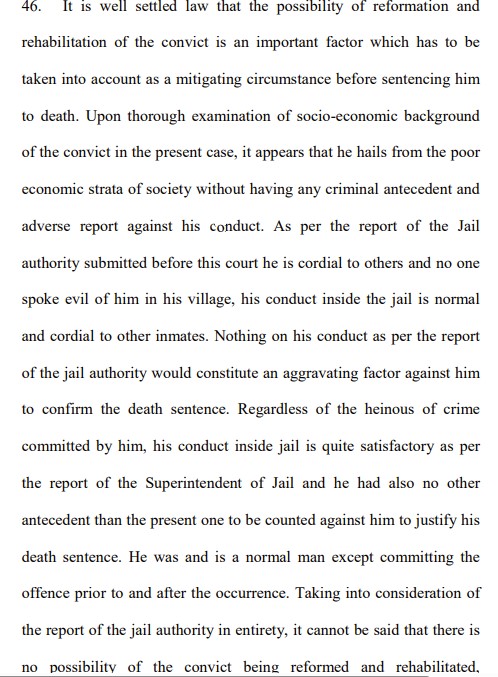
“As per the report of the Jail authority submitted before this court, he is cordial to others and no one spoke evil of him in his village, his conduct inside the jail is normal and cordial to other inmates. Nothing on his conduct as per the report of the jail authority would constitute an aggravating factor against him to confirm the death sentence. Regardless of the heinous of crime committed by him, his conduct inside jail is quite satisfactory as per the report of the Superintendent of Jail and he had also no other antecedent than the present one to be counted against him to justify his death sentence,” the court said, adding that the convict was and is a “normal man except committing the offence prior to and after the occurrence.”
The court took the report of the jail authority into consideration to conclude that it cannot be said that there is no possibility of the convict being reformed and rehabilitated, foreclosing the alternative of lesser sentence. The court, thus, commuted his death sentence to life imprisonment.
“We are therefore inclined to convert the sentence imposed on the Appellant from death to life, but taking note of the severity of the offences including murder of two persons we are of the view that the convict deserves life imprisonment for rest of his life,” the court ruled.
An 8th grade Muslim student killed his class 10th senior, in a school in Seventh-Day Adventist Higher Secondary School in Khokhra of Gujarat’s Ahmedabad. Nayan Santani was stabbed on 19th August and died from his wounds while receiving medical attention during the night at a private hospital. The murder which happened right outside the school has caused widespread protests throughout the city.
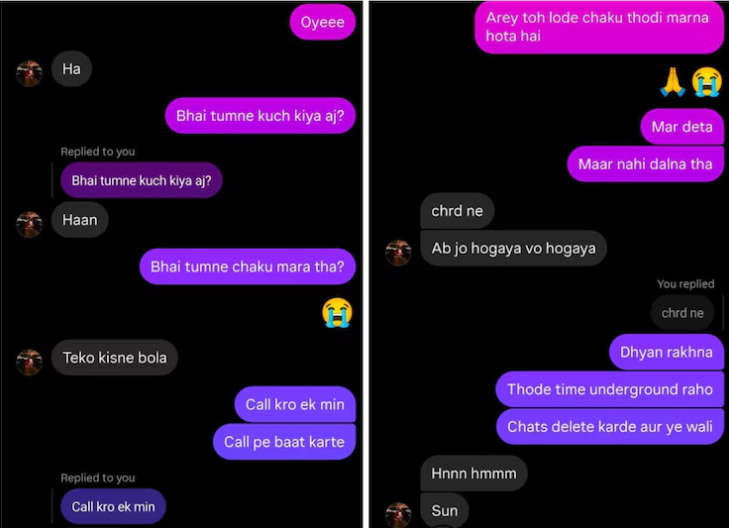
According to the investigators, the accused confessed to his heinous act to his friend. A conversation between the two transpired on Instagram during which the perpetrator admitted to the crime. It was discovered during an initial police inquiry. The exchange also revealed what provoked him to unleash the brutal attack which claimed the life of the Hindu student.
The friend asked, “Did you do something,” to which he replied, “Yes.” The former then asked him if he stabbed anyone and he responded, “Who told you?”. The friend requested the accused to call him because they should not talk about this over chat and stated, “Your name came to my mind first so I texted you.” However, he claimed that he was with his brother and added, “He doesn’t know what happened today.” Afterward, the friend informed him that the victim had passed away.
The culprit enquired as to how his friend knew about the attack. The latter clarified that he had learnt about it via a mutual acquaintance he had met on the road. “Tell him (the common friend) that I killed him. He knows me, tell him right now,” the person said.
Image via India Today
The friend demanded, “What really happened?” According to the accused, the victim challenged him with statements like, “Who are you and what will you do?” However, the friend told him that he cannot stab someone to death over this. “You could have just beaten him up, not killed him,” he added but the offender non-chalantly retorted, “Whatever happened has happened now.”
Afterward, the friend told him to take care of himself and conveyed, “Go underground for some time. Delete these chats,” as he answered with an “ok.”
On his way home from school, 10th standard student Nayan was surrounded by Class 8 students. This resulted in a violent altercation as the accused attacked him with a knife and fled. CCTV showed him staggering back into the school while holding his palm over his stomach wound while the assailant ran to the back of the building.
The security officer saw the victim and alerted the police as well as school administration. The attack took place on the premises of the school.
Hundreds of people, including members of the Sindhi community, parents of other kids, and family members of the deceased, stormed the school grounds the following morning and demanded that the management take action.