Home Blog Page 3067

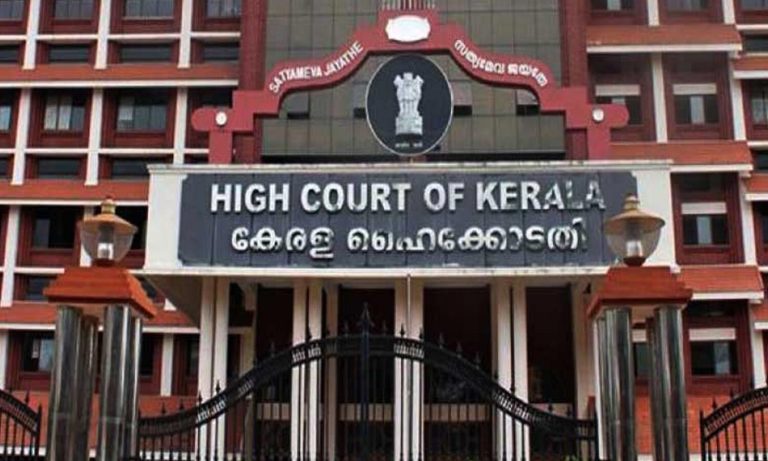
Kerala High Court acquits 13 RSS workers in a 2008 murder case of a CPM worker, slams prosecution’s attempts to tutor witnesses and form a scripted story

On Tuesday, 12th July 2022, a division bench of the Kerala High Court acquitted 13 RSS workers who were convicted to life terms by a trial court in connection with the murder of a CPI(M) worker named Vishnu in 2008. The 13 RSS workers were convicted by the Thiruvananthapuram Additional District and Sessions Court, following which, they appealed in Kerala High Court in 2016.

While acquitting them, the honourable court ripped into the prosecution for relying on a fabricated story to seek the conviction of the RSS workers. A Division Bench of Justice K. Vinod Chandran and Justice C. Jayachandran observed that the prosecution case reeked of a deliberate attempt to tutor witnesses, collect evidence and define a scripted story.

The court further noted, “There is absolutely no evidence worth its salt and the prosecution failed to prove any corroborative circumstance but for the political rivalry existing between two groups.”

Further slamming the prosecution, the court said, “We cannot but acquit the accused of the charges levelled against them, the prosecution having miserably failed to prove the incriminating circumstances against the accused.”

Vishnu murder case in Kerala in 2008

On April 1, 2008, DYFI (youth wing of CPM) leader Vishnu was hacked to death in front of the Kaithamukku passport office. All the suspects who underwent trial for the murder are RSS workers. The Thiruvananthapuram Additional Sessions Court had found 13 RSS workers guilty. 11 out of them were given double life imprisonment, one was sentenced to life, and another one was sentenced to 3 years.

However, Kerala High Court noted that there was no evidence to send these RSS workers to prison in the mentioned murder case, and it was all a scripted story based on the political rivalry between the groups.

From threats to police apathy: Soldier’s wife shares her ordeal for raising voice against Maulvi who thrashed their 11-year-old child for playing in Madarsa’s garden

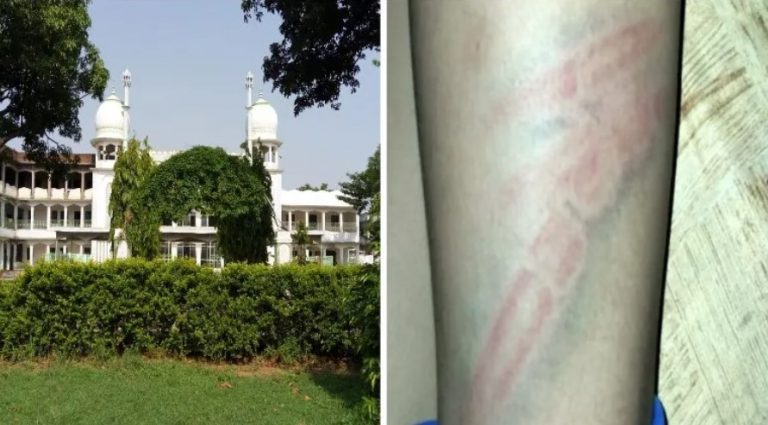
On July 6, an Army soldier’s 11-year-old son was brutally thrashed with an iron rod, by a Maulvi for playing football in the garden of a local Madarsa. The incident reportedly took place in the Kadru town in Ranchi, Jharkhand. After the incident, the mother of the victim, Roshan Tara approached the Argora police station with a complaint against Maulana Mohammad of the Hussainia Madarsa in Kadru, Hussainabad, Ranchi. She accused him of assaulting her minor son without any provocation.

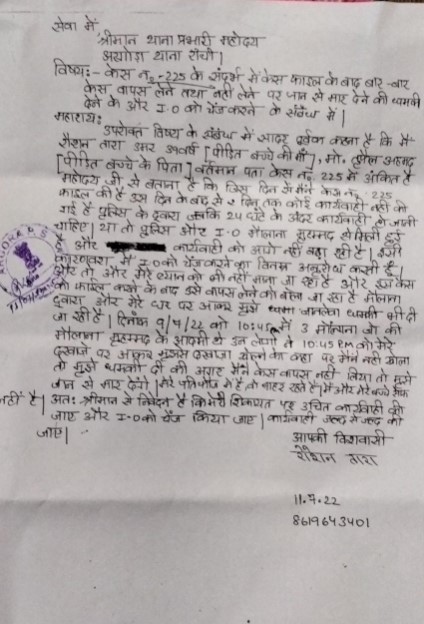
When the police took no action in her case, Roshan Tara again wrote to the SHO of the Argora police station on July 11, accusing the IO of negligence. Demanding a new IO be appointed to handle her case, Roshan Tara said that the present IO is trying to shield the accused Maulvi as he is a politically influential person. She has also alleged receiving death threats from the Maulvi for filing a complaint against him. The police too have been pressurising her to withdraw her case against the cleric, she alleged.

Letter written to SHO by victim’s mother

Notably, the Maulana, whom the police are trying to protect, as alleged by the victim’s mother, has close ties with the ruling dispensation of Jharkhand. Owing to his power and clout, the police are deliberately not taking any action against the Maulana, the 11-year-old victim’s mother has said.

Speaking to OpIndia, the distraught mother of the 11-year-old victim, who has been running pillar to post to seek justice for her son, narrated the harassment she is having to face from the Maulana, as well as the police in the area.

She said that on July 6, at around 5.30 pm her 11-year-old son went to the garden to play football with his friends. The garden where these children have been regularly playing for almost a year lies inside Madarsa’s campus. Her son was playing football with other children when Maulvi Mohammad suddenly appeared with an iron rod. While all the other children managed to flee, the Maulana grabbed her son and pinned him to the ground. He then started brutally thrashing him with the iron rod.

While narrating the incident, the devastated mother of the 11-year-old kept recalling the brutality that was inflicted on her minor son by the cleric, for merely playing in the garden.

On being questioned, the woman confirmed that her family had no personal rivalry with the Maulvi. She expressed disbelief at the cleric’s actions, saying she could not understand how such a trivial thing infuriated the cleric to the point where he descended to physically assault a small child, that too so mercilessly.

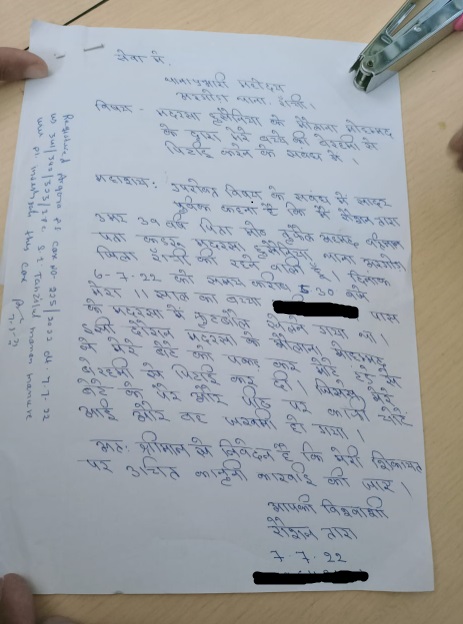
Roshan Tara claimed that she went to the police station the following day to file a report. The police, firstly, was reluctant to take the complaint. After much deliberation and pestering, the police accepted the complaint, she said, adding, that it’s been over a week now since she filed a complaint, but the police have taken no action against the Maulana yet.

Copy of complaint filed at Argoda PS

Roshan Tara told OpIndia, “Whenever I speak to the IO, Tanjijul Imam, who is handling my case, he keeps saying that they are working on the case but nothing is happening.” In view of the negligence of the police, Roshan Tara has written to the in-charge of Argora police station and has demanded to change the investigating officer of the case.

The mother of the victim further informed that the Maulana’s aides have been threatening her with life for lodging a complaint against the cleric. They along with the police officials have been coercing her to take back her complaint, rued Roshan Tara.

“My husband is in the army and I am staying alone here with my minor child. No one from the neighbourhood is also willing to come forward to help me as they are scared of the Maulana”, she said. She further bemoaned the fact that she is constrained to remain indoors due to threats from the Maulana’s aides.

Meanwhile, the Argora police station in-charge Vinod Kumar told OpIndia that the police are probing the matter. He added that if the woman is receiving death threats, he would deploy more police officials around her house.

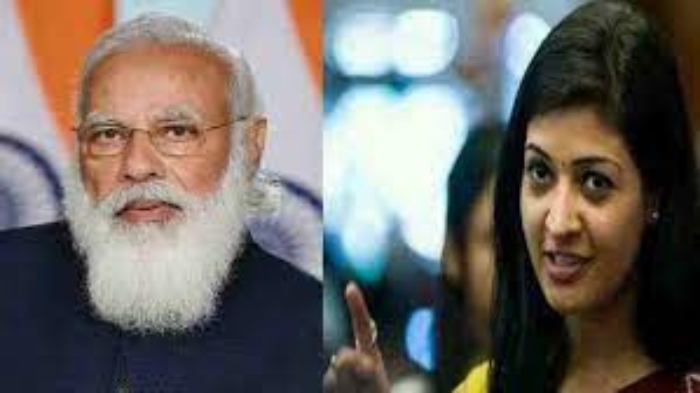
Congress leader Alka Lamba draws inspiration from Mani Shankar Aiyar to insult PM Modi with derogatory language

On July 12, Congress leader Alka Lamba took to Twitter to abuse Prime Minister Narendra Modi as she shared a report card detailing how India had “failed” in various aspects of the global index under Modi’s leadership since 2014. Drawing inspiration from Congress’ foul-mouthed leader Manu Shankar Aiyar, Lamba went on to refer to the Prime Minister of India a ‘nalayak’ (incompetent) person.

The Congress leader Tweeted in Hindi which roughly translated to, “How often has it been said to the ‘nalayak’ (incompetent), leave the rhetoric and do a little hard work, but if one listens to it. He was bound to fail.” She posted a picture of what appeared to be a report card, in which India, under PM Modi’s leadership since 2014, was depicted receiving incredibly poor grades in a number of categories, listed under the general heading- India’s global ranking under Modi.

In the remarks section, it was mentioned that ‘Narendra Modi is very authoritative; he must respect the constitution and abide by its values.’ 

The so-called ‘progress card’ was first shared by Telangana Rashtra Samithi (TRS) social media convener and chairman of Telangana State Renewable Energy Development Corporation Y Satish Reddy.

Many Modi dissenters like Congress leader Alka Lamba and their loyalist lawyer Prashant Bhushan, and TMC spokesperson Riju Dutta, in a desperate attempt to target Narendra Modi-led government, used the so-called ‘report card’ to mock PM Modi on social media. However, taking a cue from her colleague and senior party leader Mani Shankar Aiyer, Alka Lamba went on to also hurl abuses at the PM.

Notably, Alka Lamba did not stop here. She had also used Twitter, like her other colleague Dr Udit Raj, to spread false information regarding India’s position in the world’s fastest-growing economy index in 2021. She shared an image posted by the disgruntled BJP leader and former Rajya Sabha MP Subramanian Swamy on July 11 bearing false information to mislead social media users against the central government and denigrate India.

Earlier in the day, OpIndia, reported how, after the claim went viral, PIB posted a tweet debunking the obvious fake claim and exposing the flagrant lies peddled by the senior opposition leaders with the sole aim to castigate PM Modi and the central government.

FIR filed against Alka Lamba for calling PM Modi and UP CM ‘impotent’

It may be recalled that in 2020, FIR has been registered against Congress leader Alka Lamba at Hazratganj police station in Lucknow, Uttar Pradesh, over her derogatory remarks against PM Narendra Modi and Uttar Pradesh CM Yogi Adityanath. In a video shared by Lamba on Twitter then, she had called Prime Minister Modi and Adityanath ‘impotent’ and said that she spits on their face.

Lamba takes inspiration from Congress leader Mani Shankar Aiyer

Interestingly, the despicable language used by Alka Lamba against the PM of India is not exclusive to her. In 2017, Congress loyalist Manu Shankar Aiyer triggered a political storm on the last day of the Gujarat poll campaign when he went on to use a derogatory casteist slur for PM Modi calling him a ‘neech kisam ka aadmi’. His brashness did not stop here. In 2019, the senior Congress leader not only went on record to justify his casteist slur against the prime minister but even took pride in it by saying how he was ‘prophetic’ about it. 

Following his despicable remark, the party temporarily  ‘suspended’ Mani Shankar Aiyer only to take him back in August 2018.

It may be recalled that prior to the ‘neech aadmi’ remark, Mani Shankar Aiyer had made the Congress’ favourite ‘chaiwala’ jibe at PM Modi during the 2014 Lok Sabha polls. It is pertinent to note that just before the 2014 general elections, Aiyar had claimed that Modi would never become a PM and he could arrange it for him to sell tea at the AICC meet if Modi so wished.

In fact, in the month of April this year, an old interview of controversial Congress leader Mani Shankar Aiyar became viral on social media platforms where he suffered a meltdown when the journalist confronted him on his controversial ‘chaiwala’ remark.

Model who spent $600K and 12 years to look like Kim Kardashian undergoes detransition after realising she wants to be herself

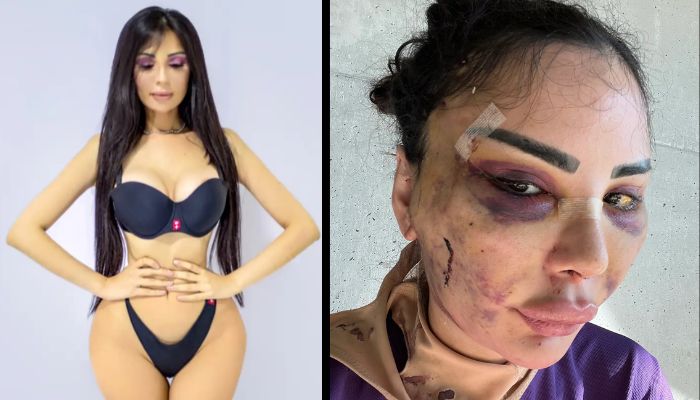
A 29-year-old Brazilian model named Jennifer Pamplona, who spent a whopping $6,00,000 on cosmetic surgeries to look like Kim Kardashian, has finally de-transitioned to her original looks.

As per reports, Pamplona had undergone 40 surgeries over the span of the past 12 years to emulate the physical attributes of the American socialite. It must be mentioned Kardashian had started to become a household name by 2010.

Awed by her looks, the Brazillian model underwent her first surgery at the tender age of 17 years. She then became addicted to surgeries, including rhinoplasties, butt implants and fat injections.

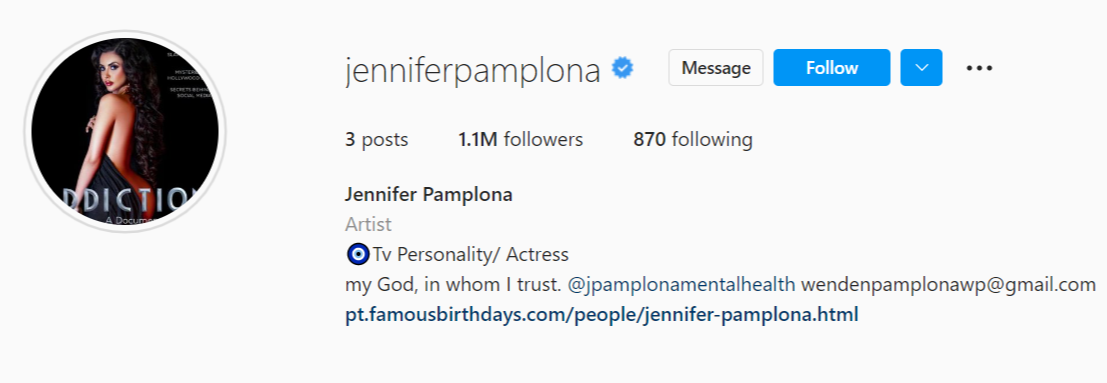
Her body transformation garnered her fame and modelling opportunities for Versace. Pamplona had even amassed 11 lakh followers on Instagram.

Instagram profile of Jennifer Pamplona

However, she felt dejected for being only known as Kim Kardashian’s look-a-like. “People would call me a Kardashian and it started to get annoying,” she recounted.

Pamplona further stated, “I had worked and studied and was a businesswoman. I had done all these things and had all these achievements in my personal life, but I was only being recognized because I looked like a Kardashian.”

The discontent, brewing within her mind, finally made the Brazilian-born model de-transition to her own self. She realised that she was suffering from body dysmorphia.

“I discovered that I was addicted to surgery and I wasn’t happy, I was putting filler in my face like I was in the supermarket,“ the model remarked.

Jennifer Pamplona: Before and after the detransition operation, images via Caters News Agency

“It was an addiction and I got into a cycle of surgery equals fame and money, I just lost control of everything. I went through a lot of hard times,” she emphasised.

The Brazilian learnt about a doctor in Istambul in Turkey, who could help her de-transition at a whopping price of $1,20,000.

“I had a face and neck lift, buccal fat removal, cat eye surgery, a lip lift and a nose job all at once. I went into the operation room as one person and I came out as another,” she said.

Jennifer Pamplona informed that she had an idea of how her face would look after de-transitioning. The painful procedure to undo years of cosmetic work took a toll on her face.

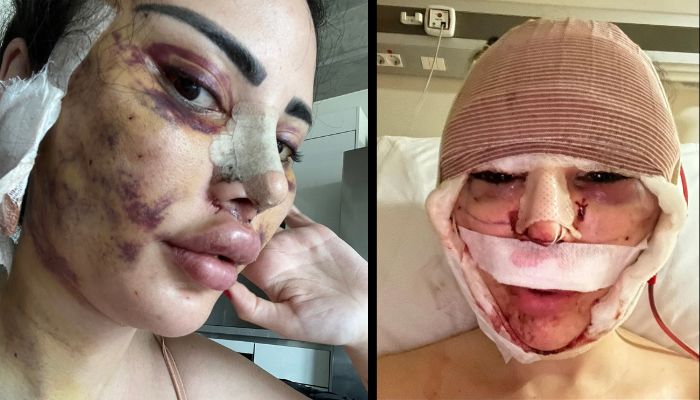
Jennifer Pamplona after her de-transition surgery in Istambul, images via Caters News Agency

Post her operation, she suffered complications and developed an infection. She bled profusely from her cheeks continuously for 3 days. The images of her disfigured face are now doing the rounds of the internet.

Although her recovery is still a long way ahead, Pamplona said, “The best feeling is knowing I’m not in a fight with myself anymore. I am now who I wanted to be and I really now understand the meaning of life.”

She has reportedly partnered with a doctor in Brazil to help individuals suffering from body dysmorphia. The Brazilian-born model is also working on a documentary named ‘Addiction’ which seeks to expose the dangers of cosmetic surgeries.

The model has also partnered with a doctor to open a foundation in Brazil, with the aim of treating people who suffer from body dysmorphia. “I feel like I can help a lot of people with my life story, but my face is beautiful and now I look even more beautiful,” she emphasised.

TOI may initiate action against Maria Khan for misrepresenting employment with publication, had blamed mother of girl attacked by Danish Khan in Jhansi

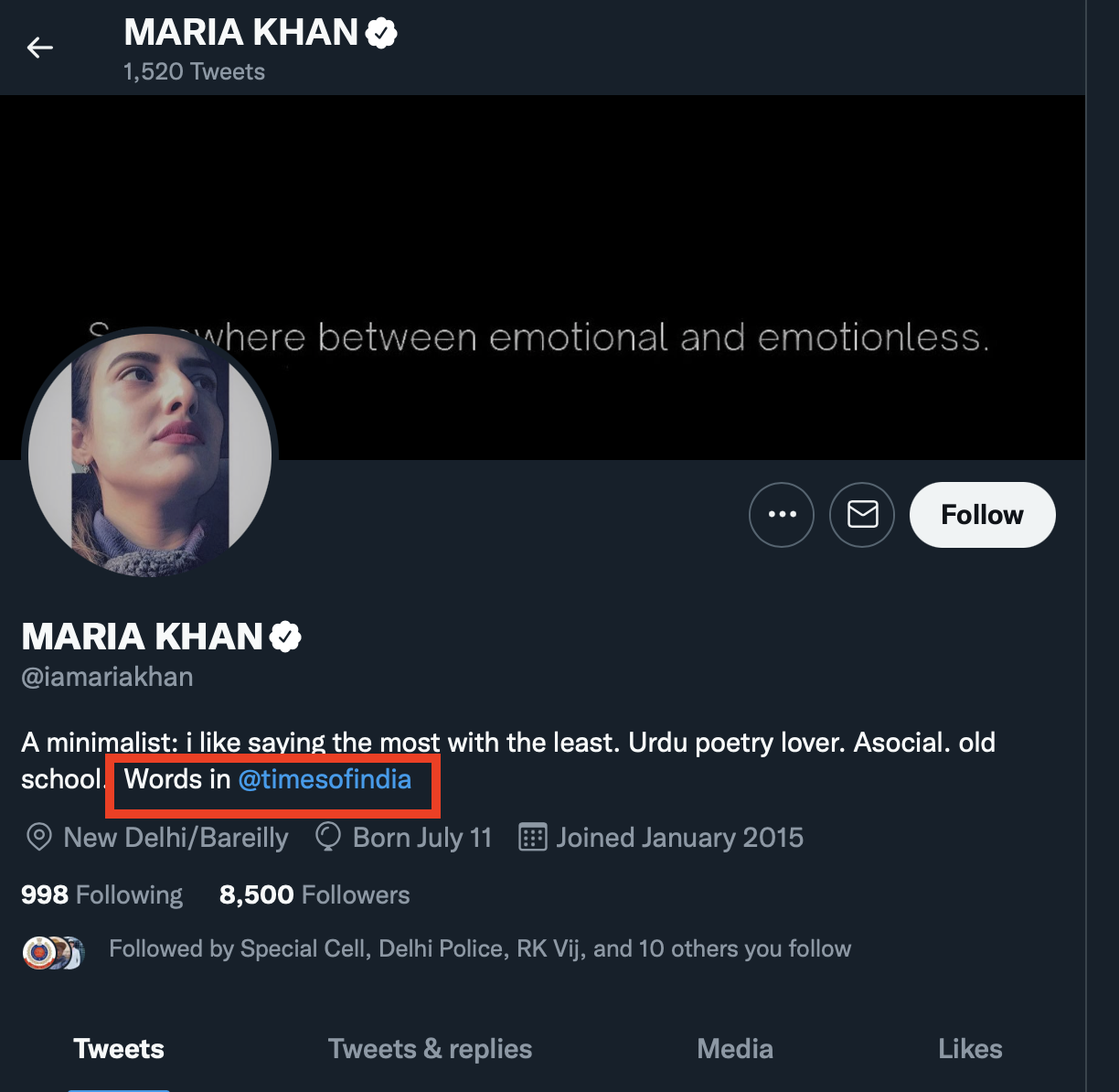
Update: Sources in the Times of India tell OpIndia that Maria Khan left her job with the publication on 18th November 2021. Since, she continues to use the Times of India name in her Twitter bio, which is prohibited as per the terms of the agreement, TOI is contemplating taking legal action against Maria Khan.

Screenshot of her Twitter profile

An archive version of her Twitter profile can be accessed here.

A day after the incident of the attack on a minor girl surfaced in Uttar Pradesh’s Jhansi, Maria Khan, who worked as a journalist at the Times of India targeted the mother of the victim and hinted that she might be lying in the case. Giving a brief statement to the media, the mother of the minor girl stated on July 12 that the accused had been harassing the victim for the past two years and executed the attack when the girl refused to accept his offer of a ‘friendship’.

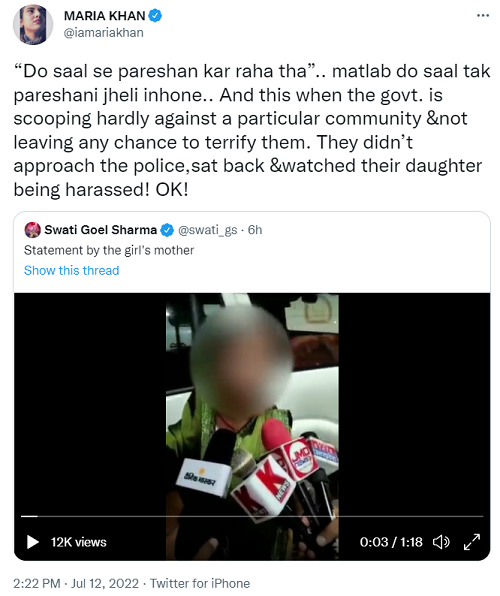
“The boy was troubling her for the past two years means these people tolerated the harassment for two years. And this is when the govt is scooping hardly against a particular community and not leaving any chance to terrify them. They didn’t approach the police, sat back, and watched their daughter being harassed! OK”, Maria Khan tweeted.

Screenshot from Twitter

Maria Khan through her tweet tried to insinuate that the girl’s mother is lying while making her allegations, might have given fake statements in the case, and might have built up the case with a specific purpose.

Meanwhile, netizens slammed the journalists for defending the accused and blaming the victim instead. “Wow, simply wow. She still doesn’t know how people try to survive in their life and ignore things as much as possible. All things aside, she can’t even have an ounce of empathy for that girl but for Danish”, one of the users said adding that the journalist was just encouraging similar-minded people to execute things the way Danish did.

Another user slammed the journalist for not understanding the plight of the women. “And she calls herself a woman..”, he said. One of the users also said that the Khan was defending the accused as if he was her brother. “Shame victim, parents, and govt except the accused. Now you can guess which community is accused from without reading the news”, the tweet read.

Yet, another Twitter user also found it hard to digest the fact that a woman was blaming another woman for the attack she survived. “Not everyone has a Twitter account and can play the victim card. Being a woman, people should at least support another woman in such condition but they won’t because of their biased nature”, the tweet read.

In a shocking incident, a 12th-class girl on Monday was attacked with a blade by Danish Khan while the girl was on her way to the tuition classes. Danish attacked her on her face and neck and then escaped from the scene. The injured girl was transferred from the Civil Hospital to the Medical College, where she remains in critical condition. The doctors have treated several injuries on her face and neck. The victim is said to have received 31 stitches.

The victim’s mother revealed that the accused had been harassing her daughter for the past two years. “He had obtained her phone number from the coaching center. He kept calling from several numbers. He used to put pressure on her to start a ‘friendship’ with him. Every day on her way to coaching, he used to harass her”, she said in the statement.

“He used to threaten her as well. My daughter did not tell anyone in the home anything because she was afraid. He attacked when my daughter refused to speak to him. Danish is about 8 to 10 years older than my daughter, ” the victim’s mother further remarked. Reports mention that three teams have been constituted to arrest Danish who is on run, and they are undertaking raids to apprehend him.

The victim narrative: How July 13 became ‘Martyrs Day’ in Kashmir, to celebrate Islamists, after horrific acts of cruelty were executed against Hindus

Instilling hostility in the Kashmiri mindset has been well achieved by employing the narrative war—the Kashmiri victim narrative—that carries on unabatedly in the Kashmir valley. The voices of all legitimate stakeholders have been muffled by this false narrative, which has also tainted history and created new, fictitious legends. The false feeling of victimisation coupled with violent Islamism, causes Kashmiri Muslims to regard everyone else as outsiders. One such persistent myth that has been debunked by the Modi government is the recognition of “Martyr’s Day” on July 13.

For those who are unaware, July 13 has been recognised as a state holiday from 1947 to 2019 to honour the 22 rioters who were shot to death by security forces after thousands of Kashmiri Muslims wreaked havoc in the Srinagar town and surrounding regions. On July 13, 1931, Jammu & Kashmir witnessed the first organised sectarian bloodbath in contemporary Kashmir history, and horrific acts of cruelty were executed against Hindus in the wake. However, this public holiday made no mention of the intentional atrocities carried out against the Dogra community and other Hindus in the valley.

In this piece, we’ll look at how July 13 is actually a black day for Kashmiri Hindus. We will look at how the gradual process of democratisation, which had been planned and started by a righteous ruler, Maharaja Hari Singh, was purposefully halted, as well as how the seeds of hatred against the Dogra community were sown under the false pretence of an anti-monarchy movement that saw the call to “Quit Kashmir.”

Setting the pretext of the 1931 carnage

Maharaja Hari Singh was the independent ruler of Jammu and Kashmir in 1931. He was in charge of Ladakh, Gilgit-Baltistan, Muzaffarabad-Mirpur, Aksai Chin, and Saksham Valley. He was a contemporary figure of his time who was committed to eradicating social injustice, ignorance, and inequality from the state. He was understandably reluctant to lease the Gilgit territory to the British, despite their requests. The British were aware of his vulnerability, namely that he was an unusual Hindu king ruling over a largely Muslim population.

The British planned to do something to achieve what they wanted. It was then the British intelligence brought Abdul Qadeer, a provocateur from Peshawar who was an Ahmadi, into Srinagar while posing as a cook for a local British living there. Additionally, Sheikh Mohammad Abdullah, an Aligarh Muslim University dropout, was also brought in.

At a public gathering at the Shah-e-Hamdaan Khanqah Mohalla, propagandist Abdul Qadeer delivered a fanatical speech. He made considerable use of the Quran to incite Muslims to rebel against the Maharaja. He promoted communal animosity and inflamed hatred by asserting that Muslims are forbidden by the Qur’an from surrendering to an infidel Hindu monarch. Additionally, he encouraged people to slaughter cows, which was illegal, just to humiliate Hindus.

Qadeer was arrested on accusations of crimes against the state. The arrest of Qadeer was met with outrage. Later, attempts were made to repeatedly disrupt his trial. It was subsequently decided that his trial would take place in the prison itself. It was in this way the premise for a massacre was created. What followed was merciless killing and torture of Hindus and conversion to Islam.

13th July 1931

As written in the book, The Warning From Kashmir, “Among the flotsam and jetsam heaved up by the agitation against the State and the Hindus was a man called Abdul Qadeer.” It was Abdul Qadeer who was the originator of all the problems and made speeches that were “calculated to worsen the already embittered relations between the communities.”

Here are some excerpts from the book narrating the scene on July 13, 1931.

“The hearing in jail fell on 13th July. On that day, a mob stormed the jail and demanded admittance along with the Sessions Judge. When the Judge had passed the gates, the crowd also attempted to get in. The other gates had been forced and the inner gates were attacked. At the suggestion of the Judge, two Muslim lawyers, representing the accused, harangued the visitors to go out of the Jail precincts. Finding that there was no possibility of ingress, the crowd went out and started stoning officials and set fire to the police lines. The police force was then called in. All efforts to pacify the unruly mob proved futile.”

“The District Magistrate’s order was defied, who had been summoned to the spot by the time and had declared the crowd to be an “unlawful assembly” and ordered its dispersal. The order was defied and finding that the mob could neither be pacified nor dispersed, the District Magistrate directed fire to be opened. The crowd fell off but later it re-assembled and resumed stoning. It had to be dispersed with a Lathi charge. Part of the crowd, however, moved towards the Hari Parbat Fort: the cavalry had to pursue it and disperse it again. A section of the recalcitrants proceeded towards a place called Maharaj Ganj which is a business locality and loots over an extensive area followed. From Bhori Kadal to Alikadal a long stretch, Hindu shops were raided. Other localities such as Safakadal, Ganji, Khud and Nawakadal too formed the centres of loot. Bazar streets were littered with property, books of accounts were burnt: the Hindu shopkeepers were molested, in short, pandemonium prevailed.” (Page no: 87)

The book mentions that Hindu merchants lost goods worth lakhs of rupees. A British officer Mr Wakefield stated that the looted items were so dispersed across the streets that his vehicle was unable to pass through. He also stated that not a single Muslim notified him about the looters’ attack on their properties.

The most ‘extraordinary’ part of the episode, according to the book, was that almost simultaneously with the events in Srinagar, there was an uprising in Vicharnag, some 5 or 6 miles off. Untold horrors have been done there, with “men owning lakhs reduced to indigence and women subjected to the worst possible and most indecent assaults.” A military force was dispatched to the location, but the destruction had already been inflicted. The ambuscade also claimed the lives of Hindus elsewhere. Some people died, and many more were injured. Random assaults persisted for a long time. (Page no: 87-88)

The misconception that it was a “democratic” rebellion to overthrow the reigning “feudal” rule is a farce peddled to support the narrative and instigate a false sense of victimisation among the Kashmiri Muslims. It was actually an Islamist uprising against Hindu rule. The horror of July 13, 1931, lasted for weeks and months and also caused mayhem in remote Rajouri, Kotli, and Mirpur. Because the Vikrami almanack is 57 years ahead of the CE, the year 1931 is in the common recollection of Hindu refugees from Mirpur as “Atthassi na Shaurash” – the massacres of 88.

According to Yuv Raj Gupta, an octogenarian who fled Kotli and now lives in Jammu, “Innocents were mercilessly killed and many were converted to Islam forcibly. Religious places of worship, of Hindus and Sikhs, that is. temples and Gurudwaras, all met with the same fate. Many were completely damaged and desecrated. In other few cases, though buildings were not damaged, the sacred idols and holy books, including the Guru Granth Sahib, were badly damaged burnt and desecrated. These happenings known as “88 NA SHAURASH” (Riots of 1988 Bikram or 1931 Christian Era) are still in the memory of not only the survivors of that time but also of their subsequent generations, and the refugees of 1947, scattered throughout India and awaiting Rehabilitation.”

The myth of the ‘freedom struggle’ of Kashmiris against Dogra rule

Again, the narrative that the July 13 violence in 1931 Kashmir was a ‘freedom struggle’ is part of an effort to instil a sense of victimisation and convince Muslims that Maharaja Hari Singh was suppressing them. Maharaja Hari Singh, however, was a contemporary king committed to eliminating illiteracy, societal problems, and inequity in the state. He had inherited the highest position in a monarchy at a time when the institution itself was under scrutiny.

Despite having full authority as a result of his royal status, Maharaja Hari Singh was aware of the changing circumstances and worked to progressively democratise the system. His administration was founded on the principles of social justice and equality. His style of administration was crystal obvious in his legendary coronation speech, in which he stated, “For me, all communities, religions, and races are equal. All religions are mine, and justice is my religion.”

Maharaja Hari Singh had already earned the trust of the populace thanks to his effective management of the Valley’s catastrophic food shortage in 1921–1922. His actions succeeded in preventing famine. His reputation for being fair to everybody in the community kept him popular. The Agriculturists Relief Regulations of July 1926, one of his first measures, was intended to free farmers from the predatory grip of moneylenders. This reform aimed to liberate farmers from the control of the moneylending elite and eradicate the starvation and disease that afflicted them.

Maharaja Hari Singh focused his efforts on the struggle against illiteracy in order to establish socioeconomic equality since he was well aware that education was the key to social upward mobility. Education advanced everywhere, and the Maharaja in particular promoted Urdu as a teaching language to engage the Muslim populace. Due to his contemporary education and exposure, Maharaja Hari Singh became committed to the cause of social equality, which included women.

Maharaja Hari Singh was the king of the masses. Untouchability was eliminated, and Dalits were allowed to enter temples. As did the Dogra Maharajas before him, he went to the mosque to congratulate the Muslim countrymen on Eid and believed that all religions are equal.

Vilifying a progressive thinker like Maharaja Hari Singh and honouring the murders of rioters who plundered shops and raped women exposes the intentions of the ones, who fomented dissension in society and labelled an Islamist rebellion against a Hindu ruler as a “freedom struggle.”


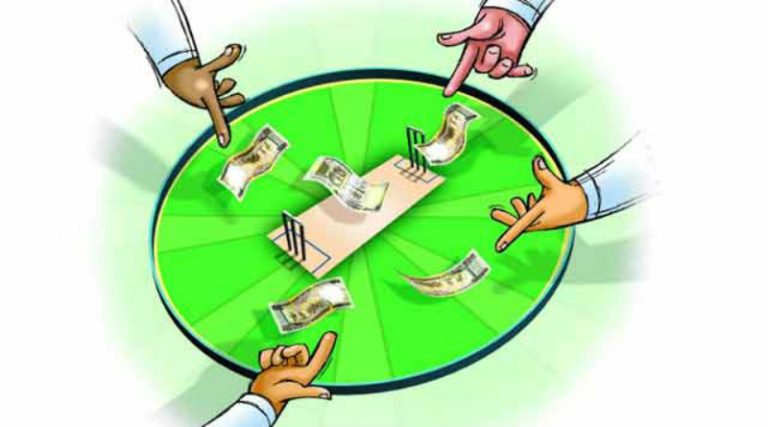
Another betting racket busted: UP-based cons ran a fake T20 cricket tournament live-streamed on YouTube, 2 persons arrested

Days after the elaborate betting racket in Gujarat that duped money from Russian punters over a fake IPL was busted, another racket with a similar modus operandi has been exposed in UP. As per reports, the UP Police have busted a betting racket in Hapur district where the accused persons ran a fake T20 tournament named “Big Boss T20 Punjab League”.

Speaking to the media, Deepak Bhuker, SP Hapur has informed that 2 persons have been arrested for running a betting racket that worked via a fake T20 series named “Big Boss T20 Punjab League”. He added that through a software, the accused had even live-streamed matches on YouTube.

A person named Ashok Chaudhary, who is located in Russia’s Moscow, reportedly provided the accused with all equipment. The accused used a mobile app named ‘Cric heroes’ to take bets, the SP informed. He added that the mastermind Ashok used to pay Rishabh, one of the arrested accused a sum between Rs 40,000 to Rs 50,000 for every match. The players who participated in the ruse were also paid.

The police are investigating the issue further.

Fake IPL in Gujarat targeted Russian punters

Recently, a fake ‘IPL’ racket was busted in Gujarat where a group of villagers were hired to pose as players and an elaborate series was planned where the farm labourers and villagers played with the IPL team jerseys. The fraudulent tournament had reached its “knockout quarterfinal” stage before the organisers of the “Indian Premier League Tournament” were arrested by the police.

The racket had even hired a commentator who had mimicked Harsha Bhogle, and they used audio of stadium noise downloaded from YouTube. The fake IPL was also streamed live on YouTube and the Gujarat villagers accepted bets from Russians based out of Tver, Voronezh and Moscow. They even had high-resolution cameras for the con.

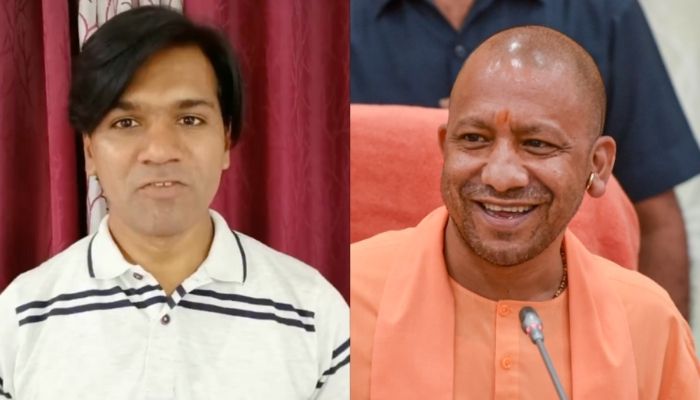
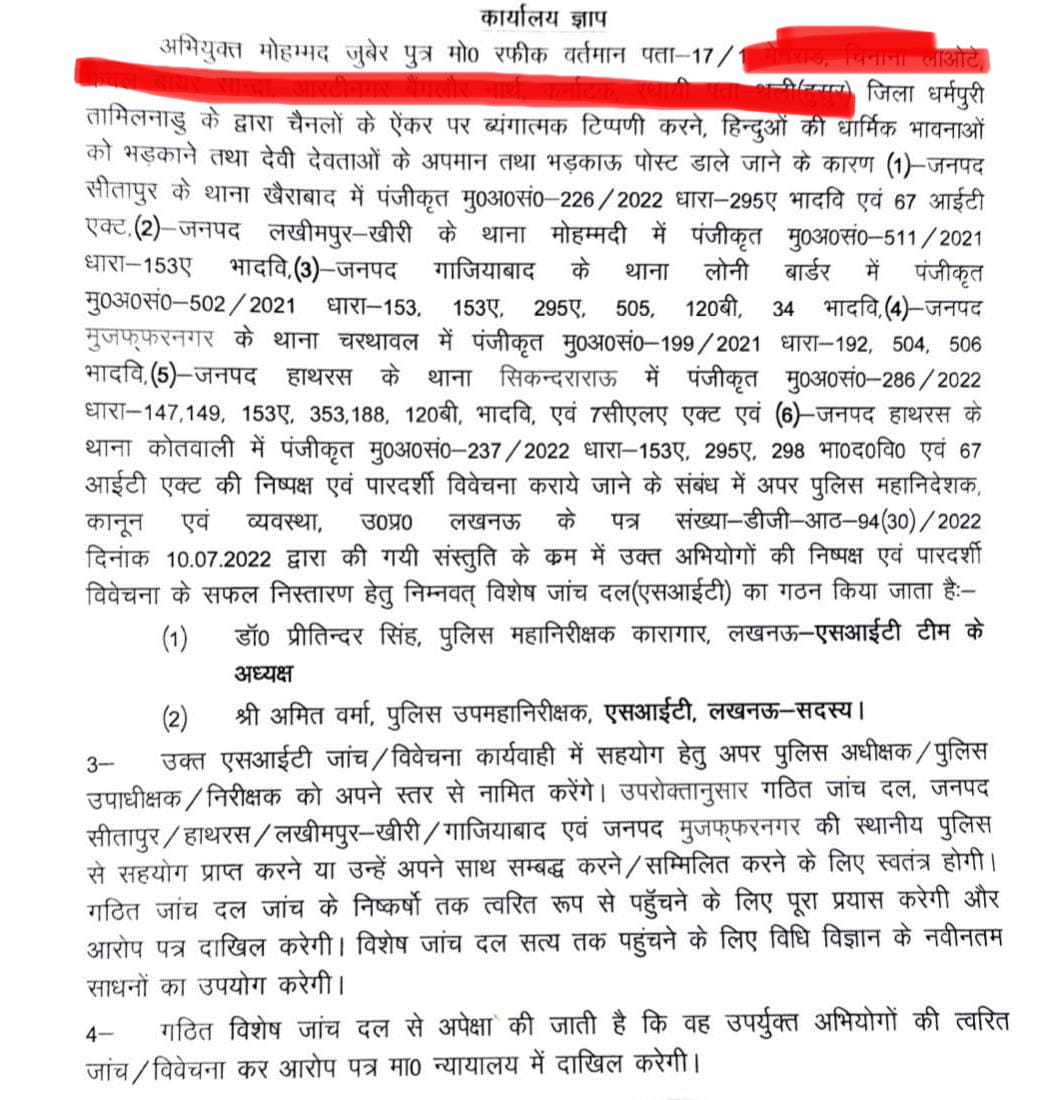
Uttar Pradesh Government constitutes SIT to investigate cases related to AltNews co-founder Mohammed Zubair

The Uttar Pradesh government has formed a Special Investigation Team (SIT) to look into all the accusations against Alt News co-founder Mohammad Zubair. Over half a dozen FIR under various sections of the Indian Penal Code have been filed against Mohammed Zubair for his defamatory comments against Hindu seers, hurting religious sentiments by sharing disparaging posts against Hindu Gods, and making critical remarks against News anchors among other things.

The SIT has been headed by IG Preetinder Singh. DIG Amit Kumar Verma has also made a part of the SIT. Mohammad Zubair is facing charges in Uttar Pradesh’s Sitapur, Lakhimpur Kheri, Ghaziabad, Hathras, and Muzaffarnagar.

UP govt constitutes SIT to probe allegations against Mohammed Zubair

The government’s directive to form the SIT comes in the backdrop of the Supreme Court extending the interim bail granted to Alt News co-founder Mohammed Zubair until further orders in the case filed in the Sitapur district of Uttar Pradesh. Zubair, however, would remain in Delhi Police custody in connection with another case filed against him.

On June 1, Khairabad Police of Sitapur district in Uttar Pradesh filed a First Investigation Report (FIR) against Alt News co-founder Mohammed Zubair for using derogatory language against Mahant Bajrang Muni Udasin, Rashtriya Sanrakshak of Rashtriya Hindu Sher Sena along with Yati Narsinghanand and Swami Anand Swaroop. The FIR was registered based on the complaint of Bhagwan Sharan, district head of Rashtriya Hindu Sher Sena, under sections 295(A) of the Indian Penal Code (IPC) and Section 67 of the Information Technology Act, 2000.

Another case has also been registered against him by the Delhi Police for allegedly hurting religious sentiments and promoting enmity through his tweet made in 2018. Zubair had been denied bail by Chief Metropolitan Magistrate Snigdha Sarvaria in this particular case on July 2. The court will hear another bail plea on July 14 in this case.

In addition to these two cases, Zubair is also facing charges in a case filed against him in UP’s Lakhimpur Kheri. Only yesterday, (Monday, July 11), the Alt News co-founder and alleged ‘fact checker’ was sent to 14-day judicial custody by the Mohammadi Session Court in the case filed against him in the Lakhimpur Kheri district of Uttar Pradesh. Additional charges under the Indian Penal Code (IPC), including Sections 153B, 501(1)(B) and 505(2), are pressed against Mohammed Zubair.

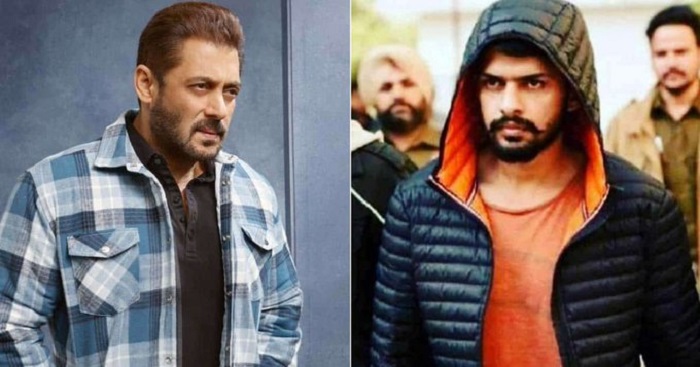
Lawrence Bishnoi confesses to plotting to kill Salman Khan; says he had bought a Rs 4 lakh rifle to murder him

On Tuesday, gangster Lawrence Bishnoi revealed to the Police that he had planned to kill Bollywood actor Salman Khan in the year 2018. Bishnoi, who is being questioned in connection with the assassination of popular singer Sidhu Moosewala also said that he had bought a special rifle worth Rs 4 lakhs to murder Khan.

According to the reports, Bishnoi told the cops that he wanted to kill Salman Khan because of the 1998 Chinkara poaching case in Rajasthan’s Jodhpur, which occurred during the filming of the movie named Hum Saath Saath Hain. During interrogation, Bishnoi reportedly stated that Chinkara, or blackbucks, are sacred to the Bishnoi community in Haryana, Rajasthan, and Punjab.

Khan was convicted to five years in prison by a Jodhpur court in April 2018 for murdering two blackbucks in October 1998. The actor has appealed his conviction. Khan was first detained in the Jodhpur jail in connection with the case but was subsequently transferred to the Bharatpur jail.

During his questioning, Bishnoi reportedly admitted to having sent texts to his colleague Sampat Nehra, who was from Rajgarh, requesting that Salman Khan be killed. Nehra was absconding in other instances at the time. Lawrence Bishnoi also informed the police that Sampat Nehra was sent to Mumbai to assassinate Salman Khan and undertook a reconnaissance of the actor’s home. According to Bishnoi, Nehra only possessed a pistol and no long-distance fire weapon, thus he could attack Khan from a distance.

The mobster then ordered an RK Spring rifle from a guy named Dinesh Dagar, according to sources, who added that the gun cost Rs 4 lakh. According to reports, the money was paid to Anil Pandey, a Dagar colleague. This rifle was later recovered in 2018 from Dagar’s possession.

On July 6, Hasti Mal Saraswat, a lawyer defending Salman Khan in the blackbuck poaching case, said that the Lawrence Bishnoi gang had threatened him with murder. In his lawsuit, Saraswat stated that a threat letter was discovered on July 3 on a door knob of the High Court’s Jubilee Chamber, which houses attorneys’ offices. According to the lawsuit, the letter had the initials of Lawrence Bishnoi and his aide Goldy Brar. It stated that the lawyer will face the same death as Sidhu Moosewala, adding that an ‘enemy’s friend is their first enemy’.

Last month, three members of the Lawrence Bishnoi gang were claimed to have delivered a letter threatening Salman Khan and his father Salim Khan. The letter allegedly threatened Salman Khan and his father with the same fate as Moosewala, who was assassinated in broad daylight on May 29 in Punjab’s Mansa.

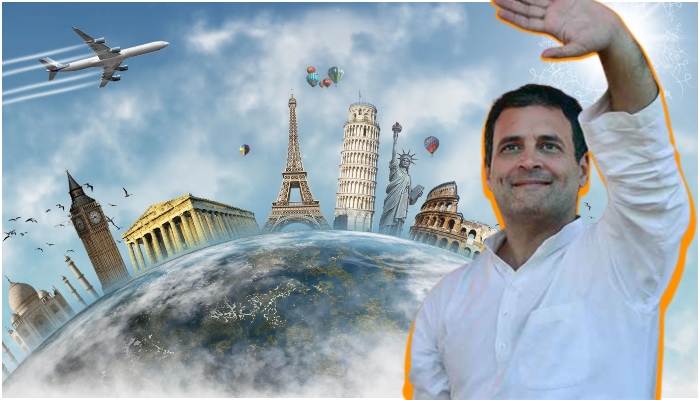
Amid the Goa Congress crisis, Rahul Gandhi vanishes again for a secret foreign trip: Each time the party faces trouble, the prince goes on a holiday

On Tuesday, Rahul Gandhi, the former Congress president and Wayanad Lok Sabha MP departed the nation for an overseas trip. The Congress party revealed that Gandhi took a trip today and will be returning to India by Sunday, July 17. However, it was unclear if the Congress leader was on a personal or official vacation when he left. The destination was likewise unknown at the time.

According to the reports, Gandhi boarded the trip at a crucial time when the grand old party is facing a probable split in its Goa section. While taking action against politicians engaging in anti-party actions, the Goa Congress unit ousted Michael Lobo from his post as the state’s opposition leader on Sunday.

Also, Congress President Sonia Gandhi urged Mukul Wasnik, a party legislator, to travel to the coastal state and see the changes. As usual, the Congress has blamed the BJP for it. The BJP has denied any role in the situation while asserting that Congress is in charge of selecting its MLAs.

Reportedly, this is not the first time that Gandhi has left the party alone to address the issues. Earlier in May, an undated video of the Wayand MP partying with a woman in a Kathmandu nightclub had gone viral. Netizens had taken severe potshots at Gandhi for partying abroad while leaving Congress in a state of crisis. After also BJP’s criticism, the Congress had responded saying that Rahul had travelled to Nepal to attend the wedding of a friend.

In April 2022, after poll strategist Prashant Kishor had rejected Congress’ offer to join the party, Rahul Gandhi had become untraceable again. Reports mentioned that Gandhi had gone missing for over 10 days and had gone unreachable, leaving the party to act alone in action during the crisis.

Earlier in December 2021, the Wayanad MP had gone for a personal trip to Italy ahead of the campaigns and rallies for then-upcoming Assembly elections in five states scheduled for 2022. He had forced the party to postpone his already scheduled rally in Punjab and had flown to Italy for a ‘personal visit’.

Since the BJP took government in 2014, Congress has been troubled by Rahul Gandhi’s frequent absence from the state on significant occasions, making it nearly impossible for it to perform as the primary opposition party in an efficient manner.

The party leadership desperately tries to project Rahul Gandhi as the face of the party and files timely requests from its members formally requesting Rahul Gandhi to become the Congress president. However, the Congress prince has not shown any interest in taking up the party president position since he quit the post in 2019.

Just before Diwali 2021, Rahul Gandhi vanished again, reportedly to London. On November 5, it was reported that Gandhi was on a ‘long vacation’. He returned after almost a month, just before the winter session commenced in the Parliament. At that time, BJP took a dig at Gandhi and questioned his trip to London.

In September 2021, while the Congress party in Punjab was facing a crisis with Amarinder Singh’s resignation, the Gandhi family was vacationing in Shimla.

Gandhi is often seen as a full-time traveller than a politician. In December 2020, he left for Italy on the 136th foundation day of his party. His party leaders could not settle on one explanation and further made themselves a target of media questions. In October 2019, fifteen days before the assembly elections in Haryana and Maharashtra, Gandhi had left, reportedly for Bangkok.

Interestingly, Gandhi also has a history of skipping important party events. In November 2019, Congress had planned as many as 35 press conferences across the country against union govt’s policies, but Gandhi, who allegedly gave directions for the press conferences, skipped them himself.

In May 2019, before the counting of votes of the parliamentary elections, Rahul Gandhi skipped an important meeting held by UPA chairperson Sonia Gandhi in which they had planned to decide on a PM candidate and flew to London for a holiday. From missing out on budget sessions in 2018 to vanishing from trips to Thailand, Cambodia, Myanmar, and Vietnam in 2015, the Congress leader seems more interested in travelling than showing support to his party. Not to forget, he had a history of skipping SPG security for his abroad visits.

It is notable here that Rahul Gandhi’s foreign visits are always shrouded in mystery. He never shares the news of travelling abroad in the media or never even shares pictures from his numerous foreign trips. In his current visit, Rahul Gandhi has flown to some unknown place and will be returning on July 17. Gandhi’s foreign visit also comes ahead of the Parliament’s Monsoon Session that is scheduled to begin on July 18. The Presidential Election will also be held on Monday, with counting slated to happen on July 21.