The Mangaluru police have registered an FIR against admins of a Facebook page called “Mangalore Muslims” for inciting hatred and violence by posting derogatory content about the 26-year-old Bajrang Dal leader Harsha. The Hindu leader was stabbed to death by Muslims on the streets of Karnataka’s Shivamogga on Sunday night.
According to the reports, a suo motu case has been registered in the cyber, economic and narcotics offences police station based on a complaint by head constable Raja M of the social media division. On Wednesday, N Shashi Kumar, Police Commissioner, Mangaluru City, also confirmed that an FIR had also been filed against “Mangalore Muslims” in the case.
Mangalore Muslims page has been accused of repeatedly posting provocative posts against Hindutva outfits and Hindu political leaders to spread hatred between Hindus and Muslims and provoke to indulge in violence. One Mohammed Shafiq has been named in the FIR, who is believed to be the admin of the page. He had shared provocative posts with other social media groups.
The Facebook page had posted content defending Harsha’s murder on Sunday, and referred to him as “street dog.” The page had claimed that Harsha was murdered for allegedly abusing Prophet Mohammed in the year 2015. It had also added that “whoever insults the Prophet will meet the same fate.”
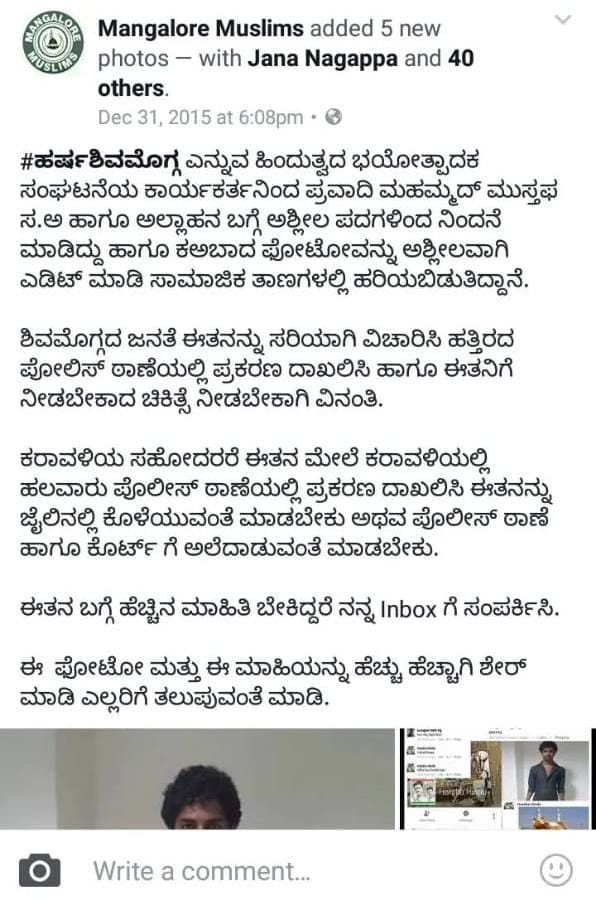
In a post shared on December 31, 2015, Islamist page, “Mangalore Muslims” on Facebook had threatened Harsha with physical harm for his remarks on Prophet Muhammad. The post read, “Harsha, a member of Hindutva terrorist group, has put out objectionable posts targeting Prophet Mohammad and Allah and has shared morphed images of holy Kaaba on social media platforms.”
In its post, the radical Islamic group had said, “Leave a text in Inbox for more information about him, share this image and information,” the page appealed to Islamists. Another Facebook page named ‘Karavvali Muslims’ shared the same message on the same day.
Now, a suo motu case has been registered against the page. The complaint states that the Facebook page called “Mangalore Muslims” uploaded a post referring to Harsha in abusive terms and claimed that Harsha had insulted the Prophet, thereby implying that Harsha was killed for mocking the Prophet.
“The post further implied that anyone who insults the Prophet, such as Ajit Hanamakkanavar, will not be forgotten by ‘Mangalore Muslims’ page. The post claimed that the “Mangalore Muslims” page will give a clue to today’s murder to police and the government, and that ‘to know the truth, Eshwarappa should be arrested and investigated, and made to confess that he gave the contract to Muslims to kill Harsha’,” stated the complaint according to Daijiworld.
The complaint also reportedly stated that the above post was false and aimed to create communal hate.
“It seems that the page is supporting Harsha’s murder, issuing a threat to Ajit Hanamakkanavar, and spreading false rumours about Eshwarappa, besides repeatedly uploading defamatory posts about Hindu organizations and Hindu political leaders,” the complaint stated.
The complaint stated that the post has been uploaded on Facebook to create Hindu-Muslim enmity and provoke communal riots. The case in this regard has been filed, and the investigation is on.
On Wednesday, the Gurugram Police detained a Madarsa teacher named Noorhasan for abducting a girl who had gone missing a month ago from Mawan town of Uttar Pradesh. The Police found the girl who was forcefully kept by the Madarsa teacher with him after they raided the location in Gurugram.
According to the reports, the 18-years-old girl had disappeared from her tuition classes on January 25 from Mawan town. The family while searching for the girl discovered that Noorhasan, the teacher of the Madrasa located near the house had also gone missing at the same time.
The family and the relatives of the girl made several attempts to contact him over the phone but to no avail. The relatives then went to the house of the accused inquiry but could find him, and his family members had also fled. On Tuesday, the family and relatives of the girl got information that the Madrasa teacher had abducted the girl and was in Gurugram with the girl.
They immediately informed the Police who then raided the location. The police caught both of them from a rented house and brought them to Mawana. The girl was presented in the court and later sent to Nari Niketan. The accused Madrasa teacher is being questioned in the police station.
Police station in-charge Vishnu Kaushik said that the madrasa teacher’s phone was put on surveillance. The police were in search of Noorhasan but he was on the constant run. No specific information has yet been attained in the process of interrogation. The family of the girl has filed a case against the Madarsa teacher for abducting their daughter. The Police has assured to take strict action against the teacher, and the investigation is underway.
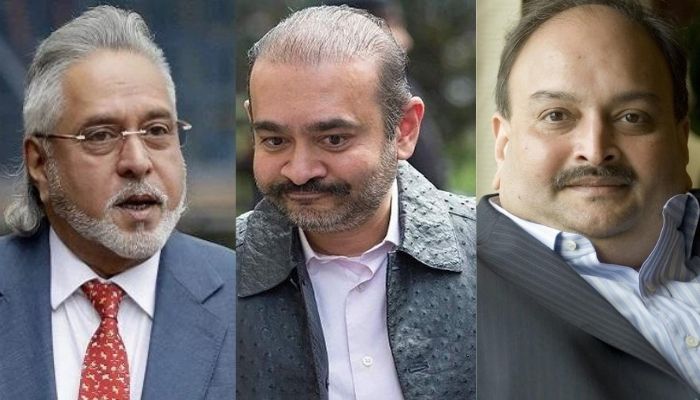
The Central Government has told to the Supreme Court that Rs 18000 crore have been returned to the banks which were stifled by fugitives Vijay Mallya, Nirav Modi, and Mehul Choksi until now. Solicitor General Tushar Mehta was representing the Centre during a hearing on petitions challenging the scope of powers available to the directorate of enforcement (ED) for investigation of crime under the law.
SG Tushar Mehta was representing the Centre before a three-member bench headed by Justice A.M. Khanwilkar and Justices Dinesh Maheshwari and C.T. Ravikumar. He told that the total record of criminal cases in the Prevention of Money Laundering Act (PMLA) pending before the top court amounts to whooping Rs 67,000 crore. Detailing about the cases investigated by the Enforcement Directorate (ED), he added that 4,700 cases are being investigated as of now. From 111 cases taken up by the ED concerning the PMLA act in 2015-16, the number has increased to 981 in 2020-21.
While comparing the numbers with the global data, Tushar Mehta added, “very small number of cases are being taken up for investigation under the PMLA as compared to annual registration of the cases under the Money Laundering Act in the UK (7,900), the US (1,532), China (4,691), Austria (1,036), Hongkong (1,823), Belgium (1,862) and Russia (2,764).”
“The efforts against money laundering have consistently advocated to include the widest range of predicate offences in the domestic laws,” added Mehta emphasizing that the measures against money-laundering cases are not only restricted to drug or terrorism-related offences and have moved beyond the same. The Centre’s responses came after senior Congress-affiliated advocates including Kapil Sibal, Abhishek Manu Singhvi, Mukul Rohatgi, Sidharth Luthra, Amit Desai, and others made submissions before the apex court on various aspects related to potential misuse of PMLA provisions introduced by way of amendments to the act.
Vijay Mallya fled to London after he was accused in the Rs 9,000 crore fraud case which led to the collapse of Kingfisher Airlines. In July 2021, a London court had declared him bankrupt. Prior to that in May 2020, he had lost the legal battle against his extradition to India. However, he has not yet returned to face trial. Mallya continues to be on bail while a “confidential” legal process is completed before he is sent to India. Reportedly, he has applied for political asylum in UK now.
In April 2021, The British Home Secretary had approved of the path to Nirav Modi’s extradition to India wherein he is accused of money laundering related to his $2 Billion USD Punjab National Bank Scam. The other accused in the case Mehul Choksi is living in Antigua and Barbuda, where he has obtained citizenship against investment.
In July last year, the ED handed shares worth Rs 792 crores to a consortium of banks recovered from the above three wilful defaulters. In December 2021, finance minister Nirmala Sitharaman while answering a question in the Parliament had announced that Rs. 13000 crore were already recovered from the asset sale of fugitive diamantaire Nirav Modi, Mehul Choksi, and erstwhile liquor baron Vijay Mallya.
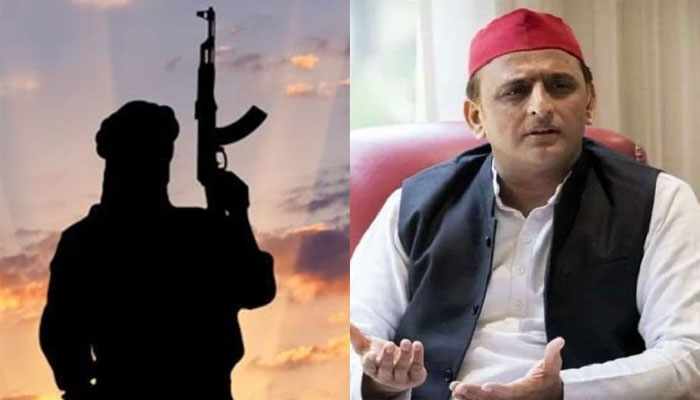
Former Director-General of Police (DGP), Uttar Pradesh, Dr Vikram Singh lashed out at former Chief Minister of UP Akhilesh Yadav for seeking withdrawal of cases against terrorists involved in bomb blasts in Varanasi, Gorakhpur and Ahmedabad. Singh, who was closely connected to the cases, said, “You [Akhilesh Yadav] are answerable to the fact that despite of being witness to so much destruction and death, you killed your soul and sought withdrawal of cases against terrorists involved in bomb blasts [at multiple places over the years].”
He added, “The triple blast that killed 18, another blast in Varanasi that killed 12, the Ahmedabad blasts, how can you ignore their involvement?” Singh was speaking in a debate on News18 India’s show ‘Desh Nahi Jhukne Dunga’. He further said, “Not only Akhilesh Yadav sought withdrawal of cases, but he also filed a murder case against me, then-DG Brijlal and 40 STF commandos over the death of terrorist Khalid Mujahid who died of heatstroke. None of us was present at the scene when he died, but we were dragged in the case.”
Singh added, “When it comes to the country, my life, Brijlal’s life or the lives of STF commandos do not matter. We will happily sacrifice ourselves for the country. However, it was unfair to drag us in the case of Mujahid’s death though everyone knew he died of heatstroke.”
‘SP Govt sought withdrawal of cases against terrorists’: PM Modi
During the Hardoi rally on February 20, Prime Minister Narendra Modi had said, “Samajwadi Party government in Uttar Pradesh sought to withdraw cases against several terrorists.” He said when terrorism spreads its roots and attacks happen in the country, it is the poor and middle class that bears the maximum damage. Normal life, businesses and tourism come to a standstill after a terrorist attack. “From Mumbai to Delhi, Jaipur, Bangalore, Hyderabad, Guwahati, Ludhiana, Agartala, Imphal and many other cities have faced such attacks, and many civilians were killed,” he added.
PM Modi recalled how Ahmedabad serial bomb blasts happened during his tenure as CM of Gujarat. He said, “On the same day, I had vowed that my government would find these terrorists from the underworld and punish them. You have seen, just a few days ago, the culprits of the Ahmedabad bomb blast have been punished.”
जब मैं गुजरात का मुख्यमंत्री था, तो उस दौरान अमदाबाद में भी सीरियल बम धमाके हुए थे। मैं उस दिन को कभी भूल नहीं सकता।
उसी दिन मैंने संकल्प लिया था कि मेरी सरकार इन आतंकवादियों को पाताल से भी खोजकर सजा देगी।
He added, “In 2006, there was a bomb blast in Kashi. There was also a blast in the Sankat Mochan temple. The Cantt railway station there was also attacked. When the Samajwadi Party government came to power again in 2013, they decided to withdraw the cases against the accused named Shamim Ahmed. In 2007, there were bomb blasts in the court premises of Lucknow, Ayodhya. In 2013, the Samajwadi government withdrew the case against a terrorist named Tariq Kazmi.”
2006 में काशी में बम धमाका हुआ था।
संकट मोचन मंदिर में भी धमाका किया गया था।
वहां के कैंट रेलवे स्टेशन पर भी हमला किया गया था।
जब 2013 में समाजवादी पार्टी की सरकार फिर से सत्ता में आई, तो इन लोगों ने शमीम अहमद नाम के आरोपी पर चल रहे मुकदमों को वापस लेने का फैसला ले लिया था। pic.twitter.com/gHJtA08dpf
Taking a jibe at Samajwadi Party’s political symbol cycle, PM Modi said, “The bombs were placed on cycles during Gujarat (Ahmedabad) bomb blasts. I wonder why they chose cycles.”
गुजरात बम धमाकों में आतंकियों ने सपा के चुनाव चिन्ह ‘साइकिल’ पर बम रखे थे
He said the court did not allow the government to take back the cases and sentenced the terrorists to life imprisonment. “Similarly, in 14 cases of terrorist attacks in UP, the Samajwadi government had given orders to withdraw the cases from many terrorists,” PM Modi added.
ऐसे ही यूपी में एक दो नहीं बल्कि आतंकी हमलों के 14 मुकदमों में समाजवादी सरकार ने बहुत सारे आतंकवादियों से मुकदमे वापस लेने का फरमान सुना दिया था।
ये लोग विस्फोट कर रहे थे, धमाके कर रहे थे और समाजवादी पार्टी सरकार इन आतंकवादियों पर मुकदमा तक नहीं चलने दे रही थी।
Earlier, Chief Minister Yogi Adityanath had also lashed out at Samajwadi Party during an interview with ANI for seeking withdrawal of cases against terrorists. He said, “When Yadav’s government came to power in 2012, the first thing they did was to withdraw court cases against those criminals and terrorists who had initiated attacks on Ayodhya, Gorakhpur, CRPF camp in Rampur and courts in Varanasi, Ayodhya and Lucknow. I would like to thank Allahabad High Court for stopping them from withdrawing the case.”
Recently, Ahmedabad Special Court had sentenced 38 accused to the death penalty in Ahmedabad serial blasts of 2008. Speaking on the matter, CM Yogi said, “Out of 38 convicted in the serial blast case, eight were from Uttar Pradesh. One of them is the son of the Samajwadi Party’s leader. I would like to ask Akhilesh Yadav to explain the matter. The public will answer those who are supporting terrorists.”
The case of Khalid Mujahid
In 2013, Khalid Mujahid, a terrorist accused of multiple bomb blasts, died in police custody. As per reports, he was rushed to the hospital by jail authorities on May 18, 2013, where he was declared dead. A case was registered against then-DGP Vikram Singh, ADG Brijlal, and 42 police officers who were involved in his arrest based on the complaint of his uncle Zahir Alam Falahi.
Khalid and his associate Tariq Qasmi were arrested on December 20, 2007, for their alleged involvement in Gorakhpur serial blast case. STF had recovered a large cache of explosives from their possession. Though Khalid had died in 2013, the case against Qasmi continued. Qasmi, who was a Harkat-ul-Jihad al-Islami (HuJI) operative, was sentenced to life imprisonment in December 2020. He was also booked and convicted in Lucknow and Faizabad court blast cases.
‘Rather than securing the society, SP provided political patronage to terrorism accused’ – BJP National Spokesperson Gaurav Bhatia
Speaking to OpIndia, BJP National Spokesperson Gaurav Bhatia said, “Rather than securing the society and ensuring law and order Samajwadi Party wanted to protect and provide political patronage to terrorism accused persons for the sake of petty vote bank politics. Notably, the Allahabad High Court reprimanded Samajwadi Party and remarked ‘Will you be giving Padma Vibhushan to the Terrorism accused’.”
Akhilesh Yadav needs to introspect whether he is with nation or with terrorists. pic.twitter.com/3K8NBKAtz4
During a debate on Republic TV, he said, “I told Akhilesh Yadav at that time withdrawing of cases was not right. When the Muzaffarnagar riots happened a GO (Government Order) was issued that the compensation would be given only to Muslim families. At that time Supreme Court reprimanded Akhilesh Yadav and he had to withdraw the order. This was the kind of appeasement he was indulged in. What Narendra Modi Ji has today said is something Akhilesh Yadav needs to retrospect that ‘Are you with the nation or with terrorists’ because you appease the people of a particular religion.”
‘Not just SP but Congress stands with terrorists too’ – BJP UP State Spokesperson Rakesh Tripathi
Speaking to OpIndia, State Spokesperson of BJP, Rakesh Tripathi outed Samajwadi Party and Congress for direct or indirect support for terrorists. He said, “Samajwadi Party can stoop to any level in the name of appeasement. If they can take the name of Mohammad Ali Jinnah and Sardar Vallabhbhai Patel together it can be assumed that they can stand with the terrorists and rioters. If you remember, Mohammad Najeer, the accused of the Muzaffarnagar riots, was brought to CM house via government plane. It is not something new for SP to stand with the terrorists and rioters.”
He added, “SP is not the only party that does appeasement for vote bank. Congress has indulged in similar practices. Congress leader Salman Khurshid had said Sonia Gandhi cried after seeing the photographs of terrorists killed in the Batla House encounter. They tried to stop the death penalty of Afzal Guru and Yakub Menon. The opposition stands with the terrorists for appeasement.”
‘How can govt decide who is terrorist’ Allahabad High Court
In 2012, when Akhilesh Yadav led government tried to withdraw cases against the terror accused, Allahabad High Court had quashed the application and questioned how the state government could decide who was a terrorist and who was not. The court said, “How can the government decide who is a terrorist? Is the government encouraging terrorism by taking steps to withdraw cases against accused persons? Today you are withdrawing cases…tomorrow you will confer Padma Bhushan on them.” Notably, SP had said in its manifesto that they would take back cases against “innocent youth” lodged in jails.
Uttar Pradesh Assembly Elections
The fourth phase of the UP Assembly elections was held on February 23. Three more phases would be completed by March 7 and the results will be announced on March 10.
On Tuesday, the Hindu activist group Hindu IT Cell alleged that the Karnataka police were refusing to register a complaint against Islamic troll Rana Ayyub for calling students at Udupi college protesting with Saffron flags as terrorists.
In a tweet, the Hindu IT Cell had shared their grievance against the police officials, alleging that they had made one of the volunteers of the organisation wait for 36 hours before accepting the complaint against Rana Ayyub. The activist group had alleged that the Dharwad police had refused even to register the FIR.
“Is this the power of your voters and the common man?” the Hindu IT Cell had tweeted.
Hindu IT Cell had filed a complaint against radical Islamic troll Rana Ayyub for referring to students at Udupi college protesting against the Muslim girl students demanding to wear burqa and hijab in classrooms. A few Muslim sections, backed by radical Islamic organisations, have been protesting in Karnataka by insisting that they would be wearing hijab and not follow the existing uniform rules inside schools and colleges.
In an interview with the BBC, Rana Ayyub was clearly seen referring to Hindu students protesting against Burqa as vigilantes and terrorists. In an aggressive tone typical to her, she was seen ranting, “…Why suddenly has this group of young Hindu vigilantes – Hindu terrorists for that matter who are hosting saffron flags in an educational complex in Karnataka?”
She was seen questioning, “Why are male students unfurling a saffron flag in an educational institution? What does that mean?”
Students with Saffron Flags in Karnataka are terorists: Alleged Journalist Rana Ayyub pic.twitter.com/oqWLqwHyIc
After the inciting video made rounds on social media, the Hindu IT Cell had tried registering a complaint. However, they had alleged that the police were refusing to register the complaint.
Police Sub-inspector Sachin said the higher officials had asked them to verify the complaint, and the legal department is looking into it.
Earlier, a similar complaint had been registered by Ashutosh J Dubey, a practising lawyer at Bombay High Court, against Rana Ayyub at Greater Mumbai Police at Bandra.
The Washington Post columnist was in the news after the ED recently attached her assets after being accused of financial fraud worth Rs 1.77 crore in the name of Covid-19 donations. However, Rana brazened out after being exposed by resorting to her usual Hindupohobic rants.
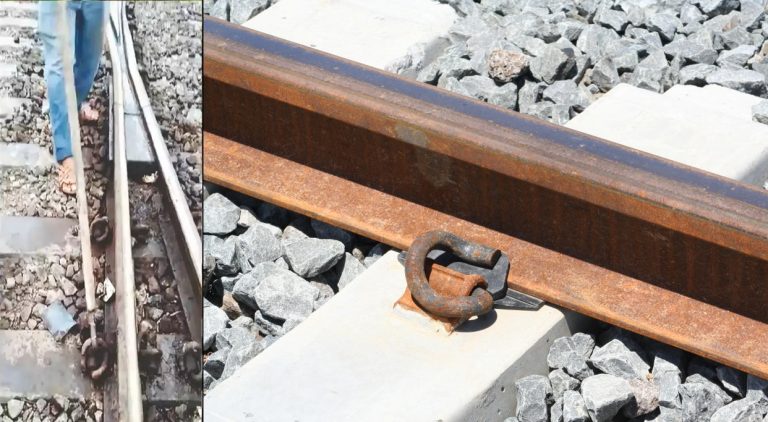
On Monday, a deliberate attempt to derail a train on the route of Ahmedabad-Bhavnagar track was averted saving the lives of the locomotive pilot and a guard. The incident came to light when an alert railway employee informed the rail officials that a large number of clips that fasten the rail tracks had been separated from the concrete sleepers.
While sometimes thieves also steal metal pieces from the railway tracks, the police during the investigation said that the clips had been removed from the track to derail trains intentionally. This was concluded because the clips were found nearby.
According to the reports, around 234 clips at the Matoda and Maroiya route were removed from the track and thrown into the bushes on the sides of the track. Railway officials confirmed the incident and immediately informed the police.
A railway official said, “The incident came to light when a railway employee was patrolling the route and spotted that the clips were missing from a portion of the track. The employee informed the seniors and then the railway protection force.” The incident was reported at 8.3 0am, following which train movement along the track was stopped. A DEMU train with just a locomotive pilot and a guard, which was about to travel on the route was stopped in time.
“The train movement was stopped for around two and a half hours. Any train that chugged along the track would have been derailed”, the Police was quoted. The Railway Officers meanwhile informed that the track had been recently converted from metre gauge to broad gauge in Moraiya. He also said that no passenger train was allowed on the track after it was aligned.
It is important to note that the incident has occurred days before the 20th anniversary of the Godhra tragedy, in which 59 Hindu pilgrims were burnt alive in a train. The incident was followed by riots in several parts of the state in the year 2002.
On the morning of 27 February 2002, the Sabarmati Express, returning from Ayodhya to Ahmedabad, had stopped at the Godhra railway station. The passengers were Hindu pilgrims, the karsevaks of the Ram Mandir movement returning from Ayodhya. A Muslim mob had attacked the karsevaks in the train by pelting stones at them, and after that torched four coaches of the train with many people trapped inside. In the resulting conflagration, 59 people were burned to death. The 20th anniversary of the Godhra tragedy will be observed on February 27, 2022. Reportedly, the mob had locked the doors from outside and poured fuel into the coaches.
In the present case, along with the Police, the Railway Protection Force also investigated the matter and confirmed that the attempt to derail the train was deliberate. Reports mention that other agencies are also likely to carry out an investigation in the case.
The Sabarmati Police has filed a complaint under section 150 of the Railways Act for the intentional attempt to derail the train.
Hindu activist Harsha was brutally murdered by Islamists over an alleged social media post in Karnataka’s Shivamogga on Sunday night. The 26-year-old Hindu activist was murdered by six Muslims for defending the Karnataka government’s regulation on uniforms that barred students from wearing any religious attire inside the educational institutions.
Two days after the murder, the Karnataka police has managed to arrest a total of six individuals – Qasif (Kasif), Syed Nadeem, Mujahid, Rihan alias Qasi, Afan and Asif for stabbing Harsha on the streets of Shivamogga. The locals speaking to OpIndia have confirmed that Harsha had repeatedly received threats from the Islamists and suspect that the Islamists may have killed him over allegedly “blasphemous” social media posts.
The brutal killing of a Hindu activist by Islamists over alleged ‘blasphemous’ posts has triggered a massive outrage across the country. Harsha’s murder has evoked a strong response from Hindus, expressing their anger and helplessness against the repeated terror attacks on the community. As usual, the secular state has yet again turned a blind eye towards the apathy of the Hindus.
The Islamists and the left-liberal establishment has now taken it to another level by blaming the victim for his own death. As the role of Islamists in the coordinated killing of Harsha emerged, the Islamists and the left-liberal media establishment quickly attempted to whitewash the crimes committed by the Muslims. Instead, they tried to shift the blame on the 26-year-old victim Harsha for his own death.
Left-liberal media outlets, Islamists blame Harsha for his own murder
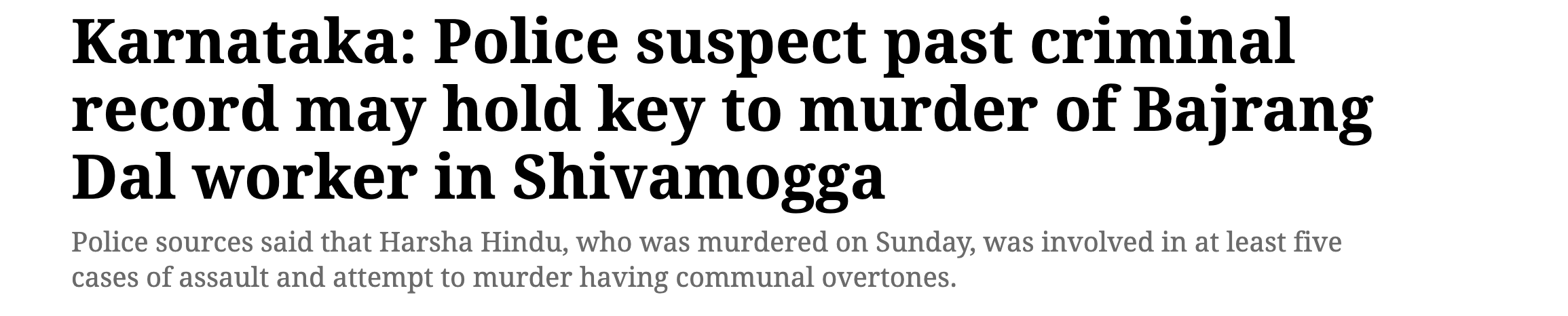
Indian Express published a report saying that the police are looking at crimes allegedly committed by a Bajrang Dal worker in the Shivamogga region to ascertain a possible motive behind his murder.
Quoting imaginary police sources, the Indian Express claimed that Harsha was involved in at least five assault and attempted murder cases, having “communal overtones”.
Image Source: Indian Express
Indian Express also claimed that Harsha was part of a mob that attacked Muslim traders in Shivamogga city on December 3, 2020. However, it did not provide any source or evidence to substantiate their claim.
The Indian Express tried to push a narrative that Harsha was a “criminal’ against whom cases were registered, and his murder was a reaction to his own act. As per Indian Express, the deceased Hindu leader was not a victim as he had a criminal past ‘as per sources’. Essentially, the Indian Express hints that nobody can be blamed except Harsha for his murder.
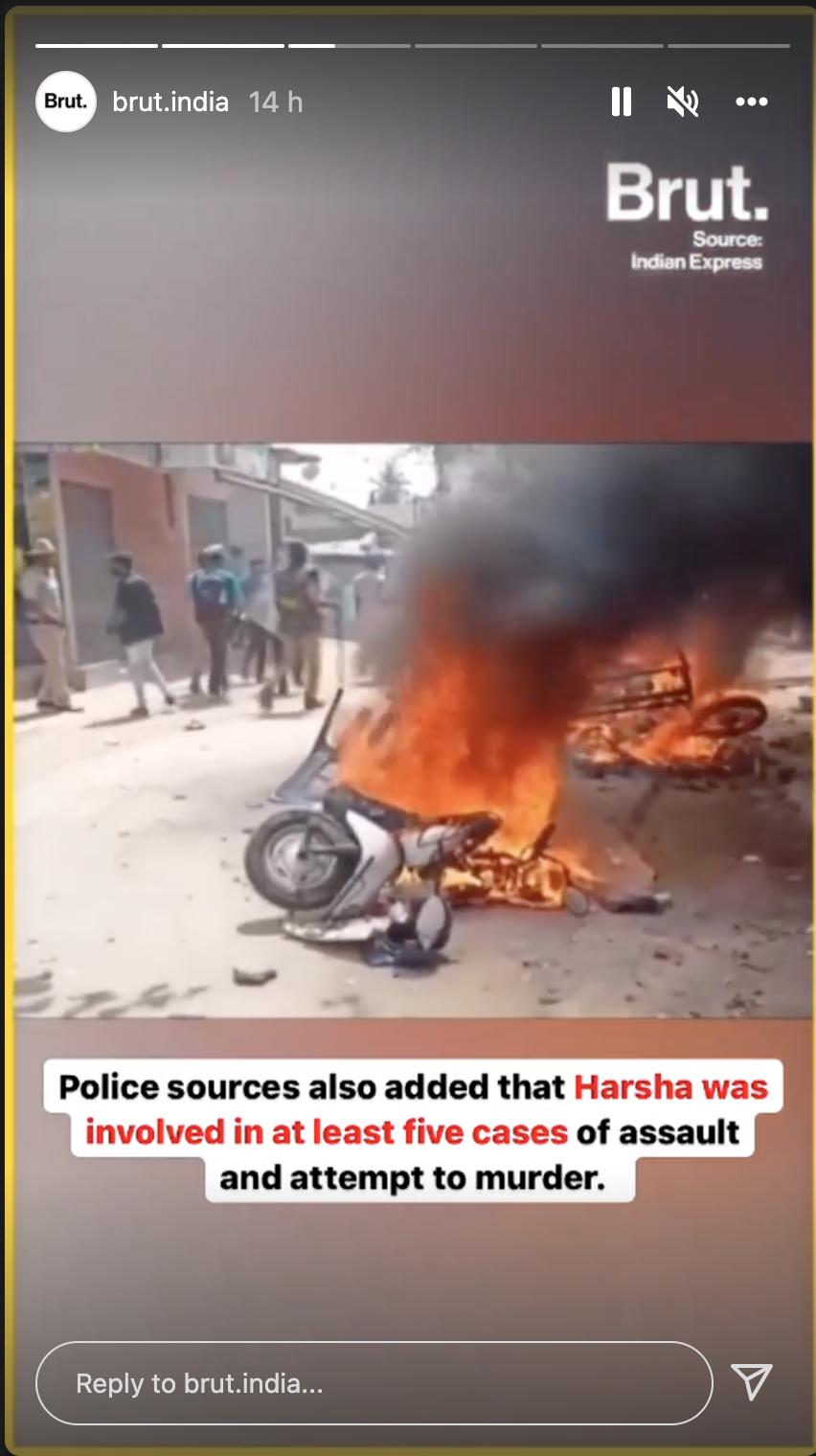
Well, it is not just Indian Express. Far-left propaganda site Brut India has also tried to portray the killing of Harsha as a legitimate response by Muslims over the Hindutva leader’s alleged criminal antecedents.
Brut India has shared a story on Instagram of violent incidents that took place in Shivamogga following the death of Harsha. The post portrays the Hindu community as the aggressor in the events that followed after Harsha’s murder.
In its Instagram story, Brut also peddled the same theory that Harsha had five cases against him to insinuate that he was a criminal and his murder was a response to the acts he had allegedly committed.
Image Source: Brut India
Times of India is not far behind. In its report, the ToI claimed that “sources” in the police said to them Harsha was an active member of Bajrang Dal, and he was reportedly attacked in the past for his hate posts on social media.
The report also added that Harsha might have been killed for his alleged derogatory post pertaining to the hijab protests that had angered some people.
The Times of India report suggest that Harsha was a criminal with cases against him for his “communal posts”, and he is to be blamed for his death as his derogatory posts had angered “some people”. As per TOI, the Muslims murdered Harsha as a reaction to some “derogatory posts”.
It is not just the powerful media establishment that is setting out a dangerous narrative of normalising the killing of Hindus for sharing their opinions on social media. Several left-wing media influencers and Islamists are now blaming Harsha for his death, saying that his previous alleged actions may have been the reason he was killed.
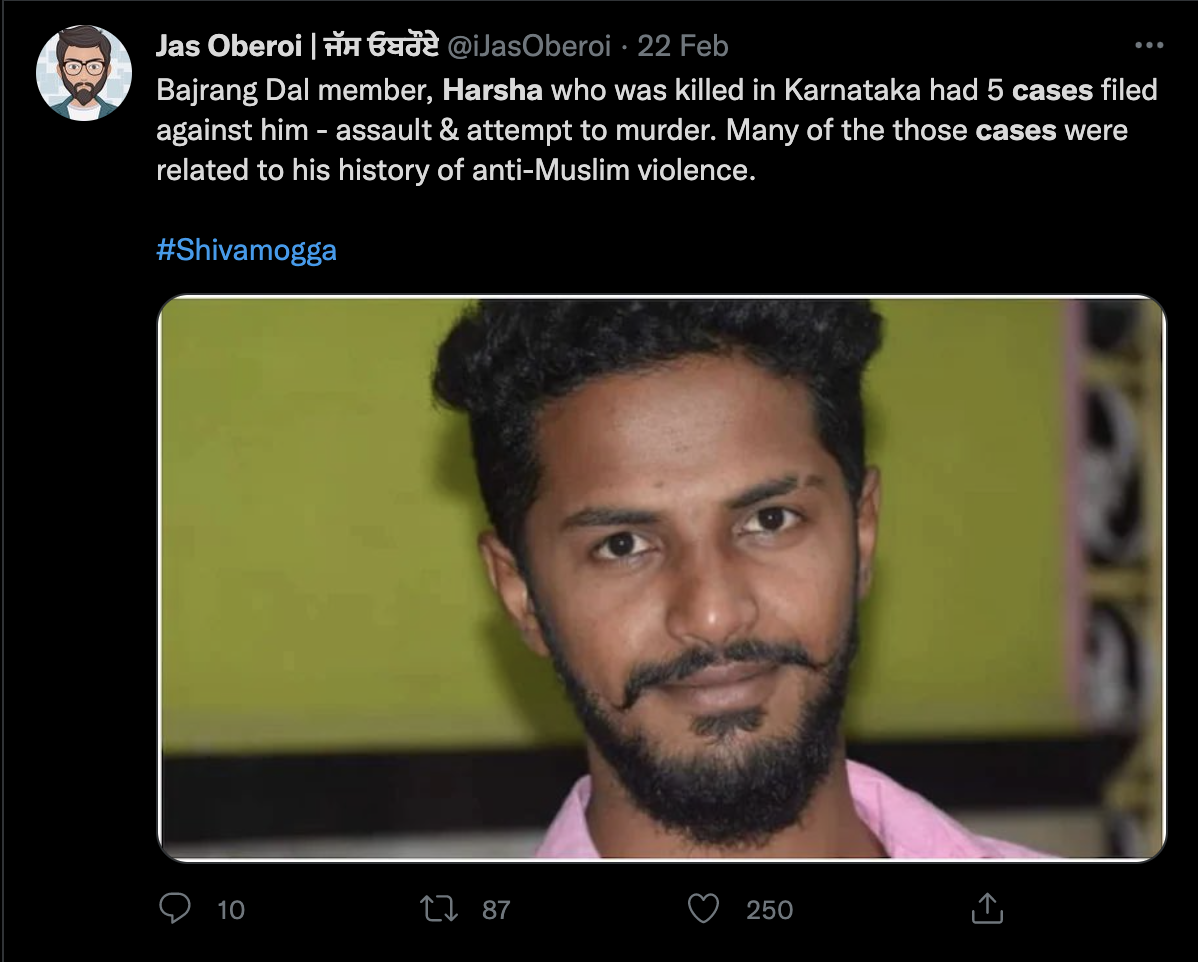
Jas Oberai, a radical left social media influencer, said that Bajrang Dal member Harsha had five cases against him, including cases that were related to anti-Muslim violence. Nobody knows whether these allegations against Harsha are real or not. But, even if the cases against him were indeed filed, how exactly does that justify his brutal murder by the accused?
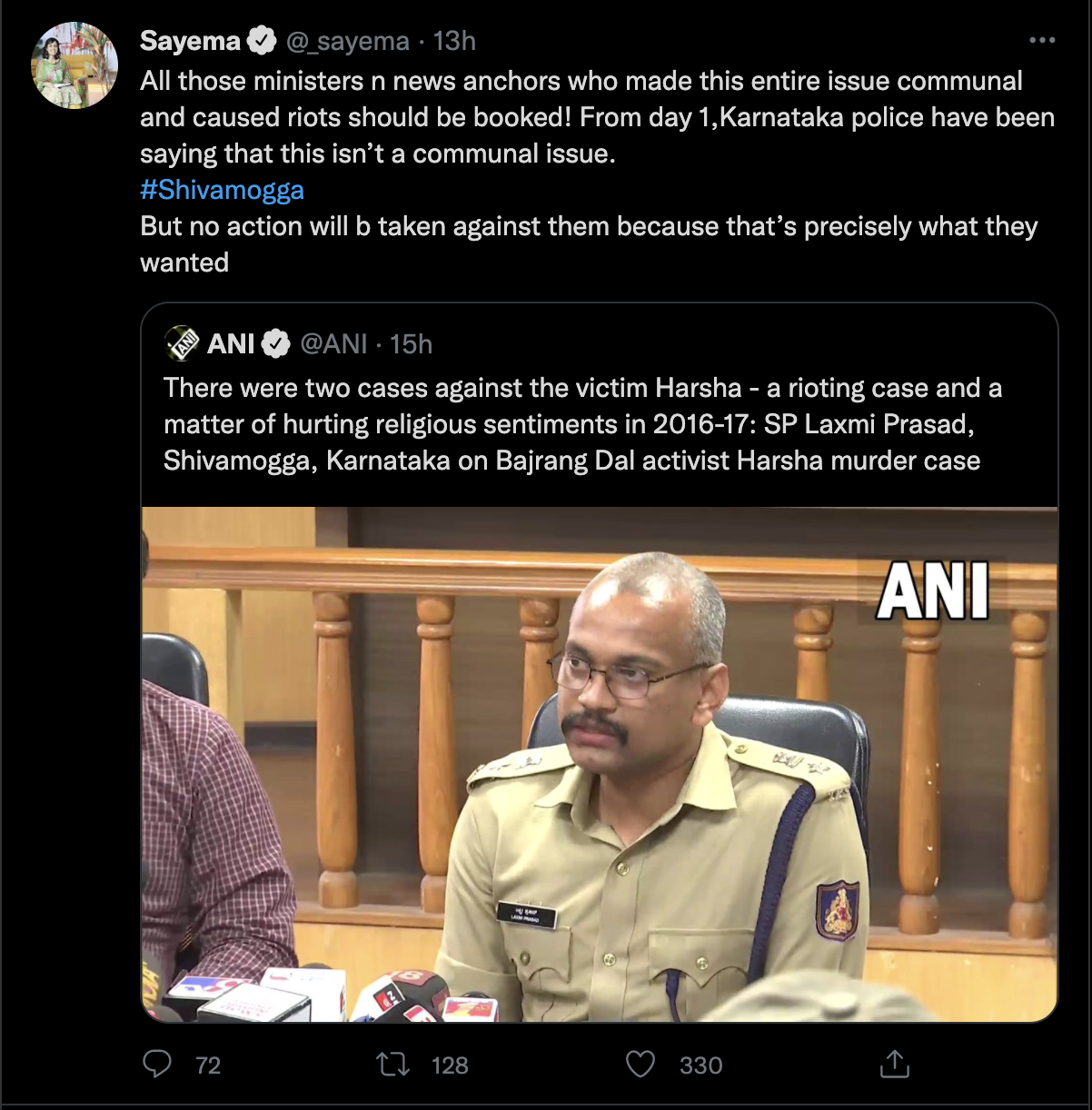
Islamic troll Sayema, who is accused of instigating a Muslim mob to attack a police station in Delhi during anti-CAA riots, also attempted to whitewash the crimes of Muslim killers of Harsha. According to Sayema, ministers and anchors turned the entire issue communal, which resulted in riots. She did not bother to add that when college students are instigated to defy college rules and wear religious attires in violation of a uniform dress code, the issue is already communal.
Citing a news report that claimed that Harsha was accused in two cases, Sayema said that the killing of a Hindu leader was not at all criminal as he was allegedly accused in a riot and communal violence case.
In a way, Sayema does not have any problem with Hindu activists being murdered if they are found to be involved in alleged ‘riot’ and ‘communal violence’ cases.
In a way, Sayema is saying that the murder victim was a lawbreaker and the 6 accused persons murdered him to uphold justice. This is how mob violence is justified.
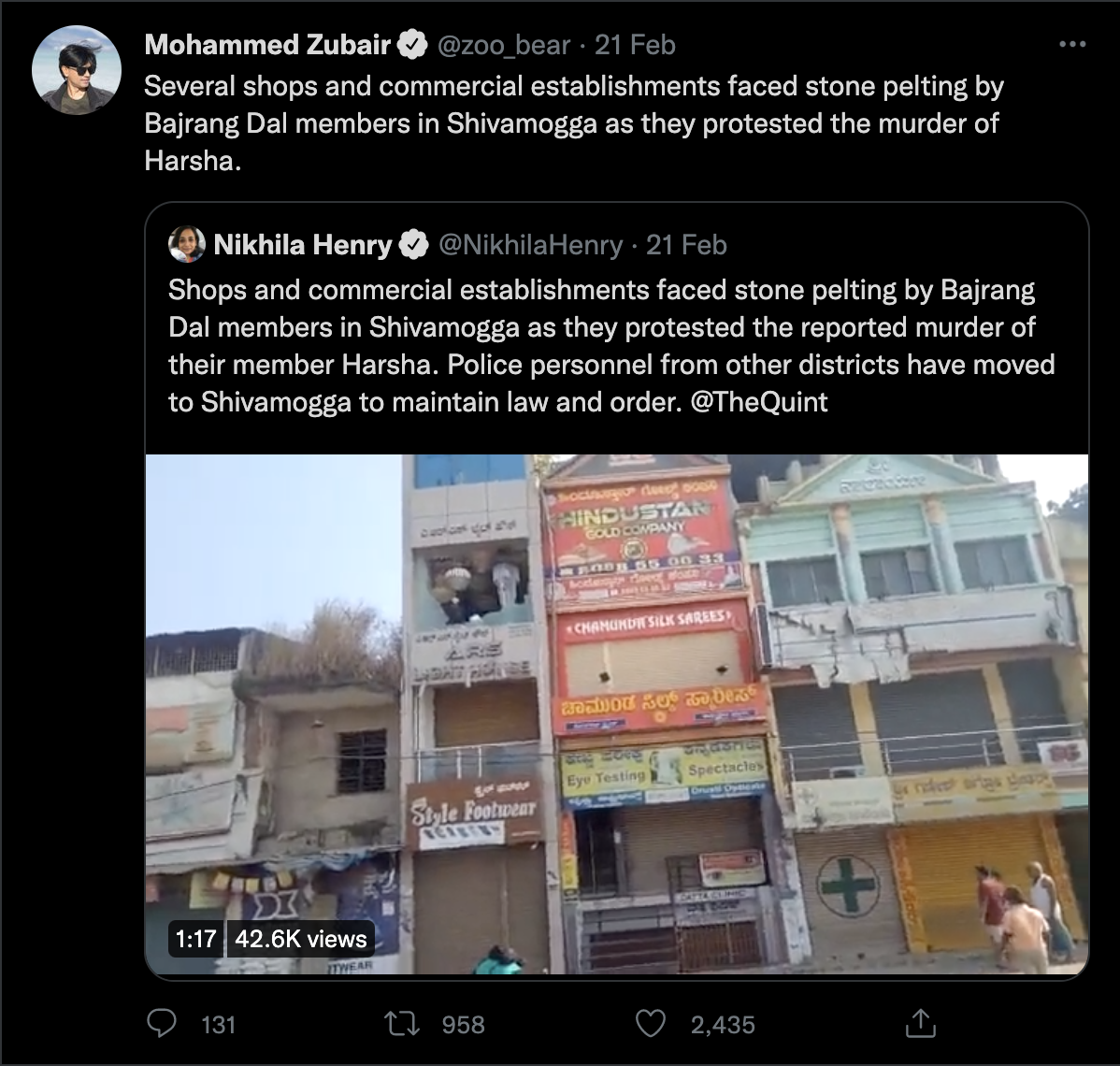
Mohammed Zubair, a notorious fake news peddler, took a step ahead to show Muslims of Shivamogga as victims by claiming that several shops and commercial establishments faced stone-pelting by Bajrang Dal members.
As usual, Zubair tried to weave propaganda that Hindus were aggressors and Muslims were the victims in Harsha’s murder case.
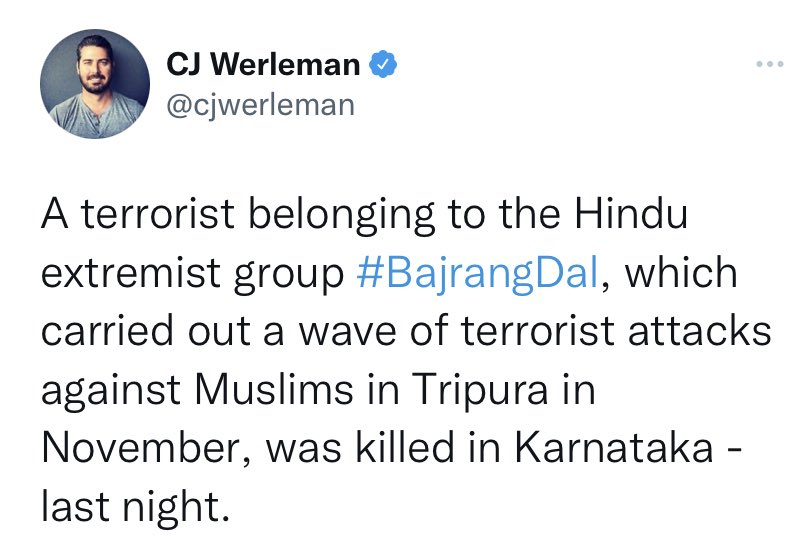
CJ Werleman, the habitual fake news peddler and also an apologist of Islamic terror, tweeted without any shred of evidence, claiming Harsha was a terrorist belonging to the ‘Hindu extremist group Bajrang Dal’, which carried out a wave of terrorist attacks against Muslims in Tripura in November.
For the likes of Werleman, the killing of Harsha was justified as he was a member of the Bajrang Dal. It is notable here that the alleged ‘attacks on Muslims in Tripura’ was fake news too. Islamists in several areas of Maharashtra had committed acts of vandalism and arson over some debunked fake claims of mosque attacks.
It is no longer even surprising to see Islamists and the left-liberal media establishment exonerating Muslims from the crime they commit against Hindus over allegations of ‘blasphemy’. However, lately, a new dangerous trend has emerged where the killing of Hindus is being normalised to achieve some petty ideological goals.
Even a dead Hindu, who has been murdered by Muslims, has to be painted as the aggressor
The killing of Harsha has evoked strong sentiments in the minds of Hindus in not just Karnataka but also across the country. As a result, there is a consolidation of Hindus across states. Most importantly, the killing has occurred right at the time when the hijab row is at its peak, a controversy that has exposed the sinister designs of Muslims and radical Islamic organisations, who have been very vocal about adhering to Sharia instead of a secular-democratic constitution.
Only recently, another Hindu man named Kishan Bharwad was killed by some Islamists in an elaborate and well-thought-out plan. A maulvi is accused of supplying the weapons that were used by an Islamist to kill Kishan, only because he had shared some social media posts that the Islamists did not like.
Amidst all these events, there is a sense of national re-awakening for Hindus. Hindus, who have been the victims of the secular state, are now raising their voices against the atrocities committed on them in the name of secularism, the expansionism of Islam and the threats that come along with that.
As expectingly, the Islamists and their allies – the left-liberal establishment do not want to see a united Hindu resurgence. Hence, the vilification of Hindus continues to carry on.
One can see a similar case in Harsha’s case as well. Harsha, who is not alive anymore, is their latest target. The dehumanisation of Harsha and showing him as an aggressor is part of the latest toolkit to show Hindus as perpetual aggressors even when it is a Hindu who has been murdered. The whole idea is to blame Harsha for his acts and to depict that Muslims were only victims of the ‘hatred’ perpetrated by Hindu activists like Harsha. For them, the killing of Harsha is just a response, and one should not blame Muslims for the killings.
Liberals perceive the killing of non-believers of Islam as valid and believe that it is just a natural response for the community to kill the non-believers if they speak something critical about their religion. For the left-liberals and Islamists, even a dead Hindu is a threat against their perpetual victimhood complex. Hence, they tend to dehumanise Hindus even after their death.
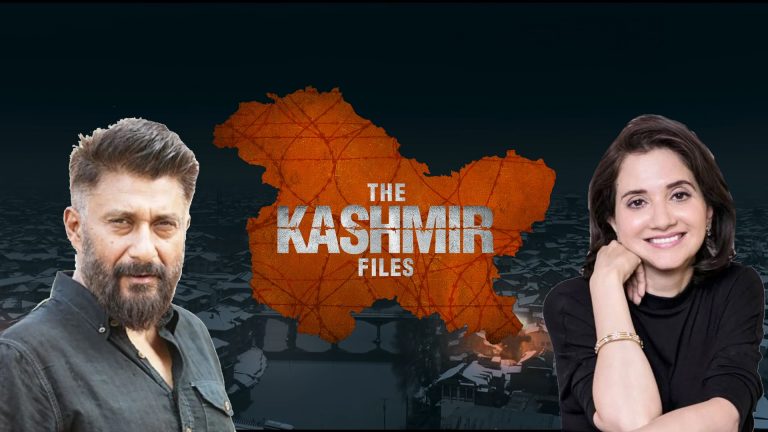
National Award-winning Director Vivek Ranjan Agnihotri’s recent flick ‘The Kashmir Files’ has stormed the Internet after its gut-wrenching trailer dropped on Monday. Agnihotri’s last ‘The Tashkent Files’ which was based on the case of Lal Bahadur Shastri’s death, was targetted by left-centred media and a league of entrenched film critics. Vivek Agnihotri has now alleged Film critic Anupama Chopra of trying to ‘sabotage’ his recent movie – The Kashmir Files.
On Wednesday, Agnihotri was seen tweeting his allegation against Film Companion head Anupama Chopra that she is playing ‘dirty tricks’ in the background to target his movie. Vivek Agnihotri asked Anupama, calling her Shoorpankha, “If you have any guts, sabotage ‘The Kashmir Files’ openly. Please stop playing dirty tricks from the background. Your only qualification is that you are married to a Producer who despite being a KP (Kashmiri Pandit), stabbed KPs in their back.”
Dear @anupamachopra, the Shoorpanakha of Bollywood, If you have any guts, sabotage #TheKashmirFiles openly. Pl stop playing dirty tricks from the background. Your only qualification is that you are married to a Producer who despite being a KP, stabbed KPs in their back.
When asked by a user on Twitter as to what the critic has done, Filmmaker Vivek Agnihotri announced that he is soon going to expose the tricks of the trade used by Anupama and her team. Agnihotri also took a jibe at supposed film critic and writer Rahul Desai, who is employed at Chopra’s Film Companion. Rahul Desai’s critique of Vivek Agnihotri’s last film in 2019 – The Tashkent files was more of a troubled rant than a serious commentary. While terming the film “A Second-Hand History Lesson In Third-Rate Politics” Rahul’s own political agenda and film appreciation skills were on display.
You will know soon. Will expose her dirty tricks soon. And also her two penny, third rate, irrelevant pawn @ReelReptile the begging parasite who reviews films only to eat free burgers & fries. Join me in this war against Bollywood Oppressors. https://t.co/u4cEJ7seTF
Interesting to note is the fact that Anupama Chopra’s husband, senior producer Vidhu Vinod Chopra had also directed a film on similar lines capturing the genocide of Kashmiri Pandits released in 2019. The movie ‘Shikara‘ was criticised widely for whitewashing the militancy, Jihad, separatism and genocide of Kashmiri Hindus orchestrated by rampant Islamic Radicalism in the Kashmir valley.
Propaganda against The Kashmiri Files has already started while the trailer of the film has become an instant hit among the masses. On the other hand, the left-liberal ecosystem had started to target long ago, and NDTV had called it a propaganda movie even before the trailer of the film was released. The film stars Anupam Kher, Mithun Chakraborty, Pallavi Joshi, Darshan Kumar, Chinmay Mandlekar and Mrinal Kulkarni in lead roles and is set to release in the cinemas on March 11, 2021.
In February 2020, many areas of Delhi were affected by the communal riots instigated by the Islamists under the garb of anti-CAA protests. The Chandbaag-Karaval area of northeast Delhi was one of the most severely affected areas in these riots. The area houses the building of the infamous Tahir Hussain. This place was later identified as the key location where the riots were conspired and planned.
It is the same area in which IB officer Ankit Sharma was brutally killed. A mob of violent Islamists had stabbed him to death. Shops, houses, and properties of Hindus were specifically marked and targeted in order to ensure maximum damage to the Hindu community. Not so far from Tahir Hussain’s home, there was a Shiva Temple in lane number six. The rioters had desecrated the temple.
Two years after the riots, there is no communal tension in this area as of now. But, the memories of the event keep haunting the local Hindu community. A feeling of fear is clearly seen on their faces when one tries to engage in conversation with them, especially about their experiences and memories of the riots and the hardships they had been through, even after the riots were over.
It was this traumatizing fear that Shyam Sahni was initially not ready to talk with the OpIndia. But as the conversations smoothened, he built confidence to express himself and his talks unfolded the reasons for the fear one after the other.
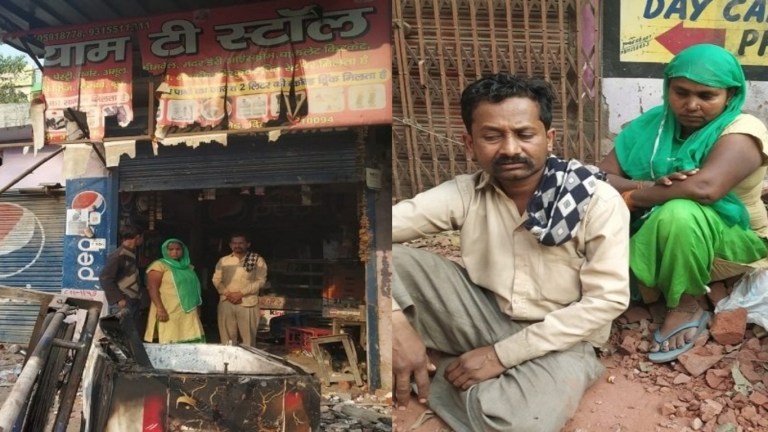
Shyam Sahni would run a tea shop
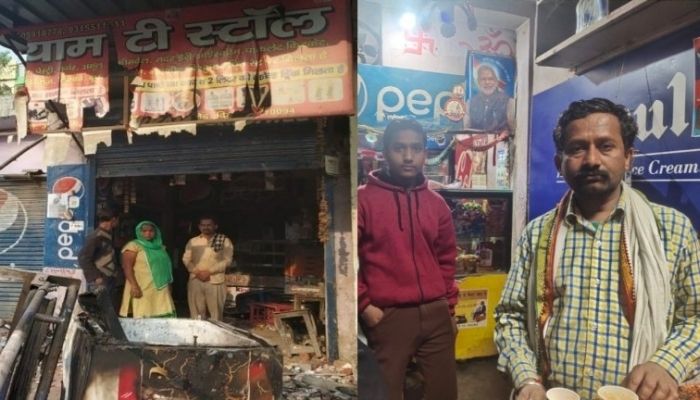
On 24th February 2020, Shyam Sahni was about to close his tea shop in the evening when he saw a mob of stone-pelting Muslims approaching his shop. Shyam Sahni said, “I was making tea in my tea shop. Muslims in the area were protesting against CAA right from that morning. Meanwhile, I was informed that a mob of thousands of Muslims is heading from Chaandbaag to Karaval Nagar and that they are vandalizing the shops as they march ahead. We immediately closed the shutter and escaped from the back doors. But the rioters broke into the shop and destroyed it. They looted everything they could. After this, the shop caught fire due to the petrol bomb which was thrown from Tahir Hussain’s building.
Shyam Sahni’s tea shop was looted in the Delhi riots of 2020. Shyam Sahni, pained, is seen with his wife.
Shyam Sahni, the tea seller, claims that he has suffered from a loss worth Rs. 5 lakhs in this riot. Being a tenant, he did not receive any great help despite a cheque of Rs. 25000 from an NGO and Rs. 32000 from Kapil Mishra and a few others sources.
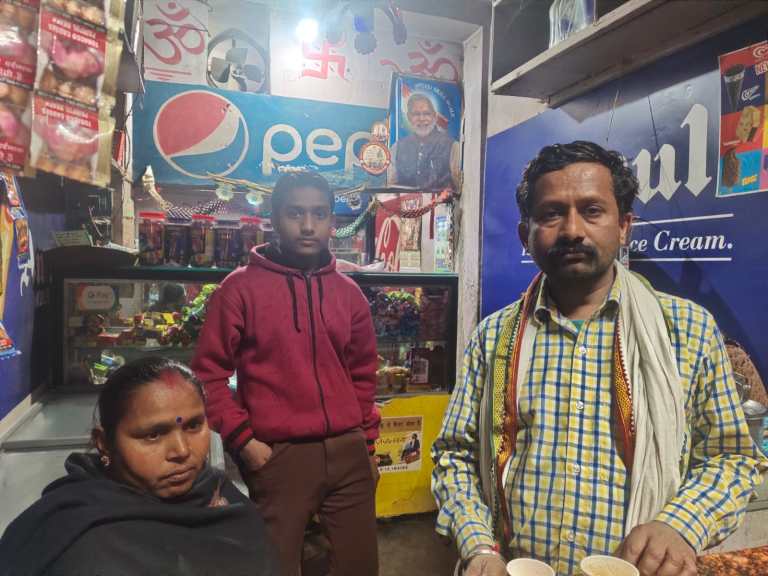
Sahni further told OpIndia, “I also had a small Dhaba. Rioters looted that too. The rioters took everything away destroyed everything there including the counter, the furniture, the fridge. They did not even spare the utensils.” After two years of the riots, while showing OpIndia his house, all Sahni had to show was bedding, a small worship place, and a few more things left in the shop that has a photograph of PM Modi.
PM Modi’s photograph in the shop
It has been two years since the Delhi riots and Sahni’s Dhaba has not yet resumed its normal business as before. The tea shop does not work anymore. According to Shyam Sahni, it is so because of the PM Modi’s photograph he has on the walls of the shop that he had placed there after the Delhi riots. When asked about the same, he answered, “We are alive all thanks to him. Come what may, will not remove it.”
PM Modi’s photograph in the tea shop.
To feed a family of six, Shyam Sahni has now started selling ice creams. He sells it in the areas like Chaandbaag, Mustafabad, and Seelampur. It is notable that the rioters allegedly hail from these areas.
In fact, OpIndia had also visited the tea shop right after the riots. At that time, the local people had told, “For four days, Shyam Sahni did not eat anything, nor did he change his clothes. His everything was ruined right in front of him.” Two complete years, but the fear persists even today; which is why Shyam Sahni was initially not ready to talk, as he still avoids any type of media. Clarifying this, he said, “I have to live in the same area. I have to live among these very people. What if anything happens to my family?”
More similar stories
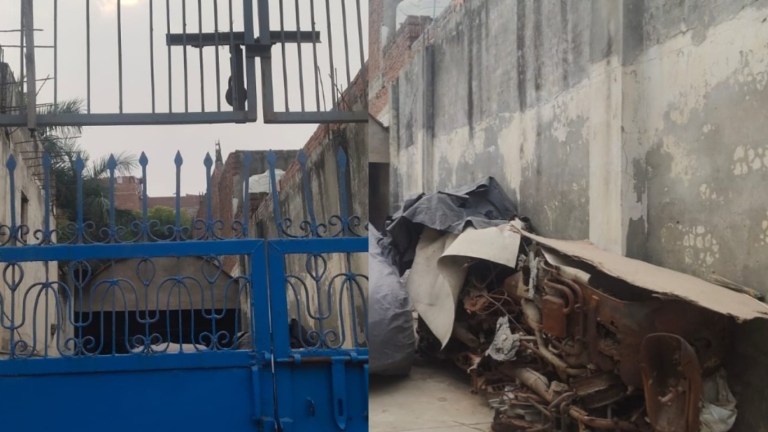
The rioters also destroyed the Giri automobile workshop. Two years later, when we reached the spot, we could not find Dilip, the owner of the workshop; but the marks of the fires were yet clearly seen. People in the vicinity informed that some Muslim man has bought the shop now.
Some Muslim buyer has now bought the Giri Automobile Workshop.
Rioters left Tahir Hussain’s building and reached the Giri automobile workshop. And what they all did there is well summarized in the attached video.
Two years ago, OpIndia had an opportunity to converse with Dilip, the owner of the automobile workshop. At that time he had informed that the rioters had caused him a loss of almost 30 to 40 thousand. Besides, Pradhanji was looted for Rs. 250000.
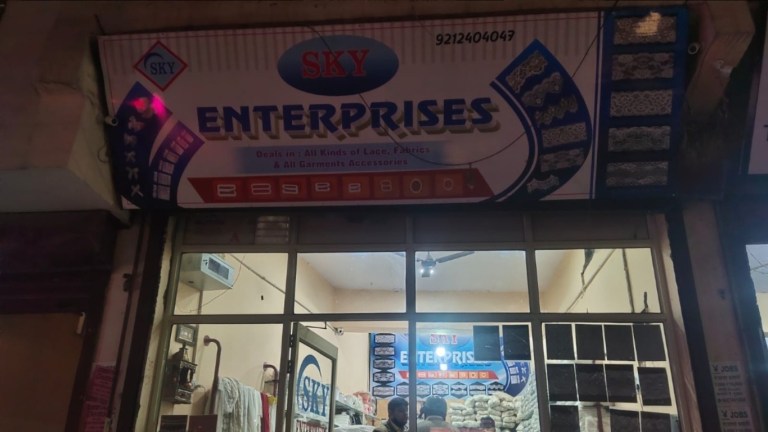
Aman E-rickshaw shares a similar story. This shop is also located in the vicinity of Tahir Hussain’s building and rioters had very badly damaged the shop. The owner had to leave the area forever. Rioters had stolen so many batteries and other parts of E-rickshaw from his shop and then burnt the shop.
Now the place houses a wholesale shop of clothes. The owner of this shop informed that within months of the Delhi riots, the owner of the Aman E-rickshaw shop left the place forever.
Some wholesale clothes shop has replaced Aman E-rickshaw shop now.
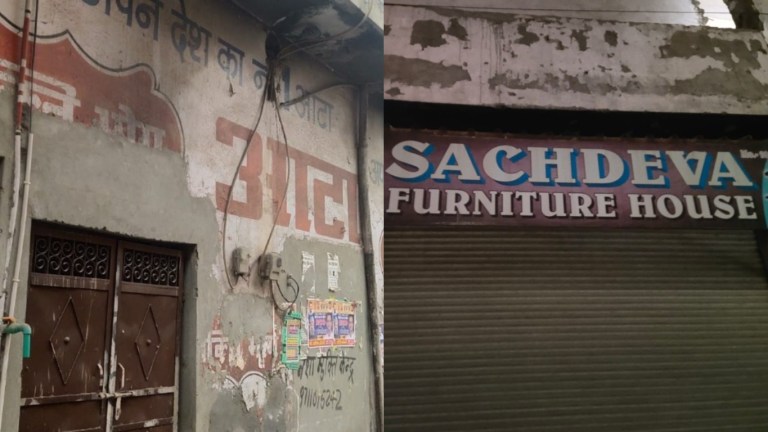
Another shop in this area, formerly called Aroda furniture, has now become Sachdeva furniture. The shop had to bear a great loss in the riots and none of it was reimbursed by any means. The rear side of the house still has the marks of the brutal fire sports played by the rioters.
Aroda furniture has now become Sachdeva furniture.
The victims of the Delhi riots of 2020 are slowly rebuilding their lives and businesses. But small shopkeepers have not yet completely recovered from the traumatic experience they have been through.
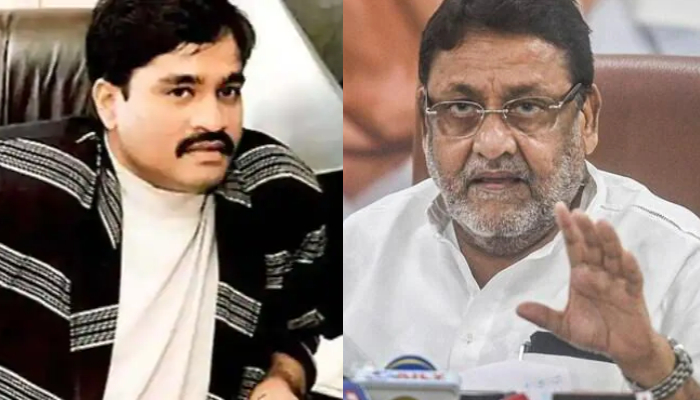
On Wednesday, the Enforcement Directorate arrested Maharashtra Minister and NCP leader Nawab Malik. Malik was issued summons to appear before the ED pertaining to a PMLA case related to elements linked to Dawood Ibrahim and the underworld.
After an interrogation that lasted several hours, Malik has been formally arrested by the ED. As per reports, he was taken for a medical examination from the ED office.
#WATCH | Mumbai: NCP leader and Maharashtra Minister Nawab Malik being brought out of Enforcement Directorate office, to be taken for medical examination.
He has been arrested by Enforcement Directorate in connection with Dawood Ibrahim money laundering case. pic.twitter.com/UMAVK5ZEVW
The Office of Nawab Malik had confirmed the news and said that the ED officials visited Malik’s house and took him away from his residence. “Today morning the ED had come to Nawab Malik’s residence. They accompanied saheb in his vehicle to the ED office. Advocate Amir Malik, Saheb’s son has accompanied saheb along with”, the tweet read. The minister was being questioned since 8 am.
Today morning the ED had come to @nawabmalikncp saheb’s residence. They accompanied saheb in his vehicle to the ED office. Advocate Amir Malik, Saheb’s son has accompanied saheb along with.
This is after the ED conducted raids in South Mumbai in connection with a money laundering case against underworld don Dawood Ibrahim and his aides. Close to nine places in Mumbai and one in Thane were raided by the ED including the residences of Dawood Ibrahim’s late sister Haseena Parkar and brother Iqbal Kaskar. The agency also took into custody Iqbal Kaskar who is imprisoned in Thane in an extortion case and presented him before the special Prevention of Money Laundering Act (PMLA) court.
According to the reports, NCP Chief Sharad Pawar criticised the act and said that this was being deliberately done to harass people who have been outspoken against misuse of central agencies. “If there is a Muslim activist who is their opponent, it is their habit to link his name to Dawood. When I was the CM of Maharashtra, they had tried to link my name with Dawood as well. This is an attempt to harass those who are speaking against the misuse of central agencies,” Pawar was quoted.
Shivsena leader Sanjay Raut also slammed the BJP led government and said the ED was being misused. “The way in which Nawab Malik was taken from his home by ED is a challenge to Maharashtra Govt. A minister is taken away by central agencies by coming to our state. After 2024, you’ll be probed too. Keep this in mind”, he added.
Nawab Malik is a sr leader & Maharashtra’s cabinet minister. The way in which he was taken from his home by ED is a challenge to Maharashtra Govt. A minister is taken away by central agencies by coming to our state. After 2024, you’ll be probed too. Keep this in mind: Sanjay Raut pic.twitter.com/hVAd56DPfT
Earlier on February 19, the National Investigation Agency had revealed that Ibrahim was planning to launch terror attacks on India using explosives and lethal weapons. He had formed a special unit with the aim of inciting violence in different parts of the country.
The premier agency also said that he has been transferring funds through Hawala channels to provide financial help to all those involved in a planned attack. He is involved in promoting anti-national activities and is also trying to create a rift between different religious groups, the agency added.
According to the reports, Nawab Malik’s name appeared in the process of investigation after the intelligence inputs directed the agency to look into the hawala transaction while probing a money laundering case against Ibrahim, Iqbal Mirchi, Chhota Shakeel, Parkar and Javed Chikna. The agency traced several hawala transactions linked to money illegally obtained through extortion, drug trafficking, sale of real estate in Nagpada and Bhendi Bazaar area of Mumbai, and other unlawful activities.
Ibrahim and several of his associates have been named by the NIA along with their roles in terror activities, including hawala transactions, against India. A case under the Unlawful Activities Prevention Act (UAPA) has already been registered against Dawood Ibrahim and his aides.