Home Blog Page 406

Himachal govt faces outrage over HPPCL chief engineer’s death, CBI takes over case, top officers sent on leave: All you need to know

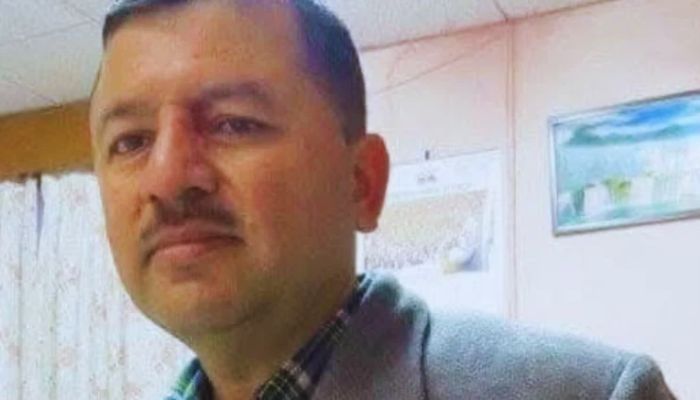
In the Congress-ruled Himachal Pradesh, the mysterious death of Vimal Negi, the General Manager and Chief Engineer at the Himachal Pradesh Power Corporation (HPPCL), has stirred a massive controversy.

Vimal Negi had gone missing on March 10, and his body was recovered ten days later. His family and colleagues had earlier raised concerns about pressure at the workplace.

The family of Vimal Negi had suspected foul play and had demanded a CBI inquiry, alleging that senior officials protected by the state government were involved in his demise. Vimal Negi’s wife, Kiran Negi, had recently written a letter to the Chief Minister of Himachal Pradesh demanding that the case be immediately handed over to the Central Bureau of Investigation (CBI).

The Himachal Pradesh High Court recently ordered a CBI probe into the mysterious death of HPPCL engineer Vimal Negi.

In her letter, Kiran Negi made a heartfelt appeal to the Chief Minister. “This matter should be handed over to the CBI at the earliest, and justice must be ensured in my husband’s death by following the directions of the High Court,” she wrote.

Notably, the CBI has taken over the investigation into the Vimal Negi death case and registered an FIR under relevant sections. The central probe agency filed an FIR against unknown people at the Special Crime Branch office in Delhi under sections 108 (abetment to suicide) and 3 (5) (involvement of many people in crime) of the Bharatiya Nyaya Sanhita. The FIR’s summary also mentions the name of Desh Raj, suspended director (electrical) of HPPCL and of the managing director.

Welcoming High Court’s decision to handover the Vimal Negi death case probe to th CBI, Himachal Pradesh Leader of Opposition (LoP) Jairam Thakur said, “Since the start, we had been demanding a CBI inquiry into this case. His family has also demanded one, even though the chief minister earlier said that his family had not demanded it. Now, the CBI inquiry is happening because his family went to the high court, and the court ordered in their favour.”

Vimal Negi, an engineer with the Himachal Pradesh Power Corporation Limited, had joined the corporation on 15th June 2024. Just two weeks later, on 1st July 2024, he was reportedly under stress and receiving medical treatment for anxiety.

The deceased engineer’s wife, Kiran Negi, has alleged that Vimal Negi’s seniors used harassed him over the last six months. Kiran Negi’s demand of a CBI investigation in the case was denied by the state government, however, now the matter has been handed over the CBI after High Court order.

Meanwhile, LoP and BJP leader Jairam Thakur demanded the resignation of Chief Minister Sukhvinder Singh Sukhu and the arrest of officials responsible for the death of Vimal Negi.

“The family wanted a CBI probe into it as the officials responsible for pressurising Vimal Negi had government protection. We had raised it in the Assembly as the session was in progress. Chief Minister Sukhu falsely claimed that the family was not demanding any such probe and instead accused us of politicising the issue. But we were suspecting massive corruption, and it is now being proven. They wanted to destroy the evidence,” Thakur said.

Shoddy investigation in Vimal Negi death case sparks outrage

Vimal Negi had gone missing on 10th March 2025, and his body was recovered ten days later. His family and colleagues had earlier raised concerns about pressure at the workplace. After days of protest and search efforts led by IG Gyaneshwar Thakur, his body was finally recovered leading to widespread outrage and demands for justice.

However, the Special Investigation Team (SIT), constituted by the state police, failed to provide any clarity about his whereabouts between 10th and 14th March, raising serious questions about the credibility of the investigation.

On 8th April 2025, the Additional Chief Secretary (Home), Omkar Chand Sharma, had submitted a 66-page fact-finding inquiry report to the state government. Sharma refused to review the report on the request of the Secretary, Power, to include the rebuttal of the three officers, who faced allegations.

The conflicting affidavits submitted by DGP Verma and the Shimla Superintendent of Police had also raised a question mark on a fair probe by the SIT.

Himachal government orders major bureaucratic reshuffle amidst mounting criticism

Resorting to face-saving measures, the Congress government in Himachal Pradesh, has sent three senior officials, Additional Chief Secretary (Home) Omkar Chand Sharma, Director General of Police (DGP) Atul Verma, and Superintendent of Police (Shimla) Sanjeev Kumar Gandhi on leave. The move, confirmed by Secretary to the Chief Minister Rakesh Kanwar, marks a sweeping disciplinary response and has triggered a bureaucratic reshuffle in the state.

“This is to confirm that ACS Home, DGP and SP Shimla have been directed to proceed on leave,” Rakesh Kanwar said on Tuesday evening, following a high-level meeting chaired by Chief Minister Sukhvinder Singh Sukhu. The meeting, which lasted over two-and-a-half hours, was attended by Chief Secretary Prabodh Saxena, Principal Secretary (Law) Sharad Kumar Lagwal, Advocate General Anup Kumar Rattan, Secretary (Personnel) M Sudha Devi apart from Rakesh Kanwar.

The action came amidst mounting criticism over the handling of the investigation into Vimal Negi’s suspicious death.

The action against officials have been taken following apparent indiscipline, allegations and counter allegations during the inquiry and investigations. Allegations of administrative negligence, procedural lapses, and internal conflict within the police hierarchy had drawn sharp public and legal scrutiny. SP Sanjeev Gandhi had accused DGP Atul Verma of interference, allegations he reiterated both in court and to the press.

‘Rajiv Gandhi sought US interference, asked Ronald Reagan to help in talks with Pakistan’: BJP MP Nishikant Dubey reveals 1987 letter

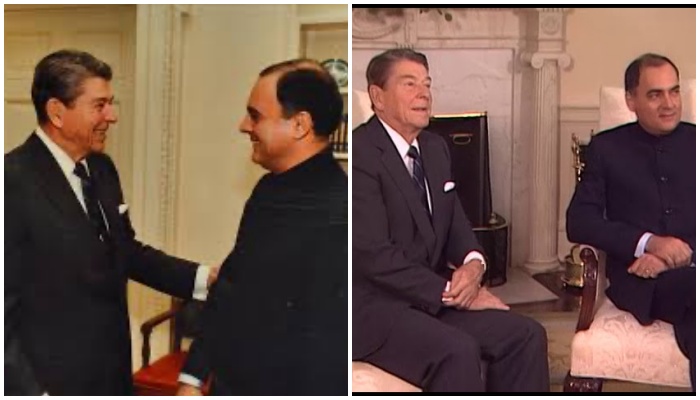
Bharatiya Janata Party (BJP) MP Nishikant Dubey on Wednesday claimed that Former Prime Minister Rajiv Gandhi had written a letter to then United States (US) President Ronald Reagan to help in negotiating with Pakistan.

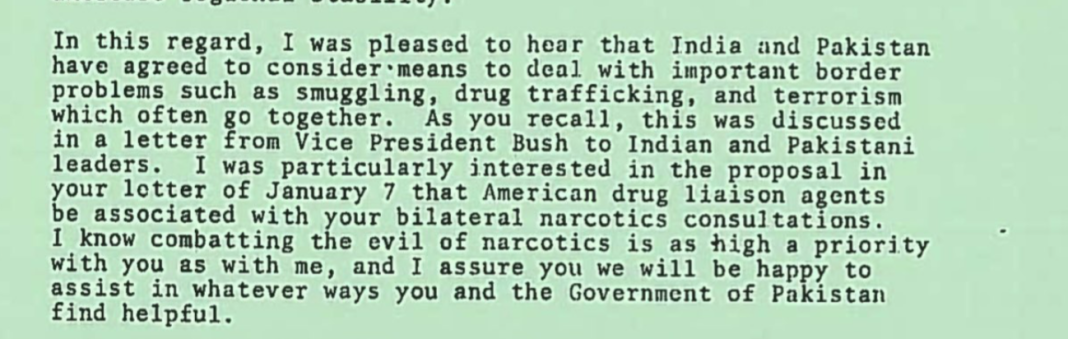
Sharing a purported letter written by a US president to the Indian Prime Minister on X, Dubey stated that it was decided under the 1972 Shimla Agreement that any dispute between India and Pakistan would be negotiated only between the two countries and there would be no mediator.

“It is not easy to be Gandhi. This letter is in reply to a letter written by US President Ronald Reagan to the then Indian Prime Minister Rajiv Gandhi. When it was decided under the 1972 Shimla Agreement that any dispute between India and Pakistan would be negotiated only between the two countries and there would be no mediator, why did the then Indian Prime Minister Rajiv Gandhi ask for US President Reagan’s help in negotiating with Pakistan?” he questioned on X.

This revelation adds a new layer to the ongoing political debate over third-party involvement in India-Pakistan relations, especially in the wake of recent escalations triggered by the Pahalgam terror attack and India’s retaliatory Operation Sindoor.

The letter, delivered to Rajiv Gandhi on March 25, 1987 by the US Ambassador to India, states that Gandhi sought US experts to be present in a bilateral discussion between India and Pakistan pertaining to cross border narcotics smuggling. Reagan had expressed that he would be glad to provide any support sought by the governments of India and Pakistan.

On Tuesday, BJP MP Nishikant Dubey shared a purportedly declassified 1971 US intelligence cable regarding former Prime Minister Indira Gandhi’s decision to accept a UN ceasefire proposal during the Bangladesh Liberation War, in response to the Opposition’s demand for clarification from the Union Government on the US’s involvement in the recent understanding on the cessation of hostilities between India and Pakistan.

He further interrogated whether India prioritised the creation of Bangladesh over reclaiming Pakistan-occupied Kashmir (PoK) and securing assets like the Kartarpur Gurdwara.

“Indira Gandhi, the Iron Lady. Under American pressure, India itself stopped the 1971 war despite opposition from the then Defence Minister Jagjivan Ram and Army Chief Sam Manekshaw. Babu Jagjivan Ram wanted that the war should be stopped only after our part of Kashmir, which Pakistan forcefully occupies, is back, but the fear of the Iron Lady and the terror of China could not do this. Was the priority for India to take back its land and the Kartarpur Gurdwara, or to create Bangladesh?” Dubey stated on X.

Earlier, Congress leader Jairam Ramesh took a dig at External Affairs Minister S Jaishankar, saying that he had been “silent” on US Secretary of State Marco Rubio’s remarks about “US mediation” and “neutral site” for India-Pakistan talks.

However, India refuted the claims made by the US President, reiterating its policy that India and Pakistan bilaterally address any matter related to the Union territory of Jammu and Kashmir.

(With inputs from ANI)

Did the Railway Minister lie? The truth about regenerative braking explained that Congress supporters failed to understand

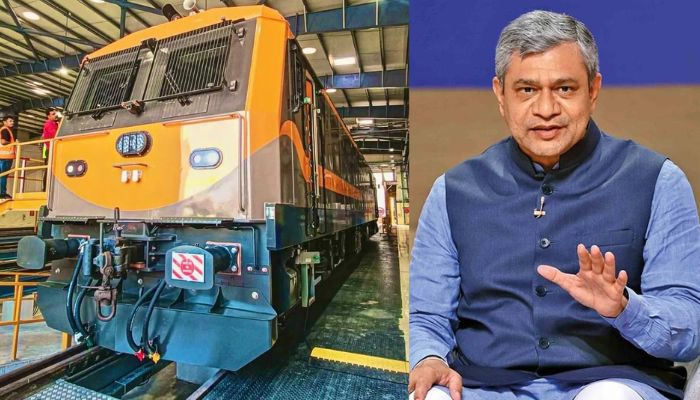
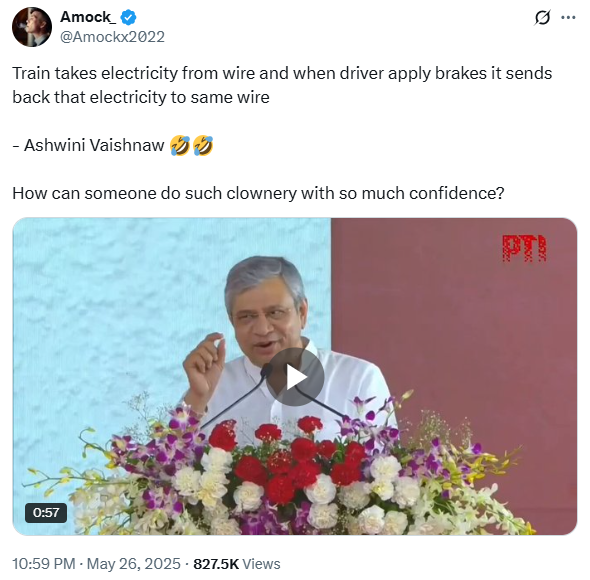
On 26th May, several Congress supporters mocked the Minister of Railways, Ashwini Vaishnaw, claiming he lied about electricity being generated via the braking system of the locomotive engine and transferred back to transmission lines. Vaishnaw, who was talking about regenerative braking in recently launched locomotive engines, was mocked by Congress supporters without understanding the technology.

In a post on X, Amock wrote, “Train takes electricity from wire and when driver apply brakes it sends back that electricity to same wire, Ashwini Vaishnaw. How can someone do such clownery with so much confidence?”

Source: X

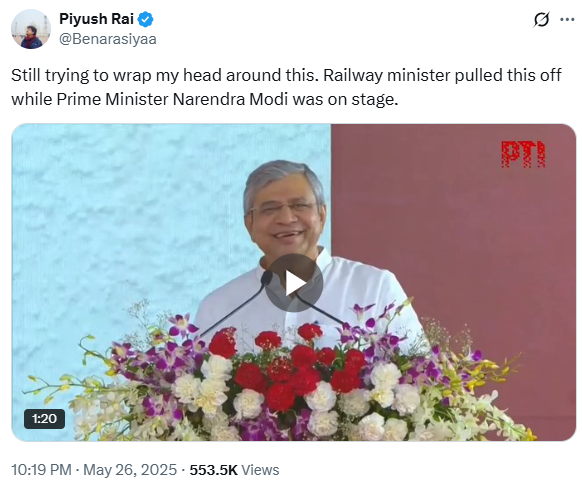
Journalist Piyush Rai, who was also unaware of the technology, by choice or by default, wrote, “Still trying to wrap my head around this. Railway minister pulled this off while Prime Minister Narendra Modi was on stage.”

Source: X

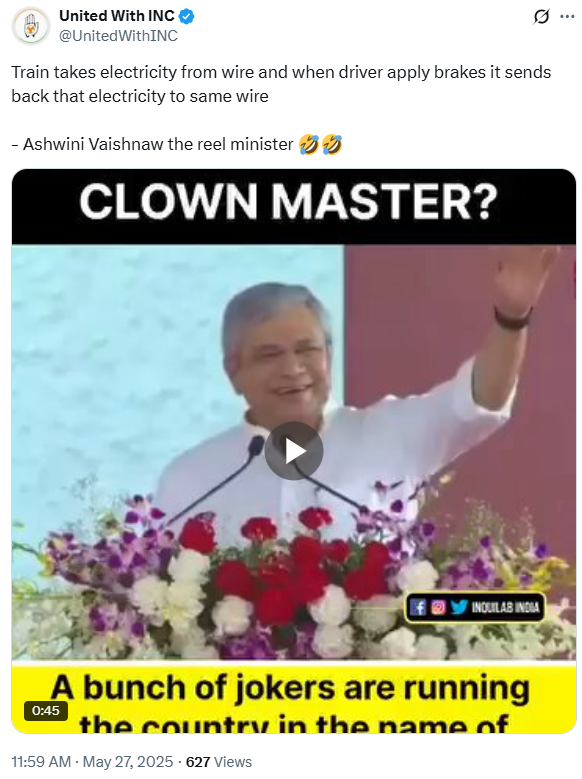
Another handle, “United with INC”, clearly a Congress supporter, wrote, “Train takes electricity from wire and when driver apply brakes it sends back that electricity to same wire – Ashwini Vaishnaw the reel minister.”

Source: X

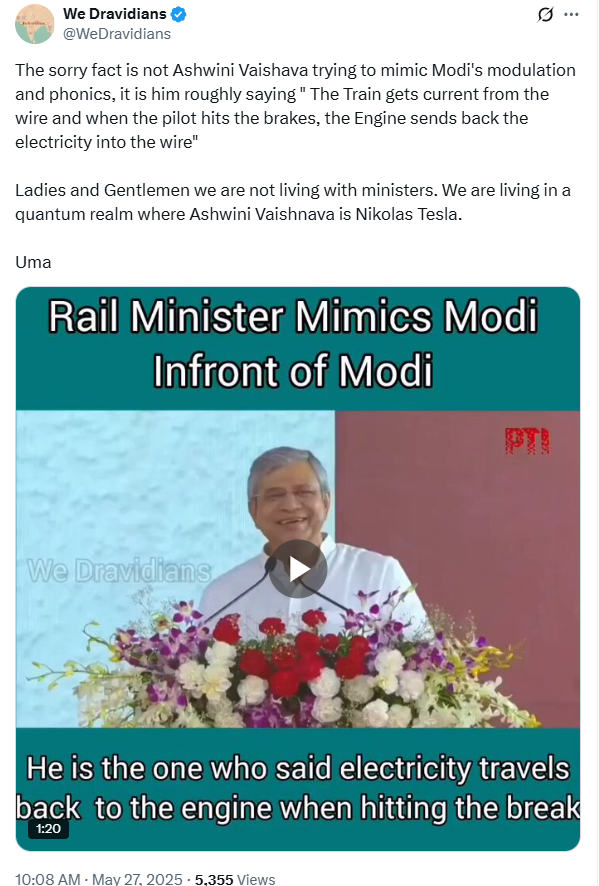
Controversial X handle We Dravidians wrote, “The sorry fact is not Ashwini Vaishava trying to mimic Modi’s modulation and phonics, it is him roughly saying ‘The Train gets current from the wire and when the pilot hits the brakes, the Engine sends back the electricity into the wire.’ Ladies and Gentlemen, we are not living with ministers. We are living in a quantum realm where Ashwini Vaishnava is Nikolas Tesla.” Not to forget, the We Dravidians handle is managed by the people who live in the great South India, where technology is apparently in the blood.

Source: X

What Ashwini Vaishnaw said

Speaking at the inauguration of the electric engine factory in Dahod, Railway Minister Ashwini Vaishnaw highlighted how the plant symbolises modern engineering and Prime Minister Narendra Modi’s vision. He explained that the new locomotives are more than just engines — they are “moving computer centres” with no noise, no vibration, and even have air-conditioned cabins and onboard toilets. He also remarked that these engines draw electricity from overhead wires while running and send power back to the same wires through regenerative braking when brakes are applied.

He said, “When the train runs, it draws electricity from the overhead wire. When the brakes are applied, the engine turns into a generator and sends electricity back to the overhead wire. This is the marvel of modern technology.”

India launches D-9 locomotive with regenerative braking, eyes exports

Notably, India has unveiled its first 9000 horsepower (HP) electric locomotive equipped with regenerative braking technology. It marks a major milestone in railway innovation. The engine was dedicated to the nation by PM Modi and has been built in Dahod, Gujarat. The codename of the engine, D9, is short for Dahod-9000.

Manufactured at a Rs 21,405 crore facility, the unit is expected to produce 1,200 locomotives over the next decade, each capable of hauling up to 4,600 tonnes at an average speed of 75 km/h. Indian Railways is eyeing on exporting these engines as well.

What is regenerative braking?

Regenerative braking is a mature and effective technology that transforms a train’s kinetic energy into electrical energy during deceleration. In a conventional dynamic braking system, the energy is typically wasted as heat. However, in the case of regenerative braking, the energy reverses the current in the electric motors, converting them into generators as the train slows down.

The electricity produced is then fed back into the power distribution system, where it can be used to power other trains or station facilities, provided simultaneous demand exists.

This technology is particularly effective in electric trains operating on AC systems, where it can be implemented with minimal additional cost. DC-powered systems face challenges such as low voltage levels and limited ability to return power to the grid, though upgrades can improve their efficiency. Regenerative braking offers significant energy savings, up to 30% in dense urban metro systems and 8–17% in full-stop commuter trains. Freight trains benefit less, recovering only around 5% of energy due to their braking reliance on mechanical systems.

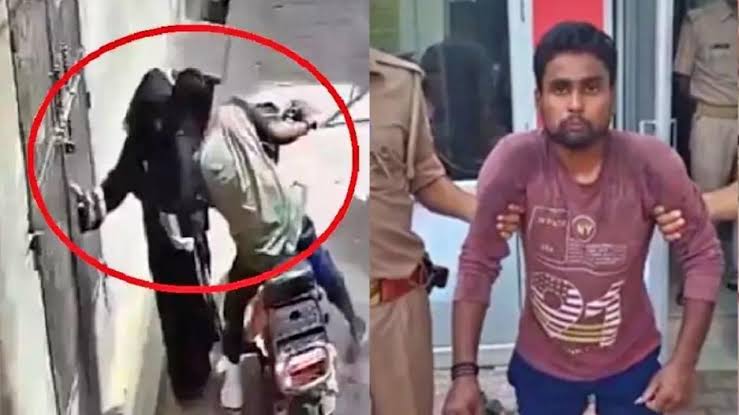
Narrative collapses: Islamists go silent after Meerut Police arrests Mohammad Suhail for molesting a burqa-clad woman

In a grim yet telling reflection of how online propaganda distorts reality, a disturbing video from Meerut recently went viral, showing a burqa-clad woman being molested in broad daylight. Instead of treating the woman’s ordeal with the sensitivity and solidarity it deserved, certain Islamist handles on X (formerly Twitter) wasted no time in amplifying the clip—not to demand justice, but to craft a narrative. One that falsely suggested a systemic targeting of Muslims in India.

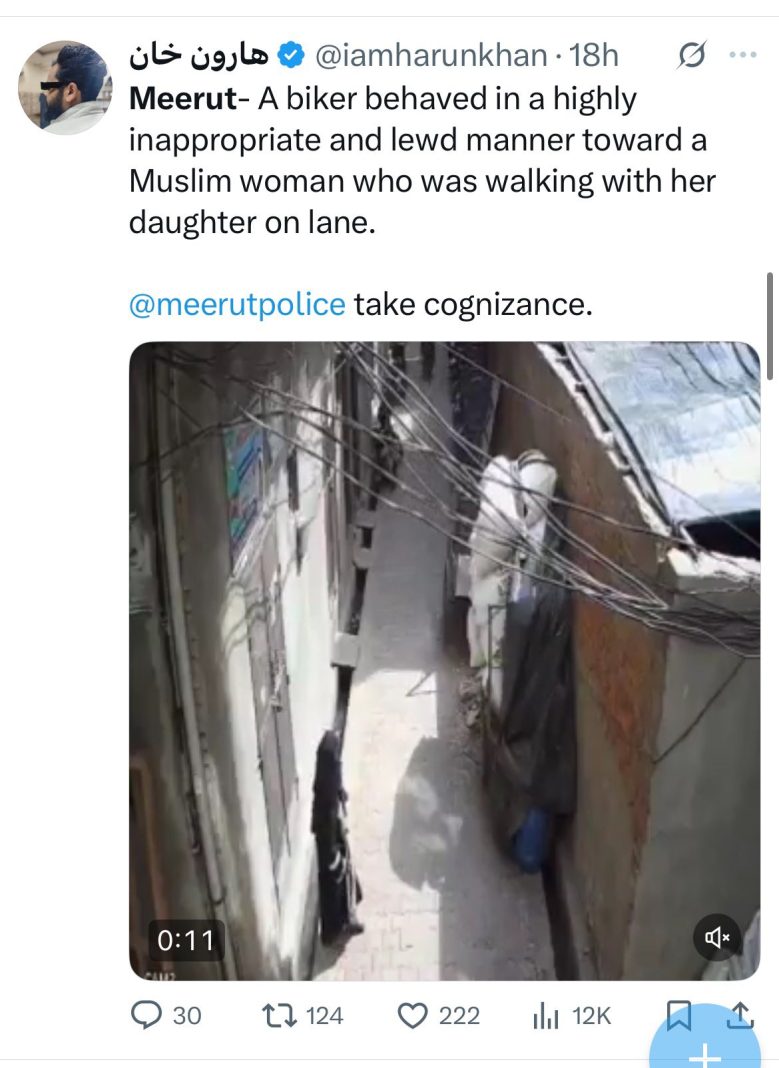
The playbook was familiar: highlight the victim’s religious identity, omit crucial context, and weaponize suffering to stir communal unrest and push a political agenda. “A biker behaved in a highly inappropriate and lewd manner toward a Muslim woman who was walking with her daughter on lane,” read one viral post.

Without waiting for facts, these social media operatives painted the incident as yet another proof of the fictional “genocide” they constantly allege against Indian Muslims. That the woman was targeted for being a Muslim was the underlying message a section of social media users tried to imply.

But the narrative came crashing down once Meerut Police arrested the accused—a man named Mohammad Suhail. Far from being a representative of any so-called ‘majority aggression,’ Suhail is himself a Muslim. This key fact blew a gaping hole in the carefully crafted disinformation campaign.

Yet, unsurprisingly, the same propagandists who had passionately tweeted the video and communalised the issue suddenly fell silent. No retractions. No apologies. No outrage over Suhail’s crime. The victim, it seemed, was only useful as long as she could be exploited as a pawn in their ideological chess game. Some of the shameless social media users defended themselves claiming they never “communalized” the incident. However, going by their history, it is appeared little more than a shoddy attempt at trying to play safe after their propaganda was exposed.

This episode exposes a larger, disturbing pattern: a section of Islamists and their fellow users on social media are less interested in justice and more focused on political opportunism. They routinely hijack genuine cases of suffering—not to advocate for victims, but to score points against the Indian state, the Hindu majority, and Prime Minister Narendra Modi’s government. Such exploitation of vulnerable individuals, particularly Muslim women, undercuts real efforts toward communal harmony and justice.

Ironically, in their rush to blame Hindu society, these online propagandists end up shielding the actual perpetrators if they share the same religious identity as the victim. Their concern is selective, their activism performative, and their silence when facts don’t align with their agenda—deafening.

What happened in Meerut is tragic and reprehensible. The victim deserves justice, and Suhail, regardless of his religion, must face the full force of the law. But the manipulation of this incident to push communal hatred reveals the true face of those masquerading as ‘human rights defenders’ on X. In their zeal to malign India, they end up trivializing the trauma of the very people they claim to protect.

Justice cannot be communal. Nor can it be selective. And truth, no matter how inconvenient, must always come first.

The ‘Black Tiger’ who saved countless Indian lives: Read the extraordinary life story of India’s greatest ever spy, Ravinder Kaushik aka Pakistani Major Nabi Ahmed Shakir

In the past few weeks, several Indians who turned against their country and became spies for Pakistan have been caught by security agencies. The arrest of YouTuber Jyoti Malhotra, Devender Singh, Gazala and Yameen Mohammad, among others, reminded many of the betrayal India faced at the hands of disgraced diplomat Madhuri Gupta. All these cases are a reminder of how betrayal sometimes wears a very familiar face. However, this moment also calls for reflection on the opposite. It is time to remember those who crossed the same borders not to sell the country, but to serve it.

While some Indians handed secrets to Pakistan in exchange for money, imaginary love and what not, there was one man who lived inside Pakistan as their own for years and sent their secrets back to India, saving countless Indian lives. His name was Ravinder Kaushik. Known to the intelligence community as the “Black Tiger”, he did not just infiltrate, he transformed.

Kaushik became one of them. He learned to speak their language. He married a Pakistani girl. He even rose to the rank of a Major in their Army. While living an extremely risky life where his cover could have been blown at any moment, Kaushik sent India information that saved lives and foiled multiple enemy operations.

Ravinder Kaushik never asked for medals and did not expect a grand welcome home, he did not even expect public recognition of his services. He only wanted to serve his country, which he did silently and relentlessly.

It is very easy to name and shame those who betray their country. However, the names of those who served the nation are often forgotten with time. It is necessary to name and remember those heroes who gave up everything, even their names, for the country.

Ravinder Kaushik was not a character from a thriller, but a real life superhero. He was India’s real life invisible shield and his story must be told repeatedly. No matter how many times you have heard his name or read about him, Kaushik’s story must live forever, not for justice, but for memory.

The making of a spy – from theatre to the shadows

Sometimes, destiny does not arrive with drums beating loudly but walks into a college auditorium and sits quietly in the audience. In the case of Ravinder Kaushik, destiny watched him, a young man pretending to be a soldier on stage, very carefully.

Kaushik was born on 11th April 1952 in Sri Ganganagar, Rajasthan. He grew up in a family where patriotism was not just a slogan, it was a habit. His father was an Air Force officer who lived through wars. When Kaushik was young, he listened, learned and dreamt of serving the country, just like his father.

It was not the battlefield that gave him the opportunity, but a college stage. He was studying commerce at SD Bihani PG College. However, he was more interested in theatre. Kaushik was not just an actor. He lived his roles, even though it was just a college theatre group. One day, he played an Indian officer captured by the Chinese who chooses death over betrayal. In the audience, there were students and among them were R&AW officials, disguised, while scouting for talent with a certain kind of courage.

They had found the zeal, attitude and patriotism in Ravinder Kaushik. After the performance, they quietly approached Kaushik. There was no drama, no cloak and dagger theatrics while recruiting him. It was a simple offer: serve your country, but you will never be seen again. Live as someone else. Die as someone else. And take every truth with you.

Kaushik did not blink an eye and said yes. In 1973, he left for Delhi and told his family that he had landed a job. In reality, he joined the Research and Analysis Wing, India’s foreign intelligence agency. For the next two years, Kaushik underwent intense and transformative training. He learned Urdu, studied Pakistan’s geography and culture. He practised Islamic rituals and even underwent circumcision. His original identity was slowly and systematically wiped out, not only from the system but from his personality itself.

By 1975, Ravinder Kaushik no longer existed on paper. He walked out of the training as Nabi Ahmed Shakir, a Muslim from Islamabad. By this time, Kaushik was fully equipped to blend into a world that would never suspect he was anything else.

What Kaushik was about to do had never been done before, and what he achieved became a legend which cannot be repeated.

Living the lie – from Karachi University to Pakistan Army

Kaushik, who was now Nabi Ahmed Shakir, arrived in Pakistan in 1975. Though from the outside he was a Muslim man from Islamabad, on the inside he was still Ravinder Kaushik, a patriotic Indian who was there to live behind the curtains and serve his country.

His first stop was Karachi University. He enrolled for an LLB. It was not just about education but about gaining credibility. He built a life that could withstand scrutiny. He debated, wrote exams and blended into the rhythms of Pakistani student life. Kaushik was a perfect student throughout, and no one doubted him. He even developed a new personality, one that would soon find its way into the Pakistani Army.

Once Kaushik’s degree was complete in Pakistan, he set his sights on Pakistan’s military. Initially, R&AW was not in favour of him joining the Army, as the risks were high. A background check, a wrong paper, a minor slip could unravel everything, making him the prime target of ruthless Pakistani military personnel. However, Kaushik believed that real access meant real risk.

He prepared for the entrance exam for the Military Accounts Department and cleared it on the first attempt. The boy who once played a soldier on stage in India was now a commissioned officer in the Pakistan Army.

From this position, Kaushik began the real mission. He sent crucial information to India. The information mattered because it was not just whispers or rumours but hardcore intelligence. From troop movements to officer transfers, ammunition dispatches and everything, Kaushik gathered intel and informed his bosses in India. He wrote reports using invisible ink, passed them to intermediaries in Kuwait or Dubai, and from there, the information travelled to New Delhi.

Kaushik lived in the non internet era. There were no email transmissions. The information took days, sometimes weeks, to reach India. Every dispatch from Kaushik was an act of faith.

Kaushik wanted a foolproof life and background. To deepen his cover, he married a local woman named Amanat, daughter of a tailor in his unit. They had a son, Areeb. Neither mother nor child ever knew the man in their home had once answered to the name Ravinder.

Kaushik maintained his appearances at work, at home and in society. He was sociable, devout, loyal to his unit. A trusted officer and a loving husband. However, all that was just a cover. In reality, he was a spy from India.

The Black Tiger who roared for India

Between 1979 and 1983, India had something that intelligence agencies can only dream of, a Major in the enemy’s Army working for them. And not just working, delivering game changing intel.

Kaushik had access to crucial and secret information which gave India a strategic edge. His reports helped prevent infiltration, foil covert operations and save thousands of lives. His intelligence reportedly stopped Pakistani operations that could have killed 20,000 Indian soldiers.

He was not doing this for fame. He could not be known. He did it because he believed someone had to, and someone noticed.

Indira Gandhi was the Prime Minister at that time. She was briefed on his contributions. She was the one who gave him a name that would live on in R&AW circles, the “Black Tiger”. It was not a codename. It was a title of honour.

Kaushik remained committed, meticulous and careful. His communication routes were painfully slow but secure. He ensured the information that was being passed on had all the accurate details and reached India ahead of time. He adapted so well that even senior ISI officers casually conversed with him without any suspicion.

Publicly, he never came back to India. One of the trips he made to India was for his brother’s wedding. He came through carefully orchestrated detours via the Gulf under the cover of an Umrah trip to Saudi Arabia. Even then, he maintained the Dubai businessman façade and bought gifts for his family in Pakistan.

By 1981, Kaushik had already spent six years in Pakistan. He had a wife, a son and a reputation. All that resulted in a desk full of secrets valuable for India. However, Kaushik knew that time was not his friend. Every new success brought him closer to exposure, and when the betrayal came, it did not come from Pakistan, it came from within.

Betrayed – the mission that exposed Black Tiger

Kaushik knew he was playing with fire. It was not his mistake that exposed him, but a miscalculation by R&AW that led to the exposure. In 1983, the agency decided to send another operative into Pakistan, Inyat Masih. His task was to deliver a special message to Kaushik. The move was risky, as Kaushik had already spent eight years in the field. There was no need for direct contact, as it could have led to his exposure. However, the decision was made.

Masih managed to cross over but was soon apprehended by Pakistan’s counter intelligence agencies. He was tortured relentlessly. Interrogations were brutal, leaving no room for human endurance, and he eventually broke.

Under pressure, Masih revealed everything, the network, his purpose, and most devastatingly, the identity of Major Nabi Ahmed Shakir as a R&AW agent named Ravinder Kaushik. ISI was in shock. They decided to verify the claim and set up a trap. They allowed Masih to reconnect with Kaushik and arrange a meeting.

Kaushik was unaware of what had transpired. He walked straight into the ambush. Kaushik was supposed to meet Masih in a park, but Pakistani officials were waiting for him instead. India’s most valuable undercover agent was arrested not because of enemies, but because someone decided to play with his life by sending Masih to deliver a message.

Kaushik was taken to Sialkot, where the interrogation began. He was tortured for long hours without a break. He had no rights. However, Kaushik did not reveal anything. Even under the harshest pressure, he did not betray his motherland. He said nothing. Kaushik never confirmed his identity. He did not disclose any further names. He did not leak a single operational detail. He chose pain over compromise and silence over survival.

Two years of darkness – Sialkot’s interrogation chambers

The two years Kaushik spent in the Sialkot interrogation centre were not imprisonment, but attempts to completely disintegrate Kaushik’s resolve. Pakistanis used every tactic, physical, psychological and emotional. They did not let him sleep. He was forced to lie down on ice cold surfaces and left in solitary confinement. The aim was to dehumanise his life, but Kaushik did not speak.

He endured the pain not as a soldier in uniform, but as a lone agent with no backup, no headlines, no guarantees. Later, in letters he managed to send to his family, he described some of what he had gone through. He never sensationalised. But the pain was undeniable. It was not just the body that suffered, it was the realisation that his mission had ended not in success or honour, but in total erasure.

The case against him went on for years, and in 1985 he was sentenced to death by hanging. However, his sentence was commuted to life imprisonment by the Pakistan Supreme Court. It was a verdict meant to continue the suffering, not offer reprieve. He was shifted from Sialkot to Kot Lakhpat Jail, and then to Mianwali, where he would remain for the rest of his life.

Even in prison, Kaushik managed to send occasional letters back to India. In one of them, he asked, “Kya Bharat jaise bade desh ke liye Qurbani dene waalon ko yahi milta hai?” (Is this what those who sacrifice for a great nation like India receive?)

He did not ask for fame. He did not demand extraction. He simply hoped that his story would not be buried in silence.

Letters from exile – when the Black Tiger wrote home

After spending years in jail, he found his last form of resistance, writing. He began sending letters to his family cautiously and quietly. These were not dramatic declarations of heroism. They were raw, reflective and painfully human.

It was because of those letters that his family learned the truth. Until then, they believed that Kaushik was working in Dubai. His carefully maintained cover had convinced even his parents. The reality came crashing down with a few lines written in a prisoner’s handwriting.

His father, a retired Air Force officer, was shattered by the revelation and could not handle the emotional blow. He passed away soon after. His mother started knocking on every possible door in New Delhi with the hope that someone would listen. She was not asking for rewards or media attention, but seeking only one thing, acknowledgement.

The government offered a token pension of Rs 500, which was later raised to Rs 2,000 per month. However, the family never received formal recognition of Kaushik’s service. His name remained unspoken in official records, even as his sacrifice became a quiet legend in intelligence circles.

Yet Kaushik never showed bitterness in his words. He spoke of pain, of loneliness, of the unending echo of forgotten promises. But he never expressed regret. He did, however, leave behind a sentence that still echoes today, “Had I been an American, I would have been out of this jail in three days.” It was not a complaint, but a mirror held up to the nation he had once protected from its greatest adversary while .

Death in silence – the final chapter of a patriot

In November 2001, after 18 years of imprisonment, Ravinder Kaushik passed away inside Pakistan’s Mianwali Jail. He had battled pulmonary tuberculosis and heart disease for months, with little medical aid. There was no last minute appeal or high profile campaign for him. There was no diplomatic push to bring back India’s son. He died as he had lived for India, in silence.

Kaushik’s body was buried in Multan, far from the land of his birth. There was no tricolour on him. There was no ceremony. Even the name on the headstone was not his. There was no official communication from the Indian side to the family. No acknowledgement. No obituary. The man who had risked everything, from his beliefs to his blood, was allowed to disappear into history with barely a whisper.

His family mourned privately. His mother kept his memory alive through press interviews, letters and appeals. But the world moved on. Even now, his name rarely makes it into textbooks or Republic Day mentions. There are no streets named after him, no national memorials, no military plaques.

But he is remembered in popular culture and intelligence circles. Kaushik has never been seen as a victim or a martyr. He is India’s Black Tiger, a man who walked into the enemy’s heart and roared, not for recognition, but for duty.

Legacy of valour – remembering a forgotten warrior

History remembers names. However, some names, as it seems, were never meant to be remembered, only whispered. Ravinder Kaushik is one of those names. However, he deserves more. Kaushik did not carry any medals. He did not feature in parades. But from the dusty lanes of Sri Ganganagar to the darkest cells of Mianwali, he lived a life of service that few can even fathom. His journey was not just across borders, it was across identities, beliefs and silence.

Even today, his story finds itself scattered. Films like Ek Tha Tiger and Romeo Akbar Walter draw from his legacy, but no filmmaker officially credits him. His family has received no state honour. His grave lies unmarked, far from the land he gave everything for.

But perhaps recognition is not always about headlines. Perhaps it begins with telling the story, again and again, until every Indian knows the name Ravinder Kaushik. Until we, as a nation, make peace not just with his service, but with our silence.

He was not forgotten because he failed, He never asked to be remembered. He was forgotten because we Indians failed.

But now, it is time we teach his name alongside our military legends. It is time we not only honour those who serve in the uniform, but also those who serve from the shadows. It is time we say it clearly, without hesitation, that Ravinder Kaushik was India’s Black Tiger, a true patriot, an unsung warrior and the bravest spy this country ever produced.

Let the silence end here.

‘Operated rape camp, abducted and murdered Hindu Professors, burnt Hindu villages’:Bangladesh SC acquits ‘Razakar’ Azharul Islam, who was earlier handed death penalty for 1971 genocide

On Tuesday (27th May), the Supreme Court of Bangladesh acquitted a Jamaat-e-Islami terrorist named ATM Azharul Islam, who was previously handed the death penalty for crimes against humanity during the 1971 Liberation War.

ATM Azharul Islam was arrested in 2012. He was found guilty of killing 1,256 people, abducting 17, and raping 13 women in cahoots with the Pakistani army.

The Jamaat-e-Islami terrorist was also involved in genocide, detention, torture, grievous injury, looting, and arson. He was convicted by the International Crimes Tribunal (ICT) in December 2014.

ATM Azharul Islam was sentenced to death on 3 counts and imprisonment on 2 counts of crime against humanity. His death penalty was upheld by Appellate Division of the Supreme Court in October 2019.

However in February this year, the Supreme Court of Bangladesh allowed Azharul to file fresh appeal to challenge the guilty verdict.

The same Appellate Division, which earlier upheld the conviction and death sentence has acquitted the Jamaat-e-Islami terrorist on Tuesday (27th May). This will ensure the release of ATM Azharul Islam.

His counsel Gazi MH Tamim remarked, “Since this case came to appeal stage from a review, there is no higher court in Bangladesh or any international forum beyond this.”

Under the watch of Muhammad Yunus and a successful regime change operaiton in Bangladesh, hardened criminals and terrorists have been allowed a free pass.

Crimes committed ATM Azharul Islam in 1971

The crimes committed by ATM Azharul Islam coincided with the ‘Operation Searchlight’, launched by the Pakistan army between 26th March 1971 and 25th May 1971.

His crimes were concentrated in the Rangpur Division of Bangladesh and extended well until the end of the Bangladesh Liberation War (26th March 1971 to 16th December 1971).

According to the International Crimes Tribunal investigation, ATM Azharul Islam attacked Moksedpur village on 16th April 1971. He was involved in killing unarmed civilians, plundering homes and setting them ablaze. He was accompanied by Pakistani army and other Jamaat-e-Islami terrorists.

A day later (17th April 1971), ATM Azharul Islam carried out attacks sytemetically in Hindu-dominated villages and killing over 1200 people near Jharuarbeel. He was involved in abudction, arson, murder and large scale genocide.

He alongside Pakistani forces raided the Rangpur Carmichael College along with Pakistani forces, abducted 4 Hindu Professors and 1 of their wives. All 5 victims were brutally murdered. The incident occured on 30th April 1971.

ATM Azharul Islam ran a ‘rape camp’ in Rangpur between March and December 1971, where he abducted, confined, tortured and repeatedly raped his victims (particularly one M.K.).

He was also involved in assault, abduction and torture (causing permanent diability) of the brother of a youth who chanted ‘Joy Bangla’ between Novemeber and December 1971.

Despite the overwhelming evidence of his complicity in crimes against humanity, the terrorist ATM Azharul Islam has been freed. In 1971, he was the President (Rangpur Division) of Islami Chhatra Sangha.

Remembering Operation Searchlight of 1971

The story began in 1970. In the General elections held on December 7 that year, Sheikh Mujibur Rahman of the Awami League secured a huge majority (167 seats) in the provincial legislature in East Pakistan. With constant interference in the affairs of East Pakistan by its Islamic counterpart, Rahman had begun demanding for greater regional autonomy.

This was just within 13 years of the Partition of the Indian subcontinent, when Muslims sought for a separate country of their own. Although united by the common Faith, the resentment between the West and East Pakistan towards each other continued to grow. Zulfikar Ali Bhutto of the Pakistan People’s Party (PPP), who won the most seats in West Pakistan in 1970 elections, was opposed to the demands of Rahman. He had threatened to boycott the Assembly and sought for the dissolution of the provincial legislature in East Pakistan, if PPP was not included in the government.

Miffed over the denial of power and autonomy to East Pakistan, Sheikh Mujibur Rahman called civil disobedience movement, on March 7, 1971. Bhutto feared civil war and President Yahya Khan, therefore, declared martial law and ordered the arrest of Rahman and other leaders.

In order to contain the civil and political unrest, the Pakistan army launched Operation Searchlight on March 26, 1971. Rahman, disillusioned by the high-handedness of West Pakistan, had already called for independence from West Pakistan.

The Pakistani soldiers launched their attack on the Bengali population in Rajararbagh and Peelkhana area. They put Mujibur Rahman behind bars and ambushed the Dhaka university, resulting in the death of 9 teachers and 200 students in Iqbal Hal. Similarly, the Pakistan army continued with its barbaric attacks on civilians in Old Dhaka, Tejgaon, Indira Road, Mirpur, Kalabagan and other places.

On the same night, several people in Chittagong were shot dead by the army personnel. National newspapers, including, Daily Ittefaq, the Daily Sangbad were shut down and their offices were set ablaze, resulting in the death of several media personnel. Mass graves were dug out and hastily bulldozed. An estimated 700 people were burnt to death in Dhaka. Similarly, they set fire to the houses of slum dwellers, fired bullets at those running away to save their lives, razed a Kali Mandir and also destroyed the Central Shaheed Minar.

It is believed that around 10,000-35,000 Bengalis were killed by the Pakistan army under the Operation Searchlight while the death toll to increased to over 3 lacs in the months to follow. “Thanks to God that Pakistan could have been saved,” Bhutto had famously remarked. The genocide against the Bengali population intensified. In the months to follow, around 4 lac Bengali women were raped by the Pakistan army while a majority of the victims being Hindus.

The situation worsened, forcing neighbouring India to step in to prevent the further continuation of genocide. In 14 days, Pakistani forces under AK Niazi signed the Instrument of surrender and thus a new nation of Bangladesh was born. While Bangaldesh has tried and hanged several war criminals, Pakistan continues to dispute the 1971 genocide, far from being apologetic about the heinous crimes.

Muhammad Yunus tired to appease Islamic extremists

Bangladesh witnessed a drastic rise in Islamism after Yunus came to power. He first revoked the ban on the radical Islamist outfit ‘Jamaat-e-Islami.’

Thereafter, he released the leader of the radical outfit ‘Ansarullah Bangla Team (ABT)’ Muhammad Jasimuddin Rahmani.

At the same time, Muhammad Yunus downplayed the targeted attacks on the Hindu community by violent Muslim mobs. He has gone on record from lamenting about attacks on Hindus to saying that the claims of atrocities are ‘exaggerated‘.

In that way, the controversial US asset was able to placate Islamic extremists. Given that Awami Legaue was against Islamism, the interim government first banned its student wing ‘Chhatra League,’ and then the parent party.

Under the watch of Muhammad Yunus, Bangladesh saw a drastic rise in vigilante Muslim mobs, which unleashed violence under the pretext of protecting the tenets of Islam.

These mobs were largely unorganised and called themselves ‘Tawhidi Janata (meaning Revolutionary People).’ They came under the spotlight over acts of vandalism and harassment of people.

The Yunus regime introduced new textbooks for primary and secondary students, which falsely claimed that the first declaration of independence of Bangladesh was made by Ziaur Rehman (a favourite icon of Muslim hardliners in Bangladesh).

The interim government also appointed a Hizb ut-Tahrir terrorist named Mohammad Azaz as the administrator for the Dhaka North City Corporation (DNCC).

The situation had become so grim that Bangladeshi ambassador to Morocco Mohammad Harun Al Rashid was forced to slam the Muhammad Yunus-led interim government in a scathing Facebook post in March this year.

Be proud of ‘Made in India’: PM Modi urges citizens to champion local products and prioritize Indian-made goods

On 27th May, Prime Minister Narendra Modi took a jibe at Chinese goods by pointing to the import of “small-eyed Ganesh idols” as an example and urged Indians to purchase indigenous products instead, especially during festivals like Holi, Diwali and Ganesh Puja. He encouraged Indians to reduce their reliance on imported commodities, stating that doing so is essential to India’s aspirations to become a developed country and the third-largest economy in the world by 2047.

PM Modi stated that although the military’s might initiated “Operation Sindoor,” it is now time for people to fortify the cause for a self-reliant India, during a speech in Gujarat’s Gandhinagar. “Operation Sindoor began with the strength of our armed forces on the night of 6th May and will now advance with the strength of the people. Every citizen must become a partner in the nation’s development,” he declared.

“If we all contribute to building a Viksit Bharat by 2047 and help take our economy from the fourth to the third position globally, we will not rely on foreign products,” PM Modi expressed. “We must encourage village traders to pledge that no matter how much profit they make, they will not sell foreign goods. But unfortunately, even Ganesh idols come from abroad, small-eyed Ganesh idols whose eyes don’t even open properly. Even the colours for Holi come from outside,” he further highlighted.

He emphasized the government’s objective of turning India into a developed country by 2047 and promised that no compromise will be made to reach this milestone. He stated that India’s metropolitan areas, especially tier 2 and tier 3 cities need to develop into thriving centers of activity and economic progress.

PM Modi’s comments coincided with concerns that China is flooding the Indian market with low-quality items. In recent years, holiday sales have been dominated by low-cost imports from the country, including religious idols, toys, firecrackers and decorative lights which have affected local producers and artisans.

Additionally, he directed people to list the things they possess in order to determine how many imported goods they utilize. “As a citizen, I have a task for you: go home and make a list of how many foreign products you use in 24 hours. You don’t even realise but even hairpin, comb used are foreign-made.”

He then added, “If we want to save India, to make India, to make India grow, then Operation Sindoor is not just the responsibility of armed forces, it’s the responsibility of 104 crore citizens.” He asserted that government programs like “One District One Product” (ODOP) and “Vocal for Local” will increase the use of domestic goods.

He voiced that Indians should try to use local products, with the exception of those that need to be imported because they are not produced domestically. “We should be proud of our brand Made in India,” he emphasised.

PM Modi also remarked that terrorism perpetrated by Pakistan is a calculated war plan rather than a proxy war. He mentioned, “We can’t call this a proxy war as those who were killed on 6th May night were given state honours in Pakistan. Pakistani flags were draped over their coffins, and their military saluted them. This proves that these terrorist activities are not just a proxy war but a deliberate war strategy. If they engage in war, the response will be accordingly.”

Notably, Turkey and Azerbaijan supported Pakistan during the recent conflict with India which sparked a robust boycott drive in th country. Many Indian tourists are canceling their vacation plans to both countries. Indian tour operators have pulled promotional packages to both countries and boycott calls are rife on social media. Celebi, a Turkish business, no longer has a ground handling license at Indian airports.

The initiative “Viksit Bharat 2047” led by the Bharatiya Janta Party government, seeks to transform India into a developed nation by the 100th anniversary of its independence. According to the government, the initiative focuses on inclusive economic growth, social equity, environmental sustainability and effective governance, thereby creating a foundation for a prosperous and resilient India. A strong embrace of renewable energy, top-notch education, better healthcare, upgraded infrastructure, open governance and inclusive development are also among its goals.

MP: Muslim man demands conversion and son’s circumcision as precondition for marriage to divorced Hindu woman; threatens to leak obscene videos

0

In Madhya Pradesh’s Bhopal, a divorced Hindu woman has accused her Muslim boyfriend, Nadeem, of forcing her to convert to Islam. On the victim’s complaint, a case has been registered against the accused under the Madhya Pradesh Religious Freedom Act.

As per an AajTak report, the accused had put a condition before the victim that he would marry her only if she and her son from her first marriage would convert to Islam and her son would undergo circumcision.

The matter pertains to the Kamala Nagar Police Station precinct. On 26th May, a 35-year-old divorced woman reached the police station and told the police that after the divorce, she had become close to Nadeem who resided in her neighbourhood. The victim got divorced around 12 years ago and was residing with her son since then. She became acquainted Nadeem about 3 years ago, who was trying to talk to her for a long time.

As per the complainant, in June 2022, the accused Nadeem established sexual relations with her by promising to marry her. However, whenever she asked about marriage, the accused youth used to prevaricate.

When she again talked about marriage, the accused said that he is a Muslim and for marriage the victim and her son will have to convert to Islam. Nadeem also allegedly threatened the victim to make her obscene videos and pictures viral on social media.

Meanwhile, the victim also learnt that Nadeem is already married. The accused, however, told the victim that his family members had got him forcibly married and he does not stay with his wife now. He claimed that he wants to marry the victim. However, on 13th May, in the absence of the victim’s son, Nadeem came home and is alleged to have forcibly removed her clothes, raped the victim and clicked pictures and videos. After this, Nadeem said that he is a Muslim and for marriage, the victim and her son will have to accept Islam. He also put a condition of getting the son circumcised, which the victim refused. 

Nadeem refused to marry without converting to Islam and threatened that if pressure was put on him for marriage, he would make the photos and videos viral.

The victim also alleged that the accused used to pressure her to wear burqa, not apply tilak and not observe fast on Thursdays. He used to forbid her from going anywhere without informing him and if the victim stepped out of her house without informing him, Nadeem used to beat and abuse her.

Tired of the perpetual harassment, the victim lodged a complaint against Nadeem. The police have registered a case against the accused Nadeem under sections 69, 352 (2) of the Indian Penal Code (BNS) and sections 3 and 5 of the Madhya Pradesh Religious Freedom Act.

Bihar: Woman branded as witch, assaulted by family members for refusing to convert to Christianity and praying to Hindu deities

In a chilling case of religious coercion and violence, a woman from Baliyadih village under Jhajha block in Bihar’s Jamui district has alleged that she was brutally beaten and humiliated by her in-laws for refusing to convert to Christianity.

The victim, Sonali Devi, filed a formal complaint with the Superintendent of Police on Monday, accompanied by her husband, Sahdev Das. She recounted the horrifying events of May 25, when her brothers-in-law, Kanhaiya Das and Panchu Das, allegedly attacked her with sticks and rods, calling her a “dayan” (witch) and issuing death threats.

Sonali, who resides alone in a house built on her share of ancestral land while her husband works in Kolkata, says she has been under pressure from her in-laws—father-in-law Tarni Das, mother-in-law Suruti Devi, and brother-in-law Kanhaiya Das—to convert to Christianity. According to her, these family members had embraced the Christian faith privately but continue to publicly identify as Hindus, making them “crypto converts.” They continue to retain their Hindu identity perhaps to access government welfare schemes and caste-based reservation benefits.

Coercion cloaked in superstition

In her testimony, Sonali detailed how her refusal to convert led to repeated episodes of abuse. She alleged that her in-laws warned her she would be denied any claim to family property unless she converted. “They use religion as a weapon,” she said. “Because I choose to remain Hindu, they call me a witch and beat me.”

The use of superstition in such coercion is especially concerning. Sonali was reportedly forced to undergo a humiliating ritual where her hair was cut by a local witch doctor, or “ojha,” at the behest of her in-laws. She was branded a witch—an age-old tactic often used in rural India to shame and silence women, now being cynically employed in a dispute driven by both land and religion.

Crypto conversion: A disturbing trend

The case exposes a growing but under-discussed phenomenon of “crypto conversion,” where individuals convert to another religion but hide their new faith to continue receiving Scheduled Caste or Scheduled Tribe benefits reserved for Hindus. Sonali’s in-laws, while practicing Christianity, have not legally declared their conversion—allowing them to retain access to government subsidies, job reservations, and land rights.

Crypto converts represent a dangerous grey zone. They claim the privileges of Hindu identity while violating its tenets and pressuring others to follow suit. It’s a form of ideological fraud with real human victims.

Police inaction

Sonali had previously filed two complaints with the Jhajha police station, but no meaningful action was taken. A local panchayat’s attempt at resolution also failed. Jhajha Station House Officer Sanjay Singh said the case seems linked to a property dispute, though he did not dismiss the religious angle entirely.

Meanwhile, Sonali continues to face mental and emotional abuse. She claims her in-laws regularly insult her for praying to Hindu deities and prohibit her from observing religious rituals. “They have converted in spirit, but wear the mask of Hinduism only for benefits,” she said.

A growing menace with wider implications

This is more than a family feud—it’s a reflection of how religious conversions, land disputes, and institutional loopholes can combine to inflict suffering on vulnerable individuals. Women’s rights advocates have warned that unless authorities take serious cognizance of such cases, forced conversions could become an instrument for both economic exploitation and ideological coercion.

Journalist Swati Goel Sharma pointed out that such coercive attempts by family members to convert cannot be dismissed as just “domestic dispute” but it is a conversion terror sowed by soul harvesters that destroy families and gravely chip away at their internal dynamics.

Sonali’s case is a test—not only of legal justice but of the state’s commitment to protecting freedom of religion and individual dignity. As she awaits justice, her fight is emblematic of a broader struggle unfolding silently in many corners of India.

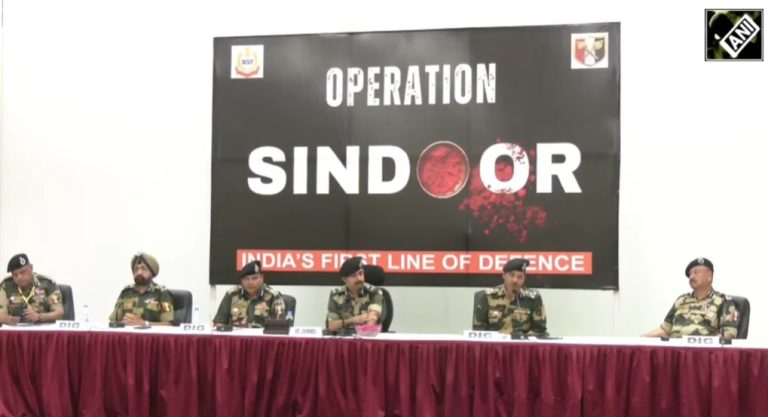
7-12 were killed in Samba during Operation Sindoor, including Pakistan Soldiers: DIG BSF shares details

0

Revealing the details of Operation Sindoor on the intervening night of May 8 and 9, in the Jammu region Border Security Force (BSF) DIG, SS Mand said that Pakistan’s Chakbura launch pad was targeted and there are reports of casualties to 7-12 people, including 3 Pak Army personnel and a few Rangers.

BSF DIG SS Mand said, “Based on a real-time input, we carried out a pre-emptive strike on a group of 30-40 Pakistani terrorists after detecting their movement across the border in Samba sector. Pakistan’s Chakbura launch pad was targeted. There are reports of casualties to 7-12 people, including 3 Pak Army personnel and a few Rangers. We gave a befitting reply to them when they fired at us. They suffered a jolt as it was a surprise to them.”

He further said that their morale was done within 1 to 1.5 hours of the pre-emptive strike.

“The terrorists were from JeM. Women BSF soldiers were also actively involved during the operation,” he added.

The BSF has proposed to name a post in the Samba sector as “Sindoor” and two other in the name of the personnel killed during the cross-border shelling by Pakistan on May 10.

Speaking on it, BSF IG Jammu Frontier, Shashank Anand said that three jawans including an Indian Army Naik was killed in fighting the cross-border shelling.

“On the morning of May 10, Pakistan sent low-flying drones to target our posts. The BSF was actively engaging these drones. However, during one such incident, a tragic event occurred when BSF Sub-Inspector Mohammad Imtiyaz, Constable Deepak Kumar, and Indian Army Naik Sunil Kumar were trying to counter a drone, it dropped a payload, resulting in the killing of all three,” he said.

“We propose to name two of our posts on our personnel we have lost, and one post to be named ‘Sindoor’ in the Samba sector,” IG Shashank Anand said.

IG Anand also praised the women personnel who fought on forward posts during Operation Sindoor.

“BSF’s women personnel fought on forward duty posts during Operation Sindoor. Our brave women personnel, Assistant Commandant Neha Bhandari commanded a forward post, Constable Manjit Kaur, Constable Malkit Kaur, Constable Jyoti, Constable Sampa and Constable Swapna and others fought on forward posts against Pakistan during this operation,” he said.

(This news report is published from a syndicated feed. Except for the headline, the content has not been written or edited by OpIndia staff)