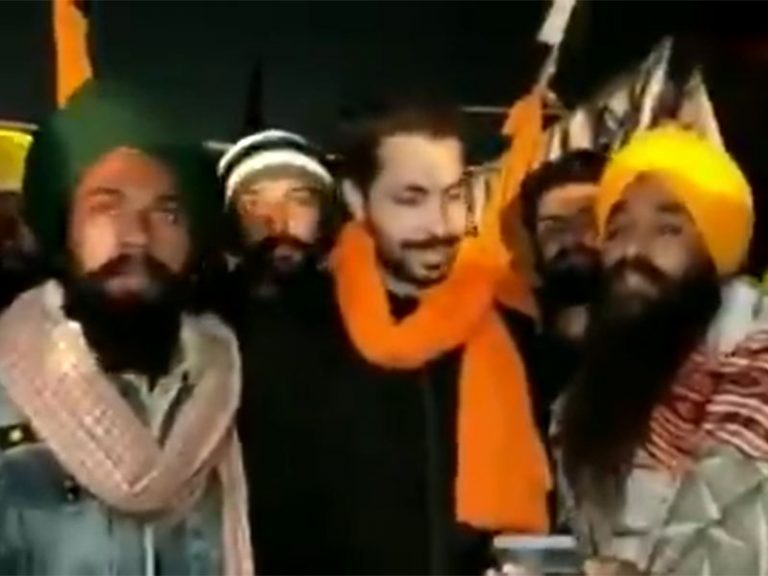
A video has gone viral on social media where Sikh anti-farm law protesters can be heard raising “Naara-e-Takbeer, Allah-hu-Akbar” slogans. Other slogans such as “Kisan-Mazdoor Ekta Zindabad” and anti-Modi slogans were also raised.
Sikh "farmers" chanting Allahoakbar!! Was for this the 10 brave Sikh gurus sacrificed their lives fighting the Mughals? pic.twitter.com/4SdVzSbvV1
People on social media expressed their unhappiness over the matter. In the video, a few men, most wearing a turban or a scarf over their head, can be seen sitting on the back of some moving vehicle. They raised various slogans including “Sat Sri Akal” and “Modi Sarkar Murdabad”.
It is not clear where the video is from or when the visuals were captured. However, given the nature of the slogans, it appears that the video was captured during the agitation against the farm laws passed by the Parliament.
The video shared on social media is 45 seconds long. The protests have been underway for quite a few months and it is not yet clear when they might end. The Delhi Police has fortified the borders in Delhi after protesters stormed the national capital on Republic Day.
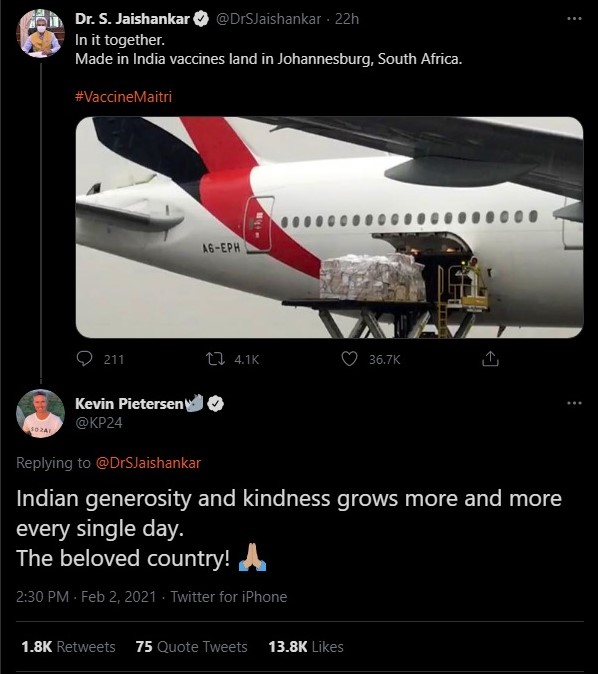
Kevin Pietersen, former England cricketer, has expressed his gratitude towards India after Minister of External Affairs Dr. S. Jaishankar shared photographs of made in India Covid-19 vaccines reaching South Africa. The cricketing superstar was born in South Africa but later moved to England.
Source: Twitter
Kevin Pietersen replied to MEA Jaishankar’s tweet saying, “Indian generosity and kindness grows more and more every single day. The beloved country!” While he received endearing messages from Indians, he was trolled for his comment by Islamists and Pakistanis.
India has been delivering Covid-19 vaccines to numerous countries to enable them to fight the pandemic. The initiative has earned India a lot of good will across the world. However, it is only to be expected that Pakistanis are not too happy with the development. But Pakistan, too, will receive 17 million doses of the India-made Covishield under UN’s vaccination alliance Covax.
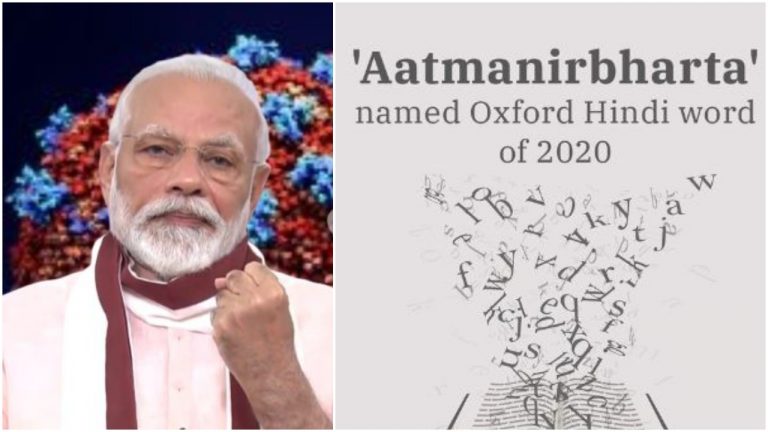
An advisory panel of Oxford languages has declared the word ‘Aatmanirbharta’ as the Hindi word of 2020. The word, meaning self-reliance came into prominence after Prime Minister Narendra Modi gave a call for ‘Aatmanirbhar Bharat‘ (self-reliant India) an important initiative in the wake of the novel coronavirus pandemic.
Experts Kritika Agrawal, Poonam Nigam Sahay and Imogen Foxell were on the panel of Oxford Languages which made the announcement Tuesday.
Word ‘Aatmanirbharta’ gained prominence after PM Modi’s call for a self-reliant India
“In an unprecedented year, ‘Aatmanirbharta’ found resonance with a wide cross-section of people as it is seen to be an answer to the revival of a COVID-impacted economy,” said Oxford University Press India managing director Sivaramarkrishnan Venkateswaran. He further added that amid a number of interesting and topical entries received, ‘aatmanirbharta’ stood out as it validated day-to-day achievements of the countless Indians who dealt with and survived the perils of a pandemic.
In a statement, Oxford Languages said that in the early months of the pandemic when PM Narendra Modi announced India’s COVID-19 recovery package, he emphasised the need to become self-reliant as a country, as an economy, as a society and as individuals, in a bid to navigate the perils of the pandemic. It opined that the usage and the prominence of the word gained significance after PM Modi’s call for an “Aatmanirbhar Bharat”.
Aatmanirbhar Bharat Abhiyaan is the vision of new India envisaged by PM Modi
Aatmanirbhar Bharat Abhiyaan or self-reliant India campaign is the vision of new India envisaged by PM Narendra Modi aimed to make India into a bigger and more important part of the global economy.
India’s significant achievement in the time of corona has been about discovering its forgotten ability to globally lead as a manufacturer. For instance, India experienced a brilliant transition from zero PPE production in the country to becoming the world’s second-largest manufacturer of PPEs. All this was achieved during the time of the pandemic.
Understanding this potential, PM Narendra Modi launched a remarkable initiative for self-reliance – Aatmanirbhar Bharat. As the Prime Minister said, making India self-reliant is the only way to make the 21st century as India’s century. The goal is to focus on domestic manufacturing by being Vocal for Local and ultimately to take Local to Global.
The large-scale manufacturing of the Covid-19 vaccine in India went on to become one of the most important achievement under the entire Aatmanirbhar Bharat campaign coined by PM Narendra Modi.
During the Republic Day parade, the Department of Biotechnology highlighted the Aatmanirbhar Bharat campaign and showcased the Covid-19 vaccine development process in its tableau at Rajpath.
Previous Hindi words of the year are Aadhaar (2017), Nari Shakti (2018) and Samvidhaan (2019).
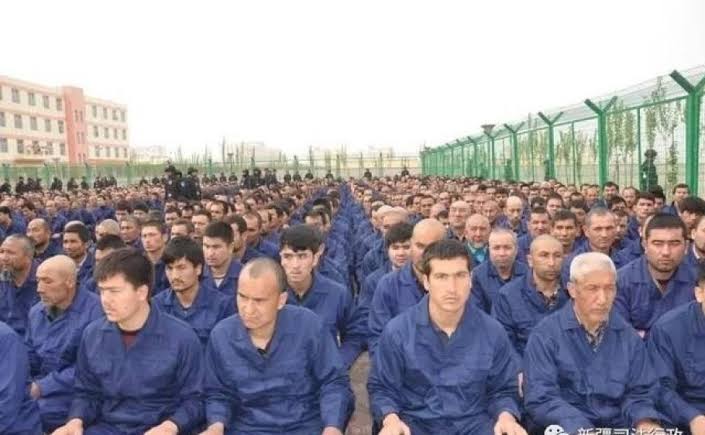
The systematic and pervasive repression of Uyghur minorities in the restive Chinese province of Xinjiang is a well-known fact. But the latest report published by The Intercept, which accessed the leaked Chinese Police data, reveals the depth and extent of how the Chinese state keeps a tab on its Muslim minority population.
The database throws light on the lengths that China goes in not only scrutinising the minority Uyghur Muslims in Xinjiang but also their relatives and friends, along with those who are living abroad. Artificial Intelligence, sophisticated surveillance systems, new-age technology and human intelligence are all employed by the Chinese Communist Party to track and monitor the Uyghur Muslims and those associated with them.
For instance, the police automation system in Urumqi, the largest city in Xinjiang province, issued an “intelligence information judgment” to flag that a female relative of a purported extremist had been offered free travel to Yunnan, a province to the south.
Technology used as a tool to further repress the Uyghur residents
The woman had found the offer on a WeChat group called “Travellers”. Authorities zeroed in on the group because of ethnic and family ties, its members included minorities such as Uyghurs, Kazakhs, and Kyrgyz. The order said, “This group had over 200 ethnic-language people, many of whom are relatives of the incarcerated people. The order directed the police to launch an investigation immediately citing the tendency of relatives of extremist people to gather.
As a consequence of the order, one person with no criminal background, who had not heard of WeChat before or travelled within China came under the scanner of the police. The authorities noted that the person exhibited “good behaviour” and elicited “no suspicion”. Yet, his phone was confiscated and sent to “internet safety unit” and the community was to “control and monitor” him, meaning that a government would appoint a trusted cadre member to visit him regularly and keep an eye on his household.
Apparently, the man was investigated primarily because of religious activities, not by him but by his elder sister a few months ago. According to the police data, the woman and her husband had invited a couple over Tencent QQ app. The couple had bought a laptop and logged on to the group every day from 7 am to 11:30 pm. The husband stopped drinking and smoking and this was a cause for alarm for the Chinese authorities. Between the two couples, the police recovered 168 religious audio files deemed illegal, as they were linked to the Islamic seminary Tablighi Jamaat.
Following Islam is considered as a “red-flag”
Practising Islam is considered a red flag that can invite coercive police action. While China claims that the policing in Xinjiang is to curb the menace of extremism and terrorism, it is just a cover for carrying out invasive surveillance of the Muslim minority residents. Mosques have cameras inside and people are monitored for the way they pray. Showing curiosity about Islam, growing a beard, carrying a prayer rug, Uyghur Books, quitting drinking or smoking, is a potential sign of religious extremism and can trigger police action against the adherents.
A wide range of behaviour habits among Muslims is considered criminal even if it is legal at the time of the incident. A police document revealed that Hui women were detained because of the evidence that showed that they had studied Quran in an online group—which was apparently legal when they studied but became illegal just before their detention. The group was inactive for almost a year before they were detained.
Chinese police forcibly suck out information from mobile phones through the “anti-terrorism sword” tool
The police database is a product of a reporting tool developed by a private defence company Landasoft that aides the Chinese government to carry out surveillance of citizens in Xinjiang. The database brings to fore a systematic campaign of repression that involves cameras placed in the homes of private citizens, the development of internment camps for housing the “extremists”, children being forcibly separated from their families and sent to preschools with electric fences, the organised destruction of Uyghur cemeteries, a structured plan to suppress Uyghur births, forced abortion, sterilisation, and birth control.
One of the most invasive ways in which China prises out personal information from its residents is using a mechanism called as “anti-terrorism sword” phone inspection tool. Checkpoints dot across the expanse of Urumqi, where city police force to plug their phones into these devices. They collect personal data such as contact list, text messages, photos, videos, audio files and documents to run it against an array of prohibited items.
Biometrics program touted as health initiative used for surveillance activities
In addition to sucking out private information from mobile phones, the Chinese government has also hustled people into participating in the biometrics program that is dubbed as a health initiative. The citizens were mandated to have their faces scanned, voice signature analysed and provide their DNA under the “Physicals for All” program. The database accessed by The Intercept reveals that the program was extensively used by the police for their surveillance activities.
Besides, the documents in the database also show widespread use of facial recognition technology to keep a tab on people that alerted by the surveillance system as ‘suspicious’. China has been increasingly deploying new technologies to aide its repression of minorities in Xinjiang.
Suffocating surveillance of Uyghurs a result of Chinese paranoia about the external or malign influence
The primary objective of Chinese authorities to put the citizens of Xinjiang under surveillance is to limit any influence that could engender the desire for greater autonomy and freedom among people. The zeal for “back-flow prevention” was reflected in China’s efforts to identify those who left the country as security threats. According to a report, Uyghur residents in Xinjiang who had managed to go abroad and seek political asylum elsewhere were regarded as terrorists, further cementing the fact that Uyghurs are monitored outside China as well.
Contact with areas outside Xinjiang, or with people in contact with those areas, is extensively monitored and is grounds for suspicion. Authorities also keep a strict vigil on suspected individuals who are made to participate in weekly “flag-raising” ceremonies to assess their psychology, with a keen eye on their loyalty and fervour. Authorities monitor not just former detainees, people under suspicion, but their relatives as well, to confirm their participation and ascertain how passionate they are about doing so.
Detention centres used to control the population, especially of Muslims
Ever since allegations of the existence of detention centres to house Uyghur population surfaced, China has been in denial, calling them “training centres” and “re-education camps” for the welfare of the residents. However, the Chinese police database leak illustrates an expansive network of detention centres that are put to use to incarcerate people and control the population, especially of Muslims.
Along with surveillance and strict policing, the database sheds light on a system where lengths of incarceration, even under the pretext of “training” or “re-education”, is often so uncertain that relatives are obliged when the detainees are handed out fixed-term sentences. Documents reveal Xinjiang’s complex system of prison-like facilities are categorised into four categories: “re-education” is for temporary detention; “vocational training” is a more lenient form of re-education; and long-term prison. It is not unusual for detainees to pass through multiple types of imprisonment in a sort of pipeline fashion.
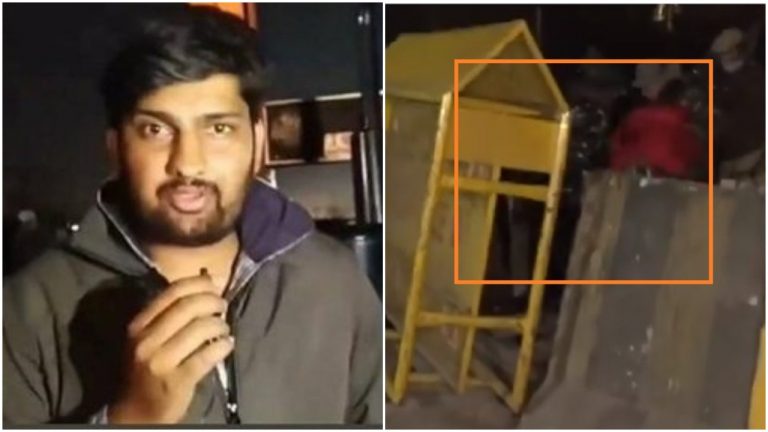
A Delhi Court on Tuesday granted bail to Freelance Journalist Mandeep Punia who works for The Caravan and Janpath. Delhi Police arrested Punia on January 30 when he was moving through roadblocks, tried to remove the barricades and misbehaved with the Police. A video of Punia had gone viral on social media platforms where he was seen trying to cross the barricades forcefully. He was soon nabbed by the Delhi police and detained.
The Court said that as the complainant, victims and witnesses are police personnel only, there is no possibility that the accused/applicant will be able to influence any of the police officials.
The Court further added, “It is well settled legal principle of law that “bail is a rule and jail is an exception”. Hence, considering the totality of facts and circumstances of the present case, submissions on behalf of both the parties as well as keeping in view the period of detention of the accused in judicial custody, he is admitted to bail on furnishing bail bond in a sum of Rs.25,000/- along with one sound surety in the like amount.”
The Court also imposed some conditions with the bail. The Court asked the accused to appear in Court regularly when required. Also, Punia is not allowed to leave the country without prior permission of the Court.
‘Journalists’ had raised slogans against Punia’s detention outside Delhi Police Headquarters
After Punia’s arrest, the ‘Journalists’ had protested at the Delhi Police headquarters on Sunday demanding the release of Mandeep Punia. Police had said that Punia was standing with the protesters, and he did not have a press ID card. He was trying to move through the barricades that were kept to secure the area. An altercation broke out between police personnel and him, after which he was arrested.
The protest outside Delhi Police Headquarters made it quite clear that for certain ‘journalists,’ misbehaving with the Police falls under the purview of ‘press freedom’ as well.
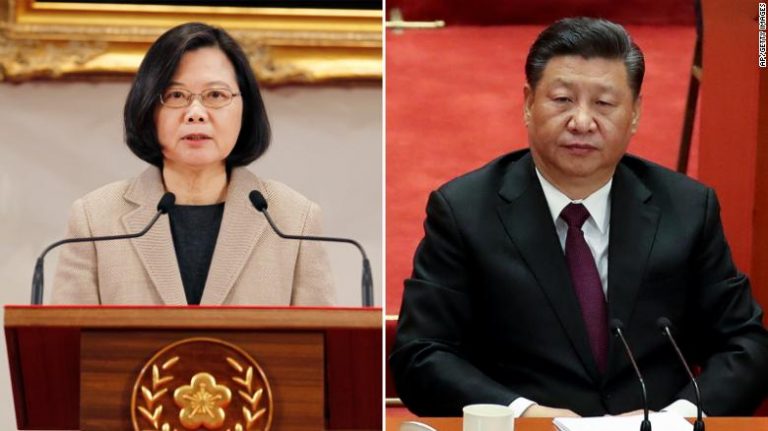
In an unprecedented event, Taiwan overtook China in terms of economic growth for the first time since 1990. As per reports, Taiwan recorded 2.98% growth in 2020 as compared to 2019.
The country’s growth was even higher than China’s annual growth rate of 2.3% in 2020. The last time Taiwan edged out the Communist-run country was 30 years ago when it clocked 5.5% growth as compared to China’s 3.9%. Taiwan also became the fastest growing economy in Asia in 2020, surpassing Vietnam’s 2.9% growth.
The historic feat was achieved amidst the global economic slowdown caused due to the Coronavirus pandemic. Taiwan’s economic success story can be attributed to the country’s tech exports, especially semiconductors, that helped tide over the financial crisis. Unlike other countries, Taiwan was successful in checking the spread of Coronavirus and avoided a strict lockdown. This factor also contributed to the growth of Taiwan’s economy.
Taiwan’s semiconductor exports boosted its economy growth
The global shortage and demand for semiconductors, used in mobile phones and computers, paved the way for imports from Taiwan. Automakers such as Ford Motor and Nissan Motor had to cut down their production due to the shortage of semiconductors. With people forced to stay indoors, coupled with a surge in electronic devices, countries had to look towards the superconductor power Taiwan.
According to economists at TS Lombard, Taiwan and South Korea have a ‘near-monopoly’ status in memory chip output and global processor chip production. The two Asian countries will use their tech exports as leverage over world powers such as the United States and China. “Taiwan and Korea are on the front line of the US-China confrontation, reliant on China for growth, but on the US as a guarantor of national security,” they argued.
Experts believe that Mainland China might become self-reliant in future in semiconductor production and emerge as the primary competitor to Taiwan. But with China still far behind in the semi-conductor race, it will continue to procure them from Taiwan amidst escalated tensions with the United States. It is important to mention that despite the global pandemic, TSMC (Taiwan Semiconductor Manufacturing Company Ltd.) grew by 60% in 2020 and rose by 11.5% in January as compared to last year.
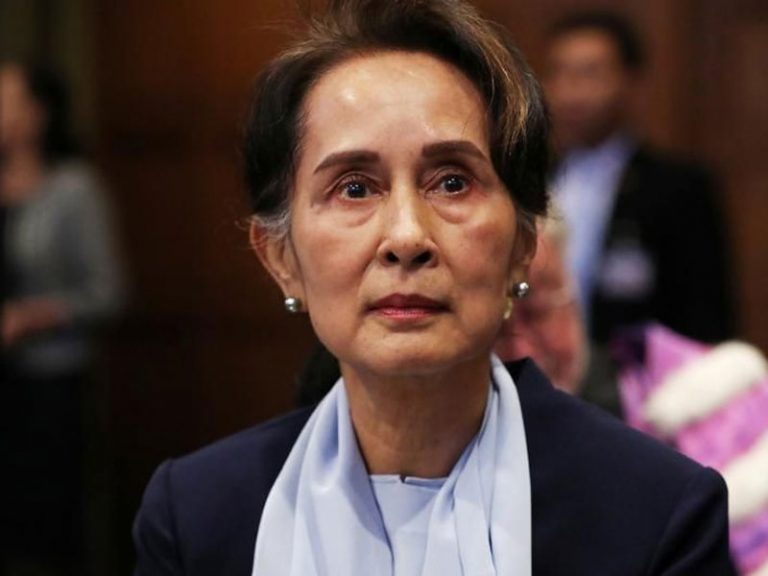
On February 2, the Norwegian Nobel Committee issued a statement condemning the military coup in Myanmar. The committee also condemned the detention of Nobel Peace Prize laureate Aung San Suu Kyi. While mentioning the work done by Aung San Suu Kyi for her struggle for democracy in Myanmar, the committee weighed in for the immediate release of Aung San Suu Kyi and other arrested politicians.
The statement was shared in the official website of the Nobel Peace Prize.
Statement by the Norwegian Nobel Committee
The Norwegian Nobel Committee is appalled by the military coup in Myanmar and the arrest of Nobel Peace Prize laureate Aung San Suu Kyi, President Win Myint and other political leaders. Aung San Suu Kyi was awarded the Nobel Peace Prize for 1991 in recognition of her brave struggle for democracy in Myanmar. She has continued to be a leading figure in developing democracy, both during the years when she was kept captive by the military and after her subsequent release. Now, 30 years after she was awarded the Peace Prize, the military has once again pushed democracy aside and arrested leading representatives of the legally elected government. The Norwegian Nobel Committee asks for the immediate release of Aung San Suu Kyi and other arrested politicians, and for the result of last year’s general election to be respected.
The military coup in Myanmar
On February 1, the Myanmar Army staged a coup and declared it had taken control of the country for one year under a state of emergency. They also detained Aung San Suu Kyi and other senior members of Myanmar’s ruling party amidst rising tensions over a recent election. As per reports, 75-year-old state counsellor of Myanmar Aung San Suu Kyi, President Win Myint and other members of the National League of Democracy were arrested at their residences in the capital Naypyidaw.
Reaction from the world leaders
The military coup has attracted sharp criticism from world leaders. Indian foreign ministry said, “India has always been steadfast in its support to the process of democratic transition in Myanmar. We believe that the rule of law and the democratic process must be upheld. We are monitoring the situation closely.”
The United States has warned of action against those who are responsible for the coup if it is not reversed. Similarly, Australia also expressed its concern saying that the military was “once again seeking to seize control” of the country and asked them to respect the rule of law.
Antonio Guterres, the UN secretary-general, has strongly condemned the military coup. Stéphane Dujarric, Spokesman for the Secretary-General said, “The Secretary-General strongly condemns the detention of State Counsellor Aung San Suu Kyi, President U Win Myint and other political leaders on the eve of the opening session of Myanmar’s new Parliament.” He further said that these developments represent a serious blow to democratic reforms in Myanmar.
It is notable here that in the past few years, certain left-liberal sections in many countries have been advocating for stripping Aung San Suu Kyi of her Nobel Prize over the Rohingya issues. However, the military coup and Suu Kyi’s detention has been widely condemned all over the world.
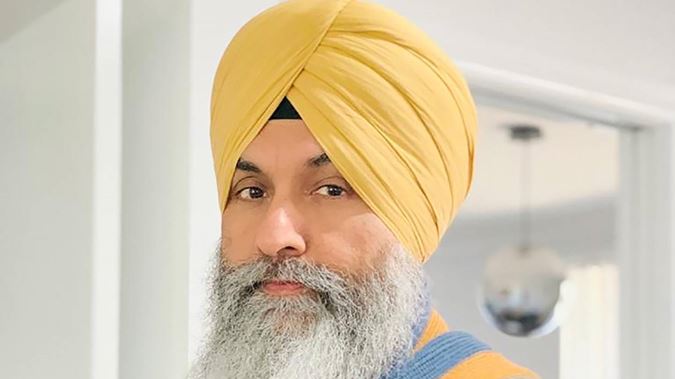
Harnek Singh, the New Zealand-based Indian-origin radio host, who was attacked by unknown assailants on December 23 night near his residence in Wattle Downs and had sustained critical injuries in the attack, is on his path to recovery. The attack against Harnek Singh came after he had supported the farm laws passed by the Modi government and criticised the so-called farmers protesting against it.
The 53-year-old Radio host recently spoke to NZ Herald narrating the ordeal he had to go through after the fateful night of December 23.
“The doctors told me that I’m on the mend so they can send me home. But when we talked to police they cautioned us by saying ‘be careful’. I asked them to define that. What should we do?” Singh told in his interview.
“Recovery wise it’s OK, I’m very happy. But psychologically, whenever you remember [the attack] …My family and relatives are very scared. My wife, she’s got courage. Living with me the last 20 years, she understands me, she knows what my commitments are. But I can see internally. Last night, nearly 1.5 hours she was telling me the story, revising the story of his attack,” Singh said.
Singh was found by a Radio Virsa colleague, slumped in his car’s seat on Glenross Drive, surrounded by a pool of blood and shards of glass. The severity of the attack can be gauged by the fact that dozens of injury scars and staple holes extend up to his arms, across his shoulders, neck and up to the top of his head.
Singh has suffered serious injuries from the attack. Besides, the threat of the assailants still looms over his head. When Singh was admitted to Middlemore Hospital for treatment, a guard stood sentry to his room in case assaulters once again try to attack him. Singh had endured grievous injuries on his torso and head. His head alone was put back together with 150 stitches. His right ear was almost hacked off.
Singh wears a cast on his hand and he will have to wait until it fully comes off to determine if he has any possible nerve damage in his hand. But Singh claims that he has passed all the memory tests given at the hospital and his mind is responding well.
Harnek Singh’s friends claim assault was religiously motivated
The friends of Harnek Singh claimed that the attack was religiously motivated. It is the second public attack Singh has suffered this year after he was assaulted in Love Punjab Restaurant on his birthday in July.
Singh’s colleagues at Radio Virsa, where he hosts a program dedicated to the Sikh community, said he was attacked as he was returning home this week from that day’s broadcast.
Balwinder Singh, who is a co-worker of Harnek Singh at Radio Virsa said that Harnek Singh’s show would obviously upset someone who is religiously fanatic, and someone who looks at the religion in a mythical point of view as a lot of religions do.
Harnek Singh had spoken against the farmers protesting against the new Farm Laws
Reportedly, Harnek Singh had recently spoken against the farmers protesting against the three laws passed by the Indian government. Singh was constantly speaking on his radio and YouTube channel against the farmers’ protest, which may also have triggered an attack against him. He had recently appealed to the protesting farmers to withdraw the politically-motivated protests in Delhi.
In the last few years, the authorities in NZ had heard eight complaints against Singh for comments he had made in Punjabi language to a caller about the Sikh sect Damdami Taksaal in response to recent violent incidents in India.
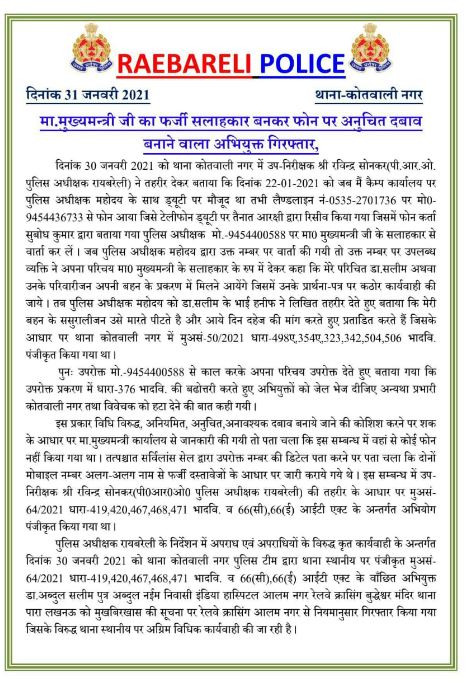
The Rae Bareli police on January 30 arrested a man named Abdul Saleem, a resident of Budheshwar, Alamnagar in Lucknow, Uttar Pradesh for posing as an adviser to Uttar Pradesh CM Yogi Adityanath, in order to pressurise the Uttar Pradesh police to act in a dowry case. The case was registered based on a complaint lodged by Sardar Kotwali SP Ravindra Sonkar.
Following the arrest, Abdul Saleem, who is the main accused in the case, reportedly confessed that he made the plan along with his brother Abdul Haneef as they wanted to implicate their sister’s husband and her in-laws in a dowry case. The accused said that the plan was masterminded by one of their associates named Sayeed Nasar Nafeez alias Sahil, who gave them the idea of impersonating as Yogi Adityanath’s adviser to mislead and pressurize the police to take action against their sister’s husband and in-laws.
Rae Bareli police took to Twitter on January 31, a day after the arrest was made, to share the details of the case. In a Press release, the Rae Bareli police informed that on January 22, when SP Ravindra Sonkar was in official duty he received a call from a mobile phone on the PS’s landline. The caller had claimed to be calling from the CM’s office.
Introducing himself as CM Yogi Adityanath’s adviser, the caller told SP Sonkar that one of his acquaintances Dr Salim and his relatives would be visiting the police station. He ordered Sonkar to look into their case on an urgent basis and take prompt and strict action based on their complaint.
After a while, the impersonators visited the Sadar Kotwali and met SP Ravindra Sonkar. They handed over a complaint to him written by Haneef. In the complaint, Haneef had accused his sister’s husband and her in-laws of harassing her for dowry. Based on the complaint an FIR was registered against Haneef’s sister’s husband and in-laws, under IPC sections 498A, 354A, 323, 342, 504, 506.
Later, once again Sonkar received a call from the same mobile number. He was then asked to include IPC section 376 (Punishment for rape) in the FIR.
Press release by Rae Bareli police
The way efforts were being made to constantly pressurise the police to take speedy and strict action in the case, created aspersions about the credibility of the caller, following which police dialled the CM’s office to find out details about this person who had been posing as the adviser of chief minister Yogi Adityanath. The caller’s mobile number was put under surveillance, which revealed that he was actually a fraud.
The Rae Bareli police then filed an FIR against the imposter under IPC sections 419, 420, 467, 468, 471 and also evoked 66(C) and 66(I) of the IT Act. They conducted raids and arrested the main accused from his residence in Alamnagar, Lucknow, Uttar Pradesh.
The Rae Bareli police have also recovered a mobile phone, two mobile SIMs, both belonging to different service providers, and Rs 25,000 in cash from the accused. Meanwhile, police have also announced a reward of Rs 25,000 for anyone providing information about the mastermind Sayeed Nasar Nafeez alias Sahil.
As the days pass, more videos of alleged farmers have emerged in which they are threatening violence if their demands are not met. In a now-viral video that was first released on January 4 on YouTube by Chadta Punjab TV, two ‘farmers’ can be seen singing a song in front of actor-turned-leader Deep Sidhu.
‘Bloodbath will follow’ – a song that threatened violence
A 5-minute video is making rounds on social media platforms sung by two ‘farmers’ in the presence of Deep Sidhu. The song’s lyrics suggest that the protestors will continue agitation even if they are termed as a rebel or terrorists. They further stated that if the government tries to get strict against them, a bloodbath will follow.
Notably, the song has been hailed by California based pro-Khalistan outfit California Sikh Youth Alliance. The same group was behind uprooting the Mahatma Gandhi statue in Davis, California. They had distributed sweets when the above two flags were hoisted on Red Fort on January 26.
‘Sukha and Jinda will rise again’
They further sang that if the government denies to take back the agriculture laws, the duo of Sukha and Jinda will rise again in Punjab. The majority of the Indians are unaware of the terror Punjab had to go through during the insurgency. During that time, apart from Jarnail Singh Bhindranwale, numerous Khalistani terrorists killed countless on the pretext of claiming a separate state Khalistan.
Two among those terrorists were Harjinder Singh Jinda and Sukhdev Singh Sukha, who were members of the Khalistan Comando Force. The duo was part of several high-profile assassinations, including Congress leader Lalit Maken (accused of Sikh genocide), General Arun Vaidya (who designed and supervised Operation Blue Star) and Congress leader Arjan Dass (accused of Sikh genocide). They were also involved in India’s largest bank robbery in 1987 for funding Khalistan, a Sikh state.
Harjinder Singh Jinda and Sukhdev Singh Sukha
Born to a farmer family, in Jandiala, Amritsar, Jinda joined the separatist Khalistan movement soon after Operation Blue Star. Sukhdev Singh Sukha, too, was born to Saini Sikh farmer family in Ganganagar, Rajasthan. They originally belonged to Hoshiarpur in Punjab. He, too, left his studies to join the Khalistan movement after Operation Blue Star. Both were members of Khalistan Commando Force.
On 31st July 1985, Congress leader and MLA Lalit Maken was walking towards his car parked near his house. He was gunned down by Jinda, Sukha and Ranjit Singh Gill alias Kukki. His wife Gitanjali and another visitor were also caught in the firing. While his wife survived the shooting, she succumbed to her injuries. Congress leader Ajay Maken is Lalit Maken’s nephew.
On 5th September 1985, Jinda and Sukha killed Congress leader Arjan Dass for his alleged involved in 1984 anti-Sikh riots that took place following the assassination of former Prime Minister Indira Gandhi by her Sikh bodyguards. Dass was named by various Sikh victims in their affidavits they had submitted to the Supreme Court appointed Nanavati Commission. He was a close aide of former Indira Gandhi’s son, Prime Minister Rajiv Gandhi.
On 10th August 1986, General Arun Vaidya, who had moved to Pune after his retirement, was shot to death by Jinda and Sukha when he was driving back home from market. The duo, who were riding a motorcycle, pulled up next to him and fired eight to nine shots at him. He is believed to have died instantly due to head and neck injuries. His wife, who was with him in the car, was also shot at and sustained injuries. Khalistan Commando Force took responsibility of the assassination and said he was killed to avenge Operation Blue Star.
On 13th February 1987, Jinda and Sukha along with other members of Khalistan Commando Force looted over Rs 5 crore from from Punjab National Bank, Ludhiana. About 12-15 Khalistani terrorists dressed as policemen and armed with submachine guns and rifles participated in the robbery. It is pegged as the biggest bank robbery in India’s history.
Also involved in this robbery was Mathra Singh, Jinda’s nephew. He was also uncle of Surjit Singh Penta, the Khalistani terrorist who consumed cyanide during Operation Black Thunder in 1988.
In march 1987, Jinda was arrested from New Delhi’s Majnu Ka Tilla. He was shot in his legs while the police tried to catch him. On 17th September 1987, Sukha was arrested after he was involved in a truck accident in Pune. He was riding same motorcycle that was used in assassination of General Vaidya. The duo admitted to their crime of assassinating Gen Vaidya but pleaded not-guilty. They justified killing him as he was ‘guilty of a serious crime, the punishment for which could only be death’.
The duo were sentenced to death on 21st October 1989 and hanged at Yerwada jail on 9th October 1992. When they were being taken to the gallows, they reportedly kept chanting pro-Khalistan slogans.
‘Enemies would have conquered India if Sikhs were not there’
They further claimed that India is safe only because Sikhs are on the border. If Sikhs move away from the border, India will cease to exist. They also said that they would not step back from sacrificing themselves as they are the Sikhs who saved and established India.
And while it is true that a lot of Sikhs protect our borders and their brave and exemplary courage has protected India from the enemies, when an individual dons the uniform, he is an Indian first, then anything else.
‘It is not easy to become Jarnail’
In the video, while remembering the Afghan-Sikh war, they alleged that because they defeated invaders, only warriors of their religion could become ‘Jarnail.’ The literal meaning of the word is commander-in-chief but the word in today’s context is often refers to the Khalistani terrorist Jarnail Singh Bhindranwale.
‘India did not give due respect to Bhagat Singh and other Sikh freedom fighters’
They alleged that Bhagat Singh, Kartar Singh Sarabha gave their lives for the country, but India did not pay due respect to the freedom fighters belonging to the Sikh community.
This is untrue. Indians, across political ideologies and religions have forever expressed their gratitude and hailed Bhagat Singh and other Sikh freedom fighters irrespective of their religion.
The current protests, however, have been infiltrated by Khalistani elements and have used this as an opportunity to pit the Sikhs against rest of India.