Home Blog Page 4702

Salman Khan’s brothers, nephew break Covid-19 protocol, FIR registered

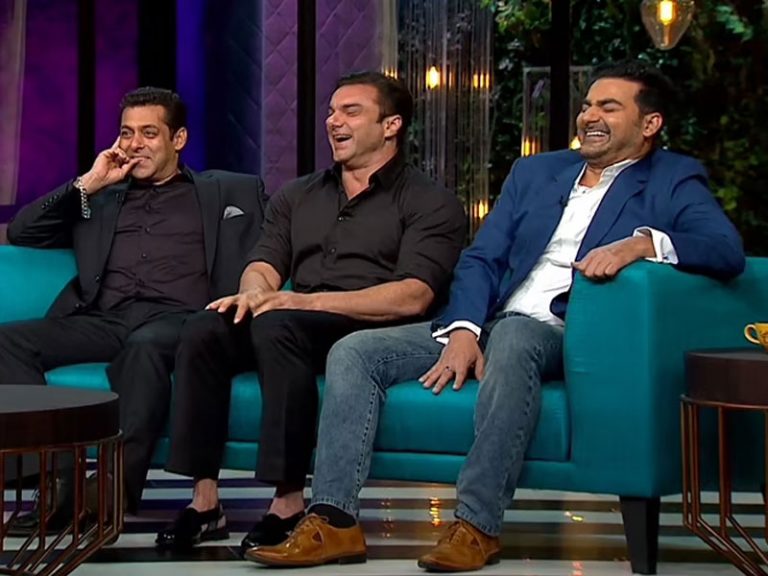
An FIR has been registered against Salman Khan’s brothers Arbaaz Khan, Sohail Khan and Sohail’s son Nirvaan Khan for breaking Covid-19 protocol. As per the reports, the trio had returned to Mumbai from Dubai on December 25. They were asked to stay in isolation at a hotel. However, they decided to skip the isolation and went home.

They had informed the officials that they had booked a suite for themselves at the Taj Lands End but decided to skip the isolation.

FIR registered under Epidemic Diseases Act

The FIR was registered based on the complaint by a Brihanmumbai Municipal Corporation (BMC) medical officer under Section 188 (disobedience to an order duly promulgated by a public servant), section 269 (a negligent act which is likely to spread infection of disease dangerous to life) of IPC and Section 3 of Epidemic Diseases Act.

In the complaint, MO said that the trio returned from Dubai on December 25 and was asked to remain in quarantine in a hotel. However, they went home. As per the health ministry regulations, the returnees from the UK, UAE and Europe are required to stay in 7-day institutional quarantine.

Trio shifted to Hotel Taj for institutionalized quarantine

TOI had reported that when BMC officials went to Sohail’s home, they were informed that as they tested negative for the Covid-19, they decided to go home instead of staying in quarantine. The officials have taken the matter seriously, and the trio has now been shifted to Hotel Taj End where they will remain in institutionalized quarantine at their own cost.

Chaitanya S DCP (Operations), Mumbai Police said, “An FIR has been filed at Khar police station. The BMC medical officer has complained that three people, who have returned from abroad, were supposed to undergo quarantine, but skipped the same and went home.” He further said that a case had been filed and an investigation is currently underway.

Abrogation of Article 370 shows impact as Jammu and Kashmir witnesses massive dip in stone pelting in 2020: Details

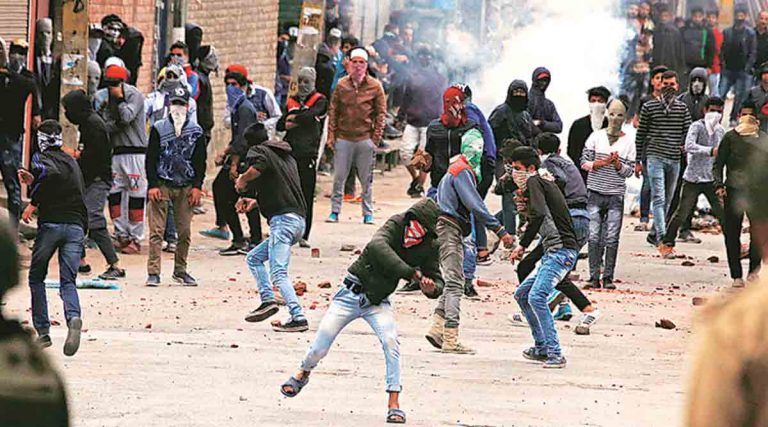
In a positive development, incidents of stone-pelting saw an 87.13% drop in 2020, as compared to 2019 in the Union territory of Jammu and Kashmir. The data, presented by Director General of Police (J & K) Dilbag Singh, shows the impact that the abrogation of Article 370, enforced in August 2019, had on the region in a span of just one year.

Singh said, “There have been 255 stone-pelting incidents in 2020 as compared to the incidents in 2019 and the year (2020), witnessed an 87.31 per cent decline.” He further emphasised, “Law and order situation is well under control. Our resolve for 2021 is strengthening and consolidating peace and normalcy in Jammu and Kashmir.”

A large proportion of these incidents were witnessed, following the Centre’s decision to do away with Article 370 and completely integrate Jammu and Kashmir in the Indian Union. In the historic legislation, the erstwhile State of Jammu and Kashmir was bifurcated into two Union territories of Ladakh and Jammu and Kashmir.

Tracking the stone-pelting incidents between 2016 and 2020

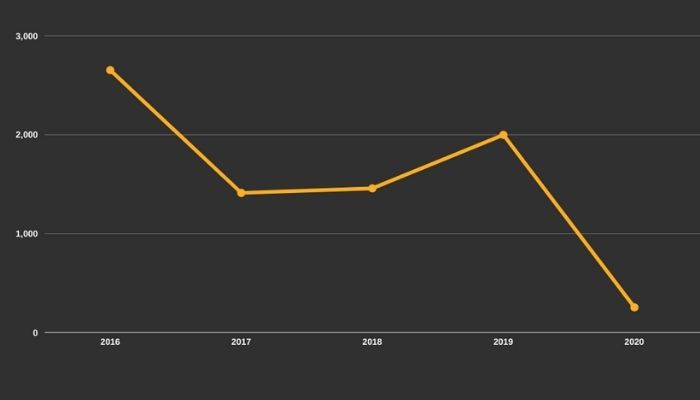
In 2015, about 730 incidents of stone-pelting were reported. Following the killing of Hizbul Mujahideen terrorist Burhan Wani in 2016, about 2,653 cases of stone-pelting were recorded, amidst widespread violence in his support. In 2017, the number plummeted down to 1,412 incidents and saw a marginal rise to 1,458 cases in 2018. As per reports, in 2019 alone, there were 1,999 incidents of stone-pelting.

While 2019 had seen a sharp increase in stone-pelting cases, following the abrogation of Article 370, a crackdown on terrorism in the Valley by the Central government had seen the cases fall to 250 in 2020. It is reported that the worst years, in terms of stone-pelting incidents, have been 2010, 2016 and 2019.

Visual representation of the fall in stone pelting cases between 2016-2020; (X axis – No. of years; Y-axis – Total incidents)

Stone pelting has been a commonplace event for the Pakistan-sponsored terror sympathisers in Jammu and Kashmir and the trend began since the 2008 Amarnath-land row agitation. While speaking to Economic Times, an Indian commander said that stone pelting is used as a tool to agitate security forces, since they are aware that the police or army personnel cannot use guns against them.

Abrogation of Article 370

In the manifesto, BJP had promised to repeal Article 370 from the state of Jammu and Kashmir that gave it special status. On 5th August, the BJP-led Union government fulfilled the promise. The state was divided into two Union Territories, Ladakh, and Jammu & Kashmir, under Jammu and Kashmir Reorganisation Act. The decision came into effect from 31sr October 2019.

Congress leader Kirti Azad slammed on social media after distasteful comment on Sourav Ganguly following the latter’s heart attack

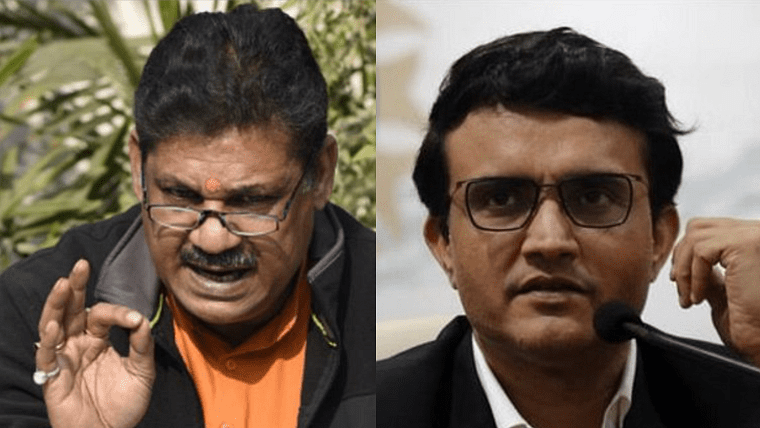
Congress leader and former cricket Kirti Azad is facing great criticism on social media for his disgusting tweet at Sourav Ganguly after the BCCI President suffered a heart attack recently. Kirti Azad shared images of Sourav Ganguly endorsing Fortune oil and took a jibe saying that the cricketer should only “promote tried and tested products”.

Kirti Azad makes a disgusting comment on Sourav Ganguly

The inappropriate remarks made by Kirti Azad hasn’t gone down well with people on social media who slammed the former cricketer for his distasteful remarks. Azad had been an elected representative of the Lok Sabha from a BJP ticket before he was suspended from the party for his comments against deceased BJP stalwart Arun Jaitley.

People also took a dig at his Congress links. He had joined the Congress party after being suspended from the BJP.

Sourav Ganguly was rushed to the Woodlands hospital in Kolkata after he suffered a mild cardiac arrest on Saturday morning while working out in the gym at his residence. Sports Journalist Boria Majumdar had confirmed that Ganguly would be discharged on Saturday itself after getting an angioplasty done. His condition is believed to be stable now.

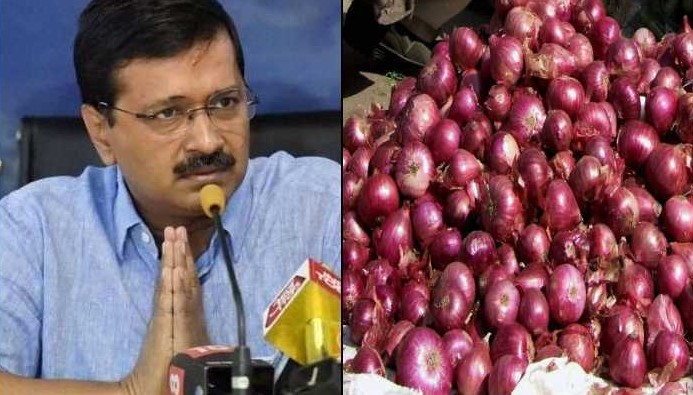
In a blow to Kejriwal’s fearmongering, onion prices drop by 60% across the country: Details

0

A lot of misinformation has been spread over the recently passed farm laws. A lot of hue and cry was raised regarding the rising price of onions as well. And both of these intersected in the recent claims made by Delhi Chief Minister Arvind Kejriwal in the month of December.

Kejriwal claimed that as a consequence of the newly passed farm laws, it would be legal to hoard agricultural products. As an example of the ill effects of hoarding, he cited the rise in the prices of onions.

However, there has been a 60% drop in the all-India average price of onions since 2019, Consumer Affairs Secretary Leena Nandan informed late December 2020. “In one month alone, the all-India average retail price of onion has dropped by 33.33 per cent to Rs 40 per kg today from Rs 60 per kg on November 30 this year,” she told PTI.

Nandan attributed the drop in onion prices to timely government measures undertaken to check the rise in prices. “Lot of facilitation was done at Attari-Wagah border (Punjab) and at seaports for quick evacuation of imported onions. Good quantities of imported onions arrived,” she said.

Nandan stated, “Around Rs 70,000-75,000 tonnes of onions were imported through private trades in 2020. Nafed also imported around 3,000 tonnes of onions.” Such interventions have contributed to the drop in onion prices.

In October 2020, the government highlighted the steps taken to moderate onion prices and the reasons for price rise in a press notification. It said, “In order to moderate the price rise,the government took a pre-emptive step by announcing a ban on onion export on 14.09.2020 so as to ensure availability to domestic consumers at reasonable rates, before the expected arrival of Kharif onion.”

The statement said further, “Thus the retail price rise was moderated to some extent, but recent reports of heavy rainfall in the onion growing districts of Maharashtra, Karnataka,Andhra Pradesh and Madhya Pradesh have created concerns about damage to Kharif crop. These developments on the weather front have contributed to the sharp increase in onion prices.”

The Government had further announced that onions were being released from the buffer stock and were being imported as well to moderate the prices. Traders were already being contacted to increase imports. All such measures have contributed towards reducing the prices of crops across the country.

Nandan also informed that the government has decided to increase the buffer stock of onions from 1 lakh tonnes to 1.5 lakh tonnes for the year 2021 Rabi season.

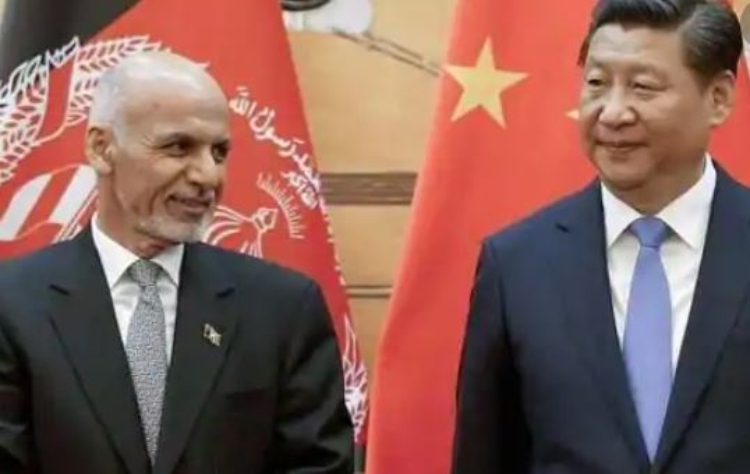
After asking China to apologise, Afghanistan quietly sends the 10 arrested Chinese spies back home in a chartered flight

Days after Afghanistan’s NDA detained 10 Chinese spies on charges of espionage and operating a terror cell in the capital city of Kabul, the government has released them secretly and allowed them to fly back home in a chartered flight. According to reports, the Chinese nationals flew out of Afghanistan in a plane arranged by Beijing on Saturday. Set free after 23 days in detention, the 10 Chinese nationals had not been formally charged.

Afghanistan asks China to ‘apologise or face criminal proceedings’

It is pertinent to note that the terms of the arrangement between Kabul and Beijing to secure the release of the 10 Chinese spies remains unclear. Interestingly, soon after the arrest, Kabul’s First Vice President had indicated that the Afghan government could consider a pardon for the Chinese spies if Beijing submits a formal apology that admits to the violation of international norms and a betrayal of Kabul’s trust. Otherwise, the Afghan government would go ahead with criminal proceedings against the 10 Chinese spies, he had said.

It was on December 10, 2020, that Afghanistan’s NDS started the crackdown. This was the first time in years that Chinese nationals had been caught spying in Afghanistan. The NDS had not only recovered explosives and other highly objectionable materials from these Chinese nationals but had also found proves which suggested that the kingpins of this espionage network had been meeting commanders of the Taliban-backed terror group Haqqani Network (HQN).

It was believed that Pakistan’s ISI has been acting as a mediator between Haqqani Network and these Chinese Intelligence agents. 

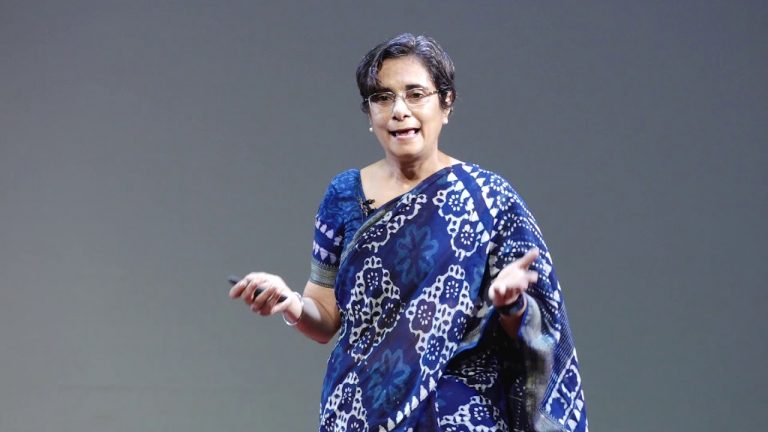
Dr Gagandeep Kang who cast aspersions on indigenously made COVID-19 vaccines is an anti-Modi Dhruv Rathee fan: Details

Ever since the central government approved the two COVID-19 vaccines for emergency use, a host of detractors, motivated by their political agenda against the Centre, have opposed the move and sought to sow apprehensions among people regarding the safety of the vaccines. One such expert who has raised aspersions on the vaccines approved by the Indian government to combat the menace of coronavirus is Dr Gagandeep Kang.

Several opposition politicians and even those who claimed themselves to be experts have called the move as “premature” and raised questions of the Drug Controller of India for approving Bharat Biotech’s Covaxin, claiming that the indigenously developed vaccine was yet to complete the final stage of human clinical trials.

Dr Gagandeep Kang denigrates the indigenously developed COVID-19 vaccines, fuels apprehensions about their safety

In her interview with the Times of India, Kang, who is the vice-chair of the board of Coalition for Epidemic Preparedness Innovations (CEPI), a global partnership seeking to proactively develop vaccines for epidemics, and professor at the Christian Medical College (CMC), Vellore, cited the complicated language that she could not comprehend as the reason for her apprehensions about the two coronavirus vaccines.

Dr Kang asserted that the vaccine is already on trial and therefore she is confused as to how it could be approved by the drugs controller. “I have no clue. I have never seen anything like this before,” Dr Kang said.

Dr Gagandeep Kang also contended that the unavailability of data basis on which the approvals were made has also played a role in engendering distrust regarding the vaccines. The CMC professor also alleged that ICMR should publish its own journal on COVID-19 vaccines just like it has done for hydroxychloroquine.

Speaking against Bharat Biotech’s Covaxin, Dr Kang lamented that the organisation has only released partial data. She said there is absolutely no efficacy data that has been presented or published.

Not just Covaxin but Serum Institute-developed Covishield also came under the criticism of Dr Kang, who expressed skepticism over the phase-3 trials conducted by the organisation.

“Even though it is labelled a phase2/3 study, it is not a phase2/3 in the form recognised in any other part of the world where phase-3 implied clinical efficacy. If you read the CTRI description of what is labelled a phase 2/3 study by Serum Institute, you realise that it actually is what would be called a phase-2 study in other parts of the world, i.e. for safety and immunogenicity and not for efficacy,” Dr Kang said.

Dr Kang further disparaged the two vaccines, stating that it is wrong to call them ‘indigenously developed’ since the adjuvant of the vaccine came from the US. “Yes, the strain is an Indian strain but a key component of the vaccine is the adjuvant and that’s not Indian,” Dr Kang said.

Dr Gagandeep Kang one amongst the 150 scientists who had urged voters to vote against PM Modi in 2019 LS

While Dr Gagandeep Kang belittled the COVID-19 vaccines developed in India and fuelled doubts regarding the efficacy of the vaccines, it is pertinent to note that Dr Kang was one among the 150 ‘scientists‘ who had signed a letter subtly appealing the voters to vote against the Modi government during the 2019 Lok Sabha elections.

Could it be that her current opposition to the two coronavirus vaccines approved by the Indian regulatory body stems from her anti-Modi stance?

For Dr Kang, fake news peddler Dhruv Rathee is an authoritative source of information

Besides, it is also worth noting that Dr Kang, who has been raising questions over the authenticity of the data released by Bharat Biotech and Serum Institute regarding the two coronavirus vaccines, has been an admirer of propagandist Dhruv Rathee.

For Dr Kang, video blogger Dhruv Rathee, who has been caught myriad times for spreading fake and unverified news, is an authoritative source of information. In one of the tweets shared by Dr Kang, the CMC professor was seen lauding Dhruv Rathee for putting together key messaging to make information accessible.

Incidentally, Dhruv Rathee is also known for his anti-Modi stance and has been exposed numerous times for purveying propaganda and fake news meant to defame the central government. It is, therefore, a bit rich coming from Dr Kang to question datasets released by India’s COVID-19 vaccine candidates when one of her sources of information is fake news peddler Dhruv Rathee.

Drugs Controller General of India rubbishes rumours of vaccines being unsafe

As India gears up for the world’s largest vaccination programme, the Drugs Controller General of India(DCGI) had rubbished the rumours of the vaccines being unsafe for the general public. Denouncing the speculations as “complete nonsense”, the DCGI said, “We will never approve anything if there is even slightest safety concern. Vaccines are 110 per cent safe. Some side effects such as mild fever, pain and allergy are common for every vaccine. The rumours of vaccines being unsafe are complete nonsense,” DCGI said.

However, despite assurances from the Drugs Controller General of India, assorted individuals, including politicians, scientists, experts and others, united by their loathing for PM Modi, have continued to sow apprehensions regarding the efficacy of the vaccines and create distrust among the public against the Centre. The pathological hatred for the Modi government has caused these individuals to take leave of their good senses, preventing the vulnerable people from being vaccinated against the Wuhan coronavirus that has so far affected more than 85 million people across the world and caused upwards of 1.84 million fatalities.

How and why I went from ‘Beef eating is a culinary preference’ to ‘those who eat beef are not my people’

Most people who grew up in a traditional Hindu family are well aware of the significance of the cow and the taboo against eating beef. The cow is worshipped and revered and there are quite a few rituals where the cow is required. In a large part of the Hindu society, the taboo against eating beef is such that consuming the meat of a cow could lead to being disowned if people in the family became aware of it. All of this is known and is not challenged by anybody.

Most of us who were raised in ordinary traditional Hindu families grew up with the knowledge that beef is the one thing that we were strictly not allowed to consume, under any circumstances. Being from a vegetarian family, the subject of meat-eating itself was seldom discussed, however, for several families I knew, even eating meat in certain restaurants and hotels was avoided because one could never be cent per cent sure what meat was served. And the reasons cited for the taboo were entirely religious.

We worship the cow, we do not eat it. It is one of the dogmas that was never challenged, at least, not in my immediate circle growing up. Even growing up in friend circles which were predominantly Hindu, the idea of eating beef somewhere was never voiced. It is something that just never came up. The taboo against beef is so internalized that it became one of the dogmas that are practically unchallenged. Reverence for the cow is part of our identity. It is a part of who we are as a collective.

Now the world has changed a lot in the past few decades. Teenagers often travel outside their hometowns for their education and young adults move out because of jobs or education and numerous other reasons. Among a cosmopolitan crowd with liberal values, it is easy to lose touch with our roots and sight of our identity. Even then, the farthest the overwhelming majority of us travel is the opinion that consuming beef is a culinary choice.

Some might choose to eat it but we, personally, will not because it goes against the values that have been inculcated within us. The notion that consuming beef is merely a culinary preference is almost always due to our exposure to a cosmopolitan crowd. It never has anything to do with conclusions we have reached after careful consideration following a reading of our scriptures.

Just as the taboo against consuming beef is a consequence of upbringing and not scripture reading, similarly, the notion that consuming beef is merely a culinary preference is a consequence of exposure to cosmopolitan influence. The scriptural justification that is often made after that conclusion has already been reached.

In fact, my journey was similar. When I was 4, we moved to a new house and the most predominant image in my memory from that time is how we worshipped a cow before we stepped foot in the house. I remember gau-mata dressed up with bells and ornamented cloth. Us putting kumkum on her forehead, and hoping, that her blessing illuminates our new house. Growing up, I remember my grandfather taking me to the nearby gaushala to feed gau-mata on my birthday. On festivals, I remember the first few rotis being made as a prasad to gau-mata.

Well into college, even the discussion of beef consumption was not really something that was discussed, as it is today.

The first time I was confronted with my ideological position on beef was when I was in Pune, Maharashtra and a bunch of us friends decided to go to Hard Rock Cafe which had only recently opened up in the city. Several dishes had beef in them, and when I looked at the menu, I got uncomfortable. While I wondered whether I should even eat there or perhaps just stick to my coke, a friend proceeded to order a beef burger.

I didn’t really say anything. I simply excused myself, told her I had to leave for an assignment and met up with other friends for lunch. We ate Misal Pav.

The person who ordered the beef burger was a friend and continued to be so for a long time. At that time, beef-eating was her culinary preference which I did not agree with, and for me, she had a right to that choice and I had simply no right to lecture her or tell her that it was not acceptable as a Hindu (she was one too).

But somewhere along the line, my opinions changed. It went from ‘it is her culinary preference’ to ‘beef is ok, but cow-meat is not’ to ‘Hindus should not eat beef, period’.

It is under these circumstances that we approach the recent discussion around beef.

The Beef Controversy

There is a lot of discussion underway regarding the permissibility of the consumption of beef in the Hindu religion. On one side, there are people who say those who eat beef cannot be Hindu while there are others who maintain beef is a culinary preference. I, personally, lean towards the former.

I am, obviously, no Dharmaguru to make that assertion, so, of course, I am speaking in my personal capacity.

One of the claims that is made to justify eating beef is that Hinduism is a diverse religion and there is nothing wrong if some people eat beef. But this is a bizarre conclusion to reach. There is the diversity of beliefs, yes, but one thing that a large part of the Hindu society believes in is that cow is an animal to revere and beef should not be consumed.

It is for these reasons that it is perplexing to me that such a notion is even floated. I think this is where the lack of a central authority in Hinduism is most acutely felt unlike Christianity where there is the Church and in Islam where the book serves as the central authority and leaves very little room for interpretation.

The argument often furthered is that there are indeed certain scriptures that allow beef-eating while others condemn it. As I have said earlier, I am no Dharmaguru and hence, the scriptural interpretation is not something I will not get into. Why certain sects evolved and started eating beef, was there a Mughal influence, and which scriptural context should be followed by all Hindus is something I am neither equipped to comment on, nor it is my place.

However, I can say with certainty that in most average Hindu households, beef eating is not permissible for deeply religious reasons. For that reason, I mostly find the intellectual discourse around beef-eating rather vacuous and almost tone-deaf to what goes on in most Hindu households. The fact that we may know someone who eats beef cannot be considered the standard by which we take ideological positions on issues.

If someone knows a murderer, are we to justify murder on that premise? If someone knows a person who likes to kill exotic animals for sport, are we to start justifying the act altogether?

The argument that “I know someone who eats beef and are still Dharmic” is a vacuous attempt to justify personal habits and extrapolate that to taking an ideological position. To me personally, it appears to be disingenuous and I try to keep away from such pursuits. Just because we know someone who is doing something that might be against the basic tenets of Hinduism, doesn’t mean that the dogma has to be done away with. To suggest that it must, signifies arrogance, and not to mention, stupidity.

The other argument that is often furthered is that several Hindu communities do consume beef and hence, not consuming beef cannot be a litmus test of being Hindu. Frankly, Hindus have liberalised their religion so much that nothing really is considered to be a litmus test for being a Hindu, however, I have a problem with legitimising beef-eating using this argument.

One of the states that is often cited is Kerala. “Kerala Hindus eat beef. Are they then not Hindus?”

My argument here is rather simple – it is entirely possible that the sect evolved into eating beef for reasons other than them considering it acceptable from the time of their ancestors.

For this, I would redirect you to an article written by user @dauhshanti. He beautifully traced the Hindu history of Kerala and proved how beef-eating was never a core part of that sect to begin with.

He writes, “In the old days, warriors of Kerala who were mostly from the Nair community, once trained in Kalaris, the schools of martial arts, took an oath to protect Brahmins and cows, as part of service to the king. This is recorded by Duarte Barbosa, a 16th-century Portuguese writer”.

“The King then asks him if he will maintain the customs and rules of the other Nayres (Nairs), and he and his kinsmen respond ‘ Yes.’ Then the King commands him to gird on his right side a sword with a red sheath, and when it is girt on he causes him to approach near to himself and la, his right hand on his head, saying therewith certain words which none may hear, seemingly a prayer, and then embraces him saying ‘ Paje Gubrantarca, that is to say ‘ Protect cows and Bramenes (Brahmins)” 

A similar oath was made by the most powerful Nair kings of Kerala, the Samuthiris or Zamorins of Calicut before their royal coronation

 “At Yagneswaram he is met by Vemaneheri Namputiri, a descendant of Melattur Agnihotri. The Eralped (Zamorin) gives him an ola (text), promising to protect Brahmins, temples and cows.” 

(The Zamorins of Calicut by K.V. Krishna Ayyar)

16-17th-century French traveller Pyrard de Laval also writes about reverence to cows given by people of Kerala.

” I must not forget to mention, in passing, and as the opportunity arises, the great honour rendered by these people to cows, however low-bred, filthy, and all covered with dirt and dung they may be. They are allowed to enter the king’s palace, and whithersoever their way leads, without anyone disputing their passage; even the king himself, and all the greatest lords, give place to them with the utmost respect and reverence, and the same with bulls and oxen.” 

(The Voyage of Francois Pyrard of Laval, Volume 1)

These excerpts presented by him clearly point towards the fact that beef-eating was something that was introduced later. This could very well be true for several other sects that consume beef today.

Therefore, using this argument to say that beef-eating should be considered acceptable, is to say that the disintegrated version of Dharma must be acceptable to us. I don’t believe in that. Not in today’s day and age when Dharma seems to be slipping right in front of our eyes.

While those who take the position that consuming beef is unacceptable and should be considered a taboo (and a non-negotiable) are considered ‘orthodox’, those who say that it is a culinary preference theorise that the former is trying to mirror Islamists and are attempting to ex-communicate people from the Hindu fold for eating beef.

That argument is equally vacuous, if I can be honest here.

The Hindu society has lost its organisational structure. There is absolutely no way that anyone can be ex-communicated from the Hindu society, least of all, on the say-so of someone like me. There is no metric to judge whether someone is a Hindu or not. Whether that is a good thing or bad, again depends on how ideologically rooted one is. Therefore, to deride those who wish to stick to the fact that beef-eating is a non-negotiable, or at least, should be a non-negotiable in the Hindu society, with this argument, is a strawman at best. Nobody can or should give certificates of Hinduism and nobody is a representative of the entire Hindu society. However, talking about personal non-negotiables is essential because it is out of those personal opinions that a societal opinion is crafted.

Why the Taboo against beef eating needs to be strengthened

Hinduism is a living, breathing religion. It changes with the times and for the times (again, whether that is good or bad depends on where you stand ideologically). In the current times, it is my personal belief that beef-eating has to be stigmatised as it has now become not only a matter of personal faith but a matter of cultural and religious resistance.

Beef, in today’s world, has become the single most subject that is invoked to mock Hindus and show them “their place”. Remind them, that they are nothing in a religionless country where minorities are mollycoddled and the majority faith is desecrated to uphold mythical values of secularism. Beef parties are specifically held to mock Hindus, cows are deliberately slaughtered on the road, Hindus are called cow-piss drinkers by Leftists and Islamists and beef, has become their rallying point against the Hindu faith.

One can even draw a parallel with the Ram Janmabhoomi movement. There is a reason why the movement resonated even with those who did not believe in Lord Ram or were his traditional bhaktas. It was a symbol of Hindu resistance and assertion that our faith will not be taken hostage by a secular state that is hell-bent on giving ancient tyrants far more respect than the people of the land.

For me, personally, it is this deliberate desecration of my faith that hand-held me from believing that ‘beef-eating is a culinary preference’ to ‘those who consume beef cannot be considered Hindus’. Does that mean I have the authority to excommunicate someone from the faith? No. Does that mean that it is a strict non-negotiable for me? Absolutely. Do I mean that the Hindu society itself should stigmatise the consumption of beef in their own circles? Yes.

The cow, traditionally, has been a symbol of Hindu resistance against foreign invasions and imperialism. For centuries, the greatest heroes of our civilization have been motivated to achieve great feats by virtue of their devotion towards the cow. There is the story of the great Chhatrapati Shivaji Maharaj who was so enraged by the slaughter of a cow that he attacked Adil Shahi soldiers as a young boy.

The ban on cow slaughter was strictly enforced during the rule of the Maratha Empire. The devotion towards the cow and the ban on cow slaughter was not only enforced by the Maratha Empire but other great Hindu kingdoms and Empires as well. The cow has always been the symbol of Hindu resistance towards imperialism.

It is for this reason that the efforts to normalize beef-eating feels like an assault on Hinduism itself. It is no secret that the Hindu Civilization today is under attack from various nefarious fronts that seek to destroy it. Every day, the news of idols being desecrated and Temples being attacked makes it way to the news. There is a Jihad against the Hindu Civilization in Kashmir and Maoists and Communists and Evangelical Christians seek to destroy our civilization as well.

And now, a symbol of our cultural resistance is being reduced to a mere culinary preference. The objective here clearly is to turn Hindus against the ethos of our civilization itself and make our way of life a soft target in the process. Whether beef can be consumed by a Hindu or not is a debate that has been settled long ago and only strengthened by the events that followed foreign invasions. That a debate has been initiated regarding the matter is a further indication of the attacks against our civilization.

Historically, Hindus have been force-fed beef in order to forcefully convert them to Islam. That tactic is used even today. In 2019, a Hindu woman was force-fed beef to convert her to Islam. In 2020 a similar case came to light as well. Cows have been slaughtered to insult the Hindu people. And now we are told that beef eating is merely a culinary preference. It is important to note here that in my view, any Hindu who sees how beef-eating is used to undermine the very sanctity of our faith and our very existence, could give up beef since it is a ‘preference’ for them and not a staple diet.

For me, the normalisation of beef-eating today is little more than a disguised attempt to undermine our resolve to defend our way of life. To counter such trends, it is imperative that the taboo against beef-eating is strengthened manifold. And only society, together, can find a solution.


Fact check: Will coronavirus vaccine shot be delivered on the penis?

With Covid vaccine now being available in few countries and India preparing to roll out the immunization program in the next few weeks, the bizarreness of conspiracy theories and misinformation is pacing up. In a recent claim, a meme is being shared as a ‘scientific discovery’ that “for male patients, the penis offers the fastest release of the vaccine throughout the body.” It is also claimed that the findings are based on the findings of the University of California based on a study involving 1,500 men who received the vaccine.

Dissecting the bizarre claim “Doctors encourage Covid-19 vaccine injection in penis”

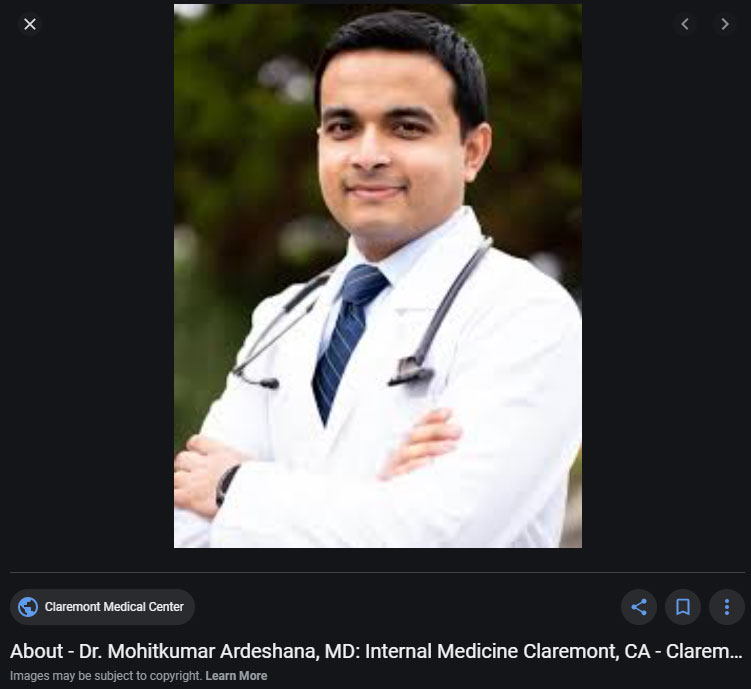
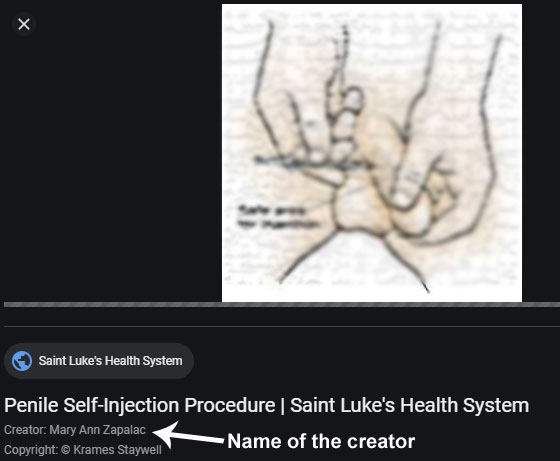
A netizen @RoflIndian provided the counter for the claim. He said that the photograph of the doctor in the meme is of Dr Mohitkumar Ardesana, MD, a primary care physician of Claremont Medical Centre, California. The picture on the right is a medical sketch of penile self-injection by illustrator Mary Ann Zapalac.

Cross verification of the images and the text by OpIndia

We decided to cross-check the information provided by RoflIndian, and this is what we found. When we searched the name “Mohitkumar Ardesana” we reached to the LinkedIn profile of Dr. Mohit. His profile suggests that he is currently working at Primary care Physician at Claremont Medical Center in Brooklyn, New York.

LinkedIn profile of Dr. Mohit

We also found his image used in the meme. The same image is used in the Claremont Medical Center’s (owned by Dr. Mohit) Instagram profile like the profile image.

Reverse image search revealed that the image is indeed of Dr. Mohit.
Same photograph was used on Hospital’s Instagram profile

Now coming to the second image that has shocked many people. When we reverse searched the image, it provided more information about the image. It was created by a well-known illustrator Mary Ann Zapalac who has worked on several medical projects in the last 27 years. Zapalac did her masters in medical illustration from the University of Texas Southwestern Medical Center at Dallas and running her business as a medical illustrator since 1993.

LinkedIn profile of Mary Ann Zapalac

The image talks about Penile Injection Therapy that is an effective way to treat erectile dysfunction. These injections are generally self-administered at home and help in improving blood flow resulting in firmer erections. The image has no relation to Covid-19 or any other vaccine whatsoever.

Reverse image search showed her name as creator

The claim that the University of California did any study by injecting Covid-19 vaccine in the penis of 1,500 men was not valid either. The University did no such research. The claim made in the viral image is FAKE.

Reliance Industries and Adani Group issue clarification amidst misinformation and false claims over farm laws

Amidst ongoing farmers’ protests, the corporate houses and small-scale industries are facing significant problems. Confederation of All India Traders (CAIT) has recently said that the protests are disturbing the economic activities in Delhi and its neighbouring states of Uttar Pradesh, Haryana, Punjab and Rajasthan resulting in a loss of Rs 27,000 crore. On the other hand, corporate houses like Reliance Industries and Adani Group have to clarify their stand on MSP and role in the Agriculture sector.

A number of Congress leaders and so-called farmer protestors have been using the names of ‘Ambani-Adani’ to spread the rumours that the central government has brought the new farm laws to benefit the large corporates. Despite the fact that the farmer organisations and political parties had themselves been demanding the same aspects covered in the new laws, there has been a constant effort by Congress and other opposition leaders and certain vested interests to defame certain corporates and malign the government.

The statement issued by Adani Group

In the statement, Adani Group said that there are factual inaccuracies in the statements given by several sections against them. In 2000, the Government of India under the National Policy on Bulk Handling, Storage and Transportation announced the project to build Silo Grain Storage infrastructure. In 2003, global tenders were invited, and the project was awarded to Adani Group in 2005. The project was commissioned in 2007 for a concession period of 20 years. It has to be noted that at that UPA was in power at the centre. The company had invested Rs.700 crore in the project.

Adani Group said it is important to understand that the project has successfully served from the last 13 years. “But some motivated elements with an agenda to hold back India’s development are misrepresenting facts stating that the Adani Group was gifted funds from the ruling government to set up this project.”

It further added that the company had increased its reach in Punjab, Haryana, Tamil Nadu, Maharashtra, Karnataka, West Bengal, Uttar Pradesh and Bihar by winning tenders released by Food Corporation of India on a competitive bidding basis. Ten more companies are working with FCI in the field, and all projects come under the guidelines of the Ministry.

It added, “Most essentially facts are being misrepresented citing the strategic growth of our Ports 8- Logistics portfolio. For the record, Adani Agri Logistics Ltd. (AALL) was established in 2005 much earlier than the ruling government came into power. The Adani Group’s legacy stands testament to working towards national goals with multiple governments over the past 3 decades.”

Adani Ports and Special Economic Zone Ltd from Adani Enterprises Limited, the flagship company of the Adani Group acquired AALL in 2018-19. It was a part of APSEZ’s vision to become Ports to an end-to-end Logistics company in India. “We appeal to the people of this nation to see through this motivated campaign to defame the Adani Group and challenge India’s growth vision for political gains,” it added.

Statement by Reliance Industries

Reliance is facing major heat especially in Punjab where miscreants have damaged over 1500 JIO towers claiming Reliance Industries, the parent company of Jio, is responsible for bringing Agriculture Laws and the corporate will take away the lands of the farmers.

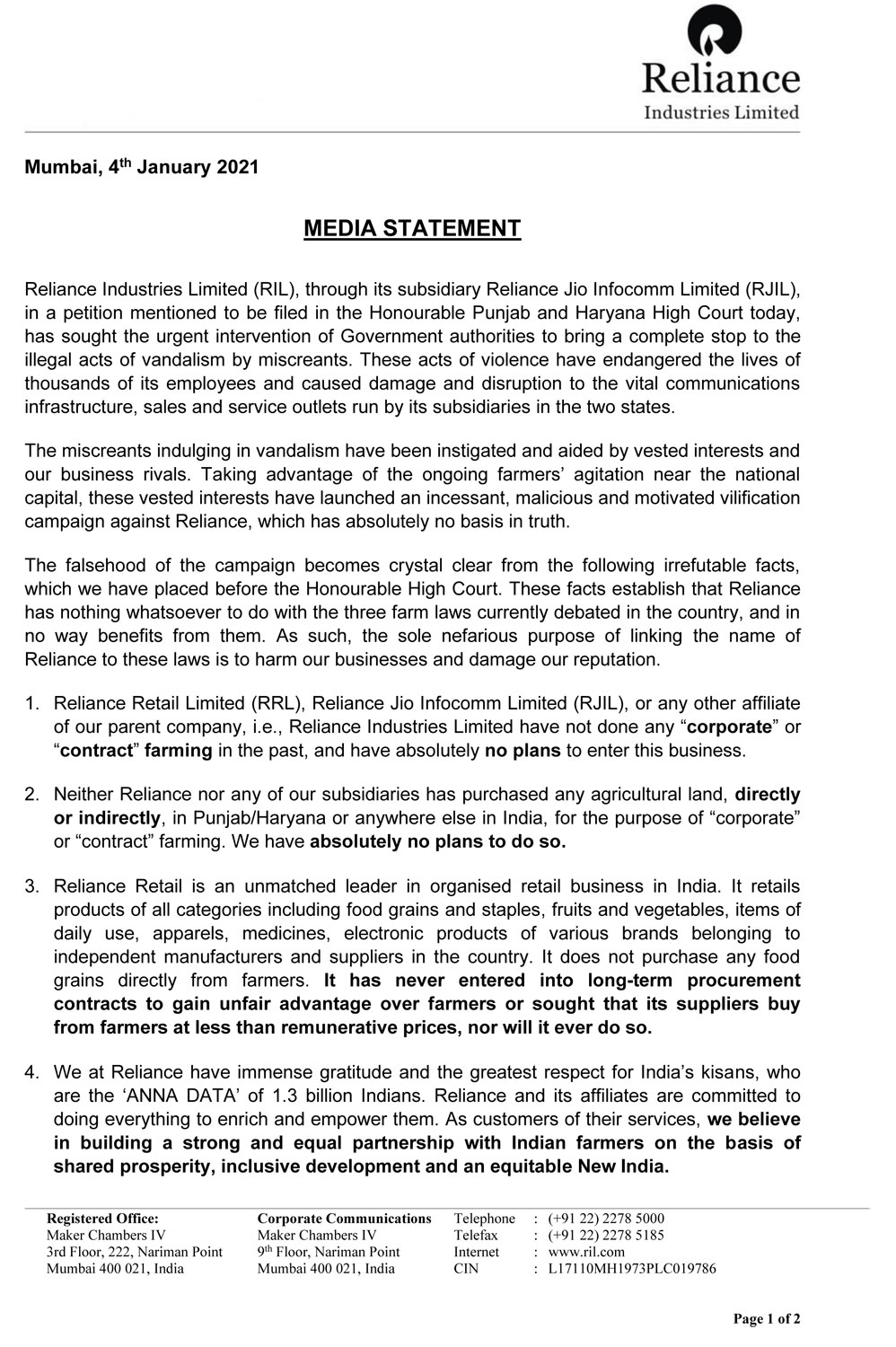
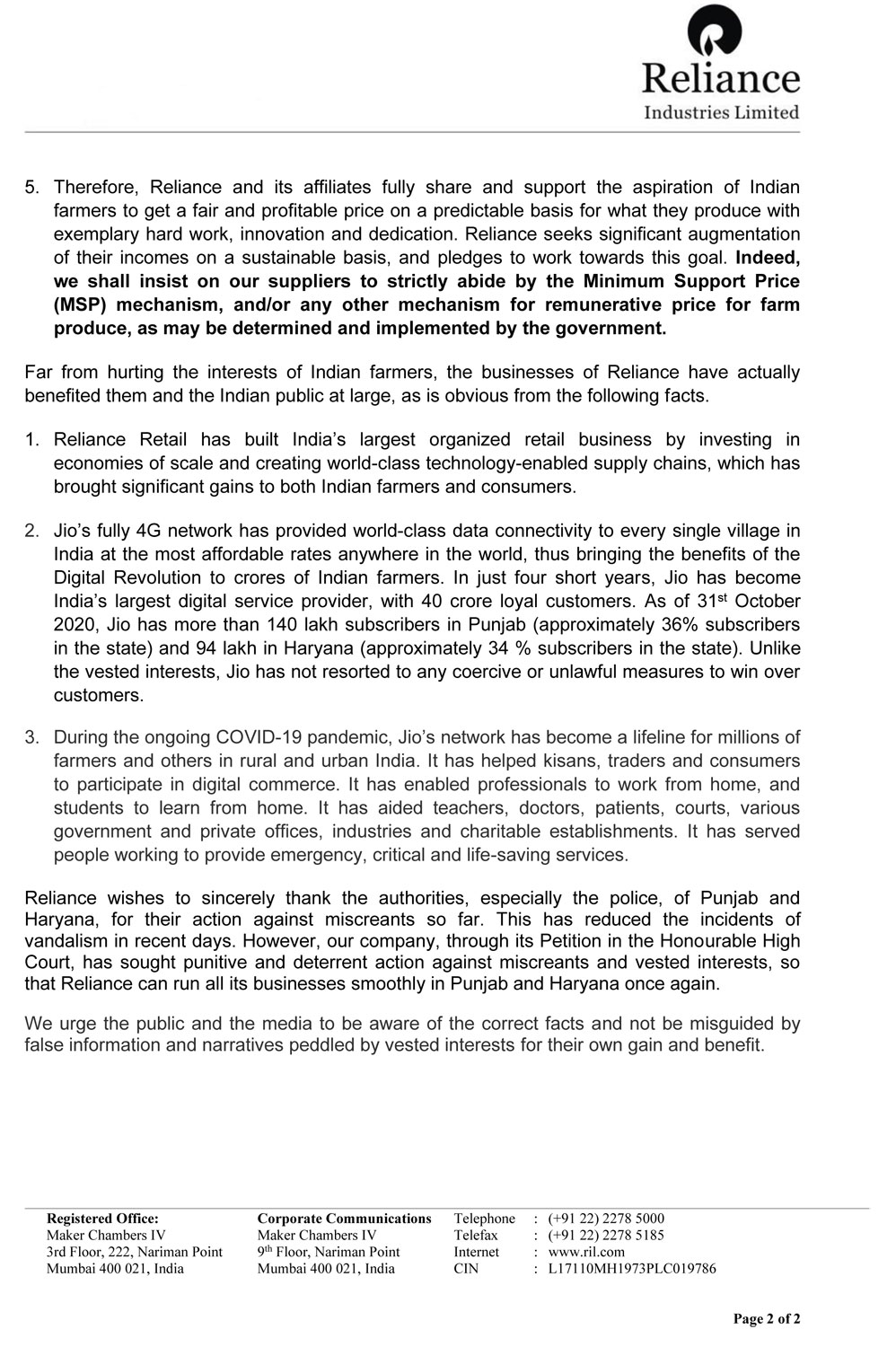
In its statement [PDF] Reliance said the company said that through its subsidiary Reliance Jio Infocomm Limited (RJIL), they have filed a petition in the Punjab and Haryana High Court to intervene for government authorities bring a complete stop to the illegal acts of vandalism by miscreants. They said that these acts of violence and vandalism have endangered their employees’ lives and caused damage and disruption to the communication infrastructure in the two states.

Statement issued by Reliance Industries (Source: RIL)

Blaming the rivals, the company said that the vandalism had been instigated and aided by vested interests and our business rivals. “Taking advantage of the ongoing farmers’ agitation near the national capital, these vested interests have launched an incessant, malicious and motivated vilification campaign against Reliance, which has absolutely no basis in truth.” It has to be noted that Reliance also filed a complaint to TRAI for the same in December.

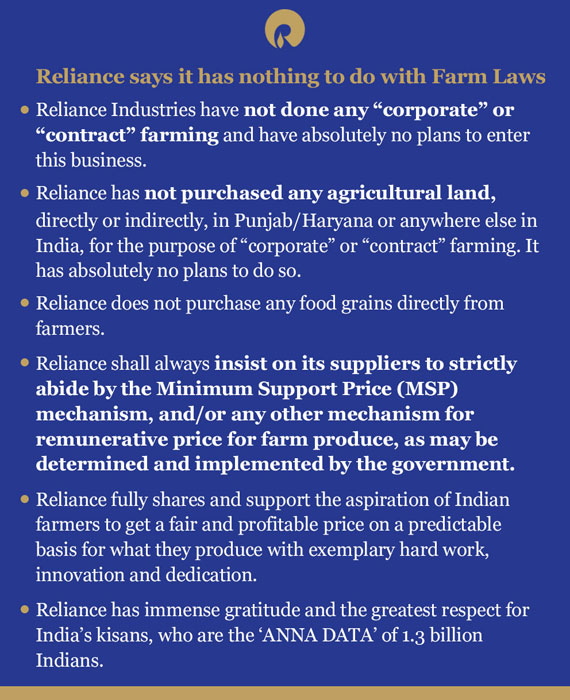
Reliance has claimed that the sole purpose of linking the name of Reliance to these laws is to harm businesses and damage its reputation. Reliance said that the company and any affiliate company including “Reliance Retail Limited (RRL), Reliance Jio Infocomm Limited (RJIL), or any other affiliate of our parent company, i.e., Reliance Industries Limited have not done any “corporate” or “contract” farming in the past, and have absolutely no plans to enter this business.”

Statement issued by Reliance Industries (Source: RIL)

RIL clarified that they have never purchased any agricultural land, directly or indirectly in Punjab, Haryana or anywhere else in India for the purpose of “corporate” or “contract” farming and they do not have any plans to get involved in the business. The company further said that Reliance Retail Ltd retails products of all categories, including food grains and staples, fruits and vegetables, daily use items, etc. The company does not buy directly from farmers and never entered in long-term procurement contracts to gain an unfair advantage over farmers.

Reliance further added that they support Indian farmers. It said, “Reliance and its affiliates fully share and support the aspiration of Indian farmers to get a fair and profitable price on a predictable basis for what they produce with exemplary hard work, innovation and dedication.” It further added, “Far from hurting the interests of Indian farmers, the businesses of Reliance have actually benefited them.”

Reliance’s statement in brief (Source: RIL)

The company said that Jio’s fully 4G network had provided world-class connectivity to every single village in India at affordable price. In four years, it became India’s largest digital service provider with over 40 crore subscribers. Jio had 140 lakh Subscribers in Punjab and 94 lakh in Haryana by October 31, 2020. “Unlike the vested interests, Jio has not resorted to any coercive or unlawful measures to win over customers,” it added.

Jio further said that during Covid-19 its network helped the farmers, traders and consumers to participate in digital commerce and enabled professionals to work from home and students to study from home. “It has served people working to provide emergency, critical and life-saving services.”

Why did the corporate houses have to come forward and clarify their stand?

Since the protestors have reached the borders of Delhi, there have been reports that there are elements that are provoking protestors against corporate houses. They are claiming that by using the laws, these corporate houses will take away their land. However, the law clearly says that land cannot be included in the contract. From actor-cum-protestor Deep Sandhu to Katha Vachak Bhai Banta Singh Ji of Gurudwara Bangla Sahib Delhi were seen spreading misinformation about the laws and provoking people against the corporate houses.

The Indian government has so far had six rounds of talks with the farmers. The seventh was scheduled for January 4, 2021.

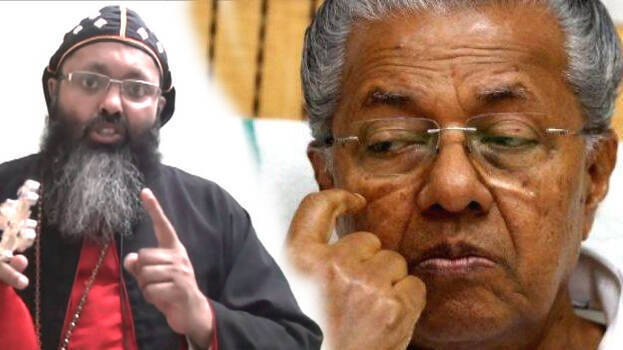
‘Won’t allow communist party’s fascist regime in Kerala’: Orthodox church asks CM Pinarayi Vijayan to keep his opinions to himself

Tearing into Kerala CM Pinarayi Vijayan for his dictatorial functioning the Orthodox Church said that it won’t allow the communist party’s fascist regime in Kerala. Church’s media head Dr Geevarghese Mar Yulios Methrapolitha said that the Chief Minister’s political messages should be directed to CPIM party offices and not at the Orthodox Church. He said that Pinarayi Vijayan has been given the CM’s position in the state and if he wants that the respect granted to him remains intact he should intervene in matters related to the Church.

“Chief minister only need to give political responses to the party’s local office. If he behaves with dignity to the church, it will be beneficial to him”, said the media head of the Orthodox faction visibly miffed with the way the CM handled the church row.

We are not the slaves of Kerala’s Chief Minister: Media head of Orthodox church in Kerala

It is being reported that the media head was agitated by the chief minister’s response to a priest from the orthodox church who asked him about the feud between the Jacobite and the Orthodox faction over the ownership and entry into Churches in Kerala. “We are not the slaves of Kerala’s Chief Minister”, lambasted Dr Geevarghese, furthering that Pinarayi Vijayan should show decency while dealing with the Church.

The Church accused Pinarayi Vijayan of blatantly lying and questioning the integrity of the priests. The media head said that the Supreme court verdict was on their side and it was the responsibility of the state government to confiscate and handover the disputed Churches to them. He also said that the eviction of the church is as per court orders and it will not be done as per the whims of the state government.