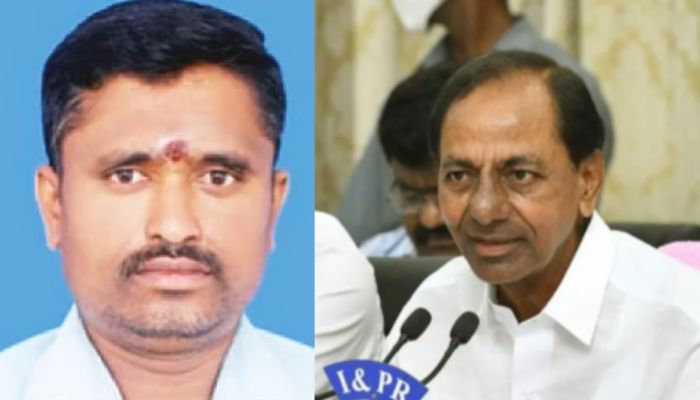
On Wednesday (20th February), Nagavelli Rajalingamurthy, the man who filed a case against former Telangana Chief Minister K Chandrashekhar Rao accusing him of corruption in the construction of Kaleshwaram Medigadda Barrage (Lakshmi Barrage), was brutally killed by unknown attackers.
Nagavelli Rajalingamurthy was a resident of Bhupalpally and the husband of former councillor Sarala from the 15th ward of Bhupalpally Municipality. Ahead of the Telangana Assembly elections, Rajalingamurthy had joined the Congress party.
Reports say that Nagavelli Rajalingamurthy was attacked when he was travelling through Reddy Colony. The unidentified assailants attacked the victim with knives and sickles. Rajalingamurthy was struck on the head while trying to escape. The bloodied victim collapsed on the road and died on the spot.
Nagavelli Rajalingamurthy accused KCR government of corruption
Back in 2023, Rajalingamurthy had tried to file a complaint against former CM KCR, former irrigation minister T Harish Rao and others, accusing them of corruption in the Kaleshwaram Lift Irrigation Scheme (KLIS) in October 2023 at Bhupalpally Police Station.
The police, however, refused to file an FIR. Rajalingamurthy then approached the local magistrate court where his plea was rejected. It was only when he approached the Principal Sessions Court, Bhupalpally that notices were issued to then CM KCR, T Harish and others. Later, the Telangana High Court put a stay on the case.
Rajalingamurthy’s family accuses BRS leaders of killing him, his wife claims Rajalingamurthy was being threatened to ‘settle’ the case
The deceased victim’s wife and former councillor Sarala has alleged that Nagavelli Rajalingamurthy was being “threatened” and offered Rs 10 lakh by Bharat Rashtra Samiti (BRS) leaders to ‘settle’ the case.
Sarala alleged that followers of former MLA Gandra Venkatramana Reddy carried out Rajalingamurthy’s killing. Reports say that the former MLA is a close aide of KCR’s son KT Rama Rao.
“KTR’s follower is Venkatramana Reddy. His follower is Haribabu. He got this done. Around 10 days ago, my husband was threatened and offered Rs 10 lakh to withdraw the complaint in the corruption case against KCR. Reddy got my husband killed in the middle of the road because he filed a case in the Kaleshwaram case, fearing they may lose. I want justice. What will happen to my two children?”,” Sarala said.
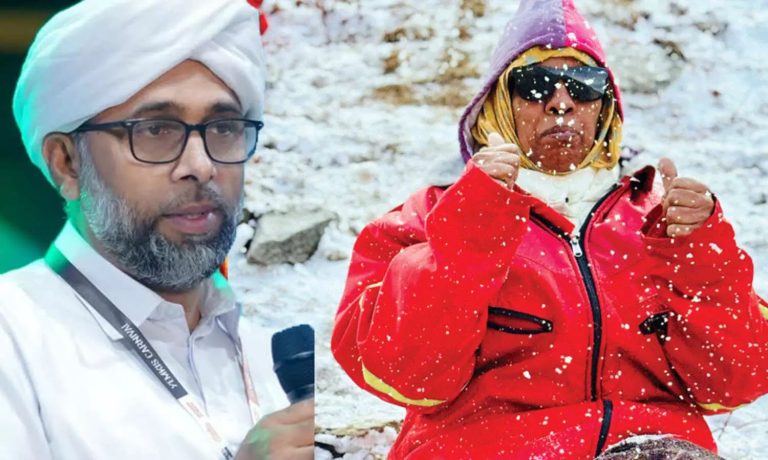
A prominent Muslim cleric belonging to a pro-CPI(M) Sunni faction in Kerala made a controversial statement after a video of a Muslim woman enjoying the snow in Manali had gone viral on social media.
The matter pertains to one Nafeesumma, who lost her husband 25 years ago but decided to visit Manali with her three married daughters in December. A viral video from the trip captures her dressed in snow gear, holding a snowball, and encouraging others to embark on similar journeys.
However, cleric Ibrahim Saqafi Puzhakkattiri, a member of the pro-CPI(M) Sunni faction led by Kanthapuram Aboobacker Musliyar, took offence at the video of a widowed woman enjoying her life.
At a community event last week, Saqafi remarked, “You might have seen a video… A grandmother, whose husband passed away 25 years ago, is playing in the snow in a distant state when she should be at home, praying in a corner. She travelled to another state and played with snow… that is a problem.”
Nafeesumma’s family expressed their disappointment over his remarks. “The ustad’s (cleric’s) stance has devastated us,” her daughter Jiffna told the media on Thursday. “He has disturbed my mother’s peace of mind, and now she feels unable to step outside. After his speech, community members believe she has done something wrong. Does a widow not have the right to experience the world?”
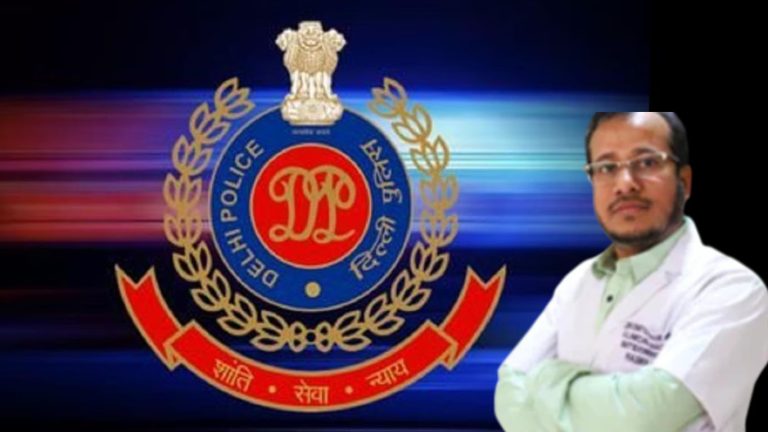
Delhi Police filed a chargesheet on 17th February against 8 accused arrested in the Al Qaeda Indian Subcontinent (AQIS) module case, including Dr Ishtiaq. The chargesheet was filed under the provisions of the Unlawful Activities Prevention Act (UAPA). In August last year, the police arrested 12 individuals linked to the AQIS in a joint operation of the Delhi, Jharkhand, Rajasthan, and Uttar Pradesh Police.
The accused were identified as Dr Ishtiaq Ahmed, Inamul Ansari, Shahbaz Ansari, Altaf Ansari, Mohammad Rizwan, Moti-ur-Rehman, Mufti Rehmatullah, Faizan Ahmed, Umar Farooq, Hasan Ansari and Arshad Khan. Invesigation is going on against one of the accused who was arrested later by the police.
AQIS Jharkhand training module case | Delhi Police filed a chargesheet in Patiala House Court against 8 accused.
Three accused have not been chargesheeted in this case. A total of 11 people were arrested initially in August 2024. These accused were arrested in a joint operation…
However, the chargesheet was filed only against 8 accused namely, Dr Ishtiaq Ahmed, Inamul Ansari, Shahbaz Ansari, Altaf Ansari, Mohammad Rizwan, Moti-ur-Rehman, Mufti Rehmatullah and Faizan Ahmed. The other 3 accused Umar Farooq, Hasan Ansari and Arshad Khan who were not charge-sheeted were granted bail by the Additional Sessions Judge Dr Hardeep Kaur. The judge has listed the chargesheet for consideration on February 24.
#WATCH | Delhi: On AQIS Jharkhand Training Module Case, Advocate Abubakr Sabbaq, says, "A total of 12 people have been arrested in this case, among them chargesheet has been filed against 8…3 people have been received bail, chargesheet couldn't be filed against them, there was… https://t.co/acOHBt6JKVpic.twitter.com/LVW0swYg7X
Six of the 12 accused were arrested by the police from Bhiwadi, Rajasthan while undergoing weapon-handling training. Others were detained from Jharkhand and Uttar Pradesh. The Delhi High Court granted a 90-day extension to the Delhi Police on December 12, 2024, to complete the investigation in the AQIS terror module case.
What is the AQIS terror module?
The investigation into AQIS module, led by Dr Ishtiaq, uncovered a well-planned network aimed at training individuals for terror attacks in India. Dr Ishtiaq, a radiologist from Ranchi, organised training camps in remote areas like Nakata forest in Jharkhand, where recruits were taught to handle weapons and prepare for suicide bombings. The group’s goal was to establish an Islamic state in India. Dr Ishtiaq had also expanded the module’s operations to Rajasthan and Uttar Pradesh. Investigation revealed that he was planning to build a suicide squad.
During the investigation, Delhi Police reportedly found that the Al-Qaeda-inspired terror module planned to collect funds for jihad using the PM-Kisan Yojana (Pradhan Mantri Kisan Samman Nidhi). In a statement to the city court, Delhi Police informed the court that two of the arrested individuals were beneficiaries of the PM-Kisan scheme. They allegedly provided money for the purchase of arms to support terrorist activities in the country.
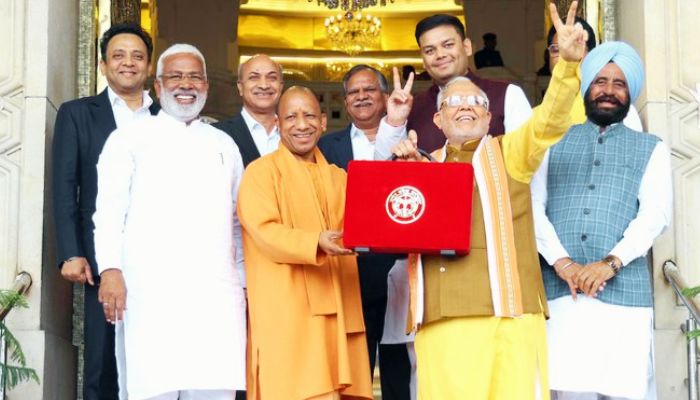
On Thursday (20th February), the Finance Minister of Uttar Pradesh, Suresh Kumar Khanna presented the state’s Rs 8,08,736 crore budget for the Financial Year 2025-26 on Thursday, marking a 9.8 per cent increase from the previous fiscal. Touted as Uttar Pradesh’s biggest budget ever, this budget is also reported to be the highest ever for any state in the country. For the fiscal year 2024-25, the Maharashtra government had presented a budget of Rs.6,12,293 crore.
Uttar Pradesh’s budget for the fiscal year 2025-26 prioritizes infrastructure development, technology, education, healthcare, and social welfare, aiming to accelerate economic growth and improve public services across the state.
The budget’s capital expenditures are 20.5 per cent of the total allocation, highlighting the government’s emphasis on industrial expansion, transportation, and investment-driven projects.
Among sectoral allocations, 22 per cent has been earmarked for infrastructure, 13 per cent for education, 11 per cent for agriculture and allied services, 6 per cent for medical and health sectors, and 4 per cent for social security programs
Additionally, a special provision has been made to equip the Legislative Assembly with modern IT systems, reinforcing the government’s focus on digital governance.
A key highlight of the budget is the establishment of an “Artificial Intelligence City” to position Uttar Pradesh as a leading hub for AI-based innovations and technology-driven enterprises. To further support this, the government has proposed the creation of a Technology Research Translation Park in Cybersecurity.
In the education sector, a significant push has been made to integrate technology into learning. Plans are in place to establish ICT labs and smart classrooms in primary and higher secondary schools across the state.
Additionally, government polytechnics will be upgraded with smart classrooms and fully digital libraries, ensuring students have access to modern learning tools. Furthermore, a Centre of Excellence has been proposed to promote Artificial Intelligence and emerging technologies.
The budget also emphasizes urban development, with 58 urban local bodies at district headquarters set to be transformed into model smart urban bodies through the convergence of various schemes.
A total allocation of Rs 145 crore has been made for this initiative, with Rs 2.50 crore assigned to each urban body.
Moreover, the government plans to establish and renovate Science City, Science Parks, and Planetariums, fostering a culture of scientific curiosity and innovation among students and researchers.
Uttar Pradesh’s budget also includes a range of social welfare measures aimed at improving the quality of life for its citizens. The Uttar Pradesh Building and Other Construction Workers Welfare Board has announced a new scheme to establish labour hubs at district headquarters, equipped with canteens, drinking water facilities, bathing areas, and toilets to improve living conditions for workers.
To encourage higher education among women, the government has introduced a new scheme to provide scooters to meritorious female students, ensuring ease of mobility and greater access to educational institutions.
The Uttar Pradesh government has also focused on strengthening forensic and medical infrastructure. Six new forensic science laboratories are being set up in Ayodhya, Basti, Banda, Azamgarh, Mirzapur, and Saharanpur, enhancing the state’s forensic capabilities to improve criminal investigations and law enforcement.
In the healthcare sector, the government has proposed an allocated Rs27 crore for the establishment of an autonomous medical college in Ballia and Rs25 crore for a similar institution in Balrampur.
These investments are expected to increase medical seats, improve healthcare access, and strengthen Uttar Pradesh’s medical education system.
Lauding the budget during a press conference, Uttar Pradesh Chief Minister Yogi Adityanath said, “This budget is over 8,08,736 crore Rs, which is 9.8 per cent higher than the 2024-25 budget. On one hand, the growth in the budget size reflects the state’s strength, while on the other hand, it also shows the commitment of the double-engine government.”
#WATCH | UP Budget | Uttar Pradesh Chief Minister Yogi Adityanath says, "… 22% of the total budget has been allocated to infrastructure development… 13% of the total budget has been allocated to education. 11% of the total budget has been allocated to the agriculture sector.… pic.twitter.com/Tl0sWIh9rs
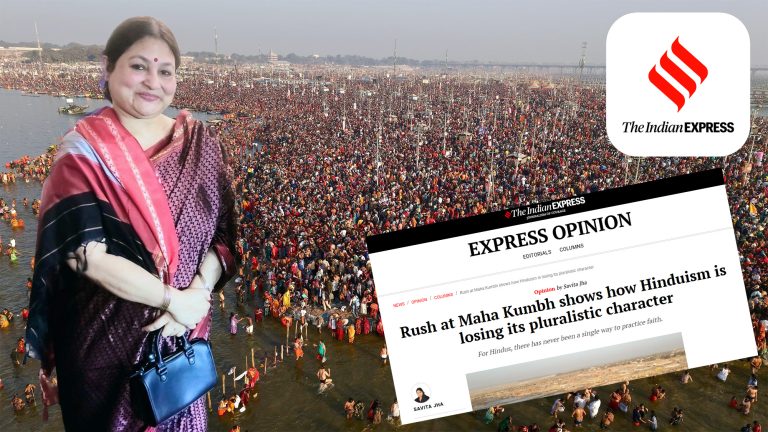
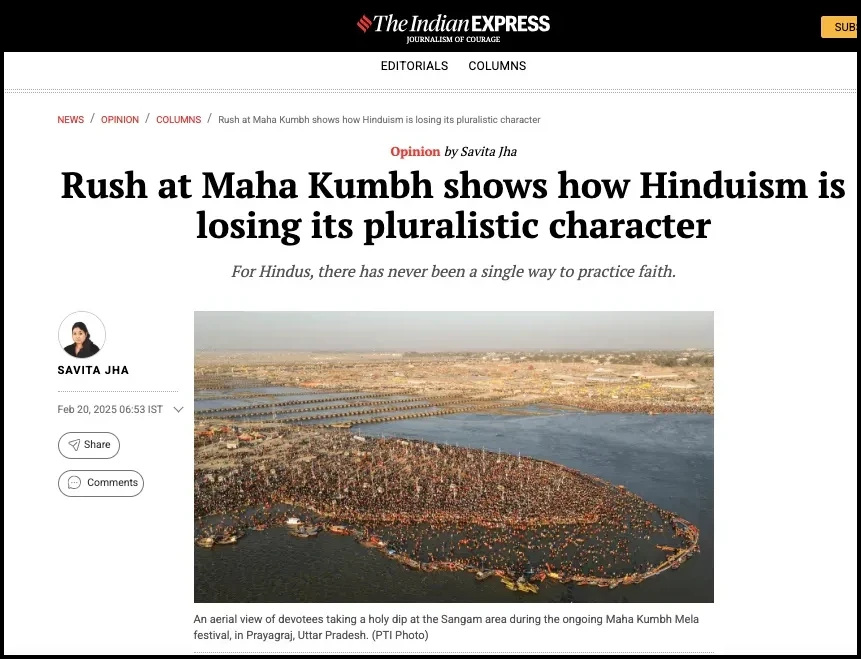
The Hindu festival of Holi is still a month away but the liberal cabal couldn’t wait to sling their annual mud, swapping Holi’s ‘regressive’ colours with the sea of devotees at Mahakumbh. As the ‘secular’ politicians of India mock the mass Hindu gathering, Delhi University professor Savita Jha in her Indian Express op-ed lamented how crores of Hindus taking a holy dip at the once-in-a-century festival is altering the “pluralistic character” of Hinduism.
In her sanctimonious screed titled: Rush at Maha Kumbh shows how Hinduism is losing its pluralistic character, Savita Jha laments that Mahakumbh is somehow forcing her to contemplate “if Hinduism is moving toward a more codified, performative and mandatory form.”
Is Hinduism becoming performative, mandatory and codified because crores of Hindus attended Mahakumbh?
From the very onset, Savita Jha makes it evident that this piece is going to be yet another ‘liberal’ attempt at gaslighting Hindus for displaying their faith unapologetically. While the JNU professor argues that since crores of Hindus are partaking in the Mahakumbh festival, Hinduism is becoming performative, mandatory and codified, however, what she affectionately called “my religion” has always been performative.
Hindu dharma has elements of and is characterised by the performance of a social or cultural role. From festivals to rituals and traditions, Hinduism is about “performing” the faith and the outward projection of faith in forms of religious symbols, dance, bhakti songs, colourful festivals etc. There is no “change” there.
As far as mandatory is concerned – Kumbh never was and still is not “Mandatory”. The Hindus taking holy dip at Prayagraj are doing so out of their own bhakti and faith. No Hindu religious leader has said that Hindus must visit the Kumbh Mela.
Unlike Islamists, who despite having numerous legal and illegal mosques take delight in performing namaz on streets, railway stations and even flights to assert their dominance and supposed religious ‘supremacy’, the Hindu devotees in Mahakumbh are not there for a show of power or assert their dominance, but simply to practice their faith. There is special spiritual zeal among Hindus during Kumbh Mela given it occurs over a gap of many years, and Mahakumbh which is said to be occurring after around 144 years makes it even more special and almost unmissable for many Hindus.
Dr Savita Jha argues that somehow the outward projection makes Hinduism ‘Abrahamic’. This is a sleight of hand. In Islam, there is no deity and no celebratory rituals per se. It is supposed to be about Namaz, which again is supposed to be done in Muslim houses of worship. It is Hinduism that celebrates community celebration, outward projection in terms of religious symbols and traditions and communal festivals.
While Hindus have undeniably become more aware and unapologetic about their faith and traditions over time, it is but a juvenile argument that somehow “heightened devotion” among Hindus hints at a departure from the “organic, regionally diverse expressions of Hinduism.”
The very fact that Prayagraj is attracting an influx of Hindus from every nook and corner of the country. From north to south, Hindus ‘rushing’ to take a holy dip at the divine confluence of the Ganga, Yamuna and Saraswati rivers beautifully reflects Hinduism’s living unity in diversity, not a decline of Hinduism’s pluralistic character. In Hinduism, pluralism is not about staying divided into sects and groups but about having own belief systems, aaradhya devas and traditions aligned with the core beliefs and principles of Hinduism and yet staying united under the umbrella of Sanatan Dharma.
It is also outrageous that Jha finds “heightened devotion” as unfortunate. Hindu dharma is not a tepid, armchair hobby, even sitting in one place and doing “naam jap” (chanting of holy name) requires effort and devotion. Hinduism has always had room for loud and spiritually profound Naga sadhus, grihast (householders) and even the quiet meditators who all come together at Kumbh showcasing how so diverse and yet similar they are in their devotion. Calling this “unfortunate” is just elitist whining and losing their minds over the fact that Hindus would not dim their devotion and joy to embrace some sanitized or ‘secularised’, low-energy ideal. Hindus are not up for this Faustian bargain.
Jha writes that “A standardised version of faith is being promoted, narrowing the vast landscape of Hindu thought into one-size-fits-all religiosity This loss of balance — between deep, contemplative faith and mass fervour — poses a significant challenge to Hinduism’s foundational essence.”
Basically, the author wants Hindus to shut up and sit at home. Outward celebration and projection of faith even by the young, urban class challenges the shame they tried to make Hindus feel for decades. The mere expression of faith by Hindus is by default associated with majoritarianism, deterrence of ‘secularism’, ‘Hindu nationalism’, if it is devoid of ‘secular’ “Ramzan mein Ram, Diwali mein Ali” flavour.
Be it after the Ayodhya Ram Janmabhoomi verdict, or over Centre rightly excluding Muslims from CAA, or for simply not becoming outrightly divorced from their faith, left-liberals have long been inducing the “survivor’s guilt” in Hindus and gaslighting the majority community which from the medical era of Islamic invasions to British era and in the ‘independent’ India has been victimised by different oppressors with one intent of destroying Hindu faith.
Contrary to Savita Jha’s assertion that crores of Hindus celebrating Mahakumbh is somehow indicating a deflection from Hinduism’s pluralistic character towards any Abrahamic religion-like centralisation, doctrinal rigidity or emphasis on obligatory practices, Mahakumbh is a melting pot of diverse Hindu groups.
The grand Hindu festival is uniting ascetics (sadhus), householders (grihast) and sects (sampradaya)—Vaishnavas, Shaivas, and Shaktas—in a voluntary, vibrant expression of faith.
Savita Jha asserts that Kumbh Mela has traditionally not been the ultimate destination pilgrimage and a personal spiritual journey for elderly Hindus. This assertion, however, is far from true. Kumbh Mela, Chaar Dhaam Yatra, and Rameshwaram (in Tamil Nadu), among others have in fact been some of the ultimate pilgrimage destinations for Hindus regardless of age though the elderly traditionally considered it more important to visit Kumbh.
Jha is upset that earlier, mostly old dying people visited Kumbh. Now young Hindus are doing so too – the problem here is about how the younger generation, which the Left tried to detach from faith and deracinate completely – are also finding solace in spirituality and wearing their faith on their sleeve with pride.
The JNU professor further compared Kumbh Mela to the Jain practice of Sallekhana to suggest that although the latter was a journey of voluntary renunciation of life, Kumbh is chaotic, reckless and devoid of dignity.
“Traditionally, the Kumbh Mela has never been the ultimate destination for pilgrimage. It was a deeply spiritual journey, especially for the elderly. Many aged individuals, aware that their bodies were nearing the end of life, would undertake the yatra with a sense of detachment, much like the Jain practice of sallekhana — a voluntary, peaceful renunciation of life. They went with the understanding that they might not return, embracing death as a natural transition rather than a tragedy, accident, fear or shock. This practice was not chaotic or reckless; it was done with dignity and acceptance, with younger companions from the village or neighbourhood guiding them. The losses, if any, were minimal because the journey was taken with restraint, preparation, and spiritual resolve, not as an impulsive, desperate act,” Jha writes.
Jha goes on to assert that while the number of Hindus participating in Kumbh Mela has increased dramatically, there lack of profound depth of contemplation. Firstly, Kumbh Mela has always been a massive gathering comprising people of all age groups, genders, and sects with better interconnectivity and travel means, it has become easier for people to participate in Kumbh Mela. Secondly, Savita Jha or anyone for that matter, cannot judge or evaluate the depth of contemplation of Hindus partaking in Mahakumbh. Can she question the depth of contemplation of Muslims in doing Haj pilgrimage or any other religious community’s rationale behind undertaking their pilgrimage?
Contrary to Jha’s assertion that the rush lacks spiritual preparation, replacing contemplation with mere performance is baseless. Kumbh pilgrimage is not devoid of contemplation, rather there is an abundance of it. The kalpvaasis observe fasts, sadhus meditate by the Sangam, all while co-existing with the crowd of devotees.
What Savita Jha fails to comprehend about the zeal and devotion of Hindus in partaking in Kumbh Mela, has been well-explained by Mark Twain in his book “Following The Equator”. Describing his experience at Kumbh of 1895, Twain wrote, “It is wonderful, the power of a faith like that, that can make multitudes upon multitudes of the old and weak and the young and frail enter without hesitation or complaint upon such incredible journeys and endure the resultant miseries without repining.”
There is no rigidity, no coercion and definitely no push towards a central mandate but it is unfathomable for the likes of Savita Jha that Hindus instead of practising their faith somewhat clandestinely in line with the ‘liberal’ expectation, are displaying their faith. Hindus are attending Kumbh Mela due to their personal devotion and not any obligation. No Hindu who for some reason does not visit Prayagraj during Mahakumbh will be looked down upon as a lesser Hindu or ostracised from the community.
Savita Jha’s assertion that Hinduism is heading towards becoming “codified” is flawed. Hinduism is codified – just that the method of codification is not one book – but many scriptures, including the Rig Veda which prescribes ways of worship. Plus, Hinduism is “codified” not merely by texts but also by performative traditions. Vedas, Upanishads, Shruti, Smriti, Puranas, Ramayana, Mahabharat and Bhagvadgita are all significant in Hinduism yet no specific text governs Hindu life. While the Gita emphasises Karma Yoga, the Upanishad delves into metaphysics and yet both reinforce the same worldview.
We are unified by not one scripture but shared principles of Dharma. While Vedas codify rituals through mantras and yajnas, their execution varies in North and South India. Hindu Dharma’s “code” is a resilient tapestry, woven from a thousand threads, not a single stitch.
#WATCH | #MahaKumbh2025 Prayagraj, Uttar Pradesh: "I have come from Hubballi, Karnataka. It is very crowded but I am happy to be here at the Triveni Sangam. We will never get to see this moment again. Our children or grandchildren will not get to see it. Only, we are fortunate… pic.twitter.com/QnfuztZ1tO
Jha also says “Even the Indian Constitution struggles to define “Hindus” with finality because Hinduism is not a monolithic religion but a vast and fluid tradition encompassing countless beliefs, practices, sects, and philosophies.”
No. Hinduism is not a disco party. There are rules, but Hinduism is indeed made up of many Sampradayas. Jha’s agony apparently, is that Left created schism is visibly disappearing.
The hypocrisy of those ever-ready to scrutinise Hindus and Hinduism is amusing. They would have their hearts melt if a Hindu keeps roza, or Hindus open their temples for Muslims to offer namaz but if a Hindu belonging to one sampradaya takes part in another’s practices, even if for argument’s sake, conceded that Kumbh is not a necessary ritual for all Hindus, it becomes a sign of pluralism being threatened.
Contrary to Savita Jha’s mendacious claim, Kumbh is actually the most plural form of worship that we can see. Hindus of all castes, creeds, financial strata and sampradayas come together. And this is precisely the chagrin of the IE article’s author— that Kumbh has seen a sea change in how Hindus come together to worship transcending societal lines, financial strata etc.
Beyond the farce of Ganga-Jamuni Tehzeeb, which has done more damage to Hinduism than benefit, Bharat’s culture, though diverse, is mainly derived from “performative” Hinduism.
Savita Jha has a problem with music during Kanwar Yatra
While Jha repeatedly expresses her unfounded apprehensions that somehow Hinduism is becoming Abrahamic in character, she finds music and dance during Kanwar Yatra problematic.
“This cost is on the rise in different strenuous practices such as the Kanwar Yatra. Self-penance was considered a purifying process; with the loud noise of DJs and bikes obstructing our inner voice, the Kanwar Yatra has become restricted to performance only,” Jha writes.
In Hindu dharma, Lord Shiva or Mahadev is the originator of all forms of artistic expression, including dance and music. How can any practising Hindu have an objection to Hindus celebrating their festivals by playing music or dancing?
The Kanwar Yatris are devotees of Mahadev who travel long distances on bikes to offer Kanwar or jal to Mahadev. They follow the sattvic diet in the holy month of Saawan and have utmost devotion to Lord Shiva. DJ music or bikes don’t diminish their faith and resolve. Hinduism has always celebrated with dance and Music – we are not Islam. Music is not ‘haraam’ for Hindus and the Kanwar Yatris must abstain from playing devotional music or overtly displaying their faith. The yatra itself is a spiritual “performance”, Kanwariyas don’t have to just sit and imagine that they undertook the yatra.
What Savita Jha calls a Hindu shift towards Abrahamic character, an “outwardly visible form of faith — demonstrated through large processions, mass pilgrimages, and aggressive displays” is nothing like what Muslims or adherents of any Abrahamic faith do. In fact, mass pilgrimages, large processions and overt displays of faith have been an integral part of Hindu culture.
Interestingly, Savita Jha also mentions how it was villagers who used to attend such pilgrimages. Basically, her problem also is that now, the Urban youth – who were forced to feel ashamed of their faith, have found their faith against and are displaying their faith on their sleeve.
“Earlier, only a few people from the village would undertake the difficult pilgrimage to Kedarnath and Badrinath, while the rest would simply receive prasad and blessings. There was a natural sense of restraint and awareness of risks, ensuring that only the most prepared undertook such journeys,” Jha writes overlooking the financial restraints people earlier had.
God alone knows what makes Savita Jha think that the tradition of serving prasad to those who could not go on pilgrimage has ended. Many Hindus who visit Vaishno Devi temple or any other such temples often distribute prasad not only to their family members but also to their neighbours and colleagues. With improved accessibility and standard of living, why would Hindus not be willing to undertake “Sa-parivar” (with family) pilgrimages? People have accidents while going to their office also, should they stop working to stay safe? Under the garb of ‘rationality’ it seems like Jha wants to deter Hindus from undertaking pilgrimages.
Is heightened devotion to blame for the Kumbh stampede? Has Hindu devotion caused violence in Mahakumbh?
The Indian Express article further insinuates that the stampede in Prayagraj last month that resulted in 30 deaths was caused by the “heightened devotion” of Hindus. While Savita Jha makes no explicit mention of any politician or political statements, her article carries the undertone that somehow, Hindus have become dogmatically expressive Hindus in the last decade.
The tragic loss of lives at Mahakumbh on Mauni Amavasya was not the first time that a stampede occurred in Kumbh Mela. Such incidents happened in 1954 and 2013 as well when both, Uttar Pradesh and India were by supposedly ‘secular’ governments. Hindus have always attached immense significance to Kumbh Mela, stampedes may occur due to rumours, mismanagement or due to conspiracies, but never due to heightened devotion. Stampedes are not unique to Hinduism, a stampede occurred at Mecca as well in 2015, would Savita Jha or any liberal ‘intellectual’ blame the ‘heightened devotion’ of Muslims for the tragedy?
In her pursuit to gaslight Hindus for attending Mahakumbh, the founder of the Centre for Studies of Tradition and Systems(CSTS), resorted to peddling lies as she claimed that there was “mindless violence” in the ongoing Kumbh Mela. In reality, there has not been a single instance of any violence during Kumbh.
Social media and commercialisation of religion making Hinduism unilinear?
Furthermore, Jha asserts that singular narratives on social media and commercialisation have reduced the faith to somewhat formulaic acts, sidelining regional variations. This is outright ridiculous. Social media can never be a space where any singular narrative thrives. People from Andhra Pradesh, Kerala, Karnataka, Himachal and other states came to Prayagraj and took the holy dip while performing their rituals, there was no dress code, no specific rule that a south Indian cannot perform their rituals before, or during the ritual bathing. Social media is replete with posts, videos of sadhus sharing ascetic wisdom, and commoners describing how they performed their regional rites and unique experiences. There is no herd mentality at play here.
“The commercialisation of religion, from packaged pilgrimages to mass events, promotes specific rituals and experiences as the “ideal” and “only” way to connect with the divine, reducing faith to formulaic participation. Several water bodies once served as sites for the observance of kalpvaas (staying near the river in a certain time period) from Paus Purnima to Maghi Purnima. In Bihar, Simaria was known as mini-Kumbh. However, modern religious expressions are increasingly unilinear, emphasising mass participation over individual spiritual experience. A standardised version of faith is being promoted, narrowing the vast landscape of Hindu thought into one-size-fits-all religiosity,” Jha writes.
Nobody can help Jha if she thinks that packaged pilgrimages or mass events like Kumbh are the ‘commercialisation’ of religion. The government would obviously promote, the grand event the businesses would naturally want to make money when they know a large number of people are gathering at Prayagraj for spiritual reasons. It is not the commercialisation of religion but a demonstration of how religious events also offer people economic opportunities. The author ignores the fact that even in the era of kings, Kumbh events had imperial patronage.
Chhath pooja, Bengal’s famous Ganga Sagar Mela, Baneshwar Mela and Pushkar Mela in Rajasthan, among others, thrive alongside Kumbh, proving that diversity isn’t lost but scaled. Hinduism never was and can never be unilinear or centred around one-size-fits-all religiosity.
Jha concludes her sanctimonious rant with a question: Is Hinduism evolving or is it being reshaped into something it was never meant to be?”
The answer is: No! It is not. Hinduism is the oldest yet the most modern religion in the world. Reason: Though Sanatan (eternal, timeless), Hinduism has evolved over the ages and yet retains its pluralistic character. Shaming Kumbh’s grandeur, gaslighting Hindus for displaying their faith, suggesting that Hinduism is corrupted or reshaping into a rigid unilinear faith is an outright insult to Hindus and their faith but then liberals draw sadistic pleasure in insulting and gaslighting Hindus for their unapologetic Hinduness.
While crores of Hindus revel in their “heightened devotion” at Mahakumbh, armchair prophets like Savita Jha slobber over their keyboards, just Rakshasas used to prevent Rishis from performing Yajnas.
Prime Minister Narendra Modi had been seeking an elusive achievement for a decade in New Delhi. A few months after leading the Bharatiya Janata Party to a resounding victory in the 2014 Lok Sabha election, it lost the 2015 assembly polls in the national capital to the then-new Aam Aadmi Party. The same story was repeated in 2020. However, the party finally ended its 27-year dry spell with a landslide victory in the 2025 assembly elections in Delhi.
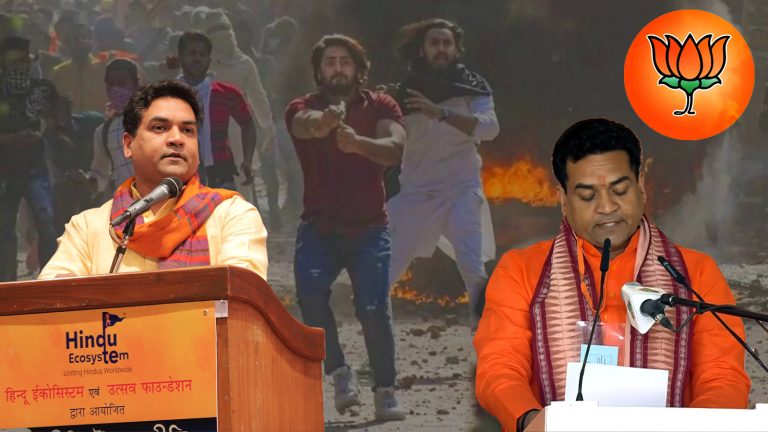
This election added a much-awaited feather to the saffron party’s magnificent cap of victories, however, it isn’t only an electoral success but a testament to the sheer will and resilience of the party’s candidates especially in light of the violent incidents that marred Delhi in 2020. One such person is Kapil Mishra who won from Karawal Nagar with 23,355 votes and defeated AAP’s Manoj Kumar Tyagi. Notably, it has been a BJP stronghold since 1993 except for the 2015 election, when Kapil Mishra won as the AAP candidate. He was sacked from the party in 2017 for speaking against Kejriwal, and was disqualified from the house in 2019, after which he joined the BJP.
On 20th February, Mishra was administered the oath of office by Delhi lieutenant governor Vinai Kumar Saxena at a grand event in Ramlila Maidan and will now serve in the cabinet of Chief Minister Rekha Gupta handling Water, Tourism and Culture ministries. Notably, the journey to success was fraught with challenges for the 44-year-old, whose reputation was dragged through the mud in the wake of the anti-Hindu riots that transpired in Delhi.
His victory in Karawal Nagar is hence particularly significant, as the region was one of those most adversely impacted during the unrest. The lieutenant governor also visited and spoke with residents Karawal Nagar and other affected areas in 2020.
What happened in Karawal Nagar during 2020 anti-Hindu Delhi riots
Anti-Hindu riots broke out in multiple areas in the national capital in the guise of protest against the Citizenship Amendment Act and the situation was similar in Karawal Nagar. Notably, the residence of ex-AAP councillor Tahir Hussain, the man responsible for the murder of Intelligence Bureau (IB) officer Ankit Sharma is situated in Karawal Nagar. His body was brutally stabbed over 400 times and then thrown into a nearby drain. Hussain also accumulated stones, acid and petrol bombs, among other things.
He reportedly confessed that he collected these weapons easily and without suspicion because his building was multi-story and still under construction. The rioters then began attacking Hindu temples, residences and businesses while yelling “Allahu Akbar” and “Maaro Kaafiro Ko Maaro” (Kill the infidels) from there. He had even urged his followers to be prepared for anything drastic as they wanted to “teach a lesson to the Hindus.” Hussain contested the Delhi assembly polls from Mustafabad constituency on All India Majlis-e-Ittehadul Muslimeen (AIMIM) ticket but BJP’s Mohan Singh Bisht emerged victorious from there.
People stuck in Karawal Nagar began making distress calls in a panic amid dense smoke plumes and stores being looted. The main road was “captured” by rioters and stone-pelters, leaving residents of Karawal Nagar and Khajuri Khas without a way out, reported The Times of India.
“A mob was outside my house and even policemen weren’t allowed entry. We were stuck at home for two days. I could hear firing. I gave first aid to a man who was hurt in stone-pelting,” reported Vikram Pandey from Karawal Nagar. “I don’t think the situation is going to change. I’m not going to put myself or my family in harm’s way. I have applied for leave and I’d rather give my resignation than remain here,” voiced a terrified member of a family of four.
The riots claimed the lives of at least 53 people and many were wounded. The paramilitary personnel in Karawal Nagar, where they were stationed to maintain order were also attacked with acid by the miscreants. Notably, the areas hardest hit by the violence were Karawal Nagar and Chand Bagh.
Delhi violence: A conspiracy against Hindus and India
The history of the Hindu-Muslim conflict in India dates back to colonial times that has shook the nation from time to time. Likewise, India was shocked by the devastation and bloodshed caused during the 2020 Delhi anti-Hindu Riots. An intricate scheme was hatched by some Muslim and Left groups, which led to rampant violence in Delhi. The investigation revealed the multiple layers and the conspirators behind the bloodbath. However, many other who were directly or indirectly involved are yet to face the music of the law.
Not only was the violence motivated by anti-Hindu prejudice or an aversion to CAA, but it was also a deliberate attempt to damage India’s reputation abroad during President Donald Trump. A meeting was conducted in a basement in Jangpura with many conspirators including Yogendra Yadav, Sharjeel Imam, Umar Khalid and others, on 8th December 2019. According to a chargesheet, a plan for implementing the Chakka Jam was developed during this time.
It was agreed that Sharjeel Imam would be in charge of organizing and guiding students from different institutions and universities in and around Delhi. Interestingly, it was also resolved that groups like “Swarajya Abhiyaan” and “United Against Hate” would support one another in whatever manner they could. Swara Bhaskar, a small-time actor, was in close touch with Umar Khalid who had instructed her to fabricate a story in support of Dr Kafeel Khan during their conversations. He had informed her in a previous conversation that the demonstrators from Shaheen Bagh in Kolkata’s Park Circus wanted her there.
The aforementioned information demonstrated how the riots weren’t spontaneous but that there was a deliberate intention to commit violence in the capital. “I promise that when Donald Trump will visit India on 24th February, we will show how the Indian government is trying to divide the country and tarnish the principles of Mahatma Gandhi. We will come out on streets in huge numbers to tell (the US President) that people of India are fighting to bring everyone together. Will you come out,” Umar Khalid’s speech also pointed towards the same.
This is indicated by the careful preparation to destroy CCTV cameras, conceal oneself behind CAA agitation and use the demonstrators to carry out violent acts. Sharjeel Imam’s 2019 appeal to his co-religionists to “cut-off chicken neck (Siliguri corridor)” is ample evidence of the true intentions and wicked mindset of these people. Sharjeel Imam started a WhatsApp group named Muslim Students of JNU. This occurred immediately following the introduction of the Citizenship Amendment Bill (CAB) into the Parliament.
A chargesheet disclosed that Sharjeel Imam was in close communication with Arshad Warsi, a Jamia student. He was also in contact with the Students of Jamia (SOJ), a “radical communal group.” The Delhi Special Cell detained Arshad Warsi in 2023 in relation to the Pune ISIS (Islamic State of Iraq and Syria) terror module. The Muslim Students of JNU (MSJ) group distributed pamphlets written by Sharjeel Imam himself across the Jama Masjid region, according to the retrieved conversations between Sharjeel Imam and Arshad Warsi.
The pamphlets were communal in nature and used the Supreme Court’s ruling in the Ram Janmabhoomi case to basically foment hatred within the Muslim community. The Delhi High Court already ruled that the riots were a thoughtfully orchestrated plot to incite unrest in the national capital. “The Delhi riots of 2020 were a conspiracy, planned and executed. They evidently did not take place in a spur of the moment,” stated Justice Subramanium Prasad when denying bail to accused Mohammad Ibrahim.
Additionally, even Delhi Police confirmed that the initial evidence showed that the anti-Hindu riots in February 2020 were a “well thought of conspiracy to destabilize the harmony in the society” rather than an act of spordiac or spontaneous violence.
How Kapil Mishra was vilified
Meanwhile, the perpetrators and their allies in and outside the media attempted to shift the blame after the riots by blaming BJP leaders including Kapil Mishra as it is not hard for them to turn a gun-wielding Mohammad Shahrukh into Anurag Mishra or conceal his identity. Kapil Mishra was accused of making aggressive remarks during the anti-CAA protests prompting the violence.
In reality, he urged the authorities to remove the protesters who were obstructing the road and causing problems for commuters and others in the vicinity by calling a pro-CAA rally at the Maujpur traffic light, near Jaffrabad Metro. “They (protestors) want to create trouble in Delhi. That’s why they have closed the roads. That’s why they have created a riot-like situation here. We have not pelted any stone,” he wrote on X (formerly Twitter).
Afterwards, despite police using tear gas shells to disperse the crowd, a stone-pelting incident was recorded in the evening near the Maujpur-Babarpur Metro Station, which is near the location of anti-CAA rallies. If this is the threshold for accusing people of violence, then many vocal anti-Hindu individuals including Swara Bhasker, Harsh Mander and others gave far more communal and problematic speeches during the protests without any opposition.
More importantly, in 2020, the Delhi police told the Delhi high court that they had not discovered any “actionable evidence” during the investigation that pointed to any involvement of prominent political figures, such as BJP leaders Kapil Mishra and Anurag Thakur in “instigating and/or participating in the riots.” The submission followed several Public Interest Litigation (PIL) requests to register formal complaints against a number of political figures, including Anurag Thakur and Kapil Mishra.
The Delhi Police accused the petitioners of selective outrage over certain incidents while disregarding other violent events, terming the pleas “motivated.” “In case, during investigation, the role of aforesaid persons in commissioning of the offences in the respective FIRs would surface, then Delhi Police would be duty bound to take statutory steps as mandated under the law against the aforesaid persons. However, no fresh FIR is warranted at this stage,” the affidavit conveyed.
Notably, Mishra also received death threats as a result of the unfounded charges, with one Mohammad Amanatullah warning that no one could save him from his imminent demise. Another messaged him on WhatsApp, threatening, “Many will kill you” in all caps. Someone declared that he wanted to kill him in another WhatsApp conversation. Furthermore, an impleadment case contesting the maintainability of a plea requesting the filing of a formal complaint against a number of BJP officials for allegedly using hate speech to stir up the 2020 Delhi anti-Hindu riots was dismissed by the Delhi High Court in 2022.
Shaikh Mujtaba Farooq submitted an intervention application on behalf of a lawyer in a pending case, asking the court to register a formal complaint and conduct an investigation against Kapil Mishra, Parvesh Verma, Abhay Verma and Anurag Thakur. However, it was junked by the Delhi High Court bench, composed of Justices Siddharth Mridul and Anup Jairam Bhambhani.
NDTV, India Today, The Quint, Congress leader Ruchira Chaturvedi, anti-India journalist Sreenivasan Jain and others even called him a “whistlerblower” in the Delhi Riots chargesheet. However, they conveniently omitted an important part of the same section. “Indicative chats corroborating the fear of conspirators from being exposed. Conspirators resorted to shifting blame by creating a false narrative and threatened the whistleblowers,” it informed. Additionally, it stated that protected witnesses have confirmed the same.
The Delhi Police stated “creating false narrative and threatened whistleblower.” This consisted of two parts. The fabrication of a false narrative came first followed by threats against whistleblowers. The Delhi Police initially posted screenshots of conversations from the “Delhi Protest Support Group” (DPSG) with Khalid Saifi, Rahul Roy and other members discussing filing a formal complaint against Kapil Mishra under this section. It should be noted that the DSPG group discussion occurred at 1 am on 24th February, after the violence had already broken out.
However, the media conveniently focused on this portion and overlooked the more than 700 pages that describe the full conspiracy. The police’s quotation of the conversations about Mishra showed how the riot engineers, including Khalid Saifi, who had even acknowledged their involvement in the conspiracy, were trying to use him as a means of deflecting attention away from themselves and inventing a “story.” Mishra had no part in the conversations that occured later in the same segment where “whistleblowers were being threatened.”
Moreover, a year after Siddique Kappan, a Kerala-based “journalist” accused by the Unlawful Activities Prevention Act (UAPA) was released on bail after more than two years in prison, a report emerged detailing how he ordered the Popular Front of India (PFI), a banned Islamist terror group, to kill BJP leaders Parvesh Verma and Kapil Mishra after the 2020 anti-Hindu riots in Delhi.
Infuriated by their efforts to stop PFI members from targeting Hindus during the 2020 anti-Hindu riots in Delhi, Siddique Kappan reportedly ordered PFI’s hit squad commander Kamal KP, a Malappuram native, to kill Kapil Mishra and Parvesh Verma, according to a report published on 19th March 2024 by the local Malayalam media outlet Janmabhumi.
Conclusion
Kapil Mishra left AAP after differences with its national convenor and former chief minister Arvind Kejriwal and grew as a significant voice for Hindus in the saffron party. His political career has undoubtedly not been a pleasant one due to his strong resistance to anti-India and anti-forces which was brought to light during the anti-Hindu riots in Delhi. They intended to create a bogus narrative, and punish him for their crimes but instead he became a minister in Delhi. There could not be a better end to their nefarious designs.
Mishra has consistently supported the Hindu community, whether through organizing donations, raising funds or providing assistance in various capacities. His recent success and appointment to the Delhi cabinet reflect the achievements of his dedicated efforts. Additionally, this development highlights the BJP’s commitment to recognizing merit and the importance of unwavering hardwork in the party.
Now, a new chapter has begun for Delhi, BJP and the winning candidates specifically Mishra after the assembly polls. There primary focus should be on fulfilling the promises, making Delhi what it was intended to be and fixing the mistakes made by the AAP. The current administration should further ensure that there isn’t any place for violence in Delhi. Mishra himself witnessed the horror firsthand and was even wrongfully held accountable for it by the usual suspects. It is time for him and his party to make sure that such a evil never rear its head ever again.
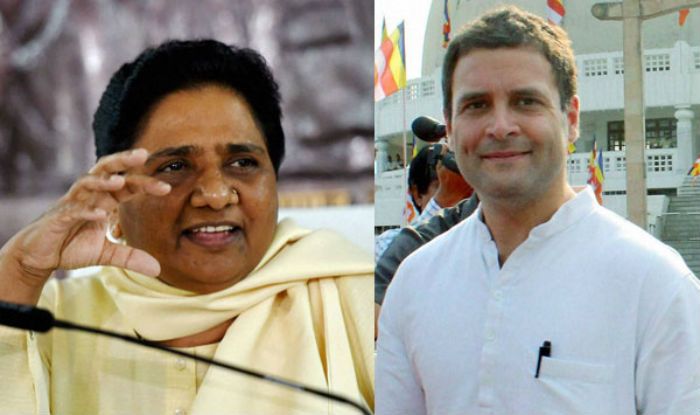
Leader of Opposition in Lok Sabha, Rahul Gandhi on Thursday indicated that if Bahujan Samaj Party chief Mayawati had fought the recent parliamentary elections with the Congress, they would have won
Addressing students at the Mool Bharti hostel in his constituency of Raebareli in Uttar Pradesh, Gandhi asked, “Why doesn’t Mayawati fight elections properly?”
In a conversation with students, one of them spoke about issues regarding the hostel when Rahul Gandhi intervened and asked, “What do you think about Kanshiram Ji?”
After the student gave his response and also mentioned Mayawati, Rahul Gandhi asked, “Why doesn’t Mayawati fight elections properly?”.
“We wanted Behenji to fight elections along with us against the BJP,” Rahul Gandhi said referring to the BSP supremo.
“However, for some reason, Mayawati Ji isn’t contesting, which disappoints us greatly. Because if all three parties come together, the BJP would never win,” the Congress MP said adding the doors of the INDIA Alliance are always open for her.
Mayawati, however, hit back at the Congress’ “double standards”. In a post in hindi on X the BSP chief said,” In the states where Congress is strong or where it has governments, there is animosity and casteist attitude towards BSP and its followers, but in a state like UP where Congress is weak, there is deceptive talk of alliance with BSP, if this is not the double standard of that party then what is it?.”
She said that whenever BSP contested elections in UP and other states in alliance with “casteist parties” like Congress, their base vote has been transferred to them but those parties have not been able to transfer their base vote to BSP. In such a situation, BSP has always had to face losses.
Notably, Congress and Samajwadi Party had contested the 2024 parliamentary elections together as part of INDIA alliance, while BSP fought the elections independently.
Meanwhile, Leader of Opposition in Lok Sabha Rahul Gandhi in his interaction with students at Raebareli asked them to ensure their participation and responsibility in the development of the country.
Rahul Gandhi, addressing students in the Mool Bharti hostel in his Lok Sabha constituency, Rae Bareli, said, “The Constitution has given all of you equal rights and opportunities to move forward and shape your future. Recognize your rights.”
“The Constitution has given all of you equal rights and opportunities to move forward and shape your future. Recognise your rights,” he added.
(This news report is published from a syndicated feed. Except for the headline, the content has not been written or edited by OpIndia staff)
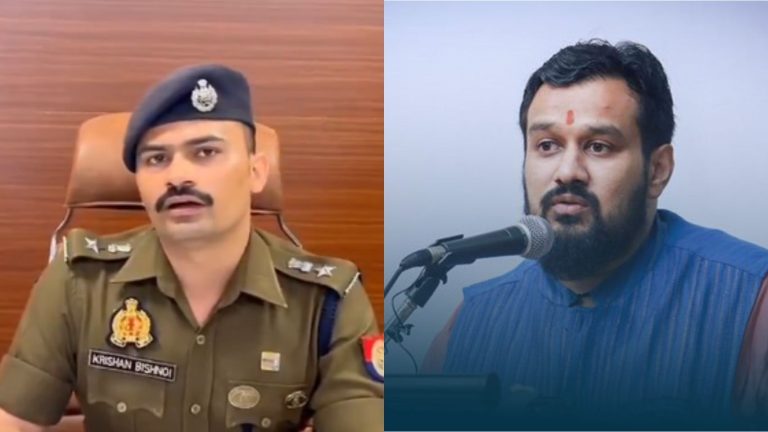
In a breakthrough in the ongoing investigation into the Sambhal violence, the Sambhal Police today (20th February) arrested wanted accused Ghulam in connection with the violence. Addressing the media after the arrest of the accused, Sambhal SP Krishan Kumar Vishnoi revealed that the accused confessed that there was a conspiracy to kill advocate Vishnu Shankar Jain during the Sambhal violence on 24th November 2024.
According to SP Vishnoi, Ghulam confessed that Shariq Satha, the mastermind of the Sambhal violence, and his gang enjoyed political patronage earlier which made it easier for them to operate in the Deepa Sarai area in Sambhal. But now it has become difficult for the gang to carry on their criminal activities due to strict police action. Ghulam also revealed he was shown a picture of advocate Jain for identification. His leaders had entrusted him with the task of killing Jain by taking advantage of the violence.
SP Vishnoi said that Ghulam, who has a long criminal history, supplied weapons to the attackers during the violence. Around 20 criminal cases are pending against Ghulam in several districts including Sambhal. SP Vishnoi further revealed that Ghulam had a conversation with his boss Satha a day before the violence, i.e. on 23rd November 2024. Satha was informed by a local about the court-mandated survey of the Sambhal Jama Masjid that was to be conducted on 24th November 2024.
Ghulam also disclosed to the police that Satha operates an automobile theft gang in Delhi NCR from abroad. Ghulam runs this automobile theft gang for Satha in the NCR which steals vehicles from the NCR and sells them in the northeastern states and sells them at the India-Myanmar border in Manipur in exchange for weapons.
The police recovered a huge cache of arms from Ghulam which had weapons made in countries like Germany, the UK and Czechoslovakia. The accused was involved in smuggling the weapons across the country.
The police have arrested 79 accused in connection with the Sambhal violence so far.
Sambhal violence
On 24th November, during the second round of court-mandated survey at Jama Masjid, Islamist mobsters gathered outside the mosque and engaged in violence. They pelted stones at police, opened fire at police personnel and set ablaze vehicles and shops. At least 20 police personnel were injured during violence and four mobsters were killed in the mayhem, likely from illegal guns carried by rioters.
Nashik District Court on Thursday sentenced Maharashtra Agriculture Minister Manikrao Kokate and his brother Sunil Kotake to two years of imprisonment and imposed a fine of Rs 50,000 each in a forgery case.
The verdict was delivered in a case dating back to 1995, where the brothers were accused of document forgery and fraud related to government housing scheme.
Former Minister Tukaram Dighole had filed a petition against the Kotake brothers, alleging that they misrepresented their income to purchase a house under the government’s quota in 1995.
The complaint was lodged at the Government Wada police station in Nashik. The case has been in court since 1997, with the court now delivering its final decision.
According to case details, between 1995 and 1997, Manikrao Kokate and his brother Sunil Kokate obtained flats under a government housing scheme by falsely claiming low income and stating that they did not own any property. However, subsequent investigation raised concerns about irregularities in their claims.
A case was registered under Section 420 (cheating), 465 (forgery), 471 (using forged documents), and 467 of the Indian Penal Code (IPC) based on the allegations.
There were four accused in the case, including the Kokate brothers and two others. However, the court did not sentence the other two accused.
(This news report is published from a syndicated feed. Except for the headline, the content has not been written or edited by OpIndia staff)
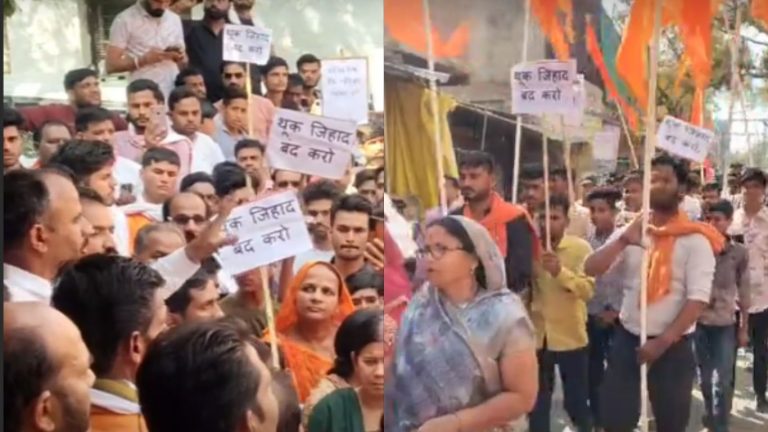
A Bandh was observed by Hindu organisations on Wednesday (19th February) in the Khategaon Police Station area in the Dewas district of Madhya Pradesh after some Muslim men spat on Hindu devotees taking part in Narmada Parikrama in Tamkhan village on 17th February.
As per reports, Prakash Yadav and his wife were going on a bike to attend the Narmada Parikrama on 17th February. The couple had a scuffle with some Muslim men as they passed by Tamkhan mosque in the evening. The Muslim men allegedly misbehaved with them and spat on Prakash Yadav’s wife.
The incident sparked outrage among people from the Hindu community. A Bandh was observed by Hindu organisations. Later, members of several Hindu organisations gathered near Sri Ram temple and took out a rally carrying saffron flags through the main routes of the town to the police station. They handed over a memorandum, addressed to the Collector and the SP, additional SP, and the SDM.
Hindu organisations said that illegal activities are taking place in the mosque
The memorandum stated that the Maulvi and Sadar of the Tamkhan mosque also misbehaved with the devotees participating in the Parikrama. It said that the mosque was built on encroached land belonging to the government and that immoral, illegal and unconstitutional activities have been taking place inside the mosque. The memorandum also accused some anti-social elements in the area of indulging in illegal mining activities. The Hindu organisations demanded a cease to illegal mining and the seizure of the machinery like tractors and boats engaged in the mining.
Culprits identified as Mohsin, Akram and Islam
Police registered a case against three people identified as Mohsin, Akram and Islam. One of the culprits is reportedly on the run. A team of police personnel led by the SDM and the Tehsildar sealed the route which was being used for illegal mining. Police have arrested two accused and are searching for others. One of the accused is a minor.
Notably, 54 villages in the Dewas district including Tamkhan village were selected by the government for renaming. Tamkhan village was to be renamed as Kanhapur.