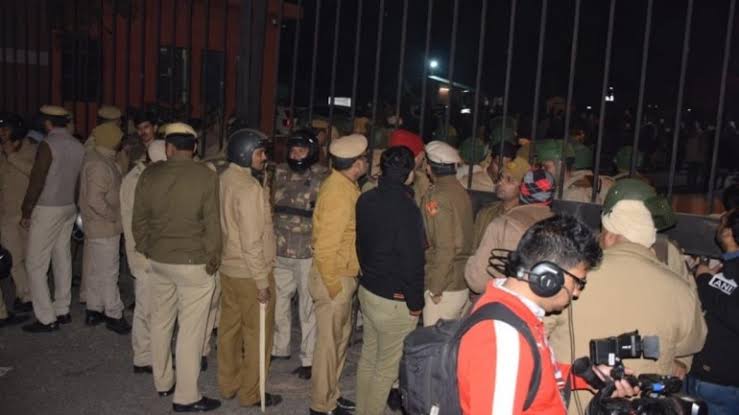
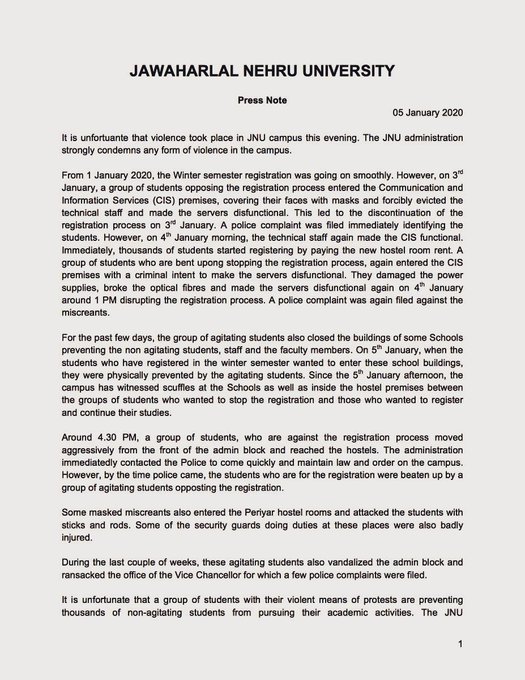
After large-scale violence erupted in the JNU campus last night where hundreds of masked men entered the campus, attacked students and faculty members with sticks and rods, the university administration has finally released a statement over the incident that has grabbed headlines since last night.
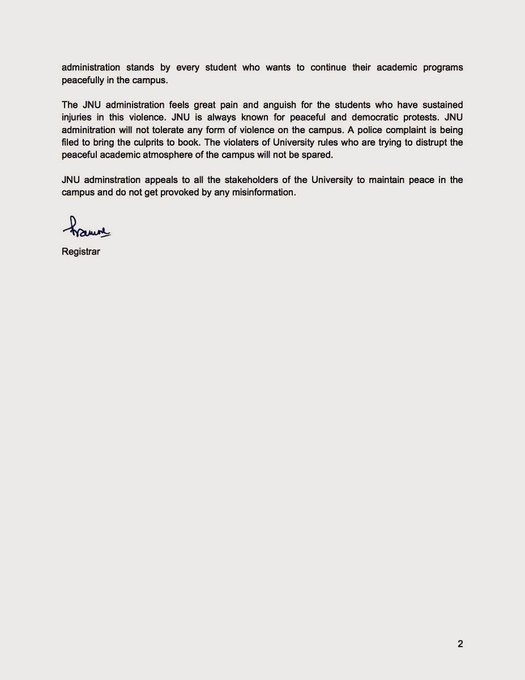
Image via Shiv Aroor on TwitterImage via Shiv Aroor on Twitter
In the statement, the university has said that the registration process has been going smoothly since 1 January. It added that on 3rd January, a group of students had entered Communication and Information Services (CIS) with their faces covered and had damaged the servers after evicting the technical staff present there.
As per the statement, after the servers were made functional, thousands of students had started registering for the new semester by paying the revised hostel fees.
However, on 4th January, violent students had again entered the CIS premises and had made the servers dysfunctional by damaging the power supplies. The university states that the groups of students opposing the fee hike want to stop students from registering with revised fees.
The protesting students have also closed some schools and have stopped the students and teachers from entering. On 5th January, when non-agitating students had tried to enter their respective school buildings, they were physically stopped by the protestors.
At 4.30 pm, the agitating students had reportedly moved from the admin block to hostel rooms attacking the students who had supported the registration process. Even though police were informed, by the time police reached, several students and security staff at the hostels were reportedly badly injured in the assault by the violent protestors.
The statement added that masked miscreants had entered the Periyar hostel and had attacked students and security staff with sticks and rods. Some groups of students had also vandalised the admin block and ransacked the VC’s office in the past few weeks. The university has filed police complaints after the incidents.
The administration has stated that it is unfortunate that some agitating students have been preventing thousands of non-agitating students from pursuing their academic activities.
Appealing all stakeholders to maintain peace in the campus, the university has stated that the violent agitators will not be spared and police complaints are being filed against the miscreants.
Since last night’s violence, the Delhi police had conducted a flag march in the JNU campus late last night.
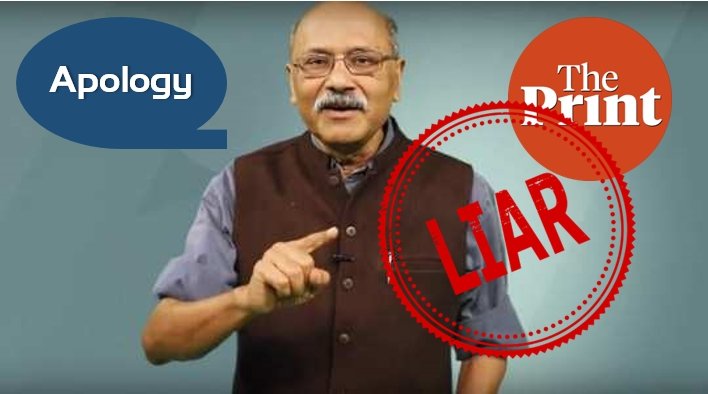
Shekhar Gupta was forced to offer an apology on Twitter after a report on The Print falsely accused a man they had profiled as someone who ‘condemns Dalit upliftment’. The man in question is Professor Vashi Mant Sharma who filed a complaint with the administration of IIT-Kanpur after Faiz’s Islamic Supremacist poem was sung during anti-Citizenship Amendment Act protests at the University.
In our profile of IIT Kanpur professor Vashi Mant Sharma, we erroneously described him also as someone who ‘condemns Dalit upliftment’. We regret the error and apologise to him.
The apology came after Vashi Mant Sharma released the audio clip of the conversation on social media platform. In a thread, he posted the entire conversation he had with the Uttar Pradesh correspondent of The Print. During the conversation, the professor can be heard clarifying his stand on the entire matter and elaborating on the reasons why he registered a complaint with the authorities on the matter.
Here is thread of uncut version of my telephonic conversation w/ ur reporter. All, kindly listen what I said. And then compare it with what Shekhar’s genius has reported & promoted. Let’s begin @SanjeevSanskrit 1/n https://t.co/E6OkqCM8gppic.twitter.com/aT1n8MY4xD
Most significantly, Professor Sharma is also heard telling The Print correspondent that he is involved in activities to improve the social standing and welfare of the Dalit community in India. He tells the journalist that he is associated with a group that works for the welfare of Dalits. Despite that, The Print proceeded to malign his reputation and claim that he ‘condemns Dalit upliftment’.
Here is 16th & last clip of uncut version of my telephonic conversation w/ ur reporter. All, kindly listen what I said. Apologies for repetitive clips, done by mistake. @SanjeevSanskritpic.twitter.com/5hEBuvTNq8
It is quite difficult to imagine any other reason than sheer malice for The Print’s slander of the Professor. The Print appears to have misrepresented Vashi Mant Sharma and slandered him merely because he holds political opinions that they don’t agree with personally. Shekhar Gupta may have apologised for it and corrected their mistake but the ‘mistake’ did not occur in any vacuum. It reflects a level of incompetence that can be adequately explained only by sheer bigotry on the part of The Print journalist.
In the past, The Print has furthered the ‘righteous Jihad’ narrative. One of their editors, Shivam Vij, invented fake quotes to justify their narrative on Kashmir and attributed it to a Kashmiri Pandit in order to give his personal opinions an air of legitimacy. When his lies were called out, he brazened it out instead of offering an unconditional apology on the matter.
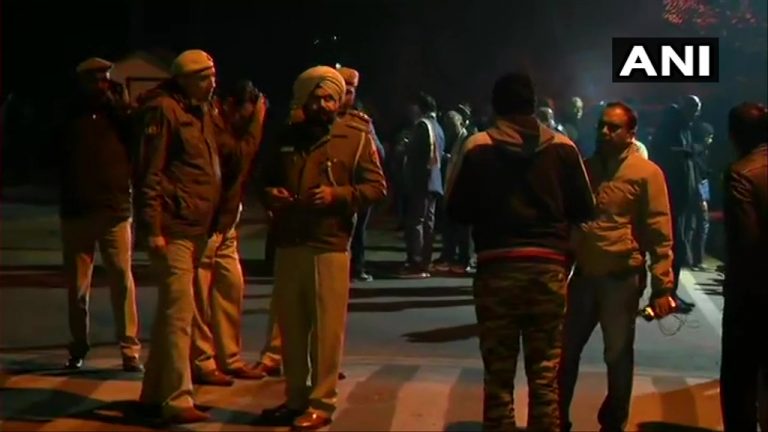
After the JNU campus saw mayhem today as masked goons went on a rampage and attacked students, Delhi police entered the campus in the evening to contain the situation. Delhi Police conducted a flag march in the campus and said that the situation is under control now.
Police had entered the campus after the JNU administration had requested them to restore law and order in the campus.
Flag march being conducted inside JNU campus, situation under control: Delhi Police
Governor Anil Baijal had also instructed Delhi police to take all possible steps to control the situation in the JNU campus.
DCP Southwest Devender Arya: At present, no violence is reported from any part of the campus. Today evening, a fight occurred b/w two groups in which few students were injured and property was damaged. JNU Administration requested police to enter University to restore peace https://t.co/6JItAs5k2h
Deputy Commissioner of Police (Southwest) Devender Arya said that the situation inside the campus is normal now. He informed that extensive flag march conducted by police and all hostel areas have been secured, adding that police deployment has been done at strategic points inside the campus. Arya said that a fight had occurred between two groups in the campus and few students were injured and property was damaged.
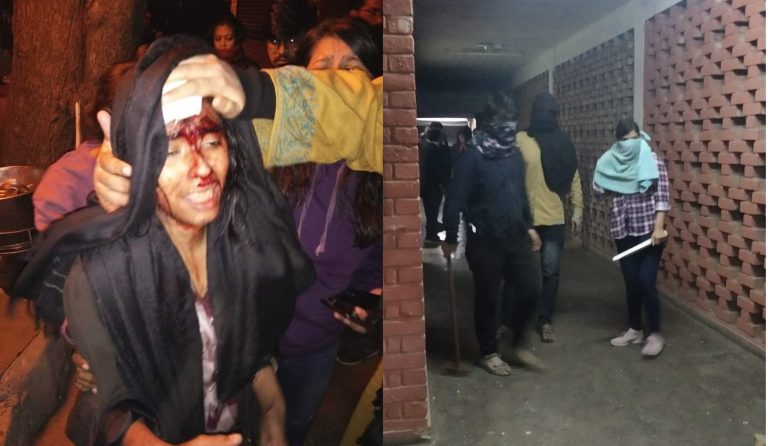
Today a large group of masked mob had entered hostels in JNU campus attacked the students. Several students were injured in this attack, including JNUSU president Aishe Ghosh. The violence took place after two days of conflict between left-wing groups and other students in the university. The left-wing groups are calling for a boycott of the classes, and they prevented students from registering for the winter semester, as they are protesting against fee hike by the university.
A large group of masked goons entered the campus of Jawaharlal Nehru University campus today and assaulted students, faculty and other staff members. JNU Student Union president Aishe Ghosh was also attacked and she was injured in the incident.
Jawaharlal Nehru University Student Union (JNUSU) President Aishe Ghosh at JNU: I have been brutally attacked by goons wearing masks. I have been bleeding. I was brutally beaten up. pic.twitter.com/YX9E1zGTcC
In a video shared on social media, Aishe Ghosh is seen saying that she was brutally beaten and she is bleeding. She said that she is not in a condition to talk.
This is JNUSU President Aishe brutally assualted by ABVP!
She is bleeding! What crime did she do? She is part of students protests against Feehike in JNU! @DelhiPolice remember this is happening under your nose and your immunity to ABVP along with JNU VC wont be tolerated! pic.twitter.com/xqkKpx97CA
Videos of the incident sent to us by sources inside the university show a large number of youths wearing masks entering student hostels, attacking students and vandalising the hostels.
In the above video from Sabarmati Hostel, the attackers are seen to be armed with sticks, rods and bats, and stones and bricks are seen lying on the floor, suggesting that those were thrown inside. Both boys and girls are seen to be part of the masked attackers. Girls in the hostel said that attackers entered the girls wing of the Sabarmati hostel armed with sticks and broken bottles and assaulted the girls. This forced the girls to lock themselves in their rooms.
Apart from Sabarmati hostel, Periyar hostel was also attacked, while several other hostels were surrounded by the mob.
Security guards posted in the university campus said that they were also attacked by the attackers. They said that the attackers are students, and they had kicked them and eaten them with sticks. They said they were beaten while trying to protect the students who were being attacked. One female guard added that she can identify a few of the attackers.
Reports telling that 400+ left members gathered around Periyar hostel, vandalised the hostel & forcibly entered the hostel to thrash the ABVP activists inside
Many people sharing photos and videos of the attack on social media are blaming ABVP for it. On the other hand, ABVP has accused that left-wing students had attacked the Periyar hostel. ABVP’s JNU president Durgesh said, “around four to five hundred members of the left-wing gathered around the Periyar hostel, vandalised the hostel and forcibly entered the hostel to thrash the ABVP activists inside.” He said that ABVP’s presidential candidate Manish Jangid was badly injured. ABVP’s Vijay said that during the day left-wing students had attacked its members, and one injured student has been admitted at AIIMS. He alleged that 300-400 masked youths from left-wing had attacked the Periyar hostel. On the attack on Aishe Ghosh, Vijay said that it is a conspiracy of left to defame ABVP.
ABVP leaders in JNU said today a large group of students had gathered for winter semester registration, as today was the last date for same. But a group of left-wing students, who want to get the classes to remain cancelled as they are protesting against fee hikes, arrived and prevented the students from registering. The left-wing students also allegedly occupied the server room of the university and shut down the internet, preventing students from registering online.
JNU में पिछले कई दिनों से नक्सली गिरोह चरम पर है और छात्रों को सेमेस्टर के लिए रजिस्ट्रेशन नहीं करने दे रहे हैं। आज जब छात्रों ने वामी नक्सलियों की बात नहीं मान कर रजिस्ट्रेशन की मांग की तो छात्रावास के कमरों में घुसकर लाठी और लोहे की राड से हमला किया। छात्र बुरी तरह से घायल हैं। pic.twitter.com/3ITSNhydAh
Photos of ABVP members attacked by left-wing students were also shared on social media by ABVP’s national secretary Nidhi Tripathi.
According to the latest news, Delhi police entered the university campus to control the situation on the request of JNU administration.
The attack came even as a section of JNU students continue preventing classes from being held due to an ongoing strike. A group of students are protesting against the fee hikes proposed by the JNU administration, and not allowing normal functioning of the university to continue.
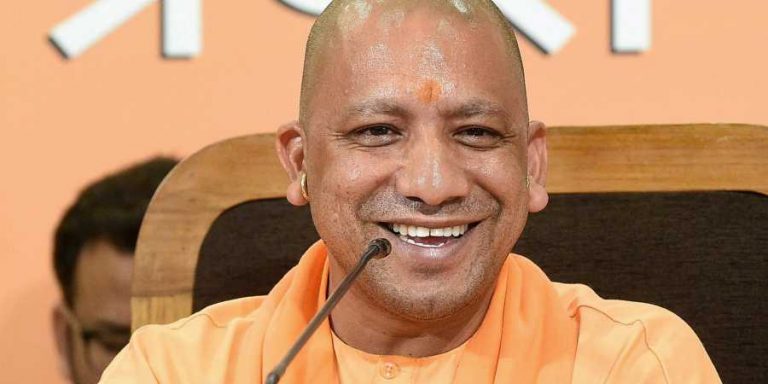
Chief Minister Yogi Adityanath met members of the Muslim community in Gorakhpur to explain the Citizenship Amendment Act and dispel any doubts that the community may have about the law. Deputy CM Keshav Maurya embarked on a similar drive in Moradabad. Gorakhpur is the Mahant’s home turf and he visited the shop of one Haji Chaudhari Kaif-ul-Wara where he handed over a booklet to him.
“This is a booklet about CAA, read it and all doubts will be cleared. I thought of beginning the awareness campaign from here,” he told Kaif-ul-Wara. He explained that it was a law to give citizenship. “Those who did not have citizenship and are living in India, this law gives them citizenship,” he said.
#CAA के बारे में बताने और समझाने के लिए मुख्यमंत्री योगी गोरखपुर में मुस्लिम परिवार से मिले
“It is the tradition of India to give shelter to persecuted people and Prime Minister Narendra Modi brought CAA to give citizenship to such people,” Yogi said. “This people’s awareness programme is aimed at clearing confusion and doubts spread against CAA,” the chief minister said. He also met several other people from the Muslim community.
Kaifulwara promised to created awareness about the CAA among people and requested Yogi Adityanath to release the violent protesters who had no previous criminal record saying that children make mistakes. It remains to be seen whether Yogi Adityanath will accede to that request.
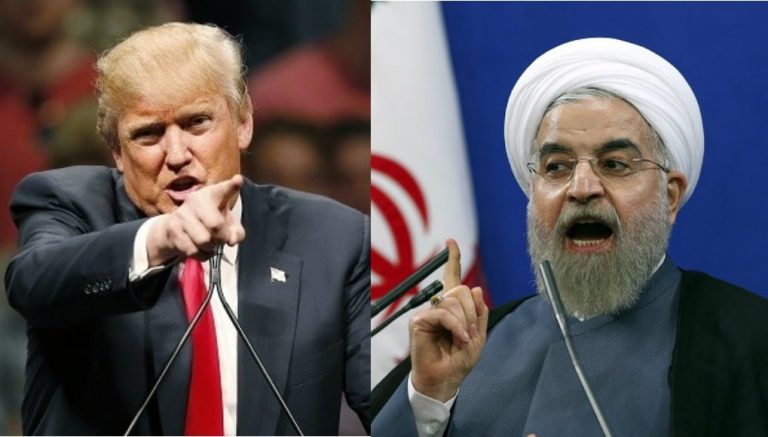
Tensions in the Middle-East between the United States of America and Iran are escalating. Following the assassination of the Iranian General Soleimani by US forces in Iraq, a war between the two countries appears imminent. The Foreign Ministry of Iran has labelled the murder of their General an act of ‘international terrorism’.
BREAKING: Iran’s foreign ministry says the killing of Soleimani is an act of ‘international terrorism’
Furthermore, Iran has also decided to finalize a further retreat from the Nuclear deal. The spokesman for the Foreign Ministry said that officials will meet late on Sunday to consider steps to reduce Iran’s commitments under the Nuclear Deal framework it signed in 2015.
Earlier, US President Donald Trump had threatened Iran that the USA has identified 52 sites, including cultural sites, if Iran started getting ideas about retribution. Now, Iran has responded by saying that if the USA chooses to do so, it would constitute a war crime. Their Foreign Minister said, “Those masquerading as diplomats and those who shamelessly sat to identify Iranian cultural & civilian targets should not even bother to open a law dictionary.”
Those masquerading as diplomats and those who shamelessly sat to identify Iranian cultural & civilian targets should not even bother to open a law dictionary.
Jus cogens refers to peremptory norms of international law, i.e. international red lines. That is, a big(ly) “no no”.
Also, Iran has unfurled a red flag on top of the iconic The Holy Dome of Jamkaran Mosque in Qom, which is an old Shi’ite tradition symbolising bloody revenge. Now, as per reports, a UK Royal Navy nuclear-powered attack submarine will be “in position to strike Iran” if the current tensions between Tehran and Washington over the killing of an Iranian general result in a full-fledged armed conflict.
There was also a terror attack in Kenya at one of the US’ military bases by Al-Shabab, an Al Qaeda affiliate. “U.S. Africa Command acknowledges there was an attack at Manda Bay Airfield, Kenya and is monitoring the situation,” said U.S Army Maj. Gen. William Gayler in a statement. “Al-Shabab is a brutal terrorist organization,” said Gayler. “It is an Al-Qaeda affiliate seeking to establish a self-governed Islamic territory in East Africa, to remove Western influence and ideals from the region, and to further its jihadist agenda. U.S. presence in Africa is critically important to counter-terrorism efforts.”
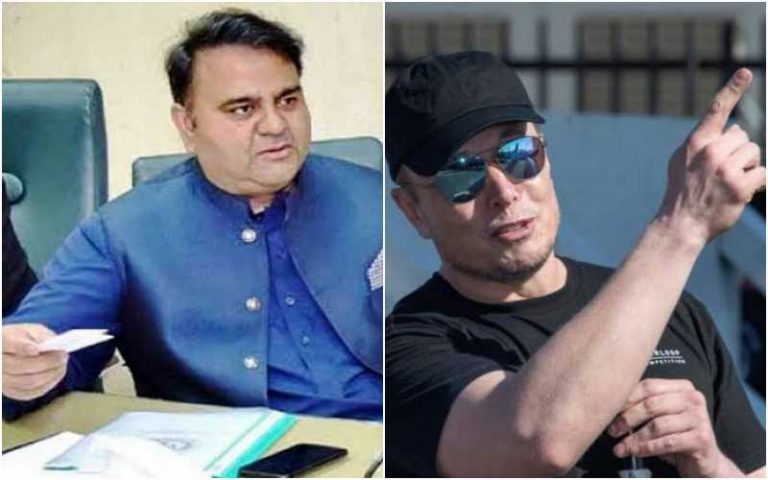
Pakistan’s ‘science and technology’ minister Fawad Hussain Chaudhry is a man with a very active imagination. He is rather popular among Indian social media users as he keeps falling for silly pranks and provides regular laughter doses on Twitter. Whenever things start becoming a little dull, Ch Fawad Hussain comes up with a brainwave and brings a lot of fun to social media, especially for Indians.
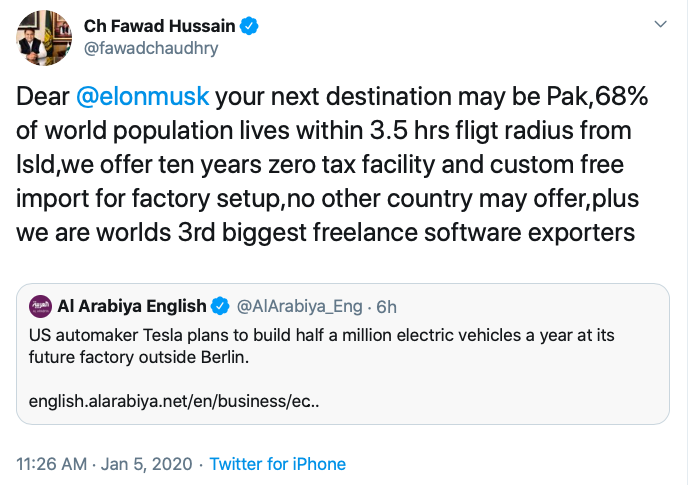
Today, Ch Fawad Hussain, who is a visual testimony that under Imran Khan’s government, there is no shortage of food in Pakistan (for some people), irrespective of the price of naan and lack of ‘timatars’, took a very profound step towards technological advancement in Pakistan. No, he did not invent a ‘timatar’ producing machine, he invited Tesla founder Elon Musk to come and “Make In Pakistan”.
Fawad Chaudhry’s tweet
Reading a news report about Tesla’s plan to build half a million electric vehicles a year in its future factory in Berlin, Fawad, being a responsible minister of Pakistani science and its technology, tweeted immediately tagging Elon Musk that he should come and “Make In Pakistan” instead. Fawad also claimed that Pakistan is the world’s third-largest exporter of freelance software.
Not just that, Chaudhry, displaying excellent marketing skills like the ’employee of the year’ salesman in local malls, made Musk ‘special offers’ like ‘Ten years zero tax facility’ and custom free import for factory set-up. He also made Musk aware that 68% of the world population lives within a 3.5-hour flight radius of Islamabad like it was brand new information that South Asia has the world’s most highly populated countries.
Since Fawad also claimed that Pakistan is the world’s third-largest exporter of freelance software, a Twitter user asked whether he means soft underwear.
Software exporters? I hope you are not talking about manufacturing of soft underwear? What software technologies has Pakistan patented in last decade? If you think media piracy and distribution is software export then you are truly Chu Fawad Hussain!
The science and technology minister has a very colourful personality and his old dance videos and rather ‘vivid’ tweets keep doing rounds on the internet. However, he has been extremely popular in India after he started falling for twitter pranks in the hopes of getting information on RAW, and Indian Army.
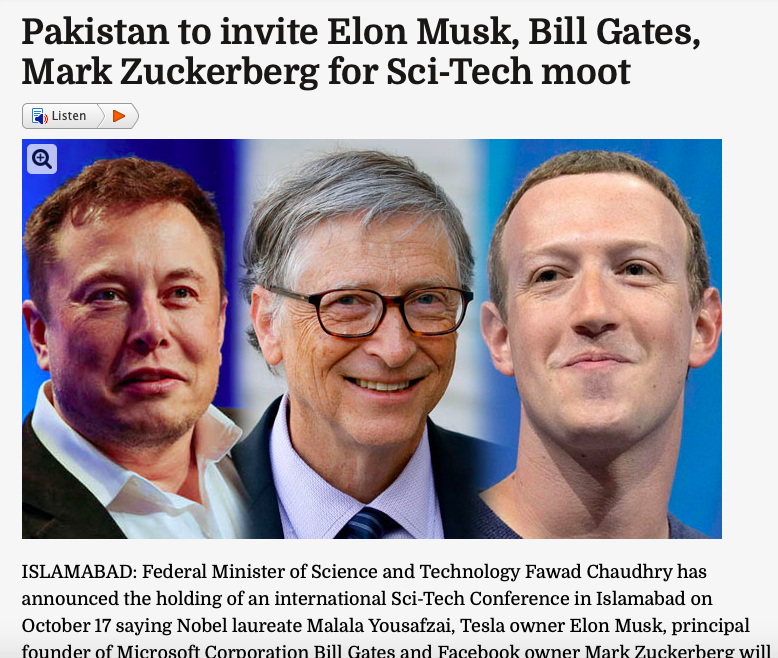
It is, however, notable here that Fawad Chaudhry’s obsession with Elon Musk is not new. In July last year, he had made big announcements that Pakistan will organise a global event on technology and innovation called ‘Think Future’. Fawad Chaudhry had declared that the massive event will be attended by bigwigs like Elon Musk, Bill Gates, Mark Zukerberg and, for some unfathomable connection to science and innovation, Malala Yusafzai.
Chaudhry’s announcement, like Kejriwal’s promises here, was covered by almost all news outlets in Pakistan, with big headlines and big images of the billionaires mentioned, heralding the idea of Imran’s Naya Pakistan. However, soon after the July announcement, India abrogated the article 370 in Jammu and Kashmir and Fawad got so busy with tweeting threats to PM Modi and Indian Army that he must have forgotten about Elon Musk and Bill Gates.
The said event was announced on October 17, on the birth anniversary of Dr Syed Ahmed Khan, but sadly, no global event happened, there was no sign of Musk, Zuckerberg, Gates or even Malala either. Instead, the Pakistan ministry of science and tech’s official handle is full of Fawad Chaudhry meeting the people of his constituency, an Australian diplomat, and the Danish ambassador on that day and the days next. Perhaps Elon Musk had other plans.
A very Happy new year to you. We are finally in the year 2020 and the nightmare of 2019 is behind us. Surely 2020 can only get better from here? We won’t mind erasing 2019 from our memory completely once we dethrone Modi and remove all evidence of 2019 ever taking place.
2020 does promise a refreshing change and we are very optimistic about this year. It got off to a very strong start with the fireworks in New York City. Loved the absolutely superb show of fireworks, the light, the colorful sparkles, the lovely sound that informed us about the arrival of the New Year. Even the smoke in the air formed lovely shapes after the explosion and we had a fun time guessing which animal which smoke cloud resembles.
Alas, the party had to end and we had to focus our energies on the burning issue of our times, the fascism in India. Modi and Shah have been trying their best to divert people’s attention from the draconian CAA which gives citizenship to persecuted minorities but we can’t let him get away with it, diary.
Within this week, they tried several ways to divert people’s attention diary. You won’t believe how far they have gone. BJP Bhakts are getting younger and younger diary, so many infants are dying in Rajasthan’s hospitals to divert public attention but we didn’t let that happen diary. We simply ignored all those deaths and our liberal followers have been following that same rule.
However, Modi-Shah didn’t give up that easily, they orchestrated an attack on Nankana Sahib in Pakistan, diary, to show how minorities get oppressed in Pakistan. They even involved Pakistan Govt in this plan, that is why the Pakistan Government refused to act for hours as the mob laid siege to the holy shrine.
This wasn’t even their worst attempt diary, wait till you hear their next plan. Modi asked his friend Donald Trump to bomb an Irani General in Iraq! That has diverted not just India, but entire world’s attention and we are still struggling to figure out how to get it back. But just imagine, diary, these 2 fascist rulers of India are starting the 3rd World War just because they are scared of our Shaheen Bagh protest. Unimaginable fascism in these two people, we just can not believe it.
Just when we were about to convince UN forces to invade India, this impending World War has upstaged our plans. However, we will not rest, diary, we will keep trying our best. Though truth be told diary, the best liberals on offer these days are not that good. This week they got caught spreading fake news of rape by UP Policemen. Amateurs, they should have known that rectal bleeding can be checked by medical tests, why make up a lie that can be easily busted? This is not 2002 when we could invent 3 days between 28th February and 1st of March, this is the social media era. Sigh, maybe we will hold a training session for these budding liberals soon.
Anyway, diary, we are leaving New York tonight. Will be going to Athens for a week, where we will come up with a new strategy to fight the fascism in India. Till then, ciao!
Imran Khan, the Prime Minister of the terrorist state of Pakistan, on Sunday finally condemned the barbaric attacks on minority Sikhs and vandalism at the Nankana Sahib two days after the incident. Taking to Twitter, Imran Khan claimed that the attacks on Sikhs go against his “vision” and the government will show “zero tolerance” against those involved in it. But along witht that, he also blamed MP Modi and RSS for attacks on Muslims and other minorities in India.
Drawing contrast between the terrorist state of Pakistan and India, Khan said that there is a “major difference between the condemnable Nankana incident and the ongoing attacks across India on Muslims and other minorities”.
The major difference between the condemnable Nankana incident & the ongoing attacks across India on Muslims & other minorities is this: the former is against my vision & will find zero tolerance & protection from the govt incl police & judiciary;
“The former is against my vision & will find zero tolerance & protection from the govt incl police & judiciary,” he tweeted, referring to the Nankana Sahib incident.
Further, Imran Khan claimed that Prime Minister Narendra Modi and RSS vision “supports minorities oppression and the targeted attacks against Muslims.”
In contrast, Modi’s RSS vision supports minorities oppression & the targeted attacks against Muslims are part of this agenda. RSS goons conducting public lynchings, Muslims being violated by mobs are all not only supported by Modi Govt but Indian police leads anti-Muslim attacks
He also said that RSS goons were conducting public lynchings of Muslims and it is being supported not only by Modi Government but also the Indian police, who according to Khan are leading attacks on Muslims.
Shockingly, the anti-India statements made by Pakistan PM Imran Khan resonated in India too as Islamists in India supported Imran Khan’s false propaganda by claiming that anybody who criticizes Khan’s statements will be considered a Nazi.
We must realise that any Indian Liberal criticizing IK for these tweets is a Nazi Enabler. They are more concerned about the image of India than the actual lives of Indian Muslims. https://t.co/xx7yd3dWET
Another user questioned PM Modi for not speaking on the Nanakana Sahib attacks and went on to claim that Pakistan PM has Zero tolerance for people who are attacking the minorities.
Anyone thinks Modi will do the same? Zero tolerance for people who are attacking the minorities. We know for a fact that Nawaz Sharif got punished quickly by Pak judiciary. Didn’t he? https://t.co/qyXTuMHA94
Imran Khan’s desperate attack against India comes at a time when the Islamists in Pakistan have continued their attacks on minorities living in Pakistan.
On Friday, in yet another incident reaffirming the persecution of minorities in Pakistan, the angry mob of Muslims had gathered around the Sikh shrine of Gurudwara Nanakana Sahib and started pelting stones at it. The mob was being led by the family of Mohammad Hassan, the boy who allegedly abducted and converted Sikh girl Jagjit Kaur, who is the daughter of the gurdwara’s granthi.
The mob of angry Muslims gheraoed the holy shrine on Friday afternoon, leaving many devotees stranded inside. The protesters threatened to destroy the gurdwara and build a mosque in its place.
Hundreds of Muslims protestors swarmed the Gurudwara Nankana Sahib and raised inflammatory slogans against the Sikhs. “We will not let any Sikh live in Nankana Sahib and will its name to Ghulam-e-Mustafa,” one of the irate Muslim protestors exclaimed.
The police along with the Pakistani Rangers and Army had rushed to the spot to quell the protest but so far they had failed in dispersing the violent mob away from the Gurudwara. The situation was brought under control after the local police and Pak Rangers arrested the protesters.
However, the mobs dispersed only after police released Hassan, the man who had abducted Sikh girl Jagjit Kaur, daughter of the Gurdwara’s panthi.
Following the attack on Sikhs by the Muslim mob at revered Nankana Sahib Gurdwara in Pakistan, the Indian government on Friday expressed its concern and called upon the neighbouring country to take immediate steps to ensure the safety and security of the Sikh community living in Pakistan.
In a statement, the Indian foreign ministry said New Delhi called on the government of Pakistan to ensure the safety and security of pilgrims who regularly visit the shrine that marks the birthplace of the founder of Sikhism. It also demanded strong action against the perpetrators of violence and vandalism.
However, the terror state of Pakistan has rejected reports of Gurdwara Nanakana Sahib being was attacked and desecrated by the Muslim mob. In a statement, the Foreign Office said that the provincial authorities in the Punjab province have informed them that it was a scuffle between two Muslim groups and not an attack on Sikhs.
The Pakistan government had claimed that the altercation happened on a minor incident at a tea-stall. It claimed that the District Administration immediately intervened and arrested the accused.
The passage of the Citizenship Amendment Act brought out into the open the grave contradictions that have befuddled the Indian State for long. These contradictions stem from the great degree of difference between the perception of the masses regarding the State of India and that of the ruling establishment regarding its role. Narendra Modi’s resounding victory in the 2014 General Elections was the first step towards resolving these contradictions. And in the first six months of his second term as Prime Minister, many of these contradictions are getting resolved.
Expectedly, members of the erstwhile establishment are not too happy with the recent developments. The vision that the current ruling dispensation has of the Indian State is more consistent with the perceptions of the masses than it could be said of any other government in the past. Naturally, the ruling dispensation is at odds with the elites that have ruled the roost till now. And the elites are making their disagreement known.
In an article published on India Today on the 3rd of January, Rajdeep Sardesai envisions a future for India in 2029, a decade since the passage of the CAA and the protests against it. The future that he paints is one of a popular revolt after India has become an unofficial Hindu Republic. The article reflects unhealthy bouts of both pessimism and optimism but such conclusions come from a poor understanding of reality.
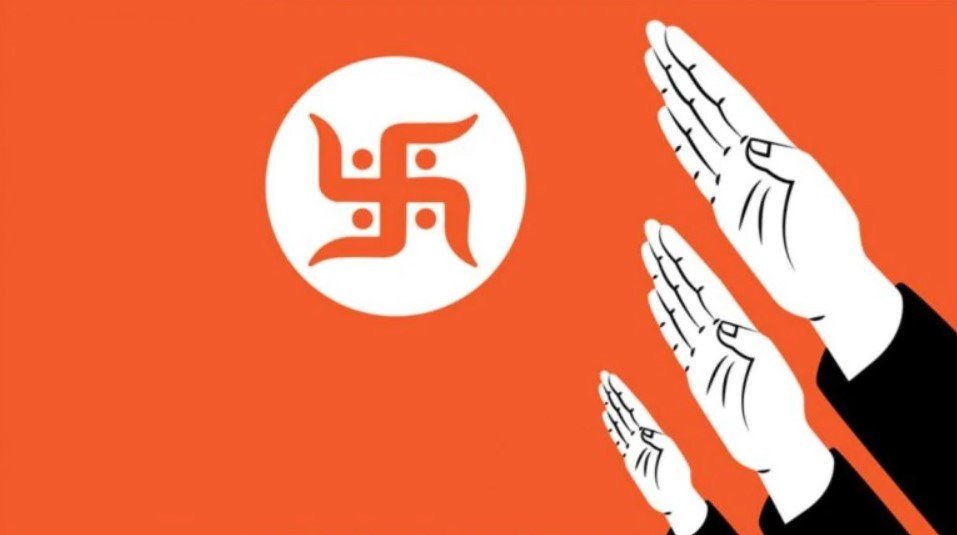
We are not going to talk much about the featured image of the article that paints the Swastika as a fascist symbol. Stupid people do stupid things but it’s an undeniable truth that even Goebbels did not provide as much positive propaganda to the Nazis as Indian liberals have. When Swastika is portrayed as a Nazi symbol, it’s not the Swastika that gets maligned. It’s fascism that receives a positive endorsement. The sacred glory of the Swastika could never be maligned by such antics. ‘Liberals’ are only portraying Nazism as an enlightened philosophy when they paint the Swastika as a Nazi symbol, they are glorifying Adolf Hitler when they do that. Do they even care?
Tanmoy Chakraborty/India Today
Moving ahead of the blind hatred of liberals towards Hindusim, we focus on the content of Sardesai’s sermons. He says, as part of his pessimistic forecast, “A 79-year-old Narendra Modi has been elected for a fourth consecutive term and, this time, imperiously, is planning a move to Rashtrapati Bhavan. The Constitution has been amended to create a presidential form of government, and the electoral system has undergone a drastic change. Supervising the makeover is Amit Shah, deputy prime minister for the past five years. Simultaneous Lok Sabha and state assembly elections have been held, but ultimate power vests in the office of a directly elected president. Other constitutional changes have seen the word secularism’ being dropped from the Constitution: India is now unofficially a Hindu Republic.”
His optimism comes next, “And then, suddenly, just as the decade draws to a close, there is a popular revolt: a widespread demand for the withdrawal of the president-for-life order. Under pressure, the all-powerful political strongman relents: the constitutional changes are rolled back, fresh elections to a duly elected Parliament are ordered.” He admits that his predictions are fantasy but says that they are not entirely unimaginable. We can concede to that.
I have often talked about irreconcilable differences between the ‘liberal’ perception of the Indian State and the Hindutva conception of it. Never have been these irreconcilable differences been more prominent than in the words of Sardesai in the abovementioned article. If a proponent of Hindutva were to envision the same future, it can be said safely that his opinions of the said events would be at polar opposites with Sardesai. A Hindutvavadi would celebrate Sardesai’s version of a bleak future and rage against his Utopia. And these are the contradictions that have bothered India for long.
Let us be honest here. The vast sections of the Indian masses, the overwhelming majority, will not mind if India is declared a Hindu State officially, and that is the worst case scenario. Most likely, they will celebrate it if India becomes so. Therefore, when Sardesai appears to lament India becoming an unofficial Hindu Republic, a proponent of Hindutva simply cannot empathize with his concerns. Furthermore, dropping the word Secularism from the Indian Constitution is unlikely to ruffle any feathers.
The Constitution of India when our country became a Republic in 1950 did not have the word in its Preamble. It was inserted by Indira Gandhi during the Emergency. Not just Hindutvavadis, everyone who believes in Democracy should demand its removal. Regarding Narendra Modi’s reelection as the Prime Minister of India for the fourth consecutive term, it won’t be surprising at all considering his current popularity. Moreover, if he is reelected Prime Minister, it will obviously be because the people love him.
The article by Sardesai is littered with comments that reflect the extent to which Lutyens Delhi is unaware of the sentiments of the country. Commenting on the BJP’s humiliating defeat in the General Elections of 2009, he says, “The Congress-led UPA seems to have a semi-permanent stranglehold over power and the country appears to have decisively rejected the politics of the Hindu Right.” Sardesai misses the salient point of the results completely.
The results of 2004 and 2009 only show that the Indian masses did not consider the UPA to be as anti-Hindu as they did during the elections of 2014. The masses were still under the impression that the parties were taking care of Hindu interests. But, by 2014, it became clear that these parties that engage in the worst forms of minority appeasement and have a terrible track record on corruption to boot. 2004 and 2009 were not indicative of a permanent defeat of the Hindu Right as an ideology in any manner, they only revealed minority appeasement combined with caste politics is a very potent strategy for electoral victory. And ironically enough, these two tactics combined with relentless corruption brought down the Liberal Establishment.
Rajdeep Sardesai then embarks upon a wild flight of fantasy. He says, “But by 2029, there are fissures too in the gargantuan Hindu Rashtra project. The nation’s periphery is on the boil: an attempt to capture Pakistan-occupied Kashmir has not succeeded. A US-mediated truce forces India and Pakistan to accept both sides of the Kashmir divide as a single entity with semi-autonomous status. In Nagaland, there are renewed secessionist demands while other parts of the Northeast see a fresh eruption of ethnic conflicts, fuelled by concerns over the shifting demographic patterns in the region. A coercive state finds it hard to stamp its authority on local antagonisms.”
One can only laugh at such predictions. Liberals have been clutching at straws since the abrogation of Article 370 but even by their pitiful standards, this is quite a stretch. For such a ‘US-mediated truce on Kashmir’ to materialize, the USA will have to be far stronger than it has ever been till now and India will have to be far weaker than it has ever been since Independence. Simultaneously, the power equation between India and Pakistan will at least have to be comparable to what it was in 1965. Does any of this look remotely possible?
India will be far stronger in 2029 than it is now, Pakistan will be far weaker by the end of this decade than it is at the beginning and the USA will be in no position to bully India at all. An India that elects Narendra Modi to power for a fourth consecutive term will not be one that will cede territory in a decade. Rajdeep Sardesai’s prediction is worse than wishful thinking, it’s the rambling of a mind struggling to preserve its sanity. As for Sardesai’s ramblings about the North East, the region is far more integrated today than it has ever been. Separatism is simply not a viable option going forward. Anyone who understands anything about the North East understands this.
Rajdeep Sardesai makes a series of other dubious assertions. Predictions of the North-South divide increasing, and farmer mutinies and college rebellions and other such musings. These are not predictions, these are just garrulous sermons of someone trying to cope with the events of the latter half of 2019. There’s a reason for Sardesai’s bout of insanity. And the reason is Hindutva. In the long arc of history, Savarkar has won and Nehru, along with everything he stood for, has been dragged through the mud.
The most important lesson of 2019 that liberals haven’t learnt yet is that Hindutva is the natural order of existence for the Indian State. Hindutva aligns the Indian State perfectly with the aspirations and ambitions of the Indian masses. This is why the BJP’s push for the abrogation of Article 370, the Ram Mandir, the CAA and the NRC received huge support from the Indian masses.
Liberals were frustrated over the fact that their anti-CAA campaign received support only among Islamic extremists and Leftist clowns at Universities while the overwhelming majority of the country was annoyed by their shenanigans. One wonders when will they realize, if ever, that the overwhelming majority of the country’s population, regardless of the political party they support, are on board with Hindutva as an ideology. They have always been onboard with Hindutva as an ideology. Hindutva just needed time to mature and for its political representatives to gain credibility. Such things, unfortunately enough, require a certain degree of time to develop. And with time, Hindutva has become the dominant political force in the country.
Therefore, now, we ask ourselves, what will India look like in 2029? Narendra Modi is likely to have retired after serving his third term and Amit Shah would, in all possibility, succeed him as the Prime Minister of the country. There is unlikely to be any drastic changes to the political set up of the country. The BJP would have expanded its base massively in South India. It is unlikely to have a great amount of support in Tamil Nadu and Kerala but it will have solid support even there.
West Bengal will be firmly with the BJP by 2029 and the state will be a BJP bastion. North-East would continue to be firmly under the BJP and overall, the BJP may be looking at 400 seats in the Lok Sabha. Narendra Modi will be considered the Founder of New India and he will be regarded as the greatest Prime Minister India has ever had. Pakistan-occupied-Kashmir is likely to have been reclaimed by then and Pakistan may have suffered a further loss of territory by then.
The Indian State will be much stronger than it is currently and will enjoy far greater clout in the international scene than it does now. Most importantly, however, it is extremely likely that India will be considered a Hindu State unofficially. It can be safely said that the face of India will be a lot more Hindu than it is now. And it wouldn’t surprise anyone if India is declared a Hindu State as well, considering the fact that an overwhelming majority of Indians do want India to be declared a Hindu Rashtra. Liberals may hate it but if Democracy demands it, then their objections make no sense.