Home Blog Page 5831

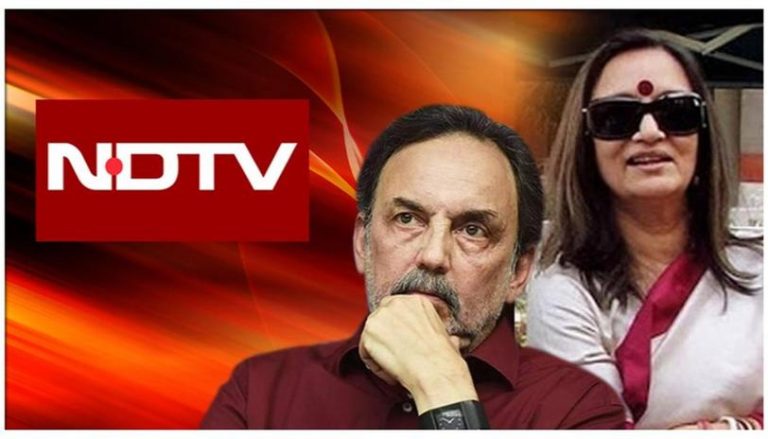
Accused NDTV promoters Prannoy and Radhika Roy move HC challenging SEBI show-cause notice for insider trading

The promoters of controversial left-wing media NDTV – Prannoy Roy and Radhika Roy have moved the Bombay High Court, challenging a show-cause notice issued to them by the Securities and Exchange Board of India (SEBI) in 2018 for alleged violation of insider trading regulations.

According to reports, the High court stated that it will pass orders on January 6. The court also said the accused husband-wife duo could “face the notice” and attend hearings before SEBI.

The petition filed by accused Prannoy Roy and Radhika Roy sought that the court set aside the notice and direct SEBI to allow them to inspect all the documents, records and internal files and notings on which the regulator had relied before issuing the same.

Read: SAT upholds SEBI penalty of ₹2.10 crore on NDTV, ₹3 lakhs each on 3 directors for not disclosing tax demand on time

The SEBI had issued the notice on August 31, 2018, accusing both Prannoy Roy and Radhika Roy of trading shares of NDTV while in possession of “unpublished price sensitive information”. The notice accused them of violation of the “Prohibition of Insider Trading Regulations”.

However, Roys petition said the notice was “arbitrary, unreasonable and issued in gross abuse of power”.

Earlier in August, NDTV founders Prannoy Roy and his wife Radhika Roy were prevented from leaving the country by the CBI officials.

Read: Here is why Prannoy Roy and Radhika Roy were stopped at the airport and were not allowed to leave the country: Read details about the ICICI-NDTV loan fraud

In recent times, NDTV has been embroiled in controversies over alleged financial irregularities. NDTV is facing multiple cases related to violation of FDI norms, Income Tax violation, and non-compliance with disclosure norms.

The central investigative agency CBI is probing a case against NDTV in relation to a Rs 375 crore loan from ICICI Bank and a corresponding wrongful loss of Rs 46 crore to the bank. There is a chain of borrow, repay and borrow where Roys took a series of loans in 2008 as they sought to buy back a large chunk of NDTV shares from the market, allegedly violating foreign direct investment (FDI) rules in a 2007-09 investment, a charge denied by the company.

Read: Read full details of the new FIR filed by CBI: Prannoy Roy, Radhika Roy and Vikram Chandra accused of criminal conspiracy, cheating and corruption

An FIR was filed against Prannoy Roy, Radhika Roy, NDTV, RRPR Holdings Pvt Ltd and unknown officials of ICICI Bank by a company called Quantum Securities Limited in June 2017. The charges levelled were those of criminal conduct, conspiracy and cheating. QSL is a shareholder both in NDTV and ICICI and filed the FIR as an aggrieved party of the alleged misdeeds.

In August this year, the Securities Appellate Tribunal (SAT) had upheld a SEBI order imposing a penalty of Rs 2.10 crore on NDTV and Rs 3 lakhs each on 3 directors for violation of disclosure norms. It is alleged that the company and its directors failed to inform the stock exchanges about a tax demand of Rs 450 crore served by the income tax department.

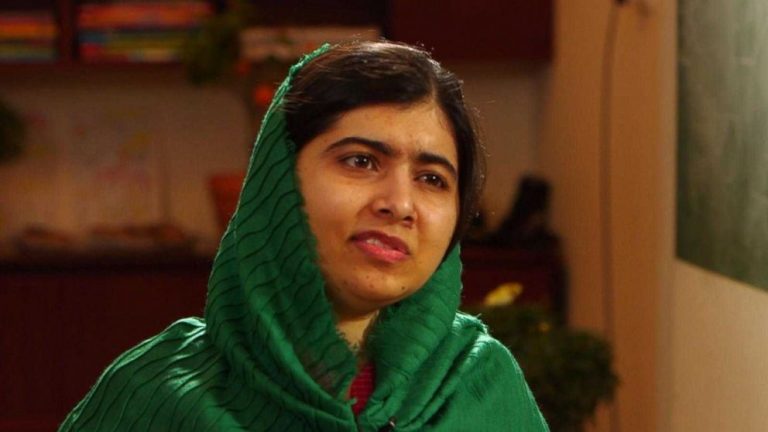
After outrage, HRD ministry deletes tweet promoting Malala Yousafzai, who had spread fake news against India on article 370

On Wednesday, Minister of Human Resource Development led by Ramesh Pokhriyal Nishank committed a gaffe after it tweeted a post glorifying controversial ‘activist’ Malala Yousafzai who had spread fake news against India after the abrogation of Article 370 in Kashmir.

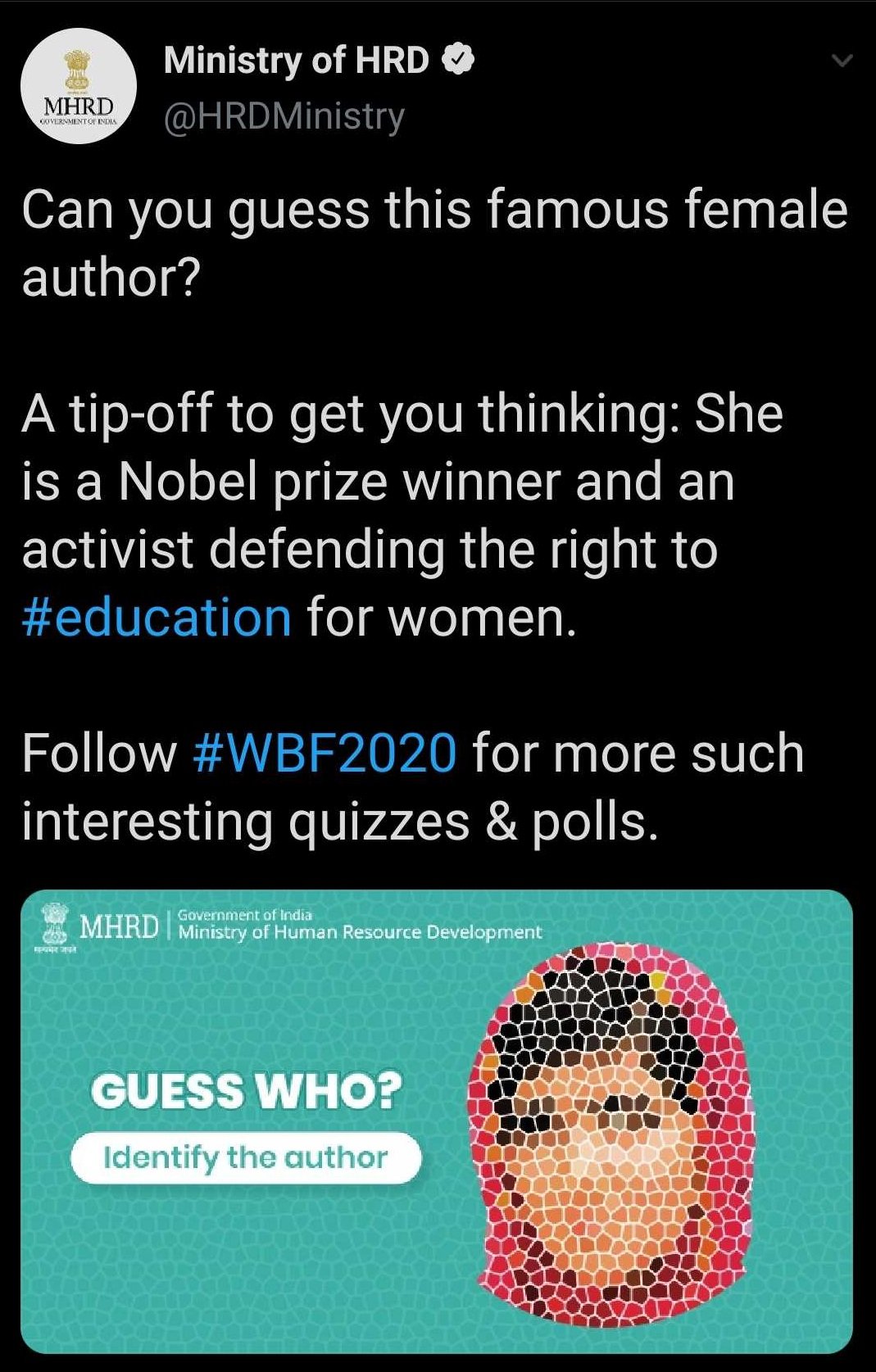
The HRD ministry had posted an infographic on micro-blogging site Twitter asking the social media users to recognize who he/she was. The infographic, part of the quiz “identify the author series” read, “Guess Who?”, while the post gave a hint to the users by glorifying Malala as a “famous female author, a Nobel Prize winner and an activist defending the right to education for women”.

The tweet Posted by MHRD.

It is important to note that Malala Yousafzai had indulged in propagating terrorist state of Pakistan’s false propaganda on Jammu and Kashmir soon after Modi government had scrapped Article 370 that gave special status to the erstwhile state.

Malala Yousafzai had resorted to fear-mongering and attempted to incite Muslims by falsely claiming that the precautionary restrictions placed in the state were impeding girl child education and also peddled lies in the process.

Read: Malala Yousafzai spreads fake news, claims girl from Kashmir missed her exams on August 12 which was an Eid holiday

She had also parroted fake Pakistan propaganda after she attempted to sell ‘fiction’ stories as the reality of the state of Jammu and Kashmir following the revocation of special status in the state. In doing so, ‘Nobel laureate’ Malala was caught peddling lies by social media users and was also schooled for her ignorance on the ongoing issue.

The act of Ministry of HRD to glorify controversial pro-Pakistan activist Malala Yousafzai earned the ire of Twitter users on Thursday. Social media users called it ‘shameful’


One user also called out HRD ministry’s ignorance regarding local heroes and accused the ministry of carrying public relation activity for Malala.


Another user asked why is HRD ministry approving and mainstream haters of India and also urged the BJP leadership to focus on the HRD ministry. Others expressed disappointment over the handling of such an important ministry in a bad manner for the past six years.


As social media users condemned the glorification of Malala Yousafzai, the HRD Ministry realised its mistake and deleted the tweet.

Read: Malala Yousafzai tries to mouth off platitudes on Kashmir, gets called out by Netizens

This is not the first time that a govt handle has made such gaffes. It may be recalled that during the anti-CAA riots at Jamia Millia Islamia University, the official twitter account of PIB had posted in favour of Jamia’s violent protesters, which was later claimed as an “error by an employee”.

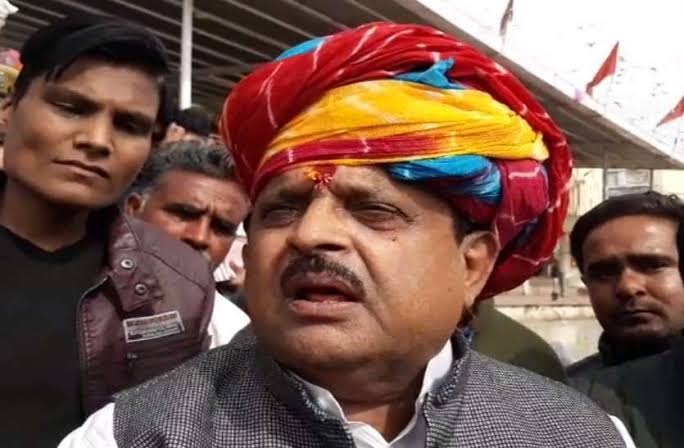
‘Main kuch nahi keh sakta’: Rajasthan health minister dodges questions on Kota infant deaths, walks off when anchor persists

In a major public health system tragedy in Congress-ruled Rajasthan, more than 100 children had died in JK Lon Hospital, Kota last month. While Rajasthan Chief Minister Ashok Gehlot had stoked a controversy by trivialising the incident, now the Rajasthan health minister Raghu Sharma has been seen dodging questions asked to him on the incident in a debate.

The news anchor on ABP News questions the Congress minister on the Rajasthan government’s apathy towards the family of the children who died in the government hospital last month. He asked as to why the Ashok Gehlot government in Rajasthan is not meeting the family’s of the children who died and why aren’t they paying any compensation to them. He questions why the Congress government has remained silent over the deaths of 100 children in government-run hospital in Kota, Rajasthan.

On one instance when the Health Minister tries to pin the blame on the previous BJP government, the anchor cuts him short by saying whatever happened during the previous government’s regime is passed, now why doesn’t his government show some affinity.

To this, the minister is heard saying: “mein kuch nahi keh sakta” (I cannot comment in this regard), before taking out the microphone and walking away.

The news anchor is seen repeatedly coaxing the minister to answer. He says that the ministry is answerable and cannot shrug off their responsibility. He says that these questions will be asked repeatedly unless the public does not get a satisfactory answer to their queries over the Congress Government’s apathy towards the case but the minister refuses to take any question.

The news anchor reminds the minister that he is the health minister of Rajasthan and it is his moral responsibility to answer to all the public grievances, but since Raghu Sharma, takes off the microphone he remained oblivious to what was being asked to him.


This apathetic response coming from the health minister did not go done well with people on Twitter who blamed the Congress ecosystem for the insensitivity shown by its ministers.

As 9 more infants died in the last two days of December in government-run JK Lon Hospital, the total count reached 100. Refusing to take responsibility, the hospital superintendent had claimed that the deaths of these newborns are due to the low weight at birth. The hospital had given a clean chit to itself by forming a committee to investigate the deaths, which has now ruled out any negligence saying resources and equipment were functioning properly.

Rajasthan CM Ashok Gehlot while speaking to media on the death of children in the state had also said that children die, there is nothing new in it. “Poore pradesh ke andar, har hospital ke andar, 3-4-5 mautein hoti hai. Prati din. Koi nayi baat nahin hai” (In the entire state, in all hospitals, 3-4-5 children die every day. There is nothing new in it), said the CM.

Bahujan Samaj Party chief Mayawati had also taken to Twitter to call out Congress General Secretary Priyanka Gandhi’s hypocrisy over silence over the deaths of these 100 children in Congress-ruled Rajasthan.

Following the deaths of the children, the National Commission for Protection of Child Rights (NCPCR) had issued a show-cause notice to the Chief Medical And Health Officer of Kota District, BS Tanwar, to look into these deaths. The NCPCR also observed that pigs were found roaming inside the campus.

The Commission has directed Tanwar to appear in person on January 3 to explain reasons for not sharing the report on action taken with the Commission.

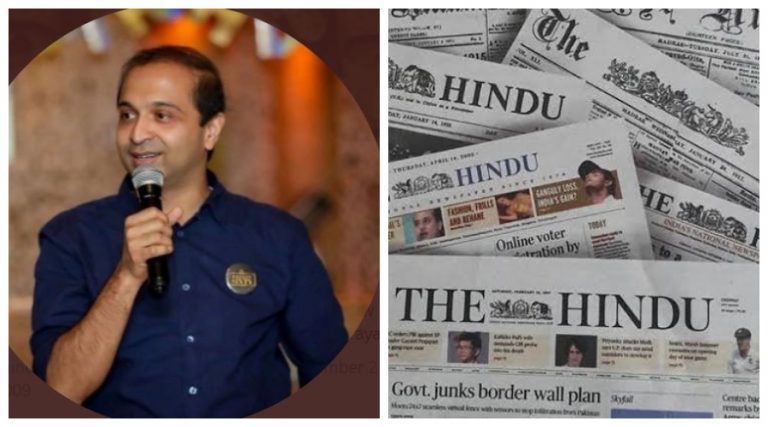
Associate Editor of The Hindu gets schooled after he cries ‘Hindi imposition’ over ISRO mission names, Gaganyaan and Chandrayaan

The associate editor of The Hindu, Narayan Lakshman, took to Twitter to scrutinize how the names associated with the ISRO mission, Gaganyaan and Chandrayaan are named in Hindi. He cries about how Hindi is being forcefully imposed outside the ‘cow belt’ by the Modi-led government.


However, netizens responded promptly to this moral science lecture and tried to knock basic sense into The Hindu associate editor, which he clearly seems to be deprived of.

Read: Hindi is a beautiful language, as is Tamil, Kannada etc: ‘Imposition’ narrative must be quashed and Sanskrit used for national integration

Twitter user Vinaya Pai briefed the editor that these words ‘Gaganyaan’ and Chandrayaan’ are actually derived from Sanskrit, a language of ancient India with a 3,500-year history which is also the oldest known languages in the world. She advised the journalist to ‘ditch this sectarianism’.


Other Twitter users also pointed it out to him that even outside of ‘cow belt’, these are commonly used terms.


Cow-belt is the region of India spread over Rajasthan, Uttar Pradesh, Haryana, Bihar and Madhya Pradesh which is largely rural and animal husbandry is a very common profession.


People were also surprised at The Hindu Associate Editor’s attempt to divide Indians by forcefully trying to fit the ‘Hindi imposition’ narrative.

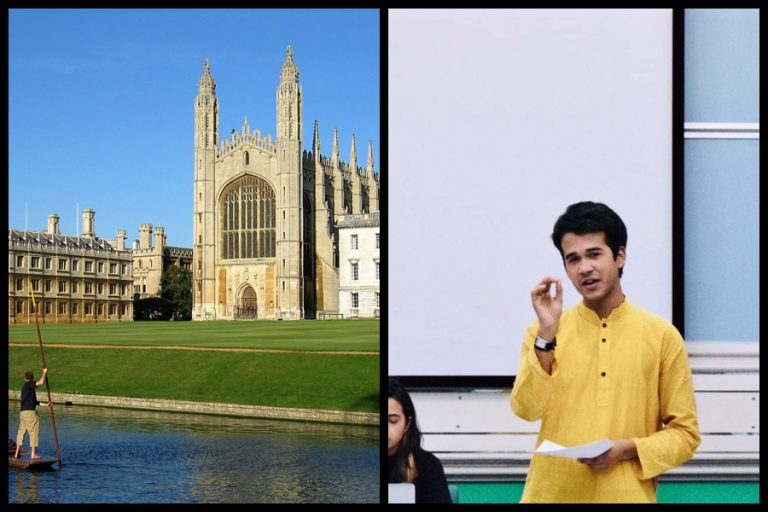
Cambridge and Hinduphobia: My experiences with the Left and the price I had to pay

In the heydays of the colonial era, the British were not exactly supporters of a united and strong India. Divide-and-rule was the way to rule a country as big as ours. Sadly, it seems some things have not changed, 72 years after modern India secured its independence from the British Raj. In a highly unfortunate turn of events, recently two Cambridge University students were murdered by an Islamic fundamentalist in London. But just a few weeks later some members of Cambridge were denouncing not Islamic fundamentalism but Indian voices and people who were trying to stand up against such violence, particularly keeping the purge of Kashmiri Pundits in 1989 and the subsequent radicalisation of Kashmir in mind.

When, on one hand, the husband of a Cantabrigian gets radicalised enough to end up fighting for ISIS and, on the other hand, some societies in Cambridge are problematic enough in myriad ways to warrant police cover for event, and yet some members of the Cambridge community keep obstructing even interactions with pro-India and pro-Hindu speakers who are not half as problematic, the priorities of some seems to be a bit misplaced.

Prevent duty has been enacted firmly (and often unfairly) in the University, but that still does not remove the danger that radicalisation has had on youth in the United Kingdom. This is particularly relevant after seeing that in around 200 cases in 2017/18, pro-Jihad activists, hate preachers and anti-semites had been invited as speakers on multiple occasion in varied universities, in a gross lapse of Prevent duty.

Without feeding on any communal divide, I feel that recent experiences have shown a certain bias and predilection, even prejudice, of some individuals and groups in the University to side (or not) with specific ideologies and political alignments, often in a manner that is post-truth and not reflective of where dangers truly lie!

This is the story of my experiences in realising and exposing the anti-India and anti-Hindu voices in one of the key architects of the British Enlightenment – the University of Cambridge, in the current day. Universities are meant to serve as sandboxes for acquiring and practising essential skills and knowledge for students to live as responsible citizens of our world. Free exchange of ideas and concepts, cutting across subjects and identities is of fundamental importance therein. Freedom of speech and expression is important to facilitate such freedom and flux. However, unfortunately, that is often saying a lot, even in prestigious universities across the world.

I did my masters and PhD from the University of Cambridge. One of the university’s core values is the freedom of thought and expression, and for most of my 5 years of studying and undertaking research there, I have never had an instance where I have felt otherwise with that. It was only when I was elected as a student union officer and leader, that I saw a darker side of the University space. The tragedy of this age often is that of exclusivism and polarisation, particularly around ideologies. This is an age of political binaries: You are either aligned with an ideology through and through, or by association with the organisations or parties or leaders associated with it, or are not. There is no space for anybody who does not conform to the either-or.

It is this culture that seems to pervade student politics in Cambridge as well. As a result of such polarisation and almost dogmatic alignment with some political ideologies, political bullying is something that seems to have taken root deep within various cross-sections of the Cambridge community. Some of these bullies self-identify as ‘left-liberals’, being neither truly left (with ‘champagne socialists’ galore) nor liberal in the least.

The university seems to provide a ‘safe-space’ where they can ironically express their overtly domineering side in the wake of lesser relevance elsewhere. In fact, some commentators like Daniel Hannan have gone so far as to ask whether students had to be left-wing to study at Cambridge! It almost seems like a mixture of academic influences and peer pressure make students invariably go down a certain intellectual and political path, and the few Neo’s who try to escape this Matrix are oft-bullied.

It is at the hand of such bullies that I have been a subject of repeated attacks, as an elected officer of the students’ unions of Cambridge University, in the last one year. The University of Cambridge consistently ranks among the best Universities in the world. I am proud to have been a part of this university and to have learnt so much from its constituents. My current college – Trinity, itself has around 5 living Nobel Laureate members, with one of them being my current supervisor Prof. Brian Josephson! While Cambridge is a paragon of excellence, what is often missed is the dark underbelly of Cambridge.

While in no way implying that political bullying is entrenched in the system, there is a certain culture that pervades the student and activist space, which interestingly is also seen in many other Universities: that of other-ing by a certain clique, which dominates the political discourse in the University space, of those not in agreement or conformity to their ideas and beliefs.

While I never saw this as a student from 2014 to 2018, it was only when I had access to certain key groups in the University space as the Chair of Executive Committee and Vice President of the University of Cambridge Graduate Union (2018-2019), one of the two student unions of Cambridge, which represents roughly 12,000 members, that I got glimpses of this beast.

For instance, it was during this time that I got close to a member of an ultra-left student organisation in the University professionally and then as a friend, and it was from him that I got to know some truths that are never said out in the open. He said that there are organisations here that have such reach that they have ‘ears’ in every college of Cambridge. They apparently have a lot of money, and reach in national dailies! Their clout is such that if they seek to blacklist and/or character-assassinate someone and make their functioning difficult in the University space, they could, by unleashing their propaganda machine. This was the ‘beast’ he said they commanded, he quipped and impishly grinned.

How deep the rot of intolerance is was something I was yet to see in full glory and sharp contrast. But saw, I did. I had been the founder-convenor of the Indian National Students Association (INSA), a nationalistic student body, in Cambridge and a 35 under 35 UK-India Youth Leader in 2018. My politics had been one of balance, of welfare and responsibility, of Dharma. These were some of the reasons my politics and outspoken nature did not go down well with many individuals and groups at times, particularly those who were openly anti-India and anti-Hindu.

There were times when there were such falsities and misprojections spread about India that it would make any patriotic Indian squirm in his/her seat; for instance, the reportage and activism around the abrogation of article 370, while highlighting legitimate concerns of human rights and self-determination, questioned the very sovereignty of India in myriad ways, such as when Kashmir was described as a region north of India!

Notwithstanding the closure of the only Hindu temple in all of Cambridge and Cambridgeshire by the Cambridge City Council, there were also times when academics such as Dr. Priyamvada Gopal, who stated that ‘Hindu extremism is rooted in a macho 20th-century response to British colonialism which mocked Hindu effeminacy‘, would openly and brazenly display her anti-India and anti-Hindu sentiments.

Since I would often stand up against such blind criticisms and jibes at India and Hindus, there was a lot of badmouthing and open lobbying against me in university societies over the years, besides alienation by many just on premade judgements of what ‘my side’ stood for (without once caring to know what that stood for), but I trudged on. While these developments were disturbing, they were not as disturbing or hostile as what was to come ahead.

On the day I had my PhD graduation, soon after my 25th birthday, I got a private message from one of the co-presidents of an activist group. The text was a long-winded message saying that I was to keep away from the meetings of the organisation thereon since some members had apparently complained about ‘harassment’ and ‘intimidation’. What followed was judgement, even hatred, coupled with negativity directed at me, not for one day, two days, a week or a month, but for three whole months!

After a painfully long period of stress, constant back-talk and gossip, I was completely absolved of the charges. It was a thumping victory and yet a pyrrhic one: the reputational damage had been subtle but all-too-evident. My reputation, ability to do justice to my mandate and my wellbeing was all affected by the smear and the hate for months!

As an Indian, I have always stood up for the interests of my country. Around the time there was the Pulwama terrorist attack on 44 jawans (military personnel), India undertook a surgical strike in Balakot in Pakistan, where it targeted a terrorist camp. With the already simmering potion of negativity at Cambridge around my politics, what put fuel to fire was my Facebook status update the Balakot surgical strike by the Indian government. In the past, I had been one of the few Indians who had gone out of the way for establishing peace and goodwill with Pakistanis by being on the Cambridge University Pakistan Society committee, but this one status made people, who had known me personally, to go from being on good terms to calling me everything from ‘war mongerer’ to seeking ‘nuclear war’.

One should have seen the intensity of hatred from various corners of the University. For them, the 44 jawans and thousands of innocent lives did not matter as much as how this had led to damage to Pakistani lives (while in the same breath saying that India ‘had just hit trees’)! In my Facebook status, I had spoken up against the issue of non-state actors and terrorism, not against the sovereignty of Pakistan. And yet there was a wide-scale mobilisation under the surface, and I heard from some sources that they had wanted to institute a vote of no confidence in me, and with their foot soldiers and workers, it may have succeeded, but it was apparently stopped by some of my supporters and friends.

Understandably, I went from having a number of Pakistani friends to a lot fewer, based only on this misprojection around the status. The next big hit was on India’s Independence Day – 15 August 2019, when I was invited to deliver a speech in the celebrations near the Indian High Commission. Children, women, elders, all for the event which was a cultural celebration of India’s Independence Day. However, before we could even get halfway through the event, we faced one of the fiercest and most aggressive crowds of protesters in central London! The issue? Abrogation of Article 370. We were a handful of Indians, surrounded by around 5000 protestors, as per London Police reports. The Indians were hit with eggs, tomatoes, bottles and other projectiles, for about three hours!

The best part was that everyone on the Indian side stood true to the Indian way of not retaliating in the same petty way as the aggressors, who left no stone unturned or abuse unused to harass the Indians. We Indians stood our ground with calm and with occasional sloganeering while the other side kept abusing and hurling the aforementioned projectiles. As much as I have always stood for the self-determination of Kashmiris, this blatant display of hooliganism and hatred was unnecessary and uncalled for.

The High Commissioner lauded the courage of every single attendee, once we were safely taken inside. On the same day, I led the historic initiative to unfurl the tricolour in the historic Parker’s Pieces ground (where modern football is said to have been born). It was not as much a statement as a quiet acknowledgement of the importance of India to humanity. This measure and my participation in the IHC incident also was faced with immense criticism from students, academics and activists. There were such hate-tweets and dirty looks on the streets of Cambridge in those days that I still find it amusing how people who do not know much about me or my views or politics could harbour so much hate for someone.

Regardless, I moved on, with self-belief and strength. The next battle was when the Gates Cambridge Scholars of a Cambridge wrote an open letter condemning the commendation by Bill Gates for Narendra Modi, Prime Minister of India. In the letter of support from the Graduate Union for this condemnation, I introduced the caveat that the Swachh Bharat Abhiyan, for which Modi got the award, was a great initiative for India and had helped millions of people. There was a huge outcry by a certain group of students, as expected. Such was the political pressure that the Union finally had to retract that section.

In all of this, instead of waging a frontal battle of ideology, it was a shadow war that these detractors waged. A battle of gossip, propaganda and misprojections. This reached the level where university activities were influenced by these groups. For instance, my participation in a University-level committee (Equality and Diversity) was stalled and protested due to my beliefs and politics! The ‘No Pasaran’ policy applied here was a needless, uninformed move, which led to such pressure that the committee itself had to be postponed!

On 13 August 2019, I was invited by Parma Shakthi Peeth to meet and interact with Sadhvi Ritambhara, the firebrand Hindutva leader of India, who had come to the United Kingdom for a while. This invitation was extended to me as an Indian student leader in the UK and was not as much on the Ram Janmabhoomi movement as on the Vatsalyagram charitable activities and other nationalistic points. Regardless, I never sought to project it as a blanket endorsement of all her speeches or views, even though I admired her tej (inner fire), strong persona and belief in her ideas. However, interaction is not an outright endorsement.

I even interacted with Aatish Taseer, whom many would consider on the opposite spectrum of the political scale, and yet did not endorse many of the things he believes in. An impartial, investigative interaction is neither platforming nor facilitation. Only if some ‘tolerant’ people understood that.

Instead they said some extremely unpleasant things about me and Sadhvi Ritambhara (including calling her ‘terrorist’), and this exploded on the student community, again with blatant misprojection and lies. My courtesy smile shared with her in a picture was projected as a smile of admiration, and my folded hands as a general social gesture of respect were taken as ‘submission’ to her.

The kind of language and false projection, both online and offline, was amazing here! There was so much hate due to this that a friend of mine lost his privileges in some circles due to his association with me! More recently, when I agreed to host Vivek Agnihotri in Cambridge and tried to use my privileges for booking this, I was charged as misusing power.

I have used these privileges in the past for various other events that were never objected to. Clearly, there was an ideological and political angle to this. For this, I was again placed under restricted action due to an official letter and complaint by somebody speaking ‘against fascist voices’. When they could not do anything around the disciplinary meeting due to a complaint on this, they took the most tokenistic, reprehensible and unnecessary step: of using the ruse of accusing me of ‘revealing confidential information’ of the Graduate Union in this blog, a charge that was not entirely true. After the disciplinary meeting, I was allowed to complete my term on 15 December 2019. However, details of this meeting somehow ended up in a Varsity article.

This leak was not by me, and there seemed to be a bigger nexus between the student-media, spearheaded by an ultra-left activist who remains unnamed for this article, and the student unions. How else could the newspaper Varsity know of the number and nature of charges in a private meeting shortly after the meeting had ended? While my blog post simply exposed the sustained campaign and attack I have had to face by some people who have differing political alignments over the year, their excessive knowledge simply exposed further the ‘Left Mafia’ that worked in the University space.

The very prospect of the organisation of an interview and interaction with Mr Vivek Agnihotri was faced by immense hate in the University, even without knowing the nature, tone or tenor of the event. So much for free speech! The supposed leak was used as the premise to dismiss me, 13 days before my term officially ends, even though my last working day was 15th December 2019. On the day of this tokenistic dismissal, I had completed 11 months and 18 days of the 12 months of my term. This was clearly an attempt at making a political statement, which was spread all around the University by the student media.

Most interestingly, unlike what would be expected of standard employment procedures, this ‘termination’ on 18th was given on the same day! No prior notice whatsoever! I have now appealed the decision by the GU and the appeal awaits a hearing (with the fear that due to time and financial constraints, I may not get the opportunity to completely resolve this, even though I have belief in the merit of my case). My name and reputation have been tarnished beyond repair, and yet I stand strong for what I believe in. I have not done anything wrong or with malintent.

I will always speak up for India and for Hindus, however uncomfortable may that make certain others. If I fall for this, I shall be a martyr to the cause of my country and people! All of this that I have shared is not symptomatic of a truly liberated space and community. This is not expected of those who profess the freedom of speech and liberalism. But this is what it is. A world mired in hypocrisy, cowardice and vindictiveness. I feel happy to have crossed and triumphed in all the ‘Battle of Cantabrigia’ that I fought with the political bullies, Left Mafia, anti-India and anti-Hindu forces in the University space at Cambridge.

As I have crossed the end of a successful term (a termination 13 days on frivolous grounds is a poor and cowardly attempt at humiliation) in office as a student leader, I look back and see many fond memories and some not so fond ones. I am happy to have made some great friends and associates, and honestly quite flattered to have made some diehard enemies! Most importantly, I am happy to have stood my ground till the very end, and pass into the proverbial sunset with my head held high.


GST collection crosses Rs 1 lakh crore in December with 16 percent annual growth, second month in a row

The gross Goods and Services Tax (GST) collections have yet again crossed the Rs 1 lakh crore benchmark for the second consecutive month in December 2019. In December, Rs 1.03 lakh crore was collected as GST owing to increased consumption and better compliance.

The gross GST revenue collected in the month of December 2019 is Rs 1,03,184 crore of which CGST is Rs 19,962 crore, SGST is Rs 26,792 crore, IGST is Rs 48,099 crore including Rs 21,295 crore collected on imports and Cess is Rs 8,331 crore, the finance ministry said in a statement.


The statement further added that the total number of GSTR 3B Returns filed for the month of November up till 31 December 2019 was 81.21 lakh. The gross GST revenue for December showed a growth of 16% from its December 2018 figure, the ministry said in a press release.

“If we consider IGST collected from imports, the total revenue during December 2019 has increased by 9% in comparison to the revenue during December 2018,” the ministry said.


According to the press release, Arunachal Pradesh showed the highest rate of growth of gross GST in December at 124%, while GST collection in Lakshadweep fell by 78% and in Jharkhand by 3%.

Jammu and Kashmir showed the highest year-on-year increase in collections, which rose 40% to Rs 409 crore last month. Maharashtra achieved the highest GST collection at Rs 16,530 crore, a 22% increase from December last year. Karnataka secured second place with GST collection of Rs 6,886 crore, an increase in 11% in one year.

Read: Two years of GST: The GST Council Miracle and how Modi sarkar became the first to survive GST

The Communist-ruled southern state of Kerala, which had criticised the central government for not offering enough financial aid during the floods while boasting about their contribution to tax net, has only contributed Rs 1,651 crore, with an annual growth of 17%.

Gujarat and Tamil Nadu also crossed the Rs 6,000 crore rupee mark. Meanwhile, the largest state of the country Uttar Pradesh stands at fifth, contributing only Rs 5,489 crore.  However, Uttar Pradesh has also seen an 11% growth in tax collection in one last year.

Interestingly, small states like Haryana has been effectively contributing to GST exchequer with Rs 5,365 crores, the sixth position in tally, just Rs 124 crore less than UP. West Bengal, Delhi, Telangana, and Rajasthan completed the top 10 states in terms of revenue GST collected in December.

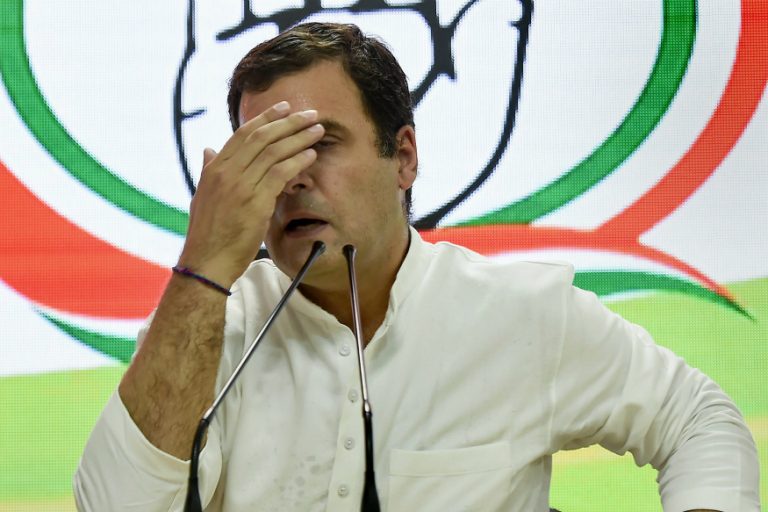
Rahul Gandhi embarrasses Congress in Kerala, writes appreciation letter for Loka Kerala Sabha summit which his party boycotted

A political gaffe by Congress leader Rahul Gandhi has pushed Kerala’s United Democratic Front (UDF) into a huge embarrassment after Wayanad MP praised Kerala government’s Loka Kerala Sabha summit which was earlier boycotted by Congress and its allies in Kerala.

According to the reports, the Congress-led United Democratic Front had earlier decided to boycott the upcoming Loka Kerala Sabha, the event held by the state government to bring Keralites living around the globe under one platform.

However, in a letter dated December 12, Rahul Gandhi, who is also MP from Kerala’s Wayanad, lauded the gathering, calling it a “great platform” to connect with the Indian diaspora.

“I congratulate the members of the Malayalee diaspora for their phenomenal success, and for being worthy ambassadors of the State. The Loka Kerala Sabha is a great platform to connect with the diaspora and recognise their contribution,” read the letter written by Rahul Gandhi.

The official Twitter handle of chief minister Pinarayi Vijayan posted Gandhi’s letter on Thursday.


Rahul Gandhi’s letter supporting the event comes at a time when UDF has boycotted the event alleging that the event turned out to be an extravaganza where the government is spending huge money amidst the financial crisis. The opposition UDF also alleged that none of the decisions taken in the first edition of the Loka Kerala Sabha has been implemented till now by the LDF government.

Read: Kerala: Congress files complaint against BJYM leader for filing ‘missing person’ report for Wayanad MP Rahul Gandhi

Reportedly, Leader of Opposition Ramesh Chennithala had quit as the LKS vice-president in June 2019 to protest against the suicide of two businessmen, Sajan Parayil from Kannur and Sugathan from Punalur. The two were allegedly denied administrative clearance from the side of government for their expensive constructions.

The UDF was also annoyed over the expenditure on renovating the venue of the Loka Kerala Sabha, the R Sankara Narayanan Thampi Hall in the Kerala Legislative Assembly complex in Thiruvananthapuram.

The Loka Kerala Sabha is one of the largest convergence of NRI business people from Kerala. It has participants from across 47 countries apart from delegates from 21 states. The second edition of the three-day meet concludes on Friday.

Anti-CAA riots: ‘Liberals’ brought back the ‘urban riot’, but Yogi Adityanath might have a solution

For over two weeks following the passage of the Citizenship Amendment Act (CAA), India witnessed rioting and violence on an unprecedented scale especially in Yogi ruled UP. From burning trains to pelting school buses with stones, from hate speeches (disguised as poems) to cornering policemen and trying to lynch them. Every rule of civilized society was broken as the anti-CAA rioters set about on their mission to overturn our democratic mandate with raw street violence.

The biggest, most disturbing takeaway here is this: urban riots have made a roaring comeback in modern India.

For a while now, it was assumed that due to the proliferation of technology, the urban riot was on its way out. After all, when there is a smartphone in every hand and CCTV in every corner, who could expect to stay anonymous in a mob? It was believed that with 24 x 7 cable news, rioting would quickly bring shame and stigma. The media and public outcry would be such that wanton violence would become politically unprofitable.

Read: Khilafat 2.0: How Useful Idiots in the media and political parties were fooled by Jamia students associated with the ‘blood brother’ of a banned Radical Islamic outfit

In the second half of December 2019, we have seen this belief turned on its head. The rioting went on and on, with much of the media actively cheering them. Sections of civil society often conferred a moral halo upon the rioters. Hate speech was characterized as “revolutionary poetry.” Rioting and stone-pelting were described as dissent. Fake news was systematically manufactured to malign police. Only yesterday, a man who called for the assassination of the Prime Minister was described by one of India’s most prominent news channels as a mere “scholar.”

The urban riot is back with a bang and the anti-CAA crowd has shown that it can be done. Not just that, rioters can expect to be glorified in domestic and international media, as well as academic and civil society circles. Nothing good can possibly come of this.

Read: Anti-CAA riots: Police seek ban on PFI as 25 members arrested for involvement in criminal activities during the protests

But there is some hope and it came out of Uttar Pradesh. This is where some of the worst violence had happened.

Untitled.png
The Asian Age headline

In one word: consequences.

And now everyone wants to get in on this idea. First, it was the Railways.

Untitled.png
The Hindu headline

Now, the Delhi Police wants the same.

Untitled.png
The NDTV headline

It is heartening to see a good idea spread so quickly through the system.

From the point of view of a thug, rioting used to be a relatively risk-free activity. Given our weak police force, they would likely not get identified anyway. Even if they were, the worst that could happen would be a few hours at the police station. Then, they get out. The case gets buried along with literally crores of other cases pending in the judicial system.

Until now. The Uttar Pradesh government moved to extract an immediate price from those accused of rioting. Suddenly, the incentive structure changed. Even if the actual number of recoveries is tiny, it has a much larger chilling effect on wannabe rioters everywhere.

Read: Railway property worth Rs 80 crore damaged during anti-CAA riots, to be recovered from the rioters: Railway Board Chairman

And it worked. The anti-CAA rioting in Yogi ruled Uttar Pradesh stopped as suddenly as it had begun. Because the incentive structure for rioters had been turned around on its head. Incentives matter.

One thing is now clear. We cannot depend on media coverage to shame rioters into stopping the violence. It was an ad hoc solution anyway, a “jugaad” to compensate for the fact that India is a soft state with underpaid, ill-trained and unmotivated police.

Read: Congress wants Yogi Adityanath to resign because he would not let Islamists and politicians burn UP during anti-CAA riots

Instead, Yogi Adityanath is using the instruments of the state to finally fulfil one of the fundamental functions of government: protecting the life and property of citizens. It is time for other jurisdictions to pick up this new way and make it count. It will go a long way to restore the supremacy of the law.

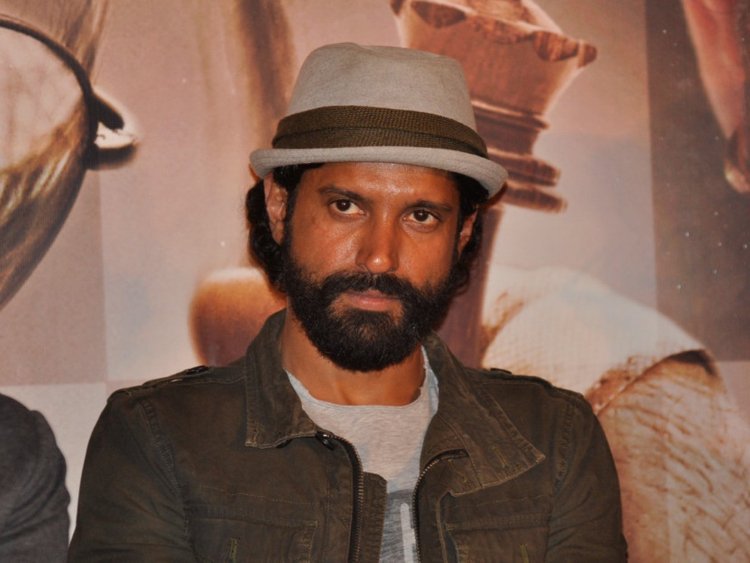
Complaint filed against Farhan Akhtar for posting distorted image of Indian Map during anti-CAA protests

A complaint has been filed against Farhan Akhtar with the Cyber Crime department of the Goa Police for posting a distorted map of India in his tweet that made an appeal to citizens to attend the protests against the Citizenship Amendment Act at the August Kranti Maidan, Mumbai. The distorted map excluded Kashmir from India. The complaint has been filed by Savio Rodrigues, Founder and Editor-in-Chief of Goa Chronicles.

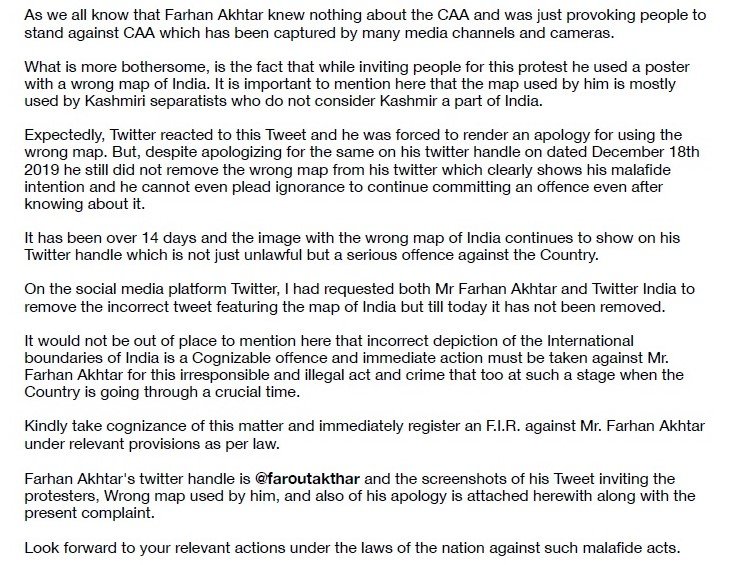
In his complaint, Rodrigues wrote, “As we all know that Farhan Akhtar knew nothing about the CAA and was just provoking people to stand against CAA which has been captured by many media channels and cameras. What is more bothersome, is the fact that while inviting people for this protest he used a poster with a wrong map of India. It is important to mention here that the map used by him is mostly used by Kashmiri separatists who do not consider Kashmir a part of India.”

Savio Rodrigues’ complaint against Farhan Akhtar

Rodrigues added, “It would not be out of place to mention here that incorrect depiction of the International boundaries of India is a Cognizable offence and immediate action must be taken against Mr. Farhan Akhtar for this irresponsible and illegal act and crime that too at such a stage when the Country is going through a crucial time.”

Read: Read why “facts” about CAA and NRC shared by Farhan Akhtar are all false or misleading

Rodrigues has requested the Police to take cognizance of the matter and take adequate actions as per law. In his complaint, he also mentioned that although the son of Javed Akhtar has issued an apology over the matter, he did not delete the wrong map from his profile. “It has been over 14 days and the image with the wrong map of India continues to show on his Twitter handle which is not just unlawful but a serious offence against the Country,” Rodrigues said.

As we had reported earlier, the anti-CAA image that was shared by Farhan Akhtar was linked with Stand With Kashmir, a Kashmiri Separatist organization that believes the terrorist organization JKLF is ‘Secular’. There are also reasons to believe that SWK is backed by Pakistan to undermine Indian interests. It remains to be seen whether Goa Police takes any action against Farhan Akhtar for his tweet.

Hinduon se azadi? Sagarika Ghose hails Islamic invaders and mass murderers as patriotic kings and freedom fighters

During the course of the protests against the Citizenship Amendment Act, we have witnessed a continuous attempt to whitewash the anti-Hindu bigotry that was inherent in these protests from the very beginning. Despite overwhelming evidence that the protests were sparked by Islamic extremism and not constitutional values, liberals continued to ally with these antisocial elements because it served their political agenda. Sagarika Ghose, a prominent propagandist in the mainstream media, continued with the Islamist, anti-CAA agenda.

Recently, she posted a tweet where she glorified Jihadis who had committed unspeakable atrocities against Hindus. According to Sagarika, people such as Siraj-ud-Daulah, Tipu Sultan and Bahadur Shah Zafar were India’s “great patriotic kings”.


The logical inconsistencies in the arguments of liberals are only exceeded by their undaunted hypocrisy. On one hand, it is argued that India did not exist before 1947 while on the other hand, Islamic despots are held up as “great patriotic kings”. Quite obviously, liberals don’t care about the truth, they only care about the agenda and their agenda requires the glorification of Islamic despots from time to time.

Furthermore, Tipu Sultan was a genocidal maniac. He relished torturing Hindus and he was proud of the fact that he committed genocide of Hindus, as a proper Jihadi. Siraj-ud-Daulah, on the other hand, did not care much about patriotic feelings either and was fighting solely to maintain his own power. He was the last independent Nawab of Bengal. It is a testament to the brutalities committed against Hindus by the Islamic regimes in Bengal that most Hindus welcomed British rule in the region.

Read: 2019 anti-CAA protests: 9 visuals that prove they were motivated by deep seated anti-Hindu bigotry and Islamic extremism

The tale of Bahadur Shah Zafar is more complicated. While the War of 1857 has been established as the ‘First War of Independence’ in the popular imagination, it was anything but. It certainly wasn’t a tale of ‘Hindu-Muslim Unity’ as it is made out to be. It was a diverse set of groups temporarily collaborating with each other to achieve a strategic objective. The Sepoys raising Zafar as the face of the rebellion had more to do with realpolitik than any real devotion towards the man.

Sagarika Ghose’s version of history is typical of liberals who blame the British for everything that is wrong with Hindu-Muslim relations. In reality, there has never really been any significant period in the last thousand years when Hindu-Muslim relations have been healthy. However, a conscious effort is made to blame the British for all the divisiveness between Hindus and Muslims so that Nehru’s secular-liberal worldview can be justified.

Read: The Mughal syndrome : A disease which clouds the objectivity of ‘intellectual’ Hindu minds

The fact of the matter is, there were three competing powers fighting for control over the Indian subcontinent until 1947. The battle for supremacy ended with the British leaving the Indian subcontinent and Islamic Supremacists carving out Pakistan for themselves. Therefore, for Sagarika Ghose to claim that Islamic rulers were ‘freedom fighters’ for India is a ridiculous claim. Pakistan may consider them freedom fighters if they choose but for India, they were nothing more than butchers.

These are the inherent contradictions within the Republic of India that have persisted since Independence. These are the contradictions that are getting resolved today. There might be a few hiccups down the line but before long, peace will prevail. Liberals like Sagarika Ghose have attempted to create Hindu-Muslim harmony by lying and through the distortion of history but as all know, harmonious relationships cannot ever be maintained on a foundation of lies.

Read: You don’t need to write a book for that, Sagarika Ghose, your track record reveals you could only be ‘liberal’

Sagarika Ghose’s tweet appears particularly distasteful because she has completely ignored the fact that the current wave of anti-CAA protests is driven almost entirely by Islamic Extremists. Slogans such as “Hinduon Se Azadi” and “Kaafiron se Azadi” were heard in these protests. The protesters, quite clearly, adhere to the same ideology as did Tipu Sultan.

The consistent refusal to see Tipu Sultan for what he was and continuous denial of the nature of the anti-CAA protests speaks volumes for the intellectual honesty of liberals. It’s only the power that they care about. Truth can be merrily be sacrificed at the altar of power. If calls for freedom from Hindus and Kaafirs is what gives them power, then they will happily support such demands from their rooftops.