Home Blog Page 15

Elon Musk names Ambani in Starlink pressure campaign against Indian govt: How the tech billionaire is using ‘useful idiots’ to turn X into a lobbying weapon

Elon Musk has spent the past 24 hours turning his Starlink regulatory impasse in India into a very public confrontation with the Indian government. What began with vague references to unnamed “oligarchs” has now become considerably more pointed, with Musk directly naming Mukesh Ambani and questioning why Starlink still does not have the final clearances required to begin commercial operations.

On Wednesday, Musk accused “certain oligarchs” of blocking Starlink to maintain a “monopolistic chokehold” over Indians, describing the alleged obstruction as “a crime against the people of India”. On Thursday, he dropped the remaining ambiguity.

“Starlink is licensed in over 165 countries and has spent five years complying with every single law and requirement of the government of India, so why still no license? Is Ambani the real boss of India?” Musk wrote on X.

The language is striking, not merely because Musk is publicly accusing one of India’s most powerful businessmen of influencing government policy, but because it represents an attempt to frame a complex regulatory process as a straightforward battle between a technology company seeking to bring connectivity to Indians and an entrenched oligopoly supposedly determined to keep it out.

The facts, however, are considerably more complicated.

Starlink already has a licence, but that is not the end of the process

One important distinction has been blurred in Musk’s campaign.

Starlink has indeed obtained an authorisation to provide satellite communication services in India. But that does not automatically mean it can switch on commercial services nationwide.

The government said on Thursday that all three licensed satellite communication operators are currently at broadly the same regulatory stage and are undergoing security assessments. Once those assessments are completed, an operator can move to the next stage of seeking spectrum assignment. The Communications Ministry called the suggestion that Starlink was being singled out “baseless and misconceived”.

In other words, the remaining hurdles are not simply a mysterious refusal to issue Musk a licence. Security compliance and spectrum assignment are part of the regulatory framework governing satellite communication services.

This distinction matters because Musk’s public campaign risks reducing a multi-stage regulatory and security process to a simple question: Why is the government protecting Ambani?

That is a much more politically potent argument than explaining the intricacies of telecom licensing.

Musk’s X following gives him an unusual lobbying weapon

There is nothing inherently unlawful about a businessman lobbying a government, criticising regulation or making his case publicly. Companies routinely engage with regulators, policymakers and the public when seeking market access.

What makes Musk’s approach unusual is the scale of the platform he controls.

As the owner of X, Musk has the ability to turn a regulatory dispute involving one company into a global political conversation almost instantly. A single post can be amplified by millions of followers, journalists, influencers and political commentators.

That makes his latest Starlink campaign more than a conventional corporate disagreement.

Rather than quietly waiting for regulatory processes to run their course, Musk is taking his case directly to the Indian public—and, by extension, to the political establishment.

His message is simple: Starlink wants to bring connectivity to underserved Indians, while powerful domestic interests allegedly want to prevent it from entering the market.

It is a compelling narrative. But compelling narratives and complete regulatory explanations are not necessarily the same thing.

And then there are the accounts Musk is amplifying

Perhaps the most intriguing aspect of Musk’s campaign is not simply what he is saying, but whom he is choosing to amplify.

One of the accounts he quoted was that of Dr Aniruddha Malpani, a doctor as per his X bio, but a detractor who posts opinions on everything under the sun.

Musk amplified Malpani’s argument that the government was more interested in protecting “crony capitalists” than citizens.

But there is an obvious question missing from that argument: what exactly does Starlink offer the average Indian consumer that existing broadband services do not?

Starlink’s strongest proposition is not necessarily competing with conventional urban fibre broadband on price. Its technological advantage is the ability to provide connectivity in locations where terrestrial infrastructure is difficult or uneconomic to deploy.

A remote village with no fibre connection and unreliable mobile coverage may genuinely benefit from satellite broadband. A middle-class household in a city already receiving 100 Mbps or 300 Mbps fibre broadband has a very different proposition.

Airtel’s broadband offerings, for example, include plans starting at ₹499 and 100 Mbps service at ₹799 per month, excluding taxes.

By contrast, Starlink’s India pricing has previously been reported as potentially ranging between roughly ₹3,000 and ₹4,200 a month, with hardware estimated at around ₹33,000. These were reported prospective prices rather than an officially launched Indian tariff, but they illustrate why Starlink’s principal selling point in India is unlikely to be cheap urban broadband.

The stronger argument for Starlink is therefore coverage, not necessarily affordability. But even at 7-8x the existing cost, it is practically unaffordable for those living in remote regions.

Meshram’s village story, and the problem with the rural-connectivity argument

Another account Musk amplified was that of Supreme Court advocate Nitin Meshram, who described the absence of mobile connectivity in his village.

“In my village, there has been no mobile network coverage since Independence,” Meshram wrote. It is worth noting that Meshram is the same lawyer who got the death sentence of a man guilty of raping and murdering a 4-year-old girl commuted to life imprisonment.

He went on to recount how a friend from the Supreme Court had once sent him birthday wishes while he was visiting his village. He never received the message because there was no network, leading his friend to believe that he had deliberately ignored him.

Musk responded that Starlink could help areas of India with poor or nonexistent internet and mobile coverage.

Meshram subsequently went a step further, writing that Starlink “is essential for India” and urging the government to allow it to operate, arguing that its ability to connect directly to devices through satellites could fundamentally expand internet connectivity and break the existing duopoly.

There is certainly an emotional force to Meshram’s anecdote. But it also provides a convenient opening to examine one of the principal arguments being made in Starlink’s favour: that the service will finally connect India’s villages and remote regions that have remained beyond the reach of conventional telecom networks.

It is an appealing argument, but a rather specious one if presented as proof that Starlink will automatically benefit the people living in these areas.

The villages that remain without reliable internet connectivity are, by definition, often places where conventional telecom companies have found the economics of deployment difficult. They are not sprawling commercial centres with a large concentration of customers capable of generating sufficient revenue to justify the cost of laying fibre, installing towers and maintaining the necessary infrastructure.

A private telecommunications company cannot simply extend its network to every remote habitation irrespective of the economics involved or whether the residents can actually afford its services.

Starlink’s satellites may solve one part of that problem, the physical difficulty of reaching remote locations. But they do not magically eliminate the second and arguably more important problem: affordability.

Starlink is a commercial service. The fact that a satellite can beam internet to a remote village does not mean that every household in that village will be able or willing to pay for the equipment and recurring subscription. If the very people being invoked as beneficiaries cannot afford the service, satellite coverage alone does little to bridge the digital divide.

There may, of course, be legitimate use cases. A school, hospital, government facility, business or community centre in a remote area could potentially use Starlink and spread the cost across a large number of users. Governments or institutions could also subsidise connectivity in strategically important or underserved areas.

But that is very different from suggesting that Starlink will simply arrive in India’s unconnected villages and make affordable high-speed internet available to their residents.

In fact, the economics of India’s rural connectivity problem are precisely why governments have historically had to intervene through programmes designed to subsidise or facilitate rural telecommunications infrastructure.

So when Musk and his supporters invoke India’s unconnected villages as an argument for immediately allowing Starlink to operate, there is a basic question that deserves an answer: how many of the people in these villages will actually be able to afford Starlink?

Until its Indian pricing, equipment costs and actual deployment model are clear, “Starlink will connect India’s unconnected villages” remains an attractive proposition, but it should not be confused with proof that Starlink will provide affordable internet to India’s poorest and most remote households.

The “Ambani versus Musk” narrative also ignores an inconvenient fact

There is another detail that makes Musk’s oligarch narrative particularly interesting.

Bharti Airtel, the company associated with billionaire Sunil Bharti Mittal, actually signed an agreement with SpaceX in March 2025 to bring Starlink services to India.

Under the proposed arrangement, Airtel and SpaceX would explore selling Starlink equipment through Airtel’s retail network, offering Starlink services to business customers and using Starlink to connect remote communities, schools and healthcare facilities, subject to SpaceX obtaining the required authorisations.

And then came another development that makes the “Indian telecom oligarchs are simply blocking Starlink” narrative even harder to sustain: Reliance Jio also agreed with SpaceX.

Jio announced its own partnership with Starlink just one day after Airtel’s announcement, with plans to explore offering Starlink solutions through its retail and online platforms, subject to regulatory approvals.

So both of India’s largest telecom operators have, at different points, positioned themselves as potential partners for Starlink.

That does not prove that every regulatory objection is legitimate, nor does it rule out competitive lobbying. But it makes the claim that Airtel and Jio simply want to keep Starlink out considerably less straightforward.

In fact, Airtel’s involvement turns the supposed competitive war on its head: one of the very “oligarchs” ostensibly threatened by Starlink was willing to help distribute it.

Musk’s second amplification is even more curious

The other account Musk quoted was Nitin Meshram, the Supreme Court lawyer whose comments about his village’s lack of connectivity have now been transformed into part of Musk’s public argument for Starlink.

What makes the episode particularly interesting is that Meshram has previously criticised Musk over Starlink, including raising concerns about the possibility of the technology being misused amid the unrest in Manipur.
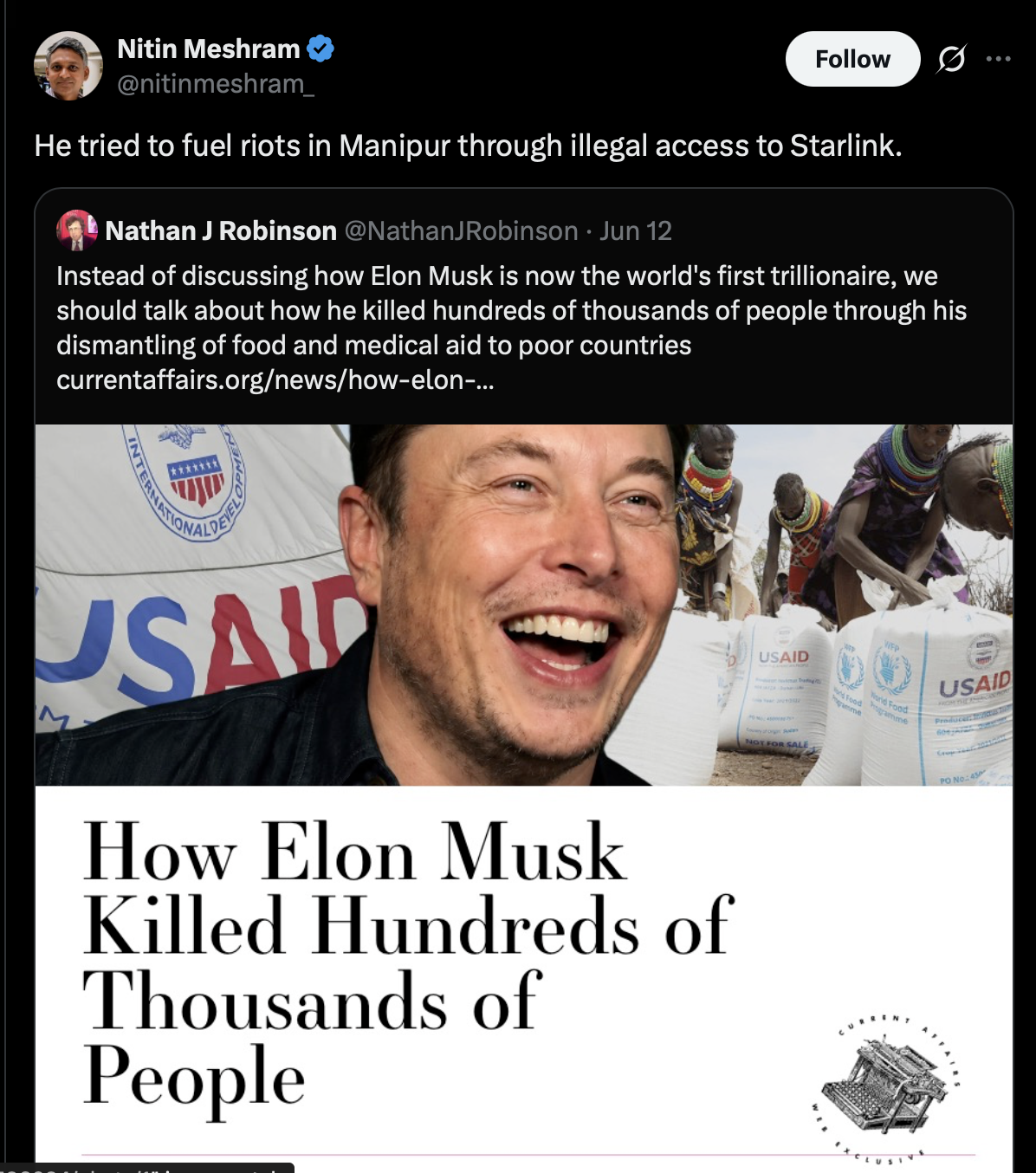
Yet he is now publicly urging the Indian government to permit Starlink to operate as soon as possible.

A change of position is not in itself evidence of anything improper. People can obviously revise their opinions as circumstances change. But what changed so drastically that Meshram suddenly started yearning for Starlink’s entry in India’s telecom sector? Certainly, the internal security of India takes precedence over internet connectivity in Mr Meshram’s “remote” village. Why would Mr Meshram endorse an organisation for internet which he had accused of fuelling riots in Manipur a few months ago?

Nevertheless, the juxtaposition is striking, particularly because Musk is amplifying the very account that provides him with a powerful anecdote for his rural-connectivity argument.

And that brings us back to the broader pattern.

Musk’s posts are not merely promoting Starlink as a technology. He is amplifying individual accounts that reinforce his preferred interpretation of India’s regulatory process, namely, that Starlink’s entry is being delayed because entrenched interests want to protect the existing telecom players.

It would be premature to claim that this is a coordinated or “inorganic” campaign without evidence showing coordination, paid amplification, bots or organised manipulation.

But the visible pattern is undeniable: Musk is using his enormous social-media reach to elevate voices that support his case.

That is influence. Whether it amounts to an organised influence operation is a separate question.

India is not obliged to replace regulation with Musk’s timetable

There is also a fundamental principle at stake.

A company being licensed in 165 countries does not mean that India must automatically adopt the same regulatory conditions. Satellite communication involves spectrum, national security, data protection, lawful interception and infrastructure requirements. India is entitled to impose conditions it considers necessary for its own jurisdiction.

The government’s current position is that Starlink, along with the other licensed satellite operators, is undergoing the applicable regulatory and security processes.

That does not mean the government’s process should be immune from scrutiny.

If Starlink has fulfilled every requirement, as Musk maintains, the government should explain clearly what remains outstanding and why. Transparency would be far more useful than either side reducing the dispute to accusations of “oligarchy” or claims of unquestionable regulatory virtue.

But there is a difference between challenging regulation and attempting to delegitimise the regulator’s process in the court of public opinion.

Musk appears increasingly interested in the latter.

Starlink may eventually enter India, but Musk’s method deserves scrutiny

There is a perfectly reasonable case for Starlink in India.

Satellite broadband could improve connectivity in remote areas, provide redundancy during disasters and extend high-speed internet to places where fibre and mobile towers are commercially difficult to deploy.

There is also a reasonable case for competition. More providers can create more choices for consumers.

But none of that means Starlink should receive a regulatory exemption, or that the government should be pressured into treating a pending security and spectrum process as an anti-competition conspiracy.

The irony is that Musk’s own Indian partnerships undermine the cleanest version of his argument. Airtel has partnered with SpaceX. Jio has partnered with SpaceX. Starlink has built significant infrastructure in anticipation of its launch. And the government says the licensed satellite operators remain subject to the applicable regulatory and security processes.

A regulatory dispute that might otherwise have played out between SpaceX and Indian authorities has suddenly become a public campaign involving accusations of oligarchy, references to Indian billionaires and amplification of sympathetic voices on X.

The Iran factor: why India may be wary of giving Starlink free rein

There is another reason New Delhi may be reluctant to simply wave Starlink through: Iran has demonstrated how difficult it can be for a government to control a satellite network once it is deployed on the ground.

During the US-Israel conflict with Iran in 2026, Starlink terminals were used inside Iran to circumvent the government’s near-total internet shutdown. Reuters reported that Iranians were using Starlink to stay connected despite the blackout, while SpaceX subsequently made the service available free to Iranians. Cybersecurity researchers also reported that Starlink or other satellite terminals were being used to restore connectivity and maintain cyber activity during the conflict. 

That episode demonstrated something strategically significant: a foreign satellite network can potentially keep communications flowing even when a sovereign government has deliberately shut down its terrestrial internet infrastructure. In short, sovereign government are right in being concerned that Starlink could be used by the US as a tool to engineer regime change operation or fuel anarchy in a country of their interest.
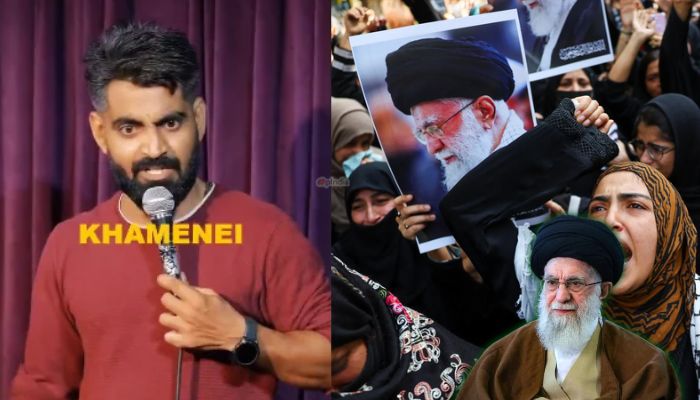
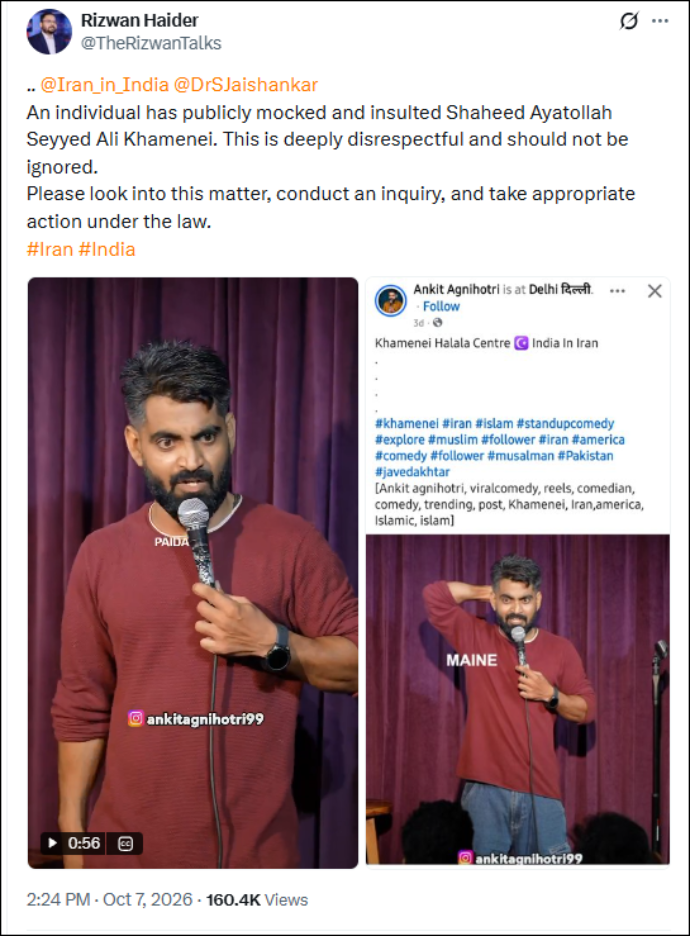
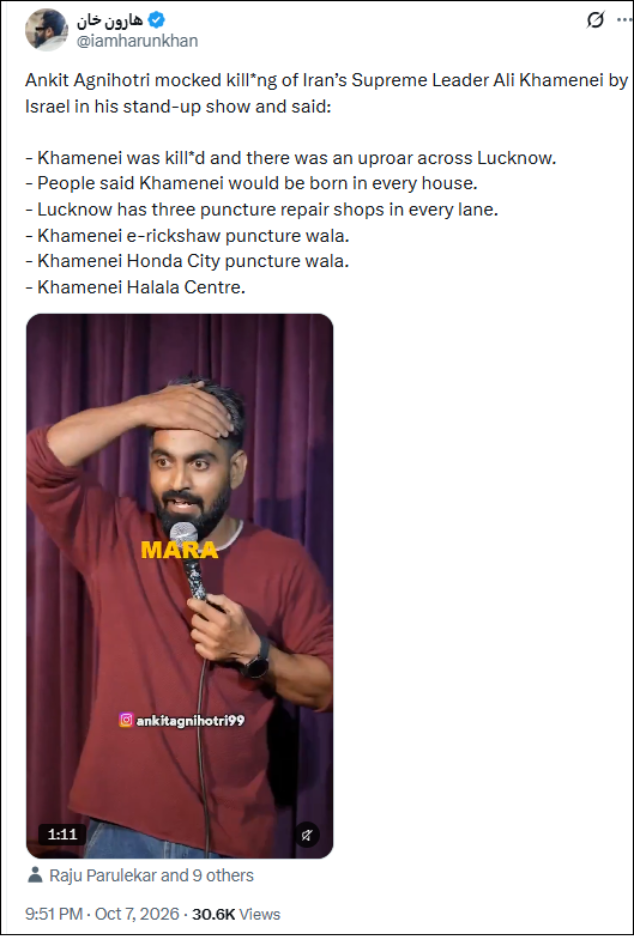
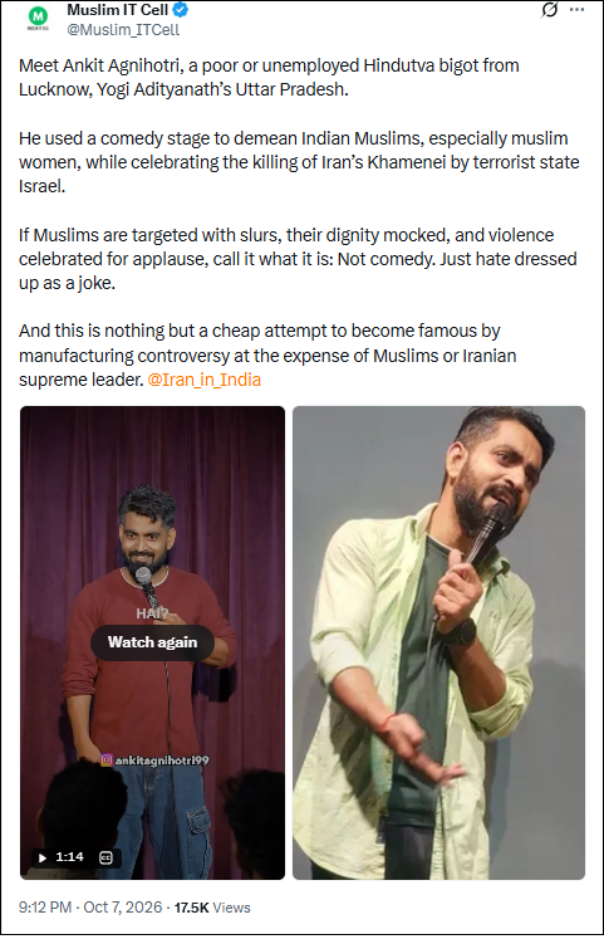
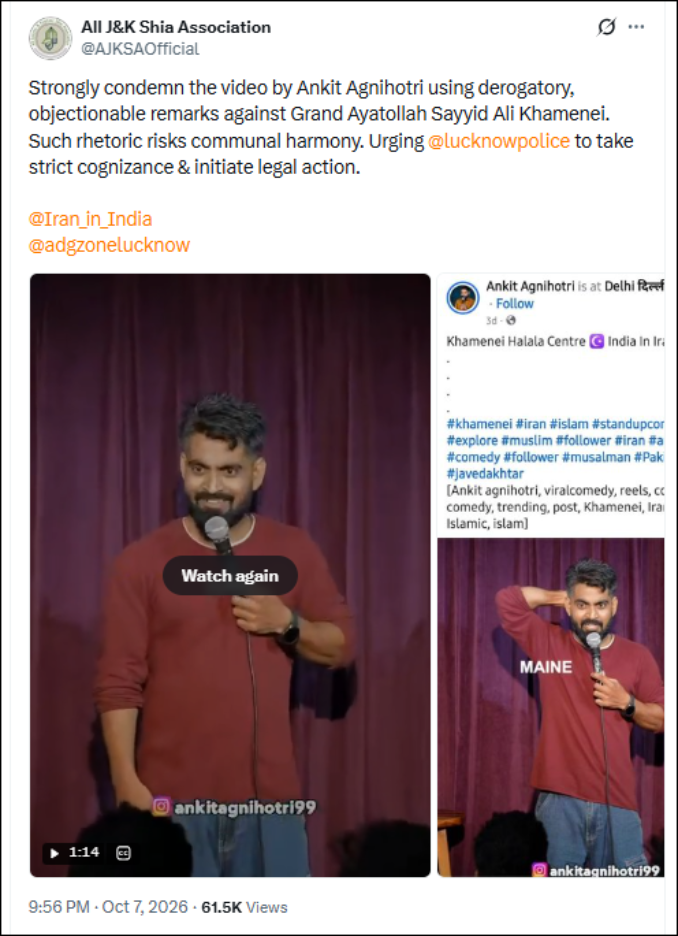
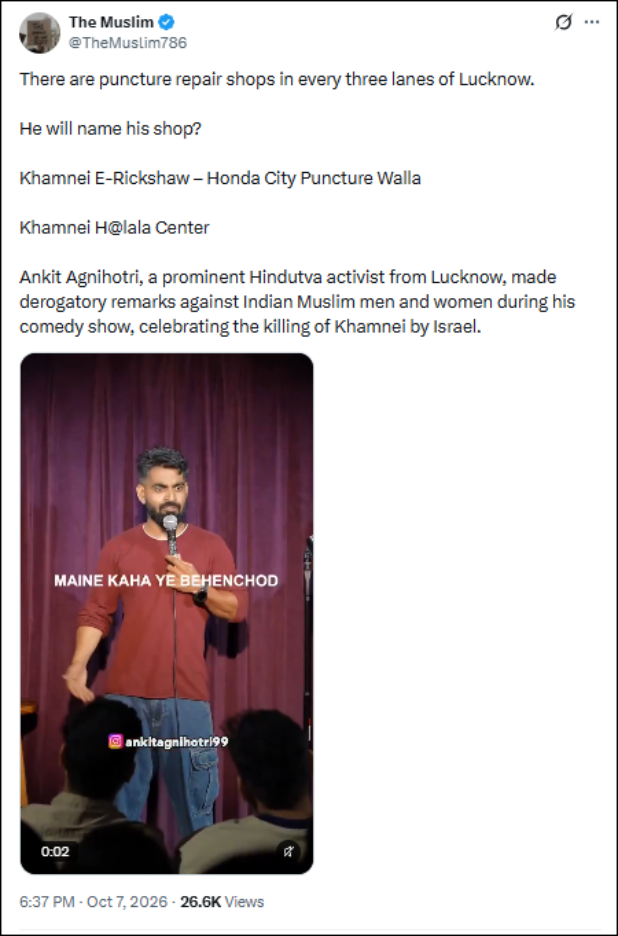
‘Take action, or we’ll take action’: Islamists dog-whistle Iranian Embassy in India against comedian Ankit Agnihotri over jokes about Ayatollah Ali Khamenei

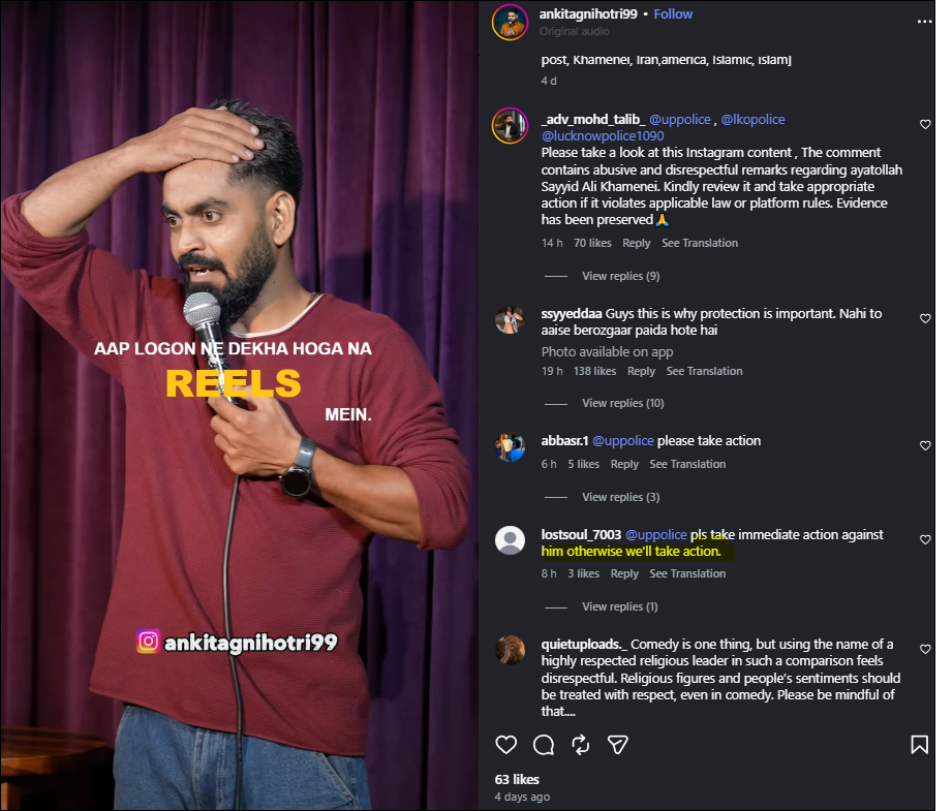
Muslims, particularly Islamists, have their loyalties devoted to foreign Islamic leaders and countries. Not too long ago, when Iran’s Supreme Leader Ayatollah Ali Khamenei was killed in a joint Israel-US military operation, Indian Muslims, particularly Shia Muslims, came out on the streets to mourn his death. Many even expressed readiness to go to Iran and fight against Israel and the US forces to avenge Khamenei. In a fresh demonstration of this transnational Islamic loyalty, Indian Islamists are dog-whistling to Iran’s Embassy in India to take ‘action’ against a stand-up comedian, Ankit Agnihotri, over jokes about Indian Muslims raising ‘Har ghar se Ayatollah niklega’ slogans after the killing of Ayatollah Khamenei. 

During a stand-up comedy act in early October 2026, Ankit Agnihotri cracked jokes about a section of Muslims declaring earlier that every house will produce a Khamenei, and raising “Har ghar se Khamenei niklega” slogans.  

A person named Rizwan Haider, who claims to be a journalist, also tagged the Iranian Embassy in India and Indian External Affairs Minister S. Jaishankar, and urged them to take ‘appropriate action’ against Ankit Agnihotri. 

“@Iran_in_India @DrSJaishankar An individual has publicly mocked and insulted Shaheed Ayatollah Seyyed Ali Khamenei. This is deeply disrespectful and should not be ignored. Please look into this matter, conduct an inquiry, and take appropriate action under the law,” Haider wrote.  

Another Islamist, Harun Khan, wrote, ” Ankit Agnihotri mocked kill*ng of Iran’s Supreme Leader Ali Khamenei by Israel in his stand-up show and said: – Khamenei was kill*d and there was an uproar across Lucknow. – People said Khamenei would be born in every house. – Lucknow has three puncture repair shops in every lane. – Khamenei e-rickshaw puncture wala. – Khamenei Honda City puncture wala. – Khamenei Halala Centre.” 

Meanwhile, the notorious Islamist victimhood peddler Muslim IT Cell tagged the Embassy of Iran in India and wrote, ” Meet Ankit Agnihotri, a poor or unemployed Hindutva bigot from Lucknow, Yogi Adityanath’s Uttar Pradesh. He used a comedy stage to demean Indian Muslims, especially muslim women, while celebrating the killing of Iran’s Khamenei by terrorist state Israel. If Muslims are targeted with slurs, their dignity mocked, and violence celebrated for applause, call it what it is: Not comedy. Just hate dressed up as a joke. And this is nothing but a cheap attempt to become famous by manufacturing controversy at the expense of Muslims or Iranian supreme leader.  

@Iran_in_India.” 

Meanwhile, the All-India Jammu and Kashmir Shia Association also jumped on the bandwagon. The Association wrote, ” Strongly condemn the video by Ankit Agnihotri using derogatory, objectionable remarks against G,rand Ayatoll,ah Sayyid Ali Khamenei. Such rhetoric risks communal harmony. Urging @lucknowpolice to take strict cognizance & initiate legal action.” 

Another Islamist handle “The Muslim” declared Ankit Agnihotri a ‘Hindutva activist’ and wrote, ” There are puncture repair shops in every three lanes of Lucknow. He will name his shop? Khamnei E-Rickshaw – Honda City Puncture Walla Khamnei H@lala Center Ankit Agnihotri, a prominent Hindutva activist from Lucknow, made derogatory remarks against Indian Muslim men and women during his comedy show, celebrating the killing of Khamnei by Israel.” 

Meanwhile, Ankit Agnihotri’s Instagram page is flooded with Islamist abuses, threats, and calls to the Iranian consulate to initiate action against him. 

Islamist pattern of weaponising social media to target Hindus 

After street demonstrations in solidarity with Iran, Ayatollah Khamenei, giving donations to Iran, now a section of Indian Muslims is expressing its reverence and loyalty towards a slain foreign Islamic leader by exposing a fellow Hindu citizen to threats of all forms. 

OpIndia has often reported how Islamists have their loyalties exported to foreign countries and leaders. This misplaced loyalty often reflects in the unapologetic expression of support and solidarity for countries staging agitations based on religion, even indulging in undermining India’s foreign policy and national security. 

It is a known fact that while the Indian government maintains a balanced stance on the Israel-Palestine conflict, Indian Muslims and their leftist allies, do not shy away from advocating Israel’s total annihilation, stage ‘Free Palestine’ protests and indulge in various theatrics, including boycott of Israeli companies, or brands that have any relations with Israel. 

In March this year, OpIndia reported how Indian Islamists were targeting the India-Israel joint Adani-Elbit Advanced Systems India drones manufacturing factory in Hyderabad. Several Muslim social media influencers even shared the location of the factory.  

Several Islamists published posts and made emotional videos, peddling disinformation that the Hyderabad factory of the Adani-Elbit joint venture was enabling the Israeli ‘aggression’, first in Gaza, and later in Iran, by supplying Hermes 900 UAV drones to Israel. This was a concerted effort to trigger a boycott against India from Islamic countries by painting India as the ‘enabler’ of Israel’s wars.  

Why? What was driving Indian Muslims to spread anti-India hate, even though they live in India and defence manufacturing keeps their own homeland safe from external threats? It is their religious loyalty towards the Muslim Ummah, their co-religionists, both of which hold much more significance for Islamists than their country, fellow non-Muslim citizens, or loyalty towards their country. 

India witnessed how, after the killing of Iran’s supreme leader Ayatollah Syed Ali Khamenei in Israeli strikes, protests by Shia Muslims erupted in Lucknow, Jammu and Kashmir, Kargil, and other areas. Many even expressed willingness to go to war-torn Iran and fight Israel and America for Khamenei, while most never even condemned the persecution of Hindus in Bangladesh and Pakistan.   

There have been numerous cases wherein a significant section of Indian Muslims has dog-whistled against non-Muslim Indians over alleged offence to their religious sentiments. 

The pattern of dog-whistling is akin to what was seen during the Nupur Sharma ‘blasphemy’ episode back in 2022.  Alt News propagandist Mohammed Zubair and other Islamists had dog-whistled against the former BJP spokesperson for quoting a Quranic fact through a trimmed clip of her statement and publicized it with Arabic translations. In no time, ‘Sar tan se Juda’ calls began to be made by rioting Muslim mobs across the country, with outrage spilling over to Gulf nations. 

The Islamist act of provocation painted a target on the backs of not only Nupur Sharma but also ordinary citizens like Kanhaiya Lal and Umesh Kolhe, who expressed solidarity with her.  Separately, both the Hindu men were brutally killed by Muslim jihadis. Since then, Nupur Sharma has been living under protection while the Muslim politician Taslim Rehmani, who made highly derogatory remarks about Hindu deities, continues to participate in debates and lives freely. 

A neathe r-redux of the Nupur Sharma episode was seen in 2025 when Sharmishta Panoli, a law student from Symbiosis Law School in Pune was hounded by Indian Islamists with ‘ Gustakhe Nabi ki ek saza, Sar tan se juda’ threats over an Instagram video against Pakistan, which ended up offending Indian Muslims over certain remarks about Islamic prophet, Muhammad. The Islamist outrage and calls for Panoli’s beheading continued even as she had promptly deleted her video and tendered an unconditional apology.   

Islamists are often joined by their Leftist non-Muslim allies in enabling and bolstering Islamist zeal for making Kafirs suffer for perceived religious insults. 

In 2018, Indian-born British celebrity chef Atul Kochhar posted a tweet criticising Priyanka Chopra and her American television show “Quantico” over a deeply anti-Hindu storyline. The episode showed Rudraksha wearing Indian nationalists plotting to detonate a nuclear bomb in Manhattan before framing Pakistan for the attack. 

Kochhar expressed his displeasure with the portrayal and argued that, contrary to the show’s depiction, Hindus had themselves faced centuries of violence and persecution at the hands of Islamist forces. This prompted a wave of attacks from the usual suspects, after which he removed the tweet and issued an apology. 

In 2023, the Kuwaiti government deported two nurses from Kerala over social media posts expressing support for Israel after Hamas attacked the country. 

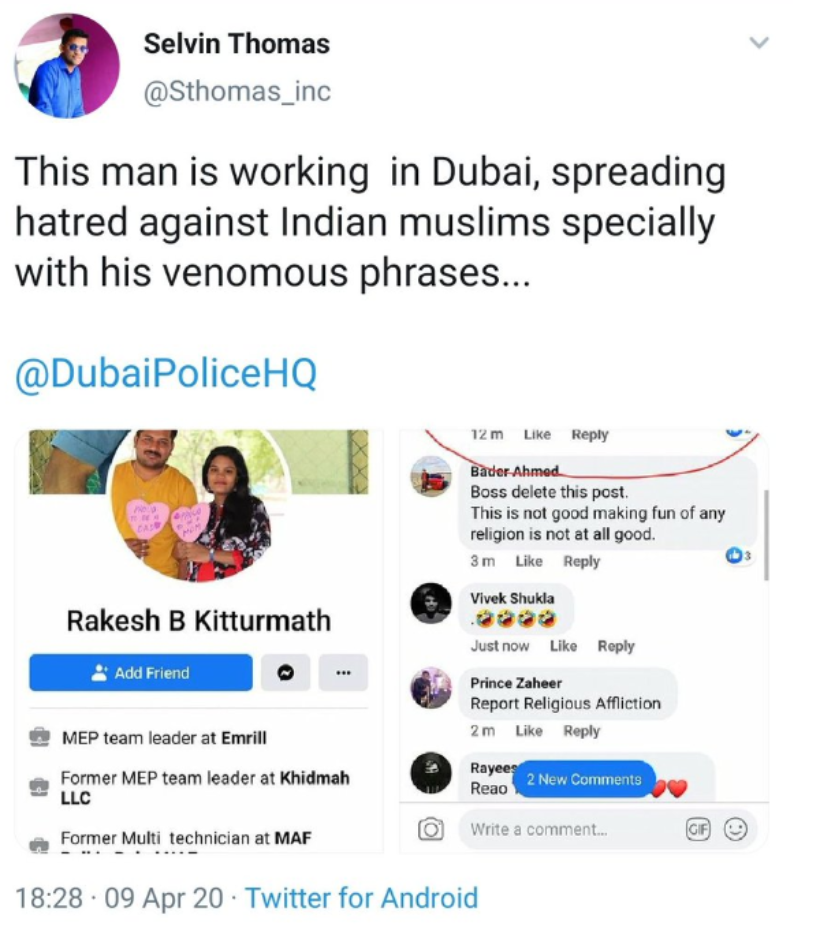
In 2020, several Indians endured similar action over content that was deemed blasphemous, resulting in job loss, legal action, and even deportation. One such case involved Rakesh B. Kitturmath, a Hindu man from Ranebennur in Karnataka. He was a team leader at Emrill Services, an integrated facilities management company headquartered in Dubai, at the time. 

Kitturmath was targeted over TikTok comments criticising Muslims who claimed that offering namaz five times a day was enough to protect against the coronavirus. He was immediately terminated from his job and faced jail time. 

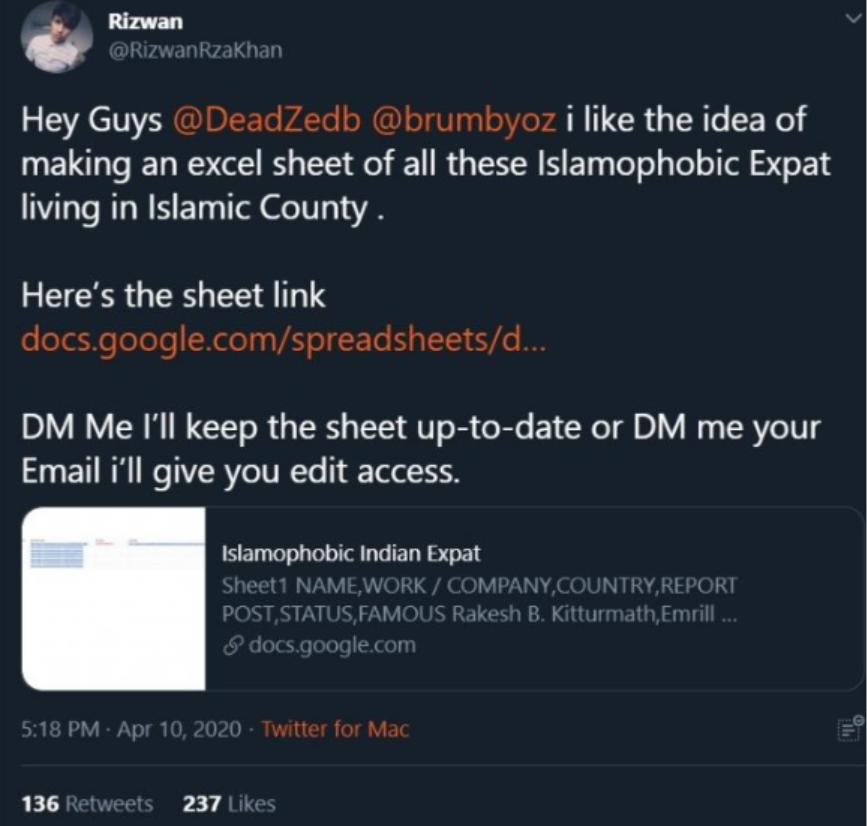
Some Indian Islamists had even d compiled a list of purported “Hindutva terrorists” for intimidation by demanding the same action against them based on false allegations, and they also succeeded in their nefarious agenda. 

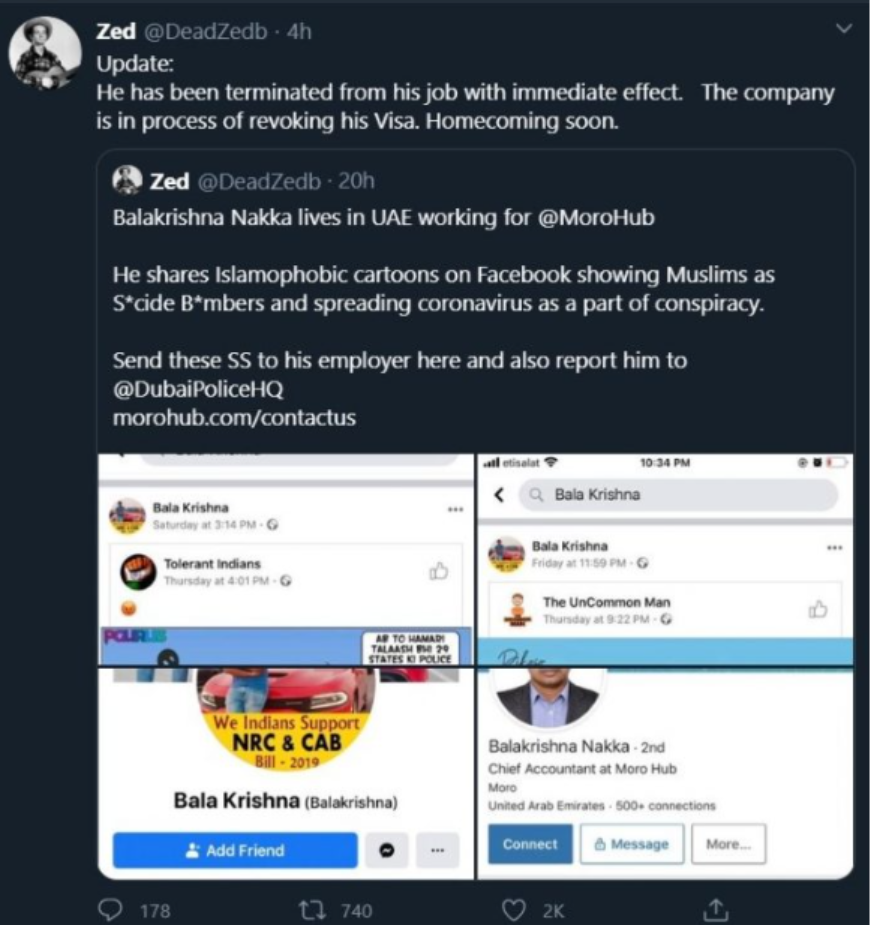
In another case, a Hindu man named Balakrishna Nakka was sacked from his job in Dubai for sharing memes on Facebook mocking the Taliban and Tablighi Jamaat. The Islamists insisted that the “Islamophobic” cartoons showed Muslims as suicide bombers and coronavirus carriers as part of a conspiracy. 

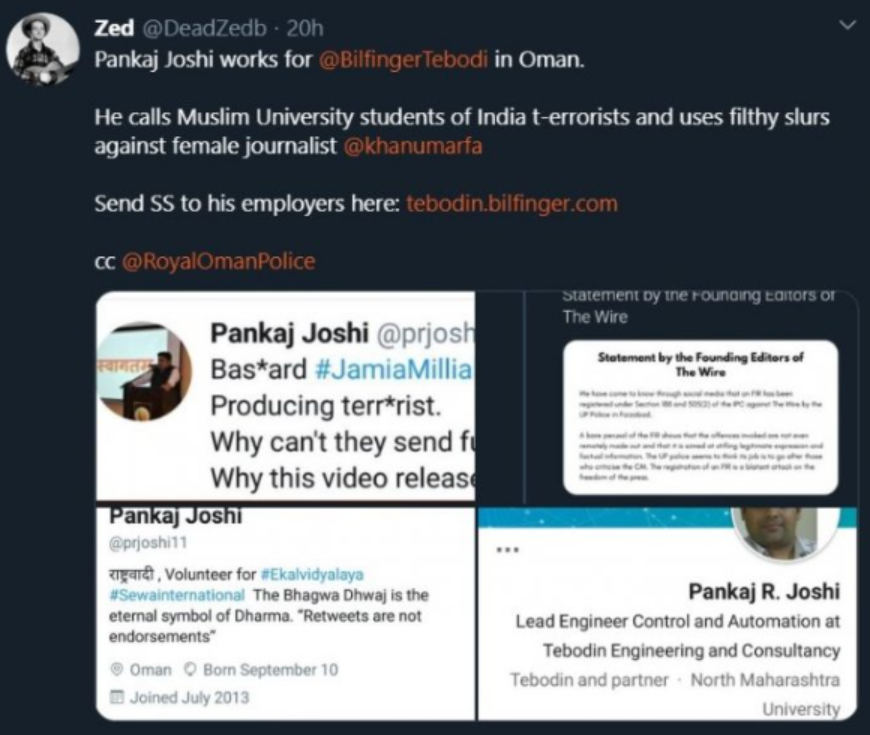
Akin to the demands in Ankit Agnihotri’s case, Islamists had, in one case, demanded police action against an Indian in Oman for posting against Jamia Millia Islamia University. 

It is essential to note that this Islamist pattern of snitching on Hindus or other non-Muslim friends, colleagues or fellow citizens over supposed religious hurt, is seen among not only Indian but Muslims across the world. 

After the 2019 Easter bombings in Sri Lanka, three Sri Lankan security personnel working at a high-end hotel in Palm Jumeirah were accused by Pakistani Muslim employees of insulting Islam  

In 2015, an Indian man was booked for “insulting Islam” in Dubai due to a Facebook post regarding the growing carnage in Iraq as ISIS (Islamic State of Iraq and Syria) swept over the nation. 

More recently, a Sri Lankan Tamil Hindu migrant worker, Anojan Sivarasa, is facing the death penalty in Saudi Arabia in an alleged blasphemy case that began with a Facebook comment. The Al-Ahsa Criminal Court had initially sentenced him to five years in prison and imposed a fine of three million Saudi riyals. Now reports have emerged that Anojan was brutally assaulted by inmates. 

The issue began over a video showing a Muslim man kicking a stray dog that had accompanied Hindu pilgrims during the annual Pada Yatra pilgrimage to Kataragama in Sri Lanka. A comment Anojan posted during the online exchanges subsequently became the basis of the criminal case against him. 

While exercising greater sensitivity when speaking about faith and avoid making inflammatory or offensive remarks is not too much to ask for, hounding people over jokes on foreign religious leaders is alarming and can also pose a serious threat to local law and order, potentially jeopardising national security. 

US conducts ‘SIR’-like voter verification: How millions of records are being reviewed to identify noncitizen voters

For months, India’s Opposition has attempted to turn the Special Intensive Revision (SIR) of electoral rolls into a political controversy. Opposition parties have repeatedly alleged that the exercise could exclude genuine voters and have sought to portray voter-roll verification as an attack on democracy.

But an interesting development in the United States offers a rather different perspective.

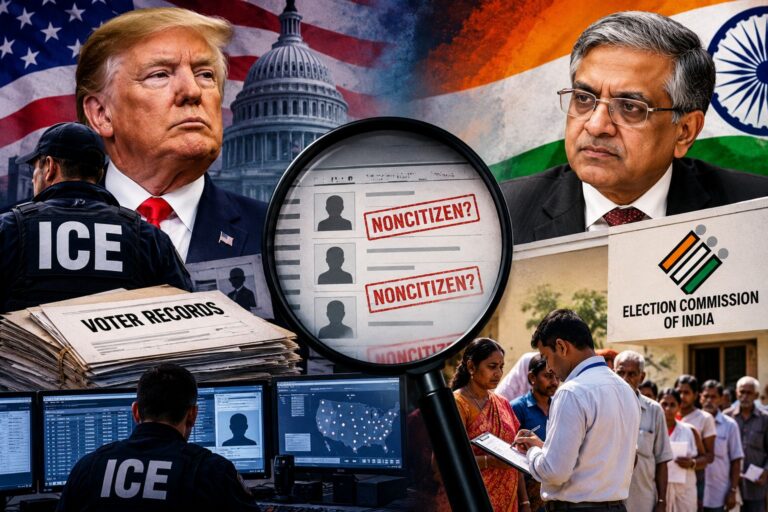
The United States government has launched an extensive operation to scrutinise voter-registration records, investigate suspected illegal registrations and identify cases involving people who may not have been eligible to vote. The exercise is being driven in significant part by Homeland Security Investigations (HSI), the investigative arm of US Immigration and Customs Enforcement (ICE).

The scale of the operation is striking.

According to internal documents reviewed by CNN, HSI described its undertaking as a phased national initiative involving voter-roll acquisition, data analysis, investigative leads and field investigations. Investigators had ingested 50.6 million records from a Justice Department dataset and another 48.4 million records obtained from what officials described as independent sources.

In other words, the world’s most powerful democracy is not treating voter rolls as untouchable documents that cannot be scrutinised.

It is doing precisely the opposite: collecting data, comparing records, identifying anomalies and investigating cases where officials believe electoral laws may have been violated.

What exactly is ICE doing?

It is important to understand that ICE itself is a large federal law-enforcement agency, while Homeland Security Investigations is one of its investigative components. HSI normally deals with serious transnational crimes such as human trafficking, drug smuggling, organised crime, financial crimes and document fraud.

Its involvement in election-related investigations represents a significant deployment of federal investigative resources.

It was reported in September that HSI had launched what internal guidance described as a “coordinated criminal voter fraud surge initiative.” The operation involved pursuing investigative leads, conducting field interviews and supporting prosecutorial review. Offices in nine states were assigned investigative leads, including Washington, Wisconsin, Missouri, Georgia, California, Pennsylvania, Nevada, New York and Connecticut.

The operation was not limited to checking whether somebody’s name appeared on a voter list.

Investigators were examining voter-registration data and following leads that could potentially result in criminal investigations. HSI was also communicating with election officials and examining whether people who were not eligible to vote had registered or cast ballots.

The distinction is important because the US system, like India’s, has multiple layers of voter eligibility and registration requirements. Therefore, identifying a questionable record does not automatically mean that fraud has occurred. A discrepancy is a lead to be investigated, not proof of wrongdoing.

And the American operation illustrates precisely why verification matters.

Tens of millions of records under scrutiny

The documents reveal the enormous data infrastructure being used by the US administration.

HSI had access to tens of millions of records and was using data analysis to identify potential investigative leads. The operation also involved voter-roll information from several states.

The US Department of Homeland Security has also been seeking access to voter rolls from states for auditing purposes. CNN reported that DHS had pushed states to share their voter-registration lists, while HSI investigators were being tasked with following potential fraud leads.

The purpose, according to the administration, is straightforward: identify people who may have registered or voted despite being legally ineligible.

That includes investigations involving alleged non-citizen registration and voting.

Internal records show that HSI was looking beyond individual voters as well. Investigators examined voter-registration organisations and nonprofits in states including Pennsylvania and New Jersey. They also developed what internal documents described as a “network-based investigative approach”, looking at organisations and possible facilitation networks rather than simply examining isolated individual cases.

Some of these investigations produced no evidence of wrongdoing. That is itself significant.

The documents say investigators found no derogatory information on dozens of New Jersey organisations, found no suspicious financial activity in another nonprofit review and closed an Ohio inquiry after exhausting investigative leads.

This demonstrates an important principle of any serious verification exercise: flagging a record for investigation is not the same as declaring somebody guilty.

ICE is also examining immigration records

The US operation becomes particularly interesting because HSI can draw upon the federal government’s extensive immigration databases.

The internal documents show that investigators distributed more than 1,500 leads generated from immigration records to field offices across the country. By late May, HSI had opened 418 voter-fraud cases and made 64 administrative arrests, although hundreds of the cases had not been referred for prosecution at that stage.

ICE lawyers have also issued guidance concerning the immigration consequences of unlawful voting by non-citizens. The guidance stated that, under certain immigration provisions, a conviction may not be required for unlawful voting to have immigration consequences.

HSI has even been examining whether people who subsequently became naturalised American citizens had registered to vote or voted before obtaining citizenship. This was among the areas receiving investigative attention.

The administration has therefore constructed an extensive system in which voter-registration records can be compared with immigration information and other government data, with questionable cases sent for further investigation.

So what does this have to do with India’s SIR?

This is where the political debate in India becomes interesting.

India’s SIR is not the same thing as America’s HSI investigations. SIR is an electoral-roll revision conducted through India’s election machinery, whereas HSI is a federal law-enforcement agency pursuing suspected violations of US law.

But the underlying democratic principle is remarkably familiar.

Both exercises begin with the recognition that the integrity of an election depends, among other things, on the integrity of the electoral roll.

If a person has died, moved permanently, been registered twice, is otherwise ineligible, or is not entitled to vote under the applicable law, there has to be a mechanism for identifying and correcting the record.

That should not be controversial in any democracy.

Indeed, the American example makes one question particularly difficult to ignore: if the United States can deploy federal investigators, vast databases and field investigations to scrutinise voter registrations, why should the mere act of reviewing electoral rolls be presented in India as inherently anti-democratic?

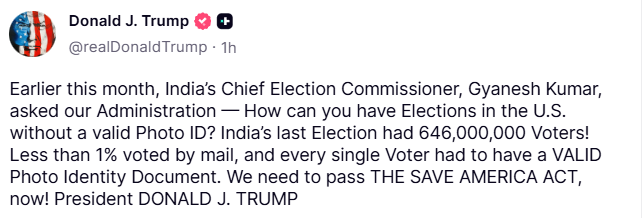
Interestingly, US President Donald Trump has himself recently pointed to India’s election system as a model for strengthening electoral safeguards in America. In August 2026, Trump publicly cited a conversation involving Chief Election Commissioner Gyanesh Kumar, saying Kumar had questioned how the US could conduct elections without requiring a valid photo ID.

Trump highlighted India’s voter-identification system and the scale of its 2024 general election while renewing his call for the SAVE America Act, which seeks stricter proof-of-citizenship and voter-ID requirements for federal elections.

The significance is hard to miss. While India’s Opposition has been portraying SIR and the Election Commission’s voter-roll verification efforts as inherently suspect, the US President was simultaneously pointing to India’s electoral safeguards while arguing that America should strengthen its own system. 

This does not make the two countries’ electoral processes identical, but it does undermine the suggestion that rigorous voter verification is somehow incompatible with a modern democracy. India’s Ministry of External Affairs welcomed Trump’s statement, stating that the credibility and robustness of India’s election machinery are globally recognised.

Verification is not disenfranchisement

There is, of course, a legitimate concern whenever voter lists are revised: genuine voters must not be arbitrarily removed.

That principle applies equally in India and the United States.

But the answer to that concern is better verification, transparent procedures, opportunities to submit claims and objections, and due process; not abandoning voter-roll revision altogether.

Even the American investigation illustrates this distinction. Investigators have pursued leads, but several inquiries have produced no evidence of wrongdoing and were closed.

The existence of a verification mechanism does not mean every person flagged by it is guilty. It means the electoral system has a mechanism to distinguish legitimate voters from potentially ineligible registrations.

That is precisely how a serious democracy should function.

The irony of the Indian debate

The irony, therefore, is that while India’s Opposition has sought to portray SIR as uniquely sinister, the United States, often presented as the gold standard of liberal democracy, is simultaneously undertaking an enormous voter-registration scrutiny exercise of its own.

America has gone further in some respects, with federal law-enforcement agencies analysing tens of millions of records, pursuing investigative leads, interviewing people and examining organisations suspected of facilitating illegal registration.

This does not prove that every aspect of the American approach is correct, nor does it mean that India and America have identical electoral systems.

It proves something much simpler.

Reviewing voter rolls is not inherently undemocratic.

In fact, democracies worldwide recognise that elections cannot be credible if nobody ever checks who is actually registered to vote.

The real democratic safeguard is not an electoral roll that is never questioned.

It is an electoral roll that is accurate, periodically verified and subject to transparent correction, with genuine voters protected throughout the process.

India should therefore be able to conduct SIR without treating every verification exercise as an assault on democracy.

And perhaps the American example provides the simplest answer to the political noise surrounding the issue: a democracy does not weaken itself by checking its voter list. It strengthens the credibility of the mandate by ensuring that the electoral roll reflects those who are actually entitled to cast a ballot.

Death-Row Sri Lankan worker attacked in Saudi jail: Diplomats denied access as Colombo relies on prison authorities’ version. Here’s what we know so far

A growing dispute over the safety of Sri Lankan migrant worker Anojan Sivarasa, who is facing execution in Saudi Arabia, has raised fresh questions about what happened to him inside prison.

Anojan, a Tamil from Natpiddimunai near Kalmunai in Sri Lanka’s Eastern Province, told his family that he was attacked with a sharp weapon and suffered injuries to six places on his head. But Sri Lanka’s government has presented a markedly different account to Parliament, saying Saudi prison authorities attributed his injuries to scratches caused by another inmate’s fingernails.

The discrepancy has become particularly significant because Sri Lankan diplomats who visited the prison were not allowed to meet Anojan or personally assess his condition.

Family says weapon attack

Rajkumar Rajeevkanth, a civil society activist assisting Anojan’s family, said the prisoner himself contacted his relatives and described the assault.

“Anojan called us himself and said he had injuries in six places on his head,” Rajeevkanth said on Wednesday. He added that Anojan was crying while recounting that he had been attacked with a sharp weapon.

In Parliament, MP Shanakiyan Rasamanickam also raised the family’s concerns, saying they had been informed that Anojan was struck on the head with a knife and that his life had been in danger.

According to the family’s account, Anojan had also been transferred from the prison where he was previously held to another facility. The assault reportedly occurred in a section housing prisoners sentenced to death.

The allegations were first made public on Monday, when Rajeevkanth called on both the Sri Lankan government and Saudi authorities to ensure Anojan received medical attention and protection from further harm.

Saudi prison officials give a different account

Foreign Minister Vijitha Herath gave Parliament the government’s version of events while responding to urgent questions from Rasamanickam.

According to Herath, officials from the Sri Lankan Embassy in Saudi Arabia had visited the prison in Dammam twice, most recently on October 6. They met the prison superintendent and doctor but were not permitted to see Anojan.

The information presented to the Sri Lankan government therefore came entirely from Saudi prison authorities.

Herath said the Saudi account was that an argument between Anojan and his cellmate escalated into a physical confrontation. The prison doctor reportedly concluded that the injuries to Anojan’s face and body were caused by the other inmate’s fingernails.

The minister said the Saudi authorities had informed Sri Lankan diplomats that no knife or other weapon had been used, that there was no identified threat to Anojan’s life and that he had subsequently been moved to another cell.

That explanation, however, has not been independently verified.

Neither the prison doctor’s report nor an independent medical assessment of Anojan has been made public. There is also no independent confirmation of whether a weapon was involved or how serious his injuries actually are.

Diplomats could not see the prisoner

The most troubling aspect of the dispute is perhaps not the conflicting descriptions themselves, but the fact that Sri Lankan representatives were unable to examine Anojan directly.

When Rasamanickam specifically asked whether embassy officials had seen Anojan or had simply relied on information provided by prison staff, Herath confirmed that they had not been granted permission to meet him or observe his injuries.

The minister nevertheless urged caution over claims that Anojan had been attacked with a weapon, saying unverified allegations could damage Saudi Arabia’s reputation.

Rasamanickam said his intention was not to criticize Saudi Arabia. Instead, he said he was seeking clarity on behalf of Anojan’s family and the people of his constituency and wanted the information reaching both the government and the family to be properly verified.

Herath said the government was arranging to provide Anojan’s family with information and documents relating to his medical condition.

The death sentence

Anojան’s case has attracted international attention because he is facing execution over a social media comment.

A Saudi criminal court in Al-Ahsa convicted him on July 28 of publishing material through an information network that was deemed harmful to religious values and public morals, as well as insulting the Prophet Muhammad. He was initially sentenced to five years in prison and fined three million Saudi riyals, roughly $800,000.

The family appealed, hoping for a reduction in the punishment.

Instead, the appeals court delivered a far harsher verdict on September 17, sentencing Anojan to death.

Sri Lanka now has until October 17 to challenge the verdict before Saudi Arabia’s Supreme Court. Herath told Parliament that Sri Lankan and Saudi lawyers were working together on the appeal and that a Sri Lankan legal team, including two President’s Counsel, had travelled to Saudi Arabia.

The government expects the Supreme Court challenge to be filed before October 14.

Questions over how the appeal was handled

The assault allegations come amid separate questions about Sri Lanka’s handling of Anojan’s legal case.

Rasamanickam asked the government to table the prosecution’s appeal, the original judgment, Anojan’s own appeal, the death sentence judgment and documents relating to any Supreme Court proceedings.

Herath said the government was prepared to table some of the judgments and legal documents in its possession but had not yet received the full prosecution appeal.

Rasamanickam also sought answers on when the government obtained the prosecution’s appeal, whether it was available before Anojan’s own appeal was heard, whether his family had been warned that an appeal could result in a harsher sentence, who authorized the appeal and what legal advice had been obtained.

According to the statement issued by Rasamanickam’s office, the minister’s responses did not address several of these questions.

Documents previously reviewed by Jaffna Monitor reportedly showed that Sri Lanka’s Foreign Ministry had helped arrange Anojan’s appeal despite a legal opinion obtained by the embassy describing the prospects of securing a reduced sentence as “extremely low”.

The documents reportedly contained no indication that the family had been warned that the appeal could potentially result in a harsher punishment. The ministry sent the family a copy of the appeal memorandum on September 16—more than three weeks after it had been filed and just one day before the appeals court delivered its ruling.

How the case began

Anojან was working in Saudi Arabia when he became involved in an online argument between Hindus and Muslims.

The debate centred on a video showing a young Muslim man kicking a stray dog that had accompanied Hindu pilgrims during the annual Pada Yatra pilgrimage to Kataragama in Sri Lanka.

The dog, popularly known among the pilgrims as Subramani, had itself attracted considerable attention after travelling hundreds of kilometres alongside them.

A comment Anojan posted during the online exchanges subsequently became the basis of the criminal case against him.

His initial five-year sentence and heavy fine were already severe. The appeals court’s decision to replace that punishment with a death sentence dramatically escalated the stakes.

Colombo seeks legal and diplomatic avenues

Herath said the Sri Lankan government would pursue every available legal avenue while respecting Saudi Arabia’s judicial system and Shariah law.

According to the minister, senior Saudi officials had indicated that they did not welcome outside interference while the case remained before the courts.

Sri Lanka could consider additional diplomatic measures depending on the outcome of the Supreme Court proceedings, including seeking royal clemency.

President Anura Kumara Dissanayake met Anojan’s parents last month and reportedly assured them that his government would formally seek clemency from the Saudi king.

Rasamanickam also sought an update on the proposed parliamentary delegation to Saudi Arabia, which was expected to be led by the Deputy Speaker. Herath said the decision would depend on the ongoing court proceedings.

Activist seeks UN intervention

Rajeevkanth has meanwhile taken the matter beyond Sri Lanka’s government.

On Wednesday, he met United Nations Resident Coordinator in Sri Lanka Marc-André Franche in Colombo to seek international attention to Anojan’s safety. He was accompanied by Anojan’s younger brother and Jaffna MP Gajendrakumar Ponnambalam, leader of the Tamil National People’s Front.

Rajeevkanth said he had also conveyed the assault to the United Nations.

He continues to stand by the family’s account but said he did not want to escalate the dispute with Saudi prison authorities because Anojan’s immediate safety was the priority.

“Anojan was attacked with a sharp weapon,” he said. “After that, prison authorities took steps to ensure his safety. We are not going to question further what they have told the government. Our primary objective is to ensure Anojan’s protection.”

Tamil and Muslim political leaders in Sri Lanka have urged Saudi Arabia to spare Anojan’s life.

Rajeevkanth said the campaign for his protection had now spread beyond Sri Lanka, although he expressed disappointment that some members of the Muslim community had criticised the campaign.

“The entire country should speak with one voice on this matter,” he said.

For now, however, the most immediate unanswered question remains what actually happened inside the Saudi prison.

Anojan’s family says he described a sharp-weapon attack. Saudi prison authorities say his injuries were caused by another inmate’s fingernails. Sri Lankan diplomats have not been allowed to examine him themselves, and no independent medical report has been made public.

With Anojan facing a death sentence and the deadline for the Supreme Court challenge rapidly approaching, establishing the facts surrounding his assault, and ensuring his safety while his legal battle continues, has become an urgent concern.

How prepared is India for a looming global food supply crisis?

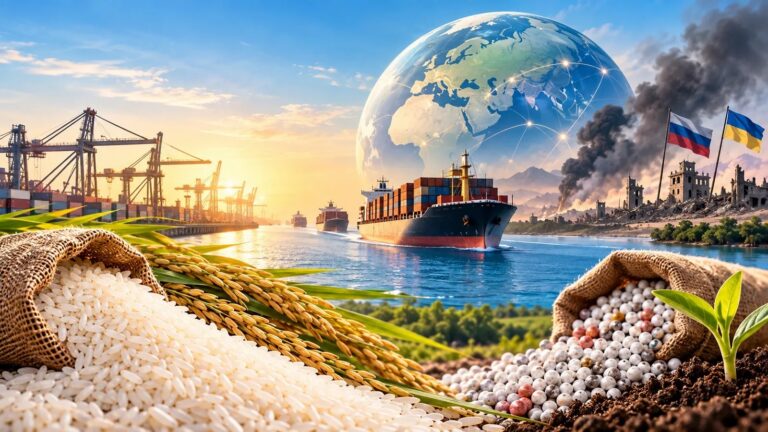
The world may be approaching another food supply crisis, but this time the threat is not simply a shortage of grain. It is the convergence of several disruptions: the Russia–Ukraine war affecting Black Sea grain shipments, conflict around the Strait of Hormuz threatening crucial fertiliser supplies, rising international food prices, and an intensifying El Niño threatening agricultural production across the world.

External Affairs Minister S. Jaishankar’s September 2026 warning of a possible food crisis has emphasised the same issues. International data reveal mounting pressure, although not an immediate global shortage. The FAO Food Price Index reached 133.3 points in August 2026, approximately 7.6% above January’s level. Meanwhile, global cereal production is projected to decline from a record 3,043 million tonnes in 2025 to approximately 2,980 million tonnes in 2026. The inventories remain substantial. The danger, therefore, lies increasingly in the ability to transport and distribute food rather than its absolute availability. The disruption of global shipping routes is the major cause behind this.

The Black Sea illustrates this distinction. Both Russia and Ukraine are major wheat exporters, but renewed attacks on ports and shipping infrastructure have disrupted exports. Grain may remain available in warehouses while import-dependent countries, particularly in Africa and West Asia, struggle to obtain it affordably. 

The Strait of Hormuz presents another vulnerability. Disruptions to Gulf fertiliser exports have increased costs, threatening future harvests in countries where farmers cannot afford adequate fertiliser. Today’s fertiliser shortage could consequently become tomorrow’s food shortage.

India faces an additional challenge from the monsoon. Deficient and uneven rainfall has damaged paddy prospects, while the strengthening El Niño raises concerns about agricultural conditions extending into 2027. An industry estimate suggests that India’s rice production could decline by around 10 million tonnes, from the previous record of 154 million tonnes to approximately 144 million tonnes. This is not yet an official government forecast, but it highlights the potential severity of the situation.

Yet India possesses an important safeguard: substantial government grain stocks. As of September, rice inventories, including unmilled paddy, stood at 59.6 million tonnes, compared with a buffer benchmark of 10.3 million tonnes. Wheat stocks were approximately 48 million tonnes, comfortably above the required buffer. These reserves, together with free foodgrain distribution covering more than 81 crore beneficiaries, provide considerable protection against an immediate food-security emergency.

However, grain reserves cannot fully protect consumers from rising prices. India imports roughly two-thirds of its edible oil requirements, making households vulnerable to global price increases. Pulses are another pressure point, with imports meeting approximately 18–20% of consumption. The government has accumulated pulse reserves and reduced certain edible-oil import duties, but international prices, shipping costs and currency movements remain important risks.

The approaching Rabi season will test India’s preparedness further. Wheat production is projected to reach a record 121 million tonnes, but below-average reservoir levels, uncertain irrigation supplies and the timely availability of DAP fertiliser could affect sowing. Government assurances of adequate fertiliser stocks must ultimately translate into supplies reaching farmers when required.

The article also highlights a difficult policy balance. India accounts for more than 40% of global rice exports, meaning restrictions imposed to protect domestic consumers can create shortages elsewhere. Conversely, maintaining exports during a poor harvest could intensify domestic price pressures. Decisions concerning grain exports, procurement, subsidies and even surplus rice supplied to ethanol producers therefore carry consequences beyond India’s borders.

All things considered, India is comparatively secure in rice and wheat, but vulnerable in fertiliser, edible oils, pulses and water availability. A single disappointing harvest is unlikely to create an immediate national shortage. The greater danger would arise if weak harvests continued into 2027, fertiliser disruptions reduced future yields, and inflation eroded household purchasing power. India’s challenge is therefore not merely to preserve sufficient grain in warehouses, but to ensure that agricultural inputs remain available, farmers can sustain production, and food stays affordable through a prolonged period of geopolitical and climatic uncertainty. 

Read the full article here on Chapter One Magazine. 

Delhi Police looking into videos of attacks on its personnel during Congress protest; Rahul Gandhi, Priyanka Vadra and others caught targeting cops, FIRs filed

On 8th October (Thursday), Delhi Police stated that it has launched an investigation into several mobile phone videos showing its officials, including women personnel, being attacked during the Indian National Congress demonstration over the Special Intensive Revision (SIR) of electoral rolls, which took place close to Jantar Mantar. The events unfolded on 6th and 7th October (Tuesday and Wednesday).

The authorities aim to determine the order of events and identify the protesters participating in the incidents. They want to identify those who mistreated or obstructed the cops stationed to uphold law and order. They are also reviewing footage from other sources. The Delhi Police also released a video documenting their officers who were attacked and sustained injuries during the agitation.

According to reports, the Delhi Police are expected to file a First Information Report (FIR) under pertinent provisions of the Bharatiya Nyaya Sanhita (BNS) regarding assault on public officers, hindering public servants in the exercise of their duties, and other corresponding sections.

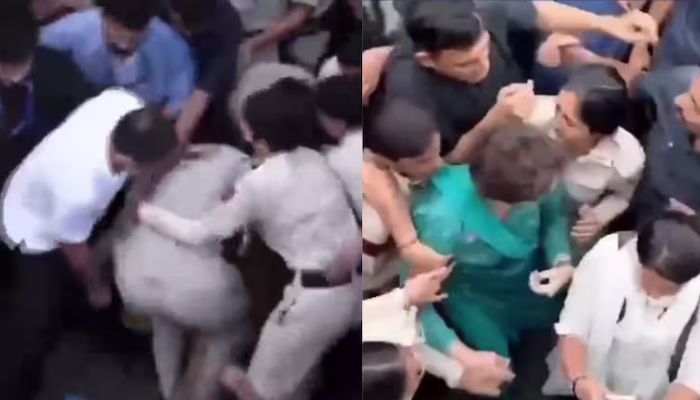
Multiple videos that are circulating on social media feature Congress leaders, including the senior brass, acting aggressively with the cops. Rahul Gandhi has been captured while pushing and shoving a policewoman.

A female personnel is shown being elbowed by Priyanka Gandhi Vadra.

A crowd similarly assaulted two police officers. An effort was made to forcibly drag them by their collar from behind by individuals surrounding them as they were simultaneously pushed to the ground, and one of them was kicked before the duo managed to escape from the violent mob.

While Rahul Gandhi was being apprehended, Ankit Kasana, a Delhi Police constable assigned to the Parliament Police and deployed for crowd control during the protest, was also assaulted and abused in a conversation with India Today. He has been treated at Delhi’s Ram Manohar Lohia Hospital (RML), and a case might be registered over the incident.

“As soon as the detention happened, around 35 to 40 people saw what was happening and started attacking me. There were some women, some men and even some senior citizens among them. They did not see that I was trying to do my duty. They tore my uniform and pulled me from behind. They scratched me with their fingernails. One man bit my hand and took a piece of flesh out,” he conveyed. Teeth marks were also visible on his chest.

“I kept saying, ‘Brother, please leave me, please leave me’. I was literally pleading with them. Thankfully, my staff came and helped me and rescued me from them. Otherwise, perhaps I would not be sitting here today,” Kasana added. Additionally, he asserted to have previously encountered similar misconduct during a Cockroach Janta Party (CJP) demonstration.

A protester was recorded forcefully striking his head against a vehicle’s windshield from within the vehicle in an attempt to shatter it.

FIR against Rahul Gandhi, Priyanka Gandhi Vadra and others

Rahul Gandhi and Priyanka Gandhi Vadra have been booked by Delhi Police for assaulting police officers and interfering with government operations during their protest against the Election Commission of India. The two leaders have been the subject of two FIRs in the last two days.

The case has also been launched against Congress workers who participated in the protest, in addition to many party leaders. Police are probing the accusations and the activities of those involved. 91 people, including MPs, were taken into custody during the rally.

Delhi Police earlier filed an FIR after Rahul Gandhi and Priyanka Gandhi Vadra, along with other members of the I.N.D.I. Alliance, had entered the Akashvani Bhavan premises without permission. The authorities stated that the march was organised from Parliament House to the Election Commission’s headquarters in Nirvachan Sadan without any request for formal authorisation or approval. 

Further action by Delhi Police

A social media site has also been instructed by the Delhi Police to take down or limit access to 11 posts and videos that gave misleading details about police actions. The police declared in notices filed under the Information Technology Act that some demonstrators had sought to move forward in defiance of regulations established under Section 163 of the Bharatiya Nagarik Suraksha Sanhita (BNSS), pushed against staff, and removed or hopped over barriers.

According to the police, they were performing their duties and restrained or detained some demonstrators. The notification conveyed that several clips “appear to be selectively” depicting the police action as “misbehaviour or unwarranted use of force,” omitting the prior instances of non-compliance, impediment and resistance. This representation is termed “selective, misleading, and contextually incomplete,” with the potential to fabricate a story about the behaviour of its personnel, incite public outrage and erode public trust in authorities.

Sri Lankan Hindu migrant worker faces death in Saudi Arabia over blasphemy against Prophet Muhammad: No honour of the dead is worth a living man’s life

A Facebook argument should never become a death sentence.

Yet that is precisely where the case of 24-year-old Sri Lankan migrant worker Anojan Sivarasa has landed. A young man working thousands of kilometres from home is facing execution in Saudi Arabia after an appellate court convicted him of blasphemy against Islam and Prophet Muhammad over a social-media comment made during a religiously charged dispute in Sri Lanka.

The central question is not whether Anojan’s words were offensive. They may or may not be. The question is whether any religious offence can justify taking the life of the person who committed it.

The answer should be an unequivocal no.

And this is precisely why the case of Anojan Sivarasa should become more than a diplomatic crisis involving one Sri Lankan migrant worker. It should become the catalyst for a much larger campaign against blasphemy laws that criminalise speech, extinguish freedom of expression and create a legal weapon that can be deployed not merely against genuine religious offence, but against personal enemies and political or ideological opponents.

Because once the State gives someone the power to have another person imprisoned or executed for insulting a religion, it has also created an extraordinary opportunity for that law to be weaponised.

From a social media argument to a death sentence

The circumstances surrounding Anojan’s case make the punishment even more disturbing.

The controversy reportedly began following an incident during a Hindu pilgrimage in Sri Lanka. Footage of a young Muslim man kicking a dog following Hindu pilgrims circulated on social media, triggering a heated religious argument. During the ensuing exchange, a user made derogatory remarks about a Hindu deity.

Anoj​an responded in Tamil with an allegedly insulting remark about Prophet Muhammad.

He then deleted the comment and posted an apology.

But the matter did not end there. An Islamist took a screenshot and brought it to the attention of his Saudi employer and the authorities. Anojan’s brother, Hamsidan Sivarasa, has said that it was individuals in Sri Lanka, Islamists undoubtedly, who contacted the company where his brother worked.

The Al-Ahsa Criminal Court initially sentenced Anojan to five years in prison and imposed a fine of three million Saudi riyals. The case subsequently took a dramatic turn when Saudi prosecutors sought to have him prosecuted under Sharia law rather than cybercrime legislation. The appellate court accepted the request and imposed the death penalty.

A young migrant worker had gone from an online argument to facing execution.

Sri Lanka must fight until Anojan is home

The Sri Lankan government must now exhaust every legal, diplomatic and humanitarian avenue to prevent the execution.

President Anura Kumara Dissanayake has met Anojan’s family and assured them that his government would spare no effort to secure a pardon. A four-member Sri Lankan legal delegation is travelling to Saudi Arabia to meet Anojan’s local lawyers and determine what further legal options are available.

That is welcome, but it must be only the beginning.

Colombo should pursue every available appeal, seek clemency directly from the Saudi leadership, maintain constant diplomatic engagement and request assistance from countries that have influence in Riyadh. Sri Lankan diplomatic missions should keep the international spotlight on the case, while the government should ensure that Anojan has the strongest possible legal representation.

The objective cannot merely be a reduction of his sentence.

The objective must be to bring Anojan Sivarasa home alive.

His family has reportedly had no communication with him since September 28. His devices have been confiscated, and the family remains uncertain about his condition and what will happen next.

The absence of an announced execution date should provide no comfort. It should make Colombo more urgent, not less.

Sri Lanka must investigate those who set this in motion

But there is another responsibility that lies with the Sri Lankan government.

It must investigate what happened in Sri Lanka.

It should investigate the Islamists responsible for targeting Anojan, writing emails to his Saudi employer.

Did they merely report an offensive comment, or did they deliberately seek to have Anojan punished under Saudi Arabia’s far harsher laws?

These questions demand answers.

The Sri Lankan authorities should also investigate those who made the derogatory remarks against Hindu deities that preceded Anojan’s response. If Islamists provoked the religious confrontation and their conduct violated Sri Lankan law, they should be prosecuted.

Likewise, if those who subsequently reported Anojan deliberately sought to weaponise his words against him and committed an offence in doing so, they too should be prosecuted.

If people insulted Hindu deities, provoked a confrontation and then sought to have the person who responded punished under the laws of a foreign country, Sri Lanka has every reason to investigate the entire chain of events, and subsequently bring the full force of law against such religious zealots.

The real problem is blasphemy law

But the Anojan case should not end with one pardon. It should force the world to confront the larger problem of blasphemy laws.

Blasphemy laws do not merely regulate speech. They place religious offence into the criminal justice system, where accusations can trigger arrest, imprisonment and, in the most extreme cases, execution.

That creates a dangerous incentive.

A personal feud can be transformed into an allegation of religious offence.

A political opponent can be accused of insulting a religion.

A social-media rival can be reported.

A disgruntled employee can invoke religious sentiments against an employer.

A mob can manufacture outrage around an isolated statement.

Once the allegation is made, the accused person has to defend himself against a charge that can carry consequences wildly disproportionate to the original words.

And unlike a physical crime, the alleged “victim” of blasphemy can be an abstract religious sentiment.

The punishment, however, falls upon a living human being. And often, the mob never waits for the law to take its course. It is one of the reasons why so many blasphemy accused are lynched to death in Pakistan before the investigative agencies could establish the “offence.”

That imbalance should concern anyone who believes in freedom of speech. And Islamists have exploited this imbalance for far too long for the world to look the other way.

When blasphemy laws become weapons

The danger becomes particularly acute when blasphemy laws are used to settle personal scores.

An accusation of blasphemy can transform an ordinary dispute into a criminal matter. The complainant does not merely seek an apology or civil remedy; he can potentially place the accused at the mercy of police, prosecutors and courts.

The Anojan case is an especially stark example of why this deserves scrutiny. According to his brother, the matter was brought to his Saudi employer by individuals in Sri Lanka. 

If that account is established, one has to ask whether Saudi Arabia’s blasphemy framework became a weapon in someone else’s dispute.

This is why such laws are dangerous even beyond their most extreme punishments.

A law designed to protect religious sentiment can become a tool to destroy the life of the person accused of offending it.

The Islamist hypocrisy over Mohammad Zubair

The reaction to Anojan’s case also exposes an extraordinary inconsistency among some Islamist voices in India.

They are now arguing that Anojan must accept the death penalty because he broke Saudi law and committed blasphemy against Prophet Muhammad.

Very well.

Then what happened to that principle when Mohammad Zubair, the co-founder of Alt News, was arrested in India over posts that offended Hindu religious sentiments?

Zubair’s supporters demanded his release and argued that an offensive social-media post should not result in prolonged imprisonment. The Supreme Court ultimately granted him relief and ended the proceedings in Uttar Pradesh.

There was nothing inherently wrong with that argument. A person accused of offending religious sentiments deserves due process. Punishment must be proportionate.

But precisely the same principle must apply to Anojan.

One cannot say “he broke Saudi law, therefore he deserves death” when the accused is a Hindu migrant worker and then say “religious offence should not result in imprisonment” when the accused is Mohammad Zubair.

India and Saudi Arabia have very different legal systems. Nobody is suggesting otherwise.

The issue is consistency.

If Zubair’s offence did not make his life forfeit, neither should Anojan’s remarks defending his faith.

Should a modern state kill a human being because he wrote an offensive sentence on Facebook?

That is the question that should be asked not only of Saudi Arabia, but of every country that retains blasphemy laws.

This should become a global campaign against blasphemy laws

The Anojan case should therefore become a rallying point for a worldwide campaign against blasphemy laws, especially those enforced by Islamic states, where Islamists often misuse the law to implicate non-Muslims and settle personal scores.

A campaign against laws that make religious offence a criminal matter punishable by imprisonment, mutilation or death.

Freedom of speech is meaningless if it exists only so long as nobody says anything that a powerful religious constituency finds offensive.

The right to express an unpopular, irreverent or even deeply offensive opinion is precisely what distinguishes freedom of expression from permission to repeat only socially approved views.

Islamists can protest in response. They can demand an apology. But their street veto cannot be facilitated with a law.

The State should not become an instrument for satisfying religious vengeance.

And certainly not an instrument for killing people.

Ironically, the Islamist bloodhounds who demand the execution of those they perceive as committing blasphemy often lean on liberal laws of democracies when Muslims are found committing the same offence. Therefore, a Zubair in India has thousands of Islamists in his support, calling for his release from jail even though he is accused of committing blasphemy against Hindu Gods and Goddesses.

No honour accorded to the dead is worth the life of the living

Anoj​an may have made an offensive remark. He may have exercised terrible judgment. He may even have violated Saudi law.

None of that makes his life worthless.

He deleted the comment and apologised. If he committed an offence, let him face proportionate justice. But execution is irreversible. Once a State kills a person, no apology can undo it, no reconsideration can reverse it, and no diplomatic regret can bring him back.

No honour accorded to the dead can justify taking the life of the living.

And that includes Prophet Muhammad.

Whatever honour Muslims accord to Prophet Muhammad, it cannot be worth the life of a 24-year-old Sri Lankan migrant worker. His honour does not depend upon Anojan’s death. No prophet requires the execution of a young man to establish his greatness, and no God becomes more sacred because a human being is killed in His name.

Sri Lanka must therefore fight relentlessly to save Anojan, investigate those who provoked him and those who reported him, and pursue every diplomatic avenue to secure his pardon.

But the world should not stop there.

Anoj​an Sivarasa’s case should become a warning about what happens when the State is given the power to punish blasphemy. It should become a campaign for the abolition of draconian blasphemy laws everywhere.

Because the freedom to speak means very little if one can be killed for speaking the wrong words.

Save Anojan. Abolish blasphemy laws. And never allow the honour attributed to the dead to become a justification for taking the life of the living.

‘Avatar of Vishnu’ to ‘Historic Milestone’: World leaders hail Modi’s 25-year political journey

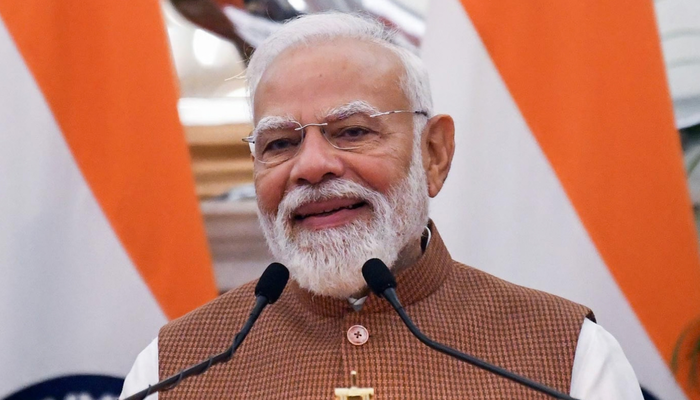
Congratulatory messages poured in from across the world as Prime Minister Modi completed a silver jubilee in public office. World leaders extended warm wishes and heaped praise on PM Modi on Wednesday (October 7, 2026) as he completed 25 years as head of government.

From calling him an “avatar” to hailing his achievement as a “truly historic milestone”, leaders from around the globe highlighted his contribution both at the national and global levels.

An incarnation of Vishnu

Referring to him as an “avatar of Vishnu”, Bhutanese Prime Minister Tshering Tobgay said that PM Modi possesses the qualities of wisdom, compassion and courage, which are hallmarks of an enlightened leader. “Today I see these qualities coming together most clearly in PM Modi’s vision of Viksit Bharat. Wisdom begins with a clear vision of a better future. And he has given India one: to become a developed nation by 2047, exactly a century after independence. With Viksit Bharat, he has given that vision a name, a deadline and a national mission,” Tobgay said. The Bhutanese PM credited PM Modi for awakening the people of India and instilling self-belief in them.

He also recalled his meeting with PM Modi in New Delhi in 2019, where he told PM Modi that he saw him as an incarnation of Lord Vishnu. Remembering his personal equation with PM Modi, Tobgay said that he always treated him like an elder brother.

Outstanding political leadership

Japanese PM Sanae Takaichi, whom PM Modi referred to as his younger sister, congratulated him and expressed deep respect for his achievements. “For many years, you have dedicated yourself to the development of Indian society and the nation, and since 2001, you have demonstrated outstanding political leadership over a long period as Chief Minister. I express my deep respect for your achievements in advancing India’s development and elevating its standing in the international community,” Takaichi said.

She also thanked PM Modi for extending warm hospitality to her during her visit to India in July. She said that she looked forward to working with PM Modi to strengthen India-Japan relations.

A promoter of good governance

Philippine President Bongbong Marcos extended his wishes to PM Modi and hailed his leadership. “From Gujarat to leading the world’s largest democracy, Prime Minister Modi’s journey has been marked by a strong emphasis on good governance, innovation, technology, infrastructure and development, contributing to India’s transformation and its growing role on the global stage,” Marcos said, adding he looked forward to welcoming Modi to Manila for the ASEAN-India and East Asia summits in November.

A quarter-century of unbroken leadership

Nigeria President Bola Ahmed Tinubu described PM Modi’s silver jubilee in public office as “a truly historic milestone” and a quarter-century of unbroken leadership. “On behalf of the Government and people of the Federal Republic of Nigeria, and on my own behalf, I extend warm and fraternal congratulations to His Excellency Shri Narendra Modi @narendramodi, Prime Minister of the Republic of India, on a truly historic milestone,” Tinubu said.

“A quarter-century of unbroken leadership is a rare achievement in any democracy. In the world’s most populous nation, it is a powerful testament to the enduring confidence the Indian people have placed in him. Across these 25 years, Prime Minister Modi has led with vision and an unwavering commitment to development,” he added.

Dedication and service to Indians

Botswana President Duma Gideon Boko congratulated PM Modi on his extraordinary feat and praised his dedication and service towards the people of India.

“Congratulations to PM @narendramodi on completing 25 years at the helm of government. We commend you for your dedication and service to the people of India. We wish you success in the years ahead and look forward to the enduring friendship between our countries,” Boko said.

Belgian Prime Minister Bart De Wever also congratulated PM Modi on his silver jubilee in public office. “I warmly congratulate Prime Minister @narendramodi on 25 years of continuous leadership in government, from Gujarat to New Delhi. Following my productive visit to India last month, I look forward to further deepening the strong partnership between our two countries,” he said in his message.

PM Modi came to the helm of a government for the first time on October 7, 2001, when he was sworn in as the Chief Minister of Gujarat. He remained the Chief Minister before being elected as the Prime Minister of India in May, 2014. He has been heading the central government since then and is currently heading towards completing his third consecutive term as the Prime Minister.

‘Hinduism is inclusive, Abrahamic faiths inherently exclusive’: Madras HC rejects Zen Trust’s plea for FCRA registration. Read what the court said

0

The Madurai Bench of the Madras High Court on Tuesday (October 6, 2026) distinguished Hinduism from Abrahamic religions, saying that the former is inclusive while the latter are inherently exclusive. A Division Bench of Justice G. R. Swaminathan and M.D. Sumathi observed in the verdict upholding the central government’s decision to deny the FCRA registration to Kanzeon Public Charitable Trust, which runs a Zen meditation centre in Kodaikanal, Tamil Nadu.

“Unlike Hinduism, which is inclusive, the Abrahamic religions are inherently exclusive. The devout Jews, Christians and Muslims believe that theirs is the one true and complete revelation because that is what their Holy books say of themselves,” the High Court said.

Respondent wrongly projected itself as non-religious: HC

The High Court dismissed the Trust’s appeal against challenging the government’s decision, stating that the Trust did not correctly identify itself as a religious organisation despite being one. The court said that organisations engaged in religious conversion cannot be granted registration under the Foreign Contribution (Regulation) Act (FCRA). “Though the applicant is engaged in religious programs, they wrongly projected themselves as non-religious. That is why the respondent authority had to say “Illa Samy” (No Sir) to Rev.Fr.Ama Samy (which name literally translates as “Yes”),” the court said.

The Trust had argued that it was not a religious organisation and that the Zen meditation centre run by it belonged to “India’s Dhyana tradition” and its activities cannot be described as having a religious nature. The government, however, maintained that the trust was engaged in religious programmes.

The Bench held that Zen Buddhism is a variant of the Mahayana Buddhist school and that the trust should have disclosed itself as a religious organisation while seeking FCRA registration. It added that the FCRA only bars an unregistered religious organisation from receiving foreign aid. A religious organisation can seek registration under Sections 11 and 12 of the FCRA, but it has to declare itself as one. “The appellant need not have been so coy…one has to make a clean breast of everything. One cannot keep any card up one’s sleeve. This is no game of hide and seek,” the Bench said.

A leopard will not change its spots: HC.

The High Court noted that the author of the trust is an ordained priest called Rev.Fr.Ama Samy SJ. The Court highlighted that Christianity is an evangelical religion, which aims to convert people. “At this stage, the learned standing counsel pointed out that the author of the trust and the moving spirit behind the appellant organisation is an ordained Christian priest. He is addressed as “Rev.Fr.Ama Samy SJ”. One cannot forget the fact that Christianity is a messianic religion. Their theological and religious mission is to bring everyone within the fold of Jesus Christ. There is a saying: a leopard will not change its spots,” the court observed.

Examining the material placed before it, the High Court noticed motifs installed at the meditation centre and referred to the argument that appropriation of local motifs marks the initial step of the ultimate takeover. “It is not for us to doubt if the said claim is genuine or spurious. A strong argument is being made that the native and local motifs are appropriated by the messianic religions so that the ground is prepared for eventual takeover. It is not within our province to engage in such debates. They have to be waged elsewhere,” the court said.

Radical Christian groups notorious for conversion activities: HC

The High Court, however, cautioned against the adverse effects of one religion trying to gain prominence over others. “We are a pluralist nation. Unlike the USA, we are not a melting pot but a salad bowl, a beautiful metaphor credited to Justice Ruma Pal. This status quo would be upset if one religious group gains ascendancy,” the court warned.

Citing precedents, the High Court pointed out that foreign funds can be used to influence national polity. The court referred to the recent instances of friction between Christian and Muslims groups in Kerala and added that if “foreign funds are freely allowed inside to facilitate conversion activities, the sovereignty of the nation would be imperilled”.

The court also highlighted that radical Christian organisations are notorious for engaging in conversion activities. “We specifically highlight the issue of conversion because radical Christian Institutions are notorious for indulging in such activities,” the court said. It stated that there is no vested or absolute right to receive foreign funds.

From ‘Modi’s War’ to Modi’s peace plan: India proposes Russia-Ukraine truce as Kyiv calls it ‘Most comprehensive’ 

India has proposed a three-part truce between Russia and Ukraine that seeks to stop attacks on energy facilities and other critical infrastructure, keep grain and energy flowing through Black Sea ports and end strikes on commercial shipping in the strategic waterway. The proposal was conveyed to the Ukrainian leadership during External Affairs Minister S Jaishankar’s visit to Kyiv on 3rd September, in what marked another major step in New Delhi’s efforts to help bring an end to the Russia-Ukraine war.

The Indian proposal goes beyond separate ceasefire initiatives put forward by Egypt, Türkiye and the United States. While Egypt and Türkiye have focused mainly on keeping grain shipments moving through the Black Sea, and the US has proposed an “energy ceasefire”, India’s plan seeks to cover both infrastructure and commercial shipping while keeping vital commodity supplies flowing. The proposal has also gained attention because recent attacks on commercial vessels have affected Indian seafarers and disrupted important energy supplies. India’s three-part truce proposal seeks to:

  • Stop attacks on energy facilities and critical infrastructure
  • Keep grain and energy flowing through the Black Sea
  • End attacks on commercial shipping in the Black Sea

The response from Moscow and Kyiv to the proposal was initially unclear, although follow-up discussions have taken place. However, Ukraine has now indicated that it is willing to consider the Indian initiative. Ukrainian Foreign Minister Andrii Sybiha has described India’s proposal as the “most comprehensive” among the peace initiatives currently being considered.

Ukraine calls India’s proposal ‘most comprehensive’

Ukraine is currently evaluating four international proposals aimed at ending or reducing the conflict, from India, Türkiye, Egypt and the United States. According to Sybiha, India’s proposal stands out from the others because of its wider scope.

“We have four proposals. The most comprehensive is India’s proposal. For the first time, India has signalled its willingness to play a role,” Sybiha said.

His comments are significant because they show that New Delhi’s diplomatic engagement is no longer limited to repeatedly calling for dialogue. India is now putting forward a concrete framework covering some of the most sensitive aspects of the conflict, including attacks on energy and port infrastructure and commercial shipping in the Black Sea. Sybiha also said Ukraine was ready to consider different ceasefire formats, including arrangements along the front lines, provided that any truce also addressed attacks on energy and port infrastructure and the situation in the Black Sea.

India has strong reasons for taking such an active role. The Black Sea conflict has disrupted grain supplies and, more importantly for New Delhi, energy shipments from Russia. According to the report, Black Sea ports account for almost 30% of Russian energy flows to India. Five Indian seafarers have also been killed in attacks involving Russian and Ukrainian forces on merchant vessels in recent weeks.

Putin praises Modi’s ideas for ending the war

Russian President Vladimir Putin also responded warmly to these diplomatic efforts, praising Prime Minister Narendra Modi and noting that he has very good ideas for finding a peaceful resolution. 

Addressing an audience, Putin said, “Prime Minister Narendra Modi is one of those world leaders who, despite our very good and even friendly relations, constantly raises the question and asks about putting an end to the conflict in Ukraine”.

Putin added that Modi has a genuine interest in ending the conflict and has been pushing for solutions acceptable to both sides. “He has an avid interest and very good ideas aimed at finding mutually acceptable solutions,” Putin said. “In that sense, naturally, the Prime Minister takes a neutral position but with an interest in the end of the conflict.”

The Russian President also thanked Modi for his efforts. “We are thankful for his desire to put an end to this conflict through peaceful means and as soon as possible,” Putin added.

Modi has similarly maintained that India is ready to support meaningful peace efforts because of its good relations with both Russia and Ukraine. “I believe, by virtue of our good relations with both sides, including key stakeholders, we can strengthen efforts dedicated to the restoration of an early and lasting peace in Ukraine,” Modi said.

PM Modi tells Putin: ‘Endless war’ must become ‘end of war’

This active mediation builds upon consistent messaging from Prime Minister Narendra Modi, who once again called for an end to the Russia-Ukraine conflict during his meeting with Russian President Vladimir Putin on the sidelines of the Shanghai Cooperation Organisation summit in Bishkek, Kyrgyzstan.

Modi made it clear that India does not support an indefinite continuation of the conflict and wants the international community to work towards a peaceful resolution. “We have to move from a situation of ‘endless war’ to ‘end of war’,” Modi said, stressing that it was the desire of humanity that the conflict should end at the earliest.

He also reiterated India’s longstanding position that disputes should be resolved through dialogue and diplomacy. “As you know, India supports all peaceful methods to resolve the impasse,” Modi said. “India advocates for resolving all problems peacefully, which is necessary for all of humanity.”

This is not the first time Modi has used such a direct message while speaking to Putin. During his earlier meeting with the Russian President at the SCO summit in Uzbekistan in 2022, Modi had famously said, “This is not the era of war.”

India has continued to maintain the same position throughout the conflict. New Delhi has kept communication channels open with both Moscow and Kyiv instead of completely aligning itself with either side. Modi has also spoken separately with Putin and Ukrainian President Volodymyr Zelensky, urging dialogue and diplomacy.

Trump repeatedly threatened India over Russian oil

India’s growing role in the peace process comes at a time when the country has faced repeated threats from the administration of US President Donald Trump over accusations that it is fuelling Russia’s war through its continued purchase of Russian oil.

Recently, a new US sanctions law has given the President powers to impose tariffs of up to 100% on goods from countries that are among the biggest importers of Russian crude or natural gas, putting countries such as India and China under potential pressure.

The Trump administration imposed a 50% tariff on Indian goods and threatened to increase it up to 100% last year, with the additional levy directly linked to India’s purchase of Russian crude. Trump administration has repeatedly argued that India’s energy purchases indirectly support Russia’s war effort.

Trump’s trade adviser Peter Navarro went as far as calling the Ukraine conflict “Modi’s war”. In an interview with Bloomberg Television, Navarro argued that India’s purchases of Russian oil were contributing to the continuation of the war. When reminded that Russia had started the war, Navarro doubled down, saying, “No, I mean Modi’s war!”

He also criticised India for prioritising its energy needs and said, “The road to peace runs at least partly through New Delhi.” Navarro accused India of being “arrogant” for arguing that it had the sovereign right to purchase oil from whichever country it wanted. “India, you’re the biggest democracy in the world. Okay? Act like one. Side with the democracies,” he said.

New Delhi, however, has maintained that its energy purchases are driven by national interest and the need to secure affordable energy for its population. India has also consistently argued that the conflict must ultimately be resolved through dialogue and diplomacy.

Now India is proposing peace while America has emerged as the biggest profiteer

The contrast is striking. While Washington repeatedly accused India of helping finance Russia’s war because of its Russian oil purchases, it is now India that has put forward a three-part proposal aimed at reducing hostilities and keeping vital trade routes open.

Navarro had argued that India was indirectly responsible for the continuation of the war and even said that American taxpayers were funding “Modi’s war”. Yet India’s latest diplomatic initiative is directly aimed at stopping attacks, protecting commercial shipping and maintaining the flow of energy and food.

While Trump’s administration sermonises India and slaps punitive tariffs, the United States has emerged as the biggest profiteer of the Russia-Ukraine war. American oil and gas companies registered record profits, including a massive 125% jump in 2022, by selling liquefied natural gas (LNG) to Europe at prices up to four times domestic rates.

US energy companies such as ExxonMobil and Chevron recorded record profits in the aftermath of the war, while American defence companies also benefited from the massive military assistance provided to Ukraine.

Furthermore, the US defence industry has raked in billions through massive arms sales and military supply packages to Ukraine, with Washington openly boasting that the funding rejuvenates domestic manufacturing. Even as the West demands strict adherence to sanctions, US-Russia bilateral trade has expanded in certain sectors, and American companies have explored returning to Russian energy projects. 

The contrast has therefore become increasingly difficult to ignore in Washington’s hypocrisy.

When Europe and America buy petroleum products refined from Russian crude or continue importing Russian non-ferrous metals and fertilisers, it is business as usual, but when India secures its own energy needs, it is suddenly blamed for the conflict. Moreover, while Washington criticises India’s cautious diplomatic balances, including its ties with China, it conveniently overlooks its own complex geopolitical alignments, such as providing financial and military accommodations to Pakistan despite Islamabad’s historical role in harbouring terrorism.

The situation has now taken an ironic turn. The country that was repeatedly accused of “funding” Russia’s war through energy purchases is putting forward a concrete plan to reduce the fighting, while the country that imposed tariffs and threatened further economic pressure on India has yet to secure even a lasting ceasefire.

Trump failed to secure lasting peace; India now steps up

Donald Trump had repeatedly presented himself as someone capable of ending the Russia-Ukraine war and used negotiations, threats and economic pressure to push both sides towards a settlement. Yet despite multiple rounds of diplomatic efforts and pressure tactics, a lasting peace agreement has remained out of reach.

This is where India’s position could become important.

New Delhi has something Washington does not have in the same measure: strong communication with both sides. India has maintained close ties with Russia while also building a relationship with Ukraine. Modi has spoken with Putin, met Zelensky and sent senior officials to engage with both governments.

India has also avoided reducing the conflict to a simple confrontation between two camps. Instead, it has repeatedly argued that dialogue is the only realistic path towards peace.

The latest three-part proposal reflects that approach. It does not seek to solve every territorial or political dispute overnight. Instead, it focuses on practical steps that can immediately reduce the impact of the conflict, stopping attacks on infrastructure, protecting commercial shipping and keeping food and energy supplies moving.

The fact that Ukraine has described the Indian proposal as the “most comprehensive” is particularly important. It suggests that Kyiv is willing to seriously consider New Delhi’s initiative. At the same time, Putin’s praise for Modi’s “very good ideas” indicates that Moscow also recognises India’s efforts.

This puts India in a potentially unique position. New Delhi is not trying to replace Russia or Ukraine in the negotiations. Rather, it is using its relationship with both sides to push them towards a framework that can reduce hostilities.

India’s mediation could raise its global stature

If India succeeds in helping Russia and Ukraine move even towards a meaningful ceasefire, it would be a major diplomatic achievement for New Delhi and potentially for the wider world.

The Russia-Ukraine war has already lasted for more than four years and has caused enormous human, economic and geopolitical damage. Its consequences have spread far beyond Europe, affecting food supplies, energy markets, shipping, inflation and global diplomatic relations.

India has repeatedly said that the conflict cannot be solved on the battlefield alone. Now, instead of merely making that argument, New Delhi has placed a concrete proposal on the table. The response from Ukraine and the appreciation from Russia show that India’s approach is receiving attention from both sides. If this eventually develops into a meaningful ceasefire or contributes to a lasting peace agreement, it would further establish India as a credible global voice capable of engaging with opposing sides during major international crises.

For a country that was repeatedly accused by the West of indirectly prolonging the war because of its Russian oil purchases, there is a clear irony in the present situation. India is now actively proposing ways to stop attacks and restore the flow of energy and food, while maintaining dialogue with both Moscow and Kyiv.