Home Blog Page 16

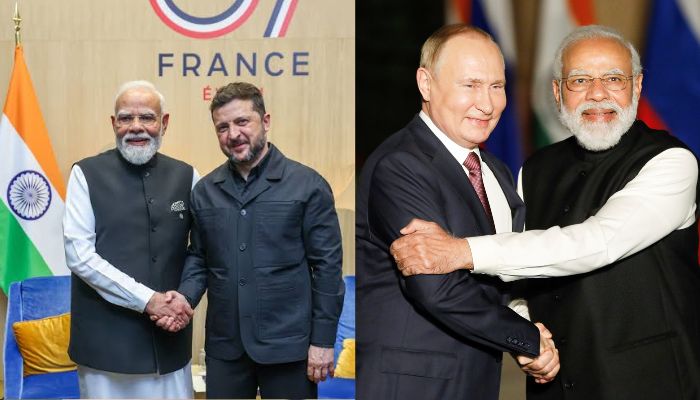
From ‘Modi’s War’ to Modi’s peace plan: India proposes Russia-Ukraine truce as Kyiv calls it ‘Most comprehensive’ 

India has proposed a three-part truce between Russia and Ukraine that seeks to stop attacks on energy facilities and other critical infrastructure, keep grain and energy flowing through Black Sea ports and end strikes on commercial shipping in the strategic waterway. The proposal was conveyed to the Ukrainian leadership during External Affairs Minister S Jaishankar’s visit to Kyiv on 3rd September, in what marked another major step in New Delhi’s efforts to help bring an end to the Russia-Ukraine war.

The Indian proposal goes beyond separate ceasefire initiatives put forward by Egypt, Türkiye and the United States. While Egypt and Türkiye have focused mainly on keeping grain shipments moving through the Black Sea, and the US has proposed an “energy ceasefire”, India’s plan seeks to cover both infrastructure and commercial shipping while keeping vital commodity supplies flowing. The proposal has also gained attention because recent attacks on commercial vessels have affected Indian seafarers and disrupted important energy supplies. India’s three-part truce proposal seeks to:

  • Stop attacks on energy facilities and critical infrastructure
  • Keep grain and energy flowing through the Black Sea
  • End attacks on commercial shipping in the Black Sea

The response from Moscow and Kyiv to the proposal was initially unclear, although follow-up discussions have taken place. However, Ukraine has now indicated that it is willing to consider the Indian initiative. Ukrainian Foreign Minister Andrii Sybiha has described India’s proposal as the “most comprehensive” among the peace initiatives currently being considered.

Ukraine calls India’s proposal ‘most comprehensive’

Ukraine is currently evaluating four international proposals aimed at ending or reducing the conflict, from India, Türkiye, Egypt and the United States. According to Sybiha, India’s proposal stands out from the others because of its wider scope.

“We have four proposals. The most comprehensive is India’s proposal. For the first time, India has signalled its willingness to play a role,” Sybiha said.

His comments are significant because they show that New Delhi’s diplomatic engagement is no longer limited to repeatedly calling for dialogue. India is now putting forward a concrete framework covering some of the most sensitive aspects of the conflict, including attacks on energy and port infrastructure and commercial shipping in the Black Sea. Sybiha also said Ukraine was ready to consider different ceasefire formats, including arrangements along the front lines, provided that any truce also addressed attacks on energy and port infrastructure and the situation in the Black Sea.

India has strong reasons for taking such an active role. The Black Sea conflict has disrupted grain supplies and, more importantly for New Delhi, energy shipments from Russia. According to the report, Black Sea ports account for almost 30% of Russian energy flows to India. Five Indian seafarers have also been killed in attacks involving Russian and Ukrainian forces on merchant vessels in recent weeks.

Putin praises Modi’s ideas for ending the war

Russian President Vladimir Putin also responded warmly to these diplomatic efforts, praising Prime Minister Narendra Modi and noting that he has very good ideas for finding a peaceful resolution. 

Addressing an audience, Putin said, “Prime Minister Narendra Modi is one of those world leaders who, despite our very good and even friendly relations, constantly raises the question and asks about putting an end to the conflict in Ukraine”.

Putin added that Modi has a genuine interest in ending the conflict and has been pushing for solutions acceptable to both sides. “He has an avid interest and very good ideas aimed at finding mutually acceptable solutions,” Putin said. “In that sense, naturally, the Prime Minister takes a neutral position but with an interest in the end of the conflict.”

The Russian President also thanked Modi for his efforts. “We are thankful for his desire to put an end to this conflict through peaceful means and as soon as possible,” Putin added.

Modi has similarly maintained that India is ready to support meaningful peace efforts because of its good relations with both Russia and Ukraine. “I believe, by virtue of our good relations with both sides, including key stakeholders, we can strengthen efforts dedicated to the restoration of an early and lasting peace in Ukraine,” Modi said.

PM Modi tells Putin: ‘Endless war’ must become ‘end of war’

This active mediation builds upon consistent messaging from Prime Minister Narendra Modi, who once again called for an end to the Russia-Ukraine conflict during his meeting with Russian President Vladimir Putin on the sidelines of the Shanghai Cooperation Organisation summit in Bishkek, Kyrgyzstan.

Modi made it clear that India does not support an indefinite continuation of the conflict and wants the international community to work towards a peaceful resolution. “We have to move from a situation of ‘endless war’ to ‘end of war’,” Modi said, stressing that it was the desire of humanity that the conflict should end at the earliest.

He also reiterated India’s longstanding position that disputes should be resolved through dialogue and diplomacy. “As you know, India supports all peaceful methods to resolve the impasse,” Modi said. “India advocates for resolving all problems peacefully, which is necessary for all of humanity.”

This is not the first time Modi has used such a direct message while speaking to Putin. During his earlier meeting with the Russian President at the SCO summit in Uzbekistan in 2022, Modi had famously said, “This is not the era of war.”

India has continued to maintain the same position throughout the conflict. New Delhi has kept communication channels open with both Moscow and Kyiv instead of completely aligning itself with either side. Modi has also spoken separately with Putin and Ukrainian President Volodymyr Zelensky, urging dialogue and diplomacy.

Trump repeatedly threatened India over Russian oil

India’s growing role in the peace process comes at a time when the country has faced repeated threats from the administration of US President Donald Trump over accusations that it is fuelling Russia’s war through its continued purchase of Russian oil.

Recently, a new US sanctions law has given the President powers to impose tariffs of up to 100% on goods from countries that are among the biggest importers of Russian crude or natural gas, putting countries such as India and China under potential pressure.

The Trump administration imposed a 50% tariff on Indian goods and threatened to increase it up to 100% last year, with the additional levy directly linked to India’s purchase of Russian crude. Trump administration has repeatedly argued that India’s energy purchases indirectly support Russia’s war effort.

Trump’s trade adviser Peter Navarro went as far as calling the Ukraine conflict “Modi’s war”. In an interview with Bloomberg Television, Navarro argued that India’s purchases of Russian oil were contributing to the continuation of the war. When reminded that Russia had started the war, Navarro doubled down, saying, “No, I mean Modi’s war!”

He also criticised India for prioritising its energy needs and said, “The road to peace runs at least partly through New Delhi.” Navarro accused India of being “arrogant” for arguing that it had the sovereign right to purchase oil from whichever country it wanted. “India, you’re the biggest democracy in the world. Okay? Act like one. Side with the democracies,” he said.

New Delhi, however, has maintained that its energy purchases are driven by national interest and the need to secure affordable energy for its population. India has also consistently argued that the conflict must ultimately be resolved through dialogue and diplomacy.

Now India is proposing peace while America has emerged as the biggest profiteer

The contrast is striking. While Washington repeatedly accused India of helping finance Russia’s war because of its Russian oil purchases, it is now India that has put forward a three-part proposal aimed at reducing hostilities and keeping vital trade routes open.

Navarro had argued that India was indirectly responsible for the continuation of the war and even said that American taxpayers were funding “Modi’s war”. Yet India’s latest diplomatic initiative is directly aimed at stopping attacks, protecting commercial shipping and maintaining the flow of energy and food.

While Trump’s administration sermonises India and slaps punitive tariffs, the United States has emerged as the biggest profiteer of the Russia-Ukraine war. American oil and gas companies registered record profits, including a massive 125% jump in 2022, by selling liquefied natural gas (LNG) to Europe at prices up to four times domestic rates.

US energy companies such as ExxonMobil and Chevron recorded record profits in the aftermath of the war, while American defence companies also benefited from the massive military assistance provided to Ukraine.

Furthermore, the US defence industry has raked in billions through massive arms sales and military supply packages to Ukraine, with Washington openly boasting that the funding rejuvenates domestic manufacturing. Even as the West demands strict adherence to sanctions, US-Russia bilateral trade has expanded in certain sectors, and American companies have explored returning to Russian energy projects. 

The contrast has therefore become increasingly difficult to ignore in Washington’s hypocrisy.

When Europe and America buy petroleum products refined from Russian crude or continue importing Russian non-ferrous metals and fertilisers, it is business as usual, but when India secures its own energy needs, it is suddenly blamed for the conflict. Moreover, while Washington criticises India’s cautious diplomatic balances, including its ties with China, it conveniently overlooks its own complex geopolitical alignments, such as providing financial and military accommodations to Pakistan despite Islamabad’s historical role in harbouring terrorism.

The situation has now taken an ironic turn. The country that was repeatedly accused of “funding” Russia’s war through energy purchases is putting forward a concrete plan to reduce the fighting, while the country that imposed tariffs and threatened further economic pressure on India has yet to secure even a lasting ceasefire.

Trump failed to secure lasting peace; India now steps up

Donald Trump had repeatedly presented himself as someone capable of ending the Russia-Ukraine war and used negotiations, threats and economic pressure to push both sides towards a settlement. Yet despite multiple rounds of diplomatic efforts and pressure tactics, a lasting peace agreement has remained out of reach.

This is where India’s position could become important.

New Delhi has something Washington does not have in the same measure: strong communication with both sides. India has maintained close ties with Russia while also building a relationship with Ukraine. Modi has spoken with Putin, met Zelensky and sent senior officials to engage with both governments.

India has also avoided reducing the conflict to a simple confrontation between two camps. Instead, it has repeatedly argued that dialogue is the only realistic path towards peace.

The latest three-part proposal reflects that approach. It does not seek to solve every territorial or political dispute overnight. Instead, it focuses on practical steps that can immediately reduce the impact of the conflict, stopping attacks on infrastructure, protecting commercial shipping and keeping food and energy supplies moving.

The fact that Ukraine has described the Indian proposal as the “most comprehensive” is particularly important. It suggests that Kyiv is willing to seriously consider New Delhi’s initiative. At the same time, Putin’s praise for Modi’s “very good ideas” indicates that Moscow also recognises India’s efforts.

This puts India in a potentially unique position. New Delhi is not trying to replace Russia or Ukraine in the negotiations. Rather, it is using its relationship with both sides to push them towards a framework that can reduce hostilities.

India’s mediation could raise its global stature

If India succeeds in helping Russia and Ukraine move even towards a meaningful ceasefire, it would be a major diplomatic achievement for New Delhi and potentially for the wider world.

The Russia-Ukraine war has already lasted for more than four years and has caused enormous human, economic and geopolitical damage. Its consequences have spread far beyond Europe, affecting food supplies, energy markets, shipping, inflation and global diplomatic relations.

India has repeatedly said that the conflict cannot be solved on the battlefield alone. Now, instead of merely making that argument, New Delhi has placed a concrete proposal on the table. The response from Ukraine and the appreciation from Russia show that India’s approach is receiving attention from both sides. If this eventually develops into a meaningful ceasefire or contributes to a lasting peace agreement, it would further establish India as a credible global voice capable of engaging with opposing sides during major international crises.

For a country that was repeatedly accused by the West of indirectly prolonging the war because of its Russian oil purchases, there is a clear irony in the present situation. India is now actively proposing ways to stop attacks and restore the flow of energy and food, while maintaining dialogue with both Moscow and Kyiv.
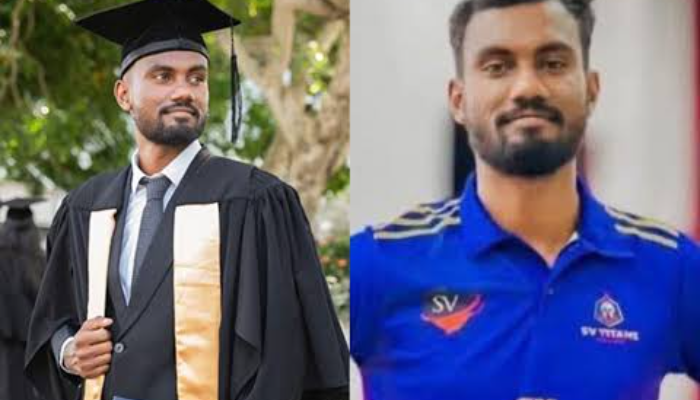
As Sri Lankan migrant worker faces death sentence in Saudi Arabia over alleged blasphemy, read how social media is weaponised by Islamo-leftists to target Hindus in the Gulf

A Sri Lankan Tamil Hindu migrant worker, Anojan Sivarasa, is facing the death penalty in Saudi Arabia in an alleged blasphemy case that began with a Facebook comment. The Al-Ahsa Criminal Court had initially sentenced him to five years in prison and imposed a fine of three million Saudi riyals.

The case, however, took a dramatic turn when prosecutors pressed to have him tried under Sharia Law. The appellate court accepted the request and announced capital punishment for him.

The remark at the centre of the matter, which was reportedly against Islam and Prophet Muhammad, was made over an insult directed at a Hindu deity. Anojan later deleted the post and even uploaded an apology video. According to his brother, someone had taken a screenshot and sent it to his employer and Saudi authorities, eventually resulting in his arrest and imprisonment in July.

Hamsidan Sivarasa conveyed, “People in Saudi Arabia knew nothing about this matter. It was individuals in Sri Lanka who sent emails to the company where my brother worked. I do not even wish to mention who those people are,” in a conversation with the BBC.

Anojan’s personal devices have been confiscated, while all communication between him and his family has ceased. They have received no information about his condition since 28th September, leaving them anxiously waiting as his fate remains uncertain.

Meanwhile, legal and diplomatic efforts are underway to secure his release as his family members are desperately exploring every possible avenue to bring him home, with no clarity yet on what lies ahead for the young man.

Of greater concern, the kingdom has a history of carrying out executions without informing either the families or the concerned foreign embassies. The relatives are only notified after the sentence has been enforced.

Hence, Anojan’s family is forced to spend the days ahead in dread while the unknown future of their son continues to weigh heavily on them.

When social media remarks put a target on back: How Islamo-leftists target Hindus

However, it is not the first time an individual has suffered severe consequences over a social media post or comment, with deliberate campaigns launched by the Islamo-leftist cabal spilling over into attempts to threaten their livelihood, personal safety and even life regardless of the context or merits of the issue.

The risks can be particularly serious for the Hindus staying and working in Gulf countries, where such controversies can have consequences far beyond the online sphere. More importantly, no one is immune from such targeting, whether an ordinary person or a well-known public figure.

A similar episode unfolded in 2018, when Indian-born British celebrity chef Atul Kochhar posted a tweet criticising Priyanka Chopra and her American television show “Quantico” over a deeply anti-Hindu storyline. The episode showed Rudraksha wearing Indian nationalists plotting to detonate a nuclear bomb in Manhattan before framing Pakistan for the attack.

Kochhar expressed his displeasure with the portrayal and argued that, contrary to the show’s depiction, Hindus had themselves faced centuries of violence and persecution at the hands of Islamist forces. This prompted a wave of attacks from the usual suspects, after which he removed the tweet and issued an apology.

The controversy, however, did not end there. Rupa Subramanyam tagged the JW Marriott Marquis Hotel Dubai, where the Michelin-starred chef operated a restaurant. She wrote that his remarks would “not go down well with authorities in the United Arab Emirates (UAE), the hotel or his Muslim patrons around the world.”

She then mocked that he would, on the other hand, become popular with the Indian Right. Others from the ecosystem similarly pounced on him, and the hotel ended its association with Kochhar.

In fact, even sharing views on geopolitical issues can jeopardise one’s employment in the Middle East. This was evident when the Kuwaiti government deported two nurses from Kerala over social media posts expressing support for Israel after Hamas attacked the country in 2023.

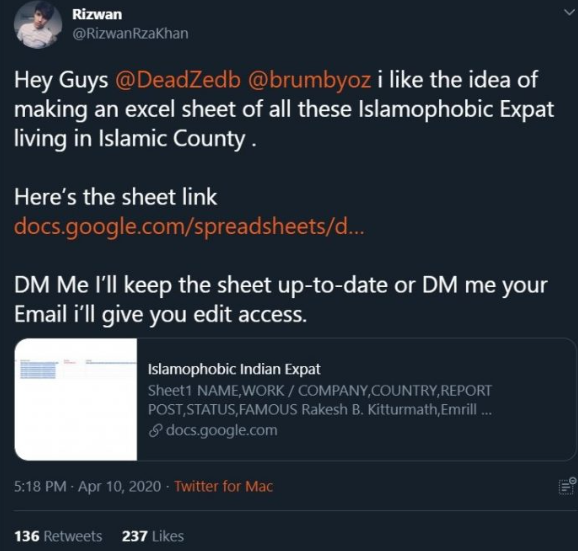
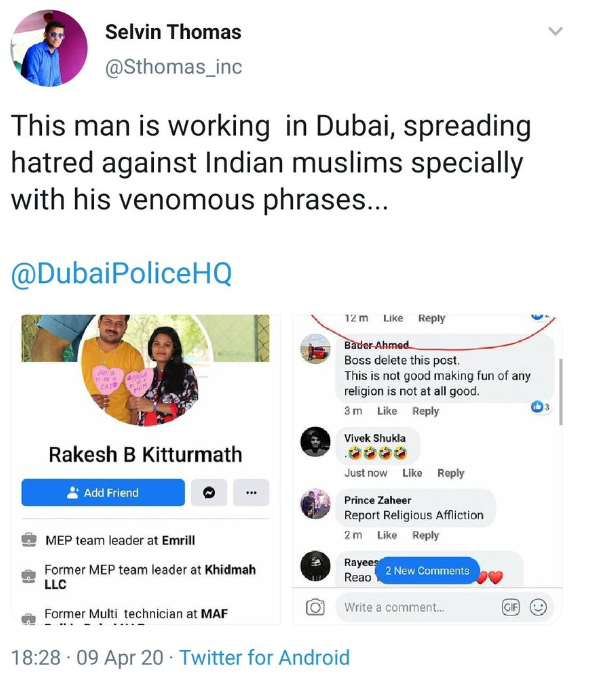
A few years earlier, in 2020, several Indians endured similar action over content that was deemed blasphemous, resulting in job loss, legal action and even deportation. One such case involved Rakesh B. Kitturmath, a Hindu man from Ranebennur in Karnataka. He was a team leader at Emrill Services, an integrated facilities management company headquartered in Dubai, at the time.

Kitturmath was targeted over TikTok comments criticising Muslims who claimed that offering namaz five times a day was enough to protect against the coronavirus. He was immediately terminated from his job and faced jail time.

The Muslim fundamentalists in India, from infamous names like former journalist Irena Akbar to ordinary trolls, had compiled a list of purported “Hindutva terrorists” for intimidation by demanding the same action against them based on false allegations, and they also succeeded in their nefarious agenda.

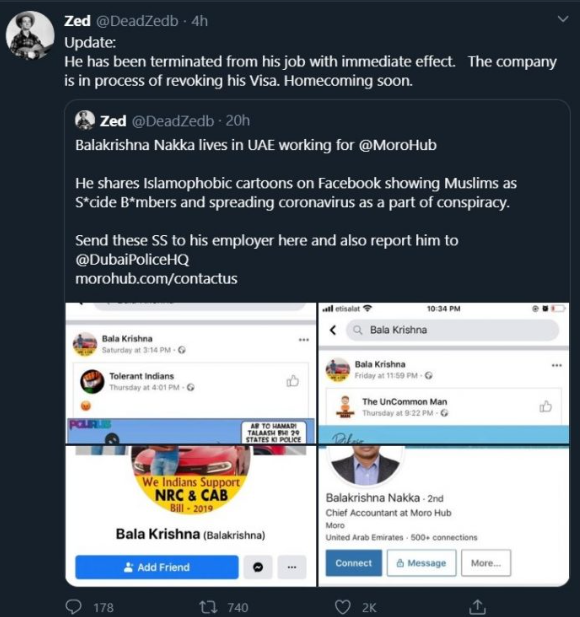
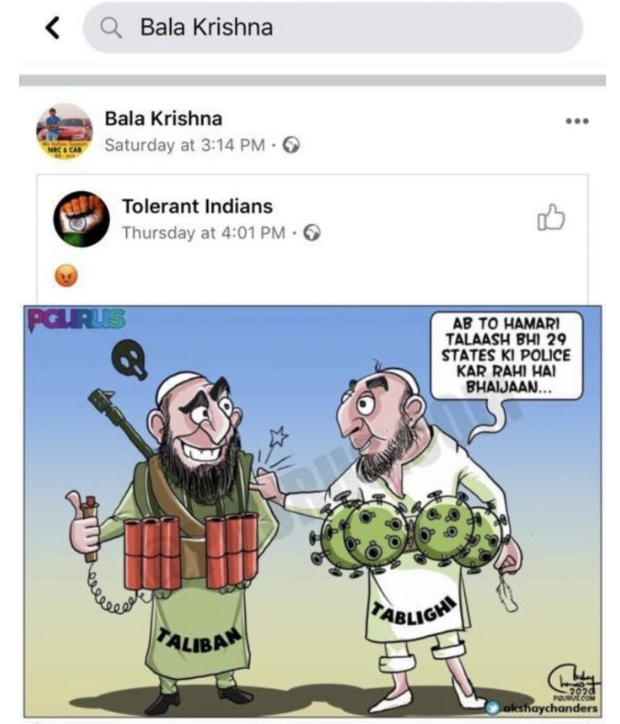
Balakrishna Nakka was sacked from his job in Dubai for sharing memes on Facebook mocking the Taliban and Tablighi Jamaat. The Islamists insisted that the “Islamophobic” cartoons showed Muslims as suicide bombers and coronavirus carriers as part of a conspiracy.

However, it is clear from the meme itself that its subject was the Taliban and Tablighi Jamaat, with no reference to or connection with the broader Muslim community. It is noteworthy that the Tablighi Jamaat organised a religious congregation in New Delhi that became a major coronavirus cluster despite a ban on such events during the pandemic.

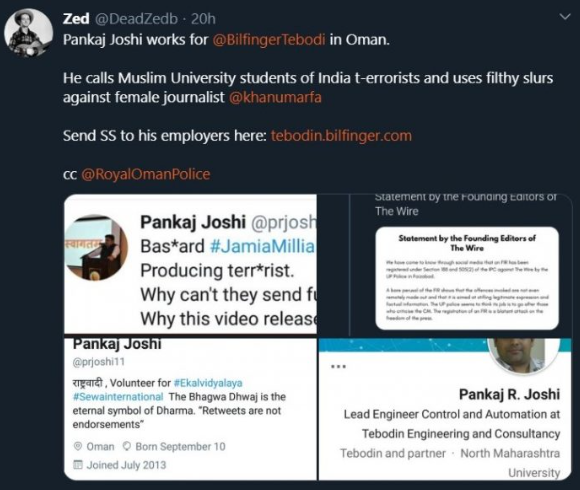
These extremists also wanted police action against an Indian in Oman for posting against Jamia Millia Islamia University.

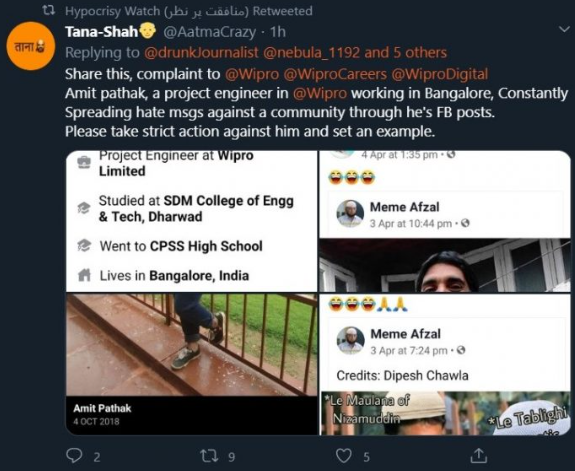
This ecosystem was not only after the Hindus in Islamic countries but even those in India, as a complaint was raised with Wipro after its project engineer highlighted the role of the Tablighi Jamaat during the Covid-19 pandemic.

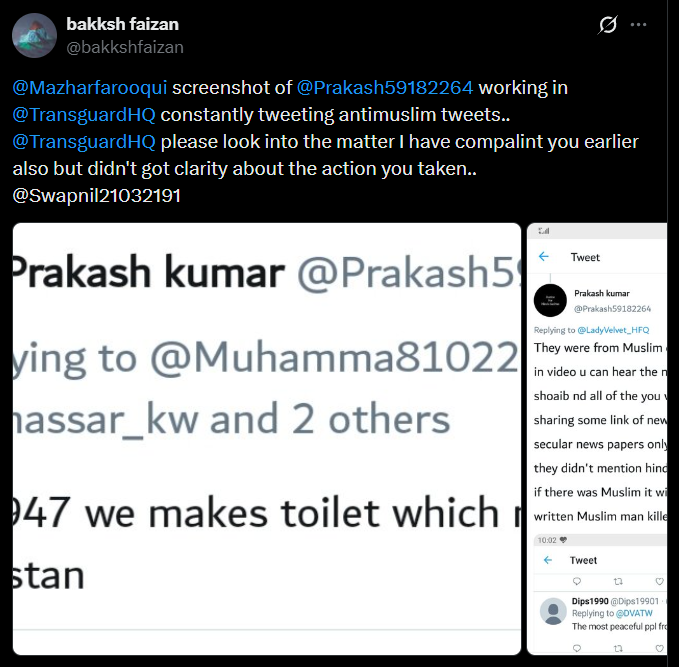
The Islamists also encouraged Transguard Group to take action against a man identified as Prakash Kumar, who made anti-Pakistan tweets. He also mentioned that the Gujarat riots began after the Godhra train burning. However, it was later found that he did not work for the company.

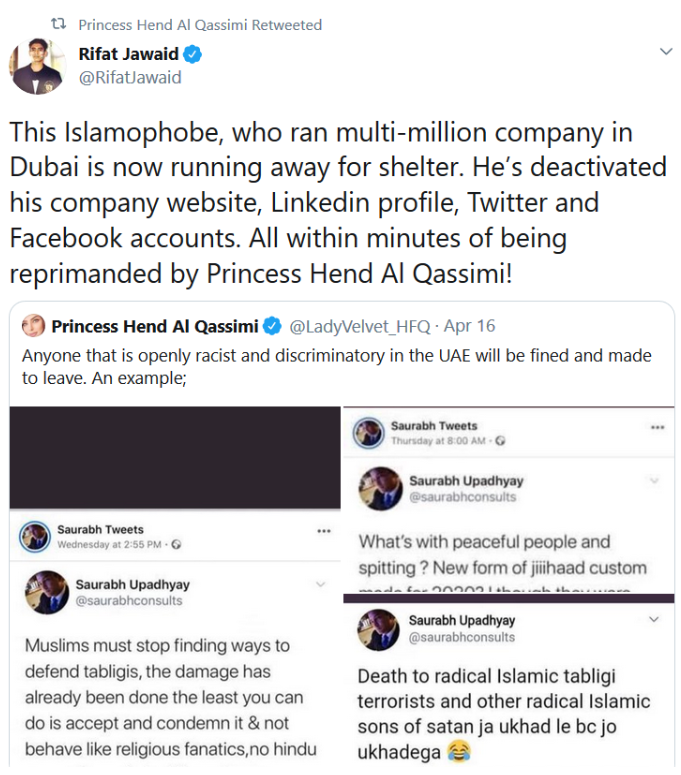
Propagandist masquerading as a journalist Rifat Jawaid mocked Saurabh Upadhyay, a businessman based in Dubai, as action was started against him after he denounced the Tablighi Jamaat and other radicals and urged Muslims not to defend them. Jawaid gleefully claimed that Upadhyay was “running away for shelter” and had “deactivated his company website, LinkedIn profile, Twitter and Facebook accounts” after Princess Hend Al Qassimi spotted his posts.

Sohan Roy, founder chairman of Sharjah-based Aries Group, had to apologise in a Facebook live video over his Malayalam poem “Viddi Janman” (Fool’s life). He did not mention any religion or community and made an oblique reference to Tablighi Jamaat through the accompanying images.

Roy asserted that religion had blinded people because they were disobeying coronavirus rules in the name of God. The poem went viral but was deleted from his X, Instagram, and Facebook accounts as the radicals attacked him.

Mitesh U, a financial manager at an Abu Dhabi-based company, was likewise targeted after sharing a Facebook post about how members of the Tablighi Jamaat had spat on others, potentially increasing the spread of the coronavirus and resulting in more casualties than a suicide attack.

Notably, many Hindus were subjected to serious action under the guise of “Islamophobia” or simply for slamming the Tablighi Jamaat’s activities during the pandemic on social media. People were forced to apologise, fired or suspended from their jobs without notice, had their salaries withheld, and were even handed over to the police over such accusations.

The conduct of the Tablighi Jamaat during that period, and the criticism it attracted, sparked the targeted harassment of those who spoke out and thus were accused of harbouring anti-Islam or anti-Muslim sentiments.

Different years, same pattern: Alleged anti-Islam posts land people in trouble

Three security personnel from Sri Lanka were accused of disparaging Islam on Facebook and Instagram after the 2019 Easter bombings in their country. The trio, working at a high-end hotel in Palm Jumeirah, were reported to the authorities by their coworkers after they shared images and posts online.

A Pakistani employee at the hotel alleged, “Some employees told me that the defendants insulted Islam on Facebook. We have 84 different nationalities working in the hotel. We summoned them for internal questioning, and they admitted making the posts.”

Al Barsha station police went to the hotel and took them into custody. Their cell phones and laptops were seized by the authorities for additional investigation after they searched their home. The men, however, refuted the charge and maintained that their uploads were about terrorism following the bombings in their nation.

In 2015, an Indian man was booked for “insulting Islam” in Dubai due to a Facebook post regarding the growing carnage in Iraq as ISIS (Islamic State of Iraq and Syria) swept over the nation. Another Indian man who also worked there was made aware of it by a friend via a WhatsApp message, after which he approached the Al Rafaa police station.

Conclusion

It is apparent that, for non-Muslims, specifically Hindus in the Gulf, even an allegation can be enough to wreak havoc on their lives, irrespective of the truth about the incident. More concerningly, action against them can be triggered by social media outrage before the charges or the circumstances surrounding them have been properly examined.

Radical elements in the Indian subcontinent have repeatedly sought to exploit such situations to demand action against the members of the Hindu community, taking advantage of the region’s stringent Islamic laws. Of course, people should exercise greater sensitivity when speaking about faith and avoid making inflammatory or offensive remarks.

However, the reality on the ground is far more complicated when those making such complaints themselves display hostility towards Hinduism and never hesitate to insult India’s majority community. On the other hand, this ecosystem swiftly turns towards its Arab overlords when it comes to making complaints against Hindus, raising the spectre of “Islamophobia,” even without any provocation.

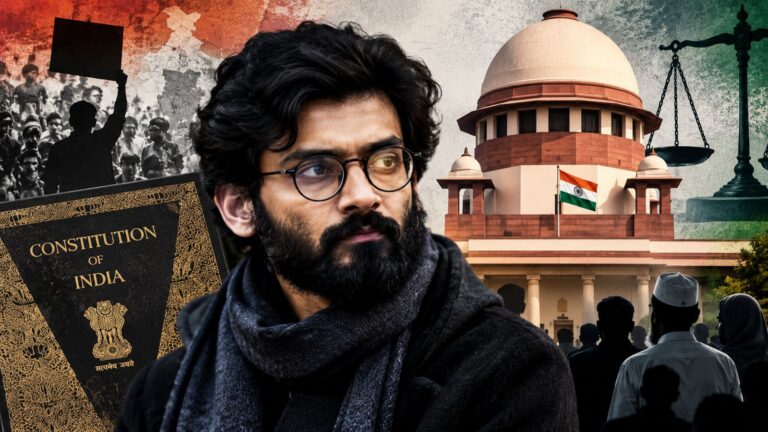
If Sharjeel Imam wants an open society, he should read the Guru of George Soros

The Indian Right has spent years accusing the Congress and the Left of being puppets of George Soros. If that is the charge, perhaps there is one person whose ideas the Left should be willing to hear: Karl Popper, the intellectual whose ideas profoundly influenced George Soros and gave the Open Society tradition its name.

“Unlimited tolerance must lead to the disappearance of tolerance.”

Popper’s argument was not that an open society should suppress unpopular opinions. It was that an open society cannot be expected to tolerate indefinitely those ideas and movements that seek to destroy the institutions that make an open society possible. Now, whether one agrees with the foundation of open societies and what those open societies would entail is a separate discussion altogether. 

But that principle, in and of itself, offers a useful way to read Sharjeel Imam’s recent letter from Tihar. Imam, in his letter, raises a question: have Indian Muslims received adequate political and socio-economic representation? A serious answer must begin with evidence rather than assume the conclusion.

Another issue inseparable from the question of an open society is what exactly Imam is alleged to have advocated, and how the judicial system has dealt with those allegations.

In the larger Delhi riots conspiracy case, the judiciary has repeatedly considered Imam’s bail at different levels. The trial court and Delhi High Court considered his bail in 2025. The Supreme Court then considered his case in January 2026 along with other accused. The Supreme Court granted bail to five co-accused but declined bail to Imam and Umar Khalid, while providing a route for a renewed bail application after the examination of protected witnesses or after one year, whichever came earlier.

Imam subsequently returned to the trial court with a fresh bail application in 2026. The trial court rejected it, and the Delhi High Court again considered and rejected his appeal in September 2026. There are also separate proceedings arising from the Jamia case in which his bail has been litigated.

The High Court, in rejecting the bail petitions of Umar Khalid and Sharjeel Imam, were scathing in their observations. In the order, the HC observed that they are “held to be the ideological drivers of the alleged conspiracy, like the speeches given, meetings held, communications, deliberations, master minding the protests, chakka jam, etc” whereas other accused, like Gulfisha Fatima, were local-level facilitators. Their alleged role in the conspiracy is far more central and serious. These observations were drawn from the Supreme Court order denying bail to the two accused. Essentially, based on the Supreme Court order, the HC too held that Umar Khalid and Sharjeel Imam are alleged to be the core conspirators and masterminds, which is why they cannot be granted bail like the other accused persons. 

The Supreme Court held that the prosecution material, taken at face value at the bail stage, disclosed reasonable grounds for believing that the accusations against Sharjeel Imam were prima facie true.

SC observed, “The material suggests involvement at the level of planning, mobilisation, and strategic direction, extending beyond episodic or localised acts. The statutory threshold under Section 43D (5) of the Unlawful Activities (Prevention) Act, 1967, therefore stands attracted qua these appellants”. 

None of this proves guilt, of course. Bail decisions, even when accompanied by an observation that the charges are prima facie true, are not convictions, and the allegations must ultimately be tested at trial. But the opposite claim also cannot be made honestly: that the Indian state simply imprisoned a dissident without allowing his case to be examined by independent courts.

Indeed, the allegations being examined are considerably more serious than a disagreement with government policy. In the prosecution’s account of Imam’s January 2020 speech, he advocated mobilising a large mob to block the route to Assam, referred to cutting the Northeast off through the Siliguri corridor or “Chicken Neck”, and advocated disruptive chakka jams. The Supreme Court’s January 2026 order records these allegations.

Again, the distinction matters. The allegation is not that Imam merely criticised the Citizenship Amendment Act or supported Muslim political mobilisation. Those are forms of political dissent. The prosecution’s case concerns not just coordination of disruptive action aimed at a strategically vital corridor and the role of such mobilisation in the broader conspiracy surrounding the Delhi riots, but also his active involvement in planning the violence which ensued. 

The prosecution case against Sharjeel Imam is considerably more complex and does not hinge only on the speeches he delivered. The charge-sheet alleges that he was involved in organising and mobilising protests from early December 2019. For instance, chats between Imam and Arshad Warsi recorded in the investigation indicate that Imam was planning “something big” and intended to mobilise students from AMU and Delhi University. The prosecution subsequently linked these activities to the protests and violence that took place at Jamia from December 13 onwards.

These facts do not automatically establish the case of the prosecution; however, it does make it impossible to discuss his incarceration honestly as though the only issue were the expression of an unpopular political opinion.

An open society must protect dissent. But an open society also has the right to investigate conduct that the state alleges threatens public order or national security, subject to judicial scrutiny and due process. That is precisely why Popper’s argument about the limits of tolerance is relevant.

The evidence on the socio-economic question is also more complicated than Imam’s narrative suggests.

Screenshot

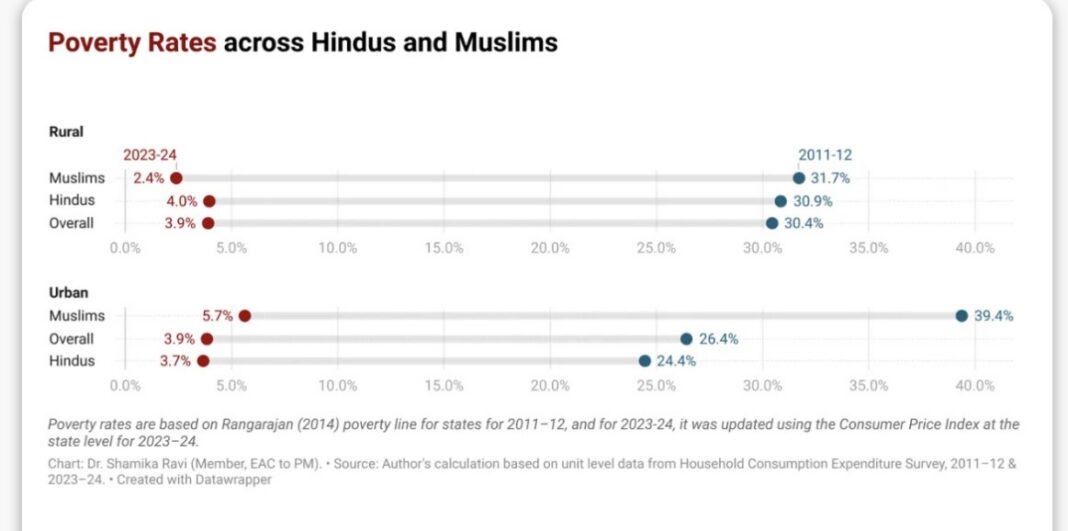
Poverty rates across Hindus and Muslims, 2011-12 and 2023-24. Source and calculations as shown in the supplied chart.

The Household Consumption Expenditure Survey data presented by Shamika Ravi show a dramatic reduction in poverty between 2011-12 and 2023-24. Rural Muslim poverty fell from 31.7% to 2.4%. Rural Hindu poverty fell from 30.9% to 4.0%. Urban Muslim poverty fell from 39.4% to 5.7%, while urban Hindu poverty fell from 24.4% to 3.7%.

The point is not that Muslims have no socio-economic disadvantage. Urban Muslim poverty remains higher than urban Hindu poverty. The point is that the data do not support a simple narrative of an Indian Muslim population experiencing uninterrupted or uniformly worsening socio-economic exclusion. In rural India, the Muslim poverty rate is actually lower than the Hindu rate.

Screenshot

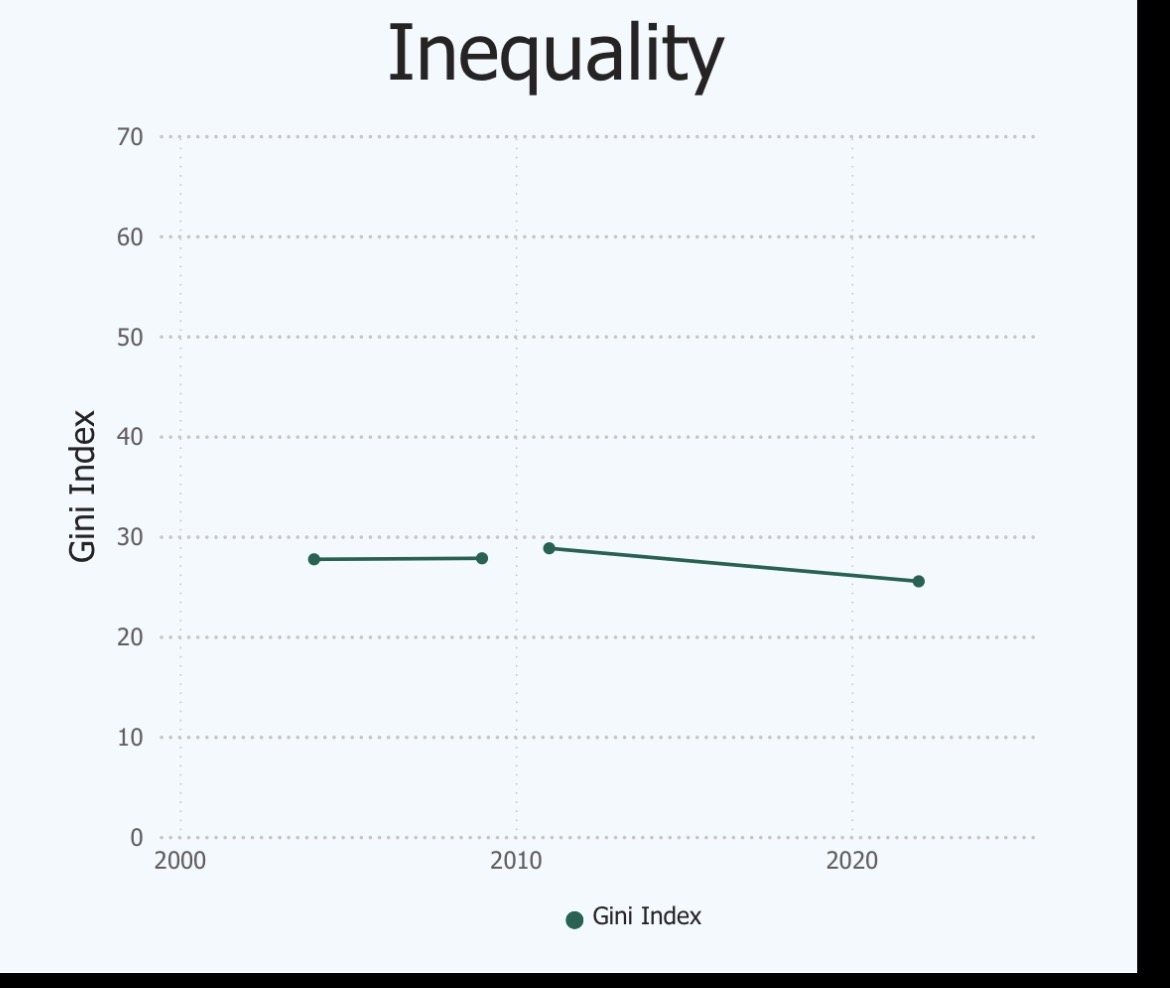
India’s consumption-based Gini index, as shown in the supplied chart.

The inequality data by the World Bank provides another reason for caution against the narrative that things are getting worse for marginal sections. The consumption inequality as measured bythe  Gini measure shown here falls from approximately 28.8 to 25.5 over the period represented. This does not mean India has no inequality. It means that any sweeping claim about a continuously deteriorating socio-economic order has to engage with evidence that points in the opposite direction.

This is where Popper becomes relevant. An open society is not merely a society in which one is free to make accusations of injustice. It is a society in which those accusations themselves remain open to evidence and criticism.

The same problem becomes even more serious when Imam moves from socio-economic disadvantage to political representation. He argues for proportional representation and stronger institutional safeguards for Muslims. But there is a crucial distinction between protecting Muslims as citizens and representing Muslims as a permanent political community.

India’s constitutional settlement deliberately chose the former. British India had already experimented with separate electorates and communal political representation. Rather than eliminating communal politics, the system helped institutionalise religious identity as a basis for political mobilisation.

After Partition, the Constituent Assembly made a conscious choice to move away from that model. It rejected separate electorates and adopted a common electoral system. That was not a declaration that minorities did not matter. It was an attempt to protect minority rights without permanently converting minorities into separate political constituencies.

There is nothing inherently undemocratic about proportional representation. India itself uses proportional representation for elections such as those to the Rajya Sabha. But proportional representation of citizens is very different from proportional representation of religious communities. The first seeks to translate votes more proportionately into seats. The second risks making religion a permanent organising principle of political power.

Imam’s argument about Partition therefore deserves scrutiny. He presents the history largely as a story of Muslim demands for decentralisation, autonomy and political representation being denied. But Partition was not the consequence of one constitutional disagreement. It involved competing nationalisms, the Muslim League’s demand for Pakistan, Congress’s competing vision of the Union, British policy, the failure of the Cabinet Mission settlement and escalating communal mobilisation.

To reduce that extraordinarily complicated history to a simple story of Muslim demands being denied is not historical inevitability. It is historical selection.

Imam also describes India’s Constitution as providing inadequate safeguards for minorities. But the Constitution expressly protects freedom of religion and religious affairs and provides cultural and educational protections for religious and linguistic minorities. Those protections can be criticised, and their implementation can be criticised. But saying that the constitutional order simply failed to provide minority safeguards is much harder to sustain.

The test of an open society is not whether it protects every political demand made in the name of a community. It is whether it protects the individual’s ability to live, argue, dissent and participate as an equal citizen.

Muslims deserve equal rights. Muslims deserve protection against discrimination. Muslims deserve genuine political opportunity. But it does not follow that Muslims must therefore become a permanently constituted political bloc entitled to a predetermined share of political power.

Perhaps, then, there is a lesson here for both sides of India’s political argument. Those who invoke George Soros against the Left should perhaps read Karl Popper more carefully. And those who invoke minority rights to argue for communal political representation should do the same.

Because Popper’s warning cuts both ways: an open society must tolerate disagreement. But it must also defend the institutional conditions that allow citizens to disagree as citizens, rather than forcing them back into permanent political communities defined by religion.

That is the question Sharjeel Imam’s argument does not adequately answer.

References:

•  Karl Popper, The Open Society and Its Enemies
The Open Society and Its Enemies – Karl Popper

•  Supreme Court of India, Gulfisha Fatima v. State (Govt. of NCT of Delhi), 5 January 2026
Supreme Court judgment – Gulfisha Fatima v. State

•  Delhi High Court, Sharjeel Imam v. State of NCT of Delhi, 30 September 2026
Delhi High Court judgment – Sharjeel Imam v. State

•  Shamika Ravi, “India is winning the fight against poverty”
Shamika Ravi – India is winning the fight against poverty

•  World Bank, India: Poverty and Equity Assessment
World Bank – India Poverty and Equity Assessment

•  World Bank, World Development Indicators – Distribution of Income or Consumption
World Bank – World Development Indicators

•  Constituent Assembly of India, Advisory Committee Report on Political Safeguards for Minorities, 11 May 1949
Constituent Assembly – Advisory Committee Report on Political Safeguards for Minorities

Bihar: Man uses SC wife to extort money by filing false cases under the SC/ST Act; read case details and how the law is being weaponised for compensation and vengeance

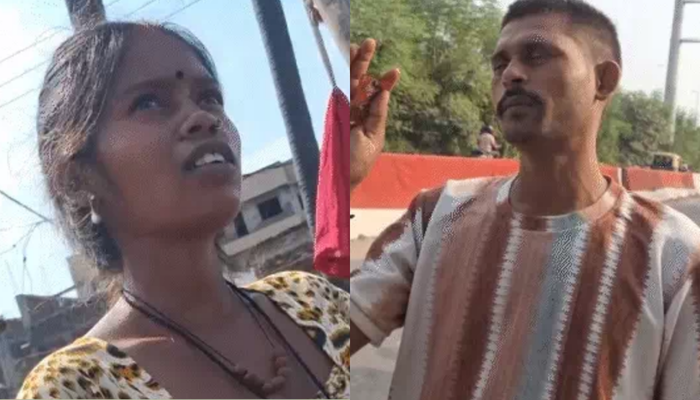
An extortion racket has been exposed in Bihar that misuses the Scheduled Castes and the Scheduled Tribes (Prevention of Atrocities) Act, 1989, commonly known as the SC/ST Act, to threaten people and extort money from them. The racket is reported to be run by a man named Ravi Yadav, along with his wife, Rinki, who belongs to the Scheduled Caste (SC) community. The couple and their relatives have been making money through government compensation and extortion by filing false cases under the SC/ST Act against people.

According to an investigative report and sting operation by Dainik Bhaskar, Ravi Yadav, a non-SC/ST, uses his wife, Rinki, to file false cases under the SC/ST Act and extort money. He also files these fake cases on request, charging hefty sums. Yadav explained his modus operandi to an undercover Dainik Bhaskar reporter, who approached him to file a fake SC/ST Act case against a person.

Blatant misuse of the law meant to protect genuine victims

Ravi Yadav told the reporter on camera that he married a woman from an SC community to make money by misusing the Act. He admitted to having filed multiple fake cases over the years and extorted huge amounts of money, in addition to the compensation given by the government, meant for genuine victims of caste atrocities.

He said that if the reporter was willing to spend money, he could get his wife to file a fake case of sexual harassment and caste discrimination against anyone. He said that the case could be made more stringent depending on the money the reporter was willing to spend. He added that if more money is paid to him, he could get his wife’s family and relatives to appear as witnesses, which would further strengthen the case. However, he made it clear that he would keep the compensation amount that will be offered to his wife after she files the case.

A wider network fuelled by extortion money and compensation

Ravi Yadav further divulged that he has several acquaintances in Bihar who have been making money in this manner. He said that he learnt about “the scheme” from a relative in Muzaffarpur. “I turned this into a weapon. Since my wife belongs to the SC/ST category, I use her status as a tool,” Ravi said.

He advised the reporter to file the case at the Danapur Court, stating that he has his people in the court, who will get the job done. When the reporter told him that he wanted to file the case at Shrikrishnapuri, Yadav said that it would be done. He also made the reporter meet his wife and her family.

The reporter was told that he would have to pay ₹2.5 lakh for filing the fake case. Four people will be involved in the process: one victim and three witnesses. He was also told that he would have to bear additional expenses, including travel, accommodation, and food for all the people who will be involved in he process, in addition to the lawyer’s fee.

How the law has been weaponised

The SC/ST Act, which was introduced as a safeguard against caste-based violence and discrimination, has been reduced to a tool being used for harassment and extortion. Instead of helping genuine victims, the law has led to the creation of a new class of victims.

Under the SC/ST (Prevention of Atrocities) Rules, 1995, as amended in 2016, complainants are entitled to monetary relief at multiple stages. This monetary relief is disbursed immediately on FIR registration, as interim relief during trial, and as final compensation on conviction.

Roughly, 25% to 50% of the amount is released by the District Collector within seven days of the FIR’s filing, another 25% after the chargesheet is filed, and the balance on conviction, drawn from a schedule that ranges between ₹1 lakh for offences like caste slurs up to ₹8.25 lakh for murder or gang rape.

It is crucial to note that this financial relief is linked to registration and charge-sheeting; these stages occur well before any court has even tested the allegation, and not conviction alone.

Many instances of false cases filed under the SC/ST Act have come to light over the past many years. The law has been weaponised for a range of reasons, including personal disputes, property matters, and the greed for financial compensation. In 2018, the Supreme Court noted the possibility of the SC/ST Act being used for “extraneous considerations”. The court introduced additional safeguards in cases involving allegations against civil servants. However, this was overturned by a subsequent amendment by the Modi government.

Last month, the Allahabad High Court ordered a statewide probe into compensation claims made under the Scheduled Castes and the Scheduled Tribes (Prevention of Atrocities) Act, 1989. The order came after the High Court came across a case in which an advocate and his family members received over ₹23 lakh in relief money in multiple claims made under the SC/ST Act.

Registration of cases under the SC/ST Act saw a consistent upward trajectory from 2020 through 2023, with the number of cases filed rising from 45,995 cases in 2020 to 45,800–46,100 in 2021, and sharply rising to 52,866 cases in 2022. The upward trend peaked at a five-year high in 2023 with 53,372 registered cases, and registered a slight drop to 48,669 cases in 2024. The situation warrants special attention and effective resolution.

In a classic case of how the SC/ST Act is misused for compensation money, a woman named Chandrawati Devi, a resident of Hastpur village, allegedly misused government schemes meant for Scheduled Castes (SC) and fraudulently pocketed around ₹46 lakh.

It was reported that in the last 10 years, 15 different cases have been registered against Chandrawati Devi and her family. Many of these cases were filed under the SC/ST (Prevention of Atrocities) Act, 1989.

Under this law, victims are provided financial assistance and legal protection. The allegation is that Chandrawati and her family repeatedly filed false cases to avail the benefits of these schemes and have so far received nearly ₹46 lakh.

CJP supporters urging protestors to buy police uniforms online to impersonate Delhi Police officials during 10th October Jantar Mantar protest: Here’s how it’s illegal 

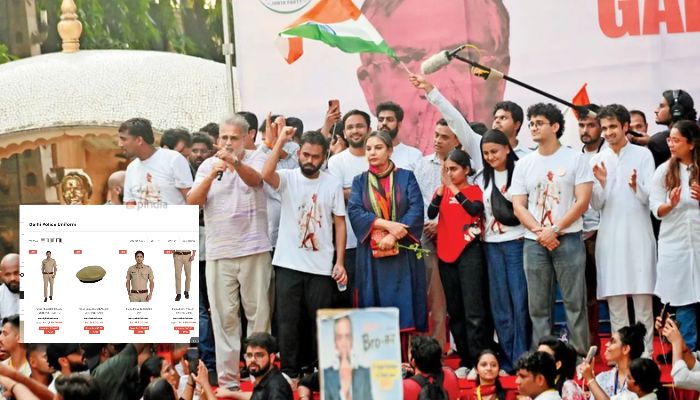
The Cockroach Janta Party (CJP) has called for a massive protest at Delhi’s Jantar Mantar on 10th October if the Chief Election Commissioner Gyanesh Kumar does not resign amid manufactured outrage over the Special Intensive Revision (SIR) of electoral rolls. Ahead of the protest, several CJP supporters online are directly or in veiled fashion urging those planning to join the protest to buy police uniforms online and impersonate police officials. 

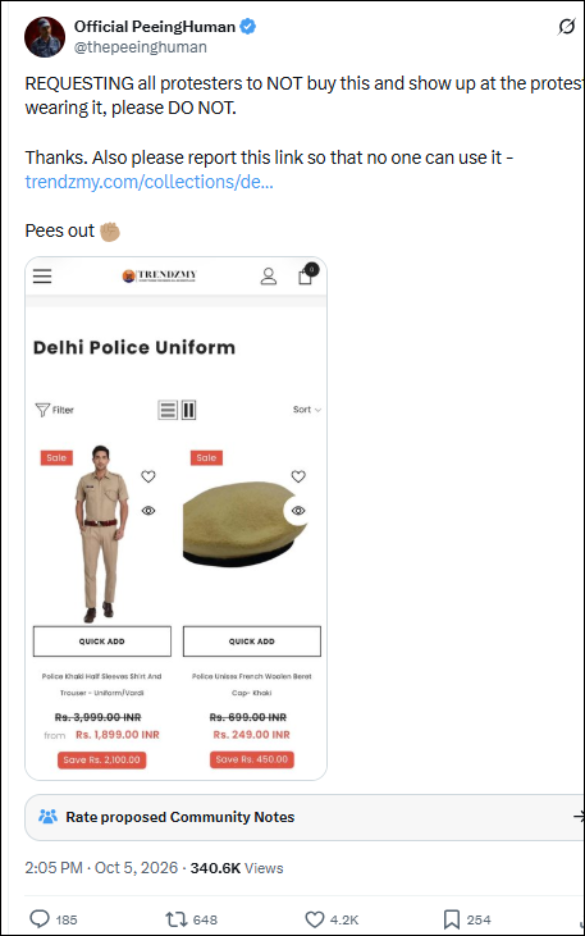
In this vein, a prominent anti-BJP troll, Ramit Verma, the man behind the @thepeeinghuman X handle, used the double bind trick of saying ‘do not do this’ while implicitly wanting people to do it. “Official PeeingHuman” wrote on X, ” REQUESTING all protesters to NOT buy this and show up at the protest wearing it, please DO NOT. Thanks. Also please report this link so that no one can use it.” 

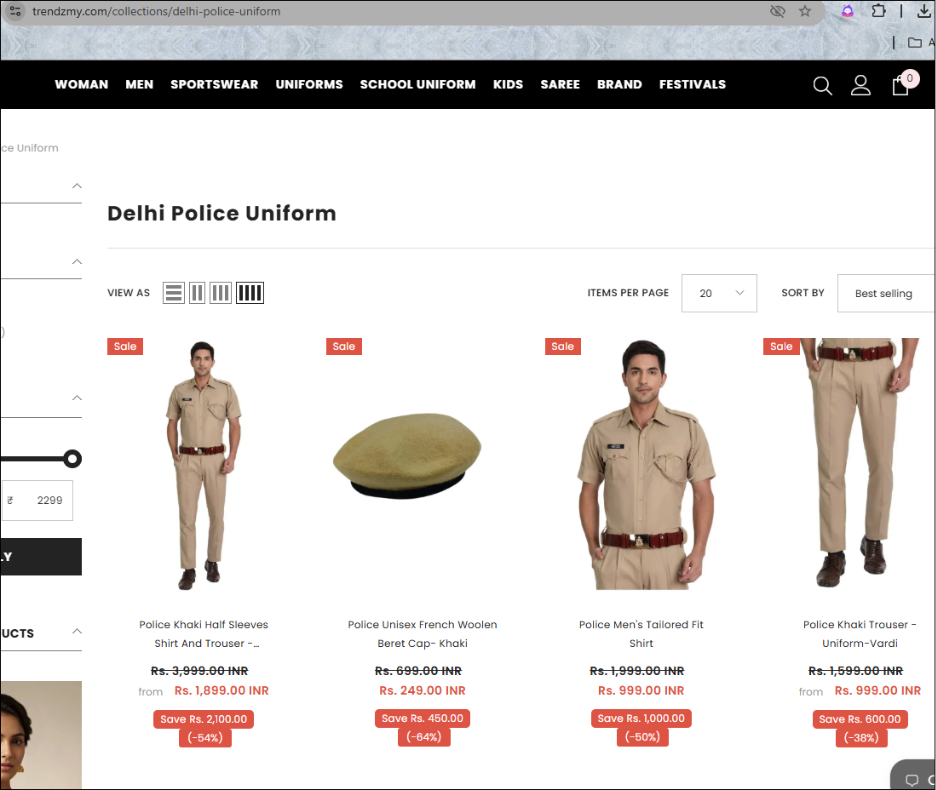
The admin of the pro-AAP channel also shared a link to an online platform called “Trendzmy” selling police uniforms and related accessories. 

Notably, Ramit Verma has earlier received backlash for falsely claiming in 2020 that goons belonging to the BJP and RSS were harassing girls at Gargi College, University of Delhi. At that time, the then DCP Atul Thakur told journalist Swati Goel Sharma that investigations did not reveal any political affiliation of those involved in Gargi college harassment case. 

In February 2025, Verma was invited by controversial US-based ‘researcher’ and Associate Professor at the University of Michigan Joyojeet Pal to an event bringing anti-India forces under one roof. 

During the CJP’s Chalo Sansad protests in July this year, ‘Peeing Human’ Ramit Verma claimed to have been beaten by the police. He said that after one blow, when he asked a police officer to hit him again, instead of backing off, the officer fulfilled Verma’s request.

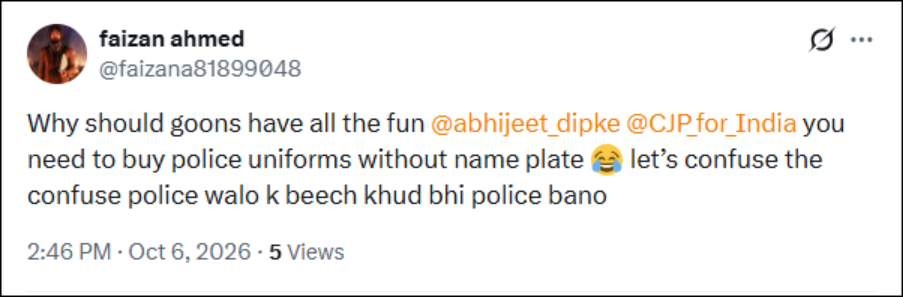
Moving ahead, an X post published on 6th October 2026 by Faizan Ahmed asked CJP and its founder, Abhijeet Dipke, to buy police uniforms without name plates, and ‘become police among the police’. 

“Why should goons have all the fun @abhijeet_dipke @CJP_for_India you need to buy police uniforms without name plate. let’s confuse the confuse police walo k beech khud bhi police bano,” the X user wrote. 

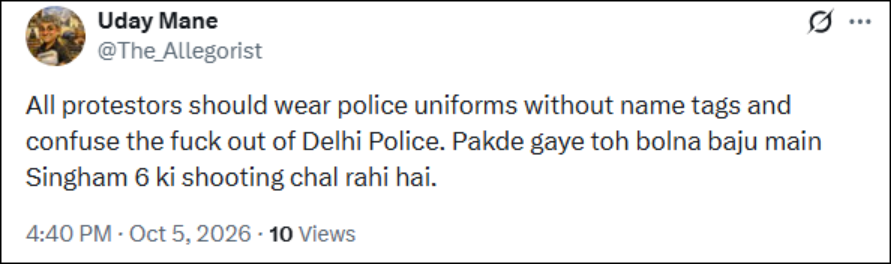
Another CJP supporter wrote, ” All protestors should wear police uniforms without name tags and confuse the fuck out of Delhi Police. Pakde gaye toh bolna baju main Singham 6 ki shooting chal rahi hai.” 

Notably, before these calls for buying and wearing police uniforms to impersonate Delhi Police officials deployed at Jantar Mantar came, several CJP supporters and influencers have been found masquerading as ‘independent journalists’. They have been exploiting press cards to create ruckus, level serious allegations against police officials, and evade detention. 

Impersonating police officers by wearing uniforms in an unauthorised manner is not only about evading detention. Those CJP ‘cockroaches’ wearing police uniforms might resort to violence and hooliganism to blame it on the Delhi Police and incite protestors. It was seen during the CJP’s July protest how CJP supporters first pelted stones at police and resorted to violence, but when the police retaliated, the latter were painted as aggressors brutalizing ‘innocent students’. 

It appears that after fake journalists and fake ‘police molesting women’ CCTV footage, a section of protestors might join the 10th of October protest while wearing police uniforms bought online. 

It is, thus, pertinent to understand what the Indian laws say about impersonating a police officer. 

What the law says about police uniforms 

The Indian law restricts the use of police uniforms to authorised personnel. 

Section 204 of the Bharatiya Nyaya Sanhita, a023, states that impersonating a public servant deliberately is a cognisable and non-bailable offence.  

“Whoever pretends to hold any particular office as a public servant, knowing that he does not hold such office or falsely personates any other person holding such office, and in such assumed character does or attempts to do any act under colour of such office, shall be punished with imprisonment of either description for a term which shall not be less than six months but may extend to three years and with fine,” the law states. 

Meanwhile, BNS Section 205 covers wearing garb or carrying a token used by a section of public servants with fraudulent intent. A person who does not belong to the class and wears resembling garb or carries a resembling token intending that it may be believed that he belongs to the class, faces imprisonment and a monetary fine. Thus, impersonating, in the present case, a police official is a cognisable and bailable offence. 

“Whoever, not belonging to a certain class of public servants, wears any garb or carries any token resembling any garb or token used by that class of public servants, with the intention that it may be believed, or with the knowledge that it is likely to be believed, that he belongs to that class of public servants, shall be punished with imprisonment of either description for a term which may extend to three months, or with fine which may extend to five thousand rupees, or with both,” Section 205 states. 

In addition, the Police Act, 1861, and service rules, including the Indian Police Service (Uniform) Rules, restrict the use of official uniform, badges, and insignia to serving personnel entitled to them. The authorised wearers include police officers and personnel on duty or as permitted by their force’s regulations. 

There, however, are limited exceptions for ceremonial events, veterans, or training with explicit permission. In context. of actors and acting projects like films, television dramas, etc., prior formal permission and approval is required to be obtained from local enforcement authorities. 

Thus, ordinary civilians using costumes with intent to deceive, or posing as officers to direct crowds, evade checks, or exercise authority, are all punishable offences. Besides, impersonating police officials may also attract additional offences, including cheating, assault, obstruction, etc. 

E-commerce platforms selling police and military uniforms 

It is alarming that e-commerce platforms like Trendzmy, Amazon, Uniformer, and DressCode Clothing are selling Indian police uniforms.  

Notably, while there is not a criminal blanket ban on selling police uniforms in the same way as wearing them to impersonate an officer is, it is restricted and regulated by local orders. 

To prevent misuse, executive magistrates can issue temporary preventive orders under Section 163 of the Bharatiya Nagarik Suraksha Sanhita, directing people to abstain from certain acts in the interest of public safety and harmony. Such orders have been used in places including Chandigarh to ban the open sale of army and police uniforms, logos, insignias and related items unless the buyer produces official identification, with sellers required to keep records. 

DressCode Clothing has also put up military, NCC and other defence uniforms for sale. 

There have been cases earlier, wherein it turned out that fraudsters used police uniforms they purchased from e-commerce platforms to deceive people by posing as police officers.  

From beret caps, winter uniforms, belts, shoes, socks to other accessories related to the police uniforms are being openly sold online, which may be bought and misused by frauds, criminals, as indicated in the present case, by several people planning to impersonate the police. It is thus crucial that the police treat the online sales of police uniforms as a serious national security issue and take strict measures accordingly. 

Chhattisgarh: Christian missionary groups cry foul after Hindus invoke SC verdict to block Christian burials at Hindu cremation ground

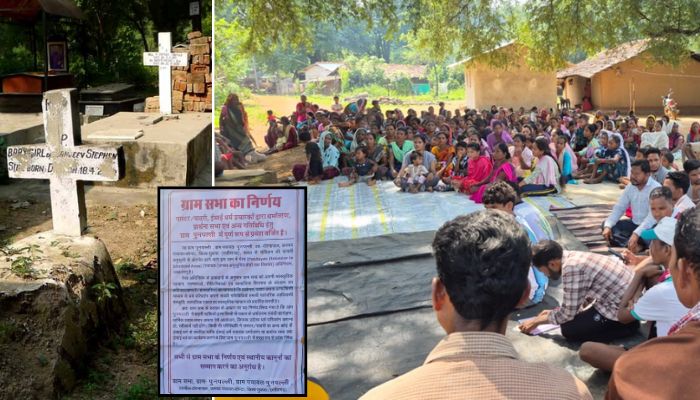
A controversy has erupted in Chhattisgarh’s Sukma district after a tribal village denied the use of its traditional Hindu cremation ground for Christian funeral rituals. What began as a dispute over whether Christians could bury their dead at a community cremation ground has now escalated into accusations from Christian groups against the Hindu tribal residents who opposed the practice.

The controversy centres on Punpalli village, where the Gram Sabha has passed resolutions restricting religious activities and refusing to provide village land for the burial of tribal residents who have converted to Christianity. Christian representatives have objected to the move and accused the villagers of discrimination, while the Gram Sabha has defended its decision as an effort to protect traditional customs, community spaces and tribal identity.

At the heart of the dispute is a deceptively simple question: does the right to practise Christianity also give a converted resident the right to conduct Christian funeral rituals at a cremation ground traditionally used by Hindu tribals? For the villagers, the answer is no, and they argue that allowing such practices could turn a sacred community space into another flashpoint of religious conflict.

The villagers are drawing a line. Christian groups call it discrimination

Punpalli has around 2,000 residents, including 21 Christian families comprising approximately 75 people.

The Gram Sabha passed 12 resolutions on October 2. One of them states that the village will not provide land for the burial of tribal people who follow Christianity.

Christian representatives have highlighted the distances involved, pointing out that families may have to travel more than 13 kilometres to Dhornapal or over 40 kilometres to Sukma to bury their dead.

But the argument being advanced by the villagers is not that Christians cannot conduct their funeral rites.

It is that they cannot simply claim a traditional Hindu tribal cremation ground as a venue for Christian rituals.

There is a distinction that Christian groups appear unwilling to acknowledge.

Religious freedom guarantees an individual the right to practise their faith. It does not automatically confer a right to take over every community institution historically associated with another faith and use it for one’s own religious rituals.

What happens when conversion changes the community’s traditional spaces?

This is where the larger issue of religious conversion enters the picture.

The Punpalli Gram Sabha has explicitly cited concerns about preserving tribal culture, traditions and social heritage. It has also raised concerns about religious conversion through inducement, pressure or other means.

Across India’s tribal regions, Christian missionary groups have used differing tactics to lure locals into converting to Christianity. Material assistance, inducements or promises of healing are among methods employed by Christian missionaries to wean locals away from their birth faith and bring them into the fold of Christianity.

But the underlying concern expressed by the villagers is clear.

If conversion changes an individual’s religion, should it also automatically change the character and ownership of the community’s traditional religious spaces?

The villagers’ answer is no.

They want their traditional Hindu tribal institutions to remain protected even when some members of the community choose to adopt another faith.

The cremation ground is not just another piece of land

This is perhaps the most important point being lost in the noise over the Punpalli resolution.

A traditional cremation ground is not merely an empty plot where anyone can conduct any religious ceremony.

For the tribal Hindu community that has traditionally used it, the site is connected to generations of funeral rites, ancestors, customs and religious practices.

Allowing Christian funeral ceremonies at such a site can therefore be seen by local residents as more than an administrative arrangement. It can alter the religious character of a community space.

And villagers have a legitimate reason to worry about what happens next.

If Christian families are permitted to conduct Christian burial or funeral rituals at a Hindu tribal cremation ground, every subsequent dispute could become a fresh flashpoint: over access, rituals, control of the land and the right to determine how the space is used.

The Punpalli Gram Sabha appears to be trying to prevent precisely that situation before it becomes entrenched.

The Subhash Baghel case is now being invoked

The controversy has been linked to the Supreme Court proceedings concerning Christian pastor Subhash Baghel, who died in January 2025.

His son, Ramesh Baghel, wanted to conduct his father’s final rites according to Christian customs at the traditional cremation ground in their native village.

The local tribal Hindu community objected and asked the family to use a Christian cremation facility around 20 kilometres away. Police officials also suggested the alternative location to prevent a law-and-order situation.

The dispute eventually reached the Supreme Court.

The bench differed on the appropriate location for the funeral. Justice B V Nagarathna permitted burial on private agricultural land, while Justice S C Sharma favoured a common Christian burial ground serving several villages.

The funeral was eventually conducted at Karkapal under heavy security.

The case subsequently became a significant reference point in disputes involving Christian burials in Bastar.

Christian groups now accuse the ‘right wing’

Christian representatives have claimed that “right-wing activists” are visiting tribal villages and encouraging Gram Sabhas to restrict Christian burials.

Nukesh Baghel, vice president of the Bastar District Rural Christian Service Committee, claimed that Punpalli was at least the 10th village in the region to adopt such a measure.

But the “right-wing conspiracy” narrative does not answer the basic question being raised by the villagers.

Why should a Hindu tribal community be compelled to permit Christian religious rituals at a cremation ground it has traditionally used?

The villagers’ position is not necessarily about preventing Christians from having burial grounds. It is about preventing a traditional Hindu community space from being repurposed for another religion without the community’s consent.

That distinction matters.

PESA invoked to protect tribal customs

The Gram Sabha has invoked the Panchayats (Extension to Scheduled Areas) Act, 1996, or PESA, in support of its resolutions.

Punpalli falls under the Fifth Schedule framework, which recognises the distinctive character of Scheduled Areas and provides Gram Sabhas an important role in protecting community traditions and practices.

Madkam Bhima, a Janpat member elected from Punpalli, defended the resolution and said the village was acting under PESA.

The villagers’ argument is essentially this: if Gram Sabhas cannot protect their traditional customs and community institutions from being altered without their consent, what meaning does tribal self-governance actually have?

That question deserves to be answered instead of dismissing every such village resolution as the handiwork of “right-wing” forces.

The real flashpoint may be what happens next

The immediate dispute concerns burials. But the villagers are looking at the larger trajectory.

Today, the demand may be for permission to conduct Christian funeral rituals at a traditional Hindu cremation ground. Tomorrow, disputes could arise over who controls the space, which rituals are permitted, whether Christian symbols can be installed, or whether the community can continue enforcing its traditional practices.

Once such competing claims become institutionalised, a site meant for the peaceful final rites of the dead can quickly become a site of confrontation between Hindu tribals and converted Christians.

The Punpalli Gram Sabha’s resolution can therefore be viewed as an attempt to draw a boundary before the dispute reaches that stage.

Religious freedom does not mean appropriation of community institutions

There is nothing inherently contradictory about defending religious freedom while also defending the right of a traditional community to preserve its religious spaces.

A tribal resident who becomes Christian should be free to practise Christianity and perform Christian funeral rites.

But that does not automatically settle the separate question of which land those rites should take place on.

If a separate Christian burial or cremation facility is available, or can be established, the issue can be resolved without forcing two competing religious claims onto the same traditional community space.

That is precisely the distinction the current debate risks losing.

The Christian groups’ allegations of persecution and their invocation of the Supreme Court case may generate headlines, but they do not erase the villagers’ concerns about conversion, tribal identity, community ownership and preservation of traditional Hindu spaces.

Punpalli’s Gram Sabha has drawn a line.

The larger question now is whether India’s commitment to religious freedom also includes the right of tribal Hindu communities to say: our traditional religious spaces cannot simply be claimed by another faith in the name of religious freedom.

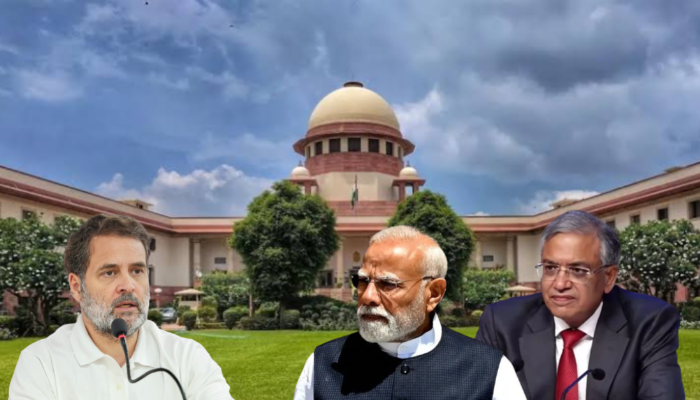
As Congress-led opposition peddles propaganda against Modi govt and CEC Gyanesh Kumar, read how SC voiced satisfaction with Election Commission over SIR process, accepted Form 6

On 5th October (Monday), Chief Justice of India Surya Kant stated that the Supreme Court had not sanctioned any modification to Form 6. The Election Commission of India (ECI) had earlier clarified that the additional declaration attached to the voter enrolment form during the Special Intensive Revision (SIR) had been upheld by the apex court.

Since then, however, the opposition ecosystem, led by the Indian National Congress, has sought to portray the development as validation of its unfounded allegations against Chief Election Commissioner (CEC) Gyanesh Kumar and the Modi government, accusing them of acting in collusion to benefit the Bharatiya Janata Party (BJP) and spreading misinformation over the sensitive subject.

Rahul Gandhi went a step further during an I.N.D.I. Alliance protest, threatening, “What has been done to the country is treason. Be it Prime Minister Narendra Modi, Amit Shah, Mohan Bhagwat or Gyanesh Kumar, none will be spared.”

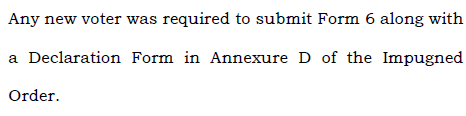
As a political script unfolds and the opposition attempts to exploit the issue to save its fast-eroding political space, it needs to be recounted that the Supreme Court not only upheld the ECI’s authority to conduct the Bihar SIR but also conveyed that a person applying for registration as a new voter was required to submit Form 6 along with Annexure D in an earlier ruling on 27th May by a two-member bench of CJI Surya Kant and Justice Joymalya Bagchi.

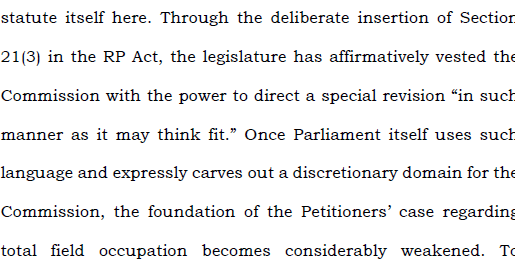
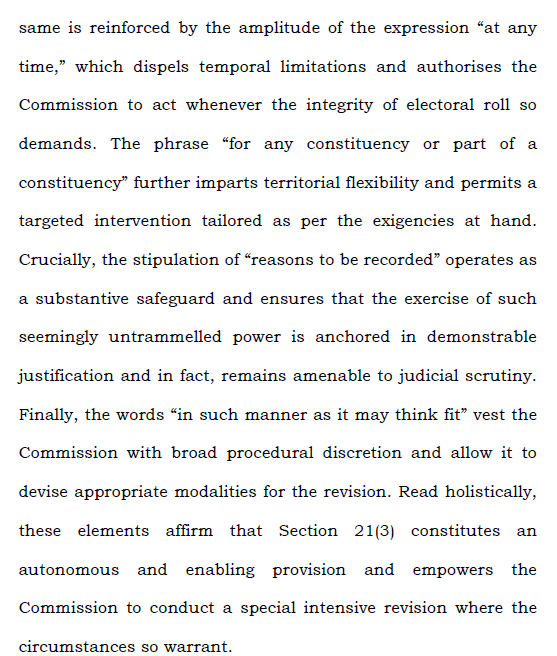
The court stated, “Through the deliberate insertion of Section 21(3) in the RP (Representation of the People Act), the legislature has affirmatively vested the Commission with the power to direct a special revision in such manner as it may think fit.” It added that the basis of the arguments of the petitioners regarding complete field occupation is significantly undermined whenever Parliament itself use such wording and thus establishes a discretionary domain for the Commission.

The court noted that Section 21(3) is a conscious attempt by the legislature to provide the Commission with the power to conduct SIR of the electoral records, which is different from the ordinary revision framework and beyond the limits set by Section 21 (2).

The court conveyed that the “opening non-obstante clause unequivocally disengages the exercise from the impediments imposed on the ordinary revision mechanism under Section 21(2) and hints at a legislative intent to create an unfettered source of authority.”

It was also pointed out that this was affirmed by the expression ‘at any time,’ which eliminates temporal restrictions and enables the Commission to take action whenever the integrity of the electoral roll requires it.

“The phrase ‘for any constituency or part of a constituency’ further imparts territorial flexibility and permits a targeted intervention tailored as per the exigencies at hand,” the court mentioned.

It remarked that the need for ‘reasons to be recorded’ functions as a substantive protection and guarantees that the use of such ostensibly unrestricted power is based on verifiable reasoning and continues to be subject to judicial review.

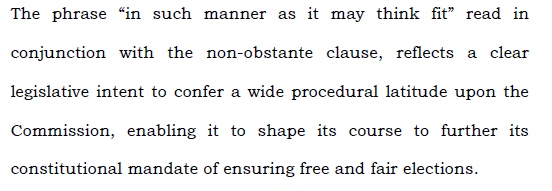
The bench emphasised that the Commission is allocated extensive procedural discretion ‘in such manner as it may think fit,’ enabling it to create suitable revision proceedings.

It then declared, “Read holistically, these elements affirm that Section 21(3) constitutes an autonomous and enabling provision and empowers the Commission to conduct a special intensive revision where the circumstances so warrant.”

ECI granted an independent source of power

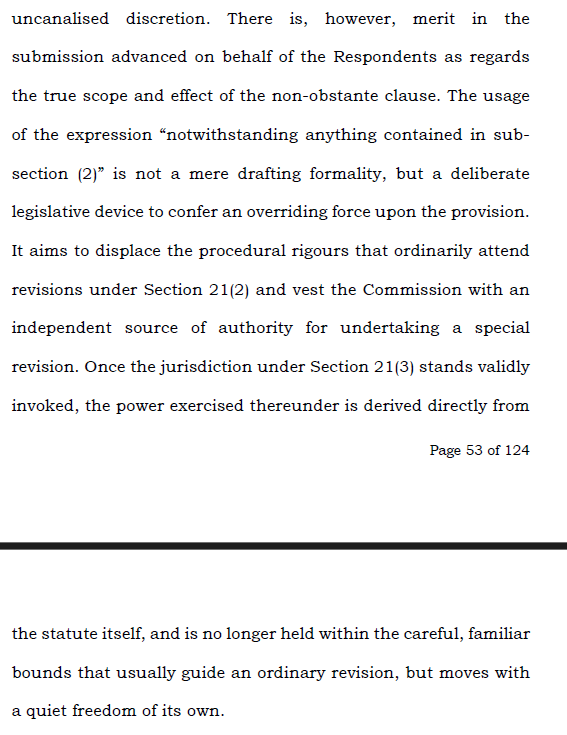
The petitioners argued that the non-obstante clause in Section 21(3) cannot be interpreted to afford the Commission unrestricted discretion by negating the responsibilities of the preceding sub-section and the RP Act’s organised framework. However, the court countered that the argument presented by the respondents on the precise extent and impact of the non-obstante clause had merit.

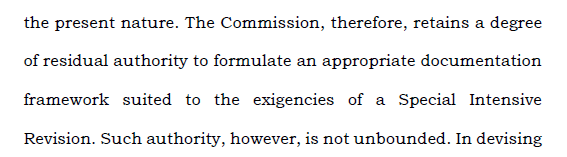
It had highlighted that “the Commission retains a degree of residual authority to formulate an appropriate documentation framework suited to the exigencies of a Special Intensive Revision.”

The court observed, “The usage of the expression ‘notwithstanding anything contained in subsection (2)’ is not a mere drafting formality, but a deliberate legislative device to confer an overriding force upon the provision. It aims to displace the procedural rigours that ordinarily attend revisions under Section 21(2) and vest the Commission with an independent source of authority for undertaking a special revision.”

It stressed that the authority used under Section 21(3) is taken straight from the statute itself after it is duly invoked and no longer operates within the cautious, recognisable constraints that usually steer an ordinary revision, but rather “moves with a quiet freedom of its own.”

The verdict read, “As regards the expression ‘in such manner as it may think fit,’ the petitioners contend that since sub-sections (1) and (2) of Section 21 mandate preparation and revision of electoral rolls in the prescribed manner, sub-section (3) can, at best, be understood as permitting only a limited procedural flexibility, albeit within the confines of the RP Act and the 1960 Rules.”

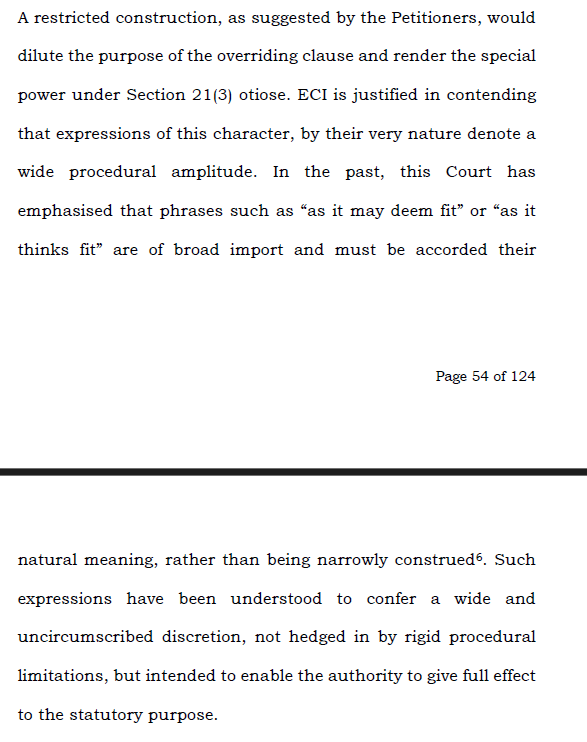
However, the respondents argued that the term was very important and meant to lend the Commission the capacity to modify the special revision process to suit the circumstances. The court also agreed that “a restricted construction, as suggested by the petitioners, would dilute the purpose of the overriding clause and render the special power under Section 21(3) otiose.”

The bench sided with the ECI and termed it right for countering that wording of this nature reflected a broad procedural amplitude by definition, remarking, “In the past, this court has emphasised that phrases such as ‘as it may deem fit’ or ‘as it thinks fit’ are of broad import and must be accorded their natural meaning, rather than being narrowly construed.”

It also announced, “Such expressions have been understood to confer a wide and uncircumscribed discretion, not hedged in by rigid procedural limitations, but intended to enable the authority to give full effect to the statutory purpose.”

The court reiterated that the phrase ‘in such manner as it may think fit’ when read in connection with the non-obstante clause implied a clear legislative intent to hand over broad procedural liberty to the Commission. The objective is to empower it to guide itself to accomplish its constitutional obligation to ensure free and fair elections.

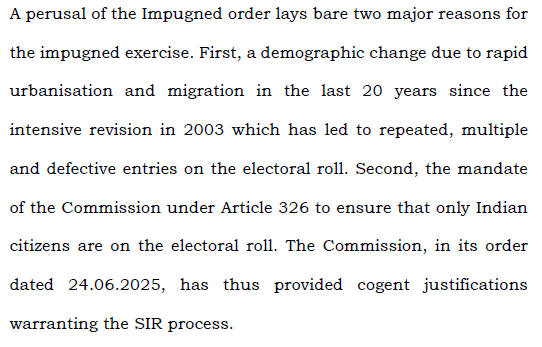
Furthermore, the court listed two reasons provided by the Commission in its order and outlined, “First, a demographic change due to rapid urbanisation and migration in the last 20 years since the intensive revision in 2003, which has led to repeated, multiple and defective entries on the electoral roll. Second, the mandate of the Commission under Article 326 to ensure that only Indian citizens are on the electoral roll,” calling them “cogent justifications warranting the SIR process.”

Supreme Court outlines pressing need for SIR, expresses satisfaction with ECI’s work

In addition, the bench decided in favour of the Commission on matters of whether the order explicitly flouted the RP Act and the 1960 Rules and if it undermines the constitutional principle of free and fair elections.

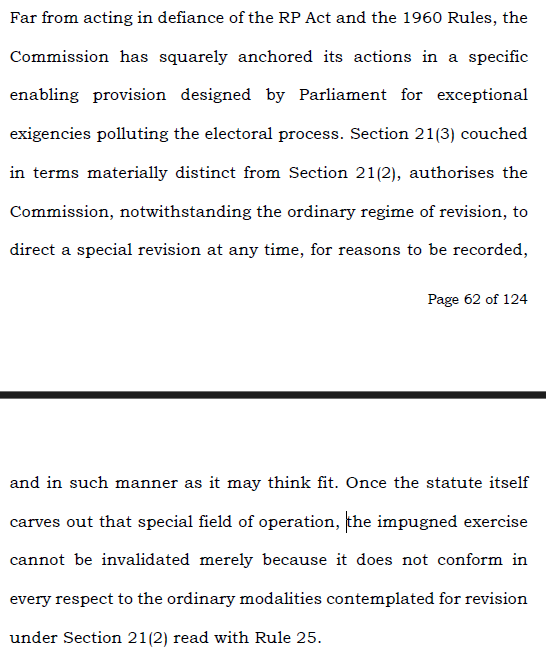
It stated, “Far from acting in defiance of the RP Act and the 1960 Rules, the Commission has squarely anchored its actions in a specific enabling provision designed by Parliament for exceptional exigencies polluting the electoral process.”

Notwithstanding the regular regime of revision, Section 21(3), set forth in a manner quite distinct from Section 21(2), allows the Commission the discretion to initiate a special revision at any time, for reasons to be documented, and in any way it considers suitable.

The exercise cannot be treated as invalid simply because it is not entirely in line with the standard procedures considered for revision under Section 21(2) read with Rule 25 “once the statute itself carves out that special field of operation.”

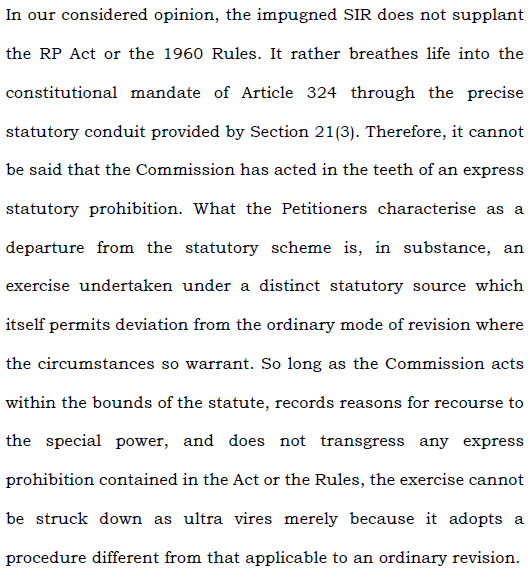
The bench mentioned, “In our considered opinion, the impugned SIR does not supplant the RP Act or the 1960 Rules. It rather breathes life into the constitutional mandate of Article 324 through the precise statutory conduit provided by Section 21(3). Therefore, it cannot be said that the Commission has acted in the teeth of an express statutory prohibition.”

The court further stated that what the petitioners claimed as a departure from the statutory scheme is actually an action executed under a separate statutory source, which itself facilitates a divergence from the standard manner of revision where the circumstances justify it.

It pronounced that the exercise cannot be classified as ultra vires (outside legal power) simply because it adopts a procedure that differs from that applicable to an ordinary revision, provided that the Commission conducts itself within the parameters of the statute, maintains reasons for recourse to the special power, and is not in breach of any explicit prohibition imposed by the Act or the Rules.

The court voiced its satisfaction with SIR’s mission and design, which are closely linked to the constitutional objective of a free and fair election. It emphasised that the integrity, precision, and purity of the electoral roll, which serves as the cornerstone of the democratic process, are just as important to free and fair elections as the procedures of polling.

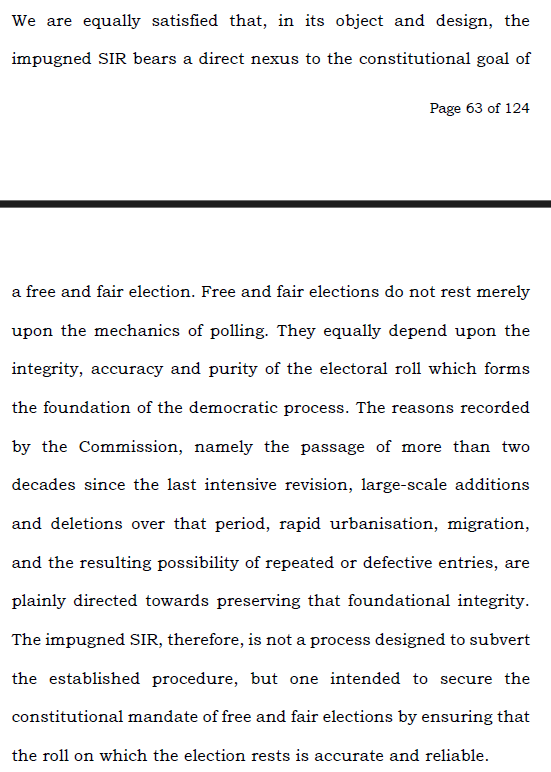
It highlighted, “The reasons recorded by the Commission, namely the passage of more than two decades since the last intensive revision, large-scale additions and deletions over that period, rapid urbanisation, migration, and the resulting possibility of repeated or defective entries, are plainly directed towards preserving that foundational integrity.”

The court referred to SIR as a mechanism devised to uphold the constitutional mandate of free and fair elections by ensuring the accuracy and dependability of the roll on which it is founded and not an instrument of undermining the existing process.

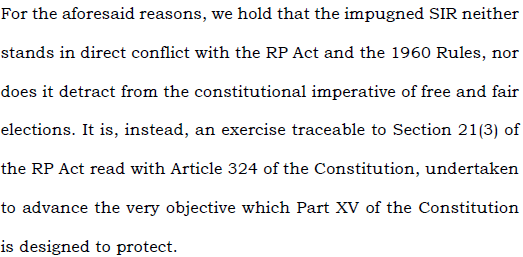
Afterwards, the bench conveyed, “For the aforesaid reasons, we hold that the impugned SIR neither stands in direct conflict with the RP Act and the 1960 Rules, nor does it detract from the constitutional imperative of free and fair elections. It is, instead, an exercise traceable to Section 21(3) of the RP Act read with Article 324 of the Constitution, undertaken to advance the very objective which Part XV of the Constitution is designed to protect.”

Exercise grounded in constitutional principle, statutory design

According to the bench, the prescribed objective was to ascertain that all eligible voters were included in the electoral roll and that all ineligible individuals were excluded, as it explored the exercise’s legal purpose and pointed to the order regarding SIR in Bihar.

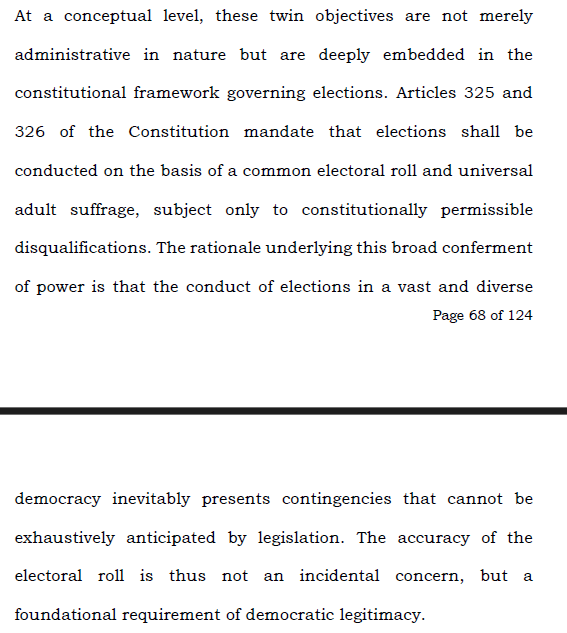
It stated that these two goals are fundamentally ingrained in the constitutional framework governing elections and are not solely administrative in character. The court added that elections must be held using a common electoral roll and universal adult suffrage, subject only to disqualifications allowed by the Constitution, pursuant to Articles 325 and 326.

The bench conveyed, “The rationale underlying this broad conferment of power is that the conduct of elections in a vast and diverse democracy inevitably presents contingencies that cannot be exhaustively anticipated by legislation. The accuracy of the electoral roll is thus not an incidental concern, but a foundational requirement of democratic legitimacy.”

It expressed that the establishment and maintenance of electoral rolls must be recognised as a dynamic and continuous responsibility since these are not static records and must adapt to changes in eligibility, population, and place of residence. It acknowledged that the notion of electoral equality is immediately impacted by any structural error in the roll, whether by a wrong inclusion or exclusion.

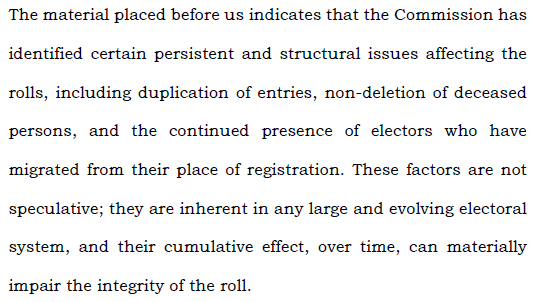
The court conveyed, “The material placed before us indicates that the Commission has identified certain persistent and structural issues affecting the rolls, including duplication of entries, non-deletion of deceased persons, and the continued presence of electors who have migrated from their place of registration. These factors are not speculative, they are inherent in any large and evolving electoral system, and their cumulative effect, over time, can materially impair the integrity of the roll.”

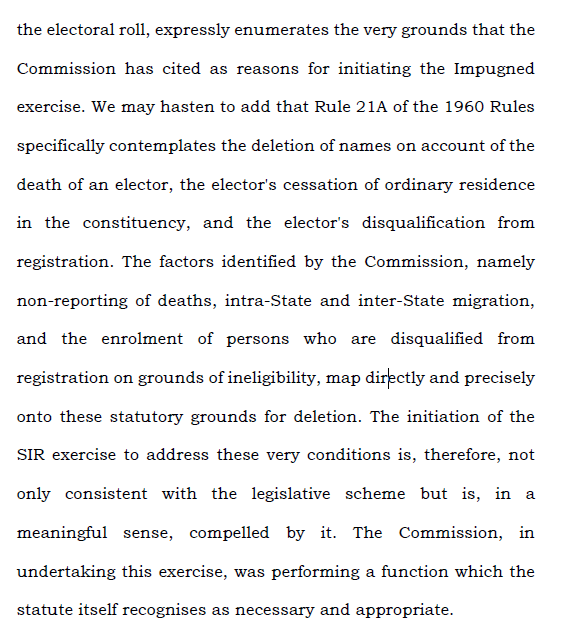
The court determined that the governing statutory framework itself sufficiently recognises these contingencies. It added that Rule 21A of the 1960 Rules, which oversees the procedure for removing names from the electoral roll, expressly lists the same justifications that the Commission provided as reasons for commencing the exercise.

It was emphasised that the rule expressly considers the removal of names in the event of an elector’s death, termination of regular residence in the constituency, or disqualification from registration.

The bench pointed out that the statutory reasons for deletion are concisely and directly mapped onto the factors that the Commission evaluated, including non-reporting of deaths, intra-state and inter-state mobility, and the enrolment of persons who are ineligible for registration.

“The initiation of the SIR exercise to address these very conditions is, therefore, not only consistent with the legislative scheme but is, in a meaningful sense, compelled by it. The Commission, in undertaking this exercise, was performing a function which the statute itself recognises as necessary and appropriate,” it declared.

In light of the fact that more than 20 years had passed since the last such exercise, the court advised that a decision to undertake an extensive review after a protracted interval should be regarded in this context. It expressed, “A system that relies exclusively on summary revisions over such an extended period may reasonably be expected to accumulate inaccuracies that cannot be effectively addressed through incremental corrections.”

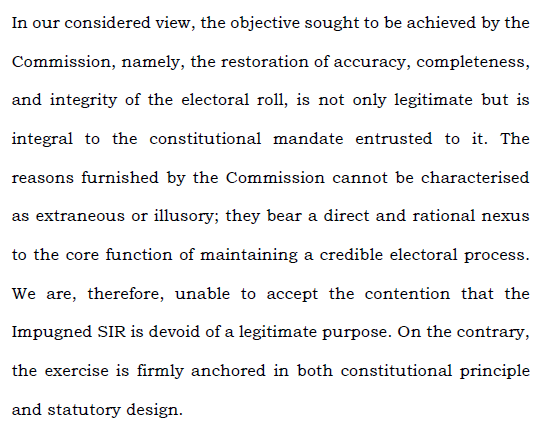
The bench conveyed, “In our considered view, the objective sought to be achieved by the Commission, namely, the restoration of accuracy, completeness, and integrity of the electoral roll, is not only legitimate but is integral to the constitutional mandate entrusted to it.”

It explained that the rationales provided by the Commission have an obvious and logical connection to the primary goal of supporting an honest voting process and cannot be described as superfluous or illusory. It therefore concluded that the argument that the SIR has no valid function cannot be accepted. On the other hand, the exercise is deeply embedded in both legislative design and constitutional principles.

SIR for purity and accuracy of electoral roll

The court restated that the goal of the procedure is to ensure that eligible voters are included and unlawful people are removed to restore the accuracy and integrity of the electoral roll. It added, “The measures adopted to effectuate this object include, inter alia, a structured house-to-house enumeration, the requirement of submission of enumeration forms, and the verification of eligibility on the basis of prescribed documentation.”

According to the court, these actions are not only logically related to the original objective, but they are also inherently intended to accomplish it. It was noted that by personally confirming the presence and eligibility of electors, the house-to-house verification approach addresses the issue of out-of-date or incorrect entries.

The court further noted that the Commission could gather current information in a common format by requiring the completion of enumeration forms, which makes it easier for constituencies to be scrutinised consistently.

The bench stressed, “It is equally significant that the Impugned exercise does not operate in isolation but is embedded within a broader procedural framework that includes scrutiny by designated officers, issuance of notice in cases of doubt, and the availability of appellate remedies.”

It then stated, “These procedural safeguards reinforce the rational connection between the means adopted and the objective sought to be achieved by ensuring that the process of verification is neither arbitrary nor unguided.”

The court pronounced that this relation is not compromised by the submission that the exercise has no empirical substance, as the statutory scheme itself acknowledges the occurrence of large-scale migration, non-reporting of deaths, and duplication of entries as a result of common administrative experience. It added that the Commission’s actions have been tailored to deal with these problems.

As a result, it announced, “In this backdrop, we are satisfied that the Impugned SIR bears a direct and proximate nexus with the objective of ensuring the purity and accuracy of the electoral roll. The second limb of the proportionality test, therefore, stands duly satisfied.”

Conclusion

The opposition and its supporters want to run propaganda against the ECI and the ruling party over the SIR drive. However, the Supreme Court’s observations cannot be overlooked amid the political brouhaha.

SIR was considered highly necessary to cleanse the voter list, as the court expressed its satisfaction while endorsing the steps undertaken by the Commission to strengthen the democratic process in accordance with the Constitution.

It further highlighted the Commission’s independent source of authority and identified Form 6 as an integral component of the procedure, noting that the latter possesses residual power to establish a documentation framework adapted to the requirements.

Beyond landfill: How strict government policies are finally taming India’s plastic waste crisis

India’s plastic waste crisis is no longer being treated merely as a failure of civic duty. For decades, local municipalities struggled to process thousands of tonnes of commercial packaging, primarily because source segregation historically failed across the country due to inadequate transport infrastructure. To permanently correct this imbalance, the central government has shifted its strategy from public awareness campaigns to strict statutory mandates, forcing corporate accountability.

The cornerstone of this regulatory overhaul is the Extended Producer Responsibility (EPR) framework. Under this mechanism, Producers, Importers, and Brand Owners (PIBOs) are legally obligated to manage the end-of-life recovery of the packaging they inject into the consumer market. This system fundamentally transfers the massive financial burden of waste management from cash-strapped local bodies directly back to corporate boardrooms, ensuring the polluter pays.

However, early EPR initiatives suffered from phantom compliance, where corporations frequently submitted unverified paperwork. To definitively dismantle this shadow ecosystem, the government notified the Plastic Waste Management (Amendment) Rules, 2025. Effective from 1 July 2025, every batch of commercial plastic packaging must carry a physically printed, scannable QR code. This digital footprint links physical inventory directly to a centralised portal. It ensures absolute supply-chain transparency and empowers statutory auditors to verify recycling claims mathematically.

Building upon this digital infrastructure, the subsequent 2026 amendments enforce aggressive material quotas. The law mandates that rigid plastic packaging must contain 30 percent recycled content by the 2025-26 financial year, scaling sharply to 60 percent by 2028-29. Furthermore, the 2026 rules formally redefine legal disposal to include industrial energy recovery. This explicitly authorises the permanent diversion of unrecyclable multilayered plastics straight into heavy industrial cement kilns and bituminous road construction, starving landfills of their primary fuel.

On the ground, the Swachh Bharat Mission empowers local municipalities to execute a structured 5-R strategy: Reduce, Reuse, Return, Recover, and Recreate. Administrative interventions, such as automated cloth-bag vending machines and formalised material recovery facilities known as Swachhata Kendras, are rapidly building a localised circular economy. Simultaneously, the state is absorbing legacy synthetic waste into national infrastructure. Shredded plastics are routinely blended with bitumen for highway construction, while Indian Railways deploys heavy-duty composite sleepers engineered from recycled polymers on critical bridges.

Ultimately, the era of voluntary corporate compliance has ended. By combining the rigid digital tracking of the 2025 rules with the physical recycling quotas of the 2026 framework, the Indian state is successfully institutionalising a circular economy and systematically dismantling its legacy plastic crisis.

Read the full article on Chapter 1 Magazine.

India saves tigers, rhinos and cheetahs, but The Economist can’t look beyond its patronising ‘poor country’ trope

British Magazine “The Economist”, notorious for its bigoted and anti-India coverage, has published a report on Sunday, 4th October, highlighting the country’s success in wildlife conservation. Titled “How India saved its tigers, lions and rhinos and elephants”, the article, on the surface, appears to be a positive account of India’s conservation efforts. However, the magazine’s framing of India’s achievement has once again drawn attention, particularly after it described India as a “relatively poor country” while discussing its success in protecting wildlife.

Sharing the article on its X account, The Economist wrote, “It is extraordinary that India, still a relatively poor country, can achieve something as selfless as protecting other creatures.” 

As usual, the anti-India magazine again called India a poor country when it could have simply highlighted India’s conservation success. Instead, it chose to underline the country’s economic status through the lens of typical Western media, for whom India is always a poor country with limited resources that dismisses its achievements, whether in space or on land, like wildlife protection. 

The article began by alleging the failure of the state, linking cases of people in India being killed in wild-animal attacks. It mentioned people being mauled by tigers in western India, attacked by leopards in the north and trampled by elephants in the east. “These deaths highlight the failures of the state,” the magazine wrote. The article thus found another way to criticise India even while highlighting a positive aspect of the country. 

However, the article immediately turned the argument around, saying, “Yet, oddly, they also reflect its successes.” According to The Economist, Indians are encountering wild animals more often because India has become remarkably successful at protecting them. 

The magazine used incidents of human-animal conflict and described them as failures of the state as the starting point for discussing India’s wildlife conservation success. While the article eventually acknowledged the country’s achievements, its opening framing placed the spotlight on deaths, failures and shortcomings before moving to the conservation story.

The magazine then moved to one of India’s biggest wildlife conservation successes, the tiger and wrote, “In the 1970s India’s national animal seemed to be heading towards extinction. Today the big stripey cat is thriving.” The article further read, “Over the past two decades numbers have more than doubled to nearly 3,700, even as populations collapsed in richer and less crowded parts of Asia, such as Malaysia.”

India’s Project Tiger: From nearly disappearing in the 1970s to nearly 3,700 tigers

This transformation did not happen by accident. India launched Project Tiger in 1973 when the tiger population was under severe pressure from hunting, poaching and habitat loss. The programme created protected tiger reserves and brought together conservation, protection and monitoring efforts.

The results have been significant. India’s tiger population had fallen to 1,411 in 2006. The 2022 tiger estimation recorded a minimum of 3,167 tigers, with the estimated population range extending to 3,925. India now accounts for around 70% of the world’s wild tiger population.

Project Tiger also went beyond simply increasing the number of tigers. It helped protect forests, prey species and entire ecosystems around tiger habitats. The programme eventually became a model for other conservation initiatives, including Project Elephant, Project Snow Leopard, Project Dolphin and Project Rhino.

India is now helping other countries bring tigers back

India’s tiger conservation model has become valuable to countries that have lost their wild tiger populations. One such example is Cambodia.

India and Cambodia signed an agreement to reintroduce six Royal Bengal tigers, two males and four females, into Cambodia. The country has been without wild tigers for years, and India has been helping Cambodian authorities prepare the habitat for their return.

The project has faced delays because of concerns over the availability of prey in Cambodia’s Cardamom National Park. Indian authorities are working with Cambodian officials on habitat preparation, prey-base improvement, technical training, anti-poaching measures and monitoring.

The National Tiger Conservation Authority (NTCA) and Wildlife Institute of India (WII) are also involved in consultations with Cambodian authorities. The objective is not simply to send tigers but to ensure that Cambodia has the ecological conditions and institutional capacity required to protect them.

India, hosting around 70% of the world’s wild tiger population, continues to draw on its extensive experience to support Cambodia’s reintroduction programme through technical training and expert consultations.

India’s conservation efforts go beyond tigers: Cheetah makes a comeback

India’s wildlife conservation story does not end with the tiger. The country also took up one of the most ambitious wildlife reintroduction projects in the world by bringing the cheetah back after the species had become extinct in India.

The cheetah was officially declared extinct in India in 1952. The last confirmed wild cheetahs were recorded in 1947, and the species disappeared because of hunting, habitat loss, decline in prey and other human pressures.

On 17th September, 2022, India launched Project Cheetah at Kuno National Park in Madhya Pradesh by bringing eight cheetahs from Namibia. More cheetahs were subsequently brought from Namibia and South Africa.

The project faced challenges, including the deaths of some adult cheetahs and cubs. However, the government’s assessment said the project was broadly moving on a favourable trajectory, with several of its short-term success criteria already achieved, including survival of introduced cheetahs, establishment of home ranges, reproduction and direct revenue contributions to local communities.

The project is not merely about bringing an extinct animal back to India. The government has described it as an effort to restore grassland and open-forest ecosystems and contribute to global cheetah conservation.

And the latest development has given another boost to the project. On 5th October this year, an Indian-born female cheetah gave birth to five healthy cubs at Kuno National Park. With the birth of the five cubs, India’s total cheetah population has risen to 60, including 41 Indian-born cheetahs.

Union Environment Minister Bhupender Yadav described the development as an important milestone in the emergence of the next generation of India’s cheetah population. He also said the birth marked the beginning of the Botswana lineage in India because the cubs’ father is a Botswana-born male.

The development shows that the project has moved beyond simply transporting cheetahs to India. A new generation is now being born on Indian soil.

Himanta Biswa Sarma hits back at The Economist.

The Economist’s description of India as a “relatively poor country” did not go unnoticed. Assam Chief Minister Himanta Biswa Sarma directly responded to the magazine’s post on X, taking aim at what he called its colonial-era mindset.

Sarma wrote, “Bringing down rhino poaching to ZERO and eliminating poachers is way easier than bringing down the inherent racist mentality of the relics of the Colonial empire. But in Assam, we never say never…”

His response came at a time when Assam has been highlighting its success in bringing rhino poaching down sharply, particularly in Kaziranga and other rhino-bearing areas.

The Chief Minister’s reference to the “relics of the Colonial empire” was also a reminder of the history of wildlife exploitation during the colonial period.

From just 12 rhinos to a global conservation success story

Kaziranga National Park offers another powerful example of India’s wildlife conservation journey.

At the beginning of the 20th century, the greater one-horned rhinoceros was on the verge of disappearing from Assam. In 1908, the rhino population in Kaziranga had fallen to around 12. Sport hunting and poaching had played a major role in the decline. During the colonial era, British military officers in Assam were involved in large-scale hunting, with reports stating that some officers individually shot more than 200 rhinos.

The situation changed after conservation and protection measures were introduced. Today, Assam has more than 3,000 greater one-horned rhinos, while Kaziranga remains one of the world’s most important strongholds of the species.

The transformation is particularly striking because the same animal that was once reduced to a tiny population in Kaziranga is now thriving there. Assam has also taken an aggressive approach towards poaching. In 2022, the state reported zero rhino poaching losses, while anti-poaching operations, habitat protection and monitoring have continued. In 2022, Assam also carried out the symbolic cremation of 2,479 seized rhino horns. The ‘Daha Sanskar’ was intended to send a message that rhino horns had no medicinal value and that the horns were the remains of animals killed by poachers.

The conservation story of Kaziranga therefore stands as another example of how a species once pushed towards extinction can recover through sustained protection.

Netizens remind The Economist about the colonial history of wildlife hunting

Social media users were quick to react to The Economist for labelling India a poor country while conveniently ignoring the historical role of British colonisers in driving local species toward extinction. 

One user remarked, “The nerve to bring negativity to a positive news. Only The Economist can do that, but also I saw some ‘en dashes’; someone is using an LLM to write the story. What’s the instruction, ‘Be a condescending assistant’?”

Another user pointed towards the history of wildlife hunting during the colonial period and wrote, “Our tigers & Rhinos went near extinction, and our cheetahs got extinct because of your great-grandparents. We may be ‘poor’ today. We are the elephants who won’t forget anything.”

Another user linked India’s conservation ethos with Hindu traditions, writing, “That’s because India is a Hindu country which believes all the creatures are one big family. That’s why we are majorly vegetarian. British and Muslims tried to destroy us but couldn’t succeed. We are bouncing back.”

A long history of biased coverage

Anti-India propagandist British Magazine, The Economist, has regularly adopted a profoundly biased stance towards India. In a recent report, it attacked the Bharatiya Janata Party (BJP) government over the introduction of the Uniform Civil Code (UCC), questioning the move and referring to it as “communal.” However, the platform raised its voice against Sharia councils in Britain and argued that the country’s secular law should take precedence over any religious regulation or statute in a 2016 piece.

In another article, it went so far as to diminish India’s deeply rooted Hindu cultural and civilisational heritage, portraying the Mughals as having introduced not only architecture and music but also food and literature to the country.

The Economist acknowledged that the Mughals demolished temples but asserted that this was not an insult to the native community. It then simply ignored the imposition of “jizya,” the slaughter of Hindus, and the forced conversions that the Islamic rulers had emphasised in their own works.

Given the media outlet’s long record of anti-India propaganda, it is hardly surprising that when forced to acknowledge India’s remarkable wildlife achievements, The Economist still found a way to lead with state failure and disparage the nation as poor.

Dhruv Rathee amplifies ‘false flag operation by Netanyahu’ narrative on Flydubai plane terror attack: Pulwama, Pahalgam to Tel Aviv, examining the Islamo-leftist pattern of giving Jihadi attacks a political spin 

The sane world is praising Indian pilot Captain Smit Machchhar, whose bravery helped save a Flydubai flight carrying 180 people, mostly Israeli Jews, headed to Israel’s Tel Aviv from an Islamic terror attack by the Jihadist Omani co-pilot Hamam-al-Hammami on 30th September. However, the global Islamo-leftist coterie is peddling opprobrious conspiracy theories. In a video published by Germany-based YouTuber-propagandist Dhruv Rathee amplified the Islamist conspiracy theory that the foiled Flydubai Islamic terror attack was a false flag operation orchestrated by Israeli Prime Minister Benjamin Netanyahu for influencing public opinion in his favour ahead of elections. 

In a short video published on his Instagram and social media pages, Dhruv Rathee spoke about Captain Smit Machchhar’s bravery and how, despite being stabbed and wounded, the Indian pilot opened the cockpit door a second time so passengers and off-duty crew could overpower the Omani pilot.  

However, Dhruv Rathee pivoted from recounting Captain Machhar’s heroic actions and resorted to amplifying the Islamist conspiracy theory that the entire “hijacking incident” was a false-flag operation that Israel itself executed. 

Playing the legacy media trick of adding a question mark to a statement to push a narrative without having to worry about responsibility and accountability, Dhruv Rathee first amplified the false-flag conspiracy theory, then conveniently added the ‘question mark’: “whether these claims are true or not will only be revealed after investigation”. The trick, perhaps, was to praise the person who prevented the attack while floating the idea that the jihadi attack itself was a politically motivated theatre. 

“But in this hijacking incident, many other questions are also arising whose answers we still do not know. Now the question is, how did a co-pilot smuggle a knife inside the aeroplane? Some people are even alleging that this entire hijacking incident was a false-flag operation, that Israel itself got it done, because elections are going to be held in Israel in one month… elections where it will be decided whether Netanyahu becomes prime minister again or not. To know the answers to all these questions, we wait for the investigation to be completed, and we see what else comes to light next,” Rathee said. 

Firstly, the Jihadi Omani Muslim pilot did not attack Captain Smit Machchhar with a smuggled knife but with the cockpit crash axe. This axe is standard emergency equipment already in the flight deck. 

Secondly, it was not a hijacking incident. UAE Attorney General Hamad Al Shamsi stated on 3rd October that the Omani co-pilot “attempted to carry out a terrorist act”. Hamam or Hammam al-Hammami planned to crash the Flydubai plane at Tel Aviv’s Ben Gurion International Airport. 

It is notable that before Dhruv Rathee, Arfa Khanum Sherwani from the leftist propaganda rag The Wire had insinuated that the Flydubai terror attack was a false flag operation. She wrote on X, “The ‘world-famous’ Israeli propaganda machine is on fire and Indian audiences seem only too eager to consume whatever it serves up, no questions asked. Guess why?” By saying this, she attempted to dismiss the verified terror attack as mere Israeli propaganda.

Meanwhile, crowdfunding scam-accused ‘journalist’ Rana Ayyub, who wrote, “The Indian right wing’s love affair with Israel and Netanyahu is ultimately rooted in one thing: its visceral hatred of Muslims. Their admiration for Modi and Netanyahu comes from the same impulse- leaders who will subjugate Muslims, and “show them their place” in the world.”

The false-flag theory, Israel’s election dynamics, and why it makes no sense 

The false-flag conspiracy theorists say that Israeli Prime Minister Benjamin Netanyahu arranged the false-flag operation on the Flydubai flight for electoral gains amid supposed dwindling domestic popularity. The question arises: how would the crashing of a flight carrying Israeli civilians have benefited Netanyahu and his Likud party in the elections? Do they suggest that the plan was to frame the supposed false-flag operation as an Islamic terrorist attack carried out at Iran’s behest, to rally united national support for PM Netanyahu against Iran? 

For that to be true, PM Netanyahu would have to be the director and the Israeli intelligence agency Mossad the scriptwriter, while Flydubai, Captain Smit Machchhar, Omani terrorist pilot al-Hammami, the UAE government, and even the Saudi authorities would have to be actors. 

This is because neither the UAE government, the Saudi government, nor the Israeli investigations support staging or false-flag claims. Thus, the ‘planted actors’ or ‘fake plunge’ theory sounds more like a coping mechanism against the fact that the flight didn’t crash than a credible claim. 

Flydubai is a UAE airline; the aircraft left Dubai; the terrorist co-pilot was an Omani national born in the UAE; the plane diverted to Saudi Arabia’s Tabuk. Neither Israel owns the airline, crew the cockpit, nor it is conducting the investigation. The UAE judicial authorities have jurisdiction over the Flydubai incident because the aircraft is registered in the UAE and flies under its flag. The Emirati authorities have said that UAE law applies to crimes committed on board “even if they occur outside the country’s territory.” 

Indian captain Smit Machchhar suffered life-threatening axe blows to his head and his wounds were bleeding profusely when he opened the door from the floor for the second time as the Omani terrorist reclosed the cockpit door when Machchhar opened it, and passengers and off-duty crew tied the attacker with headphone cables and zip ties.  

The Flydubai flight FZ1073 dropped from about 34,000 to 17,000 feet, squawked 7700 and then 7500, and lost part of its rudder. Staging that, on a foreign carrier, with a wounded non-Israeli pilot and Saudi and Emirati authorities in the loop, would be too absurdly a leaky plot for a country like Israel to pull off. 

Also, if we go by the ‘blame Iran’ angle, wouldn’t it have made a more profound impact on Israeli citizens and handed maximum political mileage by stoking nationalist sentiments if the plane had actually crashed with Israeli passengers on board? And yet, if it assumed that it was indeed a false flag, why did Israel’s ‘planted actor’ Captain Smit Machchhar not let the Omani co-pilot play his part in full? Why would Captain Machchhar sign up for an operation wherein his death was certain? 

Even though a photo opportunity for a political leader in any country is an irresistible delight, if we look at the election dynamics in Israel, despite a drop in popularity, Netanyahu’s incumbent coalition, which includes Likud party, the far-right Otzma Yehudit and Religious Zionism, athe nd the Haredi parties Shas and United Torah Judaism, remain stable.  

While the rise of former Israeli Defense Forces remainsGadi Eisenkot’s new centrist Yashar party, Naftali Bennett’s Together, Yair Golan’s Democrats, and Avigdor Lieberman’s Yisrael Beiteinu are consolidating the anti-Netanyahu bloc, polls give Netanyahu a narrow edge over his political opponents. It must be noted that Netanyahu’s personal popularity is not collapsing, but his coalition partners and the electoral arithmetic do not provide a clear path to form government again. 

Does this mean the Netanyahu-led bloc’s defeat in the coming elections is certain? No. There are three possibilities: a deadlock, a unity arrangement, or a second round. 

Given that Israelis have lived through several wars and election cycles since 2019. Whether successful or unsuccessful, a single Flydubai-like security scare will not miraculously turn all Israeli voters in Netanyahu’s favour. 

This whole false flag imagination stems from the Islamo-leftist tendency of refusing to accept or believe that a country or a group of people they oppose or hate can be victims of the crimes committed by religiously or ideologically aligned groups or individuals. When Islamists attack Kafirs, it is labelled as ‘resistance’. When circumstances allow, Islamic terror attacks are portrayed as ‘false flag’ operations.  

This is, perhaps, the reason why the October 7 massacre of Israeli civilians by Palestinian Islamic terror group Hamas is called ‘resistance’ by the Islamo-leftists, who even celebrated the horror since the victims were Israelis, particularly because they were Jews. But an Omani Muslim Jihadi’s plane crashing attempt is conveniently labelled as a ‘false flag’ operation and linked to electoral gains, and other ridiculous conspiracy theories. 

This Islamo-leftist pattern is not restricted to Israel’s Netanyahu alone, but extends to India’s Narendra Modi, another political leader the global Islamist cabal abhors.  

The false flag parallel in India 

The same Islamo-leftist template—terror attack by any Islamic jihadi group or individuals, immediate “false flag by the right-wing or Islamophobic government for elections claim, and amplification by media and social media players, has been witnessed in India. 

Back in February 2019, the Pakistan-based Islamic terrorist outfit Jaish-e-Mohammed claimed the suicide bombing by one Adil Ahmad Dar, that killed 40 CRPF personnel. A section of Indian opposition leaders, including Congress MP Rahul Gandhi and Islamo-leftists online, claimed that the Pulwama attack was a false-flag operation staged by the Modi government to exploit it in his favour for the impending Lok Sabha elections that year. They even tried to give a clean chit to Pakistan and the terrorists involved. 

The anti-Modi sentiment and the fear of getting wiped out from the political spectrum ahead of the 2019 general elections were so deep-rooted in the opposition leaders that they went on to accuse Modi of executing this brutal attack for BJP’s political gains. Many of them also questioned the role of the armed forces during this attack. Others questioned the air strike by the Indian Air Force in Balakot after this attack. 

A redux of this ‘false flag’ bogey was seen after the Pahalgam terror attack in April 2025, when Pakistan was joined by Islamo-leftist journalists and notorious Modi detractors in labelling the attack carried out by Pakistan’s Lashkar-e-Taiba offshoot The Resistance Front by singling out and shooting Hindu men at point-blank, as a false flag operation to milk electoral benefits in the Bihar and other state assembly elections. 

From Pulwama, Pahalgam to the Flydubai attack, Islamists and their leftist allies conveniently use political calendar as proof of ‘false flag’ orchestration and thereby deflect attention from the Jihadi attacker’s ideology and hatred against non-Muslims.