Home Blog Page 23

CJP leader claims ‘traitor’ CEC Gyanesh Kumar delivered Haryana, Maharashtra and Delhi elections to BJP, defeated Mamata, Stalin, and Kejriwal through SIR voter deletions: Debunking Abhijeet Dipke’s lies

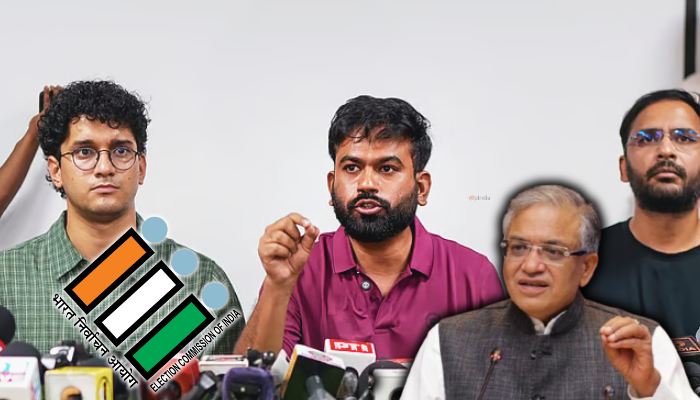
A day after The Indian Express published a dubious ‘investigative’ report casting aspersions on the integrity of Chief Election Commissioner (CEC) Gyanesh Kumar, the political opposition and its ideological allies have turned their outrage mode on. In this vein, the Cockroach Janta Party (CJP) leaders held a press conference in New Delhi on 24th September and demanded the resignation of CEC Gyanesh Kumar. However, while declaring the CEC ‘anti-national’, ‘traitor’, and a ‘threat’ to Indian democracy, CJP founder Abhijeet Dipke peddled several lies.

SIR and dubious Indian Express report become ammunition for training guns against the CEC Gyanesh Kumar and the BJP: What CJP said

During the press conference, CJP founder Abhijeet Dipke attacked CEC Gyanesh Kumar over the Special Intensive Revision (SIR), voter name deletions, and the Indian Express report on internal dissent in the Election Commission.

Dipke, joined by CJP spokespersons Saurav Das and Ashutosh Ranka, framed SIR and the claims made in the Indian Express report as some sort of ‘proof of “hijacking of India’s democracy”. The CJP announced an “EC Thik Karo” campaign.

Out of media attention for quite a few weeks, Abhijeet Dipke and his co-cockroaches exploited the moment to play a ‘revolutionary hero’, using strong language, issuing ultimatums and Jantar Mantar-style protest threats, and attempting to flag specific vote-deletion examples linked to the defeats of opposition parties and their leaders.

“To ensure free and fair elections, CEC Gyanesh Kumar must resign. If within 48 hours Gyanesh Kumar doesn’t resign, the Cockroach Janta Party will start a nationwide agitation. We won’t step back till the time Gyanesh Kumar resigns,” Dipke said.

“The Chief Election Commissioner is the biggest anti-national. Gyanesh Kumar is the biggest anti-national of this country. He should resign immediately because he is the biggest threat to India’s democracy,” Dipke added.

The CJP ‘cockroach’ continued, “What did democracy mean in our country? Democracy meant that the people would elect the government. Since Gyanesh Kumar became the Chief Election Commissioner, the government has been deciding who will be allowed to vote and who will not. Is this democracy? What kind of definition of democracy is this? You have turned the entire concept of democracy upside down.”

Abhijeet Dipke claimed that over 13 crore votes have been deleted and accused CEC Gyanesh Kumar of deliberately doing so to widen that 2% gap so the BJP never goes out of power.

“In total, more than 13 crore votes have been deleted. This is not a small number. In the 2024 Lok Sabha election, the margin between the opposition and the ruling party (NDA) was just 2%. Deleting 13 crore votes is equivalent to deleting roughly 13% to 14% of the total votes. Is Gyanesh Kumar deleting them intentionally to widen that 2% gap so that they never lose office? Why is this being done? What was the need to delete so many votes?” Dipke claimed.

Dipke further claimed that the supposed mass voter name deletions caused the defeat of Opposition leaders and parties, citing Mamata Banerjee, MK Stalin, Arvind Kejriwal and Pinarayi Vijayan by wide margins.

“The BJP failed to secure a majority in the 2024 election. The panic button was pressed when they fell short of that majority. They had come down to 240 seats after raising the slogan of ‘400 paar’. After that, they realised that the mood of the country was shifting and that regional forces were emerging very strongly,” Dipke claimed.

He further alleged, “In West Bengal, 50,000 votes were deleted from Mamata Banerjee’s constituency, and she lost by around 15,000 votes. In M.K. Stalin’s constituency, 1 lakh votes were deleted, and he lost by around 45,000 votes. In Delhi, 40,000 votes were deleted from Arvind Kejriwal’s constituency, and he lost by around 4,000-5,000 votes.”

Accusing CEC Gyanesh Kumar of ‘rigging’ the various elections, Dipke claimed, “Pinarayi Vijayan would have won, but due to the deletion of votes in Kerala, he did not become the Chief Minister. Was this move designed solely to eliminate strong opposition figures?”

Analysing the factual accuracy of the claims made by CJP leader Abhijeet Dipke

Firstly, the claims that CEC Gyanesh Kumar is the “biggest anti-national” or “traitor” and that “[BJP] government now decides who votes” are political attacks devoid of factual merit. The Election Commission is a constitutional body under Article 324, and its key functions are superintendence, direction, and control of elections, including preparation and revision of electoral rolls.

SIR is not a new and unique instrument that CEC Gyanesh Kumar has introduced to manipulate electoral rolls in favour of a political party. SIR is a long-overdue intensive voter roll cleanup. The last major SIR drive was conducted more than 20 years ago. Not weeding out dead, shifted, duplicate, and other ineligible voter names from electoral rolls would essentially have meant that the ECI was not serious about transparency in the electoral process.

Just because opposition parties and leaders lost elections in some states after SIR does not mean that Gyanesh Kumar personally oversaw the manipulation of electoral rolls to ensure a BJP victory.

Neither the claims by the Indian Express report around the Form 6 modifications issue nor the claims about alleged “centralisation” of electoral roll databases are backed by enough evidence to support the ‘Delhi has taken over the voter database’ accusations.

Speaking to OpIndia recently, several Electoral Registration Officers categorically rejected the suggestion that their statutory powers had been usurped by the ECI’s central administration.

13 crore ‘voter deletions’ do not automatically mean eligible voters were stripped of their voting rights illegally

Moving ahead, Abhijeet Dipke claimed that over 13 crore voter deletions, amounting to 13-14%, have been carried out under the watch of CEC Gyanesh Kumar. These numbers are aligned with the 13.8 crore voter deletions claim Congress made earlier. Congress claims that around 13.8 crore names have been removed across 31 states/UTs, 14.6% of a pre-SIR base of around 94.7 crore. Phase 2 (12 states/UTs) witnessed a net reduction of 5.18 crore (10.2%, from 50.99 crore to 45.81 crore), and higher gross deletions offset by additions. The Phase 3 draft rolls indicated over 6 crore deletions from 36 crore names in these states/UTs.

The deleted voters, however, were not singled out based on their caste, religion, gender or political leanings. The deleted voters included deceased, shifted/absent, and duplicates. The SIR has provisions for restoration of draft deletions through claims and objections or tribunals. In fact, the distinction between draft deletion and final exclusion after the prescribed process is not a minor technicality but central to the objective of conducting SIR.

While 13 crores in itself is not a small number, the sheer size of the ‘deleted’ number of names does not automatically mean eligible voters were illegally disenfranchised en masse, as the CJP, the Congress party and its media allies are insinuating.

Did SIR lead to Mamata Banerjee, MK Stalin and Arvind Kejriwal’s election defeats?

Abhijeet Dipke claimed that Trinamool Congress supremo lost the Bhabanipur election to BJP’s Suvendu Adhikari in 2026 after SIR ‘deleted’ around 47,000 voter names. These claims are not new. The Wire and the leftist coterie have for months been claiming that SIR helped the BJP win West Bengal. However, the anti-BJP ecosystem conveniently forgets that correlation is not causation.

What is the proof that all the deleted names were genuine voters? What is the proof that those deleted names would have surely voted for the TMC? IF defeat is the proof that SIR helped the BJP win over the TMC, then Dipke and the whole anti-ECI cabal need to look at the complete picture instead of cherry-picking numbers that suit their narrative.

In the 20 Assembly seats that recorded the highest voter deletions, TMC won 13, BJP won 6, and one seat was won by Congress. If the SIR or voter deletions were systematically designed to damage the TMC and benefit the BJP, then how did TMC dominate the highest-deletion constituencies? Clearly, data debunks ‘ECI did partisan engineering’ claims.

Electoral outcomes vary because of local candidate strength, caste and communal equations, anti-incumbency, organisational machinery, turnout behaviour, and regional political trends. Blaming SIR as the sole driver of the defeat of anti-BJP leaders or political parties is nothing but political rhetoric.

In the case of DMK leader M.K. Stalin, who lost the Kolathur seat to TVK leader V.S. Babu, Abhijeet Dipke blatantly lied about the defeat margin. Contrary to his claim that Stalin lost by 45,000 votes, the former Tamil Nadu CM lost by a margin of just 8,795 votes. The CJP leader inflated the margin to add, perhaps, a dramatic effect to his alarmist propaganda.

Notably, Tamil Nadu saw around 74 lakh voter names deleted following the SIR exercise. If the BJP actually had CEC Gyanesh Kumar as its stooge, wouldn’t CEC Kumar have ensured at least ten seats for the BJP in Tamil Nadu, if not securing it a number significant enough to make BJP a kingmaker?

In Delhi, AAP supremo and former Chief Minister Arvind Kejriwal lost to BJP’s Pravesh Verma by a thin margin of 4000 votes. In this case, the numbers hold; however, Abhijeet Dipke did not reveal what evidence he has that suggests that the around 37, 315 voter names deleted in SIR in Delhi were first identified based on their religion or political preferences, and then ‘disenfranchised’.

In India, elections are like recurring festivals; every year in some or the other part of the country, elections at different levels take place. SIR, though already delayed, whenever conducted, would have occurred before and after some elections. Mere timing of the exercise cannot be used to frame a conspiratorial narrative that the whole SIR process was exploited to delete voters from electoral rolls.

Abhijeet Dipke claims that BJP won in Haryana, Maharashtra and Delhi after Gyanesh Kumar became Chief Election Commissioner; facts indicate otherwise

During the press conference on Thursday, CJP leader Abhijeet Dipke also claimed that the BJP’s vote share in Haryana, Maharashtra, and Delhi increased sharply after Gyanesh Kumar assumed office as the CEC.

He said that after Gyanesh Kumar became Chief Election Commissioner, the BJP’s vote share rose in Haryana from 36% to 40%, Maharashtra from 25% to 27%, and Delhi from 38% to 45% and called Kumar the BJP’s “real hero”.

While these vote-share figures are roughly in the right range, there is a major problem in linking these increases to Gyanesh Kumar becoming CEC. This is because Gyanesh Kumar assumed charge as the 26th Chief Election Commissioner of India on 19th February 2025, while Haryana elections and result announcement took place in October 2024, Maharashtra polling and result announcement occurred in November 2024, and Delhi elections took place on 5th February, and results were declared on 8th February 2025.

The timeline itself debunks Dipke’s lies against CEC Gyanesh Kumar. He should explain how Kumar ‘delivered’ victories to the BJP in elections that were already concluded before he even took charge as the CEC.

Gyanesh Kumar took charge as the Election Commissioner on 15th March 2024, and constitutionally, even if two ECs and 1 CEC have the same power, final decisions are taken with consensus. There is no proof that Gyanesh Kumar, as EC, dictated terms to the previous CEC, Rajiv Kumar and the other Election Commissioner.

Even after becoming the CEC, Gyanesh Kumar does not enjoy absolute and unquestioned power without accountability.

Despite being head of the ECI, the CEC cannot overrule the other Election Commissioners. If the commissioners disagree, the final choice is decided by a majority vote.
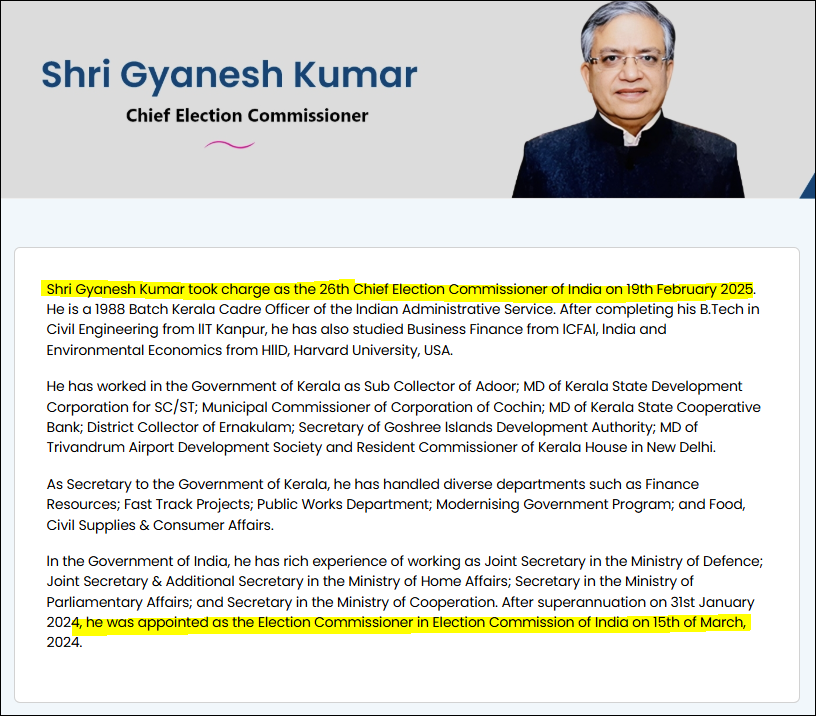
In fact, the internal discussions and dissenting note exchanges by the CEC and the other two Election Commissioners, Sukhbir Singh Sandhu and Vivek Joshi, indicate that the Commission’s top officials freely and strongly express their opinions and disagreements about various issues pertaining to the electoral process and take decisions after thorough consensus, contrary to the framing that CEC Gyanesh Kumar alone holds the reins of the Election Commission.

Opposition’s EVM hacking, VVPAT tampering, and Rahul Gandhi’s ‘vote chori’ bogey could not sow distrust in the minds of the Indian people against the Election Commission, its integrity and the transparency of the electoral process. Thus, the anti-BJP cabal has chosen CEC Gyanesh Kumar as their scapegoat.

This is probably because calling the whole Election Commission corrupt made little sense, but painting a single person, a top official, as corrupt or compromised is feasible and emotionally appealing. However, facts always triumph over sensationalism. Demanding accountability does not mean that CJP, or any political party, gets the right to character assassinate an public servant or declare his ‘traitor’.
Why India has 3 Election Commissioners: How Rajiv Gandhi changed composition of ECI to exert political control

A political storm has erupted in India after the Indian Express alleged ‘internal dissent’ between the country’s 3 Election Commissioners. The issue has become a political hot potato with the Opposition exploting the opportunity to claim ‘crisis of institutional integrity’ within the Election Commission.

And this ‘controversy has brought the spotlight on an important question – Why does India have an Election Commission with 3 Commissioners? Why not one or two?

For nearly four decades since independence, the single man in charge of conducting India’s free and fair elections was sufficient. Only an awesome contest of wills between a prime minister with an absolute majority and an unyielding civil servant birthed the present 3-member Election Commission.

The Constitutional Mandate (1950-1984)

On 25th January 1950, the Election Commission of India (ECI) was born. The Chief election commissioner (CEC) headed this constitutional body which oversaw the conduct of free and fair elections in India. The system worked smoothly with the CEC as the sole decision-maker, from the landmark elections of 1952 till the late 1980s.

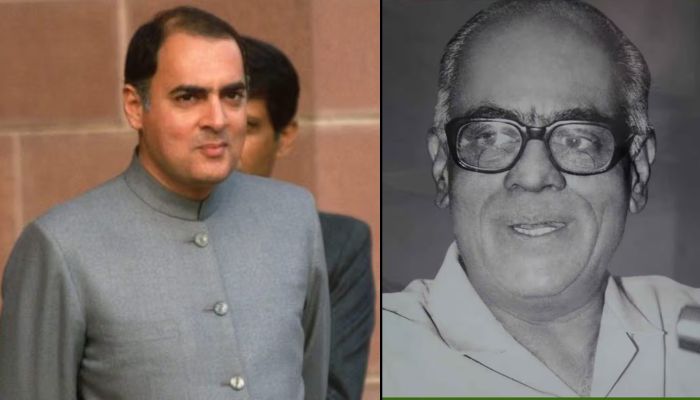
Late 1984 saw Rajiv Gandhi elected to power with a stunning mandate of over 400 Lok Sabha seats, riding on the wave of sympathy following Indira Gandhi’s assassination. With such an overwhelming majority, Rajiv Gandhi’s government did not feel the need for any independent authority to keep check on its powers.

After all, it has uncharacteristically overturned the Shah Bano judgement and the passage of the Anti-Defection Law through its sheer will. However, the Prime Minister’s office soon found itself at loggerheads with the CEC on election-related issues.

A man called Peri Sastri

R.V.S. Peri Sastri was sworn in as India’s eighth chief election commissioner on 1st January 1986. The self-effacing Sastri believed in the sanctity of the autonomy granted to the ECI by the Constitution and did not look upon any interference from the government with fondness.

The first major stand-off occurred in the spring of 1987 when Rajiv Gandhi sought to defer the Haryana assembly elections to a date after the presidential poll. Haryana was ruled by the Congress with Chief Minister Bhajan Lal, whose defeat in the assembly polls would affect the voting pattern in the presidential race.

Peri Sastri refused to accede to the Prime Minister’s request. With a wave of anti-incumbency sweeping north India, Sastri went ahead and conducted the Haryana elections in June 1987. The Congress was decimated as a result and the Lok Dal-BJP alliance came to power with Chaudhary Devi Lal as the chief minister.

Sastri then conducted the presidential election as scheduled in July, which was won by R. Venkataraman of the Congress. However, the damage to the Prime Minister’s image had been done. Sastri had openly defied the government.

The stand-off with the government intensified the following year when Peri Sastri declined to countermand the entire Faridabad parliamentary by-election in 1988 due to widespread allegations of rigging. Congress demanded that the entire election be declared null and void while Sastri ordered repolls in only those booths affected by violence and malpractice (161 booths).

Further tussles with the government over electoral rolls in Assam, in which the ruling party accused the ECI of being biased against the Asom Gana Parishad (AGP) resulted in a series of behind-the-scenes meetings to get Sastri removed from office. Peri Sastri however proved impervious to pressure and when the government finally failed in its efforts to get him removed, it decided to dilute him.

The Midnight Ambush: October 1989

On 9th October 1989, President Venkataraman (on the advice of the Union Cabinet) superseded the Election Commission by notifying the formation of a multi-member election commission with S.S. Dhanoa and V.S. Seigell as the new election commissioners. Peri Sastri was kept in the dark about this development.

A week later, on 16th October, the President appointed two new election commissioners: S.S. Dhanoa and V.S. Seigel. In his memoirs, S.S. Dhanoa wrote how he and the newly appointed Seigel found their first morning at Nirvachan Sadan greeted with a barrage of abuse by an irate Peri Sastri who refused to accept Dhanoa’s authority! The Union Law Secretary had already met Sastri earlier in the week and tried to browbeat the CEC into accepting the new status quo.

Dhanoa himself writes that neither Sastri nor the new appointees had been consulted before this farce was enacted. With a three-member Election Commission in which decisions were taken by a majority vote, the two Union appointees could openly defy the CEC.

The first test of this came the very next day (17th October 1989) when the Prime Minister Rajiv Gandhi announced the dates for the 1989 general election. (This was a prerogative of the Election Commission.) This left the opposition with barely a month to prepare for the polls while Congress prepared its attack strategy for the campaign trail. Sastri, caught between the anathema of judicial review and the electoral arithmetic of the nation, simply signed off the dates with a shrug!

The very next day, as the news broke, the Prime Minister was quoted as saying that the CEC was overburdened with work and hence the need for a multi-member Election Commission. Exactly a year ago, in October 1988, Rajiv Gandhi had stood in Parliament and vehemently opposed the very idea of a multi-member Election Commission!

The Rollback and return of the trio

The political game plan backfired spectacularly as the anti-graft crusade of V.P. Singh saw the Congress routed out of power in the November 1989 elections. The National Front government promptly revoked the multi-member Election Commission notification in January 1990, restoring the single-member Election Commission and removing Dhanoa and Seigel from office. However, Dhanoa challenged this in the Supreme Court which upheld the government’s right to reduce the strength of the Election Commission.

However, this ploy was not repeated when the Congress returned to power with P.V. Narasimha Rao who was met with an even more truculent CECT.N. Seshan.

As a man who took his mandate in the Constitution as a sacred trust and cleaned up electoral rolls with a rod of iron, Seshan often clashed with the political establishment. In an echo of the 1989 episode, the Rao government appointed two additional election commissioners (M.S. Gill and G.V.G. Krishnamurthy) in October 1993 to keep a check on Seshan. (Gill later served as a minister in the Union Cabinet under the Congress-led UPA government.)

Seshan challenged the appointment of the new commissioners in the Supreme Court. In a landmark judgment (T.N. Seshan v. Union of India) delivered in 1995 by a five-judge bench, the validity of the multi-member Election Commission was upheld, thus making it a permanent feature of the Indian political system.

The Lesson Behind Today’s Headlines

When Indian Express reports of “ideological rifts” or the “2-1 votes” by the Election Commissioners, remember that the very existence of a three-member Election Commission was once considered anathema by both the government and the judiciary. The idea of having a multi-member Election Commission is to enable the majority to rule.

So, any friction, dissent or differing opinions within the Election Commission are normal features of the system, implanted by history.

For those who feel that the Election Commissioners do not speak with one voice, remember that democracy’s twin pillars, the ballot and the Supreme Court, have always been there to settle differences. Just as they did in 1989 and 1993.

Violence, child marriages, forced unions with rapists, brides exchanged for a bag of flour, tent and more: UN reports expose what women in Gaza face within their own communities

United Nations has disclosed that women in Gaza are being subjected to severe gender-based violence (GBV), forced into marriages with their rapists and even sold for food within their own communities. The startling findings were documented in its latest reports.

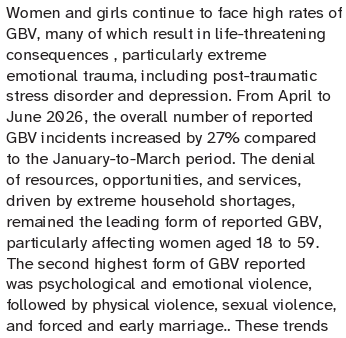
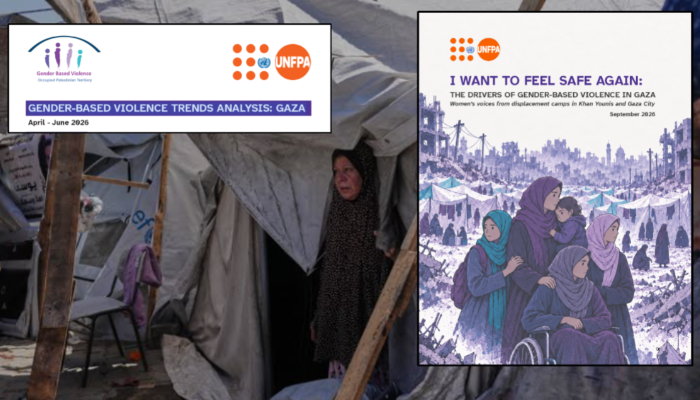
“Women and girls continue to face high rates of GBV, many of which result in life-threatening consequences, particularly extreme emotional trauma, including post-traumatic stress disorder and depression. From April to June 2026, the overall number of reported GBV incidents increased by 27% compared to the January-to-March period,” revealed the United Nations Population Fund (UNFPA) in its quarterly report “Gender-based violence trends analysis: Gaza.” The research was carried out between April and June of this year.

Psychological and emotional violence was the second most common type of GBV identified, followed by forced and early marriage, physical violence and sexual violence.

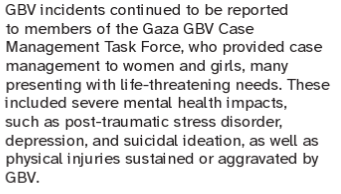
These occurrences were continuously being brought to the attention of the Gaza GBV Case Management Task Force, which provided case management to women and girls, many of whom had life-threatening conditions. These included physical injuries caused or made worse by GBV, alongside serious psychological deterioration like depression, suicidal thoughts and post-traumatic stress disorder.

The report evaluated data collected by 10 Gaza GBV Case Management Task Force partner organisations, who are members of the GBV Working Group, to emphasise the types and nature of reported incidents. Women between the ages of 18 and 59 were identified as being most impacted. It asserted that women and girls continue to be highly vulnerable to GBV violence because of ongoing displacement and poor living conditions.

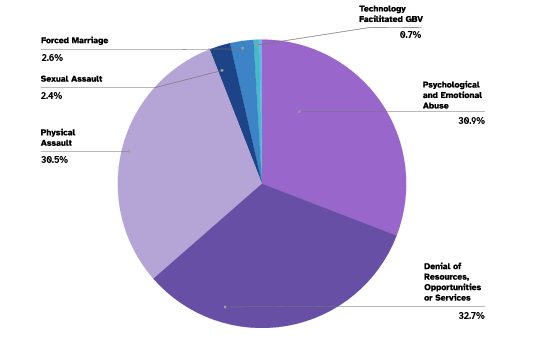
UNFPA conveyed, “Multiple forms of GBV were reported to the case management organisations, the highest GBV incidents during the period were denial of resources and opportunities (32.7%), psychological and emotional violence (30.9%); Physical assault (30.5%). Sexual violence incidents increased in number this quarter and accounted for 2.4%, unlike 2.2% in the previous quarter.”

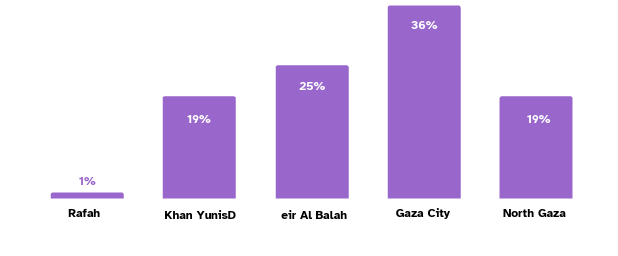
Occurrences of gender-based violence were observed in each of the five governorates. Gaza City contributed to the largest percentage of reports (36%), followed by Deir El Balah (25%), while North Gaza and Khan Younis each had an equal share (19%).

The report further read, “Women and girls remain highly vulnerable to economic deprivation through the denial of resources and opportunities, as well as other forms of gender-based violence. This highlights the multiple, intersecting forms of gendered discrimination they face, which significantly increases their vulnerability. Notably, adult women aged 18–59 constituted the highest proportion of reported survivors at 68%, representing an 11% increase from the previous quarter. This trend indicates growing vulnerability within this demographic, particularly regarding economic violence.”

According to one woman, her mother-in-law continues to deny her financial benefits after her husband died in the conflict.

An unsettling reality of forced unions and sexual violence

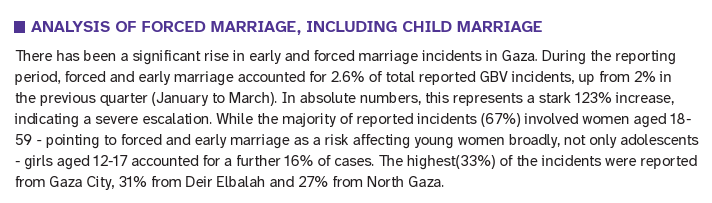
The figures for early and forced marriage cases in Gaza have significantly increased. Forced and early marriage made up 2.6% of all registered GBV cases during the reporting period, up from 2% in the preceding quarter (January to March). It added, “In absolute numbers, this represents a stark 123% increase, indicating a severe escalation. While the majority of reported incidents (67%) involved women aged 1859, pointing to forced and early marriage as a risk affecting young women broadly, not only adolescents, girls aged 12-17 accounted for a further 16% of cases. The highest (33%) of the incidents were reported from Gaza City, 31% from Deir Elbalah and 27% from North Gaza.”

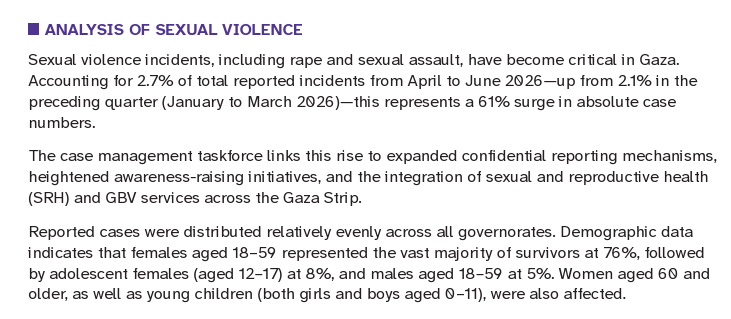
Acts of sexual violence, including rape and sexual assault, have reached a critical stage in Gaza. There is a 61% increase in absolute case numbers, representing 2.7% of all compiled events from April to June 2026, up from 2.1% in the previous quarter (January to March 2026). “Demographic data indicates that females aged 18–59 represented the vast majority of survivors at 76%, followed by adolescent females (aged 12–17) at 8%, and males aged 18–59 at 5%. Women aged 60 and older, as well as young children (both girls and boys aged 0–11), were also affected,” UNFPA unveiled.

Another report documents persistent acts of molestation, sexual abuse

A UNFPA report titled “I want to feel safe again: Drivers of gender-based violence in Gaza” was earlier published on 17th September, presenting insights from 230 women residing in Gaza City and Khan Younis regarding their everyday experiences and exposure to gender-based violence risks. “It draws on findings from 16 focus group discussions conducted by the Women’s Affairs Centre (WAC) between December 2025 and January 2026 with women aged 19-63,” the study mentioned.

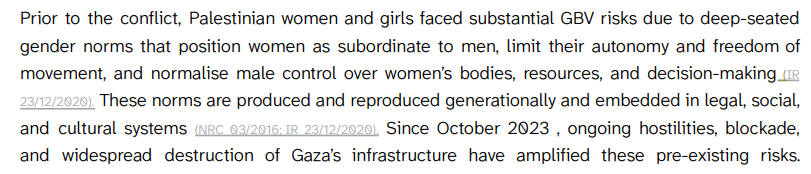
The report highlighted that ingrained gender norms already normalised male dominance over women’s bodies, resources, and decision-making, restricted their autonomy and freedom of movement and placed them as inferior to men. Hence, Palestinian women and girls faced significant GBV risks even before the armed confrontation. These standards are ingrained in legal, social and cultural frameworks and are created and passed down through generations. However, after the Hamas-led 2023 October attack on Israel and its retaliation, these pre-existing threats have intensified.

“During displacement, young men who were transporting and helping girls would take advantage of the situation to hold their hands and touch their bodies,” a woman shared. The women talked about the frequent sexual remarks, men rubbing their bodies against them in lines, purposefully touching their hands when filling water jugs and groping. Women mentioned that they had to dress modestly all the time due to these conditions.

The report emphasised that all of the Focus Group Discussions (FGDs) addressed persistent sexual harassment and assault in and near restrooms. A woman explained, “The restrooms are also the most common place for harassment of girls. Once, I was going to the restroom and saw a young man harassing young girls, staring at them and touching their private parts. I called out to him, asking what he was doing, and he quickly ran away.”

“My neighbour went to bathe at night because the bathrooms were empty. While she was bathing, she heard whispering. The bathroom had no roof, so she looked up and saw a young man watching her. She quickly put on her clothes and left the bathroom. She couldn’t tell anyone because she was afraid of being shamed. She has grown daughters and feared their reputation would be ruined. She was exhausted from crying and grief. I thought someone had died in her family,” revealed another woman.

A woman expressed how she was blamed for her ordeal and pressured into silence, conveying, “I was harassed while standing in line for water. An older man started harassing me and pressing against me. I reported him to the (camp) authorities. But my neighbours and the women in the camp told me I exposed myself. I’m really confused about this society. I’m forced to keep quiet.”

Girls married to their rapists, rape considered as adultery, no justice for survivors

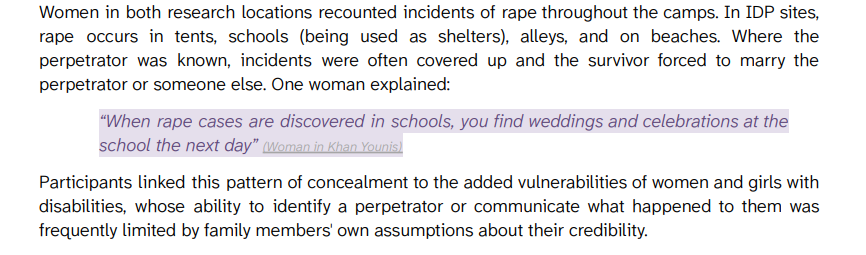
The report quoted women to outline that rapes take place throughout the camps, including beaches, alleys, schools that serve as shelters, and tents at IDP (Internally Displaced Person) sites. However, the heinous act was frequently hushed up, and the survivor was made to marry the rapist or another person if the perpetrator was known.

“When rape cases are discovered in schools, you find weddings and celebrations at the school the next day,” a woman stated. This pattern of concealment was connected to the greater vulnerability of women and girls with disabilities, whose capacity to communicate such an incident or identify a culprit was often hampered by presumptions about their credibility by their own family members.

The report specified, “Women and girls with disabilities were identified as especially at-risk, with perpetrators exploiting their limited ability to understand, resist, or report what was happening to them.” A woman highlighted, “There was a 20-year-old woman who was very naive and her level of understanding was so low that more than one young man harassed her, and one of them raped her. She almost didn’t understand what was happening to her.”

Moreover, rape was regarded as adultery, which only exacerbated the problems endured by women. UNFPA stressed, “The legal system’s classification of rape as ‘adultery’ constitutes a secondary form of violence, stripping the survivor of justice and positioning her as the perpetrator of a moral transgression. This underscores that legal institutions, even when functioning, do not always deliver justice for women.”

Marital rape was similarly identified as a significant concern in the report.

Women subjected to domestic violence by husbands, fathers, brothers

UNFPA informed, “Prior to 2023, domestic violence in Gaza was already a significant problem, with nearly one in three Palestinian women reporting violence by their husbands in the preceding 12 months. Approximately 15% of married women in Gaza experienced sexual abuse by their husbands in the previous year, with more than half experiencing it repeatedly.”

“The most common type of violence women experience is beatings. This was the most prevalent type of violence before the war, and now, after the war, it has increased significantly. Men take out their anger on their wives, and women have no choice but to endure it,” a woman asserted. Women also mentioned brothers, fathers, and parents-in-law as offenders.

The report mentioned, “Prevailing gender norms and conditions resulting from the conflict have resulted in a culture of impunity, with FGD participants emphasising that some fathers were allowing their sons to beat their daughters without consequences.”

During FGDs, domestic violence and family violence, which includes physical violence, emotional/psychological violence, suppression of access to resources, opportunities, or services, sexual exploitation, restrictions on freedom of movement, coercive control and isolation, marital rape and threats to take away kids of survivors, were the most frequently discussed forms of GBV.

According to the report, widows, women whose husbands are incarcerated, and divorcees are more likely to encounter emotional and physical violence from their in-laws. Women shared that their in-laws control them, treat them like servants, and prevent them from leaving with their children.

A woman disclosed, “My husband already forbids me from going out, even to talk to my family. Imagine what would happen if I went to a women’s safe space. If he found out, he’d beat me. I just stay quiet, sit in my tent, and keep my sadness to myself.”

Women also expressed that their husbands intercepted assistance “Fathers, brothers, and in-laws in particular were among the most frequently discussed perpetrators of denial of access to humanitarian assistance by family members,” UNFPA stated.

Exploitative arrangements in the form of child and forced marriages

“Child, early, and forced marriage are not new phenomena in Gaza – in 2019-2020, 24% of women aged 20-49 in Gaza had been married before the age of 18, reflecting longstanding social pressure to marry young,” the report read. Participants in the FGD discussed several types of these unions. These included forced marriages of rape survivors, levirate marriage (the custom of marrying widows to their deceased husband’s brother), child marriage, economic transactions in which girls are married off in exchange for resources and marriages arranged by families without women’s consent.

The report stated that “marriage was used explicitly as a transactional mechanism for securing shelter and resources, such as a widow being forced into marriage with a camp representative in exchange for a tent to shelter her children.”

It further revealed that “six participants across six different FGDs in Gaza City and Khan Younis shared stories of girls whose fathers married them off for a bag of flour.”

Women also talked about how parents have forced their daughters into marriage as a kind of “protection” for the girls or to preserve family “honour” and “avoid scandal” due to fear of sexual harassment and rape, along with strict gender norms that prohibit mixed-gender socialising.

Community members sexually exploit and abuse women, denial of basic needs

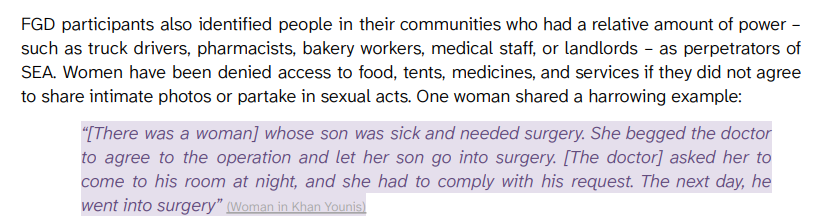
Truck drivers, chemists, bakers, doctors, landlords and other such persons in their communities with a relative amount of power were identified as Sexual Exploitation and Abuse (SEA) perpetrators by the FGD attendees. Women who refused to provide private images or engage in sexual activity were denied access to food, tents, medications, and other services.

“There was a woman whose son was sick and needed surgery. She begged the doctor to agree to the operation and let her son go into surgery. The doctor asked her to come to his room at night, and she had to comply with his request. The next day, he went into surgery,” a woman recounted.

Women also discussed incidents in which they were beaten, shoved, or struck by distributors or other members of the community while attempting to get assistance.

UNFPA highlighted that both men and women have lost access to traditional conflict resolution procedures, but the impact remained gendered. Women’s access to dispute settlement mechanisms was already more restricted than men’s, and when it did exist, it was rarely survivor-centred before the ongoing war.

According to the report, women and girls who are divorced, separated or widowed are often identified as those who are most vulnerable to SEA, denied access to humanitarian aid, economic exploitation, forced levirate marriage and abuse by in-laws. The list also included adolescent girls, females with disabilities, women whose husbands are missing or jailed, pregnant women, new mothers and older women.

Meanwhile, accounts of violence are regularly met with victim-blaming. “Participants also noted a culture of victim-blaming, with survivors choosing silence over the humiliation of being blamed for the violence,” the report pointed out.

Amid the Sahil Wakode row, Ambedkarite activist falsely blames ‘caste harassment’ for the suicide of IIT Bombay student Darshan Solanki; here’s the truth

After a caste discrimination spin was given to the suicide of an IIT Bombay BTech second-year student, Sahil Wakode, self-declared Ambedkarites and social justice warriors are building a false narrative that somehow students belonging to SC/ST communities face widespread caste discrimination and harassment across IITs. In this pursuit, an ‘Ambedkarite’ Suraj Kumar Bauddh has claimed that IIT Bombay student Darshan Solanki, who committed suicide in 2023, faced caste harassment.

In an X post published on 23rd September, Suraj Kumar Bauddh claimed that ‘Savarna’ faculty at India’s premier tech institutes are “killing” Dalit students. To back his claim, Bauddh alleged that IIT Bombay student Darshan Solanki, who died by suicide in February 2023, committed suicide due to ‘caste harassment’.

“Savarna faculty kills Dalit students. 3 years ago, in 2023, IIT Bombay student Darshan Solanki (SC) was driven to suicide after facing constant caste harassment. Today, his father joined the protest at IIT Bombay demanding justice for Sahil Wakode,” Bauddh wrote.

Bauddh also shared a video of Solanki’s father interacting with an AajTak reporter, wherein he said that Solanki was facing pressure from his roommate, and his requests for changing his room were denied, forcing Darshan Solanki to take the extreme step.

When asked whether any of Darshan Solanki’s friends or batchmates ever spoke to him about the prevalence of caste-based prejudices and discrimination in IIT Bombay, Solanki’s father said that he is not in touch with students and whatever he knows is only through media reports. Solanki’s father has expressed solidarity with Sahil Wakode’s parents; however, he did not claim that Darshan Solanki faced caste-based discrimination or pressure.

Suraj Kumar Bauddh is not alone in pushing a false narrative around Darshan Solanki’s suicide; many self-styled social justice champions are amplifying the same lies.

Did Savarna faculty kill Darshan Solanki? No, a Muslim student abetted his suicide

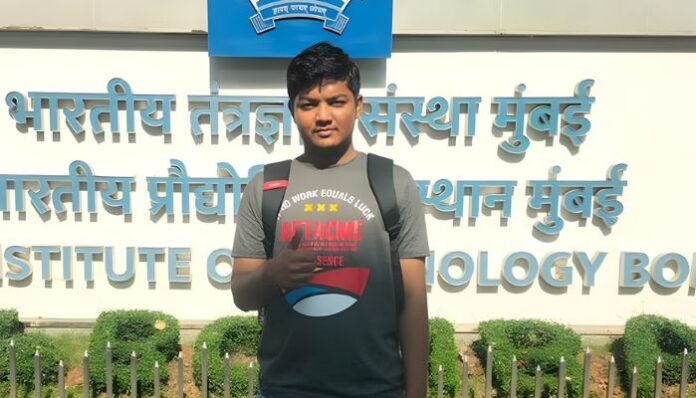
On 12th February 2023, an IIT Bombay student named Darshan Solanki took his own life. He was a Hindu Dalit who hailed from Ahmedabad city in Gujarat.

Solanki jumped to his death from the 7th floor of his hostel building. It had only been a day since the semester exams ended. Solanki had even called his mother before committing suicide and discussed plans about having a family get-together on 14th February that year.

Soon after the incident, speculations began about the cause of Darshan Solanki’s untimely death. A notorious organisation on campus named ‘Ambedkar Periyar Phule Study Circle (APPSC)’ alleged that the victim took his own life due to ‘caste discrimination.’

Caste-baiters like ‘Ambedkar Periyar Phule Study Circle (APPSC)’ and leftist propaganda outlets like Newslaundry exploited Solanki’s death for their own ‘caste discrimination’ agenda, even as the institute’s administration ruled out caste discrimination allegations.

In March 2023, an internal committee commissioned by the IIT-B found “no specific evidence of direct caste-based discrimination” resulting in the death of Darshan Solanki. The panel also alluded to his “deteriorating academic performance” as a possible reason for taking his life.

Despite this, caste politics players declared that the victim died due to ‘caste discrimination.’ This was prior to the conclusion of the internal investigation by IIT-B and the Powai police in Mumbai.

The whole leftist coterie, however, went silent as soon as the Special Investigation Team (SIT) of the Mumbai Police arrested a 19-year-old batchmate of Darshan Solanki named Arman Iqbal Khatri and found a suicide note, in which the deceased Hindu Dalit blamed his Muslim batchmate for his decision to end his life.

The SIT had recovered a suicide note from Solanki’s room that read, “Arman has killed me.” During the inquiry, the investigators discovered that harassment by Arman might have forced the victim to end his life. Handwriting experts had confirmed that the suicide note was indeed written by Darshan Solanki.

It later emerged that Arman Malik and Solanki stayed on the same floor of the IIT-B hostel. A day before his suicide, the victim had confided in another student that he felt threatened by Arman.

Arman Iqbal Khatri was arrested and was booked under IPC Sections 306 and 506 (2) and relevant sections of the Scheduled Castes and Scheduled Tribes (Prevention of Atrocities) Act (SC/ST Act).

In April 2026, a special court framed charges against Arman Iqbal for criminal intimidation and abetment of suicide.

Darshan Solanki then Sahil Wakode now: For self-declared social justice warriors, the suicide of students who happen to be Dalits is a mere tool for ideological agenda

From the 2016 Rohith Vemula case, the 2023 Darshan Solanki case to the recent Sahil Wakode suicide, Leftists and caste-baiters have long been giving a caste discrimination spin to student suicides driven by non-caste atrocity reasons merely because the deceased happened to be a Dalit. In fact, in Rohith Vemula’s case, it later turned out that the deceased did not even belong to the SC category, let alone face caste discrimination.

In Vemula’s case, the Telangana Police’s closure report stated that the PhD scholar at the University of Hyderabad, Rohith Vemula, committed suicide because “he had his own problems and was not happy with worldly affairs. If he would have been angry with the decision of the University, certainly either he would have written in specific words or would have indicated in this regard. But he did not do the same. It shows that the circumstances prevailing in the university at the time were not the reason for Rohith’s death.”

Despite this, Vemula was made a symbol of ‘upper caste’ disdain and vengeance against Dalits; anti-caste discrimination laws have been proposed in his name, seminars are held in his name, and the politics continues.

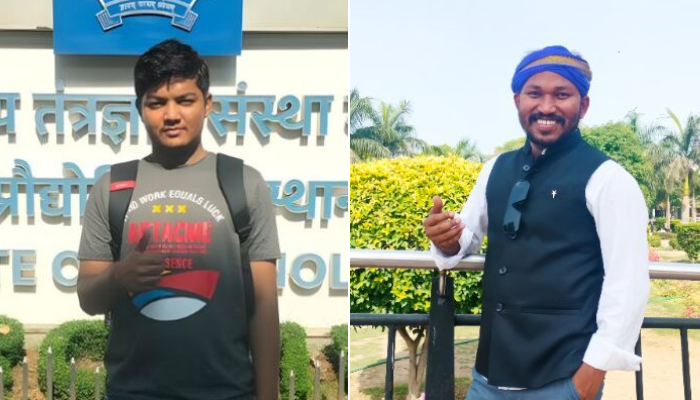
Now efforts are on to turn Sahil Wakode into another Rohith Vemula. Sahil Wakode, a 2nd-year BTech student at IIT Bombay, took his own life on Friday (18th September) after being caught red-handed by Professor Suryanarayana Doolla. He later committed suicide in his hostel room.

Thereafter, protests emerged on the campus of the institute, demanding action against the esteemed faculty member. A day later, on Saturday (19th September), Sahil’s parents alleged that Professor Doolla had been mentally harassing and using casteist slurs against their son for 3 months at the behest of IIT Bombay’s Director Shireesh Kedare.

One of the key demands of Wakode’s father, Ravindra, is the immediate release of financial compensation under the SC/ST (Prevention of Atrocities) Rules, 1995.

While Wakode’s death has been framed as caste discrimination, not a single complaint was ever filed against Professor Doolla or Shireesh Kedare with either the administration or the SC/ST cell of IIT Bombay during Sahil’s tenure at the institute.

The emergence of the CCTV footage showing Wakode using a mobile phone during the exam has punctured the ‘caste atrocity’ bogey and claims that the deceased student was not cheating. Despite being allegedly caught cheating, no disciplinary action was initiated against Wakode, and he was counselled.

Even as caste discrimination claims in all three cases, be it Rohith Vemula, Darshan Solanki and Sahil Wakode, lack concrete factual basis, self-declared social justice champions are peddling propaganda to establish an apocryphal narrative that Dalit students are being pushed to suicide by ‘Savarna’ faculty at top colleges.

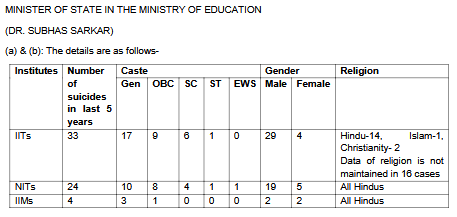
Contrary to the pushed narrative, the comprehensive data presented by the Ministry of Education in the Lok Sabha in March 2023 shows that, out of the total 61 student suicides, General-category students accounted for 30 cases (17 in IITs, 10 in NITs, and 3 in IIMs). On the other hand, OBC students accounted for 18 deaths, SC students accounted for 10, ST students accounted for 2, and the remaining 1 was recorded under the EWS category.

While the possibility of caste discrimination playing a role in individual suicide cases cannot be outrightly dismissed, the floated claims that ‘Savarna faculty kills Dalit students’ as if there is a broader pattern are devoid of factual merit and driven purely by an agenda against individuals belonging to the general category.

Was Sahil Wakode using a calculator during the examination? CCTV visuals refute the social media claims

After CCTV footage of the examination hall at IIT Bombay, where a 2nd-year B.Tech. student Sahil Wakode was caught using a mobile phone while writing the examination was released, several claims emerged on social media dismissing the video evidence as fake and AI-generated.

Many so-called pro-Dalit voices on X claimed that Sahil Wakode was not using a mobile phone but a calculator or a geometry box, which other students in the examination hall were also using.

They claimed that “caste Hindus” and “Manu Media” were spreading misinformation using the CCTV footage, adding that Wakode was using a scientific calculator or a geometry box like other students and not a mobile phone.

An Ambedkarite X account claimed that the CCTV footage of the examination hall, which was aired on various media channels, was “AI-generated”.

One X account claimed that the CCTV visuals actually show that Wakode had completed his examination and he handed over his answer sheet to the invigilator, collected his items, and left the examination hall. Dismissing the allegations of cheating against Wakode, the account argued that no student would dare cheat in an examination at IIT Bombay, that too, sitting in a front seat, and therefore Wakode surely would not have cheated during the exam.

Several similar claims questioning the CCTV footage and prematurely passing verdicts on the events that led to Wakode’s tragic death surfaced on social media. However, a look at the CCTV footage exposes the claims of all the so-called pro-Dalit advocates, who have been using the tragedy to peddle their divisive agenda.

The CCTV video shows Sahil Wakode sitting in the front seat in the examination hall and looking at his lap while writing on his answer sheet. A calculator and other items can be seen placed on Wakode’s desk as he was repeatedly looking at his lap. The invigilator notices his movements and interrupts him. Wakode then hands over a mobile phone to the invigilator. He then collects the rest of the items, which were placed on his desk, and walks out of the hall behind the invigilator.

The CCTV footage matches the earlier statement of the IIT Bombay administration that Sahil Wakode was caught using a mobile phone during an examination on September 18, 2026. He was asked to leave the examination hall by Professor Suryanarayana Doolla, who was on invigilation duty. The IIT administration said that Wakode was subsequently counselled; however, no disciplinary action was taken against him. Hours after the incident, he was found dead inside his hostel room.

Wakode’s death triggered outrage among students who staged protests by leftist student groups. His family alleged that Wakode was subjected to caste discrimination by Professor Doolla and others on the campus, which pushed him to take his life.

Based on the caste-discrimination allegations of Wakode’s family, an FIR was lodged by the Mumbai Police against Professor Doolla and others relating to abetment to suicide and the Scheduled Castes and Scheduled Tribes (Prevention of Atrocities) Act. The Mumbai Police Crime Branch is investigating the case.

While Wakode’s death has been given a caste discrimination spin, not a single complaint was ever filed against Professor Doolla or Shireesh Kedare, either with the administration or the SC/ST cell of IIT Bombay during Sahil’s tenure at the institute.

‘Hindu Taliban’, ‘fatwa’ and more: The Indian Express invites “journalists” to demonise VHP over its call to bar Muslims from Navaratri events

The Vishva Hindu Parishad’s (VHP) call to bar Muslims from Hindu religious celebrations, including Navaratri, has struck a nerve with the Islamo-leftist ecosystem, which has continued to rake up the issue in protest. This cabal appears determined to police how Hindus observe their festivals, pushing a skewed version of secularism whose burden, once again, is expected to fall solely on the Hindu community, even on their special occasions.

On 22nd September (Tuesday), “The Indian Express” hosted an interview with “author” and “journalist” Girish Kuber, conducted by another “journalist” Shubhangi Khapre, where the two repeatedly railed against the issue, even referring to the VHP as “Hindu Taliban” and describing its appeal as a “fatwa.”

It remains notably convenient for these individuals to deploy such objectionable terminology to diminish Hindus and their organisations while refraining from applying the same language where it would be genuinely appropriate, as they are acutely cognisant of the potential retaliation from Islamists should they attempt to criticise them. 

Navaratri a commercial event, allow Muslims or celebrate in your homes

Khapre claimed, “These festivities have become closely associated with the cultural nationalism of the right wing and have kept Maharashtra and the country on the boil,” pointing to the “fatwa” given by VHP over the entry of Muslims during Navaratri and Garba programs in Maharashtra, including Mumbai, Gujarat and other states.

She protested that since Navaratri is no longer just confined to worship of the goddess within homes but has become a “commercialised” mega event featuring professional dancers and singers and drawing crowds who want to rejoice and be entertained, Muslims should not be excluded from attending the celebrations.

She asked an equally agitated Kuber if such a directive was justified, to which he replied, “No. It is horrible even to think of such a thing. First, how are they going to do it? Second, the word you used was fatwa. Everyone knows who issues fatwas and what their standard is in terms of being accommodating culturally, religiously and socially. So, are we looking at the VHP becoming the Hindu Taliban?”

He maintained that a fundamental inconsistency exists between the repeated declarations of Rashtriya Swayamsevak Sangh (RSS) chief Mohan Bhagwat concerning unity and diversity, alleging that the outfit speaks in different tongues. He endorsed Khapre’s assertion that the sacred occasion is actually a commercial program in which participants purchase tickets for attendance.

Kuber drew a forceful comparison with Christmas, which he characterised as a secular festival, and argued that while Navaratri has Hindu foundations, it is extensively celebrated for social and recreational purposes. He suggested that Hindus should restrict their Navaratri observance to their homes if they wish to prevent Muslim participation in their festivities.

This is a classic trick in the liberal playbook to separate Hindu festivals from their religious roots and reframe them as social and cultural gatherings. This approach has been evident in the representation of Onam, which has a profound connection to Hindu scriptures and the story of King Mahabali and Lord Vishnu’s Vamana incarnation, yet is showcased merely as a harvest celebration in Kerala.

A similar reframing is currently underway with Pongal or Makar Sankranti, as efforts are underway to portray it as a Tamil festival with no association to Hinduism.

Furthermore, Khapre and Kuber appear to slyly overlook that entertainment constitutes only a secondary element of Navaratri, with the musical and dance performances, including Raas Garba and Dandiya, being executed as devotional acts of worship directed toward Goddess Durga or Ambika.

The real inquiry should be why Muslims who consider the singing of “Vande Mataram” as an infringement upon their faith would wish to take part in such a program, which is essentially contrary to core Islamic principles and is termed “shirk” (the association of partners with Allah), which is the gravest sin in their religion.

However, these two “journalists” lack the courage to pose such pertinent questions and instead dictate to Hindus how to mark their religious festivals, even demanding that they either welcome Muslims or discontinue public celebrations altogether.

This is the form of secularism and syncretic cultural philosophy that this faction promotes in India, wherein Hindu citizens would be demoted to a subordinate status, with their basic rights circumscribed to please Muslim. While they accuse the VHP of purportedly acting like “Hindu Taliban,” the fact remains that these people want to transform India into another Pakistan or Afghanistan for Hindus.

An unreasonable comparison and demand for government intervention

The argument descended into further absurdity when Kuber referenced Ustad Bismillah Khan to contend that Hindus should refrain from playing the shehnai at their weddings and other occasions. First, Navaratri is exclusively devoted to a Hindu goddess, whereas a Hindu marriage constitutes a sacred sacrament (sanskara) between two individuals, with religious rituals serving as an integral component.

However, the spiritual objectives of these two are absolutely distinct. One is centred upon the marital union, while the other revolves around utter dedication and surrender to a deity. Interestingly, wedding invitations are also offered selectively, and no person has the right to demand inclusion. Similarly, Navaratri events are also not government schemes where everyone, irrespective of their beliefs, needs to be included or face allegations of discrimination.

Kuber did not stop there and dragged Bollywood in a desperate bid to prove his point. “For example, if I remember correctly, ‘Man Tadpat Hari Darshan Ko’ is a Hindu bhajan sung by Mohammed Rafi. Its music was composed by Naushad, and the lyricist was also Muslim,” asking if it is also going to be banned.

If this is the reasoning, then many Hindus within the industry were the primary agents responsible for engaging these artists to produce the compositions they created, driven by professional obligation rather than devotion or spiritual conviction, and compensated accordingly for their services.

Nevertheless, drawing a parallel between Navaratri and a Bollywood production exposes the vacuity of the submission and their perception of Hindu festivals as inconsequential.

Khapre and Kuber also appealed to Chief Minister Devendra Fadnavis and the state government for intervention in this matter.

Hindus have complex, BJP is like the British

Kuber then claimed that the development reveals the majority community’s complex, when the situation should be reversed with the minority community experiencing insecurity, remarking that the VHP has demonstrated its insecurity.

Of course, the devastation caused by extremists within the “minority” community and their actions, including stone-pelting during Hindu processions, damaging Hindu pandals, vandalism and desecration of idols, love jihad and grooming jihad, to name a few, will never receive consideration from this group, who view Muslims as perpetual victims regardless of the truth.

Moreover, Navaratri programs serve as hunting grounds for predators from the Muslim community who want to target Hindu women and young girls, another ugly reality which is ignored by the liberals.

Afterwards, Khapre and Kuber proceeded to mock the sensitive issue of “love jihad,” which had been cited as the trigger for the decision by Bharatiya Janata Party (BJP) leader and minister Nitesh Rane. They too chose to dismiss the agony and pain of the Hindu victims who fell into this trap and suffered brutal consequences, much like the rest of their coterie.

Kuber commented, “Across the country, there is a race over who can appear more Hindu or more saffron than his competitor in the same camp. Look at Assam. Look at West Bengal. Many former Congress politicians are now trying to showcase their loyalty to Hinduism,” adding that Rane was not worth their attention. He complained that the BJP is full of such leaders and threatened that the party would pay an (electoral) price for entertaining them.

Secularism was apparently never under threat when politicians routinely attended Iftar gatherings and their parties went out of their way to appease the Muslims. However, the moment a Hindu leader or entity exhibits any degree of assertiveness, it is met with a barrage of obnoxious accusations.

Hindus apparently can celebrate their festivals only so long as everyone else gets a say in it, except them. The sentiments of every community must be respected but not theirs. The ecosystem wants Hindu festivals to be treated as public affairs, open to all, mirroring a community kitchen, charitable service or government initiative.

Kuber also accused the BJP of trying to replicate the British colonial strategy of “Divide and Rule” before reiterating that Diwali is becoming universal just like Christmas. “How are you going to say that only Hindus can celebrate Diwali or only Hindus can burst crackers,” he asked.

No one has stopped anyone from bursting crackers or sharing sweets, but involving others cannot come at the cost of stripping Diwali of its religious character. Christmas might well be celebrated beyond the Christian community, yet no one argues that it should be divorced from its religious identity or that its origins should be rejected. That same courtesy, however, is not extended to Hindus, whose festivals are painted as anything but religious events.

The argument then veered into the familiar territory of boycotting Muslim artists, accusations of a “majority syndrome” and even the ludicrous question of whether concerts and movies would be next.

Notably, such remarks reveal how little distinction liberals are willing to make between a deeply religious Hindu occasion like Navratri and ordinary entertainment. It is not that they fail to understand the significance of the events, rather, they intentionally downplay it to serve a narrative built around their deranged concept of “Ganga-Jamuni tehzeeb,” which is grounded in undermining Hindus and their religious rights for Muslims.

This has long been the pattern with this global ideological clique, which repeatedly finds one pretext or another to take aim at Hindus, their festivals and their organisations for daring to take a firm stand for the community and its traditions.

Indian Express’ ‘ECI crisis’ bogey falls apart: How dissenting notes on SIR process were sensationalised and sold as ‘institutional collapse’

0

If there is one thing The Indian Express appears to have discovered during its latest investigation into the Election Commission of India, it is that the words “internal crisis”, “illegal”, “centralisation” and “cloud over its conduct” make for excellent headlines.

Whether the evidence supports the dramatic narrative is another matter.

On September 23, The Indian Express, in a series of reports authored by Ritika Chopra, presented what it described as an unprecedented rupture within the Election Commission. Its principal finding was that Election Commissioners Sukhbir Singh Sandhu and Vivek Joshi had recorded objections at least 14 times over 10 months on issues concerning the Special Intensive Revision, Form 6, electoral-roll software, voter additions and deletions and other administrative decisions.

The report then took those objections and constructed a much larger narrative around them: that powers were being centralised in Delhi, that statutory Electoral Registration Officers were being bypassed, that software was overriding field-level decisions and that the Election Commission was facing an unprecedented institutional breakdown.

There is just one problem.

The evidence presented by the newspaper does not automatically establish any of those conclusions.

And the Election Commission has now responded directly.

In a press note issued on September 23, the ECI said that it is a multi-member constitutional body and that written notes, observations, technical suggestions and internal checks and balances are standard features of its functioning.

It said operational queries raised during the draft stage are part of normal administrative practice and that differing views are a normal part of institutional deliberation before a final decision is taken.

That inconvenient fact substantially complicates the dramatic storyline being sold to readers.

An objection is not an institutional coup

Let us begin with the celebrated “14 objections”.

Yes, two Commissioners objected to various decisions. That is newsworthy. It is legitimate to examine what they objected to, why they objected and what happened subsequently.

But The Indian Express repeatedly moves from “two Commissioners objected” to “the Commission is in unprecedented rupture” as if the latter automatically follows from the former.

It does not.

The newspaper itself reports that the objections were made through internal notes and communications. In other words, these were precisely the mechanisms through which Commissioners are expected to raise concerns within an institution.

The ECI has now made the point explicitly: internal notes and observations are part of the checks and balances within the Commission. It also says that all official orders, decisions and administrative directions carry legal sanction and follow the statutory procedures prescribed under the 2023 Act.

In fact, the legal framework itself contemplates disagreement.

Section 18 of the 2023 Act provides for the Commission’s business to be transacted, as far as possible, unanimously, while providing for matters on which the Commissioners differ to be decided by majority.

So what exactly is being presented as evidence of institutional collapse?

The existence of disagreement in an institution whose governing law expressly provides for disagreement.

That may be an interesting institutional story. It is not, by itself, evidence of a constitutional breakdown.

‘Illegal’ according to whom?

The Form 6 controversy provides an even better example of the problem with the Indian Express framing.

The newspaper reports that the online Form 6 was modified to ask new voters whether they, their parents or grandparents appeared in the electoral roll from the previous SIR. It further reports that Commissioner Vivek Joshi had objected to the change and that Sukhbir Singh Sandhu subsequently described it as “unauthorised” and “illegal”.

The objection itself is a fact.

But there is a rather important difference between saying: “A Commissioner called the change illegal” and saying: “The Election Commission illegally changed Form 6.”

The first is a report of an internal disagreement.

The second is a legal conclusion.

The newspaper’s own material establishes the former. It does not turn the Commissioner’s objection into a judicial determination.

If the precise statutory procedure for modifying Form 6 was violated, that can and should be demonstrated by reference to the applicable rules and the legal authority under which the modification was made.

But putting the word “illegal” in the headline because one Commissioner used that word in an internal note is precisely the kind of headline-driven framing that can leave readers with a conclusion stronger than the underlying evidence.

The biggest allegation, ‘Delhi has taken over the voter database’, faces a major problem

The most consequential claim in the investigation is the alleged “centralisation” of electoral-roll databases.

According to The Indian Express, Commissioners raised concerns that state-level officials did not have “proper and complete access” to the electoral-roll system and warned against the gradual centralisation of the database. The newspaper then takes this further, claiming that ECINet can effectively override ERO decisions and describing this as a concentration of power at the ECI headquarters.

This is where the report’s sweeping conclusion runs headlong into the facts on the ground.

OpIndia’s Ritika Chandola spoke to two Electoral Registration Officers over the Indian Express report’s claim of centralisation of powers. Both categorically rejected the suggestion that their statutory powers had been usurped by the ECI’s central administration.

They did not describe themselves as powerless functionaries waiting for Delhi to approve every addition, deletion or modification.

They rejected the claim that the ECI website had effectively taken over their statutory responsibilities.

Because an allegation about the centralisation of statutory power should ideally be tested by speaking to the statutory officers who supposedly lost that power.

And when those officers say that their powers have not been taken away, the allegation requires substantially more evidence before it can be elevated into a settled fact.

The ECI has made the same point in its official response. It says ECINet operates under cybersecurity and audit controls, while statutory authorities including EROs and DEOs continue to exercise their powers for registration and deletion under law.

There is obviously nothing inherently suspicious about having a central technological platform.

A national election system with hundreds of millions of voters cannot realistically function on disconnected spreadsheets and standalone computers sitting in individual districts.

Centralised technology is not the same thing as centralised statutory authority.

That distinction seems to have disappeared somewhere between the internal notes and the Indian Express headline.

The Goa episode may demonstrate a software problem. That is not the same as proving a power grab

The newspaper’s Goa example deserves examination.

It reports that EROs found 97 voters eligible after considering their documents, but the software did not have the necessary functionality to record their decisions before the final roll was published.

If that happened as reported, it is a serious administrative and technological issue. But even then, one has to be careful about what the evidence proves. A software system failing to accommodate a particular administrative decision is evidence of a software or workflow failure.

It is not automatically evidence that the ERO’s statutory power has been transferred to the ECI headquarters.

To establish the latter, one would need to show who actually exercised the power, under what authority and whether the ERO was legally prevented from doing so.

The Indian Express appears to move rather quickly across those evidentiary steps.

The ‘13 crore deleted voters’ headline also needs the missing context

The report prominently says that SIR has “struck more than 13 crore names” from draft electoral rolls across 30 States and Union Territories.

The number sounds enormous. And it is.

But it is also a draft-roll figure.

A name being absent from a draft roll does not necessarily mean that a genuine voter has been permanently and finally disenfranchised. Electoral-roll revision necessarily involves identifying deceased voters, duplicate entries, voters who have shifted residence and other categories requiring verification.

The distinction between draft deletion and final exclusion after the prescribed process is not a minor technicality. It is central to understanding what SIR actually does.

Yet the sheer size of the number is repeatedly used to heighten the sense of impending electoral catastrophe.

Again, the headline gets the emotional weight. The qualification comes later, if at all.

Even the West Bengal example does not prove what the headline implies

The report also raises questions about appeals filed in West Bengal and asks who authorised appeals against voters whom judicial officers had restored to the rolls.

That is a legitimate question.

But the report itself acknowledges that the question of who exactly filed those appeals remains unclear.

So, once again, there is an unanswered administrative question, not an established case of unlawful action.

There is a difference between “we don’t yet know who authorised this” and “the Commission unlawfully centralised the process.”

Good investigative journalism should preserve that distinction.

Headline journalism tends to erase it.

What the Indian Express report conveniently leaves in the background

There is another important fact in the ECI’s response.

The Commission says that while The Indian Express has highlighted selected internal notes from 10 months, it has overlooked the much larger body of approvals, decisions, instructions and initiatives undertaken during the same period.

The ECI says it introduced around 40 new initiatives and undertook electoral reforms, including electoral-roll revision, and that these decisions were the outcome of unanimous decisions of the full Commission over the past year.

That does not make the objections irrelevant.

But it makes the phrase “internal crisis” much more contestable.

If the full Commission has continued to take decisions, approve initiatives and conduct elections and electoral exercises across multiple states, then a responsible account needs to explain that broader institutional functioning rather than selecting a collection of dissenting notes and presenting them as the entire story.

The ECI specifically points out that it has recently conducted major electoral exercises in Bihar, Kerala, Tamil Nadu, Puducherry, Assam and West Bengal involving extensive administrative machinery and Commission approvals.

That is not the picture of an institution that has simply stopped functioning.

The Indian Express wanted a crisis. The facts show a disagreement

There is nothing wrong with investigating disagreement within the Election Commission. In fact, the public deserves to know when constitutional functionaries disagree over electoral administration.

But journalism has a responsibility beyond finding the most alarming interpretation of documents.

The Indian Express has established that two Commissioners recorded objections. It has established that there were disputes over Form 6. It has established that concerns were raised about access to electoral-roll software. It has raised legitimate questions about the Goa software episode and the authorisation of certain appeals.

But it has not established, merely by presenting those facts, that the Election Commission’s statutory powers have been unlawfully centralised in Delhi.

It has not established that EROs have been stripped of their statutory authority.

And it certainly has not established that the existence of internal disagreement amounts to an “unprecedented rupture” in the functioning of the constitutional body.

The ECI’s official response directly contests that interpretation, stating that internal observations are normal institutional checks, that official decisions have legal sanction and that EROs and DEOs continue to exercise their statutory powers.

The testimony of the two EROs spoken to by OpIndia further complicates the central premise of the Indian Express story.

And that is perhaps the most revealing part of this entire episode.

The newspaper went looking for an ECI crisis and found dissent. It found questions and presented them as conclusions. It found internal objections and packaged them as institutional collapse. It found a centralised software architecture and presented it as centralised political control.

The Election Commission may well have legitimate questions to answer. There should be.

But if the standard is accountability, it has to apply to journalists too.

An internal note is not a court judgment. A software problem is not proof of a power grab. A disagreement is not an institutional collapse. And a sensational headline cannot substitute for the missing facts.

The Election Commission deserves scrutiny. So does the reporting that scrutinises it.

When the facts don’t quite support the headline, perhaps the headline needs revising, not the facts.

From donation appeal to charges of fraud: Who is Jay Singh Rathore, and how the revelation of an online scam is breaking the internet

A brother’s emotional appeal for his ailing sister moved people to donate, only for the heartwarming story to unravel as an online scam. A user identified as Ajayveer (Jay) Singh Rathore claimed that his 12-year-old sister was in danger of losing her vision and asked for modest contributions to help afford her medical care.

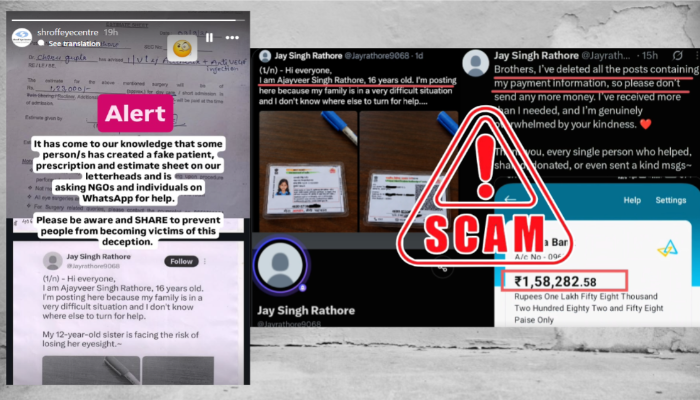
The post was made on X (formerly Twitter) on 21st September (Monday). He received over Rs 1.5 lakh from strangers online in less than a day following the request. He subsequently deleted the payment details, stating that the family had been offered more money than was needed.

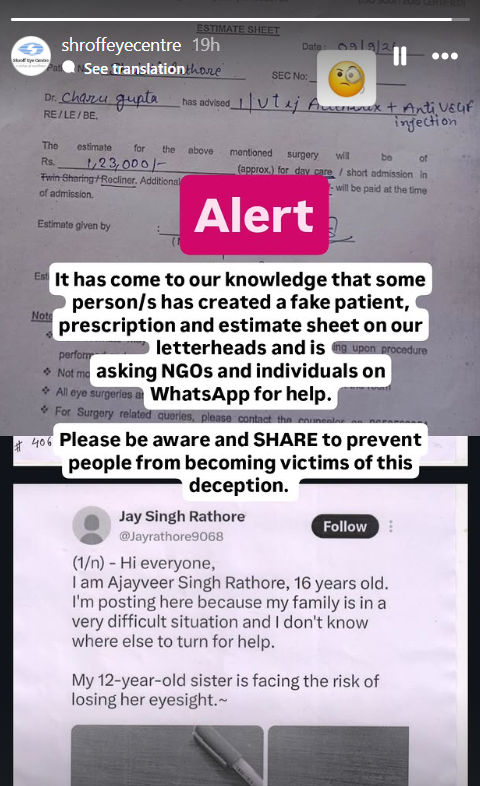
However, concerns began surfacing in relation to the medical records in the post, and the story took a major twist. Shroff Eye Centre warned that someone had used its letterheads to fabricate a patient record, prescription and estimate. Afterwards, the discussion shifted from posts about funding to long X Spaces, where people confronted Jay.

How the story unfolded

Jay portrayed himself as a 16-year-old looking for assistance for his younger sister in the initial post, which has since been removed. According to him, her eyesight started to decline a few months ago, after which she was brought by her family to Dr Shroff’s Eye Hospital in Delhi.

The doctors determined that she had vitreous haemorrhage, an internal eye bleed that was impairing her eyesight, along with glaucoma. Jay wrote that although the family had already spent over Rs 2.5 lakh on her care, the subsequent procedure would require an additional Rs 1.2 lakh. He included pictures displaying an Aadhaar card belonging to a child born in 2013 in the post.

“Between our savings and help from relatives, we have managed to arrange Rs 50,000. We are still short by approximately Rs 73,000. I have attached the medical reports, hospital bills, cost estimate and appointment documents so that people can verify the situation. Even Rs 10 or Rs 20 from people who are comfortable helping would mean a lot to us. If you cannot contribute, simply sharing the post may help us reach someone who can,” he requested.

Jay further expressed that he and his sister currently reside with their father and grandma after their mother passed away during the COVID-19 pandemic. He stated that the family has limited financial resources because his father, who works in the fields, is their only source of income.

The appeal took off right away, as Rs 1,58,282 was given to him in just a few hours. He thanked everyone who had helped and included a screenshot of the money raised in a later update on X. He asked netizens to stop because the family had more than they required and deleted the posts that contained his payment information, remarking, “I’m genuinely overwhelmed by your kindness.”

People voice doubts, hospital raises alarm

Meanwhile, many people pressed Jay to refund their money, labelling it a scam. Some reported having contacted the hospital and were unable to locate any patient with the sister’s name, while others demanded evidence of the medical emergency. They outlined inconsistencies in the prescriptions and medical records.

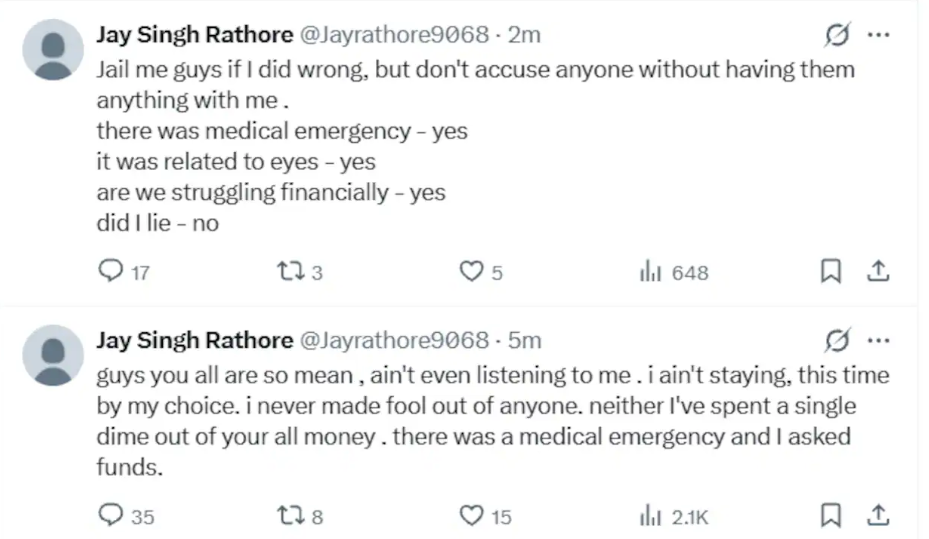
A user stated, “We trusted you, but the hospital says the patient with this ID has some other name, not Shrishti Rathore.” Jay defended himself by insisting that he was not lying to anyone and had not spent a single rupee on anything other than the actual medical emergency, declaring, “Jail me, guys, if I did wrong,” but don’t accuse him.

He termed these individuals as “so mean,” arguing that they did not listen to him because he never made a fool of anyone or spent any money, reiterating the medical emergency claim.

The biggest twist took place when Shroff Eye Centre warned about documents being distributed under its name. “Alert. It has come to our knowledge that some person/s has created a fake patient, prescription and estimate sheet on our letterheads and is asking NGOs (non-governmental organisations)and individuals on WhatsApp for help. Please be aware and share to prevent people from becoming victims of this deception,” it highlighted in an Instagram Story.

A new twist in the tale

Jay hosted a 4-hour-long discussion and appeared in X Spaces as the controversy grew and stressed that he did not plan to defraud anyone when inquired about the fundraising and the documents. He contended that the person who was ill and in need of financial support was his father, not his sister. He sserted to have used her name to boost the reach of his post.

Interestingly, Jay even stated that he did it “for fun” at another point during the conversations. He was also asked about how he carried out the scam, substituted the original patient’s name with his sister’s name and acquired the hospital documents, to which he responded that it is the responsibility of the police to investigate.

During one of the Spaces, he also began to cry as the matter intensified and users continued to make accusations and rejected his explanation, highlighting the fake documents. Participants questioned the fundraiser’s legitimacy and enquired about the money’s whereabouts as he insisted that it was collected for his father’s treatments.

Many users actively interacted with Jay throughout several X Spaces broadcasts. They emphasised that he was initially treating the issue lightly but broke down when the situation went out of his control, and more individuals began to scrutinise him. The photograph of the girl he used to trick people was also reported to be AI-generated.

Jay was given UPI credentials of the contributors and instructed that he repay the amount that had been collected. He responded by supplying a number of screenshots of payments, claiming to have already paid back some of the people. A person also posted a screenshot of Jay’s bank account, reportedly demonstrating that the total balance had decreased from Rs 1,58,282.58 to Rs 1,37,893.58.

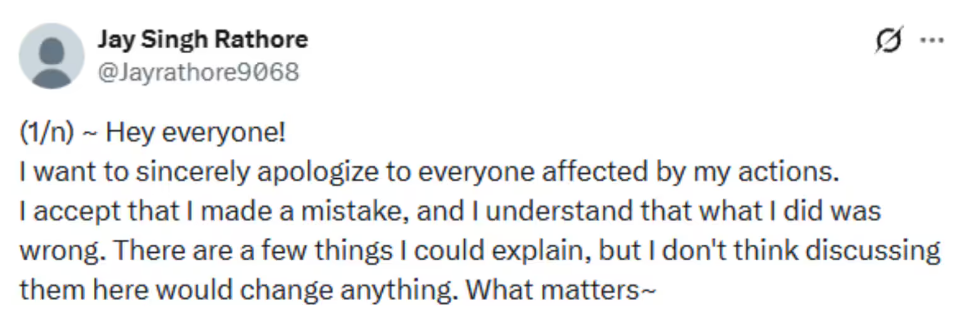
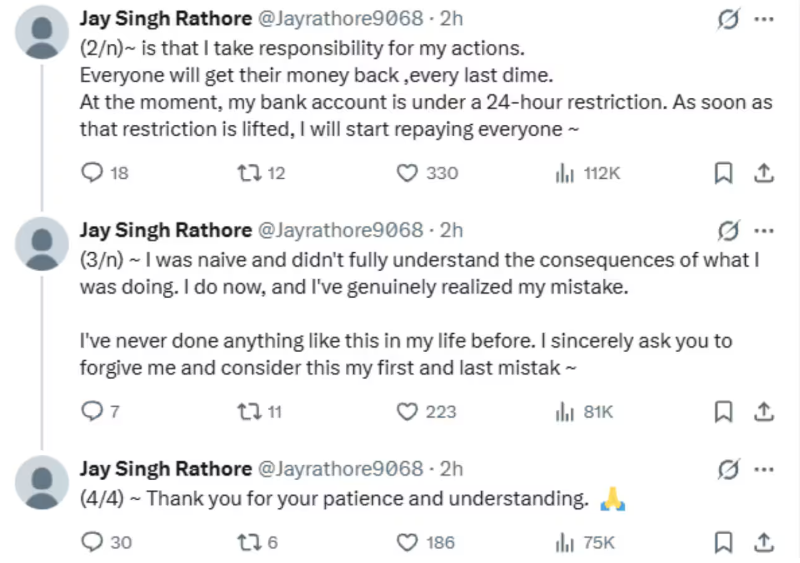
Jay eventually apologised to those impacted by his actions and accepted his mistake. He wrote, “I understand that what I did was wrong. There are a few things I could explain, but I don’t think discussing them here would change anything. What matters is that I take responsibility for my actions.”

He assured, “Everyone will get their money back, every last dime. At the moment, my bank account is under a 24-hour restriction. As soon as that restriction is lifted, I will start repaying everyone.” He claimed to be “naive” and “didn’t fully understand the consequences of what I was doing.”

However, he asserted to have learned his lesson, repeating, “and I’ve genuinely realised my mistake. I’ve never done anything like this in my life before. I sincerely ask you to forgive me and consider this my first and last mistake. Thank you for your patience and understanding.”

Jay urged people not to call him a scammer, announcing that all the money will be returned by him. He acknowledged that the outrage was justified, but added that his account had been reported and consequently blocked.

Jay committed that he would return in the morning to clarify his initial post and discuss the funds raised from donors in his latest X Space, at approximately 3:30 am on 23rd September.

Furthermore, a user identified as Ranisa, who amplified the original post, was similarly charged with being a part of the fraudulent scheme. However, she countered, “I live in Madhya Pradesh, whereas he was from Uttar Pradesh. I only liked, commented on, and quoted his post because he is a Rathore. I did not contribute any money to him.” She added, “Find even one tweet on my timeline where I have ever asked anyone to donate to him or to anyone at all. If I have ever asked anyone to donate even one rupee, I will delete my Twitter account.”

She made several tweets mentioning that she had no association with Jay and only wanted to help him, even challenging the accusers to file a case against her and allow the police to probe the truth.

The subject has become a hot topic and has been trending on social media following the unveiling of the truth.

Sahil Wakode suicide reignites SC/ST Act misuse debate: Former CJI BR Gavai says not judiciary but Parliament should make amendments to prevent misuse

The SC/ST Act, a legislation enacted with the stated objective of protecting Dalit communities from caste-based discrimination and atrocities, has come under scrutiny for rampant misuse. Amid growing public anger over the SC/ST Act, which the Modi government made more stringent, former Chief Justice of India (CJI) BR Gavai said that, like the Domestic Violence Act, the SC/ST Act’s provisions are also being misused. However, the former CJI said that it is for the Parliament to make necessary amendments to prevent the “benevolent” Act’s misuse.

Miscreants misusing SC/ST Act: Former CJI B R Gavai admits the flaw in the law, but says amending a law is Parliament’s job

Appearing on a Times Now show, India Upfront on 22nd September, former CJI BR Gavai said that the SC/ST Act was enacted to protect Dalits from untouchability and discrimination; however, some of its provisions are being misused by ‘miscreants’.

“People belonging to the SC and ST communities have suffered for ages on account of historical and social reasons. In order to protect them from untouchability, discrimination or harassment, this Act (SC/ST Act) was enacted. But, like many other Acts such as the Domestic Violence Act, there are always provisions that are misused by miscreants.”

In a landmark 2018 judgment, the Supreme Court acknowledged SC/ST Act misuse and ruled that additional safeguards be provided

Notably, Justice Gavai was part of the Supreme Court bench that ruled in the 2018 Dr Subhash Kashinath Mahajan v. State of Maharashtra case that additional safeguards must be provided to civil servants before arresting them under the SC/ST Act. 

The Supreme Court had ruled that additional safeguards must be provided to civil servants before arresting them under the SC/ST Act. The Court stated that the approval of an appointing authority or an S.S.P is required before arresting a public servant accused under the Act.

The apex court, back then, stated that the approval of an appointing authority or an S.S.P. is required before arresting a public servant accused under the Act.

The court said that to avoid false implications, a preliminary enquiry by the DSP must be conducted to find out whether the charges are correct and not frivolous.

The Supreme Court had diluted the original 1989 Act, barring automatic arrests, requiring a preliminary inquiry by police before filing an FIR, and allowing anticipatory bail.

Modi government filed a review petition; when rejected, it passed a bill overturning the SC order

In response to the Supreme Court ruling, the Modi government moved a review petition before the Supreme Court for this ruling. However, the court rejected the petition, stating that its judgment is not in conflict with the SC/ST Act and does not dilute it in any way. Rather, the ruling only flagged the issue: “Can the liberty of an innocent be taken away without application of mind? We only said to protect an innocent from being falsely implicated under the Act, which has stringent provisions. People agitating may not have read the judgment. They may have been misled.”

Following the original court ruling, widespread violence erupted across several states after Dalit groups called for a Bharat Bandh.

Months later, in August 2018, the Modi government passed the bill to reverse the Supreme Court’s order. Later, in October 2019, the Supreme Court restored the original provisions of the SC/ST Act, stating that the previous order had strayed into the legislative domain.

Only society can build pressure on government to amend SC/ST Act: Ex-CJI BR Gavai advocates Gen-Z-style pressure building

During the Times Now interview on Tuesday, the former CJI said that the judiciary did what it could in 2018 regarding additional safeguards to prevent the misuse of the SC/ST Act.

Justice Gavai said that the government took a different direction in this regard. He opined that if certain provisions of a law are susceptible to misuse, requisite amendments should be made instead of scrapping the law altogether.

Thus, it is the Parliament and not the judiciary that can make necessary amendments to the SC/ST Act to prevent its misuse. For this, Gavai suggested that society should build pressure on the Parliament.

When asked about how to build this pressure, BR Gavai suggested that a social movement akin to the recent Gen-Z protests can put pressure on the government to add safeguards to the SC/ST Act.

“Judges, the judiciary can’t do anything. Parliament has to do it. Just like the Gen-Z movement created pressure, a social movement can put pressure on govt to add safeguards to SC/ST Act,” he said.

SC/ST Act misuse for vengeance and compensation

After the Central government strengthened the SC/ST Act, succumbing to street veto and political-electoral compulsions, this law secured a reservation-like sacrosanctity. Since then, there has been a dramatic increase in the filing of SC/ST Act cases, a significant number of which turn out to be fake and driven by the motives of either vengeance against so-called upper caste individuals, or monetary compensation, or both.

Between 2018 and 2022, conviction and charge-sheeting rates have remained low despite a rise in case numbers, with conviction rates falling from 39-40% in 2020 to 32-33% in 2022. In addition, 60% of cases registered under the SC/ST Act ended in acquittal or discharge.

Between the years 2019 and 2023, while total reported atrocities against Scheduled Castes surged to a five-year peak of 53,372 cases in 2023, around 14% to 15% of all disposed cases annually were essentially concluded without reaching trial under these final closure report grounds.

In 2020, the Rajasthan Police declared that more than 40% of cases filed under the SC/ST Act were fake.

The majority-acquittal outcome across the board indicates that a significant share of cases registered under the SC/ST Act were never caste-based atrocities to begin with.

From political vengeance, revenge against general category lovers, college colleagues, to compensation claims, OpIndia extensively reported earlier on the misuse of the SC/ST Act against general category individuals.

Notably, under the SC/ST (Prevention of Atrocities) Rules, 1995, as amended in 2016 by the Modi government, 25% to 50% of the amount is released by the District Collector within seven days of the FIR’s filing, another 25% after the chargesheet is filed, and the balance on conviction, drawn from a schedule that ranges between ₹1 lakh for offences like caste slurs up to ₹8.25 lakh for murder or gang rape. 

In recent years, several courts have raised alarms over the misuse of the SC/ST Act for vengeance driven by various non-caste atrocity reasons, and for compensation money.

The Allahabad High Court bench of Justice Santosh Rai recently directed the Uttar Pradesh Government to initiate an inquiry into the process through which benefits under the SC/ST Act and the Rules framed thereunder are claimed and disbursed. The court directed particular scrutiny into the cases involving repeated claims by the same complainants or family members.

The direction was issued to the UP government when the court heard the case of one Santosh Kumar Dohrey, an advocate by profession, and his family members received roughly ₹23,36,250 in financial relief or compensation across various criminal cases under the 1995 Rules.

There are well-oiled broker networks actively involved in the systematic filing of cases under the SC/ST Act by falsely implicating upper-caste individuals to obtain compensation.

In August 2025, a Special SC/ST Court in Lucknow sentenced a lawyer to life imprisonment after he was convicted of filing false rape cases under the Scheduled Castes and Scheduled Tribes (Prevention of Atrocities) Act, 1989. The advocate, named Parmanand Gupta, used a Dalit woman working under his wife to file a large number of fake rape cases against various men. The scam was exposed after the Dalit woman revealed everything after becoming an approver in a case.

As if the prevalent misuse of the SC/ST Act for compensation money was not alarming enough, the Modi Government has reportedly proposed a 40% increase in compensation for SC/ST victims of atrocities, based on the rise in the Consumer Price Index (CPI). Under a reported proposal sent to the Expenditure Finance Committee for approval, the minimum compensation is expected to rise to ₹1 lakh and the maximum to about ₹12 lakh.

Invocation of SC/ST Act in Sahil Wakode suicide case against IIT Bombay professor triggered a broader debate around the legislation’s misuse

The issue of largescale misuse of the SC/ST Act gained national attention in 2021, when a Brahmin man named Vishnu Tiwari was set free by the Allahabad High Court after he spent 20 years in jail on false charges of rape and the SC/ST Act.

Tiwari, a resident of Lalitpur village, was booked on charges of rape, sexual exploitation, and criminal intimidation under the Indian Penal Code (IPC) and other sections of the SC/ST (Prevention of Atrocities) Act, when a woman from Silawan village, which is 30 km away from his place, accused him of raping her. He was held guilty by a trial court and sentenced to life imprisonment at the age of 23 in the year 2000. In the 20 years he spent in jail, Tiwari lost all his family members.

The Court’s acquittal was based on the medical examination report, which said that no sperm or injuries were found on the prosecutrix, who was five months pregnant at the time. Her testimony also indicated that she was not a ‘stellar witness’.

While the SC/ST Act misuse issue gained nationwide traction in 2021, the recent suicide case of an IIT Bombay student, Sahil Wakode, has reignited the debate around the issue.

Sahil Wakode, a 2nd-year BTech student at IIT Bombay, took his own life on Friday (18th September) after being caught red-handed by Professor Suryanarayana Doolla. He later committed suicide in his hostel room.

Thereafter, protests emerged on the campus of the institute, demanding action against the esteemed faculty member. A day later, on Saturday (19th September), Sahil’s parents alleged that Professor Doolla had been mentally harassing and using casteist slurs against their son for 3 months at the behest of IIT Bombay’s Director Shireesh Kedare.

One of the key demands of Wakode’s father, Ravindra, is the immediate release of financial compensation under the SC/ST (Prevention of Atrocities) Rules, 1995.

While Wakode’s death has been given a caste discrimination spin, not a single complaint was ever filed against Professor Doolla or Shireesh Kedare either with the administration or the SC/ST cell of IIT Bombay during Sahil’s tenure at the institute.

Meanwhile, Professor Doolla has received broader support, with many describing the SC/ST Act charges against him as vengeance for his decision to call out Wakode for using a mobile phone for cheating.

While the BJP largely remains indifferent to the mounting criticism of its amendment of the SC/ST Act, or has only boasted about making the law more stringent, demands to place necessary safeguards and reform the financial compensation criteria are increasing to prevent the Act’s misuse.

Not ‘just assembly’: The high-tech reality of India’s semiconductor packaging and testing sector

0

The recent momentum following Semicon India 2026 has been met with a familiar wave of digital cynicism. Critics routinely dismiss India’s upcoming chip facilities as mere “screwdriver technology,” mocking Assembly, Testing, Marking, and Packaging (ATMP) as simply dropping imported chips into plastic boxes. This profound misunderstanding ignores the technologically formidable triad required to build a modern microchip: Design, Fabrication, and Assembly & Test.

All these stages in semiconductor manufacturing are monumental feats of extreme engineering. Semiconductor design is the intellectual bedrock, where engineers use complex hardware description languages to map out billions of microscopic transistors on a silicon canvas, a domain where India already commands roughly 20% of the global workforce. Once meticulously designed, the blueprint moves to a fabrication plant (Fab). Here, inside hyper-sterile cleanrooms, Extreme Ultraviolet (EUV) lithography machines and reactive chemicals manipulate pure silicon at the atomic level, etching those nanoscale transistor patterns directly into the wafer.

The most egregious misconception, however, surrounds the final stage: ATMP. Mocking this as a minor chore fundamentally misrepresents the brutal physics of modern computing. When a fragile silicon wafer emerges from a fab, it first undergoes probe testing, where microscopic needles inject electrical signals to identify flawless dies. After that, the dies are sorted according to the fault level, and cut into individual dies. The dies are then mounted onto highly complex substrates. Using advanced “flip-chip” packaging, thousands of microscopic solder bumps are electroplated directly onto the die to forge high-speed electrical pathways. The chip is then encapsulated in a deeply sophisticated epoxy compound precisely matched to silicon’s thermal expansion rate, preventing the chip from tearing itself apart under intense heat.

Read the full article on Chapter 1 Magazine.