Home Blog Page 24

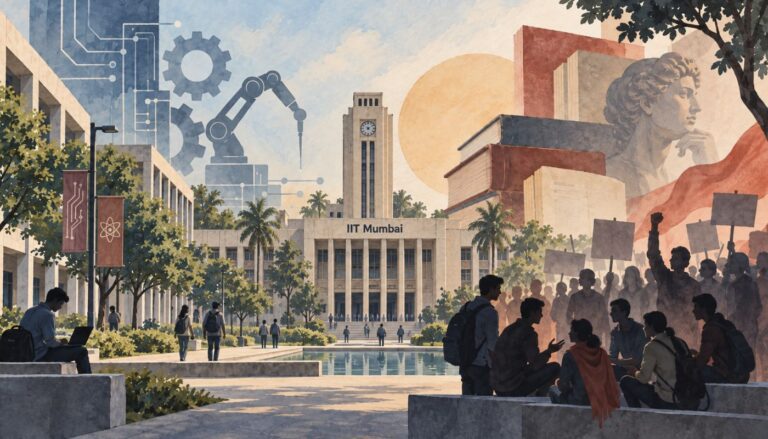
How humanities departments became engines of identity politics, and why IITs are importing the model

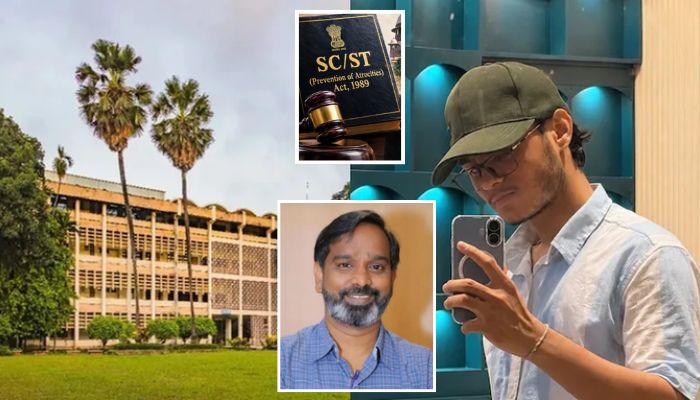
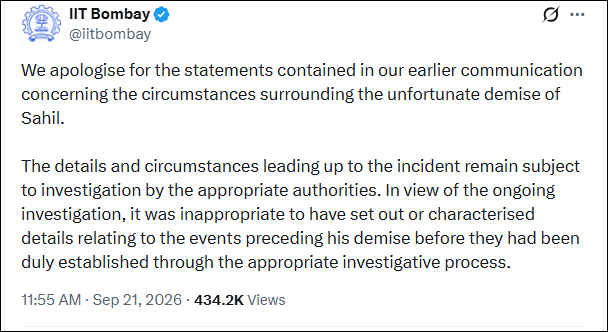
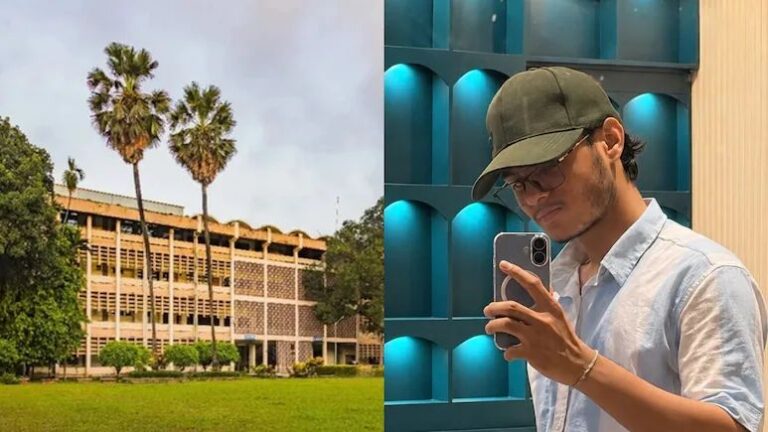
The IIT Bombay controversy following the death of second-year BTech student Sahil Wakode has reopened questions about the growing role of humanities and identity politics inside India’s premier technology institutions. Wakode died hours after he was reportedly caught using ChatGPT during an examination. His family alleged caste-based harassment by Professor Suryanarayana Doolla, leading to protests, an SC/ST Act case and Doolla losing his administrative position. Subsequent faculty support, CCTV footage and statements from Wakode’s friend complicated the initial narrative, while Left and Ambedkarite activists became prominent in the campus mobilisation.

The broader argument traces how sections of humanities and social sciences evolved from studying society to actively seeking its transformation. Beginning with Marx and the Frankfurt School, and later expanding through thinkers such as Michel Foucault and through feminist, postcolonial, critical race and queer theories, academic frameworks increasingly centred power, oppression, identity, hierarchy and structural discrimination.

Western universities provide examples of how such theories moved from classrooms into institutional politics. Yale, Middlebury, Evergreen State College, Berkeley and Stanford witnessed major controversies involving race, speech, identity and ideological activism. DEI requirements also became part of faculty recruitment, while movements such as Rhodes Must Fall expanded from symbolic protests into broader demands for institutional transformation. Some elite Western universities, including Harvard, have since moved towards greater institutional neutrality.

India’s IITs originally included humanities to broaden engineering education, but their role has expanded considerably. IIT Bombay now runs postgraduate and doctoral programmes across several humanities and social-science disciplines. IIT Madras launched an integrated MA programme in 2006 and today offers postgraduate courses in Development Studies, Economics, English Studies and Public Policy. NEP 2020 further encourages IITs to become multidisciplinary institutions with greater arts and humanities presence.

The central concern is whether IITs need autonomous humanities ecosystems at all. India already has a vast humanities education network, while IITs remain relatively rare institutions built around technological excellence. Engineers can be taught ethics, communication, economics, psychology and social awareness without turning technology institutes into general universities. The IIT Bombay episode highlights the risk that expanding humanities ecosystems may also bring ideological activism, identity-based mobilisation and campus politicisation into institutions created primarily for science and technology.

Read the full article on Chapter One Magazine.

Jindal Global Law School ‘professor’ who called J&K ‘Indian occupied Kashmir’ sent to advise the JPC on constitutional bills concerning Kashmir: Details

0

The Joint Parliamentary Committee examining the Constitution (One Hundred and Thirtieth Amendment) Bill, 2025, along with the Jammu and Kashmir Reorganisation (Amendment) Bill, 2025 and the Government of Union Territories (Amendment) Bill, 2025, is examining legislation with enormous constitutional and national significance. The committee was constituted in November 2025 and is headed by BJP MP Aparajita Sarangi. The three Bills were referred to the committee after being introduced in Parliament in August 2025.

Against that backdrop, Jindal Global Law School’s decision to send a particular professor as part of its delegation before the committee deserves scrutiny.

JGLS recently announced that it had been invited to provide its expert suggestions to the Joint Parliamentary Committee. According to the school’s own announcement, a team led by Professor (Dr.) Dipika Jain, Executive Dean of JGLS, appeared before the committee and offered suggestions and reforms concerning the proposed constitutional framework.

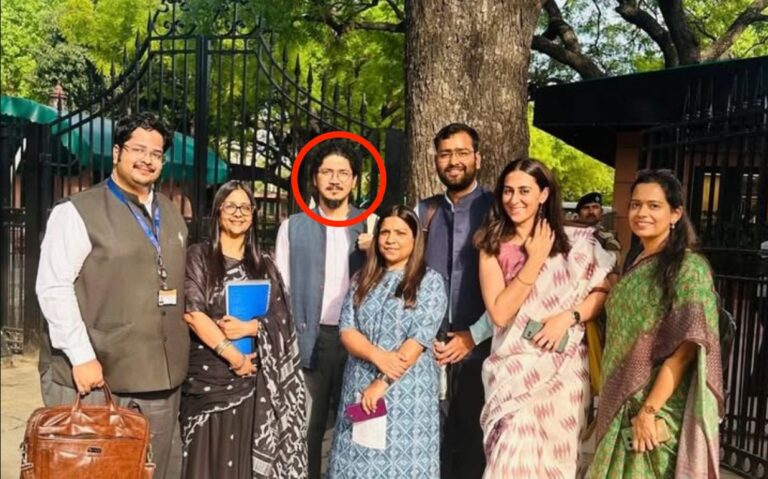
Among those named as part of the team was Arijeet Ghosh, currently an Associate Professor at JGLS.

There is nothing inherently unusual about a constitutional law professor appearing before a parliamentary committee. In fact, parliamentary committees routinely seek inputs from academics, experts, civil society organisations and other stakeholders. The Lok Sabha Secretariat itself invited memoranda and suggestions from experts, institutions and stakeholders concerning these Bills.

The question, however, is about the particular expert being presented by an institution as part of a team providing constitutional advice to Parliament.

Arijeet Ghosh is not an unknown academic. JGLS’s own faculty profile describes him as an Associate Professor specialising in Constitutional Law, Human Rights and Criminal Justice Institutions. It also records his experience as a consultant to the 21st Law Commission of India and his work with legal-policy and human-rights organisations.

But Ghosh also became the centre of a major controversy in 2021-22 after a video of him from a Jindal Global Law School classroom had gone viral.

In the video, Ghosh was heard discussing Jammu and Kashmir and saying that it must be referred to as “India-occupied-Kashmir”. He further said that although India describes Jammu and Kashmir as Indian territory and “Indian-administered-Kashmir”, he considered it an aspect of occupation and said this was what Kashmiris also said.

The controversy was not merely about an academic discussing a politically sensitive issue. The terminology used by Ghosh was itself significant. Calling Jammu and Kashmir “India-occupied-Kashmir” is not a neutral description of India’s constitutional position. It is language associated with a fundamentally different characterisation of India’s relationship with the territory. It fuelled separatist sentiments and echoed Pakistan’s stance on the issue, effectively legitimising the disputed status of Jammu and Kashmir.

Ghosh also appeared to acknowledge the highly emotive nature of the subject, referring to popular cinematic rhetoric surrounding Kashmir before saying that he did not want to get into that aspect. Yet the central proposition had already been stated: he had characterised Indian control over Jammu and Kashmir as an occupation.

That statement, whether understood as an expression of an individual academic’s political or legal opinion, is part of Ghosh’s publicly documented record. It is therefore reasonable to ask why an institution advising Parliament on legislation that expressly concerns Jammu and Kashmir would consider him an appropriate member of its expert delegation. And how could the institution and the JPC be sure his past views on Jammu and Kashmir didn’t affect his present opinions on the concerned legislation?

If JGLS wants to portray its appearance before the JPC as an example of “rigorous legal scholarship” contributing to a national constitutional debate, it cannot reasonably expect the public to ignore the previous public record of the individuals it chooses to put forward as “experts.”

The irony becomes sharper because Ghosh’s present academic profile explicitly lists Constitutional Law as one of his areas of expertise. He is therefore not appearing before Parliament merely as an incidental participant. He is being presented as a constitutional-law academic whose expertise is relevant to the questions before the committee.

And the questions before this particular committee include Jammu and Kashmir.

This is where institutional credibility matters.

Parliamentary committees are not academic seminars where every proposition can simply be treated as another interesting intellectual exercise. They are part of the legislative process. Their consultations can influence how MPs understand proposed legislation, constitutional provisions and their consequences.

That does not mean experts appearing before committees must agree with the government, the ruling party or even the constitutional status quo. Quite the contrary. Strong constitutional scrutiny requires disagreement, criticism and competing legal interpretations.

But there is a difference between inviting an expert because his arguments challenge the government’s position and failing to conduct due diligence on an expert whose previously recorded public statements raise questions directly relevant to the subject under consideration.

The Centre and the parliamentary committee therefore have a legitimate institutional interest in knowing who is being presented to them as an expert, what their publicly documented positions have been, and whether there are potential credibility or conflict concerns that ought to be considered.

This is particularly important when the institution making the submission is a prominent private law school that repeatedly positions itself as a contributor to national legal and policy debates.

Jindal Global Law School has every right to defend Ghosh’s academic freedom and to explain why it considers his expertise valuable. It can also clarify whether his views on Kashmir have changed, whether the 2021 statement represented a personal political opinion rather than a legal conclusion, and what position he actually took before the JPC.

But silence would leave an obvious question hanging.

Why was a professor who publicly described Jammu and Kashmir as “India-occupied-Kashmir” selected by JGLS to be part of the team advising a parliamentary committee examining legislation that specifically concerns Jammu and Kashmir?

The issue is not that Parliament should only hear people who agree with the government. It is that Parliament should know exactly whose expertise it is receiving and what publicly documented positions those experts have previously expressed. Those who take maximalist positions like branding Jammu and Kashmir as ‘Indian occupied Kashmir’ and therefore fanning separatist sentiments are something of grave concern for the sovereignty of India. 

The JPC is examining constitutional legislation of immense consequence. The standard for institutional due diligence should therefore be correspondingly high.

At the very least, the episode should prompt a broader question: when universities and private institutions send “experts” to Parliament, should the government and parliamentary committees conduct a basic background check on their public record? And shouldn’t the JPC and the Parliament take objection to the inclusion of dubious characters like Mr Ghosh?

In matters involving the Constitution, national sovereignty and Jammu and Kashmir, asking that question is hardly unreasonable.

Expertise matters. So does credibility. And Parliament deserves both.

Why Chandrashekhar Azad chose September 24 for his Reservation protest: The Poona Pact, Ambedkar’s separate electorate demand and the Delhi Police permission row

0

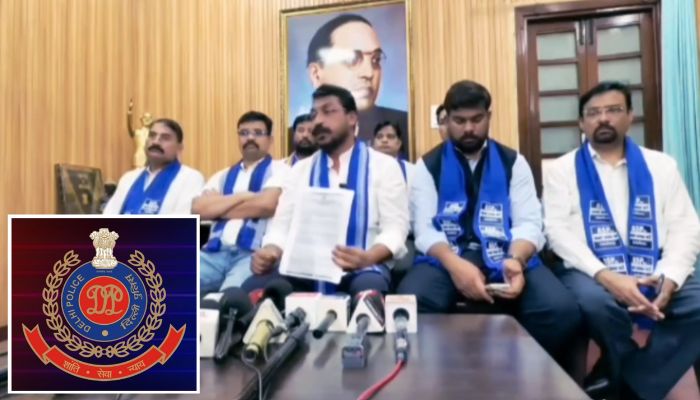
The Azad Samaj Party (Kanshi Ram) and Bhim Army chief Chandrashekhar Azad Ravan have claimed that the Delhi Police cancelled permission for their proposed pro-reservation protest at Jantar Mantar, just two days before the planned demonstration. On Tuesday, 22nd September, Azad claimed that the Delhi Police had denied permission for the protest scheduled for 24th September. The Azad Samaj Party had earlier announced the one-day pro-reservations demonstration at Jantar Mantar. The party had announced the protest on 17th September.

Azad now calls for District-level protests

Following the reported cancellation, a video shared by the Azad Samaj Party on their instagram page showed Chandrashekhar Azad reading a letter and claiming that the Delhi Police had denied permission for the 24th September.

Despite the alleged denial, Azad said the protest movement would continue. He called for district-level demonstrations across the country on the same date and said that an answer would be given to the government. His party has continued to promote the 24th September programme on its social media channels, using slogans such as “24 September Chalo Jantar Mantar” and calling it a “Sampoorna Bhagidari Mahaandolan”.

Why the chosen date is significant

The date chosen for these protests is far from ordinary and holds historical significance. The choice of date is significant because it marks the anniversary of the Poona Pact of 1932. This agreement replaced Dr B.R. Ambedkar’s longstanding demand for separate electorates for the ‘Depressed Classes’ with a system of reserved seats under a joint electorate.

The Poona Pact was signed on 24th September, 1932, following intense negotiations involving Mahatma Gandhi and Dr BR Ambedkar. The immediate background was the British government’s Communal Award, announced by Prime Minister Ramsay MacDonald, which had provided separate electorates for the Depressed Classes.

Gandhi opposed the separate electorate for the Depressed Classes and began a fast while imprisoned in Yerwada Jail. Ambedkar, who had supported separate electorates as a means of ensuring independent political representation, eventually negotiated with Gandhi and other leaders. The agreement that emerged became known as the Poona Pact.

What was the Poona Pact?

The most important change introduced by the Poona Pact was that the Depressed Classes would not have separate electorates. Instead, they would have reserved seats within a joint electorate.

The agreement provided 148 reserved seats for the Depressed Classes in provincial legislatures, substantially more than the number offered under the Communal Award. It also provided for reserved representation in the Central Legislature and included provisions relating to representation in public services and educational support.

Under the arrangement, members of the Depressed Classes could participate in a preliminary election to select candidates, after which the final election would take place through a joint electorate. The system therefore attempted to provide reserved representation while keeping voters within a common electoral system.

The question of separate electorates had been an important part of Ambedkar’s political thinking for years. In a 1930 memorandum, Ambedkar and Rao Bahadur R Srinivasan had demanded adequate representation for the Depressed Classes and proposed separate electorates for an initial period, followed by joint electorates with reserved seats.

The Poona Pact ultimately abandoned the separate-electorate model for the Depressed Classes in favour of reserved seats under joint electorates. It remains an important episode in the history of Dalit political representation and Ambedkar’s negotiations over constitutional safeguards.

Azad’s earlier demand for separate electorates

Earlier this year, Aazad himself reignited this debate by raising the demand for separate electorates for Dalits, drawing comparisons that fueled intense political discussions. 

On 17th April, Chandra Shekhar Aazad stirred controversy during a speech in the Lok Sabha when he alleged that if the government genuinely wanted to empower backward communities, women, and Dalits, it should implement separate electorates. Claiming that current reservations have failed to genuinely uplift these groups and serve merely as a slogan, he argued that “Muslims could get Pakistan, but Dalits didn’t get anything,” thereby reviving a historical political demand tied to the pre-Poona Pact era.

During his speech, the Lok Sabha MP from Nagina also referenced Bahujan leader Kanshi Ram and his book “Chamcha Yug” (Age of Stooges) to claim that representatives elected from reserved seats are forced to operate within system bounds and remain more loyal to political parties than their communities. “Therefore, a separate electorate is the only feasible solution,” he declared.

Therefore, the proposed 24th September mobilisation carries significance beyond the claimed immediate reservation demands. The date recalls the 1932 Poona Pact, while Azad’s recent advocacy of separate electorates has brought back a political debate associated with Ambedkar’s demand. 

With the Delhi Police permission issue now becoming part of the controversy, Azad has said that the mobilisation will continue through district-level protests even if the Jantar Mantar programme does not take place as originally planned.

Zerodha co-founder Nikhil Kamath under fire over WTF Discourse lineup: Who are the voices presenting ‘opposing viewpoints’ on his show

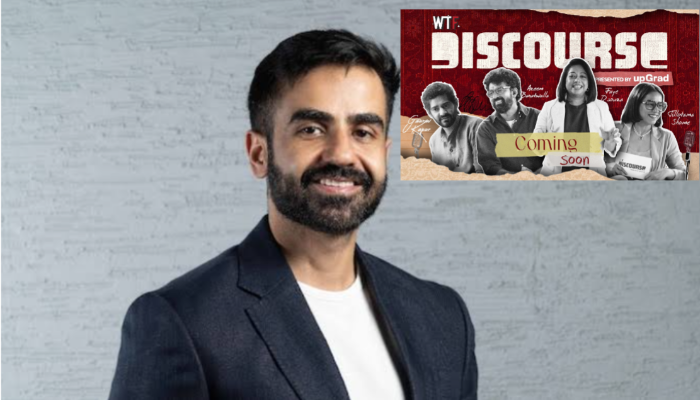
Entrepreneur, Zerodha co-founder, and YouTuber Nikhil Kamath, known for his “WTF is” podcast interviews, has launched “WTF Discourse,” a new format to allegedly facilitate discussions between individuals with contrasting viewpoints on varied subjects spanning from entertainment to capitalism in the presence of a designated moderator.

“We’re taking on everything from MBAs and startups to sport, art, influencers, capitalism and civic behaviour. The idea is simple: hear two genuinely opposing arguments without feeling the need to pick a side. Many more experts & moderators will join in the episodes to follow,” he wrote on social media while inviting recommendations for potential featured guests.

Kamath also unveiled a list of topics that will be part of the upcoming episodes. However, the names shared by him quickly drew the attention of people who asked whether the format would actually bring genuinely diverse voices to the table. Kamath was also accused of platforming different shades of the same ideological framework in the name of competing perspectives. They charged that it is essentially an ideological echo chamber rather than a program for meaningful disagreement.

The netizens question Kamath over his claims

The users highlighted that the discourse centres on people with similar ideology emanating from a single ecosystem, despite masquerading as a venue for conflicting arguments. They pointed out that Kamath was trying to deceive with his assertion of “opposing viewpoints,” which is far from the truth.

A netizen remarked, “Host, for and against – all three in each panel are leftists,” telling him not to “fool” them. The person also outlined that Kamath’s WTF is managed by Bilal Jameel, who hurled abuses at Prime Minister Narendra Modi. Jameel is the son of All India Majlis-e-Ittehadul Muslimeen (AIMIM) Maharashtra State President Syed Imtiaz Jaleel, who held protests against former Bharatiya Janata Party (BJP) spokesperson Nupur Sharma and demanded that she be hanged in public in light of Islamic scriptures.

A person posted a popular Spider-Man meme to convey the absurdity of Kamath’s claims and stated that leftists are debating each other under the guise of a contest between “two opposing ideas,” adding, “What a joke.”

Another individual mocked that they were the first member of their family lineage to experience a debate in which the moderator and all participants had the “same ideology” and would merely reiterate one another’s points.

A user wrote, “Who wants to hear these communist retards? You guys are seriously losing it. Have some shame,” pressing for a comprehensive research of their background before initiating this “drama.”

“This is an embarrassing leftist dog whistle. Your show was already bordering on pointless. This has just made things worse,” mentioned Abhay Bhargav. He noted that substantive “discourse” cannot happen when participants are exclusively taken from the same ideological camp (the communist camp), adding, “But of course, you already know that.”

The figures fuelling the backlash

Notably, the lineup for “WTF Discourse” has already raised eyebrows, with several personalities from the leftist faction scheduled to join this program, including Meghnad S, Paranjoy Guha Thakurta and Faye D’Souza, among others.

Meghnad S

“Journalist” Meghnad S, who is going to be a guest on Kamath’s show, was among the first members of the Cockroach Janta Party (CJP) before he decided to leave it. He is also a persistent supporter of anti-Hindu Delhi riots accused Umar Khalid and recently published a video titled, “If Umar isn’t free, nobody is.” He routinely hits out at the BJP, its supporters, and the media, which is not affiliated with the opposition’s ecosystem.

Meghnad was caught discussing the Nepal revolution with a social media influencer last year who justified violence as an inevitable consequence within “systems where justice is inaccessible” during their conversation.

A year before, in 2024, he had accused the Election Commission of India of favouring PM Modi when he was filing his nomination from the Varanasi Lok Sabha constituency for the general election. “I don’t see ten people proposing the nomination for him, like they are asking Shyam Rangeela even to procure a form,” insisting that “special treatment” was offered to PM Modi.

Meghnad insisted that the Election Commission had intentionally created obstacles to prevent rival candidates from fighting against him. He also had an issue with the cameras covering the event. However, the Election Commission had made it clear that both independent and registered candidates from unrecognised parties must have ten proposers.

Paranjoy Guha Thakurta

Paranjoy Guha Thakurta, a consultant and frequent contributor at NewsClick, which faces grave allegations linked to Chinese funding, is also invited to present his viewpoint on the discourse. On 22nd September, he had to release a formal public apology concerning a post about N Chandrasekharan, the chairman of Tata Sons and Tata Group. Thakurta claimed that it was based on a WhatsApp message and was subsequently discovered to contain numerous inaccuracies and factual errors.

“As soon as these were brought to my notice, I deleted the posts from my social media handles on Facebook and Twitter (X). I am sorry, but I should not have blindly believed what was sent to me, and I should have done my due diligence more carefully. Once again, I unconditionally apologise to Natarajan, his relatives and his associates for the error I made, and I hope he will forgive me for the mistake I made,” he requested.

Thakurta has consistently alleged that Indian democracy has been “hacked” after PM Modi stormed to power in 2014, declared that the media is “compromised,” and continuously targeted Indian industrialists, specifically Mukesh Ambani and Gautam Adani. In 2021, a non-bailable warrant was issued against him in a criminal defamation case submitted by the Adani Group against him, which was later stayed by the Gujarat High Court.

Thakurta co-authored an article while serving as Editor of Economic and Political Weekly (EPW), contending that the Modi government had altered special economic zone regulations to benefit Adani Group to the tune of Rs 500 crore. The media house removed the article after receiving a legal notice from the Adani Group, and Thakurta resigned from his position. The piece was later published by The Wire.

Thakurta, in 2019, was condemned for misrepresenting a two-year-old tragic incident involving a Dalit man who was reportedly beaten to death for participating in a Garba event as a recent occurrence. A year prior, he disseminated false information regarding the death of a 90-year-old Dalit man, declaring that “he was burnt alive for trying to enter a temple” in Uttar Pradesh. However, the victim was murdered by a drunkard who then burned the body and bore no connection whatsoever to the temple.

Thakurta wrote an article for “The Wire” in 2017, charging that K.V.S. Singh, the adjudicating authority of the Directorate of Revenue Intelligence (DRI) at the time, had terminated all legal proceedings concerning the Adani group. However, the Central Board of Excise & Customs (CBEC) retaliated with a strong rebuke, characterising the piece as “factually and legally incorrect” in its formal response.

Faye D’Souza

“Journalist” Faye D’Souza is slated to serve as a host for two discussions on “WTF Discourse.” She had retweeted a debunked story about the standard of N95 masks and protective equipment being distributed by the government during the Coronavirus pandemic in 2020. The reporter had to delete her tweet after she was fact-checked by the PIB, but D’Souza had already shared it, commenting “unbelievable.”

She also furiously protested against the Citizenship Amendment Act (CAA) and accused the government of imposing the National Register of Citizens (NRC) without any clarification on the matter.

D’Souza was also fact-checked over her statements on Justice S Muralidhar’s relocation from the Delhi High Court during 2020. She maintained that the central government executed a precipitous transfer of the justice due to his criticism directed at the Delhi Police and his orders mandating the lodging of First Information Reports (FIRs) against politicians accused of delivering inflammatory speeches.

However, it was revealed that the move was proposed by the Supreme Court Collegium days before his judgement. The Union Law Ministry simply sent out the notification in accordance with the decision. Furthermore, the Collegium controls appointments and transfers in the higher judiciary, and the government has no role in these affairs.

Interestingly, both Thakurta and D’Souza misused an article from “The Times of India” that stated banks could introduce an additional section in Know Your Customer (KYC) forms enabling their depositors and clients to declare their religious background. The regulatory adjustments were promulgated by the Reserve Bank of India (RBI) to the Foreign Exchange Management Regulations in 2018.

They are confined to migrants belonging to minority faith communities, such as Hindus, Sikhs, Buddhists, Jains, Parsis and Christians, from Pakistan, Bangladesh, and Afghanistan, who reside in India and possess long-term visa (LTV) documentation. However, these leftists tried to give a religious colour to the matter.

D Souza also propagated an unfounded tweet by “The Wire,” alleging that juvenile detainees released from Daryaganj Police Station were beaten both during the lathi charge and after their confinement within the station.

Sharda Ugra

Sports “journalist” Sharda Ugra, who has also made it to the guest list of Kamath’s program, regularly accused PM Modi of weaponising cricket and transforming cricketing events into political gatherings. She referenced the 2022/23 Border-Gavaskar Trophy when PM Modi came to Ahmedabad’s Narendra Modi Stadium as spectators chanted his name, in her “The Caravan” article. He was joined by his Australian counterpart, Anthony Albanese.

She stated, “From the naming of stadiums to the choice of venues, and the demonisation of Pakistan and Muslims more broadly, some observers say that Modi’s Hindu-nationalist Bharatiya Janata Party (BJP) is using the tournament as a launch pad for a third term in office. Some even speculate that, if India wins, Modi may even call for elections six or so months before the BJP’s term ends in June 2024,” in another piece of Al Jazeera. 

Ugra likewise alleged, “This World Cup, in its presentation for Indians, in television coverage and organisation, appears to have had no space for anybody else,” in a separate article for The India Forum. “In what was meant to be a feast of international 50-over cricket, the hosts have put out a re-heated IPL dish slathered with deshbhakti sauce,” she stated.

She also protested about the colour of the Indian team’s jersey, complaining, “What about that last bit of the Venn diagram – the political project? Let’s start with the plan (later cancelled) to have the Indians wear a one-time all-orange uniform in the match against Pakistan at the Narendra Modi Stadium. India vs Pakistan, Hindu orange vs Muslim green, pick your team. Get it.”

She announced that “there are going to be victory parades around four Indian cities, with at least 10 of the World Cup champs around to soak in the love,” after India triumphs in the final. India, unfortunately, lost the final to Australia.

Ugra asserted that Jay Shah, who held the position of Board of Control for Cricket in India secretary at the time, “hijacked” the World Cup in a separate column for Wisden in 2024. According to her, the BCCI were “piggybacking on the Indian team” and “treated the tournament as a vehicle for jingoism and exceptionalism, repeatedly trumpeting the BJP’s pet tropes: hyper-nationalism, and anti-Pakistan and anti-Muslim sentiment. And behind the semaphore was Jay Shah.”

Ugra further objected to the playing of the chorus “Ram Siya Ram” from Adipurush during the Asia Cup, insisting, “To Indians, its significance was obvious. Over the last three decades, the Hindu god Ram has been appropriated as the BJP’s deity of choice, with fundamentalists turning the chant, Jai Shri Ram, into a call to arms.”

She added, “The Sri Lankan DJ was playing the chorus on the orders of the Asian Cricket Council, whose president is Jay Shah. Eventually, Pakistan – the tournament hosts, remember – took control of the music. It was no coincidence that, during the World Cup, the song reappeared during the India–Pakistan match at the Narendra Modi Stadium on 14th October. Young Indians among the ICC volunteers eventually had it removed from the playlist for the rest of the tournament.”

Ugra claimed that the Pakistan team had to cancel a training camp in Dubai and arrive in India just two days before their first warm-up due to a delay in the issuance of their visas. Pakistani media, as well as British reporters with ties to the Islamic Republic, had to wait longer and missed their team’s first match on Indian soil in more than seven years.

She was also displeased over a flypast performed by the Indian Air Force aerobatics team before the final match, arguing that it was “unusual at a cricket match, and possible only on government demand.”

Ugra described the decision made by the Indian team to wear orange jerseys as “most bizarre,” adding that “the colour has been appropriated as a symbol of hard-line Hinduism (Hindutva) by the BJP, now completing ten years in power. BJP cadres flaunt orange scarves, their rallies are awash with saffron. Green is regarded as the counter-colour, used in Islam in mosques and shrines, and on flags. To kit out the Indians in all-orange against the Pakistanis, in their familiar dark green, would have turned a high-voltage match into Hindu India against Muslim Pakistan. There were two Muslims in the Indian team, Mohammed Shami and Mohammed Siraj.”

Prem Panicker

“Journalist” Prem Panicker, another guest on the discourse, on 17th September wrote, “Since no Hindu festival is complete without dancing in front of a mosque, we need to build more mosques asap,” after devotees tried to burst crackers during a Ganeshotsava procession which happened to pass by a mosque in an area of Congress-ruled Karnataka.

Panicker also reacted to a fabricated Instagram story attributed to actor-turned-politician Kangana Ranaut.

Panicker also targeted the special intensive revision of the electoral roll, claiming, “Those who lose their franchise should not worry. You will be added back after the elections.”

Moreover, Panicker has continually attacked PM Modi and argued that he has done nothing for the poor and marginalised. He stressed that the latter divides people on religious grounds and accused him of delivering hate speech. He even made fun of PM Modi’s statement that he feels a divine connection to his birth.

Panicker also peddled fake news in relation to former National Investigation Agency (NIA) judge Ravindra Reddy in 2019.

Other similar faces joining “WTF Discourse”

“Journalist” Amit Varma, an admirer of leftist leader Kavita Krishnan who confessed to protecting NewsClick and refused to reveal their China links, has compared PM Modi to late PM Indira Gandhi and insisted that he has suppressed purported dissent through intimidation without officially implementing the emergency.

The statement was made in reaction to the submission of a supplementary chargesheet in connection with the Delhi riots, which named Apoorvanand, Yogendra Yadav, Jayanti Ghosh and others.

Varma dubbed PM Modi as embodying “statism, authoritarianism and incompetence” and described his supporters as “useful idiots.” He is a consistent detractor of PM Modi. On the other hand, he is an advocate of platforms such as “Alt News” and “The News Minute.”

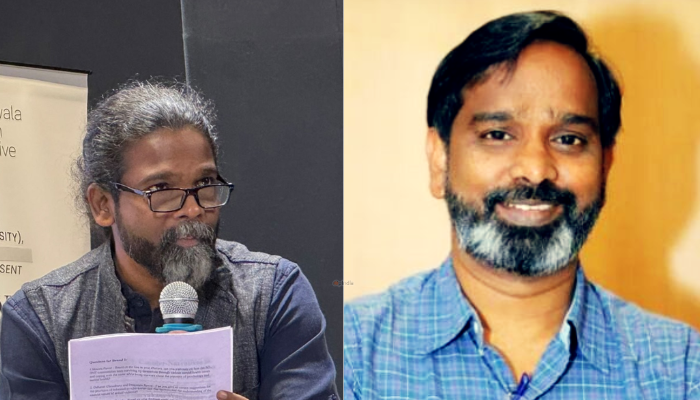
Furthermore, author Hussain Indorewala, who will appear as a guest on the program, is a regular on “The Wire.” He has voiced objections to the government’s implementation of development schemes, particularly those affecting Mumbai. He protested against the much-needed metro depot project in Arrey, referring to it as a “gamble with the city’s future.”

Hussain claimed that “profiting from urban land is the sole criterion for determining how we shape our cities” instead of focusing on “environmental destruction, or risk to life and property of residents matters in the pursuit of commercial gain.”

Comedian Azeem Banatwalla of the currently inactive “East India Comedy” group will host two sessions on the program. He ridiculed Ganesh Chaturthi in 2015 by stating the festival is celebrated by a father slicing his son’s head.

As a result, netizens have articulated their displeasure with the involvement of these personalities, pointing out that they can not offer divergent opinions because they adhere to the same ideological beliefs.

Controversial vocalist TM Krishna moves Supreme Court against Centre’s mandate to six stanzas of Vande Mataram; court seeks Centre’s response: Details

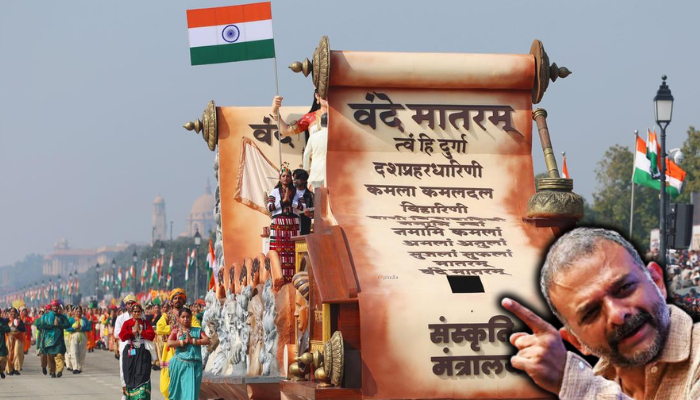
On Tuesday (22nd September), the Supreme Court asked the Central government to submit a response to a plea by Carnatic vocalist and notorious Hinduphobe TM Krishna challenging the constitutional validity of the 2026 amendment to the Prevention of Insults to National Honour Act. This amendment makes the intentional prevention of the singing of the National Song Vande Mataram or disrupting an assembly singing it a punishable offence attracting three years in jail.

The Supreme Court bench comprising Chief Justice of India (CJI) Surya Kant, Justice Joymalya Bagchi, and Justice V. Mohana asked the Union government to respond to TM Krishna’s plea within two weeks.

What plea moved by TM Krishna contends

In his plea, TM Krishna claimed that the later stanzas of Vande Mataram contain references to Hindu deities Durga, Lakshmi and Saraswati.

The plea argues that the Central government’s directions that the full Vande Mataram song be sung at specified government, ceremonial, and cultural occasions, and penalising disruption of its singing, go beyond regulating protocol.

In addition, TM Krishna contended that such a rule forces citizens to participate in singing the last four stanzas.

“In consequence and in effect, the Impugned State Action does not merely regulate national protocol or prescribe a uniform code of conduct for public functions. It compels a ceremony of assent to a symbol whose last four stanzas, Stanzas 3 to 6, are expressly devotional, deity-invoking and non-secular,” the plea argues.

The controversial Carnatic vocalist claimed that the measures laid out by the Central government violate fundamental rights under Articles 14 (equality), 15(1) (protection against discrimination), 19(1)(a) (freedom of speech and expression), 21 (life and personal liberty) and 25(1) (freedom of conscience and religion).

“By mandating the rendition of all six stanzas under penal sanction, the State transforms what is unquestionably a contested historical symbol into a compelled orthodoxy,” it adds.

Furthermore, the plea contends that the first two stanzas were originally composed as a separate patriotic lyric, and the remaining four were included when Vande Mataram was incorporated into the Bankim Chandra Chattopadhyay-authored novel Anandamath.

It mentioned the 1937 decision of the Congress Working Committee to adopt only the first two stanzas for singing at national gatherings after Muslims raised objections.

“The measure (2026 directions) is formally neutral but, manifestly, substantively coded: it sends a signal of majoritarian religious alignment and inflicts expressive subordination on believing Muslims and other conscientious objectors,” the plea adds.

Appearing for TM Krishna, controversial lawyer S Muralidhar argued that law does not define national song, making it open to misuse. In addition, the plea claims that a penal statute in this regard cannot be vague.

The plea seeks Supreme Court directions to strike down the amendment to Section 3, overturn the Centre’s law, declaring that only the first two stanzas of Vande Mataram constitute the National Song.

What the Supreme Court said

During the hearing on Krishna’s plea, Justice Joymalya Bagchi invoked the 1986 Bijoe Emmanuel case wherein the Supreme Court protected Jehovah’s Witness Christian students from legal scrutiny, who refused to sing the national anthem due to religious beliefs, emphasising freedom of conscience under Article 25.

“We expect that law of the land, as laid down in Bijoy Emmanuel, will govern. What is a national song is clear. Nobody who feels an infraction of Art. 25, 26 rights would be subjected to [penal consequences]. It’s not remit of court to second-guess what are national aspirations. It is for the state. Person can decide whether to sing 1 or 4 stanzas. There can’t be penal consequences,” Justice Bagchi said.

Justice Bagchi also orally stated that the Constitution makes no mention of a national song in Article 51A.

“Even the Constitution didn’t mention the national song in Article 51A. By customs and usage, the national song has always been mentioned and understood as Vande Mataram, with the two stanzas,” Justice Bagchi said.

However, said that the court will examine the matter to the extent of penal consequences, adding that courts cannot dictate on the declaration as a national song.

Muralidhar argued that the Central government cannot rely on an office memorandum to impose consequences of a penal statute regarding the National Song.

Meanwhile, Tushar Mehta, the Solicitor General representing the Central government, asked the court not to issue a notice, as that would sensationalise the matter. He argued that the petition was designed to play to the gallery and that the legislation made by the Parliament is in accordance with the Constitutional procedures.

“Let me be given a copy. Notice will create a sensation, which appears to be the object… Parliament, I said that is the constitutional way, not what the Naxalite wants,” Mehta said.

Vande Mataram got legal protection after an amendment to the law

On 30th July 2026, the Lok Sabha passed the Prevention of Insults to National Honour (Amendment) Bill, 2026, providing legal protection to the national song Vande Mataram on a par with the national anthem Jana Gana Mana. The legislation was cleared by a voice vote amid noisy protests and a brief debate, a day after the Rajya Sabha had approved it.

The amended Section 3 of the Prevention of Insults to National Honour Act, 1971. Under the existing law, intentionally preventing the singing of the national anthem or causing disturbance to any assembly engaged in its singing attracts imprisonment of up to three years, a fine, or both. The amendment extends identical protection to Vande Mataram. Anyone found intentionally preventing its rendition or disrupting a gathering singing the national song will face the same penalty.

The legislation, however, does not make singing Vande Mataram compulsory, nor does it punish those who choose not to sing it.

On 11th August 2026, President Droupadi Murmu gave her assent to the passed bill. With the President’s approval, the Bill has now become law.

For the first time in the Independence Day celebrations at the Red Fort, ‘Vande Mataram’ was rendered in full at the historic venue on 15th August 2026.

From a patriotic song to a subject of politics and Islamist intransigence: History of Vande Mataram

Written by Bankim Chandracharya in 1875, Vande Mataram was first published in the literary journal Bangadarshan on 7th November, 1875, and was later included in his 1882 novel Anandamath.

The song soon became a significant part of the national movement. Its use as a political slogan dates back to 7th August, 1905, during the Swadeshi movement. Large gatherings used the song to express patriotism and opposition to British rule.

‘Vande Mataram’ was first sung publicly at the Indian National Congress session in Calcutta in 1896, where Rabindranath Tagore sang it and later composed its music. Over the years, it became closely associated with the freedom struggle and inspired many people who took part in the movement.

The song was adopted as India’s national song by the Constituent Assembly in 1950. The Union government launched a year-long programme last November to mark 150 years of ‘Vande Mataram’.

The song Vande Mataram, however, was marred by political controversy in the 1930s. The Muslim League, under Muhammad Ali Jinnah, objected to the song’s religious imagery. The League argued that the idea of treating the motherland as a divine figure could conflict with Islamic beliefs. It also raised concerns about the portrayal of Muslim rulers in Anandamath.

Notably, the main offence over the full Vande Mataram song stemmed from the lyrics “त्वंहिदुर्गादशप्रहरणधारिणीकमलाकमलदलविहारिणीवाणीविद्यादायिनी, नमामित्वाम्नमामिकमलांअमलांअतुलांसुजलांसुफलांमातरम् (Thou art Durga, Lady and Queen, With her hands that strike and her swords of sheen, Thou art Lakshmi lotus-throned, And the Muse a hundred-toned, Pure and perfect without peer, Mother lend thine ear, Rich with thy hurrying streams, Bright with thy orchard gleams, Dark of hue O candid-fair In thy soul, with jewelled hair And thy glorious smile divine, Loveliest of all earthly lands, Showering wealth from well-stored hands! Mother, mother mine! Mother sweet, I bow to thee, Mother great and free.)

The issue was discussed within the Congress party. In October 1937, the Congress Working Committee decided that only the first two stanzas of ‘Vande Mataram’ should be sung at public functions. The Congress party essentially surrendered before the bigotry and intransigence of Mohammed Ali Jinnah; only a decade later, he spearheaded Direct Action Day, and India’s partition on Islamic lines.

The matter was discussed by Jawaharlal Nehru. Nehru acknowledged that ‘Vande Mataram’ had been closely linked with Indian nationalism for more than three decades, but also supported avoiding some stanzas containing allegorical references at national events.

In consequence of Congress’s abject surrender, the Vande Mataram song was mutilated, and four stanzas were dropped out of six to satisfy those who, just years after, betrayed the nation.

Even MK Gandhi, in 1937, advocated that only the first two stanzas, which do not mention overt Hindu religious imagery, be sung. Thus, in the Faizpur Congress Session in that year, only the first two stanzas of Vande Mataram were sung.

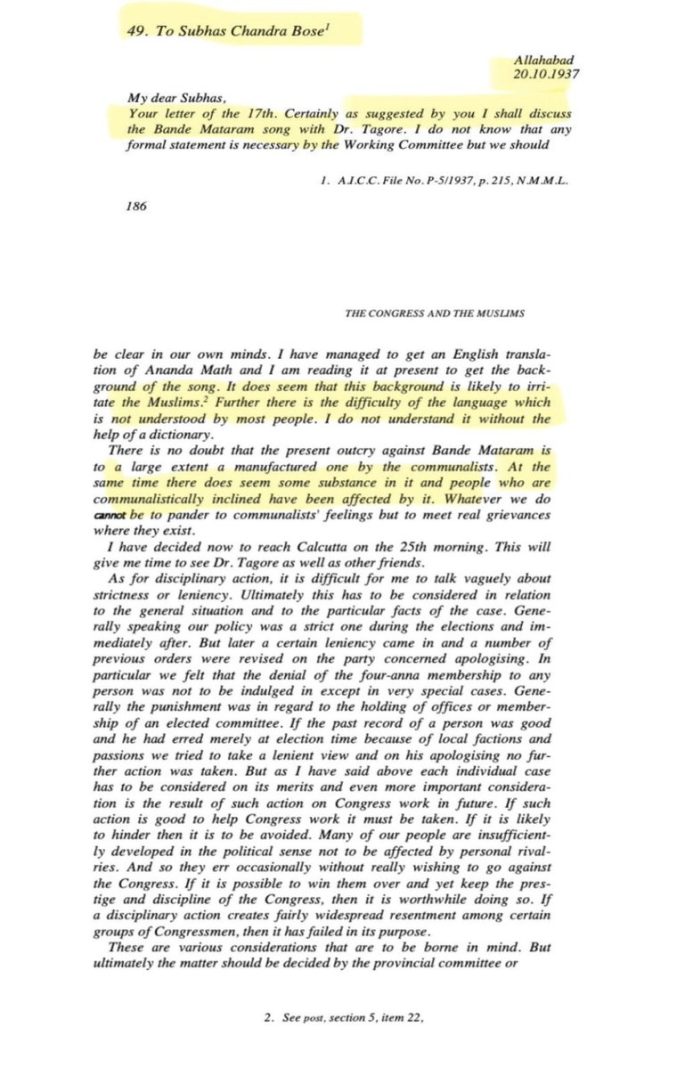
In his letter to Subhash Chandra Bose dated 20th October 1937, Nehru said that the Vande Mataram song was meant to “irritate the Muslims.”

“I have managed to get an English translation of Ananda Math and I am reading it at present to get the back- ground of the song. It does seem that this background is likely to irritate the Muslims…There is no doubt that the present outcry against Bande Mataram is to a large extent a manufactured one by the communalists. At the same time there does seem some substance in it and people who are communalistically inclined have been affected by it. Whatever we do cannot be to pander to communalists’ feelings but to meet real grievances where they exist,” Nehru wrote.

The practice of accommodating the unreasonable demands of Islamists in the name of protecting secularism has not subsided post-partition. Rather, with the presence of Muslim appeasing political parties like Congress and Islamist sympathisers like TN Krishna, the opprobrious practice has continued.

TM Krishna: The notorious Hinduphobe who labelled Anandamath as ‘anti-Muslim’

Thodur Madabusi Krishna, better known as TM Krishna, is an Indian Carnatic vocalist, author, and self-styled liberal social activist. Born on 22nd January 1976, in Chennai, India, Krishna has gained widespread recognition for his excellence in Carnatic music, a classical music tradition of India. He is the grandnephew of former Indian finance minister TT Krishnamachari, who was among the founders of the Madras Music Academy.

Besides music, TM Krishna is also known for his self-styled social activism and advocacy for various Islamo-leftist causes. He is also a staunch supporter of EVR Periyar.

Krishna has earlier made statements against particular castes and communities, especially the Brahmins, by quoting EVR Periyar. For those unversed, Periyar had a long history of spreading hate against Hindu deities, including breaking Murthis to Ravana Leela.

In March 2023, TM Krishna released a song in honour of Periyar to commemorate 100 years of his “anti-caste” movement. The post shared by TM Krishna was reshared by Tamil Nadu Chief Minister MK Stalin as well. Unsurprisingly, the Tamil Nadu CM had come out in support of TM Krishna when the renowned musicians protested against Madras Music Academy over conferring the Sangitha Kalanidhi Award to TM Krishna.

TM Krishna has closely worked with Tamil writer Perumal Murugan, who has misrepresented Hindu temple festivals of yore in order to cast aspersions on the character of Indian men and women.

On Diwali in 2023, TM Krishna took to X to express his support for Palestinians, saying that he found it difficult to celebrate the festival of lights at such a time.

“Difficult to celebrate the festival of lights when for people of Palestine lights indicate incoming death. Support for the Palestinians is support for all those who have been marginalised. In prayer for peace and a return of humanity. Support for the Palestinians is support for all those who have been marginalised,” he wrote along with a photo of himself.

In an op-ed on 14th January 2024, TM Krishna trained guns at Infosys founder N Narayan Murthy and Sudha Murthy for endorsing longer work hours by likening their views to “Brahminism”, followed by an unending rant.

In another casteist op-ed on 11th February 2024, he began by writing that the Indian classical dance form Bharatanatyam has been appropriated by Brahmins, leading to its alteration and erosion.

TM Krishna, despite being a Carnatic vocalist himself, has said that Carnatic music and Bharatanatyam are not superior to other art forms. “Carnatic music is just like gaana, cinema music, or rock and roll,” he said in an interview in January.

In 2018, irked by the outrage from Hindu connoisseurs of the arts for performing Christian hymns in Carnatic, TM Krishna vowed that he would sing one song on Allah and Jesus every month. The same year, he admitted that he feels no empathy when RSS members are killed by communists or Islamists in places like Kerala. 

In a September 2020 opinion piece, TM Krishna declared that Guru-Shishya parampara in Indian arts is abusive and should be abolished. He used the case of sexual abuse allegations against the Gundecha brothers to demonise the entire tenet of the Guru-Shishya tradition, which has given India great artists and performers.

In 2022, he performed in an event marking the Gujarat riots titled “Gujarat 2002-2002. Memories of Struggle.” He performed an “Urdu bhajan” at the event.

In February 2026, TM Krishna gave an interview to leftist propagandist Akash Banerjee, wherein he claimed that Vande Mataram was not fit to become the country’s national anthem. 

TM Krishna also declared the book Anandamath to be not just anti-establishment (British and Muslim establishment at that time) but also anti-Muslim. “In the book, it is a song that is sung by Hindu Sanyasis, while they are attacking villages where Muslims live. It is a book that is establishing the superiority of the Hindu community and the need for their control coming back,” Krishna said.

Telangana Police arrest Dalita Sena leader over Ambedkar-critical book: When street protests become a veto over free speech

0

A book criticising Dr BR Ambedkar had not even been formally launched. Its author was already behind bars.

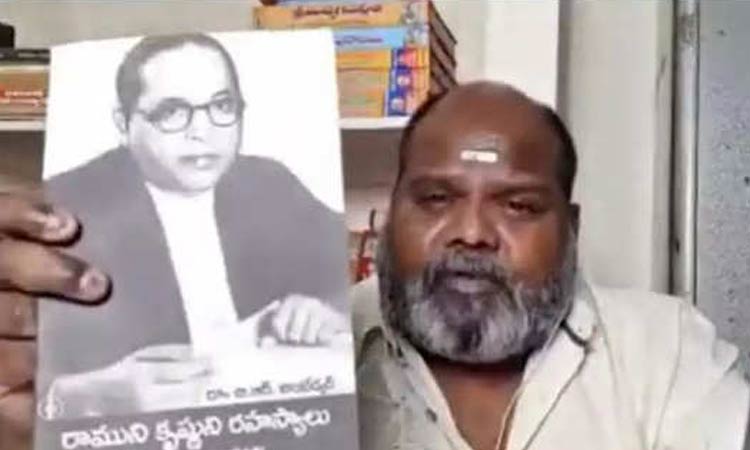
Hamara Prasad, founder of the Rashtriya Dalita Sena, was arrested by Telangana Police on September 17, a day before the scheduled launch of his Telugu book Kalpitha Nayakudu (The Fabricated Leader). The arrest came amid protests in several districts over the book’s contents, title and cover.

A case was registered against Prasad at the Central Crime Station (CCS), Hyderabad, under Sections 353(2), 196, 350 and 61(2) of the Bharatiya Nyaya Sanhita (BNS), concerning alleged statements causing fear or alarm, promoting enmity, intentional insult or provocation, and criminal conspiracy.

The arrest became publicly known on Friday, when Prasad was produced before the Telangana High Court.

The episode raises a question larger than one author or one book: when protests against controversial speech are followed by the arrest of its author and seizure of copies, does the resulting law-and-order situation end up determining what can be published?

A book challenging an established narrative

The Fabricated Leader is a roughly 730-page Telugu work that takes a critical view of established narratives surrounding Ambedkar.

Hamara Publications presents it as a challenge to widely circulated political and historical narratives, inviting readers to question established accounts and examine questions of history, society and national identity.

Prasad has also said on social media that his work seeks to challenge personality cults and present what he describes as the “real history” of India.

The book’s interpretation of Ambedkar can certainly be disputed. Critics can challenge its sources, arguments and historical claims. But that debate is meaningful only if the work can first be examined and its claims answered.

Ambedkar himself warned against hero-worship

There is a striking irony in the controversy.

Ambedkar himself warned Indians against turning political leaders into objects of unquestioning devotion. In his concluding speech to the Constituent Assembly on November 25, 1949, he cited John Stuart Mill’s warning against laying one’s liberties at the feet of even a great man.

Ambedkar then issued his own famous warning: “Bhakti in religion may be a road to the salvation of the soul. But in politics, Bhakti or hero-worship is a sure road to degradation and to eventual dictatorship.”

The point was not that great men should not be respected. It was that democratic citizens must retain their political judgment instead of surrendering it to personalities.

That makes the current controversy particularly noteworthy. Respecting Ambedkar’s legacy and allowing Ambedkar to be criticised are not mutually exclusive propositions.

If Prasad’s account is wrong, it can be rebutted. If his historical claims are false, evidence can expose them. If his interpretation is distorted, Ambedkar’s own writings can be placed alongside it, and the contradiction demonstrated.

From outrage to police action

The controversy, however, moved quickly beyond criticism of the book.

Protests were reported in several Telangana districts, including Adilabad, Asifabad and Medak. Dalit organisations reportedly held a rally in Asifabad, while protesters in Indravelli and Nirmal reportedly burnt Prasad’s effigy and demanded action against him.

In Dubbaka and Tadwai, representatives of Telangana Mala Mahanadu and Ambedkar associations approached the police with complaints over what they described as objectionable remarks about Ambedkar.

The State subsequently told the Telangana High Court that Prasad had been arrested and several physical copies of the book had been seized to prevent any untoward incident.

That sequence is what makes the case significant. The controversy did not end with people denouncing the book; it moved into the criminal justice system before the scheduled launch had even taken place.

The High Court intervention

Chandramouli, the petitioner, approached the Telangana High Court through a lunch-motion petition seeking to stall the proposed launch.

The petition objected to the book’s title, cover and contents, with the petitioner arguing that certain portions could promote hostility among Ambedkar’s followers. It also sought restrictions on circulation of PDF versions.

The High Court sought details from the State regarding action taken to remove the book from online platforms and bookstores.

By then, however, the government informed the court that Prasad had already been arrested and that copies had already been seized. Prasad was subsequently in judicial remand.

At the time of publication, the author’s website and the Amazon listing showed the book as out of stock.

In other words, the book’s scheduled launch became almost secondary to the legal controversy surrounding it.

The real issue: offence, offensiveness and illegality

None of this means Prasad is entitled to immunity from prosecution.

The police have invoked specific provisions of the BNS, and those allegations must be tested through the criminal justice process. If particular passages satisfy the statutory ingredients of an offence, the law can and should take its course.

But three concepts need to be kept separate: something can be offensive without being criminal, controversial without being unlawful, and historically wrong without being illegal.

The problem with the heckler’s veto

The broader concern can be described through the idea of the heckler’s veto: the possibility that someone can effectively control another person’s speech by threatening disruption in response to it.

The danger is not that every protest is illegitimate. Protest is itself an essential form of expression.

The danger arises when the anticipated consequences of a protest become the reason for restricting the original speech rather than restraining those responsible for unlawful conduct.

A simple principle follows: the person who threatens disorder should not automatically acquire the power to determine what somebody else is allowed to say.

That principle is particularly important in a country as politically and socially diverse as India, where almost every major historical figure has supporters who consider criticism of their icon unacceptable.

Why rebuttal matters more than removal

There is a straightforward way to challenge a book that gets Ambedkar wrong: read it and rebut it.

If its sources are unreliable, identify them. If its historical claims are false, produce the historical record. If its interpretation contradicts Ambedkar’s own writings, quote those writings and explain the contradiction.

That would not weaken Ambedkar’s legacy. It would demonstrate that his legacy can withstand scrutiny.

Indeed, there is something inherently stronger about allowing Ambedkar’s own ideas to defeat arguments made against him rather than relying on the State to prevent those arguments from being heard.

This is especially relevant given Ambedkar’s own warning against political hero-worship.

A precedent beyond Ambedkar

The implications of this episode extend beyond the immediate dispute.

Today, the controversy concerns a book critical of Ambedkar. Tomorrow, another group could object to a book critical of Gandhi, Nehru, Savarkar, a religious figure, a political party or an ideological movement.

India’s public discourse is already intensely contested. If every offended constituency can seek restrictions by pointing to the possibility of protests, fewer difficult subjects will remain open to serious discussion.

The answer is not to immunise controversial publications from law. It is to ensure that the law is applied because its ingredients are satisfied, not simply because a publication has generated sufficient outrage.

The State’s responsibility

The Telangana government has a legitimate responsibility to prevent violence and maintain public order. But those two objectives should not be conflated with preventing people from encountering controversial ideas.

If there is a credible threat of violence, those making the threat can be dealt with under the law. If a publication itself constitutes an offence, its author can be prosecuted on the evidence.

The critical distinction is between responding to unlawful conduct and pre-emptively suppressing speech because someone might react unlawfully to it.

That distinction determines whether the State is enforcing the law or allowing public pressure to shape its application.

Ambedkar’s warning deserves to be remembered

Prasad’s book may ultimately prove to be historically convincing, deeply flawed, provocative or simply wrong. Readers can decide that only after examining it.

Ambedkar’s supporters have every right to reject its arguments and defend his legacy. They also have every right to demand that demonstrably unlawful material be dealt with according to law.

But Ambedkar himself warned against political Bhakti and hero-worship because he understood the danger of surrendering democratic judgment to personalities.

His warning therefore deserves to be remembered precisely when criticism of a revered figure becomes a source of public anger.

A confident intellectual legacy does not need every critic silenced. It can answer criticism with evidence, argument and Ambedkar’s own words.

If The Fabricated Leader violates the law, let the courts determine that on the evidence. If it is merely a controversial interpretation of history, then let the battle over it take place where ideas are supposed to be tested: in public debate.

The loudest protest should not become the loudest voice in deciding what Indians are allowed to read.

Who is Suryakant Waghmore, the Hinduphobic IIT Bombay Professor targeting colleagues opposing the SC/ST Act FIR against Professor Suryanarayana Doolla in Sahil Wakode suicide case

The suicide of Sahil Wakode, a 20-year-old IIT Bombay student, has given the opportunity to self-styled ‘social justice activists’ to polish their caste politics and broader leftist ideological agenda. After an FIR was registered under the provisions of the SC/ST Act against IIT Bombay Professor Suryanarayana Doolle, who caught Wakode cheating during an exam on 18th September, the IIT Bombay Faculty Forum issued a statement in his support on 21st September. However, now a leftist Professor of Sociology at the same institute, Suryakant Waghmore, has opened a front against the Forum.

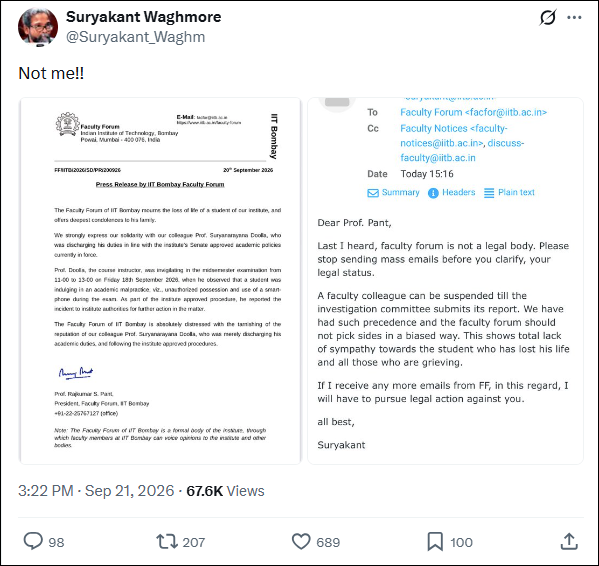
In an email addressed to IIT Bombay Faculty Forum President Rajkumar Pant, Suryakant Waghmore questioned the legal standing of the Forum itself and accused it of picking sides, in a total lack of sympathy for the deceased student. The screenshot of the said email was shared by Waghmore in an X post captioned, “Not me!!”

“Last I heard, faculty forum is not a legal body. Please stop sending mass emails before you clarify, your legal status. A faculty colleague can be suspended till the investigation committee submits its report. We have had such precedence and the faculty forum should not pick sides in a biased way. This shows total lack of sympathy towards the student who has lost his life and all those who are grieving,” the email reads.

“If I receive any more emails from FF, in this regard, I will have to pursue legal action against you,” it added.

Professor Suryakant Waghmore accused the IIT Bombay Faculty Forum of being biased against the Dalit student and shielding Professor Suryanarayana Doolla, who now faces ‘caste discrimination’ allegations. However, the Sociology professor’s email serves as a revelation of his own bias.

What the IIT Bombay Faculty Forum said

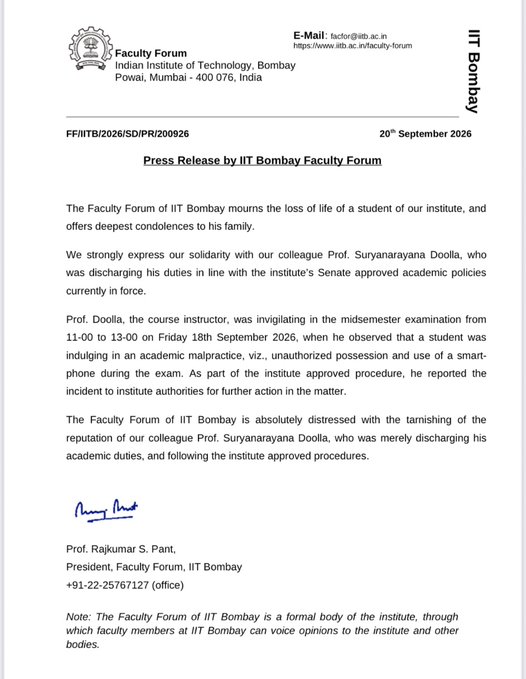
The IIT Bombay Faculty Forum issued a statement extending support to Professor Suryanarayana Doolla on 20th September.

“The Faculty Forum of IIT Bombay mourns the loss of life of a student of our institute, and offers deepest condolences to his family. We strongly express our solidarity with our colleague Prof. Suryanarayana Doolla, who was discharging his duties in line with the institute’s Senate approved academic policy currently in force,” the Forum’s statement signed by its President, Rajkumar S Pant reads.

“Prof. Doolla, the course instructor, was invigilating in the midsemester examination from 11-00 to 13-00 on Friday 18th September 2026, when he observed that a student was indulging in an academic malpractice, viz., unauthorized possession and use of a smartphone during the exam. As part of the institute approved procedure, he reported the incident to institute authorities for further action in the matter,” it adds.

In addition, the IIT Bombay Faculty Forum expressed distress over alleged attempts at tarnishing Professor Doolla’s reputation, and said, “The Faculty Forum of IIT Bombay is absolutely distressed with the tarnishing of the reputation of our colleague Prof. Suryanarayana Doolla, who was merely discharging his academic duties, and following the institute approved procedures.”

IIT Bombay administration suspended Professor Doolla’s deanship, Faculty Forum staged protest, but Suryakant Waghmore distanced himself

After initially backing Professor Suryanarayana Doolla over caste discrimination against a student who committed suicide on 18th September after being caught cheating in an exam, IIT Bombay suspended the deanship of Professor Suryanarayana Doolla with immediate effect on 21st September.

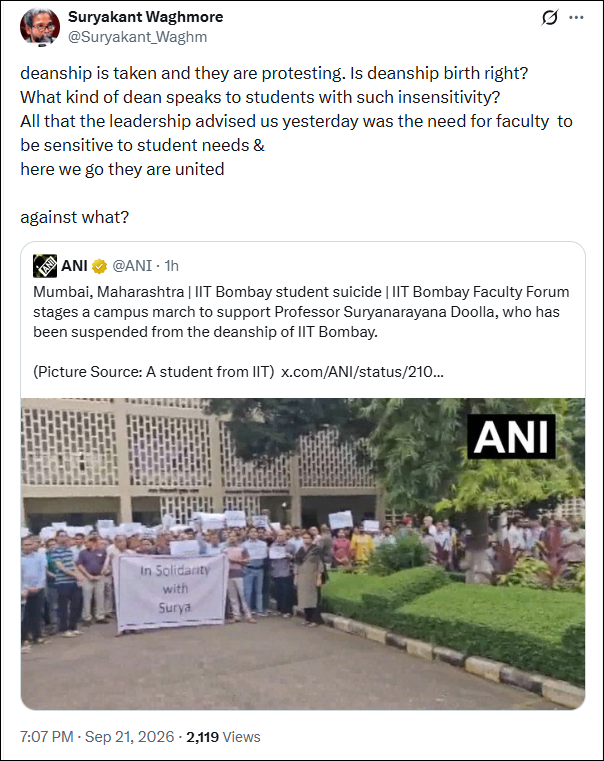
The IIT Bombay administration’s decision triggered a protest by the Faculty Forum. Giving an indirect verdict of his own, declaring Professor Doolla guilty, Professor Waghmore posted on X, “deanship is taken and they are protesting. Is deanship birth right? What kind of dean speaks to students with such insensitivity? All that the leadership advised us yesterday was the need for faculty to be sensitive to student needs & here we go they are united against what?”

Deanship is not a birthright; however, abrupt removal from this position over unproven allegations is nothing short of a punishment and damages his already under-attack reputation.

While Suryakant Waghmore has opened a front against Professor Suryanarayana Doolla, several IIT Bombay students and alumni have issued a statement backing Doolla. In a statement signed by 22 students and alumni and shared with OpIndia, they hailed Doolla’s integrity and said that the professor never demonstrated caste biases against any of his students.

From cheating to caste discrimination: Sahil Wakode suicide becomes an ideological windfall for Leftist caste activists

Sahil Wakode, a 2nd-year BTech student at IIT Bombay, took his own life on Friday (18th September) after being caught red-handed by Professor Suryanarayana Doolla. He later committed suicide in his hostel room.

Thereafter, protests emerged on the campus of the institute, demanding action against the esteemed faculty member. A day later, on Saturday (19th September), Sahil’s parents alleged that Professor Doolla had been mentally harassing and using casteist slurs against their son for 3 months at the behest of IIT Bombay’s Director Shireesh Kedare.

Meanwhile, Professor Doolla has received broader support, with many describing the SC/ST Act charges against him as vengeance for his decision to call out Wakode for using a mobile phone for cheating.

One of the key demands of Wakode’s father, Ravindra, is the immediate release of financial compensation under the SC/ST (Prevention of Atrocities) Rules, 1995.

Notably, under the SC/ST (Prevention of Atrocities) Rules, 1995, as amended in 2016 by the Modi government, 25% to 50% of the amount is released by the District Collector within seven days of the FIR’s filing, another 25% after the chargesheet is filed, and the balance on conviction, drawn from a schedule that ranges between ₹1 lakh for offences like caste slurs up to ₹8.25 lakh for murder or gang rape. OpIndia reported extensively earlier how this compensation provision is reinforcing rampant misuse of the SC/ST Act.

While a caste discrimination spin has been given to the tragedy now, not a single complaint was ever filed against Professor Doolla or Shireesh Kedare either with the administration or the SC/ST cell of IIT Bombay during Sahil’s tenure at the institute.

In fact, Sahil Wakode’s close friend Yatish Kumar said he had never observed anything that suggested his friend was facing caste-based discrimination. He recalled meeting Wakode just four or five days before the examination and said he appeared to be his usual self, “fun”, “cool” and happy.

“I don’t think casteism was an issue. I mean I have never experienced it,” Kumar told NDTV. He also stressed that he did not have complete information about everything that happened to Wakode because they were from different departments.

Even as the police are probing the caste discrimination allegations and so far, no clear evidence has surfaced indicating that Professor Suryanarayana Doolla subjected Sahil Wakode to caste discrimination or harassment, the leftist coterie is already making a Rohith Vemula out of Wakode.

OpIndia reported earlier about IIT Bombay turning into a playground of Leftist-Marxist ideologues masquerading as intellectual academics

While IITs are seen as temples of technical excellence—producing engineers, scientists, and innovators who have powered India’s progress, Leftist-Marxist ideology is metastasising across the premier institutions through Humanities departments.

Professor Suryakant Waghmore is one of the many IIT professors who subscribe overtly or covertly to the Leftist-Marxist ideology.

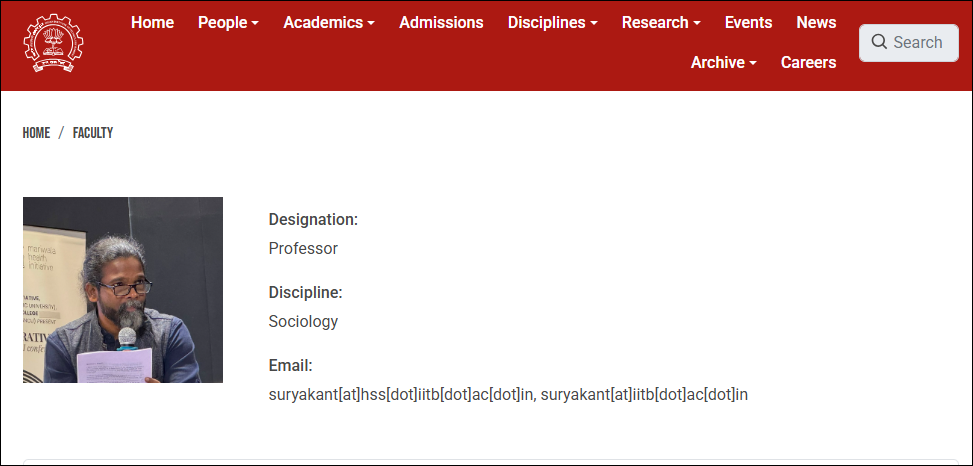
Waghmore is a professor of Sociology in the Department of Humanities and Social Sciences at IIT Bombay. BA from Karnataka University, MA in Community Development from TISS, PhD from Edinburgh as a Commonwealth Scholar, Suryakant Waghmore’s research work focuses mainly on Dalit politics, caste and violence, ‘Hinduism’ civility and exclusion.

Professor Waghmore earlier wrote that Indian vegetarianism is more about caste hierarchy than animal ethics. During the 2023 IITB mess-table dispute, he called “Bhartiya vegetarianism of purity and segregation” a “social illness”. Waghmore equated assertive vegetarian students to militants.

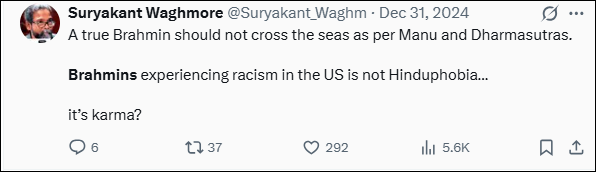
Professor Waghmore’s social justice activism, as is the case with most self-declared Ambedkarites, is all about Brahmin bashing and vilification. As reflected in one of his X posts, wherein he wrote that Hindus, particularly Brahmins, facing racism in the US are not facing Hinduphobia but their ‘Karma’.

“A true Brahmin should not cross the seas as per Manu and Dharmasutras. Brahmins experiencing racism in the US is not Hinduphobia… it’s karma?” he wrote.

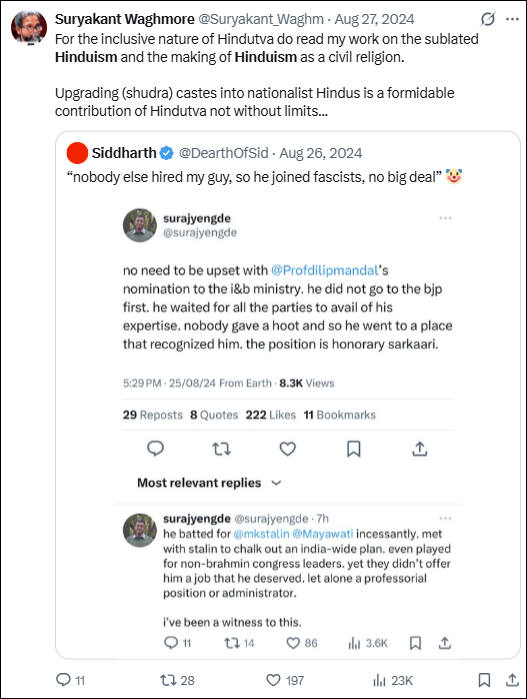
He also opines that Hinduism lacks ‘civility’.

This taxpayer-funded academic has consistently been peddling anti-Hindu propaganda, though with an intellectual outlook.

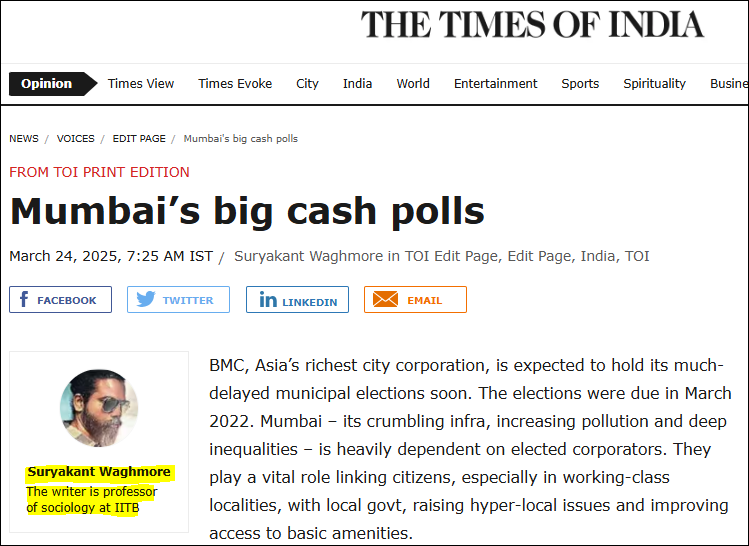
In June 2025, a show-cause notice was issued to Suryakant Waghmore after a Times of India op-ed he authored triggered backlash. The article, headlined “Mumbai’s Big Cash Polls”, was a politically charged one, published without the prior institutional clearance, in violation of Schedule B, Paragraph 5(ii) of the institute’s code of conduct.

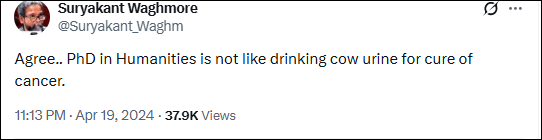
Waghmore has also taken delight in ‘gaumutra’ jibes at his critics previously.

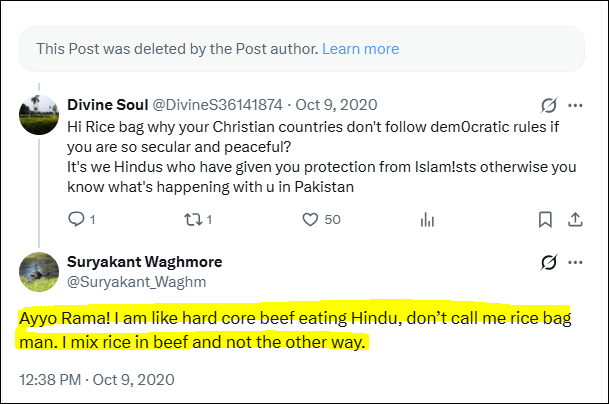
He also boasted about being a ‘Hindu’ who eats cow meat.

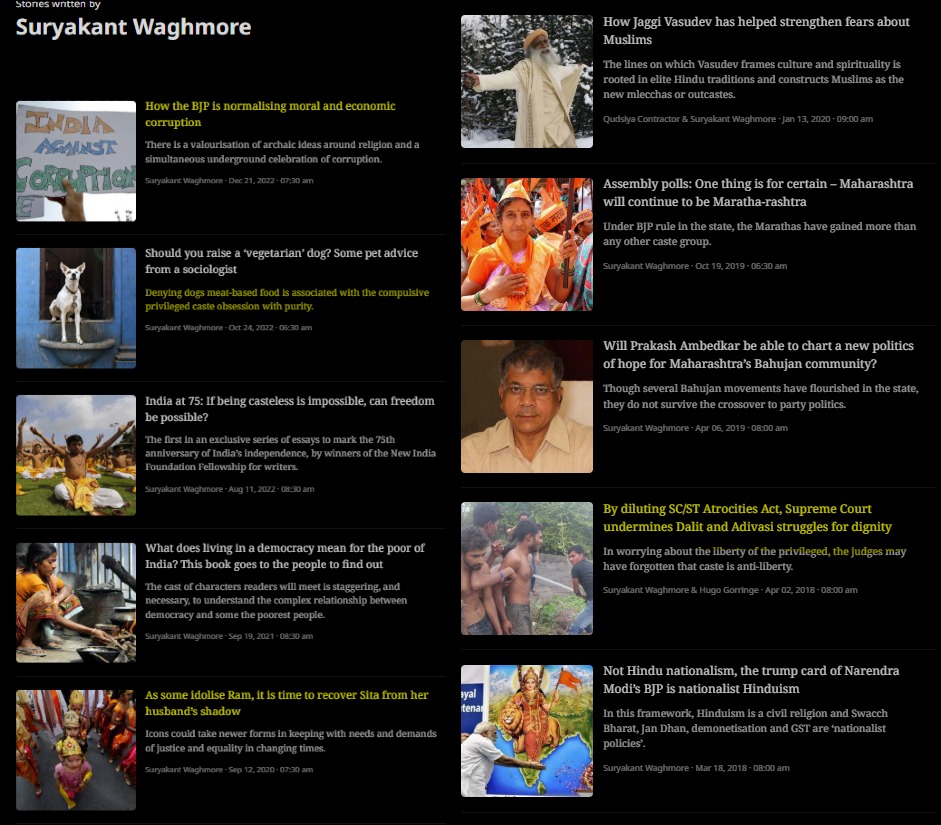
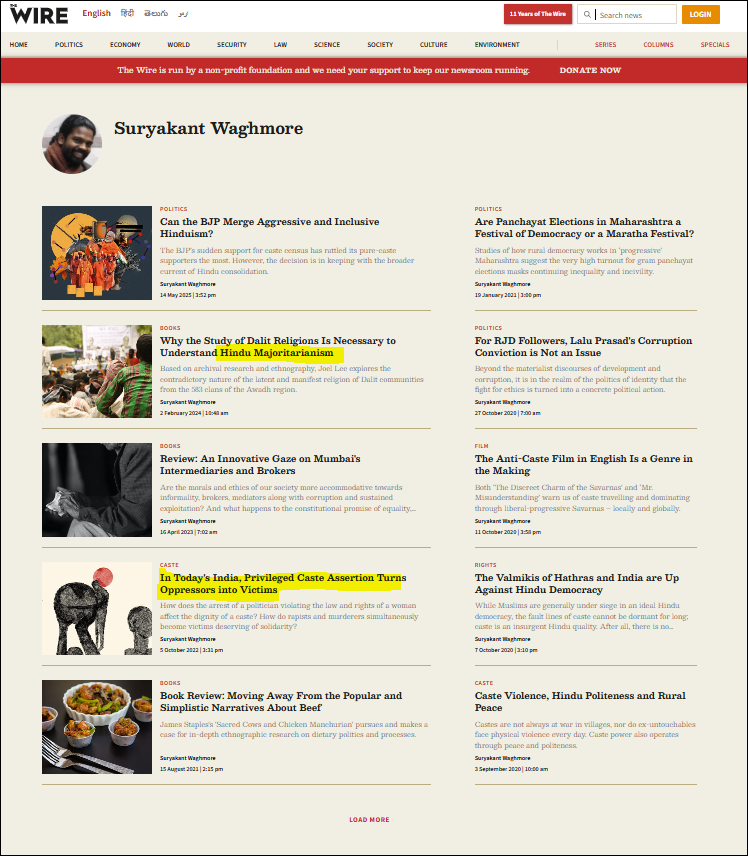
Waghmore has also previously contributed articles to Islamo-leftist propaganda rags like Scroll and The Wire.

Source: Suryakant Waghmore’s author page on Scroll

His articles are in line with his anti-BJP and anti-Hindu activism, though they carry scholarly nuance.

Source: Waghmore’s The Wire author page

With such ideological biases, it is unsurprising that Professor Waghmore is attacking colleagues for standing by Professor Doolla, whose only reported fault is admonishing a student for cheating during an exam.

Leftists like Waghmore, who delightfully sermonise others about dissent, freedom of expression and tolerance, cannot stand the fact that an ideologically aligned person can have a differing viewpoint on an issue.

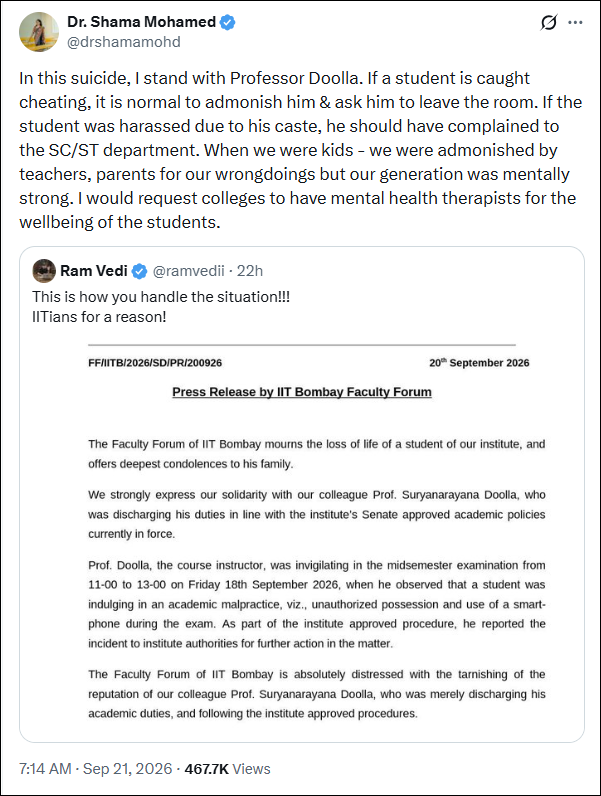
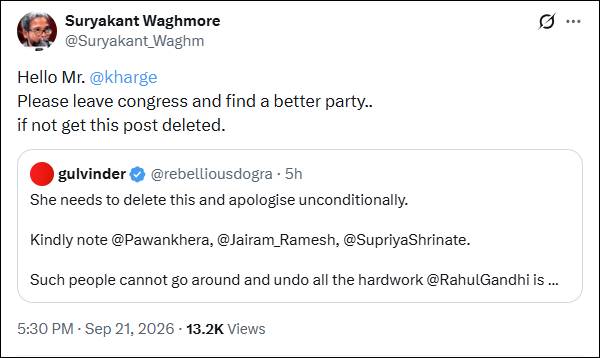
As Congress leader Shama Mohamed publicly extended support to Professor Suryanarayana Doolla, Suryakant Waghmore urged Congress President Malliarjun Kharge to either leave Congress or get Shama Mohamed to delete her post in solidarity with Doolla.

“In this suicide, I stand with Professor Doolla. If a student is caught cheating, it is normal to admonish him & ask him to leave the room. If the student was harassed due to his caste, he should have complained to the SC/ST department. When we were kids – we were admonished by teachers, parents for our wrongdoings but our generation was mentally strong. I would request colleges to have mental health therapists for the wellbeing of the students,” Mohamed wrote.

Disgruntled over Mohamed’s principled stance, Waghmore wrote, “Hello Mr. @kharge Please leave congress and find a better party.. if not get this post deleted.”

From Amarkant Thakur to Huma Namal: Who are the Leftist students exploiting the IIT Bombay student suicide for caste politics

0

In a major development in the Sahil Wakode suicide case at the Indian Institute of Technology (IIT) Bombay, the institute administration suspended the deanship of Professor Suryanarayana Doolla on Monday. This critical move came as one of the primary demands outlined in an 18-point charter that was signed by IIT Bombay Director Professor Shireesh Kedare. IIT Bombay officially suspended Professor Doolla’s deanship with immediate effect on Monday, 21st September, a decision that was communicated directly to the students via an email sent by Director Professor Shireesh Kedare.

The incident and immediate outpouring of protests

This administrative action follows a wave of massive protests triggered by a tragic incident on campus. A second-year BTech student at IIT Bombay, Sahil Wakode, took his own life on Friday (18th September) inside his hostel room after being caught red-handed by Professor Suryanarayana Doolla during an examination.

In the wake of this profound tragedy, intense protests erupted across the institute’s campus, with students demanding strict punitive action against the faculty member. Just a day later, on Saturday (19th September), Sahil’s parents came forward with serious allegations, claiming that Professor Doolla had been mentally harassing their son and using casteist slurs against him for three months, allegedly at the behest of IIT Bombay’s Director, Shireesh Kedare.

The mobilisation of political-ideological machinery

As soon as claims of ‘caste discrimination’ surfaced regarding the student’s suicide, the political-ideological machinery that traditionally thrives on identity and caste politics swung swiftly into action. Beneath the surface of student grief and demands for justice, several faces driving the latest IIT Bombay protests have been identified as Leftist students who are exploiting Sahil Wakode’s tragic death to fuel their own brand of caste politics.

Amarnath Thakur and his earlier attempt to sow discord among Hindus

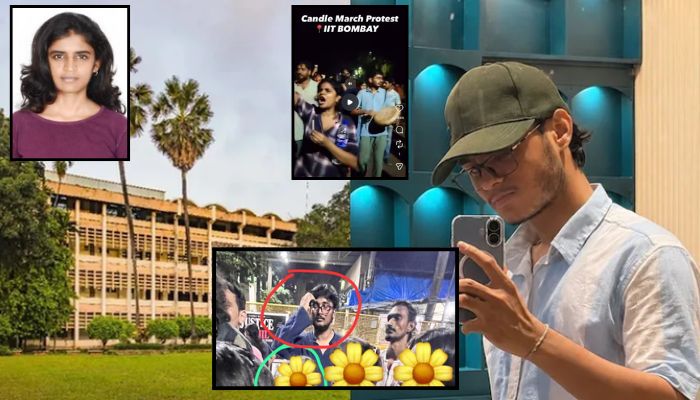
One of the leading figures in these protests is Amarnath Thakur, a PhD student in Philosophy at IIT-B. According to official institutional records on the official website, Thakur was previously enrolled in the MA program before transitioning to his PhD. He has been actively working to incite students and aggressively push caste-driven narratives into a suicide case that originated from an examination cheating incident.

Thakur’s involvement in campus agitation is not new. He was previously active following the tragic death of Darshan Solanki, an 18-year-old IIT-B student in 2023, where he similarly sought to exploit the tragedy to sow discord among Hindus by insinuating that Brahmins have historically mistreated Dalits and Shudras. During that period, he also made viral Hinduphobic remarks, openly inciting his peers against Hindus through anti-Brahmin rhetoric. Through his speeches, he consistently attempts to manufacture a caste rift within Hindu society while demonising Hindu deities such as Lord Ram.

Addressing his fellow students during earlier demonstrations, Thakur was recorded saying in Hindi: “This is a Brahminical society. Our federal government, like this university’s administration, is pro-Brahmin. We are unable to express our true feelings because of a constraint imposed by the Brahminical society in which we live. Remember that this is a Brahminical society while you eat, sleep, or do anything. Now, we have to determine what to do with this Brahminical society. And as long as you return home and chant Jai Shri Ram, your thoughts will be entirely bound by Brahmins.” 

Further attempting to manufacture a deep caste divide and incite hostility against Hindus, Thakur claimed that as long as students chant Jai Shri Ram, they would supposedly be forced to hail Kshatriyas and Vaishyas while looking down upon Shudras and Dalits.

Huma Namal and “The Collective”

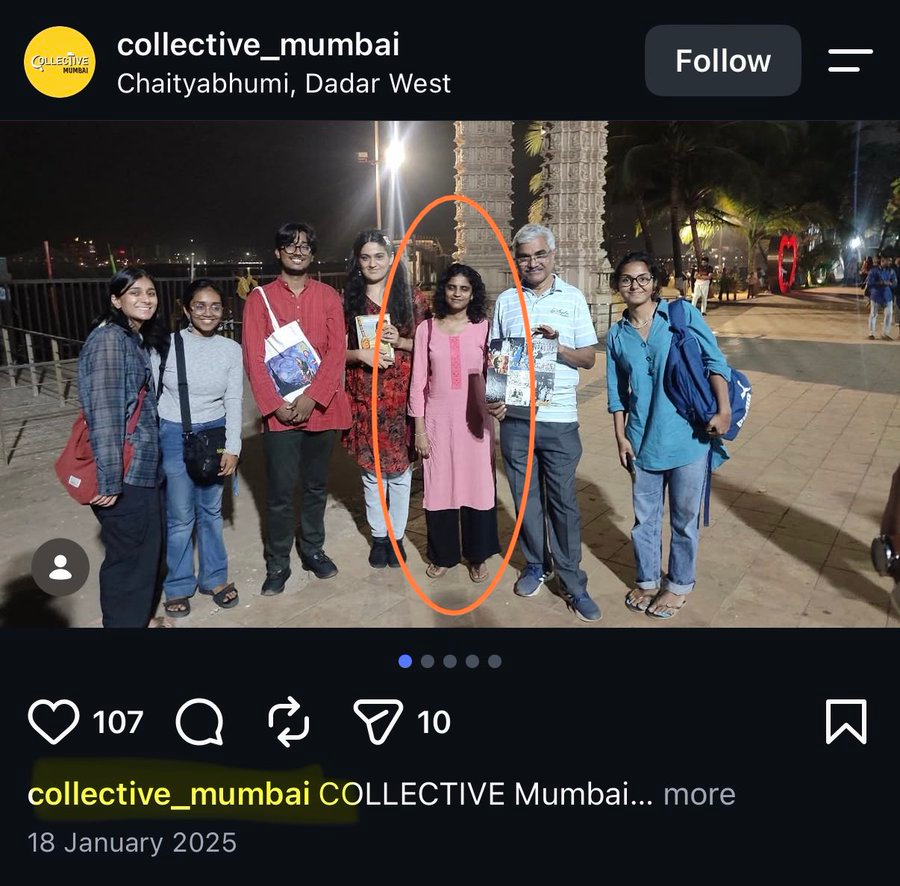
Another viral face frequently spotted leading the recent protests is Huma Namal. A PhD student in Humanities at IIT Bombay from the 2022 batch, her academic details are similarly listed on the institute’s official website. In viral video footage from the recent protests, Namal can be heard shouting slogans like “Hamare institute me Jativad hota hai” while actively inciting student hostility and playing caste politics. Furthermore, she is an active member of “The Collective,” and she can be seen in several post shared by the Instagram page of collective_mumbai.

A socialist student anti-India outfit, founded in 2021, “COLLECTIVE” claims on the surface to draw inspiration from martyr Bhagat Singh, yet it frequently stands accused of glorifying individuals involved in anti-India activities. While presenting itself as an on-campus activist group opposing what it labels “far-right fascist forces,” deeper investigative reports, such as those by OpIndia, reveal that this leftist student-youth faction functions as an extension of a radical Left-Naxal ecosystem engaging in anti-Hindu propaganda.

According to the group’s ideological framing, contemporary India is supposedly under the “ascendancy of far-Right fascist forces” empowered by neo-liberal capitalism and anti-secular tendencies, casting the RSS and BJP as villains while framing state policies as an authoritarian slide. 

Some X posts also suggest connections between Namal and the Students’ Federation of India (SFI), a prominent left-wing student organisation. SFI participants have frequently joined protests carrying daflis and dhols, raising familiar slogans such as “Azadi, Azadi,” “Haq Hamari Azadi,” and “Jaan Se Pyari Azadi” during demonstrations.

Adarsh Priyadarshi and interlinked radical networks

Another prominent face driving the protests and inciting student agitation is Adarsh Priyadarshi, a PhD student in the Humanities and Social Sciences (HSS) Department of IIT-B. Beyond his involvement in campus unrest, Priyadarshi faced severe public scrutiny last year when a minor girl from Delhi University accused him of sexual harassment. The victim publicly shared her ordeal alongside screenshots of his Instagram and X profiles, noting, “It’s unfortunate that I have to go public with a harasser because I tried handling it privately. I had hoped that appropriate action would be taken against this man, but clearly none of that has happened, because he still has a platform and all of his connections.”

Significantly, these key agitators are far from strangers to one another. In a video shared three years ago on a YouTube channel titled Let’s Talk Tattva, Amarnath Thakur and Adarsh Priyadarshi were featured together participating in a common discussion, highlighting their longstanding associations within radical campus circles.

Turning IIT Bombay into another JNU?

Through calculated agitations, inflammatory speeches, and pre-existing ideological networks, these leftist student activists have consistently demonstrated a pattern of exploiting student tragedies, such as the suicide of Sahil Wakode, to advance partisan caste politics. By pushing polarising, Hinduphobic narratives and manufacturing deep-seated social fractures, these factions are actively attempting to transform the premier academic environment of IIT Bombay into another ideological battleground reminiscent of JNU.

How an examination cheating case led to Caste discrimination allegations against an IIT Bombay professor: Read the detailed timeline of the Sahil Wakode suicide case

In a major development in the Sahil Wakode suicide case at the Indian Institute of Technology (IIT) Bombay, the institute administration on Monday, 21st September, suspended the deanship of Professor Suryanarayana Doolla with immediate effect. IIT Bombay Director Shirish B. Kedare confirmed the decision, stating that any further action against the faculty member will be taken following a thorough investigation into the matter.

Also, the probe into the suicide of Sahil Wakode, a second-year B.Tech student, has been officially handed over to the Mumbai Crime Branch. Investigating officers are currently examining Sahil’s mobile phone to check for any suicide notes or crucial digital evidence. 

What initially appeared to be a case of a student taking his own life after being caught cheating during his mid-semester examinations has now turned into a wider controversy involving allegations of caste-based harassment. The victim’s parents have publicly alleged that their son faced continuous caste-based harassment on campus. Following these allegations, the family is also seeking formal compensation under the Scheduled Castes and Scheduled Tribes (Prevention of Atrocities) Act. 

With the Crime Branch now investigating the case and IIT Bombay itself withdrawing some of its earlier statements, the exact circumstances surrounding Sahil’s death are still under investigation.

18th September: Sahil committed suicide after being caught using ChatGPT on his phone to solve a question paper

The tragic series of events began on Friday, 18th September 2026, when Sahil Wakode, a second-year B.Tech student from the Department of Energy Science and Engineering, died by suicide. The incident happened just hours after he was caught using unfair means during an ongoing examination.

According to fellow students, Sahil was caught peeking at another student’s answer sheet during the test. Shortly after this, he was asked to leave the examination hall by Professor Suryanarayana Doolla, who was conducting invigilation duty. Students alleged that institute officials later informed Sahil that he would face strict disciplinary action, including possible suspension. 

However, the IIT Bombay administration quickly disputed this account of events and issued an official statement to clarify what happened. Sahil was found using a smartphone during the exam. The administration stated that he had uploaded the question paper onto ChatGPT to get answers during the test.

They firmly denied that any disciplinary action had been initiated against him at that point. Instead, the administration explained that the course instructor and the Head of the Department had counselled Sahil, reassuring him that no action would be taken that would adversely affect his overall academic career. 

Following this meeting, Sahil returned to his hostel room, where he was found dead later in the evening. Expressing grief, the institute issued a statement saying, “IIT Bombay is deeply saddened by the loss of a student. The Institute is extending support to the student’s friends, classmates, faculty members, and others affected by this tragic incident.”

19th September: Parents allege caste harassment and seek compensation

By Saturday, 19th September, news of Sahil’s death had spread across the campus, triggering widespread student protests. Students began openly questioning how the administration handled the situation and raised serious concerns about the general treatment of students going through academic or personal stress.

While the management kept insisting that no disciplinary proceedings were started against Sahil, protesting students maintained that he was threatened with suspension right after the exam.

By Saturday morning, Sahil’s parents also arrived at the main gate of the institute, demanding justice for their late son. In a video released by the Ambedkar Periyar Phule Study Circle (APPSC), a student collective active on campus, Sahil’s parents directly blamed the institute management for the death.

Refusing to accept that their son would end his life over an exam incident, his father stated, “This is a case of caste discrimination. We took efforts to put our son in this institute, which has failed us. It is because of their torture that we have lost our only child. We demand justice. We will raise our complaint to the national capital.”

As night fell on Saturday, the campus protests grew even more intense. Demanding immediate accountability, students called for the resignation of IIT Bombay Director Prof. Shireesh Kedare and Prof. Suryanarayana Doolla. To address the rising anger, Director Kedare convened an impromptu open-house meeting late Saturday night at the institute’s Convocation Hall.

During this meeting, students voiced deep-seated grievances that went far beyond the immediate circumstances of Sahil’s death, particularly pointing out the complete lack of adequate student representation on decision-making committees that shape campus life.

Later that day, based on the formal complaint submitted by Sahil’s father, the Mumbai Police booked Professor Doolla and others. The complaint included charges of abetment of suicide alongside severe sections of the SC/ST (Prevention of Atrocities) Act. Sahil’s parents claimed that he had previously shared details about experiencing discrimination and hardships on campus. 

In his police statement, Ravindra Wakode, the father of deceased Sahil Wakode alleged that Professor Doolla had been targeting his son with casteist slurs for three months on the direct instructions of Director Shireesh Kedare.

Sahil’s father stated in his complaint, “He had come to the college on his own merit, and everything went fine in the First Year. Things changed in the Second Year when the Director, Shireesh B Kedare, instructed faculty member Suryanarayana Doolla to do caste-based discrimination… Doolla was passing casteist remarks for the past three months and had threatened to implicate him in a wrong manner before the incident took place.”

On the same day, Legal representative Advocate Nikhil Kamble, speaking on behalf of the family’s legal demands, stated, “Our main demands include the appointment of a Crime Branch team, allowing the victim’s father and five to seven representatives to monitor the investigation, and having the entire investigation supervised by the Joint Commissioner. In case the accused seek anticipatory bail, a Special Public Prosecutor will be appointed to represent the state. Three lawyers suggested by the victim’s father will oppose the bail plea in the High Court. In addition, compensation under the SC/ST (Prevention of Atrocities) Act will be provided at the earliest…”

20th September: IIT-B denies caste allegations and signed 18-point charter

On Sunday, 20th September, the allegations of caste discrimination gained massive public attention. However, Director Kedare strongly refuted all such claims, assuring that the campus maintains a fair environment. He stated, “And there is absolutely none in this case.

In fact, caste-based information of every student is completely hidden and not available for anybody’s information.” The institute’s SC/ST Students and Staff Cell also issued a statement clarifying that Sahil had never filed any prior formal complaint regarding caste bias with them or the main administration.

Meanwhile, Sahil’s parents initially refused to claim his body for the final rites until concrete official action was taken. They eventually agreed to accept the body only after Mumbai’s Joint Commissioner of Police (Law and Order), Manoj Kumar Sharma, personally informed them that the case was being officially transferred to the Crime Branch.

As soon as an alleged ‘caste discrimination’ claim emerged in the suicide of the IIT Bombay student, the political-ideological machinery that thrives on caste politics swung into action. Several Ambedkarites and online commentators claimed that General category students and faculty regularly abuse ‘marginalised students’ on premier campuses, driving them to suicide.  

Many Ambedkarite groups also used the momentum around Sahil’s case to demand the immediate and strict implementation of the University Grants Commission’s (UGC) guidelines regarding equity in higher education institutions.

Amid the mounting criticism, the Faculty Forum of IIT Bombay came forward to defend their colleague. In an official press release issued on Sunday, 20th September, signed by President Professor Rajkumar S. Pant, the forum extended condolences to Sahil’s family while firmly standing by Professor Doolla.

They stated, “The Faculty Forum of IIT Bombay mourns the loss of life of a student of our institute, and offers deepest condolences to his family. We strongly express our solidarity with our colleague Prof. Suryanarayana Doolla, who was discharging his duties in line with the institute’s Senate-approved academic policy currently in force.”

Despite the faculty’s defence, student protests outside the main gate reached a critical point on Sunday night. To break the deadlock after three days of continuous sit-ins, the IIT Bombay administration held a detailed meeting with the protesting students. Director Shireesh Kedare eventually signed and accepted an 18-point charter of demands presented by the students.

This comprehensive 18-point charter of demands included:

  • Action against stakeholders: Demanding the immediate suspension of Professor Suryanarayana Doolla and the removal of any other official found guilty after a fair probe.
  • Public apology: Demanding an official public apology from IIT Bombay for publishing what students described as defamatory and selective details about Sahil in an earlier LinkedIn post.
  • Open House: Requiring an Open House session before 22nd September, featuring the Director, Deans, and key administrators to directly address student queries.
  • Accountability of officials: Demanding that the Director, Dean of Academic Programmes (AP), and Dean of Student Affairs (SA) resign if the agreed demands are not implemented within a month, backed by weekly progress updates.
  • Independent probe: Setting up an independent committee to investigate Sahil’s death and the subsequent hospital response, demanding an interim report by September 30 and final public findings by October 15.
  • Financial support: Demanding fair and immediate monetary compensation alongside continuous institutional support for the families of four students lost in recent times.
  • Student representation: Ensuring equal representation and voting power for students on crucial academic and non-academic committees without administrative veto power.
  • Review of decisions: Reviewing all unilateral administrative decisions that impact campus culture without prior student consultation.
  • Professor code of conduct: Forming a dedicated committee to establish clear rules, complaint mechanisms, and strict timelines for grievances against faculty members.
  • Disciplinary Action Committee (DAC) cases: Mandatory inclusion of student mentors, companions, and buddies, along with complete documentation whenever a student faces malpractice charges.
  • Counselling services: Ensuring a ratio of one counsellor for every 250 students, placing at least one counsellor per hostel, and conducting regular audits of the Student Wellness Centre.
  • 24/7 mental health support: Setting up round-the-clock on-call psychiatrists, qualified emergency doctors for night shifts, mandatory mental health training for staff, and an active feedback system.
  • Faculty sensitisation: Making mental health sensitisation workshops mandatory every two months, including special training during the onboarding of new professors and staff.
  • Accessibility of Dean SA: Requiring the Dean SA office to dedicate at least 20 hours a week for direct student interactions, with mandatory written responses provided within 18 hours.
  • Hostel wing support: Allotting adjacent rooms to second- and third-year students to help maintain their existing peer support networks.
  • Student concerns portal: Setting up an institute-wide transparent portal where student grievances and official administrative actions are published publicly.
  • Student well-being task force: Establishing a permanent task force comprising students, faculty, and experts to study student distress and release semester reports.
  • Protection of protesters: Securing a written guarantee that no disciplinary, legal, hostel-related, or financial retaliation will be taken against any student involved in the peaceful protests.

21st September: IIT Bombay suspends Professor Doolla and apologises for earlier statement

On Monday, 21st September, following intense pressure from the ongoing campus protests, the IIT Bombay administration took its first major step. Director Shireesh Kedare sent an official email to all students announcing the immediate suspension of Professor Suryanarayana Doolla from his administrative role.

The email officially stated, “The Deanship of Prof. Suryanarayana Doolla is suspended with immediate effect. Any further action will be taken after investigation.”

Professor Doolla, who previously served as the Dean of Student Affairs, was holding the position of Dean of Administrative Affairs at the time of the incident. While the protesting students had explicitly demanded his complete suspension as a professor, the institute restricted the current action to removing him from his deanship position pending further legal and internal outcomes.

Alongside this action, the IIT Bombay administration issued a formal apology regarding its earlier public statements about the case. Stepping back from its initial comments regarding Sahil’s use of cheating during the exam, the management admitted that sharing such unverified details before a full investigation was wrong.

In its official statement, the institute noted, “We apologise for the statements contained in our earlier communication concerning the circumstances surrounding the unfortunate demise of Sahil. The details and circumstances leading up to the incident remain subject to investigation by the appropriate authorities. In view of the ongoing investigation, it was inappropriate to have set out or characterised details relating to the events preceding his demise before they had been duly established through the appropriate investigative process.”

Furthermore, amidst widespread rumours circulating online regarding campus leadership, IIT Bombay clarified that Director Shireesh Kedare had not resigned from his position.

The institute reiterated its commitment to fully cooperating with the Crime Branch officers as the investigation into Sahil Wakode’s death continues. Meanwhile, a section of social media, as well as IIT Bombay students and alumni, have come out in support of Professor Doolla, contending that he should not be punished for stopping a student from cheating in an exam under the guise of the alleged false caste discrimination allegations.

IIT Bombay student suicide: Professor suspended after being slapped with the SC/ST Act, but are we ignoring parents’ role in creating a culture of academic pressure?

0

IIT Bombay has suspended Professor Suryanarayana Doolla from his administrative position amid the controversy surrounding the death by suicide of 20-year-old BTech student Sahil Wakode. Doolla, who was the invigilator during the examination in which Wakode was allegedly caught using a mobile phone and seeking answers through an AI platform, will continue as a faculty member. The institute has also apologised for its earlier communication about the circumstances preceding Wakode’s death, saying that those details should not have been characterised before the investigation was complete.

The development has come a day after protests at the campus and an 18-point charter of demands submitted by students. Wakode’s parents have accused Doolla and other institute officials of caste discrimination and undue pressure. An FIR has been registered invoking provisions relating to abetment of suicide and the Scheduled Castes and Scheduled Tribes (Prevention of Atrocities) Act, and the Mumbai Crime Branch is investigating the case.

These allegations are serious and must be investigated. But IIT Bombay denied allegations levelled by the victim’s parents.

But so is another question that deserves to be asked: are we too readily turning an academic incident into a narrative of oppression before establishing what actually happened?

The facts currently available establish that Wakode was allegedly caught using a phone during an examination. IIT Bombay’s Faculty Forum has said that Professor Doolla was discharging his duties as an invigilator under the institute’s academic policy when he detected the alleged malpractice.

If a student is found using a mobile phone or an AI platform to obtain answers during an examination, an invigilator is expected to intervene. That is not harassment. That is the basic enforcement of academic integrity.

If every invigilator who catches a student cheating is subsequently accused of causing psychological harm merely because the student is distressed by being caught, we are entering extremely dangerous territory.

The job of an invigilator is not to protect a student from the consequences of cheating. The job is to protect the integrity of the examination.

That does not mean that the allegations of caste discrimination should be dismissed. The police investigation must establish whether any discriminatory conduct actually occurred. Wakode’s parents have made specific allegations, while IIT Bombay has denied caste discrimination and said that its SC/ST Students and Staff Cell had received no complaint from Wakode during his time at the institute.

There is therefore a crucial distinction that must not be lost in the political and ideological noise surrounding this case.

An allegation is not proof.

The fact that an FIR has been registered does not establish that caste discrimination caused Wakode’s death. It establishes that allegations serious enough to warrant investigation have been made.

And there is currently no established basis for conclusively saying that caste discrimination was the reason for his suicide.

Indeed, another possibility deserves to be examined: that Wakode experienced an acute crisis after being caught cheating and feared the consequences, embarrassment and humiliation associated with being caught.

That possibility cannot simply be dismissed because it is uncomfortable.

There was reportedly no suicide note found at the scene. Police have said the student was found dead in his hostel after the examination incident.

This does not prove that shame over being caught cheating caused his death. Nor does it disprove the family’s allegations. It simply means that the circumstances remain unresolved and that we should not manufacture certainty where the investigation has not yet produced it.

But whether or not that turns out to be the explanation in this particular case, the broader question of academic pressure is undeniable.

And this is where the conversation needs to move beyond the college.

Parents are part of the equation too

It is convenient to blame universities whenever a student dies by suicide.

Sometimes institutions may indeed be responsible for creating toxic environments. If harassment, discrimination or institutional negligence is established, there must be accountability.

But parents and families cannot outsource all responsibility for a child’s emotional resilience to a university.

Parents are the first educators.

Long before a child sits in an IIT classroom, he has already learned from his parents what success means.

Has he learned that honesty matters more than marks?

Has he learned that hard work is more valuable than a shortcut?

Has he learned that cheating is wrong even when failure is frightening?

Has he learned that his parents will still love him if he comes home with a failed examination?

Has he learned that disappointing his parents is not the same thing as losing their love?

These lessons matter enormously.

Parents cannot spend fifteen years telling a child that he must be among the toppers, that he must get into the best college, that he must secure the highest-paying job and that he must make the family proud, and then suddenly expect him to possess perfect emotional resilience when everything goes wrong.

We cannot create the pressure cooker and then blame only the university when the pressure becomes unbearable.

We have reduced success to a checklist

The problem extends far beyond IITs.

Indian society has developed an extraordinarily narrow definition of success.

First, the child must score well.

Then he must clear JEE or NEET.

Then he must get into an IIT, IIM, AIIMS or another prestigious institution.

Then he must get a high-paying job.

Then, increasingly, he must leave India and get a job in America, Britain, Canada, Australia or Europe.

Then comes the salary package.

Then the house.

Then the car.

Then the foreign holiday.

Then the children.

The entire journey becomes a checklist.

And somewhere along the way, we forget to ask the child whether he is actually happy.

A child grows up hearing that getting into IIT is success.

Then he gets into IIT and discovers that everyone around him was also a topper.

Suddenly, being a topper in school is no longer enough.

Now he must compete with hundreds of equally brilliant students.

Then perhaps he gets an average grade.

Then he begins to think that he is failing.

Then the comparison starts again.

His cousin has gone abroad.

His school friend has joined Google.

Someone else has secured a ₹50 lakh package.

Another friend has started a company.

Someone has bought a Mercedes at 27.

Someone has settled in New York.

And the young person begins to believe that his own life is inadequate.

This is the social pressure we rarely acknowledge.

The problem is not ambition.

Ambition is good.

Competition can be good.

Hard work is unquestionably good.

The problem is convincing children that these are the only things that give their lives value.

Parents must teach children that failure is survivable

A child needs to hear something very different from his parents.

If you get 95%, we are proud of your effort.

If you get 60%, we are still proud of you.

If you don’t clear JEE, we will find another route.

If you don’t get into IIT, your life is not over.

If you don’t become an engineer, you can become something else.

If you don’t get a job immediately after graduation, we will help you.

If you make a mistake, tell us.

If you fail, come home.

That last sentence may be one of the most important things a parent can say.

If you fail, come home.

Not: How could you do this to us?

Not: What will people say?

Not: Look at Sharmaji’s son.

Not: You have ruined our reputation.

And certainly not: We sacrificed everything for you.

Children should never be made to believe that their parents’ sacrifices have created a debt that can only be repaid through academic success.

Parents have children because they love them.

That love should be communicated explicitly.

A child should not have to infer it from school fees, coaching fees and material comforts.

Tell them.

Show them.

Make them understand that their existence has value independent of their marksheet.

Don’t burden your children’s shoulders with your dreams. Their existence itself is a cause of supreme happiness. Your children don’t have to constantly prove their worth by consistently acing one life challenge after another.

Academic integrity still matters

There is another uncomfortable truth that must not disappear from this debate.

Cheating is wrong.

It does not become right because competitive examinations are stressful. It doesn’t become right because there is cutthroat competition in premier institutes.

It does not become right because a student belongs to a particular caste.

It does not become right because the consequences of being caught are frightening.

And it certainly cannot become acceptable because we are afraid that enforcing examination rules might hurt someone’s feelings.

Academic institutions exist partly because qualifications are supposed to mean something.

If a student obtains marks by using an unauthorised phone, AI system or other prohibited assistance, the institution has every right, and indeed a responsibility, to intervene.

The solution to academic pressure cannot be to abandon academic standards.

It is to teach children that an honest failure is infinitely better than a dishonest success.

That lesson has to begin at home.

Parents should celebrate effort, discipline and integrity, not merely outcomes.

A child who scores 60 honestly should never be made to feel morally inferior to someone who scores 90 through cheating.

And when a child is caught cheating, parents should have the courage to tell him that what he did was wrong.

But they should also tell him something else:

“You made a mistake. Now accept the consequences and learn from it. You have not become worthless.”

That is parenting.

The tragedy should make us rethink what we demand from children

The IIT Bombay case will ultimately have to be decided by evidence.

If the investigation establishes caste discrimination, those responsible must face the law.

If it establishes institutional wrongdoing, there must be accountability.

If the allegations are not substantiated, that must also be accepted.

But whatever the outcome, India needs to confront the larger epidemic of academic and social pressure.

A young person’s life cannot be reduced to his examination result.

A person’s worth cannot be determined by whether he clears NEET.

A person’s intelligence cannot be reduced to his JEE rank.

A person’s future cannot be decided by whether he gets an IIT degree.

And a person’s success certainly cannot be determined solely by whether he gets a foreign job.

There are many ways to live a meaningful life.

There are many definitions of success.

Being a good son or daughter is success.

Being a good parent is success.

Being honest is success.

Doing work you enjoy is success.

Building something meaningful is success.

Helping other people is success.

Living peacefully is success.

And sometimes, simply having the courage to begin again after failure is itself an enormous achievement.

Indian parents need to teach their children this.

Love them when they win. Love them when they lose. Love them when they succeed. Love them when they make mistakes.

Demand honesty.

Demand hard work.

Demand accountability.

But never make a child believe that your love depends upon his performance.

Because examinations are temporary.

Careers can change.

Jobs can be lost and found again.

Countries can be changed.

Degrees can be earned later.

Mistakes can be corrected.

But a life lost to a temporary crisis cannot be recovered.

No IIT seat, no NEET rank, no job package, no foreign posting and no social status are worth a child’s life.

The responsibility for teaching that lesson does not belong to IIT Bombay alone.

It begins at home.

As a father, I want my son to outlive me. I would willingly give up my own life if it meant he could live forever. I am certain fathers across the world share this instinctive desire to protect their children at any cost.

That is why it is our collective responsibility to make sure our children never feel that death is preferable to facing failure, shame, disappointment, or our expectations. We must teach them that no mistake, examination, failure, or moment of embarrassment is greater than the value of their life, and that they will always have a safe place to return to in their parents.