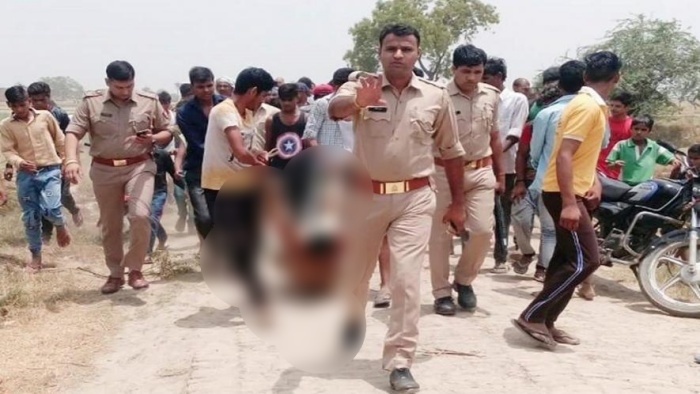
On Tuesday (12th March), a court in Uttar Pradesh’s Hapur convicted and sentenced ten people to life in jail for lynching a 45-year-old ‘meat seller’ identified as Qasim Qureshi in June 2018 over claims of cow slaughter. The sentence was pronounced by the bench of Additional District Judge (POCSO) Shweta Dixit.
Another victim, 62-year-old Samaydeen, was hurt during the incident. As per the reports, the accused persons were convicted under sections 302 (murder) 149 (unlawful assembly), 307 (attempt to murder) 149, 147 (rioting), 148 (being armed with a deadly weapon), and 153A (promoting enmity between different groups on grounds of religion) of the Indian Penal Code, 1860.
Notably, the victims did not seek death sentence for the convicts and said that they did not have any enmity against the convicts and only wanted justice.#Hapur#HapurLynching
All convicts Rakesh, Hariom, Yudhishthir, Rinku, Karanpal, Manish, Lalit, Sonu, Kaptan, and Mangeram of Dhaulana’s Bajhaida village have been sentenced to life imprisonment and a fine of Rs 59,000 each.
Earlier, in a written statement to the Court, the primary accused, Rakesh Sisodia had denied any role in the attack and had claimed he was not present at the spot when the alleged lynching happened in the year 2018. Residents then stated that rumors of cow slaughter caused the lynching but the police dismissed the claim.
The complainant and victims were represented by Adv Vrinda Grover, Adv Soutik Banerjee, Devika Tulsiani, Haji Yusuf Qureshi (Late) and Mohd Furquan Qureshi.
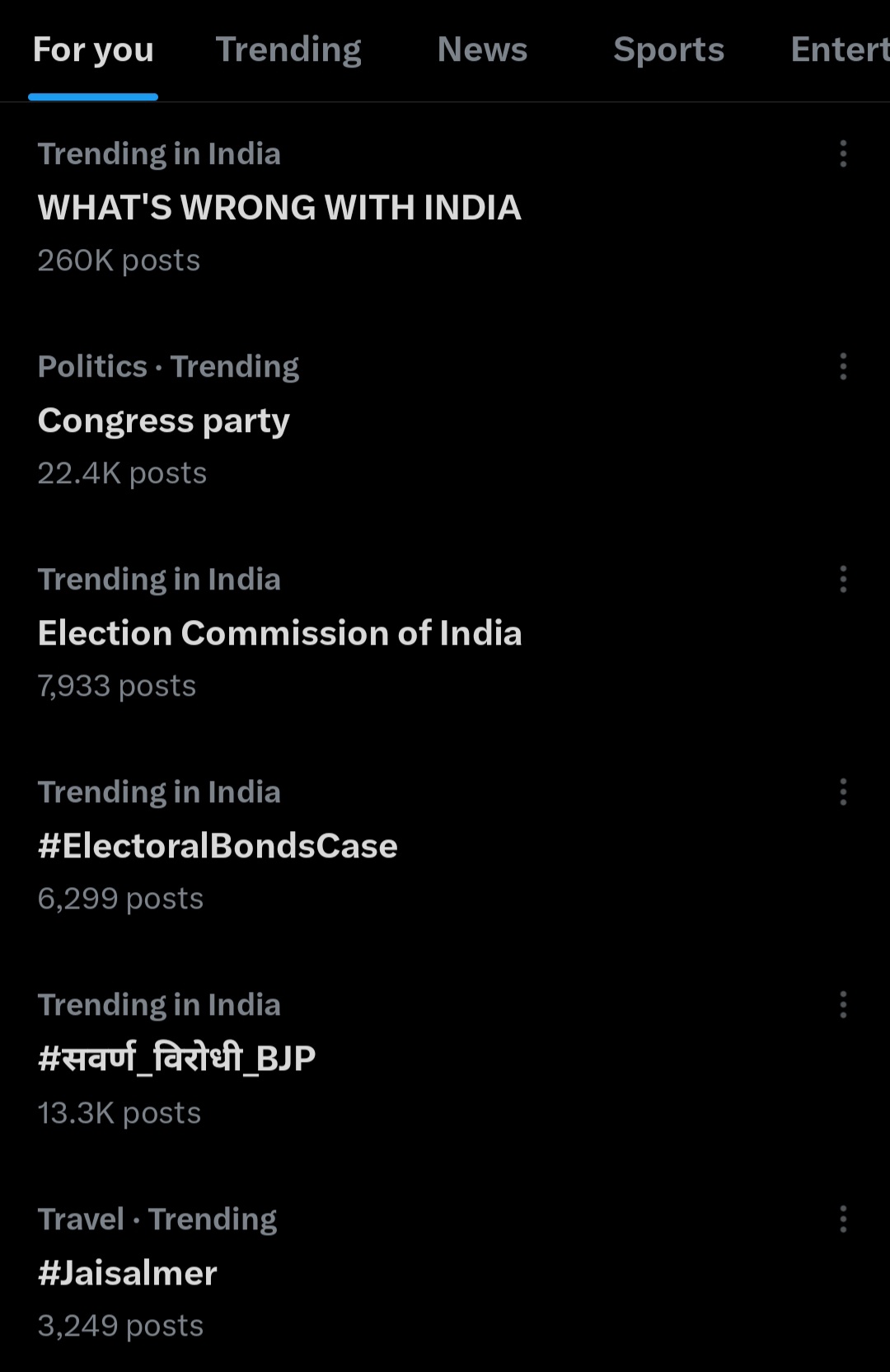
Earlier today, the official X handle of the citizen engagement platform of the Government of India, @MyGovIndia came up with a curious tweet with the caption, “What’s wrong with India?” and shared pictures of 4 news reports highlighting the recent achievement of the country.
These clippings showcased India’s achievement in eradicating ‘extreme poverty’, being the first country to successfully land on the moon’s south pole region, receiving accolades from the IMF chief for being the fastest growing economy, and other nations emulating India’s advancements in digital infrastructure.
But what was the trigger behind one of the Government of India’s X handles listing down the country’s achievements with a seemingly contradictory caption?
Foreign social media accounts trend ‘What’s wrong with India?’ on X to malign India
The Indian government’s response was part of a burgeoning X trend to hijack a malicious online campaign run by foreign social media accounts to show India in a negative light, targeting and ridiculing it for prevalent social and civic issues such as disregarding lane discipline and traffic signals, breaking rules and queues, public urination, food habits, the presence of homeless beggars on crowded streets, instances of eve teasing, drunk driving, fraud, corruption, drug trafficking, and drug users loitering in dimly lit corners of the streets, among others—issues that plague most of the countries around the world but were used specifically by detractors against India to paint a negative image about the country and discredit giant strides it is making, especially in the past 10 years.
‘What’s wrong with India’ trends on X
While it is yet to be ascertained who started the trend ‘What’s wrong with India’ on X, according to many social media users, the trend first emerged after many seemingly social media users from around the world attacked the street food in India and called it unhygienic. Gradually, as per these X users, the trend covered other issues such as women’s safety, crime, and corruption, as a raft of online users started using ‘OMG, What’s wrong with India?’ and ‘OMG, What’s wrong with Indians?’ as a part of a systematic campaign to malign India and Indians on X, formerly known as Twitter.
OMG!! WHAT'S WRONG WITH INDIA??
Indians #hijacked anti-India algorithms at work and showed the world how every country has its own problems. Hey, trolls! It is a lesson you should not target #India! pic.twitter.com/ipfp5OVuF7
Indian netizens hijack ‘What’s wrong with India?’ trend to highlight flaws in other countries
As disparaging posts with ‘What’s wrong with India?’ started trending on X, the Indian social media users quickly took charge of the situation to shed a glaring light on the serious questions raised regarding the criticism India faces from Western or developed countries worldwide, especially when similar issues are prevalent in their nations as well. Using the key phrase, ‘What’s wrong with India?’, X users shared videos from outside India to illustrate how no country is perfect and each of them is facing a unique set of challenges defined by their socio-economic conditions, historical traditions, and social ethos.
@effucktivehumor shared a video depicting homeless individuals under the influence of drugs on a street. The video appears to have been filmed outside of India, though the exact location is not specified in the post.
?OMG!! WHAT’S WRONG WITH INDIA ??
Why tf are they living in trash and eating leftovers from a trash can? Disgusting pic.twitter.com/N4PKbEIxrg
Another X user shared a picture from inside a metro train outside India. The video shows a man massing urine inside a train at a station. “OMG!! WHAT’S WRONG WITH INDIA. These Indians literally pee anywhere? Ewww,” the sarcastic post read, taking a dig at the anti-India detractors running an online propaganda against India.
OMG!! WHAT’S WRONG WITH INDIA. ?? These Indians literally pee anywhere? Ewww ?pic.twitter.com/oqXU7TduHk
“What’s wrong with India so much garbage and homeless people living on streets..” an X user tweeted along with a video from a seemingly western country where hundreds of people still live in wretched poverty in shanties and make-shift tents on the curbside of prominent thoroughfares.
What's wrong with India ?? so much garbage and homeless people living on streets.. pic.twitter.com/q9HMyR3BAF
Yet another X user shared a video of a man taking a bath inside a metro train. The video is from out of India, though the location is not mentioned in the tweet.
OMG what's wrong with india, a subhooman taking bath in metro cause there are no bathrooms, truly a 3rd world country. pic.twitter.com/q3w1C22My9
How the online campaign belies the remarkable growth story India has scripted in the last decade
While these social media users have managed to hijack the malicious ‘What’s wrong with India?’ trend, the videos of flaws present in foreign countries emphasises that regardless of geography, nations across the globe are embattling problems unique to them, and targeting any one country because of pathological hatred towards it and its political establishment does little to address the issue at hands. It also reflects a new India, that refuses to take bullying, online or otherwise, which is best exemplified by India’s foreign minister S Jaishankar, whose acerbic retorts to the West’s patronising platitudes, underpins the Centre’s ‘nation first’ policy and its refusal to be gamed by foreign institutions, moralities, and online algorithms.
Such concerted online campaigns targeting India also understate the remarkable transformation across various sectors, from advancements in technology and education to improvements in the standard of living, the country has witnessed in recent years, most notably since 2014. India’s achievements, ranging from ISRO’s successes in space technology to the impressive growth of start-ups, have undeniably left a lasting impression on the global stage.
India has leapfrogged to replace the United Kingdom to become the fifth-largest economy in the world, poised to become the third-largest economy by 2027-2028. In 2023 alone, India has proudly achieved numerous milestones, filling every Indian with a sense of pride on the international stage. From the successful Chandrayaan-3 mission by ISRO, Mumbai-based filmmaker Kartiki Gonsalves becoming the sole Indian director to win an Academy Award, and Neeraj Chopra securing gold at the Asian Games, to the ‘Natu Natu’ song making its way to the Oscars and the visually impaired Indian Women’s Cricket Team clinching gold at the IBSA, India’s ability to turn every opportunity into a significant achievement is soaring high.
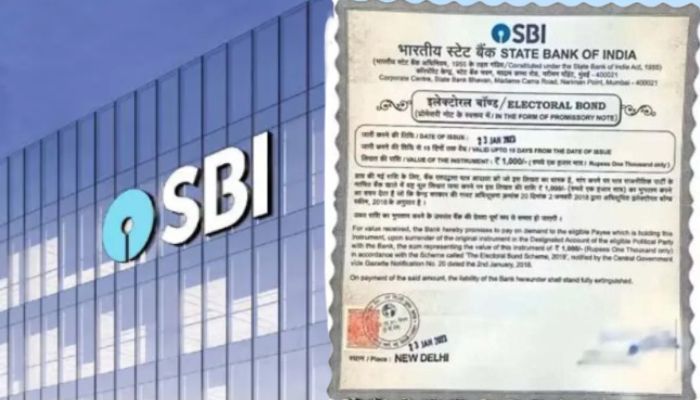
On Tuesday (12th March), the State Bank of India (SBI) submitted data on Electoral bonds to the Election Commission of India in compliance with the Supreme Court’s directions issued on 15th February and reiterated yesterday on 11th March 2024, the poll body said. The data will be collated and released by ECI – which has confirmed receipt of the data – by 5 pm Friday, as ordered.
Taking to X, the Spokesperson of ECI confirmed the development stating, “In compliance of Hon’ble Supreme Court’s directions to the SBI, contained in its order dated Feb 15 & March 11, 2024 (in the matter of WPC NO.880 of 2017), data on electoral bonds has been supplied by State Bank of India to Election Commission of India, today, March 12, 2024.”
In compliance of Hon’ble Supreme Court's directions to the SBI, contained in its order dated Feb 15 & March 11, 2024 (in the matter of WPC NO.880 of 2017), data on electoral bonds has been supplied by State Bank of India to Election Commission of India, today, March 12, 2024.
The details of the sale and purchase of electoral bonds shared by the SBI are in a raw form, India Today reported citing sources. The raw data reveals who bought bonds worth how much and in favour of which political party.
The source added that the data is being uploaded in a phased manner, with plans to release it all together on the evening of 15th March.
As per NDTV, the Chairman and Managing Director of SBI has not yet filed the affidavit confirming compliance with the court order. This is, however, ready and will be submitted on Wednesday, the report added.
Yesterday, on March 11th, the Supreme Court dismissed SBI’s plea seeking an extension to disclose details of each electoral bond encashed by political parties before the scheme was scrapped last month.
The apex court noted that the SBI doesn’t need to complete the matching exercise linking donors with the political parties but rather simply reveal the data of how much different political parties received in donations and who donated through electoral bonds.
The court directed SBI to disclose the details by the close of business hours on March 12. It further instructed the ECI to compile the information and publish the details on its official website no later than March 15, 2024, by 5 PM.
Last month, on 15th February, the Supreme Court deemed the electoral bond scheme “unconstitutional.” It instructed the SBI to provide details of all electoral bond purchases since April 12, 2019, to the Election Commission by March 6. Additionally, the court directed this information to be published on the Election Commission’s website by March 13. The apex court later dismissed SBI’s request to extend the deadline.
Ever since the Modi government notified the Citizenship Amendment Act (CAA) on 11th March, the opposition parties, Islamists and liberals have resorted to fear-mongering, misleading and peddling fake news about the Act. In this line, West Bengal Chief Minister Mamata Banerjee came up with an unfounded claim that those applying for Indian citizenship under CAA would be instantly marked refugee infiltrators and sent to detention camps. She also cast aspersions on the legality of the Act.
Speaking at a meeting in West Bengal’s Habra, CM Mamata Banerjee said, “Central Government implemented CAA yesterday, I am doubtful of its legality. There is no clarity from the Government over this. In 2019, names of 13 Lakh Hindu Bengalis, out of the total 19 Lakh, were removed from the list in Assam in the name of NRC. Several people died by suicide, Will they (whose names were removed) be granted citizenship if they seek it?… What would be the future of their children? What about their property?… All your rights would be snatched, you would be branded ‘illegal’. This is a game (Khela) to strip you of your rights…You will be taken to detention camp…You (Centre) hear me, I will not let anyone snatch away the rights of people in Bengal. For that if I am required to sacrifice my life, I will do that,” the Trinamool Congress supremo said forgetting that the power to give citizenship is with the Central government, not the State.
#WATCH | North 24 Parganas: On CAA notification, West Bengal CM Mamata Banerjee says, "Central Government implemented CAA yesterday, I am doubtful of its legality. There is no clarity from the Government over this. In 2019, names of 13 Lakh Hindu Bengalis, out of the total 19… pic.twitter.com/o15rbA7O0K
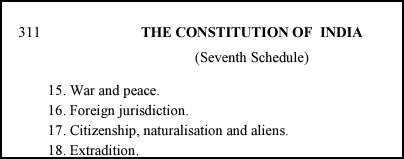
It must be noted that the Seventh Schedule of the Indian Constitution deals with the separation of powers between the Union and State governments. It states that Citizenship, Naturalisation, and Aliens fall within the Union List. This means that only the Central Government has the authority to grant citizenship to anyone seeking asylum in the country.
Source: Government of India
“People will lose government scheme benefits, civil liberties, voting rights,” Mamata Banerjee passes off her imagination as a ‘warning’
While Mamata Banerjee claims that “people” will be marked as ‘refugees’, under the CAA “people” belonging to persecuted minority groups in Pakistan, Bangladesh, and Afghanistan—including Christians, Parsis, Sikhs, Jains, Buddhists, Hindus, and Sikhs—who came to India on or before December 31, 2014, will be granted Indian citizenship. This means that not random “people” will be marked refugees rather those refugees fulfilling the CAA-mandated criteria will be granted Indian citizenship.
She further claimed that the citizenship applicants will be deprived of government scheme benefits. The West Bengal CM added that all the civil liberties of those applying for Indian citizenship via CAA will be taken away, thus warning them to think a thousand times before applying. CM Mamata Banerjee also asserted that CAA is linked with the NRC National Register of Citizens (NRC).
Contrary to Banerjee’s assertion, the Central government has stated that CAA has no link with the NRC. Established in 1951, NRC is a comprehensive database of Indian citizens. It is kept under the administrative control of deputy commissioners and sub-divisional authorities. It has only recently been adopted in Assam, a state facing issues due to illegal immigration. The goal is twofold: to remove unauthorised entries and to dissuade future migrations.
The blatant fear-mongering does not end here. Mamata Banerjee claimed that those applying for citizenship under CAA will lose their voting rights. “Will you put your fate in the hands of the BJP which has done this just to win two or three seats? If you apply for citizenship, you may not be able to vote in the coming election,” Mamata Banerjee said. It raises the question of whether the Trinamool Congress supremo is not aware that only Indian citizens are eligible to vote and not any refugees or she is deliberately misleading people.
CM Mamata Banerjee also emphasised that the United Nations “has categorically stated that refugees should not be displaced and thrown out of a country.” However, the CAA is for refugees already living in India, not for any current or future groups who may face persecution due to political and ethnic reasons in neighbouring countries. This obviously means that there is no question of displacement of anyone.
Notably, those opposed to CAA often bring up Article 14 in their argument against the citizenship act to deem it ‘discriminatory’, ‘exclusionary’, ‘unconstitutional’ and whatnot. Today, CM Mamata Banerjee also mentioned Article 14 which guarantees the right to equality as she said, “The CAA and the rules framed are unconstitutional, and discriminatory under Article 14 of Constitution, which is the fundamental right to equality.”
Notably, Article 14 assures all persons the right to equality before the law and equal protection of the laws on Indian territory. This assurance does not imply or intend absolute mathematical equality and enables the Centre to make appropriate classifications. The state can enact special laws for specific groups. The only criterion is that this categorization and the object it represents have a reasonable connection. The CAA aims to safeguard those persecuted on religious grounds in our three neighbouring nations—Pakistan, Afghanistan and Bangladesh.
Furthermore, the Indian constitution specifies the rights of Indian citizens, not refugees from other countries. The decision to grant refugees citizenship is solely up to the government.
Notably, CM Mamata Banerjee also claimed that the implementation of CAA is meant to serve BJP’s ‘political interest’ to woo several communities like the Matuas in south Bengal and Rajbanshis, as well as Namasudras in north Bengal. However, it has been a long-pending demand of these groups. As soon as the announcement of CAA implementation was made these SC/ST Hindu refugee communities burst into celebration and called it their “second Independence Day”. Notably, these refugees had migrated to India during the Partition and after the creation of Bangladesh (erstwhile East Pakistan).
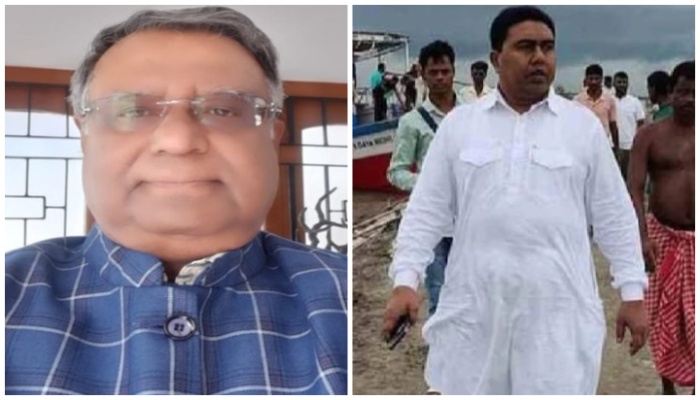
TMC strongman Sheikh Shahjahan has his roots in Bangladesh. A video going viral on social media shows Padma Shri awardee Dr Narayan Chakraborty, renowned for his pioneering work in arsenic toxicity, particularly in West Bengal, confirming that Trinamool Congress (TMC) leader Sheikh Shahjahan’s school leaving certificate is from Bangladesh.
In the video shared by journalist Abhijit Mujumdar on X today (March 12, Tuesday), Dr Narayan Chakraborty confirmed that Sheikh Shahjahan was a student leader of the Bangladesh Nationalist Party (BNP) Union in his college days. He added, “How and when he infiltrated India and acquired Indian citizenship is a matter that the National Investigation Agency should probe.”
Sheikh Shahjahan’s school leaving certificate is from Bangladesh, he was a BNP student leader, says Padma Shri Narayan Chakraborty. #Sandeshkhalipic.twitter.com/rArRYBpMhD
Political parties, the professor added, typically back goons such as Sheikh Shahjahan for two main reasons. First, to influence votes, that is, either by obtaining votes while forbidding citizens from casting ballots or by obtaining votes while completely eliminating voting. Secondly, to make sure that they have a constant supply of unlimited funds.
The political party involved, he continued, thought that all they were doing was to oppose other political opponents. They were unable to comprehend when they turned from being anti-opposition to anti-national. They couldn’t understand that they were getting ensnared and that their own ministers would never be able to escape this web.
TMC leader Sheikh Shahjahan is currently in CBI’s custody. The prime accused in the case related to the attack on ED officials in Sandheshkhali, he was handed over to the Central Bureau of Investigation (CBI) by the state police on the orders of the Calcutta High Court. The CBI has booked the ‘suspended’ Trinamool Congress (TMC) leader for ‘attempt to murder.’
Besides, the TMC leader is accused of a host of offences ranging from money laundering, sexual assault and land grabbing by the villagers of Sandeshkhali.
Locals stated that the TMC goon, a close aide of CM Mamata Banerjee, usurped the land of the poor villagers. Shocking revelations of rape, sexual harassment, and threats of gang rape came to light through witness and victim testimonies too.
What’s more, is that the role of the police was exposed through these testimonies wherein aggrieved women narrated how the state force under the TMC government was in cahoots with Shahjahan and his goons.
Amidst all this, Shahjahan was in hiding with much convenience. The TMC leader was absconding ever since the mob attack on ED.
From Truck driver to ‘Betaj Badshah’ of Bangladesh border areas: Who is TMC’s Sheikh Shahjahan
Popularly referred to as ‘Betaj Badshah’, TMC’s Sheikh Shahjahan is an influential person in West Bengal’s Sandeshkhali, an area that is adjacent to the Bangladesh border.
Despite coming from an incredibly poor family and having no political background, the 53-year-old TMC leader’s name is now a force to be reckoned with in Sandeshkhali. Shahjahan started off doing odd jobs to make ends meet. He worked as a truck driver, a conductor, sold vegetables etc, but along with all this, he continued to maintain contacts with influential people of Sandeshkhali.
He started as CPI(M) leader Moslem Sheikh’s right-hand man, collecting money for him. He subsequently started to dabble in local fishing and real estate. In 2004, Sheikh entered politics as a union leader in brick kilns in Sandeshkhali. He then joined the Left regime in 2006.
Shahjahan continued to bat for the Left when the state underwent a regime transition in 2011. However, he joined the Trinamool Congress in 2013 and rose to prominence quickly, under the mentorship of West Bengal Minister Jyoti Priya Mallick and the then-TMC national general secretary Mukul Roy.
Shahjahan gradually grew very close to Mallick and since then his ascent through the ranks of authority has been relentless.
It is believed that the TMC leader has played a significant role in the political party in power by aiding in the rigging of the Sandeshkhali area elections.
Additionally, his name has always kept coming up whenever the ruling TMC has clashed with the BJP party in the state.
In fact, in June 2019, violent clashes erupted in Sandeshkhali post the Lok Sabha elections where TMC goons had clashed with BJP workers in the area. The clash led to the death of three BJP workers including Pradip and Sukanta Mandal. Shahjahan was named as an accused in the FIR filed in connection with the murder of these two BJP workers but he had escaped any sort of police action.
Locals said that Shahjahan has been involved in various illegal activities since 2006 but he has always surrounded himself with powerful people as a defensive tactic in case he gets charged with any wrongdoing. This is purportedly the reason why he got away in the BJP workers Pradip and Sukanta Mandal’s murder case.
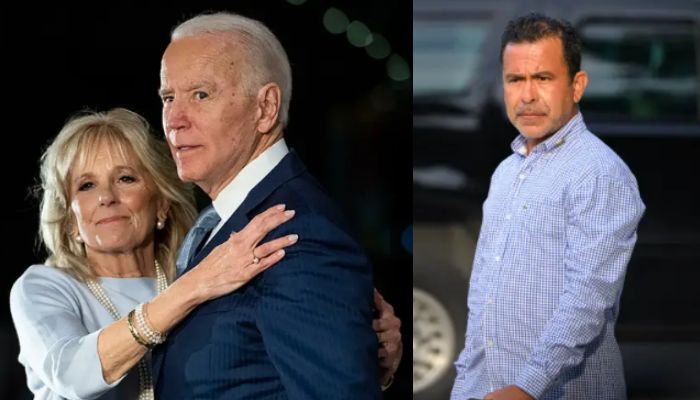
Anthony Bernal, a top official in the White House, has been accused of bullying and sexually harassing colleagues for more than a decade, as highlighted in an investigative report by the New York Post. According to the report, Bernal is considered ‘untouchable’ and wields significant influence as the top aide to Dr. Jill Biden, the First Lady of the United States.
Reportedly, Joe Biden’s wife, Jill Biden, refers to Anthony Bernal as her ‘work husband,’ according to the book ‘American Woman,’ published last month by New York Times reporter Katie Rogers. The book notes that Bernal is ‘known to make life hell for junior aides who find him to be impatient, demanding, and overbearing.’
Anthony Bernal also enjoys enormous clout in the White House operations and Democratic politics. According to the report, based on information from three sources with firsthand knowledge, Bernal has repeatedly speculated in the workplace about the p*n*s size of colleagues.
Two sources speaking with NYP revealed that Bernal (50) shared a theory with them that the size of a person’s thumb corresponds to that of their genitalia. They stated that this occurred on several occasions, both at the White House and when he was in different roles during Biden’s presidential campaign and vice presidency under President Barack Obama.
One source said, “It is to make people uncomfortable and to have power over them.” The person pointed out that they heard Bernal make the crude remarks over several years while they worked together adding, “It is Me Too — classic Me Too.”
A second source revealed hearing Bernal speculate ‘often’ inside the White House about the endowments of fellow political aides and even Secret Service agents.
A third source recalled a disparaging “jab”. According to the source, during a workplace disagreement, Bernal said about a colleague that he had a small p*n*s. In a separate encounter, the top aide of Dr. Biden “remarked on another staffer’s bulge in his khakis.”
Another former White House adviser said, “They talk a big game about integrity, decency, and kindness but when you work for the Bidens, you experience anything but that.”
A source said, “There’s no way [Jill Biden] doesn’t know. It has been going on for so long. I don’t think she has a lot of advisers willing to give her a gut check. I think she thinks that Anthony’s like her bulldog protecting her.”
The Source continued, “He (Bernal) is by far the worst and most well-known abuser, but the Biden White House is a magnet for ugly and abusive workplace behavior. It’s totally inexcusable this day in age, especially with Biden’s own narrative about standing up to bullies.”
“Her (Dr. Jill Biden) book and his (Joe Biden) stern lecture at the beginning of the administration about respect for colleagues is all bulls***. They couldn’t care less how the staff is treated because the staff is totally disposable to them. They’ve had a revolving door of staff catering to them for their entire adult lives,” the source added.
No action against Anthony Bernal, The White House comes out in his defence
The report noted that earlier there were complaints about Anthony Bernal’s ‘abusive’ nature which was pointed out by Politico in August 2021, but no action was taken against him.
One former White House official said, “He’s seen untouchable due to his relationship with the first lady. Staff have been told he’s ‘protected’ by Jill or that they should take it up with him directly.”
Furthermore, the White House released a statement on Monday in which it defended Dr. Biden’s top aide Anthony Bernal. In the statement, White House chief of staff Jeff Zients said, “The president and first lady have full confidence in Anthony’s character, as do I. His many fans at the White House know him to be both gracious and tough, holding himself up to the highest standards, with a heart dedicated to public service. It is disappointing that he is the target of unfounded attacks from unnamed sources.”
Defending himself, Bernal also denied the claims, saying, “These unfounded attacks are not true.”
This is Sexual harassment, says Expert
Louise Fitzgerald is a prominent expert on workplace sexual harassment policy. Speaking with New York Post, Fitzgerald noted that Bernal’s alleged behaviour fits the criteria for wrongful conduct.
The expert added, “It generally has nothing at all to do with getting somebody into bed; rather it’s a power play whose purpose is to denigrate individuals on the basis of their sex, sexuality, or gender presentation.”
Fitzgerald added that gendered hostility “is by far the most common form of sexual harassment.”
On Sunday (10th March), the Mamata Banerjee-led-Trinamool Congress announced the list of candidates for all 42 constituencies in the upcoming Lok Sabha elections. One of the candidates happened to be an Islamist named Shahnawaz Ali Raihan.
A native of Kaliachak town in Malda district of West Bengal, Raihan has been fielded by the TMC from the Muslim-dominated Malda South constituency.
While the TMC ecosystem has been justifying his candidature by highlighting his education at Oxford University, the party has carefully skirted over his radical Islamist views, glorification of invaders, and downplaying of terror activities.
TMC candidate fearmongers about India
After the victory of the BJP in the 2019 Lok Sabha elections, Shahnawaz Ali Raihan was invited by Turkish State-owned media ‘TRT world’ to spread canards about India.
The now-TMC candidate did not waste time in scaremongering about the country while peddling the ‘Jai Bheem, Jai Meem’ narrative in the hopes of separating the Dalits from the Hindu fold.
Raihan brazened out, “It’s not only bad news for Indian Muslims, but for the Dalits, for the Adivasis, the tribals, for the farmers. It’s bad news because Narendra Modi somehow succeeded in polarizing India, and this election held in an environment deeply vitiated over the last five years. There was a relentless assault on the democratic institutions who organized mob lynching, mob lynching of the Muslims, the Dalits, the attacks on the Dalits, and Modi’s government somehow curtailed the freedom of press.“
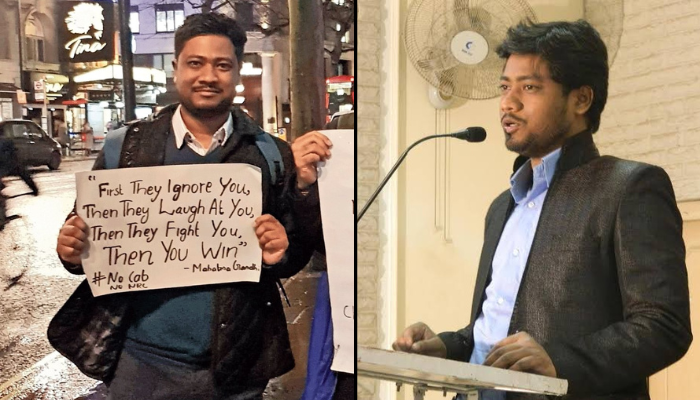
Shahnawaz Ali Raihan joined anti-CAA protests in London, raised ‘Azadi’ slogans
Following the legislation of the Citizenship Amendment Act (CAA) by the Indian Parliament in 2019, Shahnawaz Ali Raihan joined a group of ‘motivated protestors’ in demonstrating outside the Indian High Commission in London.
The protest was organised by the ‘South Asia Solidarity Group’ and the ‘SOAS India Society’ against CAA and the National Register of Citizens (NRC). During the demonstration, Shahnawaz Ali Raihan was seen raising the divisive and communal ‘Azadi’ slogans.
“Zor se bolo azaadi/ Hum kya chahtey azaadi“, he was quoted as saying by The Telegraph. “I could hear the cries of azaadi as I walked briskly towards the protest venue in Aldwych…It was raining but despite the chill, the crowd kept swelling,” he had said.
Screengrab of the report by The Telegraph
Shahnawaz Ali Raihan also insinuated that Prime Minister Narendra Modi had been speaking like a ‘white supremacist’ and that he would be behind bars if he had been in England.
Lies about CAA, repeats Pakistani talking points on Kashmir
In December 2019, TRT World again invited him to peddle disinformation about the Citizenship Amendment Act and Raihan did not disappoint.
“…The government is asking them to prove their citizenship. Their forefathers decided not to migrate to Pakistan. During the partition of India back in 1947, they decided to stay in India, and now the government is asking them to prove their citizenship. So this citizenship bill actually is a racist and very discriminatory bill,” he had claimed then.
This was despite the fact that CAA has nothing to do with Indian citizens and applies to illegal immigrants from religiously persecuted communities who entered India before 31st December 2024.
We ask University of Oxford's Shahnawaz Ali Raihan whether India's ruling BJP party would reconsider its position on the controversial citizenship law that triggered protests in the country and international condemnationpic.twitter.com/VqML1Li0Dr
During the interview, Raihan also alleged, “I definitely believe that this law will turn Indian Muslims as a second class citizen in a Hindu state. So, I mean, you tell me which country will accept that huge amount of population? Is it Bangladesh, Pakistan? No one is going to accept us. And the government can’t simply throw us out from the country. So what will happen? There will be a trauma. There will be anxiety. There will be protests. There will be discrimination.”
Later, he was heard repeating Pakistani talking points about the abrogation of Article 370 and claiming that the Modi government imposed a ‘state of emergency on Kashmir’, scrapped its autonomy and left it in extremely volatile state. “So is Indian government trying to impose this Kashmir modern on the Muslims living other parts of India? So I think, yeah,” he went on a hysterical rant.
Connection with Students Islamic Organisation of India
As pointed out by ‘Stop Hindu Hate Advocacy Network (SHHAN)’, Shahnawaz Ali Raihn served as the National Secretary of Studens Islamic Organisation of India (SIO) as early as 2010. SIO is the student wing of the radical Islamic outfit, Jamaat-e-Islami Hind.
Interestingly, one of the core agendas of SIO is to convert people to Islam through the concept of ‘Dawah’.
-Disquisition-
'Decolonising History: The Subaltern Challenge to Dominant Narratives'
?️ Shahnawaz Ali Raihan Doctoral Researcher in Modern History at the University of Oxford and Lecturer at Al-Akhawayn University (Morocco). pic.twitter.com/2M7jP2uAFo
As recently as May 2023, the official X (formerly Twitter) handle of SIO posted about Shahnawaz Ali Raihan and his participation in a disquisition titled ‘Decolonising History: The Subaltern Challenge to Dominant Narratives.’
This shows that the TMC candidate is still associated with the radical Islamist outfit.
Association with ‘Human Welfare Foundation’ raided by NIA
Raihan has also been pictured at events, organised by the ‘Human Welfare Foundation’. Interestingly, the same NGO was raided by the National Investigation Agency (NIA) in October 2020 in connection to a terror funding case.
At that time, the central investigative body had seized incriminating documents and electronic devices that suggested the diversion of funds meant for charitable activities to “secessionist and separatist activities.”
Maldah Dakshin TMC candidate Shahnawaz Ali Raihan present in the function of Human Welfare Foundation.
October,2020: Human Welfare Foundation was raided by NIA in terror funding case .
In a video from 2015, shared by popular X user ‘Subham (@subhsays), Shahnawaz Ali Raihan was seen making a case for the terrorists involved in the deadly 2014 Burdwan blast.
The incident claimed the lives of two people, namely, Shovan Mandal and Shakil Ahmed in the Khagragarh locality of Burdwan district of West.
The TMC candidate had then suggested that a conspiracy was underway by anti-terror organisations in India to copy the US’ Federal Bureau of Investigation (FBI) and implicate Muslims by suggesting extra-territorial connections.
"India anti terror orgs are stealing ideas from FBI.After every attack they show an emotion less muslim like in Khagragarh (13 burdwan blast) it was Rizia bibi.This is Islamophobia"- TMC Malda dakshin candidate Shahnawaz Ali Raihan. pic.twitter.com/pg5TxzKoCU
While the Islamist had tried to downplay the terror attack in 2015, a total of 19 individuals including 4 Bangladeshis were convicted by a special NIA court in connection to the case in August 2019.
The convicts were associated with the banned Islamic terror outfit, Jamat-ul-Mujaheedin of Bangladesh (JMB).
RSS BJP is not fascist but terrorist: Shahnawaz Ali Raihan
In February 2020, Shahnawaz Ali Raihan featured in a video posted by ‘The Companion’ and spoke on the ‘Chronology of Hindutva Terror.’ In the video, he was heard saying, “This Bhagwa terror has been going on for a long time. And it has a long history.”
Until recently, the co-religionists of Islamic terrorists would often claim that ‘terror has no religion’. This was done to hide the religious motivations behind their crimes against humanity.
Raihan who has maintained silence on radical Islamism and even attempted to whitewash the 2014 Burdwan blast alleged that BJP and RSS were running a terror network in the country. “From now on, stop calling it a communal or fascist party. Call it a terrorist party,” he brazened out.
While shielding his radical co-religionists, the TMC candide had claimed, “When a Muslim stands up for his rights, he is called an Islamic terrorist. But neither an Islamic terrorist nor a Maoist terrorist is the biggest threat to the internal security of India. Hindutva terror is the biggest threat to India.”
“Everyone has to come forward and accept that the biggest challenge of Hindustan is Hindutva Terror and this network is run by BJP and RSS,” he concluded.
Glorification of Islamic invaders
In October 2020, he participated in a programme titled ‘From Babri Demolition to Babri Verdict: The Crisis with Indian Nationalism’ hosted by an organisation named ‘India Tomorrow.’
At the very onset, Shahnawaz Ali Raihan shamed Bengali Renaissance leaders such as Raja Ram Mohan Roy, and Bankim Chandra Chatterjee for supposedly piloting the ‘Hindutva project’ and considering Muslim invaders as more dangerous than the Britishers.
He shamelessly defended Islamic invaders by claiming that they only colonised the land for 800 years but continued to live here, unlike the Britishers who took away resources and raw materials from India. Shahnawaz Ali Raihan shrewdly glossed over the barbaric rule of Islamic invaders
India is an Islamophobic country: Shahnawaz Ali Raihan
Ahead of the Pran Prathistha ceremony of the Ram Mandir, Shahnawaz Ali Raihan was roped in by the Turkish State-owned media to present a distorted history of the reconstruction of the majestic Hindu temple.
During the interview, the now TMC candidate alleged, “So you can understand how much Indian Muslims are alone today and how much are they on the edge. So yeah, I mean, in 1992, Islamophobia had not yet reached that unprecedented peak…We are living in an Islamophobic country. It’s clear in front of the whole world.”
“Of course, I mean, why he is going to inaugurate this incomplete temple? I mean, why is he in a hurry? This reimagining of India with Muslims as a second-class citizen is done through tomorrow’s event,” he claimed.
The Islamist lamented that the Opposition did not interrogate PM Modi about secularism and constitutional values. “Look, oppositions are trying. I mean, many opposition leaders said they will boycott tomorrow’s ceremony. We welcome their decision,” he was heard saying.
“The land we love, the land we cherished, the land where our forefathers had built it, the land what we called our own home. Now today we feel like outsider and all the opposition party, all the leaders of the opposition, you failed to stand up to the fascism of India. You haven’t done your best,” Shahnawaz Ali Raihan further added.
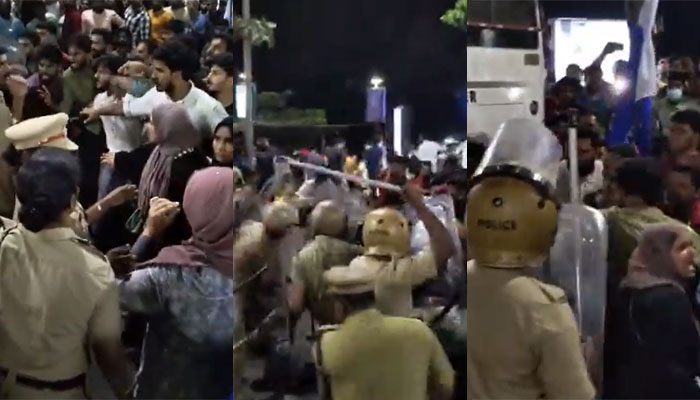
On 11th March, Kozhikode police in Kerala resorted to lathi-charge to disperse the anti-CAA protesters that were heading towards the Kozhikode All India Radio building.
Kerala Police resorted to lathi charge on students protesting CAA in Kozhikode. Women students were subjected to lathicharge during the protest organized by the Fraternity Movement outside All India Radio, a Union government institution. @MaktoobMediapic.twitter.com/4lih7BZfNR
Besides, a case against 124 protesters belonging to the Muslim Student Federation (MSF) and Congress-affiliation National Student Union of India (NSUI) was filed by Thiruvananthapuram Museum Police under Sections 143, 145, 147, 332 and 353. The protesters were also planning to march to Raj Bhavan. Furthermore, the Railway Police Force (RPF) filed a case against 40 NSU(I) members for blocking the train.
केरल पुलिस ने कोझिकोड में CAA का विरोध कर रहे छात्रों पर लाठीचार्ज किया. केंद्र सरकार के संस्थान ऑल इंडिया रेडियो के बाहर फ्रेटरनिटी मूवमेंट द्वारा आयोजित विरोध प्रदर्शन के दौरान महिला छात्रों पर लाठीचार्ज किया गया।#NoCAA#IndianMuslims#शाहीन_बाग#Keralapic.twitter.com/4Xq28uHxkq
Both MSF and NSU(I) alsostaged anti-CAA protests at Jamia Millia Islamia in Delhi.
CPM and Congress expected to use anti-CAA sentiments to gain Muslim votes
The immediate reaction that came from CPM and Congress in Kerala has made it clear that both parties are planning to use CAA to gain Muslim votes in the state. Both parties will be competing with each other to show themselves as the ‘messiah’ of the Muslim community.
Reports suggest that Congress faced criticism in Kerala for delayed reaction to Ram Mandir Pran Pratishtha. However, this time Congress was quick to react and issued statements after the Central Government notified rules for CAA.
Kerala Congress President K Sudhakaran said in a statement that if I.N.D.I Alliance comes to power in the 2024 Lok Sabha elections, they would throw CAA into the Arabian Sea. Congress leader VD Satheesan said the I.N.D.I Alliance was planning to launch a nationwide protest against the CAA and termed it a “plan to create communal division in society”.
Indian Union Muslim League (IUML), a Kerala-based political party that was the first to file a plea against CAA in the Supreme Court, said it would continue its fight against CAA. Notably, IUML has already submitted a fresh plea to stay CAA Rules notified by the Government of India on 11th March.
CPM is also opposing the implementation of CAA. Chief Minister of Kerala, Pinarayi Vijayan said, “The Centre has notified the citizenship amendment rules to create unrest in the country. The notification came just before the Lok Sabha elections. This is to divide the people, incite communal sentiments and undermine the fundamental principles of the Constitution.”
CAA rules notified by the Government of India
On 11th March, the Government led by Prime Minister Narendra Modi notified the Citizenship Amendment Act (CAA). This Act was crucial to the Bharatiya Janata Party’s agenda during the 2019 Lok Sabha elections. The issuance of these rules is expected to create a pathway for persecuted minorities from the 3 neighbouring Muslim nations of Afghanistan, Bangladesh, and Pakistan to obtain citizenship in India.
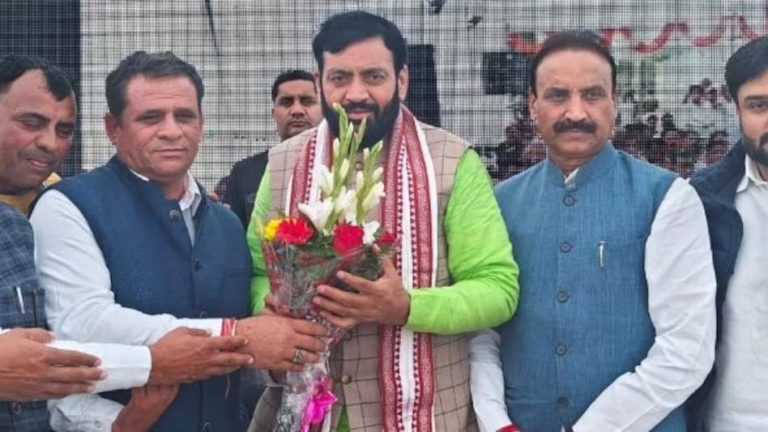
Bharatiya Janata Party (BJP) leader Nayab Singh Saini took oath as the Haryana Chief Minister on Tuesday at a swearing-in ceremony in Raj Bhawan, Chandigarh.
Four BJP leaders Kanwar Pal Gujjar, Jai Parkash Dalal, Moolchand Sharma, and Banwari Lal took oath as minister in the Haryana cabinet.
Also, one independent MLA Ranjit Singh was administered oath by Governor Bandaru Dattatreya.
Former Haryana CM Manohar Lal Khattar was also present.
Nayab Singh Saini, the Lok Sabha MP from Haryana’s Kurukshetra, met Governor Bandaru Dattatreya on Tuesday to formally stake claim to form the government in the state, replacing his predecessor, senior BJP leader Manohar Lal Khattar.
An influential figure within the OBC, or Other Backward Classes, community, Nayab Saini is the BJP’s Lok Sabha MP from Kurukshetra and was appointed the party’s state boss in October last year. He is also a close confidante of Khattar, whose second (consecutive) term ends this year.
Kurukshetra MP Nayab Singh Saini was appointed Haryana BJP state president in October last year. Nayab Singh Saini won the Kurukshetra constituency in the 2019 Lok Sabha elections by more than 3.83 lakh votes over his nearest challenger, Nirmal Singh of the Indian National Congress (INC).
In the 2019 Lok Sabha elections, the BJP had won all 10 parliamentary seats while JJP, which had contested the elections in alliance with AAP, could not put up a fight on 7 seats it contested.
The BJP has 41 MLAs in the 90-member House, in which the majority mark is set at 46. The government will be backed by six independent MLAs.
Earlier, Haryana Chief Minister Manohar Lal Khattar on Tuesday resigned from the state Chief Minister hours after the BJP alliance with the Jannayak Janata Party (JJP) broke. The JJP led by Deputy CM Dushyant Chautala had 10 MLAs in the Haryana Assembly. Manohar Lal Khattar submitted his resignation letter to Haryana Governor Bandaru Dattatreya.
(This news report is published from a syndicated feed. Except for the headline, the content has not been written or edited by OpIndia staff)
The minorities in Afghanistan, Bangladesh, and Pakistan had fled countless atrocities and arrived in India brimming with hope. They believed that in India, they would not experience the horrors that befell them in the Islamic nations and that they would be bestowed with an opportunity to live with dignity. However, many political parties were mired in appeasement politics and could not move past it, resulting in these people’s situation remaining unchanged. However, when the Citizenship Amendment Act was introduced by the Modi administration in 2019, all of these destitute Hindu refugees became optimistic once again.
Today, while West Bengal chief minister Mamata Banerjee opposes CAA and calls the implementation of the Act to be serving the BJP’s ‘political interest’, several communities like the Matuas in south Bengal and Rajbanshis, as well as Namasudras in north Bengal, are right now abuzz with tremendous happiness owing to the Modi government’s decision. For years, these Hindu refugees have waited to get Indian citizenship rights. They have been waiting for its implementation ever since the BJP government announced its introduction in 2019.
Celebrations galore in Matua belts in West Bengal
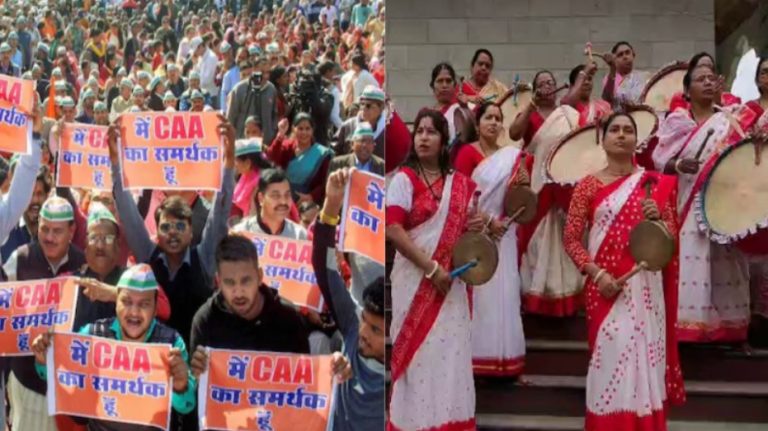
The happiness of the people of these indigenous sects knew no bounds after the Modi government on March 11, Monday, notified the law. Members of the Matua community celebrated the occasion by beating drums and exchanging pleasantries. They came out on the streets with flags to celebrate being awarded Indian citizenship at last. They called the historic moment a turning point in their lives. They called it their “second Independence Day”.
Matua Community is all now on streets celebrating & expressing their gratitude to Prime Minister Modi for CAA pic.twitter.com/iYtgzblETv
— Sudhanidhi Bandyopadhyay (@SudhanidhiB) March 11, 2024
They expressed gratitude towards Prime Minister Narendra Modi, Union Home Minister Amit Shah, and local MP and Union Minister Santanu Thakur for implementing the CAA. A person from the Matua community said, “Our wish has been fulfilled. Shantanu Thakur is like God for us. As long as there are Matua people, Shantanu Thakur will be considered God. Apart from Shantanu Thakur and Modiji, no one else thought for us.”
A person from the Matua community said, "Our wish has been fulfilled. Shantanu Thakur is like God for us. As long as there are Matua people, Shantanu Thakur will be considered God. Apart from Shantanu Thakur and Modiji, no one else thought for us." pic.twitter.com/7ffutar7C1
Overwhelmed by the scenes on the streets of West Bengal, where these Hindus were seen dancing and singing Leader of the Opposition and Bengal BJP leader Suvendu Adhikari thanked PM Modi for fulfilling the promise of granting Indian citizenship to the weaker section of Hindus who migrated to India fleeing persecution in neighbouring Islamic countries, through the CAA.
“This is #ModiKiGuarantee I wholeheartedly thank Hon’ble Prime Minister Shri @narendramodi Ji and Hon’ble Home Minister Shri @AmitShah Ji for notifying the rules of the Citizenship Amendment Act (CAA). The CAA, which was passed by the Parliament will now be implemented and the Act will come into force across the nation. The long-standing demand of the Matua Community will now be fulfilled and they will get Citizenship and no one can deny them their rights, not even Mamata Banerjee. I would like to extend my best wishes and regards to the Matua Community and the All India Matua Mahasangh,” the BJP leader wrote on X.
I wholeheartedly thank Hon'ble Prime Minister Shri @narendramodi Ji and Hon'ble Home Minister Shri @AmitShah Ji for notifying the rules of the Citizenship Amendment Act (CAA).
— Suvendu Adhikari (Modi Ka Parivar) (@SuvenduWB) March 11, 2024
Matuas, Rajbanshis and Namashudras communities in West Bengal
Classified as a Scheduled Caste (SC), Matuas are Namasudras or lower caste Hindu refugees who migrated to India during the Partition and after the creation of Bangladesh (erstwhile East Pakistan). Though there are no exact figures available, it is estimated that the Matuas constitute around 10 to 15 per cent of the entire population of West Bengal. The community which has an estimated population of three crores in the state mostly resides in the North and South 24 Parganas districts and across the bordering districts like Nadia, Howrah, Cooch Behar, North and South Dinajpur and Malda.
They are known to have a presence across at least five Lok Sabha constituencies in south Bengal, of which the BJP won two – Bongaon and Ranaghat – in 2019.
The Rajbanshis is the indigenous population of north Bengal. They are a numerically smaller group that is partly comprised of Hindu refugees from Bangladesh. According to the 2011 census, Rajbanshis are the largest Scheduled Caste community in Bengal constituting 18.4 per cent of the total population of Scheduled Castes, which means around 39,37,600 people out of the total 2 crore 10 lakh SCs in WB are Rajbanshis. Their community is considered more influential in areas like Cooch Behar, Jalpaiguri.
The Namasudras constitute 17.4 per cent (37,23,600 people) of the total SC population in West Bengal, the second-largest in the state after the Rajbanshis in North Bengal according to the 2021 census. The group of Namasudra Dalit Hindus were a small part of the migration who settled in different parts of India after being persecuted in Bangladesh. But their number is higher in Bengal. While the leftists have rejected them and their demands from time to time, the Modi government has listened to them. Be it in the 2019 Lok Sabha elections or the 2021 Assembly elections… every time BJP mentioned them and promised to give them respect and by 2024, their demand was heard which had been ignored for years.
Notably, citizenship rights and refugee rehabilitation constituted the core concerns of these three communities. These communities will undoubtedly be impacted favourably by the Bharatiya Janata Party’s decision regarding the implementation of CAA.
Prime Minister Narendra Modi visited the Matua Thakurbari temple in Bangladesh’s Orakandi on March 27, 2021. He visited Matua Thakurbari ahead of the 2019 Lok Sabha polls and met Matua matriarch Boroma. He had promised CAA during his first rally in Thakurnagar.
The Matuas who had once stood behind the TMC supported the BJP in the 2019 Assembly polls.
Now, the CAA implementation before the 2024 Assembly polls by the BJP government is sure to change the Matua poll calculation in Bengal.
Wave of happiness among the Matua community after the announcement of CAA implementation.
Their demand for citizenship is years old, which is finally fulfilled by BJP?
Matua community played a big role in BJP's excellent performance in Bengal in 2019. pic.twitter.com/KvHEsSUv07
The Matua community’s declaration of March 11 as their second Independence Day indicates how happy they are. The happiness and fervour were palpable as around 1,000 Matua members gathered at Thakurbari and danced to the beats of the donka, a traditional drum, and the rhythm of cymbals and bells as they celebrated in front of the temples dedicated to the spiritual gurus Sri Sri Harichand and Guruchand Thakur.
Let us inform you that the reason these Bengali communities are so happy is that, up until now, the past government have made no attempts to accord them respect or to hear out their grievances. However, things are about to change. These Dalit Hindus who came to India as refugees will heard and efforts will be made to provide them with the recognition they deserve.