India’s busiest airline, IndiGo, has been hit by a wave of mass flight delays and cancellations this week, leaving thousands of passengers stranded across the country and forcing emergency interventions from aviation authorities.
The disruption, one of the worst in recent years, has exposed how regulatory change and operational decisions collided to create a nationwide aviation crisis.
What triggered the crisis?
The chaos stems largely from the enforcement of updated Flight Duty Time Limitations (FDTL), stricter DGCA regulations designed to make air travel safer by reducing pilot fatigue. The rules mandate longer rest periods, tighter limits on flight duty hours, and significantly fewer night landings.
Airlines must now rework crew rosters to remain compliant, and IndiGo, which runs the largest flight network in India, found itself scrambling to meet the new norms.
Complicating matters further, the airline was already battling technology glitches and seasonal congestion, which combined with the rule changes to form a perfect operational storm. The result: widespread cancellations, heavily delayed departures, and terminal chaos across metros and regional hubs alike.
Why IndiGo was hit the hardest
IndiGo’s vast network, operating over 2,300 flights every single day, including a high volume of late-night and early-morning sectors, has long depended on squeezing maximum flying hours out of every aircraft. To sustain that pace, the airline built its roster around quick turnarounds and long operational windows, with pilots often handling multiple night landings and functioning on shorter rest intervals.
But the new fatigue-management regulations have fundamentally disrupted this model. With stricter limits on duty hours and mandatory longer rest periods now in force, IndiGo’s tightly packed scheduling strategy has come under severe strain, exposing a shortage of deployable crew and triggering the spate of nationwide delays and cancellations.
A Reuters report quoted sources as saying that IndiGo was already running short on crew, making its network extremely vulnerable the moment the new restrictions kicked in. Worse, scheduling software faults reportedly further disrupted roster management last weekend, compounding the operational chaos.
Scale of the meltdown
Over the past two days, more than 300 flights have been cancelled, while many others suffered delays running into several hours. The impact has been severe at airports in Bengaluru, Hyderabad, Mumbai, and Kolkata, where long queues, packed terminal halls and angry passengers became the norm.
As of December 4, 2025, IndiGo flights are facing disruption across the country as the new rules kick in, forcing the airlines company to comply with them, which has invariably caused delays and chaos.
Social media, meanwhile, has exploded with complaints, from lack of information and last-minute cancellations to passengers being stranded overnight without accommodation or meal support.
Some flights showed “on-time” status on boards, only to be cancelled at the last minute. Others were delayed by 6–10 hours before being scrapped. The uncertainty has eroded trust in a carrier many had long considered reliable.
X is replete with complaints about the delays passengers are facing at the airport. “Flights getting cancelled one after another, chaos at the gates, passengers arguing with crew, zero communication,” grumbled a social media user on X.
IndiGo is in a terrible state right now. Flights getting cancelled one after another, chaos at the gates, passengers arguing with crew, zero communication.
My own flight has been delayed with no clarity, we’ve been at the airport for 2 hours just waiting for any update.
Alarmed by the worsening situation, the DGCA has summoned IndiGo’s senior leadership to justify the scale of disruptions and lay out a credible recovery plan. The regulator noted a steep drop in the airline’s punctuality performance over recent weeks and is scrutinising whether IndiGo sufficiently planned for the new FDTL mandate.
What IndiGo says
The airline has publicly apologised, acknowledging “significant disruption” to operations and promising to normalise schedules within 48 hours through “calibrated adjustments.” It has said that customer support teams are assisting affected passengers with rebooking or refunds, though the situation on the ground suggests this response remains uneven.
But even as these emergency measures get rolled out, the core structural issues remain: to comply with FDTL, IndiGo (and any large airline) must rebuilt roster-planning, hiring and crew pipelines, not just for short-term patching, but for long-term sustainability.
What the crisis highlights
The crisis highlights a deeper tension in India’s booming aviation market: airlines aggressively expanding operations without proportionately expanding crew capacity may now find themselves unable to comply with safety-driven norms without severe service disruptions.
Aviation experts warn that pilots flying beyond safe fatigue limits is not an option, and the current experience could push airlines to rethink lean staffing as a strategy.
What it means for passengers
IndiGo’s operational culture, focused on ultra-tight turnaround efficiency, has hit a regulatory wall. The airline must now prove that it can rebuild resilience into its network without compromising safety, cost-efficiency, or passenger trust.
For the moment, travellers are advised to check flight status before leaving home, keep essential supplies handy, and prepare for unpredictable delays until the issue settles.
A Pakistani terrorist and ‘student’ from the University of Delaware has been arrested for planning a mass shooting targeting the university’s police department. Investigators say that he wanted to “kill all” and seek “martyrdom” in a mass shooting on the University campus
The terrorist, 25-year-old Luqmaan Khan, was found with weapons, ammunition, and disturbing handwritten notes that revealed his intentions. He was arrested just before midnight on 24th November after police officers found him acting suspiciously inside a parked pickup truck in a closed public park in New Castle County, Delaware. Officers first approached him for a routine check, but things quickly took a turn when they searched his vehicle and found several deadly items.
Loaded guns, armour and attack plans found in Truck
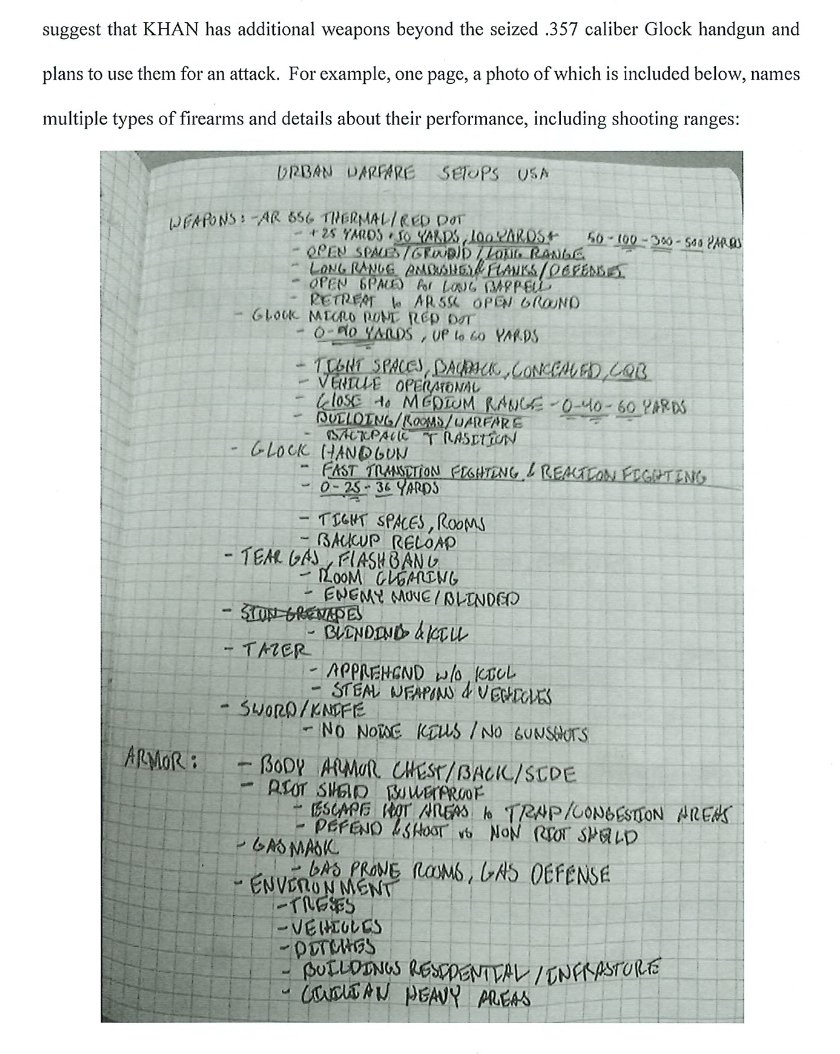
Inside the truck, police found a loaded .357-calibre Glock handgun, three extra high-capacity magazines, a ballistic armour plate and two notebooks containing handwritten attack plans. This discovery led to his immediate arrest and triggered a deeper investigation by federal authorities. Police say the items found inside his vehicle showed that he was not just thinking about violence but was preparing himself for a serious terror-style attack.
Image via X/Theunk13
Who is Luqmaan Khan?
According to the police documents, Luqmaan Khan was born in Pakistan but moved to the United States at a young age and now he is dual citizen. He has lived in the US for many years and is now an American citizen. He was studying as an undergraduate student at the University of Delaware at the time of his arrest. During the interrogation later, he said that being a martyr is “one of the greatest things you can do,” and it was his goal.
Pakistani-American student Luqmaan Khan was arrested with machine gun and a manifesto for plotting to attack the University of Delaware campus
He was born in Pakistan but moved to United States and is now a dual citizen. pic.twitter.com/Y9TaP5nPzl
After his arrest during the traffic stop, Khan was taken to the New Castle County Police Headquarters. He was initially charged with resisting arrest, concealed weapon possession and multiple firearm offences. His bail was set at $107,200 in cash. Khan has been charged at the federal level with unlawful possession of a machine gun, an offence that carries a maximum prison sentence of 10 years.
His notebook reveals his main motive: to “kill all for martyrdom”
The most disturbing part of the case comes from the notebooks police discovered in his vehicle. These notebooks contained detailed handwritten plans describing how he wanted to carry out an attack and escape afterwards. Prosecutors said the notes explained various weapons he could use, methods to carry out the shooting and techniques to evade law enforcement.
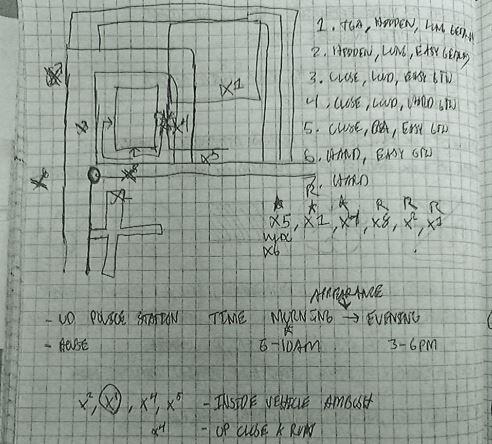
ABC 6 reported that one chilling sentence written in the notebook read: “kill all for martyrdom,” which clearly indicated he was prepared to sacrifice his life while taking many others. The notebook also included a hand-drawn layout of the University of Delaware Police Department headquarters, showing marked entry and exit points. It even mentioned one specific campus police officer by name, though officials have not yet revealed why the officer was singled out.
Officials said one of the notebooks contained extensive handwritten material describing potential weapons, methods for conducting an attack and ways to evade law enforcement. “The notebook referenced a member of the University of Delaware’s Police Department by name, and included a layout of a building with entry and exit points under which the words ‘UD Police Station’ were printed,” the US DOJ (US Department of Justice) stated.
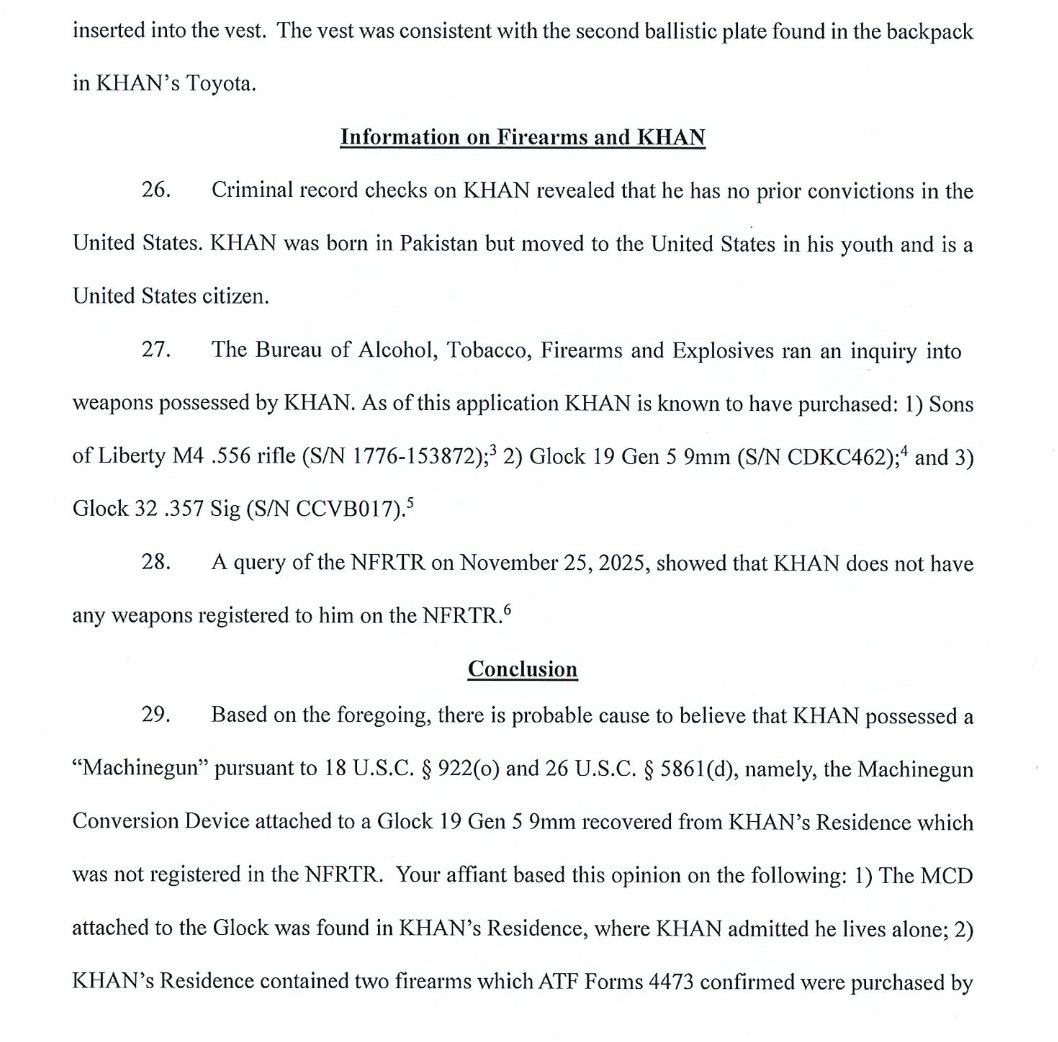
Investigators reviewed Khan’s firearm purchases and learned that he had legally bought multiple weapons over the past few years. However, two of the seized guns had been modified using illegal conversion devices that turn a normal pistol into a fully automatic machine gun. Authorities explained that such a converted weapon can fire up to 1,200 rounds per minute, making it far more deadly. This finding added to concerns that Khan was preparing for a large-scale, violent operation and intended to cause maximum casualties.
FBI raids home, recovers more military-grade weapons
Investigators confirmed that he did not have a past criminal record in America, but the evidence they uncovered shows that he was getting ready for something extremely dangerous. After his arrest, the FBI searched his home in Wilmington and found even more weapons. They recovered an AR-style rifle fitted with a red-dot optical scope, another Glock pistol fitted with a machine-gun conversion device, several extended magazines, hollow-point bullets and a tactical vest prepared to carry ballistic plates. Officials said these weapons and gear were similar to what is used in military-style operations.
Image via X/FrontalForce
University imposes ban, calls for calm
Acting US Attorney Julianne E Murray described the case as “a quintessential example of federal and state law enforcement collaborating to neutralise a grave threat to Delaware before the worst could come to pass.”
In a message to the university community, Interim President Laura Carlson confirmed that Khan was an undergraduate student and stated that the university had taken action to remove him from campus. “The University has temporarily separated the student from the University, including a ban from all UD campuses while legal matters are being resolved,” she wrote. She added that there were “no known or immediate threats to the University of Delaware community.” Carlson acknowledged the seriousness of the evidence described by authorities. “This is frightening to all of us,” she said.
While the motive behind Khan’s plot remains unclear, law enforcement officials say that if he had not been stopped, the results could have been catastrophic. A frightening combination of detailed attack planning, heavy weapons and a desire for “martyrdom” suggests that his goal was to kill as many people as possible and die in the process.
There is a peculiar pattern in Pakistan’s behaviour whenever tragedy strikes a neighbouring nation. Natural disaster, humanitarian crisis, civilian distress, Islamabad treats it less like an urgent call for help and more like an opportunity for a self-congratulatory publicity stunt. It has become a professional habit: do the bare minimum, loudly market the gesture, and expect the world to applaud. Except, every time, the truth leaks out like the smell of expired lentils Pakistan keeps dumping as “aid”.
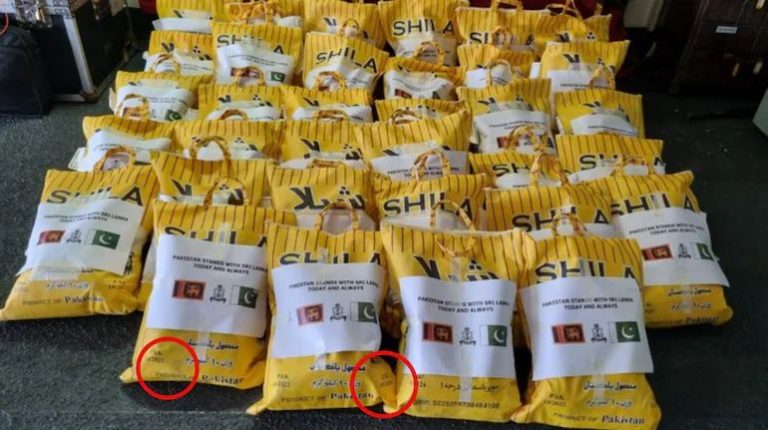
The most recent embarrassment unfolded in Sri Lanka. The island nation, already suffering from the wounds of devastating floods and a deadly cyclone, found itself at the receiving end of Pakistan’s “help”. Islamabad’s High Commission in Colombo proudly posted photos online, flaunting relief supplies supposedly sent to bring solace to disaster-affected Sri Lankans. They probably expected hashtags, praise, and diplomatic brownie points.
What they received instead was humiliation.
Printed clearly on those shiny “aid” packages, in letters no amount of PR filters could hide, was the date: EXP: 10/2024. The relief material had expired more than a year ago. Humanitarian aid is meant to uplift people in crisis, but what Pakistan sent to Sri Lanka was effectively garbage dressed up as compassion. Items that should have been discarded were being offered to disaster survivors who had already lost enough. There is incompetence, and then there is whatever this is.
To add insult to injury, the High Commission itself proudly showcased the expired consignment, which means nobody in Pakistan’s diplomatic chain even bothered to check what they were dispatching. That is not just careless; it is callous. You don’t need to be wealthy to show empathy. But Pakistan always somehow finds a way to look like it doesn’t even care.
Not a one-off disaster: A consistent pattern of hollow humanitarianism
Sri Lanka is simply the latest chapter in a book Pakistan has been writing for years, a manual on performative humanitarianism. The idea seems to be: send anything, claim a moral victory, and hope domestic media and delusional social media warriors will project it as global goodwill. This ritualistic, photo-op-first approach to crises has become Pakistan’s signature diplomatic tool.
Just a few years ago in 2022, Afghanistan, another neighbour Pakistan had then claimed eternal brotherhood with, although they are at each other’s throat currently, received rotten wheat from Islamabad. It wasn’t “slightly damaged” or “close to expiry”. The Taliban, of all people, had to publicly point out that the wheat was not fit for consumption. When even the Taliban are lecturing you on quality control, it is time for some serious national introspection.
However, Pakistan avoids introspection with the same dedication with which it avoids accountability. Instead of examining how and why such degrading aid was dispatched, Pakistan’s authorities ensured that the Afghan spokesperson who dared to speak the truth was swiftly removed. In Pakistan’s worldview, the narrative is always more important than reality. If facts embarrass the state, you do not correct the facts, you silence them.
India stands up with real help, not photo-ops
While Pakistan spoils its neighbours with expired excuses, India has embraced a humanitarian role anchored in responsibility, credibility, and respect. Under the Neighbourhood First policy, India has displayed what real relief operations look like, strategic, swift, and driven by compassion. India’s ongoing mission in Sri Lanka, Operation Sagar Bandhu, has already delivered more than 53 tonnes of life-saving supplies by land, air, and sea. These include tents, hygiene kits, surgical equipment, medicines, blankets, and other essential relief goods, all procured with urgency and empathy, not collected from scrap heaps.
What truly distinguishes India’s approach is that it doesn’t stop at delivering materials. The rescue component has been equally significant. Indian Navy ships such as INS Vikrant, INS Udaygiri, and INS Sukanya, along with Indian Air Force helicopters like MI-17s and naval Chetak aircraft, have been actively involved in airlifting stranded people trapped in the most inaccessible zones. Pregnant women, babies, the elderly, injured civilians, India’s rescue forces treated them all not as statistics or diplomatic tokens, but as human lives worth saving.
Many of those rescued were Sri Lankan citizens. Many were Indians stuck during travel. There were also tourists from Germany, the UK, Australia, and even Pakistanis who needed evacuation. India did not check passports before extending a hand. That is the difference between a responsible regional power and a performative one.
Islamabad’s aid strategy: Impress the audience, not help the victim
For Pakistan, humanitarian gestures appear to be little more than marketing products, props to click a few photos with, tweet a few lines about, and forget immediately afterward. The victims do not matter. What matters is whether the gesture can fool the domestic audience into believing their country is a benevolent power standing tall in the region.
This behaviour reveals a deeper cultural and political defect, a national mentality built on denial, where optics always override truth. Pakistan prefers PR over people; it chooses posturing over performance. And every fresh crisis exposes this hollowness again. It is not that Pakistan cannot provide genuine help. It is that it chooses not to because the goal is never to uplift the victim. The goal is to uplift Pakistan’s fragile ego.
The Operation Sindoor parallel: A nation in love with delusion
If Pakistanis can lie so effortlessly during a humanitarian situation, imagine the degree of delusion when military pride is involved. Earlier this year, during the undercover precision strikes carried out under Operation Sindoor, India successfully hit nine terror camps and at least eleven Pakistani Air Force bases. These strikes were a major jolt to Pakistan’s security establishment, exposing vulnerabilities that Islamabad pretends do not exist.
And yet, as Indian strategic and defence circles analyzed the success of the operation, large sections of Pakistan’s population were celebrating online, claiming that their air force had managed to shoot down a couple of Indian fighter jets in retaliation. There was no visual proof, no wreckage, no satellite images, nothing but bravado and digitally manufactured fantasies. Pakistan’s truth is whatever Pakistan’s propaganda mills say it is, regardless of whether evidence exists.
This is the same mindset visible in the expired aid scandal. Reality: expired food sent to a suffering nation. Pakistani narrative: we saved the day. Reality: wheat that even the Taliban reject. Pakistani narrative: leaders of Islamic humanitarianism. Reality: Indian fighter jets struck with accuracy across the border. Pakistani narrative: imaginary Indian losses broadcast by imaginary analysts.
A neighbourhood remembers
In times of crisis, the world does not remember speeches. It remembers who showed up to help, and how. Sri Lanka will remember which neighbour sent functional supplies with military support, and which neighbour sent expired leftovers. Afghanistan will remember who sent 50,000 tonnes of high-quality wheat through complicated transit negotiations, and who sent mouldy grain treated like charity.
Pakistan demands appreciation merely for making a noise. India earns respect by saving lives silently.
Performative generosity vs Real responsibility
Sri Lankans do not need expired medicines. Afghans do not need rotten wheat. Disaster victims do not deserve to be props in Pakistan’s PR theatre. Humanitarianism is not a checkbox exercise or content for social media promotion. It is empathy in action, something Pakistan desperately tries to imitate but consistently fails to demonstrate.
India behaves like a country prepared for leadership: delivering rescue, relief, and reassurance. Pakistan behaves like a country surviving on optics: delivering excuses, expired food, and empty boasts. A neighbour’s darkest hour is a test of character. India’s character shines. Pakistan’s has an expiry date.
And like all its exported products, that date passed long ago.
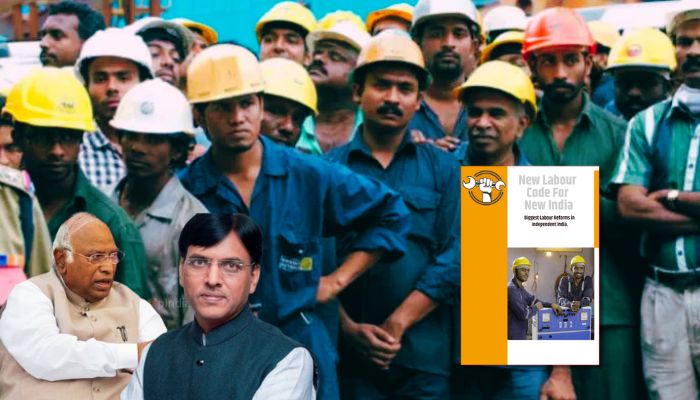
Ever since the Modi government has enforced the new labour codes in November, the opposition parties are fear-mongering about and protesting against it. On 3rd December, Congress president Mallikarjun Kharge published a long X post raising ‘serious concerns’ over the new labour codes. However, Minister of Labour and Employment, Mansukh Mandaviya retorted with a point-by-point rebuttal.
Modi Govt is anti-labour, anti-worker and pro-cronies!
The Opposition parties protested against the Modi Govt in Parliament today, expressing our strong objection about the newly implemented Labour Codes. Some of the serious concerns in the New Codes are –
Kharge claimed that the Modi government is “anti-labour, anti-worker and pro-cronies.” He claimed that the new labour codes pose a threat to job security.
“Layoff threshold raised from 100 to 300 workers i.e. more than 80% of factories in India can now lay off or retrench workers without government approval, reducing job security. – Expansion of Fixed Term Employment (FTE) will end many permanent jobs. – Companies can now hire workers on short-term contracts, avoiding long-term benefits,” the Congress leader wrote.
In response to this claim Labour and Employment Minister, Mansukh Mandaviya said that contrary to the Congress leader’s claim, the existing mandatory one-month notice and retrenchment compensation remain intact, “but Congress conveniently hides this to spread fear.”
.@kharge ji, everything you said about the Labour Codes is misleading and false. Here is the truth that exposes your lies.
Job Security Fully Protected
• Mandatory one-month notice and retrenchment compensation remain intact, but Congress conveniently hides this to spread… https://t.co/pz7I2JgDkj
He added that a provision for Reskilling Fund has also been brought up.
Notably, contrary to the fear-mongering being done by the opposition and its supportive propaganda machinery, increasing layoff threshold will aide creation of new jobs by giving the employer flexibility to engage more employees directly.
“Increasing the threshold will boost job creation, giving employers flexibility to hire more people directly instead of through contractors. • More formal jobs mean more social security, fixed wages, safety norms, and assured benefits, the very things Congress failed to expand in decades,” Minister Mandaviya said.
Refuting Kharge claim that expanding FTEs will end several permanent jobs, Mandaviya said, “Fixed Term Employees (FTEs) now enjoy all benefits equal to permanent employees (EPF, ESI, timely wages, minimum wages). This reduces rampant contractualisation that Congress allowed for years.”
Working Hours
On new rules regarding working hours, Kharge sais, “Although the Code keeps an 8-hour day on paper, states can allow 12-hour shifts through flexible scheduling. Coupled with state-determined overtime limits, this effectively permits much longer workdays, increasing fatigue and safety risks even when labelled “consensual.”
Minister Mandaviya accused Congress of deliberately peddling lies. The minister highlighted that employees can choose to work 12 hours for only 4 days, with three paid holidays. “Weekly working hours remain strictly capped at 48 hours. Any work beyond normal hours requires double overtime pay with the employee’s consent. Congress knows this, but prefers lies over facts,” the minister added.
Trade Unions’ Rights
The Congress leader further argued that the new codes will “weaken” trade unions and collective rights. He claimed that since the code says that workers must wait for 60 days before striking, in addition, a 14-day cooling-off period, would “prevent quick action against unsafe or unfair conditions.”
“Requiring one union with 51% membership to be the sole negotiator sidelines smaller unions and reduces representation for diverse worker groups. – Even the alternative negotiating council (comprised of 20% of workers) may leave many workers without a meaningful voice. – If 50% of workers take leave together, it is treated as a strike. This increases the chances of penalties and makes collective bargaining harder,” Kharge wrote.
In response to these claims, the Labour Minister said that the Congress party is peddling lies about 60 days waiting period before doing workers strikes. He said that contrary to Congress’s 60 days claim, “the law clearly states only a 14-day notice period is required.”
Dismissing Congress claim that waiting and cooling-off periods would prevent quick action against unsafe or unfair conditions, the minister said, “These reforms prevent flash strikes that harm workers’ wages and public convenience, something Congress used as a political weapon for years.”
“Reduced disruption means fewer lost man-days and more stable incomes for workers. The process ensures conciliation first, enabling peaceful dispute resolution, unlike the Congress era of chaos. For the first time ever, trade unions get statutory backing as the negotiating union. Collective bargaining is strengthened, not undermined,” the minister added.
The Congress leader also pointed out the standing orders and medium-sized units, and wrote, “Standing orders will not apply to units with fewer than 300 workers. Basic rules on working hours, leave, and termination will not be mandatory.”
Kharge claimed that this may “increase arbitrary “hire and fire” practices in medium-sized units.”
However, the Centre states that raising the applicability of threshold or standing orders from 100 to 300 workers curbs the compliance burden on small and medium textile enterprises, which make up a significant share of India’s apparel and fabric manufacturing base. Exempting smaller units from the requirement of certified standing orders will enable them to focus resources on productivity and export readiness rather than procedural compliance. This would result in improving their competitiveness in the global textile value chain.
Safety and Welfare
Under the “Weakened Safety and Welfare” subtitle, Kharge wrote, “By raising the definition of a factory to 20 workers (with power) and 40 workers (without power) where violations and unsafe conditions are most common, they fall outside the law’s safety net. – Sector-specific protections for vulnerable groups (journalists, beedi workers) have been merged into general codes, reducing safeguards.”
“Important details, such as floor wage calculation and social-security thresholds, are no longer fixed in the main law. They are to be notified as Rules, which the government can change through simple notifications, weakening parliamentary oversight and worker protections. Since the state governments can exempt any workplace from the Social Security Code, core safety and welfare protections can be easily bypassed,” Kharge added.
Furthermore, Kharge claimed that the new labour codes fail to extend safeguards for migrants. In addition, Mandatory Aadhaar-based registration risks leaving out migrants and informal workers who often face documentation errors or limited digital access, creating barriers to social-security enrolment.”
The Labour Minister addressed these claims made by the Congress leader. He said that Labour Codes “expand protections to 40 crore unorganised sector workers, including Gig & Platform workers, something Congress Govt never chose to attempt.”
Contrary to Congress’s claim that raising the definition of a factory to 20 workers (with power) and 40 workers (without power), workers at such establishments fall outside the law’s safety net, the minister said that “health, safety, and welfare rights fully apply to all establishments. No sector-specific protections have been removed. Journalists, beedi workers, and others continue to receive the same protections as before.”
Regarding Congress’s claim that new labour codes fail to extend safeguards for migrants, Minister Mandaviya said that appointment letters are now mandatory for every employee. He also added that states cannot exempt establishments from the Social Security Code without fulfilling conditions set by the Centre.
Accountability
The Congress leader also raised concern that linking fee to settlement of offences will turn wage violations into a payable cost, weakening accountability and effectively monetising illegality.
Addressing these claims, the Labour Minister said that only minor offences have been decriminalised and criminal prosecution are retained for serious violations “to ensure better compliance and faster justice for workers.”
Minister Mandaviya also pointed out that the same provisions of the new labour codes Mallikarjun Kharge ji isattacking, have already been enforced by many non-NDA states “by amending their existing labour laws. So, your criticism rings hollow even in states governed by you and your allies.”
The minister added at last, “Modi Government stands firmly for workers’ welfare, job creation, formalisation, and social security. Congress is attacking reforms it never had the vision to introduce. Congress has sunk so low in its hatred for the BJP that it is now standing against workers’ welfare. Absolutely Pathetic!”
The new Labour Codes
On 21st November 2025, the Modi government enforced the four Labour Codes in India. These include the Code on Wages (2019), the Industrial Relations Code (2020), the Code on Social Security (2020) and the Occupational Safety, Health and Working Conditions Code (2020).
These Labour Codes are aimed at rationalising a whopping 29 existing labour laws, modernise labour regulations, enhance the welfare of workers and lay the foundation for a future-ready workforce.
For the first time, the labour reforms have formally recognised gig and platform workers, including delivery executives on apps like Swiggy, Zomato, etc, bringing them under a formal welfare framework.
Changes brought in by the new Labour Codes which came into force from 21st November 2025
Mandatory appointment letters to all workers to ensure transparency, job security, and fixed employment.
All workers to get social security coverage including PF, ESIC, insurance
All workers to receive a statutory right minimum wage payment.
Employers must provide all workers above the age of 40 years with a free annual health check-up.
Employers must provide timely wages to employees.
Women are permitted to work at night and in all types of work across all establishments, subject to their consent and required safety measures.
ESIC coverage and benefits are extended Pan-India
Simplified processes and reduction in Compliance Burden.
Fixed-Term Employees (FTE) are eligible for gratuity after 1 year instead of 5
Gender-neutral pay and job opportunities, explicitly prohibiting discrimination—including against transgender persons.
National Floor Wage to ensure no worker receives a wage below the minimum living standard.
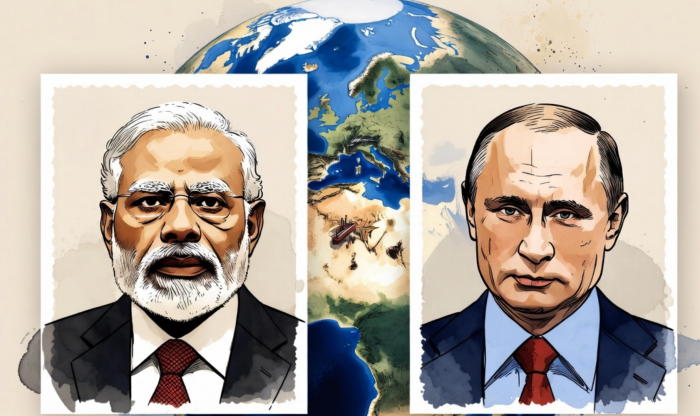
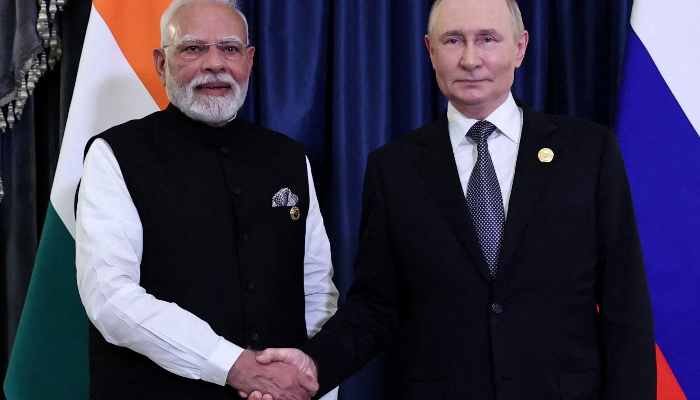
Tomorrow, New Delhi will host one of the most anticipated visits of the year. At Prime Minister Narendra Modi’s invitation, Russian President Vladimir Putin will attend the 23rd India-Russia Annual Summit on December 4-5, 2025, resuming the in person annual summit format after four years and a full-scale conflict with Ukraine. The visit has been formally announced by India’s Ministry of External Affairs (MEA), which defines it as an occasion to review the “Special and Privileged Strategic Partnership” and exchange views on regional and global concerns.
Most swift evaluations will reduce this conference to three clichés being S-400 missiles, Su-57 fighter jets, and discounted Russian oil. The amount of crude that has reached Indian ports since 2022 and India’s reliance on Russian weapons will be the subject of countless graphics. That’s all important. However, this does not fully explain why this visit is of such importance for Moscow, so sensitive for Washington and Brussels, and so beneficial for New Delhi.
In the background, the Modi–Jaishankar doctrine is evident. Multi-alignment, not non-alignment, strategic autonomy without yelling anti-West slogans, and a determined unwillingness to let either Washington or Beijing dictate whom India may cooperate with. This is as much about avoiding overdependence on China as it is about rejecting Western pressure.
What follows is a thorough dive into the “under the radar” agenda for tomorrow’s meetings i.e the payments, people and paths that will silently redefine what India–Russia ties mean in the coming decade.
A summit under pressure and a very public show of spine
This is not a usual summit season. The visit comes after US President Donald Trump put high tariffs on a broad basket of Indian goods, with American criticism openly tying that pressure to New Delhi’s decision to keep buying Russian oil and retain security ties with Moscow. The tariffs have been portrayed as part of a larger effort to drive India away from Russia by the Trump administration.
European diplomacy has been equally blatant. Just days before Putin’s arrival, the ambassadors of the UK, France and Germany co-authored an oped in an Indian newspaper severely criticizing Russia’s conduct in Ukraine and urged New Delhi to ‘do more.’
The MEA broke its normal silence and openly described the approach as “unusual” and “not acceptable diplomatic practice,” emphasizing that India does not enjoy being lectured on the eve of a big bilateral engagement.
On the Russian side, the messaging has been similarly pointed. The Kremlin has confirmed the dates of the visit and constantly stressed that India is a “key strategic partner”. Putin told Russian media that Moscow wants to “elevate cooperation with India and China to a qualitatively new level”, a rare public pairing of the two Asian giants in his pre-visit statements.
Dmitry Peskov, spokesman for the Kremlin, has gone further, claiming that Western sanctions on Russian shipping and oil are “illegitimate” and emphasizing that Moscow and Delhi are developing ways to maintain trade “without influence of third countries”, a diplomatic term for avoiding Western financial levers.
In this tense backdrop, the optics of tomorrow’s summit matter. For Western observers, Modi receiving Putin while tariffs, Ukraine and sanctions dominate headlines is uncomfortable. For Beijing, the fact that Russia is not fully locked into a China only embrace is also a difficulty. For Delhi, however, this is exactly the point: India will talk to every major pole the US, the EU, Russia, Japan, the Gulf, ASEAN but it will not allow any one bloc to veto its engagement with another.
Rewiring the money pipes: RuPay-MIR, UPI-SBP and the sanctions proof agenda
The most significant “non-defence” file on the table is arguably payments and financial plumbing. Without resilient payment methods, no amount of political goodwill or energy discounts will matter.
Since 2022, India and Russia have experimented with rupee-rouble settlement, Special Rupee Vostro Accounts (SRVAs), and bank-to-bank agreements that circumvent Western institutions in an effort to maintain trade despite the sanctions. These systems have kept trade alive but remain clumsy and unequal. Indian exporters complain of delayed payments and imprecise FX conversions. Russian businesses are trapped with significant rupee balances in Indian banks that they struggle to spend. A second-generation strategy focused on connecting national payment systems and instant payment platforms is anticipated to be pushed during this summit.
Rupay-MIR Card linkage: According to various publications, including the Economic Times and Russia focused trackers, India and Russia have agreed in principle to link India’s RuPay card network with Russia’s MIR system. Once operational, a Russian tourist in Goa using a MIR card or an Indian business traveller in Moscow using RuPay should be able to pay directly in local currency, without routing every transaction through Visa/Mastercard and Western banks.
UPI-SBP (fast payments) bridge: UPI, India’s real time digital payments backbone, and Russia’s SBP (System for Fast Payments) were discussed during External Affairs Minister S. Jaishankar’s recent visit to Moscow. According to Russia’s Pivot to Asia, this would allow users of national payment systems to execute near-instant cross-border transfers that are paid directly between Indian and Russian banks.
Honoured to call on President Putin of Russia in Moscow today.
If PM Modi and President Putin can declare even an initial framework or pilot for this payments system, it would signify a tremendous shift. Rather than fighting every new sanctions package on its own, India and Russia would be constructing a parallel banking infrastructure that gradually diminishes reliance on SWIFT and US-centric card networks.
For India, this is not about “de-dollarisation” chants. It is about insurance. In a world where sanctions and bank blacklisting have become normal measures, having a lasting alternative payments network with important partners is element of national security as vital as tanks and missiles, but considerably less visible.
From oil heavy to balanced: Fixing a broken trade relationship
India-Russia trade has expanded in value, but not in balance. As to MEA and commerce ministry data, bilateral trade touched around $68-69 billion in 2024/25, compared to barely $11-13 billion a few years earlier. The main driver has been low cost Russian crude, which Indian refiners have imported in considerable numbers since 2022.
The problem is that Indian exports have hardly changed, locked at roughly $4.9 billion, while imports from Russia (oil, fertilisers, coal, metals) have risen to nearly $64 billion, leaving India with a large trade deficit. That mismatch is unsustainable in the long term, both economically and politically.
Recent weeks have witnessed a marked shift in tone from Moscow. In interviews and briefings, Russian authorities have openly acknowledged the mismatch and stated desire to grow imports from India and improve market access. Reuters and Indian newspapers quote Dmitry Peskov as that Russia wants to “address India’s concerns on trade deficit” and make trade more strong and “shielded from third country influence”.
Officials in India have been setting the foundation. In November, the 26th meeting of the India-Russia Working Group on Trade and Economic Cooperation met in Moscow to review market access and regulatory impediments for Indian pharma, agricultural products, engineering items and services. Simultaneously, negotiations on a comprehensive free trade agreement have been restarted between India and the Eurasian Economic Union (EAEU), which comprises Russia, Kazakhstan, Belarus, Armenia, and Kyrgyzstan. An 18-month negotiation roadmap and terms of reference have apparently been finalised by the ministry of commerce.
26th Meeting of the India-Russia Working Group on Trade & Economic Cooperation ????
?️ 13 November 2025⁰ ? Moscow
Commerce Secretary Shri @RajeshAgrawal94 met Mr. Vladimir Ilyichev, Deputy Minister of Economic Development of the Russian Federation, for the 26th Meeting of the… pic.twitter.com/nZTxf9HUxG
The explanation for India is obvious. Use the oil driven trade surge to create new export possibilities in Russia and throughout the EAEU. Push for mutually recognized standards and speedier customs clearance for Indian pharmaceuticals, textiles, machinery, processed foods, and information technology services. Instead of leaving stranded rupee balances in Russian banks, convert them into orders for Indian goods and services.
Once more, the Modi-Jaishankar strategy is clear. Delhi is attempting to turn a vulnerability (trade imbalance) into leverage by demanding better terms for Indian exports as the price of long-term energy business, rather than apologizing for purchasing discounted oil, which directly benefits Indian consumers.
Energy 2.0: From cheap oil to long-term insurance
Energy is the visible thread that pushed Moscow and Delhi closer after 2022. At one point, highly discounted Urals crude accounted for over one-third of India’s imports, surpassing both Saudi Arabia and Iraq as the country’s top oil supplier. Recently, however, that proportion has slipped to a three-year low as new rounds of US and EU sanctions, tighter price-cap enforcement and concerns over “shadow fleet” tankers have made some Indian refiners more cautious.
Officials from the Kremlin are eager to stabilise volumes and maintain that this is only temporary. Putin is accompanied by senior executives from major Russian oil companies, according to the Reuters preview of this visit. The topics of discussion will include reviving or renegotiating India’s investments in upstream projects like Sakhalin-1, expanding cooperation in civilian nuclear energy, where Russia is still a major partner at Kudankulam in Tamil Nadu, and guaranteeing steady crude flows under sanction safe shipping and insurance arrangements.
The discussions tomorrow will focus on energy security on several fronts for India:
Oil and gas: Give Indian refiners certainty without overexposing them to Western fines by securing long-term supply contracts at conditions acceptable with the G7 price cap and secondary sanctions threats.
Nuclear baseload: Ensure timely construction and fuel delivery for Kudankulam’s further units and discuss prospective new nuclear projects so that India’s clean-energy transition has a robust, non-intermittent backbone.
Fertilizers and food security: Since 2022, Russian fertilizer exports to India have increased, and new agreements are being finalized to maintain price stability. Fertilizer and related inputs are now an essential component of the bilateral basket, directly impacting Indian farmers and the stability of food prices, according to a new research on trade between Russia and India.
Nothing about this is glamorous. But it is important to the political economy at home. A government that wishes to keep inflation manageable and sustain 7%+ growth cannot disregard the oil and fertiliser lifeline Russia supplies even as it diversifies with the Gulf, the US and others. Whether Delhi can establish long term, sanction resilient agreements instead of surviving shipment to shipment is the true test at this summit.
New routes to old friends: corridors, ports and, map politics
Beyond money and molecules, tomorrow’s talks also touch geography. For the past few years, India and Russia have been working quietly on a new connectivity map that lessens their reliance on chokepoints controlled by the West and conventional sea lanes. Two initiatives are essential here. The Eastern Maritime Corridor (EMC) and the International North South Transport Corridor (INSTC).
Since its initial announcement in 2019, the Chennai-Vladivostok Eastern Maritime Corridor has undergone feasibility studies and pilot trips. Recent workshops conducted by Chennai Port and Russia’s Far East officials have focused on operationalising regular shipping on this route, which can shorten transit time by up to 16 days compared to existing routes via Europe. The corridor is expected to carry not only coal and oil, but also fertilisers, lumber and potentially containerised cargo, enabling a direct India Far East link outside the crowded Malacca and Suez axis.
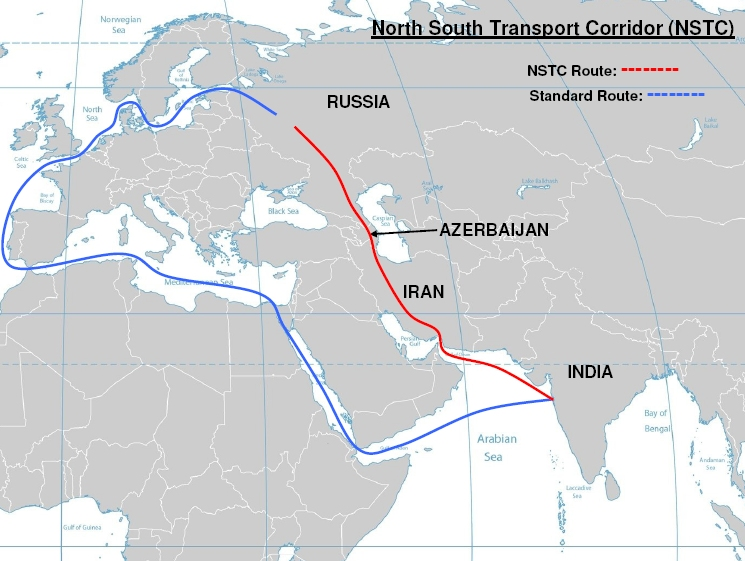
Meanwhile, the INSTC, a 7,200-km multi-modal network connecting Indian ports with Iran’s Bandar Abbas and Chabahar, the Caspian, Russia and ultimately to Europe, has gained increased prominence. With frequent delays in the Red Sea and concerns over Suez, INSTC offers an alternate route for trade with Russia and beyond.
International North-South Transport Corridor. (Source: Wikipedia)
This summit is expected to see new port-to-port cooperation agreements (for example, Chennai-Vladivostok, Mumbai-Astrakhan), progress on customs harmonisation and digital documentation along the INSTC, and possibly pilot “green corridor” schemes for priority cargo such as fertilisers, pharmaceuticals, and machinery.
This is important from a strategic standpoint for two reasons. First, it enables India and Russia design pathways that aren’t at the mercy of Western naval might or any crisis in West Asia. Second, it stops China’s Belt and Road Initiative from being the only game in town in Eurasia. Delhi does not want a scenario where every overland or maritime route from Asia to Europe flows either through Chinese-financed ports or Western-controlled sea channels. The gathering tomorrow will subtly advance the larger initiative to develop third possibilities, which includes EMC and INSTC.
People as a strategic asset: The Labour Mobility Pact
One of the most interesting items scheduled to be signed during Putin’s visit is a Migration and Mobility Agreement between India and Russia. This is about people, not hardware, unlike the major defense agreements, and it may have unexpected effects on Indian migration trends.
The deal has been finalized in recent days and would offer a framework for the legal migration of qualified and semi-skilled Indian workers to Russia, according to MEA briefings and stories in Indian media. All India Radio’s coverage and analyses in Chatham House and ABP Live point out that Russia is suffering an acute workforce shortage due to demographic decline, wartime mobilisation and restricted Western immigration, and is actively seeking to India to patch the gap.
The agreement is expected to include simplified work visas, residence permits, and documentation for Indians hired through approved channels, strong language on worker rights, wage protection, social security, and grievance redressal, and a sectoral focus on construction, manufacturing, IT services, healthcare, and possibly agriculture.
Estimates vary, but some publications imply that tens of thousands of Indian workers could relocate to Russia in the coming years under this system, with some speculative pieces mentioning long-term “lakhs” if the model works.
From Russia’s perspective, this is about maintaining manufacturing, construction sites, and service sectors operational despite sanctions and mobilisation. From India’s standpoint, it fits within a wider picture. India has previously negotiated or expanded labour mobility agreements with European, Gulf, and East Asian partners. The government openly sees abroad employment as a vehicle to transfer skills, generate remittances, and strengthen bilateral connections.
The Russia deal adds a new geography to the globe, one with strategic implications. If Indian workers become essential to Russian business, their welfare and safety will become a regular topic of discussion in bilateral conversations. In the event of a future crisis, that personal bond is still another reason Moscow should take Indian concerns seriously.
NavIC Meets GLONASS: Satellites, space and tech sovereignty
While defence analysts concentrate over S-400s and Su-57s, some of the most important collaboration during this visit will take place well above the ground. India and Russia are planning to interlink their navigation satellite systems, India’s NavIC and Russia’s GLONASS, in a way that might drastically reduce reliance on US and European positioning services.
A recent story in The Economic Times and follow ups in Russian aviation media suggest that the two sides are working on mutual deployment of ground stations for these systems, with important agreements expected during Putin’s visit to Delhi. Plans for a GLONASS ground station in Bengaluru and a NavIC (formerly IRNSS) ground station in Novosibirsk were detailed in a geospatial analysis article at least as early as 2017.
What is new is the urgency for Russia, as Western sanctions and threats to halt technological collaboration make it imperative to improve GLONASS accuracy and coverage with favorable allies. For India, the expanding usage of NavIC in commercial and military uses ranging from shipping and aviation to missiles and drones highlights the need for improved accuracy and redundancy.
By hosting each other’s ground infrastructure, NavIC and GLONASS can improve precision over respective priority regions, the Indian Ocean and Eurasia, and provide a reliable backup to GPS and Galileo. This is more than simply smartphone navigation apps; it also supports long-range missile and aircraft guidance, maritime domain awareness, logistics and supply-chain planning, and even clock synchronization for digital finance systems.
Beyond navigation, space cooperation is expected to broaden. A new long-form article on StratNews Global reports that India has publicly invited Russian businesses to engage in its commercial space endeavors, which range from satellite communications and earth observation to AI-driven space logistics and space infrastructure cybersecurity.
Here, the geopolitical logic is subtle but powerful, India collaborates with the United States and Europe on some space projects, Japan on others, and Russia on yet others. This multi-partner approach prohibits any single bloc from using space technology as a leverage point against India. For a government that frequently mentions “Atmanirbhar Bharat” in high technology, deepening space and navigation relations with Russia is another method to diversify dependence while advancing India’s own capabilities.
Everyday Security: Pharma, nuclear, fertilisers and food
The summit is anticipated to produce advancements in areas that immediately impact daily life, such as health, electricity, and food prices, in addition to grand strategy and advanced technology.
On pharmaceuticals and healthcare, India is already among the major providers of generic medications to Russia. The trade working group has been concentrating on lowering regulatory obstacles, harmonizing standards, and promoting cooperative production of pharmaceuticals and medical equipment in Russian industrial zones. With Western pharma businesses quitting or reducing back in Russia, Indian enterprises see a significant opportunity and Moscow sees India as a politically reliable, cost effective source.
In civil nuclear energy, Russia is India’s most important foreign partner. The Kudankulam Nuclear Power Plant has two functioning units built with Russian assistance and four more under construction. Tomorrow’s talks are likely to examine progress there and maybe discuss expanded nuclear cooperation, including fuel delivery agreements and maybe next-generation reactor designs.
On fertilisers and food security, Russia has quickly emerged as one of India’s primary suppliers of nitrogen, phosphate and potash fertilisers, especially after 2022. Today’s articles on trade between India and Russia and Shafaqna India specifically link the labor mobility agreement to a larger push on fertilizers, implying that tomorrow’s Memorandums of Understanding will contain procedures to ensure fertilizer supplies and perhaps local blending or production partnerships.
RT India and the information front
This visit coincides with an uncommon “soft power” development, the official opening of RT India, an English-language news station run by Russia’s state-backed RT network, from a new studio complex in Delhi.
In a brief statement, RT itself stated that RT India will start broadcasting on December 5th, with an emphasis on “India and Russia’s roles in a multipolar world” and a cutting-edge studio close to New Delhi. According to reports from Indian outlets, including regional media, the time was purposefully picked to align with Putin’s visit to India and presented as part of an effort to “strengthen the India-Russia bond through media outreach.”
For India, the picture is more complex. Officially, India allows a wide range of foreign-owned news and digital media. RT India will join a crowded media landscape that already includes Western broadcasters, Gulf networks, and Chinese state-sponsored programming on social media.
Politically, however, the symbolism is difficult to ignore. The week brings an extraordinary joint oped by three Western ambassadors criticizing Russia, the MEA’s forceful reply defending India’s diplomatic autonomy, and the debut of a Russian TV channel clearly focused on the “multipolar world” concept, all from Delhi.
Put together, these developments suggest that tomorrow’s summit is also about the fight of narratives. Moscow wants a seat on India’s airwaves in a world where information is a weapon. Delhi is prepared to put up with that, at least temporarily, as part of its larger plan to engage all key powers without endorsing anyone’s propaganda line.
Defence in background
India will raise delays in S-400 delivery, seek clarity on spares for existing Russian systems, and may explore more S-400 batteries and the potential of procuring Su-57 fifth generation jets. Although no one anticipates a final agreement on the S-500 missile defence idea at this time, some press coverage even cites exploratory discussions about it.
Delhi’s defence reasoning is simple that decades of Soviet/Russian platforms, such as Su-30MKIs, MiG-29s, T-90 tanks, Kilo submarines, and S-400s, cannot be quickly replaced. Walking away prematurely will create serious capacity gaps, especially when India faces a two-front challenge from Pakistan and China. Demand localization, improved MRO, and diverse supply chains are things you can take to prevent European sanctions or conflicts from severely impairing Indian preparedness.
When viewed from this broader angle, defence is not the entirety of a multi-pillar relationship, but rather one strong pillar. The Modi administration is attempting to transform India-Russian relations from a limited, defense-focused collaboration to a more comprehensive technological, and human partnership. That shift includes the talks on labor, payments, space, and corridors that will take place tomorrow.
The West, China and the Modi-Jaishankar balancing act
The geopolitical triangle of China, India, and the West, as well as Modi and Jaishankar’s strategies for navigating it, are interwoven throughout all of this.
That is the core of the Modi-Jaishankar doctrine. Strategic autonomy rather than bandwagoning, multi-alignment rather than non-alignment. In areas where interests coincide, like as the Quad, technology, and maritime security, India works closely with the West. However, it maintains a separate channel with Russia for energy, defence depth, Eurasian access, and now labour and payments.
Another layer is added by China. Russia’s reliance on Beijing for trade, technology, and diplomatic cover has significantly increased since the conflict in Ukraine. Many Western commentators feel that this automatically makes Russia part of a quasi-alliance with China. For India, this is a concern since a Russia entirely dependent on China would be less effective as a strategic partner and more likely to side with Beijing on issues in Central Asia, the Arctic, and even the Indian Ocean.
By remaining involved with Moscow, India is effectively ensuring that Russia has at least one big Asian partner other than China. According to Chatham House’s recent analysis of the visit, both Delhi and Moscow are looking for ways to “reaffirm relations” at a time when Russia’s tilt toward China and Western sanctions complicate the landscape, and India is an important non-Western, non-Chinese pillar in Russia’s Asia policy.
In that case, tomorrow’s pictures of oil charts and S-400 reports will merely be the visible layer. The real transformation will be in the secret architecture of payments, corridors, human mobility, satellites and narratives that India and Russia are building together not as an act of nostalgia, but as a determined manoeuvre to leave space open between a sanction-heavy West and an increasingly assertive China.
That, in essence, is the Modi-Jaishankar doctrine at work in this visit, optimize alternatives, limit vulnerabilities, and make sure India’s partnerships, especially with Russia, put Indian interests first, no matter who is uncomfortable in Washington, Brussels or Beijing.
In an ironic turn of events, US President Donald Trump, who has been claiming to have stopped around eight wars and seeking the Nobel Peace Prize, is now facing heat for his administration’s commission of a war crime in the Caribbean. A row has erupted in the US as Defence Secretary Pete Hegseth is likely to face criminal liability for giving a “kill everybody” order, which led to a second airstrike on a boat and the killing of the survivors of the first strike on 2nd September.
The US airstrikes on a suspected ‘drugs-smuggling’ boat and the Trump administration’s alleged war crime
The strikes carried out by the US forces on the order of Defence Secretary Pete Hegseth on a vessel in international waters off Venezuela’s coast were claimed to be a part of the Trump administration’s campaign against “narcoterrorists”. The US authorities claimed that the attacked boat was suspected of ferrying drugs on behalf of the Tren de Aragua (TDA) gang, a designated Foreign Terrorist Organisation (FTO).
I've taught the Laws of Armed Conflict to U.S. and mult. allied troops. It's comical to have online experts inform me:
The Laws of War do not apply to killing terrorists because Congress didn't declare war WRONG You can't make a 2nd strike at a boat you're sinking because there… pic.twitter.com/U7Nsi65oi9
However, the Venezuelan foreign minister lodged a complaint days after the strike, alleging that the American authorities are “seeking an incident that would justify a military escalation in the Caribbean”. Foreign Minister Yván Gil cited an incident of US forces occupying a Venezuelan fishing boat for eight hours.
The initial strike on 2nd September 2025 had severely wrecked the boat, leaving many survivors clinging to its debris in the water. However, only minutes later, a second strike followed and targeted the boat’s wreckage. The second strike killed all the survivors on board. It is estimated that around 8 to 12 people were killed.
Reportedly, drone footage and radio communications captured the moments of the final blow, with survivors visible and wounded.
U.S. officials say Defense Secretary Pete Hegseth gave a verbal order to “kill everybody” aboard a suspected drug-smuggling boat during the first strike of the Trump administration’s new anti-trafficking campaign.
Trump pardoned convicted drug facilitator but accuses Biden of going soft on Drug cartels
The Democrat and Republican leaders are indulging in a war of words, with the former accusing the latter of committing ‘war crimes’ in the name of aggressive policy against drug smugglers. Trump administration officials, including Pete Hegseth, are claiming that while the previous Biden administration “coddled terrorists, “we kill them.”
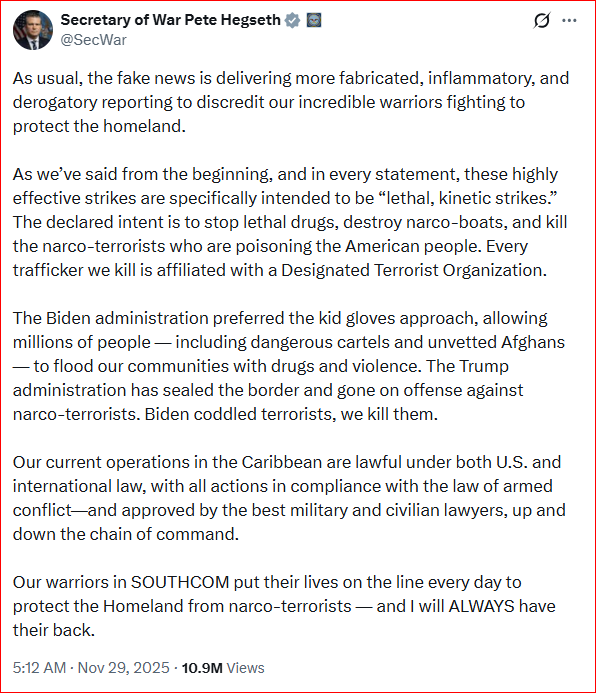
In an X post published on 29th November, Pete Hegseth dismissed the media report, particularly the Washington Post report, which claimed that Hegseth gave “kill everybody” orders to Admiral Frank M. Bradley, commander of U.S. Special Operations Command.
“…As we’ve said from the beginning, and in every statement, these highly effective strikes are specifically intended to be “lethal, kinetic strikes.” The declared intent is to stop lethal drugs, destroy narco-boats, and kill the narco-terrorists who are poisoning the American people. Every trafficker we kill is affiliated with a Designated Terrorist Organization. The Biden administration preferred the kid gloves approach, allowing millions of people — including dangerous cartels and unvetted Afghans — to flood our communities with drugs and violence. The Trump administration has sealed the border and gone on offense against narco-terrorists. Biden coddled terrorists, we kill them…” Hegseth wrote.
President Donald Trump had also expressed confidence in Hegseth, saying that he believed the Defence Secretary “100%”.
Interestingly, while Pete Hegseth accused the Biden administration of coddling terrorists, be it narcoterrorists in the Caribbean and East Pacific or Afghans, and claimed that the Trump administration kills terrorists. The reality is quite different.
It is arguably true that the Biden administration was comparatively soft on drug cartels smuggling narcotics into the US. The Trump administration has also been mollycoddling terrorists and their enablers.
In May 2025, Trump held a meeting with Ahmed Hussain al-Sharaa, the interim president of Syria, who just months back had a $10 million bounty on his head by the US government. Trump heaped praises on the former terrorist, who once admitted to having celebrated the 9/11 Islamic terror attack that killed thousands. Trump called Sharaa a “Young, attractive guy. Tough guy. Strong past. Very strong past. Fighter.”
In Afghanistan, former US President Joe Biden received all the global condemnation and domestic backlash for withdrawing US forces in 2021. However, it was Trump’s 2020 Doha Agreement that laid the ground for the eventual historic visuals of the US literally fleeing Afghanistan and leaving it in the hands of Taliban terrorists.
After elevating a former ISIS terrorist to power in Syria and leaving Afghanistan to the Taliban, Trump has declared ‘friendship’ with the Pakistan Army, the biggest Islamic terrorist group in the region. It is not a secret that Pakistan Army funds, fosters and shields Islamic terrorists and uses them as its proxies to carry out attacks against India.
In fact, the Trump administration is also going soft on convicted drug trafficking facilitators. While US forces acting on Defence Secretary Pete Hegseth’s orders are regularly striking vessels in the Caribbean over suspicion of drug smuggling, President Trump, on 29th November, pardoned former Honduran President Juan Orlando Hernández, who is convicted of facilitating huge drug trafficking, including cocaine smuggling into the US.
Hernández was sentenced to a 45-year jail term in July 2024. He was convicted of colluding with drug traffickers for over a decade to smuggle cocaine into the US.
Trump not only granted clemency to Hernández but also justified it by saying that the people of Honduras “basically said he was a drug dealer because he was the president of the country. And they said it was a Biden administration setup. And I looked at the facts and I agreed with them.”
Calling out Trump’s hypocrisy, Democrat leader Chuck Schumer dubbed the American President’s decision to pardon Hernandez as “egregious, dangerous and shameful.”
Press Secretary Karoline Leavitt’s admission and justification of the second strike that allegedly amounts to a war crime
The controversy over the September 2 airstrike began after a Washington Postreport said that the verbal order was to kill “everybody” on the boat. “In an effort to comply with that order, the commanding officer of the operation directed a second strike targeting two survivors of an initial attack, who were “clinging to the smouldering wreck,” according to the Post.
Admiral Frank M. Bradley, commander of U.S. Special Operations Command, had directed a second strike on the boat’s survivors to comply with Pete Hegseth’s verbal order to “kill everybody”.
On Monday, US Press Secretary Karoline Leavitt justified the second strike that killed survivors on the boat. Leavitt defended Admiral Frank M. Bradley, commander of U.S. Special Operations Command, saying that he had acted “within his authority and the law” when he ordered a second strike after the first strike left survivors.
“Secretary Hegseth authorized Admiral Bradley to conduct these kinetic strikes. Admiral Bradley worked well within his authority and the law, directing the engagement to ensure the boat was totally destroyed and the threat to the United States of America was eliminated,” Leavitt said.
?HOLY FUCKKKKKKK: KKKaroline Leavitt just officially tossed Admiral Frank Bradley under the bus for the second Caribbean strike to murder “alleged” drug dealers who survived initial attack.
She did NOT deny the facts — which means Trump, Hegseth, and Bradley are implicated in… pic.twitter.com/5Ea4AmsNBN
US lawmakers raise concerns over the rules of engagement of the airstrikes on the suspected drug-carrying boat
The operation carried out on 2nd September was a part of the Trump administration’s aggressive policy to interdict drug boats without prior warning. Over 83 people have been killed in 21 such operations by the US forces since September. After a series of attacks near the Venezuelan coast, the US forces have carried out multiple airstrikes along the Pacific coasts of Colombia, Ecuador, and Peru.
The rules of engagement (ROE) of the 2nd September airstrikes have been questioned by US lawmakers. The admission by Karoline Leavitt has further added fuel to the fire as many legal experts opine that Admiral Bradley’s action amounted to a war crime and murder, and thus, Defence Secretary Pete Hegseth, who ordered the strike, could be held legally culpable.
While the Trump administration faced criticism within the US for its harsh measures against alleged Venezuelan drug cartels, after Karoline Leavitt’s statement defending the second strike, US lawmakers have intensified attacks on Pete Hegseth.
Democratic Senator Tim Kaine said, “This rises to the level of a war crime if it’s true.”
Republican lawmaker Mike Turner said, “Obviously if that occurred, that would be very serious, and I agree that that would be an illegal act.”
These remarks came after the Republican-led Senate Armed Services Committee announced that it will conduct a “vigorous oversight” on the strikes.
“The Committee is aware of recent news reports – and the Department of Defence’s initial response – regarding alleged follow-on strikes on suspected narcotics vessels in the SOUTHCOM area of responsibility,” the committee’s Republican chair, Senator Roger Wicker, and his Democratic counterpart, Senator Jack Reed, said.
In a joint statement Republican-led House Armed Services Committee also called for an investigation into the follow-on strike that allegedly amounted to a war crime.
“We take seriously the reports of follow-on strikes on boats alleged to be ferrying narcotics in the SOUTHCOM region and are taking bipartisan action to gather a full accounting of the operation in question,” Republican leaders Mike Rogers, and Adam Smith wrote.
Senator Roger Wicker of Mississippi said that he expects the Committee to have full access to the audio and video of the strikes. Over 80 people have been killed in these strikes since September.
Appearing on CNN, Sen. Mark Kelly, D-Arizona, said that if the reports about the second strike are true, then “it seems to” constitute a war crime.
“If what has been reported is accurate, I’ve got serious concerns about anybody in that, you know, chain of command stepping over a line that they should never step over. We are not Russia. We’re not Iraq. We hold ourselves to a very high standard of professionalism,” Kelly said.
Former Defence Secretary Leon Panetta, who served in the Obama administration, appeared on a CBS show and deemed the second airstrike in question a violation of the rules of war and a criminal act.
“The basic rules of war that are involved here make very clear that you do not strike wounded people in the water in order to kill them. You basically then are responsible to try to make sure you do everything to try protect their lives at that point. And that the concern right now whether or not this really violated the rules of war and constituted a criminal act,” Panetta said.
Meanwhile, the Former JAGs Working Group, a group of ex-military lawyers, have released a memo assessing the second strike and argued that it amounts to a violation of both American and international laws.
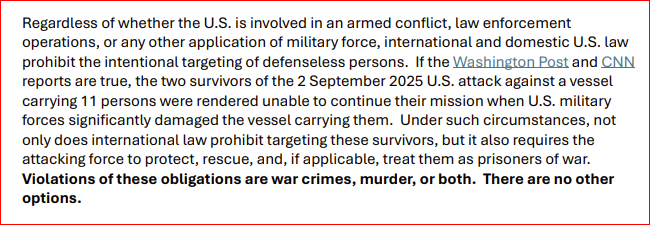
“…not only does international law prohibit targeting these survivors, but it also requires the attacking force to protect, rescue, and, if applicable, treat them as prisoners of war. Violations of these obligations are war crimes, murder, or both. There are no other options,” the memo reads.
Excerpt taken from the document released by the Former JAGs Working Group
Trump administration trying to throw Admiral Bradley under the bus?
While Pete Hegseth claims to be backing Admiral Bradley, a decorated SEAL commander who oversaw the operation on 2nd September, it seems that, amidst backlash and the possibility of legal trouble, the Trump administration is scapegoating Admiral Bradley.
These speculations are fuelled by Karoline Leavitt’s remarks that Frank Bradley “directed the engagement” and that he acted “within his authority and the law”. On one hand, Leavitt justified the alleged war crime as a ‘lawful action’, on the other, she absolved Hegseth of any role in the carrying out of the second strike.
It seems that singling out Admiral Bradley by the White House was a shrewd blame-shifting strategy. Democrat leaders like Jason Crow are alleging that the Trump administration has a history of getting reckless things done by others and then throwing them under the bus to shift blame.
The family of a Colombian fisherman killed in one of the airstrikes carried out by US forces files a complaint
The controversy around the Trump administration’s aggressive and allegedly in violation of international laws actions shows no signs of fading. Amidst pressure to provide full transparency and accountability over civilian deaths in the Caribbean caused due to US strikes, the family of a Colombian fisherman named Alejandro Carranza Medina, killed in a US airstrike carried out on 15th September, has filed a formal complaint with the Inter-American Commission on Human Rights.
The complainants alleged that the deceased man was denied his rights to due process and a fair trial. The family directly accused Pete Hegseth of ordering extra-judicial killings in the name of fighting against drug smugglers.
“From numerous news reports, we know that Pete Hegseth, US Secretary of Defense, was responsible for ordering the bombing of boats like those of Alejandro Carranza Medina and the murder of all those on such boats, Secretary Hegseth has admitted that he gave such orders despite the fact that he did not know the identity of those being targeted for these bombings and extra-judicial killings,” the complainant family said in its statement.
Venezuela’s political instability, oil reserves and Trump’s reassertion of the ‘Monroe Doctrine’
For many months, Venezuelan President Nicolás Maduro has been alleging that Trump is attempting to orchestrate regime change in Venezuela. While the drug menace stemming from Venezuela is real and massive, it is being said that the anti-drugs smuggling crackdown is a part of Trump’s wider strategy to gain control over politically unstable but oil-rich Venezuela.
It is notable that Venezuela has the largest proven oil reserves, more than five times that of the United States; however, political instability and numerous sanctions prevent the Latin American nation from fully unlocking its oil potential. What further concerns the US is Venezuela’s strengthening ties with Russia and China, both of which are seen by Washington as its rivals. Having a country tilted towards Russia and China in the neighbourhood is not something America would like or allow.
The Trump administration has been using the Venezuelan opposition’s “criminal regime” description of the Maduro government as an excuse to not only meddle in the Latin American country’s internal affairs but also to justify the intensified military actions.
While a direct invasion is unlikely, given how such an adventure played out against the US in Iraq, the crackdown against drug cartels in the Caribbean seems to be a pressure and intimidation tactic to either compel Maduro into resigning and fleeing or becoming subservient to Trump, while CIA covert action is also said to be on the cards.
Apparently, Trump’s hawkish approach to the drug menace originating from the Caribbean stems from his desperation to seize direct or indirect control over the Venezuelan oil reserves, ensure strategic security, and lucrative markets. It remains to be seen how successful the Trump administration’s revitalisation of the 19th-century Monroe Doctrine would be, in a world rapidly moving towards multipolarity.
The Kerala High Court on Monday (1st December) quashed criminal proceedings against a man, rejecting the rape accusations brought against him by a woman. A single bench of Justice G Girish examined the submissions of both sides and found several contradictions in the woman’s claims, after which he passed the decision.
The petitioner had approached the High Court seeking the quashing of the criminal proceedings, which were initiated after an FIR was filed against him on July 23, 2018, by the Erattupetta Police under Section 376(f)(n) of the IPC and Section 66E of the Information Technology Act. The complainant (woman) alleged that the petitioner committed rape on her during the period between 2011 and 2014, and subjected her to mental torture by threatening to publish her objectionable photos and disclose their affair.
HC cited loopholes in the victim’s claims
However, the High Court found the complainant’s account replete with dichotomies, which supported the man’s claim that he was falsely implicated in the case after he sued the complainant for failing to repay money she had borrowed from him and for committing insurance fraud with him.
“Having regard to the financial and property transactions between the petitioner and the de facto complainant from 2010 onwards as revealed from the case records, it is too hard to believe the version of the de facto complainant that the petitioner had been subjecting her to sexual abuse for a period of more than three years, and that she did not disclose the above crime due to shame,” the High Court noted in the judgment accessed by OpIndia.
The High Court pointed out that in 2017, the complainant had testified for the petitioner before a court in a case of cheque dishonour, in which she described him as “a close family friend”. “The allegation of the de facto complainant that on several occasions, the petitioner compelled her to come to her residence at Thrissur and also to his residence at Poonjar, and that she had to surrender herself to the petitioner, cannot be reconciled with the sworn statement which the de facto complainant gave on 26.07.2017 before the Judicial First Class Magistrate Court to the effect that the petitioner is a close family friend of her,” the Court pointed out.
Expressing disbelief in the complainant’s claims, Justice Girish said that it could not be expected of an “educated and employed lady like the petitioner would have fallen prey to the coercion and criminal intimidation of the petitioner for a period of about three years, and subjected herself to the sexual abuse of the petitioner.” After analysing the sequence of events, from the institution of a suit by the petitioner against the complaint followed by the filing of an FIR by the complainant against the petitioner, the High Court concluded that there was “substance in the allegation of the petitioner that a false complaint has been lodged against him as a counterblast to the legal action initiated by him against the de facto complainant”.
A consensual relationship turning sour cannot be a ground for invoking rape allegations: SC
The case is the latest example of how laws relating to sexual offences against women are being misused by several women in India, which results in the harassment of innocent men, undermining the cases of actual victims and the abuse of the process of law. Indian courts have repeatedly clarified that that consensual relationships turning sour or not resulting in marriages do not constitute the offence of rape.
In May 2025, the Supreme Court held that initiating criminal proceedings in cases involving consensual relationships deteriorating over time adds to the burden on the judiciary and damages the reputation of innocent persons. The observation was made by the Apex Court in a case in which fake rape allegations were levelled by a married mother of one against a 23-year-old man after their relationship turned sour.
“A consensual relationship turning sour or partners becoming distant cannot be a ground for invoking the criminal machinery of the State. Such conduct not only burdens the Courts, but also blots the identity of an individual accused of such a heinous offence. This Court has time and again warned against the misuse of the provisions, and has termed it a folly to treat each breach of promise to marry as a false promise and prosecute a person for an offence under section 376 IPC,” the top court noted, dismissing the criminal proceedings.
High Courts adopt a strict approach in dealing with false rape cases
With the rampant rise in the number of false rape cases, India Courts are exercising caution while trying rape cases. In some recent cases, various High Courts quashed criminal proceedings where the rape cases were found to be false. In August 2025, the Uttarakhand High Court dismissed rape proceedings against a minor boy after finding that the complainant and the accused had a consensual relationship. In a similar case, a Lucknow court sentenced a woman to 7.5 years in jail after she implicated two men in a rape case and offences under the SC/ST Act. Last year in August, the Bombay High Court quashed an FIR filed against a 73-year-old man, who was accused of raping a woman on a false promise of marriage. The High Court noted the fact that the complainant had been in a sexual relationship for 31 years and the complainant had never before spoken about her opposition to the relationship.
Legal remedies for men falsely accused of sexual offences
The increasing trend of rape laws being invoked by women after emotional fallout in consensual relationships is alarming and needs to be addressed by the judiciary to prevent the laws from being weaponised by vindictive individuals. There are several legal provisions which can be invoked by men facing false rape cases. Such men can seek the quashing of FIR under Section 482 CrPC (now Section 528 BNSS) in the respective High Court. They can invoke Sections 182 (false information to a public servant, Section 217 BNS) and 211 (false charge to injure, Section 248 BNS) of the IPC against women who falsely accuse them of sexual offences, after they have been acquitted or the charges have been proved to be fabricated. Apart from this, a Magistrate can invoke Section 273 of the BNSS and order the complainant to give compensation to the accused after acquittal if he finds that there was no reasonable ground for the accusation.
However, cases pertaining to sensitive relationships often have a wider social impact. Media headlines tend to sensationalise cases where the legal nuances are ignored, and controversial aspects are hyped. Intimate relationships are complicated and sometimes, due to the diverse socio-economic power dynamics, prolonged relationships can still be abusive and ‘coerced’, even though they appear to be consensual on the surface. Sweeping statements against women, and even men, tend to spread confusion among the masses. Hence, it is prudent for the judiciary and the media both to approach social issues with care.
In August this year, a group of farmers from Tamil Nadu met me and talked about how they were practising new agricultural techniques to boost sustainability and productivity. They invited me to a Summit on natural farming to be held in Coimbatore. I accepted their invite and promised them that I would be among them during the programme. Thus, a few weeks ago, on 19th November, I was in the lovely city of Coimbatore, attending the South India Natural Farming Summit 2025. A city known as an MSME backbone was hosting a big event on natural farming.
Natural farming, as we all know, draws from India’s traditional knowledge systems and modern ecological principles to cultivate crops without synthetic chemicals. It promotes diversified fields where plants, trees and livestock coexist to support natural biodiversity. The approach relies on recycling farm residues and enhancing soil health through mulching and aeration, rather than external inputs.
This Summit in Coimbatore will forever remain a part of my memory! It indicated a shift in mindset, imagination and confidence with which India’s farmers and agri-entrepreneurs are shaping the future of agriculture.
The programme included an interaction with farmers from Tamil Nadu, in which they showcased their efforts in natural farming and I was amazed!
I was struck by the fact that people from diverse backgrounds, including scientists, FPO leaders, first-generation graduates, traditional cultivators and notably people who had left high-paying corporate careers, decided to return to their roots and pursue natural farming.
I met people whose life journeys and commitment to doing something new were noteworthy.
There was a farmer who managed nearly 10 acres of multi-layered agriculture with bananas, coconuts, papaya, pepper and turmeric. He maintains 60 desi cows, 400 goats and local poultry.
Another farmer has dedicated himself to preserving native rice varieties like Mapillai Samba and Karuppu Kavuni. He focuses on value-added products, creating health mixes, puffed rice, chocolates and protein bars.
There was a first-generation graduate who runs a 15-acre natural farm and has trained over 3,000 farmers, supplying nearly 30 tonnes of vegetables every month.
Some people who were running their own FPOs supported tapioca farmers and promoted tapioca-based products as a sustainable raw material for bioethanol and Compressed Biogas.
One of the agri-innovators was a biotechnology professional who built a seaweed-based biofertilizer enterprise employing 600 fishermen across coastal districts; another developed nutrient-enriched bioactive biochar that boosts soil health. They both showed how science and sustainability can blend seamlessly.
The people I met there belonged to different backgrounds, but there was one thing in common: a complete commitment to soil health, sustainability, community upliftment and a deep sense of enterprise.
At a larger level, India has made commendable progress in the field. Last year, the Government of India launched the National Mission on Natural Farming, which has already connected lakhs of farmers with sustainable practices. Across the nation, thousands of hectares are under natural farming. Efforts by the Government such as encouraging exports, institutional credit being expanded significantly through the Kisan Credit Card (including for livestock and fisheries) and PM-Kisan, have also helped farmers pursuing natural farming.
Natural farming is also closely linked to our efforts to promote Shree Anna or millets. What is also gladdening is the fact that women farmers are taking to natural farming in a big way.
Over the past few decades, the rising dependence on chemical fertilisers and pesticides has affected soil fertility, moisture and long-term sustainability. At the same time, farming costs have steadily increased. Natural farming directly addresses these challenges. The use of Panchagavya, Jeevamrit, Beejamrit, and mulching protects soil health, reduces chemical exposure, and lowers input costs while building strength against climate change and erratic weather patterns.
I encouraged farmers to begin with ‘one acre, one season.’ The outcomes from even a small plot can build confidence and inspire larger adoption. When traditional wisdom, scientific validation and institutional support come together, natural farming can become feasible and transformative.
I call upon all of you to think of pursuing natural farming. You can do this by being associated with FPOs, which are becoming strong platforms for collective empowerment. You can explore a StartUp relating to this area.
Seeing the convergence between farmers, science, entrepreneurship and collective action in Coimbatore was truly inspiring. And, I am sure we will together continue making our agriculture and allied sectors productive and sustainable. If you know of teams working on natural farming, do let me know too!
This article was written by Prime Minister Narendra Modi on LinkedIn and has been republished here with due credit. The original article can be read here.
India has taken a strong stance regarding a joint article authored by envoys of the United Kingdom, France and Germany for “The Times of India.” The piece which was published on 1st December accused Russia for Ukraine conflict and President Vladimir Putin of “total disregard for human life.”
The development occurred against the backdrop of Putin’s first state visit to India since the onset of the war in Ukraine in February 2022. His previously landed in the country in December 2021 and now is set to arrive in Delhi for the 23rd annual summit between the two nations on 4th to 5th December.
The article was criticised by senior official from Ministry of External Affairs (MEA) who stated, “We see this as very unusual. It is not an acceptable diplomatic practice to advise India’s foreign relations with a third country. We have taken note of it.”
Former Foreign Secretary Kanwal Sibal also described the joint article as “vicious” as it “breaches diplomatic norms” and “is a diplomatic insult to India.” He added, “It is interference in our internal affairs as the purpose is to fuel anti-Russian sentiments in pro-European circles in India and question the morality of our ties with Russia.”
This vicious article against Russia just before Putin’s state visit to India breaches diplomatic norms, is a diplomatic insult to India as it questions India’s close ties with a very friendly third country.
It is interference in our internal affairs as the purpose is to fuel… https://t.co/oN5E2iLqT5
“The envoys of these three countries are free to make their views known to the MEA in an official demarche but are not supposed to engage in public grandstanding with an overt propagandist intent,” Sibal outlined and even denounced the English daily for providing space to it and “doing disservice to diplomacy and national interest.”
Diplomats attack President Putin, hold Russia responsible for the “illegal war”
The controversial article titled, “World wants the Ukraine war to end, but Russia doesn’t seem serious about peace,” have been written by Philipp Ackermann (German Ambassador to India), Thierry Mathou (French ambassador to India) and Lindy Cameron (British High Commissioner to India). It lauded the “courage and fierce determination” of Ukrainians “against Russia’s unprovoked war of aggression on their home,” without referencing the billions of dollars in resources and weaponry funnelled into Ukraine.
The article further claimed that Russia has initiated illegal attacks on innocent people and civilian infrastructure. “This last week alone, Russia has launched over 1,200 drones and over 60 cruise and ballistic missiles at Ukraine. These are not the actions of someone that is serious about peace. Neither are these indiscriminate attacks mere accidents, they are a systematic choice by Russia to wage its war of aggression with absolute ruthlessness. And it must end,” it added.
The article subsequently charged Moscow with disrespecting Ukraine’s national sovereignty, fundamental principles of the international order, independence and territorial integrity alongside breaching the treaties it has ratified concerning the Ukrainian border.
“Russia’s malign global activity, including through cyber-attacks and disinformation, shows us that the Russian leadership’s appetite for territorial expansion and global destabilisation goes well beyond Ukraine. President Putin is the one leader who could end the war any time he so wishes,” the piece asserted, insinuating his alleged aversion to peace.
Notably, the West, which claims to be the protector of global peace and order, has played a significant role in conspiring to incite bloodshed, instability and even the destruction of countries in order to install governments that align with its interests. Interestingly, Ukraine has also been a target of a similar regime change operation by the United States. The only principle or order these countries follow is one that serves their own agenda while sermoning or demonising others.
The article then delves into further condemnation of Russia, alleging that the nation has stationed troops within Ukraine and is refusing “to engage in meaningful negotiations or even a ceasefire that everyone else is calling for.” It asserted that thousands of children have been displaced as “Russia’s illegal invasion has inflicted a severe human toll on both sides.”
The envoys then added that “Putin’s illegal war, and his total disregard for human life, have taken a huge toll on his own people.”
Deliberate effort to influence India-Russia diplomatic ties
After a scathing attack on Putin ahead of his trip to India, in an attempt to overshadow this crucial occasion, the piece then dragged India and quoted PM Modi, who earlier conveyed, “A solution cannot be found on the battlefield.” However, the move has only resulted in a firm objection from New Delhi.
Furthermore, it has even reminded of a famous quote by External Affairs Minister S Jaishankar, who aptly articulated this hypocrisy when he expressed, “Somewhere Europe has to grow out of the mindset that Europe’s problems are the world’s problems but the world’s problems are not Europe’s problems. That if it is you, it’s yours, if it is me it is ours. I see reflections of that,” in 2022.
“When we look out at the world, we look for partners. We don’t look for preachers, particularly preachers who don’t practice at home what they preach abroad and I think some of Europe is still struggling with that problem,” he reiterated in May of this year.
This double-standard of Western nations resulted in 50% tariffs (including 25% for buying Russian oil) by the US on India. These countries are reluctant to support India in its fight against Pakistani terrorism, which poses a real threat to the world, or against China’s imperialistic ambitions. However, they consistently find ways to directly or indirectly ask the Modi government to take a stance against India’s close partner and ally, Russia.
The article also highlighted the contentious meeting between President Donald Trump and President Volodymyr Zelenskyy where the later was not only openly chastised but even had to apologise as “efforts to secure a just and lasting peace and end the killingm.” It declared that the “governments of France, Germany and the United Kingdom, will continue to give Ukraine our ironclad support. Today and every day,” along with additional denunciation of Russia.
These diplomats want to reduce the crucial meeting between the two world leaders as a platform for their politics of global influence via Ukraine and grab eyeballs. However, India wants no part of it.
President Putin’s India visit
India and Russia are preparing to sign many important agreements during this summit which would also feature a vital private dinner between Putin and Prime Minister Narendra Modi. Moscow and New Delhi are anticipated to concentrate on defence cooperation including the S-400 missile system and energy trading.
On 2nd December, Putin announced, “We aim to elevate cooperation with the People’s Republic of China and the Republic of India to a qualitatively new level by strengthening its technological component. This is the objective of numerous joint projects in energy, industry, space, agriculture, and other sectors.” in Moscow, providing a glimpse into the objective of the summit in Delhi.
The two nations have maintained close ties throughout the nearly four-year dispute while the European Union alongside North Atlantic Treaty Organisation (NATO) has provided Ukraine with weapons and assistance. However, New Delhi has repeatedly advocated for a peaceful resolution to the matter.
The subject can transpire during the upcoming summit and the officials restated India’s long-held position that the issue cannot be decided on the battlefield as discussion alongside diplomacy are the only viable options. India has unequivocally demonstrated its commitment for peace while not siding with any nation and remaining neutral, owing to its sovereign foreign policy. This has clearly vexed Europe and its other Western allies who want Modi government to support Ukraine.
Therefore, they seize every opportunity to pressure India or impact its relationship with Russia. The recent article published by these diplomats is yet another extension of this detrimental effort and the timing of the article has likewise sparked suspicion concerning the intentions.
It has evidently turned into a tough fact for the European Union and the West that they are unable to control India’s foreign relations with any country, let alone Russia.
On Monday (1st December), Inderpreet Singh alias Parry, an associate of the Lawrence Bishnoi gang, was shot dead by unknown attackers near Timber Market in Chandigarh’s Sector 26. The 36-year-old man was rushed to a hospital, where he succumbed to his injuries.
#WATCH | Chandigarh: Three assailants shot a car-borne youth, Inderpreet Singh alias Perry, in Chandigarh's Sector 26. The victim, a resident of Sector 33, has been admitted to PGI Hospital in a critical condition. Police are investigating the matter. Further details awaited.… pic.twitter.com/Kizxcwrmbh
Right after Parry’s killing, a Facebook post by gangster Aarzoo Bishnoi, who claimed responsibility for the murder, went viral.
Notably, Inderpreet Singh alias Parry had multiple criminal cases registered against him.
Speaking about the incident, IG Chandigarh Police Pushpendra Kumar said, “We received a call about a firing incident near Timber Market at around 6 pm. The police team reached the spot and found the victim in the car. He was taken to PGIMER, but he could not survive”.
Around 9-10 rounds of bullets were fired by the attackers. Two of the bullets hit the windshield of the Kia Seltos car Inderpreet Singh, aka Parry, was inside. The assailants, who arrived in a compact SUV, Creta, escaped the crime scene after shooting Parry. Some reports say that the co-passenger in Inderpreet Singh’s car also fired at him before escaping; however, this claim remains a subject of investigation.
#WATCH | Chandigarh | IG Pushpendra Kumar says, "Around 6 pm yesterday, we received information that a man had been shot and killed in a car in the Timber Market, Sector 26. Upon arrival, the man was taken to the hospital and declared dead. The patient was identified by the… pic.twitter.com/Ue79wJMmqV
According to the preliminary investigation, the assailants were known to the deceased, Lawrence Bishnoi gang associate. A case has been registered, and the police are investigating the matter.
The criminal background of Inderpreet Singh alias Parry and the Lawrence Bishnoi connection
Notably, Inderpreet Singh was a former Students’ Organisation of Panjab University (SOPU) leader and was jailed with gangster Lawrence Bishnoi 14 years ago. Parry had been involved in numerous extortion, arms recovery, and assault cases. He was also facing trial ia n a 14-year-old case in Chandigarh wherein he, along with other accused persons, barged into a house in Sector 40 and attacked a man named Harpreet Singh Grewal. In this case, Lawrence Bishnoi is also named as an accused.
Lawrence Bishnoi and Inderpreet Singh Parry were classmates at the DAV College. Parry entered the crime world during his graduation days. Bishnoi, Parry and gangster Goldy Brar used to be an inseparable trio before the eventual fallout.
Source: India TV
In another case, the Punjab Police arrested Parry from a hotel in Himachal Pradesh’s Sundernagar. In March 2022, Inderpreet Singh alias Parry was arrested by the Chandigarh Police over accusations of making extortion calls to businessmen and owners of clubs and hotels in Chandigarh, Panchkula and Mohali.
In 2022, when the law enforcement agencies were cracking down on the Lawrence Bishnoi gang’s organised crime syndicate, Parry was arrested at his residence in Sector 33. During the arrest, the police confiscated a pistol and 10 live cartridges from his possession. Following his interrogation, the authorities further recovered a Glock pistol with 10 cartridges and a US-made rifle, also carrying 10 cartridges. Months later, Inderpreet Singh was released on bail.
Back in 2017, Inderpreet Singh or Parry, was arrested alongside gangster Bharat Bhushan aka Bhola Shooter in the murder case of Lavi Deora of the Vicky Gounder gang.
Allegations of betrayal within the Lawrence Bishnoi gang and Goldy Brar’s emotional message after the killing of Inderpreet Singh Parry
It appears that once friends and partners in crime, Lawrence Bishnoi and Inderpreet Singh Parry were at odds. Earlier this year, Goldy Brar announced a dissociation with the Lawrence Bishnoi gang. Brar was upset with the Bishnoi gang’s dissatisfaction over how Brar handled matters about his brother Anmol in the United States.
The Brar vs Bishnoi rivalry further escalated with Brar’s associate Rohit Godara claiming responsibility for the murder of Bishnoi’s ally Sippa in Dubai.
In a social media message, gangsters Aarzoo Bishnoi, Hari Boxer and others accused Inderpreet Singh Parry of “betraying” them as the deceased criminal allegedly supported the Goldy Brar gang, extorted money for Brar and was even planning attacks on Bishnoi gang members. Aarzoo Bishnoi and others also threatened that anyone siding with Brar will be killed. While the threat message has gone viral online, the police are investigating its veracity.
Meanwhile, Goldy Brar, the Canada-based gangster, purportedly issued an emotional message expressing grief and condolences for Parry’s family. “Parry had done nothing to deserve such a death,” Brar reportedly said.
“Sat Sri Akal to all my brothers. I am Goldy Brar. I am sending this voice message to say that our brother Inderpreet Parry, who was murdered by the Lawrence Bishnoi gang, was targeted deliberately. They may now claim he extorted money or worked for others, but the truth is that Lawrence himself had called Parry after his wedding to congratulate him and discuss personal matters unsafe to talk about on the phone. He asked Parry to meet a contact at a specific location and speak from that person’s phone.”
“Lawrence called his own friend out and had him killed. This is a new low in friendship. Parry never intended any harm toward Bishnoi. Lawrence can never prove Parry harmed him in any way,” he added.
In addition to criticising Lawrence Bishnoi and accusing him of getting his own aide murdered, Goldy Brar also defended and tried to distance himself from Parry’s killing.
“We have only ever taken action against those guilty of wrongdoing. When Sippa, whom many thought was a don, was killed in Dubai, it was because he was a police informant, making money in the name of extortion and loyal to no one. At that time, Parry was busy with his wedding functions,” Brar said, adding that Inderpreet Singh Parry made his “biggest mistake” by considering Lawrence Bishnoi his friend. Goldy said in his audio message that Lawrence’s countdown has now begun.
How Goldy Brar eventually parted ways with Lawrence Bishnoi
In the Punjab and Haryana underworld, Lawrence Bishnoi once commanded a tightly controlled network where Goldy Brar, Rohit Godara, Shehzad Bhatti and others operated as trusted allies. For years, Goldy was seen as Lawrence’s “right hand”, executing major operations and helping expand the gang’s reach. Their bond, rooted in college and strengthened during their time in jail, drove several high-profile crimes, including the killings of Sidhu Moosewala and Baba Sidhique and the firing outside Salman Khan’s home.
However, the partnership began to fracture in 2024 after Anmol Bishnoi’s arrest in the United States. According to media reports, the Bishnoi camp believed Goldy had not provided sufficient legal support to Anmol. This disagreement escalated, and by early 2025 both factions had formally split. Once the separation became public, several prominent gangsters shifted sides, intensifying tensions and triggering a gang war between the two groups.