In Uttar Pradesh, numerous cases of fraudulent Muslim Peer Babas defrauding gullible people with promises of honour, prestige, wealth, business growth, or the birth of a son, and whatnot have emerged. The fake Peer Babas are running ‘Darbars’ and even defrauding people in the name of solving their problems by making coins dance by sticking magnets to their hands.
One Peer Baba makes people drink water with cloves, is accused of attempted murder. Despite this, this Baba is earning up to 50,000 rupees from 200 to 400 people by holding court for 5 to 9 hours every day. That means he is earning a whopping 14-15 lakh rupees per month. These startling revelations have been made by Dainik Bhaskar in their on-ground investigation reports.
Maharajganj: Riyazuddin alias Jinnat Baba defrauding people by claiming to talk to Maa Kali
There is a case of one Riyazuddin alias Jinnat Baba in Biraichi village near Maharajganj. The police stopped construction of his massive court. Riyazuddin’s father revealed that he was jailed and came out on bail recently. The police action came after local BJP leaders and Bajrang Dal lodged a complaint against the Muslim fraud. He said that the Jinnat Baba’s court is being held near the Ghughli Buzurg cremation ground, 10 kilometers from Biraichi village, on the banks of the Chhoti Gandak River, adjacent to the Kushinagar border.
Upon visiting, Bhaskar reporters found around 400 people in attendance of Riyazuddin/Jinnat’s fraud ‘sabha’. Shockingly, this Riyazuddin was not performing any Islamic occult practice but rather using Hindu religious symbols to fool his targets. His ‘darbar’ was near a temple of the Hindu Goddess. Riyazuddin was also performing exorcisms by waving a stick at people. He would also pretend to speak to Goddess Kali at times. He would sing Bhojpuri songs, ask Goddess Kali questions, and then, using a modified voice, would answer.
Riyazuddin would ask some to attend the court three times, while others would suggest a different treatment. Then, the boy sitting next to Baba would collect the 51-rupee fee and take the incense sticks, camphor, cloves, and frankincense brought by the people. Interestingly, when asked too many questions proving his guess about the problems his visitors are having, Riyazuddin would silence them by shouting or by asking them to make three visits to the Darbar first, and then Maa Kali would tell how their problems would be solved.
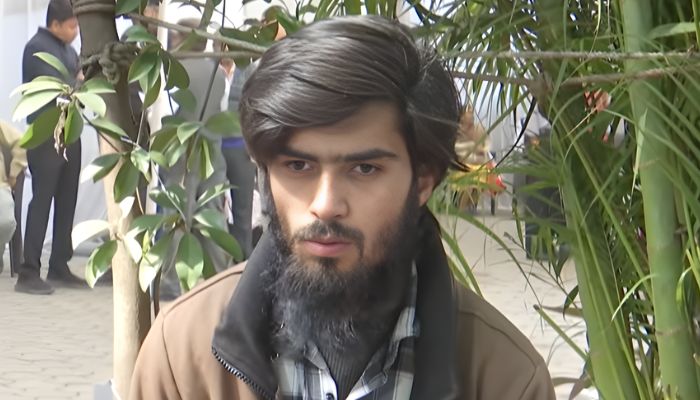
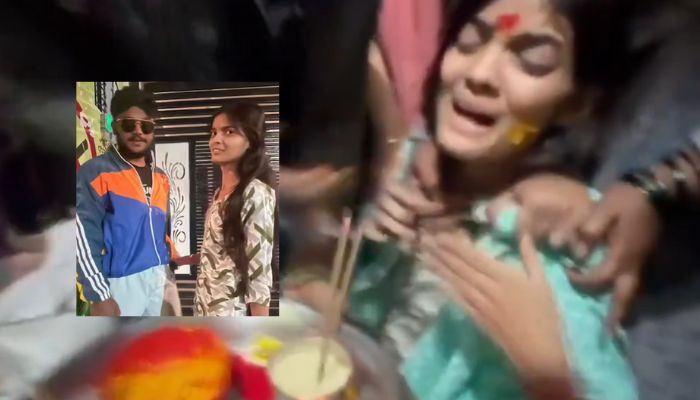
Riyazuddin. Image: Dainik Bhaskar
At Riyazuddin’s court, we were charged a fee of 51 rupees. Here, we ordered incense sticks, camphor, cloves, and frankincense from a nearby shop, which cost 70 rupees. We weren’t allowed to burn them; the boys working for Riyazuddin kept them. They returned them to the shop and collected the money.
This means Riyazuddin is earning 121 rupees per person. On the day we visited the court, he prepared forms for approximately 400 people in 5 hours. This means he earned 48,400 rupees in one day. Riyazuddin is earning a whopping 14.52 lakh rupees a month by defrauding people in this way.
Kushinagar: Saddam alias Sameer Baba giving ‘chamatkari’ treatment to remove ghosts, heal diseases and give employment
In the Kohargaddi village near Kushinagar district, one ‘Ajmer Wale Chamatkari Baba Sameer Sahib’ has set up his ‘darbar’. Baba Sameer, originally Saddam, does not pretend to be a Hindu saint, although he attracts visitors from diverse sections of society. Like Jinnat Baba, Saddam alias Sameer Baba also guesses the problems of those who visit him to have their grievances resolved and would claim that ‘Jinn’ or ‘Khabis’ has entered their homes. He would then offer ‘free’ treatment. However, that’s the catch. The so-called treatment is not really free. Sameer Baba has a lucrative ‘business model’.
Saddam alias Baba Sameer. Image: Dainik Bhaskar
His targets are asked to buy cloves worth Rs 30 and water bottles worth Rs 60. Saddam alias Sameer pretends to enchant it with some holy verses. He would ask the visitors to drink the ‘enchanted’ water for three days. Bhaskar’s team also posed as a ‘fariyadi’ to understand the modus operandi of this fraud. They found that Saddam does this with more than 200 people every day. He charges them 50 to 100 rupees. That means he’s earning 3 to 5 lakh rupees a month.
Saddam writes slips in Arabic and offers tablets as medicine for removing complications for women planning to have babies. These tablets cost Rs 1500. He has also colluded with one Altaf Ansari, who runs a pathology. This alleged physician charges Rs 800 per test and allegedly gives reports as per Saddam alias Sameer Baba’s instructions per case. Bhaskar reporter, pretended to be a woman having difficulty in conceiving. She too was directed by the fraud Baba get her tests done at Ansari’s pathology. After tests, Ansari told her that she is having problems and needs to undergo treatment. He said that if Sameer Baba wished, she would have a baby. However, when the Bhaskar reporter
Notably, when tested by a genuine gynaecologist, Dr Surhita Karim, it emerged that the test reports are normal, contrary to the lies told by Altaf Ansari.
Before becoming a full-time fraud ‘Baba’, Sameer alias Saddam used to run a gang of goons in the village. Gradually, he started misleading people by doing black magic. Now, he is holding court on his sister’s 2 decimal land (about 871 square feet). His wife and children live in the village itself. Father Amirullah used to roam around the area and repair umbrellas. Sameer’s brothers, Fakhruddin and Safuddin, are fish farmers. One brother Musafir, is a paint-polish contractor in Lucknow. Another brother Lal Mohammad has been jailed for cow smuggling. Younger brother Naeem Ahmed is the village head.
Notably, besides Sameer Baba, one Surendra Sahni is also running his fake healing courts in Kushinagar’s Pachfeda Khanu Chhapra. He has opened various shops there and attracts around 200 visitors a day. Surendra Sahni was treating sick people with exorcisms. Sahni does tricks with coins and charges around Rs 50,000 per Pooja. This essentially means that if this fraud Baba conducts even one pooja daily, he earns Rs 1.5 million per month.
Meanwhile, the police have said that criminal activities often take place in the name of exorcism and faith healing. In such a case, if any criminal wrongdoing is found in these matters, strict action will be taken.
Tamil Nadu is set to host two world-class Greenfield commercial shipyards with a combined investment of Rs 30,000 crore. The projects are spearheaded by the Government of India’s PSUs, Cochin Shipyard Limited and Mazagon Dock Shipbuilder Limited. The MoUs between the state government and the PSUs were signed during the ‘Samudra Se Samriddhi’ event chaired by Prime Minister Narendra Modi in Bhavnagar, Gujarat. The Tamil Nadu Government announced it had signed the MoUs during the Transforming Maritime Sector event in Thoothukudi.
Cochin Shipyard Limited will invest Rs 15,000 crore and it will create 10,000 jobs in the first phase. Mazagon Dock Shipbuilders Limited will invest Rs 15,000 crore and it will generate 45,000 jobs in the state. Together, the two Ultra Mega MoUs promise 55,000 employment opportunities and will position Tamil Nadu as a global hub for shipbuilding and maritime innovation.
In a post on social media platform X, Bharatiya Janata Party (BJP) IT Cell Chief Amit Malviya highlighted the scale of this development. He credited PM Modi’s vision for supporting Tamil Nadu’s rise and called it “a wave of growth, sustainability, and opportunity for the future.”
? A historic milestone for Tamil Nadu!
Two Central government PSUs — Cochin Shipyard Ltd and Mazagon Dock Ltd — are investing a whopping ₹30,000 crore to establish world-class Greenfield commercial shipyards in the state.
The Chief Minister of Tamil Nadu, M K Stalin, described the announcement as a continuation of Tamil Nadu’s proud maritime tradition. He compared it to Sangam-era trade routes. Industries Minister Dr T R B Rajaa also lauded the signing of the MoUs and framed them as a historic milestone under the state’s Dravidian Model.
சங்கப்பாடல்கள் சொல்லும் கப்பற்கலையில் தமிழரின் பெருமைமிகு வரலாற்றை!
இப்போது, தூத்துக்குடியில் 30 ஆயிரம் கோடி ரூபாய் முதலீட்டில், 55 ஆயிரம் பேர் வேலைவாய்ப்பு பெறும் வகையில் இரு கப்பல் கட்டும் தளங்கள் அமையவுள்ளன.
— M.K.Stalin – தமிழ்நாட்டை தலைகுனிய விடமாட்டேன் (@mkstalin) September 21, 2025
However, while both leaders highlighted job creation and infrastructure growth, neither mentioned that the projects are being established by Central government-owned PSUs. Instead, the emphasis was placed on Tamil Nadu’s policy push and industrial vision.
MASSIVE NEWS for the Ship Building industry in TamilNadu ???️
At the TN Rising – Thoothukudi Conclave, the Honourable @CMOTamilnadu@mkstalin avargal announced a dedicated company to promote shipbuilding in the State. Early this month, SIPCOT and VoC Port signed an MoU for the… pic.twitter.com/uprRBShyEX
Although there is no denying that Tamil Nadu will benefit immensely from the establishment of these shipyards, the omission of the Centre’s direct role is notable. For investments of such magnitude, transparency in acknowledging the drivers of growth matters as much as the announcement itself.
The Tamil Nadu Government presented the projects solely as state-led milestones, risking blurring the fact that it is Central PSUs, with significant financial backing and strategic intent, that are anchoring this transformation in the state.
Sunday’s Asia Cup 2025 Super Four clash in Dubai should have been measured in runs and wickets. Instead, it was measured in gestures: Haris Rauf’s fighter-jet mimicry and his ‘6-0’ flash; Sahibzada Farhan’s gun-like bat celebration. India’s openers, Shubman Gill and Abhishek Sharma, put together a blistering 105-run start, and India chased 172 with authority. But the conversation after the match pivoted away from cricket and toward a spectacle of political theatre on the boundary ropes.
This was not ordinary sledging. It was a deliberate performance, a replay of state narratives, broadcast to millions. When an international athlete uses a televised platform to signal disputed military claims or to enact symbols of violence, sport becomes a megaphone for politics. That is corrosive, and the International Cricket Council (ICC) and national boards must treat it as such.
Propaganda on the outfield: Gesture as message
Haris Rauf’s gestures, a fighter-jet being struck down and shouting ‘6-0’ during practice sessions, were widely interpreted to misleading claims promoted by Pakistani Army after suffering a humiliating setback during Operation Sindoor earlier this year.
WATCH: Harris Rauf was instigating Indian fans during the India vs Pakistan match
He was gesturing with his hands that planes have crashed.
This disgusting and incompetent player was also chanting 6-0 during practice sessions. pic.twitter.com/zhwQGhYHEZ
Sahibzada Farhan’s earlier “gun” celebration after his pointless half-century also cemented the impression that these were not isolated emotional outbursts but part of a pattern: sporting acts recast as political messaging, and a brazen support to terrorism exported from Pakistan. It is worth noting that India and Pakistan’s relationship deteriorated after the Pahalgam terror attack in April this year, when Pakistani terrorists gunned down innocent tourists after checking if they were Hindus. Farhan’s gun gesture is therefore construed as an implicit support to terrorists who wreaked havoc in the picturesque valley of Pahalgam. The result was a match in which the scoreboard mattered less to some players than the narrative they wanted to sell.
Yes Sahibzada Farhan, in Pahalgam Hindus were massacred with similar gun shots after taking down the pants to confirm the religion.
Rauf and Farhan’s gestures reflect a deeper and incorrigible malaise in Pakistani society
Haris Rauf’s fighter-jet mimicry and Sahibzada Farhan’s gun-like celebration were not spontaneous acts of aggression but signs of a deeper malaise in Pakistani society. When national athletes, admired by millions, casually recycle the Pakistani Army’s propaganda, it shows how far supremacist narratives have seeped into every aspect of public life. Cricket, instead of uniting people, becomes just another theatre to broadcast the delusions engineered by Rawalpindi.
This behaviour is not accidental; it is the product of decades of systematic indoctrination. The Pakistani military, aided by clerics and a complicit media, has conditioned generations to equate “honour” with hostility towards India and to see jihadist violence as noble resistance. In this warped ecosystem, defeats are rebranded as victories, humiliation is paraded as glory, and even celebrated elites like cricketers are rewarded for repeating lies instead of confronting truth.
The tragedy is not that Pakistanis lack access to facts, but that they have been trained to dismiss them outright. Independent satellite imagery, international reports, and even first-hand evidence of battlefield losses are rejected in favour of comforting slogans like “6-0” or theatrical gestures on the field. Supremacist conditioning has made society so gullible that propaganda is not just consumed but celebrated, no matter how divorced from reality it is.
Rauf and Farhan, therefore, are not outliers but mirrors of their nation’s psyche. Their gestures symbolise a country where narratives matter more than evidence, where deception is worn as patriotism, and where entire generations have been taught to exalt fantasies of supremacy over the hard truths of decline. The rot runs deeper than two cricketers, it defines a society trapped in its own lies, unwilling and unable to wake up from the delusion.

Why this isn’t just about cricket
To understand why Pakistani players performed in this way, we have to look beyond the stadium. For months now, the aftermath of cross-border strikes has been fought as much in the media and the information space as it was on maps. Independent analysis and commercial satellite imagery released after the strikes showed significant damage to several Pakistani military sites, and open-source imagery and reporting were used to substantiate those assessments.
At the same time, images and footage from funerals and public displays suggested official-level attendance at ceremonies for Lashkar-e-Taiba and Jaish-e-Mohammad terrorists killed in those operations, a development widely reported and videos going viral on social media. Those facts, and the way they were framed by competing actors, shaped a charged domestic atmosphere. India even released the names and details of LeT and JeM terrorists neutralized during the first phase of Operation Sindoor.
In that atmosphere, the Pakistan Army and parts of the country’s civil administration have repeatedly offered a counter-narrative that reframes military setbacks as triumphs. Whether by amplifying selective footage, circulating contested images, or publicising sympathetic spins, the state’s information apparatus has created a feedback loop. The public sees a steady stream of messages that valorise resistance, sanctify sacrifice, and proclaim moral victory, even where the evidence points to a different, bleaker reality.
A two-metric logic: How losses in battlefield are repackaged based on Islamic indoctrination
The crucial point is that Pakistani propaganda works because its script is disarmingly simple and emotionally charged. Victory is declared domestically on the basis of two crude metrics: first, whether a Hindu or perceived ‘enemy’ was killed, for when violence is framed through a communal lens, even the death of a single adversary is sanctified as sacrificial success and made politically useful.
India needs to understand why Pakistan thinks that it won the war. This isn’t a normal state that cares about high value targets, geo-strategic positioning or even their airbases. There are two metrics which Pakistanis (jihadists) measure any conflict. Did we kill Hindus? Did we… pic.twitter.com/nzwRWZCeF5
And second, whether the integrity of the Muslim community or territory was preserved, for as long as the Ummah is said to remain intact and no land was ceded, the narrative can be spun as proof of triumph despite catastrophic losses in men, machinery, or infrastructure. By reducing complex strategic outcomes into primal symbols of blood and land, Pakistan’s establishment ensures that defeats are repackaged as victories and delusions are passed off as national pride.
From the pulpit to the pavilion: Radicalisation’s reach
The propaganda is not just an elite exercise; it seeps into mosques, schools, social feeds and playgrounds. When state-sanctioned or state-tolerated voices elevate militant imagery and endorse martyrdom narratives, radicalised ideas gain traction among impressionable cohorts. That can mean a teenager in a small town hearing religious justification for violence, or a sportsman absorbing a martial, triumphalist worldview that recasts provocation as honour. In such an ecosystem, it is not surprising that gestures on a cricket field mimic symbols more at home in combat zones than in athletic arenas.
This is not a claim about ordinary citizens, but about the effect of sustained messaging engineered by powerful institutions, and supported by national figures. When cricketers like Haris Rauf and Sahibzada Farhan make gestures to amplify Pakistani Army propaganda talking points and legitimise terror attacks in India, they are essentially further brainwashing a dangerously radicalised Pakistani society. No amount of “people-to-people” ties can undo this damage, as witnessed over the last 76 years. So while the Indian left would be inclined to blame Modi, Shah, the Indian government, etc., for the recent acrimony in the relationship between the two countries, the primary reason, nevertheless, is the deep-rooted Islamic supremacism that is now deeply ingrained in the Pakistani psyche.
What India must do to stop Pakistan’s jihadist fantasies and subsequent propaganda ops
This is the psyche that wants to bleed India through a thousand cuts, keep exporting terrorists to India as long as Pakistan exists, and kill as many Hindus as possible, which their Islamic clerics justify citing numerous Quranic verses. This is why waiting out Pakistan’s flirtation with radicalisation is not an option for the Indian government.
What we witnessed on the ground during Sunday’s match is a cautionary tale of how Pakistan has successfully indoctrinated not just its masses but even its elites. The only way India can knock some sense of reality into this deluded population is to preempt any wrongdoing from their side and destroy the terror camps established and rebuilt there. Waiting for a trigger to retaliate means we are already allowing them to accomplish one of their objectives, which is to kill Hindus, allowing them to “get a place in heaven reserved.”
Secondly, the next phase of Operation Sindoor should not just destroy their airbases, pummel their strategic centres, and demolish their terror camps; it should also capture some area of enemy territory, just like Israel did in 1967 during the 6-day war. It would then become impossible for the Pakistani state administration and the Army to spin the humiliating defeat in combat as a victory, since Pakistan losing some of its territory would mean the Muslim Ummah’s loss.
Yes, Pakistan would still come up with propaganda tropes like ‘6-0’ or ‘centre of gravity’ to hoodwink its population, but one hopes a more proactive India and territorial losses would deter Pakistani elites from readily enlisting themselves to become tools of Pakistan Army’s propaganda psyops in deceiving their own people.
The Ayodhya Development Authority (ADA) has rejected the plan for the construction of a mosque in Dhannipur village due to the absence of no-objection certificates from government departments, as revealed by an RTI query filed by journalist Om Prakash Singh. 5 acres of land were allotted to the state Sunni Central Waqf Board in compliance with the Supreme Court’s judgment in the Ayodhya Ram Mandir case.
In a letter dated September 16, 2025, the ADA said that the application submitted by the proposed mosque’s trust on June 23, 2021, was rejected due to the absence of clearances from departments, including Public Works, Pollution Control, Civil Aviation, Irrigation, Revenue, Municipal Corporation, and Fire Services.
After the Supreme Court verdict on November 9, 2019, which directed the allotment of the land to the state Sunni Central Waqf Board, district magistrate Anuj Kumar Jha transferred the possession of the land located in Dhannipur village of Sohawal tehsil, about 25 km from Ayodhya town. An amount of ₹4,02,628 was deposited by the mosque trust as application and scrutiny fees for the proposed mosque, as confirmed by the ADA.
NOC not issued due to a fault in the plan for the proposed mosque
Mosque trust secretary Athar Husain said that during a site inspection, the fire department had raised concerns about the approach road. As per the norms for the proposed mosque and hospital building, the road should be 12 metres wide, while the road at the site is only about six metres wide and just four metres wide at the main approach of the mosque. “Apart from the fire department’s objection, I have no idea about the objections of other departments,” Hussain said. “The Supreme Court mandated the land for the mosque, and the Uttar Pradesh government allotted the plot. I am speechless as to why the government departments have not given no-objection and why the authority has rejected the mosque’s plan,” he added.
The construction of the mosque has been on hold all these years, as the mosque plan has not been able to fulfil the norms of construction. In November 2022, Husain informed that out of the 15 types of No Objection Certificates (NOCs) required for the construction, 14 were made available by the ADA, but the NOC from the fire department was not received due to the narrow road. Since the issue regarding the narrow approach road has not been resolved, the fire department has not yet issued an NOC. Along with the mosque, which is proposed to be a 7-story building with capacity to accomodate 2000 people, the mosque trust plans to build other facilities on the site, including a 300-bed multi-speciality hospital offering free treatment to the patients, a community kitchen, in which more than 1000 people will be able to eat food every day for free, and a research centre.
First cheque of donation for the mosque was given by a Hindu
The site was granted to the state Sunni Central Waqf Board by the Supreme Court to pacify the Muslim side, which has been laying claim to the Ramjanmabhoomi for decades. The state Sunni Central Waqf Board initially showed reluctance to accept the allotted land, but eventually accepted the land around four months after the verdict. Notably, the first donation for the construction of the mosque was made by a Hindu person. Mosque trust secretary Athar Husain said that the trust received the first cheque of ₹21,000 as a donation for the mosque from a person named Rohit Srivastava. Till November 2022, out of the total amount of donation received by the mosque trust, around 40 per cent was given by Hindus, while Muslims have only contributed 30 per cent.
In Uttar Pradesh’s Aligarh, an Imam named Muhammad Mustaqeem was allegedly beaten up. Contrary to the narrative peddled by Islamists that Mustaqeem was assaulted for not saying ‘Ram Ram’, it has emerged that it was a case of personal dispute and not communal.
Despite this, leftists and Islamic fundamentalists are spreading the word on social media that it was a case of mob lynching.
It is being claimed that the Imam was attacked for not saying “Ram Ram.” Interestingly, in the written complaint regarding the incident, Mustaqeem makes no mention of any religious slogans being chanted. The entire propaganda is being spread by using a video made later.
What did Imam Mustaqeem say in the viral video?
In the viral video, Mustaqeem tells that he is the Imam of the Lakhanpura mosque and teaches Urdu to children. On Saturday evening (September 20, 2025), he was returning from tutoring children. He was stopped by some people near Bulakgarhi. He was asked to say “Ram-Ram.” When he refused, he was beaten and told to go to Pakistan. He even alleged that passersby were called and abused.
अलीगढ़ में एक स्थानीय मस्जिद के इमाम को कुछ सत्ता-पोषित गुंडों ने बंधक बनाकर एक घंटे से अधिक समय तक बेरहमी से पीटा और उन्हें 'राम-राम' कहने के लिए मजबूर किया।
डबल इंजन वाली भाजपा सरकार पूरे प्रदेश को नफरत की आग में झोंकना चाहती है।
Islamists allege ‘mob lynching’, Congress joins in to further anti-Hindu propaganda
Sharing Mustaqeem’s video on social media, Islamists are giving the incident a communal angle. Local Mufti Mohammad Akbar Kazmi has described the assault on the Imam as “mob lynching.” He said that the Imam was forced to chant “Jai Shri Ram” and was beaten by 10-12 people. Police should take swift action in this matter.
Shahi Jama Masjid Imam Mahmood Raza Kazmi alleged that Mustaqeem had been harassed for a month. The boys would harass him by calling him “Ram-Ram.” If he didn’t respond, he was abused and called a “fanatic.” He was beaten up because of this. Strict action should be taken in this case.
अलीगढ़ ➡दबंगों ने मस्जिद इमाम से लगवाए धार्मिक नारे ➡नारे लगाने से इनकार करने पर पीटने का आरोप ➡घटना से समुदाय विशेष के लोगों में पनपा आक्रोश ➡बुलाकगढ़ी बच्चों को ट्यूशन पढ़ाने जाते हैं इमाम ➡पुलिस ने जांच कर कार्रवाई का दिया आश्वासन ➡थाना लोधा क्षेत्र के गांव बुलाकगढ़ी के… pic.twitter.com/FQFtHuxKSc
Similarly, Congress is using this video to further its propaganda. It is being shown that the mosque’s imam was held hostage and beaten because he refused to say “Ram Ram.”
Pro-Islamist media peddling disinformation
Besides Islamists and their political patron, the Congress party, pro-Islamist media has also amplified ‘beaten up for not chanting Jai Shri Ram’ claim without verifying the facts. The Observer Post even wrote that the imam was attacked because of his beard and cap.
ABP even reported that Mustaqeem’s beard was plucked and he was called a “cow-eater.” Similarly, Dainik Bhaskar also reported based on this statement.
Police dismiss communal angle, tells OpIndia that it was a personal dispute
A close examination of the revelations made by the Aligarh Police makes it evident that Islamists and their political as well as media allies are peddling false claims to fan communal tensions.
In a conversation with OpIndia, the police stated that this was a simple physical altercation.
According to the police, the incident occurred on August 20, 2025, involving Muhammad Mustaqeem of the village of Bulakgarhi, under the Loda police station. Imam Mustaqeem was riding his bicycle that day. While trying to remove some children from the road, he got into an argument with Zeeshanth, who was standing nearby. A scuffle ensued, resulting in injuries and both were taken to the hospital.
थाना लोधा- सोशल मीडिया के माध्यम से एक प्रकरण संज्ञान में आया है, जिसमें एक व्यक्ति द्वारा बताया जा रहा है कि उसे कुछ धार्मिक नारे लगाने को मजबूर किया गया था और उसके साथ मारपीट की गई थी, इस संबंध में अवगत कराना है कि कल दि0 20.09.2025 को थाना लोधा में ग्राम बुलाकगढ़ी अन्तर्गत… pic.twitter.com/w6C66VHg67
The police stated that complaints have been filed by both parties in this case. The police investigation has revealed that there was no religious overtones or any attempt to force anyone to chant religious slogans. This is completely false and the Aligarh police denies it.
Chief Minister Himanta Biswa Sarma stated that a second post-mortem examination of singer Zubeen Garg’s body will take place at the Gauhati Medical College and Hospital (GMCH) in Assam on the morning of 23rd September before bidding him final goodbye. The 52-year-old musician who was a cultural icon in the state, passed away in Singapore on 19th September.
Sarma informed, “The autopsy will be conducted at 7.30 am for which at least one and a half hours will be required. The body will be taken to Sarusajai Stadium once the autopsy is over, and at around 10 am, it will be taken to the cremation ground at Kamarkuchi NC Village in Sonapur.”
The chief minister highlighted that a fresh call for another post-mortem in Assam had surfaced on social media. The state authorities decided to completely rule out any foul play in his death in light of this and with his family’s approval the decision was taken. He expressed, “It (second post mortem) is not a demand from the public but from certain sections and we have decided to conduct it with his wife’s consent. We do not want to create any controversy over Zubeen.”
Sarma mentioned that he did not personally want to have the body examined again after his death and “cut up his body” once more. “After an autopsy was conducted in a neutral country, Singapore, where doctors have more technical expertise, I don’t think it was necessary for another post mortem. But there should not be any scope for any kind of politics over Zubeen,” he pointed out.
As a #ZubeenFan, personally I didn’t endorse the idea of a second post mortem on his body.
But as Chief Minister, people’s sentiment hold more weight than my opinion. Hence we have consented to cut open his body and do a second post mortem. pic.twitter.com/lHxPkh4rX1
Sarma urged people to come forward if they have proof about anyone’s suspicious involvement in any potential plot that led to tragedy. According to him, a group of Assam Police will visit Singapore shortly to gather the video and other evidence related to the incident.
The North East Festival organisers, Shyam Kanu Mahanta and Garg’s manager, Siddharth Sharma were previously the target of numerous complaints at various police stations charging foul play in the death. The state Criminal Investigation Agency (CID) has been tasked with looking into these cases.
Thousands of people flocked to Guwahati on 21st September to pay tribute to Zubeen Garg. His remains were stored in a glass casket draped with a traditional Assamese “gamosa” as grieving admirers waited for hours in queue throughout the night to have a last glimpse of their favourite artist.
Zubeen’s wife Garima Saikia and a few Assamese government officials travelled in the ambulance with him. No additional vehicles were permitted in the procession, but a bus has been organised for other family members, close relatives and associates to make their way to the cremation site, which is roughly 20 kilometres from the sports facility.
According to Sarma, leaders from several state governments will be in attendance and Union Minister Kiren Rijiju will be present on behalf of Prime Minister Narendra Modi. Assam Police personnel will carry the casket from the national highway, next to Kamarkuchi, to the cremation spot and give the legendary musician a gun salute. The final rituals would subsequently be performed by priests.
The chief minister stated, “The journey from the Sarusajai Stadium to the cremation ground and the entire cremation will be live-streamed on LED screens installed in the towns and villages across the state so that the people of the state become witnesses of their beloved singer’s final farewell since only 5,000-7,000 people can be accommodated at the cremation venue.”
For four to five hours, the roadway will be off limits to vehicles till Jorabat in order to facilitate the cremation and ensure a peaceful procession. Assam declared dry days on 22nd and 23rd September. Sarma conveyed that the Meghalaya government has announced that all alcohol stores on the Meghalaya side of the route that Zubeen’s cortege planned to pass through will remain closed.
According to the CM, Zubeen’s wife and family paid him a visit at his home on 22nd September and asked that the singer’s 13th day rites be performed in Jorhat. “The state govt will make arrangements for taking the ashes to Jorhat for the purpose. Garima and other family members will be present there,” he assured. Sarma further reported that monuments honouring Zubeen will be built in Jorhat and Guwahati.
The singer was in Singapore for a performance the following day at the North East India Festival. He reportedly had breathing difficulties while swimming and “drowning” is listed as the cause of his demise on the certificate of death issued by the officials there. His death was presumed to have been brought on by an epileptic seizure. He had experienced a handful of these seizures during the previous five years.
Gold prices hit an all-time high on Tuesday (23rd September), reaching ₹1,14,480 per 10 gram for 24 karat gold, ₹1,04,950 per 10 gram for 22 karat gold and, ₹85,900 per 10 gram for 18 karat gold.
Gold prices in India have surged significantly since early 2024, influenced by several factors, including geopolitical tensions, economic uncertainties, Trump’s tariffs, and a depreciating US dollar. At the global level, gold prices also skyrocketed after the US Federal Reserve sliced interest rates last week. Compared to Gold prices five years ago, in 2020, the rise has been 112%. In 2020 (September 19, 2020), prices for spot gold (24K) stood at Rs 51,619 per 10 grams on the Multi-Commodity Exchange of India (MCX). This price has now reached ₹1,09,388. Even a year ago, the price was ₹72,874. Over the last five years, factors like the COVID-19 pandemic, the Russia-Ukraine war, US global tariffs, and other geopolitical uncertainties have impacted the prices of gold globally and in India. Despite rising prices, demand for the yellow metal has remained unchanged.
Image via The Mint
Over the last 20 years, the prices of gold have soared 1200%, from ₹7,638 in 2005 to over ₹1,00,000 in 2025 (till June), making the yellow metal the top-performing asset in 2025 and a reliable hedge.
Investors benefit, retailers suffer
In constant currency terms, gold has shown a steady growth of 17% and in India of 20% annually since 2020. While investors have gained from the rising gold prices, retailers are witnessing slow business as non-essential purchases and jewellery sales have taken a hit. Fluctuating gold prices make inventory planning difficult for retailers. Several investors have been prompted to assess whether they should hold their gold or sell it.
Gold is an indispensable part of India’s domestic life
In India, gold is not just an investment option but has deep cultural and emotional significance. The precious metal has acted as women’s financial security since ancient times. It forms an indispensable part of occasions like weddings and other auspicious occasions. According to a World Gold Council report, Indian households account for a quarter of India’s total gold demand.
India has been the second-largest consumer of gold in the world, falling behind China. However, last year India’s gold consumption reached 802.8 tonnes, surpassing China’s 511.4 tonnes in jewelry consumption. Jewellery sector accounts for the largest gold consumption in both countries. Indian families are estimated to hold around 24,000 tonnes of gold, which is said to be more than the total gold holdings of global central banks. Around one-third of India’s gold sales happen during weddings and festivals like Dussehra and Diwali.
However, the surging gold prices have impacted the metal’s demand at the household level. The demand for gold in Q2 of 2024 was recorded at 395 tonnes, and in Q2 of 2025, it declined to 341 tonnes. However, with the upcoming festival and wedding season, the demand for gold is likely to increase. Adjusting to the increased gold prices, customers are considering buying 18-carat and 14-carat gold jewellery studded with precious and semi-precious stones.
Acting on the directives of the Allahabad High Court, the Uttar Pradesh government on Monday (22nd September 2025) ordered a complete ban on caste-based references in police records and at public places to end caste discrimination in the state.
Chief Secretary Deepak Kumar issued instructions to all departments, directing that caste will no longer be mentioned in First Information Report (FIR).
Reports (FIRs), arrest memos, or other police documents. Instead, the names of parents will be used for identification purposes. The order further directs that caste symbols, slogans, and references displayed on police station noticeboards, vehicles, or signboards must be removed immediately.
“…the government may prepare a regulated framework to regulate and amend the Central Motor Vehicle Rules (CMVR) to explicitly ban caste-based slogans and caste identifiers on all private and public vehicles. Issue uniform circulars to RTOS and traffic departments across the state to enforce the removal of caste signage and impose heavy fines, which may act as a deterrent. Strengthen provisions under the Information Technology (Intermediary Guidelines and Digital Media Ethics Code) Rules, 2021, to flag and act against caste-glorifying, hate-inducing content on social media,” the order reads.
Uttar Pradesh Government directs amendments to Standard Operating Procedures and Police rules, following the orders of the Allahabad High Court to end caste based discrimination.
Field denoting the caste of criminals in Crime and Criminal Tracking Network & Systems to be deleted… pic.twitter.com/9RCDeMyrE0
“Support media literacy and anti-casteism campaigns targeting youth on platforms like Instagram, YouTube, and WhatsApp. May set up a Monitoring and Reporting Mechanism for citizens to enable them reporting portals and mobile apps to anonymously report violations in collaboration with (i) Ministry of Road Transport & Highways (MORTH), (ii) Ministry of Electronics and Information Technology (MeitY), (iii) Press Council of India, and (iv) Civil society organizations working on caste equity and digital rights,” the order adds.
Additionally, caste-based rallies have been prohibited across the state, with law enforcement tasked to ensure strict monitoring of social media platforms to prevent violations.
Vehicles displaying caste names or vehicles with slogans/stickers glorifying caste to be penalised under Motor Vehicles (Amendment) Act 1988.
Social media be strictly monitored for messages glorifying or criticising any caste. Strict action should be taken against those who… pic.twitter.com/YochtaOJy5
The government, however, has clarified that exemptions will apply in cases filed under the Scheduled Castes (SC) and Scheduled Tribes (Prevention of Atrocities) Act, where identifying caste remains a necessary legal requirement. To implement the High Court’s directive effectively, amendments will be made in Standard Operating Procedures (SOPs) and police manuals.
Following the violence that erupted during the ‘I Love Muhammad’ procession in Kashipur of Udham Singh Nagar in Uttarakhand, police swung into action and arrested seven Islamists, including the alleged mastermind Nadeem Akhtar. An FIR has been registered against seven accused and several unknown. Chief Minister of Uttarakhand, Pushkar Singh Dhami, has been informed about the developments in the matter. Senior Superintendent of Police (SSP) Manikant Mishra has issued strict directions and deployed additional forces to maintain law and order in the area.
How the violence unfolded
The incident took place on the night of 21st September in the Alikhan area of Kashipur. According to reports, Nadeem Akhtar, along with around 400–500 Islamists, organised a gathering. Following the meeting, the mob suddenly launched an unauthorised procession with banners and posters. They chanted “I Love Muhammad” slogans and moved towards the city through the Valmiki settlement.
काशीपुर (ऊधम सिंह नगर) में “आई लव मोहम्मद” मामले को लेकर निकाले गए जुलूस के दौरान हालात बिगड़ गए। विरोध प्रदर्शन हिंसक हो उठा, प्रदर्शनकारियों ने पथराव किया और पुलिसकर्मियों पर हमला कर दिया। झड़प में कई लोग घायल हुए हैं।
When police tried to intervene and stop them, the mob turned violent and attacked the police personnel with sticks and stones. They abused the police and caused damage to government vehicles. The windows of a Dial-112 vehicle and the bonnet of another police vehicle were severely damaged. The mob tore the uniforms of the police personnel.
Under SSP Mishra’s supervision, raids and house-to-house searches have been launched. PAC has been deployed and special teams formed to track down and arrest the accused.
What the FIR says
According to the police, an FIR has been lodged at Kotwali Kashipur on the complaint of SSI Anil Joshi. OpIndia accessed a copy of the FIR. SSI Joshi has named Nadeem Akhtar as the main accused in his complaint. The FIR has been registered under Sections 190, 191(2), 191(3), 232, 121(1), 132, 221, 324(3), 351(2), and 352 of the Bharatiya Nyaya Sanhita (BNS).
In his complaint, SSI provided details of how the mob carried sticks and lathis, and surrounded the police personnel. The mob attacked the police personnel and abused them, thereby obstructing them from conducting their official duty. The complaint also recorded the destruction of government vehicles and damage to property.
Source: Uttarakhand Police
In his complaint, SSI said that he received a call from SI Manoj Dhoni, in-charge of the Basphodan police outpost, informing him about the ‘I Love Muhammad’ procession being carried out without permission. Nadeem Akhtar, Hanif Gandhi and Danish Chaudhary were leading the procession. Police tried to stop them at Alikhan crossing, however, they refused to comply and continued to move towards the Valmiki locality.
SSI called SI Kapil Kamboj and other personnel to join him via Tehsil Road. When they reached the locality, they noticed that there was a 400–500 strong mob advancing from the Alikhan side in the form of a procession. They were carrying sticks and lathis. The mob was clashing and pushing with SI Manoj Dhoni, Sub-Inspector Ajit Singh, Head Constable Jagat Singh, Constable Devnath, and Constable Amardeep.
SSI tried to make the crowd understand that they could not take out a procession without permission. However, the crowd surrounded SI Dhoni and the accompanying police personnel. They assaulted and abused them. SSI was also attacked by the mob.
Arrests and ongoing investigation
So far, several accused have been arrested, including mastermind 47-year-old Nadeem Akhtar. Ten others are in police custody for questioning. Eighteen-year-old Mohd Ashad, nineteen-year-old Kamran, twenty-six-year-old Moin Raza, and twenty-eight-year-old Danish are among the arrested accused.
More arrests are expected as police are identifying the Islamists involved in the violence using CCTV footage from the area.
CM briefed, SSP’s warning
CM Dhami was briefed about the situation by the local representatives, including Mayor Deepak Bali. The CM made it clear that lawlessness will not be tolerated and cases under stringent sections will be pursued against those responsible.
काशीपुर उपद्रव के मास्टरमाइंड नदीम अख्तर सहित 07 उपद्रवी गिरफ्तार, 10 अन्य हिरासत में। पुलिस पर हमले व सरकारी वाहन क्षतिग्रस्त करने पर FIR दर्ज।
सीसीटीवी/मोबाइल फुटेज से पहचान जारी, अतिरिक्त पुलिस बल तैनात।
SSP Manikant Mishra, who camped in Kashipur after the violence, said law and order will not be allowed to be disrupted. He warned that the strictest action will be taken against those who attacked police and disturbed public peace, urging citizens to remain calm, avoid rumours, and cooperate with authorities.
World Rhino Day is observed annually on 22nd September to raise awareness and support for the world’s five surviving rhino species. Meanwhile, an Indian state has been spotlighted for its important role regarding the same. Assam, the picturesque north-eastern state popular for its wildlife, archeological sites and tea plantations is home to an overwhelming number of the world’s greater one-horned rhinoceros population which is found in Kaziranga National Park. It is a World Heritage Site renowned for its towering grasslands, wetlands and jungles.
The park currently hosts over 3000 rhinos or approximately 70% owing to decades of concentrated conservation efforts by the Indian and Assamese governments. As of 2024, there are over 4,000 rhinos in Assam which is an astonishing rise from just a few hundred years ago. Every government has played its part to foster the growth of these exotic animals. However, the efforts to ensure a safe habitat for rhinos and the conservation of wildlife and forests has seen a drastic increase under the leadership of Chief Minister Himanta Biswa Sarma.
Alongside his commitment to focus on the preservation and protection of the state’s wildlife and forests, he has launched an unprecedented campaign to reclaim unlawfully occupied land from Bangladeshi infiltrators and other elements with the additional aim to restore the balance in the natural ecosystem.
Persistent anti-encroachment drives have been a key component of Sarma’s wildlife protection plan since taking office in 2021. These efforts target habitat degradation, agricultural encroachment and decades-long unauthorized human settlements in different regions of the state, such as the Orang National Park, the area surrounding rhino habitats like Kaziranga National Park and the larger “Greater Kaziranga” landscape.
Drive/Operation
Date/Period
Area Covered
Land Reclaimed
Laokhowa-Burachapori Eviction
February 2023
Nagaon and Sonitpur districts (part of Greater Kaziranga)
51.7 sq km (including 1,282 hectares in Arimari corridor)
Rengma Reserve Forest Eviction
July 2025 (ongoing)
Golaghat district (near Kaziranga)
~11,000 bighas (targeting betel nut plantations linked to “betel mafia”)
Broader Kaziranga Periphery Drives
2021-2025
Golaghat, Sonitpur, Biswanath, Nagaon districts
Over 100 sq km cumulatively (including unsurveyed government land)
These actions support zero-poaching milestones and translocation operations such as to Manas National Part which has over 50 rhinos and prevented peripheral encroachment that reduced forest cover, a recognised threat in Kaziranga.
Consequently, the initiatives undertaken by the government aim not just at land liberation but also serve the best interests of Assam and its natural wealth. Notably, the Gauhati High Court had ordered the state forest department to remove the encroachers on multiple occasions. However, eviction drives only became more extensive when Bharatiya Janata Party’s Sarbananda Sonowal government obtained power in May 2016.
Sarma govt’s firm efforts towards forest and wildlife conservation
The chief minister has been notably vocal about the severity of encroachment on public land and how his government has embarked on a dedicated campaign to retrieve land meant for agricultural use, wildlife preservation and the common good of the citizens from the occupants.
“In the last 3 years, with consistent government efforts and cooperation from a large section of society, we have been able to free up 167 square kilometre of land from encroachers, an area larger than the size of Chandigarh city. We are committed to making every inch of land free from encroachers,” Sarma informed while describing the extensive illicit occupation, last year.
Likewise, the BJP leader in July emphasized the shocking scale of this menace, highlighting that approximately 29 lakh bighas of land in Assam is taken over by “Bangladeshi infiltrators and doubtful citizens.” However, he added that more than 1.19 lakh bighas of land have been reclaimed as his government remained steadfast in safeguarding the interests of the state.
Assam has faced an existential threat due to rampant illegal infiltration and a planned encroachment to alter demography of districts. THIS FACES A MAJOR ROADBLOCK DUE TO OUR POLICIES.
Over 1.19 lakh bighas of land have been freed from encroachers in the State as we stand firm… pic.twitter.com/DPtrVF8f45
On 30th July, he declared that the Rengma Reserve Forest is free from encroachment while stating that only legitimate Indian citizens possess the right to access the state’s resources.
We are on a mission to RECLAIM what rightfully belongs to us.
Our forests, our lands, our Satras, our agriculture fields; we are going ALL OUT to ensure that only legitimate Indian citizens enjoy the joy of being in Assam.
The Paikan Reserve Forest was also cleansed of encroachment in July and the forest department has since planted 1.2 lakh seedlings in about 373 bighas of the more than 1,000 bighas of forest area.
Last month, Sarma informed that 26 hectares of land “enough to house 65 football fields” in the Rengma Reserve Forest have been freed from encroachment as part of an ongoing eviction drive which he dubbed as “hot pursuit.”
The Hot Pursuit continues!
Our bulldozers reached Rengma Reserve Forest yesterday to pursue Part II of the eviction drive to free forest lands from encroachers.
The result?
26 Hectares of Forest Land reclaimed — enough to house 65 football fields!!
Rhino and tiger wildlife corridors have been restored there minimising fragmentation as a result which Sarma framed as “reclaiming their kingdom.” Moreover, it reduced human-caused hazards like snares while promoting habitat connectivity.
Similarly, in the initial phase of these efforts, the chief minister in 2022 remarked on the clearance of 1400 hectares of encroachment in the Lumding Reserve Forest. He pointed out how the restoration of the ecosystem was carried out on a priority basis there and attached a stunning video of a herd of elephants wandering through the area.
We cleared an encroachment of 1400 ha in Lumding RF in Nov 2021 and took up restoration of ecosystem on a war footing. Now it's heartening to see a big herd of elephants marching into this forest.
The Assam government successfully cleared encroachments from nearly 90 per cent of the Pabha Reserve Forest in 2023 following which Sarma shared an image depicting three rhinos which were spotted in the area. “The gentle giant returning to Pabho Reserve Forest is a wonderful news for all wildlife enthusiasts.”
Happy to share that 3 rhinos have been spotted in Pabho Reserve Forest in Lakhimpur, days after our drive resulted in freeing of 4163 ha (32000 bigha) of land in the RF from encroachment.
The gentle giant returning to Pabho RF is a wonderful news for all wildlife enthusiasts. pic.twitter.com/CFdFUyiVHD
Since the beginning of its term, the administration led by the BJP leader has shown unwavering dedication to fulfilling its promise to combat the alarming decline of the state’s forests which has resulted in a similarly perilous situation for the wildlife in the region.
Sarma mentioned an unfortunate event in which a rhino was struck by a moving vehicle at Haldibari and expressed his determination to protect animals at Kaziranga, in 2022. He then announced the development of a dedicated 32-kilometre elevated corridor designed to prevent similar occurrences in the future.
Rhinos are our special friends; we’ll not allow any infringement on their space.
In this unfortunate incident at Haldibari the Rhino survived; vehicle intercepted & fined. Meanwhile in our resolve to save animals at Kaziranga we’re working on a special 32-km elevated corridor. pic.twitter.com/z2aOPKgHsx
Anti-encroachment project not only about land reclamation, important for securing state’s holistic future and wildlife conservation
86.66 square kilometres of Assamese forest land disappeared between 2021 and 2023 alone and an additional 2,132.54 square kilometres were unlawfully occupied, reported India Today NE (North East). This has severely impaired essential ecosystem functions like water security and climate regulation in addition to destroying important habitats for iconic species like the one-horned rhinoceros. Moreover, the economic losses are equally significant.
Over the years, the land mafia and Bangladeshi invaders have aggressively circumvented Assam’s strict set of regulations intended to curb encroachments. However, after the saffron party was voted to power, Assam has started a major effort to free its wildlife sanctuaries and natural areas from unlawful encroachment. The state government has taken significant action to preserve its animals, forests and land integrity.
The government demonstrated its firm commitment immediately after being elected to power in 2021, when Sarma conducted the “Daha Sanskar” for approximately 2,500 horns of one-horned rhinoceroses that had perished either from natural causes or as a result of poaching activities and were collected by the Forest Department in Assam.
Today is a historic day for Assam & India. We have taken an extraordinary step of burning stockpile of 2479 horns of single-horned Rhinos, first-of-its-kind globally in volume terms, pursuing vision of Hon PM Sri @narendramodi of putting an end to poaching in Assam 1/2@PMOIndiapic.twitter.com/4SuN0XuCWB
Together with other political figures, Sarma served as the principal guest at the ceremony, which was held today at Bokakhat in Kaziranga National Park (KNP). The event which aimed to “bust myths about rhino horns” was hailed as a “milestone towards rhino conservation.” Yadava Mahendra Kumar Yadava declared, “It’s a loud and clear message to the poachers and smugglers that such items have no value.”
He is Special Chief Secretary, Forest in the state government. “In recent years, a determined chief minister has personally monitored and ensured implementation of the laws of the land and freeing our precious natural resources from encroachments and illegal havens for variety of activities.” he conveyed a few months later.
Last year, the chief minister stated that due to the state’s efforts to rid the region of unauthorised encroachments, rhinos had relocated to the Bura Chapori and Laokhowa forest sanctuaries in Nagaon and Sonitpur districts. The government had to act swiftly because these places had seen substantial encroachment issues. Around 1,892 hectares of land in Bura Chapori were cleared throughout the four days of the effective eviction operation that started in 2023.
According to reports, after forty years, this sanctuary, once a flourishing habitat for tigers, one-horned rhinos, elephants, deer and birds had been turned into a mini-township with dozens of settlements built inside its boundaries. The bulldozers used to clear the illegal encroachment destroyed government infrastructure set up by previous Congress governments, such as schools, Anganwadi centres and medical facilities in addition to illegal colonies.
Yadava had asserted, “With continued efforts, the return of rhinos to their rightful home after a period of over 4 decades is a powerful symbol of what can be achieved when conservation takes priority.”
Assam govt actions aligns with the “Indian Rhino Vision 2020”
There were just three protected locations in Assam with rhinos: Kaziranga National Park, Pobitora Wildlife Sanctuary and Orang National Park. However, Kaziranga National Park, the biggest of these, was nearly full. More habitats had to be discovered for the species to flourish.
The Bodoland Territorial Council, the Government of Assam and conservationists collaborated in 2005 to create a long-term strategy for the same. Their goal was to establish a wild population of 3,000 greater one-horned rhinos by 2020, dispersed among seven locations in the state of Assam and hence the “Indian Rhino Vision 2020” (IRV2020) initiative was born.
The ongoing anti-encroachment drives have already boosted the number of available habitats for greater one-horned rhinoceros, decreased human-wildlife conflicts and limited poaching risks by recovering forest territory. This has even helped to reduce rhino poaching by 86% since 2016, with zero incidences in Kaziranga in 2022, the first such year in decades.
Image via PIB
Last year, Sarma stated, “Since the double-engine government took charge (of Assam) in 2016, poaching has dropped by 86%. Ever since we assumed office, we have taken various initiatives to protect the prized species, expand its habitat and ensure its safety.” Furthermore, the government efforts are in line with critical programs like Indian Rhino Vision 2020.
The “Kaziranga model,” according to Assamese wildlife officials has evolved into a model for conservation in several rhino-bearing regions worldwide. With 233 anti-poaching camps spaced 5.82 square kilometres apart, the “Kaziranga model” has gained international recognition because of the evictions that restrict entry points.
Govt projects to ensure rhino protection and wildlife conservation
Not only has the reclaimed land been utilized but the government also implemented various other measures for the conservation of wildlife and nature. Orang National Park has expanded by more than 200 square kilometres, with a focus on rhino habitat growth.
Additionally, rhino populations have been isolated by encroachments which left them open to hunting and inbreeding. However, natural repopulation (e.g. stray rhinos from Kaziranga and Orang National Park) has been made possible by restored migration routes in reclaimed regions like Arimari. The goal of 4,500-5,000 rhinos by 2030 set by the National Rhino Conservation Strategy could be achieved through meta-populations.
The government trains locals to reduce disputes (700 safari drivers and mahouts in 2024) and promotes ecotourism which brings in money for conservation. Programs such as “Rhino Goes to School” involve marginalised populations to shed light on the importance of conservation of one-horned rhino.
The government also launched many complementary efforts like “Operation Falcon” to save one-horned rhino from poachers and eliminate illegal wildlife trade. It is a collaborative police-forest anti-poaching program that uses drones, river patrols and information to break up trafficking gangs surrounding Kaziranga. It was initiated in 2024. Numerous arrests have resulted and post-eviction habitat security has been strengthened due to the same.
Assam’s dedication to protecting rhino and other wildlife habitats is further proven by recently established protected areas like Siknajhar National Park and Poba Wildlife Sanctuary.
Image via PIB
80% of the world’s greater one-horned rhino population is in Assam and since the 1980s, their number has spiked from 1,500 to around 4,014, a 170% jump. The centre and state government, forest department as well as surrounding communities have worked tirelessly to achieve this conservation success story.
Conclusion
More than 1.5 lakh bighas of land have been taken back owing to the eviction drives till August. According to Sarma, these drives “aim to protect Assam’s indigenous resources and address long-standing concerns about demographic changes due to illegal migration, particularly from Bangladesh.”
Nevertheless, he has consistently emphasized that the illegal occupation poses a significant threat to valuable animal species, forests and other forms of wildlife. It has also created serious environmental challenges. Human-wildlife conflict has escalated as a result of the loss of forests and grasslands, which are vital habitats for Assam’s various species. For example, it has caused elephants to be displaced from their native territories which has led to numerous human-animal conflicts.
The Assam government is clearly working to maintain a crucial balance between growth and environmental conservation in addition to making sure that Bangladeshi intruders do not infringe upon the rights of actual citizens. The same is evident by the efficient eviction drives to recapture government land and encroached forests including sanctuaries like Bura Chapori and Laokhowa.