The inauguration of the Ram Mandir is set to take place on January 22, and reportedly, students from a school in Chikkamagaluru have been warned of a Rs. 1,000 fine should they decide to skip school on that day, reports published in local media said.
As per reports, St Joseph school in Chikkamagaluru has reportedly threatened with a penalty of Rs 1,000 should they take a leave on Monday, January 22, the day when Pran Pratishtha ceremony is slated to take place in Ram Mandir in Ayodhya.
Bajrang Dal and Vishwa Hindu Parishad have objected to the school’s actions. Amidst the government’s directive for temple worship under the Mujarai department on the day of the Ram temple’s re-consecration in Ayodhya, there is confusion regarding whether schools should observe a holiday on January 22. The alleged coercion of students by private schools has intensified the debate, prompting Hindu advocacy groups to express their dissatisfaction with forcing students to attend the schools.
Parents are advised to allow their children to witness the live broadcast of the Ram Mandir inauguration from home if they choose to take a leave on January 22. The organisations have warned that action will be taken against schools penalising students for this choice.
ASP Krishnamurthy, overseeing the area, visited and held discussions with pro-Hindu organization workers, expressing his intention to communicate with the school board. The In-charge District Deputy Director of Public Instruction (DDPI), Prakash, also visited the school, talking with the school management board.
On January 22, elaborate Pran Prantishtha rituals are organised at the Ram Mandir in Ayodhya, where an idol of Ram Lalla will be consecrated almost 500 years after the temple was usurped and destroyed by Mughal forces to build a mosque over it. PM Modi and several other dignitaries from various fields will be attending the ceremony that marks the installation of the deity at the temple widely regarded as the birthplace of Lord Ram, the scion of the Ikshavaku dynasty.
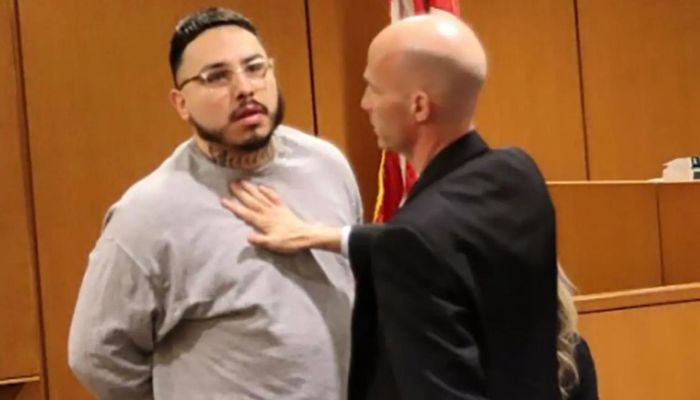
On Wednesday (17th January), during the sentencing hearing in California, a man lashed out at the killer of his stepdaughter. The sorrowful man landed at least one punch before court bailiffs intervened, separating him from the killer of his stepdaughter. Accused Euren Balbuena, aged 33, received a sentence of 33 years to life in prison for the 2020 murder of his 31-year-old girlfriend, Zaira Patino-Trejo. On Thursday, the verdict was announced by Ventura County District Attorney Erik Nasarenko.
The assailant, in Simi Valley, USA, fatally stabbed Patino-Trejo in the presence of her mother, Ariadna Avetisyan, who also suffered a head laceration. During an emotional victim impact statement, where Avetisyan was expressing how Patino-Trejo’s loss had profoundly impacted their family, her husband lunged at Balbuena in the courtroom.
The stepfather was escorted out of the courtroom after the altercation with the accused killer. Impact statements resumed about an hour later. County sheriff’s officials had not filed a case related to the incident.
In November 2023, Balbuena was found guilty of first-degree murder in the Patino-Trejo murder case. He also caused great bodily injury to her mother as he assaulted her with a deadly weapon. The fatal altercation unfolded in February 2020 when Avetisyan arrived at the Simi Valley apartment after being unable to contact her daughter. Confronted with evidence of physical abuse on Patino-Trejo’s face and aware of Balbuena’s previous history of domestic violence, the mother urgently sought to leave with her daughter.
Impeding their escape, the assailant obstructed their path and slashed Avetisyan twice across the face before turning to attack her daughter. Patino-Trejo endured over 30 stab wounds, with prosecutors contending that the actual count was closer to 95. After witnessing her daughter’s tragic demise, Avetisyan fled the scene while heavily bleeding and promptly called 911.
Supervising Senior Deputy District Attorney Melissa Suttner said in a statement, “Zaira Patino-Trejo was such a vibrant young woman with a bright future. We cannot replace her unimaginable loss, but we pursued justice for Zaira and her family. We hope that this sentence brings some small relief to her family, knowing that Euren Balbuena was held accountable for her brutal murder.”
On Saturday, 20th January, the Delhi Police arrested the main accused in the case involving actor Rashmika Mandanna’s deepfake video from Andhra Pradesh. DCP Hemant Tiwari, Intelligence Fusion & Strategic Operations (IFSO) Unit from Delhi Police has confirmed the arrest of the main accused.
Delhi | Main accused in the case of deep fake profiles of actor Rashmika Mandana arrested: DCP Hemant Tiwari, IFSO Unit
Earlier in the day, ANI reported that four suspects in the case have been tracked down and the hunt was on to nab the main conspirator. However, the four suspects initially arrested turned out to be uploaders, not creators, the police said, adding that they were looking for the key conspirator in the case. Out of the four suspects, three had been tracked based on the details provided by Meta, the company that owns and operates social media platforms like Facebook, Instagram and WhatsApp. Now the main conspirator has also been arrested.
On November 6 last year, a modified video of actor Rashmika Mandanna appeared online sparking discussions on digital safety. In the viral video, it can be seen that a woman resembling the actress Rashmika was entering a lift wearing a black swimsuit. The video quickly went viral and several social media users came forward to confirm that it was a deep fake. It was later identified that the video was of a British Actress Zara Patel.
The actor had strongly reacted to the deep fake video and said, “I feel really hurt to share this and have to talk about the deep fake video of me being spread online. Something like this is honestly, extremely scary not only for me but also for each one of us who today is vulnerable to so much harm because of how technology is being misused.”
The Delhi Police registered the FIR under Indian Penal Code sections 465 (punishment for forgery) and 469 (forgery for purpose of harming reputation) and sections 66C and 66E of the Information Technology Act at the Intelligence Fusion and Strategic Operations (IFSO) Unit of the Delhi Police’s Special Cell and an investigation has been carried out into the matter. It was reported earlier that the probe in the matter has reached a dead end as the accused had removed and deleted his or her account from the social media platforms. However, the police have arrested the main accused in the case on Saturday.
Highlighting the danger of deepfakes, Union Minister Ashwini Vaishnaw said on November 18 during an interaction with the media, “Deepfake is a big issue for all of us. We recently issued notices to all the big social media forms, asking them to take steps to identify deepfakes, to remove those content. The social media platforms have responded. They are taking action. We have told them to be more aggressive in this work.”
Recently, a gaming application morphed a video of Sachin Tendulkar and began a fraudulent promotional campaign. After Sachin Tendulkar took to X and clarified that the video showing him encouraging his fans to play games on that app was bogus, the Mumbai Cyber Police filed an FIR against it.
Notably, Deep fakes, a blend of “deep learning” and “fake,” represent a concerning and rapidly evolving aspect of artificial intelligence manipulation. These sophisticated forgeries use digital software, machine learning, and face-swapping technologies to generate artificial videos that look strikingly similar to original videos of a person or an event. These videos can depict events, statements or actions that have never happened.
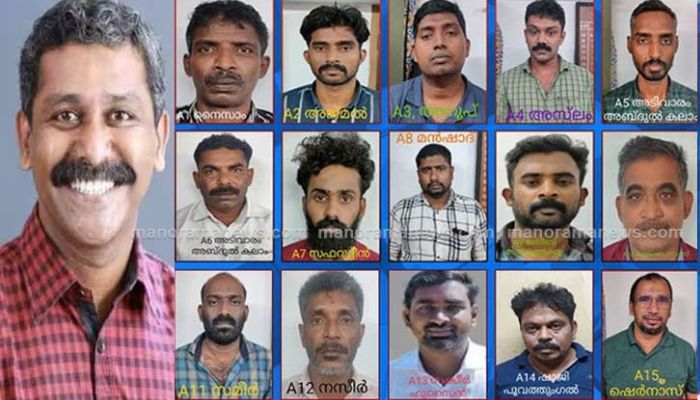
Two years after the murder of BJP leader Ranjith Sreenivasan, an Additional Sessions Court in Kerala convicted 15 members of the radical Islamist outfit Social Democratic Party of India (SDPI) guilty in connection to the case.
The verdict was delivered on Saturday (20th January). The court found 8 members of SDPI, the political wing of the banned outfit Popular Front of India (PFI), guilty of murder while 7 others were convicted for other offences including conspiracy.
Eight of the accused men who were found guilty of murder include Nizam, Muhammad Aslam, Salam Ponnad, Abdul Salam, Safaruddin, Ajmal, Anoop, and Manshad. The quantum of punishment will be declared on Monday (22nd January).
The Background of the Case
On 19th December, BJP leader Ranjith Sreenivasan was murdered at his residence by SDPI workers. The incident took place in the Alappuzha district of Kerala.
The perpetrators broke into his house in the wee hours of the morning and hacked him to death. Ranjith Sreenivasan He was a member of BJP Kerala committee and OBC Morcha (State) Secretary.
He had contested as a BJP candidate from the Alappuzha constituency in 2016. The BJP leader was an advocate by occupation.
My Deepest condolences to the family members of Adv Ranjith Sreenivasan,@BJP4Keralam OBC Morcha Secy who was killed today by SDPI goons. Kerala is gripped under extremist terror forces, state govt has surrendered to such forces. BJP stands by its karyakartas in testing situations pic.twitter.com/A6VAAJ0aG4
Following the incident, Section 144 (prohibit the gathering of four or more people in an area) of the Code of Criminal Procedure (CrPC) was imposed in the Alappuzha district to prevent any untoward incident.
The 2021 murder occurred hours after a state-level SDPI leader K S Shan was killed in the same district.
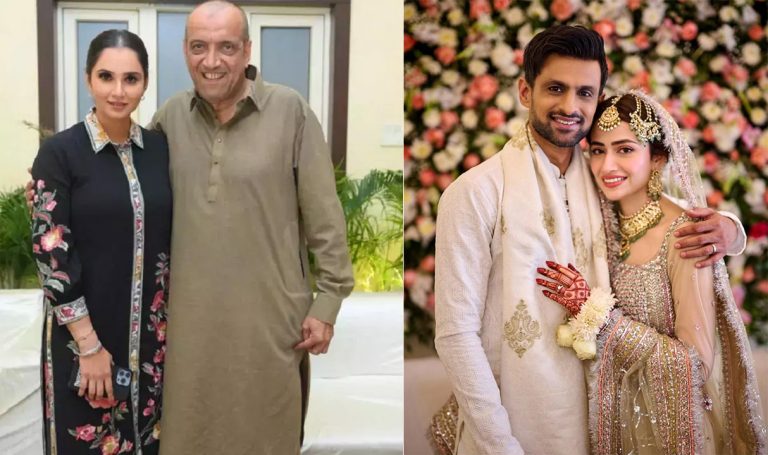
Following former captain of Pakistan Shoaib Malik on 20th January announced that he had married Pakistani actor Sana Javed in Karachi, his current wife Sania Mirza’s father announced that she has already divorced Malik. “It was a khula,” Sania Mirza’s father Imran Mirza said after Shoaib Malik’s marriage with Sana Javed was announced by Malik.
Khul, also called khula, is a procedure based on traditional jurisprudence, that allows a Muslim woman to unilaterally divorce her husband by applying to the Shariah Council. A married Muslim woman can initiate a divorce under Khula procedure by returning the mahr (obligation in the form of money, possessions or teaching of verses from the Quran by the groom, to the bride at the time of Islamic marriage) and everything she received from him during their life together, or without returning anything, as agreed by the spouses or judge’s decree, depending on the circumstances.
Sania Mirza’s father Imran Mirza has now confirmed Sania Mirza has divorced Shoaib Malik using this Khula procedure under Sharia.
The cricket player, who had a son named Izhaan Mirza Malik with Sania Mirza, shared a photo of himself and his new spouse on social media with the caption “And we created you in pairs.” He also updated his Instagram and removed, “Husband to a Superwoman Sania Mirza” which was written in his bio as well as unfollowed the Indian star a few days back.
The tennis player also posted a cryptic message on her social media which read, “Marriage is hard. Divorce is hard. Choose your hard. Obesity is hard. Being fit is hard. Choose your hard. Being in debt is hard. Being financially disciplined is hard. Choose your hard. Communication is hard. Not communicating is hard. Choose your hard. Life will never be easy. It will always be hard. But we can choose our hard. Pick wisely.”
Source: Sania Mirza’s Instagram Account
Reports stated that there had been much conjecture over how long Shoaib Malik has been dating Sana Javed since the Pakistani cricketer wished the actress a happy birthday last year. He wrote, “Happy Birthday Buddy,” while sharing a photo of them together on his Instagram account.
Notably, he married famous Indian tennis player Sania Mirza in a customary Muslim ceremony in Hyderabad, India in 2010. It was succeeded in Pakistan’s Sialkot by a Walima (reception) function. The couple had moved to Dubai after they tied the knot.
Both Shoaib Malik and Sania Mirza have kept quiet about their married lives, despite years of reports about their breakup. However, the rumours of their breakup had subsided as the two celebrated their son’s birthday in Dubai last year. They reportedly co-parent the kid who lives with his mother.
Shoaib Malik’s first wife was Ayesha Siddiqui, whom he had divorced in 2010 ahead of marrying Mirza, who became his second wife. Now, Sana has become his third wife. While he can have four wives at the same time as per Islamic Sharia rules, he married each time following divorce with the existing wife.
Sana Javed had appeared in Pakistani cinema and acted in a number of well-known drama serials. She married singer Umair Jaiswal in 2020 in a low-key ceremony during the height of the coronavirus outbreak. However, news about their divorce broke out two months prior.
Sania Mirza declared her retirement last year after a 20-year-long successful career during which she won forty-three Women’s Tennis Association (WTA) doubles titles and one singles trophy.
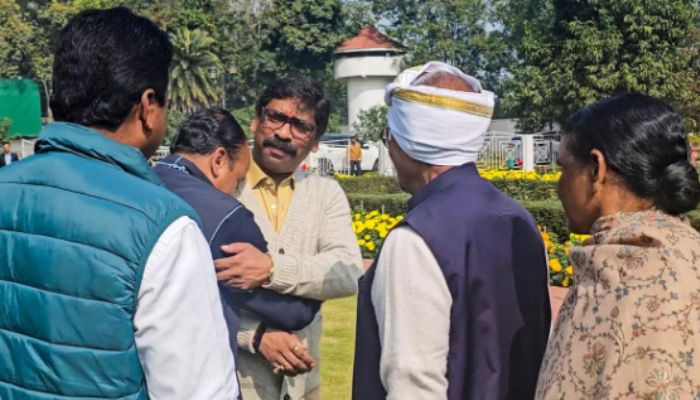
The Enforcement Directorate sleuths began questioning Jharkhand Chief Minister Hemant Soren in the alleged land scam case at his official residence in Ranchi on Saturday (20th January). Notably, while responding to the agency’s eighth summon in the case, he had asked the agency to quiz him at his residence.
The ED officials are probing an alleged money laundering that is related to a land scam case under Section 50 of the Prevention of Money Laundering Act (PMLA).
The developments in the alleged land scam case
According to the Enforcement Directorate, the investigation pertains to a “huge racket of illegal change of ownership of land by the mafia” in Jharkhand.
The ED officials are investigating the illegal purchase and sale of 4.55 acres of land under military control in Ranchi.
According to an official statement, the ED had opened a probe into three cases of land fraud based on numerous First Information Reports filed by the Jharkhand Police and the West Bengal Police against Pradip Bagchi, Bishnu Kumar Agarwal, Bhanu Pratap Prasad as well as others under various Indian Penal Code sections.
It is alleged that a massive mafia racket transferred land ownership illegally in Jharkhand. The government notification stated that “these criminal elements used to forge the legacy records in Ranchi and Kolkata.” Additionally, it was discovered that dishonest government employees had fabricated land ownership records to curry favour with the aforementioned land mafia.
Around 14 individuals have been arrested in this case so far including Bhanu Pratap Prasad, the Revenue Deputy Inspector of Badgai region in Ranchi.
During a raid on Prasad’s residence, the ED seized a substantial amount of government documents along with several suspicious documents retrieved from his mobile phone. The ED is conducting inquiries and verifying the authenticity of the documents and related information through questioning with the Chief Minister. The agency has conducted more than 40 searches and over 5 surveys concerning the case.
Meanwhile, on 1st September 2023, the ED officials had attached three plots worth over Rs 161.64 crore in Ranchi in this case. It is alleged that these land parcels were fraudulently altered to the advantage of land mafias with the help of Land Revenue Department personnel. It was the second attachment in the case taking the total value of the assets that have been attached to a staggering Rs 236 crore.
In September, the ED also filed a second chargesheet in the case. The first prosecution complaint had previously been lodged on 12th June 2023.
Notably, 14 accused arrested in the case include Pradip Bagchi, Afshar Ali, Saddam Hussain, Imtiaz Ahmed, Talha Khan, Faiyaaz Khan, Bhanu Pratap Prasad, 2011-batch IAS officer Chhavi Ranjan (Ex DC Ranchi), Dilip Kumar Ghosh, Amit Kumar Agarwal, Bishnu Kumar Agarwal, Rajesh Rai, Bharat Prasad, and Prem Prakash.
As per an earlier report, the Chief Minister’s name was mentioned in the statements of businessman Vishnu Agarwal and Revenue Sub-Inspector of Bargain Circle Bhanu Pratap Prasad. The CM would be questioned in connection with the land in Bariatu. Currently, businessman Vishnu Agarwal is in ED custody in connection with the land scam case under the charges of money laundering.
During the interrogation, Vishnu Aggarwal, the director of Nucleus Mall, reportedly revealed the name of Chief Minister Hemant Soren.
Other legal cases against Jharkhand CM
In November 2022, the ED officials questioned him for nearly nine and a half hours in connection with an alleged illegal mining case. Before his grilling by the agency, ED had arrested two of his close aides in connection with the case. Back then, ED claimed that it had “identified” proceeds of crime relating to illegal stone mining in the state to the tune of Rs 1,000 crores.
It is alleged that while he was overseeing the portfolio of the Mining Minister, he allocated a mining lease contract to himself. During a hearing in the Jharkhand High Court, the state government’s counsel, Advocate General Rajiv Ranjan, termed it a “mistake” and told the court that it had been “surrendered”.
He had earlier declined Seven summons to appear before the ED officials
Since August last year, the ED has issued eight summons to Jharkhand CM in this case. It is important to note that Soren had approached both the Supreme Court and the Jharkhand High Court seeking relief in this case. He filed a petition before both courts, seeking protection from the ED action claiming that the summonses were “unwarranted”. However, both courts dismissed his petitions.
Delhi Chief Minister following the same footsteps
The Aam Aadmi Party Supremo and Delhi Chief Minister Arvind Kejriwal has declined to join the ED investigation and has already turned down three summons, claiming that he is being victimised by the Centre through misuse of ED as he has done nothing wrong in the liquor scam case. Now there are reports that he may skip the fourth summons issued by the Enforcement Directorate (ED) on Thursday (18th January) as he is scheduled to leave for Goa for a three-day visit.
ED had issued a summons to Kejriwal on 13th January, asking him to appear before it in connection with its probe into the money laundering allegations related to the Delhi excise policy case. On previous occasions, he had cited a busy schedule in Election campaigning and a pre-scheduled ten-day annual Vipassana session while also claiming that the ED summons are illegal and witch-hunt.
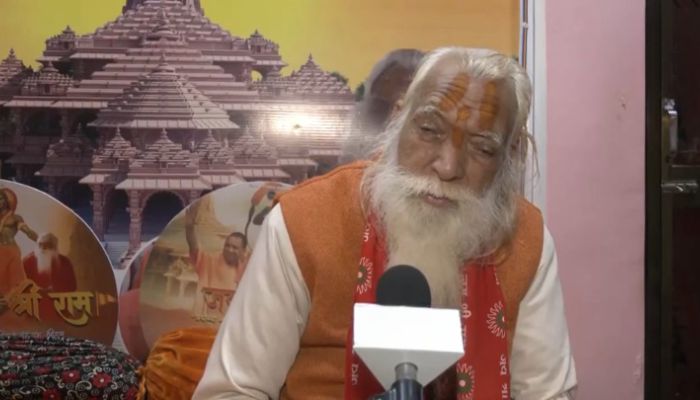
The consecration ceremony for the idol of Ram Lalla in the Ram Temple at Ayodhya is scheduled for Monday (22nd January). However, before the event, there was a controversy after pictures of the idol surfaced. The idol was unveiled three days before the official ceremony. The images depict the idol, crafted from black stone, with a yellow cloth covering its eyes. In some of the leaked pictures, the yellow cloth appears to have been removed from the statue’s eyes. Responding to this development, Acharya Satyendra Das, the chief priest of Ram Janmabhoomi, expressed his views on the matter on Saturday (20th January).
Satyendra Das, the chief priest of the Ram temple, said that before the consecration, the cloth could not be removed from the eyes of the deity’s new idol. He added that if the cloth is not visible in the eyes of the idol, then it is wrong, and it should be probed.
Acharya Satyendra Das said, “Where there is a new idol, the rituals of consecration of life are being performed. At present, the idol has been covered with clothes. It is not right to show an open-eyed idol. Eyes will not be opened before consecration. If such a picture is coming out, then it should be investigated who has done it.”
#WATCH | Ayodhya: On the idol of Lord Ram, Shri Ram Janmabhoomi Teerth Kshetra Chief Priest Acharya Satyendra Das says, "…The eyes of Lord Ram's idol cannot be revealed before Pran Pratishtha is completed. The idol where the eyes of Lord Ram can be seen is not the real idol. If… pic.twitter.com/I0FjRfCQRp
According to reports, officials are in a state of concern following the leakage of a picture of Ram Lalla from the sanctum sanctorum of Shri Ram Janmabhoomi before the scheduled consecration ceremony on 22nd January in Ayodhya. The Shri Ram Janmabhoomi Teerth Kshetra Trust is contemplating stringent measures against those responsible for the unauthorized release of the image. The trust has raised suspicions against certain officials present at the site, speculating that those engaged in the construction work at the temple might be involved. Actions are being planned against the officers believed to have made the photo of Ram Lalla viral on social media.
Meanwhile, Vijetha Yogiraj, sculptor Arun Yogiraj’s wife, said that the final picture of Ram Lalla’s idol has not been revealed yet. She said that the pictures in which the eyes of the idol are visible do not include the final version of the idol and some work regarding eyes remained when those pictures are clicked.
She said, “The final picture after the completion of eyes is still not revealed. So I’m happy that we still can wait for the final picture. But anyhow, this, this is something, everybody is looking at is an idol, this murti of Ram Lalla and you can see Ram Lalla in front of our eyes and we are, this stone Krishna Shila has qualities where when you do Abhishek, that abhisheka, that is when you put milk, you can consume it also, it is, it does, it does not affect your health and milk comes out like milk. It does not turn into curd or anything, which is why we have, which is why this stone has been selected because it does not react to any acid fire, or water, weatherproof, or anything. It will stay for several years to come, more than thousands of years.”
Photographs of the idol of Lord Ram installed in the Garbhagriha of Ram Mandir surfaced on 19th January which exhibit its delicate and complex structures. The Ram Lalla idol was installed on the marble mandapa in the sanctum sanctorum on 18th January, ahead of the consecration ceremony on 22nd January. The first photo of the deity which was covered with a white veil was revealed during the placement ceremony on 18th January.
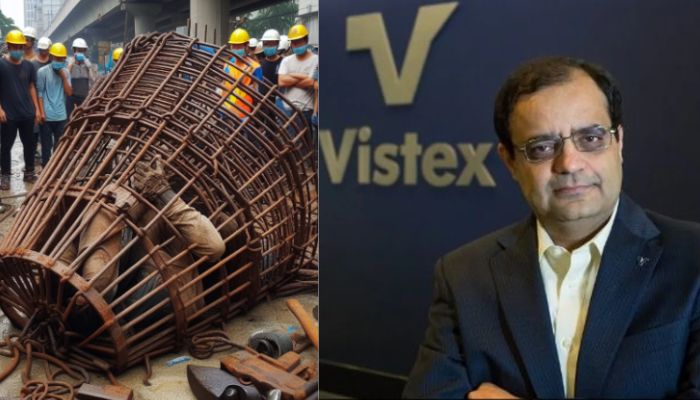
The founder-CEO of a US-based tech company lost his life, while another official sustained severe injuries, after an “Iron cage” suffered a malfunction during the company’s corporate event at Ramoji Film City in Hyderabad. Following the accident, police have registered a case for negligence and an investigation is currently underway.
The deceased has been identified as Sanjay Shah, 56, who was the CEO of Illinois-based firm Vistex. The company president Raju Datla has sustained grievous injuries in the same mishap and is currently undergoing treatment.
In the video clip of the tragic accident, the duo can be seen falling off the Iron cage after the chains holding the cage snapped, and hitting the platform below hard.
#Hyderabad | Sanjay Shah, the CEO of Illinois-based firm Vistex, and company president Raju Datla were being lowered onto a stage in an iron platform at Ramoji Film City in Hyderabad when one of the wires snapped.
On Friday (19th January), Police said that the CEO of a private firm lost his life, while another official suffered serious injury in a freak accident during the silver jubilee celebrations of the company at Ramoji Film City.
Police added that during the celebrations on Thursday evening, the company’s CEO Sanjay Shah, and his colleague Raju Datla entered an iron cage, which was to be lowered from a height when the iron chain supporting the cage broke on one side, and both of them fell.
Following the tragic accident, the duo were rushed to the hospital, but Sanjay Shah passed away while undergoing treatment.
According to police, Shah and Datla were being descended onto the stage in an iron platform from a height of about 20 feet when one of the iron wires supporting the platform snapped, leading to their fall.
Police added that based on a complaint by a company official, a case was registered against the Film City event management authorities. An FIR has been registered at Abdullapurmet police station under sections 304 A (causing death by a rash or negligent act), 336 (endangering human life or personal safety of others), 287 (negligent conduct concerning machinery) of the Indian Penal Code. The management of Ramoji Film City, the event management company, and others responsible for the safe conduct of the event have been booked.
As per information, both Shah and Datla are US citizens and they had arrived in Hyderabad for a two-day event to celebrate the company’s 25 years with employees of the Hyderabad branch.
Speaking to Indian Express, Sub-Inspector D Karnakar Reddy said, “It was just the beginning of the two-day event. The father, mother, wife, and brothers of the deceased were present in the audience. Around 680 people from the Hyderabad branch were also in the audience.”
Mumbai-based Sanjay Shah had set up Vistex as an Enterprise Resource Planning (ERP) solutions firm in 1999. Around 20 years ago, he moved to the US.
At present, the company has 20 global offices and employs over 2,000 individuals. Additionally, Shah established the Vistex Foundation and the Vistex Institute for Executive Learning and Research at Lehigh University. Datla has been associated with Vistex since the year 2000.
The long-standing Ram Janmabhoomi movement has reached its pinnacle as the consecration ceremony of the majestic Ram Mandir in Ayodhya is just two days away.
This marks the end of 496 years of struggle to reclaim the birthplace of Lord Ram, where once stood a disputed structure. Despite all attempts to deny Hindus the right to their Ram Janmabhoomi, the movement ushered into a new dawn for Hindu civilisation.
The construction of Ram Mandir in Ayodhya is the culmination of sacrifices made by the Hindu community, not just in India but across the globe.
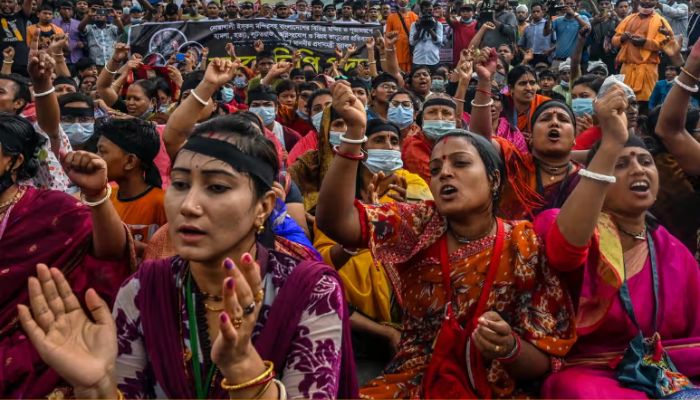
In the neighbouring country of Bangladesh, the minority Hindu community was subjected to inhuman atrocities after the disputed structure in Ayodhya was razed to the ground on 6th December 1992.
In its 2004 report, the ‘Minorities at Risk Project (MRP)’ chronicled the attacks on the minority Hindu community in Bangladesh by radical Islamists.
October 1990:
An indefinite curfew was imposed in Dhaka by the Bangladeshi government after Islamists attempted to set fire to Hindu temples. The planned arson attack was however thwarted by the police.
This was done to ‘avenge’ the storming of a disputed structure by karsevaks at the Ram Janmabhoomi in Ayodhya. Although they could not harm the Hindu temples in Dhaka, Islamists managed to attack the press and seize their cameras.
Later, Muslim mobs unleashed mayhew in Chittagong and destroyed several homes, shops and temples belonging to the Hindu community.
According to the Human Rights Congress for Bangladesh Minorities (HRCBM), Islamists attacked Hindu shops and the Gouri Math temple, located south of the ‘Bangha Bhavan’ on 30th October 1990.
“All the belongings of Hindu minorities were burning to ashes barely a mile away from Ershad’s conference. The atrocities happen in front of police and local administration but there was no effort from law enforcing agencies to prevent the violence,” the report noted.
A strong mob of 5000 Muslim men, armed with bamboo sticks and roads, tried to storm a cricket match played between India and Bangladesh at the Dhaka National Stadium.
Their attempts were foiled by the police, who fired tear gas and rubber bullets at the frenzied mob. The 2004 MRP report stated, “At least 10 people have died, many Hindu women have been raped, and hundreds of Hindu homes and temples have been destroyed.“
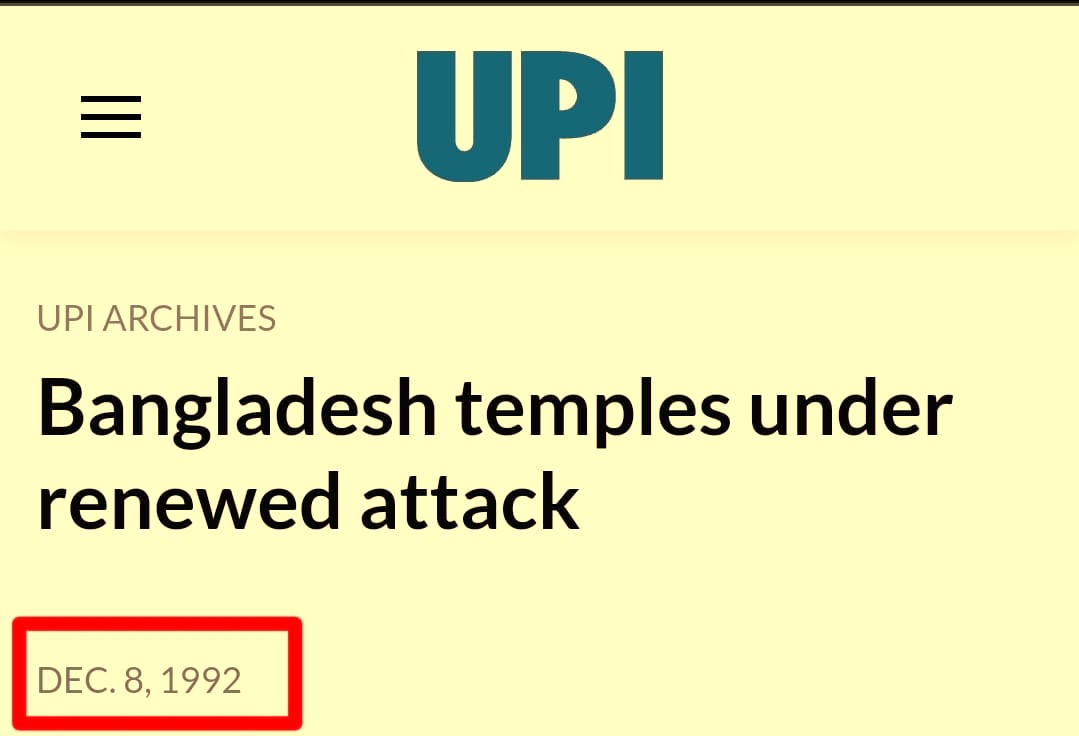
Screengrab of the 1992 news report by United Press International
As per a report by United Press International, a mob of 1000 Muslim men barged into the Hindu Shiva temple in Thatari Bazar district of Dhaka and razed it to the ground.
Islamists also attacked a Hindu temple in the Narinda district and gravely injured an 88-year-old Hin du priest in a bomb attack. Muslim mob also tried to break into the Dhakeswari Mandir in Dhaka.
They also looted shops belonging to the Hindus and smashed the cars of the minority community with sticks and iron bars.
Destruction
According to the Human Rights Congress for Bangladesh Minorities (HRCBM), the pogrom was executed by the radical Islamist outfit Jamat-i-Islami which was an alliance partner of the ruling Bangladesh Nationalist Party (BNP).
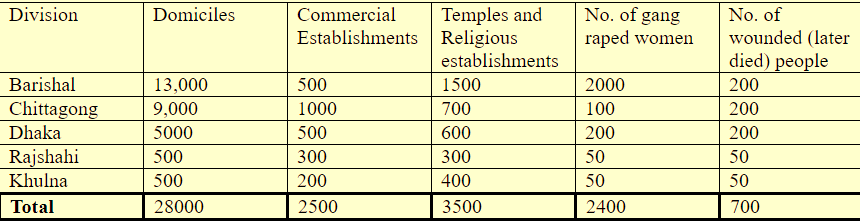
The riots were not spontaneous but rather well-planned. An estimated 2400 Hindu women were gang raped, and 3500 temples and religious establishments were destroyed by frenzied Muslim mobs.
Over 28000 homes and 2500 commercial buildings belonging to the Hindu community were razed. An estimated 700 Hindus were killed in the carnage. The numbers were conservative as acknowledged by several prominent politicians at that time.
“During the atrocities of 1992 and 1990 minority women and children have become the victims of brutal crimes. In those atrocities women were not only gang raped brutally, they were forced to walk naked in the streets,” the HRCBM report emphasised.
“Rape victims also include minors starting with age 5. In some villages, no women aged 5 to age 70 escaped the merciless attack of vicious Islamic fundamentalists,” it concluded.
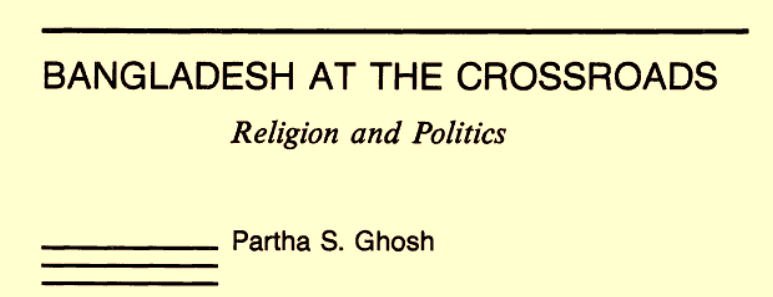
Screengrab of the paper of Partha S Ghosh
In his paper ‘Bangladesh at the Crossroads: Religion and Politics’, Patha S Ghosh notes the mayhem unleashed by Muslim mobs against the Hindu community on the night of 6th December 1992.
“Riots in Dhaka, on the day the mosque was destroyed, injured about 70 people, including two journalists, and damaged a number of shops belonging to Hindus. The Indian Airlines office was attacked and the Indian Cultural Centre burned. Sev- eral Hindu temples were attacked and one near the Nawabazar police out- post was set on fire,” it read.
Islamists attacked the offices of the Communist Party of Bangladesh (CPB) and the Nirmul Committee. They also gutted the largest Hindu rath (chariot) in Bangladesh.
Hindus, fearful for their lives, were bound by circumstances to avoid participating in the 300-year-old Shiva Chaturdash fair in Chittagong.
October 1993:
Hindus in Bangladesh decided to forego the annual Durga Puja celebrations in light of the atrocities committed against them by the majority Muslim community.
“The Hindus have demanded that damaged and destroyed temples be repaired and that an inquiry be held into the attack on a Hindu religious procession in Dhaka in August,” the MRP report emphasised.
Conclusion
The completion of the Ram Temple is a moment of triumph for the Hindu community. Ayodhya is witnessing the finalisation of the Ram Janmabhoomi movement with the consecration ceremony of the Ram Mandir on 22nd January 2024.
Piles disease has ended up providing respite to Aam Aadmi Party (AAP) leader Vijay Nair, an accused in Delhi liquor scam, as a Delhi court has issued a temporary two-week bail on medical grounds to the former AAP communications in-charge.
Vijay Nair, an accused in Delhi’s liquor scam, has been in jail for 14 months. While granting him bail, Special Judge MK Nagpal said, “Petitioner Vijay Nair is granted interim bail for two weeks in this case. This period of bail will be for only two weeks from the day of exit.”
Vijay Nair had filed a petition in the court citing piles disease and sought interim bail for 8 weeks. He had pleaded that he was a grade-III piles patient and doctors had advised him surgery.
Delhi court grants interim bail to ex-AAP communications in-charge Vijay Nair in Excise Policy ‘scam’ money laundering case on medical ground
The court approved a temporary bail of 14 days for him, not extending it to two months. However, he was instructed to furnish a personal bond of Rs 2 lakh along with the corresponding surety. The court also said that Vijay Nair will not tamper with any evidence or influence any witness while being released on bail. The court has directed Nair not to meet or talk to any co-accused, suspect, or witness related to the liquor scam case.
During this period, the court stipulated that Nair must refrain from engaging in any form of criminal activity. Additionally, the court cautioned Nair against violating any conditions set for interim bail. Nair’s lawyer, Rebecca John, vehemently advocated for his release from incarceration.
Rebecca argued before the court that her client’s health has been seriously affected due to the long detention before the trial and he has suffered from many health problems. Further, Rebecca advocated that her client needs surgery which cannot be done in custody. Since Nair is a permanent resident of Mumbai, he wants to undergo the surgery there.
However, the Enforcement Directorate strongly opposed this bail plea of AAP leader Vijay Nair. The ED said that the surgery of the accused was not dangerous and these surgeries can be performed in a referral hospital even while in judicial custody. The Enforcement Directorate contended that Nair was receiving adequate medical care while in jail. Nevertheless, Nair asserted that he required continuous assistance and the presence of his family members to facilitate a swift recovery.
Nair was taken into custody in September 2022 in the liquor scam case. This is the first time Nair has been granted bail following the arrest. In July 2023, the same court in Delhi rejected his bail plea. Vijay Nair was arrested by the CBI in September 2022, making him one of the first arrests related to excise policy scam. However, he got bail in the CBI case, but before he could be released from custody, he was arrested by the ED on 2nd November 2022.