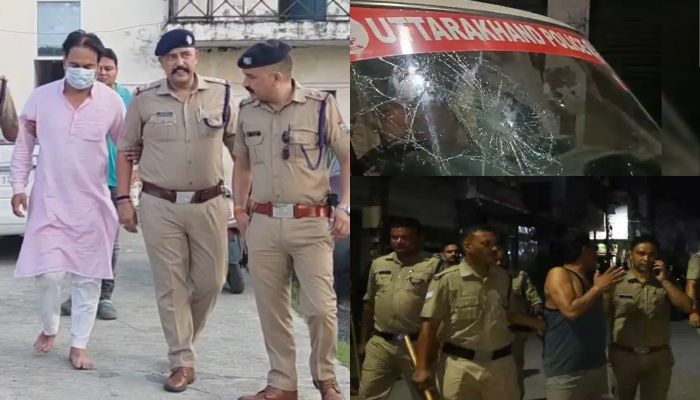
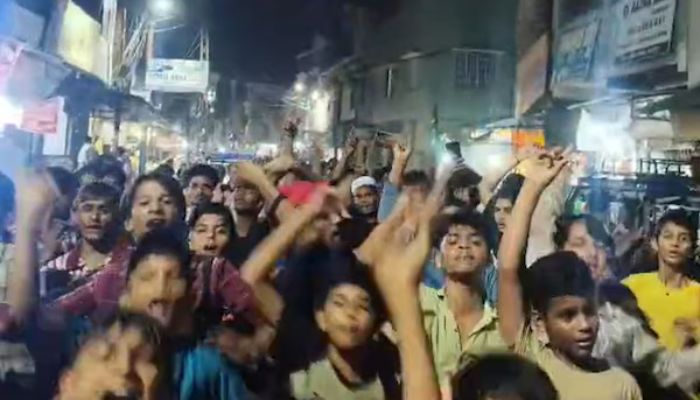
Following the violence that erupted during the ‘I Love Muhammad’ procession in Kashipur of Udham Singh Nagar in Uttarakhand, police swung into action and arrested seven Islamists, including the alleged mastermind Nadeem Akhtar. An FIR has been registered against seven accused and several unknown. Chief Minister of Uttarakhand, Pushkar Singh Dhami, has been informed about the developments in the matter. Senior Superintendent of Police (SSP) Manikant Mishra has issued strict directions and deployed additional forces to maintain law and order in the area.
How the violence unfolded
The incident took place on the night of 21st September in the Alikhan area of Kashipur. According to reports, Nadeem Akhtar, along with around 400–500 Islamists, organised a gathering. Following the meeting, the mob suddenly launched an unauthorised procession with banners and posters. They chanted “I Love Muhammad” slogans and moved towards the city through the Valmiki settlement.
काशीपुर (ऊधम सिंह नगर) में “आई लव मोहम्मद” मामले को लेकर निकाले गए जुलूस के दौरान हालात बिगड़ गए। विरोध प्रदर्शन हिंसक हो उठा, प्रदर्शनकारियों ने पथराव किया और पुलिसकर्मियों पर हमला कर दिया। झड़प में कई लोग घायल हुए हैं।
When police tried to intervene and stop them, the mob turned violent and attacked the police personnel with sticks and stones. They abused the police and caused damage to government vehicles. The windows of a Dial-112 vehicle and the bonnet of another police vehicle were severely damaged. The mob tore the uniforms of the police personnel.
Under SSP Mishra’s supervision, raids and house-to-house searches have been launched. PAC has been deployed and special teams formed to track down and arrest the accused.
What the FIR says
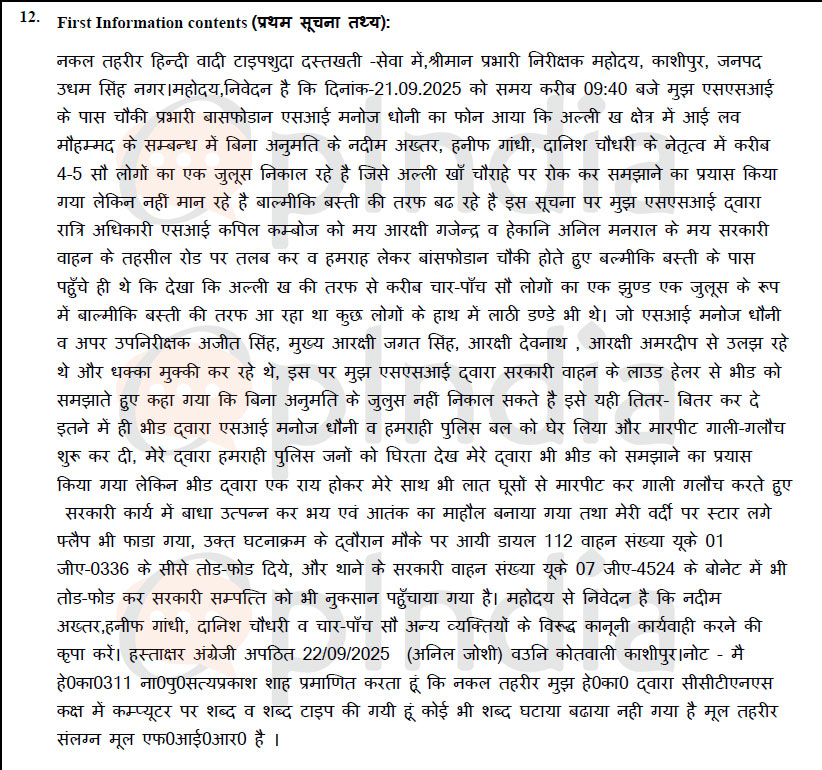
According to the police, an FIR has been lodged at Kotwali Kashipur on the complaint of SSI Anil Joshi. OpIndia accessed a copy of the FIR. SSI Joshi has named Nadeem Akhtar as the main accused in his complaint. The FIR has been registered under Sections 190, 191(2), 191(3), 232, 121(1), 132, 221, 324(3), 351(2), and 352 of the Bharatiya Nyaya Sanhita (BNS).
In his complaint, SSI provided details of how the mob carried sticks and lathis, and surrounded the police personnel. The mob attacked the police personnel and abused them, thereby obstructing them from conducting their official duty. The complaint also recorded the destruction of government vehicles and damage to property.
Source: Uttarakhand Police
In his complaint, SSI said that he received a call from SI Manoj Dhoni, in-charge of the Basphodan police outpost, informing him about the ‘I Love Muhammad’ procession being carried out without permission. Nadeem Akhtar, Hanif Gandhi and Danish Chaudhary were leading the procession. Police tried to stop them at Alikhan crossing, however, they refused to comply and continued to move towards the Valmiki locality.
SSI called SI Kapil Kamboj and other personnel to join him via Tehsil Road. When they reached the locality, they noticed that there was a 400–500 strong mob advancing from the Alikhan side in the form of a procession. They were carrying sticks and lathis. The mob was clashing and pushing with SI Manoj Dhoni, Sub-Inspector Ajit Singh, Head Constable Jagat Singh, Constable Devnath, and Constable Amardeep.
SSI tried to make the crowd understand that they could not take out a procession without permission. However, the crowd surrounded SI Dhoni and the accompanying police personnel. They assaulted and abused them. SSI was also attacked by the mob.
Arrests and ongoing investigation
So far, several accused have been arrested, including mastermind 47-year-old Nadeem Akhtar. Ten others are in police custody for questioning. Eighteen-year-old Mohd Ashad, nineteen-year-old Kamran, twenty-six-year-old Moin Raza, and twenty-eight-year-old Danish are among the arrested accused.
More arrests are expected as police are identifying the Islamists involved in the violence using CCTV footage from the area.
CM briefed, SSP’s warning
CM Dhami was briefed about the situation by the local representatives, including Mayor Deepak Bali. The CM made it clear that lawlessness will not be tolerated and cases under stringent sections will be pursued against those responsible.
काशीपुर उपद्रव के मास्टरमाइंड नदीम अख्तर सहित 07 उपद्रवी गिरफ्तार, 10 अन्य हिरासत में। पुलिस पर हमले व सरकारी वाहन क्षतिग्रस्त करने पर FIR दर्ज।
सीसीटीवी/मोबाइल फुटेज से पहचान जारी, अतिरिक्त पुलिस बल तैनात।
SSP Manikant Mishra, who camped in Kashipur after the violence, said law and order will not be allowed to be disrupted. He warned that the strictest action will be taken against those who attacked police and disturbed public peace, urging citizens to remain calm, avoid rumours, and cooperate with authorities.
World Rhino Day is observed annually on 22nd September to raise awareness and support for the world’s five surviving rhino species. Meanwhile, an Indian state has been spotlighted for its important role regarding the same. Assam, the picturesque north-eastern state popular for its wildlife, archeological sites and tea plantations is home to an overwhelming number of the world’s greater one-horned rhinoceros population which is found in Kaziranga National Park. It is a World Heritage Site renowned for its towering grasslands, wetlands and jungles.
The park currently hosts over 3000 rhinos or approximately 70% owing to decades of concentrated conservation efforts by the Indian and Assamese governments. As of 2024, there are over 4,000 rhinos in Assam which is an astonishing rise from just a few hundred years ago. Every government has played its part to foster the growth of these exotic animals. However, the efforts to ensure a safe habitat for rhinos and the conservation of wildlife and forests has seen a drastic increase under the leadership of Chief Minister Himanta Biswa Sarma.
Alongside his commitment to focus on the preservation and protection of the state’s wildlife and forests, he has launched an unprecedented campaign to reclaim unlawfully occupied land from Bangladeshi infiltrators and other elements with the additional aim to restore the balance in the natural ecosystem.
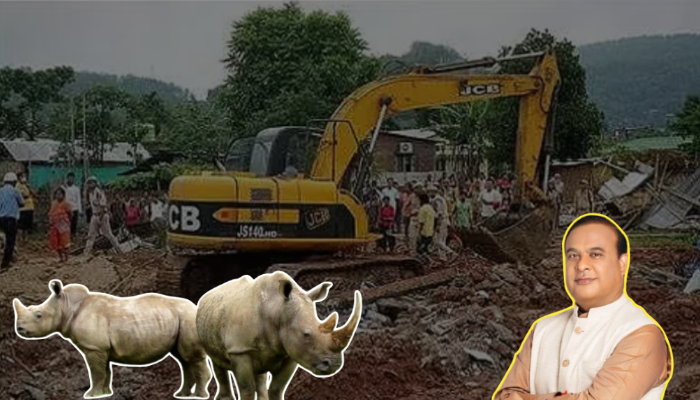
Persistent anti-encroachment drives have been a key component of Sarma’s wildlife protection plan since taking office in 2021. These efforts target habitat degradation, agricultural encroachment and decades-long unauthorized human settlements in different regions of the state, such as the Orang National Park, the area surrounding rhino habitats like Kaziranga National Park and the larger “Greater Kaziranga” landscape.
Drive/Operation
Date/Period
Area Covered
Land Reclaimed
Laokhowa-Burachapori Eviction
February 2023
Nagaon and Sonitpur districts (part of Greater Kaziranga)
51.7 sq km (including 1,282 hectares in Arimari corridor)
Rengma Reserve Forest Eviction
July 2025 (ongoing)
Golaghat district (near Kaziranga)
~11,000 bighas (targeting betel nut plantations linked to “betel mafia”)
Broader Kaziranga Periphery Drives
2021-2025
Golaghat, Sonitpur, Biswanath, Nagaon districts
Over 100 sq km cumulatively (including unsurveyed government land)
These actions support zero-poaching milestones and translocation operations such as to Manas National Part which has over 50 rhinos and prevented peripheral encroachment that reduced forest cover, a recognised threat in Kaziranga.
Consequently, the initiatives undertaken by the government aim not just at land liberation but also serve the best interests of Assam and its natural wealth. Notably, the Gauhati High Court had ordered the state forest department to remove the encroachers on multiple occasions. However, eviction drives only became more extensive when Bharatiya Janata Party’s Sarbananda Sonowal government obtained power in May 2016.
Sarma govt’s firm efforts towards forest and wildlife conservation
The chief minister has been notably vocal about the severity of encroachment on public land and how his government has embarked on a dedicated campaign to retrieve land meant for agricultural use, wildlife preservation and the common good of the citizens from the occupants.
“In the last 3 years, with consistent government efforts and cooperation from a large section of society, we have been able to free up 167 square kilometre of land from encroachers, an area larger than the size of Chandigarh city. We are committed to making every inch of land free from encroachers,” Sarma informed while describing the extensive illicit occupation, last year.
Likewise, the BJP leader in July emphasized the shocking scale of this menace, highlighting that approximately 29 lakh bighas of land in Assam is taken over by “Bangladeshi infiltrators and doubtful citizens.” However, he added that more than 1.19 lakh bighas of land have been reclaimed as his government remained steadfast in safeguarding the interests of the state.
Assam has faced an existential threat due to rampant illegal infiltration and a planned encroachment to alter demography of districts. THIS FACES A MAJOR ROADBLOCK DUE TO OUR POLICIES.
Over 1.19 lakh bighas of land have been freed from encroachers in the State as we stand firm… pic.twitter.com/DPtrVF8f45
On 30th July, he declared that the Rengma Reserve Forest is free from encroachment while stating that only legitimate Indian citizens possess the right to access the state’s resources.
We are on a mission to RECLAIM what rightfully belongs to us.
Our forests, our lands, our Satras, our agriculture fields; we are going ALL OUT to ensure that only legitimate Indian citizens enjoy the joy of being in Assam.
The Paikan Reserve Forest was also cleansed of encroachment in July and the forest department has since planted 1.2 lakh seedlings in about 373 bighas of the more than 1,000 bighas of forest area.
Last month, Sarma informed that 26 hectares of land “enough to house 65 football fields” in the Rengma Reserve Forest have been freed from encroachment as part of an ongoing eviction drive which he dubbed as “hot pursuit.”
The Hot Pursuit continues!
Our bulldozers reached Rengma Reserve Forest yesterday to pursue Part II of the eviction drive to free forest lands from encroachers.
The result?
26 Hectares of Forest Land reclaimed — enough to house 65 football fields!!
Rhino and tiger wildlife corridors have been restored there minimising fragmentation as a result which Sarma framed as “reclaiming their kingdom.” Moreover, it reduced human-caused hazards like snares while promoting habitat connectivity.
Similarly, in the initial phase of these efforts, the chief minister in 2022 remarked on the clearance of 1400 hectares of encroachment in the Lumding Reserve Forest. He pointed out how the restoration of the ecosystem was carried out on a priority basis there and attached a stunning video of a herd of elephants wandering through the area.
We cleared an encroachment of 1400 ha in Lumding RF in Nov 2021 and took up restoration of ecosystem on a war footing. Now it's heartening to see a big herd of elephants marching into this forest.
The Assam government successfully cleared encroachments from nearly 90 per cent of the Pabha Reserve Forest in 2023 following which Sarma shared an image depicting three rhinos which were spotted in the area. “The gentle giant returning to Pabho Reserve Forest is a wonderful news for all wildlife enthusiasts.”
Happy to share that 3 rhinos have been spotted in Pabho Reserve Forest in Lakhimpur, days after our drive resulted in freeing of 4163 ha (32000 bigha) of land in the RF from encroachment.
The gentle giant returning to Pabho RF is a wonderful news for all wildlife enthusiasts. pic.twitter.com/CFdFUyiVHD
Since the beginning of its term, the administration led by the BJP leader has shown unwavering dedication to fulfilling its promise to combat the alarming decline of the state’s forests which has resulted in a similarly perilous situation for the wildlife in the region.
Sarma mentioned an unfortunate event in which a rhino was struck by a moving vehicle at Haldibari and expressed his determination to protect animals at Kaziranga, in 2022. He then announced the development of a dedicated 32-kilometre elevated corridor designed to prevent similar occurrences in the future.
Rhinos are our special friends; we’ll not allow any infringement on their space.
In this unfortunate incident at Haldibari the Rhino survived; vehicle intercepted & fined. Meanwhile in our resolve to save animals at Kaziranga we’re working on a special 32-km elevated corridor. pic.twitter.com/z2aOPKgHsx
Anti-encroachment project not only about land reclamation, important for securing state’s holistic future and wildlife conservation
86.66 square kilometres of Assamese forest land disappeared between 2021 and 2023 alone and an additional 2,132.54 square kilometres were unlawfully occupied, reported India Today NE (North East). This has severely impaired essential ecosystem functions like water security and climate regulation in addition to destroying important habitats for iconic species like the one-horned rhinoceros. Moreover, the economic losses are equally significant.
Over the years, the land mafia and Bangladeshi invaders have aggressively circumvented Assam’s strict set of regulations intended to curb encroachments. However, after the saffron party was voted to power, Assam has started a major effort to free its wildlife sanctuaries and natural areas from unlawful encroachment. The state government has taken significant action to preserve its animals, forests and land integrity.
The government demonstrated its firm commitment immediately after being elected to power in 2021, when Sarma conducted the “Daha Sanskar” for approximately 2,500 horns of one-horned rhinoceroses that had perished either from natural causes or as a result of poaching activities and were collected by the Forest Department in Assam.
Today is a historic day for Assam & India. We have taken an extraordinary step of burning stockpile of 2479 horns of single-horned Rhinos, first-of-its-kind globally in volume terms, pursuing vision of Hon PM Sri @narendramodi of putting an end to poaching in Assam 1/2@PMOIndiapic.twitter.com/4SuN0XuCWB
Together with other political figures, Sarma served as the principal guest at the ceremony, which was held today at Bokakhat in Kaziranga National Park (KNP). The event which aimed to “bust myths about rhino horns” was hailed as a “milestone towards rhino conservation.” Yadava Mahendra Kumar Yadava declared, “It’s a loud and clear message to the poachers and smugglers that such items have no value.”
He is Special Chief Secretary, Forest in the state government. “In recent years, a determined chief minister has personally monitored and ensured implementation of the laws of the land and freeing our precious natural resources from encroachments and illegal havens for variety of activities.” he conveyed a few months later.
Last year, the chief minister stated that due to the state’s efforts to rid the region of unauthorised encroachments, rhinos had relocated to the Bura Chapori and Laokhowa forest sanctuaries in Nagaon and Sonitpur districts. The government had to act swiftly because these places had seen substantial encroachment issues. Around 1,892 hectares of land in Bura Chapori were cleared throughout the four days of the effective eviction operation that started in 2023.
According to reports, after forty years, this sanctuary, once a flourishing habitat for tigers, one-horned rhinos, elephants, deer and birds had been turned into a mini-township with dozens of settlements built inside its boundaries. The bulldozers used to clear the illegal encroachment destroyed government infrastructure set up by previous Congress governments, such as schools, Anganwadi centres and medical facilities in addition to illegal colonies.
Yadava had asserted, “With continued efforts, the return of rhinos to their rightful home after a period of over 4 decades is a powerful symbol of what can be achieved when conservation takes priority.”
Assam govt actions aligns with the “Indian Rhino Vision 2020”
There were just three protected locations in Assam with rhinos: Kaziranga National Park, Pobitora Wildlife Sanctuary and Orang National Park. However, Kaziranga National Park, the biggest of these, was nearly full. More habitats had to be discovered for the species to flourish.
The Bodoland Territorial Council, the Government of Assam and conservationists collaborated in 2005 to create a long-term strategy for the same. Their goal was to establish a wild population of 3,000 greater one-horned rhinos by 2020, dispersed among seven locations in the state of Assam and hence the “Indian Rhino Vision 2020” (IRV2020) initiative was born.
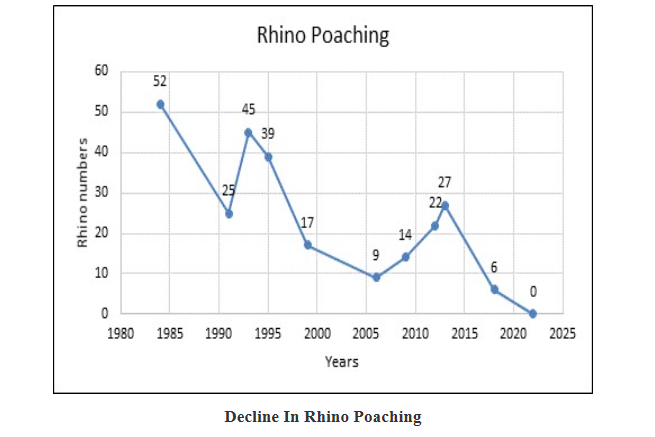
The ongoing anti-encroachment drives have already boosted the number of available habitats for greater one-horned rhinoceros, decreased human-wildlife conflicts and limited poaching risks by recovering forest territory. This has even helped to reduce rhino poaching by 86% since 2016, with zero incidences in Kaziranga in 2022, the first such year in decades.
Image via PIB
Last year, Sarma stated, “Since the double-engine government took charge (of Assam) in 2016, poaching has dropped by 86%. Ever since we assumed office, we have taken various initiatives to protect the prized species, expand its habitat and ensure its safety.” Furthermore, the government efforts are in line with critical programs like Indian Rhino Vision 2020.
The “Kaziranga model,” according to Assamese wildlife officials has evolved into a model for conservation in several rhino-bearing regions worldwide. With 233 anti-poaching camps spaced 5.82 square kilometres apart, the “Kaziranga model” has gained international recognition because of the evictions that restrict entry points.
Govt projects to ensure rhino protection and wildlife conservation
Not only has the reclaimed land been utilized but the government also implemented various other measures for the conservation of wildlife and nature. Orang National Park has expanded by more than 200 square kilometres, with a focus on rhino habitat growth.
Additionally, rhino populations have been isolated by encroachments which left them open to hunting and inbreeding. However, natural repopulation (e.g. stray rhinos from Kaziranga and Orang National Park) has been made possible by restored migration routes in reclaimed regions like Arimari. The goal of 4,500-5,000 rhinos by 2030 set by the National Rhino Conservation Strategy could be achieved through meta-populations.
The government trains locals to reduce disputes (700 safari drivers and mahouts in 2024) and promotes ecotourism which brings in money for conservation. Programs such as “Rhino Goes to School” involve marginalised populations to shed light on the importance of conservation of one-horned rhino.
The government also launched many complementary efforts like “Operation Falcon” to save one-horned rhino from poachers and eliminate illegal wildlife trade. It is a collaborative police-forest anti-poaching program that uses drones, river patrols and information to break up trafficking gangs surrounding Kaziranga. It was initiated in 2024. Numerous arrests have resulted and post-eviction habitat security has been strengthened due to the same.
Assam’s dedication to protecting rhino and other wildlife habitats is further proven by recently established protected areas like Siknajhar National Park and Poba Wildlife Sanctuary.
Image via PIB
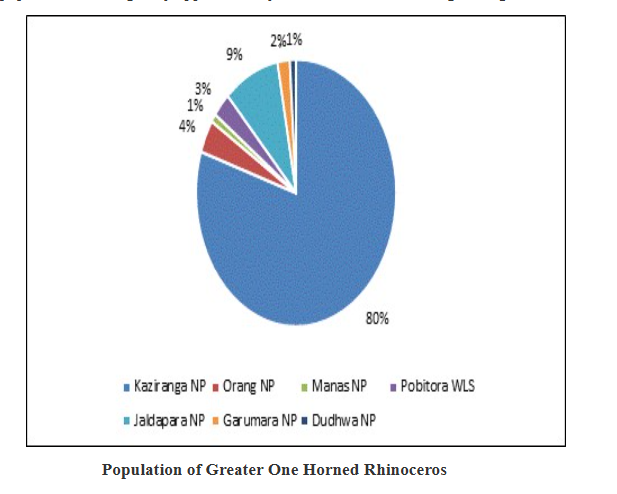
80% of the world’s greater one-horned rhino population is in Assam and since the 1980s, their number has spiked from 1,500 to around 4,014, a 170% jump. The centre and state government, forest department as well as surrounding communities have worked tirelessly to achieve this conservation success story.
Conclusion
More than 1.5 lakh bighas of land have been taken back owing to the eviction drives till August. According to Sarma, these drives “aim to protect Assam’s indigenous resources and address long-standing concerns about demographic changes due to illegal migration, particularly from Bangladesh.”
Nevertheless, he has consistently emphasized that the illegal occupation poses a significant threat to valuable animal species, forests and other forms of wildlife. It has also created serious environmental challenges. Human-wildlife conflict has escalated as a result of the loss of forests and grasslands, which are vital habitats for Assam’s various species. For example, it has caused elephants to be displaced from their native territories which has led to numerous human-animal conflicts.
The Assam government is clearly working to maintain a crucial balance between growth and environmental conservation in addition to making sure that Bangladeshi intruders do not infringe upon the rights of actual citizens. The same is evident by the efficient eviction drives to recapture government land and encroached forests including sanctuaries like Bura Chapori and Laokhowa.
On the occasion of the Hindu festival of Diwali, Axis Bank launched its new advertisement campaign ‘Dil Se Open Celebration 2025’. What surprised everyone was that in the middle of Diwali lights and Navratri celebrations, suddenly Santa Claus makes an entry.
Dil Se Open Celebrations is here! Get up to 20% off* on credit cards & EMIs from Navratri all the way till Christmas! And guess what? The news has already got someone special to come early!
Obviously, this is the same Santa who is usually considered a symbol of Christmas. By inserting Santa into Hindu festivals, the attempt seems to be to give the message that festivals belong to everyone and celebrations should go beyond the boundaries of religion. In other words, the same old sermon on secularism delivered specifically during Hindu festivals.
In the video, the advertisement shows a Garba dance going on during Navratri, when suddenly Santa Claus enters. Axis Bank used this concept to promote its offers, which will run from Navratri through Diwali and then until Christmas.
Social media outrage over Axis Bank’s ‘Christianisation’
The advertisement has triggered an uproar on social media. Many users are accusing Axis Bank of “Christianisation” and demanding the removal of the advertisement. On Twitter/X, the hashtag calling for a boycott of Axis Bank also began to trend.
An X user, The Jaipur Dialogues, tweeted, “Axis Bank is celebrating Navratri with Santa Claus. This is the height of insulting Hindu festivals. Axis Bank must immediately withdraw this advertisement, otherwise face boycott. They must be taught a lesson.”
Another user, Treeni, wrote: “Christianisation of Navratri? Axis Bank is mocking Hinduism by showing Santa Claus distributing gifts during Navratri, and plans to do the same for upcoming Hindu festivals as well!”
The Christianization of Navratri?@AxisBank is mocking Hinduism by depicting Santa Claus distributing gifts during Navratri and plans to continue this throughout all upcoming Hindu festivals!pic.twitter.com/je5a6dXOpN
“Axis Bank has Christianised Navratri. Why is this tampering always done only with Hindu festivals? Can they show Santa Claus in an Eid ad? Or Islamic symbols in a Christmas ad? Then why Santa Claus in Navratri?” An outraged user on X tweeted.
A user named Advaita wrote: “I will check my insurance plan, and now I will close my account because of your stupidity. What relation does this bugger have with our Navratri??”
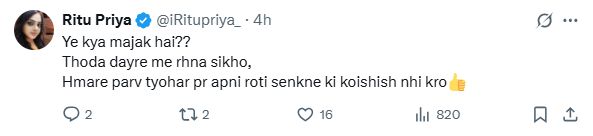
Another user, Ritu Priya, wrote: “What kind of joke is this?? Learn to stay within limits, don’t try to exploit our festivals for your own benefit.”
Vaishali Mishra questioned: “Can you make such an ad for Eid or any other Muslim festival?”
Targeting Hindu festivals to preach ‘secularism’
Axis Bank has once again rolled out the tired script of preaching “secularism” — but only during Hindu festivals. This playbook is familiar: Hindu traditions are diluted, mocked, or “universalised,” while other faiths are kept untouched.
We saw the same in 2020 when Tanishq’s Diwali ad promoted ‘love jihad’ by glorifying a Hindu woman’s baby shower with her Muslim in-laws, a campaign that sparked outrage after grim real-life cases of Hindu girls being brutalised surfaced.
Time and again, brands hide behind “secular advertising” to peddle propaganda that paints Hindus as intolerant and Muslims as perpetual victims. Notice the pattern: Ramadan ads never feature Hindu rituals, and Christmas commercials never show a Diwali lamp. Yet, when it comes to Navratri or Diwali, companies like Axis Bank suddenly discover the need to push the “festivals are for everyone” sermon.
This isn’t coincidence but a calculated marketing strategy: targeting Hindu festivals as convenient stages to deliver hollow lectures on secularism, while leaving others untouched.
The secular liberal cabal in India has traditionally been an Islamist apologist. However, even a slightest deviation by secular liberals from their ideological subservience to Islamists is met with backlash, ostracization from the Islamo-leftist ‘progressive’ ecosystem and pigeonholing as ‘Sanghi’ and even ‘Islamophobe’. Basically, Islamists hand a rude awakening to secular liberals that they are mere useful idiots for them and thus, they should stay in their lane.
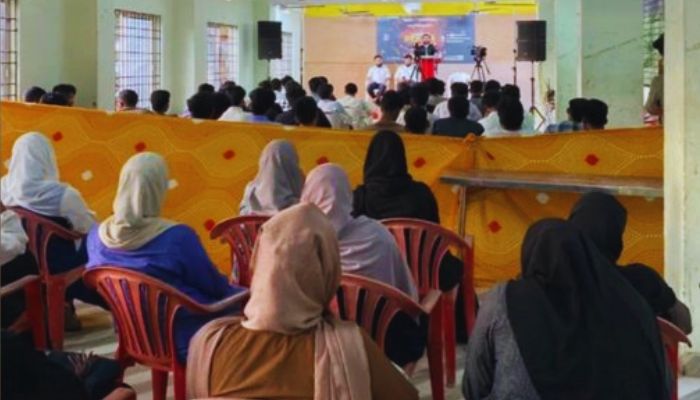
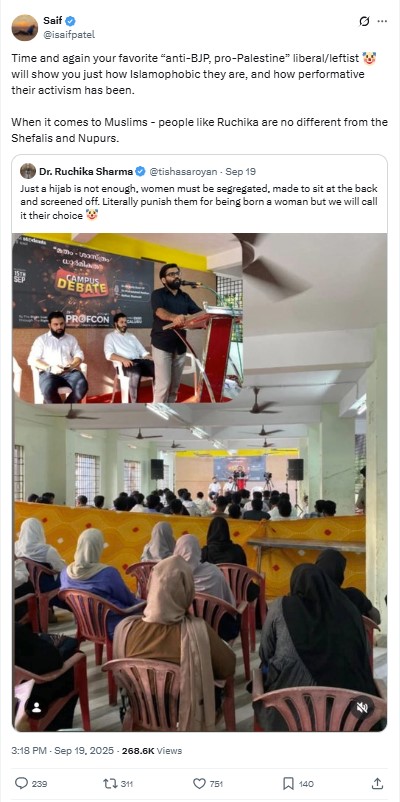
Recently, videos and images from a ‘Profcon’ event was organised by Islamists at the Cochin University of Science and Technology (CUSAT) in Kerala, went viral on social media.
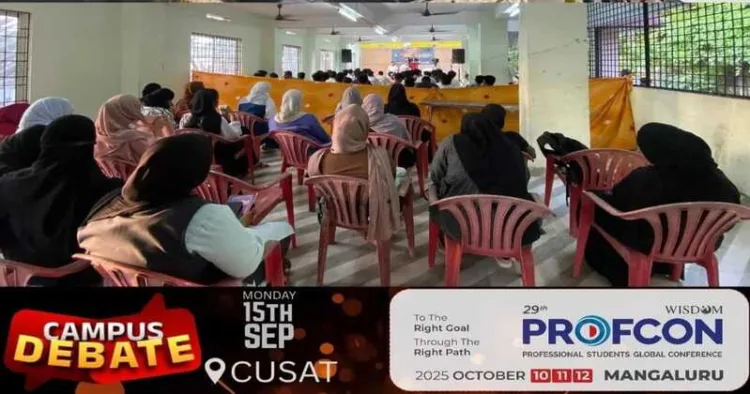
The visuals showed segregation of female Hijab-clad Muslim students from male ones in Taliban-style restrictions. The male students were seated in the front rows facing the stage, while girls were made to sit behind them, a curtain was put up as a makeshift cloth partition. This essentially prevented male and female students from seeing each other during the event.
The on-campus debate event was organised on 15th September 2025, under the banner of the ‘Wisdom Islamic Organization’, affiliated with the Islamic fundamentalist ‘Mujahid movement’. Ironically, the debate’s topic was “Religion, Science and Morality”.
Notably, CUSAT has said that it will approach court against the use of its name for the conduct of the outrageous ‘Profcon’ event. The varsity’s registrar said that CUSAT’s name and emblem was used by the organisers of the event without the varsity’s approval.
The apparent segregation of Muslim women from Muslim men in the debate sparked a discussion on social media whether Kerala is getting radically Islamised and if institutionalised gender discrimination has deepened its roots in a state that often boasts its progressiveness and near-total literacy rate.
Ruchika Sharma, a self-declared ‘historian’ who has made it her life’s mission to whitewash the anti-Hindu crimes of Islamic tyrants of the Medieval era, shared the viral picture from the said ‘Profcon’. “Just a hijab is not enough, women must be segregated, made to sit at the back and screened off. Literally punish them for being born a woman but we will call it their choice [clown emoji],” she tweeted.
Just a hijab is not enough, women must be segregated, made to sit at the back and screened off. Literally punish them for being born a woman but we will call it their choice ? pic.twitter.com/YGMMyWyBDU
In a subsequent post, Sharma wrote, “I have 99 struggles as a woman in the subcontinent, but being literally invisiblised at a campus debate ain’t one! #Smallmercies.”
This post criticising deliberate invisibilisation of Muslim women, Ruchika Sharma, who otherwise gets praise from Mughal fanboys and fellow Islamist apologists, received severe backlash from Islamists.
One of the infamous Islamists, Saif Patel, who claims to ‘despise religious bigotry’, labelled Sharma, “Islamophobic” and even equated her to Shefali Vaidya and Nupur Sharma.
“Time and again your favorite “anti-BJP, pro-Palestine” liberal/leftist [clown emoji] will show you just how Islamophobic they are, and how performative their activism has been. When it comes to Muslims – people like Ruchika are no different from the Shefalis and Nupurs,” Patel wrote.
Such is the extent to Islamist intolerance for liberal viewpoints that they do not mind slandering even their useful idiots.
Amusingly, the newly-labelled ‘Islamophobe’ Ruchika Sharma, has once admitted to not calling out her Muslim abuser just so that ‘Sanghis’ do not use it further their ‘Islamophobic communal agenda’. Earlier, Ruchika Sharma did not name her Muslim abuser because she feared fanning Islamophobia but has now ended up getting herself labelled as an Islamophobe for simply voicing her opinion against gender discrimination and segregation in the name of Islamic faith, morality, modesty and whatnot.
In replies under Sharma’s post, Muslim men and even some women have defended the gender-based segregation of women.
Quoting Sharma’s post, Arfa Khanum Sherwani, a ‘journalist’ at the leftist propaganda portal The Wire, endorsed Sharma’s thoughts with a Hundred Points emoji. Sherwani, who otherwise writes long paragraphs and rants on her The Wire program when she has to criticise the BJP, the so-called ‘Hindutva bigotry’, however, when it came to calling out Islamic invisibilisation of Muslim women and Islamists defending the outrageous practice, she chose to play it safe.
It, however, could not prevent Arfa from facing the wrath of misogynist Islamists, who schooled her on how free mixing of men and women is not allowed in Islam.
A reply to Arfa’s post seemed very interesting. A person named ‘Aurangzeb’ shared an image of Hijabi women and Muslim men sitting side by side in a room with a makeshift cloth partition in between. The person who shared this picture asked: “Fine??” However, is there an end to this sheer stupidity?
The Islamist suggested that since Muslim women and men are seated next to each other, although with a partition preventing them to see each other, there is no discrimination. It further suggested that by this way a free mixing of men and women could also be prevented and women were also not discriminated against by making them sit behind. However, what if Islamists say that the male teacher can clearly see the women and is in their vicinity. This arrangement too will become ‘Unislamic’.
Also, if even Hijab and Burqa-clad Muslim women need to be segregated from Muslim men for their safety, protect their modesty and prevent
Fitna (temptation), then is it not appropriate to conclude that the problem lies with men and not women.
As ironic as it gets, some Muslim women on X defended this biased arrangement as a matter of choice and comfort, however, how much ‘choice’ they would actually have in such a discriminating setting where modesty is protected by invisibilising women, would be known if they attempt to attend such events without a Hijab. They would not most likely not be allowed to be present there let alone getting to sit at the back behind a partition.
‘Progressive’ Kerala’s surrender to Islamist identity erasure: Making women invisible
Long hailed as India’s progressive outlier, Kerala, has over the years witnessed increased Islamist influence and spread of Wahhabi Islamic orthodoxy. This shift is fuelled by Islamist organisations and foreign funding from Gulf countries to Islamise a Hindu-majority secular India. Back in 2021, it was reported that radical Islamic organisations across the world have been financing projects that promote Islamism in India.
A Kerala-based journalist MP Basheer revealed that Islamist outfit Jamaat-e-Islami was allegedly receiving financial grants from universities in Saudi Arabia so that they could create awareness and promote Islamic dress code in Kerala and India. Jamaat-e-Islamic had started a project in India to promote the Islamic dress code for women and had access to funds from King Abdul Aziz University, an Islamic university in Jeddah, Saudi Arabia. Even Turkey and Pakistan have been forefront at funding radical Islamic thought in India, especially in Kashmir and Kerala.
Over the years, Kerala has become a hotbed of Islamic extremism. Be it unprecedented surge in love jihad/grooming jihad cases, imposition of Islamic beliefs in the region or participation of Keralite Muslims in Islamic terror organisations like ISIS, India’s most literate and ‘progressive’ state is becoming increasingly Talibanised or Islamised. This is not going to end well even for women defending gender-based segregation and other such regressive practices.
Back in 2021, a young Muslim cleric in Kerala, Maulana Swalih Bathery, said that those women going out at night after 9 PM are nothing but prostitutes, and they should be killed. This is how anti-women thoughts are spread and normalised. This is how new standards of a woman’s character are set and its violation is deemed an justification for rape and violence.
Over the past decade, Islamist outfits have leveraged on-campus events, minority institutions and cultural narratives to impose Taliban-like controls to render women invisible. This imposition of identity-erasing practices and its boastful display as empowerment is disturbing.
In 2017, a campus election poster reading “Discrimination free education, a friendly campus”, printed by members of Muslim Students Federation (MSF) at the MET Arts and Science College in Nadapuram in Malappuram.
Ironically, while the poster vouched for a discrimination free campus, it had faces of 12 men and 9 faceless women contestants. While proper images of men were put up along with their names, for women, dummy images were used. Of the 9 faceless women, one was a Hindu and was depicted without a Hijab, while the rest with Hijab.
Amusingly, the Muslim male member of MSF, defended their decision not to print original pictures of the women candidate, saying that it was their ‘constitutional right’ not to have their pictures published and that they ‘upheld a woman’s right of choice’.
Before this, in 2016, Student Federation of India unit of Ma’din Arts and Science College in Malappuram and Aspire college, Palakkad had also refrained from printing the pictures of women candidates.
A similar poster showing dummy pictures of Burqa-clad women instead of the original pictures of school toppers was published by a school named Al-Ahsan Academy in Karnataka’s Udupi district back in 2018.
Toppers but Faceless! Al-Ihsan Academy School and Women's college, Kerala, showcases the photos of the toppers. This hoarding suggests where Kerala is headed? #KeralaJihadisOwnCountrypic.twitter.com/24n5cvRNTF
In August 2022, several Muslim organisations told the communist government in Kerala not to impose gender-neutral ideas. A meeting in this regard was attended by the representatives of the Muslim Education Society, Jamaat-e-Islami, and Samastha Kerala Jam-Iyyathul Ulema, among others. IUML leader PMA Salam went on to declare that girls and boys sitting together in classrooms is “dangerous”. Unsurprisingly, the LDF government in Kerala caved in to Islamist pressure and dropped its plan to introduce gender-neutral seating in educational institutions. Apparently, Islamist intransigence trumps all progressiveness, reforms, and gender rights.
In 2015, the Farook College in Kerala’s Kozhikode, run by a Muslim management imposed a strict code of conduct which disallowing free intermingling between female and male students. Only those students who followed the diktat were allowed to attend classes. The CPM’s student wing SFI led a protest against this, however, they faced opposition from Muslim outfits like the Muslim Student Movement, the Students Islamic Organisation and the Kerala Students Union, who supported the regressive rule. The protests ended up in a violent altercation.
Reports said that the college had deployed Iran’s ‘morality police’ like groups to ensure strict implementation of gender-based segregation not only in classrooms but also across the campus.
This reflects a pivot to a Taliban-like stringent implementation of Sharia and reminds of how when Taliban took over Afghanistan in 2021, they defaced pictures of women on posters and hoardings displaying advertisements across Kabul. Today, Afghanistan is under proper Sharia governance and guess what, Muslim women as barred from getting secondary education. Attending classes with cloth partition is a rarity, in most cases, women are not allowed to enrol for classes let alone taking up jobs.
Defending faceless images of women or partitions segregating male and female students, with arguments that these practices reflect ‘choice’ and ‘Islamic faith’, preventing women from objectification, is nothing but Islamist sleight-of-hand that portrays coercion as consent, invisibility as independence and discrimination as dignity.
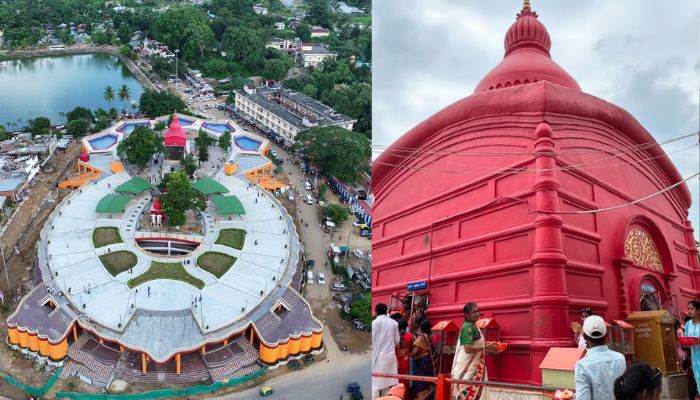
On Monday (22nd September), Prime Minister Narendra Modi inaugurated the revamped Tripura Sundari temple, which is located in Udaipur town of the State’s Gomati district and known for its divine connection to tortoises and turtles.
Established in 1501 CE by Maharaja Dhanya Manikya, it is one of the 51 Hindu Shaktipeetha shrines in India.
The 524-year-old temple is built on the top of a small hill or hillock which resembles the back of a tortoise. This is why the Tripura Sundari temple is also known as Kurma Pitha (Kurma means tortoise).
There is a picturesque, man-made lake by the name of Kalyan Sagar, which is located next to the Shaktipeetha shrine. The serene, clear water is home to rare bostami turtles.
In a short while, PM @narendramodi will inaugurate the development work of ‘Mata Tripura Sundari Temple Complex’ at Matabari under Pilgrimage Rejuvenation And Spiritual Heritage Augmentation Drive (PRASAD) scheme.
Bostami turtles are considered extinct in the wild but are plentiful in the precincts of the Tripura Sundari temple (also called Udaipur Matabari).
They are large in size and often come up to the shore of the freshwater lake. Devotees who visit the Shaktipeetha feed the bostami turtles bread crumbs, biscuits and puffed rice as part of the rituals.
Fishing and taking turtles out of the water body, which is spread over 2.75 acres, is strictly prohibited. Given that Kalyan Sagar is situated next to the Tripura Sundari temple, it is also considered sacred by the devotees.
It highlights the intricate link between faith, heritage and biodiversity. The Kalyan Sagar and the Bostami turtles symbolise a harmonious coexistence of tradition and nature.
According to local beliefs, the sacred reptiles climb the footsteps of the Tripura Sundari temple before their death and embody the blessings of the deity.
The well-being of the Bostami turtles is looked after by the Matabari Temple Committee.
The Tripura State Pollution Control Board (TSPCB) mandates that devotees not carry plastic bags near the lake. It also monitors the water quality of the lake from time to time.
Today, there is a healthy population of Bostami turtles in the lake. These critically endangered reptiles are integral to the spiritual ecosystem of the Tripura Sundari temple.
Hinduism reflects a deep connection between Faith and Nature. The overwhelming presence of the Bostami turtles at the Shaktipeetha and its reverence highlight the essence of spirituality.
In recent years, the BJP-led Tripura government has stepped up efforts to preserve the sacred turtles.
A year-long scientific study has been commissioned by the government in parternship with global conservation organisation, Turtle Survival Alliance.
It aims to conduct a thorough census of the turtle population, assess their health, and devise long-term conservation strategies. Awareness campaigns are being launched among devotees to maintain the sanctity of the Kalyan Sagar.
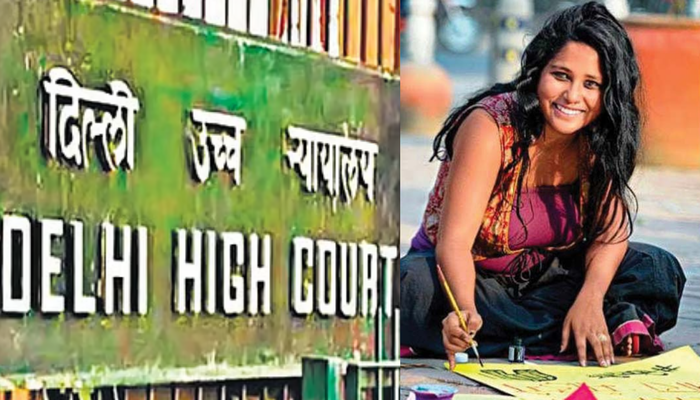
The Delhi High Court rejected the prayer of far-left ‘activist’ Devangana Kalita to reconstruct the case diaries of the case relating to the anti-Hindu Delhi riots, in which she is an accused. A single bench of Justice Ravinder Dudeja passed the judgment, while also confirming an earlier interim order directing the Delhi Police to preserve the case diaries.
“The petition is partly allowed. As far as the request for preservation is concerned, the interim order is made absolute. For reconstruction of the police diary, the request is rejected,” the Court said.
UAPA accused Kalita had requested the Delhi High Court to direct the Delhi Police to preserve and reconstruct the case diaries, alleging that the police had tampered with them. She had alleged that the Delhi Police ante-dated the witness testimonies in the case diaries relating to the criminal cases filed regarding the anti-Citizenship Amendment Act protests and a road blockade near the Jafrabad metro station in 2020.
She approached the High Court after her plea was rejected by the trial court. The trial court noted that the witness statements were not even a substantive part of the evidence. “While there may be merits in the submissions of the Ld. Counsel for the accused persons, but at this stage, this court cannot go into the truthfulness and veracity of the allegations,” the trial court remarked in its order passed on November 6, 2024.
Devangana Kalita was arrested for inciting communal violence
Kalita, along with UAPA-accused Asif Iqbal Tanha and Natasha Narwal in the 2020 anti-Hindu Delhi riots case, was granted bail in June 2021. Kalita was arrested by the Delhi Police for her role in stoking communal violence during the anti-Hindu riots in North-East Delhi in February 2020 that claimed 53 people and left more than 400 injured. Natasha Narwal and Devangana Kalita are founding members of Pinjra Tod, an organisation accused by some citizens of Seelampur, Jafrabad, and Trans-Yamuna of inciting riots in Delhi.
Pinjra Tod claims to be an autonomous collective of women students fighting for a just, accessible, non-discriminatory University and affordable accommodation and has been involved in numerous protests and campaigns of a far-left nature.
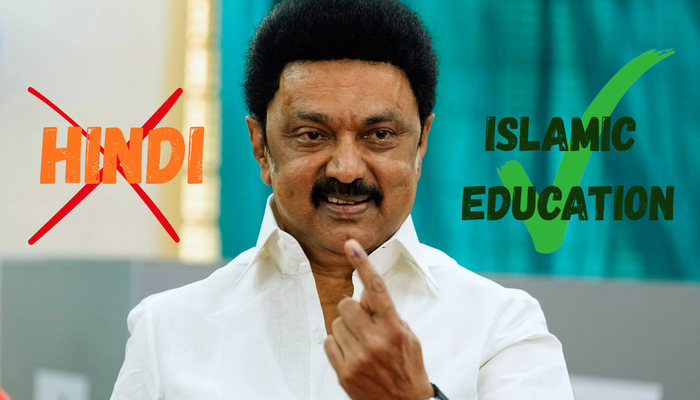
In an attempt to appease Muslims ahead of the assembly elections, Tamil Nadu Chief Minister MK Stalin pledged to protect the rights of Muslims. Stalin made the remarks during a recent event celebrating the 1500th anniversary of the Prophet Muhammad. He announced that his government has included content on the Prophet Muhammad in the school curriculum in the state.
The decision was made by the Dravida Munnetra Kazhagam (DMK) government, acceding to the demand of the Social Democratic Party of India (SDPI) leader Nellai Mubarak’s demand for the inclusion of Prophet Muhammad’s teachings in the school curriculum. “SDPI leader Nellai Mubarak requested to include the Prophet Muhamed in the syllabus. I’m happy to say that it has already been included in the Tamil Nadu Education Syllabus”, said CM Stalin. SDPI is the political wing of the banned Islamic outfit PFI.
நபிகள் நாயகத்தின் 1500-ஆவது பிறந்தநாள் விழாவில் பங்கேற்று, உலகெங்கும் அன்பு பரவிட வேண்டும் – அமைதி நிறைந்திட வேண்டும் என்ற உணர்வை வெளிப்படுத்தினேன்.
சிறுபான்மை மக்களுக்கு இடர் வரும்போதெல்லாம், பாதுகாப்பு அரணாக என்றும் திராவிட முன்னேற்றக் கழகம் துணை நிற்கும்! pic.twitter.com/xJgkHJkQsC
— M.K.Stalin – தமிழ்நாட்டை தலைகுனிய விடமாட்டேன் (@mkstalin) September 21, 2025
Stalin said that his party, DMK, stands with the Muslim community as it opposed the CAA and challenged the recently passed Waqf Amendment Act in the Supreme Court. He criticised the rival All India Anna Dravida Munnetra Kazhagam (AIADMK) for not supporting the Muslim community on matters like Triple Talaq. “If Muslims face trouble, the first political outfit that comes to your support is the Dravida Munnetra Kazhagam,” Stalin said.
DMK has historically supported Muslims: Stalin
Heaping praises on Prophet Muhammad for preaching ‘egalitarian and loving principles,’ and matched them with the ideologies of Periyar E V Ramasamy and DMK leaders like C N Annadurai and M Karunanidhi. Highlighting the pro-Muslim decisions taken by the DMK government, Stalin said that his party’s government ensured 3.5 per cent internal reservation for Muslims under the Backwards Class (BC) category, and included Urdu-speaking Muslims in the BC list, created a welfare board for minorities, established the Tamil Nadu Urdu Academy and launched the under-construction Haj House near Chennai airport. He pointed out how his party has historically supported the rights of Muslims. He said that M Karunanidhi declared Milad-un-Nabi as a public holiday in 1969, and restored it in 2006 after AIADMK discontinued it in 2001.
To further appease the Muslims in the state, Stalin expressed concern over the situation in Gaza and urged the central government to take firm steps to stop ‘atrocities’ in the area. “There must be an immediate end to the atrocities faced by the Palestinians, and the Central government should take resolute steps in this connection,” Stalin said.
The BJP attacked the DMK government over the inclusion of Prophet Muhammad’s teachings in the school curriculum, calling it the party’s communal agenda. “This is very clearly a communal agenda by the DMK. They have been saying that DMK is a communal party, always trying to gain the votes of the Muslim community,” said BJP spokesperson Narayan Tirupati.
Interestingly, MK Stalin, who vowed to wage a ‘langauge war’ against the so-called imposition of Hindi language on non-Hindi speaking states, to protect Tamilian identity, does not see any threat to Tamilian identity by including teachings of Prophet Muhammad in the school curriculum.
A poster of ‘I Love Muhammad’ was put up in Kanpur, Uttar Pradesh, on 4th September, which was opposed by some Hindu organizations. After which, the UP Police registered a case against 25 youths in this case. Since then, there have been protests against the action of the UP Police, which has now reached Maharashtra, Gujarat, and Uttarakhand.
Now, the tension reached the Kashipur of Udham Singh Nagar district in Uttarakhand, where violence broke out during a protest procession.
According to the media reports, “I Love Muhammad” procession was taken out in Kashipur in Uttarakhand’s Udham Singh Nagar. It is being reported that permission was not taken to take out the procession. As the rally moved through the Ali Khan area, stone-pelting, vandalism, and even assaults broke out. Some of the miscreants involved in the procession beat the police, which made the situation uncontrollable.
Police team to identify miscreants
However, on the directions of the police, SP (City) Abhay Singh and the police force reached to the spot and brought the situation under control. The police immediately formed teams and started identifying the miscreants with the help of CCTV footage and videos across the city. Police said that the miscreants will not be spared at any cost, and no casualties were reported in the city, nor were the industry-trade damaged.
SP of Kashipur Abhay Singh said, “The atmosphere deteriorated during the procession without permission, but the entire city has been kept under control due to the prompt action of the police and the wisdom of our team.”
“Samajwadi Party leader Nadeem Akhtar and his associates have played a major role in this mishap. Strict action will be taken against all the accused. The local administration has appealed to the citizens to maintain peace and made it clear that Uttarakhand has the rule of law. No one will be allowed to indulge in goonda raj or unrest,” he added.
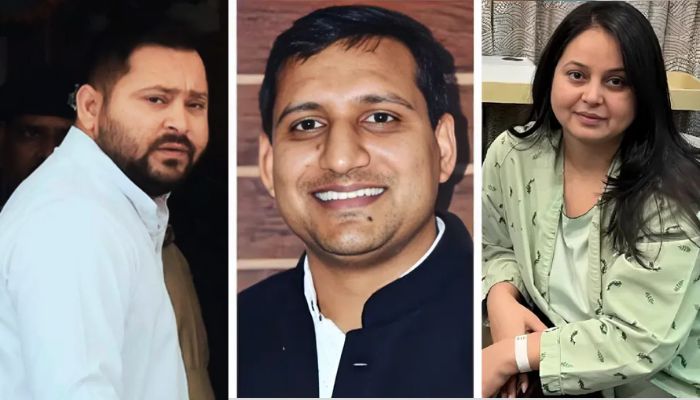
Ahead of state assembly elections in Bihar, the ‘first family’ of Rashtriya Janata Dal (RJD) seems to have devised a new method to deflect public discourse from the real issues. This new method is the classic family drama of a ‘rift in the family’. The alleged feud in the Lalu family emerged in public as Rohini Acharya, Lalu Yadav’s daughter, is reported to be unhappy with the expanding clout of Sanjay Yadav, the political adviser to former Deputy Chief Minister Tejashwi Yadav.
Recently, Rohini Yadav also unfollowed her brother, Tejashwi Yadav, and father, Lalu Yadav, on X. In fact, she unfollowed all RJD leaders and even made her account private temporarily.
Before this, she reposted a post criticising Sanjay Yadav’s presence at Tejashwi’s ‘Voter Adhikar Yatra’, which ended on 20th September. The post in question, published by one Alok Kumar, argued that while Rajya Sabha MP Sanjay Yadav was seated in the front seat of the yatra bus the seat was for either Lalu Prasad or Tejashwi and should remain unoccupied in their absence.
“The front seat is always designated for top leadership. No one should sit on it even when the leader is absent. It is a different matter when someone has the notion of being bigger than the top leader. We, along with the people of Bihar, are used to seeing Lalu Prasad or Tejashwi Prasad Yadav taking the front seat. We cannot tolerate anyone else sitting in the front seat. However, we cannot comment on sycophants who see in a person a unique strategist, advisor, and saviour,” the social media post reposted by Rohini Acharya read, although it no longer appears on her X profile.
Reports say that Rohini Acharya’s public support to narrative critical of Sanjay Yadav did not go well with her family. Acharya has since been facing criticism within the family and was also under pressure to do damage control.
In this direction, the RJD made Dalit leaders Shiv Chandra Ram and Rekha Paswan sit in the front seat during the Yatra. Rohini Acharya was quick to share the pictures of Dalit leaders seated in the front seats and wrote on X, “It has been the prime motto of Lalu Prasad’s socio-economic justice campaign to bring forward the deprived and people on the last rung of the social ladder. It is heartening to see people from these sections sitting in the front seat in these pictures.”
The melodrama did not end here as on 19th September, Acharya shared a video of her being taken to operation theatre in 2022, when she donated her kidney to ailing father, Lalu Yadav. Along with the video clip, Rohini Acharya wrote, “Those who, with their lives in the palm of their hand, possess the spirit to make the greatest of sacrifices, fearlessness – boldness – self-respect flow in their blood…”
In the 2024 Lok Sabha elections, Rohini Acharya contested from Saran and lost to BJP’s Rajiv Pratap Rudy. Now, Acharya was reportedly eyeing a ticket in the assembly elections, however, the party was not in favour of this. Attempting to put all speculations at rest, Acharya posted that she has no political ambitions, and for her, her self-respect is of supreme importance.
“I have fulfilled my duty and dharma as a daughter and a sister, and I will continue to do so. I have no desire for any position, nor do I have any political ambition. For me, my self-respect is supreme,” she wrote.
मैंने एक बेटी व् बहन के तौर पर अपना कर्तव्य एवं धर्म निभाया है और आगे भी निभाती रहूँगी , मुझे किसी पद की लालसा नहीं है, न मेरी कोई राजनीतिक महत्वाकांक्षा है ,मेरे लिए मेरा आत्म – सम्मान सर्वोपरि है ?
This post, however, came across as rather a confirmation that there is indeed a rift in the family and Rohini Acharya indeed had political ambitions. Not to forget, even Tej Pratap Yadav, who was earlier expelled from RJD, has also backed his sister over the issue of Sanjay Yadav’s increasing clout.
बिहार: लालू परिवार में संजय यादव को लेकर तनाव बढ़ गया है
◆ तेज प्रताप यादव ने बहन रोहिणी के समर्थन में कहा कि संजय यादव तेजस्वी यादव की कुर्सी हथियाना चाहते हैं
Tej Pratap recently alleged that Sanjay Yadav wants to “usurp” Tejashwi Yadav’s chair. Real or not, this family rift has contributed to diverting public attention in the poll-bound state from real ground-level issues to the Lalu family’s drama and internal power tussle.
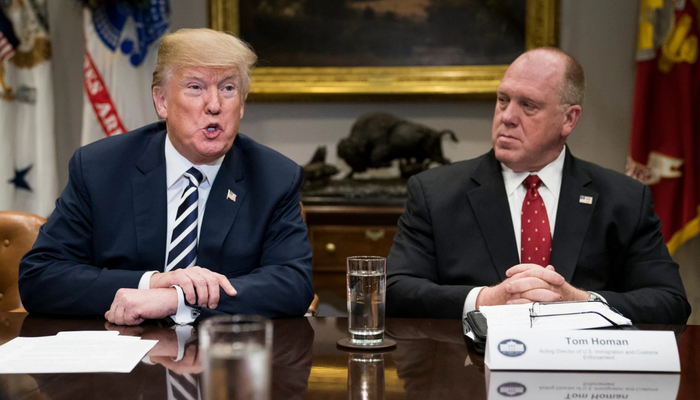
As the Trump administration recently announced sweeping changes in the H1-B visa norms by imposing a staggering additional $100,000 annual fee on H-1B visa applications, it is being speculated that the move to revise the H1-B visa norms was intended to distract Trump’s MAGA fan base from a bribery investigation against Trump’s immigration policy chief, Tom Homan.
US President Donald Trump signed an executive order revising the H1-B visa policy late on Friday (19th September), which was justified by the White House as a “crackdown on systemic abuse” of the H1-B visa system. The executive order claimed that the US companies have been laying off their American employees to hire aliens on H1-B visas at lower salaries. The changes will be effective immediately for new filings and will be effective from 12:01 AM Eastern Daylight Time (EDT) on September 21, 2025, for renewals.
The executive order, which created panic among H1-B visa holders, most of whom are Indians, is being viewed as a move to please the MAGA supporters of Trump by appealing to their hyper-nationalistic and anti-immigrant sentiments, and take their attention away from a now-closed bribery investigation against the Trump administration official. Notably, the Justice Department has largely dismantled the unit that prosecutes corruption cases, which took part in the Homan probe. Besides, after winning the Presidential election in November 2024, Trump appointed Homan as his “border czar”, which is an advisory role that did not require a Senate confirmation or a full background check by the FBI.
FBI closed Bribery investigation against Tom Homan
Trump’s border policy chief, Tom Homan, reportedly accepted a $50,000 bag of cash from an undercover FBI agent last year in a sting operation. However, the investigation being led by the Justice Department was closed, citing a lack of evidence, as reported by Reuters. Homan reportedly promised future immigration-related government contracts in return for the money.
The investigation against Homan started in August 2024, towards the end of the previous Biden administration, stemming from a separate investigation relating to national security. The target person in the separate national security investigation repeatedly mentioned that Homan had been taking bribes in exchange for future government contracts. As a result, an undercover sting operation was planned to catch Homan, and he fell for it. Homan was recorded accepting the bribe money of $50,000 from an undercover FBI agent.
Kash Patel termed investigation against Homan as “political”
Homan reportedly received the bribe from a restaurant chain and hinted that he would keep the money in a trust till his term in the Trump administration came to an end. Interestingly, the investigation against Homan was closed by the order of the Federal Bureau of Investigation (FBI), Chief Kash Patel, after Trump came to power. “This matter originated under the previous administration and was subjected to a full review by FBI agents and Justice Department prosecutors.
They found no credible evidence of any criminal wrongdoing,” said Kash Patel and Deputy Attorney General Todd Blanche in a statement on Sunday as quoted by Reuters. “The Department’s resources must remain focused on real threats to the American people, not baseless investigations. As a result, the investigation has been closed,” the statement added. Patel and Blanche blamed the Biden administration for conducting a “blatantly political investigation” against Homan, calling it “yet another example of how the Biden Department of Justice was using its resources to target President Trump’s allies.”
Homan helped companies obtain immigration-related government contracts before joining the Trump administration
Defending Homan, who oversees the Trump administration’s campaign relating to the mass deportation of people staying illegally in the US, White House clarified that he is not involved in awarding any contracts. “He is a career law enforcement officer and lifelong public servant who is doing a phenomenal job on behalf of President Trump and the country,” White House deputy press secretary Abigail Jackson said in a statement. Homan served in the US Immigration and Customs Enforcement (ICE) under the Obama administration. He was the acting director of the ICE under the first Trump administration. During the previous Biden administration, Homan reportedly ran a consulting business to assist companies in obtaining immigration-related government contracts.
When Trump assumed office in January this year, a grand jury investigation going on against Homan in the Western District of Texas was in the preliminary stage. Emil Bove, who was acting deputy attorney general and is currently a federal judge, termed the investigation against Homan a “deep state” operation when briefed about the case in February this year. He referred to the idea that unelected officials secretly control the government.