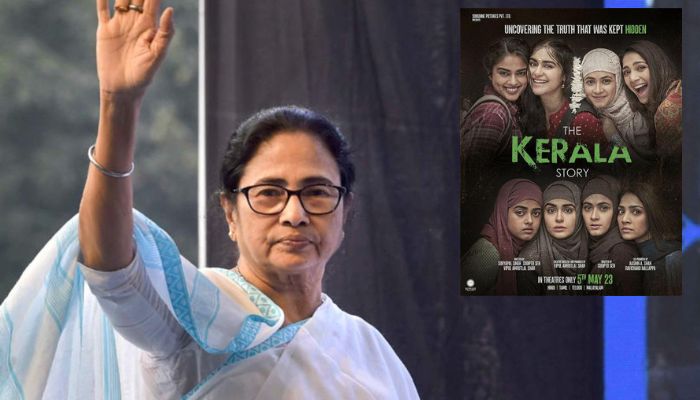
On Monday (May 8), West Bengal CM courted controversy by labelling ‘The Kashmir Files’ and ‘The Kerala Story’ as ‘distorted movies.’
During a press conference at Nabanna (State Secretariat), she claimed, “If the political party play with fire, casteism or divide and rule…Why this “Kashmir Files’? To humiliate one section. What is this Kerala File? Though I do not support the CPI (M) because they are working with BJP.”
“I am talking about the people…Instead of me, it was their duty (CPIM) to criticise it…That BJP is showing ‘The Kerala Files’…A distorted story,” Banerjee brazened it out.
The West Bengal CM went on to allege that the movie’s cast was sponsored by the BJP, which came to Bengal to promote ‘The Kerala Story’. She suggested that movie makers have no qualms about making Kashmir Files and supposedly ‘condemning’ Kashmiri people.
“What is the fault of people? We respect each and everybody. That is our Constitution. Now they are defaming the Kerala people and State. Their narrative is to defame the Bengal also,” Mamata Banerjee concluded.
It must be mentioned that she has banned the screening of the movie in West Bengal, citing the need to maintain ‘peace’ in the State. “West Bengal govt has decided to ban the movie ‘The Kerala Story’. This is to avoid any incident of hatred and violence, and to maintain peace in the state,” Mamata Banerjee said.
The targeting of ‘The Kerala Story’ and ‘The Kashmir Files’
The movie ‘The Kerala Story‘ revolves around the tragic reality of ISIS brides, with the lead actor Adah Sharma playing the role of one Shalini Unnikrishnan, who is brainwashed by her Muslim friends and gets converted to Islam. She later travels to IS (Islamic State) controlled area with her spouse.
‘The Kashmir Files’ film takes viewers back to 1989, when due to rising Islamic Jihad, a huge conflict erupted in Kashmir, forcing the great majority of Hindus to flee the valley.
Ever since the two movies hit the theatres, they came under attack from the left-liberal cabal and politicians accused of minority appeasement. They sought to denigrate the movie and term the real-life incidents showcased in it as the figment of the director’s imagination.
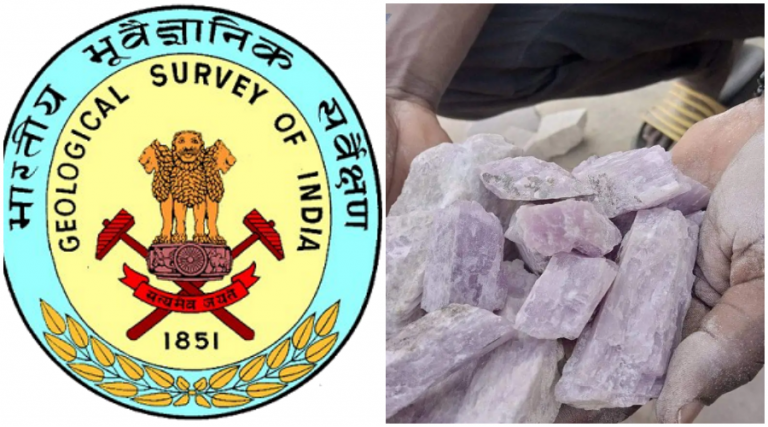
Update: After media reports claimed that a Lithium reserve was found in Rajasthan, GSI has refuted media claims. The full report on that can be read here. The headline has been updated to reflect new information.
After Jammu and Kashmir’s Reasi, lithium reserves have now been found in the Degana municipality of Rajasthan’s Nagaur district. The discovery of the reserves in Nagaur was confirmed by Rajasthan government officials and the Geological Survey of India. These reserves are said to contain significantly more lithium than the 5.9 million tonnes found in Jammu and Kashmir in February this year.
Speaking about the discovery, GSI and mining officials have said that the amount of lithium in these reserves is enough to meet 80% of India’s overall needs. The finding of these reserves could help India reduce its reliance on China for lithium, they asserted.
India presently relies significantly on foreign imports, particularly from China, to meet its lithium needs. In the fiscal year 2020-21, India imported lithium worth Rs 6,000 crore, of which China contributed Rs 3,500 crore.
Varun Goenka, CEO and Co-Founder, Chargeup said, “As India discovers significant lithium reserves in Rajasthan, in addition to the previously discovered reserves in Jammu and Kashmir, the country is well positioned to become the 3rd largest market for EVs in the next 4 years. Batteries, being the single largest cost and supplies dominated by China, have been a major obstacle for India’s EV industry.”
“However, with the ‘Make in India’ initiative and the discovery of lithium reserves, India is now able to reduce its dependence on foreign countries and control the fluctuating price of lithium. This development not only enables India to meet its domestic requirements but also allows it to supply lithium to other countries, creating a promising future for the country’s EV industry. The future seems #chargedup for India as it accelerates towards achieving its goal of transitioning towards sustainable energy sources while reducing its carbon footprint,” he added.
Over 5.9 million tonnes of deposits found in Jammu and Kashmir
On February 9, the Union Government said that 5.9 million tonnes of lithium reserves have been found for the first time in the country in Jammu and Kashmir.
“Geological Survey of India for the first time established Lithium inferred resources (G3) of 5.9 million tonnes in the Salal-Haimana area of the Reasi district of Jammu and Kashmir,” the Ministry of Mines said.
It further that 51 mineral blocks including Lithium and Gold were handed over to respective state governments.
“Out of these 51 mineral blocks, 5 blocks pertain to gold and other blocks pertain to commodities like potash, molybdenum, base metals etc. spread across 11 states of Jammu and Kashmir (UT), Andhra Pradesh, Chhattisgarh, Gujarat, Jharkhand, Karnataka, Madhya Pradesh, Odisha, Rajasthan, Tamil Nadu, and Telangana,” the ministry added.
Notably, days after the Geological Survey of India (GSI) discovered the lithium reserves in Jammu and Kashmir, the Central government decided to invite bids for the auction of the country’s first Lithium reserve. Last week, Vivek Bharadwaj, secretary of the Union Ministry of Mines confirmed that India will auction the lithium blocks found in Jammu and Kashmir later this year.
Lithium = ‘White Gold’
Lithium is a soft, silvery-white metal that has earned the moniker “white gold” due to its great demand in the global energy markets. Lithium serves a variety of purposes and is an essential part of the electrochemical cells used in the batteries for electric vehicles, laptops, smartphones, and other electronic gadgets.
The discovery of a lithium resource first in Jammu and Kashmir and now in Rajasthan can help India meet its goals of decreasing emissions and reaching net zero by 2070. This can be achieved by providing Lithium, a vital component for electric car batteries.
With India’s push for the introduction of Electric Vehicles (EVs), this is a crucial discovery because it will significantly boost the country’s self-sufficiency in EV batteries.
It is worth noting that while “reserves” are a subset of resources that are economically viable to extract, “resources” refers to an approximate quantity of a geological commodity in discovered and undiscovered deposits.
According to International Energy Agency (IEA), the world could face a Lithium shortage by the year 2025. Amidst a significant rise in demand for electric vehicles, India can play a crucial role by addressing the global shortages.
As per a World Economic Forum (WEF) report, Lithium supply is constrained not just by rising demand but also by resources concentrated in a few regions and the fact that more than half of current production takes place in regions with significant water stress. Notably, the “Lithium Triangle” countries of Argentina, Bolivia, and Chile hold an estimated 60% of global lithium reserves.
According to a report by the Central Electricity Authority (CEA), India would have a battery storage capacity of 27,000 Megawatts by 2029–30. If India manages to deal with the challenges ahead, this discovery of the Lithium reserve can prove to be a game-changer for India.
After trying in vain to stall the release of The Kerala Story, a heart-wrenching story of unsuspecting non-Muslim girls in Kerala lured into a love jihad trap and taken to ISIS-controlled territories as sex slaves or mercenaries, the Islamists masquerading as ‘journalists’ and ‘intellectuals’ are now dismissing the occurrence of ‘love jihad’ altogether, in a bid to discredit the harsh reality the movie depicts.
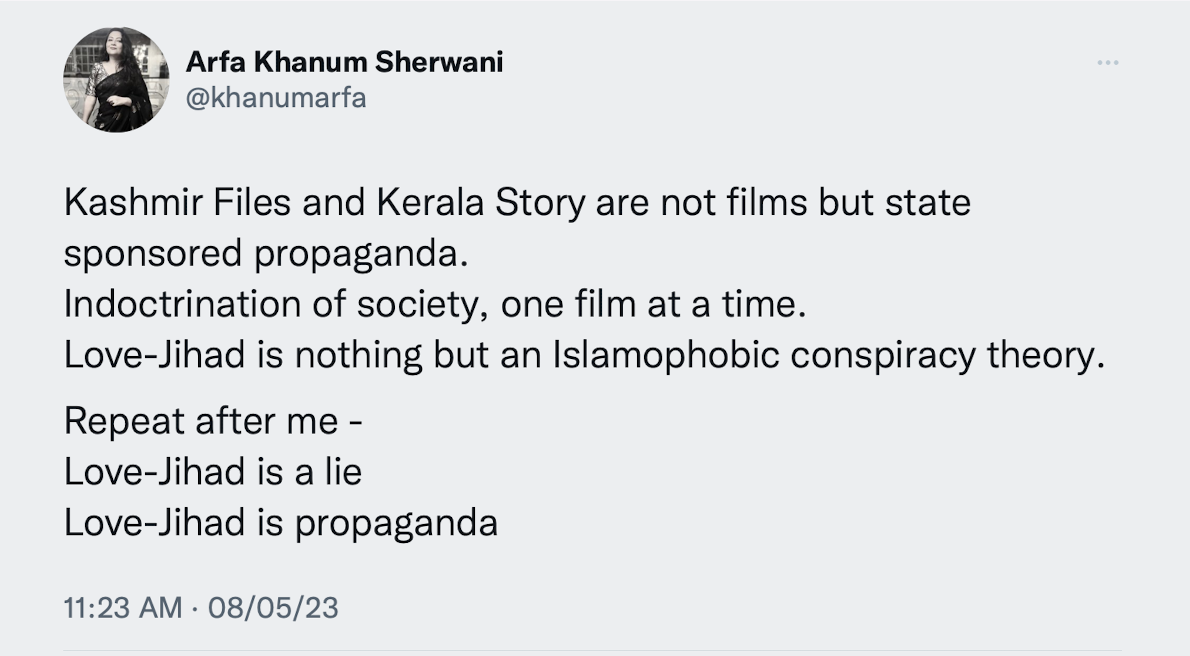
One such masquerader is Arfa Khanum Sherwani, a ‘journalist’ with the leftist propaganda portal ‘The Wire’, which has been at the forefront of prejudicial media outlets leading a crusade to reject love jihad cases and paint them as Islamophobic schemes.
Recently, Sherwani took to Twitter to attack The Kashmir Files and The Kerala Story, claiming that they were state-sponsored propaganda. For Ms Sherwani, the movie that chronicled the exodus of lakhs of Kashmiri Pandits and brought to light the religion-based atrocities hitherto swept under the rug lest it would affect the ‘secular fabric’ of the country, became state-sponsored propaganda because what it portrayed did not jibe with the narrative that Sherwani and her likes have been peddling for years now.
Similarly, Ms Sherwani also attacked another pathbreaking movie, The Kerala Story, which for the first time, brought on the silver screen the menace of religious indoctrination faced by impressionable women in Kerala. Since the premise of the movie is based on ‘love jihad’, where a Muslim man uses deceit to lure a non-Muslim into a romantic relationship and later pressurises her into embracing Islam, Ms Sherwani attacked the notion of ‘love jihad’ itself, calling it propaganda and a lie.
“Love-Jihad is nothing but an Islamophobic conspiracy theory,” Ms Sherwani posted in her Twitter rant against The Kashmir Files and The Kerala Story.
While Ms Sherwani wants her followers to believe that Love Jihad is a myth and an imaginary construct aimed at whipping up Islamophobia, the trials and tribulations of the victims of the social menace reveal the uncomfortable reality that she and others like her want to obscure. The countless testimonies of the victims speak volumes of the existence and the pervasiveness of the scourge bedevilling many Hindu women, leaving them with permanent scars and trauma for the rest of their lives if their tormentors had left them alive.
Even as Arfa Sherwani dismisses love jihad as propaganda, the cries of victims reveal the seriousness of the menace
A recent case from Uttar Pradesh stands testament to the reality of love jihad. A Muslim man, Jamal Khan, lured a Hindu woman in Moradabad, Uttar Pradesh, by concealing his identity and introducing himself as Sonu. He later converted her to Islam and married her. A few days later, he invoked the outlawed triple talaq, forcing her to leave the home.
The tragedy did not stop just there. The victim further informed that the perpetrator started physically assaulting her after their marriage when she found out that he was already married to someone else. In response to her complaint, the Majhola police filed an FIR and initiated an inquiry into the matter.
Just days before, another incident of love jihad was reported from the Khudel region of Indore, Madhya Pradesh, after the state police arrested a person named Asmat Patel, his father Shabbir Ali and his brother Haider Ali for forcing a Hindu girl to commit suicide.
According to the police complaint, Asmat met an 18-year-old Hindu girl in his college and later developed a friendship with her. He then forced her to get married to him and accept Islam and also threatened that he would abduct her if she doesn’t agree. The girl informed about Asmat to his father who warned him and his family members, Haider, Shabbir and Shahjahan to stay away from the girl.
However, Asmat issued threats to the father of the girl and said that he wanted to marry her and would abduct her if she doesn’t agree. He also pressured her and sent derogatory messages on her phone. The father then took possession of the phone and deleted the messages. Asmat, after knowing this, started sending derogatory messages to the girl’s uncle. The girl felt pressured by the continuous terrorization and decided to end her life to end the saga. She consumed poison and was declared dead after she was immediately taken to the hospital by her family members.
Similarly, in early April, another incident of love jihad was reported from the Gwalior district of Madhya Pradesh. A gym trainer was booked for allegedly raping a woman by keeping her son at knifepoint. He had introduced himself as a Hindu to cultivate a friendship with a Hindu woman, but after she learnt that he had lied to her about his religious identity, she severed her ties with him. As revenge, he came to her house and raped her.
In March 2023, yet another case of love jihad came to the fore as a man named Shadab entrapped a girl into a love affair while pretending to be a Hindu boy. He then allegedly took her to a hotel on the pretext of celebrating her birthday, where he spiked her drink. Thereafter, he raped her and took compromising photographs with her which he used to blackmail her to the tune of Rs 55 lakhs.
A month before that, in February 2023, a love jihad case was reported from Jamshedpur, Jharkhand, after a 14-year-old Hindu girl lodged a complaint accusing a Muslim youth of threatening and blackmailing her for refusing to convert to Islam and marry him.
In her complaint, the minor alleged that the 20-year-old accused identified as Shabbir Khan posed as a Hindu named Sameer Kumar and befriended her near her school about a month ago. The two soon grew close and entered into a relationship, following this, Shabbir clicked several obscene pictures of the victim.
However, after a month the minor girl found out that Sameer was actually Shabbir Khan, and he had changed his identity to start the relationship with her. When she learned about the real identity of the accused, she broke up with him and tried to distance herself from him. However, the accused Shabbir started blackmailing the victim to convert to Islam and perform a Nikah with him. On refusing, the accused threatened to circulate her private pictures on social media.
In the same month, another case of love jihad was reported from Greater Noida, Uttar Pradesh. A Dalit woman, living in a village in the Jarcha Kotwali area in Greater Noida, was raped by her boyfriend Babbar Ali on the pretext of marrying her. The woman was then gang-raped by Babbar Ali and his friend. When the victim asked Babbar Ali to marry her, he started forcing her to convert to Islam.
According to reports, the Dalit woman was trapped in love by a goon Babbar Ali in the village. On the pretext of marriage, he first had physical relations with the victim and then gang-raped her with his friend. It is alleged that when the victim insisted they get married, the accused said she must first convert to Islam to tie the knot.
The aforementioned cases are the number of love jihad incidents catalogued by OpIndia in the last 2-3 months. They do not, in any way, represent an exhaustive list of love jihad incidents across the country in the past few months. It is likely that more cases of love jihad were reported from various parts of the country but failed in capturing the national imagination, owing to several reasons, including lack of coverage by mainstream media organisations. Therefore, it must be borne in mind that these are not the actual number of love jihad cases throughout the nation in the last 2-3 months. This is a compilation of the cases that OpIndia covered. There are several cases that we may have missed and hundreds that never got reported by the media.
In fact, OpIndia has consistently been at the forefront of reporting incidents in which vulnerable Hindu women are groomed to accept their own subjugation at the hands of Muslim men. Year after year, we have documented numerous such occurrences. In 2022 alone, OpIndia reported more than 150 cases of love jihad that took place in various parts of the country.
There is also another element of stigma and fear of retribution attached to love jihad cases, which might compel victims to not report them at all. There could be numerous such occurrences where the victims’ families do not report it due to fear of retaliation because the perpetrators might be coming from financially stronger and influential families or have strong political connections or the belief that it would bring disrepute to the family. Another key reason why many similar incidences do not reach the public eye is that, due to its obvious bias toward the minority community, the leftist mainstream media usually fails to consider such situations severe enough to cover.
While the Left and the so-called liberals have always dismissed these occurrences as a figment of the ‘right-wing imagination’, the cases are real. The dead bodies are also real and the threat is imminent.Yet, the likes of Arfa Khanum Sherwani describe the reality of love jihad as propaganda, which not only dishonours the sufferings of hundreds and thousands of victims and dehumanises them but it also provides cover fire to Islamists, who carry on with their nefarious designs, luring unsuspecting and unwitting non-Muslims into a love relationship, only to have them converted into the Islamic fold.
The whitewashing of such grave crimes only emboldens Islamists, who continue to bank on their intellectual brethren to project ‘love jihad’ as a fantasy as they sneak around searching for another potential victim to be exploited and abused.
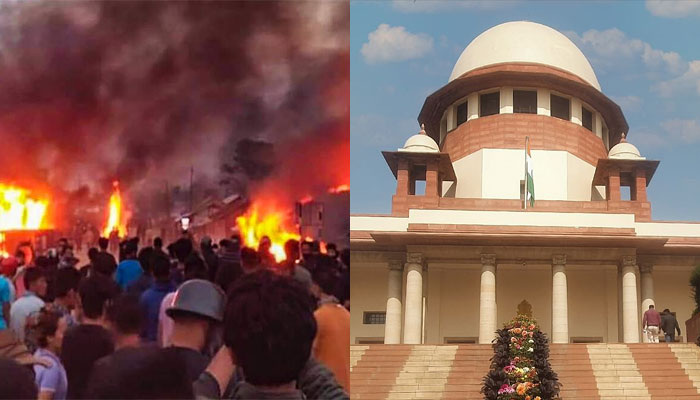
Multiple pleas have been filed in the Supreme Court against the Manipur High Court’s order directing the Central and State governments to include the Meetei/Meitei community in the Scheduled Tribe (ST) list of the Indian Constitution as a “tribe” of Manipur.
As per reports, two Special Leave Petitions (SLPs) have been filed, one was filed by the Manipur Tribal Forum and the second one was filed by BJP MLA and Chairman of the Hill Areas Committee (HAC) of the Manipur Legislative Assembly, Dinganglung Gangmei.
The plea by Manipur Tribal Forum
In its plea to the Supreme Court, the Manipur Tribal Forum has sought directions from the apex court to the central and state government to evacuate the Tribals of Manipur who fled to CRPF Lamphel Camp, CRPF Camp near the DC office, and Koirengei Camp.
Furthermore, the plea sought evacuation of small pockets of Tribals in both east and west Imphal and in the villages surrounding Imphal Valley. The forum sought directions from the central forces to escort them to their respective areas of residence in the hill districts.
It also sought directions to ensure secure and safe areas where Tribals are currently residing, stating there is a possibility of further attacks on them. The forum prayed for forming a Special Investigation Team headed by Harekrishna Deka, former Director General of Police of Assam, and monitored by Chief Justice Tinlianthang Vaiphei, former Chairman of Meghalaya State Human Rights Commission to probe the matter and bring the accused who assaulted the Tribals to justice.
The plea alleged that the dominant community killed 30 Tribal people and 132 were injured. The forum claimed not even a single FIR was filed by the police.
The plea by BJP MLA
In his plea, BJP MLA Gangmei argued that the impugned order by the High Court had resulted in unrest in the state that led to the death of 19 people. The plea read, “Due to the impugned order, the tension between both the community has taken place and violent clashes have erupted across the state. As a result of it, so far, 19 tribal people have been killed, various places in the states are blocked, the internet is completely shut down, and more people are at the risk of losing their lives.”
Gangmei further argued that the Meitei community is not a tribe. It has never been recognised as such. Plea read, “In fact, they are very much an advanced community though some of them may come within SC, OBC.”
The order directed the state to recommend the Centre to include the Meetei/Meitei community as ST in the Presidential list.
The order concluded the issue had been pending for around ten years.
The order concluded that the Meeteis/Meiteis are tribes.
The plea read, “Merely because the State of Manipur may have received some representation by the Meeteis/Meiteis does not oblige the State to do anything unless the State is convinced first, that the Meeteis/Meiteis are tribes and second, that they deserve to be in the Scheduled Tribes list.”
Manipur High Court order
On April 19, 2023, Manipur High Court Bench led by acting Chief Justice MV Muralidaran asked the Centre and state government to consider the inclusion of the Meetei/Meitei community in the ST community expeditiously. The order asked to complete the process within four weeks from the order date.
Clashes erupted in Manipur
After the orders, on May 3, violence erupted at several places in Manipur during protests by tribal groups against the demand for ST status by the Meitei community. The first round of violence erupted on April 27 in the district of Churachandpur. Protests by the tribal groups turned violent at various places in the state, where large-scale arson occurred. Manipur CM N Biren Singh has said that lives have been lost and property has been damaged in the violence. Curfew was imposed in several districts, and mobile internet services were suspended. Detailed reports on the matter by OpIndia can be read here.
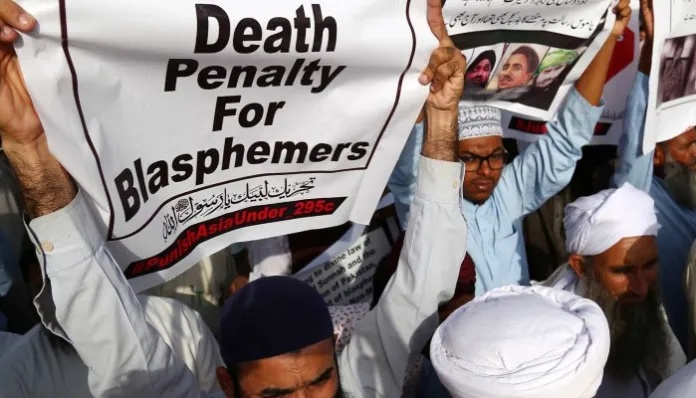
A Christian widow and a Muslim gardener, both illiterate, were arrested in the Pakpattan city of Pakistan on April 19 on blasphemy charges after they were accused of ‘intentionally’ burning papers containing verses of the holy Quran, Friday Times reported.
On April 15, a 46-year-old Christian widow named Mussarat Bibi and a Muslim gardener named Muhammad Sarmad were assigned the task of cleaning the storeroom of a school, which was filled with paper and scrap items. They gathered the paper and other scraps in a corner of the school and burned them.
Students later found that the burned items also contained holy pages. Four days later, a local resident named Kashif Nadeem contacted the police and accused the illiterate Christian widow of committing blasphemy by burning pages of the holy Quran at the school, Friday Times reported.
The complainant also gathered a mob outside the school and started protesting against the incident. However, police reached the scene on time and took the accused into custody to avert any untoward situation.
The complainant named only the Christian widow, but during the preliminary investigation, police found the gardener was also involved in setting the holy pages on fire, hence police named both persons in the FIR, Friday Times reported.
While condemning the incident, minority rights activist Joseph Jansen said that the blasphemy laws are being used as an excuse to violate people’s rights on a vast scale. In spite of their vulnerability, crimes committed against women and girls go unpunished, deterring them from seeking employment and achieving equality with men, he added.
He said that women were afraid to go out and work as a result of the abuse of blasphemy laws against religious minority women. Knowing that Mussarat is illiterate, innocent, and simply performing her role as she was alleged to have done is clear evidence that blasphemy laws have been misused, he added.
(This news report is published from a syndicated feed. Except for the headline, the content has not been written or edited by OpIndia staff)
On Monday (May 8), West Bengal Chief Minister Mamata Banerjee banned the movie ‘The Kerala Files’ (sic) in West Bengal, citing the need to maintain ‘peace’ in the State.
“West Bengal govt has decided to ban the movie ‘The Kerala Story’. This is to avoid any incident of hatred and violence, and to maintain peace in the state,” news agency ANI quoted her as saying.
West Bengal govt has decided to ban the movie 'The Kerala Story'. This is to avoid any incident of hatred and violence, and to maintain peace in the state: West Bengal CM Mamata Banerjee
Mamata Banerjee had referred to the said movie as ‘The Kerala Files’ during a press briefing at Nabanna after lashing out at Director Vivek Agnihotri’s The Kashmir Files.
“If the political party play with fire, casteism or divide and rule…Why this “Kashmir Files’? To humiliate one section. What is this Kerala File? Though I do not support the CPI (M) because they are working with BJP,” she had claimed.
“I am talking about the people…Instead of me, it was their duty (CPIM) to criticise it…That BJP is showing ‘The Kerala Files’…A distorted story,” Banerjee brazened it out.
The movie ‘The Kerala Story‘ revolves around the tragic reality of ISIS brides, with the lead actor Adah Sharma playing the role of one Shalini Unnikrishnan, who is brainwashed by her Muslim friends and gets converted to Islam. She later travels to IS (Islamic State) controlled area with her spouse.
Mamata Banerjee asked Hindus to not visit Muslim areas to maintain ‘peace’
Ahead of Ram Navami celebrations in West Bengal, Mamata Banerjee had earlier insinuated that violence occurs when Hindus take out processions through ‘Muslim areas.’
“I want to request those who are taking out the Ram Navami procession, please do but do it peacefully. Kindly avoid Muslim areas as Ramzan is going on. Celebrate peacefully but don’t try to create violence. Don’t get provoked,” she was heard saying.
Nevertheless, Islamists wreaked havoc on a Ram Navami procession in the Shibpur area of Howrah. Mamata Banerjee instead went on to give a clean chit to Islamists and absolved them of any wrongdoing during the Hindu festival.
“Ki sonkha loghu bhai bona ra, Allah Tallah er kache doye kore danaga baaj der khotom korte parbe na (Can’t my brothers and sisters from the minority community pray to Allah to finish off these rioters),” she had appealed to the Muslim community.
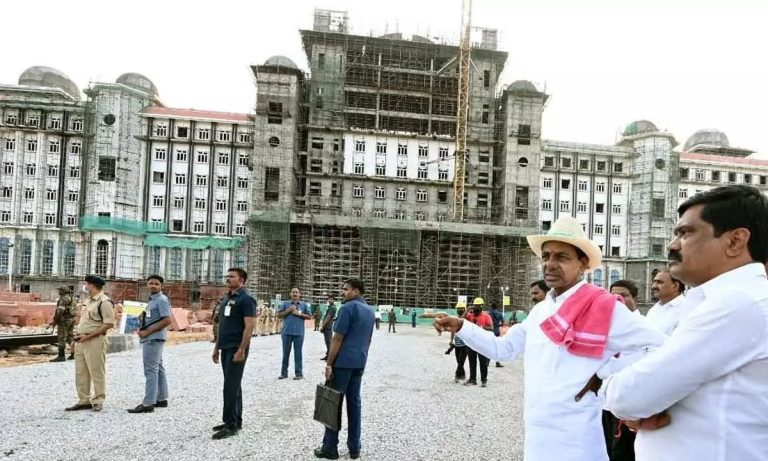
KCR recently inaugurated Telangana’s new secretariat building. A news handle of his son KTR, which goes by KTR_news (and has nearly 6 lakh followers) claimed that no other state built a new secretariat (amongst many other such weird claims in a thread). The new secretariat was constructed not because there was a dire need for this building, but because KCR couldn’t physically step into it because it wasn’t vaastu compliant according to him.
In a press conference in the year 2015, KCR announced that the existing secretariat building has very bad vaastu, and that’s why no CM ever had a good time there. He was referring to the fact that from the year 1956 (when the state of Andhra Pradesh was formed) till the year 2004, no Chief Minister of the state ever completed a full term (Chandrababu did 9 years but didn’t complete full terms). YSR was the first Chief Minister to complete a full term (2004 to 2009) but YSR died in a helicopter crash in 2009, early in his 2nd term. Post his death, we saw 2 more Chief Ministers in the remaining 4 years and then the state was split.
He was alluding to this history while commenting that the existing secretariat building is basically not safe for him to work in (though he actually claimed that this was not good for Telangana)! KCR made some other points about the bad condition of the existing building which we will discuss later in this article. KCR did not even want to work from here, so he started literally working from home, from 2015 itself!
At this point in time (2015), KCR claimed that the construction cost for the new Secretariat will be ~150 crores, and he will demolish the Chest Hospital building in the city. There was widespread outrage by people at this decision to demolish the heritage chest hospital building. This outrage forced KCR to back off from the proposed new building here.
After some time, KCR put the onus on the central government to give the Bison Polo grounds – grounds that belong to the Ministry of Defence. The Prime Minister had given in-principle approval for the same in the year 2017. However, there was again outrage from the citizens; and also, the nitty-gritty between the state and the central government on the actual terms of transfer of this land was taking too long (even though the High Court approved the construction on Bison Polo Grounds). At this point in time (2018), KCR claimed that the construction cost for the new Secretariat will be 250 crores.
In the year 2019, the AP government headed by Jagan Mohan Reddy decides to hand over their share of 58% of the existing Secretariat building to the Telangana government. With 100% ownership of the existing building and the land on which it is there, KCR now decides to demolish the existing secretariat building and build a new one in this space itself.
Now remember this – in 2015, KCR tells us that the estimated construction cost for the new Secretariat is 150 crores. In a press conference in 2018, KCR increased the same to 250 crore rupees. Once the site was finalised, he allotted a whopping 610 crores for this building in the year 2021. A minister, at the inauguration of the building in April 2023 tells us that the final cost may be around 800 crores for this building!
At the press conference in 2015; at a speech in Assembly in 2015; and also, in a lengthy speech in the Assembly in the year 2018, KCR put forth some points against the old Secretariat building. He explained that since the Secretariat complex has disjoint buildings and therefore it is very difficult for officials to walk across buildings for important meetings; the various Heads of Departments are scattered across the city and get stuck in traffic jams while coming to meetings in Secretariat. KCR tells us that even for meetings that he has called, officials had to go back and forth to get relevant documents. Listening to all of this, you would think that it is logical to construct a new building.
However, no logic can explain KCR’s refusal to even come to the Secretariat for 9 full years. He conducted meetings from his house, which is still farther away from the existing Secretariat buildings. In addition to just the Heads of Departments having to go through traffic, now the ministers, secretaries and anyone else who had to meet the CM had to go through the harrowing traffic of Hyderabad to reach his house. For a full 8 years. How could KCR be ok with subjecting so many people through this torment while claiming that earlier only a few were tormented like this?
KCR claimed that fire safety is not good in the old building. Citizens couldn’t but help to allude to this anecdote when a major fire broke out in the new secretariat in the final stages of its construction! KCR claimed that HoDs don’t sit in the secretariat. Guess what – they still don’t get space in the new Secretariat. They will sit in a building that’s a little closer to the secretariat – from when no one knows.
KCR’s lucky number is 6. So, the new Secretariat consists of 6 operational floors (LG, UG and 6 floors); Chief Minister’s office is in the 6th floor. KCR signed 6 files in 6 minutes on Day 1 in the new secretariat. The entire English media was silent on this and some even wrote glowing reports. An official building of the government was built keeping in mind the lucky number and vaastu beliefs of the incumbent Chief Minister, at the exact same location where the older building existed. It took KCR 8 years to build this. And in all these 8 years, he did not even come to the Secretariat because it was not vaastu compliant according to him. The grandeur of the building is apparently a selling point (highest point taller than Taj Mahal apparently – like anyone cares!).
The outrage against the new building seems totally justified given the reasoning and planning that went behind this. There is no need to make this a mark for Telangana pride. It is simply an expenditure to fulfil the beliefs of the incumbent Chief Minister.
All three of Karnataka’s major political parties—BJP, Congress, and JD(S)—are busy making their final pitches as the high-stakes election campaign comes to an end on Monday (May 8), two days before the state goes to poll on May 10, 2023. While all the parties are putting their best foot forward to garner the attention of the voters, several opinion polls for the Karnataka Assembly elections have emerged predicting varied results.
While some have predicted a resounding victory for the incumbent BJP, others have projected Congress to have an advantage over its competing parties in the southern state.
The Karnataka Assembly has 224 members and a tally of 113 is required to form a simple majority government.
Name of the survey
BJP
Congress
JD(S)
Others
Zee-Matrize
103-118
82-97
28-33
1 to 4
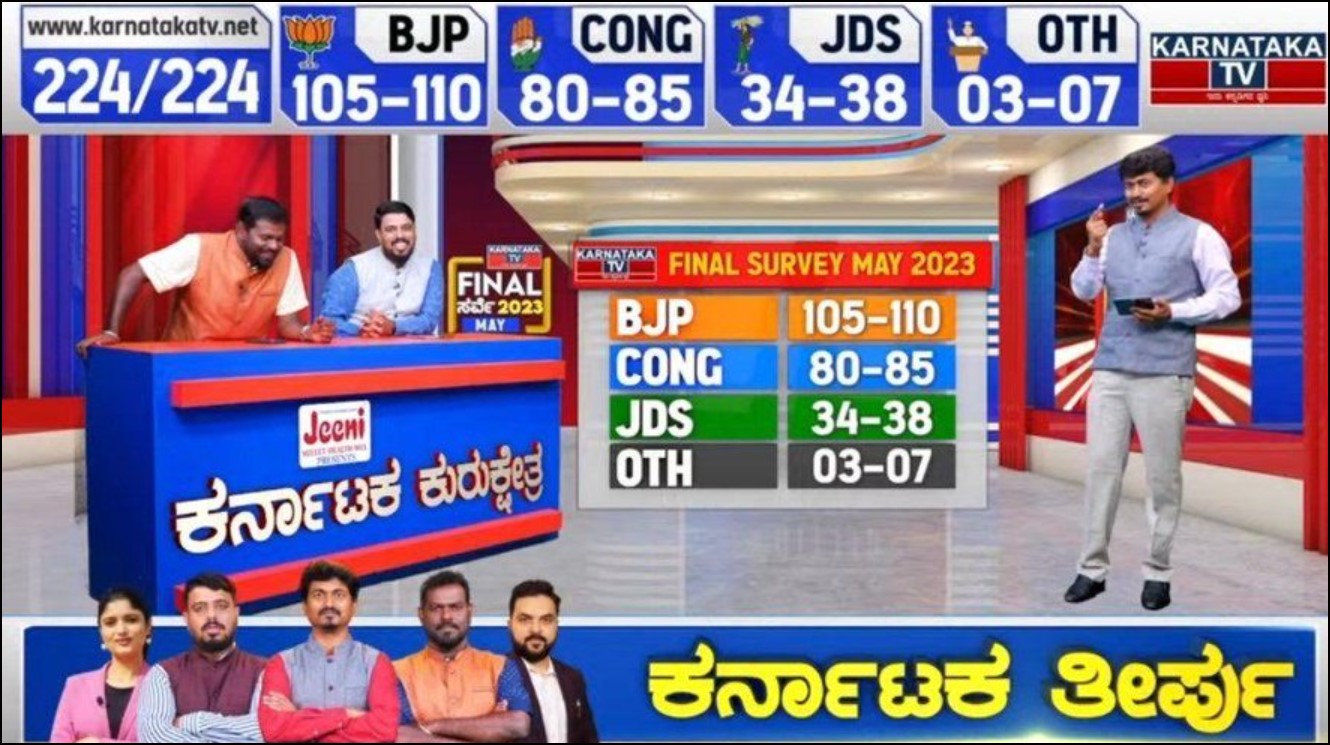
Karnataka TV
105-110
80-85
34-38
3 to 7
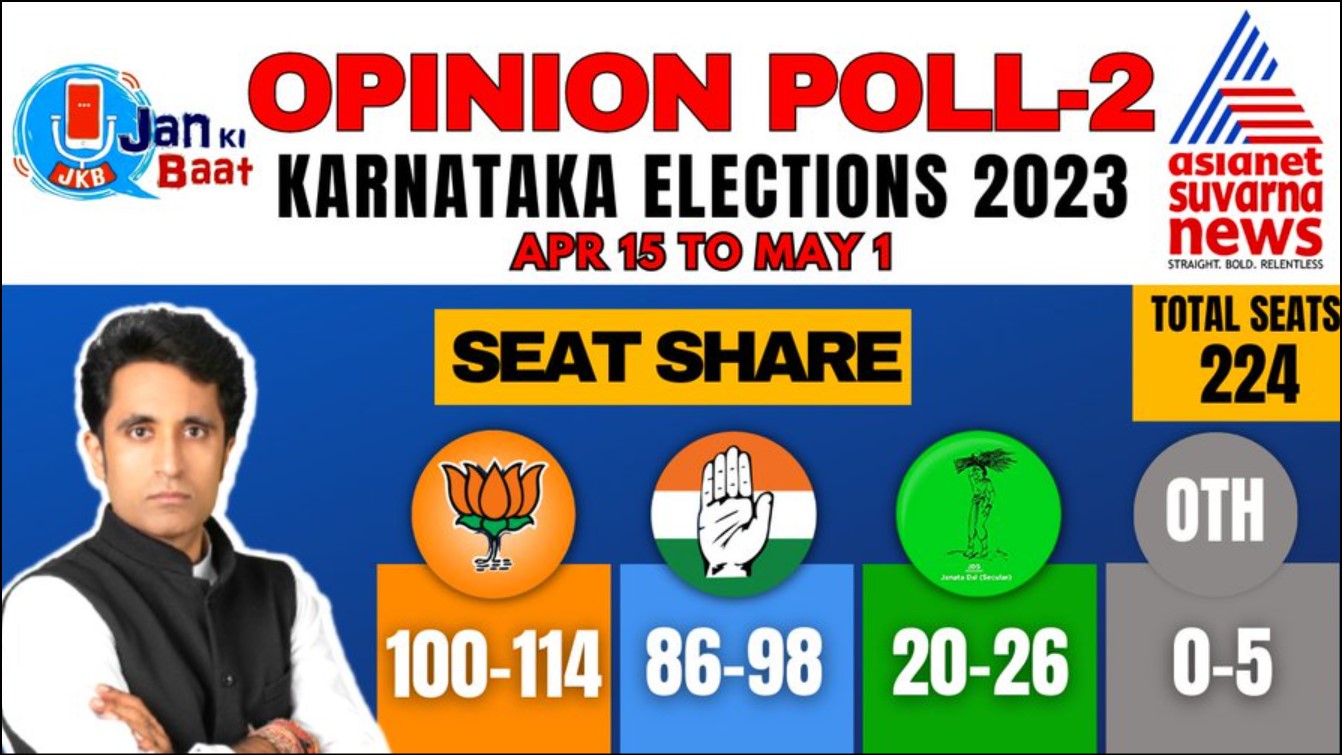
Suvarna News-Jan Ki Baat
100-114
86-98
20-26
3 to 7
NewsFirst-Matrize
96-106
84-94
29-34
2 to 7
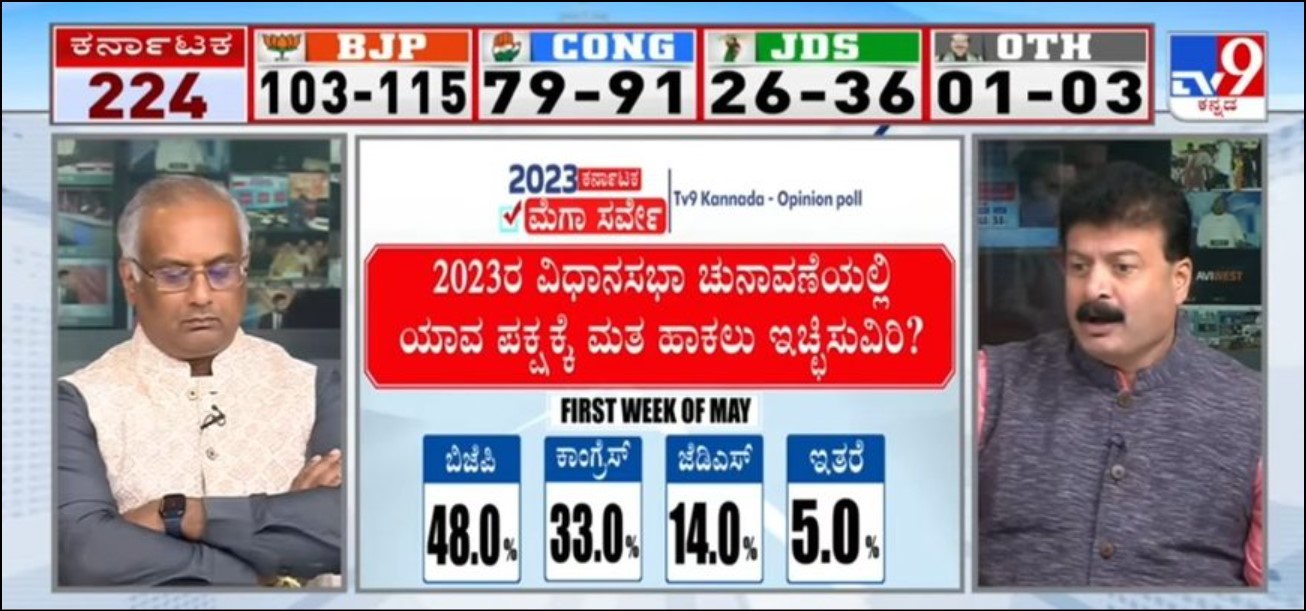
Tv9 Kannada
103-115
79-91
26-36
1 to 3
India TV-CNX
85
105
32
2
ABP- CVoter
73-85
110-122
21-29
2 to 6
C Daily Tracker
46
147
28
3
Public TV’s Mood
85-95
98-108
28-33
Vistara News
88-93
84-90
23-26
South First-People’s Pulse
90-100
95-105
25-30
Zee-Matrize Opinion poll
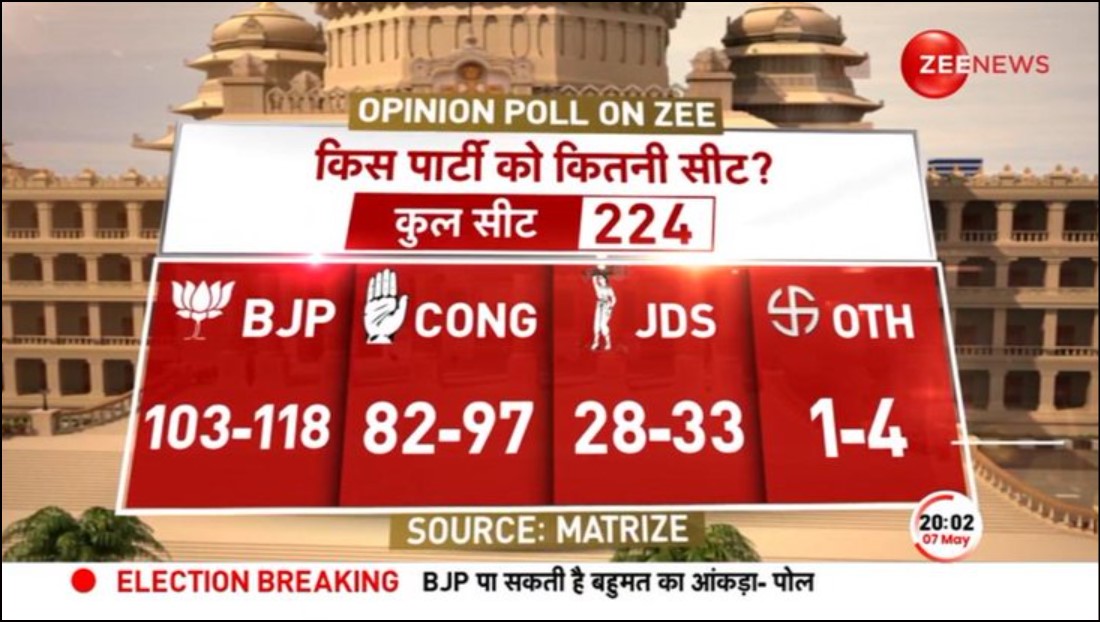
Zee TV announced the results of its opinion poll conducted in association with an organization called Matrize. According to the survey, the incumbent BJP will once again form the government in Karnataka, by comfortably crossing the clear majority.
— Matrize News Communications Pvt. Ltd (@Matrize_NC) May 8, 2023
As announced in this survey, the possible seats for the parties out of a total of 224 seats are as follows:
Bhartiya Janata Party: 103-118
Indian National Congress: 82-97
JD(S): 28-33
Others: 1-4
Thus, the survey is predicting a comfortable victory for BJP with 103-118 seats in the 224-member house. Notably, in the 2018 Assembly elections, the BJP won 104 of the 224 legislative seats in Karnataka, a significant increase of 64 seats over the previous polls.
Karnataka TV opinion poll
A regional Kannada channel Karnataka TV also announced the results of its final survey in which it predicted the BJP to emerge as the single largest party in the upcoming Assembly polls.
As announced in this survey, the potential seats for various parties are as follows:
Bhartiya Janata Party: 105-110
Indian National Congress: 80-85
JD(S): 34-38
Others: 3-7
Suvarna News-Jan Ki Baat opinion poll
Ahead of the Karnataka assembly elections 2023, the second and final pre-poll survey conducted by leading Kannada news channel Suvarna News 24×7 and Jan Ki Baat has predicted that the ruling BJP will emerge as the single largest party and might even cross the halfway mark in the upcoming Karnataka Assembly Elections. The opinion poll was based on a survey of over 30000 respondents across various districts of the state.
As announced in this survey, the potential seats for various parties are as follows:
Bhartiya Janata Party: 100-114
Indian National Congress: 86-98
JD(S): 20-26
Others: 3-7
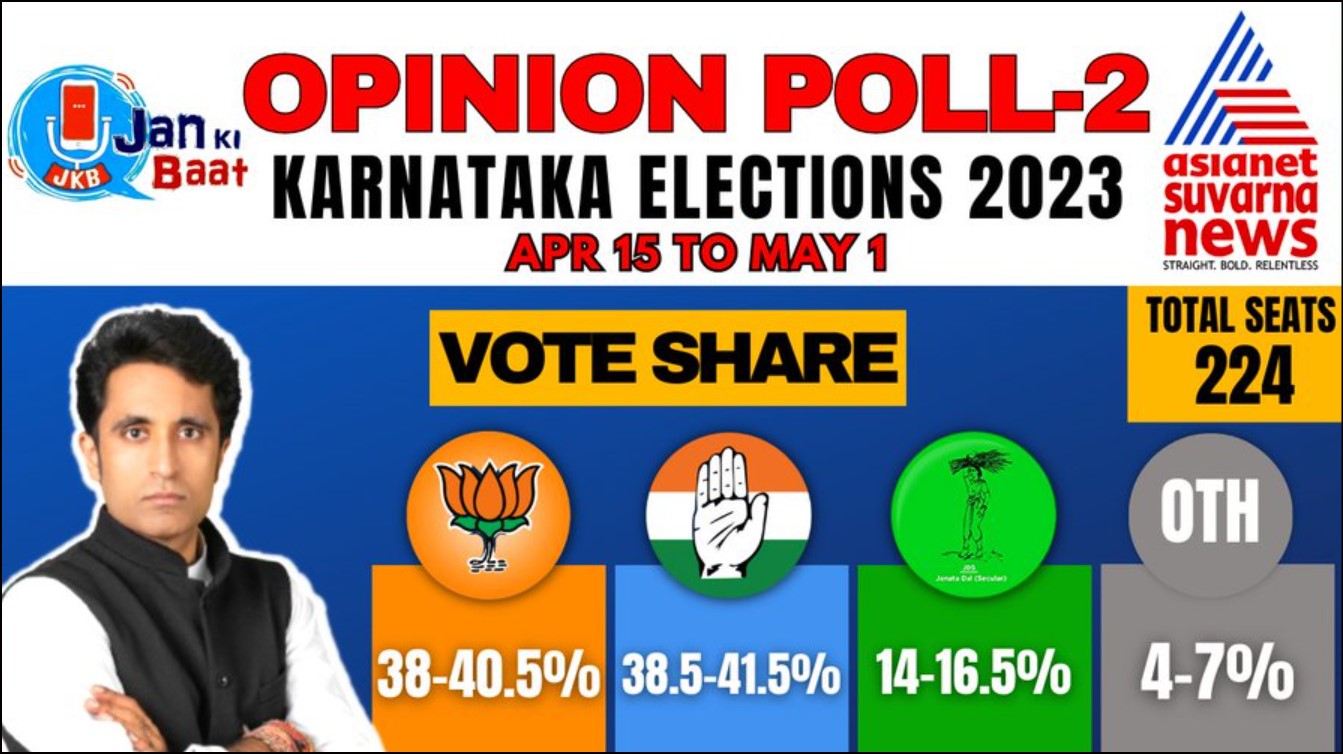
The pre-poll however placed Congress slightly ahead of BJP in terms of vote share. The potential vote share of each political party in this survey is as follows:
Bhartiya Janata Party: 38-40.5%
Indian National Congress: 38.5-41.5%
JD(S): 14-16.5%
Others: 4-7%
NewsFirst-Matrize survey
NewsFirst conducted a survey along with Matrize which also predicted that the BJP would emerge as the single largest party but might remain slightly below the halfway mark in the upcoming Karnataka Assembly elections.
As announced in this survey, the potential seats for various parties are as follows:
Bhartiya Janata Party: 96-106
Indian National Congress: 84-94
JD(S): 29-34
Others: 2-7
News 1st Matrize Karnataka Opinion Poll
BJP : 96-106 INC : 84-94 JDS : 29-34 OTH : 2-7
Congress will be around 100. BJP 95 & JDS around 28.
The results of the Tv9 Kannada opinion poll that came out in the first week of May showed BJP emerging as the single largest party in the upcoming polls.
As announced in this survey, the potential seats for various parties are as follows:
Bhartiya Janata Party: 103-115
Indian National Congress: 79-91
JD(S): 26-36
Others: 1-3
The potential vote share of each political party in this survey is as follows:
Bhartiya Janata Party: 48%
Indian National Congress: 33%
JD(S): 14%
Others: 5%
India TV-CNX opinion poll
India TV announced the final results of the survey and opinion poll conducted in association with an organization called CNX. The survey shows that the Congress party may emerge as the single largest party in the Karnataka assembly elections, but may fall eight seats short of a clear majority.
As announced in this survey, the potential seats for various parties are as follows:
Bhartiya Janata Party: 85
Indian National Congress: 105
JD(S): 32
Others: 2
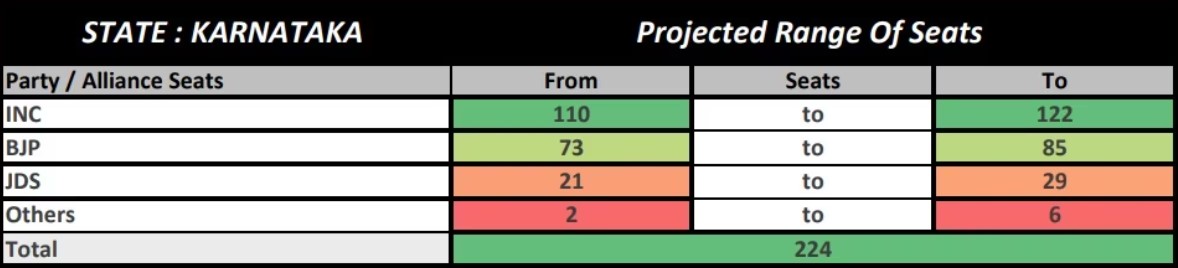
ABP- CVoter survey
As announced in this survey, the potential seats for various parties are as follows:
Bhartiya Janata Party: 73-85
Indian National Congress: 110-122
JD(S): 21-29
Others: 2-6
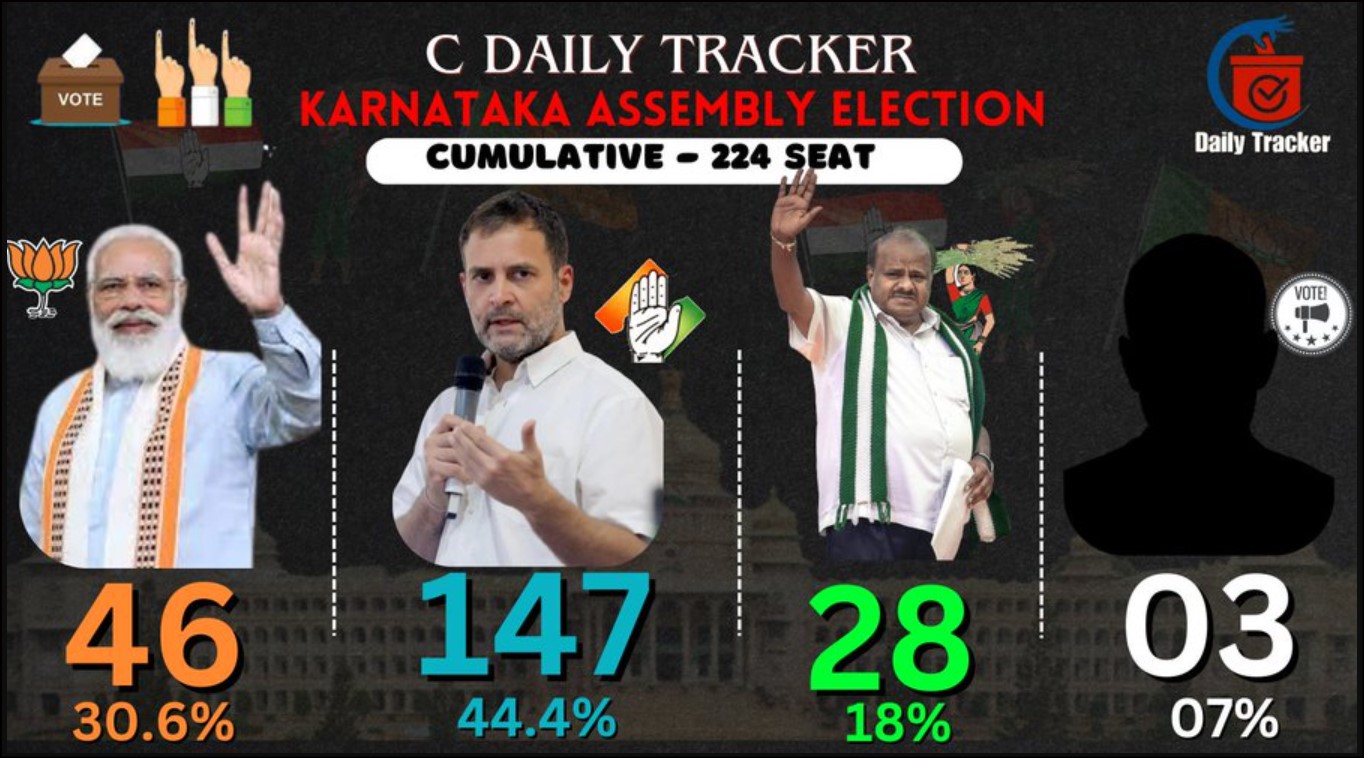
C Daily Tracker survey
The C Daily Tracker released its survey results on April 30, predicting Congress a clear edge in the upcoming polls in Karnataka.
As announced in this survey, the potential seats for various parties are as follows:
Bhartiya Janata Party: 46
Indian National Congress: 147
JD(S): 28
Others: 3
The potential vote share for various parties is as follows:
Bhartiya Janata Party: 30.6%
Indian National Congress: 44.4%
JD(S): 18%
Others: 7%
‘Mood of Karnataka’ by Public TV
Public TV’s Mood in Karnataka also gave Congress the edge in the upcoming poll. According to the survey, Congress may, however, not secure a clear majority in the state polls.
As announced in this survey, the potential seats for various parties are as follows:
Bhartiya Janata Party: 85-95
Indian National Congress: 98-108
JD(S): 28-33
A hung mandate is shown by Vistara News as it gave 88-93 seats to BJP, 84-90 to Congress, and 23-26 to JD(S). According to the survey, there are 27–30 seats where the outcome is uncertain.
The pre-election survey by South First-People’s Pulse gave Congress 98 seats, with a range of 95 to 105 seats. The BJP is predicted to win 92 seats (90-100 seat range) and the JD(S) 27 seats (25-30 seat range).
Karnataka Assembly Elections
The Legislative Assembly elections are scheduled to be held in Karnataka on May 10 2023 to elect all 224 members of the Karnataka Legislative Assembly. The results will be declared on May 13 2023.
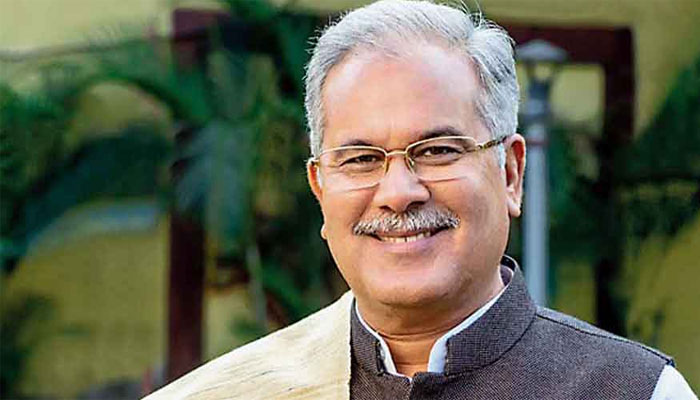
On May 6, Enforcement Directorate (ED) revealed that IAS officer Anil Tuteja, who was named in the NAN scam and being saved by Chhattisgarh Chief Minister Bhupesh Baghel, is directly linked to a Rs 2,000 crore liquor scam. Tuteja is currently serving as joint secretary in Chhattisgarh’s industry and commerce department.
ED said in its application seeking remand of the kingpin of the scam Anwar Dhebar that an illegal liquor syndicate running in the state generated corruption money of over Rs 2,000 crores. The investigation agency told the court the money collected via corrupt means was used in election-related activities.
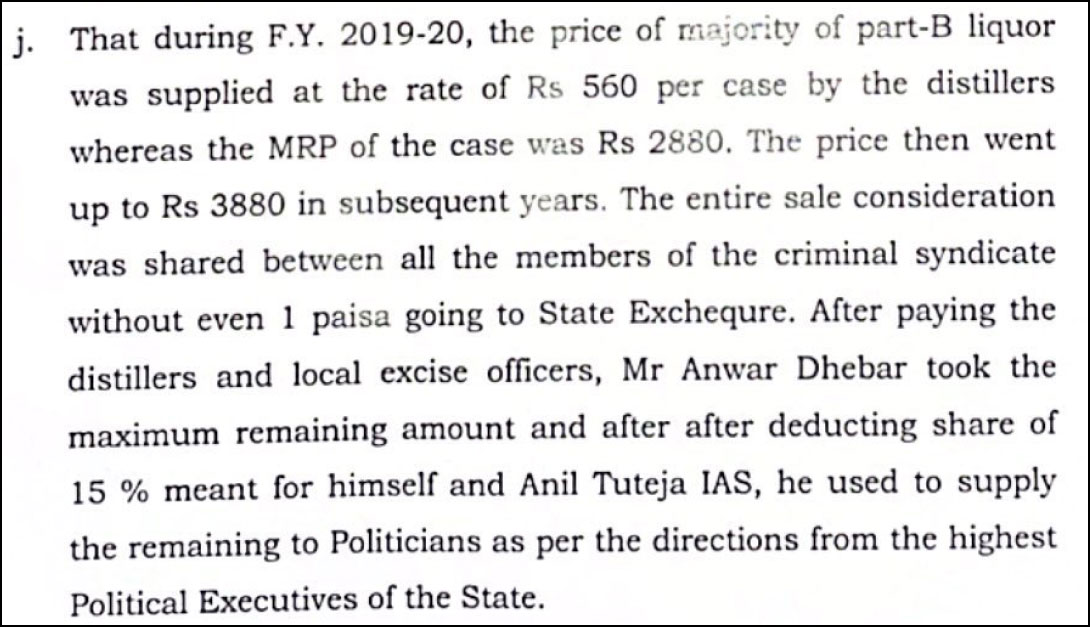
During its investigation, ED found that between 2019 and 2022, unaccounted illicit liquor worth 30-40 per cent of the overall liquor sales in the state was sold on the behest of the syndicate. While Anil Tuteja managed the money collected in the scam, Anwar Dhebar, brother of Raipur’s Mayor Aijaz Dhebar, was the kingpin of the syndicate and after the deduction of a specific percentage, all the money went to Anwar.
Source: ED
ED’s application in the court
In its application, ED mentioned that they received the Prosecution Complained filed by the IT Department along with documentary and digital data seized in search operations against Tuteja and others in the matter related to money laundering. Based on the analysis of the data by the ED, the investigation agency found there was a syndicate operating to collect bribes by controlling the high-level management of important State departments and SPSUs.
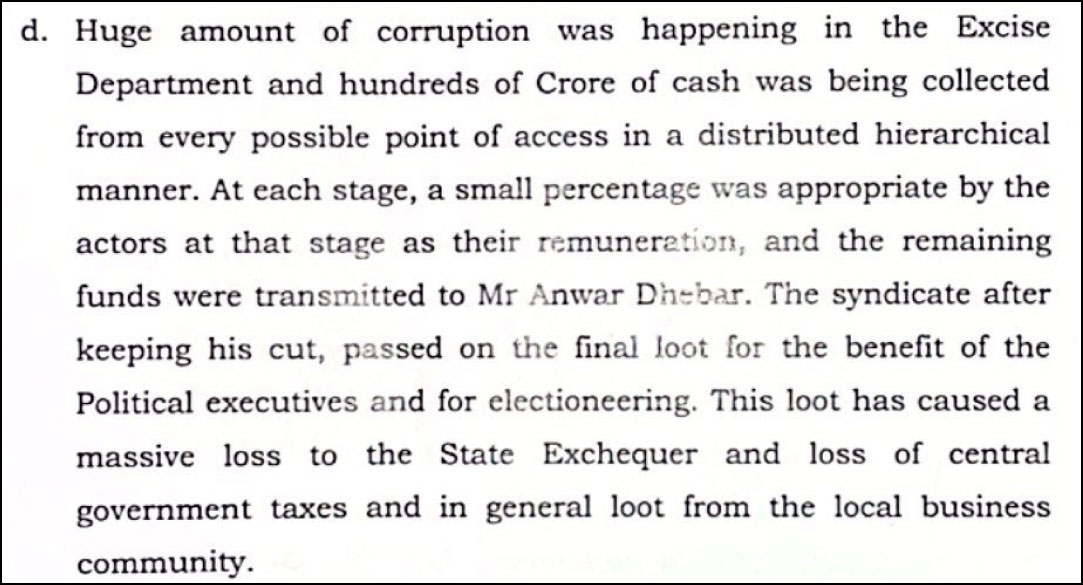
ED further noted that Tuteja was managing the affairs while Dhebar was the syndicate’s kingpin. They used their political connections to expand the syndicate across the state, particularly in the excise department. ED pointed out that they collected hundreds of crores in cash from “every possible point of access in a distributed hierarchical manner.” The actors involved in the scam would keep a small percentage of the collection and transfer the remaining funds to Dhebar.
Furthermore, the syndicate would allegedly keep their cut and send the money for the “benefit of the Political executives and electioneering.” ED alleged the loot “caused a massive loss to the State Exchequer and loss of central government taxes and in general loot from the local business community.”
Source: ED
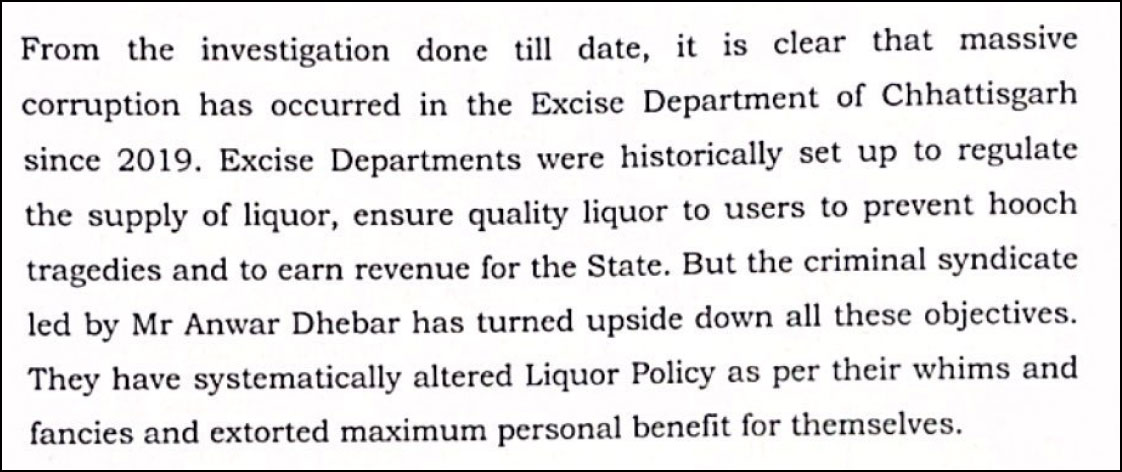
Mentioning the family background of Dhebar, ED noted that he is the brother of Raipur’s mayor, who is under investigation by CBI in a murder case. Dhebar was allegedly running the syndicate at the behest of his political masters.
ED said during the investigation, the department found the syndicate was collecting a large number of bribes from liquor suppliers. They also collected bribes from other departments, including the food horticulture department and the PWD Department. ED said the retrieved messages from the seized devices showed how deep-rooted the syndicate was in different state departments.
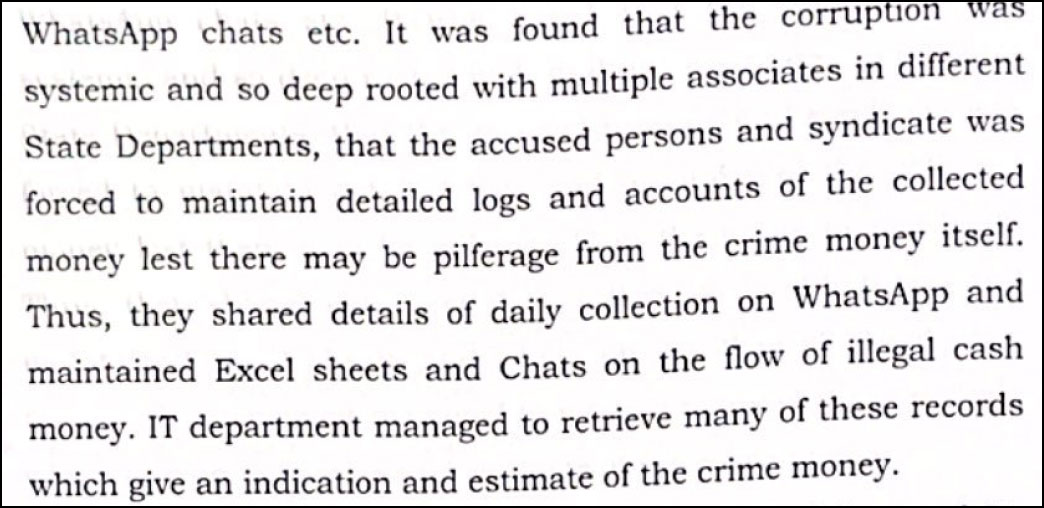
ED said, “It was found that the corruption was systemic and so deep-rooted with multiple associates in different State Departments, that the accused persons and syndicate was forced to maintain detailed logs and accounts of the collected money lest there may be pilferage from the crime money itself.”
Every day, the officials would share the information in the form of detailed logs and accounts of the collected money on WhatsApp. Hey, we’re maintaining Excel Sheets to track illegal cash flow. They also found digital evidence depicting Dhebar gave Rs 14.41 crores to Tuteja.
Source: ED
There were three parts of the syndicate. Part A indicated the commission charged by liquor suppliers for selling liquor in the state. Part B indicated the off-the-record sale of unaccounted country liquor from Sinte-run shops. ED noted the sale was being made with the involvement of distillers, hologram manufacturers, bottle manufacturers, transporters, district excise officials and more. Part C depicted the annual commission collected from the distillers running businesses in the state.
The main aim of the forming Excise Department in the state was to regulate the supply of liquor and ensure the administration made ample arrangements to prevent hooch tragedies. Furthermore, it would have earned revenue for the state. However, Dhebar turned the whole department upside down, which resulted in the personal benefit of Anwar and others involved.
Source: ED
ED noted the syndicate comprised senior bureaucrats of the state, politicians and officials of the excise department. In February 2019, ITS officer Arunpati Tripathi joined the state-government-led Chhattisgarh State Marketing Corporation Limited (CSMCL). Within three months, Tripathi was made the organisation’s Managing Director at the behest of Dhebar. He was given the job to maximise the bribe collection. Other IAS officers were also involved. IAS officer Vikas Agarwal and IAS officer Arvind Singh were included to collect money and logistics, respectively.
Manpower for the syndicate was provided by Sumcet Facilities Ltd, a company owned by an associate of Agarwal. The hologram contract was awarded to Prizm Holography and Films Securities Pvt Ltd. The task of cash collection was given to Tops Securities, owned by one Siddhartha Singhania, who was a close associate of Agarwal.
ED noted that in March 2019, Country liquor manufacturers Chhattisgarh Distilleries Limited, Bhatia Wines Merchants Private Limited, and Welcome Distilleries Private Limited met Dhebar and Tripathi. The distillers were ordered to pay Rs 75 per case commission. In return, Dhebar promised to raise their lending rates accordingly. The syndicate collected a huge amount in commission, and as CSMCL purchased the liquor, data was available. ED said a major share of the commission collected by Dhebar was given to a political party.
The syndicate also started manufacturing unaccounted kacha liquor. The syndicate decided to sell unaccounted country liquor as part of the conspiracy. It was being sold at state-run shops. Duplicate holograms were used to make them look original. Duplicate bottles were bought in cash and supplied to a distiller who would fill them and transport the illicit liquor skipping state-owned warehouses.
Dhebar set monthly targets. He would contact CSMCL MD or communicate through Arvind Singh. The senior excise officials would coordinate with the suppliers, including distillers, hologram makers, bottle makers, and transporters. Every month 200 trucks carrying 800 cases of country liquor were supplied by the distillers.
The liquor was supplied at Rs 560 per case. The MRP was Rs 2,880 per case. Over the years, it was increased to Rs 3,880 per year.
Source: ED
As it was not easy to extract money from Foreign Liquor makers and there was a demand for foreign liquor, Fl-10A licenses were brought into forte. Three known associates of Dhebar got the license. These license holders acted like collectors or intermediaries to buy foreign liquor and sold it to state-owned warehouses and generating a commission of around 10% from foreign liquor manufacturers.
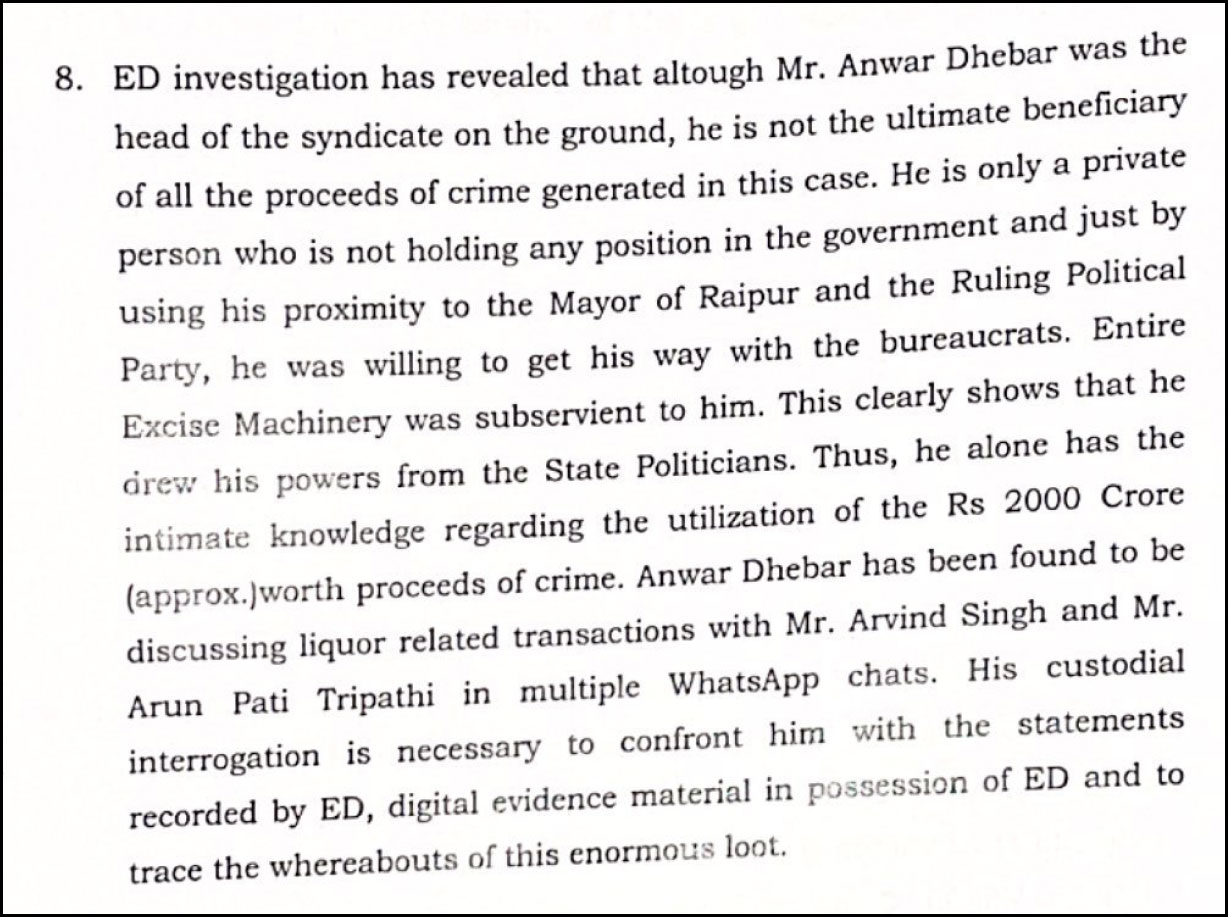
ED said, “Investigation has established that more than Rs 2000 Crore of corruption money has been generated by this syndicate.” ED further accused Dhebar of being responsible for collecting every rupee of these proceeds with the crime.
On March 29, 2023, when ED raided Dhebar’s house, he was not there. Despite being called repeatedly by ED, he refused to join the proceedings. During the investigation, ED discovered that he had a secret trap door at his house, which he used to abscond when the ED team knocked at his door. Even his relatives were non-cooperative and refused to sign the search panchnama. They called many of their supporters and tried to mob the ED’s search team.”
ED noted Dhebar was head of the syndicate, but he was not the ultimate beneficiary. ED said, “He is only a private person who is not holding any position in the government. He was willing to get his way with the bureaucrats by using his proximity to the Mayor of Raipur and the Ruling Political Party. Entire Excise Machinery was subservient to him. This clearly shows that he drew his powers from the State Politicians.”
Source: ED
Anil Tuteja and NAN Scam
In 2015, during an investigation into allegations by Congress, the BJP-led Chhattisgarh government under then-CM Raman Singh unearthed NAN (Nagrik Apurti Nigam or Public Distribution Corporation scam) scam. Twenty-seven people were booked in the case, with Anil Tuteja and Alok Shukla being the prime accused. A Chargesheet was filed by the Anti-Corruption Bureau in 2015, but then Congress came to power, and things changed for Tuteja.
Based on Tuteja’s allegations that the investigation was unfair, the Baghel-led Congress govt formed an SIT. Baghel has been since trying to personally shelf Tuteja and implicate Raman Singh in the scam. In 2020, soon after Tuteja was given bail in the case, he was appointed against by the Baghel government and became joint secretary of commerce and industries. On the other hand, Shukla was made principal secretary in charge of the education and other departments.
OpIndia’s investigation into the NAN scam
During our investigation, we accessed WhatsApp chats of Tuteja retrieved by the IT department. The chats clearly demonstrate that the entire criminal justice delivery system in the State is being abused, misused and mutilated at the behest of Anil Tuteja and his son Yash Tuteja.
It was further revealed there was a “hitlist” against political opponents, and the Chief Minister was trying not just to help Tuteja but also implicate Ex-Chief Minister Raman Singh and his family members, former Principle Secretary Aman Singh and his wife Yasmeen Singh, Former DG (Police) Mukesh Gupta, Ashok Chaturvedi and Chintamani Chandrakar.
Several officials were found to be dancing to the tunes of Tuteja. They were dependent on Tuteja for even the smallest things, like securing a gym membership for their spouses.
The chats also show that Tuteja was acting as the head of the NAN investigation, where he himself was the prime accused and was coordinating the transfer of IPS officers, promotions and other favours doled to those who were willing to participate in these nefarious designs. Further, those who did not comply were being given punishment posting or, worse, being implicated in false cases themselves.
In the submissions by Income Tax to the court against Tuteja and others, it was specifically mentioned there was a Hawala link.
While the NAN scam is elaborate, what is far more elaborate is the extent to which the Bhupesh Baghel administration seems to have gone to not only save the prime accused but also to implicate Raman Singh and others in the scam.
OpIndia’s detailed investigation of the NAN Scam can be checked here under The Chhattisgarh Files.
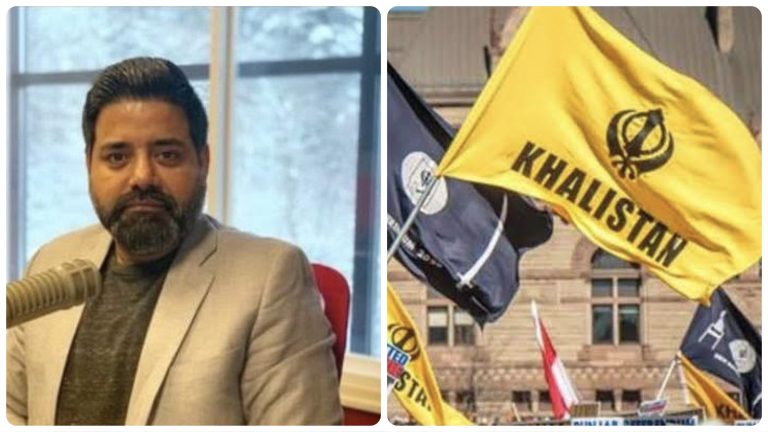
Sameer Kaushal, a radio host based out of Canada, demanded the Trudeau government take action against Khalistani elements that pose a threat to the law and order of the country. The demand was made during a webinar that discussed the Bloom report, which shed light on how Khalistani extremists were using democracies to execute their nefarious designs.
Speaking at the seminar, Sameer Kaushal, the host at Sher-e-Punjab Radio in Canada and who was attacked by Khalistani extremists in March this year, expressed appreciation for Bloom’s report, which was initiated in 2019 when then-Prime Minister Boris Johnson proposed resetting the ‘faith, religion, community’ program in the United Kingdom.
Kaushal also shared his own experience of violence at the hands of Khalistani extremists. Last month, the Indian High Commissioner’s visit to Canada’s Western coast was disrupted by Khalistani protesters who also prevented Kaushal, a recognized media person, from attending the event and subjected him to violence.
The radio host added that the Khalistanis are using religion to radicalize innocent citizens worldwide, creating a false narrative of the Indian government’s neglect of Sikh rights. He urged Canada to follow the UK’s lead and speak out against Khalistani violence in the country through the Bloom report.
N.C. Bipindra, the Chairman of Law and Society Alliance hosted the webinar, where he stated that the Khalistani movement does not represent the majority of the innocent Sikh population worldwide. He emphasized that Sikhism is considered one of the purest forms of religion, with its followers actively engaged in humanitarian aid.
Another speaker, Anilesh Mahajan, Deputy Editor at India Today, also appreciated Colin Bloom’s efforts in the report published by the British government. Mahajan noted that the increasing Khalistani activities in Western countries like the United States, United Kingdom, Australia, and Canada are being overlooked by their respective governments under the guise of freedom of speech and expression.
Since there are no policies outlining the audit of non-governmental organizations in these countries, gurudwaras are considered safe havens for pro-Khalistani activists, he added. Gurudwaras in Toronto, for example, are believed to be harbour grounds for people involved in extortion.
Mahajan stated that Khalistanis use a global criminal network that is actively funded by Pakistan. He provided an example of a man known as the “man of charity” who runs an NGO in India and carries out acts of donation in various countries, including Somalia. However, the man is secretly funded by Pakistan’s ISI and has close ties to Khalistani leaders, allowing them to expand their soft power worldwide.
The Khalistani ideology, Mahajan added, has also infiltrated Punjab’s cinema and music industry. He emphasized the need to understand the strategy of such radicals as they seek to undermine democratic values in various countries.
Colin Bloom, an independent faith engagement advisor, published a review commissioned by British authorities, recommending that the UK government investigate extremist activity within the country’s Sikh community amidst the backdrop of pro-Khalistan elements inciting violence and intimidation.
According to the report, a “small but highly vocal and aggressive minority of British Sikhs who can be described as pro-Khalistan extremists” are promoting an “ethno-nationalist agenda”. Some of these extremists are also known to support and incite violence and intimidation in their efforts to establish an independent state called Khalistan.
The report stated that the “subversive, sectarian, and discriminatory activities” of such elements are not representative of the majority of British Sikhs. The “extremist fringe ideology within the pro-Khalistan movement” has caused division within British Sikh communities.
The report further added that the UK government “should clearly define and investigate extremist activity and identify where this exists within the Sikh community, taking steps to develop a more nuanced and comprehensive understanding of subversive and sectarian Sikh extremist activity”.
Khalistanis’ protest against Bloom report fails as no one turns up
On April 29 (local time), an embarrassing situation occurred for the Khalistani elements in London as no one turned up for the protest they had called for outside the Indian High Commission office. The protest was called against the report submitted by Colin Bloom, an independent faith engagement adviser, where he used the word “Sikh extremism”.
As per local reports, despite the call for protests on April 29 on various social media platforms, none turned up. Speaking to the media house, UK police said they were aware of the protests and stationed police personnel outside the HCI office. There was constant patrolling, and police vehicles were on standby. However, protesters did not turn up.