Home Blog Page 243

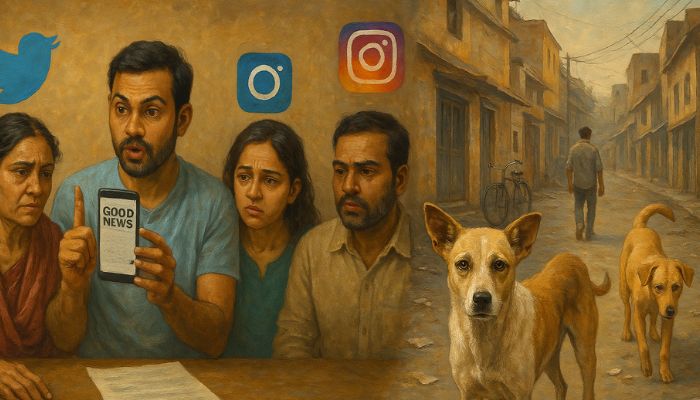
India’s growing stray dog population: A silent crisis that no governments are paying attention to

On a late March morning this year, a six-year-old boy was mauled to death by a pack of stray dogs in Ludhiana, Punjab. In just a matter of three months, he was the fourth child fatality in the district. He was playing near a garbage dump when the dogs attacked, fatally injuring him. Just weeks later in Goa, a 20-month-old toddler wandered outside her home. Stray dogs saw her as an easy prey and attacked. Her gruesome wounds proved fatal.

In one of the most recent incidents, 22-year-old Kabaddi player Brajesh Solanki died of rabies in Uttar Pradesh’s Bulandshahr. Solanki was bitten by a puppy two months ago while rescuing it. He neither informed anybody of the bite nor took anti-rabies vaccination. Last week, he felt numbness during practice. He was shifted to the district hospital and then to Noida when his health worsened, where he was diagnosed with rabies. After suffering from horrifying symptoms for around a week, he succumbed to the disease.

These incidents were once isolated and rare. However, now they have become disturbingly frequent across India. They shine a harsh light on a silent crisis that has been intensifying over the years. The explosion in the stray dog population has resulted in devastating consequences for public safety and health. Still, the central government, state governments and local authorities have failed to put an end to the problem of stray dogs that is quickly becoming a menace for the public.

Surging stray dog population since independence

Street dogs have long co-existed with humans in Indian cities and villages. However, their numbers today are unprecedented and alarming. During the colonial era and even for several decades after independence, the standard method of dog population control involved culling, or in the literal parliamentary language, “destroying the dogs”.

According to documents accessed by OpIndia from Lok Sabha and Rajya Sabha, every year thousands of dogs were killed by local authorities in an attempt to control their numbers. However, despite such drastic measures, the population continued to grow. It pointed to the failure of kill-based strategies in the Indian context. However, the numbers remained somewhat under control, and if the method had been mixed with sterilisation campaigns, it would have controlled the population of street dogs to a great extent. Alas, it did not happen the way it should have.

The 2012 Livestock Census noted that there were around 1.71 crore stray dogs in India. In 2019, the reported number was 1.53 crore. While the stats show decrease in number of strays, experts raised questions over the accuracy of these figures. They cited under-reporting and inconsistent survey methods. State of Pet Homelessness Index of India states estimates suggested in 2024 that there might be over 6 crore stray dogs in India, probably the highest in the world.

This growth is not limited to cities alone. Rural areas have witnessed a dramatic increase in free-roaming dogs. Decades ago, the issue of stray dogs was still manageable but now it has become a crisis of overwhelming proportions. The reasons behind this surge are urbanisation, uncollected garbage, poor planning, an ineffective population control system and the increasing number of so-called dog lovers who have made it their life’s motto to ensure authorities cannot even move dangerous dogs to other locations, let alone cull them.

Why the stray dog population remains unchecked

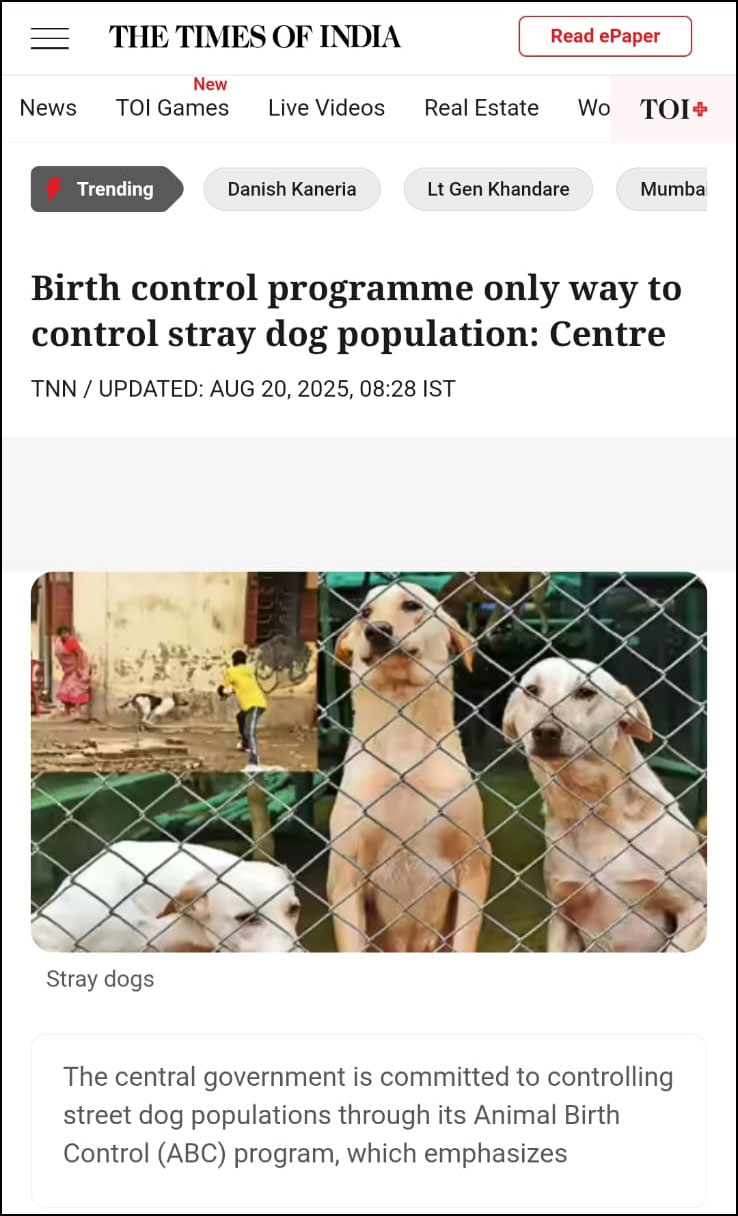
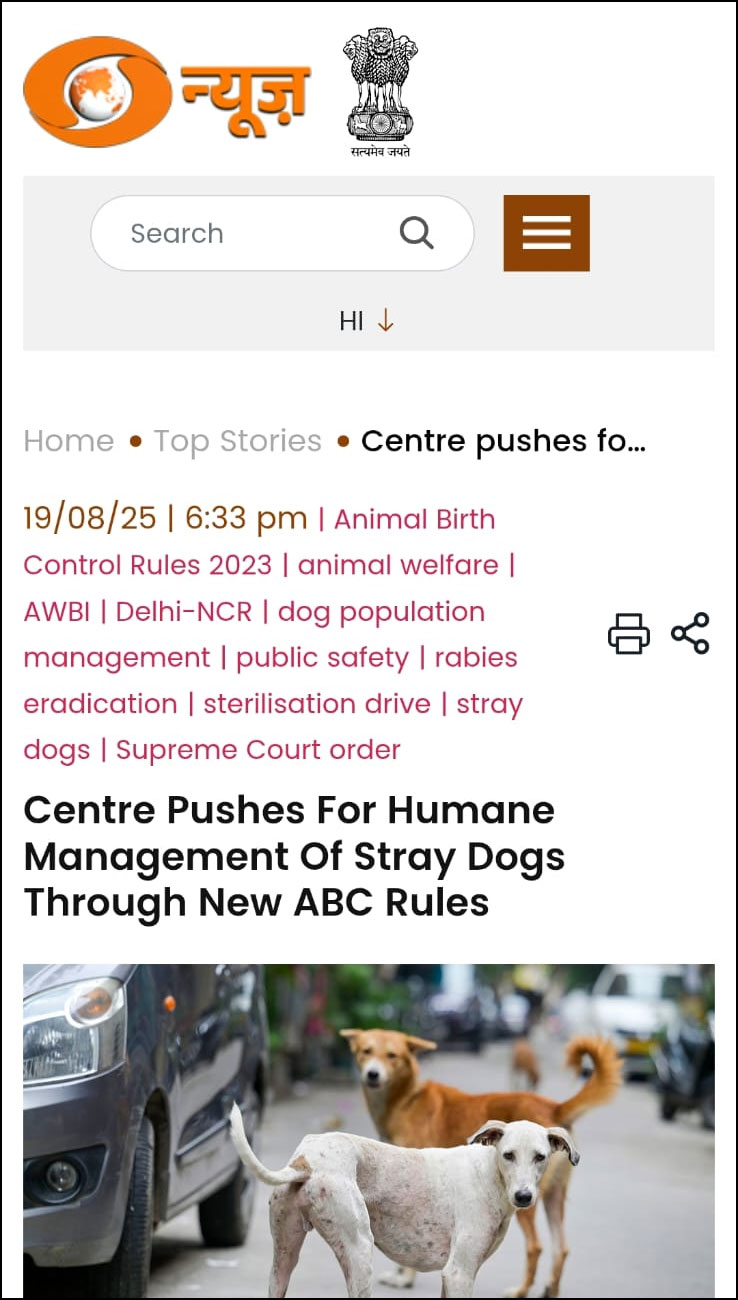
One of the main reasons for the unchecked growth in the stray dog population is policy paralysis surrounding animal control. Supreme Court-backed Animal Birth Control (ABC) Rules were first introduced in 2001. The only permissible method to manage stray dogs, according to the new rules, was sterilisation and vaccination, followed by release at the same location. The Supreme Court, on the behest of pro-dog “animal welfare” groups, passed a judgement making it impossible for the authorities and the public to get rid of the dogs, even by shifting them to a safer location where animal-human interaction could be minimised.

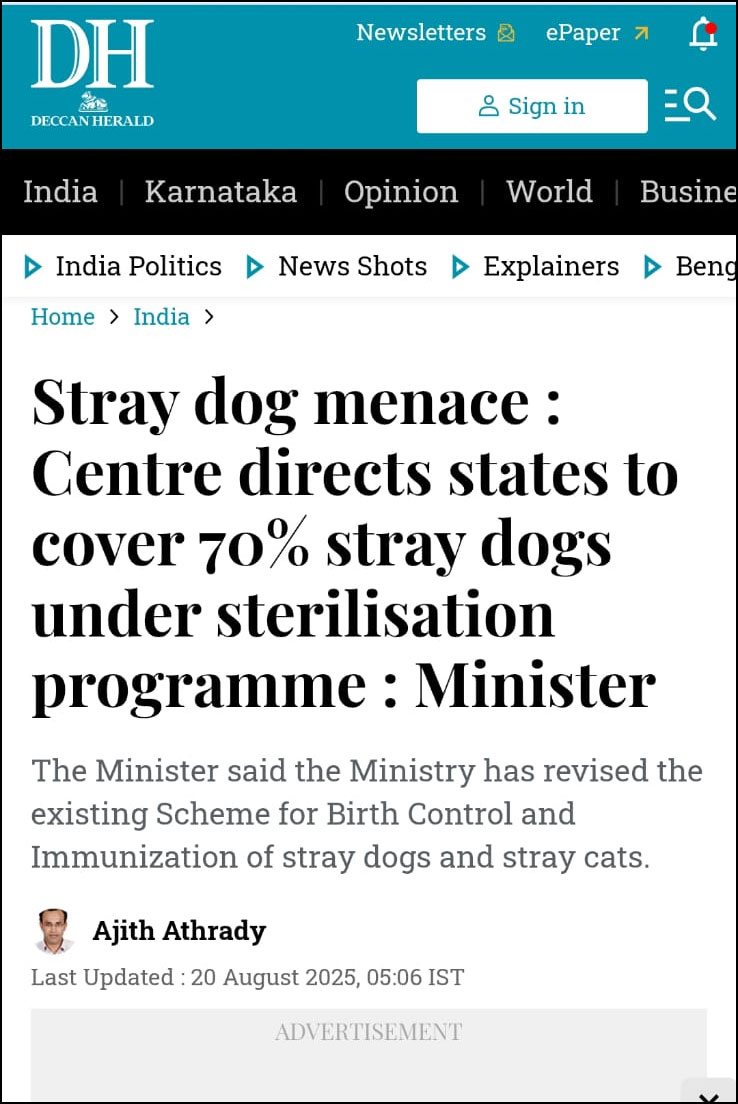
While the rules appear “humane” in theory, it is extremely hard to implement them in practice, especially at the scale required to make a dent in the stray dog population. To effectively reduce numbers, at least 70% of the stray dog population in a given area must be sterilised. However, in most Indian cities, the coverage is reportedly patchy at best.

Municipal bodies struggle with limited funding, insufficient infrastructure, lack of trained personnel and backlash from animal welfare groups on top of overall incompetence and gross negligence. The result is a slow and ineffective sterilisation effort, unable to match the breeding rate of strays.

Furthermore, in many Indian communities, feeding stray dogs is considered an act of kindness and, in some cases, even has religious merit. People routinely offer leftover food to stray dogs. If that is not enough, there are thousands of individuals and organisations across the country that specially cook food for stray dogs and feed them wherever and whenever they want, without considering the plea of locals who have to face the consequences of the formation of packs of dogs as people feed them at those locations.

While compassionate, such practices inadvertently support larger dog populations by providing easy access to food, especially in neighbourhoods where waste disposal is already poor. Garbage dumps, overflowing bins, and food leftovers on streets become regular feeding grounds for entire packs.

Mismanagement and corruption is another reason for the increasing number of stray dogs. There have been reports that municipalities in many states outsource ABC programmes to NGOs or private contractors. However, there is little to no monitoring. Several cases have surfaced where NGOs claimed to sterilise thousands of dogs, but the actual numbers were a fraction.

In Bhopal, audits revealed inflated figures, ghost surgeries, and substandard facilities. Without proper oversight, public money meant for population control ends up being wasted, and the dogs continue to multiply every year.

Public safety at stake amid a rabies crisis

The unchecked population is no longer an urban problem. It has become a public safety emergency and a national shame. India has the largest number of rabies deaths annually in the world. Dog bites are now an everyday occurrence. Between 2019 and 2022, over 1.6 crore dog bite cases were officially recorded in India. That is an average of more than one bite every two seconds. These figures are likely underreported, as many rural cases never reach the dataset.

Some states are facing a particularly grim situation. For example, Kerala reported 3.16 lakh dog bite cases in 2024 alone. In Ludhiana, Punjab, government hospitals registered over 40 cases a day. Stray dogs attack people from all age groups. From children to elderly pedestrians, sanitation workers, and delivery agents, no one is safe on Indian roads, not even in gated societies, anymore. Stray dogs are increasingly territorial, aggressive, and often move in large packs. It makes attacks more frequent and dangerous.

Notably, India accounts for 36% of global rabies deaths. Around 18,000 to 20,000 people die of rabies every year, and most of these deaths are caused by dog bites. Rabies is 100% fatal once symptoms appear, making post-exposure treatment the only line of defence. Sadly, access to vaccines, especially in remote and rural regions, remains inconsistent. Furthermore, lack of awareness is another reason people fail to report or go to the doctor immediately once they are bitten by a stray dog. There is also a psychological toll. Fear of dog attacks keeps elderly people confined indoors. Children are restricted from going to parks or playing in front of their houses. Even youth, in some areas, have to walk with a stick in their hands. In short, the growing stray dog population has transformed the issue into a full-blown national crisis, and nobody is ready to talk about it, all thanks to the Animal Welfare Boards, animal lovers, and the judiciary.

The way forward – solutions and national-level reforms

Solving this crisis demands a coordinated, multi-agency effort without any interference from animal ‘activists’, the Animal Welfare Board, dog lovers or the judiciary. India needs a mission-mode campaign that must be backed by the central government, involving the ministries of health, animal husbandry, urban development and municipal bodies. The government and local authorities must scale up sterilisation infrastructure rapidly. Dedicated funds, real-time monitoring apps, mobile ABC vans and digital dog-tagging systems for stray dogs should be implemented.

The central health ministry has started coordinating with animal husbandry authorities under a “One Health” framework, recognising that human rabies control is impossible without controlling it in dogs. However, it will take time to get results as getting all stakeholders onboard is not an easy task.

There is also a need for waste management. Unattended garbage is a key contributor to the high stray population. Municipalities must ensure clean streets and prompt waste collection. Designated feeding zones, away from residential clusters should be set up, and ‘animal lovers’ must comply with this without making a fuss.

Furthermore, there is a need for strict laws against pet abandonment and illegal breeding. Many strays originate from dumped pets or their unneutered offspring. Making pet sterilisation compulsory and regulating breeding can cut down the influx of new strays.

Finally, public awareness must increase. Citizens need to be educated about rabies prevention, responsible feeding and how to engage with authorities to sterilise strays in their areas. Compassion and caution must go hand in hand if India wants to address this human-animal conflict in a strict yet humane manner.

It is time to act decisively

India has a major stray dog problem, and it is not just about animals on the street. It is about human lives, public health and safety. The numbers have reached a stage where authorities cannot ignore them. The tragedies are happening too frequently to brush aside. India needs not only better rules but stronger action, strict accountability and a public conversation. There should be a balance between animal welfare and people’s right to live without fear. If this crisis remains unaddressed, the headlines will continue to speak through bloodied playgrounds, grieving parents and a healthcare system battling avoidable rabies deaths. The time to act was a day before yesterday. The time to wake up is now.

As PM Modi embarks on his first-ever visit to Ghana, a resource-rich African nation locked in a standoff with China over illegal gold mining: Here’s what’s at stake

Prime Minister Narendra Modi on Wednesday (2nd July 2025) departed for a five-nation visit to Ghana, Trinidad and Tobago, Argentina, Brazil, and Namibia from 2 to 9 July. PM Modi’s Ghana visit comes at a time when China and Ghana are at loggerheads over illegal gold mining.

At the invitation of Ghana’s President John Dramani Mahama, PM Modi will visit Ghana on 2-3 July. Ghana is a valued partner in the Global South and plays an important role in the African Union and the Economic Community of West African States.

“I look forward to my exchanges aimed at further deepening our historical ties and opening up new windows of cooperation, including in the areas of investment, energy, health, security, capacity building and development partnership. As fellow democracies, it will be an honour to speak at the Parliament of Ghana,” an official statement said.

Taking to X, PM Modi said, “Over the next few days, I will be attending various bilateral, multilateral and other programmes in Ghana, Trinidad & Tobago, Argentina, Brazil, and Namibia. Looking forward to interacting with world leaders and discussing ways to make our planet better.”

Highlighting the significance of PM Modi’s Ghana visit, High Commissioner Manish Gupta said, “We are privileged indeed that the Prime Minister Modi is visiting Ghana for the first time. This is the first visit of the Indian Prime Minister to Ghana in three decades. It is a very historical moment for us, and when it comes to our bilateral ties, this is a very deep-rooted relationship with a rich historical legacy.”

The Indian envoy also emphasised New Delhi’s development cooperation with Accra, noting India’s investments in Ghana through a combination of private business initiatives, government-to-government grants, and concessional credit lines. Notably, India is also set to establish a vaccine hub in Ghana.

“India is among the leading countries taking the charge for the Global South…As the Prime Minister initiated the policy to make the development human-centric and all-inclusive, this is one of the core priorities for the Global South…We have invested nearly two billion dollars through our Indian businesses in this country. Another billion dollars’ worth of investments have come through government-to-government grants, concessional lines of credit, and bias credit programs. Some of the very signature infrastructure came through here through the Indian Partnership, and one of the prime examples you would see tomorrow is the Jubilee House. This has come through Indian Partnership,” he said.

Ghana and China at loggerhead over illegal gold mining

In recent times, tensions have escalated between China and Ghana as Chinese nationals have been involved in small-scale illegal gold mining “galamsey” in Ghana. These illegal activities of Chinese nationals are causing environmental damage and also inflicting economic losses. Illegal gold mining is reported to have caused significant damage across Ghana’s Western, Ashanti and Eastern regions. Ghana has accused Chinese miners of flouting regulations, however, China denies these allegations.

In 2023, a Chinese national Aisha Huang also known as the ‘Galamsey Queen’, was sentenced in 2023 to over four years in prison and fined US$4,000 after returning to Ghana despite a previous deportation.

Ghana issued a mandate in April this year for foreigners to exit the gold market by the month end to curb smuggling and boost revenue through a centralised Gold Board. Previously, multiple license holders competed for gold from small-scale miners. This led to revenue leakage and inconsistent pricing.

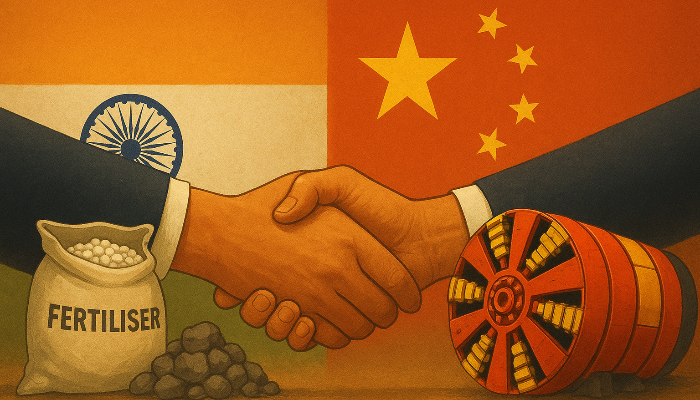
Prime Minister Modi’s historic visit to Ghana, first by an Indian PM in 30 years, is seen as a step towards further strengthening an already deep Indo-Ghana ties amid the ongoing China-Ghana dispute. Not to forget, India is a major importer of Ghanian gold. India is likely to position itself as a counterbalance to China’s influence in Ghanian resource sector.

Land for job scam: Lalu Prasad Yadav named ‘kingpin’, Tejashwi and Rabri Devi ‘beneficiaries’ in CBI chargesheet

The Central Bureau of Investigation (CBI) on Tuesday concluded its arguments on the framing of charges in the alleged land-for-jobs scam involving Rashtriya Janata Dal (RJD) chief Lalu Prasad Yadav, his wife Rabri Devi, their sons Tejashwi Yadav and Tej Pratap Yadav, and other co-accused named in the charge sheet.

During the hearing, the CBI referred to Lalu Prasad as the “kingpin” of the alleged conspiracy. The agency cited statements from two approvers, who claimed they were pressured by Lalu to appoint certain candidates whose names were finalized by his office. The CBI also presented testimonies from several prosecution witnesses who confirmed that a list of selected applicants was handed over by Lalu’s then private secretary during a conference of general managers in the Railway Department, where Lalu served as Union Railway Minister.

In addition, the agency argued that Rabri Devi, their daughter Misa Bharti, and sons Tejashwi and Tej Pratap were direct beneficiaries of land parcels transferred by job seekers. These transfers, the CBI alleged, were made in exchange for appointments made illegally within the railway department at Lalu’s behest.

With the Central Bureau of Investigation (CBI) concluding its arguments in the alleged land-for-jobs scam, the next stage in the legal proceedings will see the accused, including Lalu Prasad Yadav and his family members, present their counter arguments opposing the framing of charges. Once these arguments are heard, the court is expected to reserve its order before deciding whether to formally begin the trial.

So far, the CBI has named 78 individuals in its chargesheets, including Lalu Prasad Yadav.

The agency had previously obtained the necessary sanction to prosecute Lalu for his alleged role in the case. Initially, the CBI filed two separate chargesheets detailing irregular appointments in the Central and Western Railway zones. In June last year, the agency submitted its final and consolidated chargesheet, encompassing additional railway zones and naming Lalu, Rabri Devi, Tejashwi Yadav, Hema Yadav, former OSD Bhola Yadav, and others.

According to the final chargesheet, Lalu and other public servants were accused of influencing recruitment processes in exchange for land and other benefits. The CBI alleged that Lalu, Rabri Devi, and Tejashwi Yadav were the “ultimate beneficiaries” of the scheme. It also claimed that the conspiracy extended beyond land-for-job exchanges to include cash payments and other political incentives. The agency further stated that Lalu, in his capacity as railway minister, used his position to pressure officials, particularly in the West Central Railway zone.

Stop this nonsense already, people are not ‘suddenly dying’ because of COVID-19 vaccines or due to some grand modern medical conspiracy 

The Indian Council of Medical Research has conducted two extensive studies that have shown that the cases of ‘sudden deaths’ due to cardiac arrests have no link to COVID-19 vaccines. These studies have been carried out with vast data, covering thousands of cases across multiple hospitals, spread across 19 Indian states and Union Territories. 

These studies by the Indian Council of Medical Research (ICMR) and National Centre for Disease Control (NCDC) affirm that COVID-19 vaccines in India are safe and effective, with extremely rare instances of serious side effects. Sudden cardiac deaths can result from a wide range of factors, including genetics, lifestyle, pre-existing conditions, and post-COVID complications, and these factors vary from case to case.

Every time someone dies, especially when that someone is famous and rather young, wild conspiracy theories are spread all over social media, and mainstream media. After the recent death of entertainer Shefali Jariwala at the age of 42, these speculations and conspiracy theories touched a new level, with even media platforms fuelling the fire. 


“Covid vaccines are deadly. They are causing deaths. Shefali Jariwala died. She had taken this vaccine too”, claimed one handle on X, using a similarly misinformed and fearmongering video by an alleged media platform, that seemed to ‘confirm’ the handle’s claim. The video was about Astrazeneca ‘admitting’ that their vaccine may cause blood clots as a side effect. The video used the news of AstraZeneca to claim that people are dying because of the alleged blood clots, totally ignoring the fact that the adverse effect of blood clots happens only in extremely rare cases.

As per the data submitted by the The Medicines and Healthcare products Regulatory Agency (MHRA) in the UK, where the court case was going on, the risk of Thrombosis with Thrombocytopenia Syndrome (TTS) possibly after taking the Covid-19 vaccine was seen only in 309 cases, resulting in 56 deaths, out of a staggering 23 million first doses and 9 million second doses. On average, the risk of TTS was suggested in approximately 12.3 cases per million. 

In the global level, A 2022 study in Lancet Global Health reported rates of 8.1 TTS cases per million first doses and 2.3 per million second doses, that too with sharp geographic variations. Data from Nordic countries showed TTS risk in 17.6 cases per million, and in Asia, the TTS risk was seen in only 0.2 cases per million doses administered. In short, for an average person, there are far more chances of dying in a road accident (120 deaths per million in India, in 2023), or obesity (424 per million in India) than of dying due to a COVID jab.

It is notable here that not only are the risk factors extremely rare, even when they occur in one of the rare cases, they occur in the first 6 weeks of the jab, not years later. Linking a celebrity death to the COVID vaccine taken years ago is not only profoundly stupid, it is dangerous and helps to spread a larger anti-vaccine propaganda among the gullible people. 

Billions of doses of the Covishield (Oxford-AstraZeneca)vaccine have been administered to billions of people around the world. If the vaccines were ‘bad’, a chunk of the global population would have dropped dead long ago. 3 billion doses of the AstraZeneca vaccine were administered in the first year alone. Did we see a reduction in the global population? 

Why do people spread misinformation against Vaccines?

The fear-mongering against COVID-19 vaccines, and the general anti-vaxxer rants against all vaccines are all stemmed from the larger propensity among uninformed, unscientific and superstitious masses against modern medicine. Unfortunately, in India, a large part of the anti-vaccine propaganda has been done by politicians and fraudulent ‘researchers’ misusing academic facilities.

There is a frenzied crowd that thinks the modern governments, with all their modern scientific tools, are out to get them, and they need to time-travel back to ancient times ASAP. In their minds, the ancient times were exactly like landscape paintings with rural themes, idyllic and full of natural beauty, where people look all delighted about manual labour and everyone is ecstatic for no particular reason at all.

They forget that the old days were the days when half of the women died at childbirth, and half the children succumbed to (now) preventable diseases, a breakout of cholera often wiped out entire villages, and a single missed or scarce monsoon caused millions of deaths by starvation. 

In India, the life expectancy has improved from a dismal 20-25 years in the early 1900s to 30-32 years in the 1940s, 50+ years in the 1980s to current levels of 70 years+ in the 21st century. When one looks at hard data ‘objectively’, without idiotic and romanticised notions of ‘golden olden days’ the facts are there for all. We have been living healthier, happier and better in modern times. Women are not dying by droves in childbirth, babies have grown up nicely to become insufferable GenZ, the elderly live up to ripe old ages to torment their children and fix weddings, and a simple outbreak of cholera no longer wipes out entire villages. 

All those people, including the countless idiotic fear-mongering doomsday peddlers on social media who claim 24×7 that pharma companies and government are hand in glove in a grand conspiracy to kill them, are kept alive by modern medicine, modern technology that provides us with an abundance of crops to eat and supplies to enjoy. 

Vaccines have saved more than 154 million lives in the last 50 years

By rough estimates, the COVID-19 vaccines prevented nearly 20 million deaths globally by 2022. When one considers the overall life saving numbers of all essential vaccines that are given to children across the globe, humanity should worship the vaccine researchers, manufacturers and suppliers as Gods. But no, we would rather believe an awful-tasting tea made from some pretty flower will make us healthy because the pretty influencer on Insta says so, than believe the countless scientists who spend years researching, conducting studies, trials and ensuring quality control to save the Earth’s humans. 

A WHO estimate, calculated by analysing tons of data across the world, says that globally, childhood vaccines alone have prevented 154 million deaths in the last 50 years. That is the equivalent of 6 lives saved every minute of every year. 

the 14 main vaccines given widely in many countries, with a few regional exceptions, diphtheria, Haemophilus influenzae type B, hepatitis B, Japanese encephalitis, measles, meningitis A, pertussis, invasive pneumococcal disease, polio, rotavirus, rubella, tetanus, tuberculosis, and yellow fever, have brought down global infant mortality by a drastic 40%.

VaccineEstimated Lives Saved Globally
Measles (part of MMR)~94 million
Tetanus (including maternal & neonatal)~28 million
Pertussis (Whooping Cough)~13 million
Tuberculosis (BCG)~11 million
Haemophilus influenzae type B~2.8 million
Polio~1.6 million lives saved + ~20 million from paralysis
Rotavirus~139,000 (since 2006)
Hepatitis B~1 million+ (varies by source, due to liver disease prevention)
Other routine childhood vaccines (DTP, rubella, etc.)~3.8 million combined
source: WHO data

Death and human stupidity

The superstitions around death are many, and human stupidity and human fear are fraternal twins. Widespread internet usage has made information abundance, rather, information overload, a consistent feature in our lives. Most of us are not smart, or sane enough to keep thinking rationally through the relentless newsflow, and hence we try to process similar sounding news by connecting imaginary dots.

People die. thousands of people die every day without us knowing anything about them. They become a part of a massive database that grows every hour, every minute. We hear about a Shefali Jariwala, or a Siddharth Shukla, only because they were celebrities and only because the media and social media keep repeating their names for days. Falling victim to superstitious beliefs and believing conspiracy theories, trying to see patterns in death statistics stems from our own myopic worldview and personal fears.

Ask a doctor, a policeman, a mortuary worker, or a cremation home staff member, and they will give some hard truths we all need to hear from time to time. Death is regular, relentless, and most important of all, death is ‘normal’. 

Conclusion

Humans have been trying to outrun death for centuries. The entire pursuit of science and technology, knowledge and alchemies across civilisations through millennia has been focused on that single goal, to be able to look into the eyes of the God of Death and say, ‘Not Today’. Vaccines are our tools to help in that very endeavour, so is everything from modern medicine, surgery and all pursuits of technology, in one way or the other. 

Beijing’s worst fear? Dalai Lama likely to outline a succession plan ahead of 90th birthday

As the Dalai Lama approaches his 90th birthday on Sunday, July 6, he is expected to make a significant statement ahead of the occasion—one that could present a serious challenge to China. While many will celebrate the event with religious fervor, the Chinese government will not, for several reasons.

Often regarded as the unifying force of Tibetan identity, the Dalai Lama is expected to outline his plans for succession by continuing the legacy. He will address a major three-day gathering of Buddhist religious leaders this week, which will be attended by over 100 Tibetan Buddhist figures and include a video message from him.

While the entire world will watch closely, China will be particularly alert to any announcement related to his reincarnation. Beijing views the Dalai Lama as a separatist and has long insisted that it should control the process of selecting his successor. Any declaration from the spiritual leader may directly counter China’s attempts to dominate the succession process.

The Dalai Lama has made it clear that the centuries-old institution will continue after his death—and that China will have no role in appointing the 15th Dalai Lama. On June 2, he officially stated that the Gaden Phodrang Trust, his administrative body, will solely be responsible for recognizing the next reincarnation.

Decision taken from archieve

Dolma Tsering Teykhang, Deputy Speaker of the Tibetan Parliament-in-Exile in Dharamshala, stressed the importance of hearing directly from the Dalai Lama, stating: “China tries to vilify him at every opportunity while framing rules and regulations to manipulate the reincarnation process for its own political interests.” She added, “China is trying to grab this institution for political gain.”

This position is not new. Back on September 24, 2011, he had announced that the responsibility for deciding the future of the institution lies with the Gaden Phodrang Trust. He also noted that when he turns 90, he would consult senior Tibetan lamas, the Tibetan public, and followers of Tibetan Buddhism worldwide to reconsider whether the institution of the Dalai Lama should continue.

The Dalai Lama remains a global symbol of peace and nonviolence, with a moral standing comparable to leaders like Mahatma Gandhi and Martin Luther King Jr. However, his enduring influence has long unsettled China.

Beijing fears that a new Dalai Lama, outside its control, could revive separatist sentiments in Tibet. To prevent this, the Chinese government aims to orchestrate the reincarnation process to install a compliant spiritual figure—one that will align with state interests and help tighten its grip over Tibet.

Yet, the current Dalai Lama, Tenzin Gyatso, has stated unequivocally that any successor appointed by the Chinese state will not be recognized by the Tibetan people. He has consistently emphasized that he does not seek independence but rather meaningful autonomy within China. His approach to reincarnation is aimed at preserving Tibetan Buddhist culture and values.

In his recently released book, Voice for the Voiceless (March 2025), the Dalai Lama revealed that his successor would likely be born outside China, in a free country. This implies the next Dalai Lama could come from among the roughly 140,000 Tibetan exiles, half of whom live in India.

Global times- a mouthpeice of china

Meanwhile, China’s state-run newspaper Global Times—often seen as a government mouthpiece—has dismissed the Dalai Lama’s spiritual authority. It argues that the reincarnation of “Living Buddhas” is not solely a religious matter but one tied to national sovereignty, government control, and public sentiment. The publication insists that government oversight is essential and that the final approval of any reincarnated lama must rest with the central government.

Despite his international acclaim and influence, China continues to brand the Dalai Lama as a separatist and a “wolf in monk’s robes.” It repeatedly asserts that it holds the exclusive right to approve any successor, citing national law.

Having fled to India in 1959 after a failed uprising against Chinese rule, the Dalai Lama has remained a thorn in Beijing’s side. For China, control over his succession is about more than religion—it’s about asserting political dominance and consolidating authority over Tibet.

Is Trump bringing 500% tariffs on India? Read about the new bill the US is set to pass that targets countries buying Russian oil

In a move to target Russia, the United States is set to pass a law that seeks to impose heavy taxes on countries maintaining commercial relations with Russia. US President Donald Trump reportedly has given his go-ahead to a Senate bill that envisages levying 500% tariffs on countries that buy oil and other products from Russia, which include India and China. Republican Senator Lindsey Graham, who is a sponsor of the bill, confirmed that the proposed bill has the support of Trump, who wanted the bill to be brought forward for a vote.

The proposed bill, formally introduced in March, has found huge support with 84 co-sponsors, making it the most widely supported bill since the Russia-Ukraine war. Speaking about the bill, Graham said that it is part of Trump’s efforts to get Russia to negotiate on Ukraine.

“Big breakthrough here. So, what does this bill do? If you’re buying products from Russia and you’re not helping Ukraine, then there’s a 500% tariff on your products coming into the United States. India and China buy 70% of Putin’s oil. They keep his war machine going,” Graham was quoted as saying by ABC News. He added that it is up to Trump whether he chooses to waive it or sign it into a law after it is passed by Congress.

“My bill has 84 co-sponsors. It would allow the president to put tariffs on China, India, and other countries to stop them from supporting Vladimir Putin’s war machine and get him to the table. For the first time yesterday, the president told me … I was playing golf with him. He says, ‘It’s time to move your bill,” he added.

If signed by the US President, the bill will levy heavy duties on the products of countries buying oil, gas, uranium, petrochemicals or related commodities from Russia and not assisting Ukraine. According to Graham, the proposed legislation aims to target Russia’s economic capabilities in order to compel it to agree to negotiations.

How the Bill would affect India

India is the third largest importer and consumer of oil in the world and fulfils around 88% of its crude oil demand through imports. In the aftermath of the Russia-Ukraine conflict, that started in February 2022, India has been buying oil from Russia, as the latter has been offering crude oil at cheaper rates. Until now, India has been dependent on the Middle East for its crude oil supply. However, after the Russia-Ukraine conflict, Indian refiners have been able to import crude oil from Russia at discounted rates.

Of late, India’s crude oil imports from Russia have outgrown those from its West Asian suppliers. As of May 2025, India imported around 1.96 million barrels per day (bpd) crude oil from Russian, which was estimated to reach around 2–2.2 million bpd, by June 2025, the maximum in two years. Considering the conflict in the Middle East, India has gradually diversified its oil supplies, to reduce the impact of market instability due to regional conflicts.

As a consequence of India importing Russian oil, the India-Russian bilateral trade reached an unprecedented $68.7 billion during FY 2024–25 from $10.1 billion before COVID pandemic. The two countries have set the target of trouching the $100 billion mark in total trade volume by 2030.

On the other hand, the US is one of the largest trading partners of India. If the proposed bill becomes a law, it will impact Indian exports to the US, which include products from pharmaceutical and textile sectors, automotive components and IT services. However, India is in the process of signing a trade deal with the US, which might bring down the proposed US tariffs on India.

Shazia Ilmi defamation case: Rajdeep Sardesai withdraws appeal against court order that directed him to take down Ilmi’s unauthorised video

Journalist Rajdeep Sardesai withdrew his appeal on Wednesday (2nd July) against a Delhi High Court order that directed him to remove an 18-second-long video of BJP leader, Shazia Ilmi, which was shot without her consent, from his social media.

Sardesai had appealed against an interim order passed by a single bench of Justice Manmeet Singh Arora on April 4, 2024, that granted partial relief to Ilmi in a defamation suit filed by her against Sardesai. In the order, Justice Arora asked Sardesai to take down the video citing that it violated her right to privacy. Besides, the judge imposed a cost of ₹25,000 on Ilmi for concealing certain tweets. In his appeal, Sardesai challenged the order of the single bench on the ground that Ilmi had concealed facts.

However, the journalist withdrew his appeal after a division bench of Justices Navin Chawla and Renu Bhatnagar expressed reluctance to interfere in the matter. The court told Sardesai that he infringed her privacy. “You are clearly infringing on her privacy. Once interview is over…Once she has gotten up, moved away she wasn’t coming back…there is clearly someone following her. Don’t take our comments on this, we are telling you. The learned single judge has mildly left you out. It was clear breach of privacy. That once she has gotten up, you can’t be following her. And in her house? What else will she do…Once consent ended, she has gotten up…” the court said.

Background of the case

The defamation suit arose from an incident that happened during an India Today debate on Agniveers and Kargil Diwas July 26, 2024, in which Ilmi participated. She allowed an India Today cameraman to record her at her residence during the debate. However, Ilmi chose to leave the debate following Sardesai’s heckling and her audio being muted. But the cameraperson continued to film her despite her requests to stop recording.

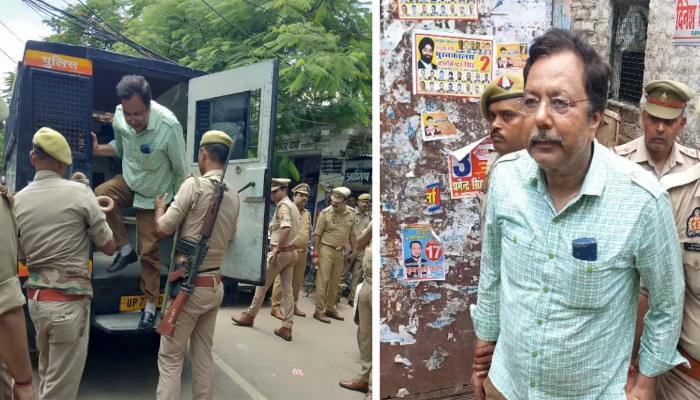
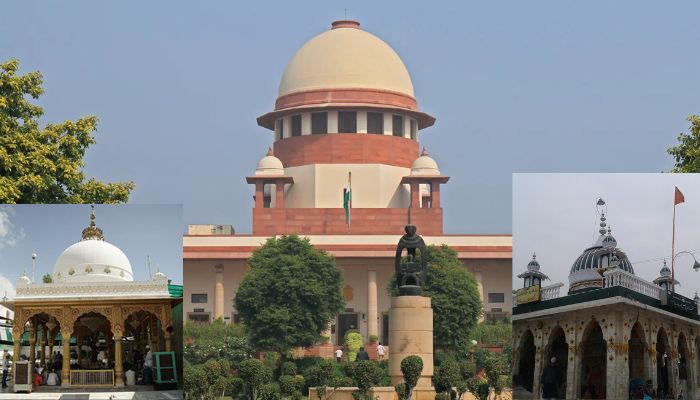
UP: Muslim cleric linked to Atiq Ahmed gang forces Hindu teacher and her 5-year-old daughter to convert to Islam, had already converted her spouse, in-laws

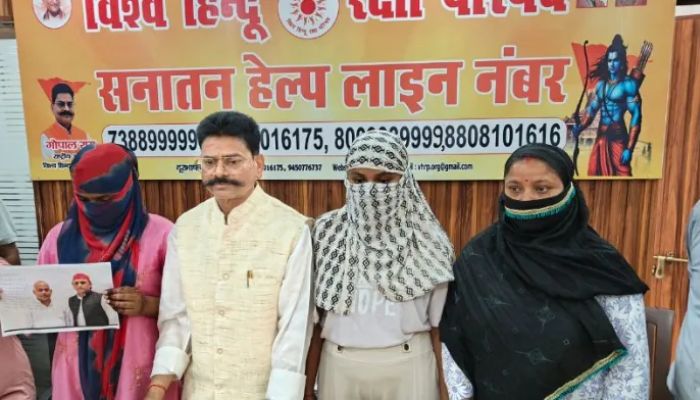
A Hindu teacher in the Sadar Kotwali area of Uttar Pradesh’s Badaun is reportedly being forced to embrace Islam. According to her, she is under constant pressure to convert from Pappan Peer, also known as Tariq Hussain, who is a member of the Atiq Ahmed and Ashraf gang and a cleric at a dargah. She has appealed for justice in a letter of complaint addressed to the Chief Minister of the state, the President and the Government of India.

The police have begun an investigation into the matter. According to the victim, Pappan Peer forced her husband, father-in-law and mother-in-law to change their religion. He is now attempting to convert the victim and her 5-year-old daughter. She revealed that the accused persistently threatened her that he won’t spare her if she didn’t comply.

She mentioned that he frequently visited the house of her in-laws for many years. He declared that there are multiple deities in Hinduism while Muslims only worship one God. The latter can also produce multiple children and have large families. She disclosed that the offender claims to be a relative of Ashraf’s brother-in-law Saddam.

The woman expressed that she got married on 10th February 2019 and her husband, who is a devoted follower of Pappan Peer, has not come to see her in the last 1.5 years. She is being threatened after she went to the offender’s place to find her spouse who even shares their personal matters with him. She asserted that her in-laws have become Muslims and want her to do the same. She had charged them with dowry harassment almost a year beforehand.

Victim accuses police of inaction

On 8th April 2024, her husband filed for divorce on the behest of the cleric. Her mother-in-law also filed a domestic abuse case against her earlier on 3th April. Meanwhile, the cops did nothing when she attempted to ask them for assistance, due to his pressure. She has been going to police officials for a year and a half, but to no avail. She showed up at the offcie of Circle Officer City on 30th June and demanded action.

The victim stated that Pappan Peer threatened her in the name of the mafia Atiq Ahmed and Ashraf when she began to oppose him and her in-laws. He alleged to be in touch with the two and boosted about his good relations with the gang. He used WhatsApp to intimidate her by sending letters from Atiq Ahmed who was incarcerated. He has been tormenting her and her little girl to convert to Islam for a long time. He even harasses her on the road and she is scared of him.

She had submitted an application to the police, but no formal complaint was filed, however, action was taken after government’s order. The City Kotwali police has registered an FIR against Pappan Peer late on 1st July evening. Additionally, the woman has accused another leader and a BJP MLA of aiding the perpetrators.

Husband refutes allegations

On the other hand, her husband asserted that he registered his statement with the circle officer and accused her of harassing him and his family. According to him, she has taken over his home and he now stays with his parents in a rented house. He accused her of fighting with him, the rest of the family and other people in their locality.

The husband stressed that he and his family are Hindus and have complete faith in Sanatan Dharma. He referred to the issue as a domestic conflict. He further insisted that he is friends with Pappan Peer and she is trying to trap him as well.

According to Kotwali Inspector Praveen Kumar, the woman has already filed a case. Pappan Peer was helping her in-laws. Hence, an FIR has been lodged against him as well. The matter is currently under inquiry.

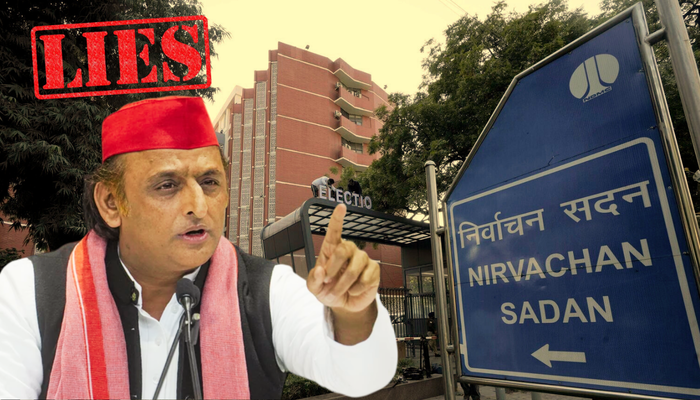
ECI is going door to door to verify voters in Bihar, Tejashwi-Owaisi-Sagarika to Ravish Kumar, all are rattled: Read what is the SIR process, which the opposition is calling the ‘NRC’

Assembly elections are set to be held in Bihar by the end of this year. As part of preparation for the elections, the Election Commission of India (ECI) is undertaking the crucial task of verification of the voter list. This is called Special Intensive Revision (SIR). In this exercise, Booth Level Officers (BLOs), who oversee voting process in every village and locality, go door to door to verify the names of people in the voter list. This is to ensure that those with the right to vote are included in the list and those who are not entitled to vote for some reason, or those who have passed away, are removed from the list.

According to the Election Commission that the exercise is being carried out to make sure that there is no irregularity in voting. There are currently 7.89 crore voters in Bihar, and verification will ensure that only the legitimate and eligible people cast their votes. For this, more than 1.5 lakh booth-level agents (BLAs) have been appointed, who are working in collaboration with all the parties.

However, opposition parties like Rashtriya Janata Dal (RJD), AIMIM, Trinamool Congress (TMC) and leaders like Tejashwi Yadav, Asaduddin Owaisi, and Sagarika Ghosh are baselessly equating this verification exercise with the NRC (National Register of Citizens). They say that all this is a conspiracy of the BJP and the NDA, to remove the poor, the Dalits, the backward classes and the Muslims from the voter list. Let us understand the verification process, what it entails, why it is happening and why the opposition is so uncomfortable with it.

How is the verification process being carried out?

The Election Commission started the verfication on 25 June 2025 and it will continue till 26th July. After the exercise is over, a revised and correct voter list will be published on 30th September. As part of the verification process, Booth Level Officers (BLO) are visiting all houses across the constituencies. They carry partially filled forms, which they handover to the people and ask people to fill in their details, such as names, addresses and attach some documents. These documents are needed to ensure that the person is eligible to vote.

If a voter’s name is in the voter list of 2003 (when the verification process was last carried out in Bihar), then he or she just has to confirm his/her information. If their parents’ names are in the list, then no additional documents are needed. However, if their parents’ names are not in the old list, then they need to provide some documents, like a birth certificate or any other relevant document.

Photo Credit: X_ECI

The BLOs upload all this information on a mobile app (ECINet). They also provide receipts to people after they fill out the forms. The EC has instructed that elderly, sick people or disabled people should not be unnecessarily troubled during the verification and should be provided with adequate assistance. The 2003 voter list has names of 4.96 crore people in Bihar. The Commission said that the people included in the list and their children do not need to provide any special documents. That means around 60% of the people will face no inconvenience.

Why the verification is being carried out?

The Election Commission said that it is necessary to update the voter list from time to time because many things change. Like-

Urbanization: People in Bihar are now moving from villages to cities.
Migration: Many people have moved out of Bihar for jobs or other reasons.
New voters: Names of youths turning 18 years old have to be added to the list.
Death: Some people have died, but their names are still in the list.
Illegal migrants: There may be some people who are not citizens of India but have got their names included in the list.

The commission said that after the necessary updates, a correct voter list will be ready. Article 326 of the Indian Constitution says that only Indian citizens who are above 18 years of age and live in a constituency can become voters in that consituency. The rules of the Representation of the People Act-1950 are being followed in the verification process. The Commission’s aim is that no genuine voter is left out and no wrong person is included the list.

Why is the opposition creating ruckus?

Opposition parties and some people are making a lot of noise about the verification process. They are claiming that this verification is a petext of the BJP to remove the poor, the Dalits, the backward classes and the Muslims from the voter list.

Tejashwi Yadav (RJD): Former Deputy Chief Minister of Bihar and RJD leader Tejashwi Yadav termed the verification as “suspicious and worrying”. He claimed that the BJP and the RSS want to snatch the voting rights of the poor people of Bihar under the pretext of this verification. He wrote on X, ” The sudden announcement of a special intensive revision by the Election Commission before the upcoming assembly elections in Bihar is highly suspicious and concerning. The Election Commission has ordered that all current voter lists be canceled, and every citizen must reapply to have their name added to the voter list, even if their name is already on the list. Why do BJP-RSS and NDA want to weaken the Constitution and democracy? We have asked some questions to the BJP’s puppet Election Commission. Please read and share with others.”

Asaduddin Owaisi (AIMIM): AIMIM leader Asaduddin Owaisi described it as ”backdoor NRC”. He claimed that due to this verification, poor people will be removed from the list because they do not have documents like birth certificate. He further claimed that in 2000, only 3.5% people had birth certificate. Owaisi wrote a letter to the commission objecting to the verification.

Sagarika Ghosh (TMC): Sagarika Ghosh of Trinamool Congress claimed that the verification process involves strict scrutiny, it requires people to provide their parents’ birth certificates. She questioned where the common people, especially the poor, will get such old documents from? Notably, the TMC does not have foundation in Bihar, yet it is speaking on this issue.

Manoj Jha and Ravish Kumar: RJD MP Manoj Jha asked if 8 crore people could be verified in a month? He claimed that this could deprive poor and vulnerable people of voting. Journalist Ravish Kumar promoted Jha’s claims by sharing his post.

Ravish Kumar has supported Manoj Jha’s tweet by retweeting it , 
screenshot of the same tweet (Photo courtesy: X_Ravish_Journo)

Meanwhile, Congress leader Digvijay Singh said that if the commission does not listen to the opposition, the ‘INDI’ alliance will go to court. He alleged that this investigation is an attempt to remove the poor and the marginalized from the voter list.

What is the NDA’s response?

The ruling NDA is supporting the verification process. NDA leaders believe that the opposition is making wild claims and inventing excuses out of fear of defeat. Union Minister Chirag Paswan said that correcting the voter list is in compliance with the law. The Representation of the People Act, 1950 states that it is necessary to update the list from time to time to remove discrepancies, such as the names of dead people or wrong people.

Former Chief Minister Jitan Ram Manjhi said that there are up to 20,000 fake voters enrolled in voter lists in some places. This investigation will remove them, which will harm the opposition. That is why they are making noise. The NDA said that verfification will bring transparency and the right voters will benefit.

Voter verification is a normal process and has happened before

Voter verfication is not a new concept. Such exercises have been conducted several times since independence to correct and update the voter list.

  • 1952-56: After the first general election, the lists for some areas were revised every year under intensive scrutiny.
  • 1956: Special inspections were conducted in cities, working class areas, and areas where people moved around a lot.
  • 1962-66: After the Lok Sabha elections, intensive and small-scale verification was conducted across the country in a few years.
  • 1983-88: Intensive investigations were conducted in villages and towns.
  • 1995-2002: Voter lists were also revised extensively in 1995 and 2002.

The last voter verification was conducted in Bihar in 2002 and the updated list was published in 2003. At that time, no one linked it to the NRC. But now, because the elections are near, the opposition is making it a big issue.

There are many ways to update a voter list-

  • In-depth checking: A fresh verification is done without referring to the old list.
  • Summary check: Updated without no door-to-door visits.
  • Special tests: If something abnormal is detected, special verifications are conducted.
  • Mixed checking: Verification by referring to the old list and going door to door.

A mixed investigation is currently underway in Bihar, for which the 2003 list has been taken as the basis.

The same old tune of the opposition

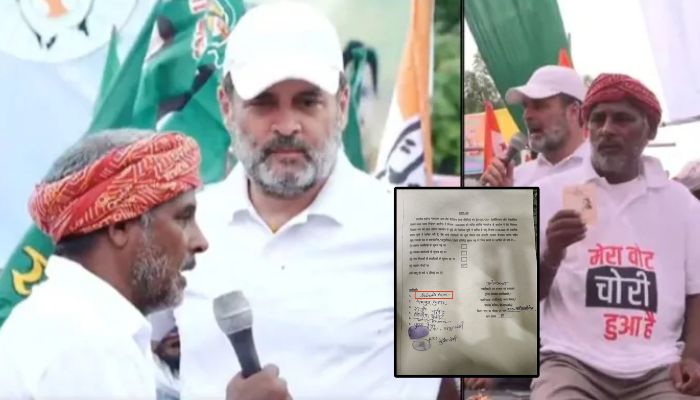
This noise by the opposition is not new. Before every big election, they raise some issue or the other. Sometimes they raise questions on the EVM, sometimes on the voter list and sometimes they call the Election Commission an ally of the BJP. Interestingly, when an opposition party wins an election, like in West Bengal or Tamil Nadu, all these questions disappear. But on losing, they level these allegations again, like the Congress is still making noise chasing the ghost of defeat in Maharashtra elections, and rehashing the same debunked lies even after being summarily rejected by the Election Commission and the High Court.

LGBTQ ‘activist’ who led online mob against JK Rowling gets 24 years jail sentence for raping a minor boy

On 30th June 2025, the Guildford Crown Court in the United Kingdom sentenced two men to 24 and 4 years’ jail terms respectively after they were found guilty of multiple child sex offences earlier this year. The convicted duo are identified as Stephan Ireland (40) and David Sutton (27). Stephan Ireland was convicted last year for raping a 12-year-old boy while Sutton helped him.

Taking to X, renowned author and women’s rights activist JK Rowling slammed Stephan Ireland, a former LGBTQ+ activist, who led an online mob against the Harry Potter author and labelled her a ‘TERF'(trans-exclusionary radical feminist) after she questioned gender-neutral terms such as “people who menstruate.”

Ireland, who co-founded ‘Pride in Surrey’ and projected himself a voice of LGBTQ+ youths, led an online mob that, for years, harassed JK Rowling for expressing views about biological sex and women’s rights.

“Stephen Ireland, who targeted me with endless abuse on here because I oppose the chemical castration of children and the removal of protected spaces for women and girls, has just been sentenced to 30 years in jail for child rape,” Rowling wrote.

Notably, Stephan Ireland was found guilty in April 2024 of sexually abusing a youngster he had cultivated on the gay dating app Grindr. With the help of 27-year-old David Sutton, who was sentenced to four and a half years in prison, Ireland drugged and raped the child, after luring him to a flat.

Ireland had a troubling private life that included grooming children, arranging the commission of child sex offences with young boys, and possessing child pornography, even though he claimed to be an advocate for LGBTQ+ rights. He and Sutton were convicted of voyeurism, aiding and abetting child sex abuse, and possessing obscene pictures of children.

“Stephen Ireland, 40, (DOB: 8/3/1984) from Addlestone, was sentenced to 24 years in prison, with a further six on extended licence, after being found guilty of the rape of a child under 13, three counts of causing a child under 13 to engage in sexual activity and the sexual assault of a child under 13, as well as: Conspiracy to engage in sexual activity with a child; Arranging commission of a child sex offence; Six counts of making indecent photographs of children; Four counts of distributing indecent photographs of a child; Possession of prohibited images of children; Possession of an extreme pornographic image,” a press release by the Surrey Police states.

Notably, JK Rowling has always been unabashed in her criticism of gender identity politics, which is quickly becoming the popular and dominant political narrative in the Western world. In certain nations, biological male sex offenders are sent to women’s prisons based solely on self-identification, which requires a man to simply ‘claim’ to be a woman, and he then gets ‘identified’ as a woman. Such male sex offenders who ‘identify’ or simply lie that they are women are then sent to women’s prisons. In many cases, these male offenders have been accused of sexually abusing women prisoners.

In March 2024, JK Rowling had complained about trans persons being allowed in women’s changing/locker rooms. “When men – all men, however they identify–are banned from women’s spaces, those who disregard the ban can be challenged, inside the space and out.”

Back in 2022, Rowling drew the ire of ‘gender-identity’ fanatics for wishing “merry terfmas”. Notably, TERF is an acronym that stands for a “trans-exclusionary radical feminist”, a term she has been labelled with by Trans activists online.

In 2021, Rowling received online hatred and abuse for questioning Scotland Police’s stand that they would be recording rapes committed by offenders with male genitalia as being “committed by a woman” if the rapist just says he is a woman.

In July 2021, JK Rowling received death threats from LGBTQ activists for flagging the dangers women face in public toilets from men identifying themselves as women. Rowling shared a screenshot of a tweet posted by one of the nasty internet trolls, who apparently wished her “a very nice pipebomb in the mailbox”.

In 2020, Rowling published an X post with the hashtag “StandWithMaya” expressing solidarity with researcher Maya Forstater. The British woman had stated online that there are only two biological sexes, for which she was fired by the U.K. poverty think tank that employed her for questioning government plans to allow people to self-identify as another gender.

Rowling’s women’s rights activism and criticism of trans activists hijacking women’s rights have won her significant support as well as backlash over the years. However, the noted author remains undeterred from her stance on gender issues.