On Sunday (October 17), the anti-semitic organisation ‘Stop Funding Hate (SFH)’ went on an unhinged tirade against OpIndia after we exposed‘The Guardian’ for shielding, giving legitimacy to Islamists and their apologists who orchestrated attacks on the Hindu community in Leicester.
‘Stop Funding Hate’ desperately wanted to strip OpIndia of advertisement revenue for showcasing the true plight of Leicester Hindus to the world, who were left at the mercy of Islamists and their sympathisers in the media industry.
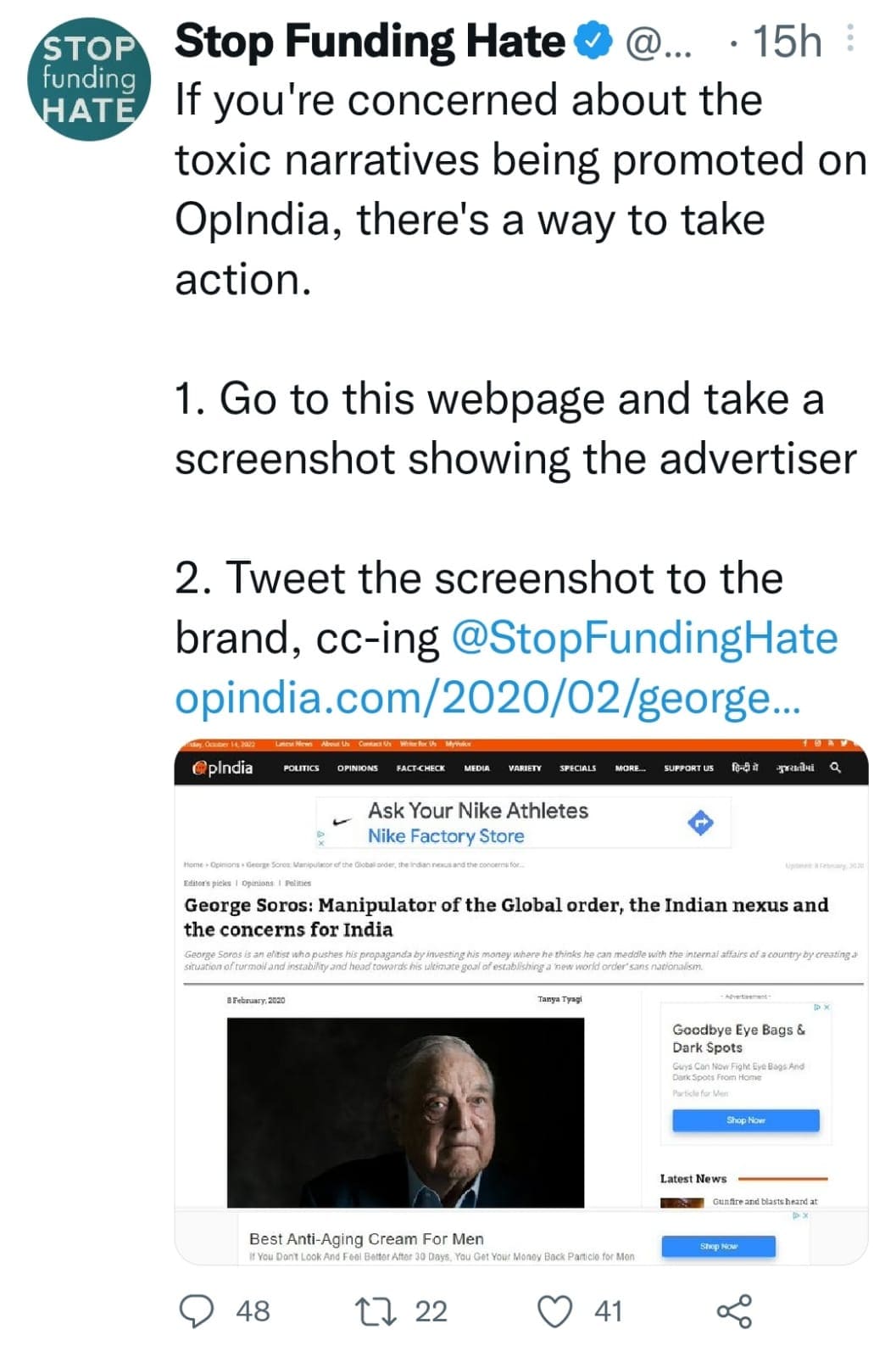
In a tweet, SFH wrote, “If you’re concerned about the toxic narratives being promoted on OpIndia, there’s a way to take action. Go to this webpage and take a screenshot showing the advertiser. Tweet the screenshot to the brand.”
Screengrab of the tweet by ‘Stop Funding Hate’
The anti-semitic organisation took particular offence to an OpIndia article, criticising businessman George Soros for disseminating anti-India narrative through leftist news portals.
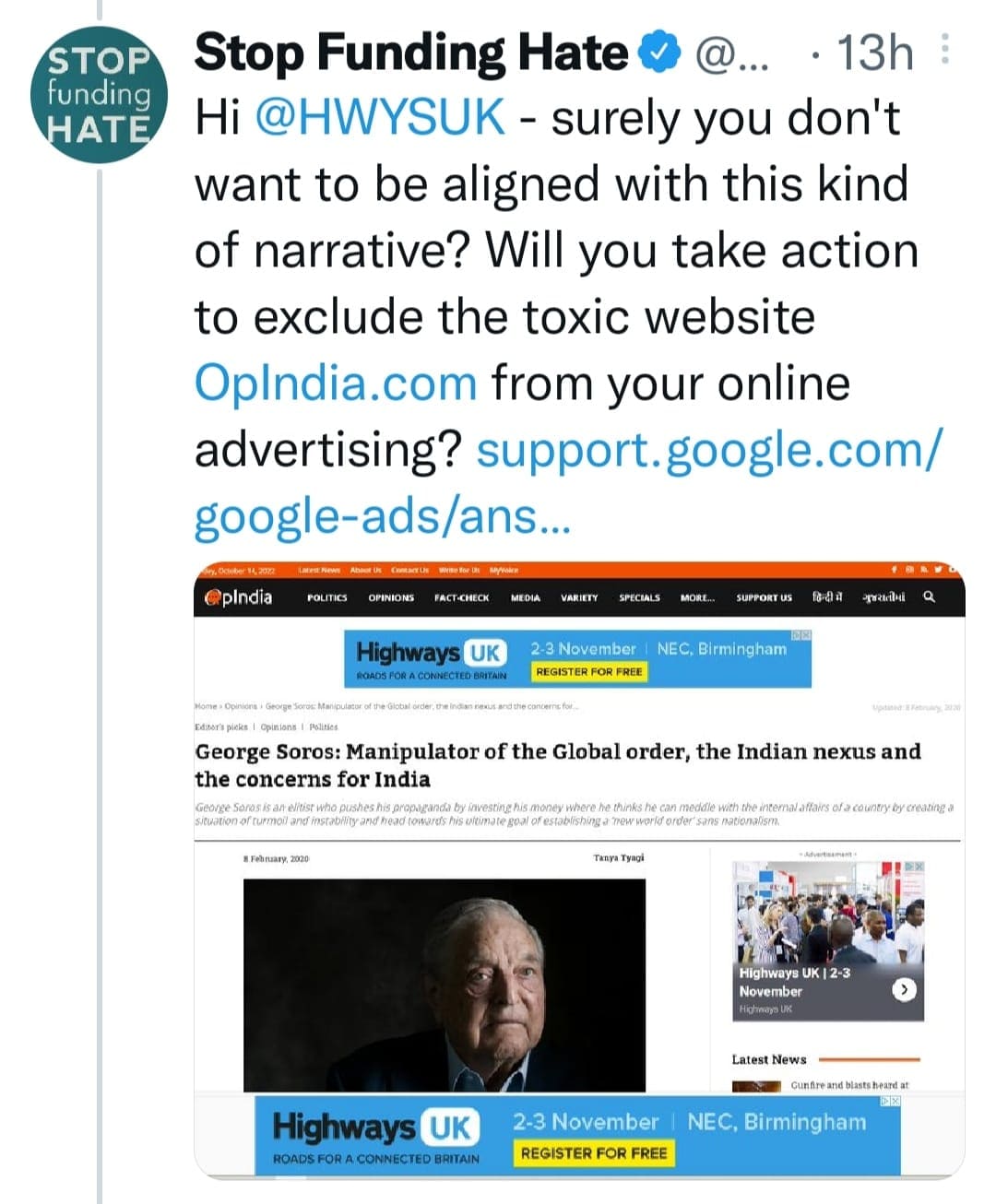
SFH pleaded with companies such as Highways UK, Vikings UK, and even Nike for placing their ads on the Opindia website. Miffed by the expose on Soros, it asked international firms to exclude Opindia from online advertising.
Screengrab of the tweet by ‘Stop Funding Hate’
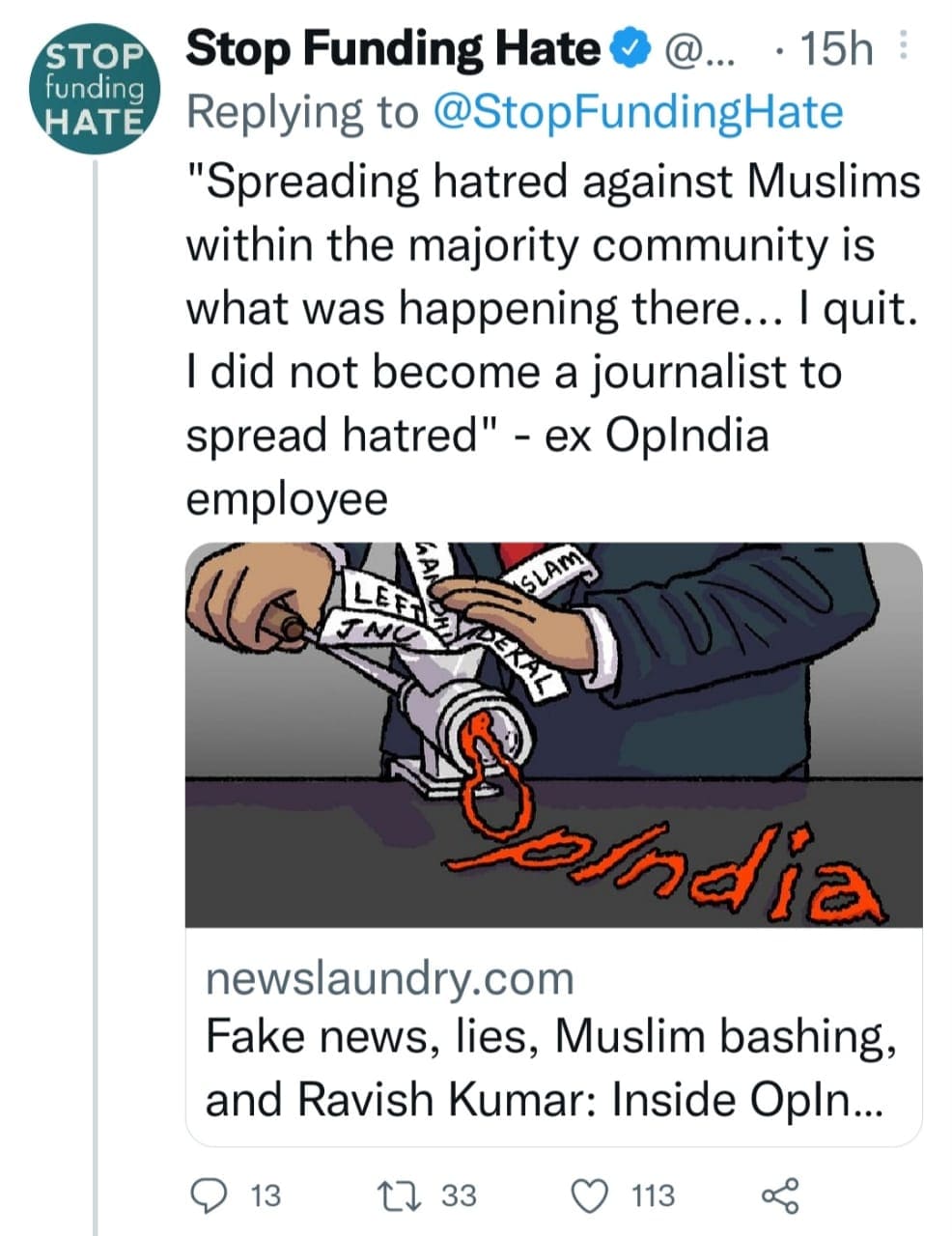
‘Stop Funding Hate’ then relied upon a propaganda piece by leftist rag ‘Newslaundry,’ which cited the ‘testimony’ of a fictitious ex-OpIndia employee to claim that we are spreading hate against the Muslim community.
Screengrab of the news report by NewsLaundry
The Guardian Debacle
The targeting of OpIndia by the anti-semitic organisation began after we exposed the tactics, adopted by The Guardian journalist Aina J Khan, to blame the violence against Hindus in Leicester on themselves.
In an intellectually dishonest piece, Khan had distinctly associated religious identity with groups of Hindu protestors, with phrases such as “unplanned protest of Hindu men,” and “Hindu men were filmed marching.”
However, she shrewdly chose not to point out the religious affiliation of the man who desecrated a Hindu temple and uprooted a saffron flag. In a bid to shield her co-religionist who desecrated the Hindu place of worship, Aina J khan used the bait of a ‘good Imam.’
We are aware of video circulating showing a man pulling down a flag outside a religious building on Melton Road. This appears to have taken place while officers were dealing with nearby public disorder. We do not tolerate violence or disorder and are investigating the incident.
The Guardian journalist thereby shifted the public discourse from the vicious attack on a temple by her co-religionist to the alleged benevolence of a ‘bystander’ Imam.
When OpIndia pointed out the obvious discrepancy in her reportage, Aina J Khan cried foul and dubbed the criticism as ‘Islamophobia.’
‘Stop Funding Hate’ tries to shut down the messenger
Given that OpIndia has been the frontrunner in debunking disinformation about the Leicester violence, ‘Stop Funding Hate’ sought to attack the messenger. In a bid to do so, it dug out old articles, quoted them out of context and begged companies to remove advertising from our platform.
Hi @OxfordSBS we’re guessing you’re unaware that your advertising is appearing on this article seeking to justify discrimination against Muslims? https://t.co/4ryRo14aht Will you take action to exclude OpIndia from your online advertising programme? – cc @NUSUKpic.twitter.com/IGLMweYcDj
— Stop Funding Hate (@StopFundingHate) May 29, 2020
In the words of our CEO Rahul Roushan, “Ads are there on the website as extra revenues and they never hurt anyone. However, the bulk of our revenues are in the form of voluntary payments by our readers, who pay us for the content they have already consumed.” However, this form of targeted harassment is bullying and an attempt to shut down dissenting voice that threatens to harm their narrative.
“We have left the rates on the consumer to decide, based on how much they have consumed and how much they can afford. We’ve seen students in tier II cities paying us as little as 10 rupees to working professionals in big cities paying Rs. 3 lakh. That’s what keeps us going, not ads,” he had said in 2020 when SFH had attacked us the last time.
As an organisation registered in the UK, SFH has every right to participate in the political debates of their country. However, an attempt to silence media portals in India due to their personal political preferences is a direct attempt at interfering with the politics of our country.
It is as sinister as election interference that the Left and Congress rails against. However, it sees no issue at all in targeting media portals abroad which would definitely impact political debates in the country.
Stop Funding hate is linked to UK’s Labour Party
Stop Funding Hate is closely linked to the Labour Party, has a history of antisemitism and has on its board members who seek to impose their own will on politics.
It is important to understand here that SFH is no different from FCRA NGOs such as Amnesty which openly attempt to influence the politics of the country, which is extremely problematic considering its links to the British government.
It is no different from Oxfam India which had urged the Congress party to form an ‘alliance’ with ‘civil society organisations’. It has tried its bullying tactic in the UK as well, against newspapers such as The Sun, Daily Mail and the Daily Express.
In response, they were subjected to much criticism although the usual Far-Left echo chamber cheered them on relentlessly. SFH partners with organisations such as National Union of Students, Accord, Citizens UK, Tell MAMA among others.
All of these are far-left organisations with no representation at all from the other end of the political spectrum. It also partners with the Centre for Hate Studies of the University of Leicester.
Stop Funding Hate has in its board members associated with far-left organisations. They have been described as ‘far-left Corbynistas’ in numerous publications.
Richard Wilson, one such board member, has been formerly associated with Amnesty International, the dubious NGO which is under investigation in India for alleged violation of FCRA laws and has a history of links with radical Islamic organisations.
On Sunday, October 16, Surendra Jain, the joint general secretary of the Vishwa Hindu Parishad, advised Muslim clerics to “pack their belongings” from Bhora Kalan after the recent controversy there. The remark was made in conjunction with allegations by the Hindu outfit that the Muslim community is attempting to grab land under the cover of restoration work in the Bhora Kalan village in Gurugram, Haryana.
Addressing a crowd at the ‘Trishul Deeksha’ program organized by the VHP in Manesar, Jain alleged that Muslims illegally captured the land in Gurugram’s Bhora Kalan village. He alleged that the Muslims in the village had entered the premises under the pretext of renovations and ultimately captured it.
The VHP leader was quoted by the Indian Express as saying, “12-13 years ago, only three Muslim families had come to Bhora Kalan and sought permission to offer namaz at a land meant for grazing goats… there was an understanding that no maulvi or anyone from outside would come. But slowly, people from outside started coming and tried to build a mosque.”
“Koi apke ghar mein ghuskar masjid banaega, aap sweekar karoge? (If someone walks into your house and starts building a mosque, will you allow it?) What happened in Bhora Kalan can happen tomorrow in Gurgaon, Manesar, Haryana, and the country. They want to convert the whole nation. Ye ibadat nahi, jihad hai (this is not Namaaz, this is jihad),” Jain added.
Surendra Jain issued a warning to the Muslim community, saying, “I want to tell those maulvis, pack up your belongings or else the people of Manesar will not leave you… Ye Hindu rashtra tha, hai aur rahega.”
Notably, the Vishwa Hindu Parishad (VHP) has long expressed concerns over the growing threat of land and love jihad, unlawful religious conversions, temple demolition, and hate speeches against Hindu beliefs and deities across the country. In fact, the Hindu organisation has stated that it intends to enroll more than one crore members by 2024 and increase its (Shakhas) units to one lakh, with 15 lakh Karyakartas striving to combat such threats.
On October 10, Leftist propaganda portal The Wire published a report with the title ‘If BJP’s Amit Malviya Reports Your Post, Instagram Will Take it Down – No Questions Asked’ authored by Jahnavi Sen, deputy editor, and executive news producer at the portal.
In the report, The Wire claimed that Bharatiya Janata Party’s IT Cell Chief Amit Malviya has such power in Meta, the parent company of Facebook and Instagram, that if he reports any post on the platform, it gets removed by the system, no questions asked. It further claimed that even if the publisher of the post that was removed from Instagram appeals against the removal, it does not get accepted by the system as “Malviya has privileges of being on the XCheck list.”
XCheck is a “Meta Program” that allegedly provides special privileges to high-profile users like actors, politicians, and other influential personalities on the social media platforms under Meta. The said program was first ‘exposed’ by Wall Street Journal in September 2021.
How it all started?
On October 6, The Wire reported that Instagram removed a photograph of Uttar Pradesh Chief Minister Yogi Adityanath’s ‘temple’ for violating its guidelines. As per the report, the image was uploaded by Instagram handle @cringearchivist, and it was removed over ‘sexual activity and nudity’ restrictions. There was, indeed, nothing sexual in the image that was uploaded. However, the mocked CM Yogi.
It seems that the publisher and The Wire presumed it was removed under the wrong category and thus began the investigation. Notably, @cringearchivist dislikes the Hindu RW section of Indian society, comparing them to the Nazis. In several posts, the group that runs the account has done so. After the removal of this post and some others, they even wrote to Meta criticizing them for removing content that is a “satirical attack on the Nazis.” Interestingly, they skipped the fact that they compared Hindus or Right Wingers to Nazis without any evidence or proof.
The Wire clearly noted that cringearchivist has a history of comparing Hindu RW to Nazis. Source: The Wire
The Wire’s report read, “In the past, @cringearchivist has posted several memes comparing the Hindu Right in India with Nazi Germany. Since one of the recent posts removed is also of that kind, the administrators are worried that older posts may too be flagged, perhaps leading to the entire account being taken down.”
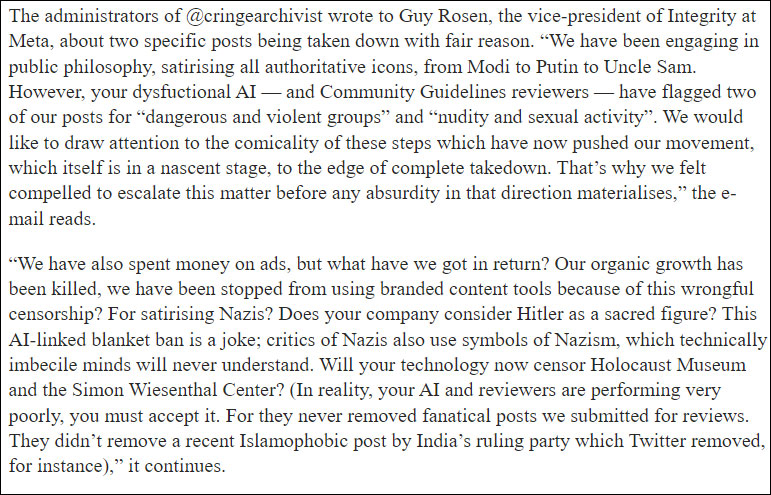
Interestingly, in communication with Guy Rosen, VP of Integrity at Meta, @cringearchivist admitted to spending money on its propaganda posts, and The Wire proudly published it in the report. It read, “We have been engaging in public philosophy, satirizing all authoritative icons, from Modi to Putin to Uncle Sam. However, your dysfunctional AI — and Community Guidelines reviewers — have flagged two of our posts for “dangerous and violent groups” and “nudity and sexual activity.” We would like to draw attention to the comicality of these steps, which have now pushed our movement, which is in a nascent stage, to the edge of complete takedown. We felt compelled to escalate this matter before any absurdity in that direction materializes.”
In a communication to Meta, cringearchivist admitted to having spent money to propagate posts against RW. Source: The Wire
It added, “We have also spent money on ads, but what have we got in return? Our organic growth has been killed, and we have been stopped from using branded content tools because of this wrongful censorship? For satirising Nazis? Does your company consider Hitler a sacred figure? This AI-linked blanket ban is a joke; critics of Nazis also use symbols of Nazism, which, technically, imbecile minds will never understand. Will your technology now censor Holocaust Museum and the Simon Wiesenthal Center? (In reality, your AI and reviewers are performing very poorly, you must accept it. For they never removed fanatical posts we submitted for reviews. They didn’t remove a recent Islamophobic post by India’s ruling party which Twitter removed, for instance).” As per The Wire, Rosen never replied to them.
‘Amit Malviya can get your post removed, no questions asked,’ claimed The Wire
Four days later, The Wire published the ‘explosive expose’ that the video of CM Yogi’s temple was allegedly flagged by none other than BJP IT Chief Amit Malviya. It further reported that the appeal against the removal was denied because of the privileges Malviya enjoyed for being on the XCheck list. Also, The Wire claimed that 100% of over 700 posts flagged from Malviya’s account were removed almost instantly.
The Wire also provided “proof” for its fantastical claims. They shared a document they claimed to be the review report for the post. The report suggested that it not only skipped auto-moderation, but the review was also not required just because Malviya has the so-called XCheck privileges.
Rebuttal from Meta
Soon after the report was published, Meta officials took onto Twitter to refute the claims made by The Wire. Communication personnel Andy Stone while replying to WSJ reporter Jeff Horowitz said, “Where to even begin with this story?! X-check has nothing to do with the ability to report posts. The posts in question surfaced for review by automated systems, not humans. And the underlying documentation appears to be fabricated.”
This was only the beginning of a ‘war of rebuttals’ between Meta and The Wire. Following Stone’s rebuttal, The Wire came up with another story on October 11, where they alleged that the documents they used were not fabricated. To support their wild allegations, The Wire shared a screenshot of an alleged mail by Andy Stone where he was upset that an internal document had been leaked to them. So much so, The Wire went ahead to call Stone a “pathological liar” based on a report on him from 2021. Though the report extensively criticized Stone, InputMag never called Stone a liar directly.
Next came Meta’s Chief Information Security Officer had to come out and clear the air that The Wire’s entire reporting is fabricated and based on forged documents. Guy Rosen, Meta’s CISO, shared a thread on Twitter where he detailed how The Wire’s reports don’t hold any water.
I wanted to set the record straight about two stories run this week by @thewire_in with untrue claims about Meta’s content moderation operations and processes. tl;dr these stories are fabrications. (1/6)
Rosen tweeted, “I wanted to set the record straight about two stories run this week by @thewire_in with untrue claims about Meta’s content moderation operations and processes. tl;dr these stories are fabrications.”
In the thread, Rosen shared that both the reports by The Wire are totally incorrect and contain misinformation about their cross-check program. Rosen also went on to share several anomalies in the reports, including email addresses not used by Andy Stone, URLs not in use, and addresses that aren’t used at their company. Guy Rosen ended his thread by hoping that The Wire is a victim of some hoax and is not actually promoting one itself. However, looking at The Wire’s track record of hitjobs, we seriously doubt that they are the victims here.
The AI checks on the image in question
From now on, as the to and fro between Meta and The Wire was no longer about the removal of the post or the image that was removed, it is essential to point out that several netizens and OpIndia checked if AI flags the photo in question.
Rohit Agarwal, who goes by the handle Techtradeguru on the social media platform Twitter, shared a thread where he checked the image with AI and found out most AI check platforms flagged the photograph as ‘person might be exposed’. The reason behind it could be the colour of the idol of CM Yogi and the person standing next to it.
(THREAD) ANOTHER PROOF THAT THE WIRE FALSELY ACCUSED META.
— Technical Trading Guru (Rohit Agarwal) (@techtradeguru) October 15, 2022
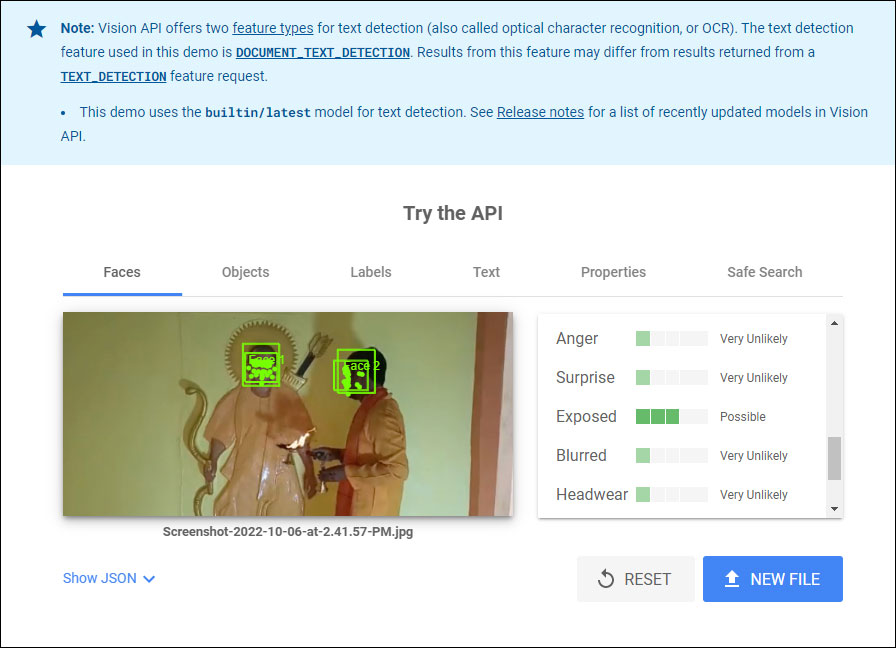
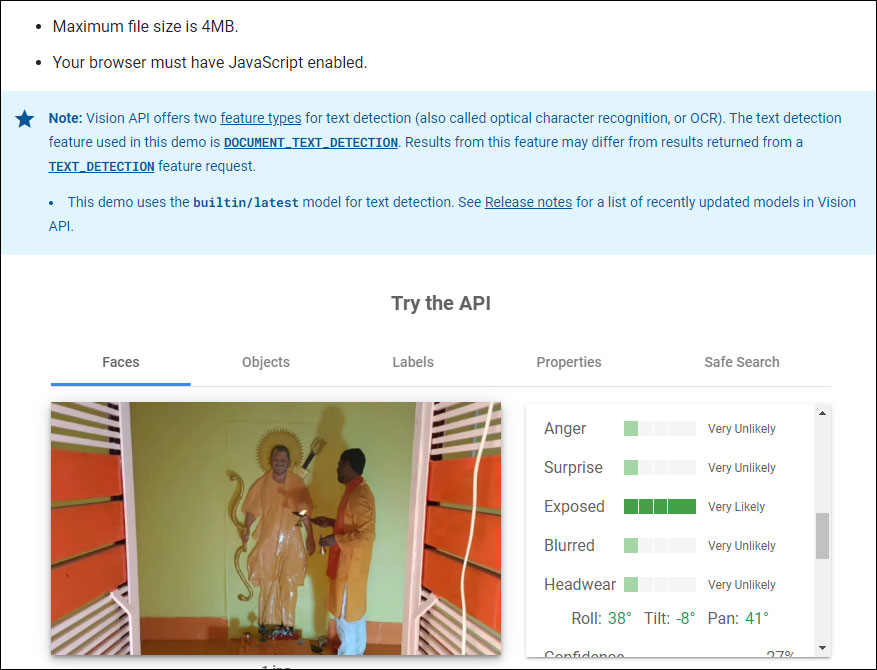
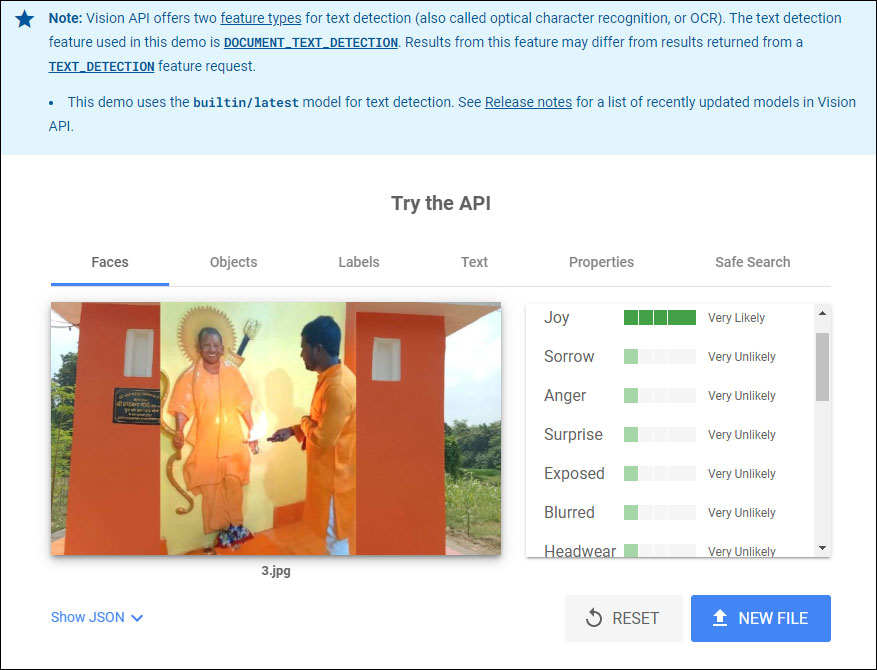
OpIndia also checked the image on multiple websites and confirmed what Agarwal was saying. Here are some screenshots of the results.
We used Google’s Cloud Vision API. The first image was sourced from The Wire while the others were sourced from Google Image Result on ‘Yogi Temple’. In the image sourced from Wire, it showed the possibility of the person in the image is exposed.
The Google AI marked the image as possibly exposed.
In the second image, the intensity of the possibility of an exposed person went high.
The Google AI marked the image as possibly exposed with higher intensity.
In the third picture, the AI showed ‘unlikely to be exposed’.
The Google AI marked the image as unlikely to be exposed.
It is clear that AI recognises the person to be exposed based on colours and angles of the photograph. It raises the question if the image was flagged by the system and The Wire allegedly fabricated the whole thing or if Malviya allegedly reported it.
The ‘language’ issue with the email that even ‘Liberal’ cabal rejected
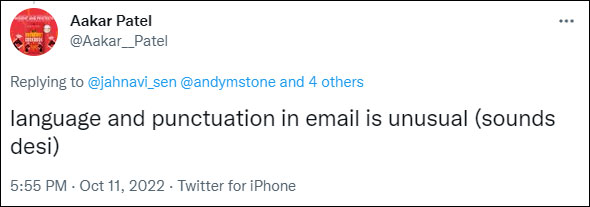
Then came the language used in the alleged email The Wire got its hands on via a source in Meta. Many netizens including members of the left-liberal cabal raised red flags. The most interesting retweet that we noticed during the whole fiasco was from former Amnesty India head and propagandist activist Aakar Patel, who is known for his anti-BJP stand. While replying to Jahnavi Sen, Aakar Patel looked down upon the language of the email that The Wire claimed was sent by Andy and said how the language and punctuation in the mail was unusual and ‘sounded desi’.
Source: Twitter
The typical colonial hangover suggested that emails were forged by an Indian because only they would use such language, thereby insinuating that the Americans have better grip over English.
In all that it is worth, there are a lot of speculations over the style of language claimed to have been used by Andy in the email. The native English speakers are brazened out over the language and have “confidently” said that Andy could not have written the email. Daniel Nazer, Senior IP & Product Counsel at Mozilla, while replying to Systems & Network Security Engineering Alec Muffett, who pointed out “bad English”, said, “It’s really sad to see them fall, and double down, for such an obvious fake. We need strong independent media willing to stand up to populist governments and big companies, but this ain’t it.”
Even a former colleague of Andy Stone stepped in to echo the language issues. Brent Kimmel of Squarespace who has worked with Andy as Tech expert, raised red flags over The Wire’s report. He pointed out that the ‘receipt’ confirmation made by the server only proves that the network request was made. He said, “It means nothing in terms of whether or not a person (let alone a specific person) received it, viewed it or interacted with it in any way. You simply can’t do “gotcha” journalism over email.”
4/x The specific mechanics of the medium just don’t allow for it.
Also, read the email and read like… Anything Andy ever wrote. Diction is completely off, obviously an ESL composer.
Furthermore, he pointed out that the language was not what Andy would have used. “Also, read the email and read like… Anything Andy ever wrote. Diction is completely off, obviously an ESL composer.”
Also, I haven’t spoken to @andymstone in roughly a decade, but I worked with him in a pretty high-pressure environment and I would have remembered if he spoke to his colleagues that way. He doesn’t.
He added that he hadn’t talked to Andy in over a decade but worked with him in a high-pressure environment. he said, “I would have remembered if he spoke to his colleagues that way. He doesn’t.”
Official Statement by Meta
In an official statement on October 12, Meta explained how The Wire’s reporting was “wrong”. In the press release, Meta said, “Two articles published by The Wire allege that a user whose account is cross-checked can influence content decisions on Instagram without any review. Our cross-check system was built to prevent potential over-enforcement mistakes and to double-check cases where a decision could require more understanding or there could be a higher risk for a mistake. To be clear, our cross-check program does not grant enrolled accounts the power to automatically have content removed from our platform.
While it is legitimate for us to be held accountable for our content decisions, the allegations made by The Wire are false. They contain mischaracterizations of how our enforcement processes work, and rely on what we believe to be fabricated evidence in their reporting. Here is what they got wrong:
The first article claims that a cross-check account has the power to have content removed from our platform with no questions asked. This is false. Cross-check has nothing to do with the ability to report posts to seek the removal of content. The posts in question were surfaced for review by automated systems, not user reports. The system is designed to ensure that enforcement decisions related to content posted by cross-check accounts are made accurately and with additional levels of human review. We don’t exempt anyone from our Community Standards and remove content that violates them if we see it. Information on cross-check has been shared publicly on our Transparency Center.
This article was also based on allegedly leaked screenshots from our internal tools. We believe this document is fabricated. The URL on that “report” is not in use. The naming convention is one we don’t use. There is no such report.
We did not identify a user report regarding the @cringearchivist content in September as reported.
The second story cites emails from a Meta employee – the screenshot included in the story has two emails – both are fake. There are no such emails.
The same story references an internal journalist “watch list.” No such list exists.
We accept scrutiny of our content decisions, but we fundamentally reject these false allegations based on what we believe to be fabricated evidence. We hope that The Wire is the victim of this hoax, not the perpetrator.”
The Wire tied itself in knots over allegations of fabricated screenshots
In its next report on the matter, The Wire further tied itself in knots. In its rebuttal to Meta’s assertions over previous reports, The Wire made several claims to justify its expose. However, most of their claims faced speculations and raised even more questions over the authenticity of the whole fiasco.
The first claim that The Wire made in their report was the emails they sent on the @fb.com extension were opened by the respective receivers. They used a technology called ‘superhuman’ that allows the sender to check if and how many times the receiver opened the email. This technology has been around for quite some time, and several email clients and extensions add the feature to your email clients.
Though OpIndia cannot verify independently as of now if what they are saying is true or not, ethically, The Wire, a platform that talks in length about privacy, has done something extremely unethical. Superhuman faced extreme criticism in 2019 over the feature. They were tracking the location of the receivers and logging them. After much criticism, they made several changes, and the CEO had to say that they were making the changes publicly.
It is noteworthy that experts in the field have raised concerns over the matter. Martin Obiols, a cybersecurity expert, said, “Do not praise people using clients that provide read-statuses for email. This is a huge privacy violation regardless of its purpose of doing it. I seriously do not understand how these tools are allowed under data privacy laws.”
Do not praise people using clients that provide read-statuses for email. This is a huge privacy violation regardless of the purpose of doing it.
I seriously do not understand how these tools are allowed under data privacy laws https://t.co/dXhZB1RPXY
Another important point is, as Superhuman has STOPPED tracking the location, there is another way to say that someone has read it. Say The Wire sent it to someone else in BCC or forwarded the email to someone else, and the other receiver opened the email. The tracking will be based on the same pixel image. In that case, it will show that the email was opened by the recipient.
Let’s take an example. Say I want to track if my boss Nupur J Sharma read the email I sent. I used Superhuman or another application to do so. She read I got the information, and it’s done. This was the first scenario. In the second scenario, I want to implicate my boss read the email but ignored to acknowledge it. In that case, I would BCC it to my personal email ID, or I will forward the email to someone else. When the email gets opened by me or someone else, I can show that my boss opened the email as there is no way to trace the location from where the email was opened. Now I am the devil at my office! This is why such tracking applications cannot be solid evidence in an expose like this.
The DKIM mumbo-jumbo!
Now, The Wire made its way to technical in the next step. The Wire claimed that they used a python-based open-source tool called dkimpy to verify if the email came from an authentic source or not. There is way too much technical jargon in the report that needs simplification. Basically, this tool allows the user to ensure of the email came from an authentic source or not. It checks the header (code-based technical information) of the email and matches it with the sender’s digital signature.
Ideally, this system not only traces the source but also provides information if anything was changed in the email during the transit. In case you are unaware, there are ways to modify the email while it travels from the source to the destination. Codes can be injected, information can be altered, and so on. This is why encryption of the data is essential.
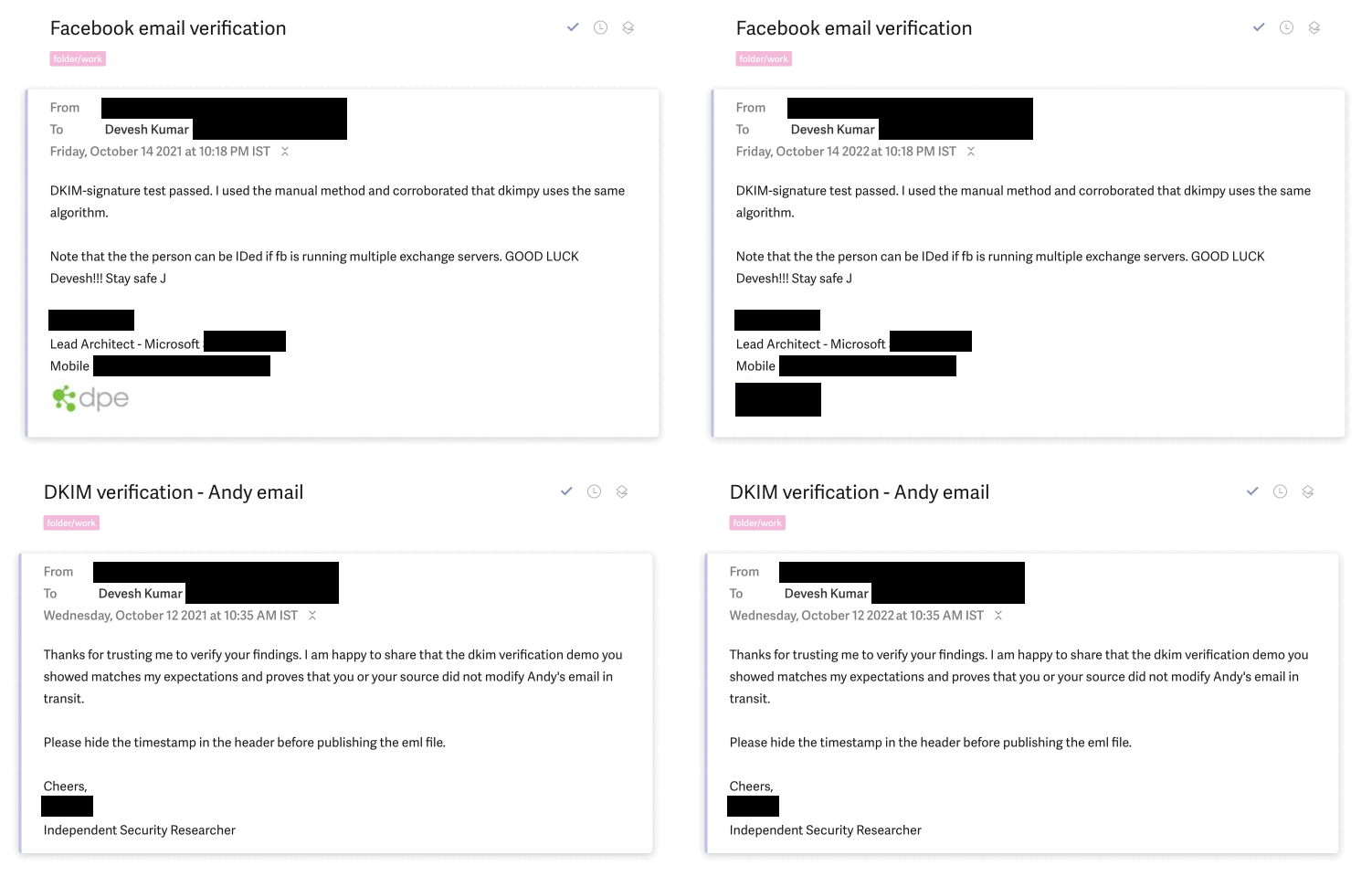
Anyway, this is where The Wire made a blunder that was noticed by a Twitter user Technical Trading Guru that goes by the handle @techtradeguru on Twitter. We will not go into the DKIM claim authenticity but point out the alleged photoshop saga that raised questions over The Wire’s report. Here is a GIF of two screenshots from The Wire that are allegedly photoshopped. More details about it can be read in our previous report.
The date was allegedly changed in photoshop without keeping the spacing in mind. Source: Techtradeguru.
Interestingly, they changed the date but did not change the day. The 2021 and 2022 calendars are not identical in terms of Days. That means 12 October and 14 October in 2021 and 2022 fell on different days of the week. Multiple Twitter users pointed out this particular mistake made by The Wire. In both screenshots, the days remained Friday and Wednesday respectively. Trying to justify this discrepancy, Wire claimed that it was due to the fact that the dates were incorrectly set on TailOS, a Linux-based portable OS. But netizens pointed out that even if the date is wrongly set in the system, it will not result in a mismatch between the day and date, if it shows the wrong date, it will show the day corresponding to that wrong date only.
It was pointed out by tech expert Pranesh Prakash in a detailed Twitter thread on The Wire’s latest report. He wrote, “Now, @thewire in is saying the incorrect dates are due to TailsOS being used and being set to the wrong date. Except, it doesn’t take a genius to realize that even were that true, TailsOS would show: Thursday, October 14, 2021 and Tuesday, October 12, 2021 NOT Fri & Wed.”
Another expert from Stanford Internet Observatory Alex Stamos detailed out the how DKIM verification video by The Wire proves nothing. He said, “The @fb.com/@meta.com argument is the weakest defense by Facebook. Clearly, the company’s O365/ProofPoint instance is setup to receive emails for either domain and various employees are sending from different domains. This argument is pretty much useless either way.”
3) The Wire’s DKIM verification video proves nothing. It would be trivial to fake the verification by dkimverify, as all you would need is a script in your path that prints “signature ok”. There are more complicated ways to fake this as well. pic.twitter.com/IS7FVYy4fC
He added, “The Wire’s DKIM verification video proves nothing. It would be trivial to fake the verification by dkimverify, as all you would need is a script in your path that prints “signature ok”. There are more complicated ways to fake this as well.”
4) @matthew_d_green noticed that the DKIM verification details in the header shown by The Wire do not match what he has received from https://t.co/v2TVEBVEId senders in the past. I have the same result. This is not strong evidence, but should be noted.https://t.co/yxDWxThQn5
Fruthermore, “What the video does show is that if the email is not legitimate then the person who made the video is in on the hoax. The Wire piece implies (but does not specify) that their own tech employee made the video.”
If this was a local time problem, then that should only affect a thick client, and it wouldn’t give you the exact time and date minus one year. It is unclear what kind of mail client these screenshots purport to come from, but there is no good explanation for the year mismatch. pic.twitter.com/1eWEzClLzI
Speaking about the date issue he said, “If this was a local time problem, then that should only affect a thick client, and it wouldn’t give you the exact time and date minus one year. It is unclear what kind of mail client these screenshots purport to come from, but there is no good explanation for the year mismatch.”
He said, “The most interesting part is the http://instagram.workplace.com login. I have never heard of this domain being used and it does not show up in recently leaked documents.”
The domain resolves, but so does any subdomain of https://t.co/7VwqWDDm1N (to the same cname). I expect this wildcard is meant to reduce DNS propagation latency when new customers setup their subdomains. pic.twitter.com/QH9Q1GMSVI
“The domain resolves, but so does any subdomain of http://workplace.com (to the same cname). I expect this wildcard is meant to reduce DNS propagation latency when new customers setup their subdomains,” he added.
Alex did not side with either The Wire or Meta. He provided scenarios from both sides and urged Meta to come out with a detailed response.
Microsoft’s employee helping The Wire in allegedly fabricated story
The Wire claimed that a Microsoft employee, one Ujjwal Kumar, based in Singapore has verified their fabricated email exchange with Facebook’s parent company ‘Meta’. Founding Editor of The Wire Siddharth Varadarajan has claimed that one Ujjwal Kumar, currently employed at Microsoft in Singapore, has ‘passed the DKIM test’.
Varadarajan shared a screenshot of an email sent by Ujjwal Kumar of Microsoft used the manual method and corroborated that the dkimpy, a library that implements DKIM (DomainKey Identified Mail) email signing and verification.
However, few hours later, Varadarajan deleted the tweet claiming that he had the consent of Ujjwal Kumar to share details, he has deleted the tweet.
Facebook uses Microsoft’s email services. The Wire tried to use the service provider to ‘verify’ details about one of their clients, quite likely without their consent and it seems, Microsoft’s Ujjwal Kumar agreed. However, Varadarajan’s ‘expert’ who ‘verified’ Facebook/Meta email as ‘authentic’ suddenly went from okay with being named to being ‘anonymous expert’ here.
The Wire’s accounts hacked, claimed Varadarajan
In another turn of events, the Wire’s Varadarajan claimed email accounts and social media accounts of people associated with The Wire and the company itself were hacked on October 16. Siddharth Varadarajan tweeted, “ALERT One of The Wire’s principal researchers on Meta lost access to his Gmail+Twitter accounts and some others at noon today. Whoever hacked him is sending suspicious phishing-type messages, like the one below. Please don’t respond to messages from [email protected] or DMs.”
In the next tweet, he wrote, “Needless to say, the Andy Stone email is safe and sound and will not fall into the hands of those keen to identify The Wire’s whistleblower in Meta in this manner.”
TMC’s Derek O’Brien to raise the issue during the winter session in the parliament
Trinamool Congress MP Derek O’Brien has now stepped in to give legitimacy to this. Taking to Twitter, O’Brien said that he would raise this issue in Parliament.
Will take this up in the winter session of #Parliament in November. We must. Keep fighting the good fight
— Derek O’Brien | ডেরেক ও’ব্রায়েন (@derekobrienmp) October 11, 2022
This, obviously, is not the first time O’Brien has chosen to raise inconsequential issues in Parliament in what appears to be his way of making up for lack of credibility otherwise. Back in 2018, O’Brien had threatened to name Twitter users in Parliament whom he found ‘offensive’ and those who ‘irritate him’.
Meta said The Wire fabricated evidence
On October 16, Meta announced that they were investigating the “evidence” about the existence of Instagram Workspace provided by The Wire and alleged that it was a fabricated video. In a tweet thread, Guy Rosen, Chief Information Security Officer (CISO) at Meta, said, “The latest video from The Wire does not show an internal Instagram system. Our investigation has identified a spoof created on October 13 using our enterprise Meta Workplace product.”
The spoof was set up as a free trial Workplace account under the name “Instagram” and using the IG brand as its profile pic. We’ve locked the account for violating policies and are continuing to investigate. We’ll provide further updates as warranted here: https://t.co/CiVFJsOvti
Meta further said that the spoof was set up using a free trial Workspace account and used the Instagram brand as its profile picture. After identifying the account, they locked it, and further investigation is underway. He said, “The spoof was set up as a free trial Workplace account under the name “Instagram” and using the IG brand as its profile pic. We’ve locked the account for violating policies and are continuing to investigate.” Meta also updated the statement about The Wire’s “expose” with the new findings.
Meta’s rebuttal came after The Wire claimed to have accessed a screen recording from its source at Meta, where the source claimed to have logged into the Instagram workspace account that Meta previously claimed does not exist.
The Wire claimed, “As is clear in the video, the URL that Meta has officially claimed “is not in use” is very much in use. New reports had been added on the day of the video’s recording. The video also showed the source navigating through the secure ‘instagram.workplace.com’ workspace and opening the notes section.”
“The Wire asked the source to run a timer while they were screen-recording to show that it was happening in real-time. Our team also ascertained that the video hadn’t been tampered with, using the video’s metadata (they have been removed from the file we have made public). Additionally, the cursor maintained consistency throughout the video’s duration, with no abrupt breaks,” it added.
However, the experts debunked the claims. Law and Policy expert Pranesh Prakash pointed out that The Wire’s claims were inconsistent with the video they posted. In a Twitter thread, he said that at one point in the video, the cursor did move abruptly. Pranesh posted the video and said, “Curiouser and curiouser: The cursor in the video released by The Wire abruptly jumps at 0:35, just at the moment when the person is logging into http://instagram.workplace.com.”
Curiouser and curiouser: The cursor in the video released by @thewire_in abruptly jumps at 0:35, just at the moment when the person is logging into https://t.co/2D5YYt6Dmb.
He also added a video uploaded by The Wire and trimmed a 5-second video out of it to show the ‘abrupt break’ of the cursor in the video. He said, “The Wire states: “Additionally, the cursor maintained consistency throughout the video’s duration, with no abrupt breaks.” I’ve clipped the moment the cursor disappears and reappears elsewhere, during the login sequence. I think this qualifies as an “abrupt break,” don’t you?”
The Wire’s initial source said they did not blame Malviya
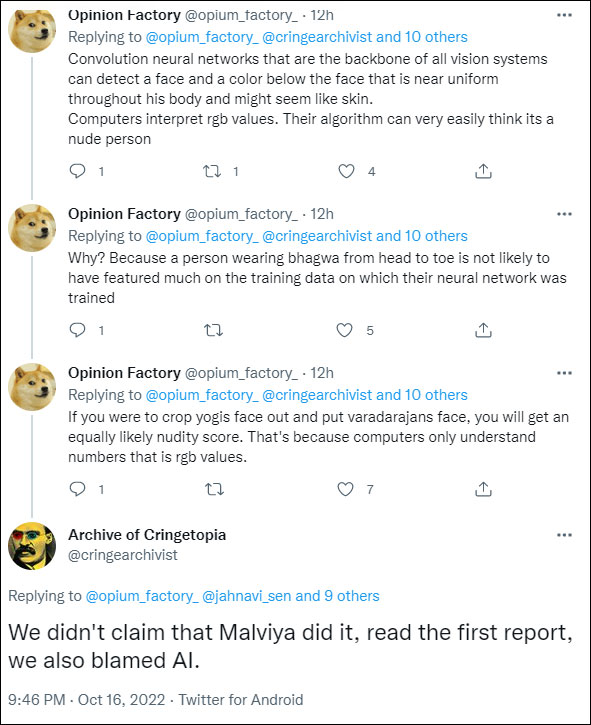
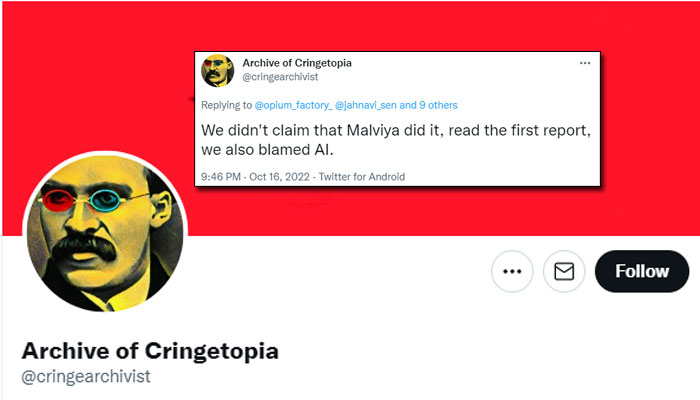
The satirical account named Cringearchivist on Instagram and Twitter, whose post was removed and the whole bullfight started, said he never blamed Malviya for the deletion. While replying to a Twitter user, Opinion Factory, Cringearchivist said, “We didn’t claim that Malviya did it, read the first report, we also blamed AI.”
Screenshot of Cringe Archivist saying he never said Malviya got his post removed
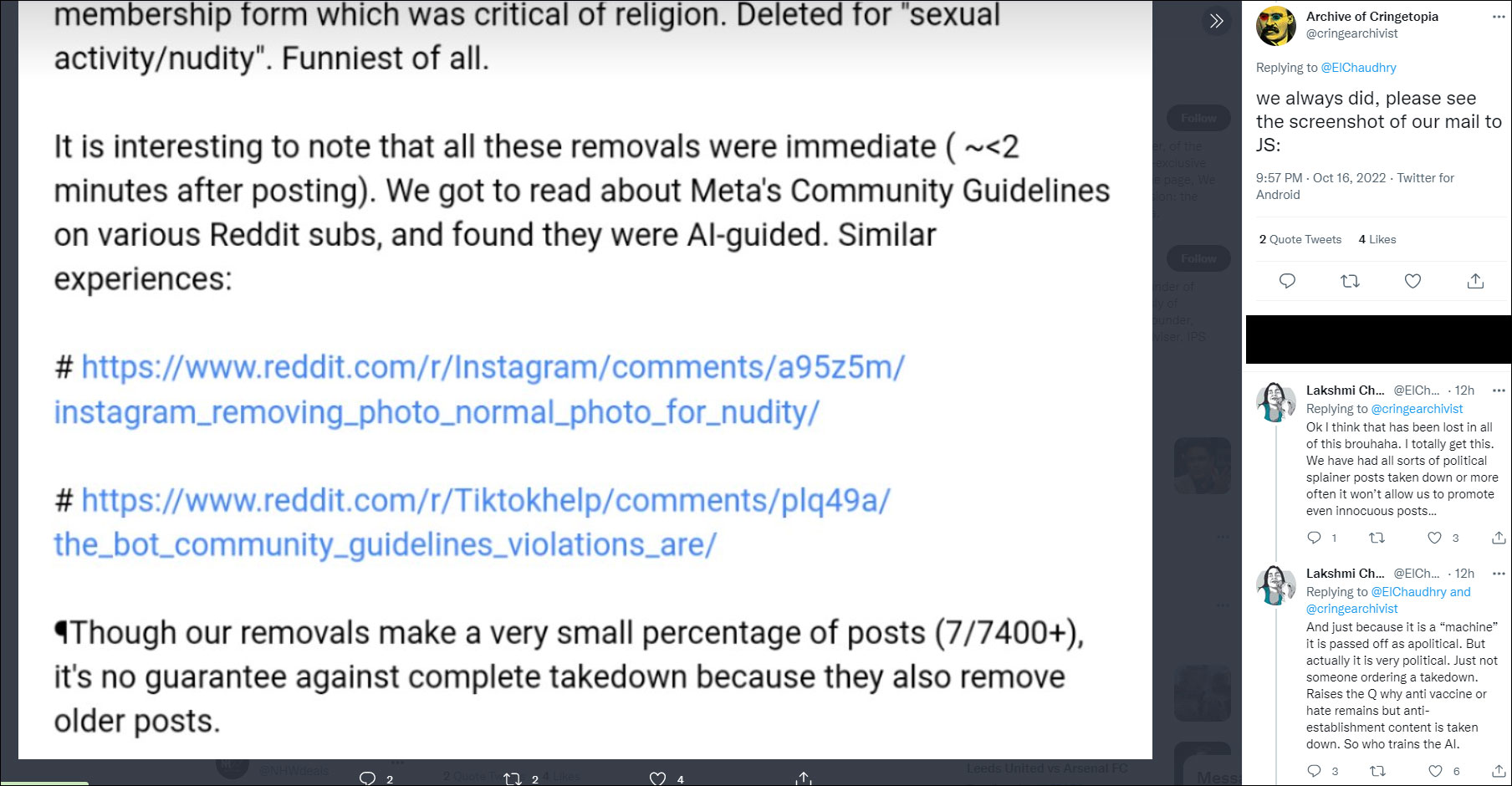
While replying to another Twitter user Lakshmi Chaudhry, Cringearchivist, said in the email sent to JS (JS is The Wire’s reporter Jahnavi Sen who broke the first story), they specifically mentioned AI and blamed it for the removal.
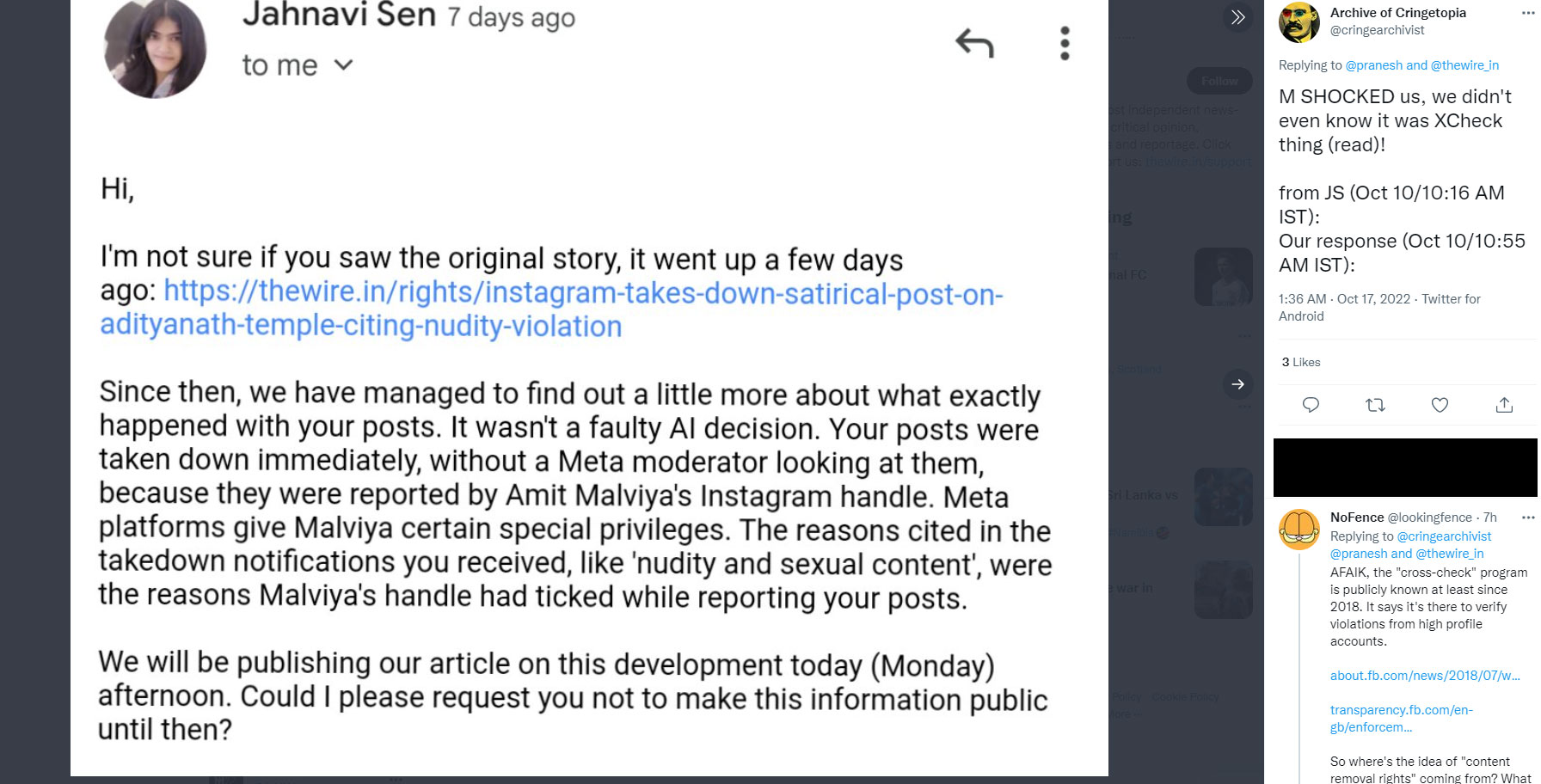
Mail to Jahnavi Sen
Now, another interesting aspect of the claims made by Cringearchivist is that they claimed to have no idea about the alleged involvement of Amit Malviya in the removal of the post, and it was informed by Sen herself via email.
Jahnavi Sen claims Malviya got it removed
In two screenshots shared by Cringearchivist, one was the email sent by Sen to them. In the email, Sen claimed that the removal of the post was not because of a “faulty AI,” but it happened because Amit Malviya reported it.
Furthermore, Cringearchivist claimed The Wire reporter never asked them when they made the account private on Instagram and if Malviya was following them. While replying to tech expert Pranesh (he has been quoted in other OpIndia reports as well), Cringearchivist revealed the information about when they went private and if Malviya followed them.
Further, @cringearchivist notes that @thewire_in did not follow up with them before the story alleging the X-Check/Amit Malviya connection.
The Wire’s reporter has ‘personal relationship’ with Meta insider
Days after making wild allegations against Meta and BJP IT Cell head Amit Malviya, whom they attributed to having superpowers to control workings within Facebook’s parent company, propaganda outlet The Wire has now backed out and cried victim. In a statement released on October 17, The Wire claimed they are not ‘ready to play this game further’. The Wire also revealed how one of their reporters working on this story had a personal relationship with the Meta ‘insider’.
Interestingly, in the statement published on their website they have skipped the portion where it reveals that The Wire’s reporter has a personal relationship with Meta’s ‘source’ who ‘leaked’ documents. The archived version of the same statement which contained this revelation can be obtained here. They added a disclaimer that they edited the website version of their statement to clear relationships with their sources in Meta. Except, instead of clearing, they ended up removing the damning fact that one of their reporters had a personal relationship with the said Meta ‘insider’.
To put things in perspective, Meta has dismissed all allegations by The Wire and said that the ‘evidences’ provided were fabricated.
The Wire, in its statement, claimed that Meta’s responses, where it said that all the evidence The Wire gave to claim how BJP IT Cell head Amit Malviya possesses some superpowers by virtue of being in an ‘elite list’ of users in ‘XCheck’, was fabricated were to goad them to give out more information about their source. This, when many tech experts, most of whom are actually Modi haters and dislike BJP to the core, have called out the shoddy reportage of The Wire. Even the images of so-called emails shared by The Wire were rejected by Meta as fabricated.
Meta categorically mentioned how the ‘workspace’ The Wire put up as evidence, was actually a spoof video made on a dummy/free trial version by someone and they are investigating it further. The Wire also claimed that Microsoft Asia’s employee Ujjwal Kumar, also helped them verify some mail as a legitimate email from Meta. Meta uses Microsoft email services and if an employee with Microsoft indeed indulged in this, it could likely tantamount to breach of client confidentiality, raising serious concerns about Microsoft’s privacy policy. OpIndia has written to Microsoft Asia regarding the concerns but we have not heard back from them yet.
OpIndia will keep an eye on the Meta Vs The Wire saga and report if there is any update in the future.
On October 16, Trinamool Congress (TMC) politician and former cricketer Kirti Azad took to Twitter and shared a photograph with an unsubstantiated quote by RSS leader MS Golwalkar, claiming that he was willing to tolerate British subjugation but not a government in the nation that granted Muslims and Dalits equal status.
The image shared by Azad has no signs of authenticity and was provided with no references. The image was shared on Twitter asking if it was true, insinuating that the remarks were made by Golwalkar in 1940. However, this does not seem to be the case. Several users clarified that the quote was never made by Golwalkar. A Twitter user shared a tweet, stating that this was never said by Golwalkar and that Kirti Azad should ‘Shut up and sit down.’
Another Twitter user Sushil Aggarwal stated that this remark was disowned by the RSS Chief and Golwalkar. He said, “The book mentioned was disowned by RSS and Guru Ji. So it does not contain the official view of RSS. Moreover, the contents of the book as quoted are doubtful. The official book of RSS thoughts is Bunch of Thoughts.”
The book mentioned was disowned by RSS and Guru ji. So it does not contain the official view of RSS. Moreover, the contents of the book as quoted are doubtful. The official book of RSS thoughts is Bunch of Thoughts.
Several other users pointed out that this quote was a fake one and this remark was never made by Golwalkar. However, Azad was yet to remove the misleading image from his account.
TMC leader Kirti Azad has a lengthy history of disseminating misinformation. Azad used social media in February this year to propagate false information about BJP leaders being assaulted in Uttar Pradesh during the state’s second phase of voting during the assembly elections.
Hi Kirti, amusing to see that you,Bhagwat Jha Azad’s son,can’t distinguish between the hinterlands of #WestBengal & #UttarPradesh!This is clip of a jihadi attack engineered by TMC on me on Election Day, April 30 2021.Having become a FAMILY DOORMAT you have lost your rationality! https://t.co/qfkH1XGlV4
— Dr. Anirban Ganguly অনির্বান গঙ্গোপাধ্যায় (@anirbanganguly) February 12, 2022
Dr Anirban Ganguly, a member of the BJP’s national executive committee, chastised Azad, the son of former Bihar chief minister Bhagwat Jha Azad and a former Congress politician, for failing to distinguish between West Bengal and Uttar Pradesh’s countryside.
Notably, the video Azad released purporting to be from Uttar Pradesh was really from West Bengal, when TMC goons heckled BJP’s Anirban Ganguly in Illambazar, West Bengal’s Birbhum, during the voting process for the last round of Bengal elections on April 30, 2021. During the West Bengal Assembly elections in 2021, Ganguly contested from the district’s Bolpur constituency.
Meta, the parent company of Facebook and Instagram, is in loggerheads with left-leaning news portal The Wire since October 10 when the latter accused the former of giving sort of “unlimited” powers to Bharatiya Janata Party’s IT Cell Chief Amit Malviya on Instagram. As per The Wire, Amit Malviya can get any post removed from the platform using his XCheck privileges and has got over 700 posts removed, no questions asked.
Now, the story has seen another turn as the satirical account named Cringearchivist on Instagram and Twitter, whose post was removed and the whole controversy started, said he never blamed Malviya for the deletion. While replying to a Twitter user, Opinion Factory, Cringearchivist said, “We didn’t claim that Malviya did it, read the first report, we also blamed AI.”
Initially, the blame was on “faulty AI”. Source: Twitter
While replying to another Twitter user Lakshmi Chaudhry, Cringearchivist, said in the email sent to JS (JS is The Wire’s reporter Jahnavi Sen who wrote the first story), they specifically mentioned AI and blamed it for the removal.
Cringearchivist did not name Malviya in first interaction with The Wire’s reporter. Source: Twitter
Now, another interesting aspect of the claims made by Cringearchivist is that they claimed to have no idea about the alleged involvement of Amit Malviya in the removal of the post, and it was informed by Sen herself via email.
In two screenshots shared by Cringearchivist, one was the email sent by Sen to them. In the email, Sen claimed that the removal of the post was not because of a “faulty AI,” but it happened because Amit Malviya reported it.
The Wire’s reporter informed Cringearchivist how the post was removed and claimed it was Malviya who reported it. Souce: Twitter
She wrote, “Then, we have managed to find out a little more about what exactly happened with your posts. It wasn’t a faulty Al decision. Your posts were taken down immediately, without a Meta moderator looking at them, because they were reported by Amit Malviya’s Instagram handle. Meta platforms give Malviya certain special privileges. The reasons cited in the takedown notifications you received, like ‘nudity and sexual content,’ were the reasons Malviya’s handle had ticked while reporting your posts.”
Going by the email, it is safe to say that Sen put the blame entirely on Malviya and not on AI. Now, the initial source of the whole bullfight between Meta and The Wire never named Malviya in the first place. How could he? They did not even know if Malviya could be involved. It was The Wire that pulled BJP and Malviya in the saga, and Cringearchivist, like an “innocent child,” sat down and did not say anything till now.
Another point that should be discussed is that Cringearchivist claimed The Wire reporter never asked them when they made the account private on Instagram and if Malviya was following them. While replying to tech expert Pranesh (he has been quoted in other OpIndia reports as well), Cringearchivist revealed the information about when they went private and if Malviya followed them.
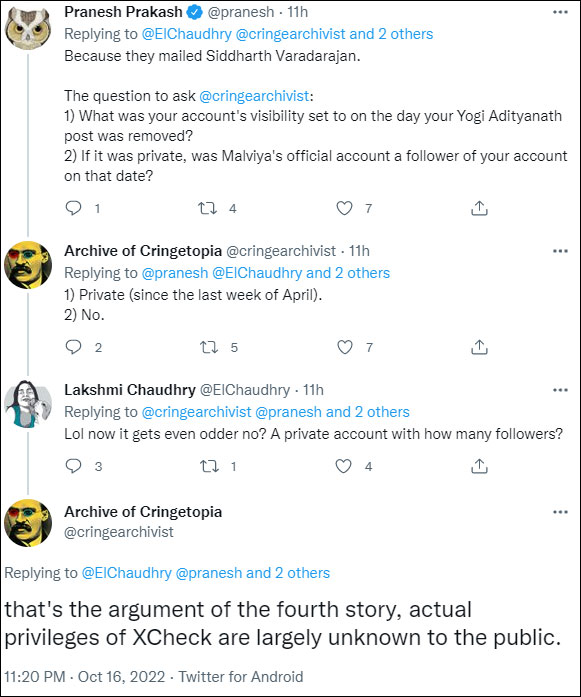
Pranesh asked, “The question to ask @cringearchivist: 1) What was your account’s visibility set to on the day your Yogi Adityanath post was removed? 2) If it was private, was Malviya’s official account a follower of your account on that date?”
Cringearchivist claimed account was private since April and Malviya did not follow them. Source: Twitter
To these questions, Cringearchivist replied, “1) Private (since the last week of April). 2) No.”
Pranesh asked a genuine question. How Malviya managed to report a post within two minutes of getting published of an account that was private in the first place, and he was not even following it? He wrote, “Further, @cringearchivist notes that @thewire_in did not follow up with them before the story alleging the X-Check/Amit Malviya connection. So they didn’t bother to check with @cringearchivist whether Amit Malviya was following their private account to even see their post!”
Further, @cringearchivist notes that @thewire_in did not follow up with them before the story alleging the X-Check/Amit Malviya connection.
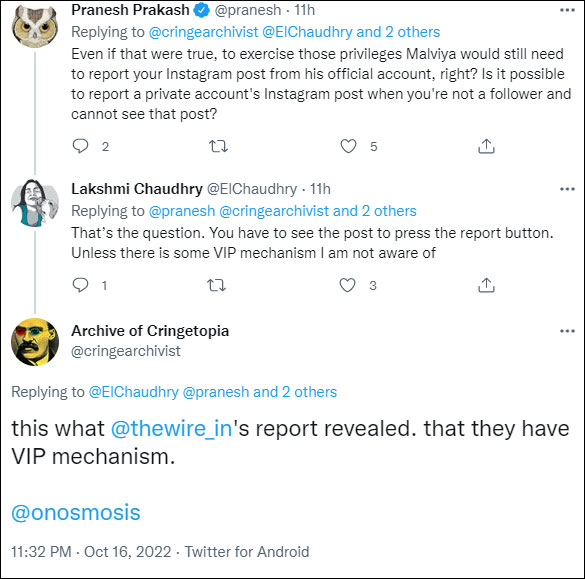
In one of the “explanations” that came from Cringearchivist about how Malviya did it, he said, “actual privileges of XCheck are largely unknown to the public.” Pranesh and Lakshmi both cornered Cringearchivist and pointed out that even to report a post, Malviya has to do it from his official account, which would have been possible only if he was following them on Instagram, which evidently, he did not.
Cringearchivist said, “This what The Wire’s report revealed. That they have VIP mechanism.” We would like to hold back from commenting on how bizarre this sounds.
Cringearchivist claimed extraordinary powers with Malviya because of X-Check privileges. Source: Twitter
There are a lot of bits and pieces that came from Cringearchivist in the last 24 hours that need deeper analysis. One can only hope to find a definite conclusion to the saga soon.
On Sunday, October 16, the Madurai bench of the Madras High Court observed that the principles of the 2019 Citizenship (Amendment) Act could be applied to Hindu Tamils who were forced to abandon Sri Lanka. The single-judge bench of Justice GR Swaminathan held that although Sri Lanka is not covered under CAA, the Hindu Tamils in the Island country could obtain Indian citizenship under the Act as they were the “primary victim of racial strife.”
“Sri Lankan Hindu Tamils were the primary victim of racial strife; can apply for Indian Citizenship as per CAA 2019”: Madras High Court@SukritiMishra12 reportshttps://t.co/Xx3bMET8gV
Notably, the humanitarian law brought in by the Modi government seeks to expedite the citizenship process for religiously persecuted minorities from Pakistan, Bangladesh, and Afghanistan who arrived in India as refugees before December 31, 2014. Though the persecuted Hindus of Sri Lanka currently do not fall under its ambit, the Madras High Court has asked the central government to decide on the matter within 16 weeks.
“Though Sri Lanka does not fall within the said amendment, the very same principle is equally applicable,” he said. “One can take judicial notice of the fact that the Hindu Tamils of Sri Lanka were the primary victims of the racial strife,” Justice Swaminathan noted.
The court was hearing a petition filed by S Abirami, a 29-year-old girl from Sri Lanka who moved to India due to ethnic victimisation. Abirami applied for Indian citizenship.
Abirami was born in a Trichy nursing home on December 14, 1993. She went to school in India, received an Aadhar Card, and has lived there for the past 29 years. Her efforts to get citizenship, however, were futile, so she filed the current petition.
The petitioner requested that the District Magistrate/District Collectors grant her permission to send her application for citizenship to the Central Government. She further requested that the Central Government issue orders within six weeks of receiving her application. Abirami’s plea stated that the Central Government should take note of the unique situation in which she is placed.
The single-judge panel noted that Abirami is the daughter of migrant parents and was born in India. The court went on to say that because she has never been a Sri Lankan citizen, the issue of renunciation does not arise. The court stated that if her motion is denied, she will become “stateless.”
Finally, the court asked the Assistant Solicitor General and the Additional Government Pleader to forward Abirami’s appeal to the Central Government for consideration and gave the latter 6 weeks to respond.
Notably, last year, the Centre for Democracy, Pluralism, and Human Rights (CDPHR), an organisation that advocates for equality, justice, and human rights, released a report on India’s seven neighbouring countries last year, emphasising major human rights crimes against minorities, particularly Hindus. According to the research, Sri Lanka is one of India’s seven neighbouring countries where Hindus have been persecuted for years.
The Center for Democracy Pluralism and Human Rights report has also raised concerns over the status of human rights and religious minorities in Sri Lanka. Talking about the civil war, the report suggested that at least 100,000 people lost their lives and 20,000 Tamils disappeared in the 26-year-long civil war.
The General Secretary of the Indian National Congress, newly appointed as in-charge of Communication, Jairam Ramesh did a podcast with the Editor of ANI, Smita Prakash. He was upset that while he is ready to debate on topics related to economics, the constitution and politics, the media is focused on the cost of the T-Shirt that Rahul Gandhi wears, who he meets etc. Jairam Ramesh forgot that the debate around the cost of dresses was started by Rahul Gandhi himself, but we are not getting into that debate in this article.
At around the 48:00 minute in this video, in quick succession, Jairam Ramesh mentioned 5 points on which he wanted debates to happen, but was upset that those don’t happen. So, I thought it would be good to discuss his 5 points in a detailed article.
1.Political centralisation is results in states getting weaker.
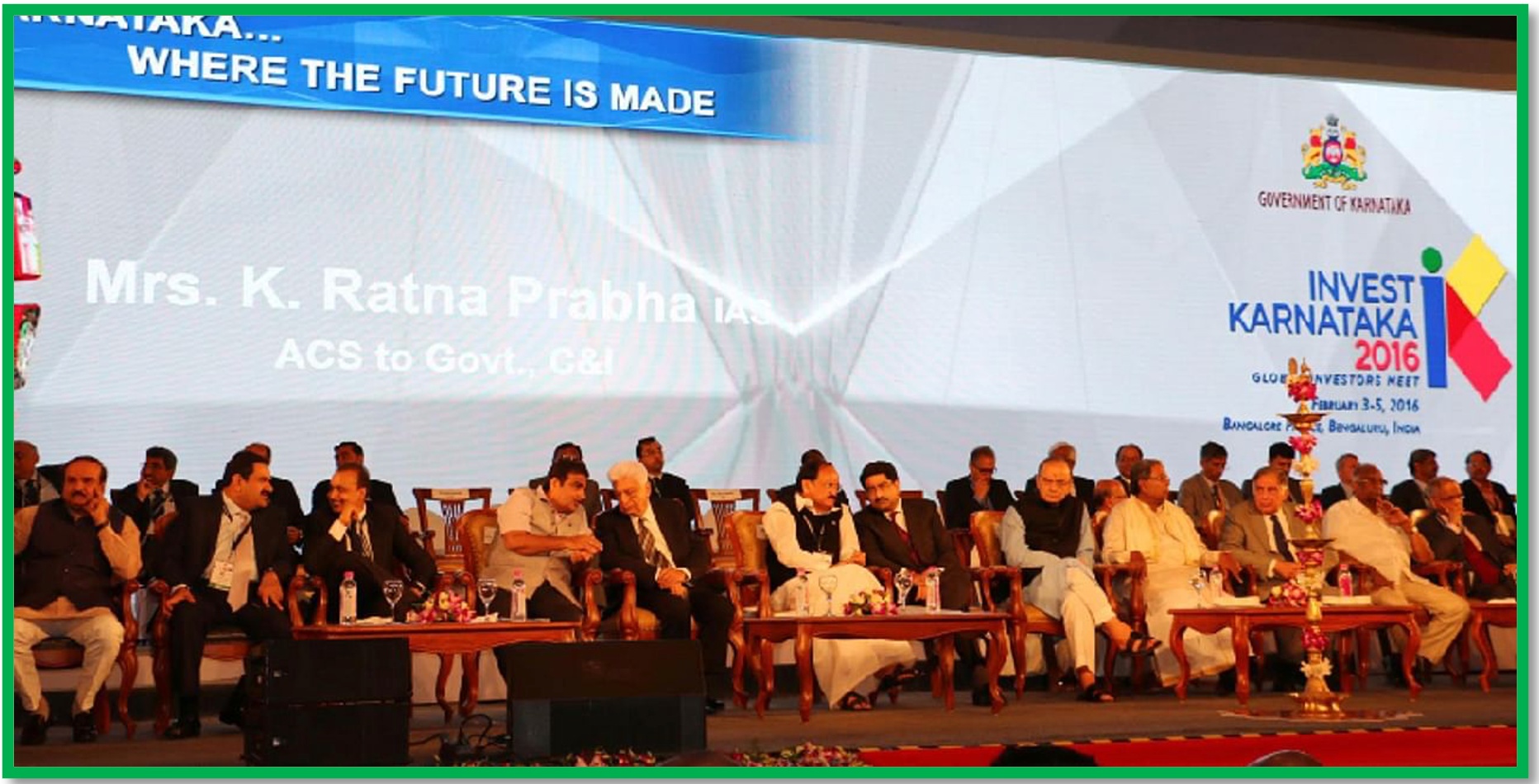
Every time Congress party says something like this, my mind immediately goes to the below picture from the Invest Karnataka Summit from the year 2016.
Invest Karnataka Summit 2016
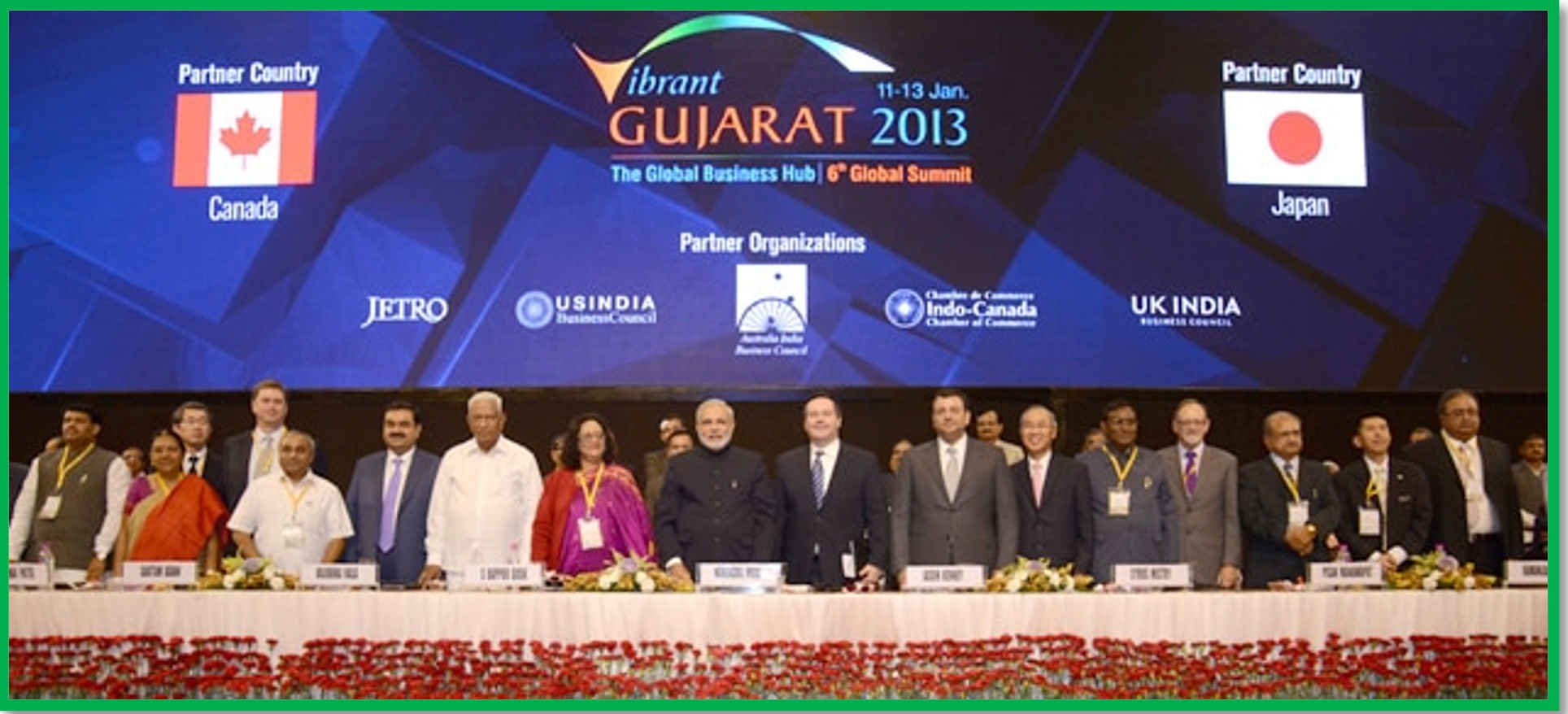
On stage, you can see a long list of Union Cabinet ministers along with the Chief Minister of Karnataka. What’s so great about the picture you may ask? The union ministers all represent the BJP and the Karnataka Chief minister represents the Congress party. So what? You may wonder! Below is a picture from the Vibrant Gujarat Summit in the year 2013.
Vibrant Gujarat Summit 2013.
You do not see a single Union Cabinet minister, because it was the UPA that was in power at the centre and therefore they used to make sure that Union ministers are not at summits organised by the BJP-led governments in the state!
The 2016 Karnataka picture is not an exception. Accompanied by a host of his colleagues, India’s Finance Minister spoke at West Bengal Investor Summit in 2015 and inaugurated the Make in Odisha conclave in 2016 – both ruled by staunch opponents of the BJP. All these participations are in addition to equivalent participation in BJP-ruled states too.
But here’s what is worse – in 2015, Prime Minister Narendra Modi requested the Chief Ministers of Gujarat, Maharashtra and Karnataka to join him on his China tour. Karnataka Chief Minister, Siddaramaiah (from the Congress party) refused to travel with the PM for political reasons. It is the Congress party that played petty politics at the risk of investments to the state of Karnataka (incidentally the home state of Jairam Ramesh!) and today wants a debate on “Political centralisation results in states getting weaker”!
It is not just the participation at the investment summits that can be highlighted towards the Narendra Modi government’s efforts to make all states stronger. At a media summit, the then Punjab Chief Minister, Amarinder Singh was asked – “Is it easy working with the centre?”. Pat comes the reply from Captain Amarinder Singh – “I have no problems. I am getting full cooperation”.
You may snark and say Amarinder Singh now joined the BJP. But then at the same summit in the same panel was Chief Minister H.D.Kumaraswamy who reiterated the same sentiment – “I have no problems working with the centre”. We have had KCR himself and his son KTR also praise the Modi government for assisting the state of Telangana, several times. As recently as 2 days back, Rajasthan’s Chief Minister Ashok Gehlot praised the Union minister Prahalad Joshi for helping them with the coal crisis.
You may still be a cynic and say that all these folks are political opportunists who will ally with the BJP or are angry with the Congress party. And for that argument, I give you this – Kerala Chief Minister, Pinarayi Vijayan. Despite all that clamour of social media during the Kerala floods, he has publicly said “it shows how supportive the Centre has been towards Kerala”. Certainly, you cannot accuse the Communists of helping the BJP!
All these statements of the Chief Ministers are a far cry from how they used to be during the UPA. Sample this – in the year 2011, the Congress Chief Minister of Maharashtra accused the Congress-led UPA central government of not giving enough funds to Maharashtra!
The GST Council is on the best examples of involving all states in the decision-making process of the states. A total of 47 meetings have been held so far, and except for one meeting, all decisions in all these meetings were taken unanimously. Can you even begin to imagine the scale of this effort?
Today, states get 10% more money than what they used to get pre-2015 from Central revenues. Today, all states get a proportionate share in 100s of infrastructure projects (ranging from roads to rail to airports to bridges to tunnels and so on!). Today, MPs cutting across party lines appreciate the PM for clearing long pending projects in their areas. Would all of this have been possible with a vengeful Congress government at the helm of affairs? Do all of these examples really mean that the states are getting weaker?
2.Constitutional bodies getting weaker.
Someone says Constitutional bodies are getting weaker and my mind immediately goes to this letter written by the then Chief Election Commissioner to the President of India, accusing the Election Commissioner Navin Chawla of leaking information to the Congress party. Or to the fact that another former CEC, M.S.Gill, joined the Congress party immediately after his retirement and soon became a minister in a Congress-led government.
Speaking of Constitutional bodies, the Productivity of the 15th Lok Sabha has been the worst in the last 50 years! Imagine, the worst ever! Sonia Gandhi’s UPA was in power during this term and in fact, was in its 2nd term. The 16th Lok Sabha (2014 to 2019) worked 20% more hours than the 15th LS, but more importantly, the “proportion of time spent by 16th Lok Sabha on legislation (32%) is higher than other Lok Sabhas”. 32% higher than the other Lok Sabhas! And Congress makes an argument that Constitutional bodies are getting weaker?
Speaking of Constitutional bodies, many of the far-reaching recommendations of the 14th and 15th Finance Commissions were accepted in totality, thus strengthening both the centre and the states. In fact, the Modi government strengthened the Finance Commissions themselves by laying out fresh guidelines that make use of the latest information and technology to help recommend the best course of action for the country!
Speaking of Constitutional bodies, we have witnessed how the office of the Prime Minister of India has been abjectly surrendered during the rule of Sonia Gandhi’s UPA (examples galore).
3.Constitution being ignored.
History is replete with examples of how the Congress party “ignored” the Constitution! The several times it dismissed popularly elected state governments; the imposition of Emergency in the country and subsequent amendments to the constitution; and the creation of parallel power structures (such as the all-powerful NAC under Sonia Gandhi), are all prime examples of how the Congress party has actually ignored the Constitution. And yet the newly appointed Communications in charge of the Congress party actually wants us to believe that the Constitution is being ignored by the BJP!
4.Polarisation is taking place. And is intensifying.
A very simple metric demolishes this argument to pieces. There were nearly 70-80 documented large riots in India when the Congress was in power. There are not even 10 large riots documented in India when the BJP was in power (for 14 years now). The father of polarization is the Congress party. Congress Chief Ministers have accused Congress MPs of engineering riots to grab their chair – can anything get worse than this? The Congress is shocked that today many Hindus are vocal about their way of life; their practices and their beliefs. And unable to grasp this awakening, they resort to a silly classification of “polarization”!
5.Economic Inequality is increasing.
Centuries-old cliché that doesn’t hold much relevance to today’s India. Rahul Gandhi’s stress on Ambani and Adani has become so boring that even his own state CMs are ignoring his rhetoric now. India has seen a record number of Income Tax filers; a record number of additions to the EPFO portal; a record number of automobile sales; a record number of mobile manufacturing and sales; we can go on and on about how today’s India is working hard to bridge the inequality gap. The Congress is however struck with this broken record of Ambani-Adani.
Jairam Ramesh’s diatribe against the media is nothing new. The Congress’s latest strategy seems to be to play the victim by saying they aren’t getting enough space to speak. Apart from a few delusional folks in Congress, there is no one who believes that the Congress party doesn’t get enough space! It is high time they realise that both their message and messenger need to change. It is high time they stop blaming people of India for not realising the awesomeness of Rahul Gandhi.
Days after making wild allegations against Meta and BJP IT Cell head Amit Malviya, whom they attributed to having superpowers to control workings within Facebook’s parent company, propaganda outlet The Wire has now backed out and cried victim. In a statement released on Monday, The Wire claimed they are not ‘ready to play this game further’. The Wire also revealed how one of their reporters working on this story had a personal relationship with the Meta ‘insider’.
Interestingly, in the statement published on their website they have skipped the portion where it reveals that The Wire’s reporter has a personal relationship with Meta’s ‘source’ who ‘leaked’ documents. The archived version of the same statement which contained this revelation can be obtained here. They added a disclaimer that they edited the website version of their statement to clear relationships with their sources in Meta. Except, instead of clearing, they ended up removing the damning fact that one of their reporters had a personal relationship with the said Meta ‘insider’.
To put things in perspective, Meta has dismissed all allegations by The Wire and said that the ‘evidences’ provided were fabricated.
The Wire, in its statement, claimed that Meta’s responses, where it said that all the evidence The Wire gave to claim how BJP IT Cell head Amit Malviya possesses some superpowers by virtue of being in an ‘elite list’ of users in ‘XCheck’, was fabricated were to goad them to give out more information about their source. This, when many tech experts, most of whom are actually Modi haters and dislike BJP to the core, have called out the shoddy reportage of The Wire. Even the images of so-called emails shared by The Wire were rejected by Meta as fabricated.
Meta categorically mentioned how the ‘workspace’ The Wire put up as evidence, was actually a spoof video made on a dummy/free trial version by someone and they are investigating it further. The Wire also claimed that Microsoft Asia’s employee Ujjwal Kumar, also helped them verify some mail as a legitimate email from Meta. Meta uses Microsoft email services and if an employee with Microsoft indeed indulged in this, it could likely tantamount to breach of client confidentiality, raising serious concerns about Microsoft’s privacy policy. OpIndia has written to Microsoft Asia regarding the concerns but we have not heard back from them yet.
The Wire has now claimed it will continue to work to independently verify Meta executive’s ’email’, which he has termed as fabricated. However, in all this, The Wire has not mentioned even once about their fantastical claims regarding Malviya’s superpowers to target any and every individual he wants at will in Meta. The trigger of this entire mess were the ridiculous claims conjured up by The Wire which even the BJP supporters found hard to believe. However, The Wire has chosen to stay silent on those claims.
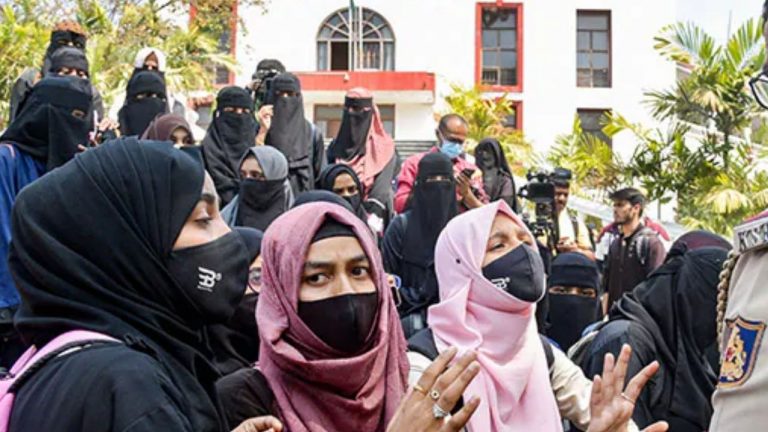
A group of female college students reportedly raised trouble at a college in Bihar after being asked to take off their hijab in the examination hall. The incident occurred at MDDM College in Muzaffarpur. The students claim that during the exam, they were asked to take off their hijabs so that officials could check for Bluetooth devices.
Reportedly, the girl students objected to standard checking to prevent malpractice during exams. They were then asked to leave the hall by the authorities, as per reports.
Muzaffarpur, Bihar | We were in the classroom & were writing the exam when the teacher asked to take off the hijab saying that we might be wearing a bluetooth device. On not taking off hijab the teacher asked us to leave, say students pic.twitter.com/E6zFFeW7pC
“We were in the classroom & were writing the exam when the teacher asked to take off the hijab saying that we might be wearing a Bluetooth device. On not taking off hijab the teacher asked us to leave,” the girl students said.
Meanwhile, another student giving the exam in the same class named Fatima shared with the media that nobody was asked to remove their hijab. The students were just asked to show their ears to make sure nobody is using Bluetooth devices to cheat during the exam.
#मुजफ्फरपुर के महंत दर्शन दास महिला काॅलेज में पिछले 7-8 वर्षों से ड्रेस कोड लागू है।
हिजाब विवाद को मुजफ्फरपुर में घुसाने की कोशिश कर रही दो लड़कियाँ ड्रेस में भी नहीं थी। ये ड्रेस में है, इस लड़की को भी सुना जाए और सच झूठ का आकलन किया जाए। #Muzaffarpur#MDDMCollegepic.twitter.com/vzUt8VMccW
Fatima also shared that the same girls go on and attend functions elsewhere without any hijab or even a dupatta, but when it comes to examinations, they bring hijab and religion into the picture. She added that these cases become religious in nature once such objections are raised.
The college administration characterized it as a routine inspection, but the students made it into a larger controversy by exaggerating it over religious grounds. MDDM college principal Dr Kanupriya said that a student got “aggressive” when asked to take off her hijab so that it could be checked to determine if she was concealing a Bluetooth device. “She said that she won’t write the exams but won’t show her ears. Then she started raising this issue on the basis of religion,” the principal said.
She further added, “It’s shocking that a class 11th girl will behave like this. It seems somebody has misdirected her in the name of religion and hijab. There’s no discrimination based on religion or caste on school premises.”
It’s shocking that a class 11th girl will behave like this. It seems somebody has misdirected her in the name of religion and hijab. There’s no discrimination based on religion or caste on school premises: College Principal pic.twitter.com/0rr5h9I2XQ
The college administration had to call the police to get things under control. The MDDM College principal reaffirmed that there is no discrimination based on caste or religion on school premises and that the student was incited in the name of religion over the matter. Pertinently, the issue of hijab in educational institutions, which was first raised in Karnataka, seems to have reached the state of Bihar.
It is worth noting that exam cheating is a widespread problem in Bihar that is yet to be addressed. Bihar board examinations have gained a reputation in recent years as a result of bogus topper controversies. Ruby Rai supposedly topped the Bihar Board examinations years ago, only to be revealed that she could not even tell the names of the subjects she had topped in.
Another Bihar Board exam topper a year later was illiterate in his subjects.
Family members help students cheat during Bihar Board exams in Hajipur, Bihar https://t.co/yZGcYkgejV
On October 16, Meta replied to the ‘explanation’ video published by The Wire in its latest report accusing Facebook’s parent company of working on instructions of BJP IT Cell head Amit Malviya to ‘silence some critics’. In a tweet thread, Guy Rosen, Chief Information Security Officer (CISO) at Meta, said, “The latest video from The Wire does not show an internal Instagram system. Our investigation has identified a spoof created on October 13 using our enterprise Meta Workplace product.”
The spoof was set up as a free trial Workplace account under the name “Instagram” and using the IG brand as its profile pic. We’ve locked the account for violating policies and are continuing to investigate. We’ll provide further updates as warranted here: https://t.co/CiVFJsOvti
Meta further said that the spoof was set up using a free trial Workspace account and used the Instagram brand as its profile picture. After identifying the account, they locked it, and further investigation is underway. He said, “The spoof was set up as a free trial Workplace account under the name “Instagram” and using the IG brand as its profile pic. We’ve locked the account for violating policies and are continuing to investigate.”
Meta also updated the statement about The Wire’s “expose” with the new findings. In its statement, Meta said, “This is an ongoing investigation, and we will update as it unfolds. At this time, we can confirm that the video shared by the Wire that purports to show an internal Instagram system (and which the Wire claims are evidence that their false allegations are true) in fact depicts an externally-created Meta Workplace account that was deliberately set up with Instagram’s name and brand insignia in order to deceive people. We have located the Workplace account in question, and found that it was created on October 13 — after the Wire’s news reports were initially published.”
It further added, “The account was set up externally as a free trial account on Meta’s enterprise Workplace product under the name “Instagram” and using the Instagram brand as its profile picture. It is not an internal account. Based on the timing of this account’s creation on October 13, it appears to have been set up specifically in order to manufacture evidence to support the Wire’s inaccurate reporting. We have locked the account because it’s in violation of our policies and is being used to perpetuate fraud and mislead journalists.”
The Wire claims its source sent a real-time video of the Workspace account
In its latest report, The Wire claimed to have accessed a screen recording from its source at Meta, where the source claimed to have logged into the Instagram workspace account that Meta previously claimed does not exist.
The Wire claimed, “As is clear in the video, the URL that Meta has officially claimed “is not in use” is very much in use. New reports had been added on the day of the video’s recording. The video also showed the source navigating through the secure ‘instagram.workplace.com’ workspace and opening the notes section.”
“The Wire asked the source to run a timer while they were screen-recording to show that it was happening in real-time. Our team also ascertained that the video hadn’t been tampered with, using the video’s metadata (they have been removed from the file we have made public). Additionally, the cursor maintained consistency throughout the video’s duration, with no abrupt breaks,” it added.
Experts debunk The Wire’s claims
One of the important aspects of the report was that The Wire claimed there were no ‘abrupt breaks’ in the cursor movement. It is one of the most crucial claims, as the cursor movement can give away if the video is modified without getting into metadata and other information. However, their claim was debunked by experts on Twitter.
Law and Policy expert Pranesh Prakash pointed out that The Wire’s claims were inconsistent with the video they posted. In a Twitter thread, he said that at one point in the video, the cursor did move abruptly. Pranesh posted the video and said, “Curiouser and curiouser: The cursor in the video released by The Wire abruptly jumps at 0:35, just at the moment when the person is logging into http://instagram.workplace.com.” The anomaly in the video was earlier reported @binhonglee.
Curiouser and curiouser: The cursor in the video released by @thewire_in abruptly jumps at 0:35, just at the moment when the person is logging into https://t.co/2D5YYt6Dmb.
He also added a video uploaded by The Wire and trimmed a 5-second video out of it to show the ‘abrupt break’ of the cursor in the video. He said, “The Wire states: “Additionally, the cursor maintained consistency throughout the video’s duration, with no abrupt breaks.” I’ve clipped the moment the cursor disappears and reappears elsewhere, during the login sequence. I think this qualifies as an “abrupt break,” don’t you?”
The Wire states: “Additionally, the cursor maintained consistency throughout the video’s duration, with no abrupt breaks.”
I’ve clipped the moment the cursor disappears and reappears elsewhere, during the login sequence. I think this qualifies as an “abrupt break”, don’t you? pic.twitter.com/P44a5Owghr
The Wire, on October 10, claimed Meta gave special previliges to Bharatiya Janata Party’s IT Cell Chief under XCheck program that he uses to get posts removed from Instagram, no questions asked. Meta, as well as netizens, refuted the claims. The Wire then came out with explanation after explanation, but all of them were called out repeatedly.