Home Blog Page 2945

Uttar Pradesh: I-Day celebration in school shows ‘Bharat Mata’ performing ‘Namaz’, police claims viral clip misleading, play about communal harmony

A video of some students at a school in Uttar Pradesh presenting a play in which the crown of Bharat Mata is removed and she is shown performing Namaz on the stage has gone viral on the internet. The video has prompted outrage, with some people urging police action against the institution.

The video shows an Independence Day celebration at a school in Lucknow’s Malviya Nagar Police Station’s Bazarkhala area. In a statement following the event, the Uttar Pradesh Police stated that an inquiry into the viral video showed that the incident occurred at the Shishu Bharatiya Vidyalaya in the Bazarkhala neighbourhood of Lucknow.

The statement by UP Police reads, “A video has been found on social media in which a girl is depicted as Bharat Mata and she is shown performing Namaz after her crown is removed. Upon investigation, it was found that the video was shot at Shishu Bharatiya Vidyalaya in the Bazarkhala locality of Malviya Nagar Thana.”

“In this respect, the school administration was contacted and it was learned that children in the school performed a play where it was portrayed that violence should not be done in the name of religion and communal harmony should be maintained. The viral video is a trimmed part of the whole play and action is being taken against the originator of the video,” it further adds.

‘Hindus killed for being Hindus’ series: The tragic tale of Chandan Gupta, killed in the 2018 Kasganj communal clash over a flag march

Things will never be the same for the family of Chandan Gupta, who was killed in a communal clash that erupted over a flag march in Kasganj, Uttar Pradesh, taken out on Republic Day in the year 2018. Though the exact chain of events leading to the violence had been subjected to multiple versions, it was clear that something triggered a fight between local Muslims and the participants of the Tiranga Yatra, and the Hindu volunteer named Chandan died.

Chandan’s father had alleged that his son was shot for refusing to chant “Pakistan Zindabad”.

Chandan’s untimely death was widely mourned by a majority of Indians except for a handful of so-called liberals who started to blame him for his own death.

The year following his death, the state government honoured Chandan’s family in the Republic Day parade organised in the police line in Kasganj. Following the demands from Chandan’s family, the government announced that a chowk or intersection in the town will be named after Chandan. Along with these, Chandan’s sister Kirti had reportedly been offered a contractual job with the government.

The Uttar Pradesh police in this matter were quick to act and on 31st January 2018 arrested the main accused Salim and 120 others. The two brothers of his Naseem and Waseem who continued to evade arrest were also finally apprehended.

However, no amount of effort can ever be adequate to heal a family that has lost a young son. Chandan Gupta’s family’s anguish over the killing of their son at the hands of enraged fanatics has only grown with time. After nearly 4 years, OpIndia contacted Sushil Gupta, the late Chandan Gupta’s father, to inquire about the latest situation in his home.

Fear compelled the elder son to quit his job: Father of Chandan Gupta narrates his family’s ordeal

Chandan’s father, who still hasn’t come to terms with the death of his young son, told OpIndia, “After Chandan was murdered, my family was protected by a police gunman for over a year. However, after a year, our security was lifted. My eldest son, Vivek Gupta, is a witness in this case. He worked in a private firm as a medical representative, but we got him to quit his job out of fear. We’ve also received a number of threats over time. Now the entire family’s responsibility rests with me alone. I am taking care of my family by working as a compounder in a private hospital. We have to get our daughter also married in the next few years, said Chandan’s father.

All accused except Salim have been released from jail

Chandan Gupta’s father informed us how over time, 28 out of the 29 individuals charged in connection with the 2018 Kasganj communal clash and the subsequent murder of Chandan Gupta, have been released from jail. “The High Court granted bail to all of them. Only one accused, Salim, is currently in custody, and his case will be tried in the High Court this month,” said Sushil Gupta.

According to Gupta, he has also filed a caveat in this case in his own capacity and was incurring a lot of expenses while fighting the case before the High Court. He said that the accused are well-off. As a result, they have an advantage when it comes to battling the law.

He went on to explain that when they went to Kasganj court to defend the case, they would have three or four people on their side, while the accused would get 100 to 200 to support them. Sushil Gupta further lamented how it was becoming impossible for his family to cope with pursuing the legal battle in the High Court with their limited resources, which is why they got the case shifted to the Lucknow Court. “Now, we travel to Lucknow for the hearings that too without any security,” said Chandan’s father.

Names of some accused in Kasganj violence as per the FIR

Witnesses not coming forward in fear says father of Chandan Gupta

“There were more than a half-dozen witnesses in Chandan’s murder case,” said Chandan Gupta’s father, adding that, except for a handful, everyone else is refusing to testify. “Now that my elder son is the sole remaining eyewitness in the case, we are more concerned about his safety,” said Sushil Gupta to OpIndia.

Chandan Kasganj
One of the accused in the case is a lawyer

Unfulfilled promises

Sushil Gupta became emotional while speaking with us. “After Chandan died, a flurry of promises were made to us, including granting my daughter a government job and renaming a municipal plaza after Chandan,” he added, tearfully. “My daughter has just finished her MSc. He was granted a job at the block level, which lasted only 5 months. Aside from that, we have placed Chandan’s statue at the crossroads at our own expense, but it has not been unveiled until today,” said Sushil Gupta.

It is unknown, however, if the administration was consulted before erecting Chandan’s bust at the crossroads. However, if Sushil Gupta is to be believed, the place where Chandan’s statue was placed was proposed by Minister Suresh Pasi after discussion with local authorities following his death. At its board meeting, the municipality also approved renaming Nadrai Gate to Chandan Chowk. However, the municipality had left the construction at the location of the statue’s installation incomplete. Following that, Chandan’s family and other community members plastered the platform and installed an idol there on January 3, 2022.

Also, we have not been able to speak with the administration regarding Sushil Gupta’s assertion concerning his daughter’s work. As soon as we receive the details, we will update this report.

Chandan Kasganj
The unveiled bust of deceased Chandan Gupta placed in Kasganj

Food was not prepared at the home of late Chandan Gupta on Rakshabandhan

The beleaguered father of Chandan Gupta told us how his family has stopped celebrating festivals after the demise of his younger son. “On Rakshabandhan, my daughter placed sweets and a Rakhi in front of Chandan’s photo and sobbed the entire day. We didn’t even turn on the gas stove… no food was prepared in our house on that day,” Sushil Gupta bemoaned.

He further told us how his wife often falls sick thinking about that awful day. “The government then helped us with 20 lakh rupees, however, all that money has been utilised in fighting Chandan’s murder case.”

Chandan Kasganj

Some people approach us with offers to end the case

“It is a travesty that while I am fighting for justice for my late son despite all the threats and pressure, there are these individuals who are being sent to pressurise me to finish the case. Most of them who approach me are Hindus. They come to me with various offers and temptations. However, I am willing to die but not give up. I will fight until my last breath to bring those responsible for the death of my son to justice,” said Sushil Gupta.

Iran blames Salman Rushdie and his supporters for the attack on Rushdie’s life

0

Author Salman Rushdie was stabbed in the neck and abdomen by an attacker identified as 25-year-old Hadi Matar in New York last week. The celebrated 75-year-old author has faced years of death threats since the publication of his novel ‘The Satanic Verses’ in 1988. Soon after the reports of the attack came out, the fingers were pointed toward the fatwa that was issued in Tehran three decades ago calling for Rushdie’s assassination. Iran, trying to deny any link between the attack and the fatwa, washed its hands off the attack and instead blamed Rushdie and his supporters for the attack.

Notably, Iranian media have been extensively gloating over the attack and have called it ‘divine retribution’. Reacting to the media reports that Rushdie may lose one eye following the attack, Iran’s state broadcaster Jaam-e Jam said, “An eye of Satan has been blinded.” US Secretary of State Anthony Blinken had termed Iran’s media’s behavior ‘despicable.’

On August 15 (local time), Nasser Kanaani Tehran, foreign ministry spokesperson of Iran, categorically denied any links between the attacker and the Islamic country. He said, “No one has the right to accuse the Islamic Republic of Iran.” Notably, he said Freedom of Speech does not give the right to Rushdie to insult Islam in his writings.

Blaming Salman Rushdie for the attack, Nasser said, “In this attack, we do not consider anyone other than Salman Rushdie and his supporters worthy of blame and even condemnation,” during the weekly press conference. He added, “By insulting the sacred matters of Islam and crossing the red lines of more than 1.5 billion Muslims and all followers of the divine religions, Salman Rushdie has exposed himself to the anger and rage of the people.”

Furthermore, according to Nasser, Iran did not have any information about the attacker except what was publicly available in international media reports. Notably, the accused named Hadi Matar had used a fake driver’s license bearing the name Hassan Mughniyah. This name is a mix of two senior officials of the Iran-backed terror group Hezbollah. The Hezbollah’s current leader is Hassan Nasrallah while Imad Mughniyeh was a senior Hezbollah official close to Iran’s Islamic Revolutionary Guard Corps Quds Force chief Qassem Soleimani.

It is noteworthy that when Satanic Verses was launched, then-Iranian leader Ayatollah Ruhollah Khomeini had issued a fatwa against Salman Rushdie, calling for his assassination, and placed a bounty of $3 million on his head. The fatwa is still active though the Iranian government has distanced itself from the decree. Later in 2012, a quasi-official Iranian religious foundation added $500,000 to the bounty.

Nupur Sharma blamed for the murders of Kanhaiya Lal and Umesh Kohle

Blaming Rushdie and his supporters for the attack has striking similarities to former Bharatiya Janata Party’s spokesperson Nupur Sharma getting blamed for the murders of Hindu tailor Kanhaiya Lal from Udaipur and Hindu Businessman Umesh Kohle from Amravati.

Both Kanhaiya Lal and Umesh Kohle were killed for extending their support to Nupur Sharma on social media platforms. Notably, Sharma was suspended from the party for her comments on Prophet Mohammed. Sharma is constantly facing threats to her life and has been hiding ever since Alt News’ co-founder Mohammed Zubair opened a floodgate of threats against her by publishing an out-of-context video on Twitter.

Following their brutal murder of Kanhaiya Lal and Umesh Kohle, several hashtags blaming Sharma went viral on social media. Even the Supreme Court Judges blamed her for the unrest in the country instead of pointing fingers at the actual perpetrators of the violence. In its oral observations, SC Judges blamed Nupur Sharma for her ‘loose tongue’ and refused to give her interim relief. It was only after the public uproar that Sharma got some relief from the court, and all FIRs against her were clubbed and transferred to Delhi.

Daughter of Subhas Chandra Bose appeals to PM Modi to bring his ‘mortal remains’ from Japan: Here is what she said

On the occasion of India’s 76th Independence Day, the daughter of Subhas Chandra Bose made a heartfelt appeal to Prime Minister Narendra Modi. She requested the Indian government to bring back the mortal remains of the freedom fighter to India.

In her letter, Anita Bose said, “One of the most prominent heroes of the independence struggle, Subhas Chandra Bose, however, has not returned to his motherland as yet…He sacrificed so much for this struggle, including his peace of mind, a family life, his career and, ultimately, his life!”

Citing declassified documents, she claimed that Netaji died on August 18, 1945, and his last remains are housed at Renkoji temple in Tokyo. “But today we have access to the originally classified inquiries of 1945 and 1946. They show that Netaji died in a foreign country on that day,” Anita Bose alleged.

“Japan has provided a ‘temporary’ home to his remains at Renkoji Temple in Tokyo, cared for in devotion by three generations of priests, and honoured by the Japanese people. Many Indians, including most of her Prime Ministers, have paid homage to Netaji and the INA there, as well,” she emphasised.

The daughter of Subhas Chandra Bose sought for DNA testing of the remains, which are now preserved at the Renokji Temple in Tokyo. Modern technology now offers the means for sophisticated DNA-testing, provided DNA can be extracted from the remains,” she continued.

Anita Bose pointed out, “To those who still doubt that Netaji died on 18″ August 1945, it offers a chance to obtain scientific proof that the remains kept at Renkoji Temple in Tokyo are his.”

“The priest of Renkoji Temple and the Japanese government agreed to a such a test, as the documents in the annexures of the last governmental Indian investigation into Netaji’s death (the Justice Mukherjee Commission of Inquiry) show,” she added.

In her letter to the Indian Prime Minister, Anita Bose said that nothing mattered to her father more than the country’s independence. “Since he did not live to experience the joy of freedom, it is time that at least his remains can return to Indian soil,” she wrote.

In conclusion, she stated, “As Netaji’s only child I feel obliged to ensure that his dearest wish, to return to his country in freedom, will, at last, be fulfilled in this form and that the appropriate ceremonies to honour him will be performed.”

PM Modi unveils holographic statue of Subhas Chandra Bose at India Gate

Earlier in January, Prime Minister Narendra Modi unveiled the holographic statue of Netaji Subhas Chandra Bose at the India Gate to mark the 125th Birth Anniversary of the Illustrious freedom fighter.

The Iconic canopy at the India Gate, which once hosted a statue of King George V until 1968, was replaced by a holographic statue of Netaji. It was created using a 4K projector. The hologram will later be replaced by a 28-ft-high permanent statue of Subhas Chandra Bose made in Granite.

The decision to install Netaji’s statue was announced by PM Modi on Twitter, saying it was a ‘gesture of India’s indebtedness to him’.

The life and crimes of Lalu Prasad Yadav: From fodder scam, whitewashing murder of Hindus to terrorising Patna for his daughter’s wedding

0

Every day we wake up to new breaking news. So much is happening around us and living in a post-truth world does not come easy. We often don’t have the bandwidth to get to the real story, and at the same time, it might be unfair to blame the public for not keeping debacles in fresh memory due to the sheer number of controversial stories. 

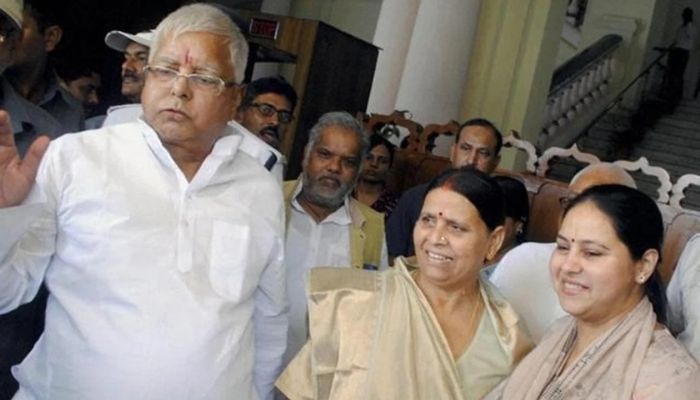
“In this age of LED, there should be no place for lantern (RJD symbol),” said Nitish in an oblique reference to how he pulled Bihar out of the age of darkness after taking over as the CM of Bihar in November 2005. He went on to launch a blistering attack on the Lalu Prasad Yadav-Rabri Devi regime while asking them to compare his 15 years of good governance with 15 years of the previous regime wherein children were kidnapped in broad daylight, women raped, rampant murders and Naxal attacks were the normal and caste clashes were a recurring event. 

Lalu Prasad’s scams and crimes spanned from the 1990s till 2014 – almost over two decades. The list of crimes committed goes on, so much so that we now see him only going in and coming out of the jail premises. The people who tend to defend the former CM of Bihar rationalise it by arguing that a poor leader is being exploited or that it’s political vendetta (their favourite magic phrase that they believe whitewashes all crimes). Nitish Kumar – the incumbent CM of Bihar who has fought Lalu Prasad a number of times – has yet again decided to bypass his morality and side with RJD for the second time due to his political compulsions and limitations. In this context, I believe it’s important to refresh our memories of Lalu Prasad Yadav, his kin, and the infamous scams. 

This article is an attempt to list some of Lalu Prasad Yadav’s scams. In some cases, he has been convicted and is serving jail time, while in others he finds himself in the various post-FIR stages. The data presented in this piece has been collated from India’s leading dailies. 

The Fodder Scam

The Fodder Scam was unearthed during 1990s in united Bihar, when Jharkhand was still a part of the state. Lalu Prasad was then the serving Chief Minister. 

It was found that excessive withdrawals had been the trend for several years. For example, between the years 1993-96, Rs. 10.5 crores was approved by the government to purchase 5,664 pigs, 40,500 hens, 1,577 goats and 995 sheep. However, the State Department of Animal Husbandry withdrew a whopping Rs 255.33 crore. After factoring in over-expenses, according to the Auditor General’s report, the total fraudulent withdrawals stood at Rs. 409.62 crores. 

The Department of Animal Husbandry had allegedly issued fake bills for large disbursements from government treasuries across districts of undivided Bihar. It should be noted that Lalu Prasad had given himself the additional charge of the state’s Minister of Finance during this time. 

The Auditor General’s comments while preparing the report on financial irregularities drew the imagery which became synonyms for the fodder scam. He commented “cattle were transported on scooters, police vans, oil tankers and autos”

The respective scam covered districts of present-day Jharkhand namely, Ranchi, Chaibasa, Dumka, Gumla and Jamshedpur along with Banka in Bihar. The scale of the fodder scam was estimated at Rs 950 crore (in rough value through dollar conversion, it would be approx. Rs 2,255 crore today).

How Lalu politicised the Sabarmati Express fire at Godhra

Lalu was sure of Congress being in his control as always, therefore, hindrance could only come from RSS/BJP. His safety was assured if he kept attacking them. 

Between 2004-09, Lalu Prasad served as the Minister of Railways and ordered a fresh probe into the Sabarmati Express fire at Godhra in Gujarat, the incident in which 59 people were killed on February 27, 2002, by Islamists.

Prasad commented on his political rival and former Minister of Railways, Nitish Kumar, that by not setting a departmental probe he was an equal partner in the conspiracy.

Lalu argued that as per the forensics report “no inflammable material was thrown in the compartment of the Sabarmati Express from outside. The only damage done to the coach was by stone-throwing”.

Nitish Kumar (Minister of Railways from 1998-99 & 2001-04) denied any conspiracy charges and found them to be baseless. According to Kumar, the Godhra incident was probed by the Commissioner for Railway Safety as per the statutory requirement.

Yadav’s statement, according to Kumar was political in nature. He went on to argue, “I demand that the first report on the incident, filed by the DRM be made public to clear all doubts”. 

Lalu’s daughter gets married: Terror for Patna

The saga circles around the wedding of Lalu’s second eldest daughter, Rohini Yadav. The marriage took place in 2002 when Lalu’s goonda raj was at its peak. 

One day before the wedding, Subhas Yadav’s (Lalu’s brother-in-law) subordinates raided numerous car dealerships in Patna including Mithila Motors, Karlo Automobiles, Ashiyana Holdings, Lawly & Sen, Daewoo Motors, and Guinea Motors. They forcefully drove away with as many as 45 brand new premium cars to ferry the VIP guests. Those who dared to resist were reportedly manhandled and the windowpanes of their showrooms were smashed. 

In the stockyard of TELCO at Deedarganj, about 35 km from Patna the subordinates drove off with five luxury vehicles – two Tata Safaris and three Tata Sumos. The drivers and fuel for the vehicles were reportedly arranged by some local policemen responsible for escorting the group. Additionally, 100 sofa sets and other furniture items from a dozen shops, designer suits and clothing worth Rs. 7 lakhs from Raymond’s exclusive showrooms, about 50kg of dry fruits along with other grocery and confectionary items worth thousands of rupees were taken away forcefully from the respective business owners. 

For five days before the wedding the entire state machinery, especially Patna Police was pressed into serving the CM, the Yadav family, and their guests. 

The message was quite apparent when CM Madam Rabri Devi and her husband Lalu Prasad’s daughter gets married, the entire nation is supposed to contribute. Whether the contribution is voluntary or involuntary – does not matter. 

Corporates flee from a lawless Patna

The automobile giant Telco decided to shut down its operations in Patna on May 24, 2002. As the offices closed, the buzz ripped through the country that the company may be pulling out of the capital city altogether. However, allegedly under pressure Telco denied such a claim through a subsequent press release on May 30. 

As per the report by the Bihar Chamber of Commerce and Industry, over 10,000 traders and businessmen had fled from the state during that decade under the Yadav family’s rule due to fear of life or extortion. 

How they justify the goondaraj by Lalu Prasad Yadav

  • As for the inimitable Lalu, his take of the sordid events is the usual: ‘It’s all propaganda to defame him and bring a bad name to the daughter’s marriage’.
  • A senior minister in the Rabri Devi cabinet, Shakil Ahmad Khan, has also come to the rescue and said, “anyone can file an FIR on flimsy charges to defame someone.”
  • “Jab saiyan bhaye kotwal to dar kahe ka?” quipped the Samajwadi leader and political showman Amar Singh at Lalu Yadav, referring to Lalu’s newly acquired samdhi
  • “I have not spent much, all these arrangements have been made by my well-wishers,” said Lalu Yadav, when asked about the expenses incurred on daughter’s marriage. 
  • “Lalu Yadav aur mukhya mantri ki beti yani Bihar ki beti,” was a satirical remark by a top official on duty at the wedding.
  • Lalu Yadav proclaims himself to be the son of a poor man, vows to fight feudal elements and when charge-sheeted in the infamous Rs 950-crore fodder scam case claimed he was being politically victimised. 

BJP’s Opposition leader in the Bihar assembly, Sushil Kumar Modi, had demanded an unqualified apology from Lalu and Rabri Devi as well as a probe into the FIR vis-à-vis the delay in its filing. He further commented, “we’re planning to go to court and file a PIL over this open hooliganism by RJD workers and their anti-social elements”. Modi has also alleged that approximately Rs 5 crore has been spent on the marriage and requested the Income-Tax Department to take a serious look into the expenditure. 

Lalu versus Kapoori Thakur

A new corporate culture seems to be brimming in the Indian political scene. There is an apparent mismatch between the value systems idealised by the politicians and the standards of conduct displayed in reality. 

Lalu considered Kapoori Thakur, the first non-Congress CM of Bihar as his ‘political guru’. He is revered as the real champion for the cause of Dalits and the poor. Yet, we get to see some stark differences between the wedding of Kapoori Thakur’s daughter while he was the serving CM and the wedding of Lalu’s daughter in 2002. 

  • While Thakur married off his daughter in his native village. Lalu Yadav had printed around 10,000 cards for Rohini’s marriage. Karpoori Thakur had ordered none. 
  • Lalu-Rabri engaged the services of the Public Relations Department, sub-inspectors, policemen and magistrates to distribute the invitations. Karpoori Thakur had warned all his officials that if any of them was even found near the marriage site or engaged in preparing for the ceremony, action would be taken against them. Initially, even the cabinet members were not apprised of the event, however, when they were made aware they offered help to Thakur. To which he responded, “it is the wedding of Kapoori Thakur’s daughter, not the CM’s daughter”. 
  • A close assistant of the late Thakur says that he had incurred a total expenditure of Rs 10,000-11,000 on the wedding in the mid-seventies. On the other end of the spectrum, we see Lalu spending roughly Rs 3-4 crore on his daughter’s marriage.

Lalu Prasad Yadav as Railway Minister

It has been reported that the modus operandi of RJD leaders was to lure people seeking jobs and demand land in exchange of the same. 

“The modus operandi was that you give me land and in return, I will give a Group D job in the Railways. Here, the land was first granted in someone else’s name and after 5-6 years it was gifted to Yadav and his family”. – by the said group-D employee

In the FIR which has now been made public, the CBI has given details of how the “land for job” scam was executed. The following was presented by CBI:

  • Twelve persons were appointed as substitutes in six different zones when Lalu Prasad Yadav was the Railway Minister between 2004-09 and seven land deals went through. 
  • Enquiry revealed that 1,05,292 square feet of land were acquired in Patna through the seven sales deeds. Of this, five were sale deeds and two were gift deeds. All acquired land was purchased through cash. The present value of the circle rate of acquired land stands at over Rs. 4.39 crores.
  • The value of land purchased by Lalu’s family was much lower than the market rate and the prevailing value of land is much higher than the circle rate.
  • No public advertisement or public notice was issued, yet residents of Patna were appointed as substitutes in Mumbai, Jabalpur, Kolkata and Hazipur railway zones. 
  • No guideline was followed in candidates’ applications while filing their appointments. They did not even give the full address of the General Manager under the Central Railways. However, the applications were still processed, and appointments were made. 

Another case of corruption against Lalu and his family members is under investigation. CBI charge-sheeted Lalu, his wife Rabri Devi and son Tejashwi Yadav in the case in 2018, wherein he favoured a private company for prime land in Patna while he was serving as the Minister of Railways. 

A CBI enquiry shows that the Department of Railways sought bids for developing, operating, and maintaining Rail Ratna Hotels on September 16, 2006. The probe agency concluded that Lalu Prasad Yadav, as the Railway Minister was aware of the whole process and was keeping a track of the tender proceedings. After the tender was awarded to Sujata Hotels, the ownership of Delight Marketing changed hands from Sarla Gupta to Rabri Devi and Tejaswi Yadav between 2010 and 2014. By this time Lalu Prasad had demitted the office of Minister of Railways. 

The CBI has levelled serious allegations against Yadav of misusing his office as the Railway Minister and even booked his wife Rabri Devi along with the two daughters Misa and Hema for being a part of the entire racket. 

In 2017, the CBI filed a case against Lalu Prasad Yadav and others during his same tenure, accusing him of selling prime railway IRCTC properties to a Bihar-based hotel group. Lalu and others were held guilty and are currently out on bail.

Miffed Congress workers in Bihar hurl insults at state party in-charge for accepting only 3 ministerial berths in new Nitish Kumar Govt

0

Disillusionment is looming large among Congress workers in Bihar over the number of ministries the party is getting in the new Nitish Kumar government. The upset workers created a ruckus at the Congress party office in Patna on Monday, over the allocation of ministerial berths in the new cabinet. According to reports, Congress will be getting three ministerial berths right now in the Bihar cabinet, which at present comprises only the chief minister Nitish Kumar and his deputy Tejashwi Yadav.

On Monday, August 15, a video went viral on social media wherein Bihar Congress workers were seen protesting against AICC’s state in charge Bhakta Charan Das outside the Sadaqat Ashram, the head office of the AICC in Patna. This happened after Das revealed that the Congress will be getting three ministerial berths in the Mahagathbandhan government in Bihar, two right now and 1 later on.

Miffed over the distribution of ministerial berths in the new government in Bihar, the Congress workers said, “who in-charge…no one is our in-charge…we are all workers..only Rahul and Sonia Gandhi are our leaders,” when told that AICC’s state in-charge Bhakta Charan Das has announced that the Congress will get three ministerial berths in the new Nitish Kumar government in Bihar.

The Congress workers, led by former Bihar Congress general secretary Mohammad Gyasuddin Khan, demanded that Congress be granted at least 5 ministries in the cabinet. He insisted that the party should not compromise and accept only three berths. “The party should either take at least 5 berths or do not accept even one,” said the party workers as they hurled abuses at Bhakta Charan Das for accepting the new Nitish Kumar government’s decision to offer only three berths to the Congress.

Khan stated that Congress should be given a cabinet position based on its number of MLAs. He stated that Jitan is a member of Ram Manjhi’s party and that a minister is being appointed from his party. Similarly, given the number of MLAs in Congress, five ministerial positions should be assigned. The cabinet should include everyone, said Khan.

Notably, speaking to PTI, AICC’s state in-charge Bhakta Charan Das said that two Congress MLAs will take oath as ministers on 16 August, and one more legislator will be inducted when the next cabinet expansion happens after that.

“The number of ministerial berths the Congress will get in the Mahagathbandhan government in Bihar has been finalised. The Congress will get a total of three ministerial berths,” Das said.

Das said the Congress MLAs who will become the ministers are yet to be decided.

The Bihar cabinet, which at present comprises only the chief minister and his deputy Tejashwi Yadav, is due for expansion on August 16, 2022.

JD(U) supremo Nitish Kumar had taken oath as the Bihar CM and RJD chief Tejashwi Yadav as the Deputy Chief Minister on 10th August, a day after the JD(U) broke ties with the BJP-led NDA and joined hands with the RJD, the Congress and some other parties, namely CPIML(L), CPI, CPI(M) and HAM to form the Mahagathbandhan government.

Congress MP Manickam Tagore lies about death of Dalit child in Rajasthan, tries to deflect attention after netizens call out his falsehoods

0

Manickam Tagore, a Congress Member of Parliament, lied about the death of a Dalit child in Rajasthan, stating it occurred in Uttar Pradesh. Tagore remarked in a tweet on Sunday that when the President addresses the nation on the eve of Independence Day, discrimination continues in the country and a teacher beat an SC student to death in Uttar Pradesh for drinking water from a pot.

He said, “When Hon’ble President addresses on the Eve #Independence day still discrimination continues…A teacher beaten SC boy for drinking water from his pot in Uttam Pradesh .. the hate and discrimination”

The tweet.

Several social media users pointed out the fake news by Tagore. A user said, “This happened in Ashok Ghelot’s Rajasthan. Congress ruled state.”

The tweet.

Another user said, “A Congress MP passes the blame for the Rajasthan incident to UP. Such ignorance! Delete the tweet, loser!”

The tweet.

After social media users pointed out that Manickam Tagore is spreading fake news, he changed his remarks and tried to modify his remarks saying that he was pointing out the discrimination and not the state where it happened. In a subsequent tweet, he said, “It’s not the state which matters but the pain. Some Sanghi’s what’s name Rajasthan.. my point remains after 75 years of Freedom still we are working on the discrimination & hate.”

The tweet.

It is notable that A nine-year-old Dalit child succumbed to his injuries on Saturday after reportedly being beaten up by a teacher in a private school in the Jalore district of Rajasthan for touching a drinking water pot. According to authorities, the nine-year-old kid Indra Meghwal was apparently beaten up by the teacher on July 20 and died on Saturday in a hospital in Ahmedabad due to his injuries. Harsh Vardhan Agarwalla, the SP of Jalore, said that the youngster had been severely assaulted.

Devaram Meghwal, the father of the deceased, reportedly claimed that on July 20, his son Indra had consumed water from his headmaster Chhail Singh’s earthen pot which was allegedly intended for upper caste people. After this, he was beaten up with lewd abuse, which led to his brain haemorrhage and he died during treatment 24 days later. Headmaster Chhail Singh has been arrested in this case. Action is being taken against him under the SC/ST Act.

Why Agniveer scheme is important: Lessons from Afghanistan, how it can protect India’s assets, growing strategic role and challenges ahead for India

The current global security trend is making every country increasingly vulnerable to some kind of threat or the other emanating primarily from the hegemonistic designs of certain Western powers who are focussed on ensuring their trade and energy security interests prevail. The ongoing war between Russia and Ukraine, the Western region of China getting restive, Taiwan becoming the next hotspot and Pakistan slipping into a self-destructive mode post withdrawal of the armed forces of the United States from Afghanistan are a few recent examples.

Amidst all the ongoing turmoil especially since 2014 when the Russian economy had entered a recession due to plummeting oil prices, China then stepped in to bail Russia out with a $400 billion energy deal, Iran refusing to toe the US line, and India somehow has successfully managed to maintain strategic autonomy walking a tight rope in a prevailing environment of contradictions, conflicts and vulnerabilities while safeguarding own core strategic interests above all these. 

India’s strategic role

India presents itself as a strong pivot in the Asia-Pacific geographical segment and an attractive springboard to dominate the entire Indian Ocean region through which passes over 70 per cent of world trade besides a large percentage of communication cables. Thus, India is strategically placed in a position to play a dominant role in the region ensuring a counterbalance to the expansionist power play. Over the last few years, it has been evident that India has continued to maintain strategic autonomy choosing to align only on issues that ensure equality and mutual benefit. 

While India has adopted a clear stance to maintain strategic autonomy a noticeable change that has begun to grip the Nation is the spread of negative narratives through the Western media. The nation’s fake news industry has somehow intensified since 2018 with the aim of generating hate through perception management against any major initiative taken by the Government of India. These elements, duly supported by inimical forces from behind the curtain, mislead the perception of the Indian masses taking full advantage of the fractured society that lacks a sense of togetherness as one identity.

Today, many TV channels are keen to break news even if they are fake. We have been noticing how protests are being generated and then slowly turning them violent, be it the protests related to CAA/NRC or Agriculture Reform Bills. The latest was the engineered violent protest against the Agniveer recruitment scheme where big protests in nearly Seven states were seen erupting with mobs running riot, burning trains and blocking roads. However, that notwithstanding, today nearly over 12 lakhs youths are seen to have applied for recruitment in the Navy and Air Force through Agniveer. It is, therefore, obvious that the riot was unleashed by the hidden enemy through hired goons.

Role of the Indian Armed Forces

The Indian Armed Forces do not constitute a job-guaranteeing organisation. They are meant to protect the sovereignty and sanctity of the borders so that citizens of the country stay safe and secure. Every individual serving in the Indian Armed Forces volunteers to lay down his life with no questions asked. No one, therefore, can demand a “job” in the armed forces. With changing times, the Indian Armed Forces will always endeavour to organise and reorganise itself as per the developing contours of emerging threats. Today, with the kind of technological advancement, war will not remain confined to the two land borders; instead, it will spread to a wide spectrum opening up multiple fronts for the Nation to tackle. Thus, it goes without saying that the time has now come to give more emphasis on technology instead of increasing manpower.

Agniveer, therefore, is considered the right step in that direction. However, unfortunately, the hidden enemy once again has managed to successfully instigate the mind of the youths showing this recruitment scheme in a bad light. The few agitating gullible and naïve youth, perhaps, failed to see the added benefits of the Agniveer scheme which will be extended to those who will leave the Indian Armed Forces after four years of service in the form of educational qualification, four years of grooming through tough training and service background which will put them way ahead of their counterparts of the same age group, good financial package and a substantive bank balance to take care of the transit window of time and above all more than an adequate number of job reservation in many civil domains offered not only by the Govt but also Corporates. 

“The Agniveer project is being rolled out in very a controlled manner and that’s the reason it can be deemed as a pilot project,” said Lt Gen B S Raju, Vice Chief of Indian Army in an interview given to News18. This clarification clearly indicates that Govt is not at all fixated with the idea but always open to bringing in changes to the system with experience gained through rolling out this project. The youth shouldn’t have anything to worry about it at this stage. 

Private military companies

In the prevailing global security scenario, no country has enough military resources to meet their security parameters generally beyond their borders. Historically, the US has always been using Private Military Companies (PMC) to meet their demand for security of their trade and energy dominance. PMCs are being widely employed in conflict since the early 1990s. Their employment rose dramatically during wars in Iraq and Afghanistan where the number of soldiers of the State and PMC employees was almost equal.

It only demonstrates that numerous international actors have already chosen PMCs as the most efficient solution to their security needs. During the wars in Iraq and Afghanistan, the US military relied heavily on contractors to support counter-insurgency operations. While American people generally want to avoid deploying troops to conflict zones, they still demand protection from terrorism. The Pentagon, the Central Intelligence Agency (CIA) and other defence agencies receive assistance in these areas from Private Companies with expertise in drone warfare, special operations, analysis of electronic surveillance and cyber security.

The US Government is the largest recruiter of PMC employees who are highly skilled individuals and mostly ex-members of the best-trained armies in the world. Increasingly, nations are employing and deploying PMCs to troubled and remote parts of the world. Beyond the scope of democratic accountability, opaque and operating beyond and around International Law, they are proving to be useful agents of diplomacy and proxy wars. There are also umpteen examples of PMCs being hired by many countries and multinational organisations to not only supplement boots on the ground in many ongoing conflict zones; but also protect the business and trade infrastructures all over the world. China has adopted the same path as Pakistan to protect their ongoing business projects.

After the withdrawal of the US from Afghanistan, ISIS is seen to be gaining ground to control the production and trading of opium. ISIS has also been talking about creating a separate province in India. Sometime ago Sawt ul Hind, an ISIS digital publication, carried stories on the Delhi riots with a clear intention of provoking Muslim sentiments not only in India but across the Islamic world. Earlier on, plenty of fake news and videos had come up provoking Kashmiris and drumming up international support against India. 

In view of this, India must now consider that participation through offering PMCs would also meet in a way, a long-standing demand of the US for the presence of the Indian military in Afghanistan. This would also serve as an opportunity to exploit the opening up of the Indian defence market for supplying weapons and military equipment to this large private army enterprise, likely to be effectively employed by Nations across the globe. This market will give a substantial push to the Indian military-industrial complexes, thereby boosting the Nation’s economic growth. India also has no dearth of well-trained retired personnel from the armed forces, armed police, special forces and other civil agencies to pick from and be gainfully utilised. Well-trained youngsters of Agniveer too will have a great opportunity to join PMCs and serve for a long time utilising their skill and zeal.

India’s PMCs will not only protect the increasing assets of India across the world; but also work as an alternative to project strength in areas or regions such as East Africa and Afghanistan where the optics of having the Indian Army as boots on the ground may not be taken well. This kind of involvement will be similar to the way the US had deployed Blackwater in Iraq or as Russia had used Wagner Group in Syria or the Chinese using Academia n Xinjiang. So, with Agniveer coming in soon, India will have a pool of well-trained and disciplined manpower to meet an assertive Nation’s rising aspirations whether it be for securing gas and mineral resources that India has recently gained rights to mine in East Africa or protecting the trade corridor under INSTC and Arab-Mediterranean corridor.

The ongoing Russia-Ukraine war has also shown how a similar model has worked for Ukraine. Since 2014, on a basis of rotation, Ukraine had employed over six hundred thousand personnel for a short duration to fight in the restive Donbas region. This helped Ukraine create a huge combat experienced reserve which came in handy when Russia invaded. Well, India does not need to stock up such a lot of combatants to beef up troops on the ground in case of a war with China and Pakistan, but definitely we need to place our foot on the ground in other parts of the world as an emerging power as also guard our growing assets. Today, PMC is a big security business of over $300 billion dollar industry.

Challenges ahead for India

No matter what the Government of India does for the good of the country, the internationally backed NGO nexus behind the CAA/NRC protests or the recent farmer protests supported and nurtured reportedly by some foreign intelligence agencies will keep seizing every opportunity to attack our government. India is blessed with a diverse society which unfortunately more often than not, presents itself as a fractured society with nearly 3000 major castes and 25,000 sub-castes in the Hindu religion besides nine major religions, 22 constitutionally recognised languages covering 29 States leading to a perceived lack of cultural integration and sense of belonging as one entity.

This is further vindicated by the existence of certain political parties totally organised not only on a specific religious identity; but also, on caste and regional identity and strangely at the same time, also claiming to represent the Nation at the global level. There is also no dearth of Pseudo Arm Chair Intellectuals, foreign-funded NGOs as also both print and electronic media who are successfully creating and deepening the divide by misleading perception. Other hanging threats which are not so visible at present, but have very dangerous lethal potential are cyber terrorism, data colonisation and demographic invasion from neighbouring countries such as Bangladesh, Afghanistan, Pakistan, Myanmar and Tibet in addition to the growth of Islam fascism in Jammu region.

The Government of India must, therefore, continue with their hard push towards building a robust economy by graduating from agrarian to manufacturing and exporting economy with a distinct focus on defence manufacturing. A strong economy will not only enhance the nation’s warfighting capability: but will also help in developing strong economic linkages, especially with neighbouring countries. With a strong economy as the foundational pillar, India will be able to ensure leverage during negotiations with major business entities and multinational corporations.

This leverage, in turn, will help in coercing these corporations to build, develop and operate data centres within Indian boundaries to protect the digital autonomy and privacy of citizens of India. The Government must, therefore, address social reforms and contain caste politics also. The prevailing internal issues such as Insurgency, Maoism, cross-border terrorism, terror modules, the likes of ‘tukde tukde’ gangs etc, all will get effectively tackled by the people of India themselves once a sense of Nationalism begin to get instilled in every Indian promoting “One India Dream”.

The final word

To sum up, it would sound apt to quote at this stage what the Indian Foreign Minister Shri S Jaishankar, while addressing a conference by the Centre for Policy Research on 02 March 2020 said, “In a world which is fractured with polarised debates, India is willing to step up to the plate and play a larger role.” Therefore, the time has now come for India to step out and make her presence felt in the global power play, leveraging every instrument of power at her disposal ranging from natural geographical dominance, the global presence of the Indian diaspora, the soft power of Bollywood, a growing strong economy, military might and nuanced diplomacy.” 

Over centuries, Indians are known to have fought successfully not only the several waves of invaders; but also, gained victories on the battleground on behalf of the Allied Forces in both World Wars all over the world. A decent number of former combatants/ex-servicemen can thus potentially be utilised to extend our footprint globally. Undoubtedly, Agniveer will be a major source of our strength. 

‘Liberals’ and ‘intellectuals’ find #HarGharTiranga problematic, say 50-year-celebrations were ‘simple’: Here is why it was simple and subdued

On 15th August 1997, India celebrated 50 years of Independence. Today, as we celebrate our 75th year, many ‘intellectuals’ are reminiscing about the ‘better’ and ‘simpler’ times of celebrations. Many ‘liberals’ are saying how the celebrations were spontaneous and there was no jingoism. Apparently, the fact that people are proudly putting up the Tricolour in their homes, shops, and commercial establishments and how the country is flooded with the Tiranga is ‘jingoism’ because the call for it was made by someone they don’t like, Narendra Modi.

Some Yogita Limaye, whose Twitter bio says she is associated with the British public broadcasting service, BBC, claimed how she remembered the celebrations of India @ 50 and how the flag was hoisted at her school. How the pride and patriotism came ‘naturally’ and ‘no one asked to do it’. The only thing that has changed now is that 15 more years have passed, and with social media, people are enthusiastically sharing their photos with the National Flag. As for ‘No one asked us to do it’ – well, the schools did, as they do even now (which is now referred to as ‘forcing children to be patriotic). And finally, what she is saying is done even now – kids still go to school, participate in flag hoisting and sing the national anthem and other patriotic songs.

Many other ‘intellectuals’ chimed in and asserted how those were ‘simpler’ times.

From other ‘journalists’ to professors from IIT to Congress supporters and even financial fraud accused persons too agreed with Limaye.

Maybe 25 years is a long time and people tend to be forgetful, but one reason the celebrations back then were muted and times were ‘simpler’, because that was one of the most unstable times in Indian politics.

After the 1996 General Elections, BJP under Atal Bihari Vajpayee had won 161 seats while Congress had won 140 seats leading to a hung parliament. Both parties were short of the majority number of 272. As usual, this election had come on the heels of corruption allegations during the previous Congress government. President Shankar Dayal Sharma invited Vajpayee, with maximum seats, to form the government and was given two weeks to prove the majority. However, because he was unable to do so, he resigned on 1 June 1996.

The second largest party, Congress decided not to form the government and instead supported Janata Dal to form the government. The then Karnataka Chief Minister HD Deve Gowda was sworn in as Prime Minister on 1 June 1996. His stint as PM lasted for 324 days. As a young girl back then my only recollection is of front page images of HD Deve Gowda caught napping inside the Parliament when he was the Prime Minister.

You see, the government at the Centre was so fragmented that on 21 April 1997, less than 4 months before the 50th Independence Day, Deve Gowda resigned and another Janata Dal leader IK Gujral, who was born in Pakistan, then in undivided India, became the Prime Minister. How he was chosen as the 12th Prime Minister of India was also quite interesting. The fodder scam had just broken and Lalu Prasad Yadav, who was then Bihar Chief Minister, was one of the accused. He was later convicted in it too. Anyway, as an accused in the fodder scam, Lalu Yadav broke off and started his own political outfit, Rashtriya Janata Dal (RJD) in July 1997, a month before the ‘sober’ 50th Independence Day.

Now, when Congress, under Sitaram Kesari, pulled the plug on the Deve Gowda government, discussions were on for the new Prime Minister. You see, no one wanted a fresh election at that time. Sitaram Kesari himself wanted to become the Prime Minister as well and called upon leaders of coalition parties, but none agreed.

Kesari was a Dalit leader and other Congress leaders did not quite respect him as much. This is also why when Sonia Gandhi forayed into active politics in December 1997, he was reportedly locked up in the bathroom in Congress headquarters so as to prevent him from filing his nomination. Coming back, Lalu Prasad Yadav and Mulayam Singh Yadav all wanted to become Prime Minister. Mulayam Singh was a tall leader from Uttar Pradesh and had won significant seats. However, no name was decided.

Mulayam Singh opposed Lalu Yadav, Lalu Yadav hated Mulayam Singh and he was also named in the fodder scam, which again raised a question mark over him becoming the PM. When IK Gujral’s name was suggested, very few leaders ‘opposed’ it. Read it again, he wasn’t chosen because he was popular, but because he was least disliked. Mulayam Singh wasn’t in much favour but then Sitaram Kesari was okay with Gujral. Finally, Lalu Yadav proposed IK Gujral’s name as Prime Minister.

The discussions lasted for hours and when IK Gujral’s name was zeroed in on, he had taken a break and was taking a nap. A Telugu Desam Party leader went up to him and woke him up to tell him the good news that he is now the Prime Minister of India, which is in its 50th year of independence. Gujral was so happy, that he reportedly hugged the leader. But as usual, even the Gujral government lasted less than a year when Congress again pulled the plug and the government collapsed on 19th March 1998, just a few months after the so-called ‘muted celebrations’.

So, now tell me, when the central government and political parties are busy figuring out the musical chairs and are not even sure if the government today will last a day, a week, a month or a year more, how will they focus on celebrating the 50th year of India’s Independence?

And when we talk about politics, how can the opinion makers, the ‘journalists’ be far behind? Today we see NDTV India’s Ravish Kumar fearmonger and tell us every day how there is an atmosphere of fear and how the Har Ghar Tiranga campaign is jingoism and lists how everything is wrong in Modi’s India. But back then, NDTV’s Prannoy Roy and sexual harassment accused turned food critic turned ‘journalist’ Vinod Dua were both on Doordarshan. In the 1980s, Dua, along with Roy started election analysis on Doordarshan. 

Those were also the times when NDTV founder Prannoy Roy and Vinod Dua, a typical Modi hater, would pontificate for hours on national television, which reinforced them as some sort of impartial experts who must be respected. And did it not work? That’s how in the coming years we got television journalists who become celebrities and influencers and lobbied for ministerial berths for politicians as we saw in leaked audio tapes of some celebrity journalists.

Essentially, people like Ravish Kumar and others like him want people like Modi gone from the political scene. That is also why they don’t like social media users who criticise, question and correct them. All these years they had unbridled power and no questions asked. Times have changed now. And hence, Modi must resign. With people like PM Modi and others not to deal with, these people can continue to influence ordinary men and women from their television screens without being answerable to anyone, and without being held accountable for their lies told.

And hence the pining for ‘simpler times’.

‘These kinds of incidents happen in every state’, Rajasthan CM Ashok Gehlot plays down death of Dalit boy in Jalore after being beaten by school teacher

0

While protests continue over the death of a nine-year-old Dalit boy Indra Meghwal, in Rajasthan’s Jalore district, Rajasthan Chief Minister Ashok Gehlot seemed least perturbed by the heinous crime that occurred in his state. Reacting to the news that the Dalit boy was allegedly beaten up by a teacher for drinking water from a pot, Ashok Gehlot tried to play down the crime by asserting that such incidents occur in all states.

“These kinds of incidents happen in every state. If you watch TV or read the newspapers, you know that these incidents happen everywhere,” said the CM on Monday.

Accusing the BJP, which is in Opposition in the state, of politicising the incident, Gehlot further added, “We strongly condemn this. Be it in our state or in any other state. Whether it is the incident of Udaipur or Jalore, we have taken decisions that are convincing to the public. The BJP should make it an issue, being in opposition. However, our government has taken action and arrested the teacher. What more could be done? The whole state and country is watching,” Gehlot added.

Meanwhile, protests broke out in Rajasthan’s Jalore district on Sunday, a day after Indra Meghwal died allegedly after he was beaten up by a teacher for touching a drinking water pot in a private school, police said.

Dalit kid succumbs to injuries after being beaten by the teacher for touching drinking water pot

OpIndia reported on August 14 how the nine-year-old Dalit child succumbed to his injuries on Saturday (August 13) after reportedly being beaten up by a teacher in a private school in the Jalore district of Rajasthan for touching a drinking water pot. According to police, Chail Singh (40), the teacher who assaulted the child, has been detained and charged with murder and violating the Scheduled Caste and Scheduled Tribe (Prevention of Atrocities) Act.

According to authorities, the nine-year-old kid Indra Meghwal was apparently beaten up by the teacher on July 20 and died on Saturday in a hospital in Ahmedabad due to his injuries. Harsh Vardhan Agarwalla, the SP of Jalore, said that the youngster had been severely assaulted.

According to a complaint letter handed to the Saila police station on Saturday by the victim’s father, Devaram Meghwal, Singh beat up Indra while taunting him with casteist insults for drinking water from an earthen pot intended for upper caste people. Indra’s father also stated that he suffered damage to his right ear and eye as a result of Singh’s thrashing and eventually became unconscious.

Meanwhile, according to some locals, the claim that the child was killed for drinking water from the earthen pot meant for upper castes is false. According to these people, there is only one water tank in the school, and students and teachers used to drink water from the same tank. They denied the claims that there are separate water tanks for upper caste and lower caste students.

Rising crimes in Rajasthan under CM Ashok Gehlot

It’s remarkable how the Congress, which has a history of using fatalities for political gain, as in the Lakhimpur Kheri or Hathras incidents, the two unfortunate cases in UP, has today conveniently downplayed the murder of a 9-year-old Dalit child since it occurred in their own backyard. The fact, however, is that Rajasthan, the Congress-ruled state, has been steadily rising up the crime charts. The state has recorded the highest number of rape and attempts to rape cases, as per the National Crime Records Bureau (NCRB) data for 2020.

In fact, last year it was reported how, for the second year in a row, the Congress-ruled state of Rajasthan recorded the highest number of rape and attempt to rape cases.

The figures for crime against women peaked at 34,535 in 2020. The report further revealed that as many as 409 cases of rape were reported just in the capital city of Jaipur in 2020. 

From cold-blooded murder to gangrape, the law and order situation in Congress leader Ashok Gehlot-led Rajasthan is becoming worrisome. 

In official statistics released by the State police, a 28% increase in atrocities against Dalit women, 20% in burglary and 28% in cases of theft between January and July were reported this year.