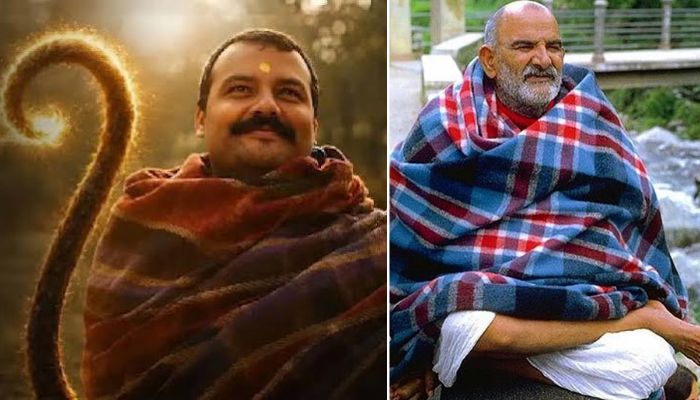
A devotional film made on a reported budget of around ₹2 crore has turned into one of the most surprising box-office success stories of 2026. Vishal Chaturvedi’sHanuman Ansh, based on the life and spiritual journey of Neem Karoli Baba, started with a limited theatrical release but gradually found a much larger audience.
The film has now crossed the ₹100-crore mark in India and is running strong even in its fifth week. By Day 32, it had collected around ₹132 crore net in India, while its gross collection stood at about ₹156.20 crore. The film’s performance is particularly striking because it began its theatrical journey on 7th August with just 25 screens and an opening collection of only around ₹10 lakh.
From a slow start to a box-office phenomenon
Unlike big-budget releases that usually make most of their money during the opening weekend, Hanuman Ansh took a different route. Its initial weeks were modest, but the film slowly gained attention through word-of-mouth.
The change became clear from its third week. After earning ₹1.08 crore in the first week and around ₹40 lakh in the second week, the film began picking up. It crossed the ₹1-crore mark in a single day during its third week, earning ₹2.50 crore on its third Sunday. It eventually collected ₹10.40 crore in the third week.
The momentum became even stronger in the fourth week, when its weekly collection increased nearly six times. By the fifth weekend, the film was putting up numbers that few expected from a film made on such a small budget.
It earned ₹10 crore on Friday, ₹16.50 crore on Saturday and ₹22.75 crore on Sunday. Its fifth-weekend collection reached ₹49.25 crore. On the following Monday, it added another ₹10 crore despite a 56% drop from Sunday.
By the first four days of its fifth week, the film had already earned ₹59.25 crore. Its fifth-week run also saw it compete strongly with the newer Gurmeet Singh’s action-crime thriller Mirzapur: The Movie.
Bigger than its budget
The biggest talking point around Hanuman Ansh is not just its total collection but the money it has made compared with its production cost.
Made on a budget reportedly less than ₹2 crore, the film has earned more than 60 times its reported budget. Its fifth-week performance even put it ahead of several major blockbusters in terms of fifth-weekend earnings. The film was reported to have recorded the biggest fifth-weekend haul in Indian box-office history, surpassing Dhurandhar.
The film has also been described by trade trackers as one of the most financially rewarding Indian films in recent memory. With its theatrical run continuing, estimates in the source material suggested that its collection could move towards the ₹150-crore mark.
The film is also expanding internationally. Hombale Films has acquired its global distribution rights, with the worldwide release scheduled for 11th of September.
What is Hanuman Ansh about?
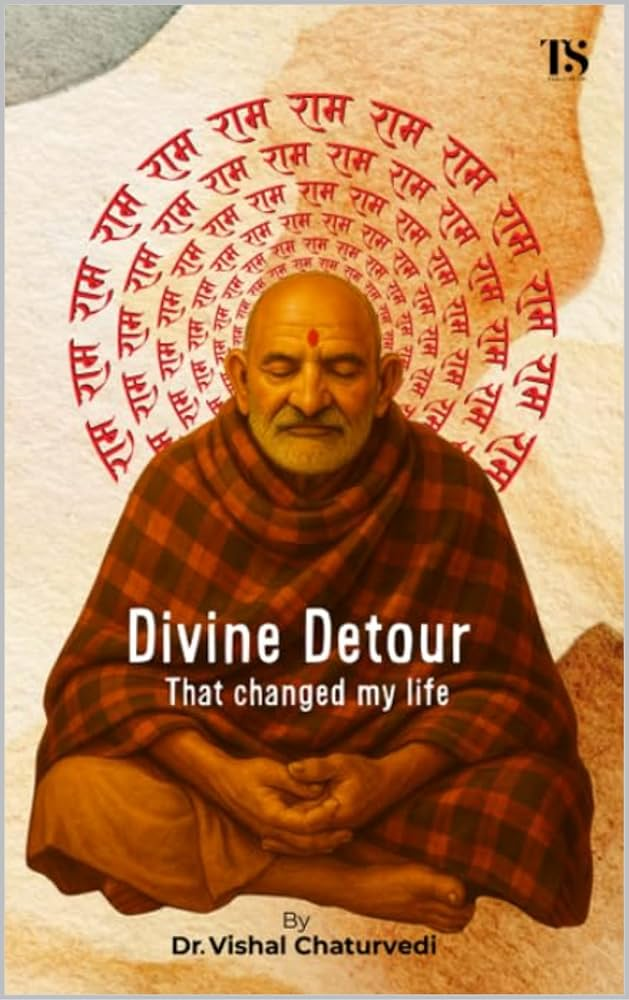
Directed and produced by Dr Vishal Chaturvedi, Hanuman Ansh is inspired by his book Divine Detour: That Changed My Life, which focuses on Neem Karoli Baba.
Shobhinaw Satyaa plays Neem Karoli Baba, while Chandan Anand is also part of the lead cast. The film tells the story of Lakshmi Narayan, a young boy living in pre-Independence India. After the death of his mother, he leaves home in search of God. His journey across North India eventually leads to his transformation into Neem Karoli Baba.
The film is planned as the first part of a trilogy inspired by Divine Detour: That Changed My Life. It has been produced by Ragini S, Namrata G Singh, Anupriya A Nagar and Dr Vishal Chaturvedi under Swambhu Media Network and Holy Cow Home Productions.
Source: Amazon
Who was Neem Karoli Baba?
The success of Hanuman Ansh has also brought renewed attention to the life of Neem Karoli Baba, popularly known by his followers as Maharaj-ji.
Neem Karoli Baba was born as Laxman Narayan Sharma around 1900 in Akbarpur village of Uttar Pradesh’s Firozabad district. He came from a wealthy Brahmin family. According to the details shared about his life, he experienced a strong spiritual urge at a young age and left home to travel as a sadhu across northern India.
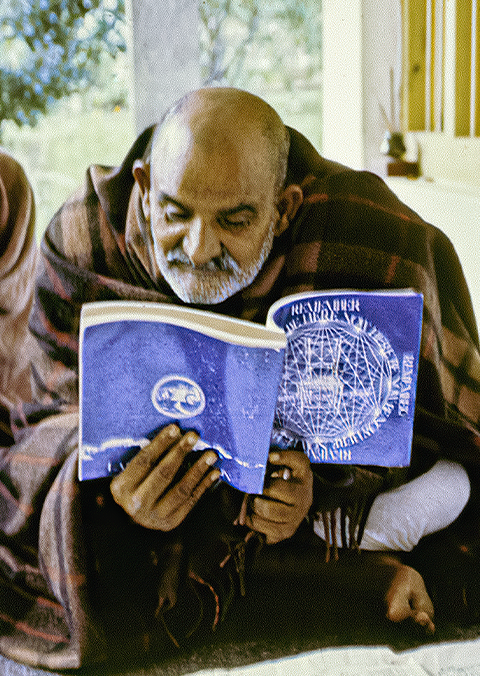
Source: NKB Ashram
His father eventually found him and persuaded him to return home. Baba later married and had two sons and a daughter. However, his spiritual calling continued. In 1958, he left his family permanently and devoted the final 15 years of his life to serving people and spreading divine love.
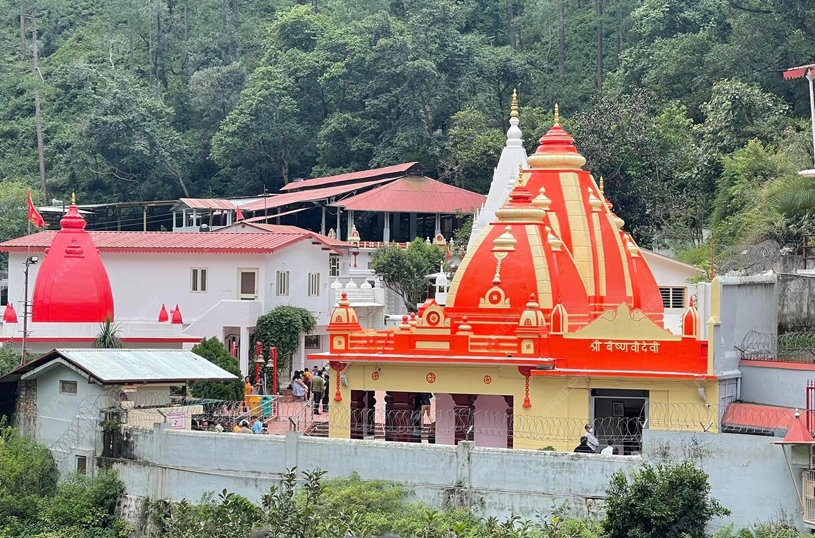
His spiritual journey became closely associated with Kainchi Dham, a temple complex located on the banks of the Kosi River in Uttarakhand’s Kumaon region.
Kainchi Dham and his global influence
Neem Karoli Baba’s influence eventually reached far beyond India. Kainchi Dham became a major spiritual destination, attracting visitors from across the world.
His name also became familiar in global technology and popular culture. Facebook founder Mark Zuckerberg has spoken about visiting the ashram after Steve Jobs recommended the place to him. Zuckerberg had planned to stay for a day but ended up spending two days there.
Steve Jobs himself had visited the ashram with his friend Dan Kottke, although he could not meet Neem Karoli Baba because Baba had already passed away. Hollywood actress Julia Roberts has also spoken about being influenced by him and being drawn towards Hinduism.
Kainchi Dham (Source: Travellopedia)
Among the foreign devotees and visitors associated with Neem Karoli Baba are spiritual figures such as Ram Dass and Ma Jaya, musicians Jai Uttal and Krishna Das, humanitarian Larry Brilliant, scholar and writer Yvette Rosser, and psychologist Daniel Goleman.
A legacy of temples and service
Neem Karoli Baba also established temples dedicated to Lord Hanuman at several places. The first Hanuman temple associated with him was inaugurated on 15th June, 1964, followed by another temple in Vrindavan. His temples and ashrams later spread to several locations, including Lucknow and Texas in the US. According to his website, Maharaj-ji established at least 108 temples.
In the late 1960s, American spiritual seeker Baba Ram Dass wrote books about Neem Karoli Baba, helping introduce his teachings to a wider Western audience. Hundreds of Westerners subsequently travelled to India to seek his darshan.
Neem Karoli Baba chose Vrindavan as the place for his samadhi. He died on 10th September, 1973. A temple was later built for him at the ashram, and his statue was consecrated on 15th June, 1976.
Why Hanuman Ansh matters
The unusual success of Hanuman Ansh has given a fresh spotlight to a spiritual figure whose influence has continued for decades.
The film’s journey also shows how a small production without a conventional Bollywood star or a massive marketing budget can find an audience when viewers connect with its subject and story. From a ₹2-crore production to more than ₹100 crore at the Indian box office, Hanuman Ansh has become an unlikely theatrical success.
At the centre of that success is the life of Neem Karoli Baba, a spiritual figure whose teachings, temples and legacy continue to draw followers in India and abroad.
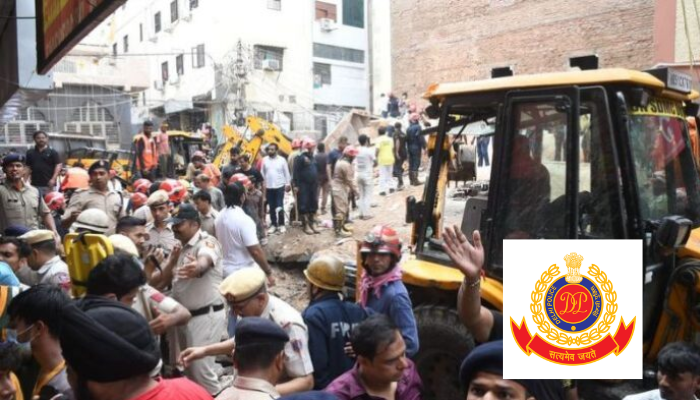
On the 6th of September 2026, a five-storey building used as a boys’ PG collapsed in Delhi’s Satya Niketan area, leaving seven dead and dozens injured. The Delhi Police promptly initiated the rescue operation and arrested the building’s owner. While the country is still deeply anguished over the loss of lives, the tragedy is being inhumanly exploited for political and ideological attacks on the BJP government. The Aam Aadmi Party (AAP) and the anti-cabal claimed that the government installed jammers at the collapse site.
AAP and anti-BJP cabal claim Delhi government installed jammers before launching rescue operation at Satya Niketan building collapse site
On 8th September 2026, AAP MLA Saurabh Bhardwaj shared video in which a YouTuber claimed that the government was doing a ‘cover-up’ of the Satya Niketan building collapse incident, by installing barricades and jammers and deploying forces.
Sharing the video, Bhardwaj wrote, “YouTube Media & Social Media is the only hope. Godi Media is a partner in crime at places like Satya Niketan. Heavy police/ paramilitary is deployed with guns to prevent social media from reporting the truth. Jammers were the first thing to be placed at building site. I think, much before Govt Ambulances, they brought jammers.”
YouTube Media & Social Media is the only hope. Godi Media is a partner in crime at places like Satya Niketan.
Heavy police/ paramilitary is deployed with guns to prevent social media from reporting truth.
Several social media users have also amplified this claim that before initiating the rescue operation, the authorities installed jammers at the collapse site while several people were stuck under debris.
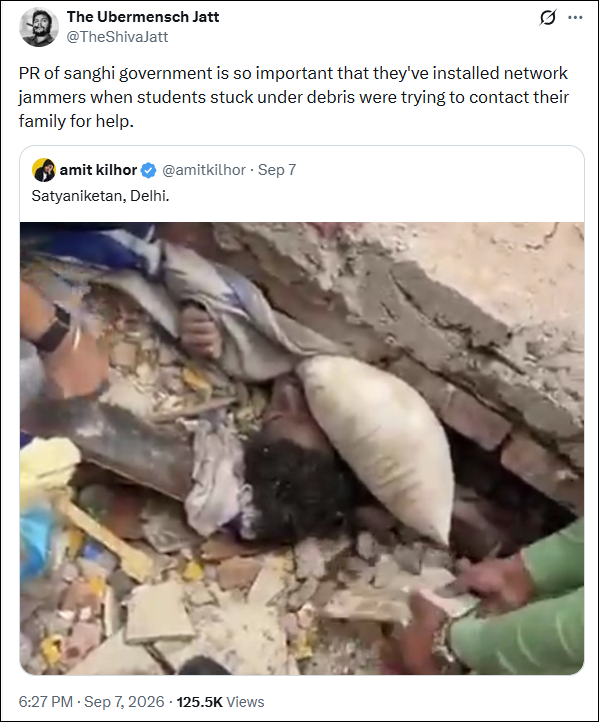
In this vein, one X user posted, “PR of sanghi government is so important that they’ve installed network jammers when students stuck under debris were trying to contact their family for help.”
Another one wrote, “They f*cking put mobile jammers at the crash site in Delhi. The children were sending videos to get rescued, people were calling Blinkit ambulances…and they put jammers!!! We are living in an extended Black Mirror episode in this country! dystopian present continuous!”
Similar narrative is being pushed on Instagram, wherein some creators claimed that the BJP government in Delhi deliberately installed jammers at the collapse site for PR, while people stuck under debris were trying to call ambulance.
“PR is so important for this government that they installed network jammers when students, stuck under debris were trying to contact their family for help,” one Instagram influencer Anuvind Kanwal posted.
This same claim has been amplified across various Instagram Reels.
One X user, Tanmoy, wrote, “This Government’s Only Weapon is Shutting Down The Internet. What a Shameful Act by the Delhi Government — They Installed Jammers in the Satya Niketan Disaster Area and Arranged things so that the Ground Reality would not get out. How Much Information Will They Block From The Rest Of The Country This Way? How Many Bodies Will They Be Able To Hide?”
This Government's Only Weapon is Shutting Down The Internet.
What a Shameful Act by the Delhi Government — They Installed Jammers in the Satya Niketan Disaster Area and Arranged things so that the Ground Reality would not get out.
The main source of this blatant misinformation is an Instagram page, The Unedited Media, which first floated the claims that jammers were activated at rescue site to prevent communications and somehow faclitate a cover up.
Delhi Police refutes ‘jammers at Satya Niketan rescue site’ claim
Contrary to the false narrative being peddled online, the Delhi Police had officially confirmed that no jammers were activated at the Satya Niketan rescue site. The police said that internet connectivity was uninterrupted before, during and after the rescue operation.
It further stated that the NDRF and Fire tender teams coordinated during the rescue operation via mobile phones. The Police also highlighted the fact that locals and media continue to broadcast on-site visuals without any internet connectivity issues.
The police also urged people to avoid engagement-farming-driven propagation of misinformation.
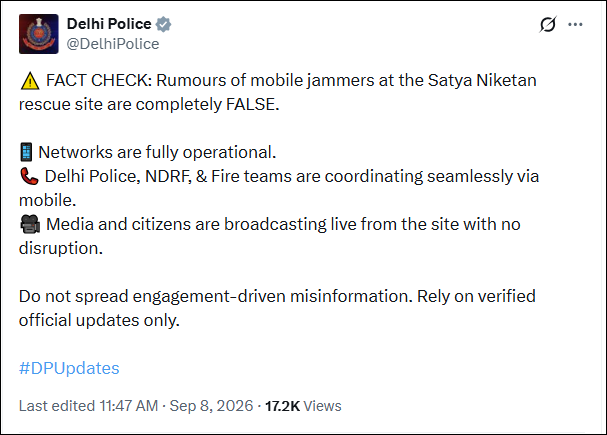
“FACT CHECK: Rumours of mobile jammers at the Satya Niketan rescue site are completely FALSE. Networks are fully operational. Delhi Police, NDRF, & Fire teams are coordinating seamlessly via mobile. Media and citizens are broadcasting live from the site with no disruption. Do not spread engagement-driven misinformation. Rely on verified official updates only.
People trapped under debris called ambulances and contacted family members: Communications from the site worked uninterrupted
Several survivors of the Satya Niketan building collapse incident confirmed that while they were stuck, they called Blinkit ambulances, sent SOS videos and messages to police and their loved ones.
One of the survivors, Aditya, a BCom first-year student, called his sister at around 2 pm, shortly after the 1:30 pm collapse. Aditya informed his sister that he was trapped and his phone’s battery was dying. He also recorded and sent an 11-second SOS video from under the debris showing his dust- and blood-covered face.
Another survivor, Neeraj Bawa, dialled one of his friends from the rubble, that help guide the rescuers.
Locals also confirmed using the Blinkit app to order oxygen cylinders and ambulances. Blinkit staff said that the first app-based emergency call came around 1:40 pm and their ambulance reached the site by around 1:50 pm. The app-based ordering and video calls require a working mobile network.
Meanwhile, the Delhi Police and NDRF teams had also swung into action and initiated a rescue operation, and there were no reports of any deliberate internet connectivity disruptions or installation of jammers for any PR gimmick by the government.
The collapsed building, known as Hostel Daze, was being used as a boys’ PG and housed several Delhi University students. It was located near Delhi University’s South Campus and opposite Sri Venkateswara College.
Police said repair and renovation work was being carried out on the ground floor when the building collapsed at around 1:30 pm on Sunday. According to the latest update from AIIMS Trauma Centre, 10 patients were brought to the hospital, of whom six were declared dead on arrival, and one later died from injuries.
The Delhi Police has arrested the owner of the five-storey boys’ paying guest (PG) accommodation that collapsed in Delhi’s Satya Niketan area on Sunday, 6th September. He has been identified as Hariram Bansal and was picked up from Bhiwadi in Rajasthan, near the Haryana border on Monday, 7th September.
The Municipal Corporation of Delhi (MCD) has also suspended five officials from its South Zone with immediate effect. The action came as rescue teams continued their search operation at the site for the second straight day on Monday.
The Eiffel Tower in Paris was closed on Monday, 7th September, after staff members went on strike, following allegations that female employees were asked to stay away from certain areas during a private visit by a Hindu religious group. The dispute stems from a visit last week by a delegation of around 100 people linked to BAPS (Bochasanwasi Akshar Purushottam Swaminarayan Sanstha). The group was in France for events connected to the inauguration of a major Hindu temple near Paris.
Eiffel Tower employees criticised the instructions they said were given during the visit, alleging that female workers were sidelined because of their gender. In a statement, staff members condemned “professional instructions that led to female employees being sidelined, replaced, and rendered invisible based on their gender.”
The employees said they were shocked by the situation. “Instructions were given to female employees of the Eiffel Tower and to female employees of contractors to make themselves invisible to welcome this delegation,” they said.
Eiffel Tower operator admits visit conditions were wrong
SETE, the company that operates the Eiffel Tower, acknowledged that the Hindu delegation had requested arrangements that would limit “interactions with women” during the visit.
However, the company said it should never have accepted such conditions. SETE said the arrangements were “not in line with SETE’s values, nor with the principles of equality between men and women” and said it would accept the consequences of what happened.
SETE president Ariel Weil also condemned the incident. “It is clearly not an acceptable practice. I restate the Eiffel Tower’s commitment to republican values and to the equality of men and women,” Weil told AFP.
BAPS policy for its Swamis
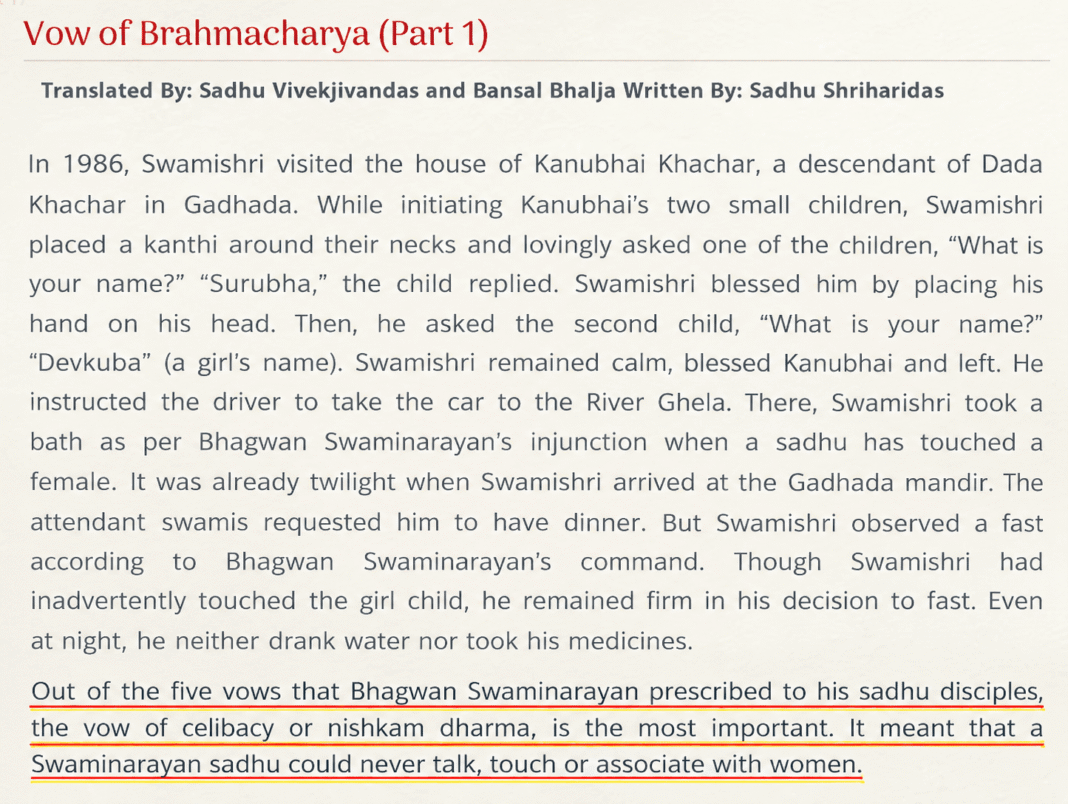
The reported request also needs to be viewed in the context of BAPS’s own religious rules for its sadhus. On its website, BAPS explains that celibacy, or nishkam dharma, is the most important of the five vows prescribed by Bhagwan Swaminarayan to his sadhu disciples. It says the vow means that “a Swaminarayan sadhu could never talk, touch or associate with women.”
BAPS also describes this as a personal spiritual discipline rather than a rejection of women, and says its sadhus are taught to respect women. Its published material provides examples of sadhus avoiding situations in which their religious vows could not be maintained.
That religious practice, however, does not necessarily justify shifting the burden of those restrictions onto employees at a public workplace. If a visiting delegation requires its religious representatives to avoid interacting with women, the more appropriate solution would be to organise the visit so that those representatives can follow their vows without asking female employees to leave their posts or avoid particular areas.
The Eiffel Tower is the workplace of its staff, and asking women to step aside or making them effectively invisible because of their gender raises a separate issue of workplace equality. The concern, therefore, is not about mocking or attacking a religious practice, but about whether that practice was allowed to dictate how local employees could perform their jobs.
BAPS responds to allegations
BAPS, which consecrated its first major temple in France near Paris on Sunday, 6th September, responded after the staff protest. The organisation said it respected the concerns raised by the Eiffel Tower employees and was taking them seriously.
BAPS said the visit had been planned in coordination with Eiffel Tower staff because of the size of its delegation and was scheduled at the beginning of normal opening hours to reduce disruption to other visitors.
Nous comprenons les préoccupations exprimées et les prenons très au sérieux.
Compte tenu de la taille de notre délégation, la visite a été organisée en coordination avec les équipes de la tour Eiffel, au début des horaires habituels d’ouverture, afin de limiter autant que… pic.twitter.com/gyiwzmh6Jv
— BAPS Mandir Swaminarayan Hindou de Paris (@BAPSParis) September 7, 2026
“To our knowledge, at no time was access to the Eiffel Tower denied to anyone,” the organisation said.
It added, “Nevertheless, we wish to offer our sincere apologies to anyone who may have been hurt or inconvenienced by this situation. We are deeply committed to the universal values of mutual respect and service to others.”
French leaders demand investigation
The incident has also triggered a strong political reaction in France. Paris Mayor Emmanuel Gregoire said an investigation would be launched “as soon as possible” and said he understood the anger among Eiffel Tower employees.
Je prends connaissance du mouvement de colère des salarié·es de la tour Eiffel et je veux leur dire que leur mécontentement est légitime.
Il n’est pas acceptable que de telles conditions puissent être tolérées. Ce ne sont ni mes valeurs, ni celles que doit porter la tour Eiffel,… https://t.co/3srttJpxPo
“All light must be shed on the facts that led to this protest,” Gregoire wrote on X.
French Equality Minister Aurore Berge also criticised the reported instructions, saying, “In France, we do not ask women to erase themselves. No dogma, no religion is above the laws of the Republic.”
The incident has therefore raised a difficult but important question: religious groups should be free to follow their own beliefs, but when those beliefs are being accommodated in a public workplace, that accommodation should not come at the cost of treating employees differently because they are women.
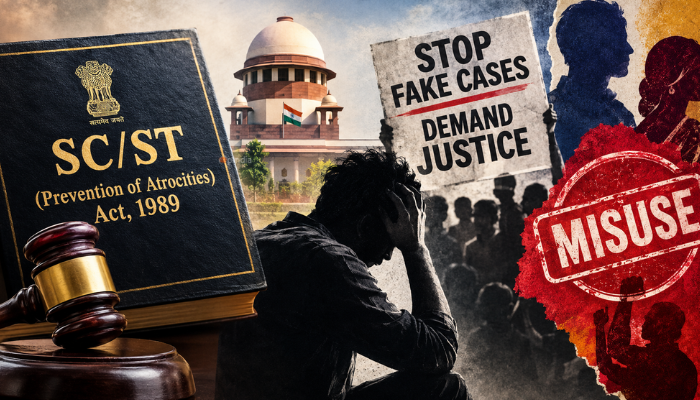
When laws encourage lawlessness and are turned into a means of destroying innocent lives and financial greed, they deserve serious scrutiny. In recent years, a debate has been going on over the gross misuse of the Scheduled Castes and Scheduled Tribes Prevention of Atrocities Act or the SC/ST Act of 1989. From ordinary citizens to the courts, concerns have been raised about fake SC/ST Act cases used to falsely implicate individuals belonging to the general and OBC categories for vengeance and to obtain financial compensation, diluting the law’s credibility.
The SC/ST Act was claimed to have been enacted to provide stronger protection against caste-based violence and discrimination. The law lists various offences relating to various patterns or behaviours inflicting criminal offences and breaking the self-respect and esteem of the Scheduled Castes and Scheduled Tribes community, which includes denial of economic, democratic, and social rights, discrimination, exploitation, and abuse of the legal process.
Under Section 18 of this Act, provision for anticipatory bail is not available to the offenders. Any public servant who deliberately neglects his duties under this Act is liable to punishment with imprisonment for up to 6 months. An amendment was added to the original Act in 2015 to make the Act more stringent by adding more instances of “atrocities” as crimes against SCs and STs.
However, over the years, a pattern of the weaponisation and misuse of the SC/ST Act has emerged. Those eligible to invoke the SC/ST Act are misusing the law in cases of personal disputes, property matters, or for financial compensation.
When the Supreme Court acknowledged the possibility of the misuse of the SC/ST Act
A major Supreme Court observation in this regard came in the 2018 Dr Subhash Kashinath Mahajan v. State of Maharashtra case, in which the court noted the possibility of the SC/ST Act being used for “extraneous considerations”.
The Supreme Court had ruled that additional safeguards must be provided to civil servants before arresting them under the SC/ST Act. The Court stated that the approval of an appointing authority or an S.S.P is required before arresting a public servant accused under the Act.
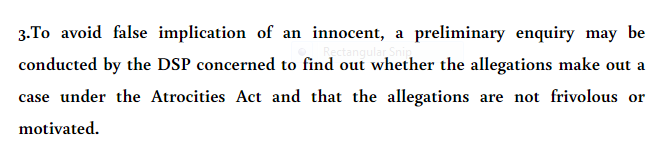
Those opposed to any scrutiny of the SC/ST Act also mentioned that to avoid false implications, a preliminary enquiry by the DSP must be conducted to find out whether the charges are correct and not frivolous.
The Central government had moved a review petition before the Supreme Court for this ruling. However, the court rejected the petition, stating that its judgment is not in conflict with the SC/ST Act and does not dilute it in any way. Rather, the ruling only flagged the issue: “Can the liberty of an innocent be taken away without application of mind? We only said protect an innocent from being falsely implicated under the Act, which has stringent provisions. People agitating may not have read the judgment. They may have been misled.”
Following the original court ruling, widespread violence erupted across several states after Dalit groups called for a Bharat Bandh.
Months later, in August 2018, the Modi government passed the bill to reverse the Supreme Court’s order. Later, in October 2019, the Supreme Court restored the original provisions of the SC/ST Act, stating that the previous order had strayed into the legislative domain.
The NCRB conundrum
The vote bank politics and street veto prevented the SC/ST Act from undergoing the much-needed reforms. As the SC/ST Act achieved a reservation-like sacrosanctity, there has been a dramatic surge in the filing of SC/ST Act cases, as per the National Crime Records Bureau of India (NCRB) data.
The NCRB’s “Crime in India” reports show FIRs registered under the SC/ST Act or related BNS sections when the Act is invoked. The NCRB data does not, at the point of registration, distinguish between incidents that courts later treat as genuine caste-motivated atrocities and those arising from ordinary quarrels devoid of any caste angle, land disputes, or other vengeful motives.
The subsequent police disposal tables, however, do classify outcomes, some as “final report false”, “mistake of fact or of law”, or “true but insufficient evidence”.
However, treating every crime registered against SC/ST individuals as ‘atrocity’ is wrong and misleading, since the data does not specifically distinguish between which FIRs reflect genuine caste-based crimes and which reflect agenda-driven fake cases.
Simply put, the NCRB data reflects any case registered under the SC/ST Act, rather than independently verifying or filtering whether each case involved a proven, direct caste-based motivation. The NCRB simply records or compiles the data it receives from various state and UT police departments. It does not audit or probe or in any way re-evaluate the foundational intent of an FIR before publishing numbers.
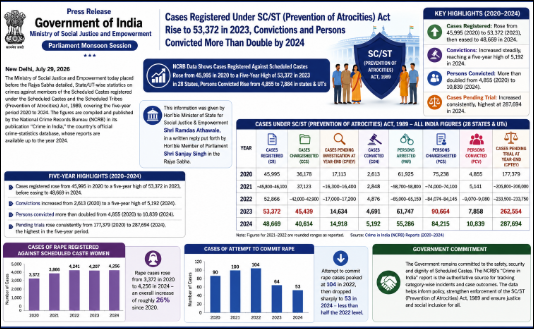
As per a written reply in Parliament by the Minister of State for Social Justice & Empowerment, Ramdas Athawale, cases registered under the SC/ST Act stood at 45,995 in 2020, of which 36,178 were chargesheeted, 17,113 remained under investigation at the year-end, and 2,613 ended in conviction. Similarly, a total of 61,925 persons were arrested that year, 75,238 were chargesheeted, and 4,855 were convicted, while 177,379 cases remained pending trial at year-end.
Meanwhile, in 2021, cases filed under the SC/ST Act stood at around 45,800 to 46,100, with 37,123 chargesheeted and about 16,300 to 16,400 pending investigation. The convictions increased to 2,848, with arrests totalling roughly 58,700 to 58,800, and around 74,000 to 74,100 persons were chargesheeted. The pending trials surged further to around 2,05,800 to 2,06,000, and 5,141 persons were convicted.
Source: PIB
In 2022, SC/ST Act case registrations increased dramatically to 52,866 cases, with roughly 42,000 to 42,900 chargesheeted and about 17,000 to 17,200 cases pending investigation. The convictions doubled from the previous year to 4,876. The arrests numbered around 65,000 to 65,150, persons chargesheeted numbered between 84,074 and 84,145, and persons convicted rose sharply to roughly 9,070 to 9,080. The cases pending trial rose to between 233,500 and 233,750.
The year 2023 witnessed a five-year high with registration of 53,372 SC/ST Act cases, of which 45,439 were chargesheeted, 14,634 were pending investigation, and convictions stood at 4,691. Total arrests stood at 61,747. In 2024, cases came down to 48, 669, though convictions rose to 5,192.
Between 2018 and 2022, conviction and charge-sheeting rates have remained low despite a rise in case numbers, with conviction rates falling from 39-40% in 2020 to 32-33% in 2022. In addition, 60% of cases registered under the SC/ST Act ended in acquittal or discharge.
Between the years 2019 and 2023, while total reported atrocities against Scheduled Castes surged to a five-year peak of 53,372 cases in 2023, around 14% to 15% of all disposed cases annually were essentially concluded without reaching trial under these final closure report grounds.
In 2020, the Rajasthan Police declared that more than 40% of cases filed under the SC/ST Act were fake.
The majority-acquittal outcome across the board indicates that a significant share of cases registered under the SC/ST Act were never caste-based atrocities to begin with.
While in some cases it may be true that there was a shoddy investigation or perhaps a cover-up to save the perpetrators, or witnesses turn hostile after out-of-court ‘settlement’, the consistently low conviction rates and high final report closures indicate a systemic misuse and weaponisation of a law meant for protection from caste-based atrocities, for caste-based vengeance and financial gains.
Major cases wherein the court found blatant misuse of the SC/ST Act provisions
In the wake of the rampant weaponisation of the SC/ST Act, people belonging to the general and the OBC category have begun fearing any legitimate public criticism of topics ‘sensitive’ to the SC or ST community, be it caste-based reservations, reforms in reservations, Dr BR Ambedkar or the blatant Hinduphobia displayed by a section of ‘Ambedkarites’.
There have also been incidents wherein individuals were threatened with fake SC/ST Act cases out of sheer hatred for the general category individuals, for coercing others into favourable land dispute settlements or for compensation.
In 2020, people in a village in the Firozabad district in Uttar Pradesh fled the village due to fake cases registered against them under the SC/ST Act. Reports said that residents of Gothua village had sold their homes and moved to other places due to harassment from fake cases. Villagers have written on the outside walls and doors of their houses that they will be sold.
BJP leader who was killed over a petty dispute was falsely implicated under the SC/ST Act
In March 2021, Dhirendra Bahadur Singh, a 52-year-old booth president of the Bharatiya Janata Party, was found brutally killed in Pithapur Malak village in the Pratapgarh district in Uttar Pradesh. It was alleged that the murder was a fallout of a dispute between two parties over sugarcane. Singh had intervened in the dispute between two people over cutting sugarcane from a field without permission.
While the issue seemed to have been resolved, Dhirendra was later beaten to death by two brothers, Ranjeet and Vipin Saroj, of the nearby Hatsara Mangapur village after he tried to intervene in their fight. Dhirendra Singh’s killers have previously tried to implicate Singh in a false SC/ST case. It was reported that locals alleged that the accused often misused the Act to threaten the people of the village.
Woman abused and molested, threatened with fake case under the Act when she resisted
In late March 2021, Narendra Kumar Nirmal, a teacher belonging to the SC/ST community, was accused of threatening a woman with a fake case under the Act if she resisted molestation. The incident happened in Samaspur Salwara village, falling under the Manikpur police station area of Pratapgarh, Uttar Pradesh.
Maratha girl falsely booked under the SC/ST Act for opposing the vandalism of a Hindu temple
In March 2021, it was reported from Maharashtra that a young Maratha girl was molested, brutally beaten up and booked under the SC/ST Act for opposing the vandalism of a Hindu temple. A mob of 15-20 people had reportedly attacked her genitals and other sensitive body parts with stones.
The victim’s family had alleged that some Dalit locals in the village tried to demolish their Hindu temple, in a bid to build an Ambedkarite temple. The victim had resisted these attempts. The Maratha girl was beaten, flogged, her genitals were mutilated, and she was also booked under the SC/ST Act.
Brahmin man Vishnu Tiwari wrongfully imprisoned for 20 years on false charges of rape and SC/ST Act
In February 2021, a Brahmin man named Vishnu Tiwari was set free by the Allahabad High Court after he spent 20 years in jail on false charges of rape and the SC/ST Act.
Tiwari, a resident of Lalitpur village, was booked on charges of rape, sexual exploitation, and criminal intimidation under the Indian Penal Code (IPC) and other sections of the SC/ST (Prevention of Atrocities) Act, when a woman from Silawan village, which is 30 km away from his place, accused him of raping her. He was held guilty by a trial court and sentenced to life imprisonment at the age of 23 in the year 2000. In the 20 years he spent in jail, Tiwari lost all his family members.
The Court’s acquittal was based on the medical examination report, which said that no sperm or injuries were found on the prosecutrix, who was five months pregnant at the time. Her testimony also indicated that she was not a ‘stellar witness’.
Professional disagreement, workplace grievances can’t be automatically charged under SC ST Act, unless specific casteist abuse in public: Calcutta HC
In February 2026, the Calcutta High Court stated in an order that all kinds of professional disagreements, administrative disputes or instances of facing workplace humiliation cannot automatically attract offences under the SC ST (Prevention of Atrocities) Act, unless there is clear caste-based insult or abuse in public view.
The HC quashed proceedings against a Sanskrit professor under the SC ST Act, saying that though the complainant belongs to the SC community, the incident of altercation and insult cannot be called a caste-based atrocity and does not come under Section 3 (1)(r) of the Act.
The professor has a PhD in Sanskrit and had served as Head of the Department of Sanskrit at Sanskrit College & University. She was accused by an assistant professor of the same university, who belongs to the SC community, of professional jealousy and harassment.
The complainant had alleged that the accused had excluded him from departmental decisions, stopped his classes, obstructed him from performing his departmental duties and insulted him during an online meeting using objectionable language. He had alleged that the HOD’s behaviour was motivated by his caste identity. The court, however, found no substance in this claim, and thus set aside the charges under SC -ST Act.
A woman filed three SC/ST cases for vengeance against Mumbai professor for questioning reservation eligibility
In March 2026, the Bombay High Court quashed a 16-year-old case against advocate and law professor Virendranath B. Tiwari, who was booked under the provisions of the SC/ST Act. The complainant named Chitra Shalunkhe had three cases against Tiwari.
In all three cases, the complainant invoked provisions of the SC/ST Act, each stemming from broadly similar allegations. In the earlier two instances, Tiwari had already been acquitted or discharged. Yet, an FIR was registered once again, this time over a 2007 incident where Shalunkhe alleged that Tiwari questioned her academic qualifications and credentials for a reserved post and assaulted her.
The court, however, found no caste-based offence, and Justice Bhobe noted that initiating proceedings “for the third time” on similar grounds appeared to be “an act of vengeance aimed at causing harassment and humiliation” to the accused, a 74-year-old senior citizen.
Woman misused SC/ST Act and filed fake rape case against ex-boyfriend
In November 2025, an SC/ST Special Court sentenced a woman named Rinki to three and a half years of imprisonment, along with a fine of Rs 30,000. The court mandated that any assistance she obtained from the state government must be returned. This came after the convict lodged a false rape and SC/ST case against her former boyfriend as an act of revenge. Special Judge Vivekananda Sharan Tripathi pronounced the verdict.
A family in Aligarh extorted Rs 46 lakhs by misusing the SC-ST Act and had filed 15 fake cases in 10 years for compensation
In a classic case of how the SC/ST Act is misused, a woman named Chandrawati Devi, a resident of Hastpur village, and her allegedly misused government schemes meant for Scheduled Castes (SC) and fraudulently pocketed around ₹46 lakh.
It was reported that in the last 10 years, 15 different cases have been registered against Chandrawati Devi and her family. Many of these cases were filed under the SC/ST (Prevention of Atrocities) Act, 1989.
Under this law, victims are provided financial assistance and legal protection. The allegation is that Chandrawati and her family repeatedly filed false cases to avail the benefits of these schemes and have so far received nearly ₹46 lakh.
Allahabad University assistant professor lodged fake SC/ST Act cases against three senior colleagues
In February 2024, the Allahabad High Court quashed a 2016 FIR registered on the complaint of an Allahabad University assistant professor, and imposed a fine of ₹15 lakh on her.
The complainant was found to have falsely accused her colleagues of various offences, including voyeurism and criminal intimidation. She had also made allegations of offences under the Scheduled Castes and Scheduled Tribes (Prevention of Atrocities) Act.
While quashing the FIR, Justice Prashant Kumar said, “This is a case where a Professor had to pay a very heavy price for asking an Assistant Professor to take classes and teach properly. He was made an accused in a frivolous and malicious criminal case and had to face trial for last eight years, and further had to face humiliation, stigma, for no fault of his own, and on the other hand, the complainant, by misusing the provisions of Scheduled Castes and the Scheduled Tribes (Prevention of Atrocities) Act, 1989 (hereinafter referred as ‘the S.C./S.T. Act’), had been using as a weapon and threatened the other seniors from taking any action against her.”
Dalit woman falsely implicated general category lover in SC/ST Act case
In June 2025, a 22-year-old Dalit woman named Rinki filed a complaint at Mohanlalganj in Uttar Pradesh, alleging that a man named Deepak, from the general category, raped her on the pretext of marriage. Deepak, who was in a relationship with the complainant for five years, was then booked under the provisions of the SC/ST Act along with rape charges. Rinki filed a fake rape and caste atrocity case against Deepak after the latter married someone else.
Karnataka HC quashed it after it turned out that the SC/ST Act was weaponised in an employment dispute
In February 2026, the Karnataka High Court quashed a 2025 FIR involving individuals from the Bengaluru North University, over apparent procedural lapses and the absence of a prima facie atrocity. The court held that an employment dispute cannot be simply turned into a caste-atrocity case merely because the respondent belonged to a non-SC/ST category.
Even noted public figures do not shy away from threatening SC/ST Act cases against people not acting as per their whims
Not only common people, but even many public figures have no qualms about boasting that they would misuse the SC/ST Act if something does not happen as per their whims. In January this year, Vanchit Bahujan Aghadi (VBA) president and grandson of Dr B.R. Ambedkar, Prakash Ambedkar, threatened to pursue legal action against Maharashtra’s Water Resources Minister and BJP leader Girish Mahajan for mere failure to mention Dr B.R. Ambedkar during his Republic Day address.
He alleged that not mentioning the name amounts to an atrocity crime under the Scheduled Castes and Scheduled Tribes (Prevention of Atrocities) Act, and therefore, a case should be registered under the draconian law.
Political encouragement for weaponising the SC/ST Act
In April this year, Kerala Congress leader CP Mathew publicly urged women leaders of his party to file complaints to make cases stronger when confronting political opponents. He also mentioned that women could tear their own clothes and then go to the police, adding that this would help build stronger cases against rivals. Mathew also encouraged women from the SC and ST communities to invoke the SC/ST Act, saying that it would make the cases more serious from a legal point of view.
"ഒരു രാഷ്ട്രീയ സംഘർഷത്തിന് സാധ്യതയുണ്ടായാൽ വനിത പ്രവർത്തകർ സ്വയം ബ്ളൗസ് വലിച്ച് കീറണം" എന്നൊക്കെ പറയുന്നത് പബ്ലിക്കായി പ്രസംഗിക്കാൻ മാത്രം വല്യ ക്രെഡിറ്റ് ഉള്ള കാര്യമാണ് എന്നാണ് ഇടുക്കി ജില്ലാ കോൺഗ്രസ് കമ്മിറ്റി പ്രസിഡന്റ് സി പി മാത്യു ധരിച്ച് വെച്ചിരിക്കുന്നത്…. 🤷🏽♂️
The game of compensation: what the law says and how compensation is the fundamental reason why fake SC/ST cases are filed
Beyond vengeance, there is a lesser-talked-about reason for the significant surge in filing of fake SC/ST Act cases: compensation. Under the SC/ST (Prevention of Atrocities) Rules, 1995, as amended in 2016, complainants are entitled to monetary relief at multiple stages. This monetary relief is disbursed immediately on FIR registration, as interim relief during trial, and as final compensation on conviction.
Roughly, 25% to 50% of the amount is released by the District Collector within seven days of the FIR’s filing, another 25% after the chargesheet is filed, and the balance on conviction, drawn from a schedule that ranges between ₹1 lakh for offences like caste slurs up to ₹8.25 lakh for murder or gang rape.
It is crucial to note that this financial relief is linked to registration and charge-sheeting; these stages occur well before any court has even tested the allegation, and not conviction alone.
Since a substantial portion of the compensation is required to be disbursed upon the registration of an FIR, this framework ends up incentivising the filing of frivolous SC/ST Act cases for compensation money. While recovery of the amount after a case turns out to be false or ends in acquittal, it is not automatic and is, in most cases, incomplete.
What is even more alarming is that there are well-oiled broker networks actively involved in the systematic filing of cases under the SC/ST Act by falsely implicating upper-caste individuals to obtain compensation.
In August 2025, a Special SC/ST Court in Lucknow sentenced a lawyer to life imprisonment after he was convicted of filing false rape cases under the Scheduled Castes and Scheduled Tribes (Prevention of Atrocities) Act, 1989. The advocate, named Parmanand Gupta, used a Dalit woman working under his wife to file a large number of fake rape cases against various men. The scam was exposed after the Dalit woman revealed everything after becoming an approver in a case.
Pooja Rawat had filed 12 such cases through advocate Parmanand Gupta, in which she levelled serious allegations, including rape, against the accused persons, and invoked the SC/ST Act. During the trial of one of the cases, it was revealed that she was not even present at the alleged crime scene and had never even met the accused persons. Apart from this, Parmanand Gupta himself filed around 18 cases against various persons.
Courts raise alarm over misuse of SC/ST Act for compensation
Recently, the Allahabad High Court bench of Justice Santosh Rai directed the Uttar Pradesh Government to initiate an inquiry into the process through which benefits under the SC/ST Act and the Rules framed thereunder are claimed and disbursed. The court directed particular scrutiny into the cases involving repeated claims by the same complainants or family members.
The direction was issued to the UP government when the court heard the case of one Santosh Kumar Dohrey, an advocate by profession, and his family members received roughly ₹23,36,250 in financial relief or compensation across various criminal cases under the 1995 Rules.
The court also noted that around 10 to 12 further cases involving claims for relief by the same advocate and his family were currently pending before the concerned District Level Committee. The court stressed that the SC/ST Act relief scheme’s integrity must be “zealously safeguarded”.
In November 2024, the Allahabad High Court had raised concerns over the misuse of the SC/ST Act and relief scheme to obtain compensation for a caste atrocity that was never committed.
The court stressed the need for a thorough verification before registering the FIR under the SC/ST Act to assess the credibility of the allegations and protect people from being falsely implicated under the stringent law.
The court said this after a complainant admitted before the court that he had filed a false FIR under the pressure of the villagers. The complainant had received over ₹75,000 from the state as compensation. The court directed that the amount be given to the accused.
Madhya Pradesh High Court judge raises concern over misuse of SC/ST Act, says brokers get involved in such cases for compensation
In January 2025, Madhya Pradesh High Court judge Vivek Agarwal raised alarms over the rampant misuse of the SC/ST Act. He also expressed concern over the misuse of laws related to crimes against women.
Addressing a division-bench workshop, Justice Agarwal said, “If we have the right, we also have the duty to ensure that an innocent person is not wrongfully punished. It is imperative to filter out inconsistencies and bring out the truth.”
The High Court judge also warned the public prosecution and police administration about the provision of compensation in the SC/ST Act. He said that as soon as such cases come to light, many middlemen also become active and trap innocent people in the name of getting compensation for the complainant. The judge also highlighted how middlemen or brokers exploit the legal system by filing bogus cases under the SC/ST Act to procure compensation for the victims and then claim a share in the payout.
“Many times people are falsely implicated in SC/ST cases. Investigating officers should take care that in such cases innocent people are not implicated and the guilty should not escape. In this case, the administration, police and judiciary are lacking somewhere. Therefore, during the investigation, we should keep in mind that our credibility is not being damaged because of the middlemen. If we have the right, we also have the duty to ensure that an innocent person is not wrongfully punished. It is imperative to filter out inconsistencies and bring out the truth,” Justice Agarwal said.
Centre proposes 40% compensation hike even as cases of SC/ST Act misuse increase
While alarms have been raised about the growing alleged misuse of the SC/ST Act for compensation, the Modi Government proposed a 40% increase in compensation for SC/ST victims of atrocities, based on the rise in the Consumer Price Index (CPI).
The minimum compensation is expected to rise to ₹1 lakh and the maximum to about ₹12 lakh, according to those privy to the development. The proposal has been sent to the Expenditure Finance Committee for approval.
While those who file false cases obtain their vengeance or financial compensation, those falsely implicated in SC/ST Act cases lose their reputation, their precious years of life, their dignity, and they and their family suffer due to a lifelong stigma of imprisonment, making it impossible for them to start afresh with the same confidence, respect and dignity they had before such cases. This blatant abuse of the system for money must not be allowed to persist and thrive. This fake caste atrocity-based extortion and fraud must be stopped.
On Pakistan Air Force Day, the PAF released a heavily graphics-driven video portraying an alternate version of the May 2025 conflict with India. Titled Fizaon K Pasbaan, the video claims that Pakistan struck as many as 32 Indian Air Force bases, destroyed two S-400 air-defence systems and shot down multiple Indian aircraft.
😂😂😂😂😂😂
Pakistan’s entire video for ‘Op Chaddi Banyan Marsoos’ or whatever is made with AI.
There is, however, a glaring problem with this grand military victory presented on screen: the video offers virtually no real footage of the destruction it claims to have caused.
Instead, viewers are treated to computer-generated explosions, animated maps, digitally rendered aircraft and fictionalised strike sequences.
For a country that has spent more than a year claiming spectacular military victories over India, the PAF’s latest production is a remarkably convenient substitute for evidence.
Pakistan has been making these claims since Operation Sindoor
The pattern is not new.
Ever since India launched Operation Sindoor in May 2025, Pakistan’s military establishment and its information ecosystem have repeatedly circulated claims of having inflicted devastating damage on Indian military assets and aircraft.
Indian aircraft were supposedly shot down in large numbers. Indian airbases were supposedly destroyed. S-400 systems were supposedly eliminated. Indian military infrastructure was supposedly crippled.
The latest PAF video simply collects many of those claims and packages them into a slick cinematic narrative.
The difference this time is that Pakistan has apparently decided that when photographs, satellite imagery and authentic strike footage are unavailable, AI-generated visuals can fill the gap.
The video boldly announces that 32 Indian air bases were hit and depicts strikes on major Indian military targets. It also claims the destruction of four Rafales, a Su-30MKI, a MiG-29, a Mirage-2000 and a Heron UAV.
But where are the photographs?
Where are the satellite images?
Where is the identifiable runway damage?
Where are the destroyed hangars?
Where is the wreckage?
The PAF video provides none of the visual evidence one would ordinarily expect to accompany claims on this scale. Instead, it simply animates the alleged destruction.
The S-400 claim gets an AI makeover
Perhaps the most revealing example is the alleged destruction of India’s S-400 systems.
Pakistan had already claimed during the conflict that it had destroyed an Indian S-400 air defence system. India rejected the claim, which became part of Islamabad’s broader information campaign surrounding Operation Sindoor. The claim was further undermined when PM Modi visited Adampur Air Base, where the S-400 system that Pakistan had claimed to have destroyed was visibly deployed.
Now, more than a year later, the PAF has brought the same narrative back, only this time with an animated strike sequence.
The message seems to be: if the original claim could not be backed up with convincing evidence, perhaps it can be made more believable with better graphics.
That is not military evidence.
That is propaganda with a production budget.
From destroyed airbases to a destroyed India
The PAF video goes far beyond aircraft and air-defence systems.
Its graphics claim that Pakistan struck 32 Indian Air Force bases and disrupted India’s national power grid and fuel supply chain. It also depicts attacks on major Indian targets, including Parliament and INS Vikrant.
The scale of the claims is extraordinary.
The evidence presented for them is not.
A computer-generated missile striking an Indian target is not footage of that target being struck. An animated aircraft exploding is not proof of a shoot-down. A digital depiction of an S-400 being destroyed is not satellite imagery of an S-400 being destroyed.
Animation can illustrate a claim. It cannot authenticate one.
Pakistan has no evidence to back its claim. Which is why it had to rely on AI to create a video. India, on the other hand, had nothing to hide and had evidence in the public domain, with pictures available on the internet of the extent of damage Pakistan faced during Operation Sindoor.
The contrast with Operation Sindoor documentary could not be sharper
And this is where the timing of the PAF video becomes particularly interesting.
India’s Declassified: Operation Sindoor, released by Discovery and discovery+ on August 15, sought to document the 88-hour military operation through the testimony of India’s senior military and security leadership and actual operational material.
The documentary put India’s military triumph on screen through real footage and imagery of the operation and the destruction inflicted on Pakistani military infrastructure.
Pakistan’s answer is now a graphics-heavy production showing the destruction of India.
The contrast could hardly be more stark:
India: Here is the footage.
Pakistan: Here is the animation.
The PAF’s production therefore appears less like a documentary rebuttal and more like an attempt to create a visual counter-narrative after India’s documentary put the military operation back in the spotlight.
Pakistan’s problem: the claims keep getting bigger
The most striking feature of Pakistan’s propaganda campaign since Operation Sindoor has been the sheer scale of its alleged victories.
First came claims of Indian aircraft being shot down.
Then came claims of Indian airbases being destroyed.
Then came claims involving S-400 systems.
Now the PAF’s official video presents a sweeping catalogue of supposed Pakistani successes: dozens of Indian bases hit, advanced air-defence systems destroyed, multiple aircraft eliminated and critical Indian infrastructure disrupted.
With every retelling, the Pakistani version of the war becomes more spectacular.
But spectacular claims require spectacular evidence.
And instead of releasing photographs, satellite imagery or authenticated combat footage showing the alleged destruction, the PAF has released an animated reconstruction of it.
That tells its own story.
When reality is inconvenient, create it digitally
The irony is difficult to miss.
Pakistan is not merely disputing India’s account of Operation Sindoor. It is attempting to construct an entirely different visual memory of the conflict.
The latest PAF video gives Pakistan the perfect battlefield: one where every Indian target can be shown exploding, every Pakistani strike can be depicted as successful, and every military claim can be presented without having to confront the inconvenient question of evidence.
The explosions are real only inside the animation.
The destruction exists on the screen.
And the proof remains conspicuously absent.
More than a year after Operation Sindoor, Pakistan’s military establishment is still trying to sell the same narrative, only now with AI and computer-generated graphics doing the work that photographs and battlefield evidence were supposed to do.
If Pakistan really has the evidence to support its claims of destroying Indian military targets, it should release the evidence.
Until then, the PAF’s latest production looks less like a response to Declassified: Operation Sindoor and more like an attempt to manufacture, through animation, the victory that Pakistan has been claiming since May 2025 to continue to mislead its population.
In another shocking example of the extent of its appeasement politics, the UPA government, led by then Prime Minister Manmohan Singh, released 25 Pakistani terrorists from Indian jails in 2010 as part of what was described as a “goodwill gesture” towards Pakistan. The group included terrorists linked to terror organisations such as Lashkar-e-Taiba (LeT), Hizbul Mujahideen (HM) and Jaish-e-Mohammed (JeM). The detainees were released on the advice of the Union Home Ministry and were later deported to Pakistan through the Wagah border.
God help our country! Shame! Pak terrorists freed in goodwill gesture – http://tinyurl.com/327q4qk
The decision came shortly before Manmohan Singh’s planned visit to Jammu and Kashmir in June 2010.
The terrorists had been detained under Section 19(1) of the Jammu and Kashmir Public Safety Act. Some had been shifted to prisons outside Jammu and Kashmir because of security concerns. Reports at the time said the detainees had also been given consular access before their release. The 25 Pakistani prisoners were eventually handed over to Pakistani authorities.
Among those released from different prisons were Noor Mohammad, Abdul Rashid, Nazir Mohammad, Mohammad Shafi, Rahim Din, Mohammad Sharief Malik, Karamat Hussain and Suhail Ahmad Kataria. Others were lodged in prisons including Agra, Naini, Varanasi, Tihar, Jodhpur and Sangrur.
Shahid Latif: The ‘goodwill gesture’ that came back to haunt India
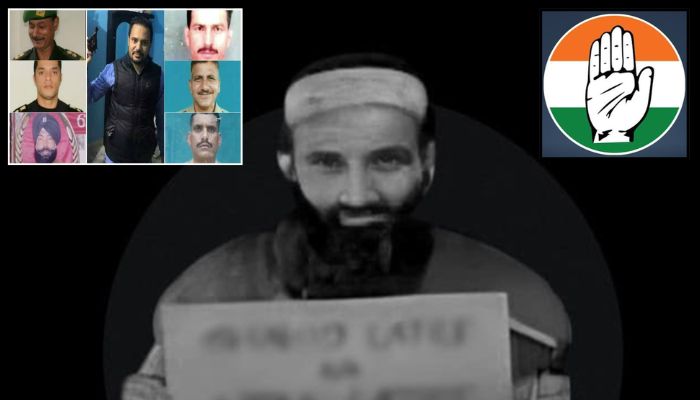
One of the most controversial names in that list was Shahid Latif, a Jaish-e-Mohammed terrorist who had spent 11 years in an Indian prison. Latif had been arrested in Jammu and Kashmir in 1994 after infiltrating the Valley a year earlier. He was later deported to Pakistan following his release in 2010.
Latif was among the 25 militants released on 28th May, 2010. The release was part of the UPA government’s effort to their version of improving relations with Pakistan, a nation that carried out multiple terror attacks on India before 2010. After returning to Pakistan, Latif rejoined Jaish-e-Mohammed and eventually became an important figure in the organisation’s Sialkot network.
The consequences became particularly significant after the Pathankot terror attack in January 2016. Intelligence and investigation agencies identified Latif as the chief handler of the JeM terrorists who carried out the attack. The National Investigation Agency’s case records describe the Pathankot assault as an attack by heavily armed terrorists suspected to be from Pakistan and linked to the Pakistan-based JeM.
Pathankot attack: Seven security personnel killed
On 2nd January, 2016, heavily armed terrorists attacked the Indian Air Force station in Pathankot, Punjab. The attackers had infiltrated from Pakistan and targeted a strategically important military installation.
The security forces launched a major operation to contain the terrorists and protect the sensitive areas of the airbase. The Indian Air Force, Army, National Security Guard and other security agencies took part in the operation. The terrorists identified as Nasir Hussain, Hafiz Abu Bakar, Umar Farooq, and Abdul Qayum were neutralised after a prolonged counter-terror operation. The Ministry of Defence said the security forces prevented the attackers from reaching the technical area where aircraft, weapons and fuel storage facilities were located.
According to the Union Home Ministry, seven security personnel and one civilian were killed in the attack, while 37 security personnel and another civilian were injured. All the terrorists involved were eventually neutralised.
Investigators later linked Shahid Latif to the attack and identified him as the mastermind who helped coordinate the fidayeen squad. He arranged logistics including weapons, clothes, medicines and other supplies for the attackers. He was also described as being close to JeM chief Masood Azhar.
Shahid Latif killed in Pakistan in 2023
Nearly seven years after the Pathankot attack, Shahid Latif was himself killed in Pakistan. On 11th October, 2023, unidentified gunmen shot Latif and his brother near the Noor Madina mosque in Daska, in Pakistan’s Sialkot district.
According to officials, three motorcycle-borne attackers opened fire after Latif came out of the mosque following pre-dawn prayers. Latif was killed along with his brother. No group immediately claimed responsibility for the attack. Pakistani authorities described the incident as a targeted killing.
Latif had been designated a terrorist under India’s Unlawful Activities (Prevention) Act and was considered one of India’s most wanted terrorists. Indian officials said he had become a key JeM commander after being deported to Pakistan in 2010.
Vajpayee government had refused to release Latif during the IC-814 hijacking.
Shahid Latif’s release had previously been sought by Jaish-e-Mohammed terrorists during the 1999 hijacking of Indian Airlines flight IC-814.
The hijackers had demanded the release of several terrorists, including JeM founder Masood Azhar. The then Atal Bihari Vajpayee government released Azhar, Mushtaq Ahmed Zargar and Omar Sheikh in exchange for 154 passengers held hostage in Kandahar. However, Latif and several other names on the terrorists’ demand list were not released at that time.
Latif was instead kept in Indian custody and was later moved to Varanasi jail following the IC-814 hijacking and the 2001 Parliament attack, with concerns that his associates could try to free him from J&K. Yet, years later, the UPA government released him along with 24 other Pakistani militants as part of its outreach to Pakistan.
The decision by the UPA government to release these 25 detainees in 2010 without securing the release of a single Indian prisoner from Pakistani custody clearly reflects a strategy centred on appeasement politics in the name of a “goodwill gesture”.
US President Donald Trump randomly lays claim to distant lands and islands on Truth Social quite often. However, on 6th September, Donald Trump made an extraterrestrial claim when he published an image of the Moon overlaid with the text “THE MOON IS OURS” and a US flag.
In the same flurry of posts, Trump earlier posted mock-up images of a proposed “next-generation US Space Force service dress uniform in space grey, appearing to be inspired by Starship Troopers film uniforms and “modernized for the guardians of the space domain”.
These, however, are just social media posts at this point in time, although they are an indication of the Trump administration’s future extraterrestrial ambitions.
When Donald Trump created the Space Force in 2019 during his first term as US President, he made it clear that he would treat space as a domain for American primacy and dominance. In his second term, President Trump signed an executive order in December 2025, directing a crewed lunar landing by 2028, initial elements of a permanent lunar outpost by 2030, and deployment of nuclear reactors on the lunar surface.
These plans are in line with Trump’s broader “America First” space policy asserting commercial development, resource utilisation, and competition with China. In fact, when Trump has to justify his adventures, he conveniently says, “If not us, China will do it”.
What international law says
While Donald Trump’s idea of the US taking over the Moon sounds rhetorically amusing, it is legally impossible. Under the 1967 Outer Space Treaty, signed after the United Nations General Assembly discussions, to which the US is a signatory, alongside all major spacefaring countries, the Moon and other celestial bodies are not subject to national appropriation by any means.
“Outer space, including the Moon and other celestial bodies, is not subject to national appropriation by claim of sovereignty, by means of use or occupation, or by any other means,” Article II of the OST states.
Article III of the UN agreement states that all exploration and use of outer space, including the Moon and other celestial bodies, will be in line with international law, for maintaining international peace.
“States Parties to the Treaty shall carry on activities in the exploration and use of outer space, including the Moon and other celestial bodies, in accordance with international law, including the Charter of the United Nations, in the interest of maintaining international peace and security and promoting international co-operation and understanding,” it states.
Are Trump’s territorial and extraterrestrial claims about projecting strength ahead of midterm elections?
For any troubled, if not failed, political leader in power, promising territorial claims, reversing perceived historical wrongs, and exceptionalism are the greatest means to project strength. President Donald Trump’s second term in office has been all about wars he never stopped, wars he promised to secure and end but failed, and laying claims over strategically significant islands and countries, and now even the Moon.
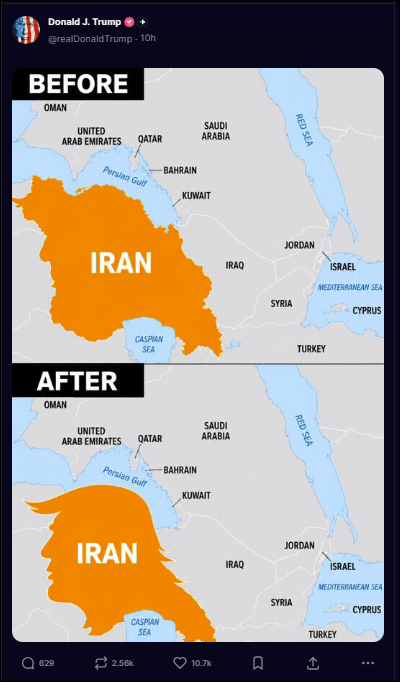
On 6th September, Trump published an image on Truth Social that included an Iran map resembling Trump’s silhouette, indicating his victory over Iran and Tehran’s subjugation. Trump’s various posts have indicated his aspirations to take over Kharg Island and the Strait of Hormuz.
In recent months, Trump has both offered and threatened a US takeover of the strategically significant Arctic territory of Greenland. Trump has claimed that the US may seize control of the autonomous Danish territory if Denmark will not agree to a deal. This one-sided takeover bid comes even as neither Greenland nor Denmark has shown any interest in handing over their territory and autonomy to the US.
Not only Greenland, but Trump has also been pushing for a US takeover of neighbouring Canada over supposed unfavourable policy decisions by Ottawa. Trump repeatedly and insultingly calls the Canadian Prime Minister Mark Carney “Governor” and Canada the 51st state of the US. Trump’s interest in merging Canada into the US is growing stronger even as neither the Canadian government nor the citizens are in favour of joining the US. Trump even claimed earlier that the US was “seriously considering” naming Lake Ontario “Lake America.”
Donald Trump has also been eyeing the Panama Canal. Months after returning to power, Trump warned of reasserting US control over the canal as he accused Panama of levying “exorbitant charges” to utilise the passage and coddling China. Trump had declared, “China is operating the Panama Canal, and we didn’t give it to China — we gave it to Panama — and we’re taking it back.”
Trump has also laid claim to Micronesia and the Marshall Islands. In a social media post, he shared an image labelling these sovereign Pacific island nations under “U.S. Territories.”
Donald has consistently been making ridiculous but bold territorial claims embellished with appealing visual spectacle, and portraying US activity or prospects of US presence as exclusive leadership.
Trump campaigned on tall promises of ending the Russia-Ukraine war. However, after over a year and a half into his second term, the war is raging on into its fifth year, with all mediation efforts by Trump falling flat.
In February 2026, the US joined Israel to launch an offensive against Iran in West Asia, while Trump initially described it as a short and decisive action to ‘liberate Iran’ and destroy its nuclear program; the conflict has dragged on for over six months. Trump’s Iran campaign has turned out to be a grinding conflict of strikes, counterstrikes, economic disruptions, and fragile, rather farcical ceasefires.
Neither the US has been able to overthrow the Mullah regime nor fully dismantle Iran’s nuclear and missile programs. Despite inflicting severe economic blows, Tehran continues to project strength, has allies by its side, and pushes back against the US offensive, showing no signs of defeat.
While the US wanted to cripple Iran economically, Washington itself has spent over $37.5 billion in direct military costs. The Iran war has inflicted way higher economic costs on Americans. Trump is facing global and domestic criticism for his unplanned offensive against Iran and its global implications, particularly on energy supplies.
Amidst all the criticism and dwindling popularity, Trump needs something to project strength and convey to the American people that he is somehow going to make America ‘great’ and ‘invincible’ not only on this planet but even on the Moon.
Cases of illegal religious conversion are increasing in parts of West Bengal. Recent incidents involving Christian religious activities have drawn protests from residents. The issue has gained fresh attention after an incident in Hingalganj in North 24 Parganas, where residents confronted a foreign national visiting the Sundarbans over allegations of religious conversion.
According to reports, the Argentine national had been staying in the Hingalganj Assembly constituency area for several months. Local sources confirmed that he had learnt Bengali and had established links with several house churches in the area. Residents accused him of approaching local people and attempting to persuade them to embrace Christianity. The allegations were widely circulated on social media and subsequently became the subject of local controversy.
News coming in from North 24 Parganas district of #WestBengal.
A Christian Missionary from #Argentina has been living in #Hingalganj Assembly Constituency area for months and converting Hindus.
The man has learnt Bengali language and built several house church in the area. He… pic.twitter.com/AE44NFKxGG
The matter escalated when villagers questioned the foreign national about his religious activities and his presence in the area. Locals sought answers about whether he was involved in conversion activities and whether he possessed the required permissions for his work.
Around the same time, police in Hingalganj questioned three people, including two foreign nationals, after receiving information about an alleged conversion-related gathering in Sandelerbil village panchayat. Police and local sources said people from different countries had gathered at a house and were accused by villagers of trying to persuade tribal residents and people belonging to other faiths to change their religion.
Some villagers also revealed that people from Kolkata, as well as Australia, Germany, Bangladesh, and Argentina, regularly visited the house. Residents said that economically weaker people living near the Sundarbans were being offered money or other inducements. Police, however, are still examining the identities of those involved, their purpose of visiting the area and whether there was any basis for the allegations.
The issue therefore remains under investigation, but the incident has clearly highlighted the growing cases of organised religious activities in the region.
Hasnabad coaching centre sparks fresh protest
A similar controversy surfaced this month in Hasnabad village of North 24 Parganas district, where a Christian-run free coaching centre for children became the centre of a local protest.
According to those protesting, children were being provided free tuition at the centre, but religious material related to Jesus and the Bible was also being used. Members of the Hindu Jagran Manch and local residents arrived at the centre and demanded that the activities be stopped.
News coming in from North 24 Parganas district of #WestBengal.
In #Hasnabad, Christian Missionaries opened a free coaching centre for small children.
In the coaching centre, small children were taught about Jesus and Bible along with other subjects.
One protester, identified as Suparna Bera, said they had come to protest because they believed the centre was being used for religious activities. Pointing towards the walls, she said, “There are no pictures of great personalities or Hindu deities on these walls. Why should this be done? Jesus’ pictures are painted all over the walls. Go inside and see for yourself.”
When asked about their demand, she said, “We demand that this be shut down immediately. Why should this continue? This must be stopped.”
Bera further claimed that the activities at the location had been continuing for around 20 years. She said locals had been aware of the matter earlier but had not come together to protest. “We knew everything, we understood everything, but no one was by our side back then. Now our Hindu community has awakened, and we also want to carry out this protest,” she said.
A person associated with the centre gave a different explanation. When asked why children were being taught there, the person said, “We just teach free tuition to these children. For the children’s study… we set this up to teach them.”
Asked why the centre had been stopped, the person said villagers and members of the local groups had arrived and objected to the activities. The person also indicated that the centre would not continue religious activities if local residents opposed them.
Another protester said that the area was Hindu-majority and claimed that children were being brought to the centre and exposed to Christian teachings. The protester said that pictures of Jesus could be seen on the walls and that references to Jesus were also present in notebooks and books.
Sonamukhi conversion led to another protest
Another incident has been reported from Sonamukhi in Bankura district, where a group of locals confronted people during a Christian religious programme.
According to videos and reports circulating online, the programme was described as an attempt to convert local residents and tribal people under the guise of a healing or prayer programme. Members of a local group reached the spot and questioned the organisers about the material being distributed there.
During the confrontation, one man repeatedly asked, “Hey, give us the books! You’re taking the Bible here!” He then questioned another person, asking, “What is in his hand? What is in his hand? Show it!”
The protesters also asked what was being taught at the gathering and whether the books contained the Bible. One organiser tried to defend the gathering, saying that the material was meant for prayer. The exchange became heated, with people in the gathering repeatedly saying, “God is formless! God is formless!”
Bengali woman catches Christian evangelist red-handed and confronts her
The controversy over conversion activities also surfaced in Jalpaiguri in July, when a Bengali woman confronted a Christian missionary during an argument over religion.
📍Jalpaiguri, West Bengal
A Bengali Hindu woman confronted and slapped a Christian missionary during an alleged attempt to convert Hindus.
This is what one vote can achieve, people feel empowered to stand up for their beliefs and resist what they perceive as unlawful or… pic.twitter.com/QZTzzl4oLi
In a video of the confrontation, the woman questioned the missionary about Sanatan Dharma and challenged the idea that it had a single founder. “Who is the father of Sanatan? Does Sanatan have a father? Sanatan is never a person! Sanatan is a religion!” she said during the exchange.
The confrontation reflected the increasingly aggressive nature of some local disputes over religious preaching and conversion. Such incidents have become flashpoints, with residents questioning missionaries over their conversion activities.
Locals finally push back as conversion cases rise
Taken together, the recent incidents in Hingalganj, Hasnabad, Sonamukhi and Jalpaiguri show how locals are increasingly speaking out against attempts to convert people in their communities. Instead of remaining silent, locals have begun questioning religious activities taking place in their neighbourhoods, confronting those involved and demanding answers about what is being taught or offered to residents. In some cases, these objections have led to heated confrontations and the disruption of religious gatherings held in the name of healing and education.
For the locals raising these objections, the issue is not simply about religion but about the illegal conversion which is happening within their own communities. They say they do not want economically weaker families or children to be approached with religious teachings, money or other inducements in the name of education, charity or prayer. Their protests show a growing willingness among residents to come forward themselves and question activities they believe could affect the religious character of their communities.
The recent protests also show that locals are no longer willing to ignore activities that they suspect may be linked to religious conversion. Whether it is questioning foreign nationals in Hingalganj, protesting outside a coaching centre in Hasnabad or confronting people during a prayer gathering in Sonamukhi, residents have increasingly chosen to raise their voices and demand action. At the same time, the cases of forced or induced conversion must be established through proper investigation and evidence.
Amid the West Asia conflict and the prolonged Russia-Ukraine war, India has once again emerged as a major energy supplier to Europe. In the month of August 2026, Indian refineries supplied over 60 per cent of the diesel or gasoil that passed through the Bab-el-Mandeb Strait towards Europe. India is keeping diesel flowing to Europe as Russian exports declined to significant lows.
Three-fifths of diesel supplies to Europe came from India
Reports say that more than 2,00,000 barrels per day (bpd) of diesel and gasoil were moved on the route across the Red Sea chokepoint on vessels bound for Europe in the month of August this year. Of this volume, around three-fifths comprised Indian supplies. This signifies a major role India has grown to play in Europe’s refined fuel market.
The Indian diesel supplies to Europe surged amidst a sharp fall in Russia’s exports. Russia’s seaborne diesel exports averaged merely 150,000 bpd in the first 25 days of August 2026, going down from 610,000 bpd year-on-year and 81% below the five-year seasonal average.
Meanwhile, US seaborne diesel exports to Europe from outside the region were recorded at 520,000 bpd in August, which is around half of those imports, up from a quarter last year; however, they slumped sharply from a first-half peak of 540,000 bpd to 350,000 bpd in the second half.
Notably, India is the world’s fourth-largest refiner, with 258.1 million tonnes per annum capacity, and exported around 61.5 million tonnes of petroleum products in FY 2025-26. However, a Vortexa analysis indicates that India’s crude and condensate imports have dropped to 3.8 million bpd in August from about 4.8 million bpd a year earlier.
How Russia’s loss became India’s gain in European fuel market
While Europe’s eastern diesel supply route through Bab-el-Mandeb, the southern entrance to the Red Sea, linking the Suez Canal and Mediterranean, has recovered after earlier disruptions, it continues to face difficulties.
Russia, which once was a major diesel supplier to Europe, has witnessed exports decline sharply due to Ukrainian drone strikes on refineries and export infrastructure. Reports say that the Perm Oil Refinery has halted operations after a Ukrainian drone attack caused significant damage to technological units 21st August.
Ukraine has been targeting Russia’s energy infrastructure to cripple its economy and undermine war efforts by cutting financial income. Perm is now operating at 28 per cent capacity, with no diesel cargoes from Tuapse since a strike in May this year.
India’s complex and export-oriented refineries, particularly the Jamnagar refinery of Reliance, have spare capacity and can refine a wide range of crudes, then supply products to the highest-paying markets.
Indian-processed diesel flowing through Bab-el-Mandeb is significant because the West Asia crisis has rerouted or constrained traditional Gulf supplies, making the Red Sea corridor more crucial for some east-to-west product movements, although this remains a risky affair.
Amid media reports and queries by employee associations at the Indian Space Research Organisation (ISRO) over ISRO undergoing privatisation, the space agency has issued an extensive clarification on 6th September. ISRO addressed all the queries about the importance of ISRO in the future after the opening of the space sector to private players. ISRO called the claims that attempts are underway to privatise ISRO or reduce its role “completely baseless and incorrect”.
“ISRO will never be privatised”: ISRO dismisses privatisation claims
In a statement issued on Sunday, ISRO said, “ISRO’s Next Chapter: Leading India’s National Space Ecosystem. There has been considerable reporting in parts of the media around the future role of ISRO, including speculations and misinformation that there is an attempt to privatise ISRO or reduce its role. These assertions are completely baseless and incorrect. We wish to categorically state that ISRO will neither be privatised nor will its importance be diminished.”
The premier space agency stated that it will remain India’s “principal institution for advanced space research and technology development, national and strategic missions, space science and exploration, and critical and frontier space capabilities.”
Participation of private sector in space will not reduce ISRO’s role
Addressing how the entry of private players in the space sector will impact ISRO and its role in the future, ISRO said that Participation of the private sector in space is not about reducing ISRO’s role. It said that the entry of private players will enable ISRO to focus even more strongly on the next generation of India’s space programme, while industry scales mature technologies and capabilities.
“What is changing is not the importance of ISRO, but the scale and structure of India’s space ecosystem,” ISRO said.
Contrary to the narrative created by several media reports, there is no tussle between ISRO and private players looking forward to entering India’s space sector.
“The space-sector reforms initiated since 2020 and institutionalised through the Indian Space Policy 2023, along with progressive liberalisation of FDI policy, aim to create a larger, stronger and globally competitive Indian space ecosystem,” ISRO said.
ISRO further stated that participation of industries, start-ups and academia is not about diminishing ISRO’s importance but about complementing and multiplying ISRO’s capabilities.
“Industry, start-ups and academia are being enabled to participate across the space value chain, complementing and multiplying ISRO’s capabilities. The reforms should therefore be seen as ecosystem expansion and capability multiplication, not privatisation,” it said.
ISRO-led national space ecosystem: Mature tech transfer does not mean ISRO is withdrawing from that domain
Speaking about multiple mature technology transfers to private players and the misinterpretation that it amounts to ISRO’s withdrawal from that domain, ISRO said that this interpretation is devoid of factual merit.
“As India’s industrial and technological capabilities have grown, mature and scalable activities can increasingly be undertaken by Indian industry. ISRO has already transferred around multiple technologies to industry. Transferring a mature technology does not mean ISRO is withdrawing from that domain,” it said.
Clarification regarding media reports on concerns relating to Space Sector Reforms and the role of ISRO
ISRO’s Next Chapter: Leading India’s National Space Ecosystem There has been considerable reporting in parts of the media around the future role of ISRO including speculations…
Contrary to the ‘withdrawal’ narrative, these tech transfers “enable large-scale production, commercialisation, innovation and access to global markets while allowing ISRO’s scientific and technical manpower to concentrate on advanced research, next-generation technologies and complex national missions.”
“The transition is therefore towards an “ISRO-led national space ecosystem,” ISRO declared.
ISRO to focus on frontier R&D, advanced tech, human spaceflight and development of strategic national capabilities
Contrary to the ‘ISRO to lose its significance’ bogey, ISRO indicated that its role is going to become even more crucial and diverse in the coming times as the space agency will bolster its role in frontier R&D, advanced technologies, human spaceflight, next-generation launch systems, deep-space and planetary missions.
“ISRO’s role will progressively strengthen in areas where its scientific expertise matters most: frontier R&D, advanced technologies, human spaceflight, next-generation launch systems, deep-space and planetary missions and strategic national capabilities,” it said.
ISRO will continue developing cutting-edge technologies, including advanced payloads for communication, navigation and Earth observation, sensors, propulsion systems and other critical technologies.
It further emphasised that mature and routinely manufactured systems can increasingly be scaled through industry. ISRO further stated that production of mature launch vehicles, routine satellites and other established systems “can increasingly be undertaken by industry or PSUs through appropriate competitive processes.”
“This allows ISRO to devote more resources and scientific manpower to the next generation of technologies and missions, while the wider ecosystem provides the investment, manufacturing capacity and scale required by an expanding national space programme,” it added.
ISRO opens up on the “Next Frontier: Space Station, Moon and Planetary Exploration”
ISRO said that the transition of India’s space sector with the entry of private players is particularly significant in view of the Space Vision 2047.
“India’s ambitions include establishing the Bharatiya Antariksh Station by 2035, undertaking an Indian crewed mission to the Moon by 2040, developing next-generation and reusable launch systems, pursuing sustained lunar and planetary exploration, and establishing India as a major global space power,” it said.
The ISRO asserted that these are technologically demanding missions that require ISRO to focus on advanced research and capabilities that cannot be substituted by commercial activity.
“The objective is therefore to enable industry to scale mature capabilities while ISRO pushes India towards the next technological frontier. The new institutional architecture gives each part of the space ecosystem a distinct role,” it said.
ISRO remains at the core organisation while Department of Space provides overall policy direction
ISRO stated that the Department of Space provides overall policy direction and ISRO remains the core organisation for advanced R&D, technology development and national missions.
“IN-SPACe facilitates and authorises the participation of non-government entities, while NSIL undertakes commercialisation and industry-led utilisation of mature capabilities. Industry and start-ups contribute investment, innovation, manufacturing capacity and market access,” it said.
Regarding the ownership and control of critical national space infrastructure and strategic capabilities, ISRO said that these “will continue to remain with the Government.”
It added that private participation in operations and services will be enabled where appropriate and will remain subject to national-security, safety and other regulatory requirements.
ISRO further clarified that strategic and nationally critical capabilities “will continue to be governed by security, safety, quality and national-interest considerations.”
Highlighting how private participation in the space sector post 2020 reforms is increasing and thriving, ISRO said, “From only a handful of Indian space start-ups in 2020, India today has more than 450, working across launch vehicles, satellites, propulsion, ground systems, Earth observation, communications and space applications.”
Indian space economy aspiration to grow from $8.4 billion to $44 billion by 2033 requires private participation: ISRO
ISRO also emphasised that while the Indian space economy is currently estimated at around $8.4 billion, India aims to increase its share of the global space market to $44 billion by 2033.
For this, government resources and ISRO’s manpower alone are insufficient. “It requires private capital, industrial capacity, entrepreneurship and global market access. A stronger Indian space industry can augment ISRO’s capabilities, strengthen domestic supply chains, attract talent and investment, increase production and competitiveness, and enable India to capture a larger share of the global space economy,” ISRO clarified.
The Next Frontier: Space Station, Moon and Planetary Exploration This transition is particularly important in the context of Space Vision 2047. India’s ambitions include establishing the Bharatiya Antariksh Station by 2035, undertaking an Indian crewed mission to the Moon by…
ISRO scientists sought clarity over ‘privatisation’
The ISRO clarification comes amidst media reports, speculations and misinformation by the detractors of the Modi government as well as a written query by nine employee bodies representing staff across major ISRO centres to ISRO Chairman and Department of Space Secretary V Narayanan.
In a five-page representation, dated 4th September, employee associations from centres including the Vikram Sarabhai Space Centre (VSSC), Satish Dhawan Space Centre (SDSC), UR Rao Satellite Centre (URSC), Liquid Propulsion Systems Centre (LPSC), Space Applications Centre (SAC), National Remote Sensing Centre (NRSC) and ISRO Propulsion Complex (IPRC) sought clarification on ISRO’s future role amidst ‘privatisation’ claims.
How India’s space sector was opened for private players
While the idea was taken into consideration before also, the Modi government’s push to bring private companies into the space sector began explicitly in 2020 as part of the broader economic reforms announced during the Covid-19 pandemic.
In May 2020, the fourth tranche of the Atmanirbhar Bharat package was announced by Finance Minister Nirmala Sitharaman. The minister said that the government wanted private companies to become partners in India’s space journey.
“The Indian Space Research Organisation has brought a lot of laurels to the country. However, the private sector is also doing a lot of work in the arena now. We want the Indian Private sector to be a co-traveller in India’s space sector journey,” Sitharaman said.
The government announced that private companies would be allowed to use ISRO facilities and other relevant assets to improve their capabilities. The government’s intent was never to fully privatise ISRO but to make better use of India’s existing space infrastructure and allow startups and private companies to develop their own capabilities under ISRO’s guidance.
For private participation, IN-SPACe was created as a regulatory and facilitation mechanism, while NewSpace India Limited (NSIL) has a commercial role in taking ISRO-developed technologies and systems to industry.
The Indian Space Policy 2023 subsequently allowed private companies a wider role across the space value chain, including the development and operation of space systems.