Home Blog Page 3147

Gun violence in the US: Indian woman shares her ordeal of being robbed at gunpoint in Atlanta, credits Indian embassy for her safe return

There has long been a war of words over gun control in the United States. The issue has waxed and waned over the years, stirred by frequent mass shootings in civilian settings. With every third adult in the States retaining a gun for protection, there has been a massive rise in gun violence ranging from rising murder rates in some major cities to mass shootings.

According to a pew research report, the country has seen some of the worst gun violence in its history with around 20,000 Americans losing their lives to guns, the highest toll in more than two decades. Considering the recent Texas shooting episode, the trend looks likely to continue through 2022 as well. A couple of days ago, around 19 children and two teachers were forced to breathe last after a gunman opened fire at the Robb Elementary School in the city of Uvalde, Texas. Police confirmed that the accused 18-year-old high school boy had a handgun, an AR-15 semi-automatic rifle, and possessed high-capacity magazines which he also used to kill his grandmother exactly before the rampage. The accused was later shot dead.

Meanwhile, the families of the children aged between 7 to 10 who lost their lives in the massacre have been left to weep over the tragedy which was neither their mistake nor their children’s mistake. The only fault was that of the 18-year-old boy who possessed a gun, probably for self-protection. While personal protection tops the list of reasons why gun owners say they own a firearm, a similar incident happened to an Indian lady who had travelled to the US for a family function. She was gun attacked by two American men who robbed her and left her with zero money in the alien land.

Arpita Patel, a resident of Thane, was mugged at gunpoint during her travel to the United States

The episode dates back to April 12, when Arpita Patel, a resident of Thane, Maharashtra had travelled to the US to meet her relatives and attend a small family gathering there. She had travelled to Atlanta and had plans to visit Canada to meet her extended family. At the Atlanta Airport, her cousin picked her up and the duo headed home. Around 20 mins after they left the airport, Patel’s cousin thought of grabbing some food on the way. They arrived at a restaurant named ‘The Halal Guys’ downtown and parked the car on the street. He asked the lady to stay in the car and walked towards the restaurant to collect the food parcels.

The man had not even walked 100 steps when 2 American men with guns in hand arrived at the spot and threatened Patel to get off the car. They snatched her small bag in which she had preserved all her legal documents including the passport. The attackers hurt her in the neck and fled away with the car that contained all her luggage, money and gold jewellery. Patel was devastated and took a few minutes to get the hang of the situation. She was just left with one sock, a jacket and a pair of shoes.

The jacket and shoes which were left in the car by the robbers

Patel then immediately contacted the local police and sought help. She told them that all her legal documents had gone and that she wanted them back at any cost. The Police registered an official complaint and assured to nab the attackers. Patel also contacted the Indian Embassy and sought help to return to India. The Embassy officers listened to her and helped her by all means.

The incident came to light when Patel recently returned from the United States on May 22 and shared her experience on her Facebook wall. “I was temporarily shattered and devastated. All my luggage, and backpack which is a world to travellers as it contains passport, cash, and other documents was gone. The only thing that was left with me was my life and hope”, she said in the post. She also lauded the Indian Embassy for the help that they provided and mentioned her gloomy experience with the local US Police.

Screenshot of the Facebook post

‘They robbed my USD 1500, gold jewellery, and all my luggage’: Arpita Patel to OpIndia

Team OpIndia contacted Arpita Patel to know the exact trail of incidents. She narrated the entire horror episode and said that the only thing that kept her stronger during that moment was the memory of her family members and herself. “We reached the Halal Guys restaurant 20 minutes after we left the Atlanta Airport”, she started. “My cousin went to get the food parcel and unfortunately had left the car doors unlocked. I was the only one in the car. As soon as he entered the restaurant, two African American boys entered the car- one from the driver’s seat and the other one from the back door. The one on the driver’s seat had a gun. He pointed the gun at me and yelled- Go, go, go, go. That is the only conversation I heard from him. He wanted me to get out of the car. I resisted”, she said.

“He then snatched my backpack and hurt me in the neck while snatching. They both then tried to run away with my backpack that had all my documents and my money. I got off the car and started to run behind them as I wanted all my documents back. I also injured my left leg in the momentum. But one of them smartly entered the car again and drove away from the entire car. I lost all my luggage. Fortunately, I had my mobile phone in my pocket. We called 911 and the local police. They arrived. We helped them with all the locations and the car was tracked after an hour or so. Though we found the car, it was all empty. They robbed my USD 1500, my gold jewellery, and all my bags except what they left me was my jacket, my shoes, my voter ID card, and a short ‘I Love You’ note written by my daughter”.

Voter ID card and ‘I Love You’ note written by victim’s daughter.

Indian Embassy helped her get the new passport within 3 days

Patel said that her experience with the local police was not at all good but the Indian Embassy helped her throughout. “We called the Indian Embassy. They were very kind to us. One of the officials of the Embassy named Manjeet Singh first confirmed whether I had a place to stay. I was sobbing as I was in some sort of trauma after the incident. I told him that nothing was to worry about my stay as I had my cousin’s place to stay. He guided me to a link and asked me to get a few documents. Though I had lost all my documents physically, I had them preserved as soft copies. After a few days, I went back to the embassy with the prints and met the head officer there. I explained to him the entire matter. He was also kind and approved all my papers within 3 minutes. And within the next three days, I was handed over a valid 10-year Indian passport from America. This is something that I’ll never forget. The Indian Embassy was an angel to me”, she added.

Lack of action by the US Police

When asked about the Police case, Patel said that the local police had identified a suspect but had not nabbed him. She added that though the police officers claim that they are investigating, she has not received any progressive updates on the case. “When we called the Police, they arrived but failed to trace the location of the car. It was me and my cousin helping them by tracking the location of the AirPods that we had left in the car. Even in the latter days after the police recovered the car, I kept on giving them updates of the locations of the robbers who had taken away the AirPods, but no action was taken. They caught one of the suspects but released him saying that his fingerprints didn’t match with the one they had collected from the spot”, she said.

“Not only that, I was continuously tracking the movement of my AirPods which the robber had stolen. I could see that they stayed in a house, the address and location of which I had sent to the police immediately. But again, they could not find anything”, she stated adding that there was zero help offered by the US government. She also opined that if anything like this would have happened to a US tourist in India, the Indian government would have definitely helped and sorted the matter. She, however, reiterated that the Indian Embassy was kind and that it was the only one who had rushed to her rescue in the alien land.

Patel meanwhile also warned the solo travellers to be safe and keep the duplicate document copies and soft copies preserved. She added that it’s very easy for the people in the US to keep guns and that in such situations of gun violence, the first contact point must be the Embassy as they lend a helping hand in real disastrous situations’.

The United States’ gun policy

Access to guns in the United States is controlled by law under several federal statutes. As of 2021, the data by the Pew Research Center suggests that gun sales in the United States have risen in recent years, particularly during the coronavirus pandemic. While there are differences in increased gun ownership rates by political party affiliation, gender, geography, and other factors, gun owners argue that the Second Amendment of the US Constitution is significant and that it should not be infringed on any legislation.

The Second Amendment of the US Constitution reads: “A well regulated Militia, being necessary to the security of a free State, the right of the people to keep and bear Arms, shall not be infringed.” The First Amendment is freedom of speech.

According to the Pew Research Center report, one of the key and defining characteristics of gun owners is that they associate the right to own guns with their sense of freedom. Around 74 per cent of gun owners say this is essential. The other main reason cited by gun owners is personal protection. Also, the survey report by the Switzerland-based Small Arms Survey reveals that the United States which houses less than 5 per cent of the world’s population, has 46 per cent of the world’s civilian-owned guns.

Further, the research report says that around 48 per cent of Americans see gun violence as a huge problem. Some of them even are demanding stricter laws against the usage of guns considering that attitudes about gun violence differ widely by race, ethnicity, party, and community type. While Americans are divided over whether restricting legal gun ownership would lead to fewer mass shootings and gun violence, it is wise for outsiders to stay alert and safe, especially while on travel.

‘What is happening in this country?’ Kerala High Court directs action against PFI for provocative slogans by minor boy in its rally

The Kerala High Court, on Friday 27th May 2022, directed police to take action against the organizers of the event of “Jana Maha Sammelanam” held on 21 May 2022 at Alappuzha, Kerala. A video of a Kerala boy making provocative slogans against Hindus and Christian had gone viral on social media platforms. This event was organized by the Popular Front of India ( PFI), an organization always under the radar for anti-national activities in the country. Coming down heavily on the slogans raised by the boy, the court orally observed, ‘What is happening in this country?’

Justice PV Kunhikrishnan said that if a member of the rally raised the provocative slogans, the organizers of the rally were also responsible. He said, “The police officers will do the needful by the law against all the persons who are responsible for this.” The petition in this regard was filed by R Ramaraja Varma, who is a former professor of the SD College of Alappuzha.

In the video from the rally that went viral, a boy is seen raising slogans while sitting on the shoulder of a man. The slogans in the Malayalam language meant, “Be ready for your death rituals if you won’t live in our land quietly. Be ready with rice flakes to fill your mouth, if you won’t live quietly (For Hindus ). Be ready to burn amber in your home if you won’t live quietly ( For Christians). Because we are coming, we are your death. We won’t go to Pakistan or Bangladesh, you have to live here as we say, or else we know how to make you live quietly, we will kill you even if we are attacked. We take pride in being a martyr, we salute them. If you won’t live quietly, we know how to ask for ‘Azadi’. Be prepared for your death.”

Referring to the boy who raised the slogans, the court said, “Children are being forced to take part in political rallies and are made to voice all sorts of provocative slogans. That is some new kind of attraction, it seems. But how far is that legal?”.  Justice Gopinath P further commented orally, “These children will grow up with hatred inside them.” He further added, “Aren’t they fostering a new generation that grows up with religious hatred in their minds? When this child grows up and becomes a major, his mind will already be conditioned to this kind of rhetoric. Something must be done.” 

During the hearing, the court asked, “Did the child raise the provocative slogans sitting on the shoulder of a man during this rally? Can people in the country shout anything? You (police) take action. They should be booked. What is this? What is happening in this country? Hope the police will do the needful. Did the police arrest the responsible persons?”

The government pleader submitted a report by the DySP Alappuzha. The report stated that two separate cases have been registered by the Alappuzha police against the PFI and Bajrang Dal workers in connection with the rally. A case has also been registered for raising provocative slogans. Petitioner’s counsel Sreekumar Chelur argued that a tense situation is still prevailing in the district. This situation is created after the recent killings of the RSS workers in which members of the Popular Front of India (PFI) and the Social Democratic Party of India (SDPI) are involved.

It is notable that earlier this month, the Kerala High Court had said that PFI and SDPI are extremist organisations which have not been banned yet. While hearing the petition of the wife of deceased RSS worker A Sanjith, seeking a probe by the Central Bureau of Investigation (CBI), Justice K Haripal had stated, “No doubt, SDPI and PFI are extremist organisations indulging in serious acts of violence. All the same, those are not banned organisations”.

Rajiv Gandhi brought Social Media to India: Rajasthan CM Ashok Gehlot claims

Rajasthan Chief Minister Ashok Gehlot has surprised everyone today by making a bizarre claim that former Prime Minister Rajiv Gandhi brought social media into the country. The Rajasthan CM was speaking to media persons after paying his tributes to former Prime Minister Jawahar Lal Nehru on his death anniversary.

Gehlot said that these days a lot of low-level comments are made about Nehru on social media, and that social media was brought by Rajiv Gandhi. CM Gehlot also alleged that crores of rupees are spent to propagate such comments on social media, and questioned what inspiration youngsters will get from these comments.

The Rajasthan CM also claimed that there are ‘teams’ located across the country to make such comments about the Congress leaders. He mentioned that even on his posts, he gets such comments that there is no point in reading them. Gehlot further said that he has no issues if the attacks are political or ideological, but personal attacks don’t suit any political party.

Congress has in the past claimed multiple times that Rajiv Gandhi brought computers and mobile phones to India, but this is the first time that a Congress leader has claimed that he even brought social media to the country.

Ashok Gehlot’s claim surprised everyone as social media was flooded with questions from curious netizens over Rajiv Gandhi’s contribution to social media.

Minister of State in Uttar Pradesh, Dinesh Pratap Singh said- Social Media came to India after 2004, Rajiv Gandhi died in 1991. But, Ashok Gehlot can give full credit of Memes to Rahul Gandhi.

Another user by the handle of @MrSinha_ listed the year in which various social media websites were started, wondering how Rajiv Gandhi could have possibly contributed to them.

While some other users could only laugh at this bizarre statement from Gehlot.

The first social media website, Six Degrees was created in 1996, and formally launched in 1997, 6 years after the assassination of Rajiv Gandhi.

Focus on education, cultural preservation, infrastructure and more: 5 key takeaways from Yogi Adityanath’s UP Budget 2022

On Thursday (May 26), the Yogi Adityanath-led Uttar Pradesh government presented the first budget of its second term in the State Assembly. It is the largest budget of the UP government to date, with a total outlay of ₹6.15 lakh crores.

The BJP government, which is eyeing achieving a trillion-dollar State GDP in the coming years, has primarily focused on fulfilling its poll promises in its 2022-2023 budget. It has a provision of ₹39,181.10 crores for new schemes and a whopping ₹54,883 crores for fulfilling 97 out of 130 election promises.

The budget, with a fiscal deficit of 3.96% of the State’s estimated Gross Domestic Product (GDP), was presented in the Assembly by Finance Minister Suresh Kumar Khanna.

In a tweet, UP Chief Minister Yogi Adityanath said, “The budget presented in the Vidhan Sabha today is in accordance with the aspirations and sentiments of 25 crore people of the state.”

“Keeping in mind the overall development of the state under the leadership of the respected Prime Minister, this budget has been made to fulfil the interests of every section of the society including villages, poor, farmers, youth and women,” he added.

Here are 5 key takeaways from the Uttar Pradesh government’s budget for 2022-2023:

Social Welfarism

In line with its poll promise, the Yogi Adityanath government allocated a sum of ₹3,301.74 crores to provide 2 free Liquefied Petroleum Gas (LPG) cylinders to Pradhan Mantri Ujjwala Yojna (PMUY) beneficiaries on the occasion of Diwali and Holi.

The government has also allotted ₹600 crores for Mukhyamantri Samuhik Vivah Yojana (mass weddings), ₹4,032 crores for Destitute Women Pension Scheme and ₹7053 crores for the old-age pension scheme.

The State Finance Minister announced that the government will provide a 40% subsidy to the boatsmen and fishermen community (Nishads) for the purchase of boats up to ₹1 lakh. The subsidy will be disbursed under the Nishadraj Boats Subsidy Scheme.

Agriculture

The Uttar Pradesh government has allocated a large portion of its budget to the agriculture sector, including a sum of ₹100 crores for ensuring minimum support price (MSP) for vegetable farmers under the Bhamashah Bav Sthirta Fund.

It has sanctioned another ₹17500 crores for strengthening procurement of ‘wheat and paddy’ at MSP. The government has also set a target to cover the entire Bundelkhand region of the State with cattle-based organic farming in the next 5 years.

This has been done in accordance with one of its poll promises. The Yogi Adityanath government has allocated ₹650 crores under the farmers’ accident scheme, wherein a sum of up to ₹5 lacs will be provided to farmers in case of accidental disability/death.

Besides, it has set aside a sum of ₹1000 crores for the Chief Minister’s Minor Irrigation Scheme and ₹1,95,000 crores for providing potable drinking water (Jal Jeevan Mission) to dry and arid regions in the State.

The government has also put forth a target to disburse 119.30 lakh metric tonnes of fertiliser and install 15000 solar pumps.

Education

Having fully realised the need for more doctors in the State, the BJP had promised to double the number of MBBS and Post-graduate (PG) seats in Uttar Pradesh’s medical colleges in its election manifesto.

The government has sanctioned ₹500 crores for the purpose, besides an allocation of ₹2100 crores for establishing new medical colleges in 14 districts. According to Finance Minister Suresh Kumar Khanna, the target is to set up one medical college in each district of the State.

He informed, “At present, 65 medical colleges are operational, and 45 districts have at least one medical college.” The UP government has allocated ₹103 crores for setting up the National Law University (NLU) in the city of Prayagraj.

The Yogi government is also keen on promoting regional languages, which are spoken in the State. As such, a budget of ₹1.5 crores is set aside for establishing Goswami Tulsidas Awadhi Akademi, Suryadas Braj Bhasha Akademi and Keshavdas Bundeli Akademi. A forensic science institute will also be built in Lucknow.

Infrastructure

Besides social welfarism, agriculture and education sector, the government is also committed to the development of large-scale infrastructure projects in Uttar Pradesh. It has sanctioned ₹400 crores for the construction of the General Bipin Rawat Industrial Corridor in Bundelkhand.

Another ₹100 crores have been set aside for metro rail projects in Gorakhpur and Varanasi. The government has allotted ₹511.93 crores for the Gorakhpur-link expressway and more than ₹29 crores for the development of an industrial corridor in its vicinity.

It has also provided a sum of ₹95 crores for purchasing land for setting up an international cricket stadium in Varanasi and an additional ₹201 crores for building an international airport in the holy Hindu city of Ayodhya.

Under its new Babuji Kalyan Singh Gram Unnat Yojana, the government will set up solar street lights in rural areas. Despite all these new infrastructure projects, no new taxes were proposed by the Yogi government.

Cultural Preservation

The BJP government, which is in charge of Uttar Pradesh, is committed to the preservation of cultural ethos and civilisation values in the State. It has set aside a sum of ₹1 crore for the constitution of a Board that will implement schemes for the welfare of sants, purohits, and pujaris.

Moreover, a sum of ₹15 crores has been allocated to build Dr BR Ambedkar Memorial and Cultural Centre and an additional ₹1 crore has been disbursed for its maintenance.

Memorials will also be built in honour of Maharishi Valmiki, Sant Ravidas, Sant Nishadraj and Maharaja Suheldev in Chitrakoot, Varanasi, Sangverpur and Bahraich respectively. A sum of ₹200 crores has been allotted for this purpose.

The government has also sanctioned over ₹276 crores for setting up a Special Security Force to protect courts and religious places such as Ayodhya, Varanasi and Mathura.

Former Haryana Chief Minister Om Prakash Chautala awarded 4-year jail term in disproportionate assets case

A Delhi court today awarded a 4-year jail sentence to former Haryana chief minister Om Prakash Chautala in a disproportionate assets case. Apart from the jail term, a fine of Rupees 50 lakh also has been imposed by the court. Besides, some of his properties will also be attached. A BI court awarded the sentence today after his conviction a few days ago.

87-year-old Om Prakash Chautala was accused of amassing assets disproportionate to his legitimate income, between 1993 and 2006. On Thursday 26th May 2022, counsels of the Central Bureau of Investigation as well as Chautala put their arguments before the special judge Vikas Dhull. Chautala was convicted on 21st May. The court observed that the accused had failed to satisfactorily account for such dis-proportionality by proving his source of income or means by way of which, he acquired assets during this period.

Om Prakash Chautala’s counsel had requested the court to grant him minimum punishment. He cited the medical ailment and old age of Chautala for this. On the other hand, CBI counsel had argued that the accused was not having clean antecedents since it was the second case in which he has been convicted, and therefore maximum punishment should be given to him so that it would send a message to society. The CBI had registered the case in 2006 and alleged that Om Prakash Chautala had earned 189 times more money than his income.

On April 3, 2006, it was alleged that former Haryana CM Om Prakash Chautala and others had amassed immovable assets along with his family members and others. After the investigation, a charge sheet was filed against him in the case on March 26, 2010. There were about 257 prosecution witnesses in the case. Chautala’s sons, Abhay Singh and Ajay Singh Chautala are also accused in this case. Former Haryana Chief Minister Om Prakash Chautala was released from Tihar Jail in July 2021 after serving his sentence in the teachers’ recruitment scam case.

Jammu & Kashmir: ‘Activist’ Waqar Bhatti arrested for derogatory remarks against Hindus over Gyanvapi Shivling

Jammu and Kashmir police arrested one ‘activist’ Waqar H Bhatti on Friday for derogatory remarks against Hindus for their religion with his tweet about the Shivling discovered in the Gyanvapi complex in Varanasi. His tweet sparked fury on social media after which several users demanded strict action against him.

BJP leader Baba Chanchal Singh lodged a complaint against Waqar at Gharota police station in the Jammu district for hurting the religious sentiments of Hindus. Waqar Bhatti was arrested by a team of police in the Tangmarg area of Baramulla. Waqar made a nasty remark in a recent tweet, equating a fountain to Shivling and referring to Hindus as ‘Gobar Bhakt.’ Following social media users’ criticism, Waqar deleted the tweet.

Image
The tweet mocking the Shivling.h

Several social media users tagged the J&K Police and requested concerned authorities to initiate action against Waqar. Following the uproar, Waqar Bhatti went on the defence, claiming that he did not make fun of the Shivling or target any religion as the case was still in court.

In a subsequent tweet, he wrote, “I never ever disrespect any religion nor I will in my life because I respect every Religion. The people who are demanding FIR against me are actually doing Politics nothing else.”

The tweet.

Waqar Bhatti was previously booked by the Madhya Pradesh Police in July 2018 for disrupting communal harmony. He was charged with suspicion of disturbing social harmony by posting a video on Facebook. Bhatti was charged with inciting hate amongst various communities under Section 153A of the IPC in an FIR registered at the Padav police station in the Gwalior district.

It is worth noting that several individuals have been charged with hurting Hindu religious feelings by ridiculing the Shivling at the Gyanvapi complex in Varanasi. 

Following the discovery of the Shivling inside the disputed Gyanvapi mosque’s Wuzukhana, a complaint was recently filed against TMC MP Mahua Moitra, ‘journalist’ Saba Naqvi, Retired IAS Surya Pratap Singh, Peace Party’s Shadab Chouhan, and RJD leader Kumar Divashankar for making derogatory tweets about Lord Shiva. Ratan Lal, a Delhi University professor, was even arrested and then released on bail for spreading another offensive Shivling caricature.

No action has yet been taken on National news daily Economic Times which also published an offensive meme on Shivling.

Mother of Hindu youth Vijaya Kamble says ‘Shahabuddin had threatened to kill my son over his relationship with his sister’: Details

The mother of the deceased Hindu youth Vijaya Kamble has revealed that the brother of the Muslim girl – Shahabuddin, had visited their house around six months back to threaten them with severe consequences if he continued to maintain any relationship with his sister.

In Karnataka’s Kalaburgi district, 25-year-old Dalit man Vijaya Kamble was brutally stabbed to death by two 19-year-old men for being in a relationship with the sister of one of the accused.

Speaking to the media, Vijaya’s mother said added that neither the Muslim girl nor her family talked to them after the brutal murder of her son. The grieving mother said Vijaya returned from work on that fateful day and left the house after he got a phone call.

According to her, they received a call after a few hours informing them that Vijaya Kamble was hit on his head and stabbed to death.

“Shahabuddin, brother of that girl, came to our house and warned my son Vijaya six months back, and now they killed my son brutally. They stabbed him and hit him in the head”, the mother of the deceased said.

Another relative of the deceased said that two men hit him on the head and continuously stabbed Vijaya. He said he tried to rescue the deceased by taking him to hospital, but he had succumbed to severe injuries midway.

Two accused Shahabuddin, Nawaz arrested

Meanwhile, the Kalaburagi police have arrested two 19-year-old men for killing a person named Vijaya Kamble for being in a relationship with a Muslim girl. The two accused, identified as 19-year-old Shahabuddin and 19-year-old Nawaz, had attacked and stabbed 25-year-old Dalit man Vijaya Kamble with an iron rod in Wadi town in Kalaburagi on Monday night.

Vijaya Kamble, a resident of Bheema Nagar Layout, was in a relationship with a Muslim girl, the elder sister of Shahabuddin. The two Muslim youths allegedly killed the Hindu youth for being in a relationship with the Muslim girl.

Kalaburagi Superintendent of Police Isha Pant said the girl’s family had come to know about the relationship, and since it was an interfaith relationship, there was resentment.

“It over this displeasure that Shahabuddin murdered him,” said Pant. The police have booked the two accused under IPC section 304 (murder).

According to the police, on May 25, 2022, Shahabuddin and Nawaz took Kamble under a railway bridge and attacked him using weapons, stones and bricks. The police said that the victim had been attacked brutally and finally succumbed to death. He suffered heavy bleeding on the spot and lost his life after the attack.

“There were multiple injuries on his neck, and there were hit marks on the head. He died on the spot. From the investigation so far, we have found that the attack wasn’t pre-planned, but we are in the process of finding more evidence,” Isha Pant said.

Islamist violence: How 2022 Ramzan was a month of Islamist violence not just for India but several other countries as well

The month of April in 2022 was considered unique in three decades as the faith-related festivities of Easter (Christianity), Passover (Judaism) and Ramadan (Islam) coincided with the Hindu festivals of Ram Navami (April 10) and Hanuman Jayanti (April 16).

The citizens of the world should have celebrated this month with a lot of buoyancy honouring all the major religions, and tying themselves up in the common thread of universal humanity and brotherhood.

On the contrary, however, this month possibly registered as a period replete with unprecedented violence driven by bigotry, intolerance or supremacist ideology.

Followers of all the faiths may have their share, however, the Islamists’ brazenly treacherous and violent rampage on the world stage was simply mind-boggling.

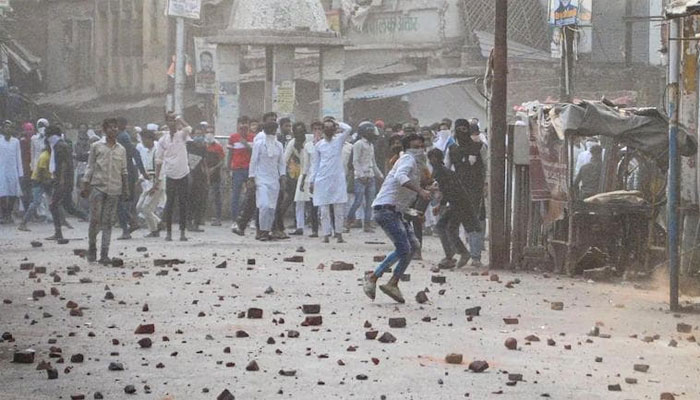
Start from India. On the occasions of Ram Navami and Hanuman Jayanti, the Islamists and their goons pelted stones at the religious processions, shobha-yatra, of the Hindus in more than seven cities of the country. In a premeditated and planned way, they used violent methods and naked bullying to disrupt the festivities of the Hindus.

However, if you had asked the ‘Islamo-Leftists’ (a term known to have been coined by the French president, Emmanuel Macron), they would say the Muslims responded with violence because the Hindus’ processions were playing loud music, raising provocative slogans and wielding weapons before the mosques. None of these charges, even if true, would warrant or justify such a savage, aggressive or terrorizing behaviour on the part of the Islamists. In the age of digital recording, this was for the law and order machinery to handle with relative ease.

The reality is the Islamists oppose the idol-worshippers processions passing by mosques or their neighbourhood because they regard idols or their carrier-Kafirs as representatives of Satan. Obligated by their religious belief and rituals, Satan must be pelted with stones. The Muslim pilgrims, in their final ritual of the Hajj, the Great Jamara, throw seven stones at a wall representing Satan. They fear the Kafirs’ persistent efforts would lead the faithful Muslims astray.  

Also, they wish to have their neighbourhoods, mostly no-go enclaves, honoured as de jure insulated or liberated zones where not only the Hindu processions but even the law and order machinery would find it hard to penetrate.

On 14 April 2022, similar behaviour by the Islamists, mostly young illegal Muslim migrants, was noticed a globe away in Granada (southern Spain), where an Easter procession was sought to be stopped violently. The Muslims pelted the Christians with missiles and projectiles that allegedly came from a migrant shelter.

In the same week, for two days in a row (14-15 April), the Islamist rioters set four police cars on fire and injured at least four officers and one individual in the city of Linkoping on Sweden’s east coast. They threw stones and attacked police cordons, tearing down riot fences. The Islamists of Sweden, mostly former refugees or asylum-seekers, were outraged by the call to burn the Quran by a far-right leader, Rasmus Paludan.

Here, the question arises, if Islam did not teach intolerance, who was igniting these communal fires in Sweden against the Swedish constitutional right to free speech? Many didn’t agree with the far-right Hard-Line movement headed by Rasmus Paludan, but they did support his right to the freedom of speech and expression. Such incidents have happened in the past in all European countries, especially the Scandinavian countries.

Just as Charlie Hebdo, a French newspaper, had the right to publish satirical cartoons of Muhammad or Theo van Gogh, a Dutch filmmaker and writer, had the liberty to make a television film critical of Islam, Paludan was also entitled to his constitutional rights as a political activist. The Islamist rioters possibly wanted to send a message that Paludan and the likes of him would face the same fate as that of Charlie Hebdo or Theo van Gogh. As we know, Charlie Hebdo’s offices were firebombed in 2011, its 12 employees were killed in an attack by the Islamists in 2015. In 2004, Theo van Gogh was shot and stabbed to death on Amsterdam street. A note was left on the body of Theo which contained passages from the Quran. Is this not faith-inspired violence and terrorism? 

No polite person would endorse the incendiary method of Quran burning, but consider the origins of pushbacks: The murderous political Islamists, by their persistent acts of violence, have brought international attention to focus on the teachings of Islam (the Quran, the Hadees etc). They have rattled the world. 

The reason the opponents of Islam wish to display their anger by taking extra-ordinary steps like burning the parts of the Quran is that it commands the followers of Islam to kill the Kafirs (the pagans, the idol-worshippers, the Jews and the Christians). 

For example, in the Quran (Sura 9:Aayat 5), it’s instructed:

“And when the inviolable months have passed, then kill the polytheists wherever you find them and capture them and besiege them and sit in wait for them at every place of ambush. But if they should repent, establish prayer, and give zakāh, let them [go] on their way. Indeed, Allāh is Forgiving and Merciful.

Saheeh International

It will be difficult to resist protest in the face of such a primitive teaching.

Away from Europe, in the month of Ramadan, see what happened in an African country, Nigeria. Reuters reported on 21 April 2022 that the Islamic State had killed or injured 30 people for selling or consuming alcohol. The Islamic State had posted a message saying the “soldiers of the caliphate in central Nigeria” had struck “a gathering of infidel Christians.”

According to another report on 17 April, the killings of 215 people across Nigeria in a week was the worst in 2022. The rival Islamist groups of Boko Haram and Islamic State in West Africa (ISWAP) had killed, abducted and looted on a massive scale.

The rumblings of the Islamists’ international violence in the Ramadan month began to be felt on 27 March 2022 itself when two Islamic gunmen, Ayman and Ibrahim Ighbariah – also Arab-Israeli cousins – opened fire at a bus stop in Hadera, Israel, killing two people and injuring twelve. It was the second shooting within days by the Israeli Arab Islamists affiliated with the Jihadist organizations.

More Islamist violence was expected in the approaching Remadan month.

On 11 April 2022, a Palestinian young man was killed by the Israeli forces as he was seen throwing a firebomb at an Israeli vehicle driving on a West Bank highway. On 15 April 2022, dozens of Palestinians marched near the Western Wall of the Al Aqsa mosque and attacked police officers by throwing rocks at them. The skirmish led to the Israeli warplanes launching attacks in the Gaza Strip on 18 April 2022.

The Islamists’ brutal killings and riots were not limited to the non-Muslims only. They didn’t spare the Muslims of different sects as well.

On Friday (22 April 2022), the day of prayer for Muslims in the month of Ramadan, again, a bombing at a mosque and adjoining religious school in the town of Imam Saheb, in Kunduz province, took the lives of at least 33 people and wounded 43. This was preceded, just a day earlier, by a series of bombings, the worst of which was an attack on a Shia mosque in northern Mazar-e-Sharif that killed at least 12 Shia Muslim worshippers and wounded scores more.

Since coming to power in August 2021, the Taliban have been battling the Islamic State affiliate known as Islamic State in Khorasan province or IS-K. The IS-K challenges the Taliban as less Islamic and aims to replace them as rulers of Afghanistan. 

A year ago, on a Friday prayer day in October 2021, an Islamic State suicide bomber shattered a Shiite mosque in the northern Afghan city of Kunduz, killing dozens of worshipers. It was the group’s second attack against a mosque in just a few days. This attack was aimed against the Hazara minority.

The Afghan Hazara community had feared that their indiscriminate killings at the hands of the Islamic State would go unchecked under the rule of the Taliban who preyed on the Hazara themselves.

Surprisingly, the Islamists’ violence against the Muslims in the holy month of Ramadan was not something new. Reporting on one such season of killings in Iraq, a correspondent of the Washington Post wrote in 2017:

“… the Islamic State has bombed a popular shopping street in Baghdad on Ramadan two years in a row. Last year’s attack was the worst Baghdad had seen, with more than 300 people either blown up or dead in a fire that subsequently swept through a shopping arcade. Earlier this week, 17 people were killed and more than 30 were injured at an ice cream parlour where families were enjoying dessert after a day of fasting..Dozens more were killed or wounded hours later in front of the government’s main pension office. The Islamic State claimed both bombings, saying they targeted Iraq’s Shiite majority. The Sunni militant group views Shiites as apostates.”

To conclude, for educators like us, it’s imperative to mention a word on the awkwardness of the universality of Islamic theology, its practice and its clash with the modern scientific temper. Take the instance of Ramadan. Islam commands the Muslims to fast during this month. The Qur’an (Sura 2: Ayat 187) insists on eating and drinking “until the white thread of dawn becomes distinct to you from the black thread [of night]. Then complete the fast until sunset.” Obviously, the practice of the dawn to dusk fast was not possible in places north of the Arctic circle where it is dark for 24 hours during winter and light for 24 hours during summer.

Islamists’ insistence that their faith was “God’s final revelation for the entire earth” and that anyone should “be able to practice it anywhere on the planet” was just not scientific.

Maharashtra: Bail denied to actress Ketaki Chitale, judicial custody extended to 14 more days for social media post against Sharad Pawar

A court in Thane has rejected the bail plea of Marathi actress Ketaki Chitale. Chitale has been in jail for over a week now for sharing a social media post against Sharad Pawar.

As per reports, the Magistrate court stated that bail cannot be granted to the actress because the alleged ‘crime’ of sharing a social media post against NCP chief Sharad Pawar is of serious nature. Chitale’s legal counsel is expected to appeal to the session’s court next.

The Magistrate’s court has extended the judicial custody of Chitale for another 14 days.

Many on social media have expressed concern that the actress is still in jail even after a week over a mere social media post criticising a political leader.

The 29-year-old actress was arrested on May 15 for a Facebook post where she had shared a verse, allegedly written on Pawar, calling him a person who hates Brahmins. Soon after the post the actress got several cases registered against her under charges of defamation and promoting enmity between 2 groups. A case under the SC-ST Act has also been filed against her. The cases have been filed in multiple police stations in Mumbai and its suburbs. A 2020 case under the SC-ST Act has also been opened against her.

Maharashtra Housing Development Minister Jitendra Awhad had threatened that NCP workers and cadres will register cases in “at least 100-200” police stations across Maharashtra in connection with the said Facebook post. NCP workers had also thrown eggs and ink at Ketaki Chitale while she was coming out of the Kalamboli police station in Navi Mumbai on May 14.

Are Arunachal Pradesh and Ladakh ‘punishment’ posting locations? Here is why the ‘dog walking’ IAS couple was transferred there from Delhi

Following the transfer of senior IAS officer Sanjeev Khirwar to Ladakh and his wife Rinku Dugga to Arunachal Pradesh, several people have interpreted this decision as a punitive measure, implying that Arunachal Pradesh, a state in the country’s north-eastern region, and Ladakh in the north are places state for “punishment posting of officers” due to their poor connectivity in comparison to other states and union territories. In reality, however, this conclusion is incorrect.

TMC MP Mahua Moitra was among those who remarked about the issue insinuating that transfer to Arunachal Pradesh is a punishment posting and why Sanjeev Khirwar was not transferred to any other state. She insinuated that by sending the erring officer to Arunachal Pradesh as a so-called ‘punishment posting’, the MHA is shaming the state, and proving that its claims of development in the far eastern state are false. However, Sanjeev Khirwar has been transferred to Ladakh, and it is his wife who has been posted in Arunachal Pradesh.

The tweet by Mahua Moitra.

Here is a detailed explanation of why Sanjeev Khirwar’s wife Rinku Dugga was transferred to Arunachal Pradesh and why he was transferred to Ladakh. Also, we will get to know why IAS officers are transferred to specific locations and how these decisions are made based on regulations.

What is the recent controversy?

The Indian Express reported on Thursday (May 26) that athletes and coaches were being compelled to finish their training before 7 PM in order to allow Delhi’s Principal Secretary (Revenue) Sanjeev Khirwar to walk his dog at the Thyagraj Stadium in the evening. According to the article, athletes who used to exercise until 8-8:30 PM under lights were instructed to depart by 7 PM. In the photographs published by IE, Sanjeev Khirwar and his wife Rinku Dugga were seen on the stadium ground with their dog.

Following the reports, the Ministry of Home Affairs transferred both officers from their current posting location in Delhi. The MHA transferred IAS officer Sanjeev Khirwar from Delhi to Ladakh in an order issued on Thursday (May 26), while his wife Rinku Dugga was transferred to Arunachal Pradesh.

What was the motive behind the transfer of the bureaucrat couple?

The transfer of the bureaucrat couple was initiated because of the apparent misuse of power and position by them in Delhi, the incident has highlighted the impropriety and elitist behaviour of the said IAS couple. Athletes and coaches were forced to finish their training before 7 PM in order to allow the couple to walk their dog at Thyagraj Stadium in the evening. The transfer is considered a punitive measure as both Husband and Wife were posted at a single location under the ‘spouse posting’ option of the central government and following the transfer, they will now be required to serve at different locations.

As a result, because they were stationed at a single location, their transfer to two distinct sites constitutes a kind of punishment. Furthermore, unless there are severe allegations against an administrative officer, no punitive action other than transfer can be taken against an officer.

How did the officers get posted at a single location?

The bureaucrat couple was posted at a single location according to a Ministry of Personnel directive stating that husband and wife might be posted at a single location under specific conditions. According to a circular issued by the Department of Personnel and Training on September 30, 2009, if both spouses are in the same Central Service or working in the same Department and if posts are available, they must be placed at the same station.

This form of posting has existed since 1986, although it was not necessary, and the DOP&T just provided recommendations. However, following the September 2009 order, it became mandatory except in some circumstances.

Why transfer to Arunachal Pradesh and Ladakh and not any other state?

Both of the officers belong to the AGMUT cadre of the Indian Administrative Services, where AGMUT stands for Arunachal Pradesh-Goa-Mizoram and Union Territory. This means, IAS officers selected in AGMUT will only be posted in either the states of Arunachal Pradesh, Goa, Mizoram, or any of the union territories. Delhi is also included in this cadre because it was an UT earlier. For other states, there are respective cadres. Apart from the Assam-Meghalaya cadre, all others are single state cadres. After selection to the IAS, the cadre is allocated based on various factors like merit ranking, indicated preference, available vacancies etc. Generally, home state is not allocated, and after allocation, change of cadre is generally not allowed except in some cases.

For multi state cadres, the officers can be transferred to different states in that cadre, but not to any other cadre. The couple was transferred to Arunachal Pradesh and Ladakh because these are a part of the AGMUT cadre. They cannot be posted to any other state unless on special deputation or under certain circumstances.

What is the AGMUT cadre?

The AGMUT Cadre of the IAS/IPS, formerly known as the UT Cadre, is responsible for four units: the three states of Arunachal Pradesh, Mizoram, and Goa, as well as Union Territories namely the Andaman and Nicobar Islands, Chandigarh, Daman & Diu, Dadra & Nagar Haveli, NCT of Delhi, Lakshadweep, Puducherry, Jammu & Kashmir, and Ladakh.

The constituent units are physically distant as well as climatically, culturally, linguistically, and administratively. In terms of location, connectivity, and educational/medical facilities, the parts vary substantially. Due to this variety, officers deployed to these regions are assigned as per a distinct cadre known as the AGMUT cadre. Sanjeev Khirwar and his wife Rinku Dugga are both officers of the 1994 batch of the AGMUT cadre. This is the reason that they were transferred to Arunachal Pradesh and Ladakh and not to any other state.

Who transfers IAS officers?

The service of an IAS officer is varied, and officers may be posted in different areas based on their tasks and the decision of the government. The regulations governing the transfer of IAS personnel can only be set by the central government. However, the central government engages with state governments when developing these rules. The Central Government alone has the authority to transfer the cadre of IAS officers. 

Conclusion

Because they are members of the AGMUT cadre, IAS officer Sanjeev Khirwar and his wife IAS Rinku Dugga have been posted to Ladakh and Arunachal Pradesh, respectively. Under the AGMUT cadre, they can only be deployed to certain states and union territories.

Furthermore, the officers’ postings are punitive in the sense that the couple has been sent to two distinct locations, rather than Arunachal Pradesh and Ladakh being punitive assignments. They were also deployed together in Delhi under the central government’s spouse posting directive which now stands terminated.

They have been posted to Ladakh and Arunachal Pradesh as a punishment because these areas are considered ‘hard’ areas. According to an order issued in 2016, the Ministry of Home Affairs discovered that certain Cadre officers want to stay in Delhi or serve in ‘soft’ regions. The Ministry’s order was to ensure that no cadre unit was left without cadre officers and that the onus of serving in areas beyond Delhi, as well as in both the ‘Hard’ and ‘Soft’ areas, was divided evenly among the officers.