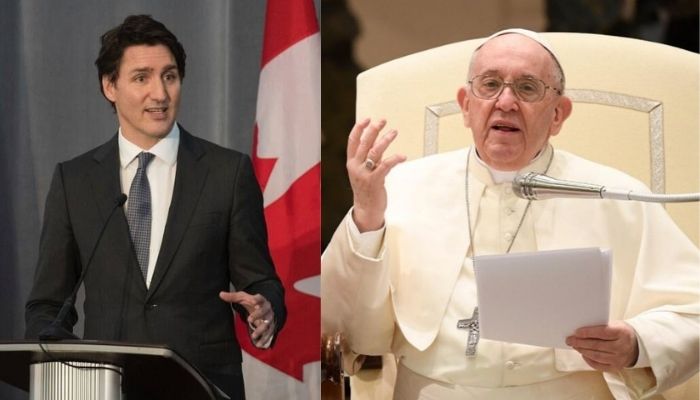
Days after meeting the Indigenous leaders of the First Nations, Inuit and Métis delegations, Pope Francis tendered an apology on Friday (April 1) for the “cultural genocide of indigenous children committed by the Catholic Church in Canadian residential schools”.
In a tweet, the Head of the worldwide Catholic church said, “I feel shame for the role that a number of Catholics with educational responsibilities have had in the abuse and lack of respect for the identity, culture and spiritual values of the Indigenous Peoples in Canada. “
He claimed that the actions of the Church in the residential schools, meant for indigenous children, were against the gospel of Jesus Christ.
I feel shame for the role that a number of Catholics with educational responsibilities have had in the abuse and lack of respect for the identity, culture and spiritual values of the Indigenous Peoples in Canada. All these things are contrary to the Gospel of Jesus Christ.
Pope Francis further stated, “Listening to the voices of the brothers and sisters of the Indigenous Peoples of Canada, I heard the suffering, hardship, discrimination and various forms of abuse experienced, particularly in the residential schools. I bear these stories with great sorrow in my heart.”
Listening to the voices of the brothers and sisters of the Indigenous Peoples of Canada, I heard the suffering, hardship, discrimination and various forms of abuse experienced, particularly in the residential schools. I bear these stories with great sorrow in my heart.
“For the deplorable conduct of those members of the Catholic Church, I ask for God’s forgiveness and I want to say to you with all my heart: I am very sorry. And I join my brothers, the Canadian bishops, in asking your pardon,” he said in a statement.
It must be mentioned that Pope Francis did not apologise and instead expressed sorrow after mass graves of indigenous children were initially unearthed from the compound of former residential schools in Canada in 2021.
On June 6 last year, he said, “I join the Canadian Bishops and the whole Catholic Church in Canada in expressing my closeness to the Canadian people, who have been traumatized by this shocking news. This sad discovery further heightens awareness of the pain and sufferings of the past.”
He emphasised, “We commend to the Lord the souls of all the children who have died in the Canadian residential schools, and we pray for the grief-stricken indigenous families and communities of Canada.”
Earlier, in April 2009, Pope Benedict had also expressed sorrow over the abuse of indigenous children in the Canadian residential school system. However, he refused to acknowledge the church’s involvement in the abuse. The recent move by Pope Francis marks a departure from the ‘shallow’ condemnation of his predecessors
The statement issued by Justin Trudeau
Following the Papal apology, Canadian Prime Minister Justin Trudeau applauded the survivors, for their continued advocacy in holding the Catholic Church accountable for its actions. Although Trudeau himself fought against compensation to indigenous children, he claimed that the apology was long due.
Trudeau remarked, “This week, First Nations, Inuit, and Métis leaders, Survivors, and youth travelled to the Vatican to continue urging the Catholic Church for an apology, which was an immense display of bravery and determination. This apology would not have happened without the Survivors who told their truths directly to one of the institutions responsible and recounted and relived their painful memories.
“Canada’s history will forever be stained by the tragic reality of the residential school system, which forcibly separated at least 150,000 Indigenous children from their families and communities, often at great distances, where they were prohibited from practising their culture and traditions and speaking their languages. For Survivors, their families, and communities, the painful legacy of the residential school system lives with them every day,” he added.
This apology is an important step forward, as we must acknowledge the truth of our past in order to move towards righting historical wrongs. We now look forward to the Pope coming to Canada to deliver the apology in person.
“Today’s apology is a step forward in acknowledging the truth of our past. We cannot separate the legacy of the residential school system from the institutions that created, maintained, and operated it, including the Government of Canada and the Catholic Church,” he added.
“Today’s apology will resurface strong emotions of hurt and trauma for many. The government will continue to support Indigenous communities across the country with the funding and resources they need to continue to search for unmarked burial sites, uncover the truth of what happened at residential schools, and continue on their healing journey,” Trudeau further emphasised.
Indigenous children, mass graves, and the Church-backed residential school system
According to the Truth and Reconciliation Commission (TRC), a large number of indigenous children that attended residential schools never made it back to their home communities. Some children ran away while others died at the schools. These students are now called the “Missing Children”.
The Missing Children Project documents and deaths and burial sites of such children who died while attending the residential schools. So far, the project has identified over 4,100 children who died while attending a residential school.
On May 27 last year, Rosanne Casimir, Chief of Tk’emlúps te Secwépemc Kukpi7 confirmed that the remains of 215 children were found at the premises of Kamloops Indian Residential School.
The news that remains were found at the former Kamloops residential school breaks my heart – it is a painful reminder of that dark and shameful chapter of our country’s history. I am thinking about everyone affected by this distressing news. We are here for you. https://t.co/ZUfDRyAfET
In the official statement, Casimir said, “We had a knowing in our community that we were able to verify. To our knowledge, these missing children are undocumented deaths.” He further added that some of the students were as young as three years old when they died. “
About 751 graves were found in Saskatchewan on June 24, 2021. Two weeks later on July 12, the Penelakut tribe informed that it had discovered 160 unmarked graves in the Southern Gulf Islands in the British Columbia province of Canada.
The unmarked graves are a testimony of a painful past where the government and Christian churches inflicted atrocities against the native population. As anger and pain spread among the First Nation people, five churches built on Indigenous land were burnt down.
In a report published in 2015 after a six-year investigation into the now-defunct system, it was termed as “cultural genocide”. The report documented horrific details of abuse, rape, malnutrition and other atrocities suffered by the students who attended the school. As many as 150,000 were known to have attended the school system between the 1840s and 1990s.
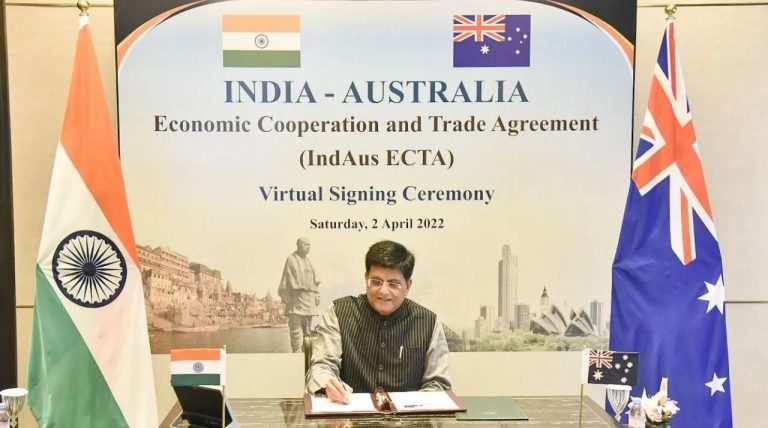
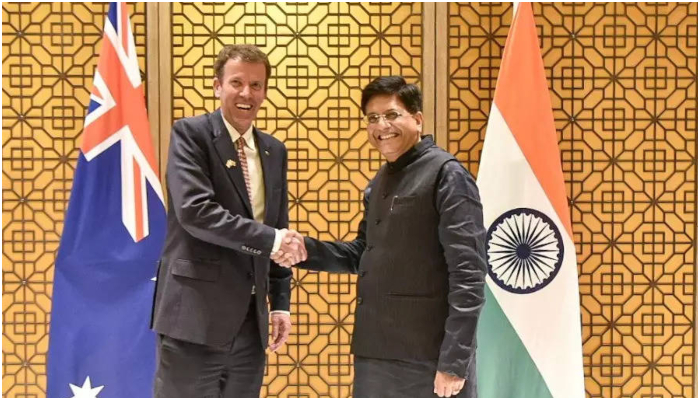
India and Australia signed an economic cooperation and trade agreement on Saturday to ensure barrier free trade in several commodities between the two countries. The agreement was signed by Commerce and Industry Minister Piyush Goyal and Australian Minister for Trade, Tourism and Investment Dan Tehan in a virtual ceremony, in the presence of PM Narendra Modi and Australian PM Scott Morrison.
According to Goyal, the agreement will almost double the trade between India and Australia in the next five years, from $27 billion to $45-50 billion. Under the agreement, Australia is offering zero duty access to India for about 96% of exports from the beginning. At present, most of these products attract 4%-5% customs duty in India. Several sectors in India, including textiles and apparel, agricultural and fish products, leather, footwear, furniture, sports goods, jewellery, machinery, electrical goods etc are expected to benefit from this agreement. Here is a brief analysis of how the agreement will be beneficial for Indian economy.
Current bilateral trade
At present Australia is the 17th largest trading partner of India, and India is Australia’s 9th largest trading partner. India-Australia bilateral trade for both merchandise and services was valued at US$ 27.5 billion in 2021. India’s merchandise exports to Australia grew 135% between 2019 and 2021. India’s exports primarily consist largely of finished products, and were valued at US$ 6.9 billion in 2021.
India’s merchandise imports from Australia were valued around US$ 15.1 billion in 2021, consisting largely of raw materials, minerals and intermediate goods. Three-fourths of India’s imports from Australia consist of coal.
While India has a surplus in trade in services with Australia, it has a deficit in merchandise trade, largely due to coal import.
Trade ( US $ Billion)
Goods
Services
Total
India’s Exports to Australia
6.9
3.6
10.5
India’s Imports from Australia
15.1
1.9
17.0
Total
22.0
5.5
27.5
Deficit(-)/Surplus(+)
-8.2
+1.7
-6.5
The Agreement
The India Australia Economic Cooperation and Trade Agreement (IndAus ECTA) is the first trade agreement with a developed nation India has signed after more than a decade. According to gove sources, this agreement will be a message for other developed countries agreements such as UK, Canada and EU, with whom India is currently negotiating for FTA. The Indo-Australia agreement is expected to increase bilateral trade from the existing US$ 27.5 billion to US$ 45 billion in 5 years. As a result of the agreement, market share of Indian goods and services in Australia will increase. India’s export is expected to increase from US$ 10.5 billion in 2021 to US$ 20 billion by 2026-27 and will cross US$ 35 billion by 2035.
As both India and Australia are large economies, these is scope for significant enhancement in bilateral trade if both have better access to the other’s markets. At present Indian exports to Australia attract 4-5% import duty, due to which India faces disadvantage compared to other countries having free trade agreements with the country, such as China, Thailand, Vietnam, South Korea, Indonesia, Malaysia and Japan. The agreement will allow India exports to compete with these countries in Australia.
Moreover, the agreement will also open up the Australian market for products and services not currently exported to the country. Similarly, the IndAus ECTA will enable Indian businesses to procure materials from Australia, providing a good sourcing alternative. The agreement will specifically benefit the Indian pharma sector due to easing of Australian regulatory processes.
The India Australia Economic Cooperation and Trade Agreement is expected to generate around ten lakh jobs in the next 5-7 years, because several labour-intensive sectors are going to benefit from it. On the other hand, it is also expected to enhance employment opportunities for Indians in Australia.
Apart from economic significance, the agreement will also have strategic importance, as India has entered into the trilateral Supply Chain Resilience Initiative (SCRI) arrangement with Australia and Japan. It seeks to enhance the resilience of supply chains in the Indo-Pacific Region and develop dependable sources of supply and attract investment including diversification of supply sources and to increase competitiveness of sectors, identification of sectors for cooperation, explore other countries who could join in the initiative, capacity building, promotion of domestic manufacturing.
It also aims to attract FDI in the region and strengthen mutually complementary relationship among the participants. US, Australia, India and Japan also have formed Quad, to further enhance cooperation and develop partnership across several issues of common concerns.
Benefits to trade in goods
Indian exports to Australia primarily consist of consumer and manufactured goods. India will mainly benefit from tariff liberalisation by the Australia, along with fast-track approval for Pharma products. Australia is offering zero duty access to 100% tariff lines from India, and Zero duty on 96.4% value of Indian exports will be offered immediately. These means, for those items, Indian exports will have immediate market access at zero duty from the day the Agreement comes into force.
At present most of these items attract 4-5% import duty in Australia, which includes, most textiles and apparel, a few agricultural and fish products, leather, footwear, furniture and sport goods, jewelry, machinery, electrical goods, railway wagons, selected pharmaceutical products and medical devices, furniture etc. For 113 tariff items comprising 3.6% of exports, the duty will be brought down to zero in the next five years.
Moreover, as India imports largely imports raw materials and intermediates from Australia, many industries in India will get cheaper raw materials and make them competitive, in particular for sectors like steel, aluminium, fabric/ garments etc.
India is also offering concessions on tariff to Australia on import of goods, which are mainly raw materials and intermediates in the form of tariff elimination or tariff reduction, with or without a tariff-rate quota. India is immediately eliminating tariff on 40% of its tariff lines comprising of 85% of Australia’s exports in value terms to India. Tariff will be eliminated or reduced on 30.3% of its tariff lines 3/5/7/10 years, as per the agreement. Only a few agricultural products such as oranges, mandarins, almonds, pears and cotton among others have been allowed with limited quota.
India has kept many sensitive products in the exclusion category without offering any concession, comprising 29.8% of tariff lines. Some of these products are milk and other dairy products, chickpeas, walnut, pistachio nut, wheat, rice, bajra, apple, sunflowers seed oil, sugar, oil cake, gold, silver, platinum, jewellery, iron ore and most medical devices. This is a major gain for India in this Agreement
Sector Specific Benefits – Products
Pharmaceuticals
Market size of Pharma products in Australia is currently estimated at $12 Billion, and Indian exports are around $345 million, which means these is scope for significant growth in Indian exports.
Australia has agreed to Annex on Pharmaceutical products, giving benefits to Indian pharma exports. This includes fast track approval for patented, generic and biosimilar medicines using the Comparable Overseas Regulator pathway, and fast track quality assessment/inspections of manufacturing facilities.
This will benefit all Indian Pharmaceutical manufacturers / medicines which have EU/ Canada FDA approvals.
Textiles
The Australian market has good potential for exports of home textiles like bed & bath linen, toilet & kitchen linen, curtains, pillow covers, quilts & comforters, cotton bags; Readymade Garments; Carpets & Floorings etc. At present, Indian exports of around 70% textile products and 90% apparel products attract 5% duty in Australia. As a result, Indian exports face disadvantage compared to exports from other countries having FTA with Australia.
With the IndAus ECTA, this disadvantage will be eliminated, and India’s exports of textiles and apparels are expected to go up from US$ 392 million to US$ 1100 million in the next 3 years. Due to additional capacity creation and investment for this increased export, additional employment of 40,000 persons per year is expected to be created.
Moreover, many of the new manufacturing units are likely to be set up in Tier 2 & Tier 3 cities & rural areas, creating an industrial eco system in these areas and generating employment
Engineering Products
India’s engineering export to Australia was US$ 801 million in 2020-21 which is likely to be US$ 1215 million 2021-22, thereby showing a growth of 51%. At present, most of Indian exports of engineering goods to Australia suffer from 5% customs tariff disadvantage. These products include flat and value-added iron and steel products, scientific and medical instruments, parts, transport equipment, non-electrical and electrical machinery etc.
With the elimination of tariffs under the agreement, it is expected that Engineering products exports may grow by around 15% per year, increasing by around 1.5 billion in 5 years to reach at 2.7 billion in 5 years.
Gems and Jewellery
Jewellery items also attract customs duty of 5% in Australia. With elimination this duty, there is likelihood of increase in Indian exports of jewellery to Australia. India’s Gems and Jewellery export to Australia was US$ 275 million in 2020-21, and it is likely to reach US$ 347 million 2021-22, showing a growth rate of 26%.
Leather & Footwear
Around 94% of India’s exports of leather products to Australia attract the duty of 5%. With the elimination of duty, Indian exports will show further growth and likely to reach US$ 100 million in next 2 years.
India’s Leather and Footwear exports to Australia was US$ 62.2 million in 2020-21 which is likely to be US$ 71.6 million 2021-22, thereby showing a growth of 15%.
Sector Specific Benefits – Services
Quota for chefs and yoga teachers
Australia has given an annual quota of 1800 for qualified, professional Indian traditional chefs and yoga teachers who can enter the country as Contractual Service Suppliers. Under this temporary entry, stay is permissible for a period up to 4 years with a possibility of further stay. Quota for chefs and Yoga teachers will facilitate movement of these professionals in Australia subject to meeting relevant eligibility conditions.
Post study work visa
Post study work visa will provide extended options to eligible Indian graduates, post graduates and STEM specialists for working in Australia. Australia has agreed to provide some opportunities for students to live, study and work in Australia temporarily after finishing their studies.
The benefits include, stays of up to 18 months after completion of diploma or trade qualifications, stays of up to 2 years upon completion of bachelor degree, stays of up to 3 years after completion of master degree, and stays of up to 4 years after completion of doctoral degrees.
Australia has acknowledged the important contribution made by Science, Technology, Engineering or Mathematics (STEM) specialists, including Indian Information and Communications Technology (ICT) professionals. To enhance mobility in these fields, Australia will extend possible stays from two to three years for Indian students graduating in Australia with bachelor degrees in the STEM fields with First Class Honours, including ICT fields.
Both countries have agreed for mutual recognition of Professional Services and Other licensed/regulated Occupations under the agreement. These obligations include elements such as coverage of all licenses and regulated occupations, allow for temporary/project specific license where feasible and establish a mechanism of Working Group to pursue on obligations related to this.
This will pave the way for initiating dialogues on Mutual Recognition Agreements in Nursing, Architecture and other professional services between the professional bodies of India and Australia, which in turn will facilitate the movement of professionals in each other’s territory.
Work & Holiday visa
Work and Holiday visa with multiple entry has been offered by Australia to 1000 young Indians, in the age group of 18-30 years, for a period of one year. Under this, they can undertake study or training for up to four months (17 weeks) or undertake paid or unpaid employment for the entire duration of their stay in Australia, generally for up to six months with any one employer.
Double Taxation Avoidance Agreement
The Government of Australia has agreed to amend Australian domestic taxation law to stop the taxation of offshore income of Indian firms providing technical services to Australia. This would resolve the issue that the Indian Government has raised about the Double Taxation Avoidance Agreement between India and Australia for the avoidance of double taxation, and the prevention of fiscal evasion with respect to taxes on income.
This was a long pending request of Indian IT industry. Once the relevant amendment is made, the Indian Tech Companies would no longer be required to pay taxes on offshore revenues in Australia, thereby enhancing their competitiveness in the international market.
Technology & IT Services
Australia requires skilled tech staff, while India has a large tech resource pool. The Australian start-up environment requires specialized talent and India has the advantage of offering skilled personnel that can meet this requirement.
India/ Australia collaboration can develop niche skill sets, provide global digital solutions, further develop Fintech capabilities. Large Indian IT companies can increase their involvement in Australian Govt. projects.
India has several low-cost product-based Software as a Service (SaaS) offerings that can be offered to Australian SMEs. Australia can also serve as the ideal market for Indian start-ups to scale up before launch in USA.
Healthcare
Australians can access Indian secondary and tertiary care facilities at highly competitive rates, benefiting the Indian medical tourism sector. Apart from tertiary care, other procedures such as dental surgery, knee replacement, cataract, etc. can also be carried out economically in India.
Indian doctors can provide second opinions or expert consultation on medical through telemedicine, and India IT expertise can assist Australian healthcare providers with medical coding/ data analytics. Medical manufacturing partnerships between the two countries can leverage Australian medical technologies while providing low cost manufacturing solutions to their Australian counterparts.
Education
The agreement will help in increasing research collaboration between Indian and Australian universities. Under dual degree programs between India and Australia, students will be allowed to study in Australia for 2 years and in India for 2 years, subject to regulations discussed by both countries.
Overall gains
India Australia Economic Cooperation and Trade Agreement will create conducive environment to grow Indian services exports due to wide ranging commitments by Australia which will bring in certainty, predictability and transparency for the services exporters. It will enhance exports linked to movement of professionals, businesspersons, students due to strong temporary entry and stay commitments by Australia.
It will enable a more liberal, facilitative, transparent and competitive services regime in the two countries. Many sectors may attract new investments and industry will benefit from world class services in finance, logistics, business services, professional services, which will further enhance their competitiveness.
Access to best in class consumer services like health, education, tourism, hospitality and audio-visual services will enable greater consumer welfare for both the sides. It will strengthen further cooperation in the new service sectors of mutual interest.
Provisions to safeguard the interest of the domestic industry
With any free trade agreement, the question of the safeguard of the domestic industry remains, due to the concessions allowed for imports. The Indo-Australian agreement incorporates several provisions to protect the domestic industry and prevent any misuse of the agreement.
IndAus ECTA incorporates stringent rules of origin for goods, to prevent any routing of products of a third country. It will require a substantial processing in the territory of the Parties.
Product specific Rules of Origin (PSRs) have been agreed for 807 lines. Moreover, for a limited number of agricultural products being offered for import by India, the product should be grown in Australia or prepared from local inputs.
Further, grounds for denial of preferential tariff benefit, enabling temporary suspension of preferential treatment, time bound verification mechanism, specifying supporting information such as cost break up and profit/related elements to be made available at the time of verification, have been provided for.
Tight Value Addition norms of 35 % (under Build up formula) and 45% (under build down formula) have been fixed in the agreement. All these will help to ensure that only products /services from Australia will count for value addition, with no leakage of 3rd Country products. This is particularly relevant in view of Australia’s large number of FTAs.
For the first time, India has made a developed country like Australia to agree to the condition of “melt and pour” as Product Specific Rules for Steel products.
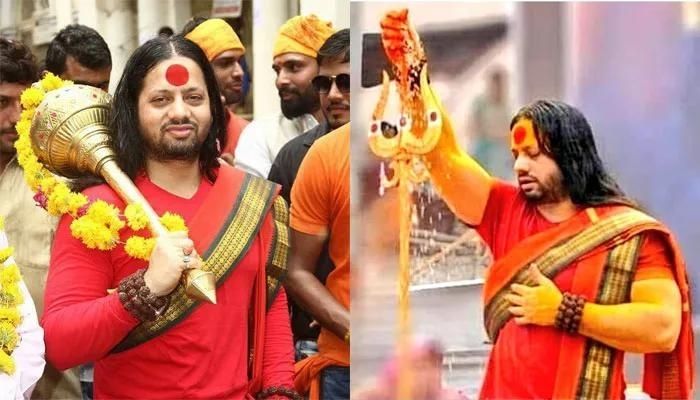
On Friday 1st April 2022, the Chhattisgarh High Court granted bail to Kalicharan Maharaj who was arrested on 30th December 2021 by Raipur Police for allegedly criticizing Mohandas Karamchand Gandhi during a speech at the ‘Dharm Sansad’ event in Chhattisgarh. A case of sedition was also registered against him. Now, he has been granted bail in this case after being asked to deposit a bond of Rs 1 lakh and two deposits of rupees 50 thousand each.
Kalicharan Maharaj allegedly used objectionable words against MK Gandhi during the Dharma Sansad in Raipur. He was arrested by Raipur police from Khajuraho in Madhya Pradesh after registering a case against him under several sections. Sections invoked against Kalicharan Maharaj included section 505 (2) (making a statement that creates or promotes enmity, hatred, or ill-will between classes) and 294 (obscene acts) for allegedly using derogatory words against Mahatma Gandhi. Later, police added 124 A (sedition) and four other sections of the IPC in the case.
Kalicharan Maharaj’s lawyer argued, “The applicant has been falsely implicated in this case due to political rivalry. The offence under Section 124 A of the Indian Penal Code is prima facie not made out against the applicant. The decisive ingredients for establishing the offence are missing in the First Information Report, there is no suggestion that the applicant did anything against the government of Chhattisgarh, the Government of India, or any other Governments of States. The complaint filed against the applicant contains no averment that the applicant did anything against the governments.”
Kalicharan Maharaj’s lawyer cited the judgments given in such cases in the Supreme Court. He also said, “It is not a crime to make a public statement quoting what is written in the books. A charge sheet, in this case, has also been submitted to the court. In such a situation, bail is his right.”
The public prosecutor argued that the accused can disturb communal harmony if bail is granted to him. After hearing the arguments of both sides, the High Court granted bail with the condition of depositing a bond of Rs 1 lakh and two deposits of Rs 50,000 each.
The Dharm Sansad event where Kalicharan Maharaj delivered the controversial speech was held at Raipur in Chhattisgarh on 26th December 2021. In his speech, Kalicharan Maharaj had criticized Gandhi for India’s partition and hailed Nathuram Godse for killing Gandhi.
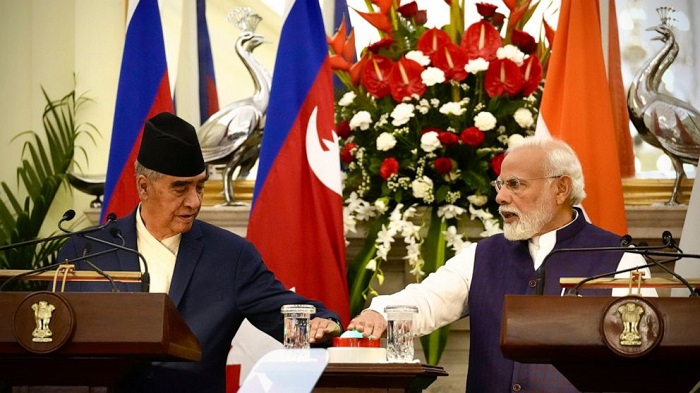
On Saturday, Prime Minister Narendra Modi and his Nepali counterpart Sher Bahadur Deuba jointly flagged off the first passenger train service between the two neighbouring nations. The launch of the much-awaited 35-km long cross-border railway link is set to connect Jaynagar in Bihar with Kurtha in Nepal. The duo also launched the RuPay digital payment application for Nepal.
PM Modi at the launch on April 2 said that the beginning of the Jayanagar-Kurtha rail line will help India in fostering trade and cross-border connectivity initiatives in all respects. “The project will make a great contribution to the smooth, hassle-free exchange of people between the two countries”, he said. The duo also jointly launched the RuPay card in Nepal and added a new chapter of financial connectivity between the two countries.
PM Narendra Modi & Nepal PM Sher Bahadur Deuba jointly flag off the inaugural run of the cross-border passenger train services between Jaynagar (India) and Kurtha (Nepal). pic.twitter.com/WvsYvQgEKu
“We agreed on the subject of greater participation by Indian companies in Nepal’s hydropower development plans. It is a matter of happiness that Nepal is exporting its surplus power to India. It will contribute well to the economic progress of Nepal”, said PM Modi as the duo further jointly inaugurated the Solu Corridor 132 KV Power Transmission Line and Substation in Nepal built under Govt of India’s Line of Credit.
Delhi | PM Narendra Modi & Nepal PM Sher Bahadur Deuba jointly inaugurate Solu Corridor 132 KV Power Transmission Line and Substation in Nepal built under Govt of India’s Line of Credit.
The leaders also held bilateral talks in Delhi and inked four important pacts to expand cooperation in the areas of railways and energy. Nepali PM Deuba is on a three-day visit to India, this being his first visit to the country after becoming the Prime Minister of Nepal. Deuba was scheduled to visit India earlier this year for the Vibrant Gujarat Conference but the event was cancelled due to the pandemic.
Meanwhile, Sher Bahadur Deuba lauded India’s management of COVID-19 and said Nepal received its first vaccine aid from New Delhi. “I admire the progress that India is making under the visionary leadership of PM Modi. We’ve seen India’s effective management battling Covid-19 and received first vaccine aid from India as well as medicines, medical equipment, and logistics to combat Covid,” Deuba said.
“As PM Modi mentioned, we had friendly talks and fruitful discussions on various aspects of India-Nepal relations. We shared our perspectives on further strengthening our friendly ties,” the Nepal PM added.
As PM Modi mentioned, we had friendly talks and fruitful discussions on various aspects of India-Nepal relations. We shared our perspectives on further strengthening our friendly ties: Nepal PM Sher Bahadur Deuba issues a joint statement with PM Narendra Modi in Delhi pic.twitter.com/88gmMg5bMI
The Jaynagar Kurtha cross-border railway link, according to the reports, will be the first modern railway service in Nepal and will operate with five coaches. The Konkan Rail Corporation Limited has provided two sets of 1600 HP DEMU passenger rakes. The DEMU rakes which were handed over to Nepal in the year 2020 have 2AC coaches.
Further, the Jaynagar-Kurtha is a part of the 68.7 km Jaynagar-Bijalpura-Bardidas rail link. Jayanagar is 4 km from the India-Nepal border. The Government of India has spent nearly Rs 550 crore for the section up to Bijalpura which is 17 km from Kurtha.
It is important to note that Nepal shares a border with five Indian states- Sikkim, West Bengal, Bihar, Uttar Pradesh, and Uttarakhand. Nepal, being landlocked, heavily relies on India for the transportation of goods and services. PM Modi today stated that Nepal is an old friend of India and that relations between our people can’t be seen anywhere in the world.
Deuba ji is an old friend of India. As the PM, this is his fifth visit to India. He has played an important role in developing India-Nepal relations. The friendship between India & Nepal, relation b/w our people – such an example can’t be seen anywhere else in the world: PM Modi pic.twitter.com/MXFM5QH4Ux
Interestingly, Nepal also became a member of the International Solar Alliance. The two countries discussed various aspects of cooperation and also reviewed the progress of the ongoing projects. India reiterated its support for Nepal’s journey of peace, prosperity, and development.
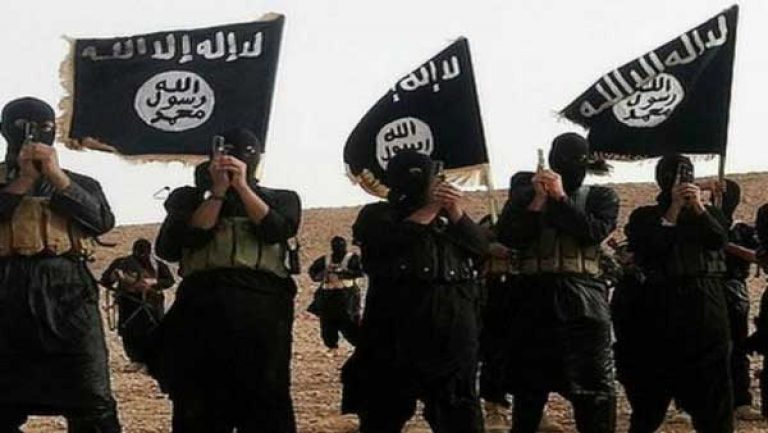
A person from Hyderabad’s old city area was picked up by the cybercrime cell of the police after it was noticed that he was accessing some banned websites. The websites he accessed included the ISIS website.
Whether he accessed those websites intentionally or unintentionally couldn’t be confirmed at the moment. The questioning in the matter is going on to ascertain his intentions, the police officials said.
Telangana | A person from Hyderabad’s Old City was picked up by Hyderabad Cyber Crime Police after noticing that he was accessing banned websites including ISIS. Whether he has done it intentionally or not is yet to be ascertained, questioning is on: Police officials
This is not the first time that Hyderabad’s name has popped up alongside the dreaded terrorist organization ISIS. Earlier, in 2018, National Investigation Agency (NIA) had arrested 8 youths from Hyderabad for planning terror attacks on the instructions of ISIS.
The same year, NIA had arrested 2 others from Hyderabad in a separate case for planning terror attacks in the country and for their links to ISIS.
ISIS magazine asks Muslims to ‘take back Babri’, calls Hindus ‘filthy urine drinkers’ who learned civilised living from Muslims
Voice of Hind, the propaganda digital magazine of ISIS has released its new edition in which it has gone on to instigate Muslims to “Take back Babri from Hindus”. The cover of the January edition of the ISIS mouthpiece read: “If you are a Muslim then you must be a terrorist so terror(ise) them….”.
On a subsequent page, there is an image of Hindus with saffron flags atop a building with the caption: “O’ Muwahhid take back Babri Masjid from Hindus”. Muwahhid means a ‘good’ Muslim who believes in the oneness of Allah.
The ISIS magazine spoke in detail against the demolition of the Babri Masjid. It also spoke about the acquittals in the case and sought ‘a kind of punishment that coming generations of Hindus would remember’ It exhorted the Indian Muslims to wage violent jihad against the Indian government.
Referring to Hindus as “cow worshipping polytheists”, the new edition of the ISIS-backed magazine provoked Muslims by calling the demolition of the Babri Masjid one of the “most shameful and insidious attacks on the Muslims of India by a rabid mob of Hindu Mushrikeen”. Cow, because cows are considered holy in Hinduism.
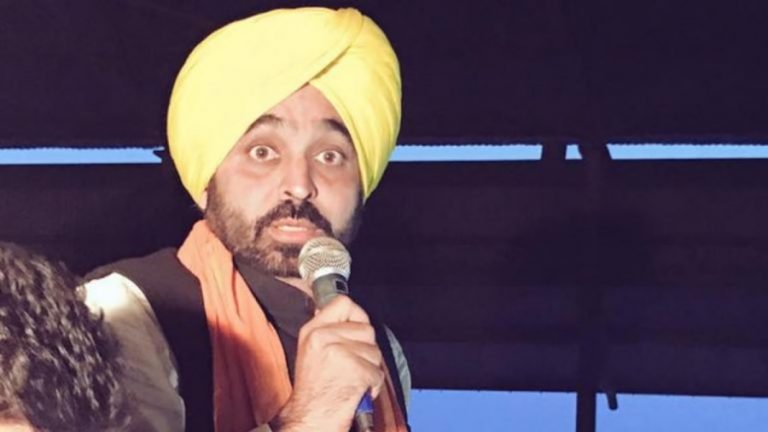
‘Give in writing that Punjab is not part of India and has to pay rent for protection from the Indian military’. How could an elected Chief Minister of an Indian state talk like this about the Indian military? That too the Chief Minister of Punjab. Does he not know about the dark chapters in the history of the state? Of course, he does. He just does not care.
Whether fortunately or unfortunately, we have to deal with the fact that Bhagwant Mann is now the democratically elected chief minister of Punjab. He gets to make the most important decisions about the 3 crore people of the state. Those are 3 crores of my fellow citizens. And when the Chief Minister of Punjab says ridiculous and dangerous lies about the Indian State, the State of Punjab and the Indian military, I am going to call him out.
So here are the four “lies” of Bhagwant Mann. And at the end of it, one cynical truth, which may actually be the worst of all.
(1) So Mr. Mann says he met Rajnath Singh over some kind of bill sent for the deployment of the Indian military to Punjab during the terrorist attack at Pathankot. But why? The terrorist attack happened in the early days of 2016 when Manohar Parrikar was Raksha Mantri. At the time, Rajnath Singh was Home Minister. He had nothing to do with the military. So it is an obvious lie that Mr Mann would have met the Home Minister on the issue of deployment of the military.
(2) Now, as many netizens have pointed out, Bhagwant Mann may have misspoken. When saying “military,” maybe he was actually thinking about the Central Armed Police Force (CAPF). First of all, how reassuring that a Chief Minister does not use words carefully while speaking in the context of a terrorist attack.
But even if you forgive that, how could Bhagwant Mann possibly say that he received a bill from the centre for the deployment of CAPF? Seriously? At the time, Mann was just a random MP. Anybody who knows anything about the structure of the Indian state would admit that he has to be lying here. Even if the Center has to collect money from the state govt, why would they address the letter to some random MP from the state?
(3) Now let us come to the issue of the Center charging money from Punjab for the deployment of CAPF personnel. The way Mann spoke, it seemed as if this is some kind of special tax that only Punjab has to pay. But that is not true at all. The rules apply equally to all states, not just Punjab. And yet, the Chief Minister chose not to clarify this point, leaving ignorant people to gather whatever mistaken impressions they might take away from this. Again, that too in Punjab, where the ghost of separatism is never far away. No words to capture just how irresponsible this is.
(4) Okay, but why did the Center want to collect money from Punjab for sending the CAPF? Even if you give Mann every benefit of the doubt, it sure sounds bad, no? After all, our taxes pay for the Central government. Are we not entitled to protection, especially in times of extreme need, such as a terrorist attack?
So why do the states have to pay? Because of the Indian Constitution. The Constitution makes it clear that law and order is a state subject. The Center has no control over it. That’s right, zero, zilch. Remember when Mamata Banerjee arrested CBI officers in Bengal? Yes, inside the state, the state government has total control over law enforcement.
One common confusion, because of the name, is that actions of “Central forces” such as CRPF, CAPF etc are dictated by the Center. No, they are not. When these “Central” forces are deployed in a state, they are placed under the control of the state police. Yes, you read that correctly. If you live in an Indian state, and you have an issue with the CRPF, please contact your local police station. The CRPF takes all its orders from there.
The Center merely keeps a reserve of “police forces.” These reserve police forces are paid by the Center but have no authority to do anything. When a state needs extra personnel for law enforcement, they have to explicitly ask the Center to send these forces. The State has to hire extra personnel from the Center. These hired personnel will be under the command of the state government. And that is why the state government must pay.
(5) So if Bhagwant Mann is “lying”, you could ask why not take action against him? This is an extremely sensitive matter. Should Mann not face some kind of punishment?
Well, remember how I promised you one cynical “truth” at the end? The fact is you can’t. Because Mann said all this on the floor of the Assembly. An elected representative speaking on the floor of the House enjoys total immunity with respect to speech. You can’t do anything about it. This is a key part of the privilege of the House. Even the court cannot touch it.
So you see. Bhagwant Mann has actually read about the constitution and the structure of the Indian state. Just the parts that help him with his pathetic propaganda.
I miss the old days when people would make jokes about Bhagwant Mann being drunk on alcohol. It is a lot worse now that he is drunk on power. Because this is no longer funny.
The former journalist and BJP Minister, Arun Shourie, has recently courted controversy for trying to water down the horrors of the Emergency and painting the incumbent Narendra Modi government in a poor light.
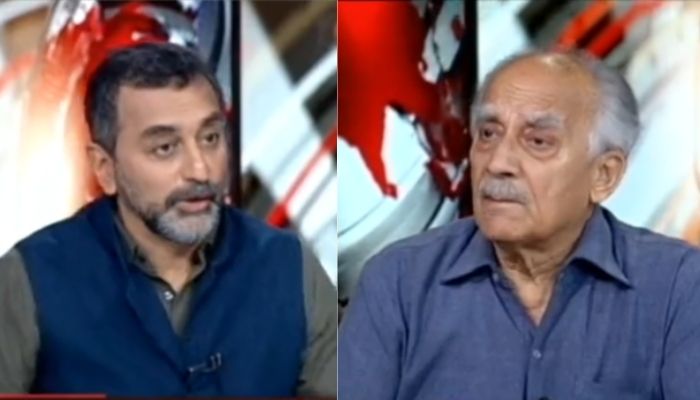
On Friday (April 1), Arun Shourie appeared on NDTV’s show ‘Reality Check’, hosted by Sreenivasan Jain, to speak about his new book ‘The Commissioner For Lost Causes’. During the conversation, Jain tried to draw parallels between the Congress government of the 70s and 80s to that of the incumbent BJP government at the Centre.
“It is not as if the earlier Congress regimes were not hostile to the press, be it Indira Gandhi and Rajiv Gandhi. Not just during the Emergency but otherwise! Yet, you say in your book that you don’t want it to be used as whataboutery,” the news anchor remarked.
He further added, “The sins of the past are used to justify the sins of the present. So in that sense then, how would you make that distinction between what was happening then and what is happening today?”
Arun Shourie responded, “One is the question of scale- both in the media and the government. Yes, there must have been people at that time who took PIB handouts and just wrote by a special correspondent and sent it to the press. But that was an exception. Today, it is the rule. “
“Similarly, in the government’s case, there were lies such as during the Bofors scandal. But today, it is endemic. You really need to search for a truthful statement from GDP figures to everything else. The matter of scale is very different,” he alleged.
“The second difference would be shame. This has now become acceptable behaviour. At that time, people were quite ashamed if the truth was uncovered,” the former BJP Minister claimed.
He continued, “If a journalist would have been fed stories by the Ministry of Home/ Defence, then, he would have come to be known as a government spokesperson. He would have felt out of place among others. But today it will be a badge of honour.”
Arun Shourie claims Indira Gandhi regretted the declaration of Emergency
Arun Shourie then went on to eulogise Indira Gandhi for calling off the Emergency and ordering fresh elections on January 18, 1977. “One of the prevailing theories was that the Intelligence Bureau (IB) had misled her deliberately, saying that you will get 350 seats and so on,” he said during the show.
“She knew that she was going to lose but she had a great unease about what she had to do including the arrest of people known to her father. There was also the heritage of the freedom struggle and the values for which the rulers of that era and their parents had fought. But today there is no sense of shame,” he further alleged.
Sreenivasan Jain hopped on the opportunity to suggest that despite quashing the Fundamental rights of citizens for 21 long months, Indira Gandhi was a just and lenient ruler.
“The withdrawal of the Emergency and the allowing of the elections was not because of IB report or external pressure but as you say of Mariyada i.e. threatened democracy but within a certain limit?” he inquired.
“There was a certain sense of personal obligation,” Arun Shourie replied. He claimed that Indira Gandhi ‘regretted’ arresting her political dissidents, who were well-known in public life and fuelled by a spirit of patriotism.
“That sense of shame and regret was there. I heard it from (philosopher) J Krishnamurti himself because Mrs Gandhi had sought a meeting with him at (writer) Pupul Jaykar’s house. He told me how remorseful she was.”
Former BJP Minister suggests ‘New India’ is worse than that during the Emergency
Sreenivasan Jain then attempted to draw superfluous analogies between the Emergency era and India of 2021. He claimed that politicians now have no sense of limit aka Mariyada. Arun Shourie nodded in affirmation and said that there is no sense of shame on the 3 sides.
“On the rulers’ side – no sense of restraint and shame at all. On the side of the media- no sense of shame in puffing or covering up those deeds and on the side of the public who have now accepted all this as the new normal,” he claimed. Arun Shourie suggested that the Covid-19 data was misleading but the people have accepted it as the new normal.
By watering down the horrors of the Emergency, the former BJP Minister portrayed Indira Gandhi as a politician who knew her limits and insinuated that PM Modi lacked both shame and restraint. He also suggested that India of 2021 has leapt decades behind in safeguarding the rights of citizens as compared to the Emergency era.
Recounting the 1975 Emergency
Indira Gandhi, whose 1971-election victory against Raj Narain was dismissed by the Allahabad High Court in 1975, imposed a national emergency in the country to protect her political interests. Indira Gandhi, rather than accepting her defeat with all grace, imposed the draconian emergency and locked up her political opponents in 1975.
The Allahabad Court’s judgment to dismiss the electoral victory of Indira Gandhi from Rae Bareli came from the fact that she had indulged in corrupt electoral practices during the elections.
The court had also barred her from contesting any Lok Sabha elections for the next six years, which led Indira Gandhi to subvert the country’s democratic procedures stated in the constitution.
The Youth Congress played a critical role during the period. Bureaucrat Naveen Chawla, socialite Rukhsana Sultana (infamous for forced sterilisation campaign), police officer PS Bhinder, and Congress leader Ambika Soni oversaw the implementation of Sanjay Gandhi’s 5-point programme.
This included demolition of slums/ beautification drive, adult literacy, abolition of dowry, caste system and contentious family planning. Not only that, Indira Gandhi several times in the past misused the provisions of Article 356 to impose President’s Rule in various states for her political gains.
During her tenure as the country’s Prime Minister from 1966- 77 and 1980- 84, she had imposed President’s rule a total of fifty times, which is the highest for any Prime Minister. Today, Indira Gandhi is remembered for attempting to destroy India’s democratic credentials to satisfy her power-lust.
In the aftermath of the Emergency, Indira Gandhi lost the 1977 elections from the Rae Bareli constituency.
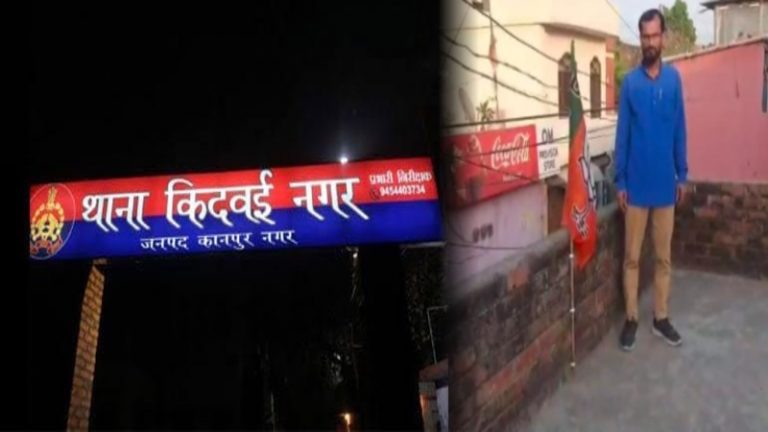
A piece of news from Kanpur has been doing the rounds on social media after it was extensively shared by mainstream media organisations. The news says that a person named Shakeel was beaten up by his neighbours for putting up a BJP flag in his neighbourhood. They further added that Shakeel had alleged that his neighbours threatened him with gouging his eyes out and slitting his neck. Some media organisations even linked this entire matter to the incident of Babar Ali of Kushinagar.
A report published by Aaj Tak on 1 April 2022 (Friday) said that only neighbours threatened to behead an educated Muslim youth for putting up a BJP flag, but he was publicly assaulted many times. It further mentioned that Shakeel worked in a multinational company and got an FIR registered against his assailants but no one has been arrested to date.
According to a report by TV9, “The case is of Juhi Colony of Kidwai Nagar. The incident took place on March 29 (Tuesday).” It further said that Shahnawaz, Rashid, Rizwan and Bhallu were the primary accused in the case who constantly issued threats to Shakeel, whom the channel referred to as the victim.
In the same case, according to a report by Hindi vernacular Amar Ujala, “The BJP flag at Shakeel’s house was snatched and thrown away. The report said Shakeel Ahmed identified himself as a BJP supporter and a few days back a BJP MLA had garlanded him. This did not sit well with many of his neighbours, the article contended, leading to their altercation with Shakeel.
Similarly, according to a News18 report, “Shakeel received threats that he would be beheaded and his eyes gouged out if he does not go along with the Muslims. The article stated that Shakeel was a BJP supporter since 2013 and that there is panic in his house following the death threats.
On the same development, The Quint wrote, “This time in the assembly elections, he put up BJP flag at his house while Congress flag was installed in the rest of the locality. Neighbour Shahnawaz, along with his family members, beat him up for putting up the BJP flag. After this, he lodged an FIR in the Kidwai Nagar police station.”
After multiple news organisations reported that a BJP supporter was assaulted, the saffron party issued a clarification. It said Shakeel has got nothing to do with the party.
Clarification issued by local BJP functionary
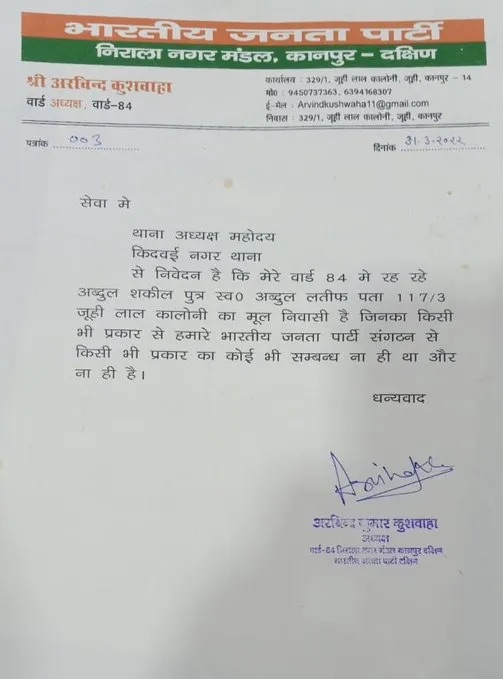
On Shakeel’s allegations, BJP Nirala Nagar Ward 84 President Arvind Kushwaha issued a letter addressed to SHO Kidwai Nagar. The letter reads, “Abdul Shakeel, who was residing in my ward 84, was never associated with BJP, in the past or in present.”
The dispute is related to house rent: Shakeel’s neighbour
As the claims of Shakeel being assaulted for putting up a BJP flag on top of his house started doing the rounds in the media, Kanpur Police swung into action to get to the bottom of the truth. In a video released by the police, Shakeel’s neighbour, Rajendra Singh, debunks the false claims that are being bandied around on social media platforms and by various news organisations.
“There was this jewellery shop in the neighbourhood, which was forcibly vacated. Since then there have been some tensions in the locality. On the day of the incident, both sides were involved in the fighting. Since I belonged to the locality, I reached there and tried separating the sparring parties. When the fighting ended, there was no flag hanging at Shakeel’s house. I warned both sides not to quarrel again and if they did, I will call the police and send them to jail. Nothing happened after that,” Singh said.
— POLICE COMMISSIONERATE KANPUR NAGAR (@kanpurnagarpol) April 1, 2022
Singh further added that he has no idea of the claims that are being made in the media. He said he has no inkling of when the FIR was filed by Shakeel. “When did he (Shakeel) file the FIR is not known to me. My name is also in this, so I am coming forward and telling you that there was no such incident of assault in front of me. The BJP flag has been put up since yesterday. The matter was about the house, and it was a minor tussle between the two sides. No one is injured and no one has been hurt in this incident,” Singh further clarified.
‘Do not spread misleading information’: Kanpur Police
Kanpur Police has asked social media users and media organisations to stop spreading misleading information pertaining to the flag dispute.
#POLICE_COMMISSIONERATE_KANPUR_NAGAR के थाना किदवई नगर में मकान में झंडा लगाने के विवाद में सामने आए चश्मदीद पड़ोसी व वार्ड अध्यक्ष के बयानों ने घटना की मंशा स्पस्ट कर दी है, उचित कार्रवाई के लिए पुलिस जांच कर रही है, कृपया भ्रामक सूचनाएं न फैलाएं। @News18P
— POLICE COMMISSIONERATE KANPUR NAGAR (@kanpurnagarpol) April 1, 2022
According to the police, “The statements of the eyewitness neighbour and the ward president, who came to the fore in the wake of news reports of a dispute over waving a BJP flag, have revealed why the altercation actually took place”. It further said that investigations are underway and appropriate action will be taken.
A similar occurrence had happened in Indore, police had denied
A similar incident happened in Indore, Madhya Pradesh as well. In March 2022, Yusuf of MG Road police station had accused Sharif Mansoori of assaulting himself for putting up a photo of Prime Minister Narendra Modi in his house. However, the police, in its investigation, found that the matter was about the tenant-landlord dispute and not about PM Modi’s picture in the house.
The dispute between Yusuf and Sharif had been going on for a long time, the police said. Despite calling him multiple times, Yusuf did not appear in front of the police. Later, Sharif Mansoori accused Yusuf of seeking cheap publicity by alleging that he had assaulted him for putting up a picture of PM Modi.
According to reports, on Wednesday (Eastern Daylight Time), Police in Washington DC discovered five fetuses at the house of Lauren Handy, an anti-abortion activist, in the Capitol Hill area.
Police officers arrived at Handy’s house in the 400 block of 6th Street to investigate a complaint regarding suspected bio-hazard items on the premises. Once inside, they discovered five fetuses, which were subsequently retrieved by the DC Office of the Chief Medical Examiner.
In a separate inquiry, a federal grand jury found Handy and nine others guilty on Wednesday (EDT). She was charged with criminal conspiracy against liberty, in connection with the blockade of a DC abortion clinic in October 2020.
Ashan M. Benedict, the DC Police Executive Assistant Chief of Police, told reporters on Thursday that the foetuses seemed to have been terminated in line with DC law. “Except for how they got into that residence,” Benedict said, “there doesn’t appear to be anything unlawful about it.” The inquiry that led detectives to Handy’s house was independent of the federal probe that led to her indictment on Wednesday, Benedict clarified.
Handy works for Progressive Anti-Abortion Uprising, an organisation that claims to mobilise grassroots anti-abortion activists for direct action. It claims to educate the public about the exploitative influence of the Abortion Industrial Complex, advocate for pregnant people, and connect abortion-vulnerable communities with life-saving resources.
Lauren Handy has a long history of legal troubles
Handy, who created the anti-abortion nonprofit Mercy Missions, hasn’t restricted her anti-abortion efforts to Washington DC. Criminal proceedings were initiated against her for resisting arrest at an abortion clinic in Michigan in 2019.
Handy has a history of legal troubles due to her anti-abortion activism, according to DC Superior Court documents, as reported by WUSA90. In December 2015, a DC charter school filed a legal lawsuit against her for trespassing. She had been arrested for illegal assembly outside the school earlier that year, as well as for unlawful entry and obstructing an entrance at several sites in 2019 January. Only one of those incidents resulted in a fine. That case originated from an arrest in March 2019 at the Washington Surgi-Clinic, which is also the location of the indictment against Handy. The charge was withdrawn in July 2019 due to a lack of evidence.
On Saturday, India decided to clear away the trade barriers while signing the India-Australia Economic Cooperation and Trade Agreement with Australia and pledged to double the bilateral trade between the two countries in the coming few years. Commerce and Industry Minister Piyush Goyal while addressing the press brief said that the agreement will help in taking bilateral trade from $27 billion to $45-50 billion in the next five years.
He also said that one million jobs would be created in India in the coming five years due to the India, Australia Interim FTA. “We expect one million jobs creation in India in next 4-5 yrs. A number of new opportunities will open for Indian chefs and Yoga instructors in the time to come”, he said as India and Australia inked the agreement in a virtual ceremony attended by Prime Minister Narendra Modi and his Australian counterpart Scott Morrison.
#WATCH | Following the virtual signing of India-Australia Economic Cooperation & Trade Agreement, Union Min Piyush Goyal addresses a PC: says, “We expect 1 mn jobs creation in India in next 4-5 yrs. A number of new opportunities will open for Indian chefs & Yoga instructors…” pic.twitter.com/fk6YFwqxbb
The deal was signed between Commerce and Industry Minister Piyush Goyal and Australian Minister for Trade, Tourism and Investment Dan Tehan. PM Modi after the signing of the deal praised the mutual trust between the two countries and said that the deal was truly a watershed moment for bilateral relations.
“There is a great potential between our two economies to fulfil each other’s needs. With this agreement, we will be able to benefit from opportunities. On the basis of this agreement, together we will be able to contribute to increasing supply chains resilience and stability of Indo-Pacific region,” he added.
Meanwhile, the Australian Prime Minister also said that the trade pact signed with India will further ‘deepen our close ties’. “The pace and scale of our cooperation since we announced our comprehensive, strategic partnership has been remarkable. The $282 million in new initiatives that my government has announced including at the summit will drive our expanding cooperation,” he said. Morrison also added that the deal was the single largest Australian investment in India.
It is important to note that Australia offers zero duty access to India for about 96.4 per cent of exports from day one. Also, with this deal, Australia has promised duty-free access to roughly around 12,000 Indian goods (95 per cent) in the Australian market. The scope of the pact will eventually be expanded to cover 100 per cent of Indian goods in the next five years. However, about 70 per cent of Australian products will get duty-free and concessional access to the Indian market under the Economic Co-operation and Trade Agreement.
India’s move to clear away the trade barriers with Australia is to benefit Indian exporters from over 6,000 broad sectors, including major export items like textiles, leather, furniture, jewellery and machinery. India’s goods exports were worth $6.9 billion and imports aggregated to $15.1 billion in 2021.