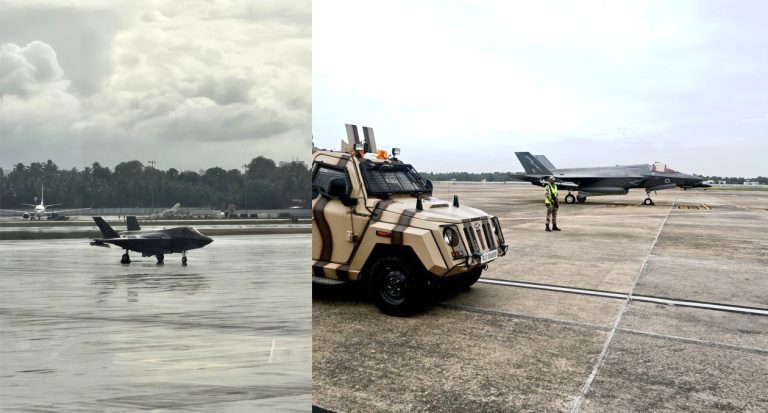
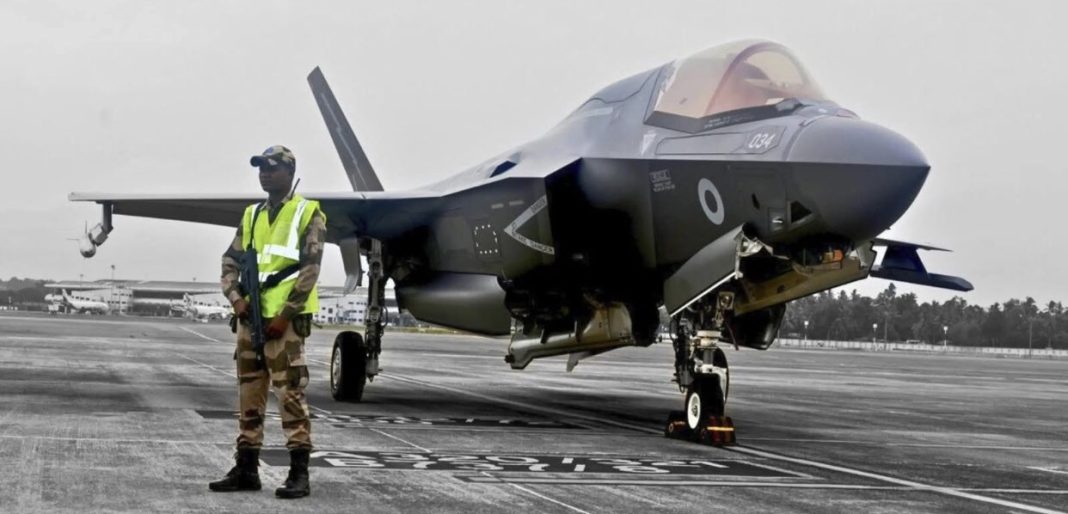
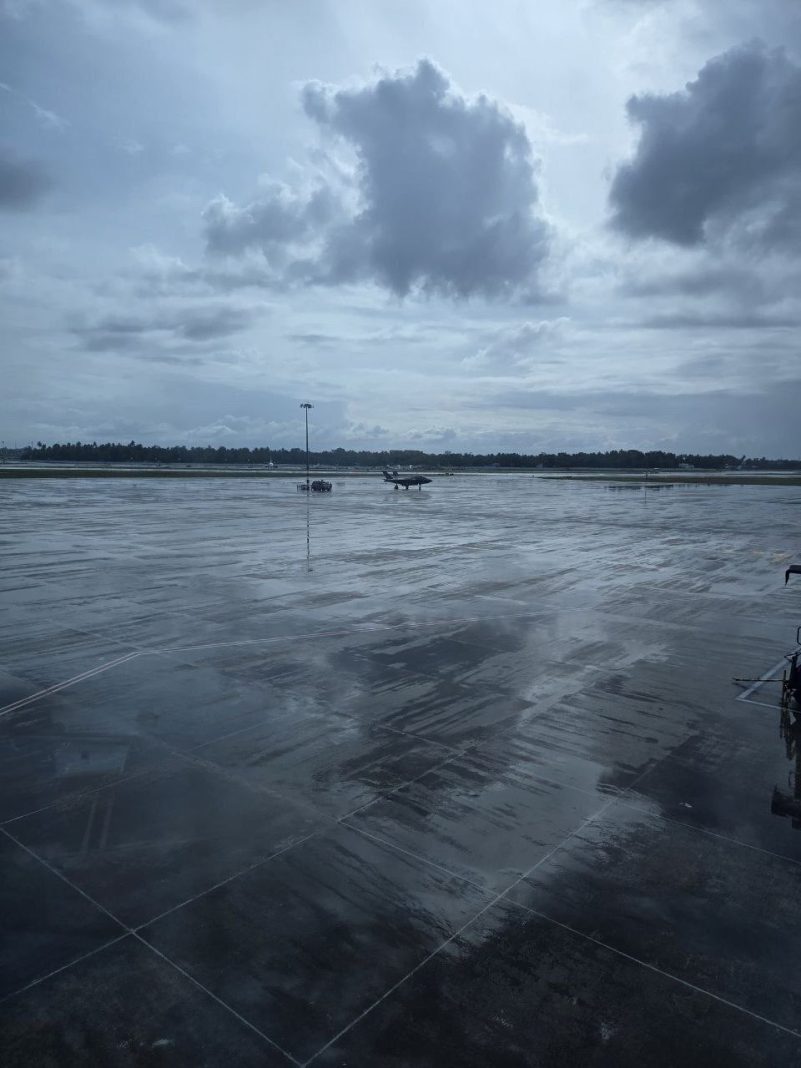
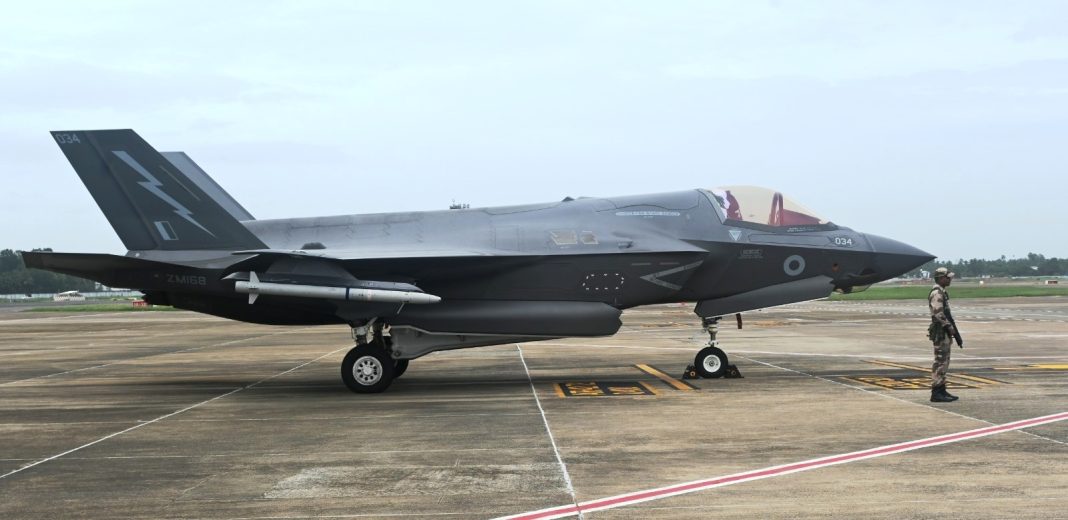
Seven days after a F-35B fighter jet of UK Navy made an emergency landing at Thiruvananthapuram airport on Saturday night due to ‘low fuel’, the aircraft still remains grounded at the airport. While the stealth jet was refuelled by Thiruvananthapuram Airport authorities, it didn’t take off, and then it was revealed that the jet was suffering from much more serious issues.
The jet, part of HMS Prince of Wales aircraft carrier group of the Royal Navy, declared emergency on Saturday night, and requested permission to land at Thiruvananthapuram airport, which was earmarked as the emergency recovery airfield. Notably, the British carrier group is currently deployed in the Arabian Sea, and recently took part in a joint drill with the Indian Navy.
What happened so far
The F-35B jet, the navy version of the F-35, landed at around 9:30 PM on Saturday, and at that time it was reported that it made emergency landing due to fuel shortage and bad weather. But 4 days later, it was reported that the jet was facing serious technical issues. As per reports, the jet was diverted to Kerala due to a suspected hydraulic system failure, not fuel shortage.
After the jet landed, a drama ensued at the airport, as the pilot Captain Mike refused to leave the spot. After completing mandatory customs and immigration procedures, he insisted on remaining near the plane, and sat on a chair provided by the airport authorities. He didn’t want to leave the advanced jet unattended. However, when a 2-men team of Royal Navy personnel arrived on the same night at around 11:15 PM, he moved into the airport terminal with the local authorities.
On Sunday morning, six Royal Navy technicians arrived to fix the jet. After checking, they confirmed that there is hydraulics failure. Another team of technicians were airlifted by a Royal Navy helicopter to begin repairs on Monday to repair the aircraft. The helicopter also brought a replacement pilot, and Mike later departed with the Royal British Navy helicopter.
Hydraulics failure, Engine Failure, Fuel Shortage
However, the issue could not be resolved by the technicians, and now it is being reported that the plane suffered engine failure. As per reports, the jet tried to land at the carrier due to bad weather, but could not and circled in the air for some time. It also dumped fuel to be able to land. But as the weather condition deteriorated, it ran out of fuel, declared emergency, and landed at Thiruvananthapuram airport. It has been speculated that as a result of landing with low fuel, the jet’s hydraulics and engine suffered damage.
The jet is parked at Bay 4 of the airport with special permission from central govt and Indian Air Force. At present, CISF personnel have been deployed to secure the plane.
Replacement pilot Freddy and three technicians are staying at the airport, and they have been accommodated at the emergency medical centre of the airport. They can observe the plane from that place. Six other technicians, who had arrived on Sunday and Monday, returned to HMS Prince of Wales by helicopter on Tuesday afternoon.
The airport authorities are providing them with food and other supplies. As per their request, a ground handling agency has also been provided for the plane.
Jet remains parked in open, Brits want to watch is constantly
As it is not certain when the jet will be airworthy, it may be shifted to a hanger adjacent to the airport. There is a hanger unit at the maintenance unit of Air India. However, at present it remains parked in the open, exposed to elements during the monsoon rains. CISF personnel continue to guard it.
A report by IDRW claims that Indian authorities offered to move the jet to a hanger, but the British personnel declined. Most probably, they refused to move the jet to hanger as doing so would mean they would not be able to maintain a watch over the jet constantly. At present, they can see the jet from their accommodation at the airport’s emergency medical centre.
As per reports, the jet’s departure has now been postponed indefinitely. Additional technical experts are expected to arrive from the UK to inspect and repair the aircraft. As the existing technicians could not fix it, it is being speculated that the jet now needs advanced tools and spares to repair, which will need to be brought from UK or US.
The Lockheed Martin F-35B Lightning II is a short take-off and vertical landing (STOVL) variant of the fifth-generation fighter, and a crucial part of Royal Navy. As the technology of F-35 remains a closely guarded secret, the jet will probably be repaired in a highly secure environment. Therefore, if and when the British Navy decides to do major repair of the jet in India, they may move it to a hanger, while keeping it under their watch.
Did India detect American stealth jet
After the jet’s landing, a tweet by Indian Air Force created euphoric speculation that India was able to detect the American stealth jet. However, that is not the case.
Indian Air Force said, “On having declared a diversion off an emergency, the F35B was detected and identified by the IAF’s IACCS network and cleared for the recovery.” This comment led many to believe that India was able to detect and identify the word’s most advanced stealth fighter jet. But the fact is, the F-35 had already declared emergency, which means it had switched off its stealth mode, so that it can be guided to land at the airport.
A Royal Navy F-35B fighter recovered off an emergency landing at Thiruvananthapuram International Airport on the night of 14 June 25. Operating from UK Aircraft Carrier, HMS Prince of Wales, it was undertaking routine flying outside Indian ADIZ with Thiruvananthapuram earmarked… pic.twitter.com/gL2CQcuJc7
During peacetime operation, stealth aircrafts switch on their transponders, and activate their Luneburg lenses, which reflect radar to deliberately increase the plane’s radar visibility. This is crucial in ensuring that friendly and civilian radar systems can identify and track them easily during non-combat operations.
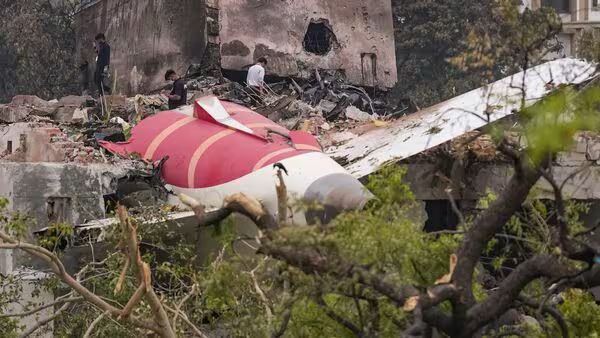
On the 12th of June 2025, an Air India plane took off from Ahmedabad at 1:40 pm. It crashed within 1 minute and more than 250 people died in this accident. Only one passenger on the plane survived. Soon after, startling facts began to emerged. The crashed flight was Air India’s 787-8 Dreamliner aircraft, manufactured by Boeing. The Ahmedabad Air India crash was the first time this model of the Boeing aircraft became a victim of an accident.
As the speculations about the potential causes of the deadly crash flooded social media, the history of accidents involving Boeing aircrafts began to be discussed. The incidents of Boeing playing with the rules of the US government and making rules according to its own in the last few years also flashed in the mind. Currently, the black box of the Dreamliner that died in the Ahmedabad accident has been sent to America. It will be examined there. Only after this, the reasons for the accident will be clear. But before that, the world market has once again come to the attention of Boeing’s old exploits.
The 1997 merger and Boeing’s tarnished reputation
Currently, Boeing the world’s second largest aircraft manufacturing company. Boeing gave the world the first jet passenger plane ‘707’. It had a reputation among the best engineering companies in the world. It gave the first jumbo jet like 747, which played a big role in connecting the world. Boeing became a great company not only in the case of passenger planes but also in the case of military planes. It made giant planes like C-17 Globemaster, which is used by the Indian Air Force today.
However, Boeing and McDonald Douglas merged. Experts say that this merger marked Boeing’s fall from grace. Boeing changed from a company focused on engineering to a company focused on profit and loss. Its focus was no longer on providing the world with the best-made aircraft but on making as much profit as possible. Where earlier employees were asked to be transparent, now they were asked to coverup mistakes.
Due to this, Boeing’s reputation started to tarnish and was no longer a leader in the global market as Airbus defeated it badly. Boeing’s falling reputation can be judged from the fact that in the last 2-3 decades it has not been able to bring any new aircraft model but is making do by experimenting on the old ones. Due to this, hundreds of passengers have lost their lives. Now that Boeing has failed in quality, its focus has been on influencing the rules and policies in America and foreign countries and getting them changed according to its own wishes.
Boeing spending thousands of crores not on innovatioin but lobbying in America
Boeing is an American company and a large part of its income comes from contracts from the US government. Boeing makes many military aircraft for America. Apart from this, the rules and policies of America apply to Boeing. It spends thousands of crores to ensure that these American policies work in its favor.
A report by the US stock market regulator SEC says that Boeing has spent more than $200 million (₹1700 crore+) on lobbying from 2010-2022. $26 million (₹225 crore) has been spent in 2021 and 2022 alone. A report by the SEC itself shows that Boeing has spent more than $320 million (₹2700 crore) on lobbying since 1998. The SEC says that Boeing ranks 9th in terms of spending on lobbying within the US.
Boeing is at number 9 in this arena while in terms of market cap, it is at number 70-80 in America. This simply means that Boeing spends much more than its status on lobbying. Boeing gives money to both the parties of America, i.e. Democrats and Republicans, to bend the rules according to its wishes. This expenditure is apart from its expenditure on lobbying . According to a report, Boeing has spent 43 million dollars (₹3500 crores+) between the years 2004-2024.
Interestingly, Boeing also takes care not to favor one party too much. Reports suggest that Boeing funds both parties almost equally. However, Boeing has given more funding to the Democrats in the past years. This process is called lobbying in the US. Although lobbying is not illegal in the US, but Boeing’s lobbying has taken the lives of 300+ people. This is a black spot in Boeing’s history.
Boeing’s insatiable greed claimed more than 300 lives
Boeing spends thousands of crores on lobbying and parties. Boeing is not a social welfare organization that it spends so much money for nothing. All this is done for profit. A few years ago, more than 300 lives were lost due to Boeing’s greed and avoiding lobbying. This story begins around 2010. Boeing, which once ruled the world’s aircraft market, was constantly being defeated by Airbus, a company from Europe. The secret of Airbus’ success was its new A320 Neo aircraft.
These were more modern than Boeing’s 737 aircraft and consumed less fuel. Due to this, airlines were constantly placing orders with Airbus and Boeing was losing. Boeing thought of making a new plane. But Boeing did not want to invest money in the development of a new plane. In such a situation, it came up with a new idea. It planned to give a new look to the Boeing 737 designed in the 1960s. Boeing named this new plane 737 Max.
Boeing then made some modifications in the design of the plane, including changes made in the wings of the plane as well as in the cockpit of the plane. In addition, its landing gear was also changed. New Leap-1 engines were also installed in the new plane which saved 14% more fuel. These engines were bigger than the old engines. While the old engines were installed under the wings of 737, the new engines were shifted to the wings due to their being bigger. If this was not done, the engines were hitting the ground.
These modifications, however, backfired for Boeing. The new engines were heavier than the old ones. Due to this, the front part of the plane would rise more in the air, which was a problem for controlling the plane. Boeing found a solution to this and introduced a system called MCAS. MCAS would automatically press the front part of the plane downwards and this was done through sensors. As soon as the sensor of the plane sensed that the front part of the plane was rising too much in the air, it would immediately bring it down.
While Boeing was popular and secured thousands of orders, the company committed a fraud. Boeing had completely changed the 737. But it claimed that it did not need to get certification again from the US aircraft regulator FAA. It is to be noted that getting certification for every system of the plane is a big expense and this would also increase the delivery timeline of the plane. Apart from this, pilots would also have to be trained on the new systems.
To avoid all this, Boeing claimed to the FAA that it was basically an old plane and hence did not need to get separate certification. It also took advantage of loopholes in the laws. Boeing built a completely new plane but did not allow the FAA to certify its systems. Boeing even lobbied on a large scale in the US and effectively got a law passed in 2018.
In 2018, the US Parliament passed the FAA Reauthorization Act after strong lobbying by Boeing . This law gave the aircraft manufacturing companies in the US the right to self-certify the technologies they developed. This law limited the powers of the FAA. This law was directly related to Boeing’s 737 Max program. Now Boeing has openly got the right to sell the new systems of 737 Max aircraft without any external certification.
Following this, Boeing continued to sell 737 Max at a rapid pace. Airlines from all over the world also bought these planes. On October 29, 2018, a similar plane of Indonesia’s Lion Air crashed into the sea shortly after takeoff. 189 passengers and crew members were killed in this accident. No one could understand why a new plane crashed like this. The pilot who died in this accident was an Indian.
Just 6 months after this incident, in March 2019, an Ethiopian Airlines plane crashed minutes after taking off from the capital Addis Ababa. In this accident too, 157 people, including the crew, were killed. After this, Boeing’s problems began to rise and its 737 planes were grounded all over the world. When both accidents were investigated, it was found that these accidents happened due to the MCAS sensor that presses the Boeing plane downwards.
It was revealed that in both the accidents, MCAS continued to push the plane down while the pilots kept trying to fly it. The pilots failed in this and this faulty system brought the plane down. When the pressure increased after the investigation of both the accidents, Boeing admitted that it had hidden this information. Boeing admitted that it had not told the pilots about this new system.
Boeing itself had certified this MCAS system as safe. Later, this became the reason for the death of 346 people. FAA could not conduct the safety check of 737 Max, for this it had already made a law. For this it had spent thousands of crores and had people in the US Parliament on its side. The result of this lobbying by Boeing was the death of 346 people and crew, thousands of planes being grounded and airlines incurring losses of thousands of crores.
Boeing’s lobbying also extends to military aircraft
Besides manufacturing passenger planes, Boeing also makes military planes. One-fourth of the planes in the US Air Force are manufactured by Boeing. The aviation giant has on many occasions secured contracts in the US by exerting pressure through its lobbying. A big example of this was the supply of refueller planes to the US Air Force to refuel planes in mid-air. This entire competition started around the year 2000. In this, tanker planes built on Boeing’s 767 planes were first selected.
Boeing KC-46
However, as allegations of corruption emerged, Boeing was sidelined. Airbus won the re-competition and its A330 MRTT was to be supplied to the US Air Force. However, Boeing created a ruckus over this and started lobbying to get this contract cancelled. Later, only KC-46 made by Boeing joined the US Air Force . However, this was not the first time when Boeing had blocked Airbus’ entry into the US.
In the 1970s, Airbus wanted to enter the US after its success in Europe, but even then Boeing kept the US government pressurizing it. Boeing is credited with keeping Airbus out of the US market for a long time. However, as soon as Boeing goes to other countries, it starts using its financial strength and lobbying to get contracts . In one such case, Boeing had made a deal of $37 billion (₹3 lakh crore+) with Saudi Arabia.
However, the relations between America and Saudi Arabia deteriorated after this. This controversy was related to the murder of American citizen and journalist Jamal Khashoggi in Turkey. America was continuously pressuring Saudi Arabia. In response to this, Saudi Arabia changed its stand regarding this deal. Boeing came into action after this and immediately started talking to the US government and the Saudi government to save this deal.
Be it keeping the F/A-18 aircraft in continuous service within the US or lobbying for the F-15EX aircraft , Boeing has always worked in this direction.
Boeing’s lobbying attempts in India
Unsurprisingly, Boeing has also been making lobbying efforts in India. Boeing tried hard to sell aircraft for India’s second aircraft carrier Vikrant. Boeing wanted to sell F/A-18 aircraft for this. For this, Boeing even gave big advertisements in newspapers in India. However, the Indian Navy chose the Rafale-M aircraft made in France, considering its needs. The deal for this has also been finalised recently.
Boeing has earlier also tried to sell the F-21 aircraft to India. Actually this is the F-16 fighter aircraft used by the Pakistani Air Force. Boeing tried to tell the Indian Air Force that the F-21 is completely different from the F-16 aircraft used by Pakistan. However, the Air Force clearly refused to show any interest in this.Indian cosmetics
What stance Boeing will take in the Ahmedabad Air India crash case will be clear in the future. If technical flaws are found in the plane, will Boeing accept them or try to evade accountability using its usual coverup tactics, time will tell this too. However, Boeing’s track record shows that it does not believe much in moral values and prioritises profits.
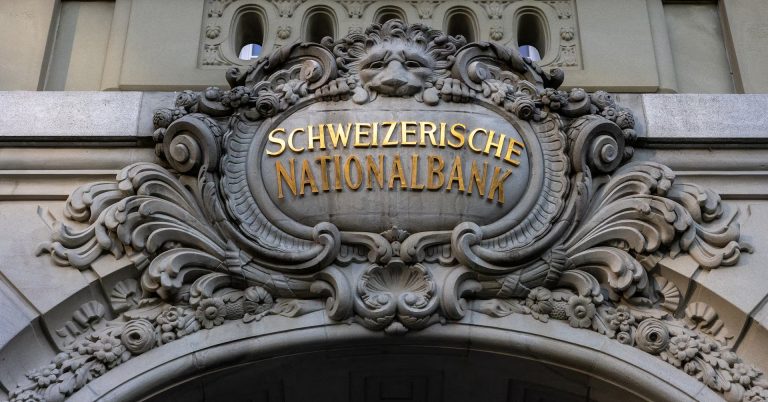
Deposits of Indian customers in Swiss banks have declined by around 18 per cent over the past decade, according to the latest figures released by the Swiss National Bank (SNB).
The data highlighted a drop from approximately 425 million Swiss francs in 2015 to 346 million Swiss francs in 2024.
The SNB data also showed that Indian deposits had seen a sharp rise during the COVID-19 period, touching a 10-year high of around 602 million Swiss francs. However, the deposits started declining after the pandemic peak.
In 2023, deposits stood at 309 million Swiss francs, but in 2024, it grows by 37 million Swiss francs to reach 346 million Swiss francs. Despite this annual rise, the overall trend over the last decade remains downward.
However, the decline in deposits is not unique to India. Several other major economies also witnessed a reduction in funds deposit in Swiss banks by their nationals.
For instance, deposits by UK nationals fell from 44 billion Swiss francs in 2015 to 31 billion Swiss francs in 2024. Chinese deposits also saw a decline, reducing from 5.01 billion Swiss francs to 4.3 billion Swiss francs over the same period.
The neighbouring countries of India Pakistan and Bangladesh also saw decline, deposits held by Pakistani nationals in Swiss banks have witnessed a steep decline over the last ten years.
According to the data deposits by Pakistanis stood at 947 million Swiss francs in 2015 but have dropped significantly to 241 million Swiss francs by 2024, a fall of nearly 75 per cent.
A similar trend was observed in the case of Bangladeshi nationals. Their deposits in Swiss banks declined from 48 million Swiss francs in 2015 to just 12.6 million Swiss francs in 2024, marking a drop of over 73 per cent.
The decline reflects a reducing trend of foreign deposits in Swiss banks it can be due to various reasons like tightening regulations, increased scrutiny, and changes in international financial transparency norms.
Saudi Arabian deposits nearly halved during the 10-year period, from 8.3 billion Swiss francs in 2015 to 4.8 billion Swiss francs in 2024.
The most significant drop was seen in deposits by American nationals. Their deposits in Swiss banks dropped steeply from 64.2 billion Swiss francs in 2015 to 24.4 billion Swiss francs in 2024, a decline of about 62 per cent.
The data highlighted a broader trend of declining foreign deposits in Swiss banks, possibly reflecting greater transparency, international regulations, and shifts in global financial preferences.
For India, the trend clearly shows that over the last decade deposits by Indian nationals in Swiss banks have declined. Though, a temporary hike in deposits was seen during the pandemic in 2021.
(This news report is published from a syndicated feed. Except for the headline, the content has not been written or edited by OpIndia staff)
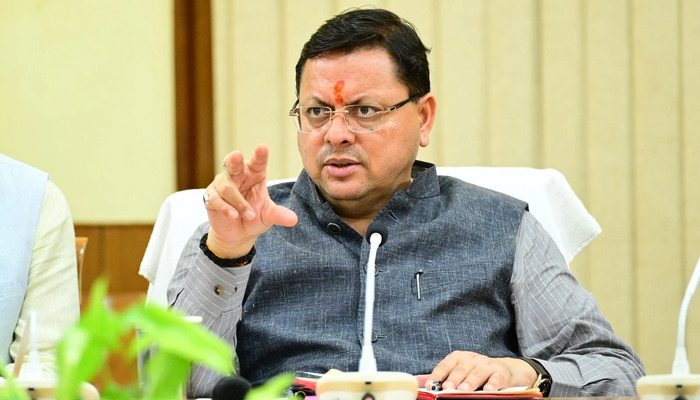
After local administration sealed an illegal madrasa built on government land in Rudrapur, Uttarakhand, dozens of local Muslims armed with sticks and rods reportedly reached at the residence of BJP councillor Nooruddin from Ward No. 15 on Monday (17th June) and misbehaved with his family.
As per reports, Nooruddin, who was not present at his house at the time, lodged a complaint at the Rampura police post stating that the mob threatened to kill him. A case has been filed by the police against 12 persons based on Nooruddin’s complaint. Rampra Station House Officer, Priyanshu Joshi said that the police are investigating the case and are on a lookout for the accused. Police are examining the CCTV footage to nab the accused.
Councillor Nooruddin has stated that some men in his ward have been maintaining a personal grudge with him and have been hostile since he won the local body elections with BJP’s support. The men have been provoking locals against him, and they used the incident of the illegal madrasa being sealed as an excuse to instigate a mob to attack his house.
Illegal consrtuctin on ‘Nazul Land’
On Monday, a joint team of the administration, including ADM Pankaj Upadhyay, Sub-urban Commissioner Shipra Joshi and Tehsildar Dinesh Kutaula, sealed the illegal madrasa constructed on Nazul land in Ward No. 15, in the Paharganj areas of Rudrapur Municipal Corporation of the Udham Singh Nagar district.
Nazul land is a land owned by state government but is not directly managed as state property. It is a government owned land which is often leased out for various purposes, including residential and commercial.
The team identified 50 other illegal, under construction buildings and also took stock of illegal structures in the Kalyani River area. The committee members of the madrasa have been ordered to show the land documents. ADM Pankaj Upadhyay said that there is a large-scale illegal encroachment on the banks of the Kalyani River and action will be taken to remove it as well.
Dhami government’s anti-encroachment drive
Uttarakhand government led by CM Pushkar Singh Dhami has been conducting a statewide anti-encroachment drive to free the government land of illegal structures. By December 2023, the government freed 5000 acres of land encroached through Land Jihad. The Dhami government has also been demolishing illegal construction on forest land in the state. In the beginning of 2023, government authorities demolished 26 Mazars that were illegally constructed on the forest land. Besides, the authorities conducted a survey and identified around 1400 religious structures built illegally on government land.
In April 2023, CM Dhami expressed his government’s resolve to eliminate the menace of ‘land jihad’ from Devbhoomi Uttarakhand. His government has been working in mission mode and taking stringent action against illegal structures mushrooming all over the state, including the Jim Corbett National Park, one of the oldest and one of the most famous forested wildlife sanctuaries set amidst the foothills of the Himalayas in the Nainital district of Uttarakhand.
Recently, on 20th March, 16 illegal madarsas in Udham Singh Nagar and 2 in Haridwar were sealed by the Dhami government. So far, more than 110 illegal madrasas have been sealed in the state. Over 200 illegal madrasas, built on government land, have been identified and marked by the state government. Udham Singh Nagar district has the highest concentration of them at 129, followed by 57 in Dehradun and 26 in Nainital.
Amazon’s new workers’ policy has sent shockwaves through its employees. The new policy states that an employee must relocate to a new major city hub, primarily in Seattle, Arlington, or Washington, DC, and if not ready, they must resign. These two options have put the employees in a bind as they either have to uproot their families and move to a major city, or face job termination.
The employees have been given 30 days to make a decision whether they will relocate or resign. If the employee decides to relocate, he will get 60 more days to make the move. The news was not shared with the affected employees in an official announcement; instead, it was communicated in one-on-one meetings.
Why is Amazon forcing employees to relocate
In a statement to Reuters, Amazon said it is a ‘visionary strategy’ to align teams with its business roadmap. A company spokesperson told Reuters, “ As part of our ongoing work to make our teams and programs operate more efficiently and to better align with our business roadmap, we’ve made the difficult decision to eliminate a small number of roles within the Books organization.”
Andy Jassy, the CEO of Amazon, said building a large team is not the path to advancement for the company, rather, e-commerce achieves more with fewer resources. He said that the company is planning a layoff as well in the coming years, while hinting that Artificial Intelligence can do a lot than an individual nowadays. Jassy also said that AI will lead to cutting jobs at his own company.
The relocation policy has also been introduced to keep the workers in close touch with their managers across the countries.
Impact on affected employees
A person who does not wish to relocate has to resign without getting a severance package. A redundancy payment, which acts as an emergency door for many to rescue them from sudden financial instability, is also closed. Mid-career professionals and parents with established roots are especially distressed by the decision. Many are unwilling to uproot themselves from communities they’ve been part of for years.
A prediction realized
The CEO had also predicted a layoff recently, where he said the company will need fewer people doing some of the jobs that are being done today, and more people doing other kinds of jobs. He had also asked the employees to be cautious about AI as it may replace them in future. Over the past five years, Amazon has already laid off approximately 27,000 employees.
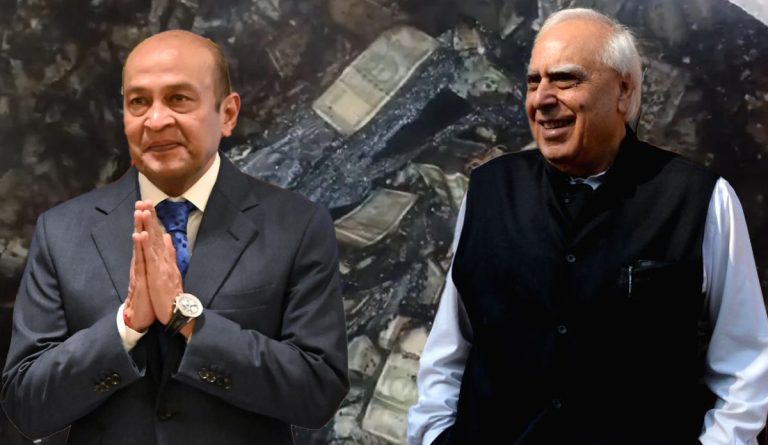
A panel consisting of three judges from the Supreme Court has proposed the dismissal of Justice Yashwant Varma. As a result, the impeachment process is likely to be initiated against him. Varma, who is charged with corruption, has been defended by lawyer Kapil Sibal who declared that his client is among the finest judges in history.
The committee recommended the dismissal of Varma from his position which is detailed in a 64-page report that has been forwarded to both the President and the Prime Minister. The report explicitly mentioned that the burnt notes were discovered in the storeroom of his official residence.
Only Varma and his family were allowed access to the storeroom as no outsiders could access it. The investigation uncovered that during the process of extinguishing the fire, the firefighters observed “partially burned notes.” A witness even remarked that he had encountered such a vast pile of cash for the first time in his life.
The committee acknowledged that such a large quantity of notes could not have been kept there without the permission of Varma or his family. It also conducted an inquiry into the involvement of his daughter, Diya Varma, and his personal secretary, Rajinder Singh Karki, who are reported to have prohibited the firefighters from disclosing information regarding the cash.
The committee has concluded that there is adequate evidence to initiate the procedure for the removal of Varma from his position, based on these findings. Verma refuted these accusations, insisting that neither he nor his family possessed any information regarding this cash.
He further stated that anyone was free to enter and exit the storeroom. In early June 2025, reports emerged indicating that the procedure for the removal could commence shortly which would mark the first instance of the forcible ouster of an active judge in India’s history.
Shocking disclosures in the report
The Supreme Court established an investigation committee regarding the case of Justice Yashwant Varma. A total of 55 witnesses were interrogated in this matter. Among those questioned was his daughter. The report indicated that various witnesses, along with videos and photographs, substantiated the discovery of a significant quantity of cash, particularly 500 rupee notes, some of which were partially burned, located in the storeroom of his residence in Delhi.
It is particularly surprising that, despite the gravity of the incident, neither Varma nor his family reported it to the police or informed any senior judicial authority. The committee noted this as unusual conduct. They expressed that Varma’s assertion of being unaware of the incinerated cash is implausible.
“If a conspiracy existed, why did Justice Varma fail to notify the Chief Justice of the High Court or the Chief Justice of India?” the committee inquired. Fire and police officials also reported observing a “large pile” of Rs 500 notes in the storeroom once the fire was doused. Although the household staff denied witnessing the cash, the committee deemed the testimonies of government officials to be credible.
The probe additionally unveiled that the storeroom was exclusively managed by Verma and his family. Furthermore, the incinerated cash “vanished” following the incident and the area was tidied up. The committee indicated that Varma’s personal secretary had instructed the firefighter personnel to omit any reference to the cash in the report. The fire service officer also informed that he was requested not to investigate further as “individuals in high positions were implicated.”
What is the matter
In March 2025, a fire broke out at the official residence of Justice Yashwant Varma in Delhi. As firefighters worked to put out the fire, they found a considerable stack of charred 500 rupee notes in the storeroom. Afterward, the then Chief Justice of India made accusations against Varma. The Supreme Court then established a committee to examine the issue. Varma was reassigned from the Delhi High Court to the Allahabad High Court soon after the instance. This move faced opposition from some lawyers and legal professionals.
Action taken against Justice Verma
The Supreme Court set up a three-member inquiry committee to investigate the case which interviewed 55 witnesses and took Varma’s statement. It delivered a 64-page report to the President and the Prime Minister, suggesting his removal from his office. He had been moved to the Allahabad High Court but has not been allocated any judicial tasks. He has not resigned or opted for voluntary retirement at this time.
Presently, there is a chance to initiate the impeachment process against him in Parliament, which would be the first occurrence of a sitting judge’s removal in India. Varma has referred to the investigation as “fundamentally incorrect”, but the committee has rejected his defense, emphasising that “the currency notes were seen by multiple people and documented in real time. It is highly unlikely that the money was placed there to incriminate him.”
The committee also questioned the roles of his daughter and personal secretary in the destruction of evidence or the sanitization of the crime scene.
He is the best judge: Kapil Sibal
Senior attorney and Rajya Sabha MP Kapil Sibal has come to the defense of Varma. On 17th June he referred to the latter as “one of the best judges” and condemned the government’s actions. He alleged that the government’s true intention is to dismantle the collegium system and assert control over judicial appointments.
He charged the government with pursuing a case against Varma, while not taking similar measures against Justice Shekhar Yadav who faced accusations regarding certain “communal” last year and opposition MPs had also submitted an impeachment notice against him.
Sibal declared, “I can say with full responsibility that he (Varma) is one of the best judges I have argued before. You can ask any lawyer of the High Court or Supreme Court, this judge is not accused of doing anything wrong.”
“It is shocking that you (the government) are targeting a judge against whom there is no evidence and are protecting the one against whom there is no need for any proof because his statement is in the public domain and there is an impeachment motion pending with the Speaker but he is sitting on it for signature verification,” he added.
However, contrary to the claims made by Sibal, a report from the three-judge inquiry panel sent to Chief Justice Sanjiv Khanna has confirmed the discovery of a substantial amount of cash at Justice Yashwant Varma’s residence on Tughlaq Road on 14th March.
The bye-polls to five Assembly Constituencies (ACs) held by the Election Commission of India (ECI) today witnessed successful implementation of several major new initiatives launched by the ECI in the past four months, as envisaged by the Chief Election Commissioner, Gyanesh Kumar along with Election Commissioners Dr. Sukhbir Singh Sandhu and Dr. Vivek Joshi.
Bye-polls were held at the ACs of 24-Kadi (SC) and 87-Visavadar in Gujarat, 35-Nilambur in Kerala, 64-Ludhiana West in Punjab and 80-Kaliganj in West Bengal. During these bye-polls, polling was held at 1354 Polling Stations (PS) in the five ACs.
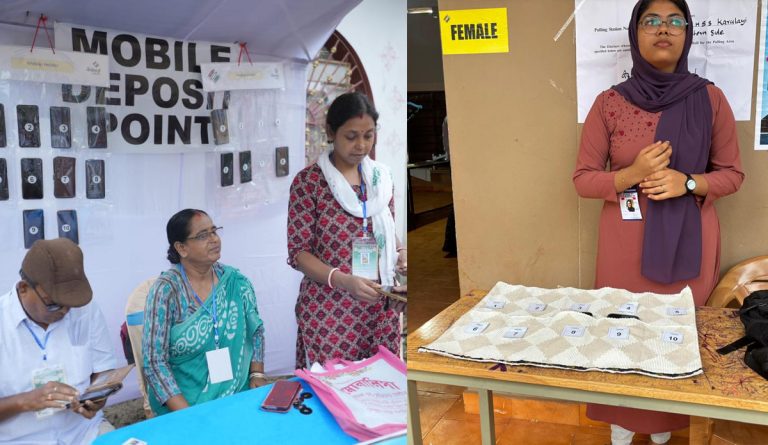
The new initiatives include the provision of mobile deposit facility for the electors at all polling stations, upgraded Voter Turnout sharing process resulting in faster updation of the approximate polling trends by ensuring that the Presiding Officer updates the VTR data at the close of poll before leaving the polling station, webcasting at 100 per cent of polling stations ensuring constant vigil of the entire polling process and individual mock poll training of all Presiding Officers.
Also, Special Summary Revision (SSR) of the Electoral Rolls was conducted before the bye-polls for the first time in nearly two decades. The successful implementation of these measures in the bye-polls paves the way for full introduction of all these measures in the forthcoming Bihar Assembly Elections.
For the first time, voters were able to avail the mobile deposit facility provided by the ECI at the entrance of all polling stations. The measure is in recognition of the ubiquity of mobile phones in both urban and rural areas and the challenges faced by the voters particularly the senior citizens, women, and PwD electors as to where to leave their mobile phones before entering the polling station. Simple pigeonhole boxes or jute bags were provided at the entrance door of the polling stations where the voters deposited their mobile phones. Volunteers were deployed at the polling stations to facilitate the process.
In a first-of-its-kind initiative, all polling stations in Ludhiana West have made arrangements for safe mobile phone deposit aims to enhance the voter experience while at the same time upholding the secrecy of voting.#GoVote with ease.#ByeElections#ChunavKaParv@ECISVEEPpic.twitter.com/3T9w6Zs5Ti
— Chief Electoral Officer, Punjab (@TheCEOPunjab) June 19, 2025
The upgraded VTR sharing process was also successfully implemented where the Presiding Officer of each polling station was able to directly enter voter turnout on the new ECINET App every two hours on polling day in order to reduce the time lag in the updation of the approximate polling trends. This was automatically aggregated at the constituency level. The approximate voting percentage trends were published every two hours as before.
In a pioneering move, ECI introduces mobile phone deposit facility to enhance voter convenience in Nilambur Bye-Elections, Kerala.#ECI#Electionspic.twitter.com/Bqa3mKTm0u
— Election Commission of India (@ECISVEEP) June 19, 2025
Also, voter turnout data was entered into the ECINET by Presiding Officers immediately after the close of poll, before they left the polling station to ensure that the approximate percentage of votes polled would be available on the updated VTR App constituency-wise after the close of polls subject to network connectivity. Where mobile networks are unavailable, entries can be made offline and synced once connectivity is restored.
Previously, voter turnout data was collected manually by Sector Officers and relayed to Returning Officers (ROs) via phone calls, SMS, or messaging apps. This information was aggregated every two hours and uploaded to the Voter Turnout (VTR) App. At the close of poll, the Presiding Officer used to update the final VTR data after completing all other statutory responsibilities like filling up of various forms including 17C where he would take the signatures of the polling agents of political parties/candidates and hand over a copy to them, sealing and safe depositing of the EVMs in the strong room as per laid down procedures etc.
Thus, the polling percentage trends were often updated hours later i.e. around 10-11 PM, based on physical records arriving late in the night or even the next day. The upgraded system of VTR updation would cut down this delay as now the Presiding Officer would be updating the data in ECINET before leaving the polling station.
The Commission has ensured 100% webcasting of poll-day activities at all polling stations, except one, in the five bye-poll ACs. The webcasting was monitored to ensure that critical activities were taking place smoothly and there was no violation of the poll process. Dedicated monitoring teams at RO, DEO and CEO levels kept a strict vigil on the poll proceedings.
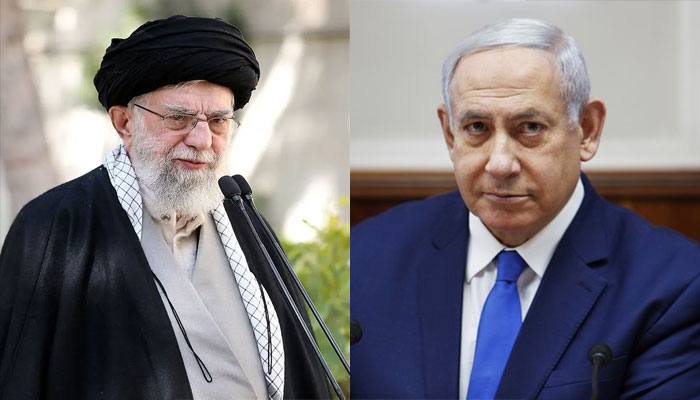
The conflict between Israel and Iran has long been simmering in West Asia. However, what we are now witnessing is not just another round in their shadow war—it is a strategic offensive that marks a surprising shift in Israel’s strategic doctrine, intent, and has much broader implications. The Israeli attack against Iran has evolved into something far more than a series of defensive airstrikes. It is a multidimensional operation aimed at systematically degrading Iran’s capabilities across military, economic, and cognitive spheres.
This is not deterrence anymore. It is a transformation in every domain.
From red lines to realignment
Israel’s long-standing “red line” has been Iran’s nuclear program. For over a decade, Israeli leadership—across party lines—has warned that a nuclear-armed Iran is an existential threat. The first phase of this offensive began predictably: surgical strikes on nuclear infrastructure on June 13. While reminiscent of past Israeli operations such as the 1981 Osirak reactor bombing in Iraq or the 2007 strike on Syria’s al-Kibar facility, this round had a broader signaling function.
The strikes were meant not just to disable nuclear development but to remind the global community—and Tehran—that Israel will not wait for international consensus when it comes to its national security and its dominance in the region. The doctrine here is clear: act before a threat becomes unmanageable. It is a wonderful example of preventive war, justified under the logic of existential risk.
However, unlike previous operations, this was only the beginning.
Opening the skies: suppressing Iranian defenses
The second phase of the offensive moved beyond isolated targets. Israeli forces took aim at Iran’s Integrated Air Defense Systems (IADS), radar stations, and missile sites. This was a strategic necessity. Someone can not run extended air campaigns without air superiority—and Israel certainly can not launch deep strikes into Iranian territory without opening secure corridors.
This mirrors Israel’s 1967 six-day war—cripple the enemy’s ability to see and respond, then dominate the skies. It is also heavily influenced by Western military doctrine, especially the U.S. strategy of SEAD (Suppression of Enemy Air Defenses). For Israel, this is not just tactical, it is a way to lay the groundwork for what comes next. This will even help drop the Israeli military on the ground for specialised operations for a few hours.
Striking the human core by eliminating commanders
What followed was the assassination of high-ranking commanders, nuclear scientists, and cyber operatives. This is classic network-centric warfare—neutralising the people who hold the system together.
In military terms, it is an attempt to disrupt Iran’s OODA loop—the command-and-control cycle of “Observe, Orient, Decide, Act.” If decision-making nodes are eliminated, the system stutters, paralysed by confusion and leaderless inertia.
It is a strategy often employed by elite Western units like the U.S. Joint Special Operations Command (JSOC), but Israel has added a regional twist—mixing high-tech surveillance with long-standing human intelligence networks across West Asia. It is a scalpel in a world of sledgehammers.
Economic war by other means
In recent months, the campaign has widened to include energy infrastructure—oil refineries, power grids, and transport lines. This is kinetic sanctions in action. Unlike economic sanctions imposed by states or international bodies, these strikes are designed for immediate and visible impact. The message is clear: Iran’s ability to fund and sustain its military endeavours will be hit at the roots.
Moreover, the consequences ripple far beyond the battlefield. Blackouts and fuel shortages destabilise daily life, erode public trust in government, and strain the economic resilience of a nation already under pressure. This is hybrid warfare in its purest form—military tools used to provoke civilian consequences.
Information warfare
The latest chapter in this campaign has moved into even murkier terrain-information warfare. Israeli cyber units have targeted Iranian state media and propaganda networks. The goal here is not just censorship—it is chaos. Deny the regime the ability to shape public perception, and you fracture internal cohesion.
This psychological front is about weakening morale, sowing distrust, and providing space for alternative voices—exile groups, reformists, or simply disillusioned citizens—to be heard. In the age of 5th Generation Warfare, where perception can overpower arms and ammunition, this is arguably the most subversive tactic of all.
Iran’s response: Ballistic missiles and drones
Iran, for its part, has not sat idle. Its response reflects a deep understanding of hybrid warfare and the value of strategic patience. Moreover, Iran has invested in operational deception—moving key assets underground, dispersing command structures, and relying on ballistic missile attacks and drone attacks deep inside Israel. According to Israel’s Defence Forces, more than four hundred ballistic missiles and more than a thousand drones were launched by the fifth day of the war, which caused unexpected damage to Israel. Iran has also activated its proxies in Iraq in order to check the U.S. bases If the U.S. directly enters the war. The indigenous capability of Iran has shown a bit of restraint to Israel’s hybrid warfare but would not sustain it for long.
A war of layers, not just lines
What we are witnessing is not a traditional war. It is a campaign that spans dimensions—cyber, kinetic, economic, and cognitive. Israel is no longer just trying to deny Iran nuclear capability; it is attempting to deny it systemic control. This is where the real danger lies.
Such a campaign risks drawing the region into broader conflict. If Iranian leadership feels its survival is at stake, escalation becomes more likely. Regional actors—Saudi Arabia, Turkey, and the UAE—may be pulled into a security dilemma. Global powers like the U.S., Russia, and China will inevitably be forced to weigh in, especially if economic or energy markets are destabilised.
The final outcome will depend on three critical factors:
Iran’s internal cohesion—can the regime absorb the shocks and maintain control?
International diplomacy—will global actors push for de-escalation or tacitly endorse the offensive?
Israel’s political calculus—does its leadership have the domestic backing to continue, or will internal pressure demand a recalibration?
Israel’s campaign is bold, layered, and dangerously sophisticated. It is not just about military superiority—it is about shaping the future of a hostile state. Whether that future includes regime change, negotiated capitulation, or open war, one thing is clear- West Asia has entered a new phase of strategic confrontation, and the geopolitical map would not be the same as today.
The second term of Donald Trump as the US President has so far been a display of the outspoken politician’s myriad mood swings. In the short span of around six months since he assumed office in January this year, Trump has engaged in several very public verbal spats, including his recent fallout with business tycoon Elon Musk, who supported Trump during the US Presidential election.
Trump is known for his informal, unfiltered and unpredictable reactions, usually not expected of a global leader, to situations that require a formal and poised response.
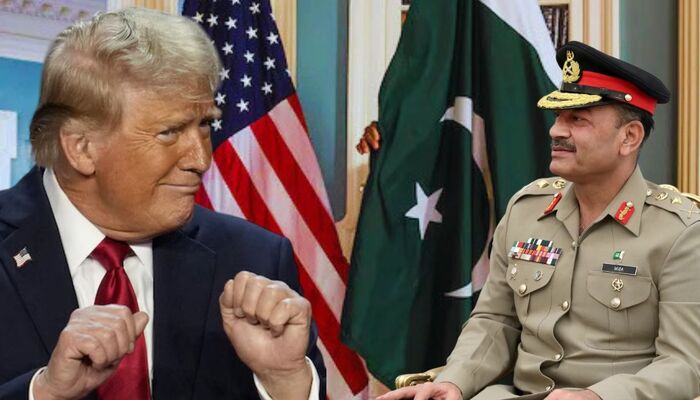
One such unpredictable move by the US President was his recent meeting with Pakistan’s Army Chief Asim Munir at the White House. Trump hosted a private luncheon for Munir, which was preceded by Trump’s phone conversation with PM Modi.
Hours before his meeting with Munir, Trump professed his “love” for the Islamic country, which he once called out for harbouring terrorists and betraying the US. Munir also reciprocated the affection showed by Trump by nominating him for the Nobel Peace Prize for allegedly stopping war between the two nuclear-armed countries of India and Pakistan, a claim which PM Modi categorically refuted during his phone conversation with Trump.
The lunch meet comes weeks after military hostilities between India and Pakistan that lasted four days following the Pahalgam terror attack. Though it is quite normal for the heads of states to have official meetings but Trump’s meeting with Munir has grabbed eyeballs as the US President has been openly critical of Pakistan in the past.
Pakistan’s patronage to terrorists is a world-known fact. The country continues to provide safe haven to terrorists, who wish death to America. Dreaded terrorist Osama bin Laden who was responsible for the 9/11 terrorist attack in the US, enjoyed the protection of Pakistan’s military for years before the US military found and killed him.
Trump stopped financial aid to Pakistan during his first term
During his first term as the US President, Trump publicly slammed Pakistan and stopped its financial aid. In July 2012, Trump had called out Pakistan for hiding Osama Bin Laden for six years and questioned when it would apologise. Trump said that Pakistan fooled the US by hiding Laden. In 2018, Trump accused Pakistan of lying and deceiving the US by accepting its financial aid worth billions of dollars and in turn nurturing terrorists that killed the US military personnel in Afghanistan.
However, the US, which has a disproportionately high voting share in the International Monetary Fund (IMF) chose not to block the IMF’s bailout package worth $ 1 billion to Pakistan, at a time when India was conducting Operation Sindoor to eliminate terror camps in Pakistan and the PoJK.
Considering Trump’s past opinions about Pakistan, his meeting with Munir comes as shocker and raises an important question as to what led to Trump’s change of heart towards Pakistan, the country that he now describes as a “great nation”. Not just that, Trump has even promised to ramp up trade with Pakistan.
Trump’s duplicity on terrorism
Trump’s new-found love for Pakistan also highlights his duplicity towards on the issue of terrorism. While Trump is opposing Iran for the reason that it supports terrorist groups like Hamas and Hezbollah, which carry out terrorist attacks against Israel, he is supporting Pakistan, which has a history of giving shelter to terrorists, as admitted by its leaders during India’s Operation Sindoor, who have carried out numerous brutal attacks on Indian soil. The fact that Pakistan army is complicit with terrorist organisations thriving on its land, became amply clear after Pakistani army’s high-ranking officials attended the funeral of a terrorist killed in India retaliatory strikes on Pak-based terror camps after the Pahalgam terror attack.
While it is difficult to predict how long Trump’s “love” for Pakistan would last considering his unpredictable mannerisms, India has fortified its position by declaring that it would not accept the interference of any external power in its internal matters, including the Kashmir issue.
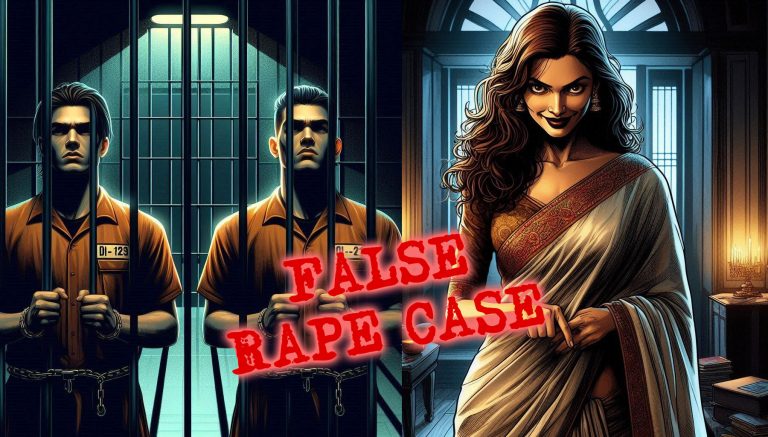
On the 16th of June 2025, a court in Lucknow sentenced a woman named Rekha Devi to 7.5 years in jail for falsely accusing two men of raping her and for offences under the SC/ST Act. In addition to the jail term, the court also imposed a fine of Rs 2.1 lakh. The court also directed Uttar Pradesh government to recover Rs 2 lakh given to the complainant woman as compensation in June 2021.
The now-convicted woman belonging to Scheduled Caste community was awarded a total of Rs 8 lakh as compensation and the Rs 2 lakh she received in 2021 was its first instalment.
Notably, the court awarded two sentences to Rekha Devi. The 24-woman was convicted under Sections 182 and 211 IPC. The first prison term is of six months under Section 182 of the IPC and a fine of Rs 1000. This section is related to giving false information to a public servant with an intent to cause them to use their lawful power against any person.
The court awarded a second sentence of seven years under Section 211 of the Indian Penal Code and a fine of Rs 2 lakh. This section pertains to falsely initiating criminal proceedings against a person. “Both the prison terms will run separately and a fine of Rs 2.1 lakh has been imposed,” the court said addiing that these sentences will run consecutively.
In addition, the court ordered that Rs 1,00,500, which is half of the total fine amount, be distributed as compensation between the two falsely accused men.
The accused in her complaint included Rajesh, with whom she had an illicit relationship, and Bhupendra. Rekha Devi filed a fake case against Rajesh and Bhupendra to humiliate Rajesh’s wife and exact revenge.
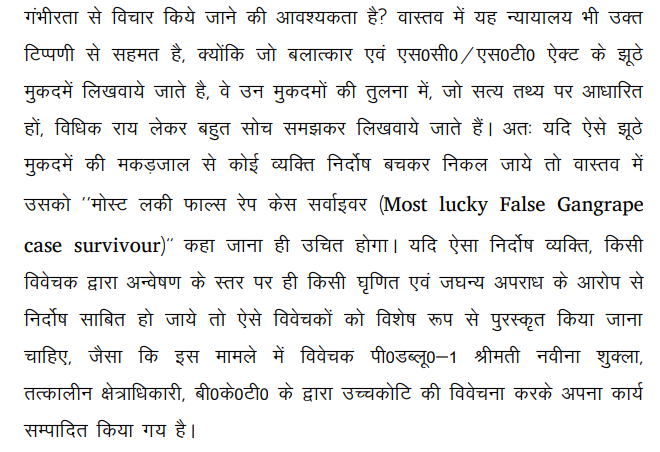
However, Special Judge SC/ST Act, Lucknow, Vivekanand Sharan Tripathi, called accused Rajesh, ‘Most lucky False Gangrape case survivor’. Notably, Rajesh and Bhupendra had to spend 3 months in jail due to Rekha’s false FIR.
In a 42-page order, Judge Tripathi noted that false accusations of rape impact the accused man’s mental health and personality. It also attaches a stigma and makes it difficult for the individual to regain his self-esteem.
“It can lead to anxiety, depression and isolation in the person. These effects can affect his behavioural thinking in such a way that his social relationships can be affected and his self-esteem can be damaged. He can feel socially isolated and his employment opportunities can also be adversely affected due to legal and judicial proceedings”, the court observed.
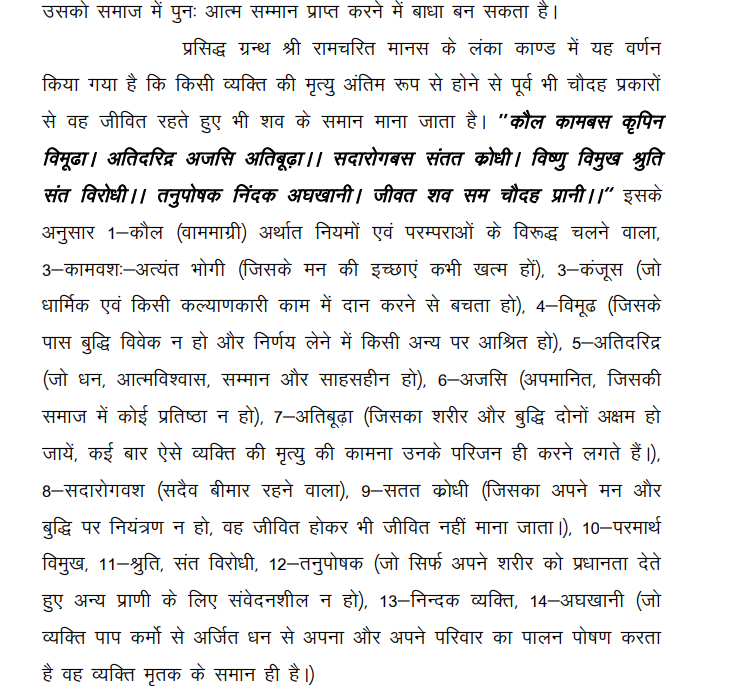
The court also mentioned a verse from the Lanka Kaand of Shri Ramcharitmanas, which says that even before physical death, a person may be considered as good as dead if they exhibit any of fourteen specific traits, including “Ajasi” (dishonoured).
The chaupai quoted by the court is: “कौल कामबस कृपिन बिमूढ़ा। अति दरिद्र अजसी अति बूढ़ा ॥ सदा रोगबस संतत क्रोधी। बिष्नु बिमुख श्रुति संत बिरोधी॥ तनु पोषक निंदक अघ खानी जीवत सव सम चौदह प्रानी॥”
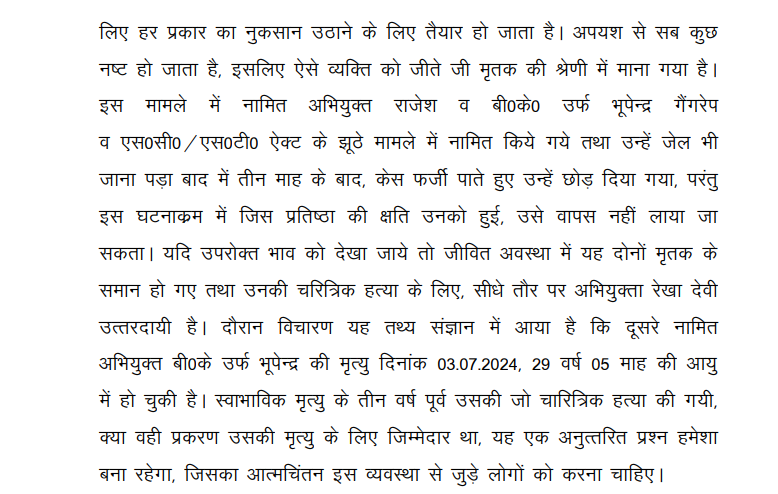
The court explained the meaning of the Chaupai and said that a person who is so discredited in society that they are considered socially dead, as was the case with the two accused men Rajesh and Bhupendra aka BK, who the court noted, suffered irreparable damage to their honour and reputation.
“It is often said that a bad man is better than a bad name, and hence, a wise person will endure all hardships to avoid disgrace. Disrepute can destroy everything, making a person, though alive, equivalent to a corpse,” the court order reads.
Notably, co-accused Bhupendra aka BK passed away in July 2024 at the age of 29, while the trial was on. The court expressed dismay over the young man’s demise and said that the emtional and social trauma inflicted by the false rape case lodged against him, contributed to his untimely demise. Judge Tripathi also remarked that Bhupendra’s untimely death remains a question warranting serious introspection by the country’s justice system.
The court held Rekha Devi directly responsible for Rajesh and BK’s character assassination.
In addtion, the court also raised concerns over rising misuse of the POCSO Act, SC/ST Act, Dowry Harassment Prevention Act etc.
In view of this, the Court recommended to the Commissioner of Police, Lucknow, that when someone files a formal complaint (FIR) for a serious crime, like rape or gang rape (as defined by Sections 376/376D IPC and the SC/ST Act), the police should include in the new FIR the number of prior FIRs that have been filed by the same person or by their family members, whether against the same accused or others.
All excerpts taken from relevant court order
The Court further suggested that when a complainant approaches the court to register a FIR under Section 173(4) of the BNSS, police should disclose any previous cases the complainant has filed in response to the court’s inquiry.
False rape cases destroying lives of innocent men
There has been a significant increase in incidents wherein women filed false rape cases against men for various reasons, especially to get revenge after relationship turns sour. It has also been seen that such false cases are filed to extort money from accused men by offering out of court ‘settlement’ to withdraw cases. Basically, file a false case, extort money, and take the case back.
In February this year, the Ghaziabad Police in Uttar Pradesh arrested a woman for making false gang rape allegations and sent her to jail. The Kavi Nagar police took Jyoti Sagar into custody after investigations revealed that she had filed three separate cases.
The woman initially filed a case against her husband in June 2024, alleging that he had raped her under the pretence of marriage and that their unborn child had died due to physical assault. However, during her court testimony, she retracted her allegations.
In August 2024, she filed another case, this time accusing her husband’s brother-in-law, Vikrant Tyagi, and Deepak Chauhan of threatening her to change her statement. Yet, just four days later, she appealed to withdraw the legal proceedings.
On January 23, 2025, the woman lodged another complaint with the police commissioner, claiming that her husband, Vikas Tyagi, had deceived her with false promises of marriage and had used caste-based slurs against her. She also accused his friend, Vaibhav Chauhan, of coercing her at gunpoint to give a false statement and write a fabricated letter. However, police investigations determined that all these claims were untrue. Police suspected that she may have fabricated these allegations in an attempt to take control of the property.
Supreme Court quashed rape case against a man accused by a woman of rape after their consensual relationship turned sour
In May this year, the Supreme Court quashed criminal proceedings against a 23-year old rape accused saying that a consensual relationship turning sour cannot be a ground for filing a rape case. A bench of justices BV Nagarathna and Satish Chandra Sharma said in its judgment dated May 26, 2025 that such cases burden the court and bring disrepute to the person accused.
The Supreme Court cautioned the courts against treating every breach of promise to marry as a false promise and then prosecuting the accused for rape. “A consensual relationship turning sour or partners becoming distant cannot be a ground for invoking criminal machinery of the State. Such conduct not only burdens the Courts, but blots the identity of an individual accused of such a heinous offence. This Court has time and again warned against the misuse of the provisions, and has termed it a folly to treat each breach of promise to marry as a false promise and prosecute a person for an offence under section 376 IPC,” the Court said.
The Supreme Court said that even if the allegations in the FIR are considered to be true, there was nothing to prove that the sexual intercourse happened against the will of the complainant and merely on the promise of marriage.
Delhi court ordered perjury proceedings against woman for filing false rape case
In April this year, a Delhi court ordered initiation of perjury proceedings against a woman for filing a false rape case in 2022. Judge Anuj Agrawal of the Court of Additional Sessions noted that the case involved a honey trap in which the victim strategically ensnared the accused in order to extract money from him, while acquitting a man accused of sexual harassment, rape, criminal intimidation, assaulting a woman with the intention of disrobing her, and outraging a woman’s modesty. The judge observed that in addition to being contradictory, the prosecutrix’s testimony was fundamentally skewed, inconsistent, and full of fabrications.
The court stated that a mere acquittal could not make up for the unfortunate accused’s suffering because the false claim of rape had the ability to ruin his reputation and break his spirit. It also pointed out that it was clear from the record that the woman had made a false statement in before the court.
“I am reminded of one famous English poem which rhymes as ‘The song of the meek, will darken any brow, as they cry aloud and beseech justice.’ But how to find strength, to do the right, so that the meek shall also survive is the question before this court? The answer perhaps lies in hearing not only the shrieks of a complainant but also the unheard cries of a person standing before this court with folded hands beseeching justice for a crime that he never committed, which got louder as the lies of the prosecutrix got manifested with the progression of the trial,” the judge said.
Allahabad HC acquitted man convicted of rape and murder after rape allegation not cofirmed
In August 2024, the Allahabad Court acquitted a man who was convicted for the attempted rape and murder of a 100-year-old woman seven years ago. The bench of Justices Ashwani Kumar Mishra and Dr. Gautam Chowdhary overturned the trial court’s judgment which awarded the accused life imprisonment. It overturned his conviction on the grounds of lack of independent witnesses and the absence of confirmation of rape and murder in the medical report. It noted that the evidence indicated that the deceased died due to ‘septic shock’ and not due to any blow or injury.
Based on the testimonies, forensic evidence, and medical report, the High Court bench found that there was no sign of rape and murder of the deceased. The court observed, “…this fact is credible that the complainant falsely implicated the accused to get the money from the government. Sunny Kumar had falsely implicated the accused by committing a criminal conspiracy because of the money taken from the accused. This is because the prosecution witness No. 1 has admitted in his cross-examination that ‘after the death of my grandmother Phullo Devi, my father and his three brothers had received Rs. 8.25 lakh from the government.’”
Bombay HC quashed FIR against 73-year-old rape-accsed man after it turned out that woman filed fake case
In July 2024, the Bombay HC quashed an FIR lodged in 2018 against a 73-year-old man who was accused of raping a woman on the false promise of marriage. The High Court bench comprising Justice A.S. Adhikari and Justice Neela Gokhale stated that the parties had been in a sexual relation for up to 31 years and that the complainant had never spoken up about her apparent opposition to the relationship.
The court, however, observed that the complainant was aware of the applicant’s marriage and still stayed in a relationship with him. Also, the applicant never promised to divorce his first wife to marry the complainant.
“She is adult enough to know that the law forbids a second marriage and there is no allegation in the complaint that, the Applicant promised to divorce his first wife and then marry her. Even otherwise, this would purely be wishful thinking on the part of the complainant that the Applicant will marry her after divorcing his existing wife,” the court said.
Consensual sex between adults does not amount to rape: What the Supreme Court said in the Deepak Gulati vs. State of Haryana case
In Deepak Gulati v. State of Haryana (2013), the woman (at that time 19-year-old) consented to sexual relations with the assumption that the accused would marry her, despite the fact that “she was conscious of the fact that her marriage may not take place owing to various considerations, including the caste factor”. The defendant served more than three years of his sentence before being acquitted by the Supreme Court.
“Consent may be express or implied, coerced or misguided, obtained willingly or through deceit. Consent is an act of reason, accompanied by deliberation, the mind weighing, as in a balance, the good and evil on each side. There is a clear distinction between rape and consensual sex and in a case like this, the court must very carefully examine whether the accused had actually wanted to marry the victim, or had mala fide motives, and had made a false promise to this effect only to satisfy his lust, as the latter falls within the ambit of cheating or deception. There is a distinction between the mere breach of a promise, and not fulfilling a false promise,” the court said.
Unless coercion is involved, consensual sexual relations not rape: Supreme Court in Dhruvaram Murlidhar Sonar vs The State of Maharashtra case
In the Dhruvaram Murlidhar Sonar vs The State of Maharashtra case, wherein a widowed assistant nurse accused Dhruvaram Murlidhar Sonar who worked at the same place as a medical officer of raping her, the Supreme Court stated that consensual physical relationships between adults cannot be deemed rape because the relationship does not culminate in marriage, given that there was no deception or coercion involved.
“Males cannot be singled out in voluntary sexual union”: When Calcutta HC acquitted a man accused of consensual sex with a minor girl
Back in 2021, the Calcutta High Court absolved a man booked under the Protection of Children against Sexual Offences Act (POCSO) Act, noting that a male alone cannot be indicted for an act of consensual sex between two sufficiently mature persons. The court noted that the 16-year-old girl voluntarily participated in the sexual act and she was not naive to not know about its implications.
If the union is participatory in nature, there is no reason to indict only the male just because of the peculiar nature of the anatomy of the sexual organs of different genders,” a single-judge bench of Justice Sabyasachi Bhattacharyya said.
There have been many other cases, wherein the courts found that women levelled false rape cases against men they either had consensual sexual relations with but relationship turned sour, to take revenge or to extort money by first filing a case then offering to take back case in exchange of money.
The prevalence of fake rape charges can be understood by the fact that, according to National Crime Records Bureau (NCRB) figures, around 74% of rape cases under Section 376 of the IPC conclude with the accused being acquitted.
It is unjustified to accuse a partner of rape in the aftermath of a consenting sexual relationship. It not only weakens genuine instances of sexual violence but diminishes the gravity of the offence. False accusations have the potential to devastate people’s lives, reputations, and professions, as well as result in false convictions or lengthy legal proceedings. Using rape accusations as a revenge tactic is harassment of accused men and an attack on their dignity.
False rape charges for personal vendetta after a relationship turns sour or use it as a weapon to target men also perpetuate dangerous preconceptions and biases against both genders, fostering a culture of fear and suspicion in relationships. In addition to destroying the lives of the involved men, these false allegations also harm the integrity of the judicial process.