Home Blog Page 3459

Sonam Kapoor’s husband accused of evading tax and duties, gets caught by a shipping company for doctored invoices

International shipping company MyUS outed actor Sonam Kapoor’s husband, Anand Ahuja, for using doctored invoices in what appears to be a bid to avoid paying taxes and custom duty. In a series of tweets in reply to Ahuja’s complaint on Twitter, MyUS mentioned the problem was not with their services but with the documents Sonam’s husband had provided.

Anand Ahuja, on January 27, had tweeted and questioned if anyone had contacts in MyUS as his shipment was delayed. He wrote, “Does anyone know someone at MyUS – I have had HORRIBLE experience recently. They are holding items improperly, rejecting formal paperwork & refusing to acknowledge any reasoning.”

Source: Twitter

Initially, the company had replied to Ahuja and said they had limited resources on Social Media accounts and advised Ahuja to contact via email or chat. Ahuja called the company a scam and said, “Have been trying to resolve with email CS for 7+ days and spent 2hrs with chat CS yesterday before this tweet. They are unable to resolve- offering unfair, ones sided & even fraudulent solutions. Your company’s new “policies” are malicious and a SCAM.”

Source: Twitter

Sonam Kapoor had also quoted Ahuja and wrote, “Terrible customer service is shameful.”

Source: Twitter

The Bombay Times then picked up the story and published an article on Sonam and Anand’s ordeal. However, after the article was published, MyUS, too, took to Twitter to clear the air.

MyUS wrote, “This is not a matter of customer service quality, new policies, or holding items improperly as was tweeted. Mr Ahuja misrepresented the price he paid for sneakers purchased on eBay, which would result in him paying fewer duties and taxes.” Notably, they also tagged Sonam Kapoor and Economic Times in the tweet as Economic Times had published a story about how My US was allegedly causing trouble to the couple.

The shipping company added that the invoices attached had up to 90% less value mentioned compared to what he had paid for the goods. It said, “The doctored invoices list prices that were up to 90% less than what he paid for the goods. While our policy is to do our best to rectify any customer issues, we have a duty to uphold regulatory compliance.”

It added, “Put very simply, we have a legal obligation to provide accurate information when sending international shipments. Both MyUS and Mr Ahuja are subject to international export rules, and we intend to follow them.”

After the tweets by MyUS went viral, Ahuja took to Twitter again to allege that MyUS refused to validate the PDF receipts and bank statements and accused them of trying to overcharge him and hold his goods for long.

He then said that he has moved all his items and closed his account.

Sonam Kapoor supports hijab

Actor Anil Kapoor’s daughter Sonam Kapoor is making headlines these days for supporting Muslim women’s “right” to wear hijab. However, her post in favour of the hijab has angered the Sikh community. In a story on Instagram, she had questioned if Sikh turban can be a choice, why can’t hijab be a choice.

Now-deleted Instagram story by Sonam Kapoor.

Interestingly, in 2013, Sonam Kapoor had questioned the idea about banning item numbers in movies and claimed women could not run around 24×7 in a burqa. She had said, “If you see our Ajanta Ellora Caves, you will understand that we are the land of Kamasutra. We can’t cover ourselves from head to toe. We can’t run around in burkha; that’s not our culture. It’s unfortunate when people say you can’t wear skirts or do item numbers or a girl can’t dress in a certain way. Are we going back to the dark ages?”

Sonam Kapoor has a history of creating controversies

Sonam Kapoor has a long history of creating controversies. In November 2021, she came out in support of a controversial NCERT document that promoted gender identity ideology. In 2019, she plagiarised the ‘Humans of Hindutva’ propaganda post and made the airstrike targeting terror camps about Hindutva.

West Bengal: Pro-hijab ‘protests’ turn violent, bombs hurled at school in Murshidabad, 18 arrested

The Hijab controversy in Karnataka has now spread to West Bengal as locals in the Murshidabad district on Saturday resorted to violence against the school authorities for asking the girl students not to wear hijab or burqa inside the class.

According to the reports, the school headmaster had asked the girl students not to wear hijab or burqa to the school. The headmaster Dinbandhu Mitra had also warned them that their name would be removed from the school registry. The school is situated at Bahutali High School in Murshidabad’s Suti area on Saturday.

After the headmaster asked the students to follow the uniform guidelines, the girls informed their parents, who staged a protest in front of the school and created a blockade.

The Suti Block 1 officer and local police arrived at the spot to resolve the situation. However, tensions prevailed near the locality on Saturday. The Muslim mob went on a rampage and threw bombs at the school.

In response, the police had to use tear gas to bring the situation under control. At least 18 people have been arrested in the case so far.

The local administration has deployed a large force at the spot to control the situation. The police resorted to lathi-charge to bring the situation under control.

Later, a meeting was held on behalf of the school administration with the family members of the girl students. The school authorities clarified that there was no such order issued by the school. The matter was later settled after talks between the school administration and students’ guardians.

The violent attacks comes amidst the ongoing row over hijab on the high school and college campuses in certain parts of Karnataka, which has resulted in tension, violent incidents across the state. The matter is now sub-judice in the Karnataka High Court.

Muslim mob brutally beats up Hindus in Karnataka

Amidst the raging hijab controversy in Karnataka, the Muslim mob have taken to the streets to unleash violence on innoncent Hindus for supporting hijab ban. On Friday, a group of Muslim youth brutally thrashed a youth named Nagaraj. The incident has reportedly taken place during the Hijab protests in the Harihar First Grade College campus in Davanagere district.

Similarly, in another incident in the Malebennur town of Davangere district, a Muslim mob had attacked a person and stabbed him for allegedly uploading a post against hijab on his WhatsApp status.

In a similar incident in Nallur village of Davangere district, another mob of Muslims had attacked a person and his 60-year-old mother for their alleged posts on social media on the hijab controversy. The 25-year-old Naveen and his 60-year-old mother Sarojamma were assaulted by the mob, who ransacked their house.

On February 8, several policemen and students were injured in the violent incident in Davanger. Many two-wheelers have been damaged by a Muslim mob and a tense situation prevailed in the Davanagere town. The incident turned communal when ‘Pakistan zindabad’ slogans were raised. However, the situation was quickly brought under control by the police.

Muslim student who topped class 12 exam in Kashmir gets death threats from Islamists for not wearing Hijab

As per a report by the Kashmir Observer, Aroosa Parvaiz, a Kashmiri student who had appeared in the class 12th exams of Jammu and Kashmir State Board of School Education, has been getting threats for not wearing hijab. The results of this exam were announced on 8th February 2022. She has topped the exam with 99.8 percent marks.

Soon after the announcement of the results, journalists published photos and videos of the top performer. As Aroosa Parvaiz was not wearing a hijab, Islamists started targeting and abusing her. Some of them even threatened her with rape and killing. While teaching her lessons of Islam, these Islamists have quoted the so-called struggle for the hijab by their fellow sisters in Karnataka.

While talking to the Kashmir Observer, Aroosa Parvaiz has said “These comments don’t matter to me but they’ve taken a toll on my parents. Wearing or not wearing Hijab doesn’t define one’s belief in their religion. Maybe, I love Allah more than they (abusers) do. I’m a Muslim by heart not by hijab.”

As the news was shared in various social media handles, the comment sections of the posts flooded with criticism and threats by the Islamists. A user named @onesoul-twoeyes has written that “Begairat… Pardah nai kia… Eski garden katt do…” which means “Shameless… She didn’t wear a veil… Slit her throat…”.

Image Source: www.kashmirobserver.net

Another social media user with account name @hurricane_syed has written in a comment “Jo taleem aurat ke ser see chader or mard ke dil see khouf dur kreay esi taleem see anpad rehna beather hai” which means “it is better to be uneducated than getting the education that takes the scarf off a woman’s head and takes away the fear in a man’s heart”.

Image source: www.kashmirobserver.net

One user @Cyed_burhaan has posted that “in Karnataka the Muslim girls fight for hijab and in our Kashmir our sisters upload their photos without covering their faces. It is not permissible that women can show their faces in front of strangers. So fear God!”

Another user called Arif Teli has written that “shame on your dress code and also on your parents.”

Image source: www.kashmirobserver.net

Shabir Ali has written that “Indeed, she is failed. She doesn’t even know what is modesty. Rip to her parents who doesn’t feel any shame for her bad hijab.”

Image source: www.kashmirobserver.net

In Karnataka, burqa (full veil) clad people who identify themselves as students have been protesting since December last year claiming they have right to wear a hijab (headscarf) to school. They have been groomed and consulted by Campus Front of India (CFI), student wing of the Islamist group Popular Front of India (PFI) which is banned in several states for extremist activities. The burqa clad people have also got support from the Taliban for their ‘fight’. The ‘liberals’ and Islamists have been claiming wearing a hijab is a choice, but it seems from the above comments, not wearing a hijab attracts threats.

Trailer of ‘Pawankhind’ released: Third Marathi film in Digpal Lanjekar’s ‘Shivraj Ashtak’ tells the story of greatest rearguard fight ever

The trailer of one of the most awaited Marathi films, ‘Pawankhind’, was released on 10th February 2022. The third Marathi film in Digpal Lanjekar’s ‘Shivraj Ashtak’ (a series of eight films on Chhatrapati Shivaji Maharaj) is set to hit the big screens on 18th February 2022, that is a day before ‘Shivjayanti’.

Digpal Lanjekar is a Marathi film director well known for his grand project of eight films based on important incidences in Chhatrapati Shivaji Maharaj’s life. While the first two films in this series have already been major hits in the Marathi film industry, ‘Pawankhind’, the third episode in line, is all set to be released this month. The trailer of the film was released on 10th February 2022.

Trailer of ‘Pawankhind’, the third film in Shivraj Ashtak.

The film is based on the greatest rearguard fight in the medieval history of India. This fight is regarded as the epitome of the integrity and the obedience shown and the promise kept by Veer Baji Prabhu Deshpande, the commander of Shivaji Maharaj who rearguard his way when he had broken the siege of Siddi Jauhar to the fort Panhalgad and heading towards the fort Vishalgad via a route through a very narrow mountain pass called ‘Horse Pass’ as barely a two or three horse riders could comfortably pass from it at once.

Baji Prabhu Deshpande had blocked the pass for five and half hours with a company of 300 soldiers and had ensured a safe passage to Shivaji Maharaj who was being chased by a mighty Adilshahi army of 10000 led by Siddi Jauhar. Baji Prabhu Deshpande sacrificed his life only after listening to the cannon fires from the fort Vishalgad as promised to Shivaji Maharaj.

The trailer of the film

The trailer full of the action scenes of this historic battle opens with the lines of the ballad of Baji Prabhu Deshpande written by Veer Vinayak Damodar Savarkar. In his poetry Veer Savarkar has written “आले आले गनीम खिंडित चवताळुनि आले, झाले झाले सज्ज मराठे सरसावुनि भाले, संख्या दुप्पट रिपुची परि ते निकराने लढती, हर हर गर्जुनि समर रंगणी तुटोनिया पडती, खड्गाचे खणखणाट त्या मधि शर सणसण येती, मारण मरणावीण नेणती वीर रणी रंगती” which means “The enemy, angry and fierce, has arrived in the mountain pass. The Marathas are ready to face the enemy with their piercing spears. They fought with valor against countless enemies. The chants of Har Har Mahadev echoed as they charged into the battlefield. The sound of attacking arrows passing by is clearly heard even in the noise of the fighting swords. They charged in such a battlefield either to kill with vengeance or to die while protecting their dignity.”

With power-packed background scores and inspiring music tracks of war anthems, the trailer gives a sneak-through of the film that depicts the battle that took place in the raining full-moon night of 13th July 1660 (Guru Pournima) between Marathas and Adilshahi army. It is notable that Adilshahi commander Siddi Jauhar was accompanied by Fazal Khan, the son of Afzalkhan whom Shivaji Maharaj had killed 9 months before the battle of Pavankhind. Chinmay Mandlekar has played the role of Shivaji Maharaj. Mrunal Kulkarni has played the role of Jijamata. Both of them are playing roles for the whole series of Shivraj Ashtak. Ajay Purkar has played the role of Veer Baji Prabhu Deshpande. The film is produced and presented by Almond Creations, AA Films, and Everest Entertainment.

The battle of Pawankhind

Shivaji Maharaj had engaged Siddi Jauhar in talks while he had sieged the fort Panhalgad for three and half months waiting for Siddi’s food stocks to reach their minimum. Maharaj had bluffed him pretending afraid and with an offer to help Siddi establish his own Sultanate against the Adilshah of Bijapur whom Siddi was representing against Shivaji Maharaj. Siddi Jauhar was ambitious and fool at the same time. He swallowed the bait.

On the night of 13th July 1660, Shivaji Maharaj escaped with a company of 600 soldiers commanded by Baji Prabhu Deshpande. Shiva Kashid who was the look-alike of Shivaji Maharaj was also among them accompanied by selective guards. When trapped Shiva Kashid, wearing the royal costumes, presented himself as Shivaji Maharaj and ensured that the enemy is confused for some time, thereby providing the time window for the rest of the troops to escape.

Statue of Veer Baji Prabhu Deshpande at Pawankhind. Image Source: www.thepositiveindia.com

When Shiva Kashid was identified and killed, the Adilshahi army chased Maharaj. It was at the Horse Pass that Baji Prabhu took the hard decision and split the company of 600 into two equal halves. Baji Prabhu Deshpande forced Shivaji Maharaj to go ahead with 300 soldiers and stayed back in the Horse Pass with the remaining 300, promising him what turned out to be the greatest rearguard of the war history. It was decided that after reaching the fort Vishalgad, Shivaji Maharaj will fire the cannons five times as a signal.

Pawankhind as seen in contemporary times.

Baji Prabhu Deshpande, aged 45, stood firm in the narrow pass with his companions. The 300 Marathas killed half of the enemies, that is 5000. Baji Prabhu Deshpande had breathed his last when he listened to the cannon fires. A handful of surviving Maratha soldiers had escaped into the jungles around. The fort Vishalgad was also sieged by the enemies. But as Shivaji Maharaj approached the fort, the Marathas attacked the sieging enemy both from the inside and outside. Shivaji Maharaj himself has led this battle right from the front. As Baji Prabhu Deshpande attained martyrdom in the Horse Pass, Shivaji Maharaj had renamed it Pawankhind meaning the Sacred Pass.

Significance of the battle

The battle holds historic importance not only because it had saved Shivaji Maharaj but it also because it has inspired so many freedom fighters in India’s freedom struggle against the British Raj. Revolutionary Aurobindo Ghosh who later turned into a Yogi has written a long poem on the valor shown by Veer Baji Prabhu Deshpande. He had written this poem to inspire and motivate revolutionaries to unite for the motherland just like the company of 300 soldiers had united for the Swarajya and to show the courage till the last breath as shown by Veer Baji Prabhu Deshpande. Besides, this incident in Shivaji Maharaj’s life is also seen as an example of strategic moves and planning and successfully executing a mission in minimum resources.

Veer Baji Prabhu Deshpande

A native of Shind Parde village in the Bhor Tahsil of the Pune district in Maharashtra, Baji Prabhu Deshpande was born in 1615 CE. He was 15 years older than Shivaji Maharaj. Initially a commander of Krishnaji Bandal of Rohida, he joined Shivaji Maharaj in the Swarajya movement when Bandal was defeated by Shivaji Maharaj. Baji Prabhu Deshpande was known as one of the closest aids of Shivaji Maharaj. He was one of the most trusted commanders of Shivaji Maharaj. In the battle of Pawankhind, Baji Prabhu Deshpande and his brother Fulaji Prabhu Deshpande, both attained martyrdom.

Kishan and Lavanya get forgotten while burqa-clad Sharia loyalists get echoed in Supreme Court: A tale of two Indias

In a nation that claims to be indiscriminate at its core, how ironic it is that the true victims of hate crime, Kishan Bharwad, and Lavanya, who don’t even exist to defend themselves, are forgotten, while voices favoring Muslim women wearing burqa are amplified in the highest levels of the judiciary. The wider populace, which claims to be alarmed by every act of hatred, has remained silent in the case of two Hindus who died defending their faith, which was precious to them as it was to every other person in the country, particularly Muslims.

Most of the self-proclaimed liberal has backed the hijab, or as I prefer to call it, burqa debate, claiming that one is allowed to practice one’s faith anywhere and whenever one deems appropriate. On the other hand, not a single slogan was raised to express the anguish of the two families who lost loved ones because they refused to adhere to the norms established by other communities, specifically Muslim and Christian here, in order to live in this society.

This is the India we live in, which is essentially a hybrid of two Indias: one that screams at every issue, alleging racism against “minorities” and an effort to silence “free” voices in society, and another that suffers from a slew of targeted campaigns against them and their practices, despite being the “majority.”

The story of the Hindu girl Lavanya being humiliated, harassed, and forced into adopting Christianity by a missionary school was not worthy of recognition for so-called liberals who are subscribing to the “Freedom” tenet of the constitution.  Similarly, no petitions were filed and no senior counsel was appointed to represent Kishan Bharwad, who was slain in a conspiracy by a group of roughly a dozen Muslims. The hijab controversy, on the other hand, has been backed en-masse by liberals at the national level, despite the fact that it poses no threat to human life!

Well, I’m emphasising the word “minority” because it ought to be highlighted. The assistance that these groups have received under this umbrella puts them over an edge of other native groups and defies the idea of protected discrimination.

As J Sai Deepak has rightly pointed out in his book India That is Bharat, “This poses a serious and existential challenge to the Iong-term survival of the Indic consciousness since those worldviews which have historically displayed a marked inability to peacefully coexist with the Indic consciousness have been afforded greater freedom to reserve their societal groupings and institutions with almost no interference by the Indian State ostensibly in the name of advancement of the fights of ‘minorities’. As a consequence, the Indic civilisational worldview finds itself disempowered in its own homeland despite decolonisation. Perhaps, no other country is in such a dire need of decolonisation as Bharat given the stepmotherly treatment the Indian State metes out to the adherents of its native consciousness.”

Though, Sai Deepak has focused on the concept of decolonisation, his statement is firmly valid in the present context too. The denial of incidents of hate crime such as Kishan Bharwad and Lavanya by the left-liberal subscribers is nothing but displays the advantage that minority groups (Muslims and Christians in this case) have gained over the native majority (Hindus) on the mercy of the Indian State. Through the help of the Indian State, which was until recently controlled by dispensations with covert backing of such groups, supporters of them have risen to the upper echelons of practically every section of intellectual representation. And these are the people who regulate that what holds the calibre to be staged into a national or international debate and what not.

The way this burqa has been tossed in the public and even the highest stage of judiciary, the Supreme Court, is being persuaded to weigh in, shows the commitment these people have to get their agendas endorsed by the Indian State. Kishan and Lavanya will be simply two more names to be documented and filed away in some police station’s records. As long as these left-wing liberals keep ratcheting up the heat on the burqa discussion, the voice for incidences of hate crime against Hindus will be suppressed. Hindus must decipher issues that lie ahead of them and comprehend that they are the only ones who can defend themselves, and that not even the Indian state is concerned about them.

Udupi BJP MLA K Raghupathi Bhat says he is getting threatening calls telling him to not oppose hijab in schools and colleges

On Saturday, Udupi BJP MLA K Raghupathi Bhat said that he has been receiving life-threatening calls from unidentified persons amid the Karnataka hijab row. He added that most of the calls received by him were internet calls from foreign countries.

According to the reports, the Udupi MLA has also received calls from local numbers issuing threats to his life and has informed the state Home Minister about the development. He said that he has faced many such threats in the past and is not at all scared about such calls.

This is a day after Bhat, who is the president of the development committee of the pre-university college for women in Udupi, revealed the role of Campus Front of India (CFI) in the hijab controversy and stated that the girls were innocent but under their influence and control. He has also demanded an NIA probe into the case.

Reports mention that Muslims in Udupi and the Qazis in the district have extended their support to the legislator on the issue. Earlier today, the Udupi MLA wrote to the state CM seeking an investigation by the National Investigation Agency into the hijab controversy.

On the entire hijab episode, the Udupi MLA has constantly been of the opinion that the pro-hijab girls and their parents are innocent but unfortunately under their (CFI) control. “The social media accounts of the students also reveal the Islamic agenda. All the posts against Ayodhya’s Ram Mandir, rebuilding Babri Masjid have been forwarded and posted. The girls have undergone a special training conducted by them”, he said.

He added that the girls are lying about wearing hijab for years at school and that they had suddenly started the hijab issue. The hijab controversy gained ground earlier this month when eight hijab-wearing Muslim girls refused to follow the school uniform regulations. They approached the Karnataka High Court seeking permission to attend the classes with hijab, as it is their fundamental right, they said.

The High Court so far has declared that no one should be allowed to wear their religious attire inside the educational institutions until the matter is pending in the Court. After this stay order, the students had approached the Supreme Court against it, however, the Supreme Court refused to interfere in the matter till the High Court disposes of it.

UP Assembly elections: Pallavi Singh, the third poster girl of Congress party’s “Ladki hun lad Sakti hun” campaign, joins BJP

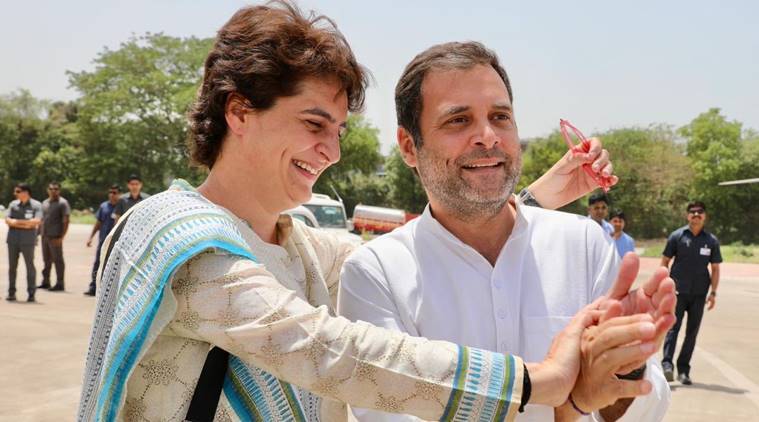
The Congress, which is battling alone on 403 seats in the Uttar Pradesh assembly elections, is suffering frequent setbacks as it strives to achieve success. In yet another blow for the Congress and its leader Priyanka Gandhi, Pallavi Singh, the poster girl of the ‘Ladki hun lad Sakti hun’ campaign, has now joined the BJP as the state assembly elections commence. Women leaders are departing Congress despite the fact that 40 percent of the Congress’s 403 seats, i.e., around 180 seats have women as contestants. 

On Saturday, the Congress poster girl for ‘Ladki hun lad Sakti hun’ campaign launched by Priyanka Gandhi, joined the Bharatiya Janata Party’s state headquarters in Lucknow. Pallavi Singh is the third Congress Party poster girl to join the BJP. Dr. Laxmikant Bajpai, the BJP’s former state president and head of the joining committee, gave Singh party membership.

Ladki hun lad Sakti hun poster

Congress leaders Vandana Singh and Dr. Priyanka Maurya, showcased in posters of ‘Ladki hun lad Sakti hun’ campaign by the Congress party, had already joined the Bharatiya Janata Party before Pallavi Singh. Both had also accused the party’s senior leadership of ignoring them. Vandana stated had that she left Congress owing to the “negligible involvement of the high command” in things concerning the 2022 elections. Similarly, Priyanka Maurya claimed that Congress fudged the distribution of tickets ahead of the Assembly election.

Priyanka Gandhi’s “Ladki hun lad Sakti hun” campaign has failed to deliver results in the state. During a marathon organized by the Congress party in Uttar Pradesh as part of its election campaign, Dr. Priyanka Maurya stated how the ladies were mistreated and misbehaved with. Several social media users are sharing posts mocking how three of the four poster-girls of Congress have joined the BJP.

Specifically, in order to win the 2018 UP Assembly elections, Congress’s Priyanka Gandhi focused her campaign on women’s concerns and devised the slogan “Ladki hun lad Sakti hun” for her UP campaign. She had previously declared in Lucknow that the party will allocate 40% of the seats in the Uttar Pradesh elections to women candidates.

The elections in Uttar Pradesh will be held in seven phases: February 10, February 14, February 20, February 23, February 27, March 3, and March 7. The ballots will be counted on March 10.

BJP vows to implement UCC in Uttarakhand if it wins Assembly elections. Here is how Goa is running its UCC programme

Ahead of the upcoming Vidhan Sabha polls in Uttarakhand, State Chief Minister Pushkar Singh Dhami has vowed to implement the Uniform Civil Code (UCC) in the hilly State.

While speaking about the matter on Saturday (February 12), he said, “Implementing Uniform Civil Code in Uttarakhand at the earliest will boost equal rights for everyone in the state. It’ll enhance social harmony, boost gender justice, strengthen women empowerment & help protect the extraordinary cultural-spiritual identity & environment of the state.”

The long-standing demand for Uniform Civil Code

The Uniform Civil Code (UCC) has been a long-standing demand of the BJP. UCC overrides personal laws and calls for a similar set of rules for adherents of different religions in civil matters including marriage, divorce, adoption, succession and maintenance. UCC was even recommended even by the Supreme Court of India during the infamous Shah Bano case of 1985.

Currently, the Hindu Personal law applies to Hindus, Jains, Sikhs and Buddhists while the non-codified Muslim personal laws are based on the Shariat Law of 1937. Similarly, marriages and divorces in the Christian community are governed by the Indian Divorce Act of 1869 and the Indian Christian Marriages Act of 1872. Zoroastrians are governed by the Parsi Marriage and Divorce Act of 1936.

The provision to set up Uniform Civil Code has been laid down in Article 44 (Part IV) of the Indian Constitution. UCC has been included in the Directive Principles of State Policy (DPSP) and can be implemented by the State governments. They are not enforceable by courts. The Western State of Goa is the only State that has implemented the Uniform Civil Code.

UCC in the State of Goa

Following the annexation of Goa, India retained the Portuguese Civil Code of 1867 that applied to all residents of the State, irrespective of their religion. As such, all marriages in the State are registered under the Goan Civil Code. It also provides provision for a prenuptial agreement for asset distribution.

Under the Goa succession, special notaries and inventory proceeding Act of 2012, no distinction is made in the right of male and female heirs in the inheritance of properties. The application of the Special Marriage Act of 1954, which allows for inter-faith marriage without the necessity to change one’s religion, is also different in Goa. Unlike other States, Muslim men are barred from practising polygamy.

In March 2021, the then Chief Justice of India SA Bobde had remarked, “Goa has what Constitutional framers envisaged for India – a Uniform Civil Code. And I have had the great privilege of administering justice under that Code. It applies in marriage and succession, governing all Goans irrespective of religious affiliation.”

He further added, “I have heard a lot of academic talk about the Uniform Civil Code. I would request all those intellectuals to simply come here and watch the administration of justice to know what it turns out to be.”

Advantages and Challenges surrounding Uniform Civil Code

UCC was envisioned by the founding fathers of the Indian Constitution as a law that will govern the entirety of the country. Gender justice and equality are the key concepts behind the idea of UCC, aimed at eliminating prejudiced and discriminatory personal laws of certain religions.

Uniform Civil Code embodies the idea of secularism by separating religion from civil subjects such as adoption, marriage and succession. It will also help in further simplification of laws and smooth functioning of the Judiciary. It is also believed that uniformity in personal laws will help foster a feeling of national integration and prevent overlapping of different laws.

“Under a uniform civil code, all the citizens are treated equally. Under the present personal laws, matters relating to marriages, adoption are treated differently under the respective personal laws, this is inconsistent with Article 14 which ensures equality before the law…The implementation of UCC will ensure that more women get liberty and equality. It will no longer bind them to religious and cultural beliefs,” wrote Pooja Arora in iPleaders

It must be mentioned that certain provisions in the Portuguese Civil Code of 1867, however, do not apply uniformly to all religions. For instance, the civil jurisdiction of courts in matters of separation and divorce do not apply to Catholics. High Courts can only convey the decrees of Canonical courts to Civil Registrars for annulment of marriage.

Unlike the rest of India, Hindu men are allowed to practice bigamy in accordance with the Codes of Usages and Customs of Gentile Hindus of Goa, 1880. They can have 2 wives at the same time, provided the first wife fails to deliver a child (by 25 years of age) or a male child (by 30 years of age).

Hindus can also adopt children while other communities are barred from adoption. Moreover, the Church has the authority and the power to not just solemnise marriages but also to dissolve them at the insistence of one of the parties.

CBI books shipbuilding company ABG Shipyard and its directors in Rs 22,842 crore bank fraud case

In one of the biggest bank fraud case registered by the Central Bureau of Investigation (CBI), the agency has charged ABG Shipyard Ltd, its then Chairman and Managing Director Rishi Kamlesh Agarwal, and others with defrauding a consortium of banks led by ICICI bank of over Rs 22,842 crore.

CBI also named the former Executive Director Santhanam Muthaswamy, Directors Ashwini Kumar, Sushil Kumar Agarwal, and Ravi Vimal Nevetia, as well as another company ABG International Pvt Ltd, for alleged criminal conspiracy, cheating, criminal breach of trust, and abuse of official position under the IPC and the Prevention of Corruption Act.

Mumbai headquartered ABG Shipyard is part of ABG Group and is in the business of building ships. The company has shipbuilding facilities in Dahej and Surat in Gujrat, and operates a ship maintenance facility in Goa.

According to reports, among the 22-bank consortium, State Bank of India (SBI), ICICI Bank, and IDBI Bank had the lion’s share of exposure, in excess of 50 per cent in the shipping company. SBI was the first to classify the account as ‘fraud’, followed by ICICI Bank and then IDBI Bank. The bank-wise breakup of the exact exposure has been made available by journalist Arvind Gunasekar on Twitter.

Meanwhile, CBI alleged in its FIR that, “the Forensic Audit report dated 18.01.2019 submitted by M/s. Ernst & Young LP for the period April 2012 to July 2017 revealed that the accused have colluded together and committed illegal activities including diversion of funds, misappropriation, and criminal breach of trust and for purposes other than for the purpose for which the funds are released by the Bank.”

“Global crisis has impacted the shipping industry due to fall in commodity demand & prices and subsequent fall in cargo demand. The cancellation of contracts for a few ships/vessels resulted in piling up of inventory. This has resulted in a paucity of working capital and caused a significant increase in the operating cycle, thereby aggravating the liquidity problem & financial problem. There was no demand for commercial vessels as the industry was going through a downturn even in 2015. Further, there were no fresh defence orders released in 2015. The company was finding it very difficult to achieve milestones as envisaged in CDR. Thus, the company was unable to service the interest and instalments on the due date,” the CBI FIR added.

On November 8, 2019, the bank filed a complaint, and on March 12, 2020, the CBI requested an explanation.

In August of that year, the bank lodged a new complaint. The CBI acted on the complaint on February 7, 2022, after “scrutinising” it for almost a year and a half and opening an FIR.

They stated the company received credit from 28 banks and commercial institutions, with the SBI having a Rs 2468.51 crore exposure.

According to the forensic audit, between 2012 and 2017, the accused conspired and committed illicit actions such as money laundering, misappropriation, and criminal breach of trust.

It may be noted that the Reserve Bank of India (RBI) had classified AGB Shipyard among the ‘dirty dozen’ to be taken up under the Insolvency & Bankruptcy Code (IBC). OpIndia had reported how 11 NPA cases which were referred to by the RBI contain a total of 25% of India’s bad loans. All these 11 cases comprise of the companies which owe the banks more than Rs 5000 crore. These 11 cases belong to Bhushan Power & Steel, Essar Steel, Jaypee Infratech, Lanco Infratech, Monnet Ispat & Energy, Jyoti Structures, Electrosteel Steels, Amtek Auto, Era Infra Engineering, Alok Industries and ABG Shipyard, who owe the banks about Rs 1.75 lakh crore.

Ajit Anjum apologises for “chor chamar” slur: Read how British institutionalised caste discrimination through “Criminal Tribes Act”

Earlier this week, YouTuber Ajit Anjum offered an apology after being rebuked by an Ambedkarite who took offence at his use of casteist slurs while talking to people of poll-bound Uttar Pradesh in one of his uploaded videos. 

Criminal Tribes Act by British rendered many communities criminals
Source: Twitter

In the video that is now going viral on the internet, Anjum uttered “chori-chamari” while conversing with locals in Sivalkhas, Meerut. But this did not sit well with self-described Ambedkarite Suraj Bauddh, who objected to Anjum’s casteist slurs and asked him to not use them under the pretext of proverbs. 

Before long, Anjum apologised for the remarks, saying that he uttered those words by mistake and had intended to speak “chori-chakari”, not “chori chamari”.

“I’m sorry @SurajKrBauddh, I wanted to speak “chori-chakari” but I do not know how it was said. I sincerely apologize. I hope you all will forgive me. I am neither like this nor think so I am also among the few journalists who may have gone among Dalits many times in the last 6 months,” Anjum tweeted. 

While Anjum apologised for his mistake, it is worth examining how such casteist slurs made it into the lexicon and who was responsible for it. Unfortunately, for the left-liberal intelligentsia, Brahmins and other upper castes are perennially to be blamed for racial inequities. Their facile analysis and existing prejudice inevitably leads them to place the burden of caste discrimination on the feet of Brahmins and upper caste. 

Since passing off opinions and conjectures as conviction is easier than taking efforts to dispassionately examine history and objectively arriving at the causes responsible for the perpetuation of caste discrimination, left-liberals prefer reinforcing their ‘confirmation bias’ that Brahmins are responsible for all the casteist inequities wracking the society. 

A cursory glance into country’s history links most of the evils bedevilling the country today to the colonialism it endured at the hands of her British rulers. Yet, the liberals, who believe that they are the brown sahibs and the legitimate inheritors of their British masters, try to airbrush atrocities committed by them. 

Historical records into brutalities perpetrated by the British lays bare the colonial treachery of changing statuses of some of groups that were avarnas and came to be known as “criminal tribes”. For instance, it was after several intervention from the British, the community of Chamars and Mahars were grouped under the category of “criminal tribes”. 

Chamars were people belonging to the leather industry, one of the most polluting industries in the world owing to the toxic waste like Chromium, Lead and Arsenic used in the tanning process. In addition to this, there are close to 15 steps involved in the entire leather-making process, which leads to emission of contaminants that pollute land, water, air in the surrounding. As a consequence, those into the business of making leather goods often suffered from serious ailments. 

And with the entry of the British colonisers, the monopoly over the leather-making shifted from indigenous natives to foreign rulers. In their bid to meet the exponential demands of the European markets, the British exploited the Chamars, often forcing them to work for longer durations with lower wages. 

Similarly, the Mahars, the caste that gave us one of the most foremost intellectuals of his time, Dr BR Ambedkar, were once a well-integrated community within the Maharashtra society. With the advent of the British, fissures started appearing in the society which was once close-knit and all-encompassing. 

British rulers passed “Criminal Tribes Act” to criminalise entire communities as habitual offenders

As conditions deteriorated and crimes proliferated, the Britishers passed various pieces of controversial legislations in 1870s, collectively called as the Criminal Tribes Act, which criminalised entire communities as habitual offenders. Under provisions of these legislations, communities were defined as “addicted to the systematic commission of non-bailable offences” that included thefts, and were registered by the government. Adult male population of such groups were to mandated to report weekly to local police and restrictions were imposed on their movements.

By the dint of legislations, several communities, including Chamars, Lodhis, wandering tribes, vagrants, itinerants, nomads, gypsies and several tribes were categorised as “criminal tribes” and their subsequent generations were labelled a “law and order problem” for the state. Those belonging to aforementioned communities were considered “thieves”, “thugs” and “bandits” by the virtue of their birth under the contentious legislation. The British treachery could be gauged by the fact that even India won its independence in 1947, close to 127 communities were grouped as “criminal tribes”.

This played a big part in sowing seeds of discord within the society and the marginalisation of the communities already facing severe economic pressure. Gradually, the division and stigma seeped through the rest of the society, who come to associate them with the oppressive categorisation that the British actuated through the agency of the Criminal Tribes Act. 

For generations, their progenies had to suffer the indignity and stigma of being grouped into “Criminal Tribes Act” for not fault of theirs or their ancestors but purely because the Britishers presumed that they were involved in robberies and other petty crimes and deserved to be pigeonholed into a iniquitous group. Those belonging to the aforementioned communities were painted as criminals and treated with disrespect, often being scornfully called “thieves” by others. This, over time, unfortunately led to the mainstreaming of racial slur “chor chamars”. 

How liberals airbrush British culpability and hold Brahmins responsible for atrocities meted out on lower caste people

Yet, it is almost always the upper castes and Brahmins who are vilified for the historical wrongs committed against them. The British rulers, who are probably more responsible for sowing discord within the Indian society and dividing it into various sects, often escape the culpability since the left-leaning liberal continue to harp on blaming on the Brahmins and faulting the caste system for all the misery suffered by the downtrodden and lower castes.

The liberals, by blaming Brahmins and upper castes are simply perpetuating the British policy of ‘divide and rule’ through which they can carry on with their mission of preventing unification of the larger Hindu society lest it brings an end to their Islamist designs and objectives. As a part of this aim, they have even tried to put up the untenable construct of Muslim-Dalit unit, billed as Jai Meem-Jai Bhim, so as to keep the Dalits away from their religious brethren in Hindus. 

It is for these self-serving reasons and not altruistic concerns for the welfare of lower castes and the disadvantaged that the liberals hold Brahmins responsible for every historical wrong committed against the lower and marginalised castes while sweeping under the rug caste atrocities perpetrated by the British.