Home Blog Page 3757

OpIndia Explains: The virtual world of cryptocurrency and the challenges it poses for Indian govt

PM Modi on Saturday chaired a meeting on the path ahead for managing the cryptocurrency sector where a consensus was reached on the Centre needing to take “progressive and forward-looking” steps while ensuring that an unregulated crypto market does not lead to “money laundering and terror financing”.

The government will keep a close watch on cryptocurrency as this is an evolving technology and will take proactive steps, multiple reports about PM Modi’s meeting on Saturday said.

The meeting was an outcome of a “consultative process as RBI, finance ministry, the home ministry had done an elaborate exercise on it as well as consulted experts from across the country and the world,” reports said. India is also going through the global examples and the best practices regarding crypto.

The meeting came on the heels of the Reserve Bank of India governor Shaktikanta Das cautioning investors about the digital currency. RBI Governor Shaktikanta Das expressed serious concerns over the credibility of cryptocurrencies. Speaking at Business Standard’s BFSI Summit, he said that it was similar to a marketing strategy to attract more public interest in cryptocurrencies. He was referring to a recent report of a research firm that claimed that at least 7.9 per cent of Indians have invested $10 billion dollars in virtual currencies, adding that the numbers were highly exaggerated.

With the interest in cryptocurrencies peaking, there is a newfound urgency by the Centre to formulate laws and policies to govern the virtual currency market. On Monday, a parliamentary committee on finance is likely to hold a meeting of top stakeholders of the crypto industry, according to multiple reports. The meeting, which is reportedly going to take place behind closed doors, will have participants from top crypto exchanges, members of the Blockchain and Crypto Assets Council (BACC) among others.

This haste in tackling the issue of cryptocurrency is because Indians are flocking to the virtual currency market like never before. As per reports, Indians had parked nearly $6.6 billion in cryptocurrencies until May this year, as compared to around $923 million until April 2020. India ranks second on the Global Crypto Adoption Index in terms of cryptocurrency adoption. The total investment were reportedly going to cross the $ 10 billion mark in the first week of November.

As Indians are increasingly warming up to the idea of investing in virtual currency markets, it is imperative to understand what cryptocurrency means and the challenges it poses.

What is cryptocurrency? 

Cryptocurrency is a form of payment that can be exchanged online for goods and services. At its core, it is a decentralised digital money designed to be used over the internet. They are usually not issued or controlled by any government or other central authority. Instead, they are managed by peer-to-peer networks of computers running free, open-source software.

For example, just like the US Dollar is managed by the American Reserve Bank and the Euro by the European Central Bank, there is no central authority that manages and maintains the value of a cryptocurrency. Instead, these tasks are broadly distributed among a cryptocurrency’s users via the Internet. 

One of the biggest advantages of using cryptocurrencies is that it makes transfer value online without the need for a middleman like a bank or payment processor, enabling value to transfer globally, almost instantly, with low fees. The technology allows individuals to take full control of their assets, without being dependent on external factors such as banks, regulatory bodies, middlemen etc. 

Besides, as is the case with conventional currencies, there is usually only one currency that each country’s government allows to be used for trade within its sovereign limits. However, in the case of cryptocurrency, there is no such barrier. Everyone who intends to participate in cryptocurrency can have his/her own digital currency. Many companies have issued their own currencies, often called tokens or coins, and these can be traded specifically for the goods or services that the company provides. 

Think of these tokens or coins as arcade tokens and chips we buy at casinos in exchange for real currency. Not real currency, but these tokens and chips are accepted inside casinos for various games and other services. Similarly, cryptocurrency coins are used to avail services offered by companies that accept certain digital currencies. However, a majority of the users invest in cryptocurrencies purely as an investment and when their value increases, they exit the currencies by selling them on the secondary market. 

The most famous cryptocurrency is Bitcoin, which was launched more than a decade ago, in 2008. The digital currency first outlined by Satoshi Nakamoto in a paper titled “Bitcoin: A Peer-to-Peer Electronic Cash System”, described the project as “an electronic payment system based on cryptographic proof instead of trust.”

By market capitalisation, the most famous cryptocurrencies are Bitcoin, Ethereum, Bitcoin Cash and Litecoin. Other well-known cryptocurrencies include Tezos, EOS, and ZCash. Some are similar to Bitcoin. Others are based on different technologies, or have new features that allow them to do more than transfer value.

Cryptocurrencies work using a technology called blockchain, a breakthrough technology only recently made possible through decades of computer science and mathematical innovations. Blockchain is a decentralized technology spread across many computers that manage and records transactions. Part of the appeal of this technology is its security. The system is highly secure and encrypted. A cryptocurrency blockchain is akin to a bank’s balance sheet or ledger. Each currency has its own blockchain, which is a continuous and ongoing, constantly re-verified record of every single transaction ever made using that currency. 

Unlike a bank’s ledger, which is limited to the user alone, a crypto blockchain is distributed across participants of the digital currency’s entire network. No company, country or third party is in control of the ledger and everyone can participate in it. 

Challenges posed by cryptocurrencies

The advent of cryptocurrency has brought with it a unique set of challenges. The most potent of them is the dilemma surrounding the legality of these digital currencies. 

Banks have been reluctant to let their customers deal with cryptocurrencies due to the uncertainty regarding the legitimacy of the virtual currency market. That concern among banks was somewhat assuaged after the RBI asked banks not to cite its 2018 order as a reason to deny banking services to customers who dealt in cryptocurrencies. RBI had stated that their 2018 order had been set aside by the Supreme Court of India.

In its April 2018 order, RBI had directed banks to make sure customers dealing in cryptocurrencies were not allowed access to banking services.

However, despite the apex court’s softened stance on cryptocurrencies, challenges still exist. One of the major concerns that have a significant impact legitimising the digital currency system is the volatility in several cryptocurrencies. Over the past several months, cryptocurrencies have proven to be extremely volatile, engendering concerns of wealth erosion and other risks involved in the trading of digital currencies. 

The illicit use of cryptocurrencies by criminals, most notably hackers and extortionists, have also sparked concerns among Indian authorities regarding its exploitation by offenders. The inherently decentralised nature that makes it difficult for government authorities to regulate has also added to the concern about cryptocurrencies. 

Cryptocurrency transactions are normally irreversible. In many of the transactions after a number of blocks, the transaction is confirmed. Therefore, if fraud is committed, it would be practically impossible to reverse the transaction. The lack of control over cryptocurrencies would mean the government will not be able to address the grievances of victims.

Traditional financial products usually have strong consumer protections. However, if any cryptocurrency is lost or stolen there is no intermediary with the power to limit consumer losses.

This is one of the reasons why not just the Indian government but governments of other countries have also taken a cautious approach towards cryptocurrencies, fearing their lack of central control and the ramifications they could have on the financial security of the country.

Other arguments that challenge the viability of cryptos include the security risk they entail, along with the lack of solution when it comes to ensuring its effective inheritance. There are also misgivings about possible asset bubbles around such currencies due to over-leveraging with possible newer types of derived products.

From a governance perspective, the ambiguity over the legal status of cryptocurrencies is posing headaches for various government departments. For instance, even though if there is no order or guidelines on disclosing the capital gains made from cryptocurrency, the tax department is asking questions and sending notices about the crypto-transactions and the gains from them.
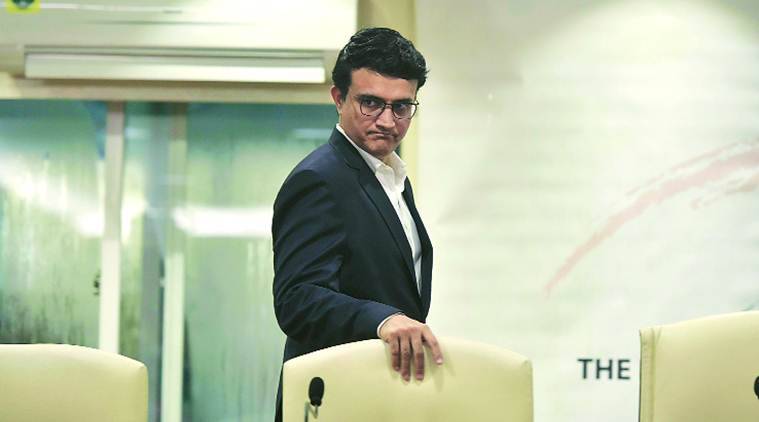
Will India and Pakistan play a bilateral cricket series soon? Here’s what Sourav Ganguly says

BCCI chief Sourav Ganguly made a statement recently on whether India and Pakistan would play a bilateral cricket series soon. Ganguly made the comment at the 40th Sharjah International Book Fair.

Sourav Ganguly said, “This is not in the hands of the boards. At world tournaments, the two teams do play each other. Bilateral cricket has been stopped for years and this is something that the respective governments have to work on. This is not in Rameez’s hands, nor mine.”

Earlier, PCB chief Rameez Raja had said, “I met with BCCI President Sourav Ganguly and secretary Jay Shah on the sidelines of the ACC meetings. We need to create a cricketing bond, while I have also believed that politics should stay away from sport as much as possible and this has always been our stance.”

India and Pakistan only play in ICC tournaments since bilateral cricket between the two countries was stopped due to state-sponsored terrorism against India. While some want the cricketing ties to resume, the national mood is not in favour of it.

When Pakistan defeated India for the first time in a World Cup event in the recently concluded T20 World Cup, there were several hateful remarks that were made which make the resumption of cricket more difficult. One Pakistani Minister called it the victory of the Muslim World while former cricketer Waqar Younis said that the best part about the victory was watching Pakistani opener Mohammad Rizwan perform Namaz in front of Hindus.

Combined with the fact that Pakistan sponsored terrorism continues to claim lives to this day in Jammu and Kashmir, it is unlikely that the Government of India would wish for cricket to resume between the two countries.

Egypt: Heavy thunderstorms bring deadly scorpions, 500 persons stung, 3 dead

0

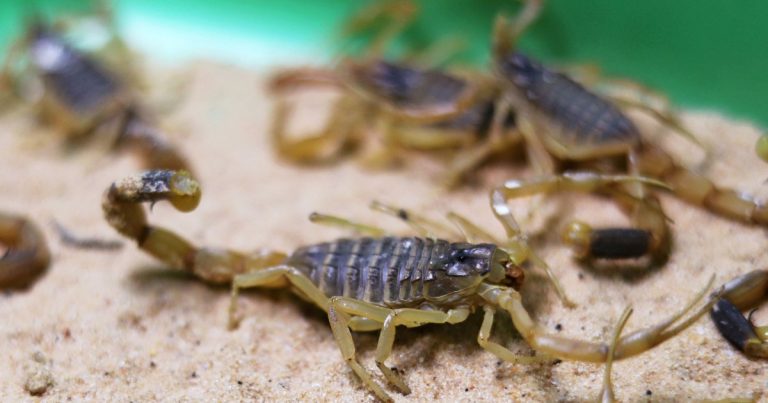
Scorpions in Egypt have stung three people to death while injuring more than 500 people according to reports. The incident has occurred in the southern city of Aswan after recent thunderstorms caused thousands of scorpions to come out in the open.

Local media has reported three deaths due to scorpion bites, however the Acting Minister of Health Khaled Abdel Ghaffar said, “503 residents in Aswan got antidotes for scorpion bites … there were no deaths from the bites,”. Khan further said that there was enough anti-venom in the hospitals of Egypt, with Aswan Governorate having 3,350 doses.

The mountainous region of Aswan witnessed heavy rains and thunderstorms on Friday forcing the scorpions out of their nests. Ministry of Health and Population in Aswan informed the press that 89 cases were admitted in Aswan University Hospital and receiving treatment while 118 people were in Kom Ombo Central Hospital and the remaining injured people of Aswan were in the hospitals of Drau, Nasr al-Nuba, Edfu, and Abou Simbel.

A health official told Al-Ahram news agency that additional doses of anti-venom were provided to medical centres in villages near mountains and deserts. Scorpions have regularly washed into the streets and homes during heavy rains in the mountainous areas of Egypt.

Notably, the fat-tailed scorpions found in Egypt were among the most dangerous scorpions in the world. Black fat-tail scorpions’ venom can kill humans in under an hour.

Symptoms of a scorpion bite include difficulty breathing, muscle twitching and unusual head movements. The Anti-venom which is used as a preventative measure before symptoms start to show can also be effective after the symptoms start to worsen.

Manipur ambush: China’s role suspected behind brutal murder of 7, including Commanding Officer’s wife and son

On November 13, a convoy of an Assam Rifles unit was ambushed by terrorists in the Churachandpur district in Manipur, bordering Myanmar. The casualties included a Commanding Officer, his wife, their 6-year-old son, and 4 other soldiers of 46 Assam Rifles. Many top Army officers are of the opinion that the attack had been carried out at the behest of China, reports Swarajya.

People’s Liberation Army Manipur and Manipur Naga People’s Front (MNPF) have claimed responsibility for the attack. PLA(M) has strong relations with China and has received aid and encouragement from Beijing in the past.

Former Director-General of Assam Rifles, Lt. Gen. (retired) Shokin Chauhan was quoted by Swarjya as saying: “China has provided ideological training and training in arms, guerilla tactics and safe havens to insurgent groups of the Northeast for a long time. Many of the leaders of these outfits have travelled to China and have interacted closely with China’s military and political leadership”.

Lt Gen (retired) Konsam Himalay Singh, the first three-star general in the Indian army from Manipur, told the website that Saturday’s ambush was an attempt by terrorists in Manipur to re-establish their importance at a time when the insurgency has been mostly subdued.

“This reeks of China’s hand in stoking the dying embers of insurgency in Manipur,” said Lt Gen (retired) Konsam Himalay Singh, explaining how Manipur is the only state in the northeast where insurgency is still active, though mostly confined. Ambushes and high-profile attacks like the one that occurred on Saturday bring these insurgent groups much-needed attention and publicity.

The PLA and other valley-based insurgency groups in Manipur maintain close ties with China, according to a Brigadier attached to the Army’s 3 Corps Headquarters at Rangapahar near Dimapur in Nagaland, who told Swarajya that the leaders of these outfits are in regular communication with China’s military.

The Brigadier added that apart from their strong suspicions that China was involved in the ambush, it has also emerged that the operations carried out by the 46 Assam Rifles battalion (commanded by the murdered Colonel Viplav Tripathi) caused a lot of difficulties for the various insurgent groups in Manipur.

The 46 Assam Rifles have taken a firm stance against drug smuggling across the porous Indo-Myanmar border, busting multiple drug trafficking rings. The insurgents run these cartels, and drugs are their main source of income. The insurgent outfits were suffering because Col Tripathi had cut off this source of income. That is also why he was most likely targeted, added the Brigadier.

It is noteworthy that Manipur shares a 398-kilometre border with Myanmar that is unfenced and highly porous. The single-lane road that connects the Assam Rifles outpost at Behiang (near the border) to the 46 Assam Rifles battalion headquarters at Khuga, where the ambush took place, is also a drug trafficking route.

Reportedly, the convoy was first attacked by an IED blast, after there was a gunfire attack by the terrorists. Colonel Viplav Tripathi, who was serving as the commanding officer of 46 Assam Rifles unit on deputation, was returning from one of his command posts on the Myanmar border when the attack took place. The four soldiers who died in the ambush were from the Quick Response Team.

A Deputy Inspector-General (Brigadier) of the Assam Rifles, who visited the ambush location, opined that the insurgents must have maintained a careful eye on Col Tripathi’s activities. “The militants couldn’t have been unaware that the Commanding Officer was travelling with his wife and son,” said the officer.

He asserted that the terrorists had crossed a red line by targeting the family of a soldier. “They will have to pay a very heavy price for this. We are conducting operations and are zeroing in on the insurgents. Retribution will be swift,” the Assam Rifles officer added.

Manipur ambush brings China’s role in Northeast region back into focus

The ambush on an Assam Rifles convoy recalls the 2015 ambush on the Dogra Regiment in neighbouring Chandel district in which 18 army personnel were killed and has brought China’s possible support to insurgencies in India’s Northeast back in focus.

By most accounts, China has always provided safe havens to insurgent groups operating in the northeast for many decades. It has been, in fact, encouraging its proxies to carry out strikes in Manipur, necessitating an increase in CI operations in the northeastern state. In such a situation, extra troops will have to be transferred from the LAC to Manipur, deflecting the attention of the Indian Army away from the Chinese buildup thus weakening India’s position along the LAC.

Top army officials reportedly told Swarajya that China has been supporting ethnic insurgencies in Myanmar’s Shan, Rakhine, and Kachin regions by supplying rebel groups with AK-series rifles, grenades, and other ammunition made in Chinese ordnance factories.

Some of these weapons, as well as explosives, are making their way into the hands of militants in Northeast India, particularly those based in Manipur, such as the People’s Revolutionary Party of Kangleipak (PREPAK), Kanglei Yawol Kanna Lup (KYKL), and the Kangleipak Communist Party (KCP).

JNU: ABVP students attacked by leftists over meeting venue row, several persons injured

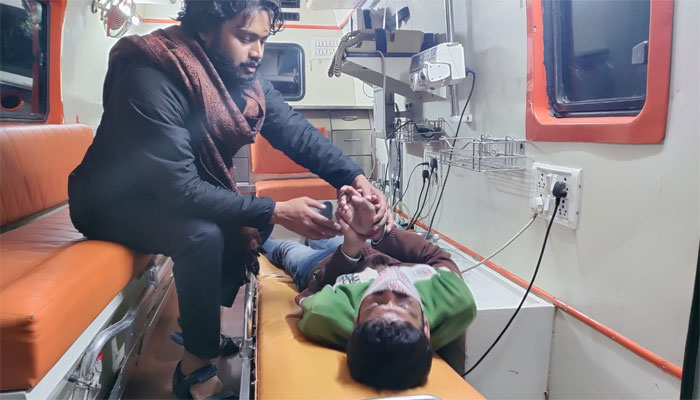
On November 14, the Jawaharlal Nehru University (JNU) students affiliated with Akhil Bhartiya Vidyarthi Parishad (ABVP) were allegedly attacked by students affiliated with Left alliances, including AISA and SFI. Reports suggest that several dozen students sustained injuring during the clash. The injured were rushed to AIIMS for treatment.

As per ABVP, some members had called a meeting that was taking place in the Student Activity Room at JNU. During the meeting, students of Left alliances came and tried to disrupt it. A clash erupted between the groups after the left-leaning students allegedly attacked and beat up ABVP members. They have further said that women and divyang students were injured in the attack. Some of the students sustained serious wounded and were rushed to AIIMS for treatment.

In a tweet, ABVP Delhi said, “In yet another instance of Campus Naxalism, Left parties violently attacked a peaceful meeting of ABVP activists in JNU earlier tonight. Finger of a MA student was broken in this brutal assault, a Divyang student was manhandled, and various ABVP activities were hit.”

They further demanded stringent action against the ‘unruly elements’.

ABVP JNU Unit President Shivam Chaurasia, in a video statement, said, “ABVP JNU was conducting the weekly organizational meeting on Sunday. We conduct these meetings every Sunday. The fringe elements of the Left groups entered the Student Activity Room and said it was time for their meeting, and we were forcefully occupying the space. We told them that the meeting would be concluded in 30-60 minutes, but they started threatening us. They said, ‘we are JNUSU, and we own this room. If anyone wants to use the room, they have to take our permission.’ Their 100 Flower group attacked us and disrupted our meeting.”

Rohit Kumar, Secretary, ABVP JNU, said, “ABVP was holding a meeting after taking permission for the same. However, the Left-leaning group of students not only disrupted our meeting but also attacked our members. Women and divyang students got injured during the attack.”

OpIndia reached out to Shivam Chaurasia to get more information about the incident. He said every week, ABVP holds a meeting in the designated room. On Sunday night, a group of left-leaning students came and asked them to leave the premises. When we did not bend down to their demands, they attacked our members. He said, “They were raising slogans like ‘RSS Murdabad’, ‘ABVP Murdabad’, ‘ABVP Campus Chodo’ and more. They also threatened our new members.”

Nidhi Tripathi, National General Secretary, ABVP, wrote, “ABVP JNU students, who were peacefully holding a meeting, have been attacked by Maoist leftists. They broke an ABVP worker’s fingers and also hit a differently-abled student.”

Later on Sunday night, ABVP JNU held a protest march against the attack on its members.

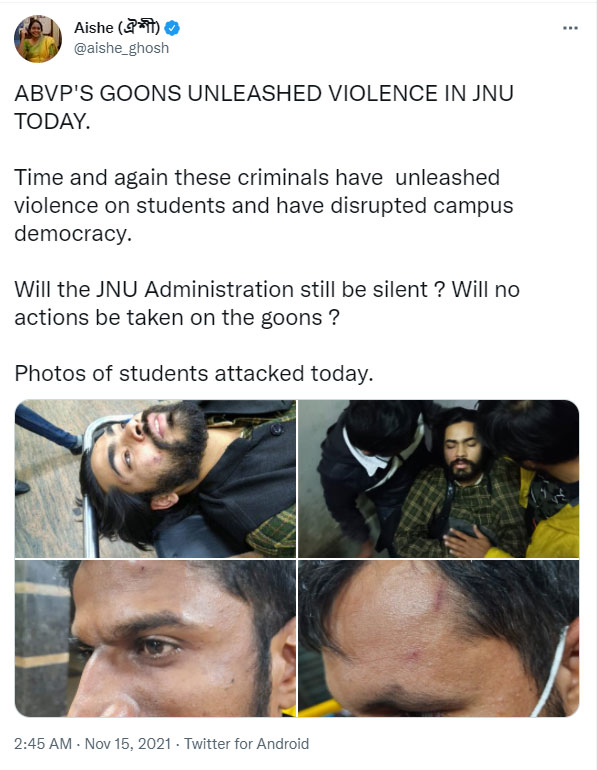
On the other hand, Aishe Ghosh, president of the JNU Students’ Union (JNUSU), blamed ABVP for the clash and alleged it was ABVP that initiated the attack and injured students of Left-alliances.

Tweet by Aishe Ghosh blaming ABVP for the clash. Source: Twitter

ABVP students who got injured during the attack have filed complaints at the Police station. In the complaints, the students mentioned the series of events that led to an attack on them. The complaints also noted that the students of left alliances threatened the ABVP members to ask the professors to fail them in exams. The female student who was attacked said in her complaint that the attackers pushed her, threw an iron chair on her and hit her in the abdomen. The students claimed that the attackers were led by one Vivek Pandey.

‘Taker, not a maker’: Elon Musk takes aim at US Senator Bernie Sanders after the latter’s rant about higher taxes for the rich

0

Eccentric billionaire Elon Musk had a go at former presidential aspirant Bernie Sanders. Sanders, an avowed Democratic Socialist, tweeted, as is the norm for him, about the need for the wealthy to pay their ‘fair share’ of taxes. Musk, in response, sent a ‘snark tweet’ saying that he had forgotten Bernie Sanders is still alive.

Source: Twitter

Elon Musk then proceeded to ask Sanders whether the Democrat wanted him to sell more stock. Another person commented that Bernie Sanders is the kind of person who goes to potluck (a party where each guest contributes a dish) without bringing any dish of his own but makes sure to bring containers to carry food back home.

Source: Twitter

To that, Musk responded, “Bernie is a taker, not a maker”. Another user said that Bernie is very much alive and selling his “snake oil” to 20 year old youths from his four houses.

Source: Twitter

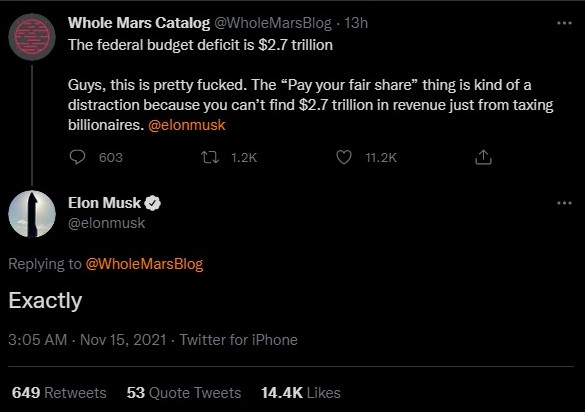
Another user pointed out that the federal deficit is $2.7 trillion and “Pay your fair share” is “kind of a distraction because you can’t find $2.7 trillion in revenue just from taxing billionaires.” Musk agreed with the tweet and replied accordingly.

Source: Twitter

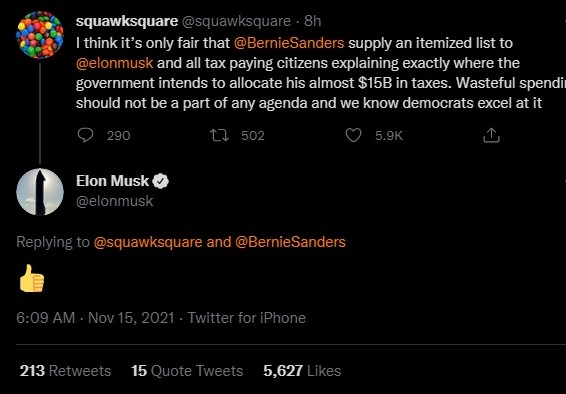
Similarly, Elon Musk agreed with another tweet that said that Bernie Sanders should send an itemized list to the billionaire and all tax paying citizens regarding where the government intends to allocated his $15 billion taxes.

Source: Twitter

A few days back, Musk also mocked another US Senator who objected to him selling his Tesla stocks based on the results of his Twitter poll. Recently, Elon Musk also committed to spending $6 billion to fight world hunger after a UN official claimed that the amount could solve the problem.

Musk said that he would sell Tesla stocks right then if the official could explain in public precisely how it will solve world hunger. On being confronted, the UN official ultimately backtracked his claim, essentially admitting that the amount could not solve the problem.

Kerala: RSS member hacked to death in front of his wife by SDPI goons, BJP accuses Pinarayi Vijayan Govt of backing SDPI

0

On Monday, November 15,  A Sanjith, a 26-year-old Rashtriya Swayamsevak Sangh (RSS) worker was hacked to death allegedly by the Social Democratic Party of India (SDPI) goons. SDPI is the political wing of the Islamist organisation Popular Front of India (PFI). 

The incident occurred at Ellapully in Palakkad district at 9:30 in the morning. A Sanjith was a native of Elappully. He was going for his work on his motorcycle with his wife when he was brutally attacked by the SDPI members.

The local report suggests that the assailants, who came in a car, stopped his bike and attacked him in broad daylight in front of many people including his wife.

Sanjith who was seriously injured in an alleged attack was rushed to the hospital where he later succumbed to his injuries. 

Speaking to the media, Palakkad BJP district president KM Haridas termed the incident a “well-planned” political murder by the SDPI. He slammed the LDF government led by CM Pinarayi Vijayan government for backing SDPI. 

“A Sanjith was going with his wife when he was stopped and brutally attacked. The SDPI in the state has got the ruling party’s backing,” Haridas alleged.

There have been political fights in the area previously and today’s attack is believed to be a result of those.

The police have kept the deceased RSS workers’ body at the mortuary of the Palakkad district hospital and launched an investigation into the incident.

SDPI has been involved in several clashes with RSS

It may be noted that SDPI has been involved in several clashes with RSS in the past. On February 24 2021, R. Nandu alias Nandu Krishna, 22-year-old Rashtriya Swayamsevak Sangh (RSS) Shakha Mukhya Shikshak at Nagamkulangara in Wayalar village panchayat in Alappuzha was hacked to death allegedly by the Social Democratic Party of India (SDPI) goons.

A few days before the aforementioned incident, the Popular Front of India (PFI) had chosen to do a rally parading men dressed in RSS uniforms. The men being paraded were also chained. The audio and visuals from the rally confirm a lot of Islamic chanting, including Allahu Akbar, la ilaha illallah muhammadur rasulullah, and others chanted during the procession. The rally was held in Tenhipalam town in Malappuram district of Kerala.

Some sources had said that PFI’s rally was to ‘celebrate’ the centenary of the ‘1921 Malabar Hindu Genocide’ or Moplah massacre, which is better known in history as the Malabar Rebellion of 1921, in which more than 10,000 Hindus were killed and as many a 100,000 Hindus were forced to leave Kerala in the wake of the riots.

Supreme Court concludes major cause of air pollution in Delhi is not ‘stubble burning’ after Centre says so

Amidst the deteriorating Air Quality Index (AQI) in the National Capital, the Centre told the Supreme Court that stubble burning in neighbouring states of Haryana and Punjab is not a major contributor to air pollution.

The Union government told the apex court that stubble burning contributed to only 10% of the pollution and thus is not a major cause of pollution in Delhi. It suggested the implementation of the odd-even rule, lockdown (in worst case scenario) and ban on entry of trucks in the National Capital.

As such, the Supreme Court concluded that major causes of pollution are industries, transport and vehicular traffic, besides stubble burning in some areas.

The apex court directed the Cente to hold an emergency meeting to discuss issues such as the implementation of work from home, stopping power plants, construction and non-essential transport.

Apex court lambasts Delhi government

The Supreme Court slammed the Delhi government for suggesting that stubble burning has been contributing to the poor AQI in Delhi. While slamming the Arvind Kejriwal-led government, it pointed out how the affidavit was based on ‘bashing farmers’. It also questioned the stance of the government for passing the buck on the Municipal Commissioner. “This kind of lame excuse will force us to hold an audit of the revenue you are earning and spend on popularity slogans,” the apex court said.

Earlier, the court also pulled up the Arvind Kejriwal-led-Delhi government over the non-installation of smog towers and emission control projects. “You have opened all schools in the national capital and now children are exposed to pollutants. This is not the Centre’s but your jurisdiction. What is happening on that front?”

Maharashtra: Minor girl gang-raped by 400 men including a Policeman over a period of six months, 3 arrested

A horrifying case of gang-rape has come to light in district Beed, Maharashtra, where a minor girl was gang-raped by around 400 different people, including a policeman, over a period of six months. According to a report in News 18 Lokmat, the victim tried multiple times to file a case, but the Police did not take any action.

According to the complaint filed by the girl, her mother passed away around two years ago. After her mother’s death, her father married her away. For a year, the victim stayed at her matrimonial house, where her in-laws and husband repeatedly harassed her. After living there for a year, she returned back to her paternal home.

Her father refused to take care of her. As a result, she was forced to live at the Ambajogai bus stand six months ago. In these six months, she was raped by more than 400 people. The girl said in her statement that she tried to file a case at Ambajogai Police Station, but no one helped her. Instead, a policeman allegedly took advantage of the situation and raped her. She said, “I have been abused by many people. I went to Ambajogai police station several times to file a complaint, but the Police took no action against the culprits. Instead, I was harassed by a policeman.”

Finally, last week her complaint was filed, and a case was registered by the Police. A case under the Prohibition of Child Marriage Act has been filed against her father and relatives for arranging child marriage. The accused have been booked under the POCSO and other relevant sections of the Indian Penal Code for rape and molestation.

According to news agency ANI, Raja Ramasamy, Superintendent of Police, Beed, said, “3 people arrested in an alleged case of rape of a minor married girl. The survivor is two months pregnant. Based on the complaint lodged by the survivor, a case has been registered under the child marriage act, rape, molestation & POCSO.”

The repeated sexual assault on the minor girl left her pregnant. The Child Welfare Committee is in the process to abort the foetus. So far, the Police has arrested four people. Further investigation is underway.

Dombivli gang-rape case

In September 2021, another horrifying gang-rape case was reported in which a 14-year-old minor girl was allegedly gang-raped by over 30 people over a period of eight months. She was first raped in the month of January when her lover made an indecent video of her and blackmailed her. He repeatedly raped her and got his friends and acquaintances to gang-rape her as well. All the arrested accused have been booked under Indian Penal Code (IPC) Sections 376 (rape), 376 (N), 376 (3), 376 (D) (A) and Section 4,6 and 10 of the POCSO Act.

Munawar Faruqui’s Hindu hatred called out, Panaji organisers cancel show after Raipur show was shut

Amidst the opposition of the Hindu Janjagriti Samiti in Panaji, the organisers of the standup comedy show of Munawar Faruqi had decided to cancel it. The development comes days after the cancellation of two shows of ‘comedian’ Munawar Faruqui in Raipur in Chhattisgarh.

As per reports, the comedian was set to perform at a mall in Panaji on Monday (November 15). But, the organisers ‘LVF Comedy’ pulled the plug on the show citing the law and order problem. The decision was taken following a meeting at the Panjaji police station. The organisers were reportedly told that the show of Munawar Faruqi could cause a law and order problem. Although the cancellation of the show was confirmed by ‘LVF Comedy’, founder Warren Viegas did not comment on the matter.

The Hindu Jagriti Samiti had earlier urged the State to not allow Faruqi to perform in Panaji, owing to his past record of making ‘vulgar jokes about Hindu Gods.’ Spokesperson Jayesh Thali remarked, “He was behind bars for 37 days in Madhya Pradesh for insulting the Hindu religion. There are elections in Goa and such events could create acrimony in the state. If Pramod Muthalik can be banned in Goa, why is Munawar allowed in Goa,” he asked.

VHP and Bajrang Dal had earlier asked Raipur authorities to cancel show of Faruqi

Faruqui was scheduled to perform on November 14 in Raipur. However, his shows were cancelled following the opposition of Vishwa Hindu Parishad (VHP) and Bajrang Dal. VHP leader Santosh Chaudhary had informed that the two groups had submitted a written application to Raipur Collector and Superintendent of Police in this matter. 

“Faruqui mocked our Gods in past and such anti-Hindu people should not be permitted in the capital. And if the administration permits, it will be the administration’s responsibility because we will stop the program in our own way,” said Chaudhary. Vishwa Hindu Parishad had warned that they will stop the show if the local administration gives permission to host the program. After Gujarat and Mumbai, Munawar Faruqui’s show was eventually cancelled.