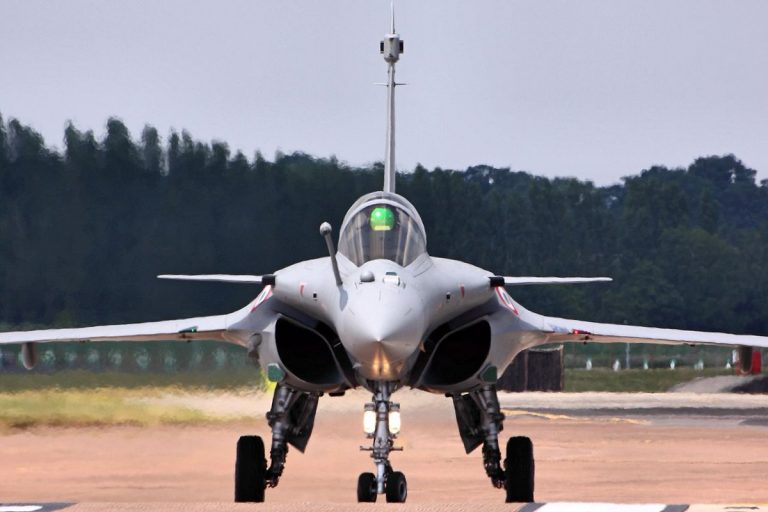
“You can’t make a soufflé rise twice”, former minister Jaswant Singh used to say. Yet it seems that’s exactly what the Indian National Congress is trying to do. Even as the Supreme Court of India delivered scathing remarks while dismissing the petitions for an inquiry into the Rafale, the Congress party has now decided to take the “expose” by Mediapart and the judicial inquiry initiated by France to revive the ghost of Rafale ghost.
As Congress blurs the line between fact and fiction, here’s your ready reckoner on the latest ‘revelations’ by Mediapart and the judicial inquiry initiated by France.
Despite the great length of writing and build-up, 99% of what has been passed off as new are the same old allegations. There are only 2 things that are actually “new” here.
THE RAFALE INVESTIGATION
What’s new
A French judge, who has replaced the old judge who retired, has re-opened his predecessor’s investigation that said predecessor had ended.
The charges are unclear – varying from influence peddling to actual corruption. Let us be clear here – while the Congress party and a large section of the media are drumming up this ‘investigation’, it was one which was closed by the earlier judge, who has now retired. There is no credible information as to what the charges really are for the new investigation.
What’s old
Regarding the influence-peddling charges, there has been no proof – just supposition of the ADAG giving money to former French president Julie Gayet’s movie, set in the Himalayas. There have been no documents provided to show any connection to Dassault or the Rafale as a result of this connection. This particular “expose” by Mediapart was debunked rather extensively while the controversy was raging.
The only proof so far has been the ledger of an arms middle man in Delhi by the name of Sushen Gupta. His accounts show payments received during 2013-2014 during the previous UPA government. These payments totalling around 11 million euros were made to a firm in Singapore. Around 2 million were transferred to India, the rest to a bank account in Mauritius – a well-known route for money laundering into India. As such the only proof relates to bribery during the Congress’ rule.
This has, in fact, been reported by Mediapart journalist as well.
According to an spreadsheet belonging to Sushen Gupta, an entity called “D” (Dassault), paid 14.6million€ to Interdev in Singapore over the period 2004-2013. Interdev transferred just 2.6M€ to the Indian company IDS, while 11.9M€ was transferred to Interstellar in Mauritius ? pic.twitter.com/8osMI5y5P8
The allegation (mind you, it is just an allegation since no documents have been provided) is that Dassault provided close to 100 million Euros for a plant to be built in Mihan for the assembly of the Falcon business jet. Yet it got only 49% share in the new joint venture with Reliance.
Reliance, which according to these allegations, provided close to 10 million euros got a 51% share.
So why is this suspicious?
The big question is why is Mediapart not releasing the documents it claims to have seen regarding this deal?
Primarily because it is suspected that like a forged document N Ram of The Hindu had published claiming a “scoop” – that had manipulated and hidden several side notes and dates – this is an attempt by Mediapart to do the same – manipulate the narrative through selective concealment of Information.
The Dassault-Reliance deal as reported by Mediapart presumably only covers the initial start-up capital, not the other costs which have been borne entirely by Reliance. These would include (but not be limited to):
The acquisition of 65 acres of land for the Mihan plant
The funding of over 150 highly skilled engineers and families to relocate to France for training at the Dassault factory in preparation for the Technology transfer of the Falcon to Reliance
The relocation of 40 highly skilled French engineers and their families to Mihan near Nagpur. This has also been done at significantly higher pay as Nagpur not being a prime metro is deemed a “hardship posting” with higher salaries and benefits
Recurring costs such as – Running, Material and Testing costs, as opposed to Dassault’s one-time investment.
Presumably, Mediapart, Like the N Ram is actively suppressing documents and reporting selectively, precisely to create a scandal where none actually exist. It’s quite alright for somebody with a low IQ like N Ram to unknowingly peddle drivel. But for a French company to not know that you can’t make a soufflé rise twice is almost a crime.
The suspicion then is not of corruption, but unethical journalism of the ‘N Ram kind’ by Mediapart.
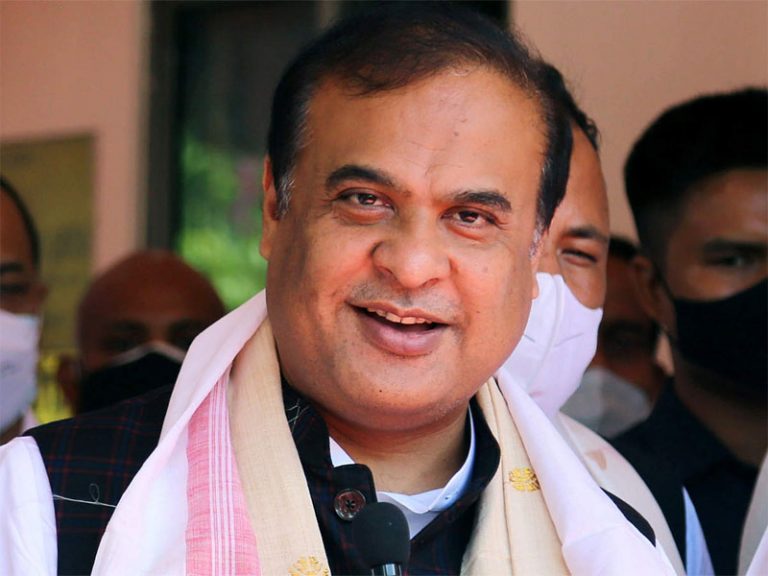
On June 5, Himanta Biswa Sarma, Chief Minister, Assam, was asked about the recent cases where arrested or under trial criminals were fired at while trying to flee. Answering the question if that was a pattern, Sarma said, “this should be a pattern if someone were trying to flee.” He was addressing a conference ‘Redefining Policing Standards in Assam’. All officers in charge of police stations across the state attended the meeting.
The Assam CM further added that if someone snatches weapons from the Police and trying to escape, and on top of that, he is a rapist, Police cannot shoot him in the chest, but shooting at the leg is the law. Notably, Sarma holds the State Home Ministry too. He added that he wanted Police to get more strict with those indulged in cattle-smuggling.
He said, “Those who smuggle cows should be caught at all costs… I don’t even want it to go to the charge sheet stage because our cows need to be protected,” he said, adding, “A cow is like a god to us.” CM Sarma asked the officers-in-charge of districts bordering West Bengal and Bangladesh to note his instructions about cattle smugglers.
CM Dr @himantabiswa held a meeting with Officers-in-Charge of @assampolice on 'Redefining policing standards in Assam'. The CM made several important announcements and issued advisories during the meeting. pic.twitter.com/MYXDq4lkLV
— Chief Minister Assam (@CMOfficeAssam) July 5, 2021
Assam CM Himanta Biswa Sarma also holds the Home portfolio.
Recent incidents of under-custody criminals getting gunshot wounds
Sarma took charge of the state as CM in May. After assuming the office, Sarma announced a massive drive against cattle smuggling, drug trafficking and other organized crimes in the state. In recent weeks several incidents have come to light where criminals involved in rape, murder, cattle-smuggling and drug peddling allegedly tried to escape from the custody and received gunshot wounds. Reportedly, 12 suspected militants and criminals have died in the shooting incidents. Several others accused of rape and cattle smuggling have been injured.
The opposition in Assam has accused the state police f being ‘trigger happy’, but the state police have refuted those allegations saying that those were genuine cases where criminals were trying to flee and police officials were forced by the circumstances to resort to firing.
‘Shooting should be the pattern if criminals trying to flee after attacking policemen’
CM Sarma said, “Today, if two kidnappers are nabbed, and they retaliate, the policeman has no choice but to fire, otherwise the policeman himself will die.” He further added when someone asks him if shooing incidents are becoming a pattern in the state, he says that it should be a pattern if the criminal tries to escape police custody. “But before doing what law has permitted us to do, we must keep our conscience clear that our work is for the good of the people and not to serve any interest of our own,” Sarma said.
He further added that the state would take a zero-tolerance approach towards any criminal who tries to escape. Later, while talking to the reporters, he emphasized that Police do not have authority for encounters. In a democracy, crime is fought through law and not encounter. These happen only when there are no other means,” he added. He also added that the charge sheets against the accused involved in rape, murder, arms, drugs, extortion should be completed in six months. He said, “Criminal cases in Assam will come down by 50 per cent if the charge sheet is filed quickly.”
Sarma also urged the Police officials to complete the passport verification process in seven days unless there is some doubt. He further talked about the National Register of Citizens (NRC) and said it is not final. He said, “Just because your name is on the NRC does not mean you are Indian. If you feel someone’s background is doubtful, leave them out. But for khilonjiya (indigenous) people, do not take time to do the verification.”
Additional Funds for all police stations
Sarma announced a fund of Rs.2.5 lakh for each Police station annually to meet recurring expenses such as fortnightly medical check-ups of all staff.
Comedians in India have been complaining since May 2014 that they cannot crack jokes freely anymore. That ‘bhakts’ take an offence to their ‘jokes’ which they quite often like to crack on Hindu gods and goddesses. Other religions are usually off limits because no one really likes to be Charlie Hebdo’ed.
One such prominent figure has been ‘comedian’ Vir Das.
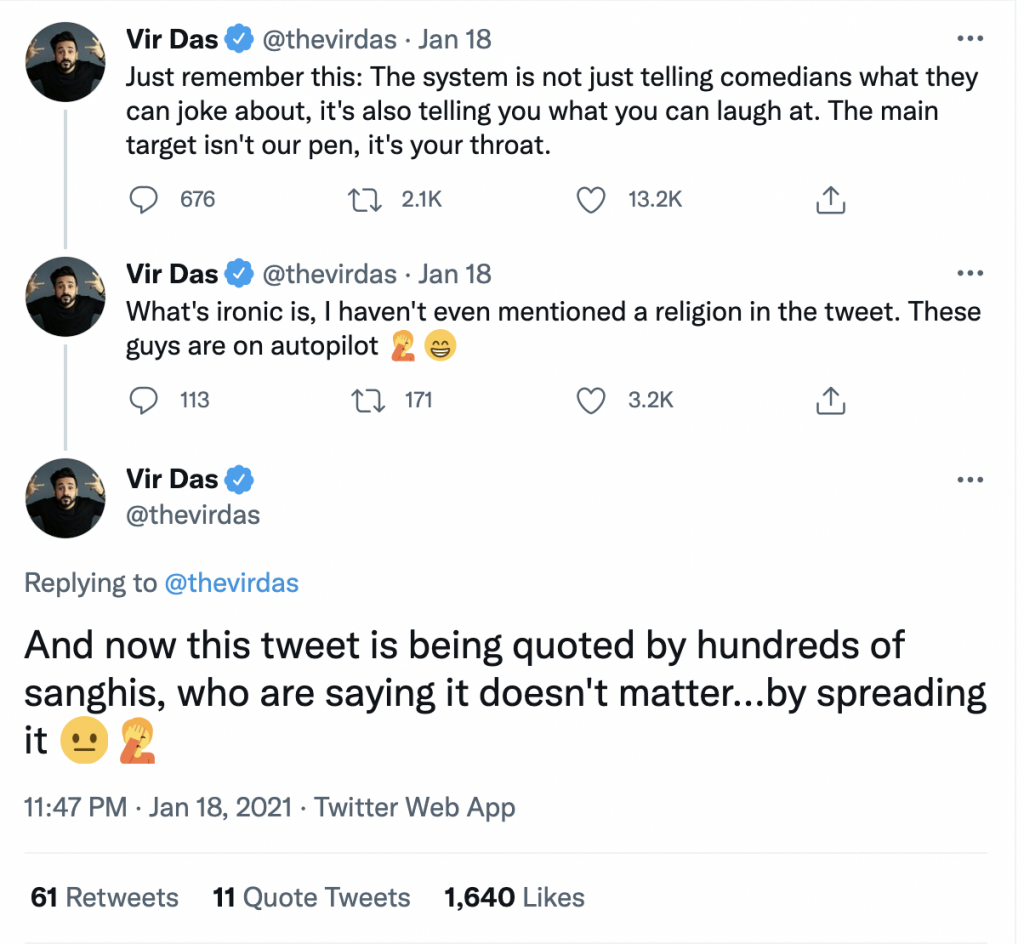
Earlier in January, Das had expressed his disappointment at how the ‘system’ was not only telling ‘comedians’ on what they can or cannot joke about but also telling people of India what they can laugh at.
Vir Das on ‘system’
He was amused how ‘Sanghis’ were quoting it.
You see, ‘comedians’ in India have an issue when it comes to taking criticism. If you find their ‘joke’, even if it is not on Hindu gods and goddesses, in bad taste or unfunny, you are a ‘Sanghi’ and don’t have sense of humour. The concept of you, as an audience, finding them ‘unfunny’ is lost on them.
Except, last night, Das got cancelled by the wokes themselves. The same wokes who just love to hate on ‘Sanghis’ and accuse them of being devoid of humour.
Here is what happened.
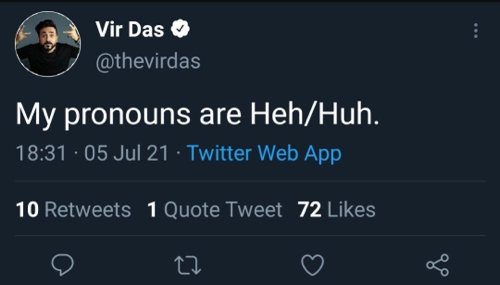
Vir Das’s now deleted tweet
At around 6:30 PM on Monday, Das took a seeming dig on ‘wokes’ who have pronouns in their profiles. Transgender, nonbinary people, who usually like to stay away from all things ‘Sanghi’, sometimes put their pronouns in their bio to help people to identify their gender.
So, ‘he/him’ is used by those who identify themselves as male, ‘she/her’ for female and ‘they/their’ for those who consider themselves ‘gender neutral’.
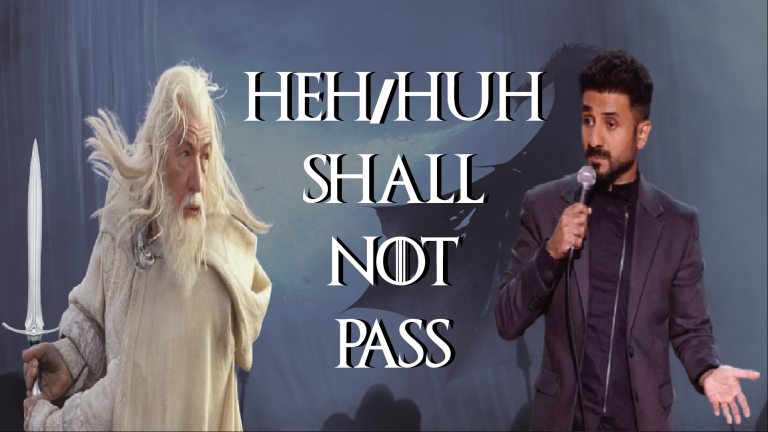
Das cracked a joke that his pronouns are ‘heh/huh’.
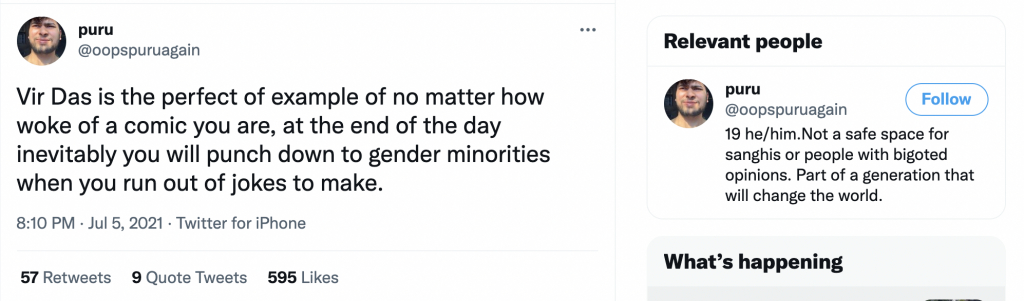
Those who do like to identify themselves with various such genders were not too happy with the said joke and accused him of ‘punching down on minorities’ amongst other things.
Sanghi-hating wokes were upset.
The ‘woke’ system took it upon themselves to teach Das what kind of jokes he can crack. As a ‘woke’ comic, cracking jokes on those who put pronouns in profiles is a no-no.
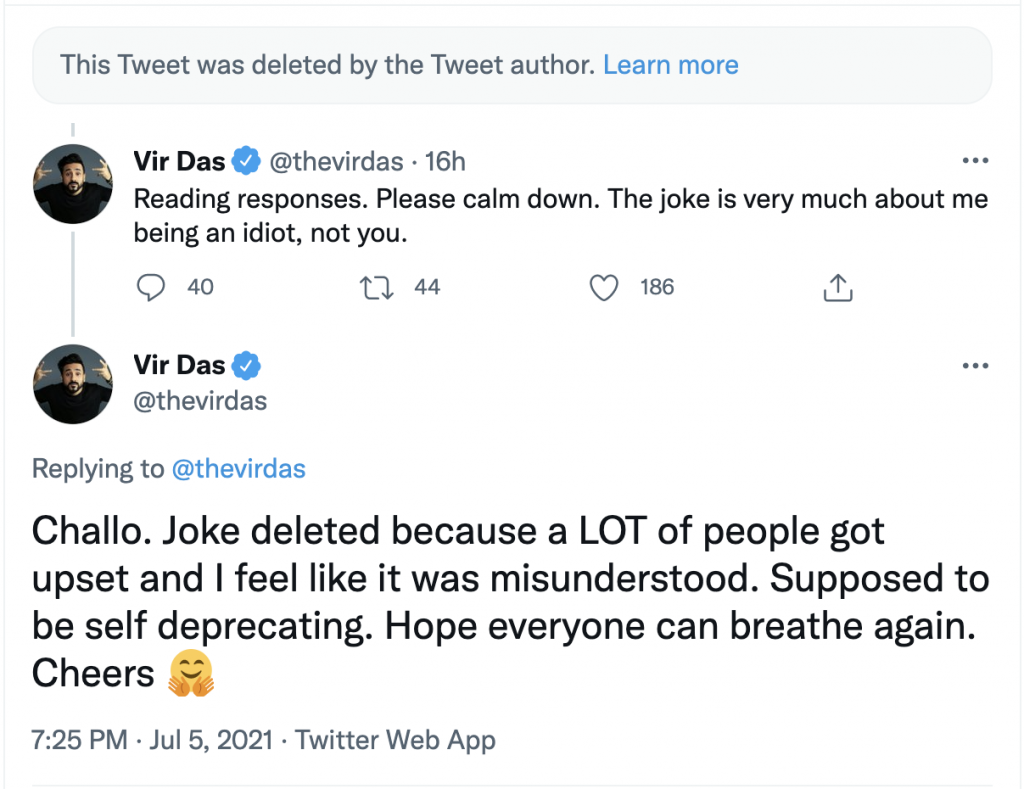
So much that in less than an hour he deleted his tweet.
Vir Das deletes his tweet
Das then claimed people misunderstood his ‘joke’ and were upset and hence he deleted his joke. You see, the ‘woke system’ got him to delete his ‘offensive’ ‘joke’. But the wokes were still not happy.
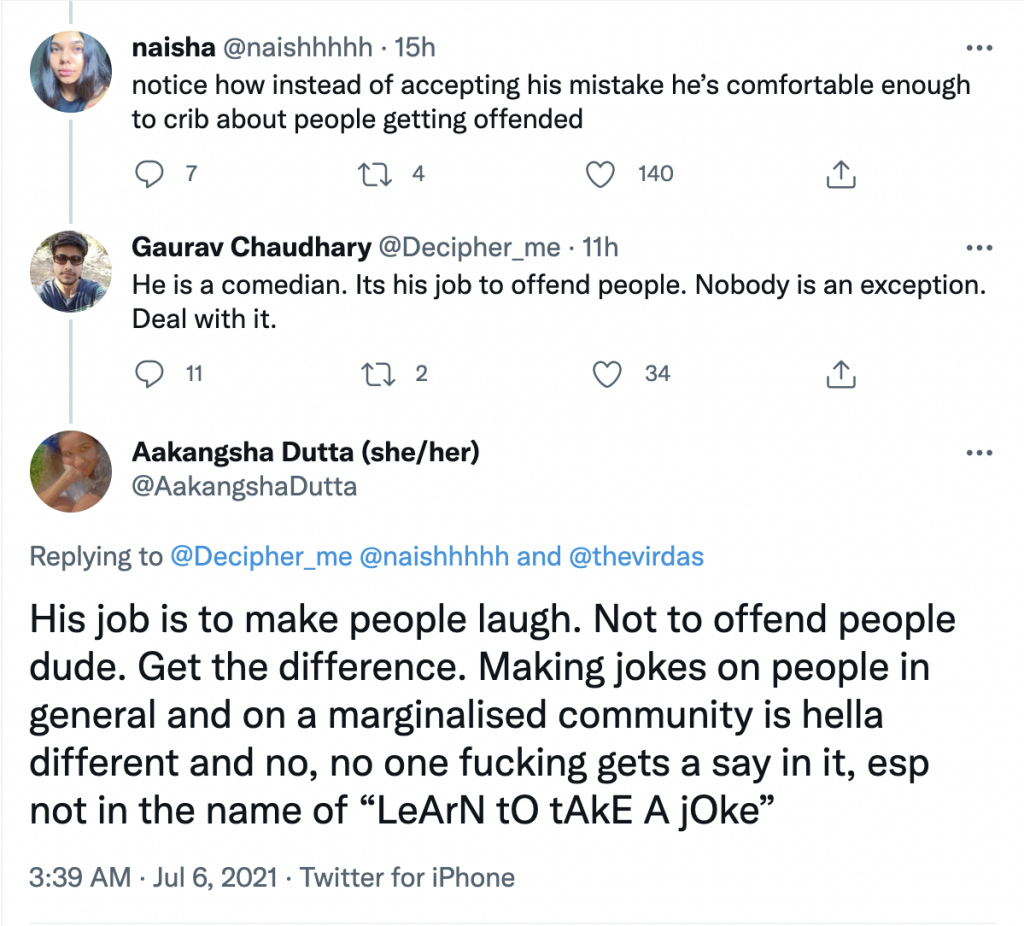
Wokes unhappy
Das was being informed by the ‘woke system’ on what kind of jokes he could crack and also those who weren’t too offended by his ‘joke’ on what kind of jokes they could laugh on.
Despite ‘Sanghis’ being offended, none of these jokers have deleted the offensive tweets. In fact, some of them tweet offensive stuff just to trigger the ‘Sanghis’ so that they can play victim. Let’s not forget the jokers who had to apologise to the ruling party leaders in Maharashtra (Shiv Sena, Congress and NCP) for a joke on Chhatrapati Shivaji Maharaj, but will still blame the ‘Sanghis’ for taking an offence. The ‘truth to the power’ tripe works only if the ‘power’ is Narendra Modi.
You see, the real ‘establishment’ is not the ‘Sanghi’ establishment. It is this ‘ecosystem’ that has been controlling your ideas on what should be offensive, what should not be offensive and what kind of offence deserves an apology. They will tell you what is attack on freedom of speech (‘Sanghis’ finding the jokes unfunny) and what is ‘respecting other people’s views’ (neon-haired, pronoun-loving, ‘Sanghi’-hating wokes).
The cancel culture has out-cancelled itself, it seems.
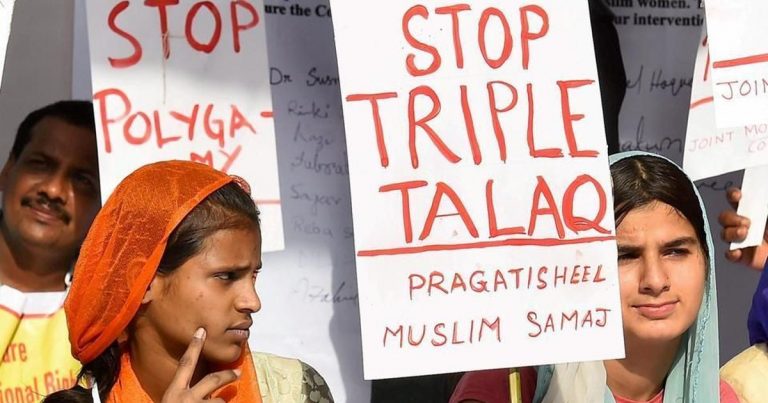
The Limbayat police have nabbed the in-laws of a victim, who was subjected to instant Triple Talaq in Surat, Gujarat.
As per reports, the woman lived near Shahpura Idgah area in Limbayat. She had filed a complaint with the police against her husband Mohammed Javed, mother-in-law Mutimun Nisha Ejaz Mirza, and father-in-law Mohammad Ejaz Mirza. In her complaint, the victim has accused her in-laws of torture, assaulting her for a dowry of ₹3 lacs, and removing her from the house with her two daughters. She has also accused her husband Javed of giving her instant Triple Talaq over a Whatsapp call. The police have now arrested the in-laws of the victim.
The central government has enacted the law against triple talaq in 2019 after the Supreme Court declared the regressive practice as unconstitutional in 2017. The law criminalises the practice of triple talaq and prescribes punishment for up to 3 years. The woman is entitled to maintenance for her dependent children under the law.
Accused booked for Triple Talaq in Ahmedabad
Recently, the Gujarat police booked a 40-year-old man named Mushtaq Shaikh in Ahmedabad for giving instant Triple Talaq to his wife. On July 1, a First Information Report (FIR) was lodged against him at the Gaekwad Haveli station, based on the complaint of his wife Shabana Banu Shaikh. Mushtaq has been booked under the Muslim Women (Protection of Rights on Marriage) Act, Dowry Prohibition Act and Indian Penal Code (IPC) Sections 498a (cruelty against wife), 294b (obscenity) and 506(criminal intimidation).
While speaking about the matter, Shabana said, “I have been married to Mushtaq for 22 years and we have a son and daughter aged 16 and 15 respectively. Right after my marriage, my husband, who is unemployed, had started demanding money from me. To save my marriage, I kept giving him money by asking my father… He harassed me mentally and physically over years.”
She further added, “On May 30 this year, I went to my uncle’s place in Juhapura for a day and when I returned, my husband started abusing me. On June 1, he again picked up a fight and said talaq three times in a bid to give me divorce. I have been staying at my parent’s place for a month.”
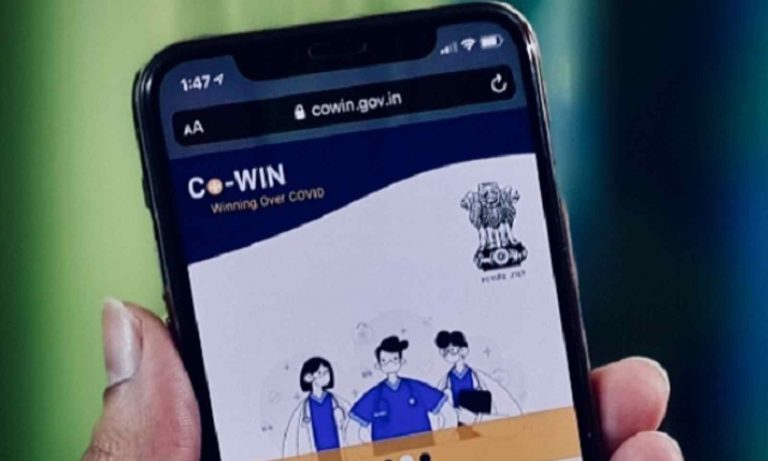
On July 5, Prime Minister Narendra Modi addressed the CoWIN Global Conclave where he announced that the CoWIN platform would soon be made open-source, and they will be available for any and all interested countries for usage. He offered the CoWIN platform as a digital public good to the world to fight the Covid-19 pandemic.
Prior to the announcement, Dr RS Sharma, chairperson of the Empowered Committee for the administration of the Covid-19 vaccine in an exclusive interview to The Print shared, “The Centre has received interest from 76 countries thus far.”
Clarifying the availability of the platform, Dr Sharma said that while the Government of India is more than happy to share this successful platform an open-source one, the only condition would be that the software should not be allowed to be used for commercial use or repackaged to be sold.
The Global Conclave on CoWin witnessed participation from 196 officials from foreign countries and 116 private individuals from 41 countries.
CoWin achieved 20 crore registrations in the first four months of its launch on 16 January and as of 1 July, 35.4 crore people have registered on the platform, informed Dr Sharma.
As per a PTI report, the countries that have shown interest in adopting the digital platform include Canada, Mexico, Nigeria, Panama, and Uganda, among others.
Link passport with vaccine certificates
Dr Sharma also informed during the interview that there are plans to update the CoWIN application by adding a feature to link passports with vaccine certificates for international travel.
The other changes on the platform will include the introduction of an editing tab enabling corrections in personal details in the vaccination certificates.
“The government has observed that in many cases, people submit incorrect personal details while registering, such as their name, date of birth or gender while registering themselves. We will now allow people to correct these details to enable corrections in their vaccination certificates,” he said.
Adding further, “We have created a mechanism to allow citizens to combine their certificates when they have, by mistake, used two different user accounts for the two different doses of vaccination,” said Dr Sharma.
“We are constantly taking feedback from all the stakeholders, learning from our own experiences, and evolving the platform to make it as accessible and inclusive for all,” he added.
CoWin integrated with consumers apps like Paytm, Reliance & others
Dr Sharma, who is also CEO of the National Health Authority, said that the software is creating new benchmarks and records every day. With an aim to have a wider outreach, consumer-facing apps such as PayTM, Reliance Group, Jubilant Foodworks, Ibibo, 1MG, Max hospitals, EkaCare, Apollo Hospitals have reportedly come onboard for integration.
“We have received over 204 applications from private and public entities to integrate with CoWIN, of which 148 have been accepted and are in the process of completing integrations,” Dr Sharma said.
He also informed that these companies will be able to allow the users to “look for available slots for vaccination or vaccines.”
Fastest tech platform
Addressing the CoWIN Global Conclave, Dr Sharma on Monday said he is proud that CoWIN has become the fastest tech platform in the world.
“It fills me with pride to share with you that CoWIN has become the fastest tech platform in the world to amass over 200 million registrations in a record four months, and then 300 million registrations in a mere five months, yet another record. What adds more credibility to this achievement is the sheer stability of the system, which is entertaining over a billion HTTP requests on an average daily,” he said.
Proud to say this: Co-WIN, the fastest tech platform in the world, amassed 300+ million registrations in a mere 5 months!
Talking about the success of the vaccination drive, Sharma noted that India has achieved an administration of over 350 million vaccine doses, with at least 284 million Indians receiving at least one dose.
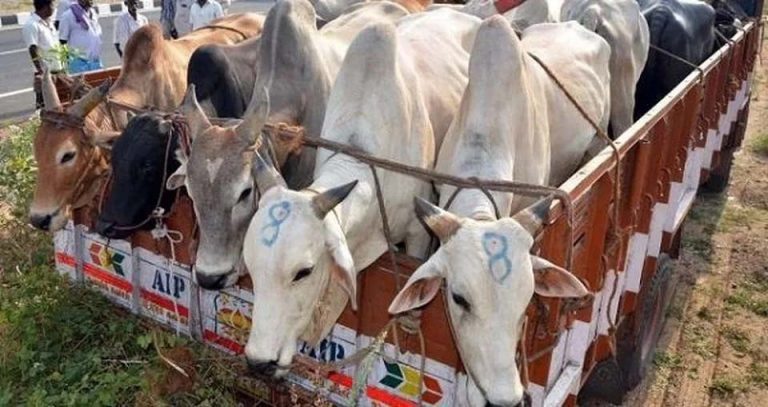
Jamil Takla alias Qureshi (38) wanted in several offenses such as attempt to murder, murder and cattle theft, jumped from the fourth floor of his residential building in Bhiwandi to evade arrest.
A team of police from the Thane crime branch along with the Gujarat unit on July 2, around 3 pm, went to arrest Takla, a resident of Kasai Wada of Nizampura. A group of 10 policemen went in hunt of him while the remaining team stationed themselves outside the chawl. As per a Gujarat police official, Takla was wanted in a case registered at a police station in Gujarat where he allegedly helped change registration plates of a vehicle suspected to have been used for cattle smuggling.
As per reports, when the police knocked on the door of the accused’s house, his family refused to answer the door. Subsequently, when they opened the door, Takla ran and jumped off the window, the official said.
It is imperative to note that reportedly this wasn’t the first time that Takla had jumped off the building to evade arrest. His previous attempts were successful when he landed safely, however, this time it proved fatal.
In a fit of rage, family members of the accused and local residents rioted and assaulted the cops blaming them for the death of Takla. Subsequently, a video has gone viral on social media where a mob can be seen attacking the cops.
Gujarat cops had come to Bhiwandi to arrest Jamil, wanted in a criminal case in Valsad. Jamil jumped out of his home on 4th floor and died. Peaceful locals beat up the cops. Attackers of police should be very severely punished. pic.twitter.com/ZraQ79w7lW
Due to the assault three cops have suffered injuries.
“We have registered an FIR for rioting and assaulting a public servant. We have arrested nine men so far,” informed senior inspector V C Dolas of Nizampura police station.
Takla was wanted for cattle smuggling
Valsad district superintendent of police Rajdeepsinh Zala in an interview to Indian Express said, “Last Tuesday (June 29), we found a deserted Innova in Dungara area of Vapi town in Valsad. While tracing the owner of the Innova, we found the location of the main accused, Jamil alias Takla, who has been booked earlier at Vapi police station for bovine smuggling. A team of local crime branch comprising three officers and constables reached Bhiwandi on Friday and the crime branch officials in Thane were cooperative. Our team was then sent to a nearby restaurant in Bhiwandi to have lunch, while Thane police sent their officers to the area for verification of the accused. This is when the incident took place. No one from Gujarat police was involved in the operation.”
Sharing additional information, Inspector J N Goswami from the Valsad crime branch said, “The Innova was found at a deserted spot in Dungara area with a punctured tyre on June 29. CCTV footage obtained showed five to six persons leaving the car on the roadside and fleeing on foot. Upon checking the registration of the vehicle, we found the number plate to be fake. An FIR was filed at Dungara police station. Then we traced the original owner of the car and got a vehicle sale agreement from him and traced it to Jamil.”
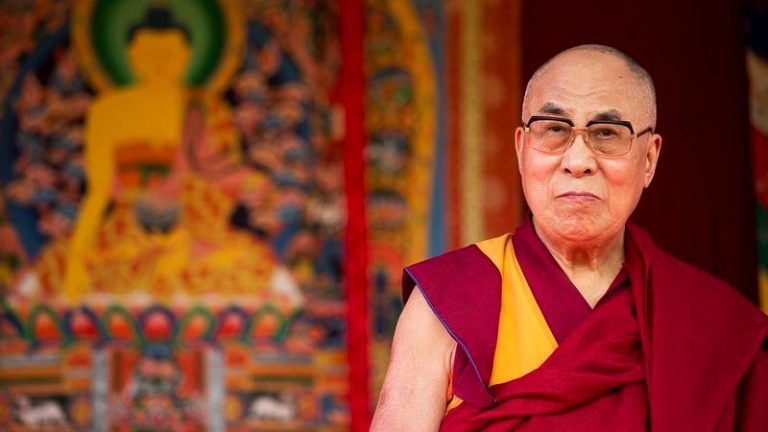
Tibetan spiritual guru Dalai Lama turns 86 today, with his followers around the world extending their greetings and celebrating the venerated leader’s birthday amidst the shadow of the resurgent coronavirus outbreak.
Dalai Lama XIV or Tenzin Gyatso as he is known with his worldly name was born on 6 July 1935 to a small farming family in the small hamlet of Taktser, Amdo, which is in northeastern Tibet. Barely at the age of two, then named Lhamo Dhondup, he was declared the reincarnation of the previous Dalai Lama XIII, Thubten Gyatso.
The Dalai Lamas are believed to be manifestations of Avalokiteshvara or Chenrezig, the Bodhisattva of Compassion and patron saint of Tibet. Bodhisattvas are enlightened beings who have postponed their own nirvana and chosen to take rebirth to serve humanity.
The current Dalai Lama began his religious education when he was 6, and by the time he reached 16, he had assumed the role of the political leader of Tibet. The region of Tibet was under a relentless assault of China, ordered by then Premier Mao Zedong, who wanted to bring the region under Chinese control. The invasion sparked an uprising against Beijing’s rule but it did not dampen China’s spirits from relentlessly pursuing its agenda of capturing the Tibet region.
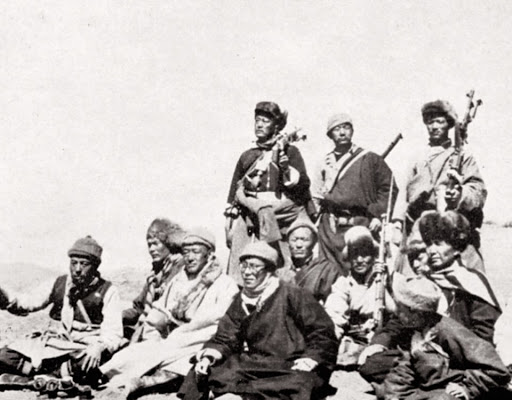
Dalai Lama pictured with his escape party in March 1959, Image via m10memorial.
Then in 1959, China moved to act against Dalai Lama, the face of the Tibetan resistance movement. Sensing imminent danger, Dalai Lama surreptitiously fled to the Himalayan town of Dharamshala, India, where he has lived in exile ever since.
In many ways, Dalai Lama’s dramatic escape to India was a watershed moment, not just in the Tibetan struggle against the Chinese occupation but also in the evolution of the relationship between India and China. Even after 62 years of his escape to India, the Tibetan spiritual leader continues to remain a thorn in the side of China and a major cause for its hostility towards India.
On the other hand, Dalai Lama’s entry into India heralded a large scale influx of Tibetan refugees in India. Tibetans facing persecution in China and who wanted to persist with their resistance against its forcible occupation came to India and continued their resistance campaign under the auspices of their foremost spiritual leader. These Tibetans and their offsprings continue to live in different parts of the country to date.
On his 86th birthday, it is worth revisiting the dramatic journey that Dalai Lama undertook to escape the sweeping and impending Chinese crackdown in his now occupied motherland.
The great escape: Dalai Lama outwits China and makes an arduous journey through the Himalayas to reach India
In 1959, even as the Chinese repression intensified in Tibet, the Chinese Army surprisingly held up an olive branch to the Dalai Lama, asking him to attend a Chinese dance troupe. Lama was the foremost Tibetan leader and considered by an overwhelming majority as the linchpin of the Tibetan resistance and commanded unmatched respect and admiration among the masses.
The invitation seemed innocuous but when he was asked to visit the Chinese military headquarters without soldiers or armed bodyguards, according to his official biography, the Tibetans thought something pernicious is afoot.
After years of altercation with the Chinese and being acutely aware of the tricks and stratagems used by them to trounce their opponents, the affable overture seemed too good to be true. As a consequence, on the day of the performance, thousands of protesters swarmed outside the Dalai Lama palace in Lhasa to keep him from being kidnapped, arrested or assassinated.
In the following days, the agitation intensified as Tibetans mobilised and organised themselves to fight the advancing Chinese forces. The Dalai Lama’s advisor, the State Oracle, sensibly suggested he flee.
So on March 17, 1959, disguised as a soldier, Tibet’s spiritual and political leader, then 23, slipped through the crowds outside his palace and embarked upon a tortuous journey towards safety and asylum. He embarked upon the treacherous path of crossing the prodigious Himalayas on foot with a retinue of his trusted soldiers and cabinet members. His entourage included his mother, sister, younger brother and several top officials. They travelled only at night to avoid detection from prowling Chinese guards.
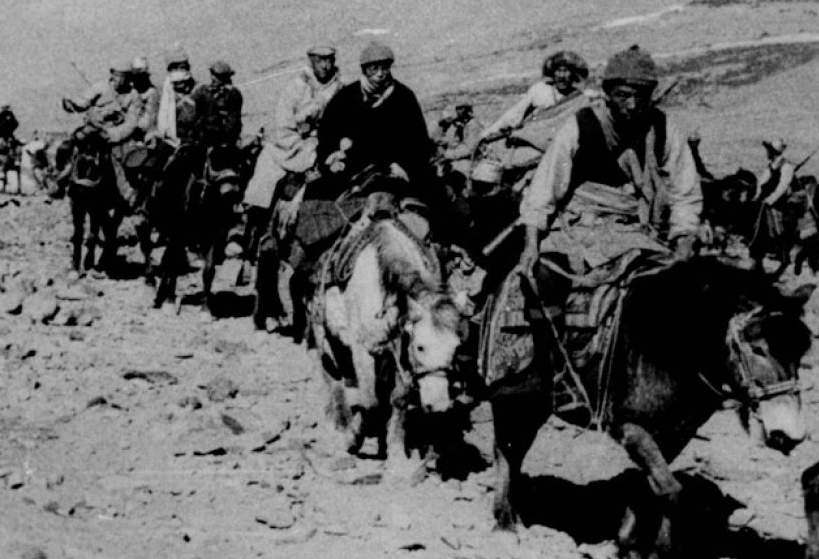
According to various accounts, the entourage travelled for days and nights on end, without stopping, on foot and horseback. They carried a month’s supplies by mules and used a single boat made of yak skin to cross the 1,500 feet wide Brahmaputra river.
Dalai Lama’s entourage, image via Dalailama.com
It took two weeks for Dalai Lama and his group to reach India. During this time, it was widely believed that the 14th Tibetan spiritual leader has been killed by the marauding Chinese forces. His followers across the world were resigned to the fact that they might not see Dalai Lama again. But on March 31, 1959, after completing a dangerous trek and crossing the gigantic Himalayas, Dalai Lama surfaced in India and demanded autonomy for Tibet.
Former Indian PM Jawaharlal Nehru almost slept when Dalai Lama was discussing with him about applying for an asylum in India
Days after arriving in India, the Dalai Lama was weighing on the option of applying for an asylum request in India. In this regard, he met Prime Minister Jawaharlal Nehru to gauge his attitude about a formal request for asylum. But, the Dalai Lama was taken aback by Nehru’s frosty reception. The Indian Prime Minister made it clear to the Tibetan spiritual leader that he would not make any commitments that would harm India’s relationship with China.
According to Dalai Lama’s autobiography, Nehru’s attitude betrayed that he had already made up his mind on asylum requests even before commencing the discussion. He was reportedly so uninterested in having discussions with the Tibetan leader that he was on the verge of dozing off.
“At first he listened and nodded politely. But . . . after a while he appeared to lose concentration as if he were about to [fall asleep],” the autobiography noted about how Nehru cold-shouldered the Dalai Lama.
The Dalai Lama explained that he had taken all steps to reach a reconciliation with China, but having failed in cutting ice with the Chinese, he was seriously considering the option of staying in India rather than return to Tibet. This reportedly made Nehru realise the gravity of the situation. He understood what the Tibetan spiritual leader was asking for, but reiterated his stance that India cannot support him.
India granted the Tibet leader asylum on April 3, 1959, and permission to establish a government-in-exile in the northern hill station of Dharamsala, already a sanctuary for thousands of Tibetan exiles fleeing Chinese repression. From there, the Dalai Lama launched an international campaign to reclaim Tibet, gradually easing this into an appeal for greater autonomy.
Dalai Lama continues to remain a thorn in the flesh for the Chinese
Nevertheless, the Dalai Lama has been a source of great torment for the Chinese. Authorities in China, to this day, fear the reach and respect that the Dalai Lama continues to command in the restive region of Tibet. China continues to raise objections to his visits to Arunachal Pradesh, a state under the sovereign control of India that China often claims is “Southern Tibet” and a part of its country. Although the Dalai Lama has given up his political role in 2011, China fears that the Dalai Lama holds enough sway in Tibet to spark an uprising against the Chinese subjugation.
The Dalai Lama has steadfastly advocated a pacifist approach to resolve the intractable relationship of Tibet with China, but the authorities in Beijing have always held a suspicious view of the Tibetan leader’s intentions. Like in Xinjiang, where China is presiding over a cultural genocide of Uyghur Muslims, they have been persecuting Tibetans and the pious devotees of the Dalai Lama in Tibet.
This has occasionally sparked a wave of demonstrations, most recently with the spate of self-immolation protests against China’s heavy-handed approach in Tibet. Since February 27, 2009, when Tapey, a young monk from Kirti Monastery, set himself on fire in the marketplace in Ngawa City, Ngawa County, Sichuan, there have been over 156 cases, where monks, nuns and ordinary people self-immolated in Tibet protesting against the Chinese repression.
In 2012, the Dalai Lama had said he does not encourage such protests but praised the courage of those who had set themselves on fire to make their grievances heard and blamed the Chinese for perpetrating a cultural genocide in Tibet.
Dalai Lama criticized by left-leaning liberals for exhibiting views that do not conform to their outlook and donating to the PM CARES Funds
Like China, its admirers back in India also share the same amount of antagonism for the supreme Tibetan leader. The Dalai Lama has been routinely subjected to criticism for expressing views that do not jibe with the liberal-communal worldview.
In 2019, Dalai Lama was branded as ‘Islamophobhic’, ‘racist’ and ‘xenophobic’, because he opined that Europe should belong to Europeans and that the larger strategic objective should be to return the Muslim and African refugees to their own lands after providing them with adequate training so that they can improve affairs in their own countries.
More recently, the Dalai Lama was targeted by a section of left-leaning liberals because he contributed to the PM CARES Fund for the country’s fight against the Chinese coronavirus. In April this year, the Tibetan spiritual leader in exile, Dalai Lama, had pledged to donate to the PM Cares Fund from the Dalai Lama Trust. The announcement was a welcome move to strengthen India’s fight against the pandemic. But the spiritual leader, who has been living in India since 1959, was soon subjected to online abuse.
National Commission for Protection of Child Rights (NCPCR) chairperson Priyank Kanoongo has written to Jammu and Kashmir DGP Dilbag Singh asking him to investigate the complaint received by the statutory body from a Delhi based activist group Kalinga Rights Forum (KRF) against Twitter India, accusing it of allowing Jihadist organisations to use the platform to promote terrorism in India.
Earlier in the day, OpIndia reported that KRF had filed a complaint with NCPCR against Twitter India MD Manish Maheshwari and its Public Policy Manager Shagufta Kamran, for “conspiring and promotion of terrorism using Kids against India & allowing terror organisations to use Twitter to facilitate recruitment activities for terrorism in Union Territories of J&K and L showing small kids as the face of terror organisations”.
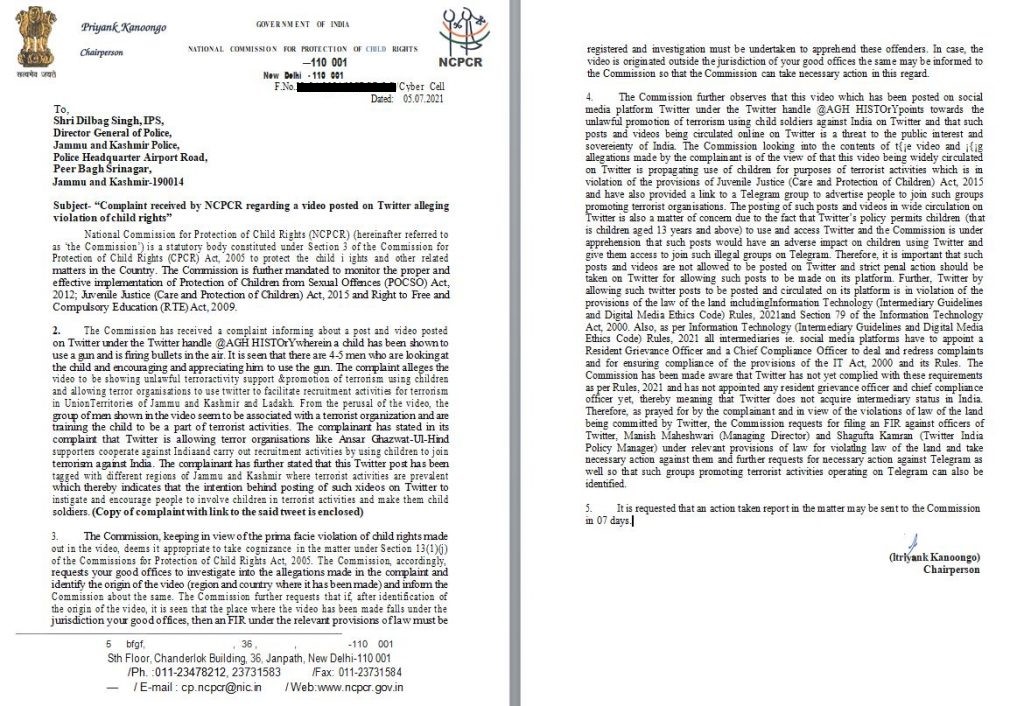
It was after KRF flagged the issue, the statutory body took cognisance of the case and wrote to the DGP of Jammu and Kashmir: “The commission has received a complaint informing about a post and video posted on Twitter under the Twitter handle @AGH HISTOrY wherein a child is shown to use a gun and is firing bullet in the air. It is seen that there are 4-5 men who are looking at the child and encouraging and appreciating to use the gun. The complaint alleges the video to be showing unlawful terror activity support and promotion of terrorism using children and allowing terror organisations to use Twitter to facilitate recruitment activities for terrorism in UnionTerritories of Jammu and Kashmir and Ladakh”, read the NCPCR letter.
Screengrab of the letter written by NRCRP to Jammu and Kashmir DGP asking to take action against Twitter and Telegram
The statutory body furthers that keeping in view the prima facie violation of child rights made out in the video, it deems it appropriate to take cognizance in the matter under Section 13(1)(j) of the Commissions for Protection of Child Rights Act, 2005 and asks J and K police to investigate into the allegations made in the complaint and identify the origin of the video and inform the commission about the same. It says that if found that the video has been shot at a place that falls under the jurisdiction of J and K police, then n FIR under the relevant provisions of the law must be registered and investigation must be undertaken to apprehend these offenders.
In case, the video is originated outside its jurisdiction, then the J and K police should inform about the same to the statutory body, read the letter.
NCPCR slams Twitter for not complying with new IT Rules 2021
Taking strong objection to such posts and videos being circulated online on Twitter, NCPCR wrote that this is a threat to the public interest and the sovereignty of India.
In the letter, NCPCR slammed the microblogging site, saying that this video being widely circulated on Twitter is propagating the use of children for purposes of terrorist activities which is in violation of the provisions of the Juvenile Justice (Care and Protection of Children) Act, 2015. It also opined posting such posts and videos in wide circulation on Twitter is also a matter of concern due to the fact that Twitter’s policy permits children (that is children aged 13 years and above) to use and access Twitter. It said that the commission is apprehensive that such posts would have an adverse impact on children using Twitter and give them access to join such illegal groups on Telegram.
“Therefore, it is important that such posts and videos are not allowed to be posted on Twitter and strict penal action should be taken on Twitter for allowing such posts to be made on its platform”.
Bringing up the issue of the social media giant not complying with the new regulations of the IT Rules 2021, NCPCR wrote that this act was also in violation of the provisions of the law of the land including Information Technology (Intermediary Guidelines and Digital Media Ethics Code) Rules, 2021and Section 79 of the Information Technology Act, 2000.
It said that the Commission has been made aware that Twitter does not acquire intermediary status in India as it has not yet complied with these requirements as per Rules, 2021 and has not appointed any resident grievance officer and chief compliance officer yet.
NCPCR orders action against Twitter India and messaging app- Telegram
Saying so, the statutory body ordered the filing of an FIR, as demanded by the activist group, against Twitter India MD Manish Maheshwari and its Public Policy Manager Shagufta Kamran under relevant provisions of law for violating law of the land.
It also asked the authorities to take action against Telegram, which along with Twitter is guilty of providing a platform to the terror organisations to operate against India and carry out recruitment activities by using kids for radicalisation, brainwashing of kids to join terrorism against India.
NCPCR also directed the J&K authorities to identify the terror groups which are promoting terrorist activities on Telegram and take appropriate action against them.
The statutory body concluded the letter by asking authorities to send a report, specifying the actions taken in the matter, to the Commission within 7 days.
OpIndia reports about the complaint filed by activist group with NCPCR against Twitter India
Earlier in the day, OpIndia reported that in its complaint to the National Commission for Protection of Child Rights (NCPCR), Kalinga Rights Forum alleged that Twitter India is facilitating terror organisations like Ansar Ghazwat-Ul-Hind supporters to operate against India and carry out recruitment activities by using kids for radicalisation, brainwashing of kids to join terrorism against India by providing them with a platform.
Speaking on how Twitter India is helping terrorist ideologies by providing the terror groups with a platform to spread their messages, recruit members, gather intelligence and also engage with their networks, the Delhi based activist group wrote that Twitter India allows terrorist supporters to post videos which show small children holding AK-47s, shooting in the air while other terrorists closely watch and instruct the kid how to shoot the gun.
The activist group shared the link and the archived link of the Tweet posted by AGH HISTOrY, going by Twitter handle @Rainbow35886147, wherein a small child is being taught how to use an AK-47 by terrorists. The activist group claims that AGH HISTOrY is a supporter of the Islamist terrorist organisation Ansar Ghazwat-ul-Hind, a Kashmiri wing of Al-Qaeda that is active in the Indian union territory of Jammu and Kashmir.
“By allowing such posts on the microblogging site, Twitter India is conspiring against India and abetting and supporting anti-India terrorist organisations to carry out terror attacks against India”, read the complaint.
It added that the terrorist supporter, AGH HISTOrY has brazenly mention links to the Telegram groups in its Twitter posts and asked fellow terrorist supporters to join these groups.
OpIndia had reported that the statutory body had taken cognisance of the complaint and was in the process of drafting a notice, ordering action against Twitter India.
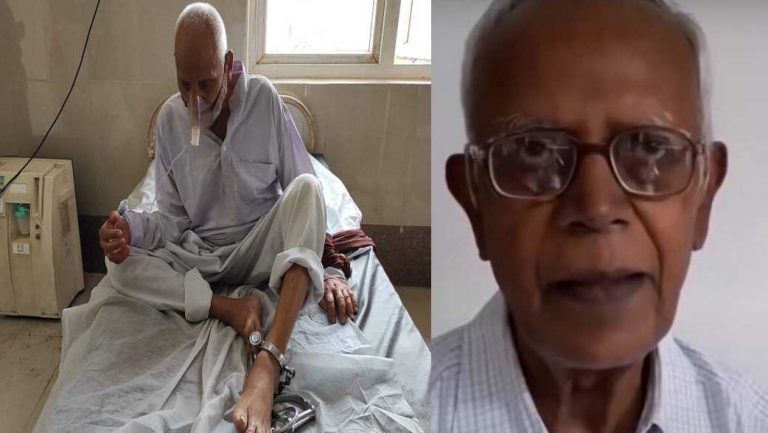
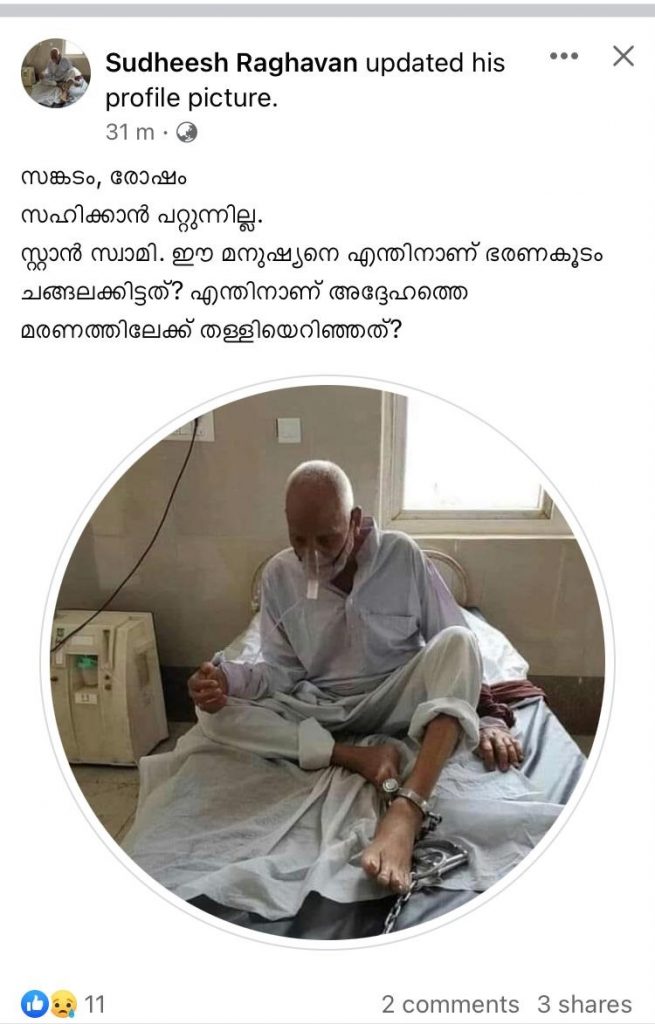
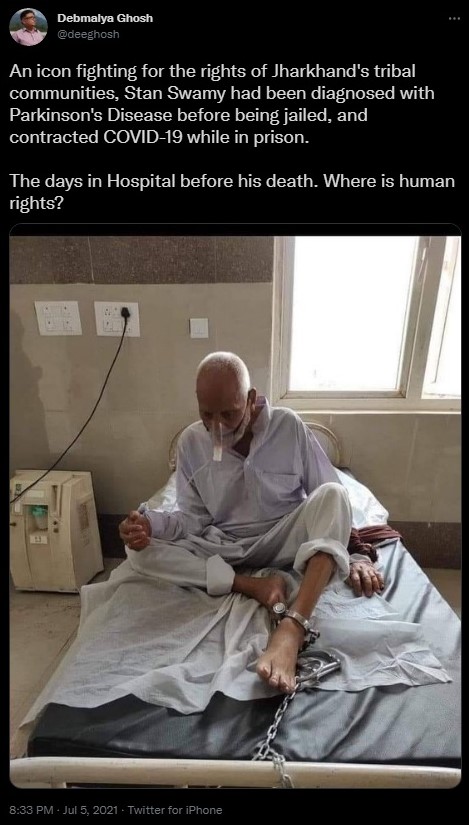
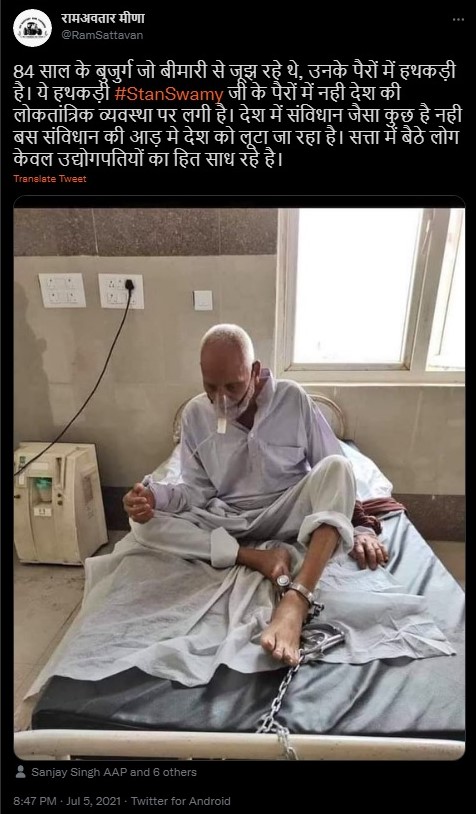
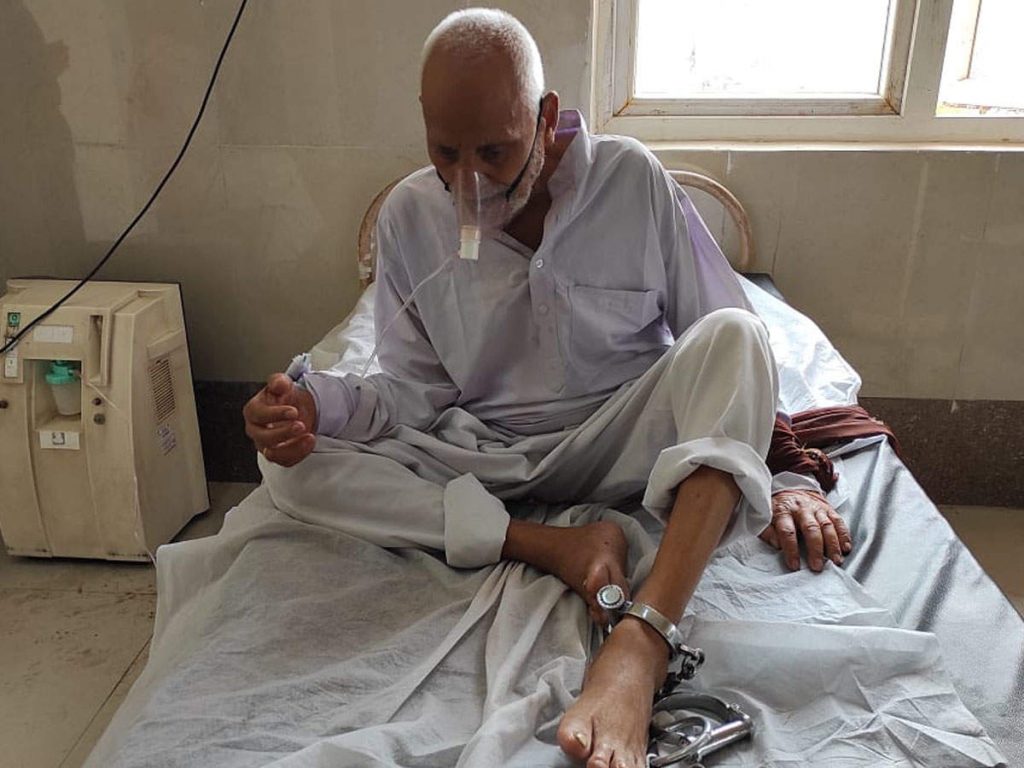
The image of a convicted criminal from a hospital bed in Etah, Uttar Pradesh is being circulated online with the claim that the photograph actually shows Stan Swamy during his last days before he passed away on Monday.
Fake news doing the rounds
Others are also sharing the image with the same claims, asking where his human rights are.
Source: Twitter
The photograph shows the person with his legs chained to the bed.
Source: Twitter
The photo is not of Stan Swamy
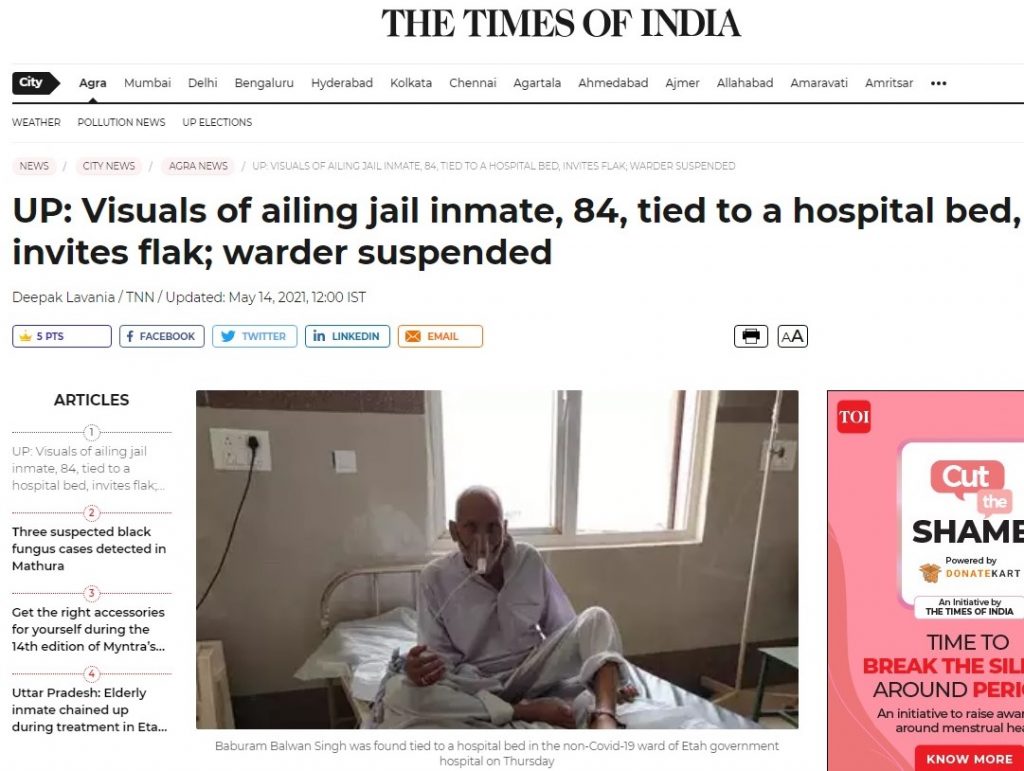
The person in the photo, however, is not Stan Swamy but convicted murderer Baburam Balwan Singh. A cropped version of the photograph was published in a report by the Times on India on May 14, 2021. The photo had surfaced on social media and had sparked anger due to the age of the old man. Consequently, an inquiry was ordered and director general (prisons) Anand Kumar was suspended, reported TOI.
Source: TOI
Kuldeep Singh Bhadauria, the jailor, had said, “He was taken to a government hospital on Sunday due to breathing problems and was referred to Aligarh. But there was no bed available there, so he was brought back to Etah, where he was admitted at the district hospital’s non Covid-19 ward. It is not clear under what circumstances he was tied to the bed. The entire matter is being investigated.”
Dr. Umesh Tripathi, Chief Medical Officer (CMO) of Eta district, stated, “Following a primary investigation, it surfaced that the patient was tied to bed by the jail staffer. I came to know about the entire matter through social media. The jail inmate is suffering from lung infection. He is being provided suitable treatment.”
The man in the photograph is Baburam Balwan Singh (Source: TOI)
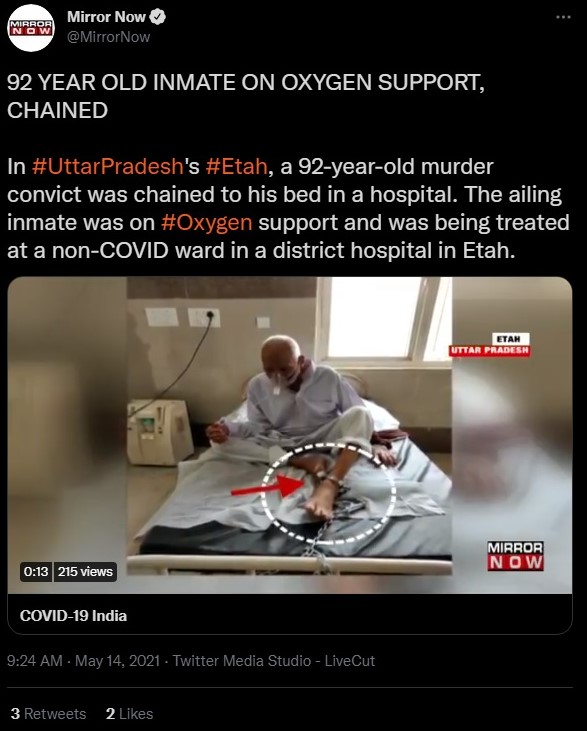
Baburam Balwan Singh was convicted of murder earlier this year. He is reported to be a resident of Kulla Habibpur village. There are other media reports which prove that the person in the photograph is not Stan Swamy.
Source: Twitter
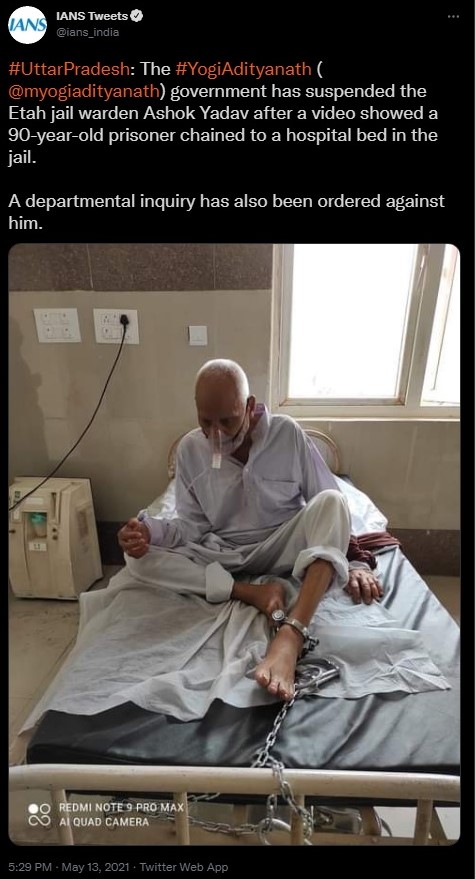
The media had also reported that the jail warden had been suspended by the Yogi Adityanath government.
Source: Twitter
Bhima Koregaon accused dies
Father Stan Swamy, an accused in the Bhima Koregaon ‘Urban Naxal’ case, has passed away, his lawyer informed the Bombay High Court when the Court took up his bail plea. According to his counsel, Stan Swamy suffered a cardiac arrest early morning on Saturday at 4:30 a.m., following which he passed away. The counsel demanded a judicial inquiry into the matter.
Furthermore, prior to his death, the accused received adequate treatment at the Holy Family Hospital in Bandra, where he had himself chosen to receive treatment after the Bombay High Court had directed him to be treated at the JJ Hospital.
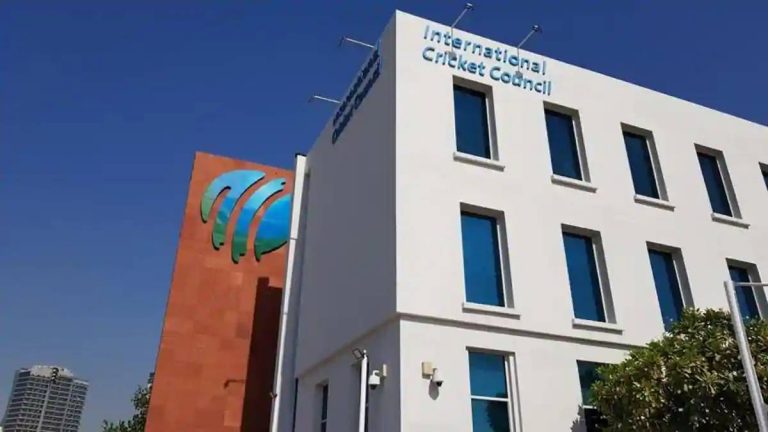
The anti-corruption tribunal of the International Cricket Council on Monday handed over a 7-year ban from all cricket to former Sri Lankan performance analyst Sanath Jayasundara after he was found guilty of breaching the ICC anti-corruption code.
The case pertains to an attempt made by Sanath Jayasundara to bribe Sri Lanka’s then sports minister Harin Fernando in January 2019 to “influence improperly the result, progress, conduct or any other aspect of an international match”.
The tribunal found Jayasundara guilty of two charges: Article 2.1.3—offering bribes or other rewards to the country’s sports minister to contrive in any way or otherwise influence improperly the result, progress, conduct or any other aspect of an international match and Article 2.4.7—obstructing or delaying an ACU investigation into possible corrupt conduct under the anti-corruption code.
“Jayasundara’s attempt to bribe a Minister is serious offence while the efforts to cover up his tracks and the lack of remorse are massively disappointing,” Alex Marshall, general manager of the ICC’s integrity unit, said in a statement.
“We won’t tolerate corrupt conduct in our sport and my team will be relentless in preventing such behaviour. This ban should serve as a deterrent for anyone who may be tempted along the wrong path,” the statement further said.
The ban is backdated to 11 May 2019, the day when Sanath was provisionally suspended under corruption charges. According to the reports, Fernando reported the alleged attempted bribe to the ACU at the time of it taking place, less than a month after he took charge as the sports minister in December 2018.
Jayasundara had been associated with Sri Lanka Cricket for a long time. He had worked with Sri Lanka’s Under-19 team, along with his responsibility at the board’s Brain Centre. He was also employed with the men’s national team in the past.