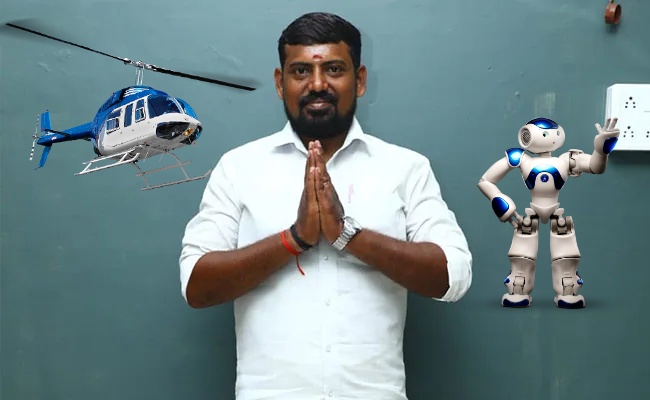
With elections closing in, politicians across party lines are making huge promises, most of which they unlikely to keep, unless they have the political will. An independent candidate from Madurai, however, has taken the promises to another level by promising mini-helicopters, trip to moon and robots, should he be elected.
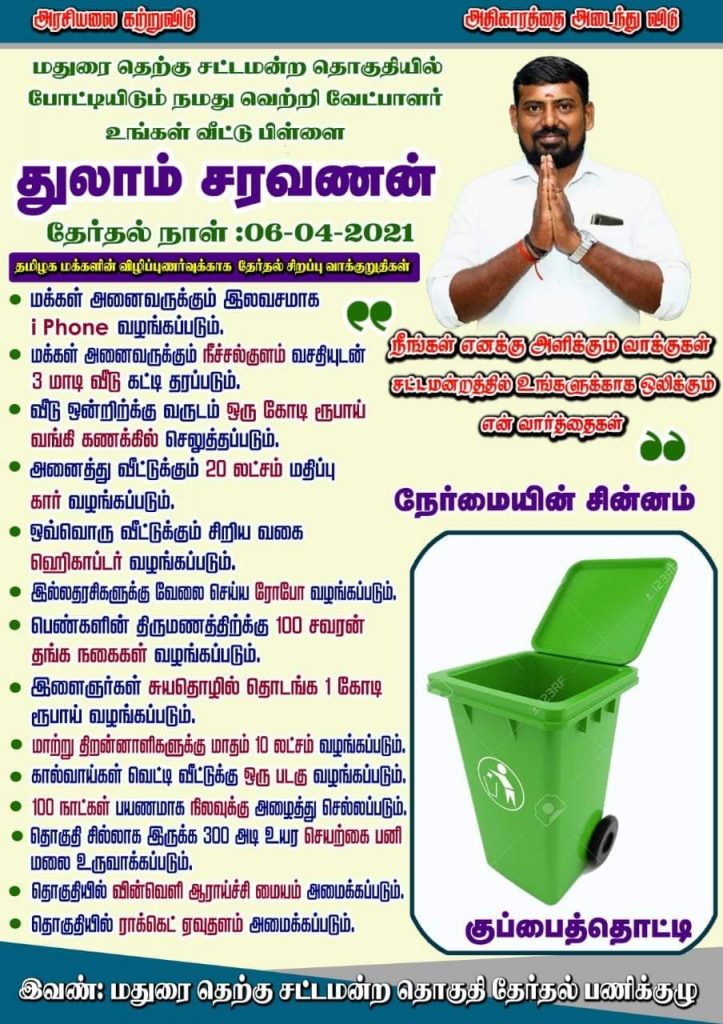
That’s not all. Thulam Saravanan, an independent candidate from Madurai South constituency, has also promised an annual deposit of ₹1 crore for every home, gold jewelry for weddings, a 3-storey house, boat for every family, 300-foot high artificial snow mountain to keep the constituency cool, a space research center and a rocket launch pad, if voted to power.
#TamilNaduElections2021: Thulam Saravanan, an independent candidate from Madurai South constituency, promises a mini-helicopter, an annual deposit of ₹1 crore for every home, gold jewellery for weddings, a 3-storey house and a trip to the moon in his manifesto. pic.twitter.com/B8dIBrApTU
The candidate has promised free iPhones too as suggested in his manifesto.
Manifesto released by Thulam Saravanan
However, the 33-year-old candidate’s aim was simply to spread awareness and to caution voters against voting for political parties which lure people by offering vague freebies. “I want them to choose good candidates who are ordinary humble people”, he said in a TV interview.
#TamilNaduElections2021: In a TV interview, Saravanan said, “My aim is to raise awareness against people falling for freebies by political parties. I want them to choose good candidates who are ordinary humble people.”
Unhappy with political parties not working for the welfare of people, Saravanan has taken a loan of Rs 20,000 to contest elections, as per a Times Now report. Mindful of the fact that he might not win, Saravanan said, “But my WhatsApp message has gone viral and people are thinking about my tall promises and the thought behind it.”
Social media is going abuzz with his claims and Twitteratis suggesting that they will be voting for him this elections, basis his promises.
The 234-seat Tamil Nadu Assembly will go to polls on April 6, with results to be declared on May 2. The ruling AIADMK has joined hands with the BJP to fight the Congress-DMK alliance in the assembly elections. It will be worthy to track if Saravanan’s awareness campaign works for him or not.
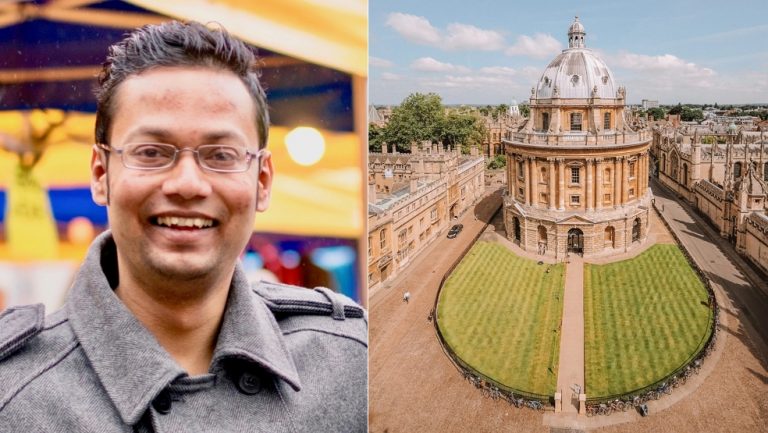
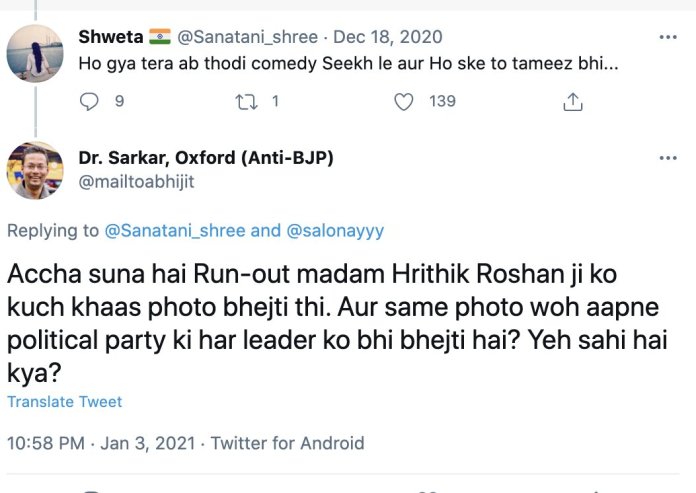
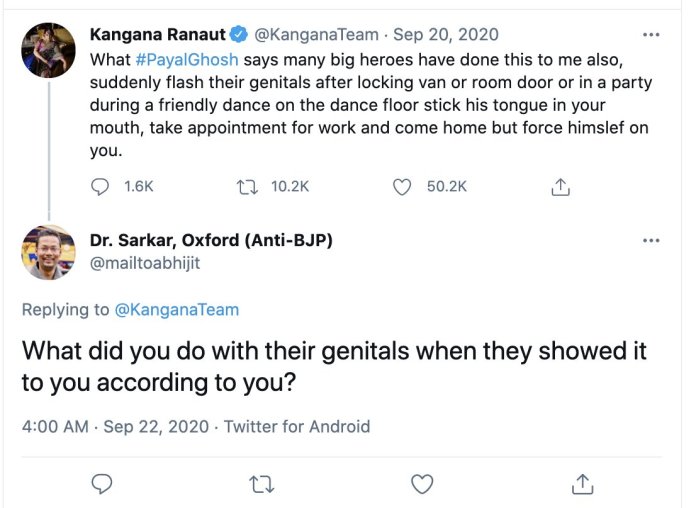
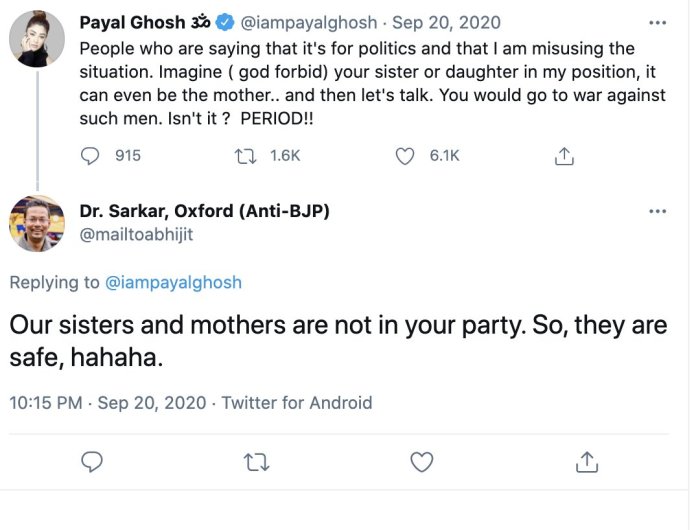
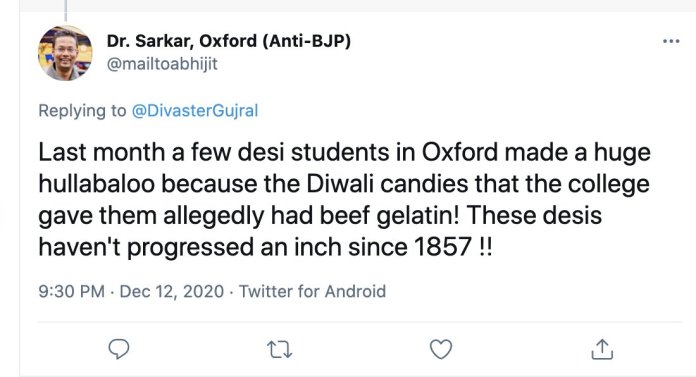
Abhijit Sarkar, an Oxford university faculty who had unleashed the ‘Hinduphobic’ attack against Rashmi Samant, the first female Indian student to be elected as President of the Oxford University Student’s Union, is now facing the heat from netizens. An online petition against Abhijit Sarkar has gone viral on Twitter. The petition demands that Oxford University should investigate Abhijit Sarkar’s nasty demeanour on social media and suspend him till the investigations are done. The campaign is being supported by author Dr. David Frawley.
University of Oxford: Complaint against Abhijit Sarkar (University of Oxford) for Hate Speech against Hindus – Sign the Petition! https://t.co/nAtahxbniq via @Change
The campaign started by a British Hindu on the online petition platform Change.org specifies that “the Hindus of Britain and India are very aggrieved and appalled by the racist, abusive and offensive attacks by Abhijit Sarkar on our community and the completely unhinged and disturbing social media outbursts of this extremist and misogynistic member of the University of Oxford staff. We the British Hindu Community will not rest until the University takes appropriate action against this extremist and zealot in academic plumes. Sarkar should be brought and held to account without further delay.“
In what the Hindu community is seeing as a brutal racial attack, the petition says that “the Hindu Community are tired of being labelled “soft”, being an easy target and a tired of being taken for granted. We will no longer tolerate racist attacks against us. We have had enough.“
The petitioner has slated out three demands, that is to hold Abhijit Sarkar accountable for his hate speech on social media, initiate an investigation and suspend him till it reaches a conclusion; that the University must reflect upon its tolerance for Hindu hatred and Hinduphobic staff and to identify trollers who are spreading Hindu hate.
The petition has received more then 31,000 signatures within two days.
Rashmi Samant isn’t the first victim of Abhijit Sarkar’s misogynist, sexist and bigoted attack. He is infamous for crawling into timelines of celebrities and politicians to troll them overlooking the fact that he is an “academician” at Oxford University and not a troll.
Meanwhile, the UK police and Oxford University have initiated a probe basis a complaint filed by Pt. Satish K. Sharma, director of the Global Hindu Federation, on Samant’s behalf accusing Sarkar of bullying and harassment.
Abhijit Sarkar who proudly identifies himself as anti-BJP and Modi hater, continues to spread hatred and misinformation against Hindus through his social media platforms. He was seen spending the entire month of February pushing his propaganda of “Hindu communalism through food distribution during a humanitarian crisis during Great Bengal Famine of 1943–1944”. Sarkar was seen attaching his article on every tweet that mentioned Churchill and related events and then declared that his article received phenomenal reception.
Happy 2 see exceptional reception of my article ‘Fed by Famine’. Altmetric of Cambridge University Press says my article is in 99 percentile, in top 5% of 17.2 million publications ever tracked by Altmetric, & occupies the 1st rank in views among all the articles in the journal. pic.twitter.com/JZ3nCQILnd
— Dr. Sarkar, Oxford (Anti-BJP) (@mailtoabhijit) March 17, 2021
Rashmi Samant on the other hand is recovering and continuing her one-year masters online from India despite having paid the fees.
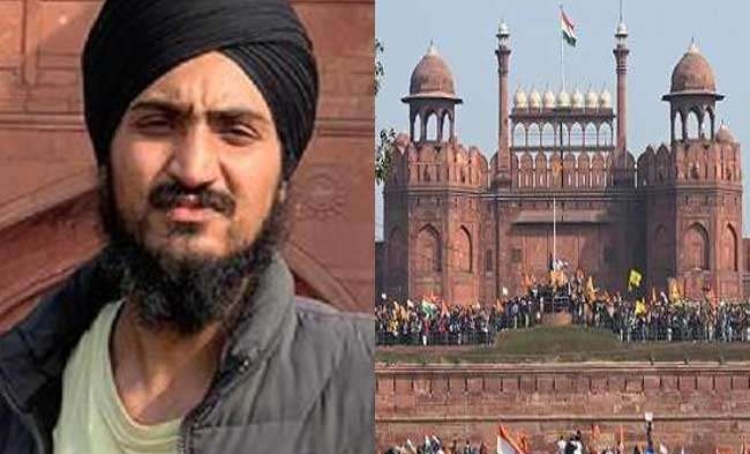
The father of Jugraj Singh, the 21-year-old rioter who hoisted the Nishan Sahib flag on the Red Fort during Republic Day riots, has been honoured at an event held inside the Golden Temple on Wednesday. Singh is wanted by Delhi police.
Jugraj Singh hails from Vaan Tara Singh village of Punjab’s Tarn Taran district. He has been booked for rioting and sedition by Delhi Police for Republic Day riots and has since been on the run. Delhi police had on February 3, announced a cash reward for information leading to the arrest of Deep Sidhu, Jugraj Singh and other accused in the Republic Day violence. This came after issuing a lookout notice against Deep Sidhu, Lakha Sidhana and Jugraj Singh amongst others.
The Golden Temple event organisers, included Sanyukt Kisan Morcha representative like BKU (Krantikari) president Surjit Singh Phul, Dal Khalsa president Harpal Singh Cheema, former leader of the Aam Aadmi Party Sukhpal Singh Khaira, Shiromani Akali Dal (Amritsar) general secretary Prof Mohinder Pal Singh, amongst others. They also expressed support for absconding gangster Lakha Sidhana who is wanted by police in the Republic Day riots case. He also carries a bounty of Rs 1 lakh on his head.
The Golden Temple event was organised in memory of the rioter Navreet Singh who was killed when his tractor turned turtle while he was trying to break barricades during Republic Day riots. Following his death, the Congress and several leftist media portals and journalists had peddled the fake news that Navreet Singh died of a bullet injury after Delhi police shot him.
“Function was held in memory of Navreet Singh, who died with police bullets during tractor march in Delhi on January 26. The ardaas and shardanjali samagam was organised by Sikh Youth of Punjab to pay homage to all farmers who lost their lives while participating in the agitation,” said Paramjit Singh Mand of the Sikh Youth of Punjab at Golden Temple on Wednesday while honouring families of those rioters who created anarchy in Delhi on Republic day.
Delhi riots
Delhi police had, however, issued a clarification soon after stating that the protestor died of injuries sustained by him after his tractor turned turtle. FIRs were filed in Delhi, Uttar Pradesh and Madhya Pradesh against several persons including ‘journalist’ Rajdeep Sarsdesai and senior Congress leader Shashi Tharoor for spreading fake information on Republic Day regarding the death of Navreet Singh.
Gangster Lakha Sidhana was about to be caught from the Singhu border area on January 26 but as the tractor rally crowd went rampaging, the accused switched off his phone and managed to flee from the area.
Later, Sidhana released a video on social media, asking people to join in support of the farm agitation in Bathinda district’s Mehraj. It is the ancestral village of Congress senior leader and Punjab chief minister Captain Amarinder Singh. Three days later, he himself attended this ‘farmers’ rally held in Bhatinda’s Mehraj. This made it evident how these protestors had planned the insurrection against the State of India with the tactical support of opposition parties like the Congress.
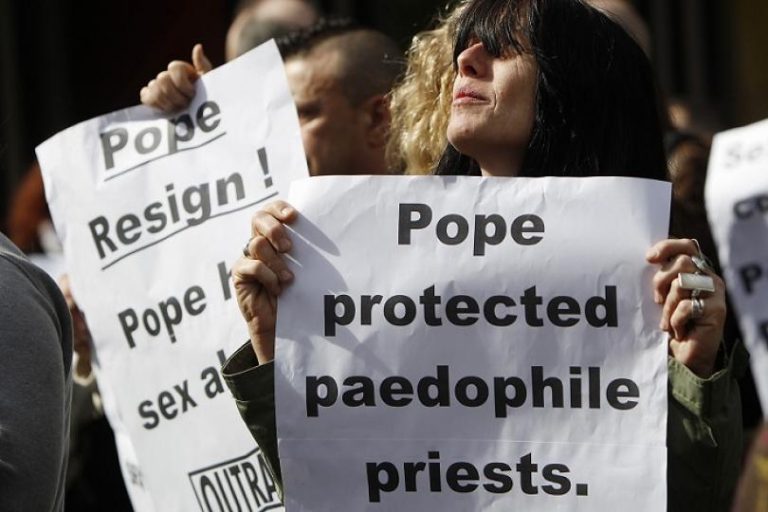
An independent study conducted about the extent of child sexual abuse in the Roman Catholic Church of Germany, published on March 18, has exposed the appalling reality of the church. The report that led to the resignation of the Archbishop of Hamburg revealed hundreds of alleged cases of sexual abuse of children.
The 800-page report led to the resignation of the Archbishop of Hamberg and has led to a massive uproar. The report on Germany’s top diocese of Cologne found 202 alleged perpetrators of sexual assault and 314 victims between 1975 and 2018.
The Archbishop of Hamburg resigns following the publication of the report
Reports quoting Bjoern Gercke, a lawyer mandated by the church, said that the 800-page report on Germany’s top diocese cologne found 202 alleged perpetrators of sexual assault and 314 victims between 1975 and 2018. Gercke reportedly said that more than half of the victims of sexual abuse were children below 14 years of age.
The report found that the perpetrators of sexual abuses included both clergymen and laymen. The Archbishop of Hamburg, Stefari Hesse reportedly tendered his resignation to Pope Francis after the report highlighted 11 instances of breach of duty linked to allegations of abuse during his tenure as vicar general in the Cologne diocese. Hesse said that he always acted to the best of his knowledge and conscience and never participated in any cover-up.
“I am nevertheless prepared to bear my share of responsibility for the failure of the system”, he was quoted as saying.
Most of the allegations cover the tenure of Woelki’s predecessor, Cardinal Joachim Meisner, who died in 2017. Woelki had faced months of protests for refusing to allow the publication of an earlier study on abuse committed by priests in his diocese.
Two church officials suspended by Cologne’s Archbishop
Cologne’s Archbishop Rainer Maria Woelki, who was cleared in the investigation, had reportedly resisted the reform. There were protests after Woelki refused to allow the publication of an earlier study carried out by Munich Law Firm on abuse committed by church priests. He cited the privacy of accused persons as the reason for refusal. However, after the publication of the present report, he suspended two Cologne Church officials named bishop Dominikus Schwaderlapp and the head of a diocese court Guenter Assenmacher. Woelki said that they had participated in the cover-up of cases of abuse.
Woelki reportedly said that he bore some responsibility for the sexual abuse scandal. Refusing to resign, Woelki said that such a move would be a short-lived symbolic step. He, however, assured that he would do everything humanly possible to prevent sexual abuse in the Church. Terming the scale of sexual abuse in the church as ‘shocking’, the government commissioner on child sexual abuse, Johannes-Wilhelm Roerig said, “I hope that the independent investigation of sexual abuse in the Catholic Church will now be pursued to full determination and a limitless will to find the truth in all German dioceses”.
Earlier study revealing instances of sexual abuse in the Church
In 2018, an earlier study commissioned by the German Bishops’ Conference had reportedly revealed that 1,670 clergymen had committed some type of sexual abuse against 3,677 minors between 1946 and 2014. Most of these victims were minor boys. The authors of the study had claimed that the actual number of victims was much higher. Paedophile scandals in churches have been exposed in several countries including Australia, Chile, France, Ireland and the United States.
Similar shocking allegations were made earlier this month in an independent investigation carried out to examine cases of rampant child abuse across churches in France. The head of the independent enquiry commission, Jean Marc-Sauve had said that the victims of child abuse in the churches since 1950 might have been over 10,000.
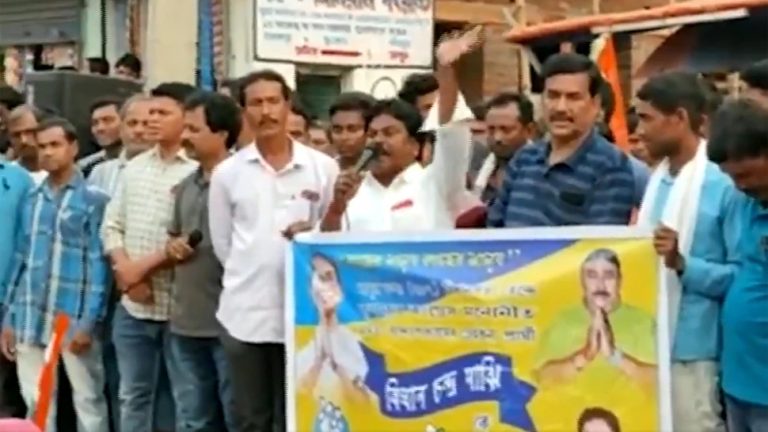
A TMC leader from West Bengal has made a sensational claim that if the Muslims in India come together, they can form four Pakistans. Speaking at an election rally, TMC leader Sheikh Alam said that Muslims are 30% and others are 70%. He said that if these 30% Muslims in the country comes together, Hindus will nowhere to go in the country.
Campaigning for TMC candidate Bidhan Chandra Majhi in Nanoor constituency in Birbhum in West Bengal, Sheikh Alam said that the BJP should be ashamed of themselves because they will come to the power with the support of 70% voters.
“We form government with 30% votes, they will form govt with the support of 70% votes, they should be ashamed of themselves. If 30% of people in India come together, we can form 4 Pakistans. If all the Muslims in India move to one side of the country, where the rest of the people go, where the 70% people will go?”, the TMC leader said.
Talking about some incident in the area, the TMC leader said that if they wanted, they could have ordered their boys to remove those people in five minutes. ‘They would have beaten them with sticks, but we didn’t do that, because we have trust on Mamata Banerjee’, he added.
Trinamool Congress is facing a tough challenge from BJP in West Bengal in the assembly elections. Moreover, the party is also staring at possible spilt in Muslim votes, as Congress, left and Indian Secular Front alliance is contesting the elections separately, resulting in a three-corner fight. Furfura peer Abbas Siddique led ISF holds considerable influence among Muslims in the state, and the TMC leader’s comments appears to be an attempt to attract Muslims votes by communalising the polls.
Sheikh Alam is clearly attempting to evoke Muslim sentiments by talking about more Pakistans with Indian Muslims. Now TMC sees polarising the elections as the only way of retaining power in the state.
It may be noted that as per official records, the Muslim population in India is around 15%, but the TMC leader is saying that it is 30%.
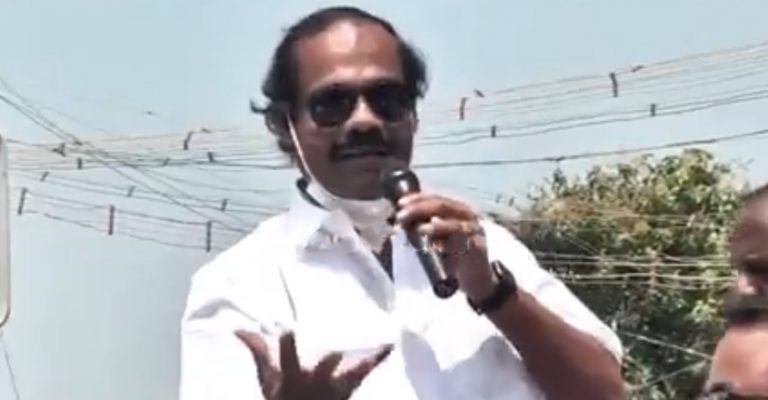
DMK leader Dindigul Leoni has come under fire after he made shocking sexist remarks against women at an election campaign rally in Coimbatore, saying women have become fat by drinking foreign cows’ milk.
In a video that has gone viral, Leoni can be heard body-shaming women saying women have become “like a barrel” after drinking milk from the foreign breed of cows. Continue to make lewd comments, Leoni then went on to say that earlier, women used to be “thin and their hips would have curves”.
“In a cowshed, people use a milking machine for foreign cows. These days, women drink milk from foreign cows because of which they have put on weight. Those days, a woman’s hip resembled the number 8. When she lifted her child, the little one stayed put on the hip. But now they’ve become like a barrel because of which women cannot carry their children on their hips,” Dindigul Leoni can be heard saying.
.@KanimozhiDMK Madame please get rid of womanizers like Dindigul Leoni, Vairamuthu etc in your party before you talk about women’s safety.. pic.twitter.com/cVkGCQ8eGi
A party member tried to interrupt DMK leader Leoni from making such misogynistic statements but to no avail. Leoni, who was enjoying making such crass comments, did not bother the party leader’s interruption.
Dindigul Leoni made such crass and distasteful comments against women while campaigning for DMK candidate Karthikeya Sivasenapathy in Coimbatore.
Severe backlash against DMK leader, netizens ask Kanimozhi to sack Leoni
After the video went viral, Leone is facing a massive backlash across social media platforms. Netizens demanded that DMK leader Kanimozhi should sack abusive leaders like Dindigul Leoni before lecturing about women’s safety to others.
BJP leader Gayathri Raghuram asked if Leoni knew what happens to a woman’s body post-pregnancy or during hormonal changes and asked Kanimozi what does she “like to say to this kind of male chauvinist.”
What a shame.. what milk does he drink? Does he know what happens to women’s body post pregnancy or during hormonal changes? @KanimozhiDMK what do you like to say to this kind of male chauvinist? Is this the respect your party people have on women. https://t.co/7yMf5esqX0
Not just BJP, even DMK sympathisers attacked the party leadership for fielding people like Leoni to seek votes in favour of the party.
DMK supporter Sumant Raman said that leaders like Kanimozhi should restrain speakers like Dindigul Leoni from speaking in the manner he spoke. His comments about the hips of women and how they have ballooned are degrading, he said.
@KanimozhiDMK kindly restrain speakers like Dindigul Leoni from speaking in the manner they are. His comments about the hips of women and how they have ballooned are degrading. You must have seen the video.#TNElection2021
The polls to the 234-seat Tamil Nadu assembly is scheduled to be held in a single phase on 6 April 2021. The ruling AIADMK has joined hands with the BJP to fight the Congress-DMK alliance in the assembly elections. The two sides are fighting a neck-to-neck battle in the state as both sides are eyeing to secure a majority. The results will be announced on May 2.
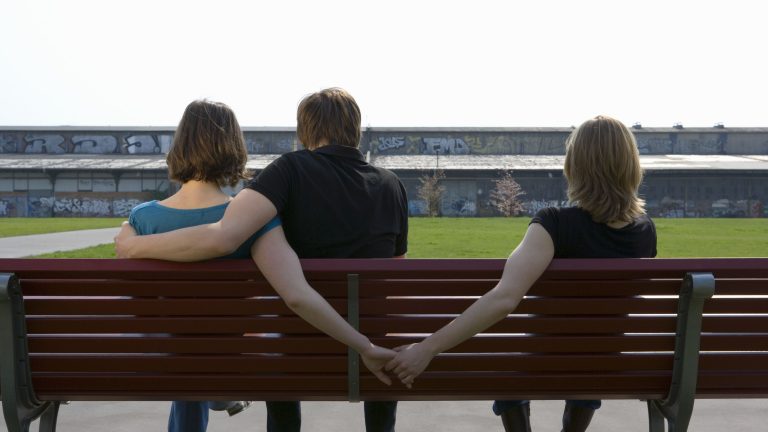
A Japanese woman has been ordered to pay 1,100,000 yen (approximately Rs. 70,000) to a man for having sex with his wife, reports Tokyo Reporter.
According to the reports, a Tokyo district court has ordered a woman to pay 1,100,00 yen as compensation to the husband of a 35-year-old woman with whom she had sex with. The 39-year-old husband had filed a lawsuit against the woman and had accused her of engaging in sexual acts with his wife.
In his petition, the husband had alleged that the two had met online and added they would meet up often to have sex. The husband said to the court though he had consented for his wife to associate with her new lesbian friend, he did not ‘permit’ them to have a sexual relationship.
The 37-year-old woman claimed that her lover’s husband was fully aware of her relationship with his wife. She argued in court that his knowledge of her relationship with his wife caused no such harm in his marriage, and the case cannot be considered infidelity.
Reportedly, the couple got married in the US and lived together for seven years.
Under Japanese law, any person can approach the court against their spouse or partner on grounds of adultery.
Such acts can disrupt harmony and constitute infidelity, rules Japanese court
However, the court ruled in favour of the husband and directed the woman to pay compensation, saying that the law of reduction of peace does not disbelieve the married. The court said that not just sex but also other acts outside of marriage could disrupt harmony and constitute infidelity.
“It was a relationship equivalent to that in which a man and woman come together to lead their lives in cooperation as a married couple,” judge Hitomi Akiyoshi said after asking the lady to pay the fine.
Further, the judge noted, “A same-sex couple is an agreement between two people, and on that basis, it can be said that it bears the same obligations to fidelity that a legally married couple of opposite genders undertakes”.
In a similar case, the Tokyo High Court had earlier ordered a woman to pay compensation to her female partner for cheating on her. The court said a same-sex union should be treated as a marriage in law. Earlier this month, a District Court had ruled that it is ‘unconstitutional’ not to allow same-sex couples to marry. This ruling “was a major symbolic victory in Japan as it does not fully recognise same-sex partnerships.
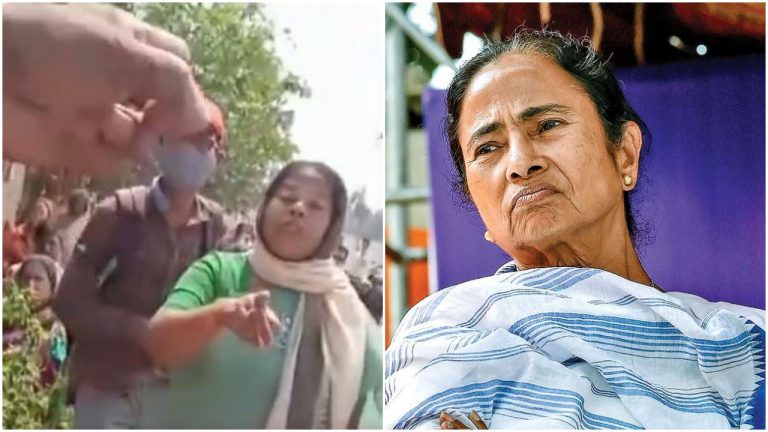
With the State Assembly elections knocking at the doors, politicians in West Bengal have been moving heaven and earth to woo their voters, In such an attempt, Asima Patra, the minister of Technical Education in Mamata Banerjee’ cabinet and a member of the Legislative Assembly for Dhaniakhali since 2016, visited her constituency ahead of the much-awaited upcoming elections in the state. But, unfortunately, instead of a favourable reception, the minister had to face the ire of the locals in her constituency.
Infuriated by the laxity shown by Asima Patra towards her own constituency, the locals threatened to beat her up with brooms.
In the video of the incident shared by a Bangla news channel, the MLA is seen screaming at a group of people who surround her and threaten her to leave or face the ire of the locals. “Ekdom katha bolbena… record hobe, shabh record hobe” (Do not say a word, we will record, everything will be recorded), a local can be heard shouting.
According to the news channel, the incident happened when a youth started recording the heated exchange of words between the MLA and the locals. The local voters blamed the MLA for neglecting her constituency for the last two years, only to appear before the elections and ask for votes.
The MLA asked the young man to stop recording the interaction. In the video, she is seen threatening him with dire consequences if he does not put his phone away. It is here when the locals start shouting at Mamata Banerjee’s minister asking her to leave or else face public fury. “Dekha jabe ke kake dekhbe” (we will see who sees whom), cries out an angry local responding to the MLA’s threats.
“Daush bachar diye kichu kaaj hoyeni, aakhun vote samay kaaj dekhate aische…jhainta bar kor jhainta..” (no wrok has been done in the last 10 years, now when they want votes they are talking about development… take out the brooms), says a local, forcing the MLA to leave.
The West Bengal Assembly election is no less than a full-fledged war for Mamata Banerjee, who is struggling to remain relevant in the country’s politics. The incumbent TMC has the Bharatiya Janata Party breathing down its neck at a time when it is plagued by internal feuds, large-scale defections by leaders and workers and allegations of widespread corruption. There is also a strong anti-incumbency sentiment working against it.
In such a situation, the edgy West Bengal CM has been making every effort to woo the West Bengal voters, be it by leaning on to a pro-Hindutva image by reciting the ‘Chandi Path’, ‘Durga Path’ or the ‘Jagannath mantra’, or releasing the party manifesto on Shivratri or by promising an overdose of freebies and doles.
However, the large dole she has been consistently handing out to local clubs, Durga puja committees and Muslim clerics have left the state’s coffers dry. Bengal today, is under a debt burden of nearly Rs 5 lakh crore that is only increasing.
Given the precarious state of Bengal’s finances, it will be nearly impossible for Banerjee to implement her poll promises. That is if she manages to overcome rising anti-incumbency and people’s fury against the party’s appeasement politics, corruption and public anger over lack of development.
On March 19, 2021, Uttar Pradesh CM Yogi Adityanath marked the completion of four years of his government in the state. On this occasion, Yogi Adityanath held a press conference in which he highlighted the achievements of his government in the past four years. However, the BBC didn’t agree with the claims made by the chief minister, and tried to insinuate that Yogi Adityanath was making false claims about his government’s achievements.
Addressing the press conference, the BJP leader had pointed out how Uttar Pradesh, in the last four years, has emerged as the growth engine of the country. While listing other achievements, Yogi said that his govt’s zero-tolerance policy against criminals in the state has brought positive results in these last four years.
Informing that these last four years have seen a 66% drop in dacoit cases, 45% drop in rape cases and 19% drop in murder cases, Yogi added that the state has not witnessed any communal riots in the past 4 years. The actions of state govt on those who break law and order have set the standard and are taken positively countrywide. Today the perception of the state has changed, said Yogi while addressing the press conferance.
Launching a booklet – Dashko Mein Jo Na Ho Paya, Chaar Varsh Mein Kar Dikhaya – Adityanath said: “While earlier no one wanted to come to Uttar Pradesh because of a sense of insecurity, there is no fear now… Earlier, however, the scene was different. Our government has also taken strict action against professional criminals, mafia elements and others harming peace, and this has set a standard for others in the country.”
BBC publishes report to berate UP Govt
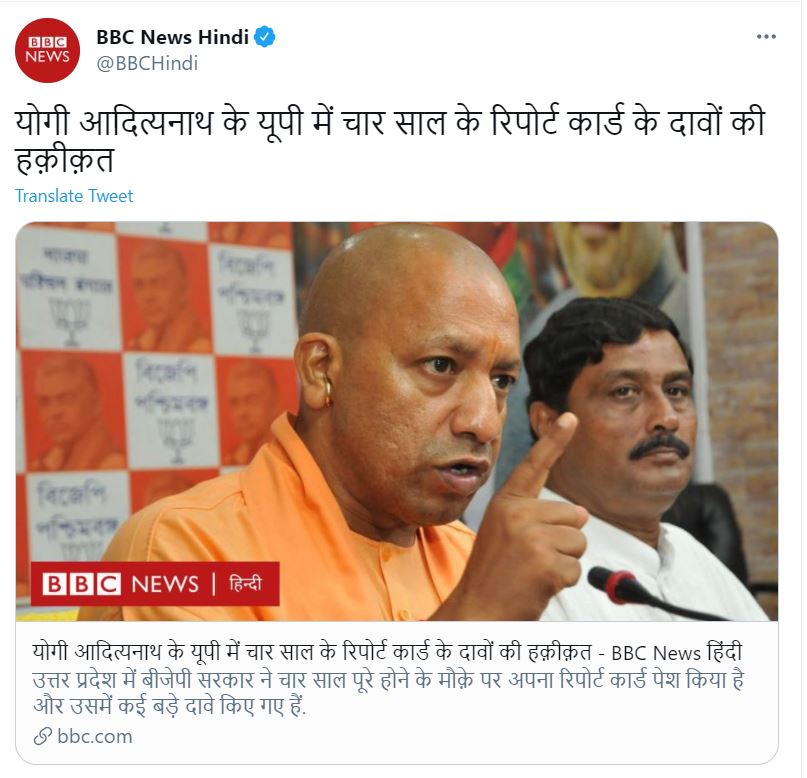
As soon as Yogi Adityanath listed the achievements of the BJP government and spoke about how it has succeeded in curbing communal violence in the state, British state-run media British Broadcasting Company (BBC), which has many a time outdone itself when it comes to peddling anti-Modi, anti-India rhetorics, published a report on it’s Hindi website trying to confute Yogi Adityanath’s claims. In its report headlined, “The truth of Yogi Adityanath’s four-year report card claims in UP”, BBC Hindi rolled out figures to refute Yogi’s claims.
The report claimed that the crime rate increase in the years 2012 and 2015 was lower than that in the year 2019, when Yogi Adityanath was at the helm of affairs in the state. Crimes then increased at the rate of 1.5% and 0.6% in 2012 and 2015 respectively, which was far lesser than the 10% increase in 2017, when Yogi Adityanath came to power in Uttar Pradesh, said the BBC report. It added that in the following two years (2018 and 2019), the crime rate increased by 10% and 3% respectively.
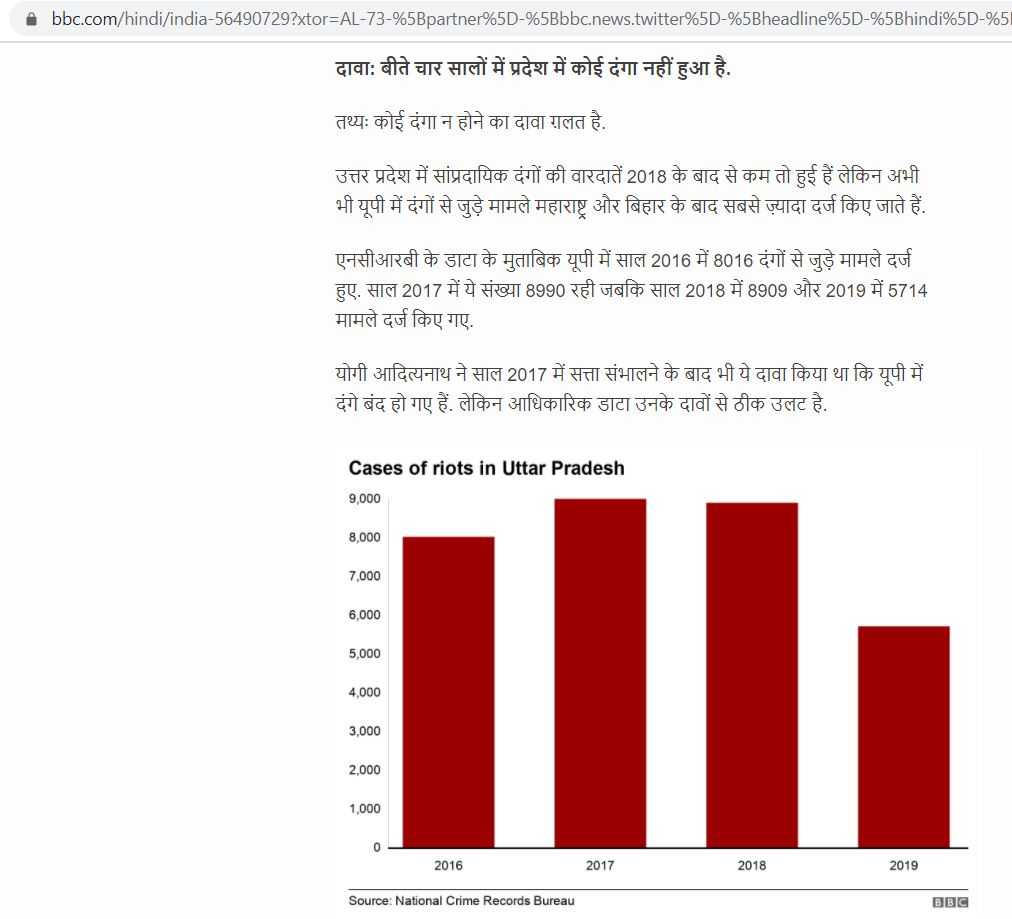
Apart from this, the report also dismissed the Uttar Pradesh government’s claim that has been no communal riots in the state in the last four years. Citing the National Crime Records Bureau (NCRB) data, the BBC report read: “The incidents of communal riots in Uttar Pradesh have decreased since 2018 but still the cases of riots in UP are the most reported after Maharashtra and Bihar. According to NCRB data, in 2016, 8016 riot cases were registered in UP. In the year 2017, this number was 8990, while in the year 2018- 8909 cases and in 2019- 5714 cases were registered. Even after assuming power in 2017, Yogi Adityanath claimed that the riots in UP have stopped, but the official data is completely opposite to his claims”.
The BBC Hindi report quoted figures to refute Yogi Adityanath’s claims
Uttar Pradesh Police bust BBC propaganda against the Yogi Government
The global media outlet’s attempt to berate Uttar Pradesh and the Yogi Adityanath government was soon called out by the Uttar Pradesh police. The UP Police took to Twitter to release the actual figures, which busted BBC’s propaganda against the Yogi Government.
राज्यों के अपराधों की समीक्षा का सर्वमान्य संकेतक NCRB के अनुसार भी अपराध की दर(Crime Rate) है न कि कुल अपराधों की संख्या का योग। NCRB 2019 के अनुसार क्राइम रेट के आधार पर कुल आईपीसी में उत्तर प्रदेश का देश में 25 वाँ स्थान है जो अधिकांश बड़े राज्यों से बेहतर है।#UPPolice (2/5) pic.twitter.com/JwkpdhZmQ3
“According to the NCRB report cited by you (BBC), the number of riots cases in the state from 2016 to 2019 was 8016, 8990, 8909 and 5714 respectively. However, the truth is that there has been no communal riot in the last 4 years in the state. The data you have mentioned is actually the instances of insurgence against the establishment, which again has also come down”. In this tweet, UP Police also shared the crime rate data from the year 2016 to 2019. The Uttar Pradesh police further shared the crime rates in the state from the year 2016 to 2019. In sharp contrast to the figures quoted by the BBC, the crime rate in Uttar Pradesh from the years 2016 to 2019 was 3.7%, 4%, 4.% and 2.5% respectively.
However bitter the truth may sound to the leftist media outlets, the fact is that the Yogi Adityanath led government in Uttar Pradesh, with it’s ‘zero tolerance’ policy against crime and criminals, has emerged successful in curbing the crimes. According to NCRB data, despite being the most populous state in the country, Uttar Pradesh under the leadership of Yogi Adityanath has witnessed a sharp decline in the crime rates. Over the years the Yogi government has been able to restore harmony in the state by efficiently controlling large scale communal violence.
The Yogi government has so far arrested 36,990 criminals under the Gangster Act while 523 accused have been booked under the National Security Act (NSA). At the same time, it has seized and demolished ₹1000 crore worth of properties held by mafias and criminals. Moreover, 10,021 criminals with bounties on their head have also been apprehended. The government has also made recoveries from rioters involved in vandalism and destruction of public property in the name of Anti-CAA protests.
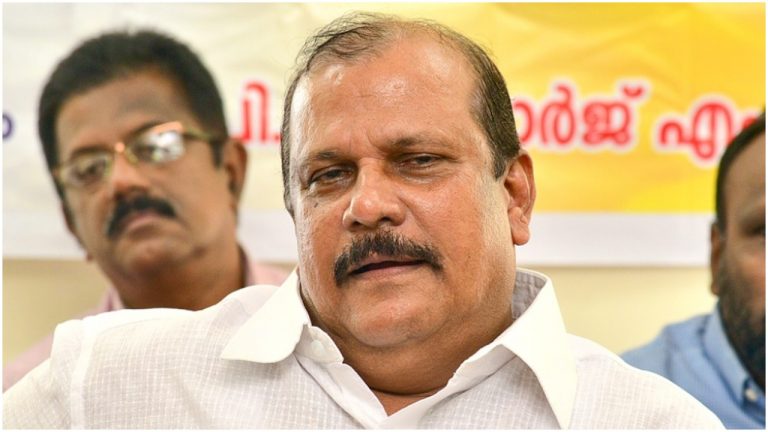
Kerala MLA PC George, infamous for making derogatory rants and often referred to as ‘potty mouth’, has yet again stoked a controversy by abusing the crowd during an election rally in Kottayam’s Erattupetta town.
According to the reports, PC George, an incumbent independent MLA from Poonjar, was seeking votes during a rally on Wednesday ahead of the assembly elections. As he addressed the rally standing atop a campaigning vehicle, the crowd surrounding him began to heckle and boo him.
The infuriated Member of Legislative Assembly from Poonjar hit back, using cuss words. The video of the incident has now gone viral on the internet. In the video that has gone viral now, PC George can be seen introducing himself as the Poonjar constituency candidate and urging people to vote for him in the elections.
As he began his speech, the crowd started heard heckling the MLA. Angered by the poor response, PC George hit back sharply, reportedly saying, “Vote for me if you want or leave it”. Further, George attacked the crowd saying their behaviour only showed that their parents did not teach them good manners.
“I now understood how your family had moulded you. I thought they would have taught you some manners. Children will only be good if the family is good. I will pray to Allah for that. I am not saying anything further,” the independent MLA said.
Continuing his rant, PC George then addressed the crowd as ‘eda’ in a disrespectful tone. “Is this politics? Doesn’t a candidate have the right to seek votes? If I give a complaint to the Election Commission, you will all land in jail,” he quipped.
As the heckling intensified, the crowd hurled abuses at PC George. Responding to the abuses, the Poonjar MLA used derogatory words, saying, “Are you threatening me? I grew up in Erattupetta. I will be here and will not run if you heckle me,” he said.
A day after the incident, the six-time MLA PC George said that he would not continue his campaigning in Erattupetta. “No one should think I am doing this (ending campaigning) because I am scared. When a group of people have become a hindrance to my right to seek votes, I do not wish to pull my land into communalism,” he reportedly wrote.
PC George had abused victims of Bishop Franco rape case
In September 2018, PC George had referred to the nun who had accused the Bishop of the Roman Catholic Diocese of Jalandhar, Franco Mulakkal, of having raped her as a ‘prostitute’. In the act of victim shaming, PC George had said that the nun who accused Bishop Franco of raping her had ‘enjoyed it’ 12 times, but 13th time, it became ‘rape’, insinuating that it was not rape but consensual sex.
Reportedly, PC George has been facing stiff opposition from Muslims in the region over some statements issued by him in the past. According to reports, PC George had linked the Muslim community in Erattupetta to terrorism in the run-up to the 2019 Lok Sabha elections. However, later, PC George had held a press meet, seeking an apology for his remarks against the Muslim community in Erattupetta.
In the run-up to the 2019 elections, PC George had announced his support for BJP candidate K Surendran who had contested from the Pathanamthitta constituency. However, PC George, chairman of Kerala Janapaksham, had neither joined the NDA coalition nor expressed his support for other BJP candidates.
However, two years later George has now distanced himself from the BJP ahead of the 2021 Kerala assembly elections. Though he had tried to forge an alliance with both Congress-led United Democratic Front (UDF) and the Left-Democratic Front (LDF) ahead of the Kerala assembly polls, both fronts have not entertained him so far.