Home Blog Page 4712

Anti-Hindu Delhi Riots accused Umar Khalid admits to his involvement in fuelling violent protests, mobilising Muslims: Reports

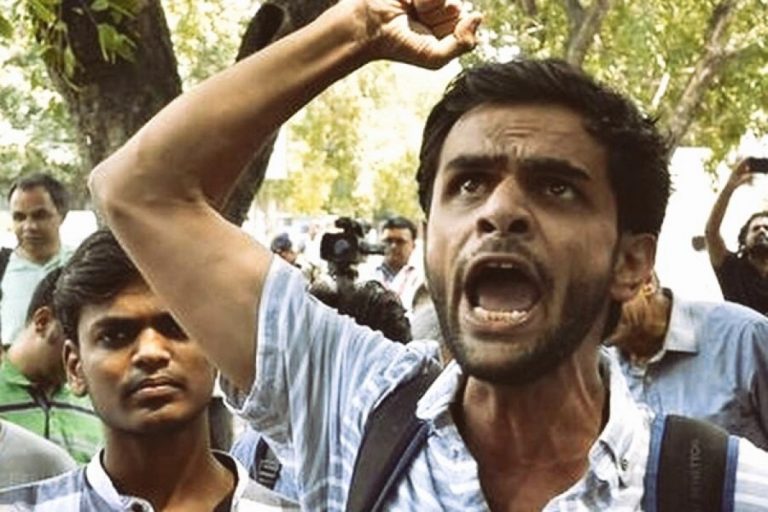
Radical Islamist and Anti-Hindu Delhi riots accused Umar Khalid has allegedly admitted to the Delhi police that he was involved in organising Muslim groups, instigating them and prepare for large scale violence.

According to the reports, the Delhi police on Wednesday filed a charge-sheet against radical Islamist and anti-India propagandist Umar Khalid, accusing him of conspiring to fuel the riots in the national capital, besides making anti-national speeches and inciting Muslim mob to unleash riots on the streets of Delhi.

As per reports, Khalid has himself admitted in his disclosure statement that he played a crucial role in organising anti-CAA groups, mobilising Muslims against the law, by asserting that the new law was “against Muslims’ and had also planned to involve women and children in the ‘Chakka Jam’.

The Delhi Police Crime Branch, in its charge-sheet, alleged that Umar Khalid, along with other accused Khalid Saifi and former AAP leader Tahir Hussain, organised a meeting in Shaheen Bagh on January 8 to plan the violence. 

Khalid was arrested by the police on September 14 for his alleged involvement in the horrific Northeast Delhi riots. He was summoned by the police for investigation and was later arrested.

Umar Khalid conspired with fellow Islamists to conspire riots in Delhi

In an earlier charge sheet filed by the Delhi police and admitted by the court, it was alleged that Khalid had hatched the conspiracy of the anti-Hindu Delhi riots along with his friends during the visit of the US President Trump to India. Khalid had allegedly met the former AAP Councillor Tahir Hussain and another accused Khalid Saifi to assure logistical support during the riots through his contacts in the PFI.

The Arvind Kejriwal-led Delhi government had recently gave its sanction to the police to charge 18 people accused in the Delhi riots case, including radical Islamists Umar Khalid, Sharjeel Imam, former AAP leader Tahir Hussain and others under sedition charges for their involvement in the Anti-Hindu Delhi riots case.

The Aam Aadmi Party government in Delhi finally gave its ascent to prosecute the radical Islamists and far-left ‘activists’ who plotted the communal riots in Delhi in the last week of February that took the lives of more than 50 people. The Delhi government has also provided sanction to prosecute far-left protestors such Natasha Narwal, Devangana Kalita, former Congress leader Ishrat Jahan and 15 others in connection with the Anti-Hindu Delhi riots case.

India lodges strong protest against the destruction of a Hindu temple in Pakistan

0

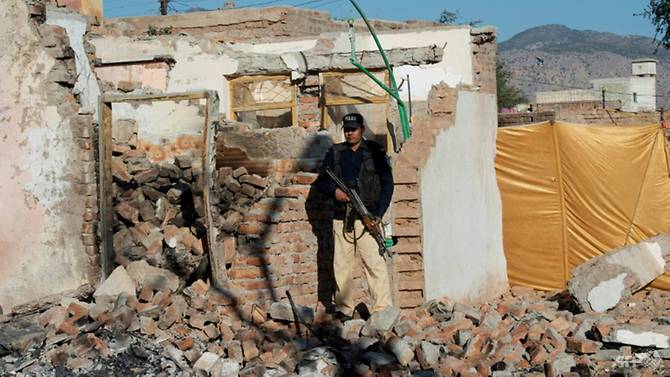
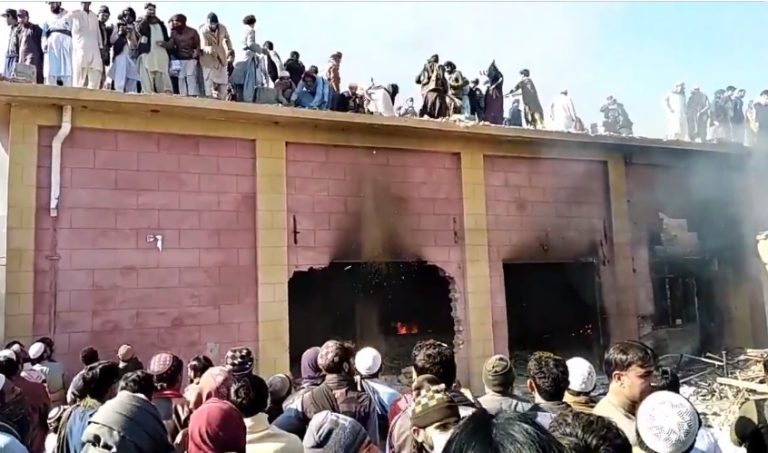
India has strongly protested the wanton and malicious destruction of Hindu temple by several Islamic fanatics in Pakistan’s Terri village in Khyber Pakhtunkhwa on December 30. Concerns were conveyed to Pakistan through diplomatic channels.

“The matter was taken up officially with the Pakistani side and a strong protest was lodged,” an official of the govt of India said.

Fanatic Islamists raze down the temple in Pakistan

Videos circulating on social media showed several Islamists using hammers to damage the temple walls of the recently constructed Krishna Dwara temple, situated in Karak’s Teri union council. The fanatics who were led by a local cleric and supporters of Jamiat Ulema-e-Islam party (Fazal ur Rehman group) set fire to the building, then razed it down with hammers and crude weapons. The video which went viral on social media showed how the miscreants surrounded and vandalised the temple for hours.

Notably, the temple was demolished allegedly in the presence of district administration officials.

Reportedly, the temple was built after Guru Shri Paramhans Dayal was laid to rest at the site in July 1919. However, the Muslim residents of the area had closed the temple after the Partition in 1947. In 2015, the Krishna Dwara temple was restored on the orders of the Supreme Court of Pakistan.

Rohit Kumar, an advocate and the Hindu activist said the residents violated the agreement by vandalising the temple. Earlier, Hindus and the Muslims of the village had signed an agreement on December 22 agreeing that the renovation of the temple would not exceed the specified area.

However, the Muslim residents of the area had alleged that that the Hindu community was illegally expanding the temple building. They said the matter was reported to the police too.

According to the Muslims, as police did not take action against the Hindus, they themselves took the law into their hands and demolished the temple.

Hindu community in Pakistan stage a protest against the wanton attack on the Hindu temple

The act against the Hindu minority community was widely condemned by human rights activists based in Pakistan and other parts of the world. A day after the unfortunate incident, the Hindus living in Pakistan staged a protest in Karachi. “This incident would have never happened if the then administration had given exemplary punishment to the miscreants who had earlier made a similar attempt in 1997”, said Ramesh Kumar Vankwani, the patron-in-chief of Pakistan Hindu Council and member of National Assembly.

According to reports, as many as 30 people, mostly members of a radical Islamist party, including Jamiat Ulema-e-Islam leader Rehmat Salam Khattak, were arrested after the Hindu temple was vandalised and set on fire on Wednesday. Over 350 people have been named in the FIR, Provincial Police Chief KPK Sanaullah Abbasi has said.

Is your home constantly set to a ‘sexist’ temperature? Ivanka Trump’s hair vs AOC’s hair: Meet the person The Guardian pays to write such columns

History becomes legend, legends become myth. So goes the popular saying by literary legend JRR Tolkien. In the world of the mainstream media, with the passage of time, truth becomes lies, fiction becomes fact, journalists become a joke and when enough time has passed, ‘legendary’ journalists turn into something more. They become a meme. Such is the story of The Guardian columnist Arwa Mahdawi.

According to her bio on The Guardian, Arwa Mahdawi is a “Guardian columnist and brand strategist based in New York.” In addition to these, she is also a gargantuan hypocrite and the stereotypical media hack whose sole objective is to peddle propaganda. The headlines of her column which have gone viral on social media recently illustrate it beautifully.

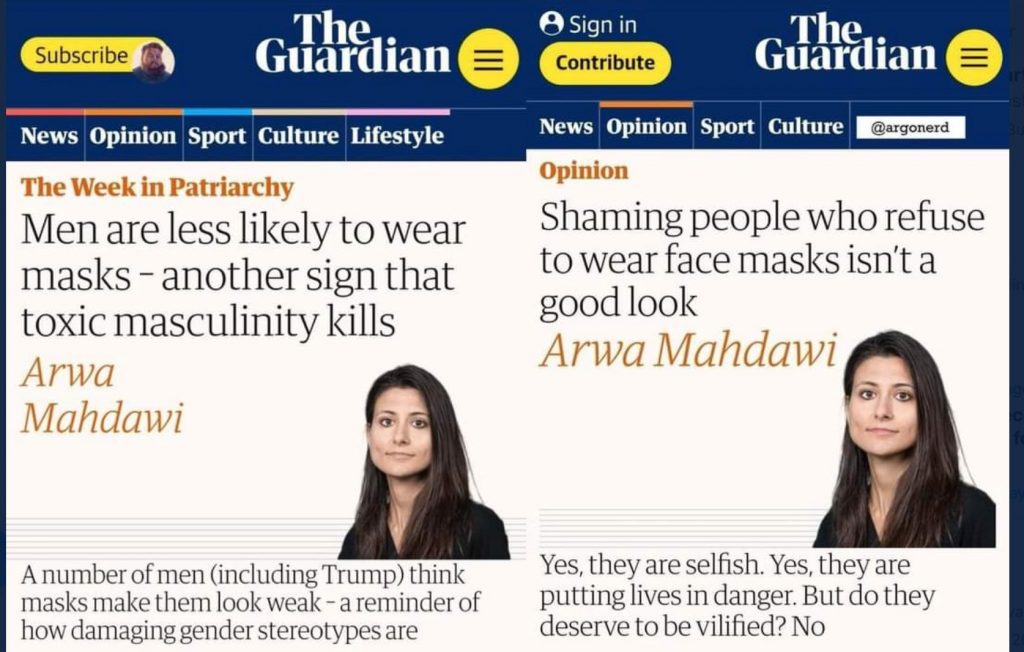
On the 16th of May 2020, one of her columns was published with the headline, ‘Men are less likely to wear masks – another sign that toxic masculinity kills’. She said in the column, “A number of men (including Trump) think masks make them look weak – a reminder of how damaging gender stereotypes are”. A couple of months later, she published another column, this time with the headline, ‘Shaming people who refuse to wear face masks isn’t a good look’. And no, this is not a joke.

Image Source: @Suffragentleman/Twitter

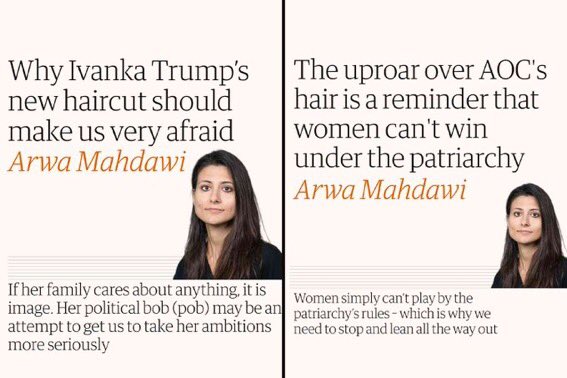
It is not a one-off incident. It is a consistent feature of her columns. In September 2019, Arwa Mahdawi published a column with the headline, ‘Why Ivanka Trump’s new haircut should make us very afraid’. Apparently, “Her (Ivanka Trump’s) political bob (pob) may be an attempt to get us to take her ambitions more seriously”.

Less than 30 days later, Arwa Mahdawi published a column with the headline that said, ‘The uproar over AOC’s hair is a reminder that women can’t win under the patriarchy’. One cannot make this stuff up.

Image Source: @gelatinousmass/Twitter

Arwa Mahdawi has other hits to her credit as well. During the Antifa riots in the USA in the aftermath of the death of George Floyd, she explicitly defend the rioting and suggested that violence is the only way to end police brutality and ‘systemic racism’. In her column titled, ‘If violence isn’t the way to end racism in America, then what is?’, she stated, “The uncomfortable truth is that, sometimes, violence is the only answer left.”

Mahdawi further argued in the article, “But if violent unrest isn’t the answer then what is? How exactly do you go about ending police brutality and systemic racism in America? Should protesters go home and write sternly worded letters to their representative? Should they emulate Madonna and post videos of their kids dancing in protest? Should they peacefully take a knee? Should Americans simply vote Trump out and vote Joe Biden in instead? You know, the guy whose 1994 crime bill significantly contributed to mass incarceration in America? Should people patiently wait for incremental change?”

The Guardian column

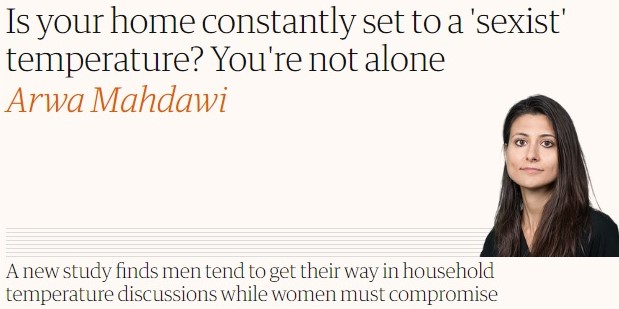
Another of her stellar hits was on air conditioning. Arwa Mahdawi wrote in a November 2019 column titled, ‘Is your home constantly set to a ‘sexist’ temperature? You’re not alone’, “A new study finds men tend to get their way in household temperature discussions while women must compromise”.

She stated, “Are you a victim of thermal bullying? Does your partner or roommate always get their way when it comes to how hot your house is? If you answered “yes” then stay strong – you’re not alone. According to a new study, conducted by researchers from Ohio State University, a lot of households contain a “thermostat dictator” who rules the temperature dial with an iron fist. As it turns out there’s a gendered nature to this – the thermostat dictator is normally a man.”

“The thermostat dictator is normally a man.”
-Arwa Mahdawi

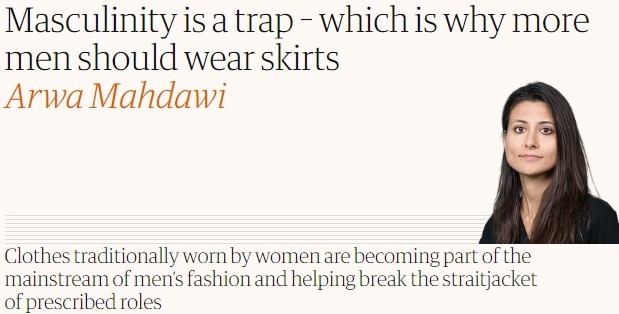
In June 2019, Arwa Mahdawi had a novel advise for men: Wear Skirts! That particular column titled, ‘Masculinity is a trap – which is why more men should wear skirts’, she argued, “Clothes traditionally worn by women are becoming part of the mainstream of men’s fashion and helping break the straitjacket of prescribed roles”.

She argued in the column, “It is sad that so many men are petrified about seeming effeminate. It is sad that it is not socially acceptable for men to experiment with fashion in the same way women can. Happily, however, things are changing gradually.”

The Guardian columnist’s novel advise for men

Her columns have made Arwa Mahdawi a joke on the internet and a lot of people are having fun at her expense. However, it does reveal a lot about the standards of the mainstream media that such garbage commentary is published as Vedic wisdom. But then again, it is something that people across the political spectrum have come to expect from the media.

Why did ‘Wonder Woman’ Gadot hail Shaheen Bagh Dadi? Here is the project she is working on with someone who celebrated anti-CAA violence

Gal Gadot, the Israeli actress who plays ‘Wonder Woman’ in the movie adaptation of the popular DC Comics character, is in the limelight of the Indian media space not for her movie, but for sharing the picture of Shaheen Bagh’s Bilkis Bano as one of the women whom she draws inspiration from.

Gadot shared a picture of Bilkis Bano and wrote, “Bilkis. This 82-year-old activist fighting for women’s equality in India showed me it’s never too late to fight for what you believe in.”

This triggered a backlash from Indian social media users who criticised the Israeli actor for posting misleading information about Bilkis Bano and wrongly attributing her for fighting for women’s equality. They informed her that far from championing the cause of women, Bilkis Bano was involved in the protests that opposed the Indian government’s decision to expedite the citizenship of refugees who have been facing religious persecution and genocide in India’s neighbouring Islamic majority nations. Shortly thereafter, the story was deleted by Gadot but it remains in her Instagram photos.

Gal Gadot to feature in a movie with controversial Indian actor Ali Fazal

Gal Gadot’s post on Bilkis Bano has left many wondering as to what got the actor into falsely claiming the octogenarian woman as an ‘activist fighting for women’s equality’. Many have pointed out to the actor’s professional association with the controversial Indian actor Ali Fazal, who had celebrated violence that was unleashed in the aftermath of the passage of the Citizenship Amendment Act in December 2019.

Fazal is all set to share the screen with the ‘Wonder Woman’ Gal Gadot in 20th Century Fox’s upcoming adaptation of Agatha Christie’s “Death on the Nile”. The film is a follow-up to the studio’s 2017 blockbuster “Murder on the Orient Express” that starred Hollywood actor Johnny Depp and was also an adaptation of Christie’s novel of the same name. The movie is going to be directed by Kenneth Branagh, who also presided over the first part and will play the role of the moustachioed Belgian detective Hercule Poirot.

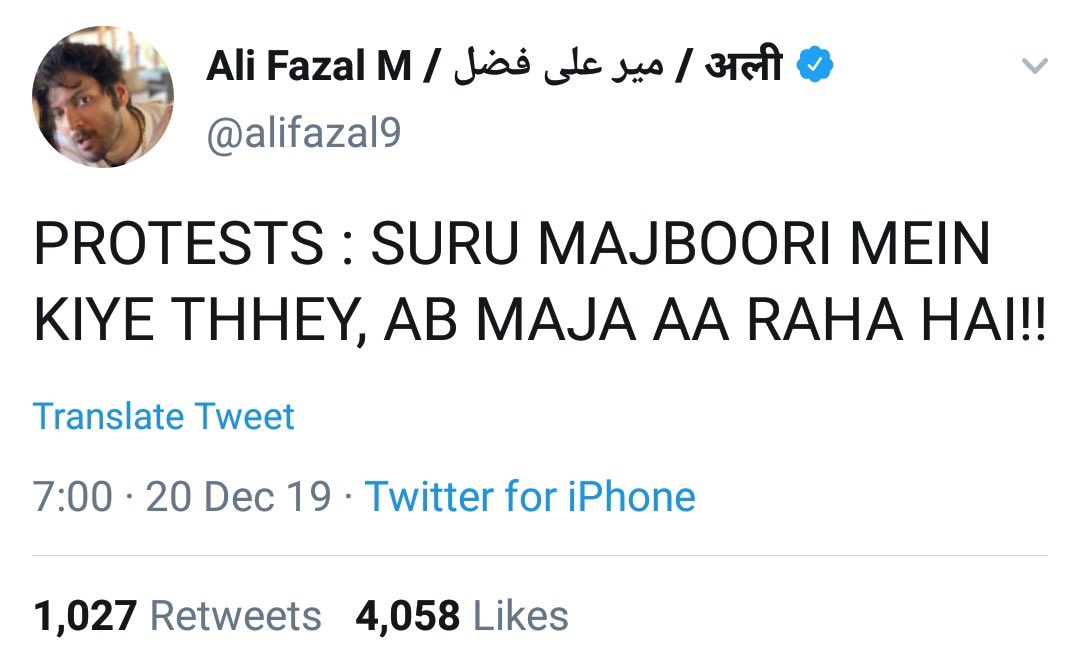
It is being alleged that Bano’s inclusion in the Israeli actor’s list of “personal wonder women” may have been inspired from her co-actor, Ali Fazal, who has not shied away from extending his support to anti-CAA rabble-rousers. In the wake of the violence, stone pelting, vandalism and incidents of arson reported from many parts of the country following the enactment of the CAA in December 2019, Fazal had posted a tweet on the anti-CAA riots saying that he was enjoying it all.

Source: Twitter

Many prominent personalities had come in support of the anti-CAA protests, including the opposition political parties, thereby emboldening the demonstrators to continue their protests against the Citizenship Amendment Act. The protests continued for several months in Shaheen Bagh in Delhi and eventually culminated in the horrifying Northeast Delhi riots that shook the national capital.

Bilkis was not fighting for women’s rights, she wanted persecuted non-Muslims in Islamic nations to be left to die

Bilkis, who was featured in the list of top 100 influential people of 2020 in Times Magazine, was recently seen at farmers’ protests gaining some more footage for herself. Her presence had brought back the grim memories of the Shaheen Bagh protests, where Islamists sat on a so-called ‘protest’ beginning in December last year, against the Citizenship Amendment Act.

Bilkis along with the protestors had blocked a major highway and caused traffic disruptions for months. She was one of the leading ‘protestors’ at Shaheen Bagh against the humanitarian Citizenship Amendment Act. The sit-in protests disrupted the lives of the people of Delhi. Shaheen Bagh, the mecca of anti-CAA protests, was one of the major reasons that led to the worst anti-Hindu riots in recent history. Women like her were used as a shield at the sit-in protests. Anti-India slogans had attracted separatists from all over India and provided cover for the radicals and extremists. In the end, the riots happened and many including Dilber Singh Negi, IB officer Ankit Sharma and others were killed mercilessly.

Moreover, the anti-CAA protestors were essentially opposing the Indian government’s decision to grant citizenship to persecuted minorities in the three neighbouring Islamic nations, Pakistan, Bangladesh and Afghanistan. Hindus, Sikhs and Christians in these nations are facing genocide. They are killed, kidnapped and raped every day. But the so-called ‘protestors’ saw the humanitarian law as “anti-Muslim”. Bilkis Bano of Shaheen Bagh was the face of such an Islamic movement that wanted the persecuted non-Muslims to be left to be killed.

India witnesses a record high collection of GST in December: Finance Ministry

In a major development, India witnessed a record high collection of Goods and Services Tax (GST) for the month of December 2020.

As per reports, GST revenue collected last month stood at an all-time high of ₹1,15,174 crores. At the same time, the figure is 12% higher than the tax collected in December 2019. Finance Ministry informed that this has been the highest gross revenue collected since the Goods and Services Tax came into force in July 2017. It is important to mention that GST revenues have clocked more than ₹1 lac consecutively from the last three months.

While the Central GST (also called CGST) stood at ₹21,365 crores, the State GST (also called CGST) collected in December stood at ₹27,804 crores. At the same time, a compensation cess of ₹8,579 crores was generated and an integrated GST of ₹57,426 crores (₹27,050 crores collected on imports) was received. Prior to this, GST revenue collection was highest in April 2019 when it had clocked nearly ₹1.14 crores.

As per reports, Cess worth ₹ 8,579 crores have been collected, with ₹971 crores from imports alone.

In a statement, the Finance Ministry stated, “In line with the recent trend of recovery in the GST revenues, the revenues for the month of December 2020 are 12 per cent higher than the GST revenues in the same month last year. During the month, revenues from import of goods were 27 percent higher and the revenues from the domestic transaction were 8 per cent higher than the revenues from these sources during the same month last year.”

Over 100 benami properties, assets worth Rs 200 crore in driver’s name: Read details of what ED recovered in raid of rape accused SP leader

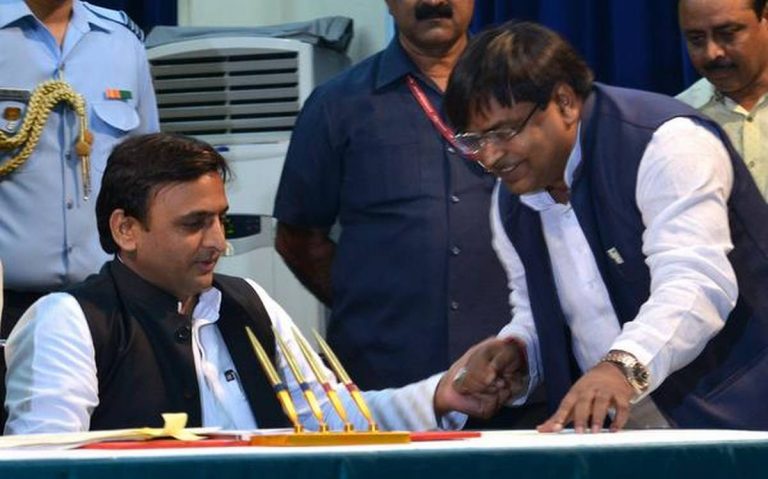
Central probe agency Enforcement Directorate raided multiple locations of former Uttar Pradesh minister and Samajwadi Party leader Gayatri Prajapati in connection with a money laundering case probe against him on December 30 (Wednesday). Prajapati had held the mining portfolio during the Samajwadi Party government under Akhilesh Yadav.

The Enforcement Directorate is probing Gayatri Prajapati on charges of possessing alleged disproportionate assets and in connection with two FIRs filed by the CBI against the minister and others last year in connection with the illegal sand mining case.

Seven locations in Lucknow, Kanpur and Amethi, including the premises of a chartered accountant of Prajapati based in Kanpur, the residence of his driver, “Benami holders” in Amethi and Gayatri Prajapati’s house and office in state capital Lucknow were searched simultaneously by over 50 central probe agency officials under sections of the Prevention of Money Laundering Act (PMLA).

ED seized documents of more than 100 Benami properties during raids at the premises of Samajwadi leader

During the raid, the ED has reportedly seized old currency notes worth Rs 11 lakhs. Apart from this, ED has recovered blank stamp papers worth Rs 5 lakh, cash amounting to Rs 1.5 lakh and documents of more than 100 Benami properties.

The documents that the ED has recovered during the raids show that Gayatri Prajapati owns assets in more than six cities including Lucknow, Kanpur, Mumbai, Sitapur. According to a report by News 18, ED has recovered more than 44 property/land-related documents in the name of Gayatri Prajapati and his family members and found evidence that black money collected from the mining scam has been invested in these Benami properties. These assets were taken in the name of close relatives, personal assistants and drivers, revealed ED.

Gayatri Prajapati purchased assets worth 200 crores in the name of his driver

The agency has gathered proof which suggests that the Samajwadi Party minister had purchased assets worth 200 crores in the name of his driver. Moreover, the agency seized dozens of files from Gayatri Prajapati’s residence in Amethi’s housing development colony and his driver Ramraj’s residence in Tikri. Apart from this, the minister’s IT returns and bank accounts were also being scrutinised.

The ED team has demolished the house of Gayatri’s relative Harilal Prajapati and servant Ramtahal Verma. According to reports, the team also questioned the Samajwadi Party leader’s servant about the former’s illegal assets and sources from where he acquired the black money.

The Samajwadi Party leader accused of rape and molestation

For the unversed, Gayatri Prajapati was arrested and sent to jail on March 15, 2017. He was charged with rape, criminal conspiracy, and criminal intimidation. The former minister, along with others, is accused of raping a woman and attempting to molest her minor daughter. He is currently undergoing treatment for various ailments at the KGMU in Lucknow.

It might be recalled that in January 2017, a woman from Chitrakoot had alleged that Prajapati, then a Minister in SP chief Akhilesh Yadav’s cabinet, along with his men, raped her and molested her minor daughter. Prajapati reportedly took photos and continued to rape her for two years by threatening to leak the photos. He also falsely promised to give her an important position in Samajwadi Party and a mining contract. The victim later filed a complaint. However, the UP Police refused to file an FIR. The woman then approached the Supreme Court, which directed the police to lodge a report. In February 2017 he absconded but was later arrested in Lucknow.

22 locations of former UP Minister searched over the sand mining scam occurred during Akhilesh Yadav’s rule

In June 2019, the Central Bureau of Investigation (CBI) had carried out searches at 22 locations in Uttar Pradesh and the national capital, including three residential premises of former UP Minister Gayatri Prajapati, in connection with the illegal sand mining scam, that occurred in 2012–2017 during the Samajwadi Party rule.

He and four IAS officers of the state were booked by the CBI, on the basis of which the ED filed its money laundering case.

Akhilesh Yadav had been the Chief Minister of Uttar Pradesh from 2012 to 2017 and Prajapati Gayatri held the mining portfolio in the cabinet from 2012 to 2013. According to reports, the illegal sand mining scam took place between 2012 and 2016. For this reason, the central agencies have also been keeping a close eye on former UP Chief Minister Akhilesh Yadav in the matter.

The agencies are of the opinion that both Akhilesh Yadav and Gayatri Prasad Prajapati jointly approved of all the mining contracts when they were at the helm of affairs in Uttar Pradesh. As per rules, any deal which is above Rs 5 lakhs need to be approved by the CM, so the agencies are certain that all the illegal deals were done with the approval of the then CM Akhilesh Yadav.

Shiv Sena leader who vandalised Karachi Sweets seeks to get 55 criminal cases withdrawn: Her is how he plans to use new state policy

Shiv Sena leader Nitin Nandgaonkar, who was recently seen threatening the owner of sweets shop to change the name of the shop, is trying to get all the criminal cases filed against him withdrawn. According to the Hindustan Times, Nandgaonkar has 55 criminal cases filed against him. The Maharashtra cabinet had cleared a proposal on December 2 allowing for the withdrawal of cases registered for social and political agitations filed in last five years till December 31, 2019. Nandgaonkar has asked his lawyers to initiate the process for withdrawal of the cases against him.

“I have no regrets for having criminal cases registered against me. Most of the sections under which cases are lodged against me are non-bailable, but every time, I have been given bail by honourable courts as they believed by intention. In none of the cases was I imprisoned. All my agitations are for social causes and against injustices to common man. In most of the cases- be it overcharging by autos or inflated bills by hospitals during the pandemic- the results were seen”, he said. Nitin Nandgaonkar said that the cases pending against him were fit for withdrawal under the policy. Nandgaonkar had reportedly thrashed a few auto drivers for rigging their meters and also attacked a molester from Matunga. He has cases filed at various police stations.

The government prosecutor said that cases for social and political protests are withdrawn under section 321 of the Code of Criminal Procedure only after the approval of public prosecutors and trial courts.

Nandgaonkar had threatened Karachi Sweets shop owner to change the name of his shop

Last year in November, a video of Nitin Nandgaonkar threatening the owner of Karachi Sweets shop located in Bandra West to change the name of his shop had gone viral on social media. He told the shop owner that Karachi is in Pakistan which is a country of terrorists. He said that he did not want anyone to use the name Karachi to run a business in India. Following his threats, the shop owner had to hide the name of his shop by covering it with newspapers.

Two Hindus found hanging inside police officer’s room in Pakistan’s Sindh, activist says they were tortured before being murdered

The horrifying atrocities meted out against the minorities in Pakistan continues unabated. Just days after a historic temple in Pakistan’s northwestern province of Khyber Pakhtunkhwa was razed and torched by a rabid Islamist mob, two Hindus have been found hanging inside a law enforcement official’s room in the Sindh province of Pakistan.

According to the reports, two Hindus—Babita Meghawar and her relative Dongar Meghawar—were found hanging from the ceiling in a room of a police officer ASI Gul Mohammad Sand in Mithi, Tharparker, Sindh. Pakistani activist and lawyer Rahat Austin has reported that Babita was the sister-in-law of Dongar Meghawar and they both were tortured before being murdered.

Minorities in Pakistan persecuted because of their faith

The minorities in Pakistan suffer a perennial threat of persecution, both from the non-state actors as well as the Pakistani establishment. Recently, a rabid Islamist mob destroyed a Hindu temple in northwestern Pakistan by setting it on fire.

The Krishna Dwara temple, which is situated in Karak’s Teri union council, came under attack by hundreds of residents who set fire to the building, then razed it down with hammers and crude weapons.

Reportedly, the temple was built after Guru Shri Paramhans Dayal was laid to rest at the site in July 1919. However, the Muslim residents of the area had closed the temple after the Partition in 1947. In 2015, the Krishna Dwara temple was restored on the orders of the Supreme Court of Pakistan.

Rohit Kumar, an advocate and the Hindu activist said the residents violated the agreement by vandalising the temple. Earlier, Hindus and the Muslims of the village had signed an agreement on December 22 agreeing that the renovation of the temple would not exceed the specified area.

However, the Muslim residents of the area had alleged that that the Hindu community was illegally expanding the temple building. They said the matter was reported to the police too.

According to the Muslims, as police did not take action against the Hindus, they themselves took the law into their hands and demolished the temple.

Minority girls, especially Hindus, targeted, abducted and converted to Islam in Pakistan

The death of the two Hindus came on the heels of an Associated Press report which said that more than 1,000 girls, a majority of them Hindus, are abducted, raped and converted to Islam every year in Pakistan. The report suggests that as many as 1000 Christian, Sikh and Hindu women between 12 and 25 years are abducted, raped, married, and forced to convert to Islam. Due to limited financial means of the families of such victims, many cases go unreported.

The girls are mostly kidnapped by their own acquaintances and relatives or by older men looking for brides. Sometimes they are taken by powerful landlords as payment for outstanding debts by their daily waged parents. Police often look the other way, doing little to help these persecuted minorities. Once converted to Islam, the girls are quickly married off, often to older men or their abductors, according to the independent Human Rights Commission of Pakistan.

Pakistan has a history of committing atrocities against the minority community, especially Hindu girls where they are often kidnapped and forcefully converted to Islam. Many of these girls are minors and are sexually exploited. In August this year, some unidentified men led by one Muhammad Adil barged into a Hindu family’s house in Sindh and abducted their daughter Kavita. She was later forcibly converted to Islam and married off to her abductor.

A minor Hindu girl was abducted in Jacobabad in June this year. Two minor girls, one Hindu and other Christian (hearing and speech impaired) were abducted on different occasions in May. In April, two Hindu girls were abducted from Sindh province and in January, a Sikh girl was abducted, followed by an attack on Nankana Sahib Gurudwara.

Associated Press claims ‘Muslims and Hindus live peacefully in Pakistan’, while reporting the Islamist attack on Hindu temple: Details

Western Media has always had a soft sport for certain tyrannical regimes and the most intolerant and radical sections of the Islamic community. Therefore, quite naturally, they have a morbid affection towards Pakistan, as a consequence of which, the Islamic State’s terrible record on human rights, the state sanctioned persecution of its minority Hindu population and overt support for terrorism is whitewashed and brushed under the carpet.

It is this same tendency that was reflected in a recent report by the Associated Press (AP) on the destruction of a Hindu Temple in a Pakistan by an Islamist mob. The incident occurred at Khyber Pakhtunkhwa’s Karak district on Wednesday. The Krishna Dwara temple, situated in Karak’s Teri union council, was attacked by hundreds of residents. They set fire to the building, then razed it down with hammers and crude weapons.

Riaz Khan and Mohammad Farooq, reporting from Peshawar in Pakistan for the AP, wrote, “Although Muslims and Hindus generally live peacefully together in Pakistan, there have been other attacks on Hindu temples in recent years. Most of Pakistan’s minority Hindus migrated to India in 1947 when India was divided by Britain’s government.”

It is not surprising that Khan and Farooq are deliberately lying on the matter, that Hindus are permitted to live peacefully in Pakistan. They are probably Pakistani citizens, therefore it is only to be expected that they are being dishonest here. Denial of the atrocities against minorities is engraved into the national character of the Islamic State. What is really shocking here is that the report passed the editorial muster of the AP.

Less than seven days ago, AP published a report where it revealed that a thousand girls from minority religions in Pakistan are forcefully converted to Islam every year. The report suggested that as many as a thousand Christian, Sikh and Hindu women between 12 and 25 years of age are abducted, raped, married, and forcefully converted to Islam. Due to limited financial means of the families of such victims, many cases go unreported.

And now, the same news agency is reporting that “Muslims and Hindus generally live peacefully together in Pakistan”. Is this supposed to be some kind of twisted joke? In what world can both these statements be accurate? And given that we know the atrocities that are perpetuated against Hindus in Pakistan every single day of the year and the terrible circumstances under which Pakistani Hindus have to live, how could a news agency be deluded enough to make such a claim?

Furthermore, the AP was reporting on an attack on a Hindu Temple here and the fanatic manner in which the Temple was razed to the ground. Quite clearly, the motivation here appears to have been to give the Pakistan state a free pass for the atrocities committed against Hindus. The objective of the propagandists was to whitewash the Islamist mentality that prevails over much of Pakistani society and in the process, whitewash the truth that is observable to anyone paying attention.

Former CIA agent reveals how a Jihadi turned Al-Qaeda mole duped US Intelligence services and unleashed a terror attack: Read details

In a startling disclosure, a former CIA agent Marc Polymeropoulos revealed how a jihadi-turned-informant duped the US Intelligence Services to unleash a terror attack that left 7 CIA agents dead.

While speaking to CBS during the episode of ‘Intelligence Matters’, Marc Polymeropoulos talked about slain jihadi Humam Khalil Abu-Mulal al-Balawi who worked as a double agent for the Al-Qaeda as well as the CIA. Balawi, a doctor by profession, first came to the notice of Jordanian security agencies after he was found speaking against the West and hailing jihadist attacks on chat forums. Since Jordan is a counter-terrorism partner of the United States, Balawi was apprehended for exhibiting extremist tendencies by the agencies.

The Recruitment of Balwai to infiltrate Al-Qaeda

Marc Polymeropoulos stated that the Middle Eastern security agencies do not work like the CIA. “The Middle Eastern services are not necessarily like us in terms of our ability to kind of throw around a lot of money and it would almost be, using a different set of kind of motivations for recruitment. And a lot of it has to do with being a coercive threat against the family. It’s something that Middle Eastern services actually are quite effective at, especially the Jordanians,” he emphasised.

Polymeropoulos informed that Balawi was recruited by the Jordanian authorities to work for them and the CIA. He revealed, “It was relatively quick. I think it was probably not a lot of personal meetings. It was jailhouse recruitment and then it was some more meetings after his release and getting ready to deploy. Ultimately, it’s again, it’s not something unusual for a Middle Eastern service because the belief is always that they have leverage over an individual due to family members still being present.”

Balawi passes key information about Al-Qaeda

Balawi was then sent to South Waziristan in Pakistan in 2009 to infiltrate the Islamist terror outfit Al-Qaeda. He spent months growing his contacts with other jihadis so much so that the Pakistani Taliban invited him to stay with them.

The former CIA agent recounted, “He (Balawi) actually sends a video which shows him sitting next to a senior al-Qaeda member close to the leadership circles and in touch, this was pretty solid evidence. That one would hope to have received, that it had gained the trust of the rank and file, also of senior al-Qaeda.” Interestingly, Balawi had made an impact on the Al-Qaeda terrorists that there were chances of him treating Ayman al-Zawahiri, an Egyptian terrorist and leader of Al-Qaeda since 2011.

His inputs also corroborated with what the CIA and Jordanian authorities already suspected about Zawahiri’s medical condition. “Think about the hunt for Zawahiri was of such critical importance to the entire kind of global war on terrorism. And at that point, you start thinking that this is the best lead we’ve had to al-Qaeda’s senior leadership in years,” stated Marc Polymeropoulos.

Over-reliance and Security lapse on the part of CIA

However, over-reliance of Balawi proved fatal for the CIA. He turned out to be a double-agent. “The security protocols broke down and he was treated as almost a visiting dignitary,” the ex CIA agent remembered. As such, Balawi was successful in carrying out a suicide attack in Camp Chapman at a CIA base near Khost in Afghanistan on December 30, 2009.

“We let our guard down on this and how it happened is just something that I think we’ll never know. And I say this painfully, too, because I knew all the officers involved. There were top-notch people on the ground,” Marc Polymeropoulos emphasised. He added, “Right, so again, there were several rings of security where he should have been searched. He wasn’t. He comes up to a location in which I believe a dozen officers were present at that point. Our security team did ask for him to step out of the car and they were going to search him.”

Former CBI agent recounts the horror of 2009

“The problem is this was far too close to the kind of a team that was on the ground. And before they could disarm him in any fashion, he had a suicide vest on. He detonated himself and seven of them were killed. I’ve been to that location at coast base. In fact, I was there a year later and there was still shrapnel holes kind of in the car gated steel roof. I slept in a guest house right there on-site, which was certainly difficult psychologically for me. There was an attempt to search him at the last moment but it was far too late.”

The former CBI agent concluded, “He should have been searched by not only by U.S. personnel, frankly, by Afghan personnel in the outer ring of security. That should have been done far earlier and that was kind of normal protocols that for whatever reason, to this day, no one can really understand why they were not followed…”