Home Blog Page 4765

Jharkhand: Communal tension over burial of the dead body of a woman in Forest Department land

0

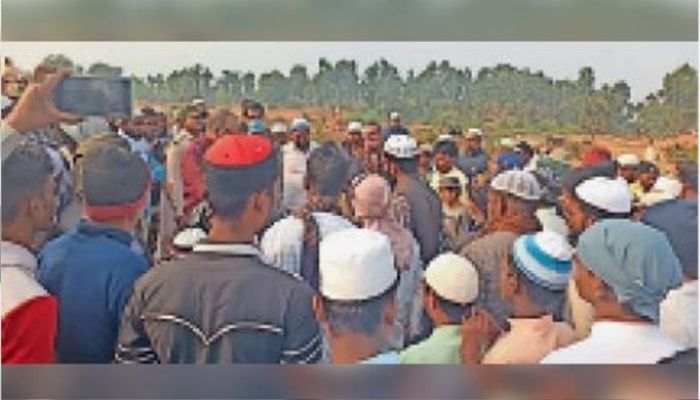
On Sunday, communal tension flared up in Kechgadhi village in Dumri, Jharkhand over the burial of a dead body on the land owned by the Forest Department, reported Dainik Bhaskar.

As per reports, the family members of a deceased woman, belonging to a ‘particular community’, wanted to bury her on the Forest Department land on Sunday. However, the other communities objected to it, citing that the land belongs to the government and is not meant for religious burials.

When the Dumri police station was informed about the development, the cops tried to pacify both communities and resolve the matter. Forest Department official Amar Vishwakarma, ASI Jaina Balmuchu, Dumri police station in-charge Raju Munda and area superintendent Ravi Bhushan Prasad rushed to the spot and took up the matter with the family and the locals. In the end, the officials were able to convince the family to bury the deceased at their cemetery and not in the Forest Department land.

Demands to legalise MSPs is retrograde, can destroy the farm sector and hurt the Indian economy: Explained

Ever since the Modi government passed three farm laws to free the country’s agricultural marketing and procurement systems, the farmers, especially from Punjab have hit the streets to demand a rollback on the law.

One of the main arguments of the protesting farmers is that the newly enacted laws would alter the existing procurement system and could nullify the MSP system that guarantees them a minimum income to their produce. Fearing a loss to their income through the alleged dismantling of the MSP system, the farmers have now demanded that the centre should bring in a law to give MSPs a legislative framework.

Let us understand what is MSP and how does the system work. We shall also discuss how legalising MSPs is a retrograde step that could be dangerous to India’s farm sector.

What is MSP?

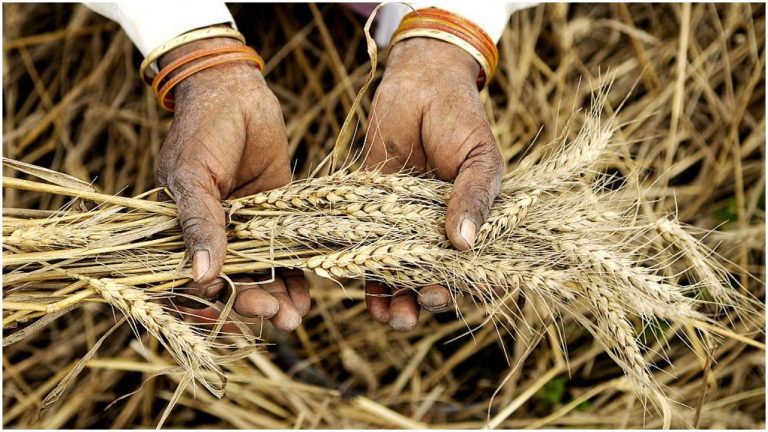
The MSP or Minimum Support Price is the minimum price set by the government at which farmers can expect to sell their produce for the season. If and when market prices fall below the announced MSPs, procurement agencies step in to procure the crop and ‘support’ the prices.

Theoretically, MSPs, which is guaranteed minimum price for the farmers for their produces also acts as a safety net or insurance for them when the market prices go down. It is also the price that government agencies pay whenever they procure the particular crop under their current procurement rules.

Who announces MSP?

Every year, at the beginning of each sowing season, the Cabinet Committee of Economic Affairs announces MSP for various crops based on the recommendations of the Commission for Agricultural Costs and Prices (CACP). The CACP, an advisory body, calculates the MSP based on the demand and supply, the cost of production and price trends in the market among other things when it fixes MSPs.

Also, CACP is not a statutory body set up through an act of Parliament and it can only recommend MSPs. However, the decision on fixing and enforcing finally falls under the government.

At present, the centre announces MSPs for 23 farm commodities — 7 kinds of cereal – paddy, wheat, maize, bajra, jowar, ragi and barley, 5 pulses – chana, arhar/tur, urad, moong and masur, 7 oilseeds – rapeseed-mustard, groundnut, soya bean, sunflower, sesamum, safflower and nigerseed and 4 commercial crops – cotton, sugarcane, copra and raw jute.

Interestingly, sugarcane is the only crop that has provisions for statutory MSP. These provisions came due to its pricing being governed by the Sugarcane (Control) Order, 1966 issued under the Essential Commodities Act. The price of Sugarcane is fixed under a ‘fair and remunerative price’ (FRP) during every sugar year, announced by the government.

Present status of MSP and procurement by states

Other than for Sugarcane, MSPs for any other farm produce does not have any legal backing. Additionally, even though the centre announces a fixed price in the form of MSP, the procurement does not always happen at MSPs. Most of the times, farmers sell their produce at much lower prices than MSP owing to certain uncontrollable market dynamics, factors such as excess supply, lack of storage infrastructure etc.

Another major problem with the MSP is lack of government machinery to the procure all crops that are under the MSP system. The two cereals – wheat and rice, which forms the basis of India’s food security act, are majorly procured by Food Corporation of India under its PDS network.

The state government has the responsibility to procure the produce from the farmers and those states that have better infrastructure and procurement policies will benefit from the current system. Less than 6 per cent of farmers benefit from the current minimum support prices (MSP), according to the Shanta Kumar-headed High-Level Committee on Restructuring of Food Corporation of India (FCI). 

The MSP-based procurement system has also found success in states which has a well-oiled system of middlemen, commission agents and APMC officials. In Punjab, more than 95 per cent of paddy and wheat growers benefit from MSP while in Uttar Pradesh, only 3.6 per cent of the farmers avail the benefit.  

Does the new farm laws concern MSPs?

As stated above, currently the provision of MSPs does not have any legal backing. The three new farm laws passed by the Modi government also do not have any provision for MSP. Legally, there is no law that puts an obligation on the government to purchase farm produce at MSPs from farmers. There are also no laws that put the onus on private players to buy at MSP.

However, based on rumours that the Modi government will repeal MSPs, the farmers from Punjab have now descended on the streets asking for the rollback of the three laws. Farmers are upset with the three farm bills because none of them mentions anything about MSP.

Even though Prime Minister Narendra Modi and his government have categorically stated that the MSP system will remain, the protesting farmers are in no mood to relent. In fact, the three farm bills that have been introduced by the government concerns with the reform of APMCs and introduction of contract farming and have nothing to do with MSP.

Instead, the objective of the new laws is simply to open up the procurement structure in the country and grant farmers, traders freedom of choice to sell and buy agricultural produce outside the existing APMC mandis. The farmers’ premise for demanding the legal backing for MSPs comes from the fear that minimum support price (MSP) will not be enforced once private mandis come up.

Nevertheless, the so-called farmer protests have now turned political resulting in these protesting farmers pushing for several other unconnected demands including the legal backing for the MSPs. One of the major demands of the protesting farmers is that they want the government to codify MSPs and provide legal backing.

However, setting MSP as a floor price legally will effectively derail the market for other players. Legalising MSP is also retrograde and anti-market, which could cause devastation to the Indian farm sector.

The legalisation of MSP and its effects on the agriculture sector and economy

At outset, it is important to understand how public procurement process under the MSP system works in the country. Farmers cultivating any of the 23 crops under the current MSP regime can sell his produce at the local APMC market that falls under his ‘trading area’. Theoretically, the Food Corporation of India purchases the produce brought by the farmer at MSPs that are announced by the government just before each sowing season.

However, the current public procurement by the FCI and the state government do not take place equally in all states. For example, Punjab alone contributes to 127 lakh metric tonnes, i.e., 33 per cent of the total wheat procurement in the country, thanks to its well-structured APMC structure. In states like Bihar, the procurement is less than 0.1 lakh metric tonnes.

In addition to the existing horizontal inequality in procurement among states, there are no guarantees for any farmers that his produce will be procured at the stipulated MSPs. In reality, MSP is just a notional indicative price for the procurement under which the farm produce cannot be bought, however, most of the times the procurement is done at a price much less than MSP.

For example, the MSPs for maize in the current sowing season for Rs 1,850/quintal. However, the market price for maize was somewhere around Rs 1,200/quintal despite the centre’s higher MSP. The increased gap between the MSP and the actual market price is due to the basic demand and supply mismatch. Interestingly, the current fiscal was one of the most productive years for the agricultural sector, which saw a marginally higher growth compared to other sectors amidst the coronavirus induced lockdowns.

The inclination for an average farmer to demand legal backing to MSP comes from this growing gap between MSPs and the realised market price. It is not wrong or unjustified for an average farmer to demand a better price for his produce. However, the legal backing of MSP or codifying the structure of MSP into law and thus regulating the prices of agricultural produces in the country would cause a devastating blow for the farm sector in the country.

The reasons for this are simple. In any free-market economy, the price of any goods and services produced in the country has to be decided by market forces and not by the state. The principles of free-market economy stipulate that the market dynamics will lead to a better price realisation for a good thus creating a balance between producers and consumers. However, if the state starts to regulate the price of goods, the market equilibrium will eventually disrupt leading to either higher prices of the product or completely crashing down the value.

For example, if the state decides to fix legal MSPs for paddy at Rs 2,000/quintal and the market prices are much lesser than the MSPs, private traders would stay away from buying the produce leading to excessive supply than the demand. As demand for the product diminishes, the price of paddy crashes automatically. As buying at lower prices is prohibited as per the law, a buyer cannot buy at a lower price.

However, it also leads to another major problem. The big corporations, private traders can now use the system to advance their interests and force the market to crash only to pick the commodity later at a much lower price. Codifying laws for MSP will be a death knell for a small farmer in the country.

The codification of the MSPs structure will also have a bearing on India’s Public distribution system. With government legalising the procurement prices, the FCI has to procure the cereals at an already prescribed price, which may increase in times of shortage, thus putting extra burden on state finances.

Legalising MSP could create inflation, agro exports will lose the competitive edge

One of the major arguments against legalising MSP is that it could impact the macro-economic prospects of the country by risking an abrupt increase in inflation. The higher costs of procurement and open market operations of food grains caused due to a statutory MSP will increase the food prices, leading to inflation in the economy. The obligation for the government to procure at the prescribed rate of MSP, which will be backed by law, will create supply-side inflationary trends in the economy.

The poor in the country can no more afford such high priced food grains. The risk may also come from the fact that with no demand-side pressure, the price of the food grains may crash due to the market dynamics despite having made MSP legal, making the farmers once again the victim of the flawed policy.

On the exports front too, legalising MSP could cause nothing but harm to the farmers. If MSPs determined by the government and enforced by a law is higher than the prevailing rates at the international market, the agriculture produce from India will become costlier.

India’s agriculture exports, which accounts for about 11 per cent of the total export commodities, will be less attractive leading to losing out in international markets, results in the generation of less foreign exchange. Such volatility in the forex reserves of the country and need for more dollars to fund our increasing imports can also devaluate rupee, fuelling the vicious cycle of Current Account Deficit and inflation.

In a way, the very demand of farmers to force the government to bring in a legislative framework for the MSPs and procurement could cause devastating effect not just on farm sector but also on country’s economy on a whole. Instead of rushing towards pressurising the government to repeal the three farm laws and demanding for codifying MSPs into laws, the protesting farmers should perhaps be aware of the irreversible damage that could cause to the agro sector by enacting laws to make MSPs a legal right.


Sana Khan, who married a cleric after quitting showbiz for Allah, gets moral policed by Islamists on honeymoon pics

Actress Sana Khan, who recently made headlines for leaving her showbiz career for Islam and marrying a Muslim cleric, has been the latest target of moral policing by Islamic fundamentalists.

On Sunday, the actress had uploaded pictures of her, highlighting her time in Gulmarg, Kashmir, on Facebook and Instagram. Through her post, Sana Khan conveyed to her audience that she has been having a good time with her husband Mufti Anas. “Alhamdullilah” kaha karo beshak Quran pak bhi “Alhamdullilah se shuru hota hai (Keep saying Alhamdullilah. Even the Quran begins with it),” the caption of her post read.

However, her ‘modest’, well-intended social media post did not go down with Islamic fundamentalists. She was targetted for not following the basic tenets of Islam and engaging in Haaram (prohibited) activities such as posting pictures online.

Sana Khan had also faced similar backlash for another social media post, uploaded on Saturday.

Follow complete rules of modesty, ordered Islamic fundamentalists

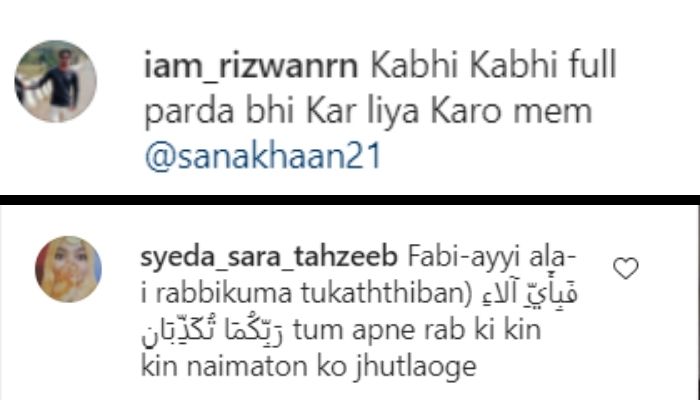
An Instagram user (@iam-rizwanrn) slammed Sana Khan for not following ‘complete purdah’ and not being modest enough. “Sometimes try to completely cover yourself,” he said. It is important to mention that the comment came despite the actress being fully covered. Another user, Syeda rebuked, “How many rules of Allah shall you break?”

Quran does not allow woman to wear ‘manly clothes’

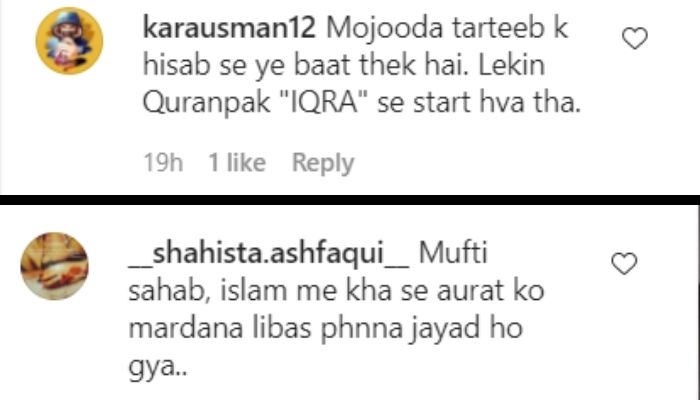
Another user (@karausman12) wasn’t happy either. While ‘correcting’ her knowledge of Quran, he emphasised, “This is okay according to the current customs. However, Quran begins with the word Iqra.” Shahista Ashfaqui, an Instagram user, was irked with her husband Mufti Anas for allowing her to wear ‘manly clothes’. “Since when did it become permissible in Quran for women to wear manly clothes,” she inquired.

Stop uploading pictures on social media, Islamists tell Sana Khan

Besides telling the actress to wear modest clothes and steer away from breaking the ‘rules’ of Allah, Islamists told Sana Khan to stop uploading pictures altogether on social media.

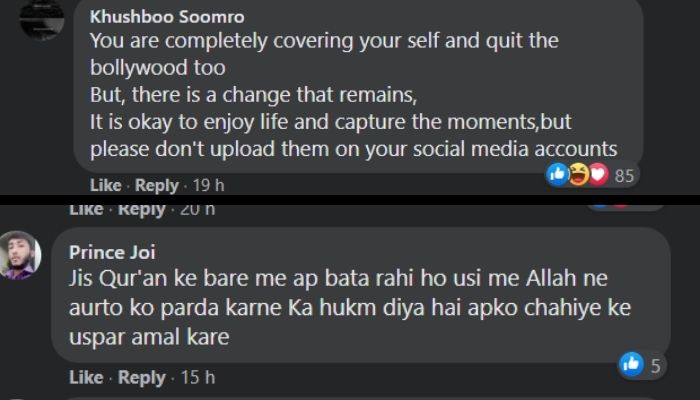
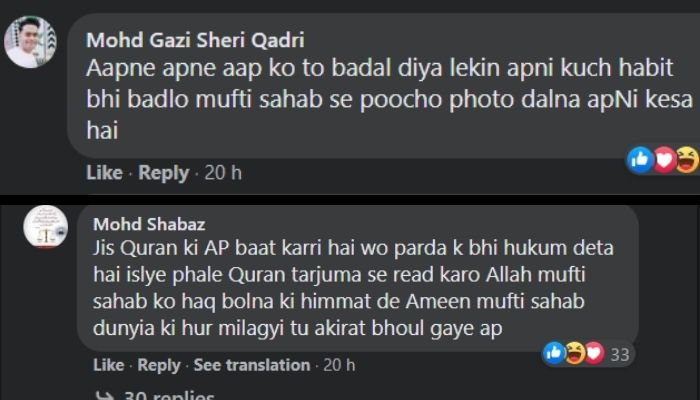
“You are completely covering yourself and quit the Bollywood too. But there is a change that remains. It is okay to enjoy life and capture the moments but please don’t upload them on your social media accounts,” wrote Khushboo Soomro on Facebook. Another user, Prince Joi, emphasised that she must follow the Quran and observe purdah/ full covering that she has been quoting in her social media posts.

Another user Mohammed Gazi wrote, “You changed yourself but not your habits. Ask your husband about the kind of pictures that are permissible to be posted online”. Mohammed Shabaz also slammed the husband of the actress for not having the courage to educate her the rules of Islam.

Sana Khan quit Bollywood for Islam

In October this year, actress Sana Khan has decided to quit the entertainment industry after being enlightened by the ‘teachings of Islam’. The decision came at the backdrop of her depression phase, following her ‘bitter breakup’ with dancer Melvis Louis. 

In an Instagram post, Sana Khan dubbed her decision to leave showbiz as the ‘happiest day’. While hoping that Allah will ‘guide her’ in her new journey, she asked her followers to pray for her. While invoking Islamic references of the ‘Judgement Day’, she hinted at how her Faith and her profession were at loggerheads with each other. “Therefore, I announce that I will quit the film industry and will serve humanity. I will follow the rules as specified by my Creator. I request my fans to pray for me and hope that Allah will listen to my prayers,” she reiterated.

Actress finds ‘Halal love’, marries cleric

Former Bollywood entertainer Sana Khan, who participated in reality show like Bigg Boss and had acted in Salman Khan movies like Jai Ho had married a Surat-based Muslim Cleric, Mufti Anas in November. As per reports, Bigg Boss 8 contestant Ajaz Khan, who regularly posts communally sensitive remarks on social media, introduced her to her husband.

In the videos that have surfaced online, she was seen wearing a white bridal gown and her husband was also wearing white outfit. She married the Muslim cleric in a small intimate ceremony in Surat. The newly married couple also cut a cake after the wedding.

Chinese Communist Party’s data leak shows how China infiltrated corporates, foreign consulates, including Indian, for spying

Shocking revelations have come forth with the massive leak of Chinese Communist Party (CCP) records. The CCP through a recruitment agency carried out a well-coordinated infiltration by getting its members employed in senior, specialist and advisory positions in consulates of countries such as India, UK, USA and Australia.

According to a report by The Australian, CCP infiltrated the consulates in Shanghai through government-run recruitment agency. Through a well-coordinated effort, advisers were placed in western countries for over a decade.

Whistleblowers have extracted a list of 1.95 million CCP members from a Shanghai server. The list contains details such as names, the positions they held, birthdate and ethnicity. As per the investigation done by The Australian, at least 10 consulates in Shanghai employed CCP members as senior political and government affairs specialists, clerks, economic advisers and executive assistants.

Foreign experts believe that this could be a state-sponsored ‘spying ring’ wherein CCP members are employed in consulates, some for as many as 16 years. The leaked database also revealed that some of the CCP members were employed in corporates such as Boeing, Pfizer and AstraZeneca. Boeing, the American company, has defence contracts worth billions while Pfizer and AstraZeneca are leading pharmaceuticals which are developing the Chinese coronavirus vaccines. CCP members are also recruited at various Western universities as well.

The Australia and New Zealand Banking Group (ANZ), the Australian multinational banking company, has at least one branch of CCP members. The banking company said that it does not interfere in employees’ political inclinations. And while there is no evidence that every CCP member is a Chinese government spy, the new revelations raise severe security concerns.

CCP currently has 92 million members and they must pledge that they put party’s interest above all and be ready at all times to sacrifice all for the party.

Volvo, Citibank, HSBC, IKEA, Volkswagen, Jaguar-Land Rover and Mercedes-Benz are amongst the companies which have CCP members on payroll.

The leaked database shows that the CCP members have been recruited in Indian, Australian, US, British, German, Swiss, New Zealand, Italian and South African missions in Shanghai. The report states that the ­Department of Foreign Affairs and Trade (DAFT) directly hires local staff through a Chinese government agency, the Shanghai Foreign Agency Service Department (SFASD). The SFASD has at least 12 active CCP branches with 249 members.

SFASD’S website currently lists job vacancies for the Australian, US, Czech, Ethiopian, Brazilian, Chilean and Hong Kong consulates in Shanghai from July 2020. The Australian quotes Samuel Armstrong, spokesperson for the British Henry Jackson Society foreign policy think tank who said that the SFASD looks like a well-organised, state sponsored spying ring. Another intelligence officer said that any CCP member working in foreign country’s embassy or consulate is a potential spy.

The leaked database also showed that one CCP member worked for New Zealand Consulate in Shanghai for four years as policy adviser for trade and economics. Further, six CCP members have worked at the US Consulate in Shanghai in various roles including a political specialist, a procurement supervisor and ­an assistant.

There is a current senior officer at the British consulate in Shanghai, who according to The Australian, works near MI6 officers operating under diplomatic cover, with concerns intelligence could be passed back to the CCP. The MI6 is the British Intelligence Agency.

The report further states that the Swiss Embassy has a trade officer and deputy head of station who are CCP members while the German Consulate has a clerk who is a CCP member. Similarly, one CCP member spent as many as 12 years in Italian consulate. Another CCP member spent 16 years in South African consulate.

Another CCP member spent eight years as a senior political and government affairs specialist at the US consulate before moving to the British consulate, the report says.

The report says that the massive leak explains how the Chinese President Xi Jinping works: by setting up branches inside companies and government agencies.

The database, originally extracted in April 2016 from Shanghai server, was leaked in mid-September to the newly-formed international group, the Inter-Parliamentary Alliance on China. It is made up of 150 legislators around the world. The leaked data was then provided to an international consortium of four media organisations: The Australian, The Mail on Sunday in Britain, De Standaard in Belgium and Swedish journalists.

Pakistani journalist reporting on atrocities against Hindus and other minorities declared ‘imaginary person’ by Mehr Tarar and others

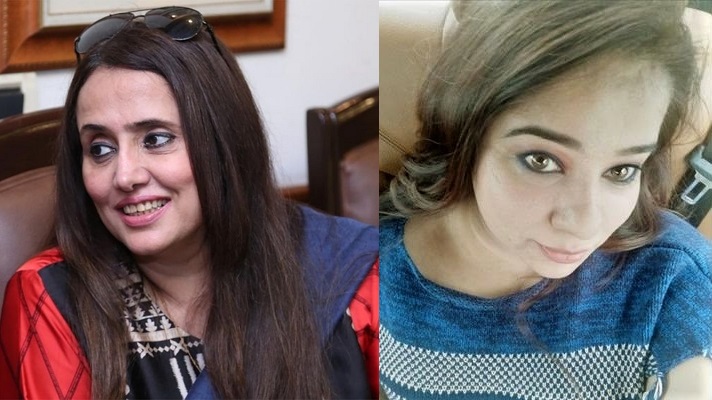
Pakistani columnist and socialite Mehr Tarar has declared that Naila Inayat, a Pakistani journalist with verified Twitter account, is actually a person who doesn’t even exist. Quote tweeting a tweet saying that Ms. Inayat is a fake, fictitious twitter character, Tarar said that she has raised this suspicion earlier also.

Mehr Tarar claimed that no one in Pakistan has met this person, or for that matter, has even heard of her. It is pertinent to note here that Ms. Inayat has written articles in various Pakistani and international mainstream publications. But Ms. Tarar believes that all these publications were dealing with an imaginary person till now.

The tweet that Ms. Tarar was quoting itself was quoting another tweet, which had claimed that Ms. Inayat was created by The Print, news and affairs website launched by Indian journalist Shekhar Gupta. Pakistani Twitter user Maria Sartaj wrote that “A reporter no one had heard of in Pak became the biggest messenger of anti-minority news from Pak”.

A large number of Pakistani social media users made similar claims, which seem ridiculous in the face of it.

The Print was launched by Shekhar Gupta (and Barkha Dutt, who mysteriously dropped out) in 2016, while a simple look at Ms. Inayat’s Twitter profile itself shows that she had been writing for various publications much before the website came into existence. Following is a tweet of hers from 2013, which shows an article authored by her for USA Today:

There are many such tweets and articles from her that are from era when Shekhar Gupta’s website didn’t exist. In fact, most of the articles by Ms. Inayat are in non-Indian publications, and thus the claims of her being imaginary and crated by some Indian journalist are laughable. Yet, someone as senior like Mehr Tarar made resorted to such means.

However, not everyone in Pakistani was party to this weird conspiracy theory. Author Salman Rashid replied to Mehr Tarar, saying that he had met Ms. Inayat personally at The News on Sunday, a Pakistani weekly, in 2007. It may be noted that Ms. Inayat’s Twitter profile mentions that she had worked in the weekly earlier.

The attack on Ms. Inayat by Islamists from Pakistan is understandable, as she has become very popular on social media in India recently due to her reporting on atrocities on minorities in Pakistan, especially kidnap and forced conversion and marriage of Hindu, Sikh and Christian minor girls by Muslim men.

Mehr Tarar had become very popular on social media in India after she was ‘accused‘ of having an affair with senior Congress leader Shashi Tharoor back in 2014.

From being accused in terror case to defending Bhindranwale: Meet farmer protest supporter Khalsa Aid International and its CEO Ravi Singh

Right from the start of the ongoing farmers’ protests, questions have been raised about the authenticity of the protests, with doubts being raised about it being a political movement, fomented by the opposition parties led by Congress, to prevent the Modi government from carrying out the much-needed reforms. The enthusiasm and alacrity of the Congress leaders in encouraging and endorsing the protests only served to solidify the suspicions that Congress has indeed been fuelling the protests.

Later, the involvement of dubious characters such as Yogendra Yadav, Deep Sidhu, and suspicious organisations such as Sikhs for Justice (SFJ) in the ongoing farmers’ protest only added to the already battered the credibility of the demonstrations.

The hijacking of the protests by pro-Khalistani supporters who raised Khalistani slogans and held posters of Khalistani terrorist Jarnail Singh Bhindranwale, and the association of another shady organisation, Khalsa Aid, with the protests, has further cast a dent into the genuineness of the protests, giving an impression that the protests might be a well-thought-out conspiracy by the secessionists to revive Khalistani sentiments by engendering resentment among people against the Modi government.

Recently, Khalsa Aid had set up massage centres at the farmers’ protests in makeshift spaces at Singhu border. In a Facebook post, they announced, “Khalsa Aid India has set up this makeshift space as a massage centre. This is for our farmer brothers and sisters who were experiencing pain. We are overwhelmed by the love and blessings that our farmers bestow on us.”

Besides massage centres, Khalsa Aid has reportedly also provided the demonstrators with shelter home, footwear, bathing, hygiene kits, fogging fire extinguishers, portable washrooms and toilets and many more. The mind-bogglingly elaborate services provided by the Khalsa Aid to the protesting agitators have led many to wonder if the organisation already had a heads-up about the protests for making such detailed arrangements for the protesters.

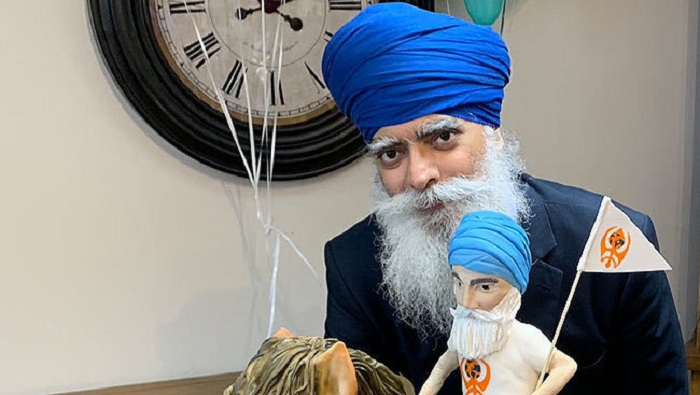
With questions being raised about Khalsa Aid, it is pertinent to catalogue the antecedents of this dubious organisation and its CEO, Ravi Singh, who has often, unabashedly displayed his Khalistani proclivities and pursued its nefarious agenda, behind the veneer of providing humanitarian aid.

Khalsa Aid, an offshoot of the Khalistani terror outfit Babbar Khalsa, accused of financing terror acts in India

The Khalsa Aid is suspected to be a front organisation for the Khalistani outfit Babbar Khalsa International (BKI). The NIA had registered a case in this regard in December 2012, alleging that Khalsa Aid was one of the organisations linked to the BKI funding the Indian BKI members to commit terror acts in the country.

“On the allegation that Punjab based BKI operatives are receiving money from UK based BKI operatives (viz. Balbir Singh Bains, Joga Singh) and its front organizations, including but not limited to, Sikh Organisation for Prisoner Welfare (SoPW), Akhand Kirtanee Jattha (AKJ) and Khalsa Aid, to commit terrorist acts in India, with the active support of Pakistan based BKI leaders (Wadhwa Singh, Jagtar Singh Tara). Further, Intelligence suggested that the money is being distributed to sleeper cells, jailed terrorists and the families of the terrorists in Punjab,” the NIA summarised the case.

Unfortunately, the case has hit a dead wall for the past one and a half years as the Britain government had declined to share evidence on the accused based in the UK into the terrorist funding case related to the Babbar Khalsa International (BKI).

Murky finances and illegal fund-raising characterises Khalsa Aid International

Besides being allegedly involved in funding terror activities in India, Khalsa Aid International has also been accused of illegally raising funds and being non-transparent about how they utilise the pooled funds. A report published in the Tribune India Service stated that Khalsa Aid has often sought donations in the name of charity but those funds have often failed to reach the beneficiaries.

The Khalsa Aid International is a non-accredited organisation in Australia and it does not appear in the list of registered organisations in the country. As per the Australian rules, fundraising for a non-accredited organization within its territory is a legal offence. But over the years, Khalsa Aid had raised millions of dollars from Australian cities, including Sydney. Following this revelation, two prominent Gurudwaras in Sydney decided to stop funding the contentious organisation and started helping the poor directly.

Another incident that highlighted the murky operations of the Khalsa Aid’s “humanitarian work” was when the organisation had to grudgingly admit that it had never been to Syria for any kind of work after it sought donations in the name of rehabilitating victims in the war-ravaged Syria.

The organisation also claims that it has provided services to victims in Bangladesh and Kerala, but the financial details of the organisation have no mention of the organisation’s charitable work in the above-mentioned places.

Ravi Singh, the CEO of Khalsa Aid, accused of being a cheater and running a crooked organisation

The person who heads the Khalsa International Aid is as dubious as the organisation he heads, if not more. According to a person who penned his brush with the Khalsa Aid CEO, Singh exploited people by appealing to their empathy, asking them to donate money for the welfare of poor, victims of atrocities, etc., using only a part of it on the actual aid and using the remaining amount on himself.

The user alleged Singh to be an opportunist who, in the name of fundraising for the needy and the poor, sought publicity by uploading videos of himself donating money and other essential items to the people. The person also stated that money in the tunes of lakhs and crores were raised by Singh but only a few thousands were donated to the needy. Moreover, the person, claimed that there were gross irregularities in Khalsa Aid’s projects, no transparency in accounts held by them and money raised for a specific purpose were diverted for personal expenses and other projects.

According to Ajmer Singh Randhawa, the person who wrote down his encounter with Khalsa Aid CEO Ravi Singh, after much pressure and persuasion, when the expenditure and collection of funds were made public, he was astonished to find that against the collection of Rs 7 crore, only Rs 35 lakhs were spent on helping the families of Sikh Dharmi Fauzis and martyrs.

For Ravi Singh, Khalistani terrorist Jarnail Singh Bhindranwale is a “champion of oppressed” and “son of Punjab”

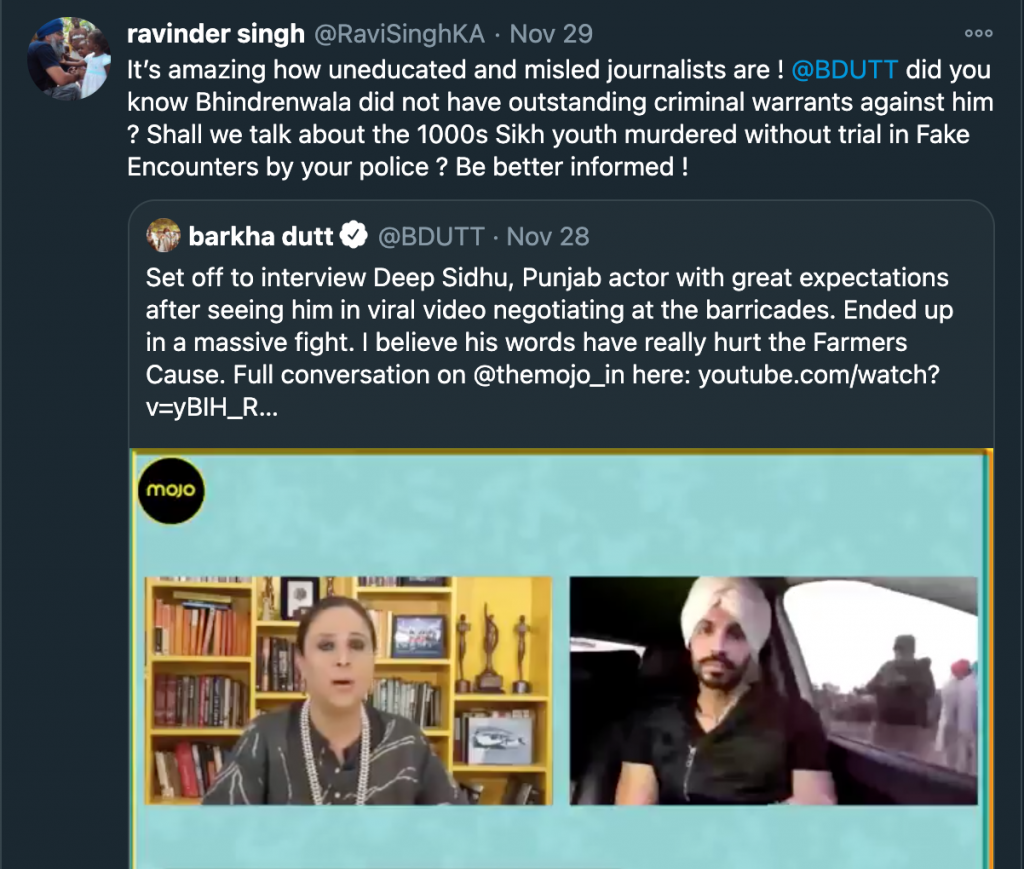
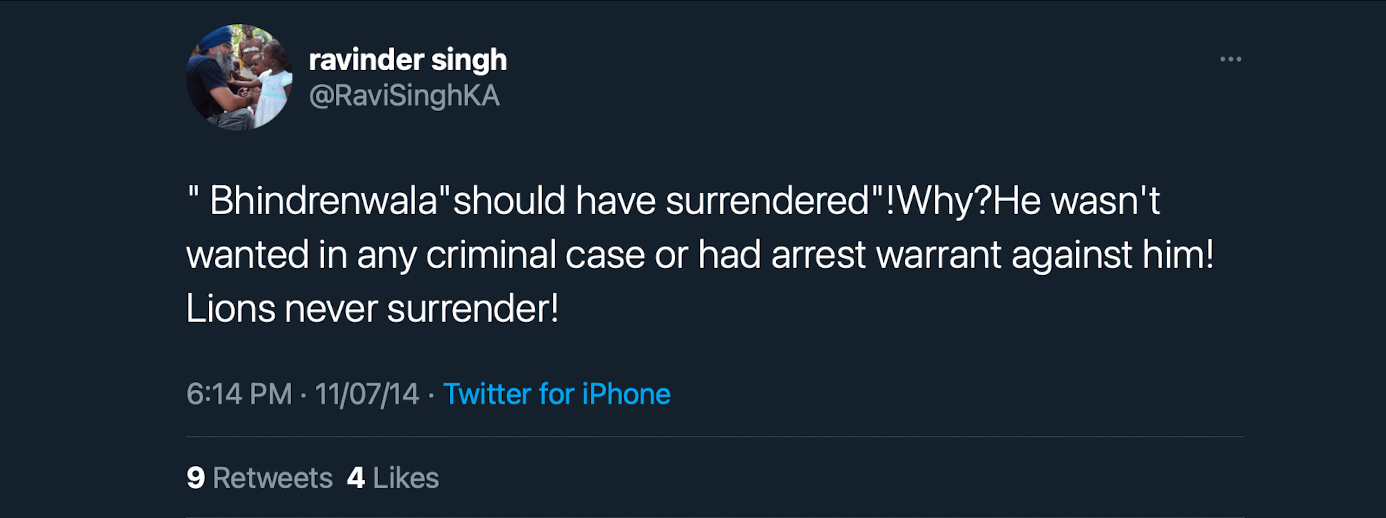
The CEO of Khalsa Aid has on more than one occasion exhibited his Khalistani proclivities, taking up the cudgel for Khalistani terrorist Jarnail Singh Bhindranwale and proffering flimsy arguments to allege that he was not a terrorist. Following Barkha Dutt’s interview with Deep Sidhu, Singh alluded that journalists are uneducated and misled to call Bhindranwale a terrorist because he did not have any outstanding warrant against him.

Source: Twitter

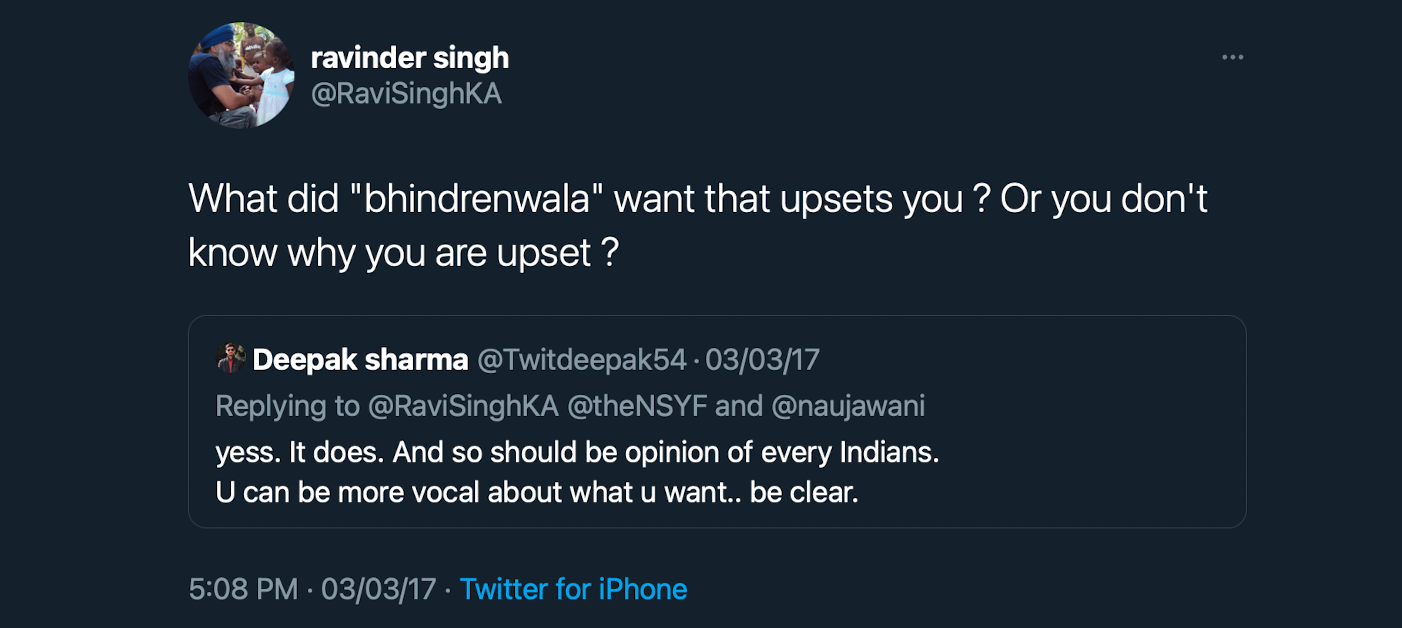
In fact, Singh’s support for Bhindranwale is not a new phenomenon. Over the years, he has been diligently supporting Bhindranwale while attempting to discredit those who raise questions over Bhindranwale’s link to Khalistani terrorism.

Source: Twitter
Source: Twitter

Singh even hailed Bhindranwale as a “Lion”, trotting out the same hoary platitudes that he has been mouthing off for years that Bhindranwale has no criminal case or had an arrest warrant against him that lions do not surrender.

Source: Twitter

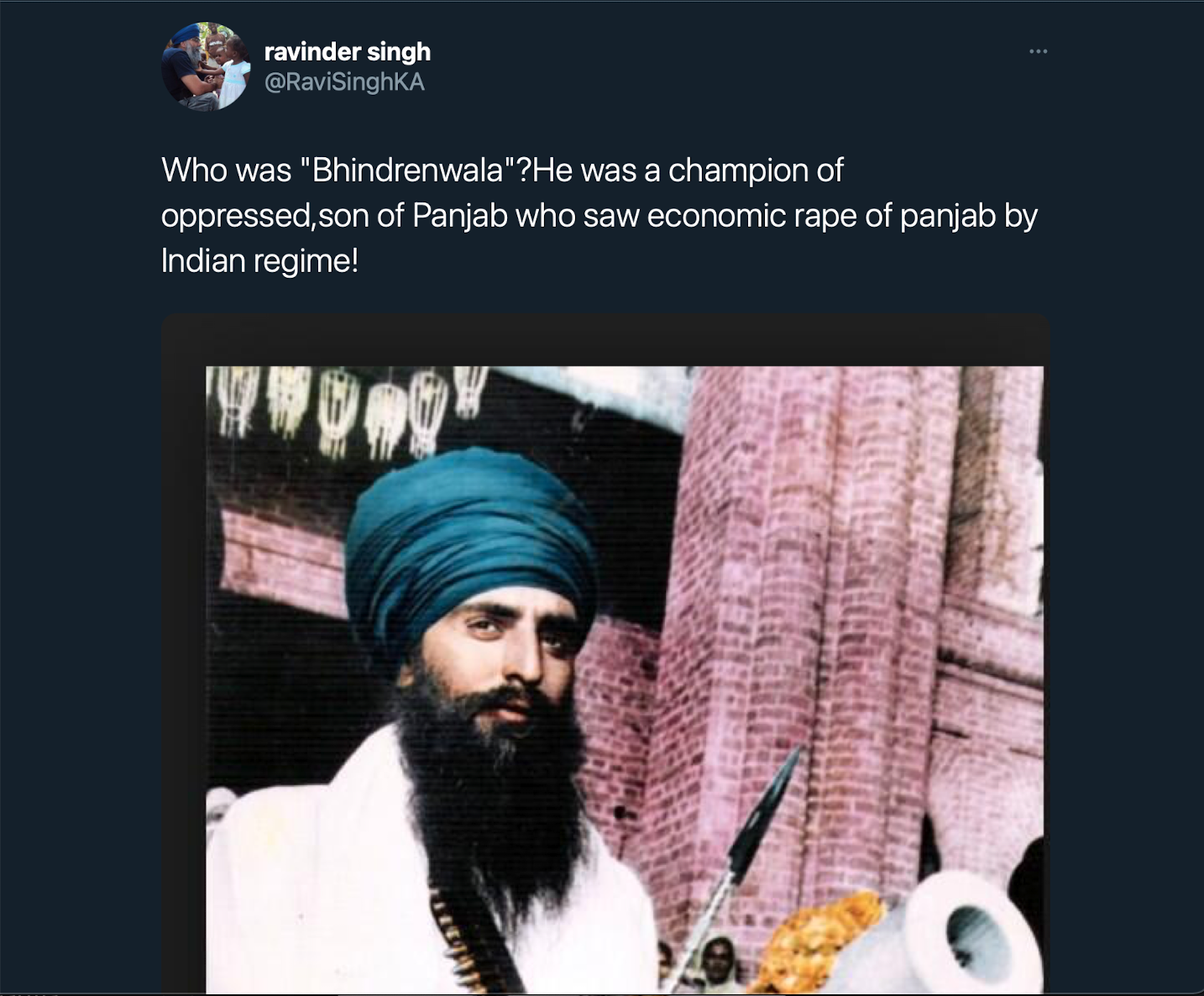
In one other tweet, Singh had glorified Jarnail Singh Bhindranwale as a “son of Punjab” and “champion of oppressed, and who witnessed the “economic rape of Panjab by the Indian regime”.

Source: Twitter

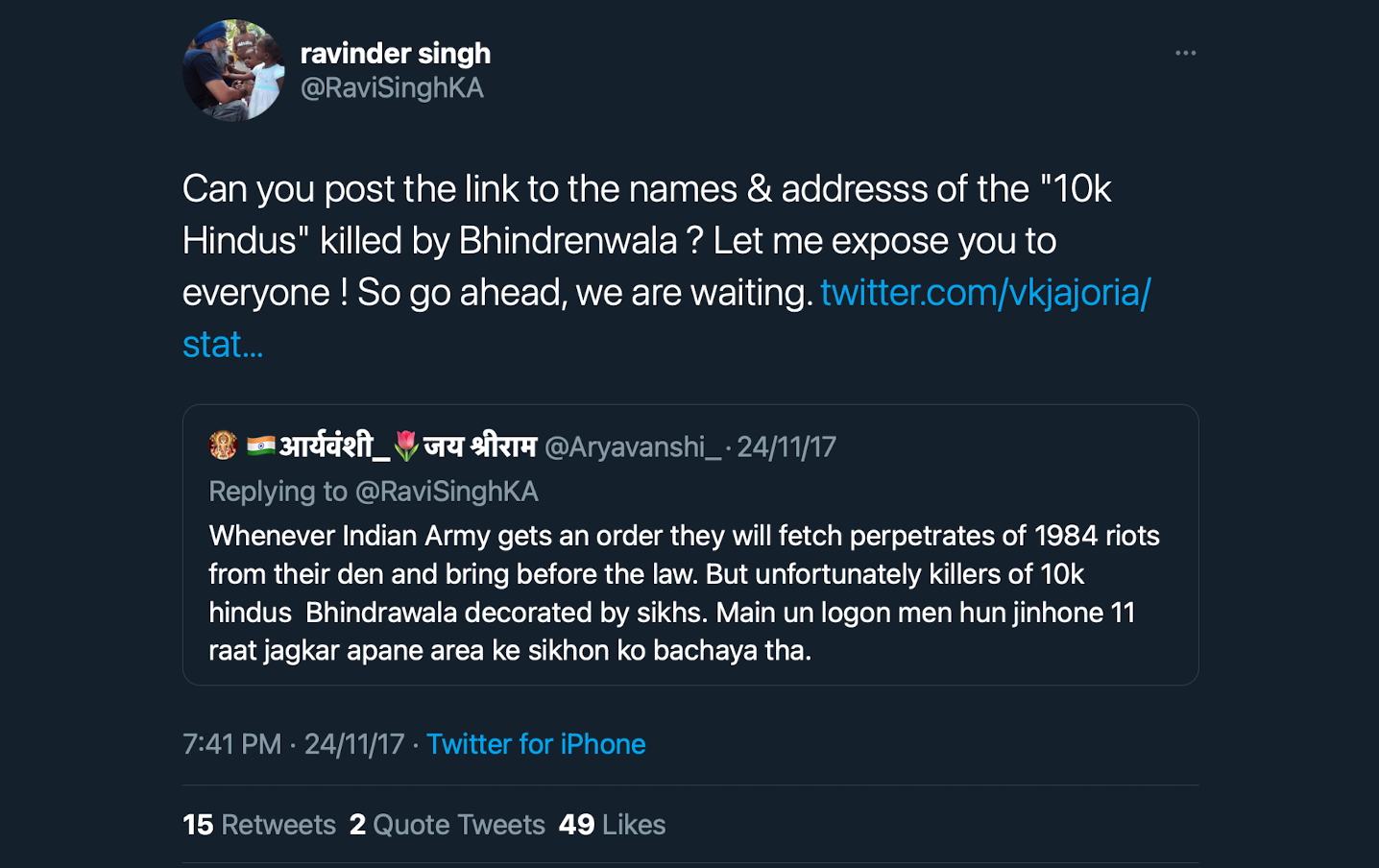
Contrary to facts, Ravi Singh believes RSS was involved in 1984 anti-Sikh genocide

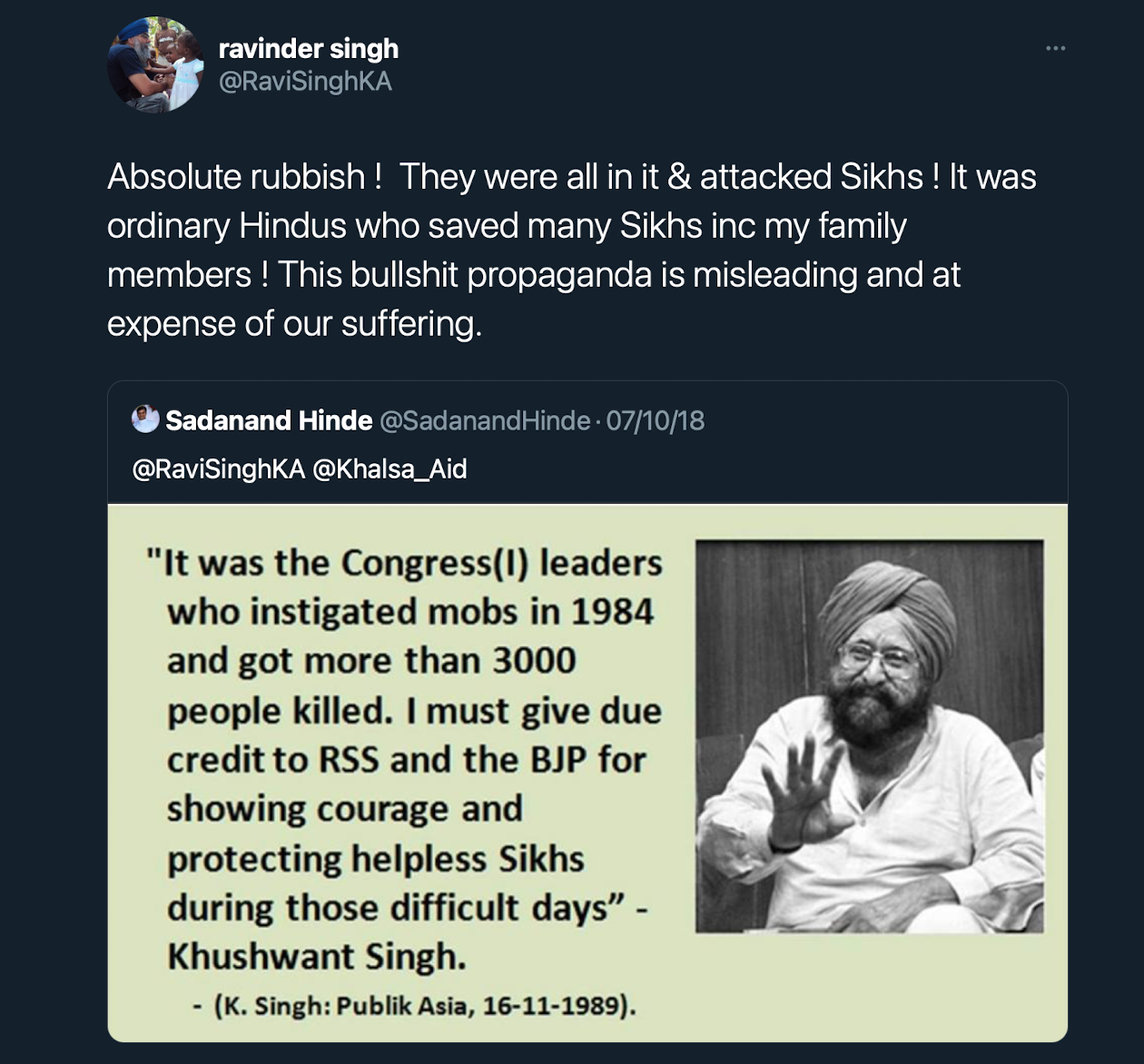
Bhindranwale even also holds grouse for RSS being credited for saving Sikh lives during the anti-Sikh pogrom presided over by the Congress leaders and their supporters in 1984 following the death of the former PM Indira Gandhi. Counterintuitively, Singh believes Sikhs were saved by ordinary Hindus while alleging that RSS members were in cahoots with the Congress leaders in perpetuating the atrocities against Sikhs.

Source: Twitter

Khalsa Aid CEO Ravi Singh comes out in support of Pakistan after Nankana Sahib stone-pelting incident

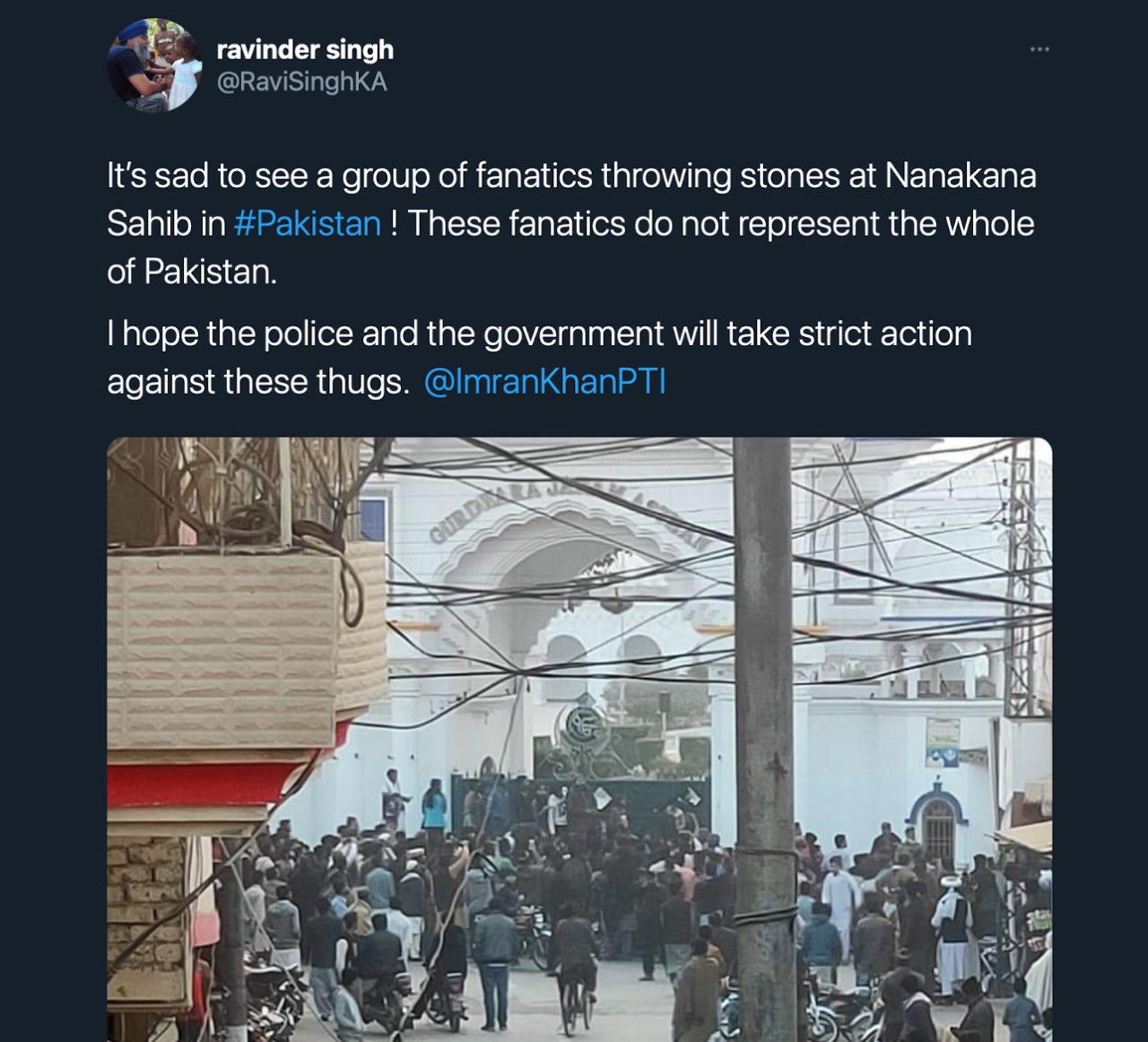
Earlier this year, the Sikh shrine of Nankana Sahib came under attack from bigoted Pakistanis, led by the family of a boy who had allegedly abducted the daughter of an official of the gurdwara in August last year and forcefully converted her.

Singh was at the receiving end of social media fury when he casually asked “What is the situation at Nankana Sahib? Was there a mob of fanatics throwing stones at the Gurdwara Sahib”? Later, Singh took to Twitter to whitewash the atrocities meted out to Sikhs in Pakistan, stating that a few fanatics do not represent the whole of Pakistan.

Source: Twitter

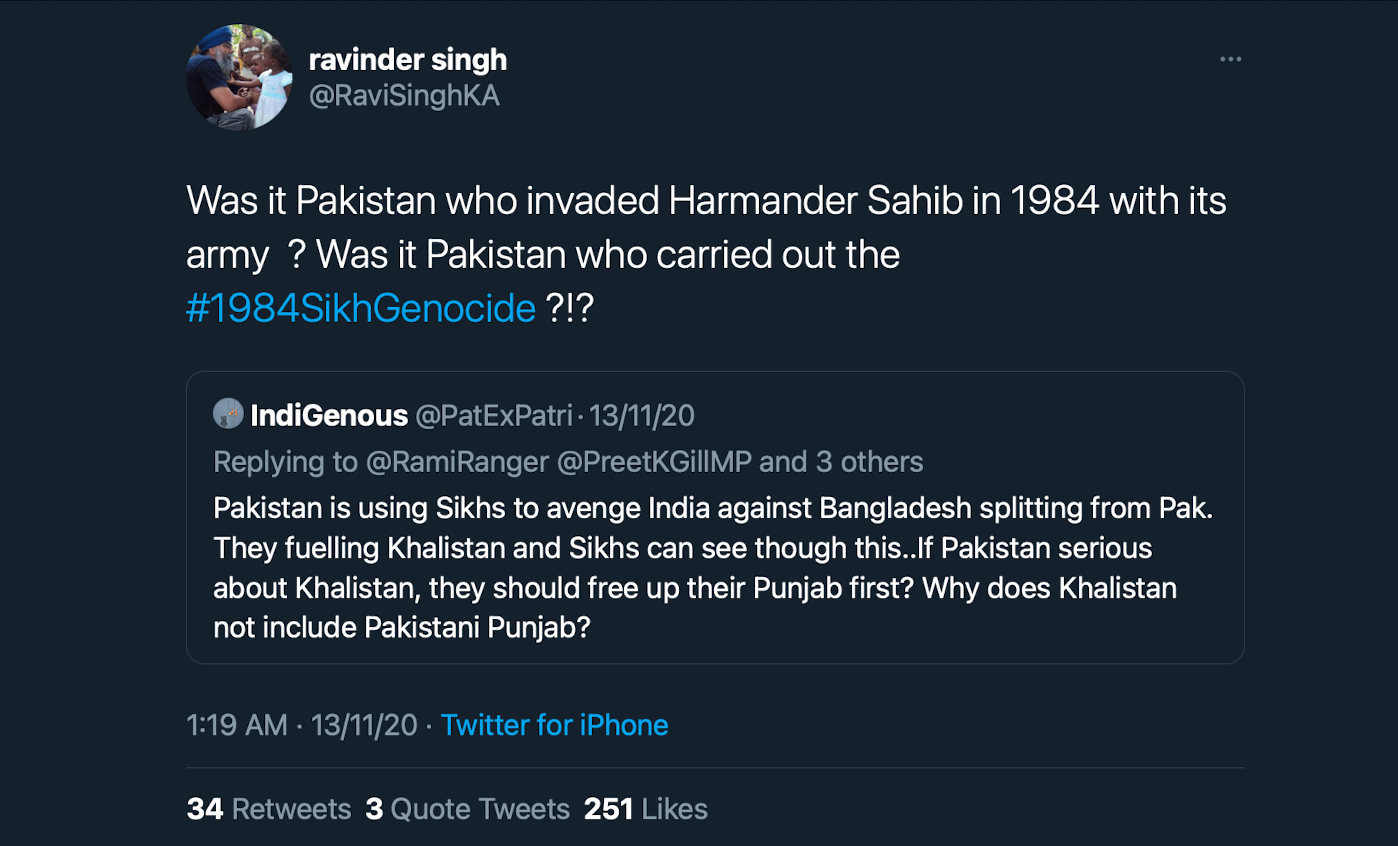
In a separate incident, when one of the Twitter users stated that Pakistan is using Sikhs to avenge its dismemberment of erstwhile East Pakistan, Singh once again came out in support of Pakistan, glossing over their role of instigating Sikhs against India by highlighting a disconnected case of invasion of Harmander Sahib in 1984.

Source: Twitter

Singh opposes construction of Ram Temple in Ayodhya

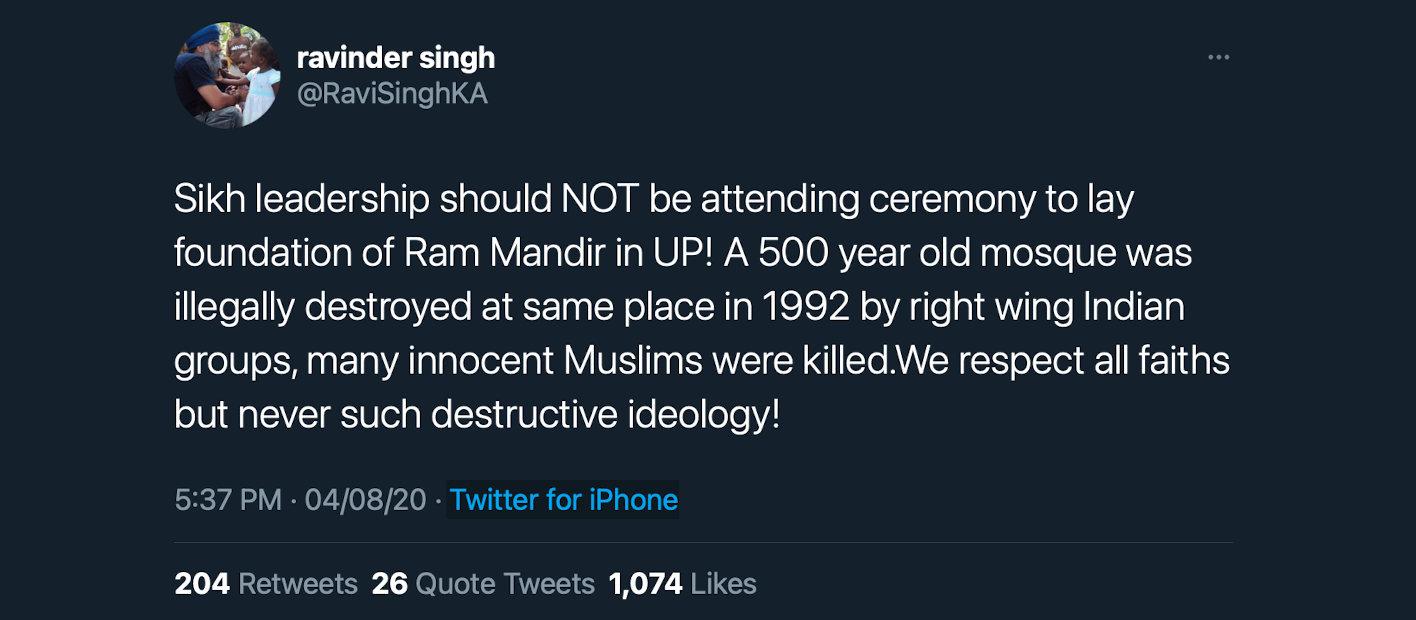
A day before the Bhoomi pujan of the Ram Temple was organised in Ayodhya this year, the Khalsa Aid leader Ravi Singh had taken to Twitter to spew venom against Hindus and oppose the construction of the temple that has the legal imprimatur of the Supreme Court of the country.

Source: Twitter

In his tweet, Singh urged the Sikh leadership to not attend the ground-laying ceremony and alleged that a 500-year-old mosque was legally destroyed at the place by right-wing fanatics in 1992 and termed Hindutva as a “destructive ideology”.

Singh maligns the Indian Armed Forces, accuses them of murdering Sikhs in fake encounters

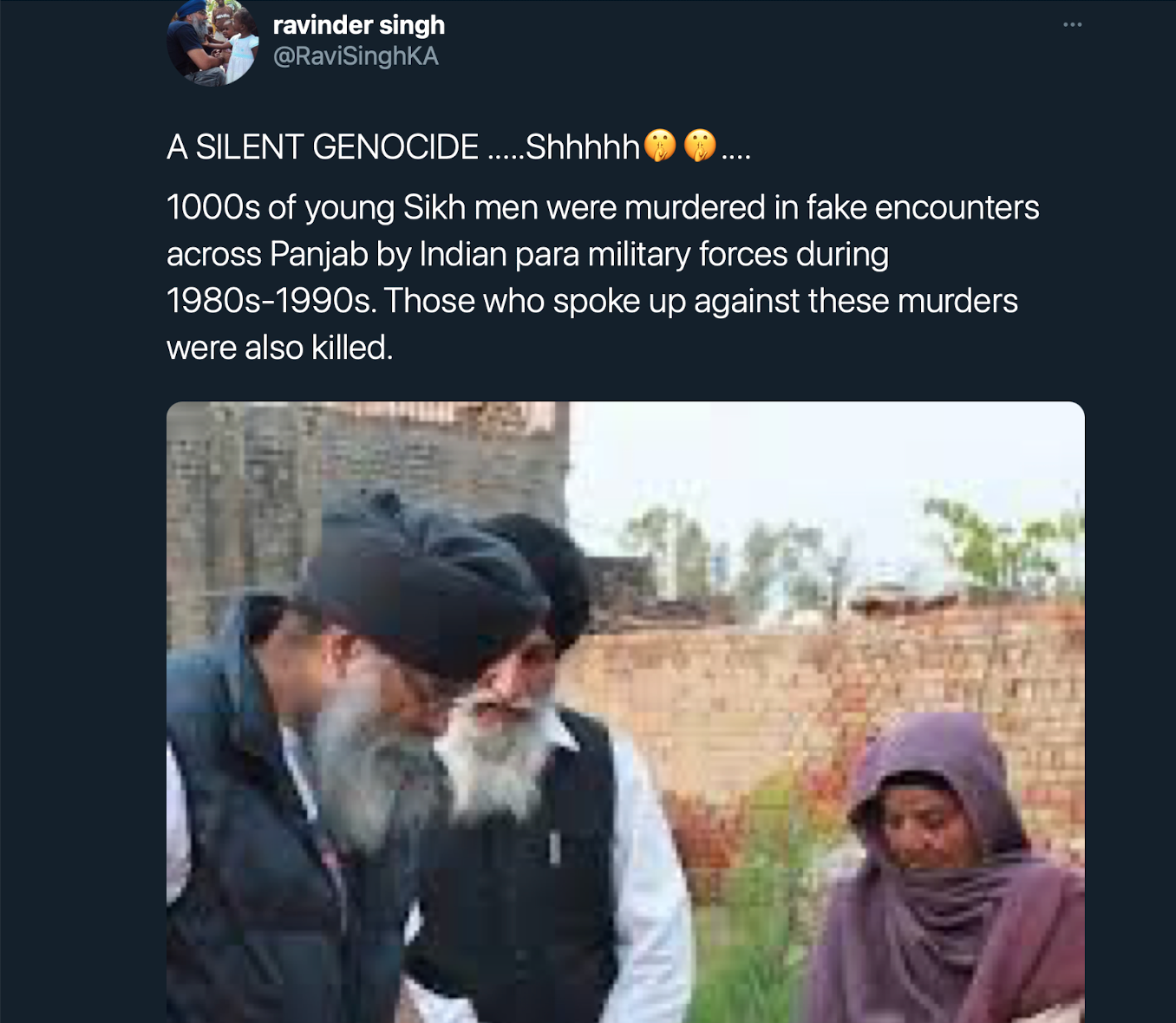
Singh, who is now extending “humanitarian aid” to the protesters creating ruckus along the Delhi borders, had in the past also maligned the Indian Paramilitary forces, making slanderous and unsubstantiated allegations against them.

Source: Twitter

Sikh preposterously claimed that 1000s of Sikh youths were murdered in fake encounters by the forces and those who spoke of the genocide were also killed.

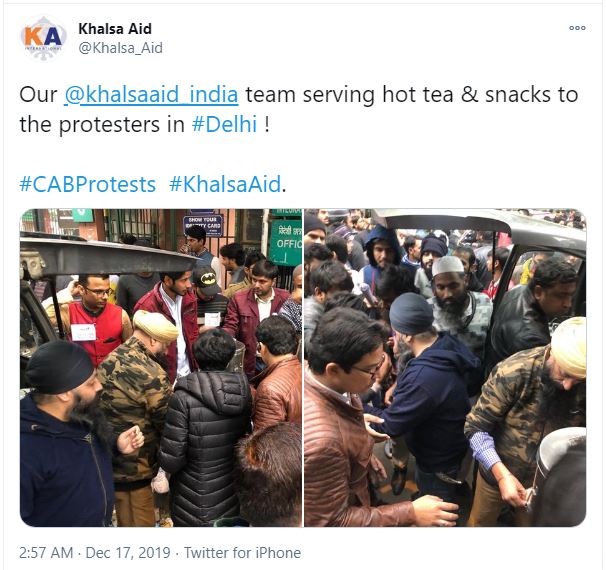
Khalsa Aid served tea and snacks to rampaging anti-CAA protesters

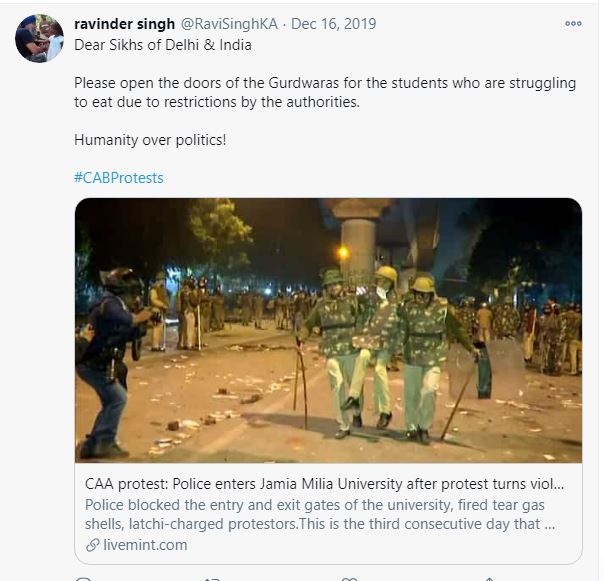
When the anti-CAA protests swept large swathes of northern India, especially the capital and Uttar Pradesh, Singh had extended his support to the protesters at the Jamia Millia Islamia who had indulged in vandalism, arson and stone-pelting under the pretext of carrying out peaceful protests against the Citizenship Amendment Act.

Source: Twitter

Singh had urged Gurudwaras to open their doors to the anti-India brigade that was bent on fomenting unrest.

Source:Twitter

The volunteers of Khalsa Aid were also seen serving snacks and tea to the protesters in Delhi who were demonstrating against the Citizenship Amendment Act.

From supporting Khalistani terrorism, defending Jarnail Singh Bhindranwale, to swindling money in the name of fund-raising, railing against the construction of Ram Temple in Ayodhya, defaming the Indian Armed Forces, and coming out in support of Pakistan, Khalsa Aid International and its CEO Ravi Singh have their hands in an array of anti-Indian activities.

Their association with the ongoing farmers’ protest in the country not only discredits the protests but also betrays that behind the facade of demonstrations, lies an ulterior motive of fomenting trouble in the country to undermine the Modi government.

How Newslaundry cheered ‘death to Modi’ song by ‘farmers’ out of hate, and soon realised it will expose their propaganda

A distasteful video ‘Modi marr jaa tu‘ has gone viral on social media where communist leaders masquerading as farmers were seen chanting death chant for PM Modi. OpIndia received this video through a tweet shared by a source. The same video was shared by BJP IT Cell head Amit Malviya.

With very little details available on the video, OpIndia tried to find out the source. For this, we checked out the tweet we had received. It was shared by an employee working with propaganda website Newslaundry.

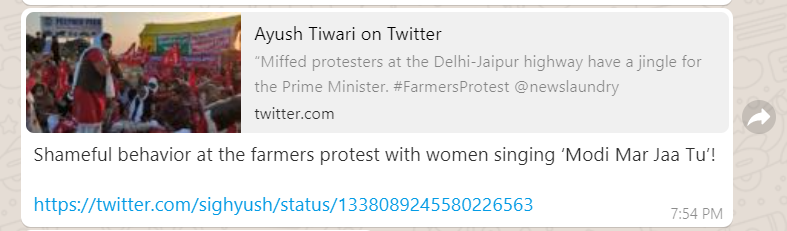
Ayush Singh’s tweet received by this reported via WhatsApp

As one can see from the accompanying text that the Newslaundry employee used “Miffed protestors at the Delhi-Jaipur highway have a jingle for the Prime Minister”, Singh shared it with much glee and thought a death wish for the Prime Minister of a country was just a ‘jingle’ and a ‘normal’ thing to do. Singh portrayed these blood-thirsty women chanting death upon PM Modi as ‘miffed protestors’ who were singing a ‘jingle’.

Hate-filled slogans at “farmers’ protests”

The so-called farmers have on more than one occasion come up with pro-Khalistan and pro-Islamist slogans. In fact, some ‘farmers’ also boasted how they had once killed Indira Gandhi, they could also kill PM Modi. The same was justified by Yograj Singh, actor and father of cricketer Yuvraj Singh. In fact, he even went on to humiliate the Hindus.

Newslaundry also retweeted Singh’s tweet, following which it started getting some traction. However, not many appreciated. People could see that it betrayed the hate that certain sections of the media has for the Prime Minister and BJP supporters in general.

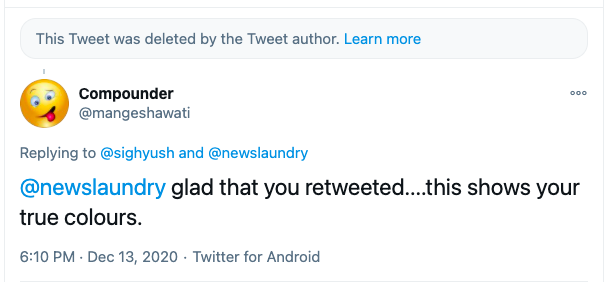
Reply to Ayush Singh’s tweet

However, soon after his tweet started getting traction he quickly deleted it.

As one can see, the reply to Singh’s tweet came way before Malviya’s tweet which came little after 6:30 PM.

Once the video shared by Malviya started gaining traction, Singh perhaps realised he subconsciously exposed the communists masquerading as farmers. Which is why he perhaps deleted the tweet.

Perhaps this also explains why many journalists too have earlier wished death to PM Modi. A columnist with Shekhar Gupta’s ThePrint had wished PM Modi gets assassinated. Times Now journalist, Prashant Kumar, had also wished for the assassination of Modi.

Similarly, Suprateek Chatterjee, a columnist with The Quint had also tweeted death wish on Modi. That is not the only time The Quint has given a platform to people who go upon wishing death and political assassination. Vikas Malhotra, an author at The Quint, too preferred political assassination (of PM Modi) to create history. 

Grooming Jihad: Shoyab Khan became ‘SK Sinha’ to entrap minor Hindu girl using social media, abducted and forcefully married her

0

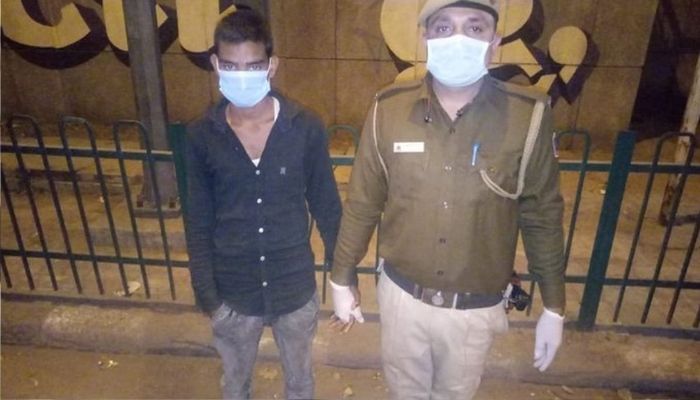
A day after the Delhi police apprehended an 18-year-old man named Shoyab Khan on serious charges of impersonation, kidnapping and forced marriage of an underage girl, new details have emerged in connection to the case. The case is an addition to the already worsening situation of ‘Grooming Jihad‘ wherein sections of radical Muslims specifically target non-Muslim women hiding their own identities.

As per reports, Shoyab is a resident of Mewat in Rajasthan. He used to befriend girls on Facebook under the pseudonym of SK Sinha. The accused sent a friend request to the 15-year-old victim in July 2019. They would chat frequently on Facebook. On October 22 this year, he travelled to Delhi and forced the underage girl to marry him.

Shoyab abducted the victim and took her to Muzaffarpur in Bihar. They then stayed at his friend’s place for a day, before moving to Azamgarh in Uttar Pradesh. The victim’s father filed a complaint with the Rajouri Garden Police after the girl went missing. The police began their investigation and found that the name of SK Sinha featured in messages frequently after they analysed call details and social media accounts of the girl, including Facebook.

Minor girl rescued after 46 days

On further probe, the cops found that the account was created by one Shoyab Khan in Alwar district of Rajasthan. A police team raided the village in Mewat and found that the accused and his family were on the run from the law enforcement authorities.

The cops had launched a manhunt to nab the accused. The investigative officials analysed CCTV footage and examined over 300 auto-rickshaw drivers. The girl was rescued following 6 hours of door-to-door inquiry by ASI Sanjeev, SI Prakash Kashyap and Head Constable Shaukat Ali. The girl has been handed over to the family after 46 days.

Shoyab Khan booked for abduction, criminal conspiracy

It has come to light that the accused had reached the Faridabad metro station on October 26 and boarded an auto from Faridabad to Badarpur. He, however, abandoned the victim in the vehicle and fled. Based on Intelligence data gathered by Ali, Khan was apprehended from Badarpur. He has been booked for the abduction and criminal conspiracy. The police informed that charges of rape will be pressed, based on the statement of the victim to the Child Welfare Commission and her medical examination results.

Grooming Jihad on the rise

In another such case, a minor victim was lured by one Golu Khan by posing as a Hindu and ultimately forced her to convert to Islam and perform Nikaah with him. He went to the extent of wearing a Tilak and Kalawa in order to make his presence as a Hindu more convincing.

In another case, a minor girl from Ballia was lured by Imran after hiding his religion. He managed to elope with the girl but her relatives with help from relatives managed to track them down. He was arrested by the Police in the end and a case was registered against him under relevant sections of the IPC. In yet another case, a Muslim man engaged in a relationship with a Dalit Hindu woman by posing as a Hindu and later, told her that she had to convert to Islam if she wished to get married.

Dhulagarh riots: When police remained complacent with Muslim mobs ransacking Hindu homes in West Bengal

0

It has been four years since the small town of Dhulagarh in West Bengal witnessed one of the horrifying episodes of communal violence. The day was December 13, 2016. It was the occasion of Eid Milad-un-Nabi (the birthday of Prophet Muhammad).

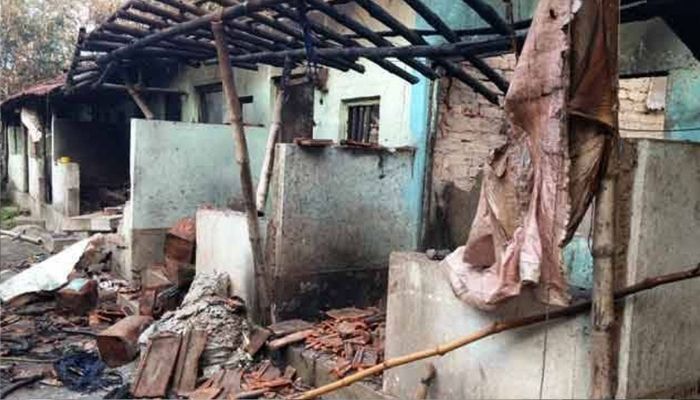
On the fateful day, a large group of Muslims took out a procession to commemorate the day. They alleged that the procession was stopped and stones were pelted at them near Annapurna Club at Dewan Ghat. And thus followed a tale of violence and arson. The Muslim mobs went on a rampage, forcing local Hindu families to flee the town.

The Islamist mob specifically targetted the Hindu-dominated Pollepara and Banerjeepara localities. They hurled country-made crude bombs at Hindu homes, looted the houses for cash and jewellery and later set them on fire. And the carnage continued unabated, despite police deployment. It is pertinent to remember that Dhulagarh is located just 25 km from the State Secretariat, Nabanna, in Howarth.

Hindus recount the horror of Dhulagarh riots

A local Hindu, Lakshmi Mallya narrated, “Nothing is left. We are looted of all our belongings. They (Muslims) ransacked and vandalised our houses and eventually set them on fire. We could not save a single penny from our houses, only managed to save our children and ran for life.”

Another Hindu man, Manna, whose house was vandalised by the rioters lamented, “We can’t live here anymore so we have taken shelter in our relatives’ place. Police came that day but when we were attacked even the cops ran away.” He is a barber by profession and runs a family of three. His wife, Seema, said that the Muslim mob stole ₹65,000 cash and a laptop that they had bought for their son.

A 32-year-old woman, Subhra Khanra, had to flee her house and take refuge in the local temple, after the mob ransacked her house, stole jewellery and set it ablaze. She said, “They were carrying petrol and kerosene in drums and had come fully prepared. After looting our jewellery and money they set everything else on fire. Where will we go now?”

Police stood as mute spectators, recounted Hindu victims

While speaking to India Today, another victim, Maitri Mondal informed that she had heard the violent mob yell ‘Pakistan Zindabad’. They entered her house and set it on fire. Her son, who was to appear for board exams in February of 2017, had his books converted into ashes. She narrated how the police did not do anything when the rioters went on a rampage. “For five hours, they created mayhem and the police came when everything was lost. Not a single minister has visited us yet,” Mondol lamented.

Another Hindu man, victimised by the Dhulagarh riots, stated, “When the police came, we were told to leave our houses in two minutes! They didn’t even stop the mob from vandalizing our homes. They kept looting and burning as the police stood as silent spectators.” Although the police had registered cases of rioting and arrested 65 people, the victims of the violence and the Opposition BJP had questioned the role of police in preventing the damage.

Muslim appeasement by Mamata Banerjee

The Trinamool Congress has often faced social media backlash for its Muslim appeasement and blatant attempts to trivialise and downplay atrocities against Hindus in the State. She had denied any instance of rioting in Dhulagarh and blamed social media for rumour mongering.

“In the last 15 days, social media is running wrong information on an incident which did not take place at all…In order to break a news, one must not act irresponsibly. If something has really happened then you (media) have every right to report but I think a field survey must be conducted,” she had claimed. This was despite the fact that the government had already announced a compensation of ₹35,000 for the victims and the process of disbursement had begun.

While being well-aware that the perpetrators belonged to the Muslim community, Mamata Banerjee restricted coverage of the incident by the media. The TMC government restricted the entry of media persons in Dhulagarh and even filed a First Information Report (FIR) against three employees of Zee News, including Sudhir Chaudhary for supposedly promoting ‘enmity’ between communities. It must be mentioned that Zee News was the first to uncover the incident.

Law and order situation in west Bengal remains unchanged

It has been 4 years since the Dhulagarh riots. However, the law and order situation, under the Mamata Banerjee regime, has shown little to no improvement. In May this year, shocking visuals of Telinipara, where communal clashes took place, after Hindu houses were set on fire had gone viral on social media.

Locket Chatterjee, BJP MP from Hooghly took to Twitter to inform that while she tried to call the CP of Chandannagar Police, Dr Humayun Kabir, he did not take her calls. She alleged that the West Bengal state administration had been a mute spectator as Telinipara burned. She further stated that she was prevented from going to Telinipara amid allegations of widespread communal violence and looting wherein police also facilitated perpetrators.

Victimisation of Hindus continue from Dhulagarh to Delhi

However, nothing seems to have changed since the Dhulagarh riots. The conscience of India is still shaken with the scars of the recent anti-Hindu riots of Delhi, wherein Muslims mobs went on a rampage, killing 52 people. The visual imagery of Mohammed Shahrukh Pathan intimidating a police officer and the horrifying image of IB officer Ankit Saxena’s hand sticking out a ditch sends chills down the spine. While the Delhi police swung into action and contained the orchestrated riots within 2 days, the same wasn’t true for the ill-fated Hindus of Dhulagarh.

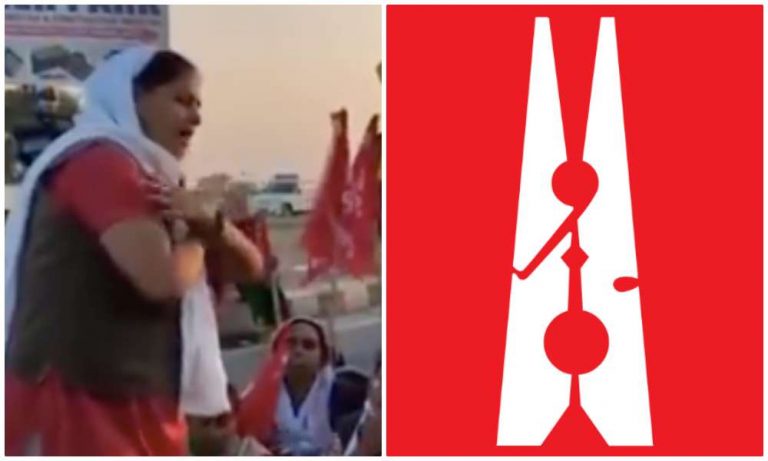
Watch: Left Front’s farmer wing asks PM Modi to die at farmer protests, sings ‘Modi mar jaa tu’

Protesters at the ‘farmer protests’ have been making some extremely problematic comments and statements throughout. Apart from individuals such as Yograj Singh who have made hate speeches at rallies, others have also made controversial comments. Now, a video is doing the rounds on the internet where protesters can be heard in a song asking Prime Minister to die.

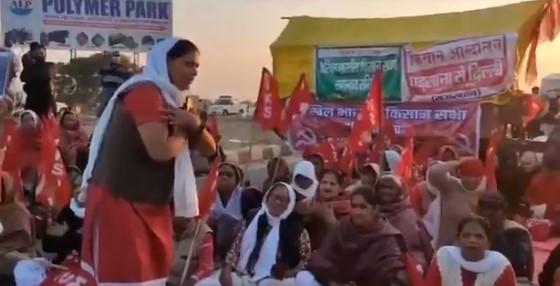
It is not clear where the video was captured. But a banner of the All India Kisan Sabha (AIKS) with the Communist hammer and sickle in the background can be spotted. The AIKS is a a Left front organisation with two factions, one associated with the Communist Party of India and the other with Communist Party of India (Marxist).

The women protesters can be heard singing ‘Modi mar jaa tu’ with lines that go ‘Desh bech ke kha gaya, Modi mar jaa tu’ (You have sold the country, Modi, go die). We cannot confirm when the video was captured. But there is a banner at the back which says Gharsana to Delhi. Gharsana is in Rajasthan.

Farmer protests has leaders with Naxal sympathies

IANS reported that the Ekta Ugrahan of the Bharatiya Kisan Union (BKU-Ekta Ugrahan) is the largest represented group at Delhi’s borders. Almost two-thirds of those gathered there are reported to be their members. It is the same group calling for the release of ‘Urban Naxals’ involved in the Elgar Parishad case and Islamists arrested in the Delhi Riots case.

Lawyer and coordinator of BKU, N.K. Jeet is reported to have said on December 10, “It is our conscious decision to support these accused. The Naxal movement was always a farmers’ movement all over India. Releasing these accused is a demand of the BKU. We made it part of the memorandum to the government related to the farm laws.” He had also reportedly said, “Naxalism has helped the tribal people claim their rights.”

Hundreds sick but refuse Coronavirus tests

Hundreds of protesters participating in the ‘farmer protests’ at Singhu Border could be infected with the Wuhan Coronavirus. They are sick but they have refused to take the test for the virus. Authorities are worried that there might be many asymptomatic carries present at these protests. The exact number of protesters that are sick is not known but unofficially, the number is pegged at 300.

Deputy Commissioner Sonipat, Shyam Lal Punia, said, “We have set up two Covid-19 counters at Singhu Border and are regularly screening the protesters. Ten teams of doctors and paramedical staff have been deployed. An average of 70 to 90 people are visiting us every day who have been diagnosed with fever, muscular pain, or increased blood pressure.”

“We are regularly monitoring the situation. The patients are not ready for the Covid-19 tests. We distributed 50,000 masks but they are neither following the social distancing nor wearing the masks. The senior citizens say Covid-19 is nothing,” he added.