Home Blog Page 66

Pentagon’s report on China’s military developments: What it means for India’s LAC stand, Pakistan front and the future of warfare. Read details

The recently published ‘Report to Congress on Military and Security Developments Involving the People’s Republic of China (2025)’ by the U.S. Department of Defence, which was required by Congress, provides an organised overview of how Washington evaluates China’s strategy, force modernisation, and operational preparedness, particularly for high-level conflict in the Indo-Pacific. The report’s framing is crucial; it contends that the PLA is preparing for a strong enemy (the United States) and is constructing a whole-of-nation strategy Beijing refers to as ‘national total war,’ with the First Island Chain serving as the immediate strategic centre of gravity while simultaneously pursuing global power projection.

Some documents define a nation, while others describe a trajectory. The Pentagon’s most recent congressionally mandated assessment of China’s military and security advancements is the latter. The basic assertion of the paper is straightforward: China is developing the PLA into a tool of national power intended not only for Taiwanese emergencies but also for a broader, long-term capacity to compel, discourage, and, if necessary, engage in combat across a variety of spheres.

From an Indian standpoint, this report is valuable not because it discovers China’s ambitions, we have witnessed them at sea and at the LAC, but rather because it unifies the following (1) China’s push for regional military dominance (2) its growing network of overseas access points and logistics (3) its accelerating nuclear and missile posture (4) its maturation of cyber and information warfare and (5) a persistent Pakistan lever that Beijing can use to complicate India’s deterrence calculations.

Beijing’s on a deadline

The Pentagon reiterates that Xi Jinping has instructed the PLA to be able to accomplish important goals by 2027 often associated in U.S. assessments with a Taiwan contingency and presents this as a component of Beijing’s larger strategy to alter the regional balance. The report also emphasizes that U.S. and ally operations in the Western Pacific are seriously threatened by China’s expanding missile weapons, which are capable of holding targets at long ranges. 

The immediate conclusion for India is not that Taiwan equals a distant problem. It is that even though the centre of gravity is still in the East, the same set of capabilities, ISR (Intelligence, Surveillance, Reconnaissance), precision strike, integrated air defence, long range fires, cyber, space support, and logistics can be used in a variety of theatres, including the Indian Ocean and the Himalayas. In other terms, China is assembling a toolbox. India sits awkwardly near a number of the nails.

The LAC and Arunachal Pradesh: Stabilise the border, cap India’s partnerships

One of the most India-relevant parts in the report is about diplomacy on the Line of Actual Control, not missiles or ships. The Pentagon points out that just prior to a meeting between Xi and Modi at the BRICS summit in October 2024, India and China announced an agreement to disengage from remaining standoff sites along the LAC. Monthly high-level discussions on border management and limited normalisation initiatives followed. The report’s assessment is instructive that India is still sceptical and mutual mistrust continues to limit the connection, while China probably wants to take advantage of lower tensions to stabilise bilateral relations and stop USA-India ties from growing. 

This is a classic Beijing strategy, drop the temperature just enough to lessen external balancing against China while maintaining the underlying pressure points that generated the crisis in the first place. The conclusion for India is that while calm along the LAC might be strategically beneficial, it can also be perilous if it leads to complacency in infrastructure, force posture, surveillance, or alliance/partnership momentum.

A relevant mental model is that China does not require the LAC to remain heated in order for it to function as leverage. When China constructs roads, communities, logistical hubs, ISR, and airfields along a peaceful border, it may still deploy new normal disinformation to portray Indian countermoves as escalating.

The logic of the Pentagon report makes Arunachal Pradesh, the silent pivot of this whole competition, much more crucial. China’s persistent attempts to challenge India’s sovereignty in this area (by renaming locations, sending signals akin to stapled visas in the past, and promoting maximalist historical narratives) are more than just ‘propaganda,’ they are preparations for coercion. Gaining influence in Arunachal doesn’t require the PLA to start a war. In order to raise the political cost of India’s regular governance (infrastructure, tourism, elections, investment), it can employ calibrated pressure, such as patrol intrusions, infrastructure buildup across the border, abrupt exercises, airspace assertions, and information campaigns. 

According to the Pentagon report, China aims for ‘strategic deterrence and control’ over neighboring countries while maintaining pressure below open conflict. This makes Arunachal an ideal arena because it has high symbolic value for Beijing, high emotional and territorial stakes for India, and a location where China’s enhanced ISR, logistics, and rapid-mobilization capabilities can be used to signal escalation dominance without necessarily crossing thresholds. 

Treating Arunachal as a core state rather than a ‘frontier’ would be the proper course of action for India. This would entail strengthening persistent surveillance and counter-drone layers, accelerating road, bridge, and airfield resilience, and promoting a diplomacy plus development narrative that prevents Beijing from depicting the state as “disputed” in international discourse. 

The Pakistan angle: China’s second front

Pakistan is the other pressure axis if the LAC is one, and the study offers a relevant actual data point, China’s J-10C (fourth-generation aircraft) shipments. According to the report, as of May 2025, China has supplied Pakistan with 20 J-10C units, which are said to be its only J-10C exports. These units were connected to two earlier orders totalling 36 since 2020. That transfer isn’t symbolic. When combined with contemporary air-to-air missiles, sensors, and data linking, it represents an operational enhancement of Pakistan’s capacity to challenge airspace and endanger valuable assets. 

Pakistan’s advantage was linked to situational awareness and an integrated sensor to shooter chain using Chinese origin systems, with J-10C fighters and long-range missiles playing a crucial role, according to Reuters reporting surrounding the May 2025 India-Pakistan air battle. The strategic significance for India is evident even in cases where Pakistan’s claims were made up and greatly exaggerated: China’s military-industrial ecosystem can quickly improve Pakistan’s deterrence toolkit, and Pakistan can act as a technical, tactical, and narrative testing ground for Chinese systems.

The narrative component is no longer an afterthought. According to a Reuters article on the findings of the US-China Economic and Security Review Commission, China launched a campaign to disparage the French Rafale following the India-Pakistan conflict, enhancing imagery and language aimed at marketing Chinese weaponry while undermining the reputations of Western platforms. India should interpret this as part of a larger trend, information operations as a combination of alliance disruption, export promotion, and deterrent shaping.

Connect this to the Pentagon report’s findings regarding China’s cyber posture, which include ongoing intrusion activities, pre-positioning in vital infrastructure, and a readiness to utilize cyber impacts to interfere with crisis logistics and decision-making. The ‘Pakistan angle’ for India encompasses more than just jets and weapons. Additionally, there is a chance of coordinated pressure, such as maritime signaling in the Indian Ocean, cyber and information pressure throughout the country, and kinetic threats along one axis, all of which are intended to divert India’s focus and complicate mobilization choices. 

The ‘STRING’ is less about bases, more about usable logistics

China’s foreign policy is still frequently described in Indian commentary as a spectacular ‘string of pearls’ map. The report offers a more pragmatic perspective, focusing on what China can truly accomplish with international access now and what it is developing to do in the future.

The Pentagon adds that the PLA Support Base in Djibouti has not helped noncombatant evacuations or the ongoing Red Sea crisis; instead, it has facilitated a permanent regional presence under counter-piracy framing and is increasingly supporting military diplomacy. That statement is significant because it suggests Beijing is still learning how to convert base ownership into full-spectrum operational utility, including collaborative planning, allied interoperability, logistics, repair, medical, and crisis response. To put it in Indian terms, China’s foreign policy is genuine but not yet smooth. 

Regarding Cambodia, the report mentions the opening of the Joint Logistics and Training Center at Ream Naval Base in April 2025. While both sides will retain vital personnel for operations, official claims regarding training and humanitarian missions and denials regarding permanent basing are noted. Texture has been added by independent reporting and analysis: While highlighting ongoing international concerns and the symbolism of increased facilities, the AP reported on Cambodia’s public claim that Ream is not exclusive. The Diplomat looked at the improved infrastructure as well as the unanswered questions regarding the scope of China’s privileged access, including suggestions that some facilities might be functionally exclusive. 

Ream doesn’t scare India because it is ‘encircled’ by a single port on the Gulf of Thailand. It is significant because it is an additional phase in a larger Chinese initiative to establish several nodes that shorten PLA operational distances, extend time on station, and normalize presence in areas linked to India’s maritime alliances and commerce lines. 

And this is where the Pentagon study becomes awkwardly direct: it mentions a number of nations, including Pakistan, in which China is evaluating military access for potential future development (along with locations like Burma, Thailand, Sri Lanka, UAE, and others). India’s western seaboard and Arabian Sea calculations would be altered if China were to obtain even restricted, rotating, logistics only access in Pakistan that could be used in times of crisis, especially when combined with Pakistan’s own naval modernization and China’s submarine expertise. 

China’s capability that affect India: missiles, nuclear posture, cyber and maritime power

Nuclear and Missile trajectory: According to the report, China’s stockpile of nuclear warheads was in the ‘low 600s’ until 2024, but it is still expected to surpass 1,000 by 2030. Additionally, it details an open ocean launch of an unarmed DF-31B ICBM in September 2024 and implies that China is creating early warning and counterstrike strategies similar to launch on warning logic. The estimate that China most certainly loaded more than 100 DF-31 class ICBMs into silo fields, a sign of accelerated nuclear modernization was noted in Reuters’ coverage of the study.

This should not be interpreted by India as China is suddenly targeting India, but rather as (1) China’s strategic forces are growing in ways that boost confidence and escalation options and (2) increased Chinese nuclear capacity can alter the diplomatic and psychological context in which Beijing supports Pakistan in times of crisis. Because it feels that deterrence is greater, a more secure China at the top of the escalation ladder may be more inclined to take chances further down.

Cyber and Information Warfare: The paper highlights rising infiltration activity, characterizes China as the most persistent cyber danger to U.S. networks, and discusses the PLA’s efforts to maintain strong cyber capabilities meant to weaken vital systems during a crisis or conflict. It also highlights a significant vulnerability, China’s lack of combat experience and integration into joint military operations may make it difficult to use cyber capabilities. 

This is both a warning and an opportunity for India, while the size of the investment indicates growing complexity, complicated joint integration is still difficult even for strong military, and India can take advantage of doctrinal and interoperability gaps.

Maritime power and the Indian ocean: The report highlights China’s growing international involvement in energy security, its desire for operational reach, and its access to important maritime routes. 

This is consistent with more general evaluations that indicate India is currently attempting to transition from a historically land-heavy strategic stance to a more powerful naval counterpart, despite obstacles related to procurement and tempo. It is not implied that India has to match ship for ship. By enhancing marine domain awareness, undersea deterrence, and partner enabled presence, India can make sure the Indian Ocean continues to be an undesirable arena for PLA coercion.

China’s weakness: where India should be realistic

China has weaknesses, despite all its posturing and expansionist plans. There are limitations in its planning. However, rather than waiting for limits to last, India’s benefit lies in taking advantage of them more quickly than China can adjust. 

Corruption and Political control: Even if long-term discipline improves, the Pentagon report highlights the short-term preparedness impacts of Xi’s anti-corruption effort against Rocket Force leadership and defence industry elders. The important realisation for India is that the PLA’s modernisation is profoundly political rather than just technological. Political purges have the potential to skew procurement decisions, impede decision-making, and promote risk aversion. However, they can also create a more strictly regulated PLA that uses fewer internal veto points to carry out Xi’s aims. 

Industrial choke points: According to the report, China’s reliance on foreign suppliers for some aircraft and helicopter engines is diminishing. This is important because advertised platform numbers frequently conceal hidden restrictions related to propulsion and materials science. India should keep an eye on China’s capacity to maintain high-performance engine dependability, maintenance cycles, and sortie rates at scale in addition to how many airframes? 

Overseas basing still maturing into operational muscle: The research describes Djibouti’s limited utilization in big crises, which implies a learning curve in expeditionary logistics and crisis response credibility. Since the simplest moment to create a theater is before the other side’s presence becomes routine, India can take advantage of this window by strengthening its own partner logistics arrangements, repair hubs, and maritime cooperation. 

The intangible business, real combat integration: The report’s observation that little combat experience makes it difficult to integrate cyber into joint warfare serves as a reminder that joint warfighting is a lived, trained, and tested culture rather than a PowerPoint skill. However, India needs to exercise caution because China may make up for its lack of combat experience with scale, sensors, and precision weapons. China also learns quickly through exercises, simulations, and watching other people’s fights. 

Beijing’s preferred strategy is pressure without triggering a coalition slam

A consistent Chinese preference becomes apparent when you combine the report’s LAC reading, its description of global access building, and its Pakistan arms-export data point.

In order to ensure that India invests on near border and Pakistan contingencies, hesitates on deep marine projection, and advances gingerly in coalitions, China’s best option is to keep India strategically limited but not publicly mobilized. This explains why periods of border thawing can coincide with increased Chinese outreach in South Asia and the Indian Ocean, and why Beijing finds arms shipments to Pakistan to be strategically advantageous because they are comparatively inexpensive as compared to the ongoing expense India must bear in retaliation. 

Add the information layer now, the claim made by Reuters that China escalated messaging to disparage Rafale during the India-Pakistan conflict suggests a desire to influence third-country procurement decisions and impact global perceptions. This is significant because the purchase of Chinese sensors, missiles, and planes by Southeast Asian nations, Gulf allies, and African littorals affects India’s security environment and creates interoperability ecosystems that facilitate PLA access and hinder India’s influence. 

Predictions: what the next decade could look like for India

1) Managed calm at the LAC will come and go, but infrastructure will keep moving forward

According to the research, China believes that managing India’s external alignments will result in less LAC conflict. 

Anticipate cycles of increased pressure when Beijing wants leverage (or when it thinks India is preoccupied), engagement and partial normalisation when Beijing seeks strategic leeway. India should view a tranquil border as an opportunity to strengthen preparedness rather than a cause for relaxation.

2) China-Pakistan military integration will deepen into a full spectrum ecosystem including air, cyber, space aided ISR, and narrative shaping

The J-10C delivery statistic is just one indication of the larger trend in which China is transforming Pakistan into an interoperable ally whose capabilities may make India’s air and missile defense calculations more difficult. 

Anticipate increased focus on drones, coordinated messaging, long-range air-to-air missiles, EW, integrated air defense, and data linkages.

3) The Indian Ocean contest will increasingly be about logistics, undersea, and gray zone presence, not dramatic fleet battles

For China’s expeditionary logistics, Ream and Djibouti are more important as learning laboratories than as bases.

Prioritizing marine domain awareness, ASW, island infrastructure, and partner interoperability areas where India can create high friction for PLA operations without attempting to replicate China’s industrial scale will be the most effective way for India to respond. 

4) Chinese nuclear expansion will reshape crisis psychology in Asia

The difficulty of escalation management is increased by China’s plan to have more than 1,000 nuclear warheads by 2030, silo loading, and early warning/counterstrike concepts.

Maintaining credible deterrence, bolstering decision-time resilience (communications, cyber hardening, continuity of government), and creating diplomatic crisis-management channels that lessen miscalculation during high-tempo events are crucial for India.

What India should do strategically, not rhetorically 

A phrase like ‘two-front threat’ is not the most crucial Indian answer. Geographical advantage is created by a set of priorities.

India should prioritize (1) faster surveillance to decision loops (space, drones, aerostats, SIGINT, and fusion), (2) hardened air and missile defense with cyber resilience, (3) long range precision and counter ISR options that increase China’s risk at the LAC, (4) maritime domain awareness and undersea deterrence in the Indian Ocean, and (5) a serious information strategy that anticipates disinformation aimed at procurement, alliances, and domestic cohesion. Future conflicts will be fought twice, once in the sky and once on the ground, according to Reuters reporting on the Rafale-related narrative drama.

Additionally, India must create plug and play logistical and intelligence collaboration where interests align, avoiding inflexible bloc behavior that Beijing might diplomatically exploit, and embrace partnerships without sacrificing strategic autonomy. The Pentagon report’s own framing that China wants to stop U.S.-India ties from getting stronger should be interpreted as evidence that India’s alliances are important and seen as detrimental to China’s chosen course of action.

Conclusion

When read objectively, the Pentagon’s China report is more than just about an American planning document and Taiwan. It is a mirror held up to the next stage of the Indo-Pacific. China is developing large-scale coercion tools, experimenting with international logistics, expanding nuclear options, and using Pakistan as an economic means of drawing India’s attention while simultaneously attempting to keep the LAC quiet enough to impede India’s external balancing. 

The implication is not one of panic for India. There is a clear sense of urgency. China is endlessly iterative, but it is not unbeatable. In order to increase China’s costs over the entire arc from the Himalayas to the sea lanes, India must be as iterative, quicker in procurement reform, sharper in collaboration, more robust in cyber and narratives, and more thoughtful in exploiting geography and partnerships. 

Uttar Pradesh: Is Shahjahanpur becoming a conversion hub? How Tamil Nadu-linked Christian organisations funnelled Rs 4 crore to convert Hindus – Multiple FIRs, Foreign funding and more

0

On 21st December, Shahjahanpur Police busted a Christian conversion racket in Kailashnagar colony in the Roza Police Station area. Four people, including a woman, have been arrested in the matter. According to media reports, around 200 people had gathered at a house. These people were lured with promises of money and marriage. The police acted on a complaint by Vishva Hindu Parishad (VHP) activists and raided the house, where they found a prayer meeting, also known as a ‘changai sabha’, being conducted to convert Hindus to Christianity. OpIndia accessed a copy of the FIR in the matter.

What the FIR says

The FIR has been registered on the complaint of VHP functionary Ashneel Singh under Sections 131, 197, 352, and 351(3) of the Bharatiya Nyaya Sanhita (BNS) and Sections 3 and 5(1) of the Uttar Pradesh Prohibition of Unlawful Conversion of Religion Act against Angel, Vivek, Vipin, Monu, and Ramadevi.

Source: UP Police

In his complaint, Ashneel said that at around 1 pm on Sunday, he was travelling on Mohammadi Road. He noticed a large crowd at Ramadevi’s house in Kailashnagar Colony under the Roza Police Station area. When he reached the spot, he found that a Christian prayer meeting was taking place at Ramadevi’s house. The people present there were abusing the Hindu religion and insulting Hindu deities by using derogatory language.

Source: UP Police

When Ashneel objected, Angel, Vivek, Vipin, Monu, and Ramadevi started hurling abuses at him and became aggressive. They attempted to assault him and issued death threats. Ashneel managed to escape and informed the police. When the police reached the spot, around 150 women fled the scene. A video of the meeting was submitted to the police by Ashneel.

Source: UP POlice

When Ashneel questioned attendees of the meeting, they said that they were promised a large amount of money and assistance in getting married if they changed their religion.

Speaking to the media, the police said that they found a stage at Ramadevi’s house with a cross and other Christian items placed there. While four people have been arrested, Ramadevi managed to escape. Police are tracing her whereabouts.

Police are also examining call detail records (CDR) and probing the funding trail in the matter, including the possibility of foreign funding. Speaking to the media, police officials said a similar nexus was busted in July in Shahjahanpur and several people were arrested. In that case, Rs 4 crore worth of funding, including funds coming from abroad, had come to light. He said that Rs 48,000 of foreign funding (US Dollars) was being recieved by the main accused on daily basis.

5 FIRs, 4 crores of foreign funding, Tamil Nadu-linked Christian conversion racket busted in Shahjahanpur

On 13th July, a similar case surfaced in Shahjahanpur’s Sindhauli area. Acting on information about a suspicious gathering, members of the Hindu Yuva Vahini raided a house near a gurdwara. They found that a religious conversion operation was taking place at the location.

When Hindu Yuva Vahini members reached the spot, several people fled. However, six individuals were caught and later taken into police custody. Superintendent of Police Rajesh Dwivedi confirmed that the detained individuals were questioned and that their bank accounts were examined to trace financial transactions and possible foreign funding. Police said the initial probe indicated that people were being mobilised on religious lines and encouraged to convert through inducements, prompting a deeper investigation.

The 13th July case was just the beginning. At least five FIRs were registered in the following days linked to this case. Media reports suggested that at least Rs 4 crore of funding was recieved by the main accused in the case and the conversion racket was being operated from Tamil Nadu.

OpIndia accessed three FIRs and court documents, and spoke to the then district convenor of the Hindu Yuva Vahini, Thakur Raghvendra Singh.

How the case unfolded – Exploring FIRs

It all started with the first FIR on 13th July 2025 at Sindhauli police station. The FIR was registered on the complaint of Raghvendra Singh under Sections 5(1) and 3 of the Uttar Pradesh Prohibition of Unlawful Conversion of Religion Act. In his complaint, Raghvendra said that he received information about religious conversion activities being carried out by Christian missionaries at a house located in the eastern direction opposite the Sindhauli gurdwara.

Source: UP Police

Based on the information, Raghvendra immediately reached the spot with members of the Hindu Yuva Vahini and informed the police. Acting on the information, police apprehended several individuals from inside the house who were involved in carrying out or facilitating religious conversions. The accused named in the FIR include Prahlad Singh, Mukesh Balmiki, Gurdas Balmiki, Anshneet Kumar Rathore, Kiran, Anshi Devi, Sana, Bimla Devi, Aarti, Rajwati, and others.

Source: UP Police

Raghvendra said that a bag recovered from Anshneet contained a Bible, Christian religious material, an Aadhaar card, and photographs. Several other associates managed to flee the scene. Though Padmnaman has not been named as an accused directly in this FIR, he is the husband of accused Kiran and father of Anshi Devi. Padmnaman was arrested by the police as he was recieving funding from Tamil Nadu-based Christian missionaries organisations. Following the FIRs, a bail order has been discussed in this report where role of Padmnaman has been described in detail along with the funding detials.

Source: UP Police

Furthermore, Raghvendra mentioned one room inside the house that was found locked at the time of the raid and said that it might contain material hostile to Hindu beliefs, requesting the police to carry out a detailed inspection.

Source: UP Police

The second FIR

The second FIR in the sequence was registered at Khutar police station on 27th July, based on a complaint filed by Avnish Mishra, a member of the Hindu Yuva Vahini. The FIR was registered under Sections 352 and 351(3) of the Bharatiya Nyaya Sanhita (BNS) and Sections 3 and 5(1) of the Uttar Pradesh Prohibition of Unlawful Conversion of Religion Act against Harishchandra Jatav and his son Shailesh.

Source: UP Police

In his complaint, Avnish said he received information about religious conversion activities being carried out at a house in Kumbiya Mafi village, where Hindu women and men were being lured with monetary inducements to convert to Christianity. Acting on the information, he, along with other members of the organisation, reached the spot. They found that Harishchandra was hosting the prayer meeting at his residence and that around 30 to 40 Hindu women and men were attending the meeting. They were being persuaded to abandon Hinduism and embrace Christianity.

Source: UP Police

When they raised objections, the accused abused them and issued death threats. Avnish said the accused claimed they were receiving foreign funding to carry out conversions and had already converted several hundred Hindus. A local resident told Avnish that he was offered Rs 50,000 to convert to Christianity.

Source: UP Police

During the raid, police recovered Bibles, Christian prayer material, and other literature related to Christianity from the spot. An investigation has been initiated, including scrutiny of possible external funding linked to the accused.

The third FIR

The third FIR in the case was also registered on 27th July on the complaint of Raghvendra Singh under Sections 131 and 351(3) of the Bharatiya Nyaya Sanhita (BNS) and Sections 3 and 5(1) of the Uttar Pradesh Prohibition of Unlawful Conversion of Religion Act against Hemraj Pasi, Om Pal, Laungshri, Ladli, and 20 to 25 unknown persons.

Source: UP Police

According to Raghvendra, he received information about religious conversion activities being carried out in the Chena Ruriya area. When he, along with other members of the organisation, reached the spot, they found that Hemraj, Om Pal, Laungshri, Ladli, and others were carrying out conversions of Hindus by inducement and coercion.

Source: UP Police

When objections were raised, the accused assaulted them with sticks and injured several members of the Hindu Yuva Vahini. The accused also claimed that they were receiving Rs 2 lakh to Rs 3 lakh, with promises of earning more. They threatened the villagers accompanying members of the Hindu Yuva Vahini that they would be implicated in false cases. They openly claimed that they had “settings” with the police and that no one could harm them. Based on these allegations, police registered the FIR and initiated legal proceedings against the named and unidentified accused.

Source: UP Police

What Raghvendra told OpIndia

Speaking to OpIndia, Raghvendra said that the conversion activities in Sindhauli were not recent incidents but had been going on in an organised manner for a long time. He said, “This was not something that started suddenly. It has been going on for almost a year, and in some cases even for four to six years.”

According to him, the accused initially held meetings in rented premises. However, they later purchased land and constructed a house specifically for this purpose. He added, “People were told that it was a satsang. Poor and less educated labour-class families, especially women, were deliberately targeted because they could be easily influenced.”

He further said that monetary inducements were used to gather women at these meetings. He said, “Women were offered Rs 500 to attend, and those who brought other women were also paid Rs 500.” Furthermore, the women who attended these meetings were told that worshipping Jesus Christ would help them conceive. He added, “When a child was eventually born, it was projected as proof of that belief.”

The shocking allegation of ‘entertainment classes’

Raghvendra also made a shocking revelation about the conversion nexus in the region. He said that young people were lured to attend ‘manoranjan class’ or ‘entertainment classes’ where they were made to participate in dance and similar activities to gradually alter their mindset. He said, “What was initially told to us by the informant was about these entertainment classes.” These classes were part of the conversion process.

Raghvendra said these sessions were organised separately from the prayer meetings and were aimed only at younger participants. Young boys and girls were made to dance and were told to do so freely, without worrying about clothes or decorum, he said. According to him, participants were encouraged to let go of inhibitions, which he alleged created an atmosphere of emotional and moral vulnerability. “Once that stage was reached, they would tell them to choose whatever they felt like doing. This was completely wrong and unacceptable,” Raghvendra said, adding that these activities were designed to gradually influence and manipulate those attending the gatherings.

However, when the police raided the place, such activities were not taking place at the time and were not mentioned in the FIRs or court documents. OpIndia could not independently verify whether these activities were taking place before the individuals involved in the conversion nexus were arrested.

The revelation of funding

Raghvendra further said that scrutiny of the bank accounts of the arrested individuals later revealed transactions amounting to approximately Rs 4.25 crore. He said, “As we went deeper, it emerged that such activities were taking place at nearly 200 locations across the district.” He added that while the case is currently pending before the court, “information about similar activities continues to surface every now and then.”

Raghvendra also praised the Chief Minister of Uttar Pradesh, Yogi Adityanath, for a firm administrative and political stand against unlawful religious conversions. He said, “This became possible only because of Maharaj Yogi Adityanath ji. His clear stand has strengthened action on the ground.” He added that such cases were earlier ignored but are now being taken seriously by investigating agencies.

Referring to recent judicial observations, Raghvendra said that the High Court has also taken a strong view on the issue of religious conversions in the state. “The High Court has clearly said that if someone carries out religious conversion, they should not be entitled to reservation or government benefits. No facilities should be extended to them,” he said.

According to him, these developments have emboldened people to come forward with information and resist such activities. “The message is clear now. Protecting Sanatan Dharma is the priority, and action will follow wherever violations are found,” Raghvendra added.

Court denied bail to Padmnaman alias Pastor Joshua

OpIndia also came across a bail order where the Shahjahanpur District and Sessions Court denied bail to Padmnaman alias Pastor Joshua. The bail was rejected on 11th August 2025 by the court of Additional Sessions Judge Ashish Verma, Shahjahanpur,

The court noted that the bail application had been filed by Padmnaman alias Padmanavan alias Pastor Joshua and his wife Kiran Joshua, both of whom were lodged in district jail in connection with the case. The prosecution case, as recorded in the order, stems directly from the first FIR registered on 13th July 2025 on the complaint of Hindu Yuva Vahini district president Raghvendra Singh. The FIR stated that Christian missionaries were carrying out religious conversions by inducement at a house located opposite the Sindhauli gurdwara, following which Padmnaman, his wife Kiran, and several others were apprehended from inside the premises.

The bail order records that during the raid, a bag belonging to Padmnaman and Kiran was recovered containing a Bible, other Christian religious material, Aadhaar cards, and photographs. The court further relied on the case diary, which stated that Padmnaman, originally a resident of Tamil Nadu, had received substantial funds for conversion-related activities. Bank records showed that Rs 25,75,642.99 was credited to Padmnaman’s Bank of Baroda account from organisations including Jesus Redeems Missionary, Missionary UP Holder Trust, and The Pocket Testament League. The order also noted multiple high-value transactions, including UPI transfers from Mumbai-based digital accounts.

Source: Shahjahaanpur District Court

In addition, the court observed that Rs 4,76,029 had been credited to the bank account of Padmnaman’s wife Kiran Joshua from the same missionary organisations. The order recorded that Kiran was originally a Hindu woman who converted to Christianity after coming into contact with Padmnaman, a fact reflected in the case diary and supporting documents. Independent witness statements cited in the order alleged that Padmnaman, Kiran, and co-accused Ashneet Kumar Rathore were organising weekly prayer meetings in Hindu-majority areas with the objective of converting poor and vulnerable villagers through inducement.

Taking note of the seriousness of the allegations, the documented financial trail, and the wider social impact of the alleged activities, the court held that the offence was of a grave nature. Without entering into the merits of the case, the court concluded that there was no sufficient ground to release the accused on bail and accordingly rejected the bail application of Padmnaman alias Pastor Joshua and Kiran Joshua.

The organisations from which funding was received

Jesus Redeems Ministries

One of the organisations whose name has surfaced in the funding trail of the Shahjahanpur conversion cases is Jesus Redeems Ministries, an evangelical Christian outfit led by Tamil Nadu based preacher Mohan C Lazarus. The ministry’s own literature claims that Lazarus experienced a miraculous healing after embracing Christianity, a narrative that forms the ideological foundation of the organisation’s outreach. It repeatedly foregrounds illness, suffering, healing, and deliverance, themes that have figured prominently in several conversion related cases as tools used to emotionally influence vulnerable individuals and families.

The organisation claims to conduct large scale prayer campaigns, fasting prayers, all night prayer sessions, and so-called deliverance festivals, while actively propagating Christianity through magazines, television broadcasts, emails, and organised outreach. Of particular concern is its stated focus on children, teenagers, youth, and women as distinct target groups for evangelism. The inclusion of children in structured, conversion focused campaigns raise serious questions about consent, vulnerability, and ethical boundaries, especially in a country where religious freedom laws explicitly prohibit conversions through inducement, coercion, or the exploitation of minors.

Police records and court documents in the Shahjahanpur case show that funds linked to Jesus Redeems Ministries were credited to the bank accounts of individuals accused of facilitating unlawful religious conversions

The organisation also claims to operate an extensive network of “World Revival Prayer Centres” across India. Its footprint spans Andhra Pradesh, Telangana, Karnataka, Kerala, Maharashtra, Jharkhand, Punjab, Puducherry, Delhi, and Tamil Nadu. Centres are listed in cities such as Chittoor and Tirupati, Secunderabad, multiple locations in Bengaluru, Hassan, Mysuru, Tumkur, KGF, Kottayam, Thiruvananthapuram, Mumbai’s Dharavi and Malad, Ranchi, Chandigarh, Puducherry, and New Delhi. In Tamil Nadu alone, the organisation lists at least ten centres, including Adambakkam, Ambattur, Chengalpattu, Kanchipuram, Egmore, Purasawalkam, Royapuram, Shanthi Nilayam, Tambaram, and Tiruvallur.

Mission Upholders Trust

Another organisation that has surfaced during the probe into the Shahjahanpur conversion cases is Mission Upholders Trust, a Tamil Nadu based body headquartered in Vellore. The trust presents itself as a support organisation for missionaries and pastors, stating in its mission declaration that it works to address what it calls the “unmet needs” of the missionary community. These include healthcare, bereavement and crisis care, emotional and spiritual renewal, rest and recuperation, and the social and spiritual “enhancement” of missionaries’ children and retired missionaries.

According to its own stated objectives, Mission Upholders Trust seeks to “equip, energise and encourage” missionaries so that they may continue to function as “salt and light of the society at all times”. While the language is framed as welfare oriented, the emphasis on sustaining, strengthening, and expanding missionary activity inevitably raises questions when such organisations appear in the financial trail of unlawful conversion cases. The trust’s stated focus is not on general public welfare but specifically on enabling missionaries to continue and deepen their religious outreach.

Official records show that Mission Upholders Trust is FCRA registered, allowing it to legally receive foreign contributions. Financial disclosures indicate that the trust received Rs 49,52,936 in the financial year 2023–24 and Rs 56,53,856.76 in 2022–23 as foreign funding.

Taken together, the arrests, multiple FIRs, court findings, and the documented financial trail point to a far deeper and more organised operation than an isolated incident of unlawful conversion. What emerges from Shahjahanpur is a pattern involving inducements, repeated gatherings, coordinated activity across police station limits, and money flows linked to Tamil Nadu based missionary organisations receiving foreign funds. While authorities are swiftly acting against the missionaries involved in the conversion nexuses in the district, the sheer amount of conversions happening raise serious concerns that need much deeper investigation.

Sheikh Hasina attack accused, money laundering convict, and known for Hinduphobia: Meet Tarique Rahman, Khaleda Zia’s son set to stir Bangladesh’s political cauldron

Tarique Rahman, the 60-year-old acting chairman of the radical Bangladesh Nationalist Party (BNP), which is supported by the Islamist group Jamaat-e-Islami, is anticipated to return to Dhaka on 25th December (Thursday), ahead of the February 2026 national elections. He lived in self-imposed exile in London for nearly 17 years.

Tarique is scheduled to leave London at 6:15 pm (12:15 am Bangladesh time) on Biman Bangladesh Airlines flight BG-202 from Heathrow Airport. His spouse, Dr Zubaida Rahman and their daughter, Zaima Rahman, are going to join him. He is expected to land at Hazrat Shahjalal International Airport in Dhaka on Christmas Day at 11:55 am.

“With your prayers, I will return to the country on the 25th. I request that everyone refrain from going to the airport that day. Those who respect this request will be showing respect for the party and the country,” Tarique declared at a Victory Day event in London on 16th December. He added that anybody who disregards this request and proceeds to the airport shall be deemed to be acting in their own interest. On the other hand, the BNP has prepared extensively for rallies and receptions in the nation’s capital, as well as in other locations.

Meet the “crown prince” of Bangladeshi politics

Tarique is the eldest son of the nation’s army commander as well as former president Ziaur Rahman and former prime minister Khaleda Zia, who held office for three terms and is chairman of the BNP. He is frequently referred to as the “crown prince” of Bangladeshi politics.

Tarique was born on 20th November 1967 while the nation existed as East Pakistan. He was briefly imprisoned as a youngster during the 1971 independence struggle, which the BNP emphasises by referring to him as “one of the youngest prisoners of war.” His father, Ziaur Rahman, became a powerful army commander after Sheikh Mujibur Rahman, the founder of Bangladesh and father of former prime minister Sheikh Hasina, was assassinated in a coup in 1975.

Tarique was 15 when Ziaur Rahman was killed. He joined the University of Dhaka’s Department of International Relations in the 1980s after completing his undergraduate studies at BAF Shaheen College, which is also in the national capital. He then joined the BNP at the age of 23. He took part in demonstrations against Hussain Muhammad Ershad’s military regime. However, his career has been distinguished by considerable controversies and grave accusations.

According to a 2006 United States embassy cable, Tarique was labelled as the BNP’s “heir apparent” who “inspires few but unnerves many.” He was also described as “phenomenally corrupt” and a “symbol of kleptocratic government and violent politics,” by other cables.

However, Tarique was instrumental in his mother’s 1991 national election campaign. He aggressively started anti-government rallies under the pretence of justice for the oppressed during the Awami League’s rule from 1996 to 2001. The rivalry between Zia and Hasina was known as the “Battle of Begums.”

Political heir to self-imposed exile

Tarique became a prominent member of the BNP and was regarded as his mother’s political heir in the early 2000s. However, a tumultuous time in Bangladeshi politics caused his career to fall apart. During an anti-corruption campaign in 2007, he was arrested and imprisoned for nearly 18 months. The BNP leader received bail on 3rd September 2008, after which he immediately flew to the UK for medical treatment and stayed there ever since with his family. He was deemed culpable in multiple cases.

He was also fined 200 million taka and sentenced to seven years in prison by Bangladesh’s high court in 2016 for money laundering. The decision reversed a Dhaka court’s 2013 acquittal of Tarique on allegations that he and a companion embezzled $2.5 millions to Singapore between 2003 and 2007.

According to reports, he was in contact with the United States administration to discuss “bilateral issues,” and a similar meeting happened in 2013 as the Anti-Corruption Commission filed 12 complaints against him and his close accomplice, Giasuddin Al Mamun. Jon Danilowicz, who was the US Mission to Bangladesh’s deputy commander from 2012 to 2014, even supported Tarique’s return as the BNP’s acting chairman.

Furthermore, a special court in Dhaka sentenced him to life in prison on 10th October 2018. He was found guilty by the court of multiple charges of murder and criminal conspiracy in connection with a grenade explosion on 21st August 2004 that killed 24 people and wounded Sheikh Hasina in Dhaka. The attack transpired when Khaleda Zia served as the prime minister of the country.

Interestingly, the Bangladesh Supreme Court’s appellate division affirmed the high court ruling clearing Tarique and others in the case less than a month after the Hasina government fell on 5th August of last year. Meanwhile, he continued to play a significant role in the BNP and was later named acting chairman.

Hatred for Hinduism and the role in armed militancy in India

The heir to the BNP has expressed his severe Hinduphobia and insulted sacred texts. “Scriptures of the Hindu religion do not offer any moral teaching – all the religious scriptures are porn scripts,” he barked in a Facebook live in 2023. Tarique had a tight relationship with Nurul Haque Nur, the convenor of the Gono Odhikar Parishad, who wanted to remove Sheikh Hasina by any means necessary.

Nur had declared, “Yes, I have indulged in a conspiracy with foreign intelligence agencies, including Mossad. In my bid to unseat the government, I held a meeting with Mendi N Safadi, a Mossad agent, to hatch a conspiracy to unseat this government,” in a Facebook Live from Saudi Arabia.

The removal of Sheikh Hasina is already perceived as a regime change operation orchestrated by the United States with the assistance of vested interests within the country.

Moreover, retired deputy director general of India’s Defence Intelligence Agency (DIA), Major General Gaganjit Singh, revealed that the Bangladesh Nationalist Party (BNP) and Jamaat coalition were arming militant factions in India after ten trucks full of weapons were confiscated at Chittagong in April 2004.

ULFA leader Anup Chetia alias Golap Barua, who was in Dhaka jail, disclosed that the massive ammunition was intended for the banned United Liberation Front of Asom (ULFA) and similar other outfits in northeastern India to destabilise the country.

Singh stated that Chetia “was operating in close coordination with Directorate General of Forces Intelligence (DGFI) and some National Security Intelligence (NSI) officials who had close links with Tareque Rahman (current acting chairman of BNP) and his cronies in what was then referred to as Hawa Bhaban (political office of BNP)” while talking to India Today.

Hawa Bhaban became infamous as the most secure, powerful and alternative powerhouse during the BNP-Jamaat coalition government (2001–2006). Tarique, along with his meticulously selected group of “crooked” confidants, permitted several malicious schemes, including the grenade attack on Sheikh Hasina, the leader of the opposition at the time.

Additionally, terrorists of the Lashkar-e-Taiba, who collaborated with Inter-Services Intelligence (ISI) on the arms shipment, were also present at the planning stage meetings.

Notably, now the anti-India and Hinduphobic leader’s Bangladesh return coincides with increased political tension, widespread violence, particularly directed at the minority Hindu community, the takeover by extremist forces, attacks on the media, arrests and controversies regarding the trajectory of the interim government headed by Muhammad Yunus, along with rapidly deteriorating relations with India.

Google launches Android’s Emergency Location Services in Uttar Pradesh by integrating with the state’s 112 service: Read how it will improve access to emergency services

About a decade after the introduction of Android’s Emergency Location Services (ELS) in other parts of the world, the services have finally been launched in India. Tech giant Google launched its Emergency Location Service feature for Android phones on Tuesday (24th December) in India. The services will be introduced in Uttar Pradesh, which will be the first state in India to fully operationalise the feature by integrating it with the state’s 112 emergency response system.

This comes after the successful testing of the feature’s pilot program in the state. The pilot program was tested in the state over the course of 20 million calls and messages. The ELS reportedly managed to send crucial details even from calls that dropped after a few seconds.

The technology was developed by Google in collaboration with Uttar Pradesh Police and Pert Telecom Solutions (PertSol). It is intended to improve emergency response by fixing the challenge faced in tracing the location of the caller due to a weak network. The Emergency Location Services will help first responders locate a person in distress in time, which can make a huge difference in emergencies.

ELS uses a multi-layered system to track the caller’s location

Unlike the conventional method that relies entirely on cell tower triangulation, Google’s ELS uses a multi-layered system. It uses a “Fused Location Provider” which combines data from GPS, Wi-Fi, and cellular networks to pinpoint a caller’s location. This provides the ELS with a higher accuracy with a precision level of within 50 metres. The Automatic Activation in the ELS gets instantly triggered on getting a call or SMS on 112. The service is free of cost, and no separate app or hardware is needed for the service.

During the pilot test that went on for a few months, ELS supported over 20 million emergency calls and SMS messages. The service was able to identify the caller locations, even when the calls dropped due to various reasons.

The service is available on all Android devices running version 6.0 and up. ELS is powered by the machine-learning based Android Fused Location Provider to provide precise locations to emergency services, regardless of where callers are when they ask for help.

The service protects user privacy, offers multilingual support

Another specification of the ELS is its multilingual support. It can transmit additional data from the caller’s device, such as the device’s language settings, which can help dispatchers communicate more effectively. According to Google, the service ensures user privacy. The feature is strictly “Emergency-Only”, and precise location data of the caller is sent directly from the handset to the emergency service provider (UP112).

Google said that it does not collect, store or see any location data shared during distress calls. It added that the service remains dormant and does not track the user until an emergency number is dialled. The 112 emergency service is an initiative of the central government, which is available across the country. However, its operation is subject to the policies of individual states and union territories. It is not clear whether other states will implement Google’s ELS.

Google and Apple have been offering ELS in several countries in over 69 regions, including the 911 SOS calls in the US. Google’s Emergency Location Service on Android was introduced in 2016 as a means of sharing users’ crucial details about location with emergency services instantly. It extended the feature to the US in 2018.

Gujarat: Govt takes over Seventh Day School where Hindu student was killed, locals-parents thank govt and OpIndia

The Seventh Day Adventist High Secondary School in Khokhra Maninagar area of Gujarat’s Ahmedabad has been under the scanner after a controversy following the brutal murder of a Hindu student by a Muslim minor student. The school has now been taken over by the state government.  The Ahmedabad City District Education Officer has been appointed as the administrator. On December 22, the DEO of Ahmedabad took charge as the administrator of the school. Following the official takeover, the parents’ association and the Janakrosh Sangharsh Samiti celebrated by beating drums and distributing sweets. The parents welcomed the officials and also expressed their gratitude to OpIndia

After taking charge, the DEO appointed officers and issued instructions for the smooth running of the school. DEO Rohit Chaudhary told the parents that the government will work keeping in mind the educational and safety interests of the students. The officer added that no new admissions will be given in this school for now. During this, parents and people of the Hindu community gathered in the school and expressed their gratitude to the government by celebrating. An OpIndia team was also present at the spot. 

What the parents told OpIndia

Speaking to OpIndia, a local parent said that the government had supported the project from the beginning, adding that officials, including the DEO, were also cooperating. Describing his meeting with the education officer, he said that the DEO had assured him that the future of no child would be ruined and no one needed to worry. Another local also expressed his gratitude to the BJP government and local leaders. Parents who are members of the Janakrosh Sangharsh Samiti have also welcomed the government’s decision and expressed their gratitude to the government. 

Another parent said that what happened in the Seventh Day School in Ahmedabad was very serious, and the government has taken exemplary action and warned the schools that if other schools are involved in such serious incidents, the government should take similar action. A leader of the Sindhi community also called this decision a victory for the Hindu community. 

Meanwhile, another local told OpIndia that the brutal murder of a Hindu student had repercussions throughout the country, after which the agitation by the entire Hindu community also had repercussions throughout the country. As the conflict over all these matters increased, the government also started taking strong action and constituted an inquiry committee to investigate the school. After that, when irregularities and clumsy administration came to light, the government took the administration of the entire school into its own hands and took exemplary action. He also said that not only a son from the Sindhi community but also from the Hindu community was killed in this school, and therefore, the entire Hindu community fought together. 

In addition, the members of the parent council also expressed special gratitude to OpIndia. The local Hindus said that from the time of the murder incident till the school was taken over by the government, OpIndia has done a commendable job by giving special coverage. Another parent thanked OpIndia, saying that it has been successful in conveying correct information to society.

A Hindu student was brutally murdered at the Seventh Day School

It must be recalled that on August 19, 2025, after school, a Hindu student, studying in Class 10, was attacked by a minor Muslim student, studying in Class 8, with a sharp weapon, resulting in the Hindu student’s death. The attack stemmed from a minor dispute between the victim and the attacker. However, there were also indications of a pre-planned conspiracy.

Immediately after the incident, the Instagram chat of the accused went viral on social media. The chats of the accused showed that he admitted to killing the Hindu student and showed no remorse or fear. “Yes…so what…?” and “Now stop…what’s done is done,” the accused said in the chat. His friend advised him to delete the chat. The police took the accused, who considered the notorious criminal Pablo Escobar his role model, into custody under the Juvenile Justice Act. His bail application was rejected.

OpIndia provided comprehensive on-the-spot coverage of the incident. The deceased student’s grandfather and classmates told OpIndia that there had been past incidents of bullying, threats, and even the feeding of meat by Muslim students to Hindu students at the school, but the school ignored the complaints and took no action. The locals rose in protest. Meanwhile, OpIndia highlighted multiple controversies linked to the school in question as well as its questionable foreign connections.

This report was originally published in OpIndia Gujarati which can be checked here.

UP cough syrup case is not linked with Tamil Nadu cough syrup deaths: Read the truth behind Codeine network that Yogi govt is dismantling

The crackdown on the illegal codeine cough syrup network in Uttar Pradesh has intensified sharply. So far, 128 FIRs have been registered, 280 drug licences cancelled, lakhs of bottles seized, and 32 key accused arrested.

While the Yogi Adityanath government is moving decisively to dismantle the syndicate, a parallel attempt is underway to spread confusion and misinformation. Unrelated incidents involving cough syrup from different states are being selectively circulated and misrepresented to create false linkages. There is a strong possibility that you, too, may have encountered such misleading claims.

To cut through the noise, here is everything you need to know about the Uttar Pradesh cough syrup case.

What is the Uttar Pradesh cough syrup case?

As explained earlier in detail, the case revolves around an organised criminal racket involved in the illegal stocking, sale, and trafficking of prescription-only cough syrups containing codeine, an opioid drug.

Codeine is a derivative of opium. It is commonly used in cough syrups and can cause mind-numbing effects if taken in excessive amounts. Long-term use of codeine has the potential to cause addiction, similar to heroin or opium. In recent years, its use as a soft drug has increased.

These medicines, which cannot be sold without a doctor’s prescription, were being illegally sold using fake documents and forged records to justify massive overstocking. The syrups were then routed through shell companies and smuggled across states.

Investigations revealed that the network extended beyond Uttar Pradesh to Kashmir and West Bengal, and even across the border into Bangladesh. Acting on intelligence inputs, the Uttar Pradesh STF conducted a raid in Lucknow, which exposed the entire operation.

Is selling this cough syrup illegal? Is the medicine adulterated?

No. The medicine itself is not fake or adulterated. Codeine is an opioid that is legally sold only in prescribed quantities via regulated sellers. The network that the UP government is working against, stocked codeine illegally and smuggled it illegally to be used as a addiction inducing drug.

On 8 December, FSDA (Food Safety and Drug Administration) Commissioner Roshan Jacob, during a joint press conference in Uttar Pradesh, categorically clarified that all cases so far relate to illegal stocking, sale, and smuggling, not adulteration.

The seized cough syrups fall under Schedule H drugs, which are legal medicines meant for human use, but only under medical prescription. The offence lies in violating regulatory norms, selling without prescriptions, and trafficking the drug illegally.

Given the scale and intent of the operation, the case has been brought under the Narcotic Drugs and Psychotropic Substances (NDPS) Act, which is why the accused are not getting bail easily.

Is this linked to the Tamil Nadu cough syrup deaths?

Absolutely not.

The tragic deaths of children in Madhya Pradesh and Rajasthan linked to cough syrup manufactured in Tamil Nadu are a completely separate case. That matter is currently under investigation by the central government. That case was about adulterated cough syrups manufactured with DEG, a toxic substance.

There has been no instance of child deaths linked to cough syrup in Uttar Pradesh. Any attempt to connect the two cases is deliberate misinformation.

The Uttar Pradesh case strictly concerns illegal trafficking of otherwise legal medicines, not deaths caused by contaminated drugs.

Is the codeine cough syrup used as an intoxicant?

Yes, when misused.

Medically, the syrup is prescribed to treat cough and pain. It contains codeine, an opioid derived from opium. Typically, 10–20 mg of codeine per 5 ml is used in these syrups.

When consumed strictly as prescribed, it functions as a normal medicine. However, investigations revealed that drug addicts consume it in excessive quantities, leading to intoxication lasting six to eight hours due to high codeine intake.

Why does a Rs 120 syrup sell for Rs 1,500?

This is where the economics of abuse and smuggling come in.

In Muslim-majority countries like Bangladesh and in Indian regions with a high Muslim population, including parts of Uttar Pradesh, Jharkhand, Bihar, West Bengal, Assam, Tripura, and Sikkim, this cough syrup is being used as an alternative intoxicant.

Since alcohol is prohibited (haram) in Islam, codeine-based cough syrup has emerged as a perceived “halal” substitute for intoxication. As a result, a bottle priced between ₹120 and ₹160 in legal markets is being sold illegally for ₹1,200 to ₹1,500.

The bottom line

The Uttar Pradesh cough syrup case is entirely about illegal storage, sale, and trafficking of prescription medicines. There is no evidence of fake drugs or deaths linked to these syrups in Uttar Pradesh.

Attempts to link this case with the Tamil Nadu cough syrup deaths are aimed solely at spreading confusion and discrediting the Yogi Adityanath government, which is taking firm action against a well-entrenched drug trafficking syndicate.

The facts are clear. The misinformation is deliberate.

13 Muslim men convicted for brutal murder of Hargobinda Das and his son: Read how West Bengal CM Mamata Banerjee had tried to pin the blame on the BJP

On 22nd December (Monday), a Jangipur trial court found 13 Muslims guilty of killing 72-year-old Hargobindo Das and his 40-year-old son Chandan. The murder took place on 12th April, in the Dhulia town of Murshidabad district. A mob pulled the two from their home and mercilessly hacked them to death in Jafrabad of Samserganj.

The accused were identified as Dildar Nadab, Asmaul Nadab alias Kalu Nadab, Enjamul Hoque, Jiayul Hoque, Feqarul Sheikh, Ajfarul Sheikh alias Bilai, Monirul Sheikh, Ekbal Sheikh, Nurul Sheikh, Saba Karim, Hazrat Sheikh, Hazrat Ali, Akbar Ali alias Ekbar Sheikh and Yousuf Sheikh alias Sheikh Eusub.

They had been booked and convicted under sections 103(2), 310(2), 331(5), 191(3), 115(2), 126(2), 332(a) and 3(5) of the Bharatiya Nyaya Sanhita (BNS). The decision was pronounced by Judge Amitabh Mukhopadhyay of the Jangipur Sub-Divisional Court, and the quantum of punishment is set to be announced on 23rd December.

Special public prosecutor Bivas Chatterjee informed, “The 13 were convicted for murder, robbery, trespassing, rioting with a deadly weapon, causing hurt and wrongful restraint, among other BNS sections. This was one of the fastest convictions in Bengal in a twin murder case. The sentencing is expected on Tuesday.”

A 25-person Special Investigation Team (SIT) under the direction of the Deputy Inspector General (Murshidabad Range) submitted a 983-page charge sheet. The SIT conducted raids across Bengal, Odisha and Jharkhand to apprehend the attackers,s including the neighbours of the victims.

The father and son had withstood the bloodthirsty crowd twice, according to eyewitnesses who testified in court. However, on the third occasion, the assailants returned armed and killed them. Family members who witnessed the atrocity also provided their statements in court.

Family approaches Calcutta High Court, BJP leader reacts after verdict

The Calcutta High Court has already received a plea from the family for a Central Bureau of Investigation (CBI) probe, and the case is currently pending. Chandan’s widow also remarked that the subsequent action would be determined once the sentence has been delivered.

Bharatiya Janata Party leader Amit Malviya took to social media following the judgment and stated, “West Bengal under Mamata Banerjee is increasingly unsafe for Hindu Bengalis, who are facing targeted violence.” He referred to the lynching of the father and son as “a deeply disturbing reminder of this reality.”

The horrific incident transpired after a violent anti-Waqf Amendment Act agitation in the area. However, Malviya pointed out that “the judge categorically noted that the murder had nothing to do with Waqf, exposing attempts to mislead the public and deflect responsibility.” He further conveyed, “Justice after loss does not erase the fear that Hindus within the state continue to live with. Law and order, equal protection, and truth must not be compromised for political convenience.”

Parul Das recounted the dreadful event

“First, they broke that shop. They looted everything and then went away. Later, they came back and destroyed our kitchen. They then hurled stones, threw glasses and bottles on our rooftop. They pelted stones and bricks from the other side of the fence. When they came for the 3rd time, they were armed with spades, shovels and other sharp weapons.” The disclosure was made by Parul Das, the spouse of the late Harogobindo Das, in May.

She further recalled, “The father and the son were standing there. They dragged the father-son duo out. The father was hacked near the drain. My son was killed just underneath that tree.” The grieving woman replied, “No, nothing. The murders would not have happened during the third time (if cops were there). They (the police) came 4 hours later,” when questioned if the authorities came to assistance. The images that were displayed on TV helped her to recognise the killers.

“We are in a state of terror. We want the BSF camp,” Parul had demanded. She was also unaware of the reason behind the cruelty inflicted upon her family and expressed, “How do I say? We did not have enmity with anyone.” Moreover, the West Bengal police and members of the All India Trinamool Congress (AITC or TMC) were accused of harassing Parul and her daughter-in-law Pinki Das.

West Bengal was experiencing widespread violence over the Waqf Amendment Act at the time, and Murshidabad was no exception. On 11th and 12th April, numerous inhabitants of Samsherganj’s Dhulian municipality and Tinpakuria gram panchayat were forced to escape after their homes and cars were set on fire and vandalised.

The 13 culprits, who are also from the same area, seized this opportunity to carry out the brutality that was otherwise unrelated to the demonstration. A police official earlier mentioned that the murderers were armed with swords and sticks, reported The Hindu. According to him, the murder weapon, which was later found, was an incisive sword-like tool with a sharp 90-degree bend towards the top.

On the other hand, according to the SIT chargesheet, rumours regarding firing at a nearby mosque by security personnel led to the double homicide as the maniacal crowd set houses on fire and committed arson.

Mamata Banerjee tried to find political conspiracies as Islamists targeted Hindus in Murshidabad

It is clear that the murder resulted from the bloodlust of the radical throng and was unrelated to the central act in any manner. Nevertheless, Chief Minister Mamata Banerjee, instead of taking responsibility for the inadequacy of her state’s machinery to safeguard the lives of the innocent Hindus, chose to promote political propaganda regarding this sensitive issue.

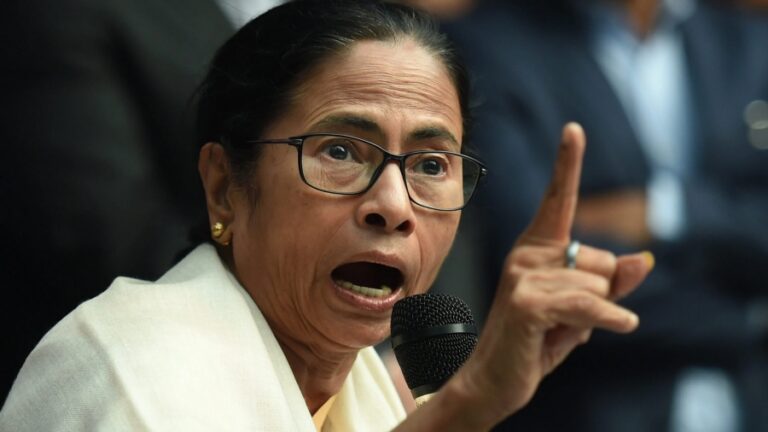
While addressing a group of Muslim leaders (imams), Mamata declared that the Murshidabad violence was “pre-planned” and attributed the blame to the BJP. “Yesterday, I saw a tweet from ANI quoting the Home Ministry that Bangladesh is involved in this. If this is true, the central government is responsible for it. Border Security Force (BSF) takes care of the border and not the state government. Why did you allow the people of the BJP to come from outside, cause a disturbance and run away,” she asked.

“The central government can’t evade responsibility. I will find out who the BSF had financed in the border areas by paying money to local youths to pelt stones during the violence,” the chief minister alleged.

She even warned Prime Minister Narendra Modi that the “atrocious” Waqf Amendment Act would split the nation and implored him not to implement it. The chief minister accused Union Home Minister Amit Shah of “harming the nation most for his own political agenda” and even asked PM Modi to restrain him. She also reiterated that her party was “at the forefront in the fight against the Waqf law.”

Other than the fact that the violence in Bengal was fueled by divisive comments made by Mamata and other TMC leaders to please their favourite demographic, it is quite evident that she held everyone accountable for the unrest except for the police, which is tasked with maintaining law and order or her government that was elected to power in the state.

The ineptness exhibited by Mamata’s administration was also apparent in the SIT chargesheet. The authorities not only failed to suppress rumour-mongering but also could not contain the jihadis as they rampaged throughout the area. Importantly, Parul Das had also underscored the police’s utter incompetence, stating that her husband and son would have survived had the cops not shown up four hours late at the spot.

However, the TMC supremo continued to escalate her problematic rhetoric as Bengal was set ablaze by extremists in the name of anti-Waqf Amendment Act protests, and she consistently issued statements that echoed their sentiments while simultaneously attacking the saffron party.

Mamata lashed out at the RSS after criticism for failing to prevent violence.

Mamata did not even hesitate to hit out at the Rashtriya Swayamsevak Sangh along with the BJP, alleging that they were propagating a multitude of untruths in relation to the violence in West Bengal.

“What BJP and its allies are spreading is false and narrow. What they are saying is a basket of untruths, full of misinterpretations. Please do not believe them. They want to foment riots,” the chief minister asserted. “The BJP and its allies have suddenly become very aggressive in West Bengal. RSS is also among their companions. I did not mention RSS earlier, but this time I am forced to say that they are also at the root of the ugly lies being spread in the state,” she further contended.

“They are eager to use an unfortunate incident that has occurred as a result of provocation. They are using it to do the politics of division. They want to play the divide and rule game. It is a dangerous game,” Mamata argued. The BJP and RSS, according to her, were attempting to discredit what she referred to as “universal Hinduism,” which included “Hinduism to Islam, from Christianity to Buddhism,m from Jainism to Judaism.”

Her reaction transpired after Bengal Governor CV Ananda Bose rightly criticised the government’s “handling” of the unbridled chaos and described the situation as “bizarre and barbaric”. Suvendu Adhikari, the leader of the opposition in the West Bengal Legislative Assembly, also highlighted that the administration could not stop the violence.

Conclusion

The violent demonstration against the act served as a guise to murder the two Das men, who had no connection with any of it. The Muslim mob killed them in a shocking illustration of their savagery. However, Mamata, rather than reprimanding the police, did what she usually does and targeted the BJP and RSS, as she cannot afford to alienate her voter base, which was behind the crime and the turmoil on the streets of the state.

Hindus were killed, and riots were taking place in the state while Mamata and TMC leaders were indulging in peddlina g narrative against the Waqf Amendment Act instead of attempting to restore order. Afterwards, she began to take out her anger at the BJP and RSS when faced with the reality on the ground, as if it were not a consequence of her administration’s glaring shortcomings.

As India and New Zealand finalise a Free Trade Agreement, read how it will benefit Indian farmers, labour-intensive industries and students

India and New Zealand have announced the conclusion of negotiations on a $1.3 billion Free Trade Agreement (FTA) on Monday (22nd December). The trade deal, aimed at doubling bilateral trade between the two countries over the next five years, is expected to take effect early in 2026. Jointly announced by Indian Prime Minister Modi and New Zealand Prime Minister Christopher Luxon, the agreement was finalised after nine months of negotiations that commenced in March 2025.

However, the implementation of the agreement, which has been given a go-ahead by the Indian cabinet, can take another 6 months after it is passed in the New Zealand Parliament.

Describing the FTA with New Zealand, PM Modi said that the deal was a “historic milestone” aimed at deepening economic ties between the two countries. “An important moment for India-New Zealand relations, with a strong push to bilateral trade and investment! My friend, PM Christopher Luxon and I had a very good conversation a short while ago following the conclusion of the landmark India-New Zealand Free Trade Agreement. Concluded in just nine months, this historic milestone reflects a strong political will and shared ambition to deepen economic ties between our two countries. This FTA ensures: Enhanced market access, deeper investment flows, numerous opportunities for innovators, entrepreneurs, farmers, MSMEs, students, and youth,” PM Modi wrote on X on Monday.

New Zealand PM hailed the trade deal with India as being founded on a strong friendship between the two countries. “I’ve just spoken with India’s Prime Minister Narendra Modi following the conclusion of the NZ-India Free Trade Agreement. The FTA reduces or removes tariffs on 95% of our exports to India. It’s forecast that NZ exports to India could increase from $1.1B to $1.3B per year over the coming two decades. Boosting trade means more Kiwi jobs, higher wages, and more opportunities for hard-working New Zealanders. The agreement builds on the strong friendship between our two countries. India is one of the fastest-growing economies in the world, and this gives Kiwi businesses access to 1.4 billion Indian consumers,” PM Luxon wrote in a post on X on Monday.

The FTA is the third major trade agreement concluded by India in 2025, following agreements with the UK and Oman. All three trade deals have been made by India with developed economies having higher per-capita incomes, underscoring how India’s trade negotiating capabilities have increased significantly. In recent years, this is the seventh Free Trade Agreement concluded by India, after agreements with the United Arab Emirates, Australia, Mauritius and the European Free Trade Association (EFTA).

A key highlight of the entire trade negotiations is that it was India’s first women-led Free Trade Agreement. The Indian negotiating team was almost entirely comprised of women, including the chief negotiator, deputy chief negotiator, leads for goods, services, investment, and the Indian ambassador to New Zealand.

Indian labour-intensive sectors to get a boost

The trade pact is expected significantly boost the two global economies. The key focus of the deal is job creation for both countries. Under the deal, New Zealand would provide zero-duty access to 100% Indian exports. This stipulation will boost the labour-intensive sectors of India, including textiles, apparel, footwear, marine products, gems and jewellery, handicrafts, and engineering goods. As a result, Indian workers, artisans, women entrepreneurs, youth, and MSMEs engaged in these sectors will benefit from it.

Employment opportunities for Indian students and skilled professionals

Indian students studying in New Zealand are set to gain significantly under the FTA. The agreement removes numerical caps on Indian students and guarantees at least 20 hours of work a week for the duration of their study. It also provides extended post-study work opportunities up to three years for STEM (Science, Technology, Engineering, and Mathematics) graduates and post-graduates. Additionally, the trade deal offers post-study work opportunities up to four years for Doctorate holders, paving the way for skills development and global careers. “For the first time with any country, New Zealand has created a dedicated pathway for student mobility and post-study work visas with India,” the Indian Commerce and Industry Ministry said. The trade deal is expected to open up employment avenues for Indian professionals as India has secured access to 118 services sectors, including telecommunications, construction, IT, financial services, travel, and tourism.

The FTA envisages a fixed quota of work visas for Indian professionals, for which it establishes a new Temporary Employment Entry (TEE) Visa pathway. The TEE provides a quota of 5000 visas for a given period and a stay of up to three years. This covers professions like AYUSH practitioners, yoga instructors, chefs, and music teachers, along with high-demand sectors including IT, engineering, healthcare, education, and construction, strengthening skilled workforce mobility and services trade.

Indian farmers’ interests protected under the trade deal

Indian farmers’ interests have also been ensured under the trade deal through an Agricultural Productivity Partnership. The partnership will cover products like apples, kiwi, and honey to enhance domestic productivity and increase farmer incomes. Moreover, New Zealand has committed to granting GI-level protection for Basmati rice, which will benefit Indian rice farmers. To safeguard the interests of Indian farmers, India has ensured that sectors such as rice, dairy, wheat, soya, and other key agricultural products remain fully protected, with no market opening that could harm domestic livelihoods.

New Zealand increases investment in India

New Zealand has agreed to invest $20 billion into India over the next 15 years in exchange for receiving market access in a fast-growing Indian consumer market. This is a significant leap from the $6.43 billion investment made by New Zealand in India during the last 25 years. During the last 25 years, New Zealand has invested about $6.43 billion in India.

India has recently emerged as a strong trade negotiator and has struck mutually beneficial trade deals with several world economies. The country has been multiplying as well as diversifying its trade ties as it paces towards realising its Viksit Bharat Vision 2047.

Same old lies of ‘vote chori’, ‘civil war’ and institutional collapse: How Rahul Gandhi used his Germany visit to push regime-change narrative, again

Rahul Gandhi’s latest attack on India’s democratic institutions during his five-day visit to Germany was neither spontaneous nor novel. It was the continuation of a carefully constructed political narrative, one that seeks to convert repeated electoral rejection into an allegation of systemic fraud.

While addressing audiences in Berlin and later at the Hertie School, Rahul Gandhi once again alleged that Indian elections are “not fair,” asserting that the Congress had actually won the Haryana Assembly elections and that the 2024 Maharashtra Vidhan Sabha elections were compromised. These claims, delivered on foreign soil, were presented as evidence of a “full-scale assault on India’s institutional framework.”

However, far from being whistleblower revelations, Gandhi’s allegations rest on arguments that have already been repeatedly dismantled, most comprehensively by OpIndia, using official data and the Election Commission of India’s own records. Remarks in Germany merely recycled these discredited claims for an international audience less familiar with India’s electoral processes.

One of the elections Rahul Gandhi repeatedly cites to bolster his claim that “India’s democracy is compromised” is Maharashtra. During his Germany visit, he again alleged that the Maharashtra Assembly elections were “not fair.” This assertion is demonstrably false and has been debunked several times, most recently in June this year, after Gandhi authored a misleading opinion piece in The Indian Express titled “Match-fixing Maharashtra.”

At the very outset of that article, Gandhi alleged “industrial-scale rigging,” claiming that official statistics themselves revealed a “step-by-step playbook” of fraud. Yet, when examined closely, each pillar of his argument collapses under factual scrutiny.

The Election Commissioner’s appointment lies

Rahul Gandhi first attempted to cast suspicion on the appointment of Election Commissioners, claiming that the Modi government “rigged the panel for the appointment of umpires” by removing the Chief Justice of India and ensuring a 2:1 majority in favour of the ruling party.

What Gandhi conveniently omitted is a historical fact. From India’s first general election in 1951–52 until March 2023, Election Commissioners were appointed exclusively by the President on the recommendation of the Union Cabinet, meaning 100% control rested with the ruling party of the day.

The 2023 Election Commissioners Appointment Act, enacted by the Modi government, actually diluted the executive’s own power by mandating the inclusion of the Leader of Opposition in the selection panel. Rahul Gandhi’s outrage, therefore, is not about fairness; it is about losing the unilateral privilege that Congress once enjoyed. The irony is sharpened by the fact that during Congress rule, even Sonia Gandhi, who held no constitutional post, was widely acknowledged as exercising decisive influence over institutional appointments.

The myth of ‘inflated’ voter registration

Gandhi’s second claim revolved around allegedly inflated voter registration in Maharashtra. He falsely asserted that the number of registered voters exceeded the number of adults in the State, citing an increase from 9.29 crore voters in the May 2024 Lok Sabha elections to 9.70 crore voters in the November 2024 Vidhan Sabha elections.

This argument collapses once historical data is examined. Across the past five election cycles, the increase in voter registration between Lok Sabha and Assembly elections has consistently hovered around 4%. In fact, the 4.26% increase in 2024 was not anomalous; it was lower than the 4.69% increase recorded in 2004 and comparable to previous cycles in 2009 and 2014.

More importantly, the Election Commission categorically dismissed these allegations immediately after the elections. It clarified that all political parties, including Congress, had full access to voter lists throughout the revision process. The exercise was overseen by 97,000 Booth Level Officers and 1.03 lakh Booth Level Agents, 27,099 of whom were appointed by the Congress party itself. If voter rolls were indeed “inflated,” the first question Rahul Gandhi should answer is why his own party’s booth-level machinery failed to detect it or whether he is implicitly accusing his own agents of complicity.

The recycled lie about voter turnout

Rahul Gandhi also resurrected a long-debunked claim regarding voter turnout, alleging fraud because turnout rose from 58.22% at 5 pm to a final figure of 66.05%. According to him, this 7.83 percentage point increase, equivalent to 76 lakh voters, was “unprecedented.”

The Maharashtra Chief Electoral Officer had already dismantled this claim in November 2024. He explained that voters queued at polling stations until closing time and that evening voting surges are common in urban and semi-urban constituencies. In fact, similar increases were recorded in the 2019 Maharashtra elections. The CEO further clarified that turnout figures reported during polling hours are based on oral telephonic updates, whereas the final turnout is calculated using Form 17C, signed by polling agents of all candidates and verified during counting.

The ECI also pointed out that Maharashtra’s average voting rate is approximately 58 lakh votes per hour, meaning up to 1.16 crore votes could be cast in the final two hours. In 2024, only about 65 lakh votes were recorded during that period, well below the average. Despite these clarifications, Rahul Gandhi continues to propagate the same falsehoods, now even abroad.

Conflating Lok Sabha and assembly elections

Another intellectually dishonest tactic employed by Gandhi was conflating Lok Sabha and Vidhan Sabha results. He argued that the BJP’s higher strike rate in the Assembly elections compared to the Lok Sabha elections five months earlier was evidence of rigging.

This ignores a basic political reality: voters routinely differentiate between national and state elections. Even when elections are held simultaneously, outcomes often diverge sharply. The 2019 Odisha elections offer a textbook example, BJP won 38% of Lok Sabha seats but only 15.6% of Assembly seats, despite voting occurring on the same days. In Maharashtra’s case, the elections were separated by five months, making Gandhi’s comparison even more untenable.

Fabricating an ‘evidence trail’

Gandhi further alleged that the Election Commission suppressed evidence and denied access to voter rolls with photographs. This claim is demonstrably false. Detailed constituency-wise voter data is publicly available on the Maharashtra Chief Electoral Officer’s website. The EC engaged with Congress’s complaints from the outset, contradicting Gandhi’s portrayal of an opaque and hostile institution.

Perhaps the most farcical claim was his argument that increased voter numbers at certain booths mathematically proved fraud. Gandhi asserted that 600 additional voters per booth would require 10 extra hours of voting, an argument that betrays either ignorance or bad faith. Voting in India does not take one minute per voter, nor does each booth operate with a single machine or room. Multiple polling rooms function simultaneously, allowing several voters to vote at the same time.

Even worse for Gandhi’s case, his claim that the BJP won “most” seats where voter numbers increased is flatly false. In 53 such seats, the BJP did not win at all. Congress itself won 16 of them, including Mumbadevi, Palus Kadegaon, Nagpur North and Dharavi, often by margins several times larger than the increase in voters. The logical implication of Gandhi’s argument would be that the BJP “rigged” elections to help Opposition parties win, a conclusion so absurd that it exposes the hollowness of his narrative.

From domestic lies to foreign platforms

Despite these comprehensive debunkings, Rahul Gandhi carried the same allegations to Germany, presenting them as settled facts before foreign audiences. This is not an accident. It is a pattern. When faced with repeated electoral defeat in 2014, 2019, and 2024, Gandhi has chosen not introspection, but institutional vilification and the internationalisation of domestic politics.

Ironically, the same democratic system he maligns is the one that made him Leader of the Opposition, gave the Congress party power in several states, and continues to provide constitutional avenues for challenge and reform. What Rahul Gandhi calls an “assault on democracy” is, in truth, the electorate’s refusal to endorse his leadership.

The Maharashtra “vote chori” claim stands exposed as a patchwork of half-truths, selective data, and outright falsehoods. Repeating it in Germany does not resurrect its credibility. It only underscores a deeper problem: Rahul Gandhi’s inability to accept democratic verdicts unless they favour him.

What Rahul Gandhi calls an “assault on democracy” is, in reality, an unwillingness to accept political failure. Carrying that discredited narrative to foreign lecture halls does not strengthen democracy; it undermines India’s institutions for personal political cover.

Democracy does not erode when leaders lose elections; it erodes when they refuse to accept the verdict. Rahul Gandhi’s Germany claim, much like his earlier foreign interventions, reveals less about the health of Indian democracy and far more about the Congress leadership’s inability to come to terms with repeated rejection by the Indian electorate.

The regime change ecosystem and Rahul Gandhi’s useful alignment.

Rahul Gandhi’s persistent effort to portray India as a democracy in decline cannot be viewed in isolation from the global ecosystem that thrives on such narratives. Over the past decade, “democratic backsliding” has become the preferred entry point for external political pressure, economic coercion, and soft regime-change operations, particularly against countries that resist Western strategic or ideological alignment.

Modern regime-change operations rarely resemble overt coups or military interventions. Instead, they operate through a layered framework: delegitimising electoral outcomes, questioning institutional credibility, amplifying minority persecution narratives, and repeatedly asserting that the incumbent government lacks democratic legitimacy. Once these claims gain traction, they are weaponised through international media, NGOs, academic institutions, multilateral bodies, and “early warning” indices that present subjective political assessments as empirical risk analysis.

India has increasingly found itself in the crosshairs of this ecosystem, especially as it asserts strategic autonomy, resists alignment pressures in the Indo-Pacific, maintains independent positions on Russia, and refuses to subordinate domestic governance to Western moral policing. Unsurprisingly, India’s democracy is now routinely portrayed as “at risk” by organisations that rely on datasets, funding streams, or ideological frameworks rooted in interventionist liberalism.

Rahul Gandhi’s foreign speeches fit seamlessly into this architecture. By repeatedly alleging “vote theft,” “institutional capture,” and “assault on democracy” on international platforms, he lends domestic political legitimacy to narratives that external actors are eager to promote. These claims then circulate back into global discourse as citations, “India’s Leader of Opposition asserts democracy is compromised, creating a self-reinforcing loop of delegitimisation.

This is precisely how soft regime-change narratives are normalised: internal political grievances are internationalised, selectively amplified, and reframed as moral emergencies requiring global attention. The irony is that while Rahul Gandhi presents himself as a victim of institutional oppression, he simultaneously empowers external actors who have a documented history of advocating political interference, sanctions, and even military intervention in the name of democracy and human rights.

In fact, Rahul Gandhi’s recent claims in Germany cannot be dismissed as isolated slip of the tongue. They form part of a consistent and traceable pattern that stretches back several years, most notably to his 2021 visit to the United States and his unexplained October 2023 trip to Uzbekistan. Together, these episodes reinforce the argument that Gandhi has systematically internationalised India’s domestic politics in a manner that aligns with regime-change narratives.

During his 2021 visit to the United States, Rahul Gandhi openly courted American political and academic opinion by portraying India as a democracy under siege. Speaking at multiple forums, he urged the US establishment to “stand up for democratic values” in India, language that went far beyond diplomatic concern and bordered on an invitation for intervention. At the time, Gandhi repeatedly framed the Modi government as authoritarian, alleged the erosion of institutional independence, and suggested that minorities were unsafe. The messaging was unmistakable: India, under its elected leadership, had deviated from democratic norms and required external moral pressure.

These remarks were made even as India was grappling with the COVID-19 crisis, a period when national unity and responsible opposition were paramount. Instead, Gandhi chose to amplify internal political disputes on foreign soil, feeding into a global ecosystem already predisposed to viewing India through the lens of democratic backsliding. This was among the earliest clear signals that international platforms were becoming a preferred arena for Congress’s domestic political battles.

That trajectory resurfaced under far more intriguing circumstances in October 2023, when Rahul Gandhi undertook a sudden and largely unexplained visit to Uzbekistan, at a time when India was in the midst of crucial Assembly elections. No official purpose was outlined, no structured engagements were publicly disclosed, and no clarity was offered about the timing or intent of the trip. The visit might have remained a curiosity had it not coincided with high-level diplomatic activity involving Samantha Power, the Administrator of the United States Agency for International Development (USAID), who was in Uzbekistan around the same period for regional connectivity discussions.

The coincidence raised legitimate questions, particularly given Power’s well-documented role in advancing interventionist human-rights doctrines, her association with regime-change frameworks, and USAID’s historical involvement in civil-society mobilisation across multiple countries. When viewed alongside Rahul Gandhi’s repeated foreign speeches alleging democratic collapse in India, the Uzbekistan visit appeared less random and more suggestive of strategic alignment with global networks that prioritise political pressure over electoral legitimacy.

What ties the 2021 US visit, the 2023 Uzbekistan trip, and his subsequent remarks in Germany and at Harvard together is not geography, but intent. In each instance, Rahul Gandhi has chosen to portray India as a failing democracy before foreign audiences, questioned the legitimacy of its institutions, and implicitly or explicitly encouraged external actors to take notice or action. This is the hallmark of a regime-change narrative, where internal political defeat is reframed as a moral emergency requiring international validation.

It is therefore no coincidence that Gandhi’s rhetoric aligns closely with the language used by interventionist figures, NGOs, and policy bodies that routinely classify India as being on the “brink” of genocide, authoritarianism, or democratic collapse. Nor is it accidental that such narratives intensify ahead of or immediately after major Indian elections.

Whether intentional or not, Rahul Gandhi has positioned himself as a useful validator within this regime-change ecosystem. His statements abroad do not remain mere opinions; they become inputs in reports, resolutions, media editorials, and diplomatic pressure campaigns aimed at weakening India’s elected government. This is not opposition politics; it is externalisation of political failure with potential national consequences.

New York Times finally acknowledges brutal lynching of Hindu Dipu Chandra Das in Bangladesh, but claims ‘South Asia’ pattern and refuses to name Islamic mob

In a horrific incident, Dipu Chandra Das, a Hindu garment factory worker in his thirties, was brutally lynched by an Islamic mob in Mymensingh, Bangladesh. Dipu Das was first beaten to death, then his body was tied to a tree, and set ablaze in full public view by a Muslim mob on 18th December over the allegations of blasphemy. The Western media, ever dextrous in pushing the Muslim victimhood bogey, maintained a deafening silence on Das’s killing. No front-page outrage from CNN, no urgent dispatches from Washington Post, no alarm-raising by The Guardian. Days after ignoring the incident like it never happened, The New York Times finally reported on the brutal lynching of Dipu Chandra Das.

Muslim mob killed Hindu man in a rapidly Islamising Bangladesh, but NYT finds entire South Asia to blame, refuses to name the Islamic mob that killed Dipu Chandra Das

The acknowledgement, however, was not without framing it as an incident of some sort of abstract intolerance and a part of a “broader pattern of intolerance in South Asia.” The headline of the NYT report itself is quite revealing of the newspaper’s agenda of using the Bangladeshi Hindu man’s lynching for making a broader statement that somehow religious intolerance is not a Muslim-exclusive phenomenon, but the entire South Asian region is grappling with it, and Muslims too are victims of it.

Notably, Dipu Chandra Das’s alleged comment that all religions contain superstitions, during a discussion with co-workers about Muslims fixating on Friday (Jummah), somehow enraged the Islamist co-workers who accused him of insulting the Islamic prophet, Muhammad.

In the article headlined “Lynching of a Hindu in Bangladesh Fans Fears of Rising Intolerance”, the NYT reported this atrocity, however, the framing of the horrific incident by reporters Shafi Hasnat and Mujib Mashal, evidently intended to dilute the Hindu man’s brutal killing by Muslims and integrating it within “a wider pattern of religious intolerance in the South Asia region.”

The article tries to claim the entire ‘South Asian region’ as dysfunctional when it comes to religious tolerance, and that all parties, be it Muslims, Hindus or other religious groups, are equally intolerant of each other and brutal lynchings, as that of Dipu Chandra Das, happen with Muslims too in India.

The New York Times article says that “…the brutal nature of the killing, amid a wave of riots and mob violence, has raised alarms about the tense leadership vacuum that has persisted in Bangladesh since its authoritarian prime minister was toppled in student-led protests last year.”

Very shrewdly, the NYT reporters mentioned facts of the brutal lynching of the Bangladeshi Hindu man, to maintain a balance, while blaming everything–leadership vacuum, exploitation of chaos by ‘extremist forces’ for political gains ahead of elections, and rumours of insult to Islam, but not the actual, factual and persistent cause of the Islamist onslaught against Hindus.

Islamists are intolerant of the mere presence of Hindus, their temples and culture; they are intolerant of the fact that a Hindu, a Kafir, reportedly dared to even speak about Islamic superstitions. Political instability, blasphemy rumours and other circumstantial aspects are mere excuses, not causes, of the Islamist persecution of Hindus.

The NYT’s wordplay is a sample of its bias here. A Hindu man got brutally lynched, and the Islamist mob that killed him gleefully chanted Islamic slogans while torching his body and enjoying the spectacle. Buy for NYT, the incident is not the highlight, the perpetrators who did it are not even named, but their priority is that ‘fears of rising intolerance are being fanned’. It almost reads as if the Hindu man got lynched on his own, and the incident just fanned the fears of rising intolerance automatically. The Islamic mob that carried out the brutal act has nothing to do with it.

The New York Times dragged India into its report about the brutal killing of a Bangladeshi Hindu: The insidious monkey balancing

The NYT dragged India into the scene, and claimed, “The threats to Hindus in Bangladesh have drawn widespread concern in India, where Prime Minister Narendra Modi’s government has repeatedly voiced alarm. But they are the latest in a wider pattern of religious intolerance in the South Asia region.”

The NYT claimed that ‘Hindu vigilantes’ target Muslims over accusations of carrying cow meat, or suspected Bangladeshi Muslim infiltrators. The newspaper, however, did not make any mention of the brutal killing of Kanhaiyalal by Islamic jihadis; it does not find the incidents of Sar Tan Se Juda and Allahu Akbar slogan-raising Muslim mobs attacking Hindus on Holi, Diwali, Ram Navami and other festivals or for celebrating cricket match victories, as cases fit for mention under ‘rising religious intolerance’.

Excerpt taken from the relevant New York Times article

Earlier this month, a Muslim man named Sarfaraz and nine other Islamists were found guilty of brutally murdering a Hindu youth named Ram Gopal Mishra last year for removing an Islamic flag and installing a saffron flag. Sarfaraz was sentenced to death, while others were awarded a life sentence. Mishra was dragged by Islamists, shot at close range, his body was riddled with 40 bullet wounds, and his toes were burnt. Still, the NYT did not mention this case or say that Hindus are being attacked for their religious identity only in Bangladesh and Pakistan, but also in India.

The NYT deliberately picked the case of a Hindu man from the “bottom ranks of India’s rigid caste hierarchy”, who was mistaken for a Bangladeshi illegal and assaulted in Kerala. The NYT’s choice of case was interesting as it indicated that in India, Hindus attack anyone they think is Bangladeshi or someone “India’s ruling Hindu nationalist politicians loosely use to describe Muslim migrants”, and upper caste Hindus torment Dalits. The NYT smartly peddled the Muslim-Dalit victimhood narrative without even appearing too obvious.

Apparently, the killing of Dipu Chandra Das was too brutal to ignore, so The New York Times decided to report it, but in a manner where the Islamist-inflicted atrocity is diluted and subsumed in a generic South Asian ‘regional pattern’ of intolerance.

In fact, the whole India mention was an act of monkey balancing, an insidious trick of both-sides-ism. The New York Times reporters quite efficiently used this deflection tactic to soften Muslim atrocities by dragging unrelated and exaggerated parallels from the other side. The NYT basically told the readers that “Look, Muslim co-workers killed a Hindu co-worker in Bangladesh over blasphemy allegations, but it happens in India too, where Muslims are attacked and killed by Hindus for being Muslims, so everyone is equally guilty in South Asia.”

The New York Times reported a Muslim mob’s brutal crime against an innocent and helpless Hindu man, using vague vocabulary  

For a change, The New York Times pointed out that while Muhammad Yunus, the Chief Advisor to the Interim Government of Bangladesh, condemned violence as a security challenge, not targeted attacks on “any section of the population” (no specific mention of Hindus), the religiously-motivated killing of Dipu Chandra Das was celebrated by “many”. The NYT, however, did not mention that Muhammad Yunus has been coddling Islamists. He unbanned Jamat-e-Islami, released jailed Islamist fanatics, and has inducted Islamists into his regime. Yunus has also continuously been downplaying Islamist-orchestrated anti-Hindu violence as non-communal ‘disputes’ “exaggerated” by the Indian media.

The New York Times made a hardly three-line mention of how, among the “many” who celebrated the brutal mob lynching of Dipu Chandra Das was Jubayer Ahmad Tasrif, who is set to contest the upcoming elections. The newspaper included this incident of a person who is going to contest elections, rallying support from fellow Hindu-hating Muslims by hailing the killing of a Hindu man, as just additional information. Had a Hindu politician in India celebrated a Muslim man’s lynching, the NYT would have run out of ink analysing how Hindu nationalism is crushing ‘minorities’, the collapse of democracy, and of course, the death of the ‘idea of India’.

It, however, is quite a progress for a publication like the New York Times to even mention the lynching of a Hindu man as a religiously-motivated killing, given that the NYT was among the major Western media outlets which passed off the Islamist pogrom against Hindus as ‘political retribution’ for supporting the Awami League.

Dipu Chandra Das (L), his body set ablaze by a Muslim mob in Mymensingh district, Bangladesh (R).

However, skipping the specifics like Islamic intolerance-motivated killing of a Hindu man by Muslim mob and using vague vocabulary like ‘religiously-motivated’ killing by factory ‘co-workers’ and ‘angry mobs’, suggests that the Bangladeshi Hindu man’s killing was among the few isolated incidents of religious intolerance and violence, those too, triggered by power vacuum, political gains-related motives and whatnot. The NYT mentioned the religious identity of perpetrators incidentally, only to explain it to the readers that the supposed ‘blasphemy’ was committed against Islam. It is disgraceful that for days, when the Western media finally deigned to cover Das’s killing, it twisted a narrative of a watered-down ‘regional patterns’, to dilute the Islamist motivation behind the savagery the Hindu man was subjected to moments before and after his death.

No propaganda, narrative, rhetoric or framing can change the fact that Dipu Chandra Das’s brutal lynching and setting ablaze of his body in the street, was a targeted attack not by ‘offended Muslim co-workers’ or ‘Muslim vigilante’ or ‘Islamist extremists’ but Muslims on a Hindu man belonging to a religious minority community in Bangladesh, where Hindus have faced systematic persecution for decades.

It is dishonest, morally corrupt and journalistically unethical for the NYT to withhold names of Muslims as aggressors in Dipu Chandra Das’s case, while explicitly characterising Hindus as aggressors otherwise. Apparently, for the Islamo-leftist media, when Hindus happen to be or are accused of being the perpetrators of violence against Muslims, their religion or their Hinduness is the explanation and motivation, but when Muslims commit violence against Hindus, their religion is purely incidental.

Das was killed for by Islamists in a country where the Hindu population has dwindled from 22% at the time of independence to hardly 8% amidst a wave of violence, rape, temple desecration, forced conversions, land grabs, and false implications in blasphemy cases.

The Western media widely covered the political killing of radical Islamist student leader and avowed India-hater, Osman Hadi. In the past few days, it has been seen how the Western governments and organisations, including the US, EU and other missions, have expressed deep sadness over Hadi’s killing, with the UN calling for an impartial probe. The international media lionised Hadi’s Islamist anti-Hasina and ‘revolutionary’ credentials while downplaying his Islamist ideology, glossing it over as fierce activism.

For Dipu Chandra Das, a humble factory worker with no record of any political affiliations or radical ties but only the misfortune of being a Hindu in Bangladesh, there has been no outpour of sadness, anger or demands for strict action against his Muslim killers. The West’s hypocrisy is glaring, where Islamists are romanticised as ‘activists’ and ‘fighters’ while Hindu victims of Muslim intolerance and violence are dismissed as footnotes in a “regional pattern”.