

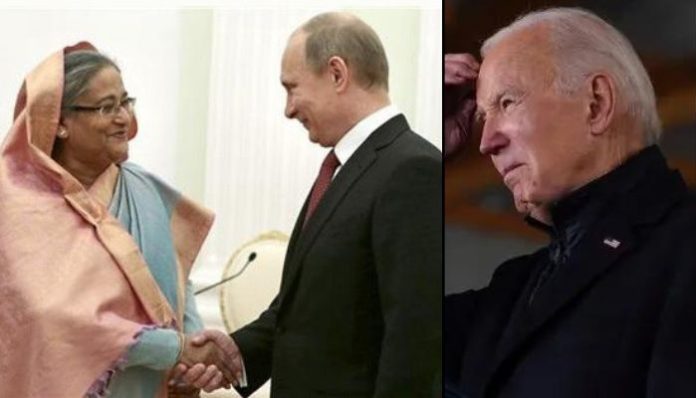
Amidst the deteriorating relationship between Bangladesh and the United States, a Russian Navy squadron arrived in Chittagong on a friendly visit for the first time in 50 years.
“H.E. Mr Alexander #Mantytskiy, Ambassador of Russia to Bangladesh, on the deck of the Russian naval ship anchored at the Chittagong port,” the Russian Embassy in Bangladesh said in a tweet on Sunday (12th October).
Russian Ambassador Alexander Mantytskiy visited the Russian squadron belonging to the Pacific fleet at Chittagong port. It is considered a huge milestone in Russia-Bangladesh relations at a time when the US government is accused of election interference in the Islamic Republic.
The Russian Pacific Fleet Squadron is visiting the Chattogram Port
— Embassy of Russia in Bangladesh (@RussEmbDhaka) November 12, 2023
A huge milestone for Russia-Bangladesh relations
The last time Russian/Soviet naval ships visited Bangladesh was 50 years ago pic.twitter.com/xlBFENdl0l
It must be mentioned that the Soviet Union played a crucial role during the 1971 Bangladesh Liberation War and blocked the American aircraft carrier USS Enterprise from entering the waters of the Bay of Bengal.
It also helped in reviving the economy of Bangladesh through ‘mine-sweeping operation’ at Chittagong port.
“At that time, the group of Russian naval ships came here actually to save the young country that gained its independence in 1971 from a humanitarian catastrophe. After the war of independence, the port’s waters were mined and also tens of vessels were sunk there,” the Russian Ambassador to Bangladesh said.
H.E. Mr Alexander #Mantytskiy, Ambassador of Russia to Bangladesh, on deck of the Russian naval ship anchored at the Chittagong port pic.twitter.com/0kcQsNsUbF
— Embassy of Russia in Bangladesh (@RussEmbDhaka) November 12, 2023
“The Bangladeshi authorities turned to various countries with a request to help resolve the problem. Some of them agreed but for a large sum of money, which the republic lacked. It was only the Soviet Union that agreed to provide support for humanitarian reasons,” he added.
According to the Russian media agency TASS, the naval squadron anchored at the Chittagong port consists of the oceanic tanker Pechenga, anti-submarine warfare ships Admiral Panteleyev and Admiral Tributs.
US regime change operation in Bangladesh
Elections in Bangladesh are scheduled to take place in January 2024. Sheikh Hasina-led-Awami League is seeking re-election for the third consecutive term. She has been the Prime Minister of the country since 2009.
With just two months away from the elections, the United States government, its agencies and the embedded media are called out for orchestrating a ‘regime change operation’ in Bangladesh.
Attempts are now being made to distort the public perception of incumbent Bangladeshi Prime Minister Sheikh Hasina and present her as an ‘autocratic leader.’ The Joe Biden-led-US government is accused of election interference under the pretext of ‘saving democracy’ and conducting ‘free and fair elections’ in the Islamic Republic.


